 Ask ChatGPT


The Met’s exhibition “How Tiffany Studios Lit Up the Gilded Age” explores Louis Comfort Tiffany’s decorative arts—stained glass, mosaics, and lamps—and how Tiffany Studios shaped Gilded Age New York and American religious/public interiors, while highlighting the women and immigrant artists who designed and produced the work.
Alice Cooney-Fruhlinghausen, curator of American decorative arts at the Met, spent ~40 years studying Tiffany objects and helped bring the Tiffany garden landscape window to the Met. Min Chan hosts The Art Angle (Artnet News).
Tiffany’s work became a major status symbol (especially electrified homes with Tiffany lamps and dramatic stained-glass stair windows). The studio was a collaborative, full-service operation with marketing and press releases. Women designers (“Tiffany Girls”) and immigrant artists were central; rediscovered letters by Clara Driscoll changed attribution.
the garden landscape window; the “Four Seasons” drawing commissioned by Walter and Jean Brown Jennings; Tiffany-designed windows in churches/synagogues nationwide; the Havemeyer House interior (1891–92) as an example of radical design; St. Paul’s Church in Troy, NY.
Written by AI. May contain mistakes.
Discussion on Louis Comfort Tiffany's impact on the decorative arts and the upcoming exhibition at the Met.
“Really began a little bit in the late 1950s and a little bit more in the 1960s, but it was really not until the late 1970s and 1980s where his work has become incredibly well received.”
An in-depth look at Tiffany's contributions to the art and architecture of Gilded Age New York and his prominent patrons.
“And so we sat down to discuss all things Tiffany, from how he left his mark on Gilded Age New York to the artist who worked in his studio.”
Examination of Tiffany's work on public buildings and the significance of his stained glass windows during the era.
“because any visitor who came into that house had to have been quite overwhelmed by what they saw.”
Highlighting the contributions of women designers in Tiffany's studios and the discovery of their significance in his work.
“When a window went up in a church or a synagogue, he would send out press releases to every newspaper within a radius.”
Learn about Agnes Northrup's contributions and significance in Tiffany Studios.
“So I think some of our lamps that we know of are her design.”
Explore surprising findings regarding the artistic collaboration at Tiffany Studios.
“Well, the drawing that I just mentioned, the Four Seasons drawing, is one of those.”
Understand Louis Comfort Tiffany's artistic philosophy and his approach to beauty.
“I mean, to discover something in Tiffany's hand as well, he is synonymous with stained glass, the decorative lamps, but his creative ambitions were immense.”
Examine the radical and innovative designs that Tiffany created during his time.
“own country estate were these designs really kind of like radical and astonishing at the time that they would design and made?”
Learn about the enduring legacy and influence of Tiffany's work today.
“It really began a little bit in the late 1950s and a little bit more in the 1960s, But it was really not until the late 1970s and 1980s where his work has become incredibly well-received and appreciated and well-loved.”
Discover how the understanding of Tiffany's work has evolved over time.
“In all the years that I've been working on Tiffany's work, there are just more questions than answers, unfortunately.”

Get the gist, explore an idea or ask about something said.
 Claude
On The Art Angle, what are the key points of this episode?
Searching your listeningAutomatic transcript. May contain errors.
0:00Ben here with an important message for Art Angle fans. We have put together our first ever live podcast festival during Miami Art Week. Artnet Airwaves brings five live recordings to the talk stage at Untitled Art Miami Beach. That's Artnet's own, the Art Angle and Art Market Minute, plus some of our favorite other art podcasts, Bad at Sports, Nota Bene, and New Crits. Margaret Kerrigan and I will both be there hosting and invite you to come be part of the conversation. Join us Wednesday, December 2nd from 2 p.m. to 5 p.m. and Thursday, December 3rd from 12 p.m. to 5 p.m. Register by the link in the show notes.
0:41I hope to see you there. Took a while for his artistry to be re-appreciated. Really began a little bit in the late 1950s and a little bit more in the 1960s, but it was really not until the late 1970s and 1980s where his work has become incredibly well received.
1:03I'm Min Chan and this is The Art Angle, a podcast by Artnet News.
1:14The Gilded Age is back. I'm not just talking about the billionaires of today or the hit HBO series, but a new exhibition at the Metropolitan Museum of Art, dedicated to the spectacular designs of Louis Comfort Tiffany. That name will ring a bell for anyone with a passion for decorative arts. Around the turn of the 20th century, Tiffany and his studio revolutionized the field, creating dazzling stained glass windows, lamps, and other decorative objects. These works were marvels of their time, transforming private homes and public buildings. Today, they're touchstones of American decorative arts and remain highly sought after by collectors.
1:52The Mets exhibition takes us behind the scenes of these enduring designs. It brings together watercolors and drawings from Tiffany Studios, alongside stunning examples of its handiwork in mosaics, stained glass, and of course, lamps. Along the way, it shines a light on the many women designers and immigrant artists who help bring Tiffany's vision to life. The show is curated by Alice Cooney-Fruhlinghausen, the Met's curator of American decorative arts, who has spent some 40 years studying and working with Tiffany objects. She was also, by the way, responsible for bringing the magnificent Tiffany garden landscape window to the Met.
2:33If there's anyone who knows Tiffany, it's her. And so we sat down to discuss all things Tiffany, from how he left his mark on Gilded Age New York to the artist who worked in his studio. and why, after more than a century, the world still can't get enough of Tiffany. Hi Alice, thank you for joining us on The Art Angle today. Delighted to be here. Wonderful. So we're going to talk about Tiffany in the Gilded Age, but let's set the scene here and travel back to New York at the height of the Gilded Age. What did the city look and feel like, and what was the appetite for art and luxury, beautiful objects?
3:11Well, in many ways, it's very much a New York story, I would say. Many of Louis Tiffany's patrons were New Yorkers. They were building grand mansions beginning in, well, the late 19th century. You see Fifth Avenue, Madison Avenue being populated with extraordinary homes, many of which are no longer there, of course. Tiffany grew up in New York. He was born in New York. He died in New York. He established his businesses when he first became a painter. He was a member of the National Academy of Design. He was a member of all the clubs of note in New York, the Century Club. He was a founding member.
3:48And many of his commissions were in New York. His studio was in the YMCA building. Then his early operations were at Park Avenue South and 24th Street. That moved up to Madison Avenue and 45th Street. He had furnaces in Corona and Queens. He built a country estate on Long Island. So New York was really an important place for him. But in terms of the Gilded Age, this was where many of the individuals who had made extraordinary sums of money, and certainly many names we know and are familiar to us, but there were also a huge number of names that are not familiar. They're not household names, but are represented in the exhibition by commissions and in some cases by actual works of art that are from those initial stirrings.
4:42So, you know, when we think about the Gilded Age as well, we think about, you know, like you mentioned, opulent mansions and really extravagant furnishings. And how did Tiffany's aesthetic fit into, you know, the taste of the period or did it depart from it? I think that's a very good question. And I've given that a lot of thought over the years. I mean, certainly there was extraordinary demand. And he wasn't the only person providing decorations for Gilded Age patrons. And it's not just individuals who are building mansions. Of course, this was huge church building boom. Houses of worship of all denominations were being built and needed to be decorated.
5:21Others needed to be upgraded and decorated sort of in the same vein as their opulent mansions. and commercial buildings that were being built at the same time, certainly cultural institutions as well. So I think it's important to think about it a little bit holistically. Most people think about the great grand mansions in Newport and Long Island's Gold Coast, for example. So Tiffany was one of a number of decorators. This was a moment when the profession of decorating really came into its own. There was Herter Brothers. There was George Shastey. And I might argue that Tiffany was commissioned in some ways by some very enlightened and sophisticated patrons.
6:01And some of them were major collectors, if you think of Louisine and Henry Osborne Havemeyer. Or we have a drawing for Charles Deering, who was a great friend of John Singer Sargent and collected the work of Augustus St. Gaudens. We have a drawing that was commissioned by Mrs. Richardson Pratt of Brooklyn. The Pratt family had founded Pratt Institute. There is something to be said for some of these patrons sort of willing to go against the trend for slavish historical replication and really interested in something new, interested in something innovative. I imagine that commissioning a Tiffany interior or a stained glass window was not cheap.
6:45And also, you know, at this time, only half of the U.S. households, I think, were electrified, which means, you know, owning a Tiffany lamp really said something about your social standing and your wealth. And could you speak about Tiffany as, you know, a status symbol in a way, having a Tiffany in your home? The lamps are what we think of today. But I think at the time, if you had a grand stained glass window on the stair landing overlooking your hall or your grand entrance space, that was an extraordinary commitment and statement at the time because any visitor who came into that house had to have been quite overwhelmed by what they saw.
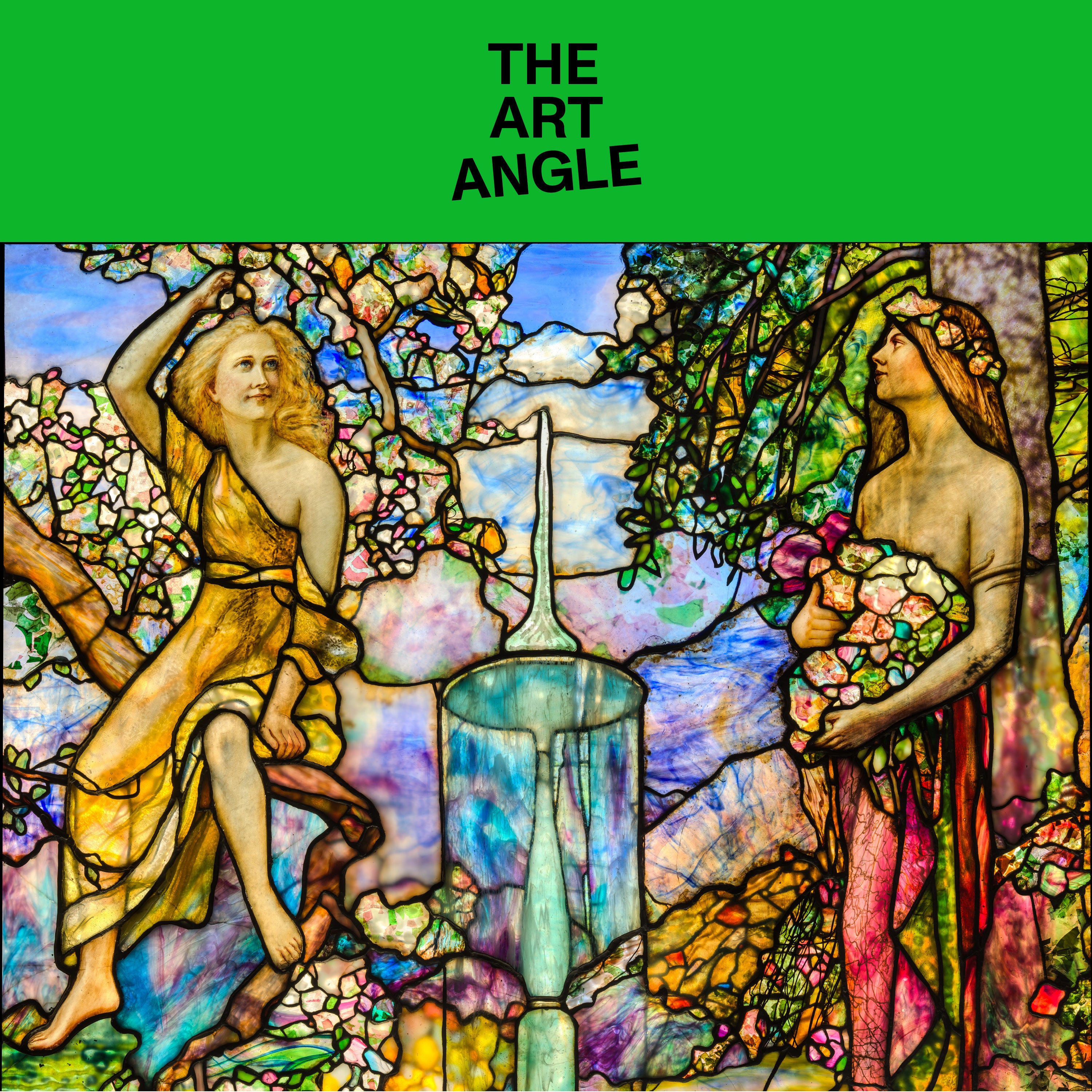
7:29And I think about our garden landscape window that's in our American Wing Courtyard for which we have the drawing. That is spectacular. It's mesmerizing. It draws you in, but it's different. is not what you would expect from many houses at the time. Yeah, for sure, for sure. And let's also talk about his work with public buildings, like you mentioned. The exhibition has its drawings for churches, theaters, museums. And how did those commissions really help shape the visual identity of American cities at that time? The demand was huge. And as I mentioned, the number of buildings that were being built was really quite something.
8:06Tiffany was able to accommodate this in many different ways. He had a large workshop, and in 1889, he even established a separate ecclesiastic department within his firm to address the demand for the interiors and individual elements in houses of worship, whether they be bronze doors or an altar rail or a marble and mosaic baptismal font or the entire interior. not to mention the stained glass windows that were so much a part of the decor of Gilded Age religious interiors. There's hardly a city in this country today that you can't find a church with Tiffany windows in it, and even abroad, but there were thousands of windows produced by Tiffany's studios.
8:58It was only possible really because he had the full service operation within his studios from the design. And he had many designers. And one has to remember that Tiffany did not design everything that came out of his studios. They were designed in his vision, to be sure. And many of our design drawings in the exhibition, for example, many, many of them have his signature approved by Louis C. Tiffany. So he truly ensured that things coming out of his studios were something that he felt was his aesthetic as well. So you have these designers and many of the designers remain anonymous. We've tried to identify more than has been thought of before.
9:49There were women who were designing. Women were important in several aspects of this workshop itself. But it was a hugely collaborative endeavor. So you have from the design, you have just for a window, for example, you have a full scale drawing. Then that goes to the selector, often women. It took great artistry. They were choosing the individual pieces of glass for color, for texture, for its striations. And then they were cutting the piece of glass. And that's a special skill. And some of the individual pieces are extraordinarily difficult to cut. And from there, copper foil had to be affixed to the edge of the pieces of glass.
10:39then they went to the men who would solder this they would trail lead solder that adhered to the copper foil not the glass and they have to solder it on one side they solder it on the other side and then it has to be patinated and then he had a very robust marketing department as well whenever he did a major window he usually exhibited it in his own workshop so the public became very much aware of his art, and that was a great way for him to advertise and bring in new clients as well. When a window went up in a church or a synagogue, he would send out press releases to every newspaper within a radius.
11:22So there might be 10 press releases that would be sent out, and these local newspapers would often print the press release verbatim.
11:43I do want to talk about the designers, the women designers, the immigrant artists that worked in his studio. You know, there was Agnes Northrup, Clara Driscoll, the so-called Tiffany Girls. And how did their contributions come to light? And how has our understanding of those contributions really changed over time? One of the things I'm very interested in is the role of women in the work that came out of Louis Tiffany's studios. And it is so much more important than we ever dreamed or knew about. I think one of the most important discoveries was now, I think, really 25 years ago, when a cache of letters were discovered in the Queens Historical Society and also Kent State.
12:29And these letters were written by Clara Driscoll and family members. It was an unusual, popular in the late 19th and early 20th century, a round robin letter. So it was extensive, and it was going to many different family members, and they passed them around. But she talked a lot about the work of the Tiffany Studios. Clara Driscoll was the head of the women's glass cutting department, which we now finally call the Tiffany Girls. She was hired when she was unmarried. When she got married, she left, as was typical of the period when women were married, they usually left the workforce. It wasn't that Tiffany didn't employ unmarried women.
13:15It was really a cultural situation at the time. I think that's important to recognize. But she talks about other women who were working there. She gave us names of some of these women, which was incredibly important. and she talks about her designs of some of the Tiffany lamps, which nobody really realized before. Very, very important. I also think through the letters, we've learned that she shared these designs with some of the other women. For example, because I've been so focused on design drawings, I've read through all these letters and see that in many cases, she freely admits, and also says that Tiffany admitted that she wasn't a good draftsman.
14:03She was embarrassed. She wished that she could have been. She had the idea. So I think some of our lamps that we know of are her design. The drawings were actually executed by another woman, possibly Lillian Palmier or Alice Goovey, who was one of her close friends and roommates when she was working for Tiffany's studios. So there's a lot more that we still need to learn. And of course, I became interested in Agnes Northrup because we have now three drawings that bear her name, and those are the only drawings known that do have Agnes Northrup's name. We have two that she signed, one where she signed the floral border for a window whose central figural allegorical panel was signed by Louis Tiffany.
14:49So it's a collaboration between two designers, in this case, Northrup and Tiffany himself. But we also have a very beautiful drawing for the central panel of our garden landscape window with a beautiful signature for Agnes Northrup. And that is really what started me on my quest to bring to light Agnes Northrup and her very important role within the studios as one of his most important designers, designer of flowers, of landscapes, of gardens, some of the most beautiful windows that have come out of Tiffany's studios. Yeah, and you've spent four decades with the drawings that are in the exhibition, and I'm sure they're full of discoveries, but was there one or a few that really surprised you about the processes in the studio or the collaborative environment in the studio?
15:43Well, the drawing that I just mentioned, the Four Seasons drawing, is one of those. And we know a certain amount about that drawing. We know that it was commissioned by a man named Walter Jennings of Standard Oil Fortune and his wife, Jean Brown Jennings. Jennings. She was a great horticulturalist, I found, and I think may have been the instigator for the floral decoration that surrounds the central panels. The drawing itself, we've had a lot of time to study, and I've worked very closely on this project with paper conservators because this was a huge part of this exhibition. The current conservator, Marina Ruiz Molina, has been working on these drawings for 16 years alone.
16:30She and I have looked very closely at this particular drawing, and we've looked at it with infrared reflectography imaging, and that has revealed a great deal in terms of the individual hands. There are very few designs that are signed by these artists, but we have the central drawing for the garden landscape. And also recently I have been able to document the autumn landscape drawing to Agnes Northrup as well. We've looked carefully at both of those drawings and we've seen a couple of things that distinguish her work. Very detailed underdrawing in graphite, for example, and then the application of watercolor.
17:17And if you look at that drawing with the infrared imaging, you can see that very, very clearly. You look at the central panel, which was signed by Tiffany, there's no underdrawing whatsoever. And so already we have these two divergent painting styles, completely, completely different. And it's based on that, one of our great discoveries, I think, is our ability to attribute the drawing that's right as you enter the exhibition of this extraordinary sort of exoticized figure in the center in a pergola dripping with wisteria with an Egyptian wing scarab at the very top of the pergola. And close looking at that drawing in comparison with other drawings that we feel confident were Louis Tiffany's hands, we're now attributing that drawing to him as well.
18:16So those are hugely revelatory and exciting for me. For sure. I mean, to discover something in Tiffany's hand as well, he is synonymous with stained glass, the decorative lamps, but his creative ambitions were immense. They were much broader. He painted, he created textiles, jewelry, furnished his Long Island estate in high style. And how would you characterize his artistic philosophy? You know, what was he trying to achieve with his practice? Well, he would say it was the cult of beauty. And I think that really was a motivation for him. He embraced any kind of new technology, new materials. And we've seen this in the drawings with the use of photography.
19:02He had a darkroom within his own studio in his house on Madison Avenue and 72nd Street. And he embraced different kinds of photography as well. And he used it in the creative process. So that was rather important. He was fascinated with color and with light. And of course, this was the moment when electricity was just being founded. Electric lighting was just new at the time. and this was a challenge for him to really figure out and come up with new ways of shielding that electric light bulb if you will whether it was a blown glass lily shade or leaded glass lampshades that are so beloved today and then I feel strongly that you have the cult of beauty you have his interest in color and light you also have him designing and living to the cult of nature and nature was so important to him you see it in his artwork the use of nature in so many different designs in many many different media and in the lavish gardens that he established for his own country estate were these designs really kind of like radical and astonishing at the time that they would design and made?
20:22That's a good question, too. Some of the designs were very radical at the time that they were made. And I would argue the earlier years show a much more kind of radical idea than maybe some of the later ideas. We have one drawing from the Havemeyer House, for example. That entire interior was hugely radical. It was on 66th Street and Fifth Avenue. It was executed between 1891 and 1892 for hugely enlightened patrons, patrons who were already collecting seriously what was considered avant-garde French painting and the French Impressionists. The house, we have a single drawing, and it's of an andiron, but it's an andiron in the Celtic style.
21:10It's sort of, if you were to look at it carefully, and it has a glass jewel. So integrating different materials into something that traditionally would never have had that kind of ornamentation, I think it shows that experimental, that innovative design quality that Tiffany was really using. Now, some of his clients didn't want that. Some of his clients wanted a much more traditional look, and his studios were willing very much to produce that as well. Do you still see his influence today? You know, it's so interesting. Tiffany went straight out of favor late in his own life, which must have been very sad for him.
21:55He died in 1933, and it took a while for his artistry to be re-appreciated. It really began a little bit in the late 1950s and a little bit more in the 1960s, But it was really not until the late 1970s and 1980s where his work has become incredibly well-received and appreciated and well-loved. And I think it resonates today very much in the sense that it does bring enormous beauty. the reaction to our garden landscape window installation, where it's almost an immersive environmental experience because you see the plant material coming alive almost. And then when you delve into it, you have this tremendous appreciation for the craftsmanship involved.
22:46And I hope also with this sense of collaboration that was so critical to producing a work of art And the other thing, while most of the Grand Gilded Age mansions were destroyed less than 50 years after they were constructed, there are still many houses of worship that retain works of art in their original contexts. churches and synagogues, some with full-on decoration within the St. Paul's Church in Troy, New York, for example, with an altar rail with incredible windows and mosaic wall decoration. So I think it lives on today. People are experiencing it differently from their own experiences, but they're still hugely appreciated whenever you go into one of those buildings.
23:42Amazing. And you've spent decades working with objects, drawings from the studio. Has your own understanding or impression of Louis Comfort Tiffany changed at all? In all the years that I've been working on Tiffany's work, there are just more questions than answers, unfortunately. We wish he'd left lots of letters and journals and records, but we don't have those. So it would take many lifetimes or many careers to fully grasp everything that we would want to know or that I would like to know about the work of Louis Tiffany. Many more discoveries waiting to be made. Indeed. Thank you for speaking with me today, Alice.
24:30Thank you so much for having me. The Art Angle is produced by Sonia Menalili with contributions from Ben Davis, Caroline Goldstein and Drew Russeth and me, Min Chan Thanks for listening and see you next week
The Gilded Age is back! I’m not just talking about the billionaires of today, or the hit HBO series, but a new exhibition at the Metropolitan Museum of Art dedicated to the spectacular designs of Louis Comfort Tiffany.
That name will ring a bell for anyone with a passion for decorative arts. Around the turn of the 20th century, Tiffany and his studio revolutionized the field, creating dazzling stained-glass windows, lamps, and other decorative objects. These works were marvels of their time, transforming private homes and public buildings. Today, they’re touchstones of American decorative arts and remain highly sought-after by collectors.
The Met's exhibition takes us behind the scenes of these enduring designs. It brings together watercolors and drawings from Tiffany Studios, alongside stunning examples of its handiwork in mosaics, stained glass, and, of course, lamps. Along the way, it shines a light on the many women designers and immigrant artists who helped bring Tiffany's vision to life.
The show is curated by Alice Cooney Frelinghuysen, the Met’s curator of American decorative arts, who has spent some 40 years studying and working with Tiffany objects. She was also, by the way, responsible for bringing the magnificent Tiffany Garden Landscape window to the Met. If there's anyone who knows Tiffany, it’s her.
And so Culture Editor, Min Chen, sat down with Frelinghuysen to discuss all things Tiffany—from how he left his mark on Gilded Age New York to the artists who worked in his studio, and why, after more than a century, the world still can’t get enough of Tiffany.
Come see us at Artnet Airwaves during Miami Art Week! Register here