 Ask ChatGPT

Iris Van Herpen discusses her fashion-as-art practice that merges nature-inspired forms with advanced technologies, arguing technology should bring people closer to nature rather than replace it. She explains her creative process (R&D, hundreds of samples, intuitive draping/pleating, long stitching), the role of “failed” experiments, and how wearable works transform when worn. She also describes the Brooklyn Museum retrospective “Sculpting the Census” (140+ designs, extended through Jan 2027) and an atelier performance inviting visitors to pleat and ask questions.
Iris Van Herpen, fashion designer known for 3D-printed and biomorphic couture (e.g., Björk and Lady Gaga collaborations; Eileen Gu’s bubble dress; bioluminescent algae garment with Chris Bellamy). Host: Min Chan (Artnet News “The Art Angle”).
Written by AI. May contain mistakes.
Exploring the influence of imagination on the future of nature and innovation.
“We have a lot of influence on what people can imagine the future to be.”
An overview of Van Herpen's background and her unique approach to fashion.
“Iris Van Herpen is a fashion designer, but it's a title that barely captures the scope of her imagination.”
Discussing the intersection of technology and nature in Van Herpen's work.
“that it's been extended through January 2027.”
Iris shares her journey from a traditional approach to embracing technology.
“but that make use of advanced technologies like 3D printing and laser cutting.”
Exploring the collaborative spirit and craftsmanship within Van Herpen's atelier.
“working with architects and from working with them I started working with the 3D printing and And from there on, my mind expanded in bringing more science and technology into the work.”
Iris reflects on how failure influences her creative process and leads to new ideas.
“It takes a village to bring a design to life.”
Discover how the interplay between art and technology shapes design.
“possible physically in this moment of time.”
Learn about the influence of nature on fashion and personal expression.
“Has technology altered your understanding of what a human body can look like or what it can do?”
Understand how technology can be harnessed for creative and environmental purposes.
“You can really read almost an ecological message in your work about how nature is beautiful.”
Hear about the aspiration for future creations in fashion and ongoing exploration.
“I think as artists or writers or philosophers, we have a lot of influence on what people can imagine the future to be.”

Get the gist, explore an idea or ask about something said.
 Claude
On The Art Angle, what are the key points of this episode?
Searching your listeningAutomatic transcript. May contain errors.
0:00Iris Van Herpen: We have a lot of influence on what people can imagine the future to be. And I feel it's really important to show the futures that are possible and imaginable in this positive balance between nature and innovation.
0:21I'm Min Chan and this is The Art Angle, a podcast by Artnet News.
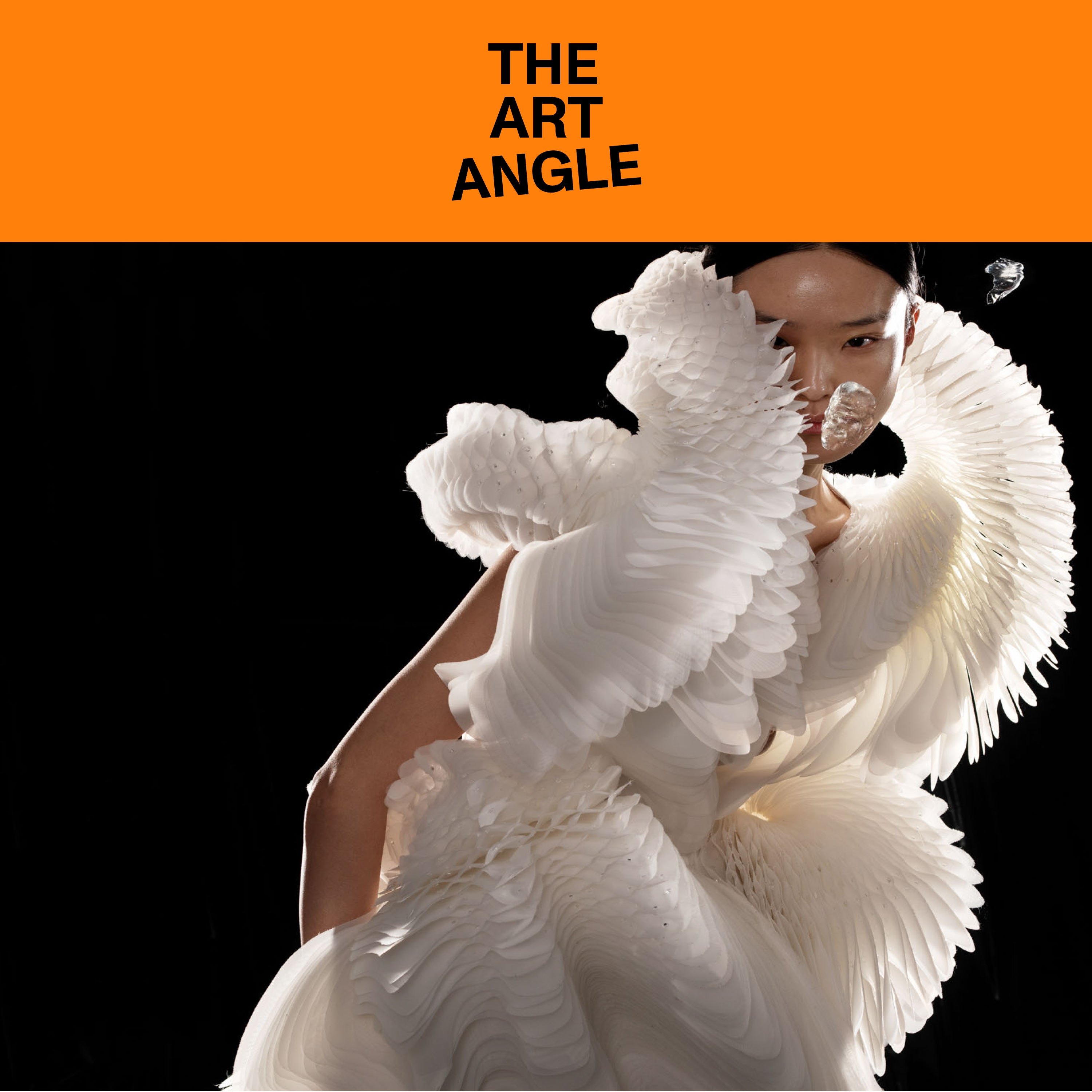
0:33Iris Van Herpen is a fashion designer, but it's a title that barely captures the scope of her imagination. Her practice reaches far beyond the runway, drawing on everything from the natural sciences to astronomy. The results are extraordinary garments that seem to belong to some otherworldly ecosystem. You might know Van Herpen's work from her groundbreaking 3D printed dress, or her biomorphic creations for Bjork, or Lady Gaga, or the bubble dress that Eileen Gu wore to the Met Gala. She's even created a garment that incorporates living bioluminescent algae. These couture designs take their cues from the natural world and use cutting-edge technology to bring to life often overlooked forms, like the intricate structures of fungi or the undulations of the ocean.
1:18And while we tend to think of biology and technology as two separate realms, Van Herpen sees them as much more closely intertwined. In fact, she believes the distinction between them may not be so clear-cut. That's something we explored when I caught up with her at the Brooklyn Museum, which is currently hosting Sculpting the Census. It's a retrospective featuring more than 140 of her designs. The exhibition opened in May and has been so popular that it's been extended through January 2027. In our conversation, we talked about her lifelong fascination with nature, her discovery of technology, and the curiosity that continues to power her practice.
1:55We also explored a question that lies at the heart of her work. What happens when technology doesn't take us further away from nature, but brings us closer to it? Hello, Iris. Welcome to The Art Angle. Thanks. So you're well known for your really sublime designs that are influenced by nature, but that make use of advanced technologies like 3D printing and laser cutting. I've heard recently that you actually grew up with not a lot of technology around you, and you were quite skeptical about design tools like Photoshop. What changed for you? Was there a particular moment that changed the way you see technology?
2:32Iris Van Herpen: Yeah, no, it's true. I grew up in a small village in the Netherlands. Very beautiful nature area. And I didn't have television back then. And computers weren't really a thing yet. Neither the phone. So I definitely think that has influenced me creatively. And I went to the art academy and I was very hands-on, still am. So really focused on the craftsmanship. And then when I started my own brand, I was really focused on the traditional side of the haute couture craftsmanship in the beginning. And there was so much to learn because it's such a beautiful evolution of centuries of craftsmanship. So I dived fully into that.
3:15Iris Van Herpen: And I didn't really need any tech back then. But there was a moment, I think it was after two and a half years, where there were architects coming to me asking me to collaborate on a piece that I would make inspired by the museum that they have designed. And I wanted to create the water dress. It's a fully transparent piece that looks like a splash of water that hits the body. and I had this image in my mind very clearly on how it should look but I had no idea on how to make this with traditional techniques I couldn't use any fabrics or materiality in that sense that was traditional and I was a bit stuck in that sense and I had to go outside of the usual techniques that I was using then and I tried some 3D printing but back then the 3D printing would not be possible to go that transparent so I ended up doing it by hand but it did actually make me go outside of my comfort zone and to do the first collaborations and that's how I started working with architects and from working with them I started working with the 3D printing and And from there on, my mind expanded in bringing more science and technology into the work.
4:42Iris Van Herpen: So it was a slow evolution. And it was really actually coming from a creative puzzle, I would say. So it wasn't necessarily the technology itself that inspired me. It was more the vision of bringing the natural elements into my work. And we might come back to that later, but I don't see big contrasts between nature and technology, for example. But we can dive into that later because a lot of people see them as opposite. Your use of technology creates work that really looks futuristic. But at the same time, as you mentioned, it's balanced out with a lot of meticulous, extraordinary craftsmanship.
5:23Is there a balance you seek out in your work? A balance between the human hand and the machine?
5:29Iris Van Herpen: Yeah, it's a natural balance in my mind. It's all mixed. A lot of the pieces that you will see in the exhibition as well, they are so layered and it involves both very intricate craftsmanship that is done by hand and also other techniques. And it's sort of indistinguishable on what is what. And I also like to play with that. A lot of the early 3D prints, for example, they are fully 3D printed. but when you look at them, they look handcrafted. Like, for example, the cathedral dress. When you look at it, you see a wood-carved dress, but it's actually 3D printed and it looks like an old cathedral.
6:09Iris Van Herpen: And the opposite, a lot of the handcrafted pieces, they look very futuristic. And I remember back then, a lot of the articles that would come out would always have it wrong. Like the pieces that were handcrafted, people would always think it's 3D printed and the other way around. So I like to play with the perception of the craft and the innovation. Yeah. And speaking of your exhibition, you know, you've recreated your atelier where you're staging a participatory performance in a way. Why the decision to offer this peek into your workspace? Yeah, I feel that the atelier inside the exhibition is one of the most important parts of the exhibition because it really brings people into the way I work.
6:55Iris Van Herpen: And because a lot of the looks are so unfamiliar to people in how it is made, there is a lot of curiosity around the process. And I really wanted to bring the heart and the liveliness of my atelier in Amsterdam into this atelier in the exhibition. And of course, the heart of the atelier is the craftsmanship and the collaborative spirit that is inside it. And what I really like about making the pieces by hand is that it involves many different people. And when you work by hand, there's always a difference between me creating a look or you creating a look. So every person does the handwork in a different way.
7:36Iris Van Herpen: There is an identity inside the handwork. And creating this look inside the exhibition is sort of an experimentation on that. like what happens if you bring all of these different hands inside the creative process they are all different and that differences brings the organicness that was so needed into this piece like if I would do all the pleating myself it would not have been the same look as it is now so I wanted to bring those different voices into the look and also more subconsciously I like to think on how the creative process works. So during the craftsmanship in the atelier, there's always a lot of conversation happening.
8:18Iris Van Herpen: And I wanted to bring that conversation spirit inside this atelier as well. So when I was pleading, the audience was invited to join me. And I would ask questions about nature or their senses. And I've met so many inspiring people that are artists themselves or scientists or architects. And all of these conversations are, of course, within my mind when I'm draping the work. So it's subconsciously, but I'm 100 % sure that these conversations have shaped the draping process and the creative process itself. So it's, yeah, it's one big experiment that came to life inside the atelier. That's so lovely to hear.
9:00It takes a village to bring a design to life. It really does. Could you share more about the processes that happen inside your atelier? I mean, what goes into bringing an idea that you have to something that can be worn?
9:13Iris Van Herpen: Yeah, it's a long process and it usually starts with the R &D, so the research and development. I do a lot of research with the atelier to new materials, also sustainable materials and techniques. And then from those experiments, we create small samples. And that's also what you see in the exhibition. You see hundreds of small samples. And that is really the birth of a new piece. And some of them are not right yet. Some of them feel right. So it's an intuitive process of selection. I choose the ones that resonate the most with me. And then we make them into larger pieces, larger draping panels, depending on the complexity.
9:57Iris Van Herpen: And then I start raping on a mannequin just like we did inside the atelier here. And that is a very intuitive process. The material tells me what to do. I usually don't have too much of an idea on where I want to go because I want that subconscious layer into the process. I can, of course, sketch things out, but I think it's too predictable. I really like to work very intuitively on the mannequin. and usually after that draping process either we start again for different reasons we have to recreate the materiality and then the atelier starts making the look or it can be directly sewn as it is so the look that is inside the exhibition here it's all draped on a base dress and this can now be sewn that's going to be the most elaborative part of the process so So the draping and the pleating took nine days, but the stitching is going to take a few months.
10:56Iris Van Herpen: Wow. Yeah. Also, when the design is worn, it also changes the design in a way. Absolutely. I mean, it creates different dimensions. Has a wearer ever surprised you by sort of activating a design in a different way? Yeah, absolutely. Movement and that transformative energy is really important in my work. I have a dance background so I'm always thinking about these works as sort of dance pieces happening on the body. So it's really about the interaction between the person who is wearing it and the textures that I'm working on. And I'm often looking for a certain fluidity. But again there is contrast in my work where some pieces embody all of that fluidity and that energy within their stillness.
11:46Iris Van Herpen: and then other pieces are really responsive to the body and they change and transform when they are worn and I think one of the most beautiful parts of the creative process is when someone puts the piece on for the first time it can be very emotional and super surprising like often I don't know how it responds to the body I can have an idea but you only know when it's really happening. Of course, the identity of that person is also influencing the whole character of the work. So yeah, that's one of the most special parts of the process. I'm sure. We've seen a lot of your successful designs throughout the exhibition.
12:32I'm also curious about how failure fits into your process. I mean, were there experiments or ideas that didn't work out? What role does failure play in leading you to somewhere different, somewhere unexpected?
12:44Iris Van Herpen: Yeah, it's a really important part of the process. If I think of the early process, the R &D, probably more of the samples that we do are not ending up into the collection. So the failure is definitely a really important part. And I think it's natural to have it as part of the experimentation. And interestingly enough, all of the samples that have failed, I think they've only failed within the time that they have been created. Because a few years later, they can be the beginning of a new idea. So they have been very essential. And I think that's exactly what you can see in the atelier here in Brooklyn.
13:31Iris Van Herpen: you see hundreds of samples probably the majority of them have never ended up in a collection but they have been the beginning of new ideas at the same time so I've learned throughout time to really embrace that part of the process in the beginning I would of course try to avoid it as much as possible and after some years I realized it's such a vital part of the process and also in the concepts that I'm developing. A lot of the ideas that I have in my mind now, I know are not possible physically in this moment of time. They might take another 10 or 20 years, but it's important to already work on them, even on early R &D samples.
14:19Iris Van Herpen: So I'm always working with different timelines at the same time. Gotcha. It's always interesting to me, the relationship between art and technology, you know, technology inspires art, but art also really pushes the technology that one day these failures could be, like you say, actually realized, you know. And I also want to talk about, you've touched on this, collaborations across disciplines with engineers, scientists, architects. How has working so closely with people across disciplines changed what it means to you to be a designer? You know, has it changed the way you think about your own designs?
14:52Iris Van Herpen: Yeah, it has changed the way I look at fashion. I have a very interconnected experience of fashion and couture. I see the relationship between couture and science and art and philosophy and nature, architecture, dance. there is so much interconnectedness between all these disciplines. And by working with all kinds of people so closely, I've expanded my perspective on what a garment can be and how an artwork can be embodied. Because we're all used to looking at an artwork on the wall or as something external, but it can become a part of your own sensory being. It can become an extension of your skin and your presence and your being.
15:49Iris Van Herpen: And when that happens, it's a new medium, I would say, something in between fashion and couture and art and technology. And that's the area that I'm most interested in. But yeah, it has slowly evolved through time, that perception. And that's one of the things that I hope that people will take from the exhibition as well, that when they've been traveling through all the spaces that they have a wider perception of what an embodied artwork can be and what fashion can be. Yeah, I actually don't actually think about your work as fashion. There are works of art that can be worn, you know? There's wearable art in a lot of ways.
16:33Iris Van Herpen: It's interesting that you're saying that. I've had a hard time with the word fashion as well because your first imagination is linked to mass production and like products that we have all around us. But the origin of fashion is, of course, something much more intimate and much more handmade and much more tied in with culture and even our vision to the world and the spirits around us. So it has been a much more personal expression in the past. So the modern or the contemporary world fashion is not something that I relate to, but in its history, I definitely relate to it. Yeah, I totally get it.
17:18Yeah. We spoke previously when the exhibition opened, we mostly talked about nature and how nature has really shaped your imagination. But I'm also wondering if technology has shaped the way you see nature in a way. You mentioned your clothes. They don't just accommodate the human body. They change it. they extended. Has technology altered your understanding of what a human body can look like or what it can do?
17:43Iris Van Herpen: Yeah, I think both technology and nature have influenced that perception. Through my work, I'm always searching for my own connection within nature, a deeper connection, I would say, than only the visual aspect of it, but really my relationship to the other types of consciousnesses and the other types of languages around us and that is very influential to maybe a perspective beyond the human form and technology has also influenced it in a different way I've come to learn that nature is the best artist alive I would say And we are nature and we tend to forget that. But even our culture is nature.
18:34Iris Van Herpen: If you look at other organisms, they have their own culture and it's also expressions of nature. And technology is also, in the end, an expression of nature because we are creating it. So I don't see a big contrast between technology and nature. I just feel that nature is much more developed and advanced than any type of technology that we have been able to create so far. So I see nature as a tool of creativity. I see technology as a tool of creativity. And they are extensions of the same thing. Yeah. I really want to talk about how you see this relationship and connection between technology and biology.
19:14I remember 2025, your sympiosis collection has this garment that's made of biolumicent algae, which was created with Chris Bellamy, who was a biodesigner. I mean, it kind of suggests that biology itself is a form of technology.
19:28Iris Van Herpen: The other way around, I would say. Yeah, technology is a form of innovation and that ultimately is an ever going energy within nature. nature is really innovative within its evolution and its new forms of creation all the time and technology is an expansion of that yeah what was it like working with like a living organism it's so intriguing yeah it changed my process at the time as a designer i'm working with all kinds of materials but usually the moment that I work with them they are static in the sense of being alive and by working with the algae and the institute of technology and Chris Bellamy I had to start thinking in a different way because it wasn't only about thinking on what I want to create visually or emotionally it was about how can we redesign the creative process in order to nurture a new being so it's about getting to know these organisms understanding what their needs are and to almost be a parent to them like to nurture them and within that process it became a metaphor for almost for a direction that I want to go to where nature becomes a equal partner in the creative process not just a material or an inspiration but really a collaborator and that changes everything in how you make your decisions and how you go through the creative process and yeah I think there's a lot more to explore and to do in that we um yeah that's such a beautiful idea Yeah.
21:23You can really read almost an ecological message in your work about how nature is beautiful. It's fragile. It's a need of preservation. Would you agree with that? And how do you make sure that the technology doesn't overwhelm the environmental questions you're trying to ask?
21:38Iris Van Herpen: Yeah, it's very true. Like I said before, within my work and creative process, I'm looking for that deeper connection with nature. And that, of course, informs the way I go through life. And that's also what I'm hoping to inspire other people with is to feel these other spirits that we're so dependent on and also to take care of them. So there is definitely that underlying message in the work. And technology is just a tool. So there are, of course, amazing innovative tools that help the preservation of nature. and there's all kinds of technologies that are not helping at all. So it's about creating the focus on the tools that are actually helpful.
22:27Iris Van Herpen: Like for example, the 3D printing nowadays is very advanced in all the biodegradable materials and the recycled materials as well. And it creates a lot less waste than going into the traditional pattern cutting. that's one example but there are so many of where you can actually use technology to create a cleaner way of making and very currently I'm intrigued by some of the research that is done with AI on decoding animal language one of the inspiring projects that I've been looking at is the CITI projects they are very far now with decoding the whale language and i think it makes us realize how much culture there is within these animals it also includes birds and bees and so many other animals and indigenous knowledge has always known these other types of consciousnesses and these languages but contemporary science has of course not really accepted it over the last centuries and i feel that were under the verge of a revolution there in terms of consciousness acceptance that we realize there is eight billion types of consciousnesses around us and we only speak one language and I feel that that could really positively influence the way we preserve these other beings the more than human beings so it's one example on how technology can open up our eyes in equalizing ourselves within the ecosystem, I would say.
24:11Iris Van Herpen: And of course, there is many examples on how technology, including AI, is doing the opposite. But I think within my work, I'm trying to show people the future that I want to see. I think as artists or writers or philosophers, we have a lot of influence on what people can imagine the future to be. And I feel it's really important to show the futures that are possible and imaginable in this positive balance between nature and innovation. I think technology is a contemporary word for innovation. I think innovation in the larger sense will become much more advanced than the technology that we know today.
24:58Iris Van Herpen: Yeah. That's such a beautiful answer. So you spent, you know, nearly two decades really pushing the boundaries of fashion is there something that you still cannot make that you still want to make oh so much i mean there's much more that i cannot make than i can make and that keeps me going that's honestly the reason that i stay curious and eager to explore but i always like to compare it to our ocean we live on a blue planet and we have only discovered five percent of what's down there and that's also how I see my own practice. I've only touched the surface and there's so much more to explore.
25:39Iris Van Herpen: So I have a lot of fantasies and imaginations on what I will be doing in 20 years and I hope that it goes beyond my imagination today but there's a lot to explore. Yeah. Yeah. This has been so inspiring. Thank you, Iris. Thank you. The Art Angle is produced by Sonia Menelili with contributions from Ben Davis, Caroline Goldstein Andrew Russeth and me Min Chen thanks for listening and see you next week
Iris van Herpen is a fashion designer, but it’s a title that barely captures the scope of her imagination. Her practice reaches far beyond the runway, drawing on everything from the natural sciences to astronomy. The results are extraordinary garments that seem to belong to some otherworldly ecosystem.
You might know Van Herpen’s work from her groundbreaking 3D-printed dress, or her biomorphic creations for Bjork or Lady Gaga, or the bubble dress that Eileen Gu wore to the Met Gala. She’s even created a garment that incorporates living, bioluminescent algae.
These couture designs take their cues from the natural world, and use cutting-edge technology to bring to life often overlooked forms like the intricate structures of fungi or the undulations of the ocean. And while we tend to think of biology and technology as two separate realms, van Herpen sees them as much more closely intertwined. In fact, she believes the distinction between them may not be so clear-cut.
That’s something we explored when Culture Editor, Min Chenm caught up with her at the Brooklyn Museum, which is currently hosting “Sculpting the Senses.” It’s a retrospective featuring more than 140 of her designs. The exhibition opened in May and has been so popular that it's been extended through January 2027.
In their conversation, we talked about her lifelong fascination with nature, her discovery of technology, and the curiosity that continues to power her practice. We also explored a question that lies at the heart of her work: What happens when technology doesn't take us further away from nature, but brings us closer to it?