 Ask ChatGPT


The episode argues that Central Asia’s art scene is rapidly changing from a Soviet-suppressed legacy into a new “soft power” and cultural-infrastructure boom, driven by young populations, digital adoption, tourism growth, and major public/private investment. It compares Kazakhstan (more private, museum-led) with Uzbekistan (more government-led), and highlights how countries are asserting distinct identities internationally, including Venice Biennale independent pavilions (2021–2022). Key examples include Almaty’s Threads of Heritage exhibition for tapestry pioneer Badama Zaurbakova (80th birthday), Nerlin Smogalov’s $100M modern/contemporary museum with works by Bill Viola, Yayoi Kusama, and Richard Serra, and Uzbekistan’s CCA contemporary arts center in a repurposed diesel/tram station. It also notes tensions: Kazakhstan removed Azel Kader Kanova’s installation of redacted Stalin-era arrest warrants from its Venice pavilion.
Margaret Kerrigan (Artnet News, host) and Anika Olsen (Artnet Galleries editor; traveled to Kazakhstan and Uzbekistan).
Written by AI. May contain mistakes.
Explore the evolving art landscape in Central Asia and its rich heritage.
“Train up a new generation of artists, bring in artists from elsewhere to work with them, things like that.”
Discuss the economic growth and cultural revitalization in Central Asia.
“Young populations diversifying trade and rapid digital adoption are turning its cities into serious markets and destinations.”
Delve into the significance of artist Badama Zaurbakova and her recent exhibition.
“And we're coming at it as newcomers, the way many visitors will, curious and keen to know where to start.”
Investigate the reappraisal of art history and inclusion in the canon.
“was more or less timed to her 80th birthday.”
Clarify the geographical context of Central Asia and its countries.
“I mean, I think, especially as you noted before, like there are a lot of stands in the region.”
Learn why Central Asia is gaining more attention in the global art scene.
“has become a subject of fascination for me.”
Explore the changing travel experience and tourism in Kazakhstan.
“So this is, you know, your second or third time going?”
Discuss Nerland Smogalov's role in establishing art institutions in Kazakhstan.
“So you'd have to get like maybe a local number, get a local to call a car for you, things like that.”
Examine the role of the Tzlany Center as a cultural platform in Almaty.
“And more locally, you know, from asking around, I think it's being really embraced because it's coming up alongside other things.”
Explore the repurposing of Soviet-era architecture in contemporary contexts.
“However, again, sort of timed to the Almaty Museum of Arts, New Orleans Museum.”
Discuss the emergence of independent pavilions from Central Asian countries.
“But I don't want to leave Kazakhstan yet.”
Explore the complexities and artistic freedom challenges faced by artists in Central Asia.
“Like, I think what struck me when I first started exploring the region is just how different each country, each region, even each city was from each other.”
Discover the significance of Uzbekistan's first Contemporary Arts Center and its impact.
“But it kind of just depends what the artist is working on.”
Learn about the role of youth in Uzbekistan's cultural scene and art initiatives.
“I know, like, they had kind of soft launch things when you went to Uzbekistan the year before, right?”
Examine how Uzbekistan blends historical craftsmanship with contemporary art.
“libraries, schools, things like craft apprenticeships.”
Experience the historical and cultural significance of Samarkand's architectural sites.
“And speaking to that a lot more, I think it was very interesting.”
Learn about the unique approach and themes of the Bukhara Biennial.
“But it makes me think, too, because like the tiling and ceramics are another one of those craft traditions that they've really embraced.”
Discover the pivotal role of the ACDF and its leader in Uzbekistan's art scene.
“I think they'll be doing previews soon-ish.”
Examine how Uzbekistan is addressing its Soviet past and heritage sites.
“So a little mysterious, but maybe that's the mystique that they want.”
Discuss the aesthetic and cultural significance of Soviet architecture in the region.
“But now in Uzbekistan just this year, they named 10 different sites in Tashkent that were all Soviet sites as UNESCO World Heritage Sites.”
Get tips on exploring the burgeoning art scene and museums in Central Asia.
“One thing I would be remiss without noting in Tashkent, though, I don't know if you got a chance to go to it while you were there, was the Hotel Uzbekistan, which is a big Soviet-era hotel.”

Get the gist, explore an idea or ask about something said.
 Claude
On The Art Angle, what are the key points of this episode?
Searching your listeningAutomatic transcript. May contain errors.
0:00Train up a new generation of artists, bring in artists from elsewhere to work with them, things like that. Yeah. And I think you really see that, like speaking of the young population, like in Kazakhstan, there's so much private funding and private projects. But Uzbekistan, it's really their government. Hi, Margaret Kerrigan, and this is The Art Angle, a podcast by Artnet News. Central Asia has a deep artistic heritage, from Silk Road craft traditions to a vibrant early 20th century avant-garde. But Soviet rule left a legacy that included the repression of artistic expression. And for decades after independence, the region was often defined by that past.
0:42That's changing now in a big way, and the international art world has started paying more attention to the five countries colloquially known as the stands. The region is seeing a ton of growth. Young populations diversifying trade and rapid digital adoption are turning its cities into serious markets and destinations. Cities like Tashkent and Almaty are modernizing, while heritage sites like Bukhara and Samarkand are taking on bigger economic and cultural roles. Last year, the European Bank for Reconstruction and Development said that the region is expected to grow faster than China. Amid all this economic momentum, Uzbekistan and Kazakhstan in particular seem keen on building soft power, pouring major money into culture both at home, in new museums and biennials, and abroad in pavilions at Venice and collaborations with international institutions.
1:33So today, we're looking at the region through the lens of institutional building and cultural infrastructure, with governments leading in some places and private collectors in others. And we're coming at it as newcomers, the way many visitors will, curious and keen to know where to start. I just made my first trip to the region this fall, and I'm joined by my colleague Anika Olsen, Artnet's Galleries editor, who made a few journeys there in the last year. Hi, Anika. I'm so excited to have you on the Art Angle today. Thank you for having me. I'm really excited to be here. So you just got back from a really big trip to go see an exhibition in Kazakhstan of an artist named Badama Zaurbakova, who I had never heard of before.
2:19Can you tell me a little bit about what this trip entailed and who this artist is? Yeah, absolutely. So this was my second time going to Almaty in Kazakhstan, and this was an exhibition at the National Museum of Art there. and she is one of Kazakhstan's most famous artists. She's an icon there. She was a pioneer of their tapestry school and this exhibition, Threads of Heritage, was more or less timed to her 80th birthday. So she's been working for many decades and it was really just bringing her overarching career and practice back to light and also inviting a more international audience to familiarize themselves with her.
3:04Because again, like within Kazakhstan, she's quite famous, but outside of Kazakhstan's borders, it's a little bit more nebulous. So she seems really primed for a reappraisal on a more international, global scale. Yeah, you wrote such a great report of the exhibition as well, because I thought what you teased out in it is that like they did a good job of really celebrating what she's meant to Kazakhstan, but also kind of placing her alongside more like familiar Western names without like trying to fit her to a Western framework. Yeah. And I think we're really in that moment here. And I think Central Asia at large fits in this moment where we're reappraising the history of art.
3:51Who is in our canon? Whose histories are we looking at? and not necessarily trying to place them in a hierarchy, but expand the field and include a broader range. Yeah, I think this moment is so interesting for the region, but I would say maybe because so many people are kind of learning what's going on there culturally for the first time, maybe we should define the region because I know I had to Google it when I'm still kind of getting up to speed on geography, which was never my best subject to begin with. Yeah. Yeah, absolutely. I mean, I think, especially as you noted before, like there are a lot of stands in the region.
4:33But to put it more concisely, so the Central Asia region is five countries and you've got Russia to the north, you've got China to the east, to the west, the Caspian Sea, and on the other side of that, the Caucasus, like Azerbaijan and Armenia and Georgia, and then to the south, Iran and Afghanistan. So just to go over the countries that are in it, Kazakhstan is the biggest. It's along the top. It's one of the biggest countries in the world. And then you also have Tajikistan, Kyrgyzstan, Uzbekistan, and Turkmenistan. Over the past couple of years, this region, especially from an art angle, I have to plug the podcast again,
5:20has become a subject of fascination for me. I've been fortunate enough to go and visit quite a few times now, and I hope to again more. And it's really exciting that people are starting to take note of this region. Yeah, I made my first trip this year, just this fall to Uzbekistan, and my mind was really blown by it. And I guess a question I have that maybe you could summarize more succinctly than I, because you've been doing more traveling there, is maybe why do you think this region is getting more attention now? Yeah, I think it really has to do with just a critical mass. I would say with Turkmenistan, which is a very insular country, isn't doing so much, and Tajikistan hasn't been doing so much.
6:07But for instance, like Kyrgyzstan, even though it's not from the art world that I'm more familiar with, they've been really promoting their world nomad games. So those were started in 2014, so not particularly recent, but just in the past couple of years, in no small part due to social media, they have exploded in popularity. I know they were all over my TikTok this fall. And I want to go so badly. They look amazing. But yeah, from the Times of Central Asia, they reported that in 2026, so this last edition that we were probably both watching on our phones, they had 3 ,000 athletes from 104 countries as compared to their first edition had just under 600 athletes from only 19 countries.
6:56And same, they were expecting maybe sat just south of 100 ,000 visitors. And it turns out they welcomed almost double that, closer to 200 ,000 visitors. That coupled with the cultural pushes from places like Kazakhstan and Uzbekistan. Again, you're reaching this critical mass and the world's really taking notice. Yeah, maybe let's go back to Kazakhstan, really, since you were there so recently, just a couple of weeks ago. So this is, you know, your second or third time going? I can't remember. Second. Second. So what are you noticing now that you've, you know, gone before and returned that maybe you didn't notice before?
7:33How are things already changing? Because there is a really big just tourism push right now that is also happening at the same time that there is this cultural kind of renaissance happening. Yeah, I would say just from a tourism standpoint, there's a reduction in friction, I would say, in traveling there. So the first time I went was in 2025 and using Yandex Go, which is sort of their version of Uber. Foreign phone numbers just weren't working or weren't working well. Like it was very unreliable. So you'd have to get like maybe a local number, get a local to call a car for you, things like that.
8:10And then this last time I went, which was only about a month ago, super easy, super streamlined. Could use those numbers. More tap-to-pay places. You know, just the little small frictions.
8:25The first time you went there, you interviewed, like, the big guy behind the art scene, Nerland Smogalov. So can you tell me a little bit about him and what he's doing there? Yeah, Nerlin is quite the character. He is a bona fide business tycoon who has been an entrepreneur since the early 90s. And last year, he opened the first museum dedicated to modern and contemporary art standalone in the region. Massive undertaking. I would say like for a Western parallel, it's sort of similar to the road, but with an even more diverse program. The budget for the project was about$100 million. They hired some of the best architects.
9:15And the core of the collection is actually his private collection. He's been collecting Kazakh art for decades. And that's about 700 pieces. But on top of that, there's Bill Viola. There's Yayoi Kusama. He has a massive, massive Richard Serra, which again, they built the museum space that it's in specifically to hold, obviously, the tons and tons of Corten steel. And it's the only one in the region. So, you know, audiences from Central Asia, that might be the only place that they could see it that side of Europe. And it's really exciting. Did you have a sense of like how it was received when it opened?
9:54I think it was one of the first things in Almaty where, at least from an international perspective, a lot of people took note. A lot of people took note. Because again, it is just a state-of-the-art massive museum with one of the best collections. Like, no expense was spared for it. And more locally, you know, from asking around, I think it's being really embraced because it's coming up alongside other things. Like, I know we'll talk about this Lenny Center, where there's this sort of pride and excitement that there's so many resources dedicated to the cultural sector. Can you tell me a little bit more about that center?
10:34Because I'm less familiar with that one. Were you also able to visit that? Yeah, so I visited it both times, actually. It was originally opened in 2018. However, again, sort of timed to the Almaty Museum of Arts, New Orleans Museum. It got a new home in 2025. So they both opened about the same time. So it's, again, part of that critical mass. And the Tzlany Center is a bit more flexible, right? They don't have a collection in the way that the Almaty Museum does. So they really act as a platform for, you know, anything from performances, traveling exhibitions. They offer a lot of, like, cultural talks.
11:11They can host events. And again, in a really beautiful, beautiful contemporary building now. Yeah, I think when I was looking at it online, it's very cool. It was developed by this architect named Asif Khan, who I think his wife is Kazakh. And they transformed this Soviet-era cinema. It looked amazing. Yeah. Yeah, you see that a lot, I would say, especially in Almaty that I've seen personally, but across Central Asia, where you have these very monumental Soviet buildings, Soviet-era buildings, that are sort of either being repurposed creatively or, you know, carried on for uses that are more appropriate to today.
11:57I'd love to get into some of the Soviet architecture, too, because that's something I noticed around Tashkent when I went to Uzbekistan, too. But I don't want to leave Kazakhstan yet. What else is cool there? In 2025, that was my main focus, was looking at those two institutions. And then this last time was at the State Art Museum, which is where Badama's show was. And it's a little too soon to tell. I mean, I'm definitely going to be watching it closely. but they have a collection and a program that's much broader and a lot more historically rooted but it looks like this is just my prediction like they're going to start incorporating more shows that speak to the present moment.
12:39Interesting. I know that something that you you kind of flagged before too in some of your reporting is that a lot of these countries in that region are also kind of breaking out on their own, like abroad as well. And you notice this specifically around the Venice Biennale. Maybe we can talk a little bit about what Kazakhstan was doing this year. When did they kind of separate and start doing their own pavilions? I would say for the three that are doing the main push, which is Kazakhstan, Uzbekistan, and Kyrgyzstan, all between 2021 and 2022, where formerly they were best known for the Central Asia Pavilion in Venice, they all presented their own independent pavilions, which I think is a really interesting thing to note, especially that it all happened at a similar time.
13:32Obviously, we weren't in those rooms to see. I don't know that they coordinated that per se, But I think it would make sense that they would all see each other trying to sort of claim their international identity a little bit more. Yeah, it is a very culturally diverse region as well, which I think it makes sense that they would want to kind of platform different things. Like you said, like Kazakhstan is so big. Like, yeah. And I don't think it would have served them to continue presenting just under like the Central Asian banner because it's not a monolith at all. Right. Like, I think what struck me when I first started exploring the region is just how different each country, each region, even each city was from each other.
14:18And I'm glad that like myself included in the world are starting to see that nuance of a region that maybe the West before it just sort of lumped together. Yeah, I totally agree. But I mean, it's not without its tensions, right, I guess I would say, is that, you know, this is a region that has a history of, you know, artistic suppression in some ways. And while there is so much going into, like, rebuilding its kind of cultural influence right now, and we're seeing it kind of play out across this grand stage right now, there is still some questions around, like, how much artistic freedom do some of these artists working in the region have or whatnot?
14:53And that did come up at this year's Venice Biennale because the Kazakhstan Pavilion removed a work by an artist named Azel Kader Kanova. It was an installation made of redacted Stalin-era arrest warrants. And there was a big open letter, like, just before the Biennale opened, trying to get it reinstalled. It was a group presentation of Kazakh artists. So there is still other things in the pavilion. But it does, I mean, it just does kind of raise questions of like, you know, with this kind of progress with their cultural scene and all of this investment into it, there is still this kind of like lingering, like, how is it moving forward and what's happening next?
15:34And I don't know if you've come up against that in some of your conversations with people there. Yeah, I mean, it's really interesting. Again, it's very nuanced place to place, artist to artist, institution to institution. Like, it's important to note that the Almaty Museum of Art, Nerland's museum, is a private institution, right? So he has said that he doesn't want to do any sort of gatekeeping of the program, and he won't have final say. But then that's also very different than the Kazakh government at the pavilion. I'm not super familiar with that particular instance. I did hear about it. And then there's just also the nuances of the different relationships of the countries together.
16:15This, again, is more macro than just the art world. But there's long-term tensions between Kyrgyzstan and Tajikistan. Kyrgyzstan has really deepened its ties with China as well, doing cultural exchanges as well as economic exchanges. So just seeing how these relationships between cultural institutions as well as private versus public, sponsored, funded, commissioned, And it'll be interesting to see how this plays, especially before more international audiences who might be picking up on that a little bit more. Yeah, I think something you noted, too, in your review of Batama's show is, like, you know, it really is specific because she was very clear that even having, you know, spent a lot of her career working within a Soviet context, she was like, no, it never really affected what I was doing.
17:08But it kind of just depends what the artist is working on. Yeah, and she was very explicit and quick about that. She was like, absolutely, there was no interference. I did whatever I wanted, whenever I wanted. Obviously, that's every person's experience is different, but you do, again, it depends on who you speak to. This distinction that you made, too, between kind of the private and the public funding for these things is also something you've noted in some of your reporting around this over the last year or two, where that is a big shift between how, like, Kazakhstan is working and somewhere like Uzbekistan.
17:46So maybe let's take a look at Uzbekistan. I just went in September for the opening of their first Contemporary Arts Center, which is called CCA. And it was really cool. Like you were saying, it's like a more Kunsthalle thing. It doesn't have its own permanent collection. It's platforming contemporary artists. It's, again, this like reclamation of historical architecture that they're trying to use in new ways. It's a former diesel station slash tram station. So it used to be like covered in dirt and oil and stuff. And they've made it really beautiful. It's like very stunning. It has like a ton of natural light.
18:25But it's really, it has like this gorgeous like yellow brickwork that's very common from like the imperial era, which is like early 20th century. So, and they kept a lot of that. Like it looks great. The curator and artistic director of it, Sarah Raza, said it was really important to kind of try and tell this more nuanced story because there has been a sort of history of just kind of like, oh, well, that's over. So let's tear it down. Yeah. Yeah. And I feel like Sarah Raza really was the one to choose to sort of champion that project because she's been so immersed in Uzbekistan's cultural rise recently.
19:04Yeah, she's a Yale professor, and she was on sabbatical to kind of help open this museum. She's back at Yale as of this fall. But she also wrote a really great book called Punk Orientalism, which really does look at this kind of like Soviet resistance and kind of how things are growing out of that now. I thought CCI was really interesting. I know, like, they had kind of soft launch things when you went to Uzbekistan the year before, right? Yeah, the year before I was initially thinking I would go see its opening and then it was held. So I was really excited that you got to see it and the photos looked incredible.
19:41Again, I'm so glad that they kept that architecture. I think it really serves it. And I believe they also do a range of artist residencies now as well. Yeah, yeah. They have some really great artist residencies. And I think that's kind of like where they started. Well, I mean, I guess we should say like this region has such like a young population that like a core component of what they're trying to do is, you know, get younger people, students involved with this, train up a new generation of artists, bring in artists from elsewhere to kind of work with them, things like that. Yeah. And I think you really see that, like speaking of the young population, like in Kazakhstan Uzbekistan, there's so much private funding and private projects.
20:24But Uzbekistan, it's really their government behind it. And it was so interesting and almost shocking to me when I was there. It's somewhere between 50 and 60 percent of Uzbekistan's population is under the age of 30. I know, that's so wild. Especially within the global context when people are so concerned about, you know, young people and falling birth rates. That is a resource that the Uzbekistan government is very aware of. And you can see, again, outside of like CCA or the biennial, they're really funding libraries, schools, things like craft apprenticeships. Yeah, I think the reclamation of craft is like really important there.
21:03And there is, I mean, there's so much incredible craft work. That was a big centerpiece in CCA too. They had a big outdoor work, which is like these clutch of like ceramic orbs that was by Shokroy Rakimov. And he's like the youngest member of like a very well-known ceramics family in Tashkent and that, you know, like we got to visit their studio and everything. And that's such an important heritage for them. That's kind of all of these different kinds of crafts. And I think kind of elevating them and putting them in dialogue with more contemporary art is really important. And I think there's sort of like a revisiting by younger generations to try and reclaim them as well.
21:43and correct me if I'm wrong because the CCA also brings in or it integrates into its program more contemporary international art as well is that right yeah absolutely when I was there like so they'll be switching out the exhibitions I think you know a couple of times a year but they really launched with kind of a an all-star lineup of international conceptual heavyweights like Nari Ward and Ali Cherry and Kim Soo-ja. And I would say it's like very minimal work, you know, like you do have to spend time with it. And it was, to me, it was like, you know, for the first contemporary art space here, like it really, it's not the most like accessible work in some ways, but I, you know, I talked to Sarah Raza about that and she was like, it's really just about getting people interested.
22:32You know, it doesn't need to necessarily be figurative. Also this generation, like the younger generation looks at these spaces differently. Like they also just want like an aesthetic thing, you know, they don't necessarily need to have it be figurative or something like that. And she's like, you know, they're very visually oriented. They want to take selfies with stuff. Like to that end, I think it really does serve that, like not to reduce it to a selfie opportunity, but like it's an interesting way, I would say, to open up a dialogue about what contemporary art is and can be. And like, you know, again, to like draw a Western analog, like CCA really is trying to position itself as like, you know, industrial chic, like the Tate modern or, you know, things like that.
23:19So, and I think they do a good job of leveraging that space because it is such a large space that there is actually like not a lot of work in it, but the work really does demand your time and attention and kind of like a physicality to it in a way. So I feel like they'll, I mean, my personal take on it is I think they'll continue to like commission a lot of large scale sculpture or even like maybe sound pieces for it just to kind of use that space and the monumentality of that space in that way. But yeah, I'm curious to see where they go with it. And also it sounds like they trust their audience, like especially these like younger audience, Uzbek audiences.
23:57Yeah. They can put the more ambitious, maybe conceptual, you have to meet the points. Yeah. And something I was wondering about, like, I don't know, this isn't really my area of expertise, but I did find it interesting that also just of it being in a context of more of an Islamic art history, which is less figurative overall. Like, maybe that these audiences are coming to this work in a different way than a Western audience would. And speaking to that a lot more, I think it was very interesting. And on top of that, like to your point about the importance of education, especially from the Uzbekistan side, since this is the state kind of rolling these things out, like they had a learning library that anyone can go to in CCA.
24:43It also had a very cool like vinyl listening room, which I thought was like such a nice addition. I was like, oh, I would come out here as a young person. I'm still young, but I'm just not as young. As an old person, I would like that. Yeah, as an old person, I really think this is great for the youngs. But yeah, I think something else that they also talked about a lot is that there's just like legitimate proximity to one of the major universities there. It's like right next door. So they are trying to really capture a young, eager audience and kind of also cater their social programming to that as well.
25:21Right. And on this last trip, which I was very jealous of, as I understand, you visited Samarkand. Am I pronouncing that correct? Yeah, Samarkand was really interesting. It's a very historic, UNESCO-protected city. It's really well known for as Registan, which is this historic public square. And it was the heart of the Timurid Empire. And it's famed for these three huge madrasas, which is this kind of classical Persian style. And they were built between the 15th and 17th centuries. it was unlike anything I'd ever seen before. I mean, like, truly, again, like, to speak of monumentality, like, I was floored by them.
26:05Like, the tile work there, they're really well known for this, like, teal and blue tile work, and it just adorned these madrasas in the most beautiful way. Yeah, I learned so much, and it was, like, it was, you felt, I felt very small there, and it felt very unlike anywhere else I had ever been. I guess I should say, too, that like the Samaritan area, like it was all it's always been such a cultural cross section. It was a really pivotal stop on the Silk Road. And it's one of the longest just like inhabited historical cities in the world or something like that. That's something across all of Central Asia, because, you know, you hear you hear sometimes of it in Iran or Persia or like parts of China.
26:48But like Central Asia's roots is like a crossroads as traveling roads, trade routes have been pivotal for centuries, millennia even. And you really feel that heritage throughout all of the countries there and they really embrace it. I hope you get a chance to go back and hit Samarkand because there's this other architectural moment there. We went to Shai Zinda, which is a necropolis that's built up the side of this hilltop. And again, it was like built, I think, between like the 11th and the 15th centuries. But people continued to build in there, I think, up to like the 19th. So it's like really iterative.
27:32But to like walk up the stairs between these like really very, they're narrow, very vertical, very tall, like tiled tombs. I mean, again, I haven't experienced anything like that before. It was so distinct to me. And it was like it felt so like ancient, but also very contemporary. And it felt like it was the most beautiful Necropolis I've ever been to. And anytime I'm traveling, I'm going to try and hit a Necropolis. I love them. I hope I get to see them at some time. But it makes me think, too, because like the tiling and ceramics are another one of those craft traditions that they've really embraced.
28:14And I would say, too, like I didn't get a chance to go to this place in Tashkent. It just opened this spring, but it's their new Center for Islamic Civilization, where I think a lot of those like Islamic artistic practices are also really well documented. I mean, I think it cost like$150 million or something like that. We walked by it briefly. Truly, the scale of it was immense. And like the guide that we were with was like, we can't take you here this time because it literally takes like a whole day to walk around it. We don't have time. So again, go back for that. Yeah. I went last year for the Bukhara Biennial, which is another one of those truly history cities, like ancient cities.
29:01That was the inaugural edition of the Biennial. And it was led by Diana Campbell, who is a curator, and it was under the theme Recipes for Broken Hearts. But what really fascinated me about their approach to the biennial was both their commitment to Uzbek, not just artists, but craftspeople, as well as the context itself. So the biennial was installed throughout the old town. So it was like truly exploring. I know they say explore and discover a lot in the art world, but this truly was physically exploring and having to like peek in buildings and see what's where. And they had a very interesting approach where they would pair international artists with local Uzbek craftspeople and invited them to come up with projects that, you know, spoke to both.
29:51And the craftspeople, it was such a diverse range. So it wasn't just ceramicists, but it was also like Antony Gormley worked with like a bricklayer to textiles and weaving. And just seeing the product of those dialogues, especially installed in the public spaces throughout the entire Old Town, was really fascinating. They're really leveraging their cultural heritage in a way to tap into the contemporary art world and art scene. It's very ambitious. And the next one's coming up, and I'm very excited about it. I think they'll be doing previews soon-ish. It's really interesting because for their second edition, they've actually tapped an architect rather than a traditional curator for the edition.
30:40It's from Y Architecture. His name is Kalapat Yantrasast. And I'm fascinated to see what he will do with the physical space for the second edition of the Bukhara Biennial. Yeah, I think he's done some cool stuff. He's done stuff at the Louvre and a lot of big museums around the world. So I noted that too. I'm curious to see like what an architectural take on that would be. And when is the next edition? It's coming up in 2027. Yeah. Well, cool. Maybe we can go together. I was going to say, maybe I'll see you there. I guess we really couldn't talk about any of this, though, without mentioning the Art and Culture Development Foundation, or otherwise known as ACDF, which is kind of behind all of this and bankrolling all of this, what do we know about it?
31:34We know at its head is the singular figure, and I'm sure you met her, Gyan Umarova, who is truly, it appears to be everywhere all at once and involved in every project. And it's also deeply tied, I know, to their Department of Creative Economy and Tourism. And frankly, I don't know the longer history of it, but I know right now it is, you know, all stops pulled. They are involved and invested in every single aspect of the creative economy in Uzbekistan. And she's really the driving force behind a lot of this happening from the CCA to the Bukhara Biennial to these libraries and schools being instituted.
32:23She's a really interesting figure. Like you said, like she really is at everything. She like has got a million things going. She's extremely polished. There's not a lot of info about her out there. Yeah. I will say, yeah, I did some research before and as far as like what she did prior to being part of this foundation and working within the president's administration and the cultural economy. I couldn't find really anything. I'm not sure entirely what she was doing prior to that. So a little mysterious, but maybe that's the mystique that they want. Yeah, yeah, exactly. When I met with her in September, we just had a really brief meeting and interview, but she's clearly very ambitious and she cited other equally ambitious culture-building projects.
33:15She's looking to Saudi Arabia's Vision 2030 and kind of like Sheikha Amayas' influence on the Qatar scene. And I think she's very much like, that's us. That's how we're doing it. We're going to do it. We're going to be as big as them. Yeah. I did think it was interesting, too. A lot of these Central Asian institutions are also really looking to partner with other major international museums and kind of like seed things out further abroad. And while we were there for the opening of CCA, I noted that ACDF and Qatar Museum signed a big five-year deal to kind of work together more closely. In Doha right now at their Museum of Islamic Art, there's like a big Uzbekistan heritage show.
34:04So I do think that's kind of Like, as much as she's looking to these people and people like Sheikh Al-Mayasa to further what she's doing in Uzbekistan, I think it's really clear that Guyana is also working very closely with them. Yeah. I mean, it's similar, like, with what you see in Kyrgyzstan and their deepening ties with China and the cultural exchange. So, for instance, in one of their museums, they hosted an exhibition based on Chinese photography. And then in Beijing, they hosted an exhibition of Kyrgyz artifacts and historical objects. So it is definitely, while I think the main focus for all of them is within their borders, like you can't understate the relationships that they're building outside of them as well.
34:52I do want to bring us back to what we were talking a little bit about earlier, about like the Soviet kind of component of this too, because I did find that very interesting that there was maybe I would say not like a wholehearted embrace of the Soviet history there, but I think it's starting because I think for a while it was just like, push it away, push it away after the fall of the USSR and they had their independence. They're like, eh. But now in Uzbekistan just this year, they named 10 different sites in Tashkent that were all Soviet sites as UNESCO World Heritage Sites. So that was really interesting.
35:28And they've been working. That's another project that was kind of being helmed by ACDF to make sure that nothing happened to those sites. And I don't know if you got to see much architecture elsewhere when you've traveled around from that moment. Yeah, I will say in Almaty, also just Soviet architecture because the USSR was so large and encompassed so many countries. Like it's nothing that Central Asia is dealing with alone. I think it's a wide-ranging question of what do we do with these sites? And oftentimes, you know, money is just a factor. Maintaining any building is sort of a factor. There was quite a bit of, of course, Soviet architecture in Almaty.
36:09It's curious because it seems in Almaty, this is just my experience when I was there, Its opinion seemed a little bit divided between preserving them as cultural heritage sites versus adapting them to, you know, just private businesses now. So, like, it wasn't uncommon to see, like, this very intricate, you know, Soviet building. And, you know, it's a movie theater now. Whereas, like, before it was, like, a conference center or something like that. But I do see a lot of grassroots movements coming up and starting to like look at this and wrestle with it. Yeah. One of the heritage sites, the UNESCO protected sites that I saw in Tashkent that I absolutely loved was the Cosmonaut Metro Station, which was built in 1984.
36:58And as the name suggests, it's dedicated to the Soviet Union's cosmonauts. And I mean, honestly, when I walked into it, I was like, I cannot imagine like London or New York having any kind of station to this level of like aesthetic gorgeousness because it would just immediately be like, I don't know, like vandalized or something. It just had the most like richly decorated marble and like decorative glass plate lighting. It also had these reliefs that were created by the artist Boris Klochov and like depicting like the Soviet space pioneers just like painted. It was so it was so wild to see. And I'm like, I'm so glad that they are arriving at this moment of like having these discussions and protecting the site because what a loss that would be to like lose that station.
37:50It's so cool. I will say, too, that the cosmonauts are my favorite motif on Soviet architecture, which I saw across Uzbekistan and Kazakhstan, sort of like a find Waldo, find the cosmonaut, which is my favorite. One thing I would be remiss without noting in Tashkent, though, I don't know if you got a chance to go to it while you were there, was the Hotel Uzbekistan, which is a big Soviet-era hotel. But unfortunately, that one's not protected by UNESCO. I think it's actually owned by a Singapore company. It was bought at one point. So it is privately owned now, which is why it's kind of the same.
38:26But it's absolutely the most, like 17 floors, the most stunning example of Soviet brutalist architecture. And it has this really cool latticework that goes up and down the front of it. And when you walk into it, it's just, it's so crazy. It's like walking into like a Reno, Nevada casino in 1986 or something. Like it's just got such a different vibe inside. Yeah. And I think that's quite common because in Almaty as well in Kazakhstan, they had the Kazakhstan Hotel. I think it's privately owned as well. I would have to double check that. But again, it's just this, it's simultaneously retro and futuristic architecture.
39:05That's really fascinating. Yeah, totally. Well, for anyone that's thinking of maybe going to the Bukhara Biennial next year or otherwise checking out some of these amazing museums, there's more museums on the way. We haven't even gotten a chance to talk about them. There's still major museums in development and all across Central Asia. Do you have any advice on what to hit or things you wish you had known when you went before? uh i think for both tashkent and almadie i mean tell me if you disagree with this is just get out there and start walking like i know i know today people like to take their ubers their cars here and there but both cities are just overflowing with just interesting little street corners and shops and even little galleries um i was wandering in almadie and i came across like a an independent theater building that also had like contemporary art in it.
40:00There's just so much to see that, especially if you're going with like Western tech or like your Western SIM card, might not come up on, you know, Google or Apple Maps. And yeah, just explore every inch of it. It's so interesting to see so much development happening so quickly too, that really does make you want to go back several times and just see what else is new and what else is happening there. Yeah, I know we're both plotting our next foray. You'll see us there. We will hold the next Art Angle there. Exactly. Art Angle Live in Tashkent. Yeah. Or Almaty. Yeah. Either one. Yeah. Awesome. Well, thank you so much for coming on.
40:41And it was so fun to talk about this and kind of just compare notes and see what we're enjoying and see what's happening there. So thank you so much for joining us this time. Thank you for having me. and hopefully we can someday make it over there together. A hundred percent.
40:58The Art Angle is produced by Sonia Manalili with contributions from Min Chen, Ben Davis, Caroline Goldstein, and Andrew Russett. Thanks for listening and see you next week.
Central Asia has a deep artistic heritage, from Silk Road craft traditions to a vibrant early 20th century avant-garde. But Soviet rule left a legacy that included the repression of artistic expression, and for decades after independence, the region was often defined by that past. That’s changing now, in a big way, and the international art world has started paying more attention to the five countries colloquially known as “the Stans.”
The region is seeing a ton of growth. Young populations, diversifying trade, and rapid digital adoption are turning its cities into serious markets and destinations. Cities like Tashkent and Almaty are modernizing, while heritage sites like Bukhara and Samarkand are taking on bigger economic and tourism roles. Last year, the European Bank for Reconstruction and Development said the region is expected to grow faster than China.
Amid this economic momentum, Uzbekistan and Kazakhstan in particular seem keen on building soft power, pouring major money into culture both at home, in new museums and biennials, and abroad, in pavilions at Venice and collaborations with international institutions.
So today, we’re looking at the region through the lens of institution building and cultural infrastructure, with governments leading in some places and private collectors in others. And we’re coming at it as newcomers, the way many visitors will: curious, and keen to know where to start.
News Editor, Margaret Carrigan just made her first trip to the region this fall, and she is joined by Annikka Olsen, Artnet’s Galleries Editor, who made a few journeys there in the last year.
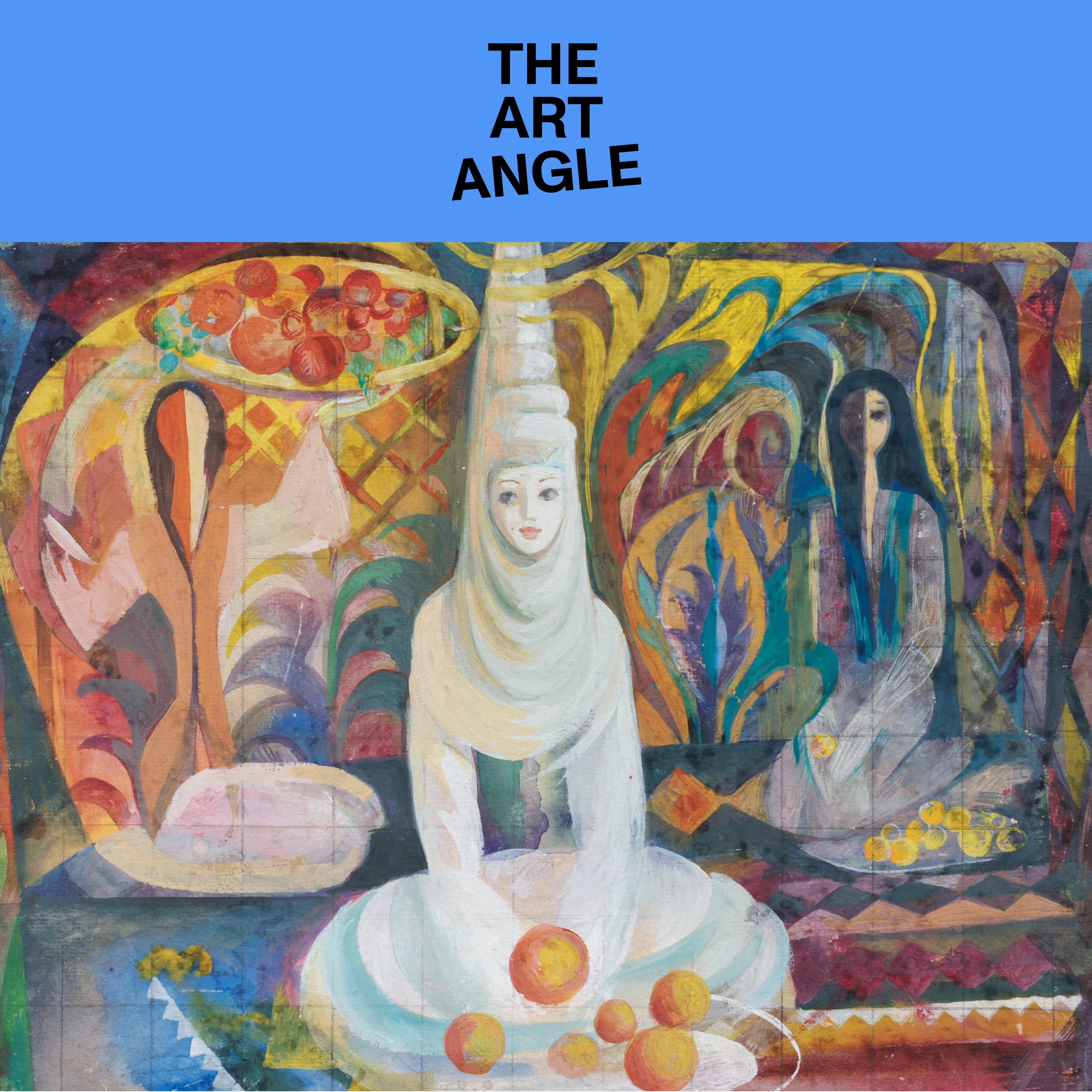
Artwork: Batima Zaurbekova, Waiting (1980). Courtesy of Abylkhan Kasteyev National Museum of Arts of the Republic of Kazakhstan, Almaty.