In short
The CMO Podcast - Episode Summary
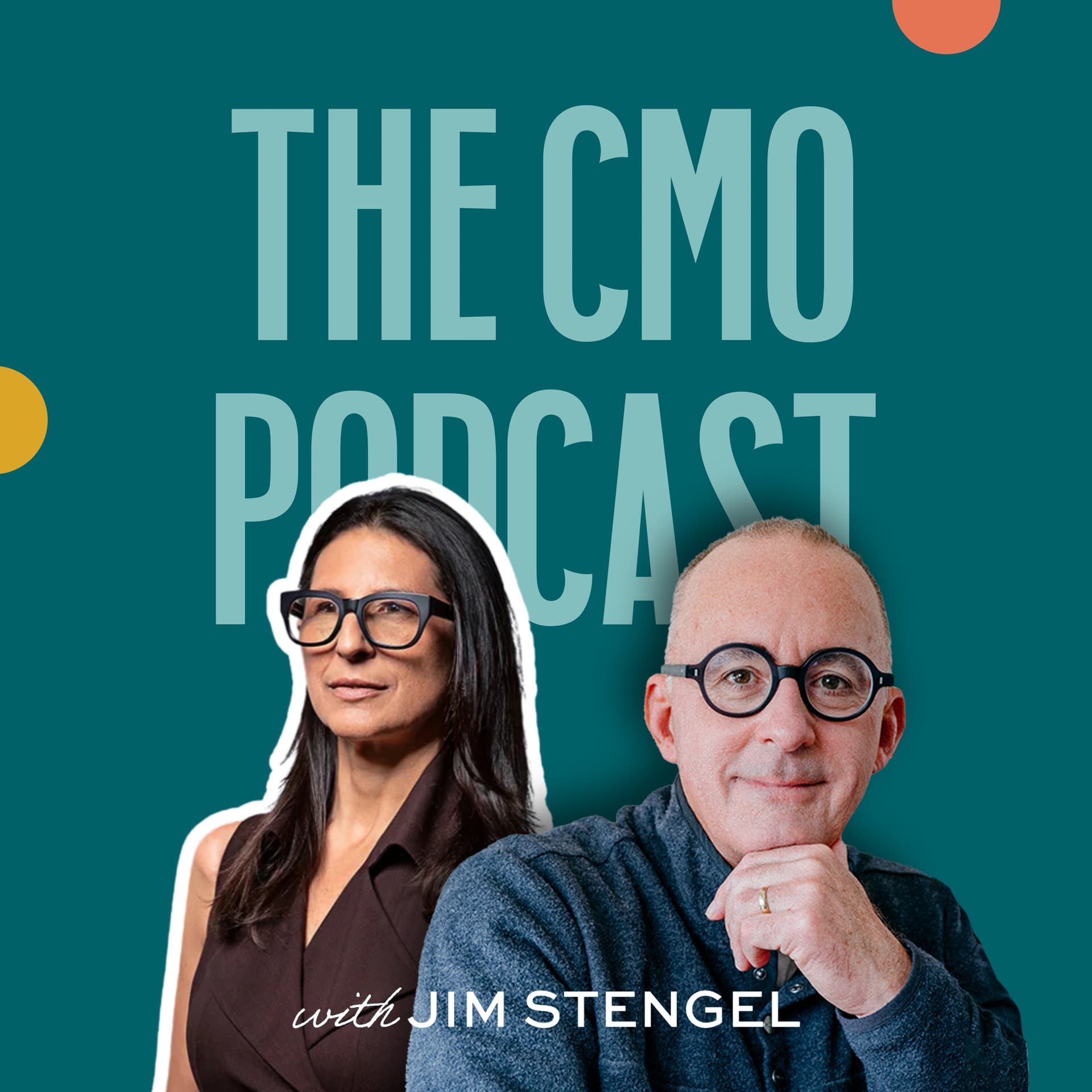
Podcast Overview Title: The CMO Podcast Host: Jim Stengel, Former CMO of Procter & Gamble Description: A series of intimate conversations with leading CMOs, focusing on their motivations and the pivotal role of marketing leadership in shaping consumer experiences.
Episode Title
The Brand Builder's Playbook // The Science of Brand ROI: Measuring What Matters with Raja Rajamannar (Mastercard)
Episode Description
In this episode, Jim Stengel, Ryan Barker, and Cait Lamperton discuss the critical challenge of demonstrating the ROI of branding efforts. Joined by Raja Rajamannar, CMO of Mastercard, they explore how effective marketing connects creative storytelling with measurable business growth and how to gain credibility with CFOs and boards.
---
Key Concepts & Arguments
- Importance of Brand ROI
- Challenge for Marketers: Proving the ROI of branding is one of marketing's toughest questions, especially in a data-driven world where every dollar spent requires justification.
- Connection to Business Growth: Effective branding can lead to measurable business outcomes, including profitability and market share.
- Raja Rajamannar's Framework for Measuring Marketing ROI
Raja outlines a framework focused on three dimensions
- Brand Strength: Understanding how branding initiatives enhance brand attributes.
- Business Growth: Measuring marketing's impact on customer acquisition, retention, and overall sales.
- Sustainable Competitive Advantage: Assessing if marketing efforts contribute to long-term market positioning.
- The Role of Data in Marketing
- Grounding Marketing in Data: Successful marketing strategies at Mastercard are built on data analytics, emphasizing the importance of quantitative metrics.
- Real-Time Feedback: Utilizing transaction data for immediate insights into marketing effectiveness.
- Bridging the Gap Between Marketing and Finance
- Collaboration with CFOs: Establishing strong partnerships with finance leaders to articulate the value of marketing investments.
- Simplifying Complex Metrics: Translating marketing jargon into business language that resonates with CFOs and board members is crucial for gaining support and trust.
---
Key Takeaways
- Establish Clear Metrics for Brand Measurement
- Transparency in Marketing Spend: Marketers must demonstrate how marketing initiatives translate into tangible business results, moving beyond soft metrics.
- Engage the Entire Organization
- Marketing Education: Involve employees from all levels in understanding marketing's role, fostering a culture where everyone contributes to brand building.
- Proactive Brand Management
- Avoiding Reactive Approaches: Do not wait for economic downturns or investor pressures to prove the contribution of brand efforts. Continuous measurement and communication of brand equity are essential.
- Utilize Both Creative and Analytical Approaches
- Balancing Creativity with Data: While creativity drives storytelling, data provides the backbone for justifying marketing decisions and investments.
---
Noteworthy Quotes
- “Purpose and profits are not mutually exclusive. If you pursue purpose methodically, thoughtfully, and innovatively, profits will follow.” — Raja Rajamannar
---
Recommendations for Listeners
- Share Insights with Leadership: CMOs are encouraged to share episodes like this with their CEOs and CFOs to foster discussions on improving brand ROI.
- Continuous Learning & Experimentation: Embrace new methodologies and frameworks to enhance brand measurement and understanding, focusing on both short-term and long-term objectives.
---
Conclusion This episode of The CMO Podcast emphasizes the critical need for marketers to effectively measure and communicate the ROI of brand investments. Raja Rajamannar’s insights provide a valuable framework for CMOs striving to connect branding with business outcomes, highlighting the importance of collaboration, data, and proactive brand management in driving organizational success.
---
Next Episode Teaser: Join us for the next installment in The Brand Builders Playbook, where we will continue to explore strategies that underpin resilient and revenue-driving brands.
Written by AI. May contain mistakes. Listen to the episode to check what was said.
Transcript
Automatic transcript. May contain errors.0:00Purpose and profits are not mutually exclusive. You pursue your purpose methodically, thoughtfully, smartly, and innovatively. So long as you're able to connect the dots back to your business, profits will follow. Welcome to the Brand Builders Playbook, the show for modern marketers who are done with guesswork and ready to implement what actually works. Well, hello, everyone, and welcome back. This is episode four of the Brand Builders Playbook. This is Jim Stengel. I'm Ryan Barker. And I'm Kate Lamperton. Kate, welcome back. We're so glad to have you with us this week. You mentioned on our last episode that we have been so intentional in our sequencing that each episode builds on the previous one.
0:44We started this whole series with why brand is essential to business. Then we talked about how to build brand love, then pricing power. Now this week, we're walking right into marketing ROI, one of the most pressing challenges for leaders today. But before we get into that, we always start the episodes with the brand playbook that we are admiring this week, hopefully relevant to the topic of the week. And this week is the science of brand ROI and measuring what matters. So, Ryan, this is your space. So we're going to let you start with what's the brand you are admiring this week? Yes. So you may recall Unilever 2022, Terry Smith, one of the largest shareholders, was criticizing some of their brands like Hellman's and Dove being purpose-driven.
1:28What does Mayo have to do with purpose? I love this example because they came well-equipped on proving brands' contribution to ROI. They took the data and were able to show that the equity of those two brands and others outperformed their peers. Even within the portfolio of Unilever, brands that were purpose-driven out for within their own family. And the KPIs they showed to prove this were things like pricing power, profitability, the pace of growth. And so I think it's highly relevant today whether brands are being faced from activist investors or simply you just need to constantly show as a brand builder your contribution to the bottom line.
2:09That sort of underscores the importance of the topic today. I think it's a great example. So, Kate, how about yourself? Whose playbook are you admiring this week? Well, you know, what I've been reflecting on is actually a campaign that many people are probably familiar with from, you know, it started when I was I was growing up with this Got Milk campaign, which started in the 90s. And they've gotten a lot of press lately for their the celebration of their 30th anniversary. And when you look across the collateral that this campaign created for a product that is, you know, there's no brand involved here.
2:44There's just a product that was made into a brand of its own. And in fact, a campaign that became its own brand. I think it's fascinating. The Got Milk campaign just posted all this content from their tour around California, where they went and talked to real people about the way that milk is part of their lives. And it is charming. It's creative. It makes you happy. And right now, I think that that's something I really appreciate in pretty much any campaign that's out there. And so while it's not a single corporate brand, it's a product brand that has really changed the way that people think about their everyday experiences.
3:20And I think that's really exciting to see. Do you ever teach that case in school? We absolutely talk about Got Milk. Absolutely. And what do you love about it? What do you tell your students about it? I'm at Wharton. And so our students are all very, you know, to the point of this episode, very interested on whether this made money for everyone. And that's an interesting conversation. But the conversation I find more interesting is how you take something that has faded into the background for most people that is perhaps even just it's just a commodity. It's just a box. It's just a jug. That's the most distinctive thing about it.
3:51And you make it something that is affectively important and that even allows people to laugh at themselves. that's a pretty phenomenal thing to be able to do when you're just starting from the basis of a product that really isn't particularly differentiated across companies. Ryan, anything to add to that? Did you have your milk today? I did have my milk and my Wheaties, but it made it culturally relevant. And I like that you brought an example where it raised all ships for the category, not necessarily at the individual brand level. So often we're adversarial one brand versus the other, as opposed to let's raise the category.
4:26Well, this week, I am liking Netflix. Our topic is ROI and measuring what matters. And this brand, this stock has massively outperformed Magnificent Seven over the past year. And according to your data, Ryan, the brand has grown its customers and its loyal following. And we talked about pricing a little while ago in the playbook. This brand has been able to withstand price increases and not lose a step. It shows the power of the brand. And the last thing I love about them is they're never static, right? They're fabulous at what they do. Their algorithm is wonderful. They just keep improving their core content.
5:03They have new subscribers. They're now into live events, sports. So they just never, ever stop thinking about how to get better. So I think they're a beautiful playbook to look at when you think about brand ROI and measuring what matters. How about you guys? What are you guys watching on Netflix right now? Too much. Can I just say that? Just too much. When you're saying they're never static, Sometimes I want to be like, guys, stop anticipating what I want quite so well. You're not helping my productivity. It's a pretty remarkable experience. I've been doing the Formula One series. Yeah. That's so good.
5:33Oh, my gosh. Talk about making something culturally relevant in a culture that didn't previously understand it. Absolutely. It's been remarkable. And I'm an Adams family fan, but we won't go there. So listen, this week's topic is all about brand ROI, connecting brand investment to business outcomes, how to win over CEOs, CFOs, boards. So Ryan, as we were planning this playbook series months ago, why did we choose this topic as one of the eight precious topics we're going to explore in this series? I think too many organizations take brand for granted. They look at it as an expense as opposed to one of the most important assets to measure, manage, and maximize.
6:12And I think whether you're a new brand builder or a seasoned brand builder, you're constantly going to be put in a position to have to justify your contribution to the bottom line. And I think it's relevant with now all the new toys and technology and big data that we can become a little more sophisticated in doing that for both short-term and long-term sustainable contribution. Kate, I've known you for many years now. You've done incredible work on decision science, marketing effectiveness. Why do you think brand building efforts are still seen as hard to quantify in boardrooms? Fuzzy, not measurable.
6:45Why is that still going on? Because we know in most cases it's not true. I'm going to give you a really honest answer. And the first part of the answer is that I think a lot of people have just stopped trying. There are many new tools out there. And I think part of the reason that they've abandoned those tools is because they keep changing so fast. And when there's a new tool every week, it's almost like learned helplessness. So they're not going to chase the next tool if they're not hooked into a series of metrics that they can watch over time and that can be integrated into their thinking in a systematic way.
7:19So I think part of the problem is that there has been sort of brand measurements hype cycle after hype cycle. And if they don't connect with a way of doing this, that allows them to really see longitudinal changes and to connect apples to apples over time. They just give up. It's an understandable move. The second issue with this is that people forget what the point of brand measurement is, right? If what you're doing is measuring people's perception of a brand on an absolute basis with no comparison, say, to your competitors or even to yourself in the past, those numbers become decreasingly meaningful, right?
7:57Our goal with brands is to build them, is to make sure that we are providing something that our competitors are not to our target audience. And when in general, you just take a really broad, absolute measure of everybody in the world, it's not the most useful information. So first I'd say they've gotten exhausted by the hype cycle on kind of cruddy brand measurement. And second of all, they haven't, when they have measured brand done it in a way that allows them to really derive competitive insights, which is, I think what would be motivating to most boardrooms. I totally agree. Okay. What we see a lot at Bera is the frameworks of the past remain true today, but they've just evolved a little bit.
8:38And the purpose of measuring brand, well, there's many things. We've had companies say to us, a dollar spent on brand, can you tell me what that translates into sales? At which point, we do a cross-sectional analysis or a time series analysis where we're literally plugging in first-party data and proving the elasticity and the lag effect. That's important. If brand is not an expense, but actually contributes to short-term and long-term sales, that's important. We've had folks who want to put money into mixed modeling and want to understand how much do I need to spend on brand by channel in order to understand short-term sales and long-term sales by channel.
9:16And that's for a very important purpose of I'm spending all this money. What's the ROI and how much can we expect today versus tomorrow? And then one of the most famous ones that I think the average executive appreciates is brand valuation. Well, if it comes to M &A, what's this thing worth? How do I put a dollar value on an intangible and connect that to the enterprise value? And then I guess another one that's highly relevant also is audiences. Putting money on going after one audience versus another audience, what's the ROI of that? Which one can I expect to be there for the next three to five years?
9:50I can jump in there for a second, Ryan. I think that part of what you're highlighting is the importance of knowing what question you want to answer. I think that may be another reason why people sometimes don't get very far with their brand metrics because they don't have a well-articulated question. And when they do, then they're better able to figure out what kind of analyses make sense and what kind of data. But it does take some work to be able to even articulate what you want to know about your brand. I totally agree, Kate. I think it really depends on why am I trying to understand the ROI of brand?
10:23We've had clients that come to us and say, look, we need to prove to stakeholders that a dollar spent on brand will drive short-term and long-term sales. So we take time series of transactional data. We do a time series analysis and prove both the lag effect and the elasticity of a one-point lift of equity of what happens to future sales. We have folks that come to us that say, I need to understand the ROI of brand by channel. And so we're going to talk later about MMM in one of these episodes. Every dollar I spend, how much is it contributing to short-term sales versus long-term sales? And what's the balance between brand building and performance marketing?
10:59We have folks that come and ask about the ROI of audiences. Should I go after one audience versus another audience? And so a lot of this is about resource allocation and setting expectations to today and to tomorrow. Yeah. And in each of those cases, I think part of the magic is when a company has a well-articulated question. They know exactly what they want to do. I think often, again, because we have not spoken very articulately about the value of brand over time, people don't even know that they can ask those questions. And so learning about how other brands are dealing with brand-related data, I think can open up a company's sort of mind space to even be able to formulate questions that previously they might have thought were completely unanswerable.
11:45Let me add one more piece to that. There are folks that still believe, hey, brand doesn't really move that much, right? And I'd say wrong. Those are lagging indicators. Leading indicators move just as much as sales and share. And so could you ever imagine a company wanting to only want to measure sales one time a year, four times a year? And so this is table stakes. All right, you two, we have Raja offstage and the wings ready to come in. But before we bring them in. Ryan, I'd like you to start by talking about, you know, how have you thought at Barra.ai about tying brand to business outcomes?
12:16I mean, this is your business. You've been at this for years. This is your passion. So I'd like you to go there. And Kate, listen up. I want you to remark on what Ryan is saying. So understanding that brand is an asset, not an expense is essential. There are many different techniques and use cases. I'll just hit some of the four. The most popular probably is brand valuation, which shows up on P &Ls in certain countries, but not in the US, for example. But other ones is taking a time series of brand data, real-time measurement, three years, and connecting it to any behavioral data, sales, share, profit.
12:50And that's really to understand the lag effect. CFOs are impatient. How long does someone have to wait to get a one-point increase in equity to see a lift in sales? There's cross-sectional analysis, which is understanding you versus peers. Peers could be within category. Peers could be within culture. And understanding what's your contribution to the bottom line versus those peers. There's media mix modeling, which I know we have a whole podcast on, which is putting brand into the equation as a dependent variable to understand both short and long-term contribution of every dollar spent. So I'd say there are four different techniques that we use widely to help folks and to weaponize the organization and to prove that brand isn't this fuzzy thing, but one of the most important assets to measure, manage, and maximize.
13:37Kate, is this what you teach? I mean, we try, right? So, you know, what I like about what Ryan just said is brand is a DV, a dependent variable, and it's also an independent variable. And that can be complicated for people to take in at a certain point in their education. But, you know, I came into contact with Barrett first because I was trying to teach things like brand valuation. And every metric I saw there just seemed like it was a PR stunt or it was just so fuzzy that you could maybe calculate something, but it wasn't going to tell you how to manage to it. So measuring is one piece, managing is the other piece.
14:10Of course, that's how I came into contact with you all. I mean, you get us past a black box and you're able to speak in terms of actual outcomes and inputs. What I'd say that we often lean on for students that are developing a sort of sense about how brand works is the idea of a simple experiment, right? So when you're living in Barrow world and you have access to this phenomenal data over time, you can do some really remarkable things. Sometimes, though, we don't have access to that just yet. And so we all know about A-B testing, but there are also lots of other interesting ways to run small scale experiments that abstract us from the marketplace in all its richness, but at least give us directional indications of how people are going to respond to different things we might do to affect the brand or how the brand impacts the way other elements in our marketing mix are going to be responded to.
15:03So we wouldn't extrapolate the effect sizes in the same way as Ryan would from his data, but we can at least get a sense of how things are related to each other. And of course, at Wharton, we love conjoint, right? It came out of Wharton. So we talk about conjoint all the time. And again, it's with a bit of a grain of salt because you have to take the findings differently. But I think that those experimental approaches can give you insights into causality in a shorter timeframe sometimes in a way that's at least indicative of what might happen. So one last question before we go to Raja. What do you think is the most powerful methodology or metric to share with CFOs?
15:35I know we have to look at a lot of things. We're more in the weeds than the CFO might be, but what do you think would be the power metric? I would say of all the benefits of measuring brand equity, the ability to reduce price sensitivity, the ability to prove that brand doesn't just get to sales, but gets profitable sales when done right is probably the most important to not only short-term, but long-term sustainable, purposeful growth. And I think that makes sense. what we talk about a lot is how much it affects the customer lifetime value calculation, because it comes in multiple places. If you have a strong brand, it reduces your customer cost of acquisition, and it also increases your retention.
16:12And the other primary parameter in there is margin. So the brand plays into each of those. You get a premium on the margin, you lower your cost of customer acquisition, and you get greater retention, your customer lifetime value is going to skyrocket and aggregate customer lifetime value across the base is highly correlated with the value of the firm. So it makes perfect sense that if you want to affect all of those, the place you go is brand. There isn't a single CFO that wouldn't appreciate those benefits. And we should have them listen to episode three too, all about pricing power. Okay, gang, enough of us.
16:46Let's bring in Raja to hear what he says about brand ROI. It's one of his passion areas. So, well, as is our tradition, each week we have an expert join us. And this week, we are welcoming Raja Rajaminar, the Chief Marketing and Communications Officer of MasterCard. Welcome, Raja, your colleague and also a dear friend, also a fellow citizen of Cincinnati. I want to say last April, I went to New York and saw you inducted into the American Advertising Hall of Fame. It's highly prestigious. You know that. Some of our listeners might not. But I have a question for you to start off this discussion on ROI.
17:20What role did ROI have in the decision of the American Advertising Federation Board to award you that amazing honor? So firstly, Jim, thank you very much for having me on the show. It's always a pleasure and delight to be chatting with you. And as I said, I consider you as one of the industry's foremost thought leaders at Doyen and somebody who I consider as a role model. And I'm going on record saying this. Let's start on that. And as far as Advertising Research Foundation is concerned, I have no clue. I don't know if they selected me by accident or they were just being good to me. I have no idea, but I'm very grateful that I'm there and I'll take it.
17:57I'm very happy about it. Well, it's a beautiful evening. Now, listen, we're going to jump into this topic of ROI. Ryan and I can't wait to talk to you about this, but I was looking at your background. I know it pretty well. You've been at MasterCard about 13 years. When you joined, do you know what the stock price was when you joined 13 years ago? As a matter of fact, I believe it was about$650 or so, which then it split one to 10. And then again, it has gone up. Now we are hovering around 575. So there is, I believe, probably we have grown nine to 10 times in the last 12, 13 years. Well, that is precisely my point.
18:36That is one of the best runs a CMO has ever had in terms of shareholder value. So I want to start with what do you think the most important KPIs have been to show that brand strength has been one driver of that remarkable return? So, Jim, in fact, if I can just take one step back and give a little bit of a context, right? So roughly half of my career, I spent managing P &Ls in businesses and the other half managing marketing as a function. What I always found when I was managing businesses and when I had marketing people reporting to me, I would ask them, okay, I'm giving you$10 million or whatever is the amount.
19:18Tell me exactly what you're getting back to the company. Invariably, most of the marketers would flounder with that. Either they come up with some soft metrics, which seem to be fluffy to a non-marketing person. It looks like they're hiding behind some mumbo-jumbo and they're waffling along. and I would get very impatient. And this is in spite of the fact I'm a marketer myself. I would say, look, if you're not able to convince me or tell me even what you're giving me in return, me means a company in return, I would as well put it in sales or some sales promotions or put it in some, you know, what do you call events or whatever else it is there.
19:55But I don't really want to spend money without knowing what is happening. That has been a big problem that I have seen. And I consciously started at particularly MasterCard building a very tight partnership with my CFO and trying to demonstrate to her the value of brand, right? And she was a German, she's a German, and now she's no longer a CFO. But the very first time that I met her, she said, look, I hate you marketing guys, the way you spend money and waste and you spend on this brand and all. Who cares about the brand? I don't. And I don't know if consumers do. So I actually immediately said, hey, what watch are you wearing?
20:35Of course, it was a Cartier. And I said, that is such a stupid decision. You know, it only tells you time and nothing else. And you're spending tens of thousands of dollars. Whereas I can get you a Casio watch for less than$15, which has a calculator, which has got your contacts in it. You're very clever. It has a stopwatch. And it also tells you time very precisely, et cetera. And I said, the difference between that and Cartier is the brand value. I think I made a mark there and we hit off quite nicely after that. And we established a CFO for the marketing department to be reporting to me and to her jointly.
21:13Now there, we started building right from first principles and foundations as to how do we measure our ROI. And I was always keeping in mind what appeals to the CEO and the CFO as much as what I need from my own side to be able to manage my function effectively. So from that point of view, we have established three dimensions for measuring our ROI. The first one is, is it strengthening my brand on attributes that I care about? Number two, is it advancing my business or growing my business, whether it is growing new account acquisitions or whether it is better margins with existing customers or cross-selling and upselling or customer retention?
21:57so the entire life cycle of consumers? Is marketing and marketing campaigns, are they advancing? And the third is, is marketing function building a sustainable competitive advantage? And when I mean sustainable, I don't mean ESG. What I mean is sustainable is a competitive advantage that can be retained and sustained over a period of time, longevity. These are the three dimensions. we started creating a series of KPIs. And each KPI, we track some of them through surveys, some of them through data analytics, because we've got transaction data. So for example, if I'm running a particular campaign, I want to test it out into equivalent markets.
22:41We run the thing and then check, because in our case, we get real-time feedback. Each time a consumer is using their MasterCard, I get that information instantly, while fully preserving the privacy of that consumer. So we don't know who it is, but we certainly know what kind of consumers are spending where in response to me. So Raja, I love the story with the CFO and how to bridge that gap. What about in the boardroom? What would you say is the biggest misconception about brand ROI? So I think there are multiple misconceptions about not just brand ROI, but all of marketing. And board members typically are not from a marketing background.
23:19and therefore they have certain thoughts and opinions, which I think it is a responsibility of the CMO to gently and delicately bring them along, tell them what is and what is not marketing and how we run our campaigns and why. Because one of the very interesting things is anybody who is not a marketer has a very strong opinion of how to run marketing or what should be run. Is this a good campaign? We should be doing this. We should be doing that. I think the key is we have to make sure that the board understands what we are up to. We have to make sure why what we are doing makes sense and also demonstrate to them quantitatively, to the extent possible, that this is what my campaigns or my initiatives or my marketing investment is delivering back in return.
24:09And, you know, lots of people, for example, they say, hey, I think we should probably bring back the priceless campaign in the original format. as an example. We said, oh, there is a reason why we moved away from that format while having it sort of in the background. We do it very little bit, but we said there is a little bit of staleness that comes over a period of time. When the format is overused, it becomes very predictable, and consumers stop noticing it. And therefore, it sort of becomes almost invisible to the consumers, and it doesn't make sense. And then so to sort of gently go at it, and also what I have been doing is we set up marketing demos at the board meetings.
24:49So there are kiosks. Literally, it's like at an event you do, we set up outside of the boardroom some of the demos for marketing. And we say, look at this, this is what we are doing, this is what we're doing, show them the videos. Because in every board meeting, there may not be enough amount of time to talk to board members about everything that we are doing. So we take the key messages in the board meeting, we give. And the rest of the things, what we're trying to do that are worth telling the story to the board members, we set up demos outside and say, hey, during lunch, before lunch, or it is during breakfast, whatever is the gap.
Read the full transcript
25:23If you want to go, here are people who are staffing those kiosks, so to speak, outside our boardroom. And my team enthusiastically shares what's happening. And that gives a lot of confidence to the board members that they have visibility into what is happening. We don't duck any questions. We don't agree just because it is easier to agree with their point of view. And if we are disagreeing, we'll tell them why we are disagreeing and what is the rationale behind the whole thing. And it's a journey. And today I feel that we have got an extremely strong support from the board and that they love what we are doing in marketing.
26:02And that's a huge help. And the same thing is true for the CEO and his direct reports, so are my peers, where we have done things like, you know, putting them through the motions of how we create a campaign or how we do a media plan or how do we plan, you know, anything to do with some event or whatever. When they get that experience themselves a little bit hands-on, so to speak, suddenly there is a lot of newfound respect for what marketing does. And that it's not just common sense. It's not simply telling your agency, hey, go and do it. They do it and And we are sort of, you know, claiming credit for it.
26:35It's not that way. And then they see it. So I would say that's a journey. Very interesting. You've been in this role a long time, 13 years. You've been up and down with several economic cycles. Right now we're in a nice surge in the stock market, but, you know, nothing lasts forever. Does your approach change when we're in a tougher down period, a tougher economic cycle? Does your approach to marketing change? Do the things that you measure change? Does your thought about ROI get more intense or is it always intense? So the reality is there is always a lot of accountability for every dollar that is given to marketing.
27:09So that expectation and the intensity of expectation doesn't change, particularly when there is an economic downturn. And if the company's revenues are under pressure, there is a lot more intensity on marketing. Now, if we cannot justify our marketing investments as delivering results for the business, it'll be very difficult to hold on to our budgets. So therefore, what we do is extra diligence to demonstrate what we are giving a return for the investment we are getting. So to basically connect the dots between marketing investment and business outcomes in a credible, believable fashion. So this is one part of it.
27:46Second, what I always find is when there is a downturn, you don't go and start selling things to your customers or consumers. That's the worst time because in the downturn, everyone is under pressure. So there are times to sell, but these are the times to serve the consumers. And if you were to say, for example, if you say B2B marketing, if my outreach to our clients and prospects is, hey, we are here for you. If you need anything, we are here to support you in every which way. If you need flexibility on some stuff, we are here to take care of that. Or if you want to share some of our assets or sponsorship assets, we are happy to make because we understand that you're also under budget pressure.
28:29And so we go in that kind of a fashion. And the first time, you know, we have said the biggest one was around the COVID situation. Same thing we do with our partners. So we sponsored a ton of things. And when COVID happened, most of the sponsorships could not even do anything. So many companies have either walked away from the sponsorships or they said, look, you have not delivered, therefore we are turning the tap off. What we said is, let's discuss and see how we can work together. Because they don't want to fire everyone on their teams either. So that takes money. So we said, okay, let's think about how we can actually restructure our deal in a manner that after the COVID or whatever is the pandemic is behind us, how we can actually collaborate.
29:17And I'm willing to give you some value now so that you can sustain yourself. And it was deeply appreciated. And for the consumers as well, we take a very non-salesy approach and we try to give them solutions which will help them in their circumstances. And so that's how we approach. And it did make a lot of difference. And in fact, I heard particularly for me, what was most compelling was the B2B marketing during that time. Because we understood exactly what they were going through and they knew that we understood the situation. We were empathetic. We were very supportive and collaborative. And that paid off in oodles when we came out of the pandemic.
29:56Now, we talked a few minutes ago about your market cap growth, incredible growth since when you started 13 years ago. What have you seen regarding brand-related metrics in terms of questions analysts and your investors are asking? What are they paying more attention to than they did 13 years ago? Are they more interested in brand, less interested in brand? So what's the state of that? So from the analyst's point of view, they have got certain thoughts in their mind. Like, for example, in a world where there is so much of trust deficit and in a payments kind of a situation, trust is very critical.
30:32It's at the bottom of it. It's at the heart of it. They want to understand how are we doing on brand trust? Are people trusting our brand? And is it different and ahead of our competition, for example? That matters to them quite a lot. Number two, they also want to understand what is sustainable and differentiated into the future that our brand stands for. Like, for example, they say the future is going to be with Gen Z, millennials, alpha, call it what a Gen alpha. How are you actually appealing to those people? Because our brand is more than 60 years old. So they understand clearly for the regular middle age and above, we are doing fantastically as a brand.
31:13but they want to understand how we are doing for the future generations. The good thing is we have anticipated these quite some time back, and we got into areas like electronic dance music. We have got into areas like e-sports in a big way. All these have really got us a lot more into the younger population than ever before. And we show that difference and how the trajectory has been over the years. And they're sincere, they truly appreciate it. Likewise, they talk about things like, you are known to be a payments technology company. But everyone knows MasterCard is this. But now you're very big in things like cybersecurity.
31:49You're big in loyalty services. You're big in areas like fraud detection and management. So in each one of these areas, how is your brand getting to be known so that when a salesperson goes to a particular company, because the target audience is very different now. For example, to sell cybersecurity, we don't go to the head of cards business, which is what traditionally we used to do to sell our wares. Now we have to go to the CISO or CIO or whoever it is. So our target audiences are changing and we actually demonstrate to them, here are the various target audiences. This is how we used to go before.
32:24This is how we are building our brand equity, we call the brand image, in their minds and then give them a sense of confidence and comfort that our brand is well positioned in this kind of a space. So analysts are absolutely asking these questions about the brand. Roger, it's interesting. you talk about today's customers and then going after tomorrow's customers. How do you think about ROI for short-term versus long-term? Are there some rules of thumbs of how our listeners can think about that math? So there are two things. When I look at ROI, I look at less about brand and more about performance marketing, right?
32:59And both those have to be working in tandem together. So when you look at, like, for example, I can't say I ran one campaign, and this is how much my brand has moved. So brand movements take place over a longer period of time than just a campaign. Yes, the brand decline can happen in an instant. So for brand decline or brand reputation measurements, we do it in real time. So for example, let's say when we went to the F1, we could actually see an immediate jump in our brand reputation as a tech driven company, technology driven company, because of the entire space there. Or if there is some crisis, God forbidding, that reputation takes a hit in an instant.
33:39So brand reputation, we measure continuously and on an ongoing basis. The rest of the brand image and brand affinity and all these metrics that we have got, they are more longer term. We measure them once in a quarter just to think about it directionally, and we get a little bit more quantitatively fixed on an annual basis. How are we doing? How have we done this year compared to the previous years? and where do we want to be next year? So that's how we look at the overall brand. For example, we want to raise funds for a particular program. It doesn't have to be only for the social good. We do a ton of other things as well.
34:16And in those cases, the result is the direct measure of the campaign effectiveness or lack thereof. We talk about, for example, B2B. We have got a whole 360-degree campaign around money 2020, which is happening in Vegas. Did we win any new customers? How many leads have we generated? How many of those leads have been marketing qualified and then sales qualified? What was the conversion like? What was the average size of the business that we got? And therefore, Money 2020, as an example, was it worth our participation? We spent so much money, this is what we got. And when I say what we got, we also measured the lifetime values of these relationships.
34:56So B2B is extremely simple from that point of view to measure the short-term ROIs. On the B2C, there are some like spend enhancement programs. Suppose we launched acceptance of MasterCard at a metro, and we want to see that there has to be a lift because we paid a lot of money to make that entire infrastructure. We stand it up. And from that point of view, if nobody is using it or there is not a significant jump, its waist and I have to measure it in real time. So those are the kind of things that we do. And it depends upon the type of objective. Some are short-term and immediate, some are a little intermediate, and there are brand-specific ones which are more long-term.
35:38Raja, you mentioned when we started talking that you look at the attributes that you care about in terms of brand attributes and you measure those. I'd be curious, I think it will help our audience to know, So is there a framework or methodology you use to track brand ROI? Are there platforms that you leverage, tools that you leverage? Because you're very good at this. And I just wonder what our listeners and audience could learn from how you approach your methodology and your framework of thinking. So what we have done, Jim, first and foremost, we leveraged our internal data analytics resources quite substantially.
36:15Now, MasterCard, if I remember it right, have got about seven or eight data analytics companies that it acquired. And they are incredibly, incredibly detailed and insightful in terms of how they do the protocol ROI. Not just ROI, but every type of data analytics that is data analysis that is done. So what we did was we started partnering with them and say, OK, if you start at the base level, there is the market mix model. Now, how good is the market mix model? Where are the gaps? Given that we have the kind of data which, for example, a packaged goods company doesn't have in real time, how can we incorporate our things into those models to be able to get dashboards almost on a weekly basis or on a campaign level basis?
37:02So we started evolving and creating a ton of proprietary data. Second, we also look at doing a lot of regressions. So regression analysis, where basically we say, okay, we have run these, these, these. this is what it has resulted in by way of results, how much of it is because of what we have done versus because the gasoline prices have gone down and people had more money and they were spending it. So the attribution aspect of it, we have really, I would not say perfected into an art, but we moved in that direction pretty substantially. So we know what is because of us and what is happening because of just the environment.
37:39So that's one thing. So the causal relationship and a credible attribution is something which we have focused quite a lot on. That's number two. Number three, there are some metrics which did not exist that we could pick it up off the shelf. So we started looking at some. So for example, ironically, I worked in a health insurance company before I joined MasterCard. It's called Humana. At that time, there were some studies which were shown that health insurance companies in the United States were the most hated category. Even if you have a wonderful brand, you're in a very bad category from a consumer perception perspective.
38:17The one which was next to that was credit cards. So when I made an improvement from number 20 to number 19, we were still in a very bad quadrant as an industry at the point in time, because the misperception that people have about companies like MasterCard is that we are credit card companies. We don't issue a single credit card. We are a technology company, which will make it available to any bank. and the banks may charge and collect whatever they would want to do. But because they see the MasterCard logo on the card itself, they immediately say MasterCard is charging interest or they are actually driving me into debt, which we don't do any of that.
38:55But perception is reality. So there's a negative perception about the whole category. So we had to bring in something what we call as brand affinity index. So how do we change from being one of the most hated categories? We are a good brand in a bad category, so to speak, to really move the needle and say, you know what? MasterCard is move it away from being a credit card company to being perceived as a payments technology company and so on. And we feel terrific in terms of how much of movement we have made. And that required us to do things which are out of the ordinary, like our partnership with Stand Up to Cancer Foundation that raised so far about$75 million.
39:34And we have helped in the, we didn't do it, of course, but it's stand up to cancer people. But we help them in terms of some of the methodologies of drug discovery and so on, which resulted in discovering nine drugs from molecule discovery all the way to FDA approval that have happened in the last 12 years or so. And there was also a discovery of early detection of ovarian cancer, which we actually enabled through our funding and our interactions with these folks and with the various researchers. So what happens is we then tell the story at a place like MLB All-Stars or World Series, right, where there is a stand-up to cancer moment.
40:17It is not a MasterCard moment. It's a stand-up to cancer moment. And they say, we are standing up for somebody to write the name off on the placard that they are standing up for in their fight against cancer. One of the most deeply moving and touching what you call occasions and people, they start looking at it and they say, yeah, this is what MasterCard is doing. It changes the perception and shifts it into a real positive, warm territory. And this is not just in a superficial manner because we do it year after year consistently. And this is not about using them as sound bites for our CEO to talk or for any one of us to make in conferences, but this is the walk that we are really walking.
41:00And that's something which is giving. So we do a ton of stuff like that. So as a result of which now I can say that at least a half a dozen major global programs we are running that are good for the society and seen as being driven by MasterCard or enabled by MasterCard, which changes my brand scores pretty dramatically in a positive way. Good for society. I'm sure you've seen there's been a lot of criticism over the last few years on purpose driven marketing. And can you really get an ROI on that? Can you comment a little bit about that? Absolutely. This is something which I feel very strongly about.
41:33Purpose and profits are not mutually exclusive. You pursue your purpose methodically, thoughtfully, smartly, and innovatively. So long as you're able to connect the dots back to your business, profits will follow. And you can give any number of examples. Let me just go back and tell you about this stand-up to cancer itself, right? I said we have raised$75 million and we run the campaigns. It costs quite a bit of money. the way we raise this money is very simple. We say that during these eight weeks in summer in the United States, use your MasterCard at particular category of merchants, like say restaurants, instead of some other product.
42:14Your price remains the same. Whatever you are paying the bill at the restaurant doesn't change just because you're using a MasterCard. You're just substituting whatever else you are using for MasterCard. We contribute a small portion of our profits from that transaction to stand up to cancer, which adds up to about$4 to$5 million per year. And this is what has come to about$75 million so far. Now, what happens is when we run this, during the period, assuming that the restaurant category is growing at 8%, MasterCard's growth happens to be at 14 % during this time. After the promotion ends, it comes down, but it settles higher than 8%.
42:52That differential between 8 % and say 9 % is where we have settled, compensates me fully, pays me back fully for the money I'm giving to Stand Up to Cancer. So we have got permanent market share gain on an annual basis within the year, within the accounting year. I have totally recouped my investment through revenues. This happens again and again and again. We have done it with Priceless Planet Coalition. We have done it with World Food Program. We're doing program after program after program and it pays off. All right, and I'm going to end with one question, then I want you to wrap it up. And we're going to let Raja go.
43:29This is a fabulous discussion. I've heard you say in other venues, Raja, that marketers often don't speak the language of business. And you kind of referred to that earlier in the show. From all of your experience and all the organizations you've been involved with, like the ANA Growth Council, what should CMOs be doing or learning or unlearning to really earn the trust of their CFO, their CEO, and the board at large. What's your advice? I think that's such an important topic that it should be on the top of a CMO's agenda. Firstly, if they are not very conversant with numbers, with financials, they need to have somebody who is their right-hand person who will help them understand and craft a narrative using actual numbers.
44:15You need to talk the language of the CFO and the CEO. If you have to get their alignment with whatever you are doing. Otherwise, you are talking your own marketing jargon. You are living in your own fringe world. You will really never cut it through with these people. And this is what I always tell. You don't have to be an engineer or a quanti whiz kid, but you can have somebody like that on your team who can actually help you and focus you on the stuff that you need to have, number one. Number two, some people have the head for numbers. Some people don't have, which is okay. In which case, don't have the insecurity to put your quantitative person in front of the board, but be present there.
44:55And also, and interpret and appropriately intervene and tell, hey, this is what this guy has shared the numbers with you. Let me tell you the qualitative story of it and why it matters and so on. When you tag team in that way, I think it takes it to a different level. Now, I'm fortunate. I'm a chemical engineer and I'm a nerd. So I don't need somebody else to help me. But still, I have my CFO. The reason I have is the same truth told by somebody else other than a marketing person about marketing has more credibility. So if somebody else is tooting your horn, it's much more productive and powerful than you telling these things.
45:33So I would always say that you need to have a representative of the CFO on your team. And the CFOs will be delighted to do that because for the first time, they will be getting insights into or behind the curtain what's happening in marketing. They will know, they want to know, not to just cut your budgets, but they're genuinely curious and inquisitive as to what's happening with all this money. I'm giving these guys or these girls millions and millions of dollars. I just need to know how they are spending it. And typically marketers are a little closed because the perception is if I open the door, they take away my money.
46:05That doesn't have to be so. I would say that's what it is. So firstly, have confidence in yourself that you are doing the right thing. Number two, have somebody who understands quantitative stuff on your team, financial stuff on your team. And number three, you need to look at it as a campaign. Now, we do marketing all the time for our company, for our products, for our services. What about marketing our own function? If our audiences are the CEO, CFO, the C-suite and the board, you know what they're looking for. You need to understand and then tailor your message to them and give appropriate proof points as to why they should believe your story and your golden.
46:45I know I'm oversimplifying, but this is exactly what it is. No, no. And this idea about having a meeting with your CFO and agreeing on a person to report to you and the CFO whose job is to help you improve the ROI of marketing. I did the same at P &G in my first early days in the job. We weren't where we needed to be an ROI. I talked to the CFO about it. He'd loaned me a director. The director reported to the CFO and me. Met with the CFO every week. And so we were united in solving the problem. and we made massive progress. Love it. I think Raja just gave us a masterclass on how what's taking somewhat an intimidating topic and make it a two-way street between CFO and CMO, right from the beginning conversation with the watch and having real numbers to bring it in.
47:31So thank you, Raja. Really appreciate all the insights for our listeners. Thank you, Ryan. And thank you very much, Jim. Really appreciate. Well, welcome back, Kate. I'm enjoying my coffee. I hope you enjoyed your coffee after that riveting conversation. It's always riveting with Rajah. You never know where it's going to go, but it always goes to good places. So what was your take after relaxing and listening to that? Ryan and I were trying to get the best knowledge out of him that we could. You're listening to it all. What do you think? Well, first of all, I feel like you could have kept going for a long time.
47:59But there were a couple of things I really loved. And honestly, I'm going to steal one of them. And it's his opening example about the Cartier watch when he needed to convince people that brand mattered. I have a lot of watch people in my orbit, and they love watches. and I think they love them so much that they forget how much of it is just wrapped up in the brand and yes there are technological differences and more sophisticated and less sophisticated but it's such a good example of a product in a very mature category where tons of differentiation lives in that brand and I also loved how many times he referred to the power of data having good real-time data that could show you fairly quickly as things were changing and I love that even though in some cases the data was anonymized, it didn't take its power away.
48:44You don't have to deny consumers dignity and privacy in order to really to serve them better, given the data that they have. So I really love to love to hear that conversation because I think sometimes that's lost. Ryan, did you like the data part as well? What about you? What was your takeaway? Roger just gave a phenomenal masterclass on so many things that I loved, but I think the message just simple. For success today in brand building or being a marketer, you have to tie brand to business metrics. And I love that you need to be proactive in starting a dialogue with the CFO to help bridge the gap between marketing and finance.
49:22If you do not, you will probably have budgets dictated to you. You will have a secondary role in building brand and business. And I love the eloquence of how he brought it and made it fun to Kate's point of simple. You don't need to use overcomplicated components to get a CFO to understand that brand is in fact an asset and not an expense. Now we have two traditions in the show. We always open with the playbook that we admire before we start the show. And we always end with what we recommend listeners. What should they add to their playbook from this episode? What did they hear that they might say?
49:58I got to add that. I've got to question that. I've got to supplement that. So Ryan, if there's one thing from this episode that you would like our audience to add to their playbook, what is it? Yeah. Whether you're new to the role or seasoned, do not wait for bad times for an activist investor for M &A activity or a recession to begin to prove brand's contribution to the bottom line. I'll also add that there are many components of measuring brand's contribution. And it's your duty to constantly remind folks that even though it doesn't show up in the P &L in many countries, it shows up in our pricing power.
50:35It shows up in our ability to tickle the heartstrings of our customers and keep them loyal. And it shows up in ways that attract employees to want to come to work for companies. It's not just external, it's within. Kate, what about you? I love what Ryan just said about staying ahead of this. When you start doing it reactively, it's going to be a scramble. But if you do it always, then you're really signaling that this is part of how business works. What I would add is this idea that you can bring everybody in the organization onto the marketing team in a sense. And so if I were in this kind of position, I would take that idea of creating these experiential exposures to the marketing process and walking everybody through them.
51:19Honestly, from the person at the front desk to your board members, help them all understand why you're making the choices that you're making and why they make a difference. All of a sudden, everybody is on your team. And very often, I think marketing kind of lives behind this smoke and mirrors idea. Those are the creative people over there who knows what they're doing. When you really explain the decisions, I think you get a lot more power from the entire organization. And we know the truth is everybody is marketing all the time, whether that's in their job title or not. I would like to add to that.
51:51So while ideally brand is owned by the CEO down as its most important asset, as marketers, when you enter an organization, it's interesting to see how quickly you can see how to break down the silos of the other lines of business. And so what you're saying, Kate, is really showing how every line of business plays an important role in nurturing and growing that asset we call brand. Yeah, I love where you're both going with this. And my takeaway is totally consistent with what you're saying, I would be very practical. I would share this episode with my CEO and CFO and ask them for their reaction to it and then ask them for their support in driving the financial value for the company through building their brand and ask for their ideas.
52:34You'll have your own opinion about where you are on that journey. They will as well. And if the three of you come together on where you are and what are some ideas to improve that, just good things will happen. There's zero downside. and so much upside in that. Okay. Anything else, you two, before we wrap up for this week and get ready for next week, part five? So that's four down, Jim. We're halfway there. Very much looking forward to the next four. You keep finding the most interesting people, so I wouldn't want to step away from it. Okay. Well, that's it for this week's playbook. Please join us next week for another episode in the Brand Builders Playbook.
53:10We'll see you then. Thanks for listening to the Brand Builders Playbook, where we explore the real strategies behind resilient revenue-driving brands. If today's conversation sparked new ideas or helped you see things differently, do us a favor, follow the show on your favorite podcast app, leave a review and give us a like or rating. It really helps others find the show and keeps our conversation going. And if you know a brand leader or marketer who needs to hear this, share this episode with them. And don't forget to check out the worksheets in the show notes. We'll be back next week with more insights, more playmakers, and more of what it takes to build brands that last.
From the publisher
This week on The Brand Builder’s Playbook, Jim, Ryan, and Cait dive into one of marketing’s toughest questions: how do you prove the ROI of a brand? In a world where every dollar spent needs justification, they explore how marketers can connect creative storytelling to measurable business growth.
To help unpack it, they’re joined by Raja Rajamannar, Mastercard’s Chief Marketing & Communications Officer. Raja shares how Mastercard built one of the world’s most trusted brands by grounding its marketing in data, financial discipline, and purpose. He outlines his framework for measuring marketing ROI across three dimensions, brand strength, business growth, and sustainable competitive advantage, and shares practical lessons on earning credibility with CFOs and boards.
“Purpose and profits are not mutually exclusive. If you pursue purpose methodically, thoughtfully, and innovatively, profits will follow.” — Raja Rajamannar
—
Download this week’s worksheet: http://bit.ly/3KX9ts4
Read about upcoming episode topics and guests here: https://bera.ai/podcast/
See Privacy Policy at https://art19.com/privacy and California Privacy Notice at https://art19.com/privacy#do-not-sell-my-info.