
In short
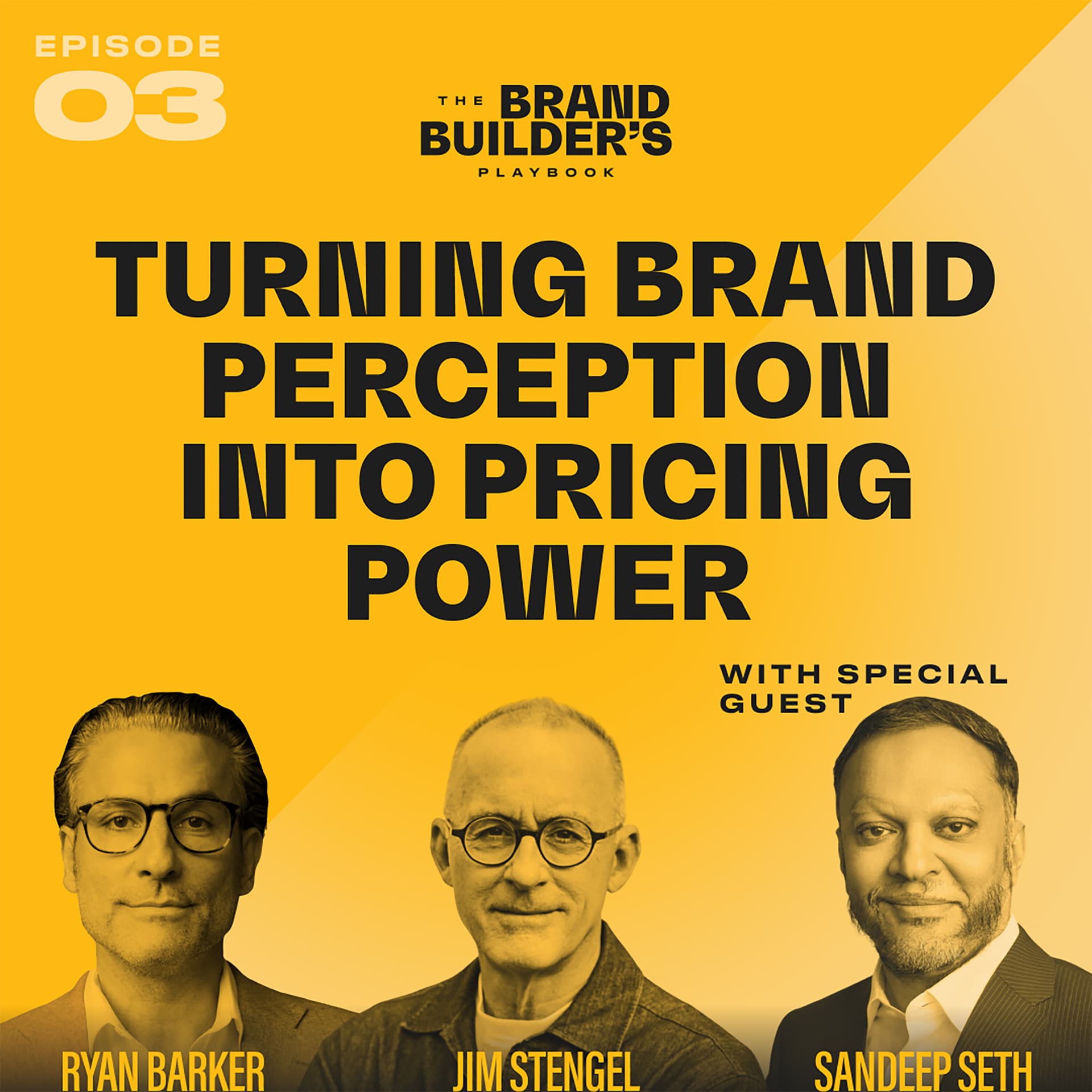
The CMO Podcast - Episode 3 Summary: The Brand Builder's Playbook / Turning Brand Perception into Pricing Power
Podcast Overview
- Host: Jim Stengel (Former CMO of Procter & Gamble)
- Co-hosts: Ryan Barker and Cait Lamberton (Professor of Marketing at Wharton)
- Guest: Sandeep Seth (Chief Growth Officer at Tapestry)
- Theme: Exploring the correlation between brand perception and pricing power, especially in the luxury goods market.
Key Concepts Discussed
Brand Perception and Pricing Power
- Consumer-Centric Pricing: The episode emphasizes that the price is ultimately set by the consumer's perception of the brand's value.
- Differentiation: Building a unique brand that consumers feel is indispensable can lead to pricing power. A well-differentiated brand commands higher prices without losing customers.
- Brand Love: The emotional connection consumers have with a brand can lower price sensitivity, allowing brands to charge premium prices.
Importance of Brand Positioning
- Emotional Connection vs. Functional Superiority: While functionality is essential, emotional connections often drive consumer loyalty and willingness to pay a premium.
- Point of Market Entry: Identifying the moment a consumer first engages with a brand is crucial for building long-term loyalty and maximizing lifetime value.
Insights from Guests
Sandeep Seth's Experience
- Transition from P&G to Tapestry: Sandeep's journey from a long tenure at Procter & Gamble to leading brand growth at Tapestry highlights the importance of adaptability and the willingness to take risks.
- Revitalizing Brands: Sandeep discusses how Tapestry is working on revitalizing Coach, Kate Spade, and Stuart Weitzman by focusing on emotional connections and consumer insights.
Differentiating Luxury Brands
- Expressive Luxury: Sandeep explains how luxury brands like Coach are transitioning from being seen primarily as status symbols to embodying self-expression. This shift connects deeply with younger generations.
- Managing Discounting: Sandeep cautions against heavy discounting practices, which can devalue brands and create a "deselection barrier" for potential consumers.
Practical Takeaways
- Measuring Price Sensitivity: Companies should regularly assess consumer sentiment and willingness to pay through market research tools, including conjoint analysis.
- Aligning Brand Strategy and Pricing: Pricing should reflect the brand's strategic positioning rather than merely cost considerations. Strong brand identity can justify premium pricing.
Recommendations for Brand Leaders
- Understand Consumer Needs: Continually reassess consumer expectations and experiences to ensure the brand meets their evolving needs.
- Embrace Innovation: Brands should innovate not only in products but also in communication and consumer engagement to reinforce their market position.
Conclusion
The discussion underscores the intricate relationship between brand perception and pricing strategy. Successful brands understand that pricing power is less about cost structures and more about the emotional and experiential value they deliver to customers. The insights from Sandeep Seth, alongside the expertise of the hosts, provide practical strategies for marketers looking to enhance their brand's value and pricing power.
---
Call to Action
- Follow the Podcast: Stay updated with future episodes by following *The CMO Podcast* on your favorite podcast platform.
- Engage and Share: Share insights from this episode with colleagues and fellow marketers to amplify the conversation around brand building and pricing strategies.
Written by AI. May contain mistakes. Listen to the episode to check what was said.
Transcript
Automatic transcript. May contain errors.0:00When the Coach brand comes up, she remembers something that was associated with a specific moment in their lives. And I thought that's exactly how Coach is. It's a life moment product. They're not in the handbag business. They're in the belonging business. Welcome to the Brand Builders Playbook, the show for modern marketers who are done with guesswork and ready to implement what actually works. Well, hello, everyone, and welcome back. This is episode three of the Brand Builders Playbook. We're having a lot of fun. This is, of course, Jim Stengel. I'm Ryan Barker. And let's welcome in Kate Lambert into this discussion.
0:35Kate, this is the first time you're joining this series, and we're so looking forward to it. First off, are you a podcast fan? You know, when I can find a good one, yeah. It's funny, though. People love to recommend podcasts to you. And so I'm always interested in the ones they recommend. More often than not, somebody's recommending something to me that's about murder or Irish people, which is entertaining. But it's nice when I run across one that is truly informative. Do you listen to marketing, kind of brand building podcast? Are you more sort of lifestyle? I do. When I walk to work every day, I have a specific, I'm not going to plug them specifically, but I have a specific podcast that I do listen to that is almost exactly the right length for my walk to work.
1:19And it focuses on retail and marketing issues. So I feel like I walk into my day and I'm ready. I'm ready to think about what's in front of me. There's no murder in our podcast today other than the potential of profitability being murdered when not following the playbook. There you go. Nice segue. That's good, Ryan. Okay, but full disclosure, Kate, you and I have a history together, right? We collaborated on a Harvard Business Review article about two years ago. We've been on stage together in New York City, and now we're doing this podcast. So we just got to continue to rock this, you know, maybe a Netflix series next, right?
1:55Let's see. That's where the murder comes in, Ryan. No, what I always enjoy is that we have this combination of decades of real world experience that you've had. I have this academic perspective. But then I think that what a lot of people in your orbit also have is this hunger for big picture thinking. People have big visions and big aspirations. And so it's always fun to connect those dots. Well, we're so happy you're here. And I just want to know, you know, this is your first one. What are you looking forward to in this show? Because you're going to be on several episodes. and Lindsay also joins us here and there, Lindsay Waking.
2:29What are you looking forward to? I mean, I'm a little bit selfish in that I love to learn things that I can take back to my students. They've all heard old stories for a long time, but the new stories are the ones that really mattered. So from a selfish perspective, it's that. But I also always find it fun when we do something like this and we hear from people out in the world that they learned something new. I'm an educator. So we'll see if we can both do some learning and do a little bit of helping other people learn too. Well, we have a great guest later in this show and we'll introduce him later, but it's a really, really good one.
2:58And it's spot on the topic we have this week. So our first episode talked about why brand building is important, which was a fabulous discussion with Chris Burgrave and Lindsey. Episode two talked about brand love and the business impact of that. And this week, we are going into the details on how to turn brand perception into pricing power. So Kate, you're the only teacher here on this show. Ryan and I are not teachers. We're coaches sometimes on our best days. So let's start in a really, really fundamental place. Can you talk to us about pricing power as a concept? What does it mean? And what does it mean when you have it as a brand or as a company?
3:38I love the order that you're doing this because it makes perfect sense. If you effectively differentiated your brand and you have something like brand love in context where people express that, feel that, or you can capture that, the way that should be translating is into pricing power. So all else equal pricing power allows you to raise your prices without losing customers. That tells you the very big challenge in marketing that we want to fight against fundamental laws of economics, which are that price goes up and quantity goes down. Pricing power changes that relationship for you. And so what we often talk about is that building pricing power has to do with making sure that nobody thinks there's a substitute for you.
4:17And you can do that in a thousand ways. You know, brand is a huge piece of that. Brand is kind of where that rolls into. If you have a well-developed brand, people say, look, I can only buy that brand. I trade down for a lower price. I'm going to give up something I can uniquely get from the prior brand that might have raised its prices. So you can think of anything that reduces substitutability as giving you pricing power. And so it can be tougher to build this in some categories than others. So for example, if you're selling a commodity, you're selling something like a paperclip, and I'm sure somebody will fight with me and tell me there's huge variants of paperclips.
4:52But if you're selling paperclips, you've really got to fight hard to convince people the other paperclips aren't a good substitute. But if you're selling a luxury good, which almost by definition refuses comparability, you often can capture more pricing power. And that's what you see in brands that have continued to raise prices and still see their sales stay high. So Kate, is this area of pricing a popular course at the Wharton School? Yeah, we cover it in the intro to marketing. And I think the ways that we look at price can make it fun. So for example, if you look at it in the context of a conjoint analysis where you say, how many dollars are people willing to trade off to get - Talk about what a conjoint analysis is, please.
5:35Okay, so - I'm not assuming anything on this show. What's a conjoint analysis? So in a conjoint analysis, we're able to understand how consumers evaluate different bundles of attributes put together. So what you might do is configure a phone with three different attributes and each of them has two different levels. And you're going to present people with differently created possible phones and say, which one would you choose? And when you do this over and over and over again, you're able to back out the weights. Like how important is it that the phone has this level of memory over this other level?
6:08And part of that is how important is it to be this brand over that brand. And then you can translate that into dollars. So you'll say, listen, when I holding everything else equal, if I go from PC to a Mac, here's how the dollars change. Now, if I do that, and I have to give up an attribute, then we can see what the willingness to pay is. And so they like it when they can see it in the context of a product and a brand combination, because it really helps us understand how matching a more complex set of consumer preferences ties into our ability to drive prices. So Ryan, did you learn about conjoint analysis at the Johns Hopkins University?
6:49We did, in fact. We did. Kate wasn't available to teach me then. But what's fascinating as I'm hearing Kate talk about attributes, I think a big part of where pricing power begins in the journey is in optimizing your positioning. Now, Kate's giving very good examples of functional benefits. We look at the purpose, the emotional, the functional, and the experiential benefits. And there's an optimization to be done across all of those. What's fascinating is many companies say, I don't have superior or inferior functionality. Can I actually command a premium price through the emotional connection?
7:27When done right, you bet you can. So this is such an exciting topic. So we're getting ahead of ourselves a bit. We always like to sort of early in the show, I mean, we're only three shows into it, but we like to kind of talk about what playbook we're all admiring this week and link it somehow to the topic. So I want to start with Ryan. We're in our third episode. We're talking about pricing power today. We have Kate joining us for the first time. Whose playbook out there in the world this week are you finding really interesting? Yeah. And I'm going to tie it to today's topic of pricing power. You may have seen the Elf Cosmetics brand decided to increase all prices of all products by $1 due to tariffs and inflation.
8:09And one might think that's a bold move. Well, according to our data, they absolutely have permission to command a premium price. And last episode on brand love, my favorite benefit is today's topic. Love reduces price sensitivity. They have enough differentiation and uniqueness and meaningfulness to command that premium price. So I think it was a calculated move. And so very impressed that they're moving forward with that. They are, by the way, Dave, Belf has been on my show, the CMO podcast. They are the number one brand by units in mass cosmetics, which is amazing. I absolutely believe that.
8:49I mean, I think they were the first makeup I bought when I was back buying my glittery nail polish at the writing. right and then they you stick with them because it never feels like like they're going to let you down and you can try things you can experiment it's all within your reach and I think that makes a lot of sense so Kate what playbook are you admiring this week well I foreshadowed it a minute ago but I'm right now putting together some work on luxury branding and so I've been really interested at looking at what Chanel does because for Chanel their pricing power is actually part of their brand.
9:22You know, we usually think to Brian's point, when you have a great brand, you can do this, but also when you do this, it can reinforce the exclusivity of your brand. So just looking at the data since 2019, the price increases every year. The smallest price increase has been 11%. In 2023, they increased the price by 24 % for their iconic bag. I mean, that's crazy, but they have the right kind of brand to do it and they have enormous confidence in their brand. And I think that's what they're signaling, right? And they're doing this at a time when luxury sales are not quite as fire as they were right after COVID.
9:59Things are softening a little bit. So to do it even under those circumstances, I think is a huge statement for the brand. So they're using their price to tell us more about the brand. I think that's a really interesting step. Why do you think they can do that at those crazy percentages? I mean, I know that's hard to shorthand. It's really that it's kind of one of those anti-laws of luxury. What that does is then it creates more exclusivity. Whereas with other brands, the point is to sell to as many as possible. That's not the goal for luxury. In luxury, it's to be wanted by as many as possible.
10:34but you actually want to maintain control of the stock and the number of units that are out there. And they're very careful about that. Well, I would say the playbook that I'm liking this week, and I have liked this playbook for many, many years, but it's American Express. And when I was in Cannes this year at the big festival, I had their CMO on the CMO podcast. And the impressive thing about American Express is they obviously command a price premium and And they believe in their brand so deeply. They believe in the strength of the brand. They believe investing in the brand. They are one of the great training grounds for brand builders, much like a P &G is.
11:13There are so many ex-American Express people who are leading all kinds of organizations, including financial institutions. But I think it's this value that if we invest in people's affinity for a brand, their respect for a brand, their feeling that I can't live without it. And we use the word badge a lot. I mean, it is one of the original badge brands. But I think they're just amazing. Their stock price continues to go up. And I think it's their continued focus on investing in a brand and their distinctive brand positioning that sets them apart and enables them to create the premium, which is a lot of what we're going to talk about today.
11:53So Ryan, let's talk a bit about this pricing power. And we have to start that discussion with brand positioning. And you know much more about brand positioning and pricing power than most people on this planet. So could you start us with what you've learned, what you've seen among your many, many clients around brand positioning? What are they doing right? What are they doing wrong? Because obviously, if you don't get the position right, as Kate just talked about, pricing has to be a part of that, then game over. So what are you seeing and learning from your clients these days about pricing power and positioning?
12:24Well, let me start with just the examples of the playbooks we're talking about. There's a misperception that pricing power is mostly for luxury when in fact can apply to value brands as well. So positioning, whether value or luxury, really starts with our ability to identify the drivers of four elements. We talk about a brand's purpose, a reason for being beyond making money. We talk about the emotional connection that we want folks to feel. We talk about the functional benefits that can support that and the experiential benefits. And when folks come to us quite often talking about pricing power and the tariffs are coming and I don't have functional superiority, what can we actually do?
13:05It's really about, well, do we feel good about our positioning? Do we really have things that make us different and unique and meaningful in people's lives? And if we do, and that's balanced across those four elements, we don't have to rely on functional superiority to command that premium price. But to get positioning right, who's the target? Which is another episode we're going to have, Jim. Good. Kate, any reaction to that? What Ryan just rattled through? I think what's so interesting and what I've really liked in the work that you guys have done before is the recognition that these things have different values, have different value in different contexts for different brands and that they change over the course of a product's lifecycle.
13:52That insight to me is so often overlooked. You know, we teach the product lifecycle at universities, but we don't always back up and realize the positioning that worked, especially in these rapidly moving categories. Positioning that worked six months ago needs to be evaluated constantly and tracked to see if it's still resonating. You know, I think that can be hard. You know, it's for brands like American Express. On one hand, they've stayed very consistent, but they have also updated. Oh, yeah. Right. They have figured out how to continue to make new connections over time. And so I think it's funny to say, we say we're going to boil this down to pricing power and say that's a signal of brand strength.
14:30But the complexity, the individuality of each brand is where the real work comes in. And so I think that it's always interesting to see brands that get that they need to keep evaluating and updating. And the ones that think this won two years ago and that's it. And we're not changing it. And I'll tell you, I've worked with both kinds of companies. So it happens. So funny you say that because pricing power, as we just talked about, is differentiation to command a premium price, meaningfulness for household penetration. Differentiation today could become table stakes in as little as a quarter or two quarters later.
15:07And so that constant cycle of, is this still different enough to command that premium requires measurement and having those inward looks? You know, it's nuanced. This isn't kind of the topic that we're talking about today, but this idea of positioning evolving based on how consumers or customers are changing, how human beings are changing. It's a tough one because one of the great characteristics of great brands, Chanel is a good example, is their consistency. You know, Apple is consistent. Chanel is consistent. Many P &G brands are consistent, but they're not static. No, they evolve. Yeah. They grow in the same way humans do.
15:40Yes, I'm still me. You're still Jim. You're still Ryan. But if we talked to 10 years ago us, we'd have a really interesting conversation. And I think that, you know, we have to, people have to be willing to let go. I think it was W.E.B. Du Bois had this great quote. The important thing is at any moment to be willing to give up what you are for what you could be. And I think it's helpful for brands to think of it as an evolution rather than a pivot, which they like to say. I mean, come on, right? Like, no, it's going to be a next step. And if people can see the continuity, it's going to help you.
16:11You know, Jim, the purpose and emotional connection tend to last longer than the need of refreshing functional and experiential benefits to keep up with culture and audiences. So there's a different timeline between those elements. Yeah. I mean, I get the question a lot. How often should a purpose change? And I'll say if you're playing at the right level, it shouldn't change much. How you express it will change. Exactly. Exactly, which speaks to the importance of the strategic thinking in developing the tactics. So again, we're talking about price, which we usually think of as a tactic, right?
16:48It's product, price, place, promotion, people down here, right? But it should flow from the strategy. So people say, oh, can we push our price up by a percent? Well, it depends on what your strategy is, doesn't it? And what you're doing with those other pieces and how they all live together. And for all those marketers listening to this show, pricing is in your domain. So if you're in a company that says pricing is finances thing or it's sales thing, get into those conversations because as Kate, you just talked about, pricing is about brand strategy. Well, every week we have a guest joining us and I am super excited about our guest joining this week to talk about brand perception and pricing power and a lot more.
17:24So we're going to welcome Standeep Seth, the chief growth officer of Tapestry, the parent company of Coach, Kate Spade, New York, and Stuart Weitzman, three great brands who have great brand equity, and I suspect a little bit of pricing power. But anyway, Sandeep, you're a 23-year veteran with Procter & Gamble, all of that in beauty care. So it's really, really good to see you again. And before we start, should we do like the P &G chant or the P &G handshake? What do you think? Absolutely. Procterites can't meet without the chant. So nice to meet you again, Jim. Well, let's talk a little bit about, you went from P &G to Tapestry, right?
18:02So tell us about that. Why? What was compelling? Tough to leave a company after 23 years. I left after 25 and it's still a big part of me. So it's not a small decision. So what compelled you to join Tapestry? Absolutely. You talked a bit about my 23 years at P &G and mostly in beauty. I would actually start a little further back. I mean, you know, at P &G, we always talk about fit for use. I'm sure you remember that. I've called my journey as misfit for use. I started as a civil engineer in construction, to selling fax machines door to door, to doing automation for steel plants, and then doing my MBA majoring in finance and ending up in marketing.
18:48Perfect career path. Absolutely. At every stage. And I started P &G India, which, you know, everyone starts in healthcare. So I worked on WICS, new business development, and then moved to Singapore with 20 years of beauty out of the 23. And I would be as far from beauty as possible. And Indian engineer, I'm sorry, I'm stereotyping myself here, being put into beauty, which I had no idea about. And I think that's really where it started for me, doing things that I have to learn from scratch. and maybe I'm not even in my comfort zone. Of the 20 years, nine years were only 11 years SK2, first as the CMO, then running the business globally.
19:32And as serenity would happen, it was COVID. I was sitting at home. I normally wouldn't pick up calls from headhunters. And there was one from Dallas that I got in the middle of COVID. And I was speaking to this person over a speaker. And my wife was at home. this COVID, we're all locked up at home. And he said, hey, we come across your profile. We have a role, which I think you fit in. Have you heard of a brand called Coach? And I remember looking up at my wife since we were sitting at home and all we could do was clean up things. And she found the first Coach bag I had gifted her before we got married.
20:09And I'm like, oh, my God, there's something here. But my question to him and later to the CEO of Tapestry, Joanne, was why me? I'm not from fashion. I actually never worked in the U.S., though I was leading SK2 globally. U.S. was part of it. Why do you think I could be a fit here? And I think the challenge he threw at me was really the reason I took this up. She said, look, we are a brand that's driven by creativity and innovation through our design and craftsmanship. And, you know, Coach has started in 1941 and is known for its creativity and craftsmanship. You know, Coach Leather is always talked about as the highest quality that you can find, whether the new bags or, you know, the whole inspiration from Baseball Club.
20:51That's how it started back in 1941. And we are one of the top retailers in fashion. But what we are missing is the third leg, which is brand building. So we're looking for someone who's coming from brand building background to complete the whole triage of what we have from a creativity and design point of view from our retail muscle and bringing brand building. And that was a challenge I really wanted to take up. It was putting me out of my comfort zone completely again. I've been 23 years at P &G and Jim, once you're 23 years here, you're a proctor for the rest of your life on that. And then moving my two teenage sons and my wife from Singapore to the U.S.
21:31to New York was another challenge, which was interesting. I was talking to a colleague at P &G who I trusted and said, hey, I have this. What do I do? He said that, look, this will be very inspiring for your kids that you are restarting at this age again. And why don't you do that? So I think, as I said, you know, it kind of all came together. I took the leap and here I am. I'm super pumped that I took this up. I'm going to turn it over to Ryan in a minute, and we're going to get you talking about Tapestry and the great brands you have. But before we leave the P &G one, the topic of this show is pricing and positioning and pricing strategy, pricing flexibility.
22:06You worked on two brands of P &G. I know them well. SK2, super premium brand, and Olay, also a premium brand among its competitive set, who have built great brand equities, strong brand positioning over time, have been consistent, but not static, which we were talking about before you joined the show. So if you had to say one lesson you learned about positioning and pricing strategy from those two brands, what would it be? I would say pricing is an integral part of positioning. You know, whether I look at my days at Olay when I started, you know, Olay Australia, we were known as a grandmother's brand.
22:40And at$10 in a grocery store, it was an expensive brand to buy. I remember my first in-home where the consumer said, Olay smells like my grandmother, right? And we had no pricing power on that. to later when that brand truly turned around and then kind of became my brand and only went through that whole resurgence back in the early 2000s, pricing was not an issue. So again, pricing is a value. It's an outcome, right? I would say rather than an input measure of what does your brand stand for in the minds of the consumer and how you position it. Conversely, you know, and I'll talk a bit about even luxury fashion.
23:18A lot of times, it's the discounting that becomes the deselection barrier where consumers don't see the value of the brand. So we think we can use price as a way to get more customers. Actually, for every customer we're getting, we're creating deselection for 10 others. Sandeep, you come from your academia of engineering and finance and then going into the world of emotional connection and imagery and fashion. Can you talk a little bit about the science or discipline that you use in terms of determining how to charge a premium price? And I'll give you a little context. A lot of the CMOs we deal with, finance makes the decision and brand plays a big role, as we were just talking about.
24:01What's your role in that contribution and how do you bring facts into the conversation? Firstly, I would say, you know, it's the consumer who decides the pricing. We can put any price out there. They're not going to buy if they don't see the value. So I think acknowledging that and understanding that is important. Of course, there's a whole science, as you said, behind pricing. We have a P &L, we have a gross margin, and I run a business, so I know what that means, that we need to deliver a gain on that. So if you look at tapestry, which is probably another reason why I could move quite seamlessly from Proctor to Tapestry is Tapestry is a very data-driven organization.
24:44And again, it's 90 % direct business, so we have first-party data extensively for every customer we are selling to. But we're always looking at that data to make decisions on how do we look at pricing. And I think that's why partnering as a CMO and partnering with your CFO is very critical on defining. So one of the things we started with is to really start with who's our customer, who's that consumer we are targeting. And we very specifically defined the point of market entry consumer. And we defined what are the price barriers for this consumer. So, again, that was a very essential starting point for us to say that if we want to get this Gen Z, 18 to 24 year old, come in and buy their first handbag from Coach, we've got to be very clear what we are putting out in front of them, right, on that.
Read the full transcript
25:33But then again, as I would say, pricing is an outcome of desirability. You know, how desirable is your brand? I mean, I faced the same challenge of my mother's brand or grandmother's brand, I would say, three times around now, first with Olay, then with SK2, and then with Coach. It didn't matter what price I put out there, no one was willing to buy Coach, right, at one point. I mean, Coach has been through many cycles, but in the most recent cycle, it was rejected by many millennials. That's not a brand for me, and Gen Z's were not even considering it. So we had to really go back and really say that, look, let's not start with the price.
26:06Let's start with the consumer. Let's start with the insight that we are building in. And the three things that are working for us today, I would say, is our innovation. You know, the products that we are putting out there, whether it's the Tabby or the Brooklyn Bank, are truly resonating with this generation. Our emotional connection, which we've kind of driven through brand purpose, and I can talk about that. And eventually the value that we offer to this customer. I think three of that coming together is really what's allowing us to create the right pricing. So, again, as I said, there is a lot of science here, but there's also a lot of, you know, we call it magic and logic at Tapestry.
26:43So it's kind of both coming. We are running elasticity studies at every stage of, you know, the choices we're making. So it's not random that we wake up in the morning. But the one last point I want to make, and then I'll pause and you can tell me where to go with it, is this whole deselection barrier. One of the things we saw with the outlet businesses, the way they were growing, discounting and through performance marketing, that was becoming the way brands were driving. And I think that was the downfall of many brands in the category. And we realized that the more discounting we are putting at, we're actually creating a perception of low brand value overall on that.
27:19Not even the price point, just the messaging of discounting. So how do we get out of that? And a big part of what we had to do was really start with creating desirability versus creating, you know, a discount perception of the brand. We're going to talk about Coach in a minute. And Ryan and his team have some interesting data that we want to talk about with you, which I'm sure you're familiar with. But before we do that, I'd like you to speak a little bit about P &G and Tapestry. What could each of those organizations learn from each other regarding brand perception and pricing power? That's an interesting question.
27:54Never thought of it like that. But look, I mean, I bring in with me a lot of how we've gone about pricing at P &G, which is putting the consumer at the center of it. So, you know, not starting with just the P &L, but starting with the consumer and saying, what is the value of what I'm offering to this consumer? and what is that. I mean, the whole concept of point-of-market entry, I think, is something I've learned from our days at P &G. So a lot of that we brought here. But on the other side, the models that a retail company like Tapestry runs with its first-party data are quite amazing. Now, sometimes we don't have the luxury of that at P &G since a lot of that is going through groceries or third-party wholesale on that.
28:36But that rigor allows us to create a precision in how pricing and pricing elasticity can be modeled into what is there, both from a evergreen collection that we have or the newness that we are launching. And what is the power of that data if you could, in the P &G context, work with the retailers who have that data to drive that? Because that gives you a real sense of what is the brand value in the minds of the consumer and how far you could go or not versus just being driven by the financials of it. Sandeep has brought up this point of market entry concept a couple of times. I'm very familiar with it.
29:16Some of our listeners may not be. It's a very powerful principle. And you're kind of that's inculcated at P &G. Sandeep, could you talk about that principle of point of market entry? Why it's so important? What you've learned about it? Absolutely. Look, I mean, in the most basic sense, it's the point where the consumer first time enters the market or starts making their own decision to buy the product and i think that's where the habits are formed on what it is and as a leading brand if your intent is to grow the market it's really about growing point of market entry and disproportionately gaining share now there are there could be many other entry points into the category through the life stages that that we can tap one and we can talk hours about that but i think point of market entry that that that first point and i you know at coach we talk about that's the first date you know when you start falling in love you know how do you create magic of the first date and and bring the consumer in and that increases uh not just you know um your penetration but also helps with lifetime value because you have the highest lifetime value starting with the consumer at the point of marketing that's an interesting principle i'm curious when things like a recession or bad times or tariffs, which may not affect you guys, is there a point of re-entry and the balance between innovation, emotion, and value?
30:36You're saying, does that equation change? The macro always plays a role here. But interestingly, as I kind of briefly mentioned earlier, I mean, where we play with our brands, it's a very emotional category right on that and and you know we've seen that in in the past recessions also 2008 or or earlier to us as i look back into our data is um the category is quite recession proof in that sense because people are making an emotional purchase i always share this data you know within our target audience for coach there are 25 million women who are going to turn 18 next year and every year for the next 10 years we've done the math globally in the markets we play and when you're 18, you're going from high school to college, doesn't matter the session or not, you're going to buy a handbag.
31:21The point of market entry becomes even more important for this group. But you're right. I mean, look, there are a lot of people who are going to defer their investment choices or they're going to make different choices on that. So how do we really focus on different life stages and what do we mean and how do we bring the brand emotionally closer at those choices? I've talked about one important one is high school to college, which is like going from backpacks to handbags, but, you know, starting a new job, right? And all of these are those points where you're making a decision to, you know, change your wardrobe, buy a new handbag and what happens.
31:58So I think in situations like this, it gets even more important to focus on that versus going with more broad generic messages and how do we connect with the consumers at the right point. Yeah. So it's interesting to hear the theories and strategies you guys put in place of what we're seeing in the data. So the coach brand in the US, and we look at a panel of 1.6 million Americans, is a loved brand. And the uniqueness and meaningfulness we see compared to peers is off the charts. However, the awareness of the brand is lower than its uniqueness and meaningfulness. And to a lot of folks, that means, oh, no, is that a bad thing?
32:34No, it's a fantastic things. It means what they know of the brand today is incredibly unique and meaningfulness. And the innovation piece you've been saying is showing is they're constantly right when they think they know you well, there's still more to be constantly learned. And we're seeing that in the data. And you may have heard in the beginning when we're talking about the constructs of what drives uniqueness and meaningfulness, purpose, emotional, functional, experiential. Your emotional connection is superior to your functional, even though your functional is off the charts as well. So it's really interesting to hear the strategies that built that over time.
33:09Look, firstly, you know, the data point that awareness is low really encourages me because that shows the headroom I have to grow from where I am. So we know we have a meaningful proposition to the consumers we are reaching out to, but there's so much potential on where we go. I think one of the things we called out, I would say, four years back, we had an investor day, September of 2022, is the evolved positioning of what coach is. Like if I were to just kind of go a little back in the history of Coach, I mean, Coach has in some way been integral part of driving American fashion in a way back in 1941 with men's leather wallets inspired by a baseball glove to, you know, the 60s when Bonnie Cashin was the first female creative director in this industry, kind of bringing in the codes of Coach, which still are the codes of, you know, how we brand it.
34:02And then, you know, around 90s and 2000, when the so-called accessible luxury came to life, where, you know, the trade-off at that time was, you know, to have a luxury experience, you had to pay a very high price. And Coach brought that experience at a price that was inclusive. And then many other brands came into that. And I think that also led to a bit of a downfall because it became a pricing game at one point, right? Everyone trying to lower their price, discount more. And I think that's where, you know, under Stuart Weavers, who's the current creative director who joined us in 2014, we started to re-invision what this would look like.
34:36And we came up with this evolved positioning of expressive luxury. And I'm going to talk about this because this is where the whole emotion starts. As we started talking to the younger generation, I would say specifically Gen Zs, one of the biggest things that comes out is the role of luxury has evolved from just being status and symbol to self-expression on that. Now, while self-expression in itself is not a new concept, every generation wanted to have that self-expression for this generation is very different to previous, driven by the single difference of social media. Everything in their life is recorded and every mistake is up there.
35:14and the tension. And I have, as I said, two Gen Zs at home. My daughter's 14, my son's 19. The challenges of self-expression for this generation are creating such tension and such, you know, so many different mental issues that we kind of see that has become a big challenge for our industry because fashion and beauty are at the forefront of what self-expression really means for this consumer. So as we started going deeper on one side, you know, they're looking for multiple personas. Who I am on Instagram is different to what my TikTok persona is, to what my real life personality is. And how do I express myself in each one of them?
35:57But at the same time, there's a big self-doubt, which is, will I be accepted? Right. That's the that's the biggest thing I want to express myself. But I also don't want to be canceled. I want to be accepted. Like, how do you bring this two together? And this is at the extreme of its, you know, for any generation, I would say. No other generation has been recorded to the extent this generation is on everything we do. And that's where, you know, we felt that as one of the leading luxury brands, we need to help our community overcome this pressure. And that's why we started defining what our brand purpose would be.
36:34And it was really about inspiring confidence in the community to find the courage to express your true self with a tight line of courage to be real. So that's where we kind of narrowed down. And we said, instead of really talking about our products, yes, our products are featured in everything we do. We're going to talk about this. And our mission is to really be that conduit that provides you that confidence and that courage to be real. And that's what we've been working on. Now, how do we do that? It comes to life through the products we want to put out there. It comes to life through our communication, but also through our experiences that we are creating in online and offline environment.
37:11So we have dramatically changed because there's a pressure on walking into a luxury store and talking to a store associate. How do you overcome that? How do you remove that at every stage and then allow that self-expression? So that's been our journey, I would say. That's that's helping us connect emotionally first. And you mentioned, you know, from a functional superiority point, if your coach has always stood for the highest quality of craftsmanship and the leather that we use. In fact, you know, vintage coach bags sells at a much higher price point sometimes than even the new ones because of the quality of the leather that's out there.
37:47Sandeep, we haven't talked too much about Kate Spade or Stuart Weitzman. Are you going through sort of the same thought process with those brands in terms of obviously your purpose is different and the customers are different, consumers are different, but the same thought process? Absolutely. Look, you know, Kate Spade's been through its own journey and, you know, Kate Spade is an iconic brand of the 90s and one of, again, very loved brand in the US and parts of the world. But it needs its own rejuvenation where it is at its stage. So we are now codifying the brand growth principles as a company and how we bring that to life.
38:24You're right. I mean, the Kate Spade consumer is very different to the coach consumer who's much more timeless versus, you know, coach Kate Spade consumer is looking for different attributes and different emotions on that. So it's not so much about confidence and courage. It's about, you know, more about joy and connecting right in that front. So how do we take the core principles of brand building and reapply is the work that's happening across our other brands. And on Stuart Weitzman, just one line, we are in the process of divesting that brand, which we had announced last year. So, yes, the broad principles remain the same, but our focus is how do we continue the momentum that we're seeing on Coach?
39:06How do we turn around Kate Spade and how do we really turn tapestry truly into a brand building organization? We're going to let you go in a minute, Sandy. But we end the show with Ryan and myself and our other host. In this case, it's Kate talking about one takeaway for our listeners from everything we've just experienced on the show. You've been a part of the show, a big part of the show. If you'd like to leave our listeners with one takeaway, one piece of advice, one piece of wisdom from your experience on brand positioning and pricing power, what would that be? I think really understand where you fit in the lives of the consumer and what's that value that you can offer because that goes beyond any other competitive advantage you look for.
39:48So that obsession of understanding their lives and then seeing how you fit in uniquely, I think that's what we're trying to do with each of the brand. And that gets immense value and pricing power or anything else we can talk about. Ryan, does your data support all that? Absolutely does. Sandeep, thank you. This is a real gift. And it's good to see you again. And you sound like you're having fun. Absolutely. Thank you, Jim. Thank you, Ryan. It was a pleasure talking to you guys. Thanks for being on. We appreciate it. Thank you. Welcome back, Kate. You've had a coffee break and you've had some popcorn, I see.
40:23I did. So what were you settling in like the movies and watching? It was just as good. Probably better. This is good. Okay. I'm a marketing nerd, so, you know. No murder. The better you get. No murder. There was zero murder in that story. Well, Sandy was remarkable, you know, so sitting back, listening to it, the conversation, you know, what did you take from that? What things would you highlight? I mean, one thing I want to do is take the whole thing and make my students listen to it because there were so many points in there that were like, yeah, that stuff we tell you, it's real. It's really real.
40:54And it turns out it's really hard. Sounds so easy when you say it. But then, you know, to his point, he's got a brand that they revitalized. He's got a brand that they need to turn around and they've got a brand they're going to decide to let go. And the pathway to each of those decisions is really different. And you have to get them right. There's a lot at stake. Like, you know, what really resonated too was the story about his wife's bag. So we'll start there. When the Coach brand comes up, she remembers something that was associated with a specific moment in their lives. And I thought that's exactly how Coach is.
41:27It's one of, as he brought up a number of times, it's a life moment kind of product. It's the kind of thing you buy for someone when they finish their PhD or you buy for somebody when they, you know, get their first real grown-up job and they can't carry that thing they've been carrying for 10 years anymore. And I think that we do really well to tap into the power of those moments because as different as people are, in those moments, we're all kind of looking for the same thing. But it raises one interesting question. Do we as a brand say, you know what, there are millions and millions of people turning 25 every year and that's a huge market in and of itself.
42:02If we get that whole market, we are golden. So let's do that. or do we try to create a ladder within the brand so that we can keep people over their lifespan, which is much harder? Or do we kind of acknowledge, look, yeah, we're where they start, we're their point of entry, but for the consumer, what the entry isn't the entry to our brand, it's entry to premium and luxury. And so for them in their experience, yes, this is my first luxury product, but they see others as being more appropriate later. So I think there's an interesting call to be made there about what a brand tries to do and how the consumer sees the category as a whole.
42:42But I think in the end, the part that kind of stuck with me is two things he said. One, the consumer sets the price, right? And also, when you talk about these life stage products, he sort of starts getting to what the business is that they're really in. They're not in the handbag business, they're in the belonging business. And so the true competitors for them are other products that provide that sense of acceptance and belonging and affirmation. And so if I were going to answer that first question about how far they want to stretch, I would ask that question, you know, where else do we have the same, can we provide the same sense of social acceptance and belonging, not where are we the best handbag?
43:25Kind of back to Brian's earlier points about functionality not being the thing. It's really about the business they're in is satisfying that deeper need. Did anything surprise you from what you heard? One thing that I think is the tension is this question of innovation, right? So these older brands will often talk about how they're innovating. And I know that objectively coaches, they've got these new product lines that you use non-conventional materials. they're using more sustainable inputs into their goods. I'm not always sure that term innovation is easily understood in some contexts. I think it's hard to understand exactly what that is.
44:06So what was interesting to me was to hear how that's part of the initial discussion. But as we go on, again, it's not the innovation that matters. It's the extent to which that innovation is responsive to some need the consumer really has. You can have the newest, coolest fabric, but if that doesn't translate into this makes me feel socially accepted and affirmed, the innovation itself is really, it's really not relevant at all. So I guess I wouldn't say I was surprised, but I think I found it interesting to hear both this story about, you know, deep and emotional resonance and this idea of technical innovation.
44:41I think sometimes we get lost in one or the other and we aren't able to make the connection between the two. I think the surprise I saw, delightful surprise, is piggybacking on self-expression and maybe it's innovation in channel is the multiple personas that an individual can have depending on their channel. That makes this exponentially more complex. What is my persona on TikTok versus LinkedIn versus Facebook or something else. And so the purpose and the positioning being a connective tissue and agile enough to tweak for those, I thought that as a delightful surprise. I was just on a call before this with a person who does experimental philosophy and they were just looking at how people interpret others based on the channel they see them.
45:28So it's very relevant. And what they have found is that people think the authentic self is the in real life self. So, you know, given that kind of insight, We might expect people experiment more with other kinds of riskier brands in their online persona. But in real life, they still want the coach bag. They want the universal donor. And so I think you're right. That's a super interesting insight. And I think there's actually some research being done that can inform the decisions that that would affect. Absolutely. I loved how he beamed, Ryan, when you said your uniqueness and your meaningfulness is strong.
46:04I think I remember that correctly. but your awareness is low. And he just beamed. He said, that's the potential of this brand. Headroom. Which affects everything, right? How you think about your spending, your strategies, your communication, your target audience, I suspect. Absolutely. Yeah. So I was thinking about that combination and that seemed like a positive to him. Do you guys interpret that as being that the segment that is aware of them absolutely adores them, totally gets them. And then the other segment is really a blank slate. Is it, is it two different segments in there? Or is that the same person that doesn't really know, but vaguely thinks they like it?
46:44It's stronger than vague. It's what they think they're familiar with the brand. They hold an incredibly high uniqueness and meaningfulness, the two building blocks for the demand curve. However, imagine a brand that you thought, you know, everything about this brand and then innovation comes out and new things come out. You're like, wow, it's not, I don't think I I fully understand. I'm loving what I'm seeing, but I don't know everything about it. If you see maximum familiarity and UNM, it actually doesn't leave a lot of headroom. So it's a good thing. I mean, a lot of folks misperceive that awareness is the star of the show and uniqueness and meaningfulness is you could build that later.
47:20And it's the opposite. Okay. We end the show with a piece of advice, a takeaway, what you want our listeners to think about applying all this great discussion we've had about brand perception and pricing power. So if you boil this down into one piece of advice, if you're in a room of CMOs, which this is, as our listeners, there's many more than CMOs, but what would your piece of advice be? This is such a hard question. You know this is hard. I know it is. That's why I'm going last. I mean, I think I'm going to steal Sandeep's line. I'm going to steal the consumer sets the price. Yeah, I love it.
47:55they determine how much pricing power you have. If you can really get inside and understand what business you're in for them and why you do that for them better than everybody else, then you know how much price and how you have. If you keep backing out and saying, well, our technical category is X or Y, and we have this objective benefit that we provide, and it costs us$40 million to make that objective benefit, really I don't think that needs to go into your pricing considerations nearly as much as what the consumer is going to bring to the table and what they're going to compare you to as a potential substitute.
48:30Kate, a follow-up question to that, because you work a lot of companies. How would you recommend they do that? I'm an experimentalist myself, right? And so if it's me, I don't run the experiment in the field because it's going to make people mad. However, there are really classic marketing research tools that you can use that can help you figure this out. And, you know, I don't think it's just, you know, age and inertia talking. I think that a well-designed marketing research study that presents products at different prices and gives people an incentive compatible decision is a good place to start.
49:04And then when you do that, you also from the same people measure the benefits that that product is providing to them. And then you do the analytics necessary to make the connection, right? So it's a combination of using what we've always done and tapping into better analytics that can help us make sense out of it from the consumer's psychological perspective. I think the lesson comes from everyone who spoke today. I think it's that the pricing power doesn't come from the CFO. Brand builders played enormous role, starts with measuring your pricing power and connecting it to the financials in terms of willingness to pay a premium.
49:41So I really think it's everyone's responsibility. All brand builders play a role in reducing price sensitivity. I think this episode was a great chapter in pricing power and brand perception. I mean, I think there were so many ideas, so many fundamentals, so many lessons in the conversation we've had and what Sandeep talked about. So I think it meets the playbook metaphor really well. And I think there's a lot of ideas and thoughtfulness in the discussion we've had here. I'll have one out of left field in terms of my takeaway. I guess it's not terribly related to our topic this week, but hey, this guy was 23 years at P &G with children in formidable years, living in Singapore, I assume that's P &G's Asia headquarters, South Asia headquarters.
50:29And he jumps to New York City with his kids because he had a discussion with that management team and he liked the chemistry. He liked what he heard. He thought they need someone who's a great brand builder. I have some credibility in that. I have some credentials in that. I have some experience in that. This sounds like it could be a really, really great fit. That took a lot of courage. And so I think there's a great lesson there about courage, about moving when something excites you, when you sense an organization that needs what you have, you know, it can lead to great things. And we didn't talk a lot about his family and all that, but my guess is everyone's having a great time.
51:05So I think there's a lot of lessons there about career pathing and decisions we make in our lives and our careers. Very nice. And also that he started as an engineer, right? Yes. And how many people do find their way to marketing ultimately? And I think that superpower of having the combination of a really rational analytical mind and the interest in humans, it's pretty remarkable. It goes to say that if you master the foundation, the fundamentals of any playbook of brand building, it opens a lot of doors for you, transcends industries and sectors. Okay, you guys, thank you. That was wonderful.
51:40So thanks for this wonderful session. And that's it for this week of the third episode of the Brand Builders Playbook. We'll see you for episode four next week. Take care, everyone. Thanks for listening to the Brand Builders Playbook, where we explore the real strategies behind resilient revenue driving brands. If today's conversation sparked new ideas or helped you see things differently, do us a favor. Follow the show on your favorite podcast app, leave a review and give us a like or rating. It really helps others find the show and keeps our conversation going. And if you know a brand leader or marketer who needs to hear this, share this episode with them.
52:16And don't forget to check out the worksheets in the show notes. We'll be back next week with more insights, more playmakers, and more of what it takes to build brands that last. Thank you.
From the publisher
The consumer sets the price. That simple truth reframes how we think about brand strength and its real business impact.
In the third episode of The Brand Builder’s Playbook, hosts Jim Stengel and Ryan Barker, along with guest co-host Cait Lamberton (Professor of Marketing at Wharton), unpack one of the most powerful—and often misunderstood—outcomes of strong brand building: pricing power.
Our guest this week is Sandeep Seth, Chief Growth Officer at Tapestry (parent company of Coach, Kate Spade, and Stuart Weitzman), who joins the conversation to share lessons from his decades at Procter & Gamble and his current work revitalizing iconic fashion brands. Together, they explore how differentiation, brand love, and consumer perception translate into a brand’s ability to command a premium.
From conjoint analysis to luxury pricing strategies, and from mass-market cosmetics to premium handbags, this episode dives into how pricing becomes both a signal and an outcome of brand strength. Listeners will walk away with fresh insights on how to connect strategy to pricing, reduce price sensitivity, and build long-term brand value.
True pricing power doesn’t come from spreadsheets—it comes from the trust and love consumers place in your brand.
---
Download this week’s worksheet:
Read about upcoming episode topics and guests here: https://bera.ai/podcast/
See Privacy Policy at https://art19.com/privacy and California Privacy Notice at https://art19.com/privacy#do-not-sell-my-info.