In short
Why AI is worsening “bad marketing” by amplifying weak foundations—leading to inconsistent, confusing messaging that fails to convert.
Guests
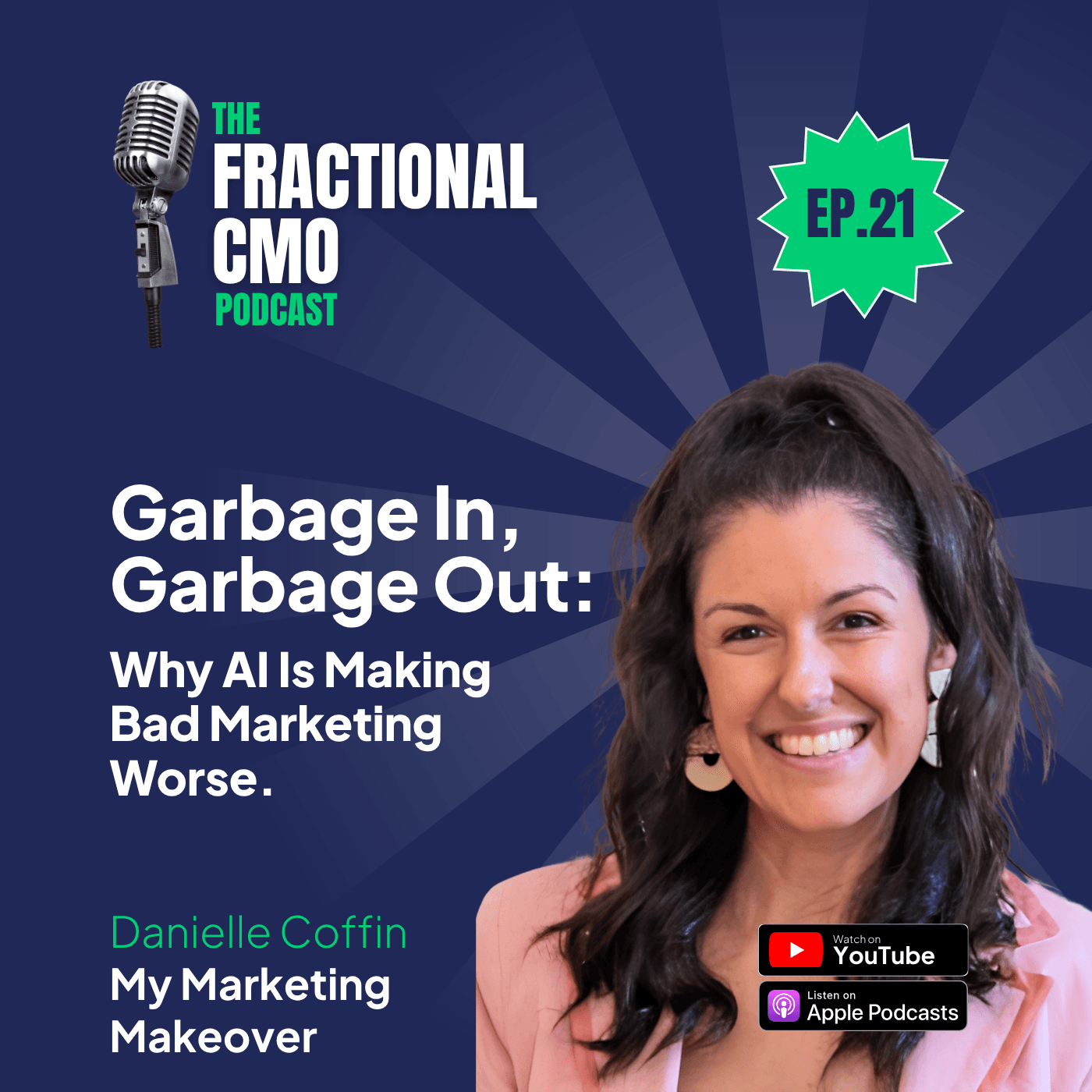
Danielle Coffin, Melbourne-based marketing professional and founder of her own consultancy/fractional marketing offering; ~18 years experience across IBM, in-house, agency, and consulting; previously worked with many clients and saw real conversion data vs vanity metrics.
Key claims
Bad marketing starts with not knowing the audience deeply (pain points, motivations, “elephants in the room”); AI-generated content is easy to spot when foundations are missing; more content isn’t the solution—consistency and trust are; inconsistent messaging erodes credibility.
Notable examples
Vanity metrics (likes/followers/viral reach) vs outcomes (sales leads, booked calls, bounce rate); broadening audience dilutes messaging; using competitors/forums (e.g., Reddit, Facebook groups) and AI prompts carefully to avoid “false positives.”
Written by AI. May contain mistakes. Listen to the episode to check what was said.
Chapters
Tap a time to open that second in VODanielle Coffin's Marketing Journey
0:45 to 4:25
Danielle Coffin shares her extensive background in marketing and her journey to consultancy.
“We are Australia's largest fractional marketing network.”
Defining Bad Marketing
4:25 to 7:23
Discussion on what constitutes bad marketing and the importance of understanding your audience.
“its impact on, on marketing and design and creative and all the other aspects of growing a business.”
AI's Role in Marketing Challenges
7:23 to 12:43
Exploration of how AI amplifies marketing issues instead of solving them, focusing on content quality.
“because obviously we didn't want to talk about how old you are and how old I am, but you've alluded to, you know, almost a 20-year career in marketing.”
Balancing AI and Human Touch
12:43 to 14:00
Advice on maintaining a balance between AI-generated content and authentic communication.
Navigating Content Consumption
14:00 to 15:00
Explore the impact of rapid content consumption and the importance of self-awareness in marketing.
Understanding Your Audience
15:01 to 19:06
Learn how to deeply understand your audience for effective marketing.
“I don't want to be in front of the camera all the time.”
Crafting Strong Messaging
19:07 to 22:05
Discover the importance of strong messaging and value propositions in marketing.
“You need to sort of find out the motivation behind that data.”
Effective AI Utilization
22:06 to 24:10
Gain insights into how to effectively utilize AI for marketing strategies.
“So consistent, you know, repetition, repetition, because as we said before, we're all consuming content so rapidly.”
Channel Strategy for Marketing Success
24:11 to 28:00
Understand how to develop a channel strategy that aligns with your audience's preferences.
“Do you need to be at a certain expo every year?”
AI's Role in Marketing
28:00 to 28:50
Discover how AI supports rather than replaces traditional marketing methods.
“Is that sort of a fair conclusion for what you're saying here?”
Show all 11 chapters
Connecting with Danielle Coffin
28:50 to 29:38
Learn how to reach out to Danielle Coffin for more marketing insights.
“But hopefully that didn't affect anybody else.”
Transcript
Automatic transcript. May contain errors.0:06Simon Dell:Right, oh well look it looks like we're already, there we go, it looks like it's already started recording. It was tricking me thinking it hadn't started. So welcome to the SEMO Marketing Podcast. That's thrown me completely now. I've forgotten where I am and who I am and all these kind of things. Before we do the introductions to our guest, my name is Simon Dell. I'm the CEO of CEMO. If this is your first time here, you spell CEMO, C-E-M-O-H. If this is not your first time here, you already know how to spell that. But you can find out more about us if you want at CEMO.com, or you can come and email me, Simon at CEMO.com, or find me on LinkedIn.
0:50Simon Dell:We are Australia's largest fractional marketing network. we find marketing solutions to marketing problems or growth solutions to growth problems because we're trying not to say marketing anymore. So, but my guest today is Danielle Coffin. Now, Danielle, it's cold where you are. Where exactly are you? I'm in Melbourne. So yeah, middle of winter. Okay. Yeah, it's pretty crisp. And we've got the heater blasting in there, keeping you warm yeah yeah yeah that's the background noise okay so cool all right well first of all uh tell us a little bit about you you've obviously been in marketing for a fair few years but give us the give us the edited highlights of uh of the of danielle's career uh yeah so pretty squiggly career um but yeah started in uh at uni uh literally after finishing year 12 uh studying marketing as my dad said I'd be good at it I didn't really know what it was so yeah and I fell in love with it just the people side the psychology side the communication side like everything about it really resonated with my personality and my strengths and then yeah started an internship at IBM at the age of 20 in marketing and yeah that kind of kick-started my career so yeah it's nearly it's about 18 years so not trying to tell you my age but yeah it's and yeah it's just been such a fun I just yeah lived overseas did all of the things whilst you know still building my career had my own side ventures have worked in-house I've worked agency have worked as a consultant so kind of seen every side of of the marketing landscape and and from different lenses so that's kind of got me to where I am today to actually run my own consultancy and fractional marketing kind of offer that I have for some retainer clients and then I have some kind of other offers for the people that aren't as like ongoing and yeah I just love it and I just think that you know to me marketing is quite simple and I think the industry and everyone in it can over complicate it and now with AI it has kind of brought a whole different dimension to marketing and growth and all of those different aspects of business and lowered the barrier for everyone to be a marketer.
3:34Simon Dell:What's been your highlight of the career so far? What's the favourite bit that you could go back to if you could um to be honest it's right now um yeah i know that sounds uh maybe a bit fluffy but i've been literally working towards running my own my own kind of consultancy and managing my own hours and owning my time for about the last seven years i've been working towards this and um yeah this year i was able to uh financially be able to do it um you know we've got a young family, mortgage, all of the things. So I didn't do it, you know, willy nilly. There was a lot of thought, a lot of planning, a lot of preparation.
4:14And yeah, so I'm just absolutely loving my weeks. I wake up Monday morning just so excited.
4:20Simon Dell:Cool. Well, look, we're going to talk about AI today, because obviously, it's everyone's favourite subject to talk about at the moment, especially its impact on, on marketing and design and creative and all the other aspects of growing a business. But before we sort of do that, because the title for this was why AI is making bad marketing. And I kind of wanted to get an understanding of what you define as bad marketing, because that's a fairly open-ended statement in terms of open-ended definition anyway. Yes. So, I mean, from the outset, you don't know if people's marketing is working or not because you're not inside the business.
5:06So what might look like it's working might not be underneath. And that's where kind of I look at it differently because I've had so much exposure to businesses, the inside of businesses. working in agency we had about 20 clients at any one time so we had like a front row seat to their data what was working and what wasn't working and a lot of it wasn't working um and you know there's all those vanity metrics of like oh they've got so many likes they've got so many followers um all of the things that can really make you look like you're doing well to someone else but at the end of the day it's the conversion metrics of sales leads booked calls you know all of those really really strong metrics that that's what you need to be looking at as a business owner over oh did that go viral or why did we you know did we get that many how many likes did we get or how many impressions and I'm like how much traffic do we even traffic to the website I'm like yeah cool but is it converting what's your bounce rate so So, you know, having that exposure, I now see as well with all of the AI use, you can kind of see an AI produced, you know, ad or social post or even website from a mile away because they haven't done the foundations.
6:34and so if you don't have your foundations right you are feeding AI just absolute BS and it's just not going to produce the outcomes and the growth and the you know at the end of the day everyone wants sales from their marketing right that's what we're doing marketing for so you know it's just starting to kind of help business owners and leaders in businesses start to kind of call out some of the BS that they might be fed by their agency or their marketing team or even themselves, I don't know, to try and help them really get those foundations right so that then you can produce good marketing that actually works and converts.
7:20Simon Dell:Well, let's take it back a bit before, let's go back three or four years because obviously we didn't want to talk about how old you are and how old I am, but you've alluded to, you know, almost a 20-year career in marketing. Before AI rolled around, what was bad marketing then? What would you, what would have you called out, even maybe before social media? Maybe, you know, what was, what is taking AI out of it because we know that the slot that that can produce. But yeah, what is bad marketing? Yeah, so mine is my take on it, and this doesn't matter what channel you're using, how you're getting your word out there.
8:07If you don't know who you're talking to and you don't have messaging that actually helps them feel heard and understood, then you're not going to cut through to your audience, no matter where you're doing that, whether it's an event marketing, whether it's big billboards, whether it's radio, whether, you know, back in the day when we kind of, you know, we're doing that more, whether it was, you know, commercials, you know, you just, those, that's kind of the main crux of it. And I see it time and time again, that people get into business, and a lot of them are technicians, you know, they've, they're good at some sort of technical thing, whether it be hairdressing, whether it be making something with wood, wooden things, candles, whatever, you're good at that.
8:55And then suddenly you have to know how to do business and market yourself. They're not good at doing that. And so suddenly you're trying to talk to someone to sell them something or promote something that you're trying to sell, but you actually haven't done the nitty gritty
9:15Simon Dell:work to really understand who they are what their you know motivations and i'll go into this as part of my like you know ways to fix you know bad marketing um and yeah so if you and you don't have the time to do that because suddenly you're like i need to make money i'm stressing um and you get into that kind of rat race cycle and it's not till you know maybe you make a certain amount that you start kind of building on that but you haven't still done the foundations of who you're actually talking to and i think people get a bit scared so they start to broaden their um audience parameters which can sometimes dilute then your messaging yeah well i i guess the the sort of next question i have is is um how is i i you feel obviously ai is amplifying the problems rather than fixing problems um you know often we were told in marketing throughout the years that more output is supposed to help like um you know if you listen to um if you listen to the likes of someone like gary v you know you know years ago not years ago not actually not years ago but in the in the near past he would sort of say you know just volume of content volume of volume of content volume of engagement out is the solution the more you do the more these channels will notice you the more you'll get shown to the customers the bigger your business will grow and and obviously what we're seeing now is that is that solution to a degree on steroids because you know ai is doing it all for us have we have we sort of gone out the other side or do you think that more is better was never actually the right solution i think it is if you are giving the right content so um you know gary b is very much around the give give give give give and then you ask to receive so you know he gives a lot of free advice, a lot of free tips, a lot of this.
11:32And I think, you know, he's very, you know, he understands who he's talking to as well. So, you know, the, you know, the producing more and more content, that's not the issue here. I think the issue here is they're producing content that is either confusing, it doesn't, it's not consistent on message, on brand, it's, it is, you know, it might even contradict each other. And I'm a big, If I'm reading someone's content, suddenly they've brought something in that they, I've got a bit of an elephant memory. A few weeks ago, they said something different. I'm like, whoa, what's going on here? I'm starting to lose trust in this brand.
12:13And so it's just very, you've got to be careful. If you're pushing out a lot of content, you really need to have those foundations strong so that you are staying consistent. because once you start pushing out inconsistent messaging, that's when you start losing trust, which is what I just kind of was saying before. And then you start confusing your audience. And then once you confuse, you lose.
12:42Simon Dell:Before we come on to the sort of solution side of things, the three things that you're going to talk about in terms of fixing this, it's probably worth stressing that this isn't an anti-ai argument it's not at all it's not saying you know we need to go back to the the basics of writing stuff down with a pen and paper you know um you know so it's but but the struggle i think a lot of a lot of businesses see is that there's they don't know where the line is they don't know where the line between making something better and something worse is do you kind of have any ideas as to how businesses should sit to understand where that line is yeah so i think what i say to my clients and and things is just like what can you physically do like from a resource perspective are you able to push out content every day or is that going to stress you out um you know because we're we're starting to kind of come out the other side a little bit with, you know, the way that we consume content, you know, I have real strict restrictions on myself with my phone and my social apps and the way I consume content.
13:55And I, you know, I know a lot of other people are starting to do that too, because we've kind of gone down here and then out the other side, like we do with everything that's new and exciting and different. And then we realise the behaviour of it isn't probably as healthy as we thought um and so that's where we start to be a bit more discerning and and start to you know put those human um barriers and boundaries around ourselves um and so i think you know a little bit we are we have been consuming content so much and so rapidly um that you know sometimes we forget to enjoy life and be in the real world um the amount of kids i see walking with just a head down don't even see me walking in front of them and looking at their phones and um so i think you know there's definitely a line and i just say to you know the business owners or leaders you know what can you from a resource perspective or from a realistic point of view like what can you produce each week from a content perspective what makes sense for your business as well so instead of like oh we have to be the next garyvee which is not the business model i want I don't want to be in front of the camera all the time.
15:09But, you know, he does. And I know other people, I've got other friends who do want that. They've got a camera person with them all the time. And, you know, all of that drivers, they can do content in between meetings and stuff. And I'm like, that's awesome for them. But is that what you want? So I think that's just part of that, like, self-awareness and really feeling, figuring out what you want for your brand. And because once you start producing that content and you get known for that, it's kind of hard to kind of stop and change and divert.
15:40Simon Dell:Yeah. Well, let's think about the three things that you'd flagged to sort of fix this. Any particular order that you want to approach them in? Yeah. So the first one is 100 % knowing your audience because that filters into the next kind of two steps. so this is not like you know putting together a demographic of you know females aged 20 to 30 who live in this area like yes that forms part of it but it's really getting into the deeper side of what they need what they don't even know they need what are their pain points what are their motivators you know how do they spend their day what are they where do they spend their time so that you can really understand, you know, how you can get in front of those people.
16:32And then from there, you can start to figure out what kind of messaging and stuff is going to cut through. Because I always say to my clients that, you know, if you're trying to reach a cold audience, having kind of a problem solution style messaging is the best way to kind of get in front of those people to take some sort of action, whether that be click something to your website, even download a free piece of resource you know a lead magnet that can get them into your email list so kind of you know really understanding what their problems is and how your product or service is going to solve that is a key key thing to kind of unpack here as well as elephants in the room.
17:19So I know a lot of people like to shy away from things that are kind of, you know, taboo or going to make their audience a little bit squirmy, which could be price. It could be, you know, one of the downsides of your product or service or something like that. But I might call that out, honestly, like it's going to help people feel seen and heard and understood, as well as going through objections that you might get when you're going down the process of call out objections earlier and frequently asked questions. So there's a few things that can be unpacked in this to kind of really understand your audience better.
17:59And then, yeah, my kind of little actionable tip here is that one of the things that is really interesting around what motivates us is that as humans, we're actually more motivated to move away from pain than we are to move towards pleasure so pulling out pain points and things that might be um you know they might be experiencing now and then how you can solve those is a really strong place to start
18:34Simon Dell:yeah okay so that's number one what's the so and and again i think number one is number one Number one feels like traditional marketing, like what we were doing 20 years ago when we started our careers. And just before we sort of jump on to number two, I think one of the solutions or one of the processes behind number one is to, which I think a lot of people forget, to do is actually go and talk to the customers is use a level of market research and yeah you know to actually sit down with them and go you know what is it that you want what is it that you need and you know how can we help you and those kind of those like nice long open questions where you get some insights from them yeah you know rather than making assumptions based on yeah Even if you've got data, never make the assumptions based on that data.
19:42Simon Dell:You need to sort of find out the motivation behind that data. It's the emotional motivations, yeah, which you can't get from data. And I think as well, what I say to my clients as well is don't just pick any customers. Who are your best customers who you want to get more of those people in? you know so you can think about like-minded you know okay what what motivated you to need this you know and all of that stuff so it's really important and a really easy thing you know a low-hanging fruit to to action yeah yeah um okay so uh number two what's your sort of suggestion yes number two is then starting to really pad out some really strong messaging and a really strong value proposition so this is where you talk about your audience not about you which we can all get really uh you know it's really easy to start talking about ourselves like we do this our mission is this we do that i and i think you need to flip the script and it really needs to be about your audience so using what you've done in uh you know unpacked in the number one around, you know, knowing your audience and stuff is then really, and you can use AI to help you kind of craft this, but really having some strong messaging, some strong positioning and value proposition statement that really brings the value you're going to bring to that audience.
21:22And making sure that you kind of have, I like to have it on like one, one or two max pages, because once it starts to go down to like an 18 page document which I have seen from many clients I'm like you ain't gonna remember that and I get you know where you you want to feed AI with a lot of this stuff and train your AI agents and whoever whatever platforms you're using to understand your audience but if you have too many different messages it can again start to dilute your content and your marketing. So my thing as well here is, you know, marketing is not about saying a hundred things once. It's about saying one thing a hundred times.
22:07So consistent, you know, repetition, repetition, because as we said before, we're all consuming content so rapidly. And if I see something here and then I see it here and then I see it there and then I see it there and it's all the same messaging and then I get an email about it, it starts to cut through, right? So I think it used to be kind of the seven touches of marketing and now I think we're looking at like 15 because we are just in a content driven world. And a lot of it is white noise. So I think, yeah, having a really starting to really unpack those messages and again, you know, talking to your customers about it, talking to your clients, starting, you know, I also do research around competitors here.
22:53okay what what are they doing how are they doing it and then also like forums and things where you your audience might be hanging out reddit I know that sounds bad but there's a lot of people trying to get answers and asking questions on reddit Facebook groups that kind of are in your industry or the type of work you do so you know there's really interesting places where you can find this content and again like you can help uh ai can help you do a lot of this research as well um but you need to prompt it properly otherwise you're just going to get uh crap in crap out
23:31Simon Dell:um that's an interesting you know that's an interesting conversation because um you know give example me and my business partner have been having a similar conversation with claude in the last couple of weeks. And, but we both ask slightly different questions. So the conversation goes off in a different direction. And I think there's a, there's obviously a danger, as you say, that if you ask the wrong questions, you get the wrong answers. And sometimes, you know, sometimes actually, understanding the questions you should be asking is the first step of all of this otherwise otherwise you do you just end up going in a in a circle of you know you just you just end up producing a false what i would call false positive you get the answer to something that you think's right but that wasn't the first place yeah yeah and you know ai doesn't have a frontal globe so it can't um it can't kind of you know when clients ask me questions i'll be like oh do you mean this like because i can kind of troubleshoot and and figure out kind of what they're trying to do without um whereas ai is you know they want to please you so you know i actually prompt i tell my claude to say um you're my devil's advocate like tell me this is crap like um so and that actually does give another another lens which i've done for a few um a few things recently and i'm like oh that's actually really good um and yeah because you you don't want to just have someone pandering to you the whole time because it's just not how you're going to grow yeah yeah yeah yeah okay third third and final kind of tip in terms of yeah yeah yeah so So the final thing is a channel strategy.
25:35So this is where instead of being on every platform known to man kind or woman kind, whatever we can say now, actually think through back to your audience and knowing where they are, where they hang out, what channels do you need to be on? And it doesn't have to be all digital. You know, where do you need to be? Do you need to be at a certain expo every year? Do you need to be at certain networking events? Do you need to be sponsoring an event or a podcast? Or where do you need to be? Where are your audience hanging out? And where are they going to be taking notice? So obviously there's the social media and lower barrier, less expensive platforms like social media where you can show up on Instagram and Facebook and, you know, TikTok and LinkedIn and all of those places.
26:35But, you know, but are your audience there? Like you need to be a bit more discerning around it. Like I've had clients, you know, say, oh, you know, I think we need to be on TikTok. And I was like, why? You're not targeting anyone under the age of 30. And they were like, oh, my daughter said, you know, I'm like, oh, okay. Well, let's just be a bit careful. So I think it's just really thinking through and using that human brain. It is just such a wonderful thing to figure out, you know, and, you know, a lot of it is trial and error too, but, you know, finding out where your customers did find you again, talking to your customers again.
27:16How did you find me? um so yeah it's just i think we lost back to talking to your customers i'm not sure if it
27:25Simon Dell:cut out just yeah no i got cut out there i don't i think one of us got cut out there so yeah okay yeah we thought that in the edit so yeah yeah so i think just not having to be everywhere um but really thinking through that and you can do that you know through chatting to your customers again and doing that kind of audience research to really figure out okay where where am I gonna be able to cut through and be noticed yeah yeah okay look I think there's a lot of there's a lot of good insights there I think there's a lot of good ideas I think I think the general gist I get from that is that AI is there to support, you know, not traditional marketing, but you know, more solid marketing approaches rather than replace all of those.
28:25Simon Dell:Is that sort of a fair conclusion for what you're saying here? Yeah. So really having those marketing foundations understood from your end so that you can prompt your AI to really do good marketing for you and cut through to your audience. Yeah. Okay. Thank you very much for your time today. No, thank you for having me. The little glitch at the end there. But hopefully that didn't affect anybody else. And look, if people want to reach out to find you, what's the best way of getting in contact with you? Yeah, so my Instagram is mymarketingmakeover. That's my handle. Or my website is mymarketingmakeover.com.
29:17They're kind of the two avenues best to contact me on. And then I'm also on LinkedIn as well.
29:24Simon Dell:Yeah, and of course, you're on the CIMO website as well. I'd have to keep telling everybody that as well. So thank you very much for that. some great insights really appreciate your your time today no worries Simon thank you so much for having me
From the publisher
AI hasn't fixed bad marketing, it's just made it faster and louder. In this episode of The Cemoh Marketing Podcast, Simon Dell sits down with fractional marketer Danielle Coffin (My Marketing Makeover) to unpack why so much AI-generated marketing falls flat, and what to do about it.
Danielle covers what actually counts as bad marketing versus vanity metrics, why AI amplifies weak foundations instead of fixing them, and her three-step fix: truly knowing your audience's pain points, building one clear message instead of a hundred scattered ones, and choosing the right channels instead of trying to be everywhere. Practical, foundations-first advice for any business owner or marketer trying to use AI well instead of being used by it.
We would love to know what you think, so give us a rating and review on Apple Podcasts and Spotify.
🌟 SUBSCRIBE to our YouTube channel to learn weekly expert marketing tips and ideas.
If you think you have a great story for the podcast, contact our producer at podcast@cemoh.com.
🚀 If you need help growing your business, visit cemoh.com to find an experienced marketing consultant to help you.