In short
Human connection in marketing—why “warmth” and trust beat generic content, and how to use AI without sounding the same.
Guests
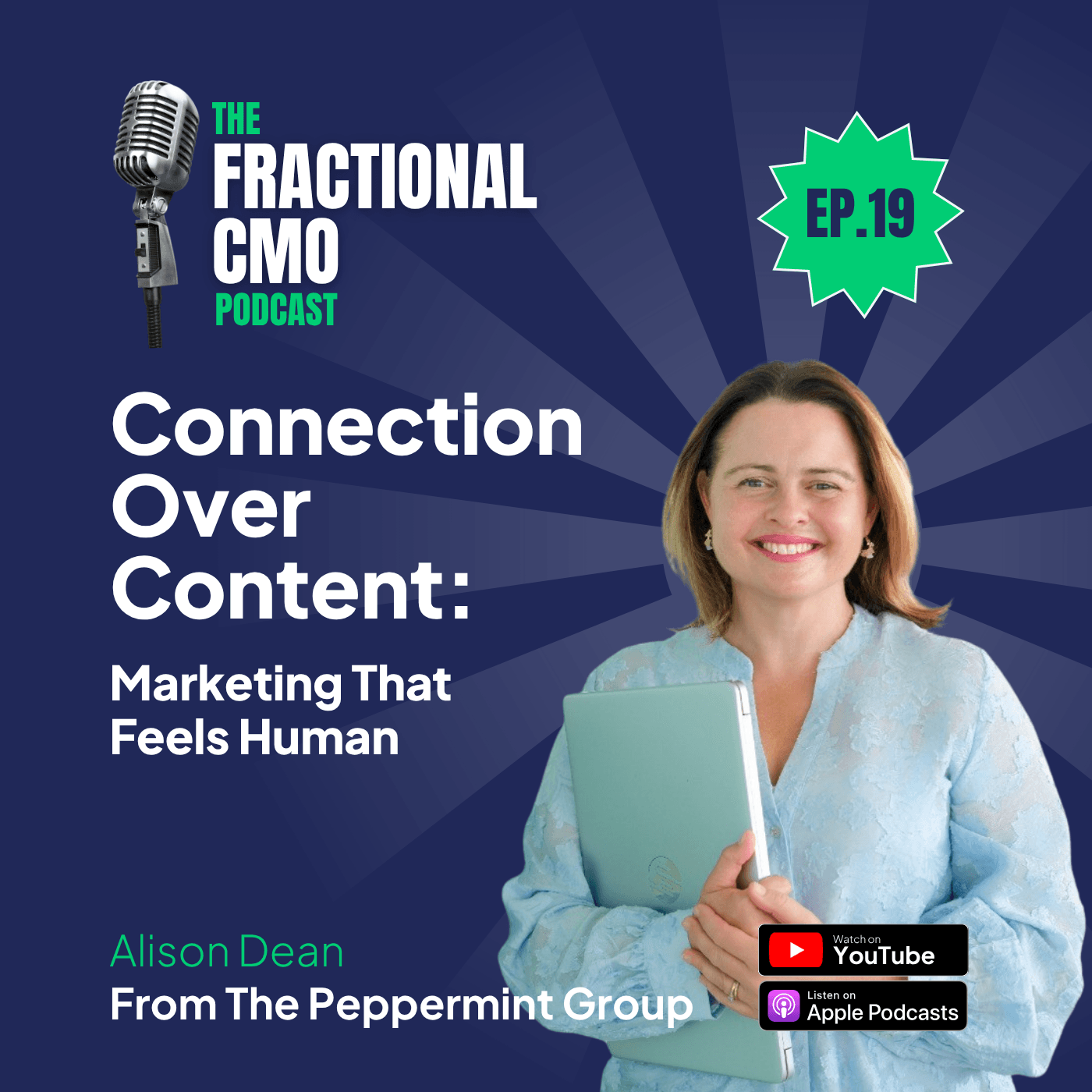
Alison Dean, 20-year marketing/brand professional. Started at Clemenger (Sydney) working with multinational brands on experiential marketing. Founded the High Tea Party, a live event series that drew ~30,000 women annually across Australian states and Auckland (NZ). Later sold it to a media company; COVID disrupted plans.
Key claims
People don’t have a marketing problem; they struggle to be seen and felt. Warmth comes from genuine human interaction and two-way storytelling, not feature lists or high-volume AI posts. AI should handle the “80%,” but founders must define the “20%” message and strategy in their own voice.
Notable examples
High Tea Party “microcosm” where brands had no direct competitors; guests got hair/nails/fashion and walked out with products. Brands’ sponsorship “self-liquidated” via instant purchases (e.g., capsule wardrobe showing purchasable items on real women).
Written by AI. May contain mistakes. Listen to the episode to check what was said.
Chapters
Tap a time to open that second in VOAlison Dean's Journey in Marketing
0:45 to 4:34
Alison Dean shares her extensive background in marketing and her experiences with the High Tea Party.
“First things first, let's give us the two-minute Alison story.”
Creating Memorable Experiences
4:34 to 6:43
Discussion on how to create events that prioritize customer experience over sales.
“That was not even close for two minutes.”
Key Learnings from Live Events
6:43 to 9:10
Insights from Alison on the importance of genuine connections in marketing.
“Everyone knows how to do something out there.”
The Challenge of Scaling Warmth in Business
9:10 to 13:07
Alison discusses the difficulty of maintaining personal warmth as businesses grow.
“It was how we communicated between events.”
The Human Touch in Marketing
13:07 to 14:00
Exploration of how genuine human interactions are vital for effective marketing.
“Where do you normally see that warmth dying first?”
Human Connection in Marketing
14:00 to 16:10
Learn why genuine human interaction is essential in marketing.
“It's the feeling, it's the story behind the human, it's the interaction.”
The Role of AI in Marketing
16:10 to 19:29
Discover how AI can enhance marketing while maintaining a human touch.
“Let's strip everything back and be simple.”
Building Authentic Business Connections
19:29 to 24:52
Learn strategies for fostering authentic connections with customers.
“when we were discussing having this conversation, and I think there was a sentence you said, most people have AI backwards and that it doesn't make marketing easier.”
Investing in Long-Term Communication
24:52 to 28:00
Understand the value of investing in brand-building for long-term success.
“Let's review what our marketing's doing and tell our story.”
The Importance of Connection in Marketing
28:00 to 29:38
Learn why understanding your audience is crucial for effective marketing.
“real women, and they'd go out the door and purchase 25 grand's worth of product.”
Show all 11 chapters
Connecting with Alison Dean
29:38 to 30:29
Discover how to reach Alison Dean for further conversation and insights.
“So if everyone wants to reach out to you, what's the best way of getting a hold of you?”
Transcript
Automatic transcript. May contain errors.0:07Simon:Welcome to the CEMO marketing podcast, the CEMO fractional marketing podcast or whatever I've decided to call us this week. My name is Simon Dell. I'm the CEO of CEMO. If you don't know nothing about us, come find out about us on CEMO.com. If you've been here before, then welcome back. We are going to talk about connection today, not in the Telstra sense of my phone line and all that sort of stuff, but in the proper human connection. And I'm lucky enough to have Alison Dean with me. So welcome to the show, Alison. Thank you. First things first, let's give us the two-minute Alison story. Now, when I ask people to do this, I'm like, Imagine it is a movie trailer and you've got to get all the best bits of what you've done so far in your life into a two-minute movie trailer, ideally with some explosions and…
1:07Simon:Along the way. But no sex scenes. You won't get that from me. I'm a bit old for that now. Hi, everyone. Welcome to the podcast this morning. Thank you so much, Simon, for having me. I'm really thrilled to be here this morning. My pleasure. I have been 20 years in business this year, which is a bit of a milestone, always in marketing in the brand space. I started in one of the largest ad agencies in Sydney, which was Cleminger back in the day, and was working there with a lot of multinational brands that were desperately wanting to look for this connection that we're going to talk about today. now just be preface this by saying these were in the days before digital media there was no facebook there was no instagram but these brands knew if they wanted to get in touch with these customers they needed those customers to touch feel and sample their product so we called it back then experiential marketing it's all about experience and they felt that they wanted to earn that trust through the customer.
2:20So in my journey, I couldn't find it. I couldn't find a lot of these opportunities for people to touch and feel these, you know, multinational brands. We would go to places like shopping malls and all those kinds of places, but there wasn't something specific where you could target your ideal target market. So what did I do? I founded the High Tea Party. Now, a very cute brand, but there was a reason for it, and it was to attract the right women to come along to this event. So over 15 years of that 20 years I've been in business, I created this live expo that brought about 30 ,000 women, a lot of women through the doors every year.
3:05We ran one in each state of Australia and then in Auckland in New Zealand. Now, think about it like this, Simon. And it was like an idea of flipping that expo on its head and forget about the brands for a moment and think about it as a customer experience. So going back to what these brands wanted, they wanted those customers to really trust them. So I flipped it and made it all about the women. Again, the high tea paddy, cute brand. but it was also what can we do to wine, dime them, give them fashion, all those things that allowed them to have that exceptional day and, of course, walk out with, you know, products in their hand and services the companies that are involved.
3:47So I think what I learned most about that time is that people buy from people they feel connected to and I suppose during that time I still needed to run a business and the business was to build it something that was scalable and then I sold that to a media company that wanted that amount of volume and moved on now as I am now to a fractional CMO and I'm hoping when I say that I work for founders with their own businesses and their own ideas and trying to really strict marketing back because with AI and all the world out there it feels very chaotic so
4:31Simon:So that's where I'm at. Did I do it in two minutes? No, that was terrible. That was not even close for two minutes. No sex scenes, though. There was no explosions as well. I was waiting for that. No explosions. What about 30 ,000 women? That was explosion, I tell you. That was explosive. Yes, probably. Okay, a lot to unpack there. Yeah. A lot to unpack for half an hour. Look, my first question is, how do you make something like that 30 ,000 women I mean obviously it wasn't all 30 ,000 women at the night but how do you make something like the high tea party where these brands want to connect with these these um these women how do you make that not feel like a salesy promotional event how does it not feel like it's uh um you know like Oprah used to do where you know you get a car and you get a car and all that kind of, how do you make it not feel like that?
5:30I think the biggest thing about the event was like I talked about, it was all about the experience of the guests. Anywhere you went, there was nothing, it was all about the experience. So if you had a hair care product there, the girls were getting their hair done. They didn't have to buy the product. They were there to get their hair done. So as part of the ticket price, it was all about get your hair done, have your nails done, watch a fashion show. And then I would ticket price it with all-day champagne, all-day food that you were making it more about them and their experiences. And the brands were separate to that because at the end of the day, the feeling that they got for coming into the room was, well, what has Alison got for them this year?
6:18Not what's Alison selling to them. So it was all about the feeling, which is coming back to what I, what we're going to talk about is about connection and how you scale that is all about the trust and that the people have that feeling about your brand before you even start to sell. That's marketing to me. Yeah.
6:43Simon:Okay. All right. um i was gonna i was gonna ask a very insightful question there and i've completely forgotten what it was because then you said something else and then i went off and a brain went off on another tangent there completely yeah um but what did what did you doing that doing those live events must have taught you some stuff that that running an agency or being part of a clemenger was had had never taught you that I mean there's got to be some some key learnings once you are physically in front of these potential buyers what did you what did you what was the key learning you made you got out of all of that um I think that especially coming back into this era of me being a fractional CMO and reflecting back on what I what I learned a lot um is that people don't have a marketing problem.
7:38Everyone knows how to do something out there. They know how to post a Facebook post. They know how to set up a channel. Yeah. But I suppose the biggest thing I learned was that it's harder for people to be seen but not felt like no one is listening. So for me to have this microcosm of an event set up to kind of say you come into this microcosm brand and you'll be seen wholeheartedly in this space with no other competitors. So, for example, I never had two hair care products or two nail products. You are that product, but you're absolutely being seen and therefore connected with that client. because they can't see anybody else and make a choice.
8:34Simon:Yeah. It's all about that. So I suppose me reflecting on that now is, you know, people forget that marketing is like telling your story like you're at a dinner party versus how you want your story to look like in a beautiful brochure. Yeah. And I think that is what the Tea Party was really about too is that it's not all simple and fabulous. as it's I'm talking to real women and I'm talking to them and I'm building the community around it. And that was a very big part of it at the time. It was just not the live events. It was how we communicated between events. You know, Sydney would only get one event a year.
9:18So, therefore, I had to make sure that I continued to keep these Sydney women, for example, engaged for the whole 12 months and then we'd move to Melbourne and things like that. So I think now, especially in this era, you know, people don't want to see something polished. They want to see something real. And that's, I feel like that feeling is what I created at the Tea Party.
9:42Simon:Look, I mean, I love what you created there. And obviously I can see the success based on the fact that there was 30 ,000 women that wanted to go to these things. But why is nobody doing that now? or are people doing this now and I'm just I'm oblivious to it because it strikes me that that you've you've niched down you niche down at women and I suspect those women were in a certain demographic you know they they fitted within a certain you know a certain age and whatever it was right but this this strikes me that this would work in all demographics or lots of different demographics? Why is nobody doing it like this?
10:32I suppose when you create a live event like that, the infrastructure and the processes and systems that you have to put in place for the one female that's coming to feel that special connection, to feel part of it is quite difficult to say the least. So, you know, I did things like come into my ballroom, but you're not going to sit with 10 other strangers like a normal ballroom set up. I'm going to sit you in a table of two if you've come with your mother or a table of 10 if you've come with your girlfriends. So we seated it like a restaurant. Now, to make a large hotel like the Hilton Sofitel and all the places I host these events do that is, you know, it's something that has to be really understood by them that it's not a normal event.
11:32Then I would turn that ballroom over to get through those 5 ,000 women that would come to each event and 30 ,000 nationally. I'd turn the ballroom over eight times in a weekend. So to make it that special and that connected was a team. Now, when the media company bought it off me, COVID hit, unfortunately. So that went downhill at the time.
12:00Simon:Wow. That was a good time to get out then by the sound of it. So their whole premise was this is the live magazine for us. So as we know, magazines are not the first thing you pick up anymore. but this was going to be that for them post-COVID was that they'd pick this up and use it as the live, you know, a live magazine where you had all the, you know, interactive spaces. So I suppose that's the answer to it, that it is to get that feeling, you have to put the work in and you have to feel like each guest. But because I was a small business, which is very different than me being part of a bigger agency, This was my livelihood as I created and owned it.
12:44So every person that came into me was like, well, that's my income as a business owner. So I'm going to treat them, every single one of them with a feeling that I can't believe that you'd like to come to my event. So that was, that warmth, I think is part of, part of it because it was owned by a small business as opposed to a large. Yeah.
13:07Simon:Yeah. Yeah. Let's talk about that warmth because the question I have is that that warmth of that one real conversation, when businesses scale, there's the obvious problem that that warmth can tend to cool down a little bit, sometimes a lot. Where do you normally see that warmth dying first? Yeah, I think, especially in this era of AI as well, it's very easy to market, right? You can make 1 ,000 posts in a week. Your content is never scarce. You've got volume constantly. But I think the warmth comes from being human, right? So I'm taking people and the people that I support with my fractional CMO business back to being that genuine human touch again and saying to them things like, you know, the local fruit shop owner, why did my parents go back to that fruit shop every week to buy those apples?
14:21It's the feeling, it's the story behind the human, it's the interaction. And so what I'm saying now to people is you can write a thousand posts with AI and you genuinely can keep that up. But what is it that that customer actually wants to know? And what is the message you can only write about your business? And I say it again and again to people like there's 10 electricians that live in my street. What is the one thing that would make you go to one over the other? That's the feeling I'm talking about and people miss that when they scale because they're talking about products first or describing features.
15:05And that comes down to it's time to make sure that, you know, we protect that humanness and we protect when AI is doing the volume, let's talk about the story, let's listen to our customers. You know, I've got a client at the moment that he's quite a large manufacturer in educational products. And 80 % of his work come from him as the CEO doing demonstrations of their product. But he will never change that because he knows how to sell his products. So how does he scale that? He goes into different industries. He does those things. He makes his team make sure that they know how to scale.
15:52Simon:Yeah. And how he shares his ideas with those potential customers. So it's in all of those types of messaging pieces. You can put your message out, but let's not overcomplicate what we're trying to do. Let's strip everything back and be simple. And the story is always simple. You created a business for a reason because you wanted to help that particular customer. regardless if it's a product or service. Now let's talk in their language, not your own. Yeah. It's funny you mentioned that CEO doing the product demo. I remember coaching, I say coaching, mentoring a CEO who had a rather large, it was some sort of industrial supply business.
16:42Simon:It was a while ago. I can't quite remember what it was. But as he'd grown the business, he was still the one who did all of the sales calls. and he was, you know, I remember saying to him in the session, going, why are you doing this? You've got people doing every other part of the business and the finance and the operations and delivery and manufacture and sourcing and all those kind of bits and pieces. Why don't you just hire someone to do the sales calls? And because he used to sit there for eight hours a day doing sales calls. That was his job as the CEO, right? And he turned around, he just said, he goes, I really like doing them.
17:22That's right.
17:23Simon:He said I really liked talking to the customer. And, you know, now I look back on it and I go, that was his way of maintaining that warmth, of maintaining that sort of engagement with the customer. Even as he got bigger and bigger and bigger, he was still the one making that call. Making the calls. And, you know, it's interesting that is because people go into business, because they're passionate about a product. I mean, my work as a CMO is to take that passion of a product and make sure you flip it so that you're talking to the customer and not, here's our product bias. That's the difference is that, you know, when you think you're not selling enough, it probably isn't because you need an agency to run another ad or you need another channel like TikTok or you need another something happening, it's because the real issue is that you're talking to everyone, but you're never talking to someone specific.
18:29So when my client is on that phone call, he's got the right person in the palm of his hands and he knows that his product solves that problem. So if he actually isn't selling because that is his ideal customer and the product was was made for them or even at some point in conjunction with them because he went to market and said, what do you need? So that is where the warmth is, I think as well, is that it's not a one-way street, it's a two-way conversation and negative and positive feedback about your business is always good. I remember a lot of times at the high tea party where the scones were, where the scones were hard and the sandwiches were, you know, you go, that is good to know because I want to feed back to that person that I want to get it right.
19:24I want to make a difference for that. So, yeah.
19:28Simon:Look, you spoke about AI a little bit in your original brief when we were discussing having this conversation, and I think there was a sentence you said, most people have AI backwards and that it doesn't make marketing easier. It makes everything sound the same. So talk me through that because the danger is we're all using AI. We're all starting to tap into it and all it's going to do is just create the same, same, same, but different. Exactly. And I think AI is a tool that is, you know, is one of those phenomenal, parts of history that we're sitting in right now that will allow us to, you know, multiply our workloads in a heartbeat.
20:20And clearly in my business, that is something that I'm, you know, consistently using. So I am not sitting here saying that AI is not a great tool because absolutely it is. but what AI can't do for you is be your creative head. So how you are as a founder and why you are in business and why you've built the product or service, unless you have built that in to feel genuinely human and to not trust what it outputs, to test the boundaries of it, to make sure it feels like you, to put the time and the energy in first. And we call it strategy here, you know, in marketing terminology, but getting those pillars right, making sure we're having, we're telling the right, we're having the right message, we're writing the right message, then that's the part where I'm saying is don't let it be your strategy.
21:24Still sit down in a room with people and build it together with the people that are in your business or outside of your business to really formulate exactly what you want to say in market, then use it. So maybe not backwards, but there's a step before it that people are just going straight in and seeing these answers, which are, you know, fabulous, it's brilliant, it's producing, but unless we're going to put out real answers, information about your business, you're just going to be average. You're going to be talking to everyone again. You're going to be drowning in what looks like AI. I mean, we can all see things out there already that are AI.
22:09You know, use it for that 80%. That's what it's there for. But don't forget, the formula is to still be 20 % in your business to make sure the message is clear and protect that um protect that it's still the same that will not change um as we move forward in you know this ai era it will not change it is how you will stand out will be because you're human how you will stand out is that like i'm saying is the connection um you know people trust people that's why they buy your product whether you're a b2b you're emotional you know i've gone to many clients that if you don't emotionally connect, you don't get the job, whether you're the best in the room.
22:54So that's what I'm saying to founders out there as well is be, yeah.
22:59Simon:So what does that, what does that translate to? Because I think again, you, you said the one thing you can't automate is about, is, is, is about to become the most valuable thing that you have, right? Which I think is a great quote, right? All the things you're saying there, I think everybody goes, yeah, get that. I completely get that. What does a founder do on a Monday morning with that, right? When they've listened to this over the weekend and they sit there and go, well, Alison's right. I need to be better at building connections. Do they, if they're the CEO, do they sit there and go, yeah, actually, I'm going to sit and make the phone calls.
23:37Simon:You know, I'm going to do that. What would you say is a simple step for them to take Monday morning? You know, I think the first thing is, is to talk about your business. Like you're talking to a friend about it, number one. Like, can you formalize, people call it an elevator pitch, forget the elevator pitch. Talk to me about, when you get to work on a Monday morning, let's talk about the three biggest things that your business does that completely is, um, hits the pain points of that customer. So what is it that they do? Then let's talk about whether that is actually being put out in messaging because sometimes we put out things that we're all cluttered and chaotic about, oh, this is the new product we've got out there, so let's talk about this, then let's talk about this.
24:36Do those things, but are we telling that story consistently all the time? So let's bring it back to basics. So on Monday morning after they've listened to this, I'd say, right, go back to basics. Why did I start the business? Let's review what our marketing's doing and tell our story. I've got a community centre that I'm working with who've been in market for 50 years doing the most wonderful work in Sydney for people that have, you know, have aged care, you know, want to stay in their own home. They support them with services. we've got a 50-year history. Now, when I go and look at their messaging, they're not speaking about how they're evolving.
25:20They're not speaking about where they're going to next. They're not talking about the future. Yes, let's talk about the past, but where are they going? So I have to frame that and make sure that they are talking online and also face-to-face with one clear message, and that's what I'd say to them.
25:39Simon:Yeah, okay. um well just to close then um what we've talked about that let's talk about money because um it's a question that obviously i get asked a lot and i suspect you get asked a lot yeah is investing in this warmth right investing in this communication let's take it back all the way to the to the um to the high tea party yeah you and i both know that doing those kind of things for brands pays off in the end right and it may not pay off the following day it may not pay off the following week it might take a month it might take six months right that's that's a hard some some businesses who don't necessarily understand marketing you know and and this is a bit new to them that's sometimes a hard ask for them to sort of go hey invest this money in what is essentially brand building brand awareness here and this may pay off in six months time right did you ever get that kind of push back when you were doing that with the the high tea party that they couldn't see that they couldn't potentially see the results happening instantly right so that was that was what That was one question.
27:04Simon:And then the second thing is then how did you encourage them to put a price on this? Because if they're going to come and spend thousands of dollars with you, understanding that return on investment must have, for some of them, been a challenge. Yeah. First and foremost, let's talk Tea Party first. Um, the microcosm I talk about is, was based on you do this and you will see an instant return on investment because the instant return on investment was those women walked out the door with products. So if I gave you an example of a fashion brand that did a capsule wardrobe, do you know what a capsule wardrobe is, Simon?
27:51Yeah. Great. Capsule wardrobe. That's all they showed is what was available to purchase on the day. nothing more. That brand would show it on real women, not stick figure women, real women, and they'd go out the door and purchase 25 grand's worth of product. So my micro, that's how I ran it, is that you will see a result instantly. Your sponsorship of this event was self-liquidating because you bought out sales. So that's number one. number two when i talk to clients now about how you invest in this or why you would invest in this and pay thousands of dollars is well what happens if you don't because again you are talking to nobody if you do not know who you were talking to yeah and if i was to say and i'm not if i was to say any other marketing that you do that you put yourself in a room with someone so that you are very clear about who you are as a business and what your messaging is and who your audience is and why you are a business.
28:57If you do one of those things and run your entire campaigns, activate, execute through Claude, through AI and all the tools we have, do that one thing because that is about the connection. And that is where CMOs and those types of people are able to pull that out of you. I'm not a rocket science. It's not my business that I go into businesses. I listen and I find those nuggets of wisdom that they have for what they've produced. And it excites me because of that. So if I was to do one thing is to get that message right. Because if you don't, you'll spend thousands on nothing.
29:36Simon:Yeah. Wise words. Alison, thank you very much. Thanks, Sonny. Appreciate it. So if everyone wants to reach out to you, what's the best way of getting a hold of you? Yeah, so the Peppermint Group is my website. So thepeppermintgroup.com.au and you can always find me on Instagram at Alison L. Dean as well. So love anybody to, even if you just want to chat. And I'd assume you're on LinkedIn as well, but there may be a few Alison Deans out there. A few Alison Deans out there, probably no Peppermint Group ones. Perfect. All right. Thank you very much for your time today. Thanks, Simon. I appreciate it.
Read the full transcript
30:16Simon:It's super helpful. And again, if anybody does want to reach out to Alison, by all means, you can reach out to her direct or you can find her through simo.com as well. Cool. Fabulous. Take care, everyone.
From the publisher
In this episode of The Fractional CMO Podcast, Simon sits down with Alison Dean, fractional CMO and founder of The Peppermint Group, who has spent 20 years in marketing and brand. Alison started her career at Clemenger working with multinational brands, then founded The High Tea Party, a live event experience that brought 30,000 women through the doors every year across Australia and New Zealand before she sold it to a media company.
Simon and Alison explore why human connection is the one thing you can't automate, and why it's about to become the most valuable asset any business has. They cover what 15 years of live events taught Alison about trust and warmth, why businesses lose that warmth when they scale, how AI makes everything sound the same, her 80/20 formula for using AI without losing your voice, and the simple thing founders should do on a Monday morning to get their message right. Expect scones, capsule wardrobes, and a masterclass in making customers feel seen rather than sold to.
Alison's website: thepeppermintgroup.com.au
Connect with Alison on LinkedIn: https://www.linkedin.com/in/alisonldean/
We would love to know what you think, so give us a rating and review on Apple Podcasts and Spotify.
🌟 SUBSCRIBE to our YouTube channel to learn weekly expert marketing tips and ideas. If you think you have a great story for the podcast, contact our producer at podcast@cemoh.com.
🚀 If you need help growing your business, visit cemoh.com to find an experienced marketing consultant to help you.