
In short
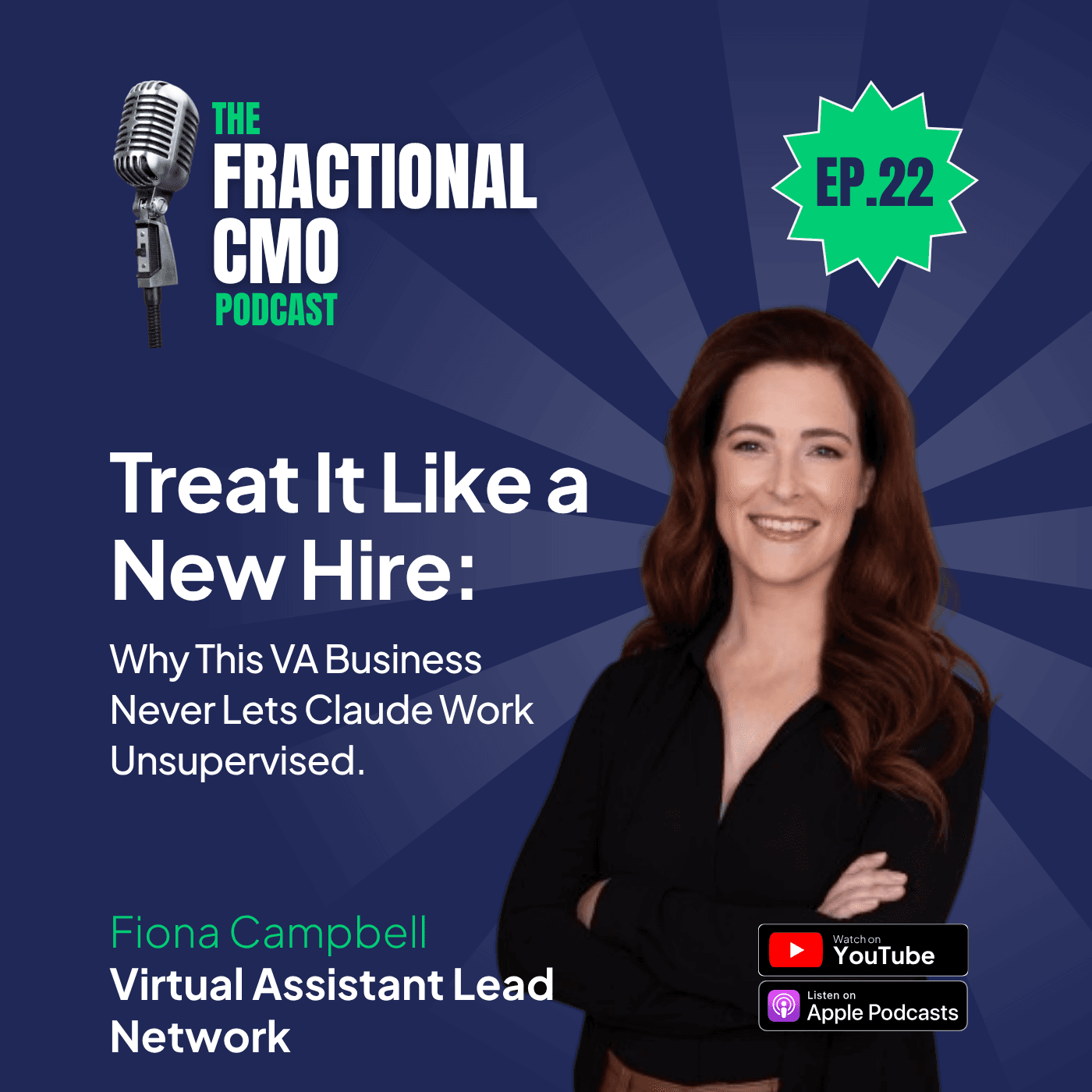
How Fiona Campbell uses Claude in her Australian virtual assistant businesses, emphasizing supervised use, internal documentation, and human checkpoints to prevent costly errors.
Guest
Fiona Campbell, runs Thought Penny (Australian VA agency; currently closed for new clients) and Virtual Assistant Lead Network (VA/OBM jobs board; free for businesses; 300+ members; lean, VA-run team). She also integrates Claude with tools like Shopify/Clavio/PipeDrive and has built brand/style-rule documentation for AI.
Key claims
Treat AI like a new hire—never let it work unsupervised. Use Claude “team” settings to prevent chat sharing. Store business knowledge in markdown files (tone, brand rules, decision logs, backlog). Require human review/green-light for higher-risk steps; monitor especially during the first 100 runs. Claude can add nuance by asking for reasons and updating protocols.
Notable examples
Claude misread a Shopify backorder SKU and marked it in stock; Claude drafts/triages customer service context; Claude automates Shopify inventory updates from invoice CSVs; Claude Design/AI Engine helps generate and adjust website pages while enforcing color/style rules.
Written by AI. May contain mistakes. Listen to the episode to check what was said.
Chapters
Tap a time to open that second in VOIntroducing Fiona Campbell
0:45 to 1:53
Fiona introduces her virtual assistant agency and current projects.
“So I do have my own Australian virtual assistant agency called Thought Penny.”
Virtual Assistant Lead Network Overview
1:53 to 2:32
Fiona discusses the Virtual Assistant Lead Network and its benefits.
“And, yeah, really exciting what we're seeing.”
Implementing AI in Business Operations
2:32 to 3:26
Fiona explains how AI is used for organizing content and business operations.
“For us, we're predominantly using AI to document our business and set up procedures and protocols.”
Security and Protocols with AI
3:26 to 5:02
Discussion on security measures when using AI and internal protocols.
“I think it's important to make sure that no one on your team is able to share their conversations with the platform.”
Training AI with Brand Guidelines
5:02 to 7:13
Fiona describes the importance of training AI on brand guidelines and decision-making.
“I'm a bit pedantic and a bit of a perfectionist.”
Flexibility and Out-of-the-Box Thinking
7:13 to 8:01
Exploring AI's limitations in creativity and problem-solving.
“Do you think that with those guidelines, I mean, how rigid are those guidelines?”
Challenges and Mistakes with AI
8:01 to 10:54
Fiona shares experiences with AI mistakes and the importance of monitoring.
“Um, first, I don't think it's possible for it to have out of the box thinking because it's, it's, it's pulling from, um, learnt behaviors.”
Human Oversight in AI Operations
10:54 to 14:00
Discussion on the necessity of human oversight when using AI tools.
“And as orders come in, the invoices are turned into CSV files.”
Human Checkpoints in AI Workflow
14:00 to 15:40
Learn how human oversight is crucial in monitoring AI outputs.
“checks in place, you know, you have work being checked at certain points.”
Training AI Like a New Hire
15:40 to 17:40
Understand the importance of training AI systems with human guidance.
“Send an email or send a sign-off task or send a Slack message just to flag, hey, I just did something cool.”
Show all 18 chapters
Balancing AI and Employee Roles
17:40 to 19:45
Explore the dynamics of AI integration and its impact on employee responsibilities.
“So, and the way I talk about the elephant in the room with that as well.”
The Value of Boring Work
19:45 to 22:40
Discuss the necessity of repetitive tasks for skill development.
“and learned the skills by doing the boring work.”
Integrating AI Tools Effectively
22:40 to 25:00
Learn about various tools and integrations that enhance productivity.
“What's been the sort of standout integration from you?”
Documenting Brand and Design Systems
25:00 to 28:00
Discover how to create effective branding and design guidelines using AI.
“And just to do a quick segue, so one of my favorite integrations is I've done a custom MCP with AI Engine.”
Leveraging AI for Design Systems
28:00 to 29:22
Learn how AI can streamline design processes and improve efficiency.
“So I said, go and research everything you can about Claude design functionality.”
Establishing Effective Documentation
29:22 to 31:28
Understand the importance of documenting business processes with AI assistance.
“It is a rabbit hole that we can dive into, you know, for hours on end.”
Treating AI Like a New Team Member
31:28 to 32:54
Discover why it's essential to hold AI to the same standards as human employees.
“It's teaching Claude that it needs to work with you as you work to build up those files.”
Connecting with Fiona Campbell
32:54 to 33:38
Find out how to get in touch with Fiona for VA services and support.
“So final thing, if everyone wants to reach out to you, what's the easiest way of getting hold of you?”
Transcript
Automatic transcript. May contain errors.0:06Simon Dell:Welcome to another SEMO marketing podcast. My name is Simon Dell. I'm the CEO of SEMO. We are a national marketing solutions company. I completely forgot what we do there for a minute. and I have as my special guest today a lovely person called Fiona Campbell. I'm not going to explain what Fiona does because I'm going to let Fiona do that herself. So welcome to the show, Fiona. Hi, thank you for having me, Simon. So tell us, give us the Fiona edited highlights, the sort of the five-minute show reel, the sizzle reel, as it were. Sure thing. So I do have my own Australian virtual assistant agency called Thought Penny.
0:58But right now that's closed for business. Our full book of clients are not growing any further. So at the moment, my current project is my sister business, which is the virtual assistant lead network. So essentially what that is, it's a jobs board for virtual assistants and online business managers who are based in Australia. And unlike other platforms like SEEK, it's free for businesses to list their ongoing roles or short-term projects or one-off tasks, et cetera, on our jobs board. And that's because we have a membership base of those Australian VAs and OBMs who are accessing those jobs board and our training and webinars, etc so uh yeah going strong it's been going for a few years now and we have over 300 members and yeah it's run on a very lean team um from the beginning before ai was a thing it was already a lean team of virtual assistants created by virtual assistants run by virtual assistants for virtual assistants and yeah virtual assistants just to throw that word in and phrase in again But, yeah, we've just started using Claude to help with the operations there and power through even more work, keeping our existing team.
2:23And, yeah, really exciting what we're seeing.
2:27Simon Dell:So, obviously, we're going to talk today. The predominant conversation is obviously AI. um we are bombarded with all sorts of information about ai every day in in pretty much every medium that we're in what are you what are you personally using it for at the moment what's the the go-to for you day to day yeah sure so uh we we do use it to help organize our content not necessarily create our content like people typically are using AI for. For us, we're predominantly using AI to document our business and set up procedures and protocols. And it's the day-to-day running of the business itself. So important to know though that I do think it's really important anyone who wants to do this, they look at what plan they're using and the settings.
3:29I think it's important to make sure that no one on your team is able to share their conversations with the platform. For instance, we're using Claude. I'm using the team's plan so that I can enforce that no one is able to share their chats with Claude for Claude to learn from, etc. And also, they're not able to share public links to any chats they have. It's all kept internal. So that gives us, you know, that assurity that it's not going anywhere so we can use it to its full abilities. And so, yeah, it knows exactly how our business is run. We have shared projects with that team's plan. You can have shared projects and each project has shared files, shared knowledge.
4:27So the chats themselves, whoever from my team I put in that project, they can't see each other's chats unless that's shared with the team. Though the knowledge files that it's pulling from are all shared. And so what I mean by that, it's markdown files and the types of files are, well, a record of decisions that we make, a backlog of problems we've seen that aren't exactly a priority, but someone should probably fix those next time we get a chance. There's our tone of voice, our brand and style guide to say, no, that color red isn't, it looks similar, but it's not quite right. I'm a bit pedantic and a bit of a perfectionist.
5:05And I like consistency, not just visually, but with the words we use, et cetera. There are definitely some things that I don't want our brand ever to say, like mumpreneur or anything like that.
5:19Simon Dell:That's a terrible word. We all hate that word. Yeah, I'm not happy with it. And everyone who wants to use it, go for it. But that's a decision I've made for my business. And it means that I can put those rules in place. And I can even tell Claude, next time someone tries to use it on my team, is go, this is what Fiona thinks about this and have an automatic warning system in there. And visually as well. It's, you know, if you're trying to make this colour work with this colour, Fiona's not going to be happy about that. This is the reason why. And I guess a big part of that as well is that's all well and good, but the onus can't all be on me to build that out.
6:00Though I did nerd out over one weekend and build out a big chunk of how all this works because that's my thing. But it is about educating your team as to how we're going to use it. and how we're going to maintain it. And it only works if you spot something, an error, you know, Claude's made a suggestion and you know it's wrong. And we explained to Claude, no, we never ever do this because of this. And it will update the project files the next time someone goes to do it. And I'm in a good place because everyone on my team has been with me for a while. We already know the rules and what it should be, but we're still teaching Claude that when it makes a suggestion, it's, oh, I'm going to suggest this because according to the brand guidelines or according to the protocol, we do this to avoid this risk, et cetera.
6:55So it's not just about just telling someone, this is a new person, for example, this is the way we do things in our business. It's also educating them on the reason why, the way you'd bring on any staff member before you had AI, you explain why we do things the way we do, because they're going to remember it better and have buy-in to that decision.
7:17Simon Dell:Do you think that with those guidelines, I mean, how rigid are those guidelines? Because this is obviously one of the big challenges that you find with AI is that it's not going to suggest anything new. There's no flexibility. It's being governed by a certain set of rules. I mean, to a degree, that's all businesses, irrespective of whether you're using AI or not using AI. But do you find there's any out-of-the-box thinking? Do you think it's just following a set of patterns that it's supposed to do and that perhaps is potentially going to hold you back in the long term? Great question. So a lot of thoughts on this.
8:03Um, first, I don't think it's possible for it to have out of the box thinking because it's, it's, it's pulling from, um, learnt behaviors. But I do find that, uh, Claude is a lot better than chat GPT in terms of understanding nuances. And I do think we've, uh, really landed on something great here where we don't just say, this is the rule and this is the rule. Claude has the rule and it has the reason why so if if it finds a situation that doesn't quite fix fit in that box um you know I might tell it to do something and it will say oh this isn't really in line with your protocol but I can see here that this is different to the example in our reason why for this and then I'll say and it'll ask me if I'm sure and if I say I'm sure I'll go right well let's document this nuance here.
8:59So it keeps adding layers. So it might be, you know, customer service as an example. It's helping us to triage the inbox and provide context. So I've still got the same team member going through emails and dealing with inquiries, but the time it would have taken her to go and check their membership record and check, you know, the content the history of email comms we've had with this person yeah yeah is really minimized and so um and it's not just that you know claude's also going oh i know that they've also gone and downloaded this lead magnet we shouldn't suggest that they go and get this resource because they've already got it and they've opened it um it knows so much more than we would know if we want to answer someone quickly.
9:50We're not going to go and find every single little detail or know that they've been a customer on and off for the last four years, et cetera. And so with that out-of-the-box thinking, it's not out-of-the-box thinking, but there's an element of agreeing or just towing the line and agreeing with everything you say. And I think it's important to put in your instructions that it should question every decision and you know if if someone is going oh no we just we need to go against protocol and go this way it's insisting on asking for the explanation why yeah so that it can answer yeah yeah let's let's talk about let's talk about
10:37Simon Dell:mistakes because obviously i think that's something that that people are concerned about And I'm going to use an example that I literally found two minutes before I spoke to you. So I have Claude integrated into an e-commerce store, it's a Shopify store, which will have something like 300 or 400 SKUs on. And as orders come in, the invoices are turned into CSV files. the csv file is uploaded to shopify this is all done by claude not me yeah and the um quantity on hand is updated or if it's a new product shopify will build the product to put it in stock so what might take somebody hours and hours and hours and hours of work right is now being done completely automated by claude claude putting a back order stock item two weeks ago that was a backorder stock item it wasn't coming into stock it was listed in the invoices backorder but claude has misread it and put it into stock and one of the items that isn't in stock has been sold now it's not a major disaster you know we can sit there and go back to the client and go, hey, that product doesn't exist.
12:09Simon Dell:We haven't had it arrive yet. We're really sorry. Do you want us to refund your money? That's not a problem. But that's me on a smaller scale with items that are, you know, not a major issue. What do you say to the people who would say that is an enclosed example in a small space of a problem that could go wrong isn't a major issue. But as your business gets bigger and more significant and more important, those mistakes are much more significant and potentially much more costly than this mistake would be. Yes, definitely. Okay. So what I'd say is that you need to treat your AI like it is a person.
13:03You wouldn't bring in someone new and so say, oh, you've done it right once, I'm just going to stop monitoring the work that you do and let you go off. It is, there are going to be times. I still think that there are instances where Claude's making less mistakes. Well, not mistakes, sorry. You know, picking up, when my team's proofreading a listing, for example, there is so much work that goes in when someone submits a listing, so for a VA role, and we need to proofread it. There are so many things that go into that, including making sure it's not a scam. And, you know, people are really clever.
13:48But things are going to slip through. mistakes are going to be made if you're working with a human team member, even someone that's been with you for a while. And so what you do with a human is you put things in place, checks in place, you know, you have work being checked at certain points. And yes, I've got my clawed making errors, but that's why we always have a, we're monitoring closely the first hundred times it does something very, very closely. But even still, we've got that human checkpoint at each. So as that example with the listings coming in, we get alerted straight away on Slack and via email, et cetera.
14:36We want to jump on it as soon as there's a listing comes, that's the bread and butter for our business is our jobs board. So we're going in, but the first thing we do now is we say, hey, Claude, we've got a new listing. And we've taken it through step by step what we would do, but we still do it. So that's something we're never, ever going to fully automate. And we have a human, but we've taught it to at each stage of the process. It's telling us what it's about to do. We quickly read it and we give it the go ahead, the green light. There are some things that don't need, you know, that aren't that critical or don't have that much risk that don't need that.
15:18But those sorts of processes where it could go wrong, I think just having a human have a look, go, is this right at some point? Or, you know, how did you find out that, is it because that order was placed that you found out that Claude had created that? So maybe there needs to be something in place where it's got, if you put a rule in place, if you're ever going to do this, you need human sign-off first. Send an email or send a sign-off task or send a Slack message just to flag, hey, I just did something cool. Someone might better be aware of this before someone orders something that doesn't exist.
15:58and for that same reason as well we I have in my organization rules that Claude never sends an email right it's it will draft a million emails but it it's told not to send and yeah I do think that you need that well what would you do with a new hire would you just tell them to go ahead and make it happen. And maybe you would, maybe you, you, you're fine with taking those risks, but surely you're deciding in what context is like, Oh, what's the work that can happen with this type of, in this area of my business, this business function, whereas you might be more protective and careful with another, but we've had lots of conversations where we tell Claude, um, oh mate, we don't say you're an idiot, but we might as well.
16:49And you go, but it's not just, hey, you've made a mistake. It's saying, it's the conversation you have with a real human and saying, can we work out why the mistake happened? What do we do? What do we put in place to make sure it doesn't happen again? And building that. And I think as well that that's, if you're going to build a skill in Claude or an automation using Claude, you should first be doing it in chat, in projects. and really refining it and having a human work with every step until it doesn't make a mistake, you know, a hundred times.
17:28Simon Dell:With all this talk, do your staff ever feel that their days are numbered? No. And, well, I'm speaking on behalf, but I'd like to think not. If you're listening, no. So, and the way I talk about the elephant in the room with that as well. Like, hey, everyone, we're using this great thing. Oh, look at this job that used to take all this time. We've got a backlog of things that we want to work on. They've got their own passion projects within the business that, you know, they have to keep pushing down because it hasn't been a priority. But now this is freeing up their time. And it's not just that.
18:08They're still doing the check. So they're still looking at it. Claude's coming back and saying, oh, I don't think this is a scam because of these things. And also I checked these 50 other things that you would never have thought to check to make sure that this person is real. Right, yeah. But they're still involved. It's almost like, it's not almost, they have, they've been promoted to more of a management position. um so because i also only hire vas that you know have that initiative that i can entrust them with responsibilities not just spoon feed them tasks uh and so you know their job is to make sure it's to use claude as a tool or even as you know their their junior staff member and get it to do the legwork but now i say well now that you've got it doing that it's your responsibility to make sure that we have a blog post lined up for the next three months, that we're planning ahead on finding new people to present webinars to our members, et cetera, because you're not doing that work.
19:18To be honest, that might be why some people leave a job as well, whether it's employees or a junior VA who's becoming more ambitious. It's if you're getting someone to do the boring work that could be done by Claude or other AI.
19:35Simon Dell:But then again, just playing devil's advocate here, the challenge that a lot of us have got to where we've got to in our lives and learned the skills by doing the boring work. Doing the boring work is part and parcel of, I mean, I always think about the famous tennis players. and or you know the famous story of tiger woods who was you know when he was a young golfer was was you know sitting hitting out hitting balls um you know far longer than anybody else was out in the wind out in the rain out in the thunderstorms and all those kind of things that boring repetition that we've done in our training lives is what builds our skill set and our muscle memory and knowledge base of all these kinds of things into becoming who we are now.
20:30And if we're removing that from somebody, how do they, how do they get to, you know,
20:37Simon Dell:how do they, how do they become who they want to become without that experience? Yeah, I guess I haven't given that enough thought because I haven't had to, because I've always hired, you know, at that level where they're coming in and to the point where they can tell me what they think needs to be done and take over. Um, but in terms of the up and coming, uh, you know, fresh grads out of uni who maybe that is something to worry about, that they're not trying to do stuff from scratch. and I still think in that instance that AI is useful in terms of helping to teach them how they can improve what they've done but maybe we do need to put something in place for that next generation where it's, oh, no, you're not going to learn how it's done.
21:36I mean, there's a reason that my team can look at what Claude's done and say, no, that's wrong. I know you've put forward a compelling argument as to why we should do it this way, but I'm here to tell you I'm reading that and you're going to annoy people. You know, Claude will draft stuff all the time. I'd say that, you know, more than 50 % of what it writes will copy it, paste it and completely reword it to be us and to be human much quicker than starting with a blank canvas for sure. But you're right, you know, there's a reason that we know what we need to change it to, and that's because we're clinging on to who we are as people and being genuine.
22:20And, you know, we are telling Claude, oh, cut the fluff. We don't need to be condescending or add in words for the sake of it. You know, two-word sentence is fine sometimes. and so yeah that's that's a really interesting concept that I'm going to go think about all day
22:42Simon Dell:now yeah right yeah I'll send you away to have a think about that and we can we can discover a later day um so what are you what are you integrating with Claude so and I'm going to preface that question by talking about what I've integrated with Claude I think the three main four main things would be um it is currently whilst we're talking it is currently looking through my gmail account um trying to find things in my gmail account um of with you know following certain patterns and certain rules that i've asked it to look for so it's it's looking through my gmail um i've i've integrated it with canva but that hasn't been particularly successful um we're still struggling from a design perspective in terms of getting it to do certain things but that's probably me not having spent a lot of time looking at it um and then clavio and shopify which it has been super successful with so for me that's where i'm integrating we use pipe drive on a company basis oh yeah um and um we're trying to integrate it in fully into pipe drive um so yeah there's lots of places that we're using it and with different levels of success.
24:02Simon Dell:So how about you? What's been the sort of standout integration from you? Okay. So first on the Canva thing, yeah, completely agree. It's good at Canva in terms of looking at what someone's created and reviewing it and saying, oh, looks like they've not used your fonts or your brand colors and this is what needs to be fixed, but I haven't used it to create images. I have set up a custom MCP for something that can generate images with AI. We're not really using it. I was just nerding out once and playing with it. But have you checked out Claude Design? Not to a massive degree just yet. I literally stopped thinking about it.
24:50You do need time because it is a rabbit hole. And once you realize what it can do, it's a fun way to procrastinate. But what I'd suggest is if you are going to do it, well, this suggestion works for us because we already have comprehensive documentation on our brand and style guide in projects. And just to do a quick segue, so one of my favorite integrations is I've done a custom MCP with AI Engine. So AI Engine is a plug-in on our WordPress website. And now I can. I'll have a website page. So I still use copywriters. And I got a copywriter to put together our About page, our new About page, four years in a business and only just wrote our About page, breaking all the rules.
25:43But it was fantastic. So I gave it the copy and I then said, I've got the copy. The copy's approved. I love it. Help me build the website. And then it built the page and then I gave it image files for post-it notes. and then I worked with it to say, I still haven't decided, you know, where these work or it'll put one there and I'll go, those colours clash. And so I write into the rules, go, never, ever let anyone put this coloured post-it note when we have this background, et cetera. I'm really pedantic and that might be a problem sometimes, but it's working so far. So it's, you know, I'm then, I've got the preview page, so it's not published yet, but I've got the preview page on my desktop computer, and then I'm talking to Claude on my phone using voice.
26:40And so I'm just looking at it and saying, and I don't know what the problem is, whether it's a margin or padding or, you know how sometimes when you go, there's just that one niggling thing that's annoying me about that page and you want to change it. And I would spend ages fiddling and then looking to see how it renders and then going back and going back. I can just say, I don't know what the problem is, but I can see the gap between that and that is not the same as the gap between that and that. Or the alignment of where this image is to the text should be here. I'm just saying that by voice and then it's going away and fixing the page without me touching a thing.
27:16I just refresh the preview and see what it's fixed. And just talking through how you want your website to change is pretty exciting. But it's through activity like that, that we've fully documented our brand and style guide to the point where if someone tries to put that colored post-it note on that background, it goes, Fiona wants to know if you want the website to look like shit. And then so it's documented to that point. Then I go, oh, I've just discovered Claude Design. Write me a brief because in Claude Design, it's not just creating images, et cetera. It can create HTML website files. But you create a design system first.
27:54So you teach it what your brand colors are, all of that stuff I just talked about. But first, if you start with your chat that already knows all this stuff about you, I said, you need to tell it to learn about itself. So I said, go and research everything you can about Claude design functionality. Then write me a brief to go and put in to create that design system so I'm not filling in all their fields. It's all done for me because I've already told one Claude employee once what to do. And so it can then delegate.
28:30Simon Dell:Yeah. And then from there, yeah, it's pretty spectacular. Like it's leaps and bounds above every other automated design that I can think of. Well, I'm going to have to go and have a play around with it. And the interesting thing is, and I think here's another challenge, is that I have burnt through all of my credits yesterday.
28:58Simon Dell:So I'm going to have to upgrade it to a slightly higher capacity level. But yeah, that's been my sort of challenge. But I've been using it extremely heavily this week. So, you know, in the process of being involved in setting up another business and making sure that that's all set up, ready for people to come in and run it so that I don't have to. But look, thank you for everything, all your ideas and suggestions. It is a rabbit hole that we can dive into, you know, for hours on end. But what I was going to ask you, the final question today, if a business owner is sort of looking at it. and scratching their head and going, hey, I need to start doing this.
29:43Simon Dell:What's a good starting point for them? So in an ideal world, a business already has some procedures documented, though talking to lots of VAC, because I know that many people have everything in their head. And so in that case, I would, the very first chat, I'd set up that Claude account. Yeah. This is not sponsored by Claude. And I would, the first conversation would be, I want to document how my business runs. I need you to interview me and create markdown files that would allow any other user to come in and ask a question about how my business operates. And as part of that prompt, say, you need to set it up so that every time you interact with me, you're updating that knowledge bank.
Read the full transcript
30:46And that's something that I have had to enforce for me, for my organization rules. I've now put it into a skill now that I've tested it quite a few times. But one of it that is whenever new knowledge is learned or a correction is made or there's a nuance that it needs to document or, you know, we've written a new customer service reply, you know, it says, make sure you tell me like the final version that you sent to the customer so it can learn in this situation, this is how we deal with it. It's that making sure, enforcing that anything new is put back into those files so that you're continuously improving.
31:27It's not that you need to document every single thing about your business. It's teaching Claude that it needs to work with you as you work to build up those files. And I think the backlog one is one of the most important ones as well because sometimes you just, you know what your priority is. you know you've got to get something done and it goes, oh, well, I've picked up this error here. This is something on the website that needs to be fixed. And, you know, sometimes you don't have time to go and create an Asana task or it doesn't even need one. You just go, oh, just tell me the next time I'm working on this page of the website, et cetera, we'll fix it then.
32:08So, yeah, documentation is the most important thing and making sure that you don't give up if it does the wrong thing, it doesn't do what you like or what it gives you is rubbish. Tell it it's rubbish and tell it why. And then, you know, say, you made this mistake. Why did you make it? What do we do to make sure it doesn't happen again? Treat it like you would a person and don't assume that it's going to make no errors because, you know, there's topical with the AI slot button. But I think that, yeah, a lot of people are going, oh well it must be right because uh you know ai wrote it so it must be fine it must have no mistakes there must be nothing wrong with it we're not holding it to the same standards we would a new team member and i think it's important to do that yeah thank you very much for your insights
33:01Simon Dell:and thoughts and ideas and as i said there was i'm sure there was a lot more that we could talk about but i think this is one of those things that people need to digest you know in small small increments and start learning slowly and, you know, get better and better at. So final thing, if everyone wants to reach out to you, what's the easiest way of getting hold of you? Find me on LinkedIn, Fiona Campbell, Virtual Assistant Lead Network. But if you need a VA, then valeadnetwork.com.au. And we do have, they're all based in Australia and we do have members who can actually help you set up Claude, et cetera, as well.
33:42Simon Dell:And I can testify because our VA, who has been with us for a long, long time, Jess Woods, came through your network. She's wonderful. I love Jess. Hi, Jess. Forever grateful for that. Beautiful. All right. Thanks so much, Simon, for having me. Have a good rest of your day, Fiona. Thank you. Bye.
34:12Thank you.
From the publisher
AI doesn't run your business, it runs on whatever rules you give it. In this episode of The Cemoh Marketing Podcast, Simon Dell sits down with Fiona Campbell, founder of the Virtual Assistant Lead Network, to unpack how she's built her entire operation around Claude, and why she treats it like a brand-new staff member rather than a shortcut.
Fiona covers how she's turned Claude into a shared knowledge base for her business, documenting brand voice, decision logs and a running backlog so the AI (and her team) stay consistent, why documentation beats clever prompting when it comes to getting AI to sound like you, the human checkpoints she insists on before anything ships or sends, and her golden rule for handling AI mistakes: treat it like a person, ask why it happened, and fix the process, not just the output. Practical, trust-but-verify advice for any business owner using AI to scale a team without losing control of it.
We would love to know what you think, so give us a rating and review on Apple Podcasts and Spotify.
🌟 SUBSCRIBE to our YouTube channel to learn weekly expert marketing tips and ideas.
If you think you have a great story for the podcast, contact our producer at podcast@cemoh.com.
🚀 If you need help growing your business, visit cemoh.com to find an experienced marketing consultant to help you.
#AIinBusiness #VirtualAssistant #BusinessAutomation #AITools #SmallBusinessTips #BusinessOperations #AIForBusiness #BusinessGrowth #MarketingPodcast #Cemoh