In short
Whether oil prices are driving the next phase of the Iran war, and how higher crude and gas costs will hit consumers and politics.
Guests
Andy Verity, BBC economics correspondent and financial investigator who has covered oil prices for 30+ years.
Key claims
Oil spikes feed quickly into US pump prices; the bigger risk is sustained high prices causing inflation and forcing central banks to keep rates higher. Energy costs are the main “ouch,” with natural gas doubling and heating-oil prices doubling for rural users. Markets fear a prolonged conflict (more like Russia-Ukraine than Venezuela), raising the risk premium. The US and allies can temporarily release reserves (G7: ~21 days) to calm prices, but it won’t solve the underlying supply risk.
Notable examples
Karg Island (Iran’s crude loading hub) and Strait of Hormuz traffic disruption; 1970s Yom Kippur oil embargo and Iran’s 1970s revenue collapse.
Written by AI. May contain mistakes. Listen to the episode to check what was said.
Chapters
Tap a time to open that second in VOOil Prices and the Iran War
0:57 to 3:04
Explores how fluctuating oil prices impact the Iran war's outcome.
“West Texas crude now hovering around$100 a barrel.”
Listener Engagement for Q&A
3:04 to 3:41
Hosts encourage listeners to submit questions about the Iran war.
“Quick message before we dive into today's episode.”
Impact of Oil Prices on Consumers
3:41 to 4:48
Discussion on how rising oil prices affect consumers and the economy.
“I cover economics and I also do financial investigations.”
The Ripple Effect of Oil Prices
4:48 to 8:13
Explains the broader economic effects stemming from high oil prices.
“As they say with these things, up like a rocket, down like a feather.”
Strategic Importance of Karg Island
8:13 to 10:15
Details the significance of Karg Island in oil supply dynamics.
“We've heard a number of rationales from the Trump administration as to why they're actually striking Iran.”
Comparing Current Crisis to the 1970s
10:15 to 12:28
Analyzes the current oil crisis in relation to past events in the 1970s.
“of Hormuz are shut, but in a much more medium term to long term way.”
1970s Oil Crisis and Its Aftermath
12:28 to 14:00
Explores the causes and consequences of the 1970s oil crisis.
“And how fair is this comparison now to that time?”
Economic Turmoil and the 1979 Revolution
14:00 to 15:19
Explore how the oil price crash influenced Iran's political landscape leading to revolution.
“And this had an interesting effect in Iran.”
Oil Price Manipulation: Past and Present
15:19 to 17:18
Discuss the political manipulation of oil prices in the 1970s and its relevance today.
“Now, I've been reading this book, King of Kings, an incredible book about the 1970s in Iran, written by a journalist called Scott Anderson.”
Current Oil Market Dynamics
17:18 to 19:26
Analyze how the current geopolitical climate impacts oil prices and global markets.
“It's in a much stronger position because it's the world's biggest exporter of natural gas and petrol.”
Show all 12 chapters
G7 Responses to Oil Supply Issues
19:26 to 23:28
Examine the G7's strategy for managing oil supplies amid geopolitical tensions.
“Transcription by CastingWords at the lives and fortunes of some of the world's richest people.”
Iran's Strategic Position in Oil Markets
23:28 to 26:24
Investigate Iran's leverage in the global oil market amidst ongoing conflicts.
“So if we have any significant developments at the moment, there's a risk that it causes the price to spike again.”
Transcript
Automatic transcript. May contain errors.0:00This BBC podcast is supported by ads outside the UK. If you are currently overpaying on software to run your business, remember this number, 10 ,000. That's the number of new businesses that join Odoo per month. Join Odoo today at odoo.com. That's O-D-O-O dot com. Hi, I'm Simon Jack. I'm Zing Zing. And together we host Good Bad Billionaire, The podcast exploring how some of the wealthiest people on the planet made their money. And we are back with a new season. From sporting superstars to music moguls and celebrity CEOs. We'll be taking a closer look at the lives and fortunes of some of the world's richest people.
0:39And asking you to decide if they're good, bad or just another billionaire. Good, bad, billionaire from the BBC World Service. Listen now or search for Good, Bad, Billionaire wherever you get your BBC podcasts.
0:56Is the price of oil what will decide the outcome of the Iran war? Oil prices soaring. West Texas crude now hovering around$100 a barrel. The biggest weekly gain ever recorded. Yeah, it is absolutely staggering. Look, oil prices are going through the roof. Drivers I spoke with tell me that they feel like there is no relief in sight. When I woke up overnight and prices were around$120 a barrel, I don't want to use this word loosely, but there was borderline panic. Donald Trump spent a chunk of Monday afternoon on the phone with reporters in an apparent attempt to calm the situation. Then he held a press conference in Dural, Florida, where he said the war would be over soon.
1:39You called it an excursion. You said it would be over soon. Are you thinking this week it will be over? No, but soon. I think soon. OK, and with respect to... Very soon. Look. And he threatened aggressive action against Iran if its leadership tried to restrict oil flows. We're also focused on keeping energy and oil flowing to the world. And I will not allow a terrorist regime to hold the world hostage and attempt to stop the globe's oil supply. And if Iran does anything to do that, they'll get hit at a much, much harder level. I will take out those targets that were easy. Sometimes, when gasoline prices go up, U.S.
2:19presidents can get spooked. We know this because something a bit like it's happened before. In the early 1970s, a crisis in the Middle East led to a huge spike in oil prices, and that then became an economic crisis in the United States. In Iran, the new Supreme Leader Khamenei Jr. may have that playbook from the 1970s on his mind on just his third day in his new job. From the BBC, I'm Tristan Redmond in London. And today on The Global Story, are oil prices determining what happens next with Iran?
3:04Quick message before we dive into today's episode. We've been getting some brilliant questions and story ideas from listeners on the war in Iran. Please keep them coming on theglobalstoryatbbc.com because right now we're cooking up a Q &A episode on the Iran war and we'll have that with you very soon.
3:21Andy Verity:But today on the show... But you can trace in the oil price over the last 60 years. Oh, we've got the graph out. This is good. I've got the chart and you can look at each of the points. We're talking about oil prices. And just as Donald Trump was embarking on that press round on Monday, we recorded with the BBC's economics correspondent Andy Verity. I cover economics and I also do financial investigations. I've been covering oil prices for at least 30 years. Well, you're the very man we wanted to speak to today, especially because, you know, we're hearing a certain amount about how oil prices may be increasing as a result of the war in Iran.
4:01And we kind of wanted to understand from you how people might expect the war to affect their wallets in the coming days, weeks, or even months?
4:12Andy Verity:One word answer, ouch, I think is probably true. But the pain that you will feel in your wallet will vary depending on which country you're in. Now, in the United States, for example, they feel it very keenly because only a small portion of what they pay at the pumps is tax. So in the United States, they'll see it very quickly. It feeds through to the pumps within a couple of weeks, probably, of any surge, any spike in crude oil prices will feed through to the pumps and they'll see that. What becomes damaging about this crisis and will be difficult to sustain both politically and economically for the Trump administration is if the price stays high and doesn't come back down again.
4:49As they say with these things, up like a rocket, down like a feather. You see the prices at the pumps rise pretty quickly. That's because retailers need to protect their margins. They're not so much thinking about the cost of the petrol they've already bought, but the cost of the next batch or the batch after and how they're going to defray that cost. And because they have small profit margins, those can easily be wiped out if they get that calculation wrong. Down like a feather, because of course, when prices are coming down, the risk is the other way around. And if the retailers are protecting their margins, then they can relax for a little bit and allow us to pay higher prices, and something consumers bitterly complain about.
5:25The more powerful effect is the effect on energy prices, so your gas bill, your electricity bill. What you have seen with the price of natural gas in this conflict is a doubling. Crude oil's jumped to about 50 % nearly since Iran was attacked. And you've had in the price of natural gas, because so much of it comes out of the Gulf, a quarter of world supply comes out of the Gulf, whereas it's only about a fifth of crude oil supply. When Qatar says we're closing down our exports, that's really serious. You know, the Gulf as a whole is the biggest single geographic area for exports. The worst affected people, though, are those who've got heating oil.
6:04So rural homes around the world use heating oil if they don't have a direct supply of gas. And there, for example, price of a litre of heating oil has doubled. Why heating oil in particular? Well, heating oil has been particularly badly affected, partly because unlike, say, your litre of petrol on the forecourts, it doesn't have much of a tax element to it. But you are subject to volatile prices, and it's often the first thing that changes. Price of 500 litres of oil wobbles up by£100 or down by£100. And then the poor householder has to think about whether they buy less of it this time around.
6:39OK, but it's not just energy prices, is it? Because there are ripple effects throughout the economy as a whole. Could you explain those to us?
6:47Andy Verity:So, for example, how does it affect things like interest rates that touches everyone? Well, yeah, I'll come to interest rates in a sec, but the most immediate, obvious effect is on the cost of transportation. And so anything that needs to be transported is, of course, pushed up in price. I mean, they reckon for the rule of thumb is that for a$20 rise in the price of crude oil, if that's sustained, you get about 1 % to 2 % rise in inflation generally. Now, the effect that has on interest rates, to your earlier point, is that central banks will become more anxious about cutting rates and more inclined to raise rates.
7:25Now, it's important to distinguish the reason for the inflation. The reason for the inflation, as it was in the 70s, is what economists call in 101 economics cost-push inflation. In other words, it's because the cost is going up, that pushes prices up. Because transportation, for example, is more expensive. Exactly. But what the central banks get concerned about is that you get a second-order effect. So as people seek to compensate for higher energy costs by demanding higher wages, then that in turn means that their employers have to charge higher prices to their customers in order to cover those higher wages and you get a wage price spiral.
8:02Having said that, we haven't really seen that sort of inflation since the 70s. And the big spikes of inflation we've seen recently, like 2022, Russia's invasion of Ukraine, have been very much cost-push inflation, cost-pushing it up. Okay. We've heard a number of rationales from the Trump administration as to why they're actually striking Iran. But when we were talking about this in the team earlier on, it struck us that one of the things we haven't heard Donald Trump say is kind of what he said a lot before the United States struck Venezuela, that oil might be one of the motivations for the United States
8:38Andy Verity:in pursuing a conflict against Iran. In all the quotes we've had from him on this over the last week and a half, he said, we've got plenty of oil. and indeed it's true that the United States is now a net exporter of crude oil and of natural gas so it's in a much stronger position in that regard than it was say in 1973 or 1979 I mean there's been a big effort over the decades to diversify supply so that there wouldn't be that vulnerability because of the shale oil and all of the shale oil that's coming out of the United States. But having said that, there are interesting things. Karg Island is an interesting example.
9:17Yes. Okay. So Karg Island, I'm seeing that mentioned here and there now. So tell us about what that is exactly. Well, the point about Karg Island is they're not bombing it. Karg Island is the main place where they load up crude oil from Iran to go to refineries in the West, in the Persian Gulf. And it belongs to Iran. It belongs to Iran. And because a lot of Iranian coastline is not suitable to accommodate the huge supertankers that move all around the world, Karg Island is one of the few places where they can load up with crude. If you bomb that, then you cause a problem that will last for months in the supply of oil coming out of Iran.
9:56Andy Verity:Because a significant chunk of global oil production passes through Karg Island. That's right. Something like a majority of, I think, nine out of 10 barrels, I was reading, Iran's cells are loaded on at Karg Island. So if you then strike, if you eliminate that from the equation, you really are damaging supply, not just in the very near term, where the Straits of Hormuz are shut, but in a much more medium term to long term way. And that would have a knock on effect on the price of a barrel of crude for delivery, not just next month, but three months from now, six months from now, etc. Why are they not bombing that?
10:30Because they actually want the supply of oil to keep going and they don't want nasty effects. They don't want the deep unpopularity that would result from oil prices shooting up and petrol prices shooting up on the forecourts as they have been. Well, so they're not bombing Karg Island. They're not. But nonetheless, as I understand it, and correct me if I'm wrong, there is a massive decrease in the number of oil tankers that are passing through the Gulf.
10:57Andy Verity:Is that right? Yeah, in effect, it's effectively stopped. You might have a few ships going through. But the reason for that is that Iran straddles the Strait of Hormuz, which at one point I think is only about 21 kilometers wide. So it can effectively close that strait by threatening to set fire to any ships that come through, which is what it has done. Now, when Iran threatens something like that, it's such a high risk that the insurers at Lloyds of London and the like are unwilling to underwrite it. And that's why Donald Trump tried to intervene and say, look, we'll give you a state backing to cover that cost.
11:33But nevertheless, there's a risk to life and limb. Even if the United States was underwriting your insurance for going through the Strait of Hormuz, your crew might be a bit anxious about being set on fire. And this has effectively stopped traffic through the Strait of Hormuz, and that's having the consequences for global supply that we see. Out of the Gulf, something like 20 % of crude oil, something like 25 % of the world's gas comes. And therefore, if you stop that, then it's naturally going to have a knock-on effect. And most Iranian oil and gas is exported to Asia, primarily China.
12:06Andy Verity:Is that correct? There's certainly a large chunk of it comes out and obviously goes into world markets. But China is one of the big consumers and they have a big problem if they have inflating prices for petrol, just like the United States does. So this causes problems the world over for consumers because fuel is a global commodity that we all have to compete for. Well, you've mentioned the 1970s a number of times, and I want to sort of delve into that a little bit, because what's happening right now has been described by some commentators as possibly the worst oil crisis since the 1970s. What actually happened in that decade?
12:45How serious was it? And how fair is this comparison now to that time? Well, there's lots of parallels, partly because it involves the Middle East, including Iran, which there were interesting things going on there in the 70s. So 1973, six years after Israel invaded the West Bank and the Golan Heights, you have a reaction that's been long planned by the Arab countries that were surrounding it. And that took place. It's called the Yom Kippur War because it took place on the Jewish holiday of Yom Kippur. And what you also had at that time was an embargo on the West for its support of Israel. And that led to a tripling of the oil price from$3.50 to more than$10 and precipitated an inflation crisis worldwide.
13:33Suddenly, for the first time, people were looking at prices shooting up. I can remember it. You mentioned the 1970s. I was about four years old. I can remember the price of a Curly Whirly doubling. A Curly Whirly chocolate bar. Correct. Yeah, that was how it manifested itself to me. But obviously, my parents were very anxious about making car trips and people started car sharing and things like that. There were those manifestations in the 1970s. That subsided after the embargo was lifted and the crisis settled down. Then you had 1978. 76 to 78, the oil price crashed. And this had an interesting effect in Iran.
14:12More supply came on stream, and Iran, the oil price there dropped, and that led to a severe reduction in tax revenue for Iran. And that led to the government becoming more indebted to international creditors. And the Shah was perceived as having spent on himself, on frippery and luxury, and neglecting the needs of the wider population, which was a big motor to the popularity of Ayatollah, the first Ayatollah, Khomeini. When he came in, it was partly economic concerns. There was also big industrial unrest. They had a massive strike in the oil industry in 1978. And that all created a sort of chaotic atmosphere and partly triggered the 1979 revolution.
14:59I mean, the first example you gave there of the 1973 oil crisis is a reaction to the Yom Kippur War. So it's oil producing countries using oil prices for political purposes to punish countries they perceive to be supporting Israel in that conflict. Now, I've been reading this book, King of Kings, an incredible book about the 1970s in Iran, written by a journalist called Scott Anderson. And he talks about the thing that you're mentioning, which is in the mid 70s, oil prices decreasing and getting Iran into financial trouble. Now, that came about, Scott Anderson writes, because of a collusion between the United States and Saudi Arabia to put Iran under pressure economically and to stabilize world oil prices.
15:50So, again, it was a political reason for doing it. I'm just wondering about what you make of the idea that those efforts to use oil prices for political purposes in the 1970s are something that we're seeing now. and whether or not the Iranian government, the Islamic Republic, learnt lessons from what we saw in the 1970s.
16:10Andy Verity:Well, it's certainly true that Trump will have sort of dim memories of those episodes in the late 70s when it was an American priority to diversify the world oil supply so they couldn't be held to ransom by Iran or Saudi Arabia or OPEC or anybody else. Now, there may be voices within the Trump administration now who are saying, look, you want a friendly government in Tehran. and that'll be a lot better for you. The official justification, though, of course, doesn't have to do with oil. It has to do with the potential for Iran to arm itself with nuclear weapons. And that is the, at least, stated concern.
16:47He said it's a small price to pay if the price of oil goes up. And I think, well, he can maintain that if it lasts for a week. But the fury among American consumers and drivers is going to build. But yes, the oil price and the attempt to leverage it for political ends
17:03Andy Verity:has been a feature of the market, but it's less of a feature now, partly because... But does that playbook originate in the 1970s? Yes, I think so. Some of the same factors are at play, but what's changed fundamentally is that America is not a rabid consumer of petrol anymore. It's in a much stronger position because it's the world's biggest exporter of natural gas and petrol. So a high price doesn't necessarily cause exporters a problem. It causes importers, which I'm afraid to say the United Kingdom is and lots of other countries are, much more of a problem. When we look at the current conflict, how do oil prices fit into Iran's overall plan?
17:38Are they the main tool or just one of many? Well, I think Iran, because it only represents a portion of world oil production, cannot do that much to leverage its control over its portion of the oil supply in order to achieve its geopolitical ends. So the thing that really triggered the market panic over the last week because people were quite relaxed about it a week ago, if you remember. We'd seen some surge in the oil price, but we hadn't seen the fastest rise in six years, which is what we saw this morning. That was because at first it might be more along the model of Venezuela. You go into Venezuela, it's an oil producing country, you decapitate its head of government and bring him to New York, but then you leave the rest of the situation as it is and oil can continue coming out.
18:24I think at first the markets were thinking, this was a bit like that. Now they're thinking it's not going to be that simple. This is not going to be a conflict like Venezuela. It could be something much more long-lasting, something maybe more like Russia-Ukraine.
18:46And I think there's that fear of a prolonged conflict which is making traders' price into the future price of oil a much bigger risk premium.
19:26Transcription by CastingWords at the lives and fortunes of some of the world's richest people. And asking you to decide if they're good, bad, or just another billionaire. Good, bad, billionaire from the BBC World Service. Listen now or search for Good, Bad, Billionaire wherever you get your BBC podcasts.
19:48You mentioned, Andy, that the United States is a massive oil producer and exporter in its own right these days, much more so than Iran. When we look at the impact geopolitically of the oil crisis in the 1970s compared to what we're going through now, how important and significant is the diversification of the oil markets in all of this? Because if it's a more diversified market, does that mean that the market is in a better position to absorb the current shock?
20:22Andy Verity:I think the short answer to that is yes, because we have greater diversity of supply, which has been a driver of Western energy policy for the last five decades, really, since the crises of the 70s. They didn't want that to happen again. They didn't want to be held to ransom by OPEC. So there was a big drive to find other sources of oil and also other sources of energy. So in this country, for example, in the UK, something like a third of our energy or a quarter of it comes from renewable sources. and that's also reduced the exposure to crude oil price movements of our economies. So it is an important change.
20:57And we should also keep in mind, is this worse than 2022? I'm not sure it is. What you saw then was the price of crude oil spike up to$120 a barrel. It got near that this morning, but fell back again now. I think it's below$100 a barrel now, partly because the G7 has said it's going to talk at least, about releasing reserves. France has cast some doubt on that, but there is a move afoot at least to release some reserves to soften the effect of the constriction of supply coming out of the Strait of Hormuz. So relatively hot off the press here, we actually have a statement issued by those G7 ministers after their meeting, in which they say, quote, that they are monitoring the situation and they, quote, stand ready to take necessary measures.
21:42But what are the tools that a group like the G7 has at its disposal at this point to calm things down? Well, one is just release the reserves. They've got a certain amount of number of barrels of oil held in reserve. If you release that in order to compensate for the lack of supply coming out of the Gulf, then the supply-demand equation settles down. You don't have this horrible imbalance between demand for oil and the supply of it not meeting demand. By increasing the supply of it, there's more of it around, Those who really need it don't need to pay quite so much in order to get hold of it. That could ease the crisis.
22:20But the problem with that is it's only temporary. So I think they've got enough reserves to last about 21 days to offset the effect of the Gulf supply being cut off or constrained for the next three weeks.
Read the full transcript
22:30Andy Verity:Well, I was going to ask you, what's the downside of releasing those reserves? You have to build them up again at some point in the future. Does it panic markets, though? No, no, it calms markets, I think. And it's the prospect of them doing something decisive that has actually caused the price to fall back from its earlier highs earlier today. So if they are saying officially, we stand ready to do this, for some on the market, that's enough to reassure them. But I think we'll have to wait and see what happens over the next few days. Unfortunately, the whole situation and the oil price seems to depend on the news flow.
23:03and if the news flow is, I don't know, someone's hit Karg Island or somebody else has joined the war, then that will have its knock-on effect. At the moment, Iran is doing its best to sow chaos and that's clearly the strategy. We even had this talk of a missile going into Turkey. Was it from Iran? They said no. If not, who was it from? What's going on there? Are they trying to draw more people into the conflict. So if we have any significant developments at the moment, there's a risk that it causes the price to spike again. Is creating an oil crisis part of Iran's plan to end the war? Well, I think probably the Iranian regime would say it's not us who's created this crisis.
23:48So no, it's not our plan. Actually, this is something that was quite unnecessary. We were in talks about the nuclear development, and we were nearly there. So they would say, now, of course, that's an irredeemable situation, and there's going to be a conflict. So it's not so much them planning it as them adapting to the situation they find themselves in. But as I say, if America wanted to cut off all oil exports from Iran, it could just bomb Karg Island. It doesn't bomb Karg Island because that's not what it wants. So Trump may maintain the argument that it's a small price to pay to pay a bit more for the petrol at the pumps if we get rid of what he regards as an evil regime.
24:26That's more or less what he said. But it's a question of stretching out the duration of this conflict, how much endurance both US consumers and political supporters of Trump are going to have. Because if we know one thing about the history of conflicts to do with oil exporting countries, like Russia, Ukraine is one example, we know that the longer it goes on, the worse the economic effects are. So if you're looking back at 1979, when you had inflation of more than 20 % and wage rises of more than 20 % as well, it's nothing like that. If one of Iran's principal leverage tools against the United States and the rest of the world is putting upward pressure on oil prices, is that diminishing in terms of its effectiveness these days because the United States produces so much of its oil?
25:24Is the US kind of insulated against that leverage from Iran? The United States, yes, is much less vulnerable than it was in past decades to an oil price shock. But we should be clear, this is a global market. Neither the United States nor Iran is in control of the oil price. That's the traders on the market. And that's why you get these animal spirits effects that I was referring to earlier. You get fear driving the price.
25:57As opposed to careful, rational analysis of supply factors and demand factors. And so even though the G7 countries might say, look, we stand ready to do whatever's needed, It still hasn't led the oil price to come back down to where it was before the crisis began. It's not that calming. So Iran is not in control. The United States is not in control of the oil price. And it could cause some big political problems if the conflict is prolonged.
26:40That was Andy Verity, the BBC's economics correspondent. And after we spoke to Andy, by the end of Monday and early Tuesday, after Trump's interventions, oil was down to a slightly less intimidating$90 a barrel. And one thing we didn't have time to get into in this episode, In that late flurry of interviews on Monday, Donald Trump said he might temporarily loosen oil sanctions around the world to further ease pressure on energy prices. Now, a possible beneficiary of that measure might be Russia. Trump said he spoke with Vladimir Putin and that he believes the Russian president, quote, wants to be helpful.
27:18And that's it from us for today. We'll be sticking with that and other stories from the U.S.-Israeli war with Iran as it continues. and if you're after the very latest news headlines twice daily, then we recommend our sister show, The Global News Podcast, which is available on bbc.com or wherever you listen. Our episode today was produced by Sam Chantarassak and Zandra Ellen. It was edited by James Shield and mixed by Travis Evans. Our studio manager was Mike Regard and our senior news editor is China Collins. I'm Tristan Redman. Thanks for listening. See you tomorrow. Cheerio.
28:24Transcription by CastingWords Good, Bad or Just Another Billionaire? Good, Bad, Billionaire from the BBC World Service. Listen now or search for Good, Bad, Billionaire wherever you get your BBC podcasts.
From the publisher
Oil prices surged to a four-year high on Monday, before dipping after President Trump said the Iran war will end “very soon”. Just days ago, Trump said that he would not stop the war until Iran’s “unconditional surrender”.
Turmoil in the region had led to the near complete shutdown of shipping traffic through the Strait of Hormuz, and Iran has reportedly said it will not allow “one litre of oil” to be exported from the Gulf if US-Israeli attacks continue.
We speak to BBC economics correspondent Andy Verity about the lessons both the US and Iran might be learning from the oil crises of the 1970s, and ask whether oil could determine how and when the war ends.
Producers: Sam Chantarasak and Xandra Ellin Executive producer: James Shield Studio manager: Mike Regaard Mix: Travis Evans Senior news editor: China Collins
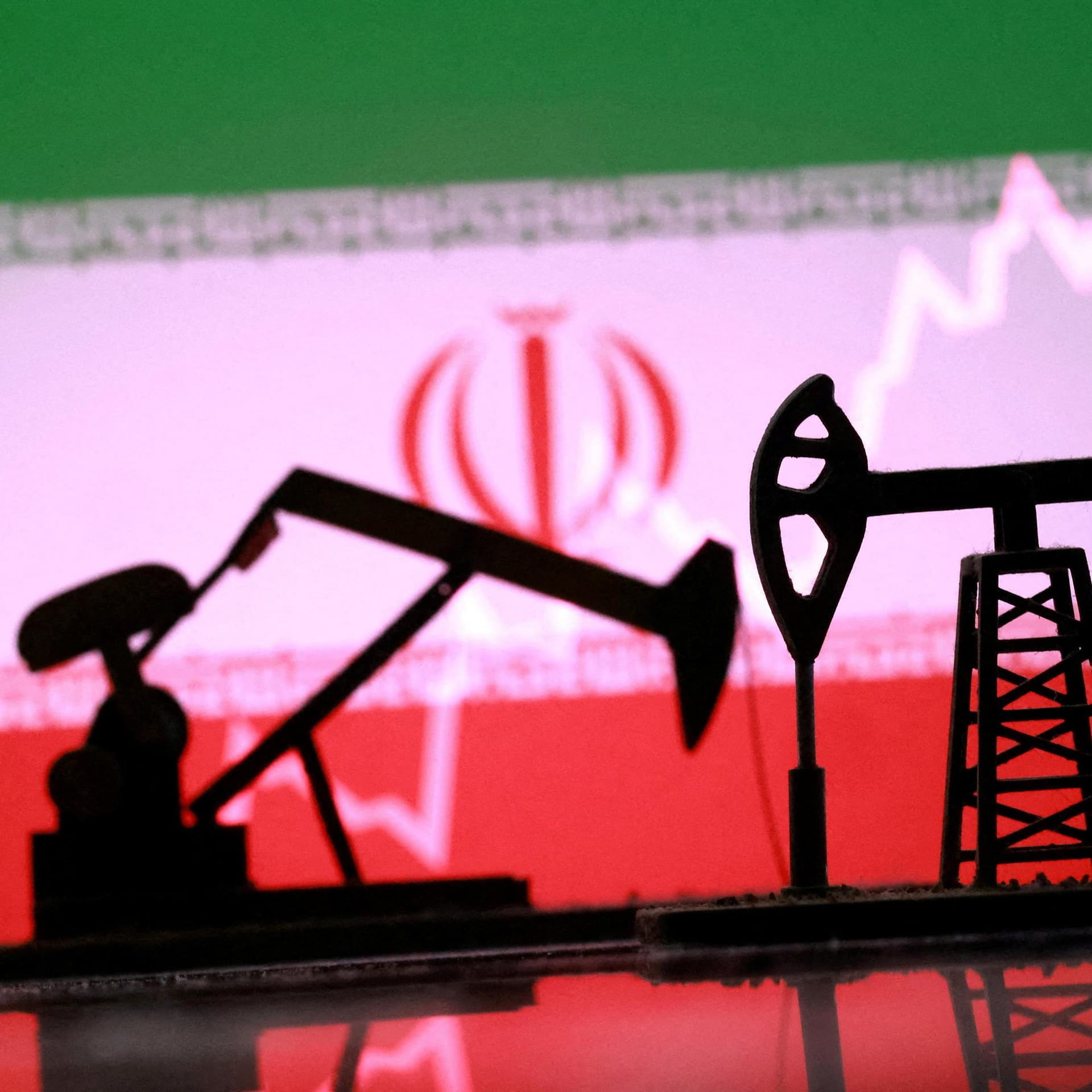
Photo: 3D-printed oil pump jacks, Iranian flag, and a rising stock graph appear in this illustration. Credit: Reuters/Dado Ruvic/Illustration/File Photo