
In short
BBC Global Story episode on Jair Bolsonaro’s ongoing trial in Brazil over alleged attempts to overturn the 2022 election and incite/enable a coup, and how Donald Trump has publicly backed Bolsonaro, including through threats of 50% tariffs and sanctions/travel bans. It compares Brazil’s January 8, 2023 unrest to the US January 6, 2021 events.
Guests
Ioni Wells, BBC South America correspondent based in Brazil, reporting from Brasilia during the final stage of Bolsonaro’s “coup trial.”
Key claims
Bolsonaro supporters call it a “witch hunt”; prosecutors say Bolsonaro helped plan a coup and had knowledge of “Operation Green and Yellow Dagger,” including alleged assassination options against Lula. Police also cite a December 2022 meeting with top military commanders. If convicted, Bolsonaro could face up to 43 years.
Notable examples
Bolsonaro’s 2018 Trump Oval Office visit and jersey exchange; January 8 riots with supporters invading Congress/Supreme Court/palace; Trump’s social-media letter threatening tariffs; US sanctions/travel ban on judge Alexandre de Moraes; Lula’s polling boost after tariffs.
Written by AI. May contain mistakes. Listen to the episode to check what was said.
Chapters
Tap a time to open that second in VOSetting the Scene: Bolsonaro's Trial
0:51 to 1:31
Discussion on the unfolding trial of Jair Bolsonaro and its implications.
“A former president who's alleged to have incited an insurrection to overturn an election is on trial.”
The Trump-Bolsonaro Connection
1:31 to 3:20
Exploring the relationship and political parallels between Trump and Bolsonaro.
“Ioni, can I have you just introduce yourself, give us a sense of who you are, what you do for the BBC?”
Who is Jair Bolsonaro?
3:20 to 6:15
An overview of Bolsonaro's political style and impactful decisions during his presidency.
“You mentioned the American president's investment in this trial, in this case.”
Lula's Political Comeback
6:15 to 8:41
A look into Lula's rise and challenges during Bolsonaro's presidency.
“You know, what I find really interesting here is that during Bolsonaro's first term, his main political opponent is the former president, Luis Ignacio de Silva, a.k.a.”
The January 8th Riots
8:41 to 9:56
Details of the protests that occurred following Lula's inauguration and their implications.
“Bolsonaro himself decided not to turn up because he was in Florida at that time.”
Comparing Brazilian and U.S. Political Turmoil
9:56 to 11:31
Analyzing the similarities and differences between Brazil's and the U.S.'s political unrest.
“Authorities responding with tear gas to try and regain control of Brazil's capital.”
Investigation into Bolsonaro's Alleged Coup
11:31 to 13:17
Discussion on the investigations into Bolsonaro's alleged coup attempt and its significance.
“So the moment that Bolsonaro was out of office, suddenly he became he lost that presidential immunity.”
Bolsonaro's Lobbying Efforts
13:17 to 14:00
Exploring Bolsonaro's family's efforts to influence U.S. politics in his favor.
“So Bolsonaro has been under investigation surrounding his actions around the 2022 election.”
Lobbying Efforts Surrounding Bolsonaro's Trial
14:00 to 15:40
Learn about the lobbying efforts by Bolsonaro's allies and their impact on U.S. perceptions.
“And there has also been a very long lobbying campaign by his son, Eduardo Bolsonaro.”
Trump's Unprecedented Actions and Tariffs
15:40 to 18:02
Explore how Trump responded to Bolsonaro's trial with tariffs and political rhetoric.
“And I will say I wasn't paying a whole lot of attention this summer to the ins and outs of all of that lobbying effort.”
Show all 13 chapters
Domestic Impact of U.S. Interference
18:02 to 20:58
Discover how U.S. actions may influence Brazil's political landscape and Lula's popularity.
“could actually backfire a little bit for Bolsonaro and for Donald Trump.”
The Ongoing Trial of Bolsonaro
20:58 to 24:46
Get an overview of the trial's progression, key evidence, and Bolsonaro's defense strategies.
“they said that the only reason this coup failed was that Bolsonaro couldn't get the support of the Air Force and Army commanders, although they say that the Navy commander was quite sympathetic to this plan.”
Political Polarization in Brazil
24:46 to 26:54
Learn about the deep political divides in Brazil stemming from Bolsonaro's trial and its implications.
“But I'm curious from your vantage point in Brazil, what has been the cost, the political cost of putting a former president on trial?”
Transcript
Automatic transcript. May contain errors.0:00This BBC podcast is supported by ads outside the UK.
0:30How to Change, as she shares true stories from Nobel laureates, authors, athletes, and everyday people about why we make the choices we do and how to make better ones to help avoid costly mistakes. Listen to choiceology at schwab.com slash podcast or wherever you listen.
0:50In Brazil right now, an alternate reality is unfolding. A former president who's alleged to have incited an insurrection to overturn an election is on trial. Donald Trump has a lot to say about it. He loves the country, and he fought hard for those people, and they want to put him in jail. And I think that's a witch hunt, and I think it's very unfortunate. But despite the American president's protests, the verdict is expected to come this week. He may well be found guilty and go to prison for the rest of his life. From the BBC, I'm Asma Khalid. And today on The Global Story, the trial of Jair Bolsonaro and why President Trump is so obsessed with it.
1:42Ioni, can I have you just introduce yourself, give us a sense of who you are, what you do for the BBC? Sure. I'm Ioni Wells. I'm the BBC's South America correspondent based in Brazil. And right now I'm in the capital, Brasilia, where I'm covering the final stage of the coup trial against Bolsonaro. Can you tell us a little bit about what that trial has been like? What has been unfolding in Brazil over the course of the last week? It has been a frenzy here in Brasilia.
2:16This is probably one of the biggest news stories in the last couple of years here in Brazil, coming to its final conclusion. It has gripped the country. There have been crowds of reporters here in Brazil or outside the Supreme Court. The trial of former Brazilian President Jair Bolsonaro entered its final phase today. He's accused of leading a conspiracy to stay in power after losing the 2022 presidential election. If found guilty, Bolsonaro could face up to 43 years in prison. Of course, this is being watched not just here in Brazil, but around the world, particularly in the United States, after Donald Trump leapt to Bolsonaro's cause just in the last couple of months.
2:53President Trump has rallied behind the former Brazilian president, calling the trial a witch hunt.
3:01As soon as September 12th, we're expecting to hear whether the judges consider him guilty. Will he spend the rest of his life in jail? These are questions that both his supporters and his critics want to know the answer to.
3:20You mentioned the American president's investment in this trial, in this case. And I really want to start with how Donald Trump and Jair Bolsonaro developed a relationship. I would say that most Americans, I think, really met Bolsonaro when he came to the Oval Office during President Trump's first term in the White House. Yeah, that's right. I mean, after Bolsonaro was elected president of Brazil in 2018, he went to the U.S. and he did this joint press conference with then President Donald Trump in his first administration. Thank you very much. It's a great honor to have President Bolsonaro with us from Brazil.
4:01He has done a very outstanding job, ran one of the incredible campaigns. Somebody said it a little bit reminded people of our campaign, which I'm honored by. He stood on similar policy platforms to Donald Trump. So there was already a kind of political connection there. He rallied against so-called woke issues, against political correctness. He slashed environmental protections. There were lots of sort of parallels in terms of what he stood for and what Donald Trump stood for. You know, Brazil is a great, great soccer power and a great country. They exchange football shirts. So we're going to exchange jerseys.
4:37I see that we get one. Bolsonaro gave a soccer jersey to Donald Trump of the Brazilian national team with Trump on the back. Use the opportunity, Mr. President, to hand you a gift, a jersey, as a token, as an emblematic token. The football shirt thing is interesting, actually, because much to the dismay of a lot of left-wing football supporters in Brazil, the Brazilian football shirt has become a symbol of Bolsonaro's fans. It's what many of them wear to these big rallies. and Bolsonaro presented this shirt to Trump with his name on the back. And I think that relationship has really kind of continued.
5:14Brazil has a great friend. I think probably because of the relationship that we have, Brazil and the United States have never been closer than they are right now. It seems like the two of them get along quite well. You know, I've heard Bolsonaro referred to as the Trump of the tropics. Can you give us a sense of who Bolsonaro is as a politician? Are there any stories that really define who he is to you? He was sort of known for the way that he would use quite provocative rhetoric in his presidency. He oversaw the COVID response, for example, in Brazil. Brazil had a huge death toll during COVID.
5:52And he often received criticism for, for example, referring to COVID as a little flu, while on the other hand, handing out big cash programs for some of the poorest in the country. He relaxed gun ownership laws. He had no issue slashing environmental protections in the Amazon because he felt that would help his base and rally his base behind him. So he wasn't afraid of saying provocative statements, which has continued even to this day. You know, what I find really interesting here is that during Bolsonaro's first term, his main political opponent is the former president, Luis Ignacio de Silva, a.k.a.
6:32Lula, as we know him. And Lula was actually in jail on corruption charges. But ultimately, these two political giants do go head to head in the 2022 election. So can you just explain to us what happened with Lula's case? Well, I think some important context here is that in 2019, the Supreme Court in Brazil reassessed the case of the now president, Lula da Silva. Essentially, it led to his accusations being thrown out in 2021. Lula was able to walk free and was able to run for election again. And that really shifted the dial in Brazil because President Lula is really a kind of left hero in Brazil.
7:20And that was something that really, really worried Bolsonaro and his allies. They started to see that the polling was suggesting that there was a chance that Lula de Silva may be able to beat Bolsonaro in that presidential election. So before the election even took place, he began to sow doubt in the electoral system. Questioning if it was going to be free and fair elections, you're saying? Exactly. Casting doubt on the electronic voting machines, for example. So there was this kind of narrative that was spread quite early on, before this election even took place, that the election was going to be rigged against him.
7:56What happens ultimately in that election? Well, Lula won the first round, but not by enough. So it went to a second round between Lula and Bolsonaro. In that second round, Lula won by 50.9%. Bolsonaro got 49.1%. So this was a really, really close election. I think the closest presidential election to date in Brazil. So that itself was grounds for an incredibly divisive period after that election. I mean, you literally were splitting the country in two. So very, very polarizing. It is safe to say that his supporters were furious. The inauguration of Lula da Silva took place on the 1st of January.
8:43He vowed to rebuild Brazil. Bolsonaro himself decided not to turn up because he was in Florida at that time. But it was really in the days following the inauguration that we started to see tensions build again. On January the 8th, nearly exactly two years after the January 6th riots in the US, busloads of Bolsonaro supporters arrived in Brasilia, all wearing yellow and green football shirts, carrying Brazilian flags. Total chaos in Brazilia as thousands of hardline protesters invaded government buildings. Supporters of the former president Bolsonaro entered Congress, the Supreme Court and the presidential palace.
9:24They smashed into the windows of Congress and the presidential palace, smashing everything in their midst, graffitiing on the walls, stealing and looting some of the furniture and items in those buildings. There's been no evidence of fraud, despite what these protesters claim, but no matter. What these people want is military intervention. Some even said very openly, including to our BBC teams there at the time, the purpose was for the military to join them. They wanted a coup to happen. They saw this as their way of seizing back power for Bolsonaro. Authorities responding with tear gas to try and regain control of Brazil's capital.
10:02In listening to you narrate what happened that day, Ione, it feels frankly eerily similar to what I recall happened in Washington, D.C. I live in our nation's capital. But after January 6th, 2021, here in the United States, you know, there was a grand jury indictment. There was a special counsel by the Department of Justice. Ultimately, though, Donald Trump, he ran for re-election. And of course, we all know he won that election. And then he went on to pardon people who were arrested in the January 6th riots. The thing that I find so striking about what is happening in Brazil right now is that things have gone unimaginably differently.
10:46Why do you think that is? Well, I think in part we have to look a little bit at Brazil's history as well. Brazil, in living memory, has history of a military dictatorship, which, with the support from the US, allowed conservative sectors of society, with the help of the military, to impose a dictatorship on a country which led to years and years of censorship, of extrajudicial killings, of torture, of severe human rights abuses, which is very, very raw and fresh for many Brazilians. And I think the idea that something similar could have been plotted and could have been implemented is something that is deeply, deeply troubling for authorities in Brazil and also much of the public, essentially.
11:31So the moment that Bolsonaro was out of office, suddenly he became he lost that presidential immunity. It became easier for authorities to start investigating both what had happened in these riots, but also what might have led to it. And since then, this has developed into a much, much wider inquiry about not just these riots that took place on January the 8th, but actually a much bigger alleged coup proposal that Bolsonaro and his allies are accused of initiating. Over the last couple of months, years, police have found various different pieces of evidence that suggest that Bolsonaro had attempted and masterminded a coup to cling on to power that dates far back to way before those riots took place on January the 8th in Brasilia.
12:20In fact, Bolsonaro is accused of having full knowledge of a plan codenamed Operation Green and Yellow Dagger to assassinate President Lula da Silva. This plan, according to police, was even printed out by one of Bolsonaro's aides at the presidential palace. And it detailed things like poison being one option to kill Lula. Poison his political opponent. Well, the accusation that police have raised is that this was one of the options, along with other weapons listed on this plan that had been put together by some of his allies. Now, the accusation against Bolsonaro is not that he necessarily drafted that plan, but that he had full knowledge of it, essentially had given his blessing to that plan, which is something that he has denied.
13:03So this is the first time that a coup attempt in Brazil has really been put on trial in the past. People who attempted these kind of things were given amnesty. So this is really a test case for authorities, not just in Brazil, but I think around the world as well. So Bolsonaro has been under investigation surrounding his actions around the 2022 election. What has he himself been doing in the interim in order to try to influence the outcome here? Well, when these investigations first started, him and his family described these allegations as politically motivated. He has also widely appealed for international support in his cause as these investigations have continued over the last few years, notably to the U.S.
13:52and to the MAGA base in the U.S. Even before Donald Trump was re-elected, a lot of kind of MAGA characters, even people like Steve Bannon, had kind of really adopted Bolsonaro's cause and talked a lot about it. And there has also been a very long lobbying campaign by his son, Eduardo Bolsonaro. And a friend of mine, Eduardo Bolsonaro of Brazil, the Chamber of Deputies. He's a congressman in Brazil, but he's spent the last couple of months lobbying U.S. officials and trying to convince them to put pressure on the Brazilian authorities. Thank you. Thank you. Say hello to your father. Thank you very much.
14:31Great family. Great gentleman and a great family. I think there's no doubt that his lobbying has grown the attention and the profile of Bolsonaro's case in the U.S. And I believe it's a witch hunt and it should be. Donald Trump has adopted the Bolsonaro's narrative. He's described this case as a witch hunt, as political persecution, which is exactly what Bolsonaro's defense centers on. Look, he's not like a friend of mine. He's somebody that I know, and I know him as a representative of millions of people. Brazilians, they're great people. And he loves the country, and he fought hard for those people, and they want to put him in jail.
15:12And I think that's a witch hunt, and I think it's very unfortunate. But then he started to actually turn his opposition to this case into real, intangible actions. Coming up, Trump does something unprecedented to try to save his political ally.
15:37Ione, we were just talking about Bolsonaro's son lobbying President Trump. And I will say I wasn't paying a whole lot of attention this summer to the ins and outs of all of that lobbying effort. But what did catch my attention was when President Trump sent out this letter on social media. Do you remember this moment? That's right. And it was a really unprecedented moment, that letter. Yeah, I just want to read from this actually for a moment here. He said that the treatment of Bolsonaro is an international disgrace. And quote, this trial should not be taking place. It is a witch hunt that should end immediately!
16:13And really what I think was so striking, Ione, is that the point of this letter was actually to introduce tariffs on Brazil and huge tariffs. More surprises with new letters from President Trump. He's now threatening 50 % tariffs on Brazil. Instituting a 50 % tariff on Brazil, partly over the trial of former President Bolsonaro. Yeah, the tariffs are completely political. Donald Trump used Bolsonaro's trial as his justification for implementing 50 % tariffs on some Brazilian goods. Yeah, some of the biggest in the world. It's not about a trade deficit because there isn't one. The U.S. has a large and growing trade surplus with Brazil.
16:56In other words, it exports more to Brazil than the other way around. We're seeing a shift into President Trump using the threatened tariffs in ways that are not economically related. It's not the only action as well that Donald Trump has done in response. The U.S. has also sanctioned the Supreme Court judge, Alexandre de Moraes, under a law that's usually reserved for people who have committed serious human rights abuses or corruption. The U.S. has imposed a travel ban on him and his family. I want to follow up on that. Does it seem like this is the American government trying to influence the outcome of a domestic trial?
17:36And is any of this having an impact on what is actually going on on the ground in Brazil? So to take your first question, I think that is certainly how this is being read, that this is an attempt by the US government to try and put pressure on Brazilian authorities at this time. That's certainly how President Lula da Silva here in Brazil has described this. He's slammed what he's called foreign interference in Brazil's independent judiciary. I think it's interesting, though, because there is potentially, I think we are already seeing evidence that this could actually backfire a little bit for Bolsonaro and for Donald Trump.
18:10How so? Well, for example, President Lula was not doing particularly well in the polls in Brazil. He had been flailing a little bit, particularly over the economy. These tariffs have given Lula a bit of a boost in the polls. He's even taken to wearing a blue cap, quite similar to Trump's MAGA red hat, but instead saying, Brasil é dos Brasileiros, essentially Brazil belongs to Brazilians. He's even suggested in interviews that if Donald Trump was in Brazil, he would probably face similar proceedings. So Lula's kind of adopted this cause as a sort of patriotic one. So one thing I don't really understand is why Donald Trump would try to tether himself so closely to Bolsonaro.
18:52Right. Why would he advocate so fiercely for him? Because in my view, he seems to be reminding Americans of January 6th and some of the parallels. when in reality, I would say Bolsonaro is being accused of more egregious crimes. But it feels strange to me that Trump is going out on a limb politically, reputationally to tether himself to Bolsonaro by backing him so publicly in this moment. Yeah, I think that is something that has surprised people. I think, I suspect anyway, that the most likely explanation is that Donald Trump sees quite a lot of himself in Bolsonaro. He's faced similar legal woes.
19:28He also claims that institutions and judges are out to get him, hopes that that will rally his base online. But there is also potentially a chance, and you will certainly know more about this, that this could backfire a little on Trump as well, because if it does push prices up in the US, that's something which might hit American consumers of coffee, of beef. But also, I think it's interesting at the moment, Trump's obviously had some backlash within his MAGA base, within the Republican Party, over his desire to intervene in events overseas. And I wonder whether, depending what the outcome of this trial is, he may be facing some of that domestic pressure as well.
20:07I want to turn to the trial itself. It's been going on for a while now, is my understanding. Where is it at at this moment? This trial has been going on for years now, really, in terms of the evidence that has been gathered by police that's culminated in the final stage of the trial that we're seeing now. There have been other kind of wild pieces of evidence that have come out in the course of this trial as well. Various different pieces of evidence that point to a meeting that Bolsonaro held in December 2022 with top military commanders, essentially presenting them with a plan for a coup and asking them to join him in this attempt.
20:49Now, police say this is backed up by testimonies from some of the people who are present, as well as documents and audios as well. Last week, when we heard from the judges, from the top prosecutor in Brazil, they said that the only reason this coup failed was that Bolsonaro couldn't get the support of the Air Force and Army commanders, although they say that the Navy commander was quite sympathetic to this plan. So we've been hearing more in the last week from the prosecution, from the judges who are on the panel assessing this case, but also from Bolsonaro's defense as well. Yeah, I want to ask you about this because these are damning accusations.
21:27What is Bolsonaro's team saying in response to all of this? Well, on Wednesday in court, we heard from Bolsonaro's defense. They say that there is not a single piece of evidence in their view that links Bolsonaro to Operation Green and Yellow Dagger or to the January 88th riots. They've echoed, for example, statements that Bolsonaro has made over the last couple of years that he wasn't even in the country at the time of those riots. And one of the key things they've said as well is that this coup was, in their words, never consummated, that it never actually happened, that Bolsonaro did hand over power.
22:01Which is true and accurate in terms of what happened. Yeah, that's right. And this is one of the biggest points of contention now because his supporters say, well, this never happened. So how could there have been a coup? His critics and the prosecution say the very fact that he had planned a coup, that he had asked military commanders to give him their support, was in itself the beginning of a coup. And so for his critics, this trial is so important because they see it as an important moment to punish that act so that he and others couldn't try something like that again. That it sends a message, you're saying, for the future.
22:39Exactly. What do you think is going to happen ultimately with this trial? Where do you see it ending? So this week, what we're going to see next is each Supreme Court judge, there's five on the panel that are assessing him, essentially outline what their verdict is, which charges or not they think he's guilty of, and what sentence they would recommend. Do you have a sense of which way the judges are leaning? I think it is certainly clear that from what the judges have said, they feel there is a lot of evidence against Bolsonaro. There is a growing expectation, given the evidence that has been presented in this case, that at least on some of these charges, he could well be found guilty.
23:23This is a point of contention, really, because Bolsonaro doesn't feel like the judges are going to represent him fairly, not least because Alexandre de Moraes is one of the judges who has become Bolsonaro's nemesis in this trial. but also the current president of the Supreme Court, one of the judges on this case, was formerly a lawyer for President Lula da Silva. So Bolsonaro doesn't feel like this is going to be a fair trial, even though the judges have said that they are acting freely, independently, and assessing only the evidence that they have in front of them in this case. And potentially, if found guilty on all of these different charges, he could be looking at more than 40 years in prison, which as a 70 year old would potentially be the rest of his life.
24:09That's a that's a life sentence. Essentially, yes. I mean, for a man of his age, that is a life sentence. So the stakes here are incredibly high for Bolsonaro. You know, Brazil has done what America, what the United States did not do. It brought a former president to trial for allegedly trying to subvert democracy and cling to power. And I think a number of liberals in the United States might be watching what is going on in Brazil with a bit of envy, you know, kind of wishing that the American justice system would have more aggressively pursued Donald Trump's case. But I'm curious from your vantage point in Brazil, what has been the cost, the political cost of putting a former president on trial?
24:57A president, as you say, who garnered nearly half the vote in that most recent presidential election. The cost has been deep, deep polarization in Brazil. On the one hand, you have Bolsonaro's critics and the prosecution saying that this was an authoritarian attempt to cling on to power through illegal means. On the other hand, there are Bolsonaro supporters who believe that actually the authoritarian thing here is not this attempted coup, which didn't actually happen in the end, but the way in which Supreme Court judges are targeting Bolsonaro and holding him to account in this case. the Supreme Court is immensely powerful.
Read the full transcript
25:43It has given itself sweeping remits. It's taken down many online social media accounts, triggering a backlash in the US at times. And Bolsonaro himself has been placed under severe restrictions as this trial has gone on, banned from using social media, banned from contacting his son Eduardo Bolsonaro, banned from leaving the country, banned from even going out of his house without an ankle tag, being under 24-hour surveillance. So his supporters believe that is the authoritarian thing. It sounds like you're saying they both believe democracy is under threat, but they believe it's under threat from the other.
26:21Exactly. The tension here in Brazil is, what is the most undemocratic thing going on here? Is it the judges who have these sweeping powers who are trying to set a new precedent for how coup attempts and spreading damaging information about the electoral system are dealt with? Or is the damaging thing the attempt itself? This is the tension that is at play at the moment in Brazil.
26:53Ioni, thank you so much for your time and thank you so much for your reporting. Thank you so much for having me.
27:04All right, folks, that is a wrap for today's show. Thanks so much for listening, and we'll see you again tomorrow.
27:22Ever wonder why we make the choices we do? And how to make smarter ones? Introducing Choiceology, an original podcast from Charles Schwab. Join Wharton Professor Katie Milkman, an award-winning behavioral scientist and author of the best-selling book How to Change, as she shares true stories from Nobel laureates, authors, athletes and everyday people about why we do the things we do and how to make better choices to help avoid costly mistakes. Each episode covers the latest research in behavioral science and dives into themes like the power of self-control, shaping your mindset for success, navigating new beginnings, and why starting over can feel so hard.
28:07Listen to choiceology at schwab.com slash podcast or wherever you listen.
From the publisher
In Brazil this week an alternate reality is unfolding: a former president, who allegedly tried to incite an insurrection to overturn an election, is on trial. A verdict is expected this week, and he may go to prison for the rest of his life.
On January 8th 2023, Jair Bolsonaro’s supporters broke into government buildings, demanding to overturn the result of the election Bolsonaro had lost. In the aftermath of those events, Bolsonaro was accused of masterminding a plot for a military coup. He denies these claims and says the charges are politically motivated.
President Trump has called the trial a “witch hunt” and gone to extreme measures to try to influence its outcome. But have his attempts to influence the trial backfired?
We speak with Ione Wells, the BBC’s South America correspondent, who has been reporting from inside the trial.
Producers: Viv Jones and Valerio Esposito Executive producer: Annie Brown Mix: Travis Evans Senior news editor: China Collins
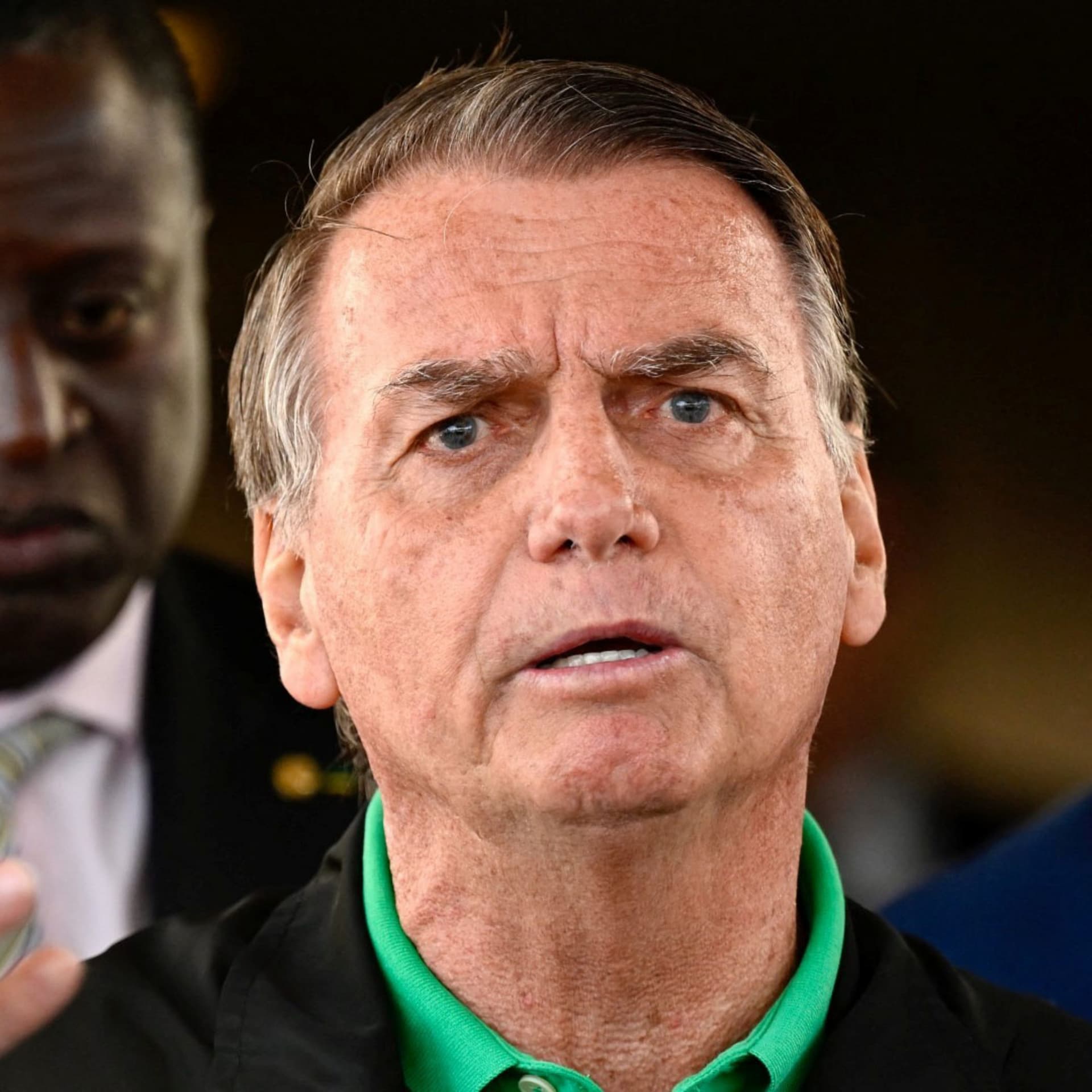
Image: Former Brazilian President Jair Bolsonaro in Brasilia on July 17, 2025. Mateus Bonomi / AFP via Getty Images