
In short
Colombia’s Sunday presidential election and whether right-wing outsider Abelardo de la Esprilla (“El Tigre”) could shift the country—and the region—toward tougher anti-crime, pro-U.S. policies, amid rising violence tied to cocaine trafficking.
Guest backgrounds
Ione Wells, BBC South America correspondent, reporting from Colombia on the election buildup.
Key claims
The race is framed as hard right (Esprilla) versus hard left (Ivan Cepeda). Esprilla is Trump-endorsed and seeks a military crackdown, including “mega prisons” and U.S.-backed action against narco trafficking. Violence has escalated during President Gustavo Petro’s term; cocaine production is at record highs. Trump’s endorsement is portrayed as possible leverage: U.S. support for Colombia could hinge on Esprilla winning, echoing past U.S. election interventions in Latin America.
Notable examples
Esprilla defended notorious figures (Alex Saab; David Mercier Guzman) as a criminal defense lawyer; he cites El Salvador’s Nayib Bukele and wears a tiger-themed slogan on a national football shirt. Cepeda helped architect Petro’s “Total Peace” and supports negotiations over force, rooted in his father’s death linked to paramilitaries.
Written by AI. May contain mistakes. Listen to the episode to check what was said.
Chapters
Tap a time to open that second in VOTrump's Shield of the Americas Summit
0:30 to 3:00
Discussion on the Shield of the Americas summit and its implications for Colombia.
“This spring at his golf resort in Southern Florida, President Trump corralled a group of like-minded conservative leaders from Latin America together.”
What's At Stake in Colombian Elections
3:00 to 5:20
Exploring the significance of the upcoming Colombian presidential elections.
“It's been a minute since we've had you on, but it's wonderful to have you here.”
The Front-Runners: Espreya vs. Cepeda
5:20 to 7:00
Analysis of the two main candidates in the Colombian election and their contrasting views.
“with more momentum, given his success in the first round.”
Espreya's Background and Political Stance
7:00 to 8:00
A closer look at Abelardo de la Esprilla, his history, and his campaign strategies.
“He also defended David Mercier Guzman, who is essentially the leader of what was Colombia's biggest Ponzi scheme.”
Espreya's Controversial Image
8:00 to 9:40
Discussion on Esprilla's hyper-masculine image and public controversies.
“And I think we would expect that if he were elected, there would be closer collaboration between the United States and Colombia when it comes to tackling narco trafficking.”
Opposition Candidate Ivan Cepeda
9:40 to 11:40
Overview of Ivan Cepeda's political background and his candidacy against Esprilla.
“wear the Brazilian national football shirt.”
Violence and the Colombian Elections
11:40 to 13:50
Insight into the role of violence in Colombia and its impact on the elections.
“His father was, as I say, a victim of state violence.”
Understanding Drug Violence in Colombia
14:01 to 16:41
Learn about the historical context of drug gang violence and its impact on Colombian society.
“I mean, here in the United States, there are certainly people who continue to go on vacation in Colombia.”
The Role of the U.S. in Colombian Politics
16:41 to 19:17
Explore how U.S. involvement and Trump's endorsement influence the Colombian election.
“The production of cocaine has hit a record high.”
Potential Consequences of a Rightward Shift
19:17 to 21:44
Examine the implications of more Latin American countries aligning with Trump's policies.
“which I think is a significant intervention and certainly one which the left is not happy about.”
Show all 11 chapters
Public Perception of U.S. Military Intervention
21:44 to 26:07
Discuss how Colombians perceive U.S. military actions and their potential impact on sovereignty.
“We have seen a slight decline in the number of regularity of these strikes compared to what was happening last year.”
Transcript
Automatic transcript. May contain errors.0:00This BBC podcast is supported by ads outside the UK.
0:30learns how to invest and manage money. Learn more at schwab.com.
0:37This spring at his golf resort in Southern Florida, President Trump corralled a group of like-minded conservative leaders from Latin America together. For decades, leaders in this region have allowed large swaths of territory, the Western Hemisphere, to come under the direct control and transnational gangs have taken over and they've run areas of your country. We're not going to let that happen. We'll help you. The summit was dubbed Shield of the Americas, and the leaders posed for a family photo in front of a logo of a legit shield with an image of North and South America. Yeah, when I saw the shield, Asma, thank you for bringing it to my attention, I thought it looked a bit like the logo for Paw Patrol, which for anyone who has kids is a familiar cartoon.
1:23Same colours, similar font, same style. But it is actually a serious logo for a serious foreign policy initiative, an attempt to show that the United States is reasserting its dominance in its own backyard. Every leader here today is united in the conviction that we cannot and will not tolerate the lawlessness in our hemisphere any longer. The only way to defeat these enemies is by unleashing the power of our militaries. But when it comes to fighting drugs, one key country was not at this meeting, Colombia, though that might soon change. On Sunday, Colombia is going to elect a new president, an outsider nicknamed the Tiger, endorsed by Donald Trump.
2:14His name is Abelardo de la Esprilla, and our guest is going to pronounce that a lot better than me in a minute. He's ahead in the polls and he's within striking distance of the presidency. Asprey is in the Trumpian mold, a self-styled maverick, a U.S. citizen who says he wants a tough military crackdown on crime. From the BBC, I'm Asma Khalid in Washington, D.C. And I'm Tristan Redmond in London. And today on The Global Story, could Colombia be the next country in Latin America to take a hard turn to the right? And how might that benefit Donald Trump?
2:59Ioni, welcome back to The Global Story. It's been a minute since we've had you on, but it's wonderful to have you here. Yeah, thank you for having me back. Ioni, we wanted to have you on the show because you're in Colombia this week reporting on the buildup to Sunday's election. And these elections, they seem like a really big deal, not just for the nation of Colombia, but the region as a whole. Can you just begin by telling us what's at stake here? Yeah, that's right. This, I mean, like many recent elections in Latin America is a very polarizing choice between what many would describe as a hard left and hard right candidate in Abelado de la Esprea and Ivan Cepeda.
3:41And I think why this is so important, not just for Colombia, but also for the US and for the rest of the world, is these are two candidates with very, very different visions for tackling the biggest issue that's facing Colombia at the moment, which is rising violence, the internal armed conflict that has been surging in Colombia for decades, but has really escalated again in the last couple of years. and Colombia, of course, is the world's biggest producer of cocaine as well, which links to that issue of violence. And so I think whichever candidate is elected will have huge repercussions, not just for how Colombia deals with these issues, but what that means as well for relationships with the United States and also other countries around the world.
4:24I imagine the two outcomes would have dramatically different results, right? I mean, the hard right and the hard left you're describing, which that I find so interesting. It just feels like the choices are so stark. Yeah, it does. And many people have commentated on not just this election, but other elections in the region as also representing a collapse of the center ground, really. People veering towards more radical ideas, more extreme ends of the political spectrum to try and find solutions to some of the problems they're facing. Ioni, at this point, is there a sense of who's the favorite?
4:57Espreya, the right-wing candidate, won the first round of this election. And the polls suggest that he is still in the lead.
5:10So I think many are seeing him as the favourite to win, although it is always hard to say there could well be a last-minute surge. But at the moment, he is certainly going into the selection with more momentum, given his success in the first round. Well, tell us a little bit about the candidates, please, Ioni, because they are strikingly different. particularly we have this political newcomer on the right. And I want to warn you in advance, Ioni, that we are very much hoping you are going to talk about the fact that he likes to sing. And quite often when you come on the show, we ask you about South American leaders who like to sing.
5:44So please tell us about him. Yeah, well, like another Latin American leader, Javier Millet, who we've talked about on this programme before, he does like to sing, as you say.
6:04And actually, he's quite an admirer of Javier Millet, certainly on his small state, free market economic policies. But Abelardo de la Esprea, who is the right-wing candidate in this election, is a political newcomer. He was born in Bogota, but raised near the coast, and he's made that a really central part of his campaign, speaking to what he sees as a base of people on the coast who feel quite left behind by a so-called establishment political class. He is somebody who was a defense lawyer, but also he's got a bit of a business empire. He's had various clothing brands, alcohol brands, real estate companies.
6:44This does sound familiar. Yeah, exactly. A lot of parallels you could make, in fact, with the US. He worked as a criminal defense lawyer and he defended, in fact, some of Colombia's most notorious figures, including people like Alex Saab, who's a close ally of the ousted Venezuelan leader Nicolás Maduro, who's now facing money laundering charges. He also defended David Mercier Guzman, who is essentially the leader of what was Colombia's biggest Ponzi scheme. He has faced quite a lot of criticism for that from his critics who say that he's enriched himself off essentially criminals. Although he would argue that this is just simply part of his work as a defence lawyer and that comes with a job.
7:27He is very much positioning himself in this election as a right-wing strongman, somebody who's going to take on violence and crime and criminal organizations in Colombia with an iron fist. He is inspired by El Salvador's president, Nayib Bukele. Many have said that he even shares the same beard as Bukele. Certainly, I think his policies are inspired by him, not just his facial hair. He wants to build mega prisons in Colombia's jungles. He's promised a really tough military approach to tackle criminal organizations, including with U.S. support. He's a big admirer of Donald Trump. And I think we would expect that if he were elected, there would be closer collaboration between the United States and Colombia when it comes to tackling narco trafficking.
8:10He has been very explicitly endorsed by Donald Trump. It's interesting as well. He also, as part of his brand, his campaign, has had this hyper-masculine sort of alpha male image. He posts workout videos of himself. He's talked about needing male grit to be a leader. He has at times faced accusations of sexism for talking about women staying in their proper place. And at one point talking to a female reporter, asking her to look at a photo of him and, in his words, look at what had won him votes from the female electorate, alluding to essentially his private parts in that. So he has faced allegations of quite sort of lewd comments at times throughout this campaign.
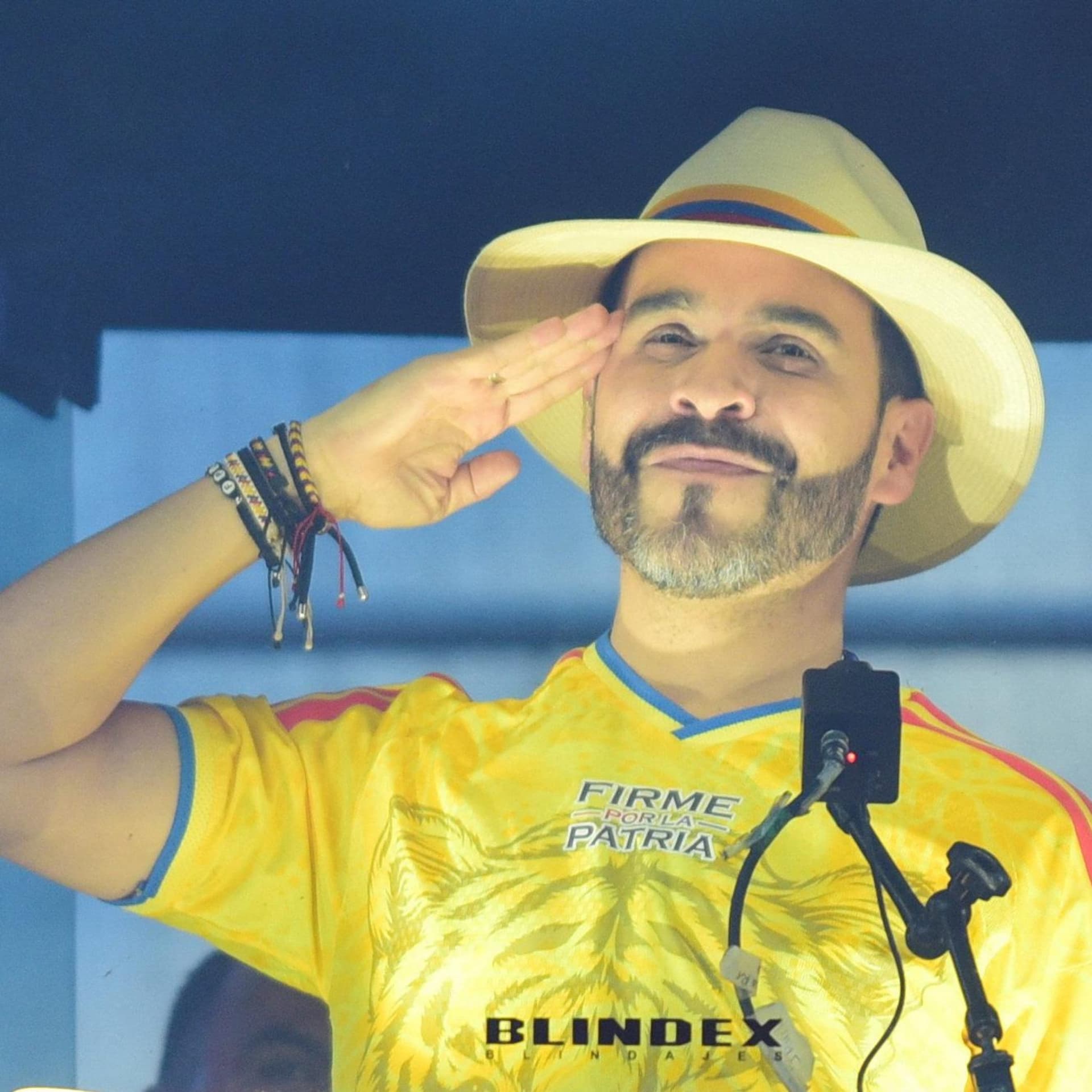
8:52He has a nickname for himself. What's the story with that one, Ioni? Yeah, he calls himself El Tigre or the Tiger. And again, I think this is part of his attempt to identify himself as this strong, fierce character who's going to take on criminal organisations in Colombia. He also has a slogan, which essentially translates as stand firm for the homeland. Interestingly, he has emblazoned both these things, a tiger and that slogan onto a Colombian national football shirt, which he is repeatedly seen wearing at his rallies, much to the dislike of left-wing politicians in the country who say that he's politicizing the national football team, especially during the World Cup.
9:33And I think it's interesting that he's done this, actually, because it's akin to other right-wing leaders in the region. I'm sure you remember that the former right-wing leader of Brazil, Jair Bolsonaro, also used to wear the Brazilian national football shirt. And for a long time, even to this day, actually, people as a result came to associate that with Bolsonaro and with the right. But that is kind of his way of showing that he is this patriotic figure who wants to, yeah, in his words, defend the homeland. And he's encouraged his supporters to do the same. I mean, he sounds like quite the character.
10:04And what I don't fully understand is how he became such a force in Colombian politics, because I had read that he is also a U.S. citizen, an American citizen, and spent a number of years in Florida. Is that right? Yeah, that's right. He worked and lived in Miami for a long time. He is Colombian by birth, but he did gain his U.S. citizenship in 2023, having lived in the U.S. for a long time. And he, in fact, talked about living there because he felt it was more secure than Colombia. But it has been quite divisive. Some of his supporters think that it's a positive thing and think that it would mean closer ties with the United States in addition to the backing that he's had from Donald Trump.
10:45But I think there are some Colombian voters who are not sure about it, who think that it might mean that he's more interested in U.S. affairs than in Colombia. OK, so he is the candidate on the right. You mentioned that he's going to be going up against a candidate on the far left. Who is he facing? So he's facing a left-wing senator called Ivan Cepeda, who is an ally of the current president, Gustavo Petro. And he's a more, I suppose, a more longer-term political figure in Colombia. His father was also a politician who was killed by paramilitaries who were working for the Colombian state. So he, as a result in his earlier career, had founded a foundation for victims of crimes committed by the state.
11:31You can see why from his own personal experience, he feels very strongly that military force against criminal organizations isn't always the answer in Colombia. His father was, as I say, a victim of state violence. And I think he feels that Colombia's internal conflict between the state and other groups has not worked over the years. He was part of the government peace talks that took place in 2016 that led to that peace deal with the FARC. Many listeners may remember that 10 years ago this year, there was this historic peace deal that took place between Colombia's government and the FARC guerrilla group, which did lead to the disarmament of thousands of FARC fighters at the time.
12:12He is also credited as being the architect of Gustavo Petro's main flagship policy, which is called Total Peace. And that was essentially the strategy of trying to prioritize negotiation and peace talks with armed guerrilla groups and cartels rather than just resorting to military force against them. He has promised to essentially continue what Petro has started, which is to prioritise negotiation and peace talks. When you search for pictures of Cepeda, more often than not, he is wearing a cardigan. So the contrast with Mr Estrella could not be more stark, I would say. It's the tiger versus the cardigan.
12:56Yeah, exactly. It's kind of like this quite bookish, more traditional looking politician versus this firebrand of an outsider. He is somebody who is trying to frame himself as a sort of safer pair of hands. Certainly he isn't moderate when it comes to his politics. He very much identifies himself as being firmly on the left rather than in a sort of centre ground. I think he's also framing himself as somebody who would be a kind of continuity candidate in that sense, but more, shall we say, more moderate personality-wise than Petro has been. Petro has proved very polarizing over the years, particularly because of his tendency to essentially go on long rants on social media, to often speak his mind in ways that has caused him trouble with other world leaders.
13:42Him and Donald Trump, for example, famously often exchange quite heated insults on social media. Ivan Zepeda is essentially framing himself as a perhaps more contained version of Petro, but still continuing with his political project. Iona, you've mentioned violence a couple of times, and I just want to know if you can give us a scope of the violence. I mean, here in the United States, there are certainly people who continue to go on vacation in Colombia. Can you give us a sense of how big of an issue drug gang violence is, if indeed this election is seen as a referendum on how to deal with this violence?
14:18Yeah, I mean, certainly, well, on your point about people still visiting, you know, it is a place that is increasingly in recent years become very touristy. Most Colombians agree that's been a positive thing for the country in the last couple of years, that it has had this boom of foreign tourism, people feeling perhaps more comfortable visiting than they did in the past. That being said, violence in Colombia is of course not something new. For decades the country has had this bitter internal armed conflict which has seen guerrilla groups, armed cartels and criminal organizations fighting against each other but also fighting against Colombia's state.
14:54That you know the years ago had left at its worst point hundreds of thousands of people dead before this landmark peace deal that happened in 2016 which did lead to the disarmament of thousands of fighters at the time. Since then, though, many feel that some of the progress that was made after that peace deal has unraveled. Armed groups have ended up filling, I guess, the vacuum that was left in some poorer regions where the state wasn't very present. There were parts of Colombia where essentially criminal organizations are essentially the de facto state. Fighting has continued over very profitable cocaine trafficking routes, but also illegal mining sites with illegal gold mining as well being a huge issue in Colombia.
15:39Has the situation gotten worse, Ioni, over the last four years with Petro in power? I ask because you say that it seems like it's such an issue in this election cycle. Yeah, I think it is fair to say that there has been an increase in violence in the last couple of years. Membership of armed groups has grown. Violence has escalated too. And there have been various incidents as well of violence, as I say, in the build up to this election campaign. We had a candidate in the election assassinated last year at a rally. There have been a series of drone attacks, car bombs, kidnappings, violence escalating really in the build up to this election.
16:18Candidates themselves receiving death threats. So there have been a range of factors, but we have seen, I think it is fair to say, not just a growth of membership of armed groups, but also an increase in violent incidents during Petro's presidency, as well as cocaine production itself, hitting a record high. So that is one of the reasons why it is such a big factor at this election. Cocaine has hit a record high, really. The production of cocaine has hit a record high. Petro's argument is that his government is seizing record amounts of cocaine. And that is a factor that has been fueling violence, not just in Colombia, but also in neighboring countries, too, as control over these trafficking routes is fought over by different criminal organizations.
17:00So, Ioni, you've described a domestic dynamic around cocaine production and violence that you say is really at the heart of this election in Colombia. But it also strikes me that it's not happening in isolation. You know, as you mentioned, the United States, we've seen President Trump put his thumb on the scale and say that he has a preferred candidate. His administration has also made it abundantly clear that they see the Western hemisphere as the United States domain, as their turf, their sphere of influence. It just makes me wonder to what degree that relationship with the United States is a factor in this campaign.
17:40I think certainly the endorsement of Esprit is very significant by Donald Trump. And he has backed Espréa as the candidate that will restore order to the country, that will be a strong, tough leader. He has also very explicitly said that essentially if Espréa wins, Colombia will have, in his words, the total support and strength of the United States. Now, I think that is significant because it's not the first time that Donald Trump has explicitly intervened in a Latin American election, but also not just intervened in terms of an endorsement, but actually kind of made a bit of a veiled threat there that the U.S.
18:18support for Colombia hinges on victory of the right wing candidate. You know, we saw this happen in Argentina in the midterms, for example, where, you know, a financial bailout that the U.S. was going to be providing to the Argentina was contingent on Javier Millet. an ally of Donald Trump winning those midterm elections. I think we're seeing a similar dynamic play out here where, you know, whether or not this is something which ordinary Colombians will prioritise is hard to say, but I think it is certainly really significant that essentially what Trump is promising here is US support. And I think for a country that has, yeah, deep economic problems with inequality, but also this problem with surging violence, The promise of potential US support is significant.
19:02We don't know exactly what Donald Trump is referring to there, whether he's promising potential military support when it comes to tackling cartels or whether he's promising the restoration of some USAID projects, for example. But he is promising some kind of support if his ally wins, which I think is a significant intervention and certainly one which the left is not happy about. They say that this is foreign interference in an election and shouldn't be acceptable. From the US point of view, what's in it for Donald Trump? What's in it for the MAGA movement if Esprea were to win? Well, I think, as you touched on, Trump has put this renewed emphasis on the Western hemisphere in his foreign policy.
19:42He wants to play a much more muscular role. And particularly, he wants to show that he is doing everything he can to tackle not just drug trafficking, but cartels themselves, tackle migration to the United States. We've seen this already through not only the U.S.'s military intervention in Venezuela, but also its strikes on small alleged drug trafficking boats, many of which were in the eastern Pacific off the coast of Colombia, but also joint military operations that the U .S. has been carrying out in Ecuador, one of Colombia's neighbors, to try and tackle criminal cartels. So I think from the U.S.'s perspective, if Donald Trump had yet another ally in the region that would essentially enable Donald Trump pretty unhindered to carry out his agenda, I think that would give the U.S.
20:30permission really to be more muscular in Colombia potentially. As I say, we don't yet know what that might look like in practice, whether or not Esprea, for example, would want U.S. direct military support on Colombian territory, something which would likely prove very controversial. But I think certainly having that ally would strengthen Donald Trump's case that he's got this kind of what he's described as a shield of America is essentially a coalition of right wing leaders in the region who are all working together to try and tackle cartels in particular. The US and Colombia have always had an alliance.
21:05But as I say, that has been strained in recent years, given the ideological differences between Petro and Donald Trump.
21:16We know that the CIA has a presence in Colombia. But, you know, potentially, as I say, we could see a more direct role for the United States when it comes to tackling narco trafficking in Colombia were Esprea to win. So I think, yeah, in terms of what's in it for Trump, I think it is gaining yet another ally in the region that has been gradually over the last couple of years shifting more and more to the right as security and concerns about organized crime have become really top issues for voters across the region.
21:56you mentioned the boat strikes a moment ago um what has espreya said at all about the boat strikes that the trump administration has carried out at the caribbean i i haven't heard them talk a lot to be honest about specifically the u.s strike that's really interesting yeah i mean i think it It is something that has been a huge story in the country for months. We have seen a slight decline in the number of regularity of these strikes compared to what was happening last year. So perhaps that is a bit of a factor. But I think people's views on them may slightly split down quite predictable ideological lines in a way, because I think those who want a sort of tough military approach to tackling the drug trade may be more likely to support those U.S.
22:42strikes. than those who don't think that's the answer. Although one thing that I did find interesting both in Colombia but also in Venezuela when I went earlier this year was that even some people who support US intervention in general or support the idea of a tougher approach on criminal organizations or drug cartels or drug trafficking, there is a sort of discomfort, I think, that a lot of people have with the idea of the US being directly militarily involved in their country. So, yeah, I think there is a bit of discomfort about that idea of US intervention, and it would definitely prove controversial if that is something that ends up happening.
23:20We've talked with you on several occasions, haven't we, Ionee, about this Latin American country or that Latin American country shifting to the populist right. It's not a universal trend. There are exceptions, Brazil and Mexico, for example. But there are increasingly big Latin American players that have close relations with the Trump White House. What happens if the continent as a whole tips towards the right in this fashion? Then how big of a win would that be for the Trump administration? I think it would be a huge win because essentially what we've seen play out so far is that Donald Trump can push his agenda in other parts of the Western Hemisphere because of having allies and more and more allies in the region.
24:15We know that in the last few years, several countries, Chile, Ecuador, Argentina, Bolivia, have all shifted towards the right. Also places in Central America, El Salvador, Honduras, Peru is still hanging in the balance at the time we're talking. but at the moment looks like it may be the right-wing candidate who is just narrowly ahead. The Brazilian election is later this year, which again is looking very, very close at the moment. But I think Trump has a huge amount to gain potentially because it does make it, as I say, easier for the US to have a much more muscular approach if they can push forward their agenda in the region without much ideological resistance in the way that Trump has faced, for example, at the moment under Gustavo Petro in Colombia.
24:58And I think the more there are, the more they almost can strengthen each other and carry out their agendas, whether that's around this iron fist approach to tackling criminal organizations or whether it's around migration, too. I think what we've seen in places like El Salvador, for example, there have been partnerships when it comes to migration, returning deportees, for example, from the United States as well. Potentially it's something he will be able to work with governments on across the region more easily if he doesn't face as much ideological opposition. The US has a lot to gain potentially from having economic allies in the region too.
Read the full transcript
25:39But Latin America is a region with huge amounts of natural resource, not just oil, but also rare earth minerals, gold, diamonds. I think if he has an ally in Colombia and an ally in many other countries across the region, it makes it much easier to carry out some of those policies without resistance. resistance.
26:05Ione, thank you so much for spending some time to walk us through all of this. Thank you for having me. Thanks, Ione. Great to see you. Thank you. You too.
26:19I'm trying to work out, if I sort of went to my friends and said I have a nickname, henceforth I will be known as the panther, I think they might struggle to take me seriously.
26:38That was the BBC's South America correspondent, Ione Wells. And a quick note before we go. Here on The Global Story, we've done some really insightful episodes over the last few months. If you missed our show this week with Lise Doucette, we can't recommend it highly enough. Lise is the BBC's chief international correspondent. And she helped us understand who, if anyone, actually has won the Iran war. So check it out. And one final note, listeners, there is a big birthday coming on up. That's right. The USA is turning 250 years old this July. And here on the show, we're going to be running a special series that will dive into some of the unexpected ways that America has shaped the world.
27:21As part of that, we want to hear from you all. How has your life been impacted by the United States? We'll be joined by some of the BBC's best correspondents to answer your questions as well. So do get in touch. As always, our email address is theglobalstory at bbc.com. Today's show was produced by Zandra Ellen and Viv Jones. It was edited by Bridget Harney. Our digital producer is Matt Pintus. Our senior news editor is Chyna Collins. Our studio manager is Mike Regard. I'm Tristan Redman. And I'm Asma Khaled. And that's it for today. Thanks, as always, for spending some time with us. We'll be back again tomorrow.
28:00Cheerio.
From the publisher
On Sunday, Colombia will elect a new president. A Trump-endorsed outsider, Abelardo de la Espriella, nicknamed ‘The Tiger,’ is now ahead in the polls, and within striking distance of the presidency. His platform promises a military crackdown on narcoterrorism and closer collaboration with the United States.
Many Latin American nations have shifted to the right in recent elections, and the Colombia vote is seen as a crucial litmus test for the wider region’s political landscape. Could Colombia be the next country in Latin America take a hard turn to the right? And how might that benefit President Donald Trump? We speak to BBC South America correspondent, Ione Wells.
Producers: Viv Jones and Xandra Ellin
Executive producer: Bridget Harney
Mix: Travis Evans
Video producer: Matt Pintus
Senior news editor: China Collins
Phto: Colombian right-wing presidential candidate Abelardo De La Espriella. REUTERS/Cesar Quiroz