
In short
How the Venezuelan prison gang Tren de Aragua became central to Trump’s immigration crackdown, including claims of “enemy aliens,” use of the Alien Enemies Act, and related U.S. actions toward Venezuela.
Guests
Jonathan Blitzer, staff writer at The New Yorker covering immigration, politics, and foreign affairs; he reports on immigration and the Tren de Aragua narrative.
Key claims
Tren de Aragua originated in Venezuela’s Tocoron prison (2014–2015) but expanded via extortion, drug/human trafficking, and human smuggling as Venezuela’s economy collapsed and millions fled. U.S. identification markers are vague; tattoos and “Air Jordans/Jumpman” are cited from court documents, but experts say there’s no single clear marker. Trump’s Aurora campaign narrative used a viral armed-men video; he later invoked the 1798 Alien Enemies Act to round up Venezuelans suspected of gang ties and send them to El Salvador without due process. A judge blocked deportations, yet about 252 men were flown anyway; most later returned to Venezuela in a July prisoner exchange.
Notable examples
Tocoron Prison; Aurora, Colorado viral video; “Operation Aurora”; Alien Enemies Act history (War of 1812, WWI, WWII); 252 detainees sent to El Salvador; Stephen Miller’s role; claims of Maduro-linked conspiracy.
Written by AI. May contain mistakes. Listen to the episode to check what was said.
Chapters
Tap a time to open that second in VOU.S. Military Buildup in the Caribbean
0:38 to 1:42
Overview of the U.S. military's actions in the Caribbean related to drug cartels.
“Navy is deploying the world's largest warship to the Caribbean.”
Introduction to Trendy Aragua
1:44 to 2:14
Discussion of Trendy Aragua, a Venezuelan gang linked to Trump's immigration narrative.
“From the BBC, I'm Tristan Redman in London.”
The Nature of Trendy Aragua
2:21 to 3:40
Exploration of the origins and operations of the Trendy Aragua gang.
“I'm a staff writer at The New Yorker, and I cover immigration, politics, and foreign affairs.”
Identifying Trendy Aragua Members
3:50 to 5:50
Discussion on the vague identification markers for Trendy Aragua gang members.
“I think you wrote that at some point Air Jordans were seen to be an identifying characteristic of Tranda Aragua.”
MS-13 Comparisons and Immigration Impact
6:05 to 7:42
Examining how the Trump administration's approach to gangs relates to MS-13 and immigration.
“And part of the reason for it was because the way a gang like that operated was to be enmeshed in the undocumented Central American community in different towns across the United States.”
Trendy Aragua's Expansion
7:42 to 9:30
Understanding how Trendy Aragua expanded into other countries and the U.S.
“What are the steps that actually bring them to the U.S.?”
Aurora, Colorado: A Key Location
9:30 to 12:00
Exploration of how Aurora, Colorado became significant in the Trendy Aragua narrative.
“And so you started to see the gang move in the late 2010s into neighboring countries.”
Trump's Operation Aurora
12:00 to 14:04
Detailing Trump's immigration policy speech and its connection to Trendy Aragua.
“Well, Jonathan, can you talk more about that?”
The Alien Enemies Act: A Historical Overview
14:04 to 22:00
Learn about the origins, historical applications, and implications of the Alien Enemies Act of 1798.
“Can you just start off by telling us where this act actually originally came from and what it was supposed to be for?”
Trump's Immigration Policy and Venezuela
22:00 to 23:10
Explore how Trump's administration invoked the Alien Enemies Act in relation to Venezuelan immigrants.
“knows all about the kind of internal dynamics of their politics and so on.”
Show all 12 chapters
Stephen Miller's Influence on Immigration
23:10 to 24:10
Understand Stephen Miller's role in shaping immigration policy and his ideological motivations.
“And the reason he did that was because there was a whole domestic political constituency that he was playing to at the time.”
Tensions Rising: Military Action Against Venezuela
24:10 to 26:32
Discuss the escalating U.S. military actions against Venezuela and the motivations behind them.
“And now, actually, that's just the tip of the spear for expanding presidential power and authority abroad.”
Transcript
Automatic transcript. May contain errors.0:00This BBC podcast is supported by ads outside the UK.
0:30Just tap into iHeart to start watching. And we hope you enjoy the show.
0:37The U.S. Navy is deploying the world's largest warship to the Caribbean. The USS Gerald Ford aircraft carrier has been dispatched as part of a military buildup. This comes after the United States began blowing up boats in the region. The Trump administration justifies these attacks because it says the U.S. is at war with drug cartels. and with countries that harbor them. But if it's a war, it's not only being waged abroad. There's also evidence it's being conducted on American soil. Because before President Trump was blowing up boats off the coast of Venezuela, his administration invoked a rarely used measure to round up migrants.
1:20Now, Trump won the election with a promise to crack down on illegal immigration. And since he's re-entered the White House, there's been a big decrease in unlawful border crossings. But today's story is about people who had already been living in the United States. Venezuelans who the Trump administration has accused of being enemy aliens or even narco-terrorists. Trump is particularly focused on this one criminal gang from Venezuela. It's a gang he talks about a lot. Trendy Aragua. Trendy Aragua. Trendy Aragua. Trendy Aragua. From the BBC, I'm Tristan Redman in London. And I'm Asma Khalid in Washington, D.C.
2:06And today on The Global Story, what is Trendy Aragua? Is it a major threat to U.S. domestic security? Or is something else going on?
2:21I'm Jonathan Blitzer. I'm a staff writer at The New Yorker, and I cover immigration, politics, and foreign affairs. We're talking to Jonathan today because he's done some really in-depth immigration reporting recently. And the story starts with Trump talking about a specific Venezuelan gang, Trenda Aragua. So we started by asking him, what exactly is this group? Trenda Aragua is a prison gang from the state of Aragua in Venezuela that really first came to the attention of Venezuelan authorities around 2014, 2015, and primarily as a nationally powerful gang that was based out of a prison called Tocoron Prison, and that operated in a way that a lot of prison gangs do, both in Venezuela and in the wider region, which is that you had kind of leadership of the gang ensconced in this prison, issuing orders from inside the prison.
3:13But the gang itself had increasing influence outside, foot soldiers outside the prison, such that, you know, even though the leaders of this gang were notionally in prison, they were actually running a pretty massive criminal organization that had, you know, illegal mines that they were profiting from, extortion of local and regional businesses, some measure of drug trafficking, some measure of human trafficking. One of the things that I think is so interesting, and I've seen this actually written about in your reporting, is how the identifying characteristics of Tranda Aragua are really vague, right?
3:49It seems like there's some tattoos. I think you wrote that at some point Air Jordans were seen to be an identifying characteristic of Tranda Aragua. And can you just help us understand what are law enforcement officials using to identify these folks? Yeah, well, let me be clear. I mean, you know, speaking to gang experts, speaking to the, you know, to those, whether academics, reporters, you know, sociologists and so on in Venezuela or in the wider region who have spent, you know, years invested in trying to understand this criminal organization. The one through line you hear in all of these accounts, whatever the individual discrepancies and what one expert thinks versus another is that there are not any kind of singular set of clear identifying markers for members of a gang like Tren del Agua.
4:30So the U.S. government has claimed that tattoos are indicative of gang membership in Tren d 'Aragua. The actual set of tattoos that you see the U.S. government kind of identifying as the relevant ones, and this is based on documents that the government has now submitted in different court cases, are basically a kind of list of popular kind of iconography from Latin America, lines from certain rappers, the image of a crown, Michael Jordan, Jumpman insignia, which is like a widely, I mean... To any child of the 90s, exactly, would be very familiar with this image. That's right. That's right. This has been a fact of American law enforcement going back decades.
5:18And we've actually seen this over the years with MS-13, for instance. I mean, MS-13 is a different thing. And we can talk about it, and I actually think in many ways that the Trump administration has tried to sort of map on to Tren d 'Agua certain assumptions it's always had about MS-13. MS-13 being the gang from Central America. You're saying Central American roots, right? That's right. But, you know, in this case, there, you know, there aren't, you know, clear like identity markers for Tren d 'Agua members in the way that there have been historically for gangs like MS-13. I'm referring to, for example, tattoos.
5:49You know, with MS-13 during Trump's first term, one of the ironies of the way the Trump administration handled MS-13 in the United States years ago was that it tended to arrest the very immigrants who were being victimized by MS-13. And part of the reason for it was because the way a gang like that operated was to be enmeshed in the undocumented Central American community in different towns across the United States. And so, you know, people were living their lives in very close proximity to certain gang members. And so there would be certain assumptions about patterns of behavior of these gang members that, of course, did apply to the wider public.
6:28For instance, I mean, during the first Trump administration, we saw instances of the government arresting on charges of membership in a gang. People who were wearing the Brooklyn Nets basketball team hats, Chicago Bulls hats, another basketball team, certain hooded sweatshirts. And the deeper you got into some of the reporting around how actual members of the MS-13 gang at the time responded to these sorts of crackdowns was, they were making preparations to avoid wearing certain kinds of identifiable markers because they knew law enforcement was after them. And so it was very much the case that innocent people who didn't even think twice about wearing a Chicago Bulls hat or Brooklyn Nets hat who got swept up in this.
7:05In the case of Tren de Aragua, even just the basic premise that tattoos are some kind of identifiable marker is itself kind of a red herring. You know, MS-13 over the years is a gang that has operated based on expanding territory on the street. And so certain forms of markers, the kinds of classic images you see of Central American gangsters, of people who are heavily tattooed on their faces, on their arms, on their necks, over the years that got scaled back even among the Central American gangs. But there is a history to it in the Central American context. There is not that clear kind of history in the Venezuelan context.
7:41I wonder if you could tell us the story, please, of how Trenderagua go from being this kind of prison gang in Venezuela through to them arriving in the United States. What are the steps that actually bring them to the U.S.? They move bit by bit into other countries in the kind of mid-2010s for a few reasons. First, it's hard to build a business off of extortion, as this gang does and as many gangs do, when the country is in such a dire economic state. The country over the last decade plus has effectively collapsed under the weight of failing economy, government mismanagement, increasing authoritarian crackdowns from the regime of Nicolás Maduro.
8:24It's just hard to raise money off of people to extort them if they don't have money for you to take from them. And so it was inevitable to a certain degree that the gang started to branch out to neighboring countries in South America because the kind of money-making opportunities for extortion in Venezuela in the midst of this massive economic collapse really started to shrink. Then you also had the fact, and this is the second key point, over the years, as the number of people from Venezuela have fled the country, and this is kind of a key part of understanding how Tren de Agua has started to loom large in the kind of international context.
8:57You know, over the last decade or so, almost 8 million people have fled Venezuela. As more Venezuelans fled the country, the gang sort of moved with them following migrants because that is the easiest group to victimize. And in fact, another form of income and profit for a gang like Tren del Agua is human smuggling. And so, you know, naturally, as you have a very vulnerable population that's leaving their home, looking for work, looking for some measure of stability, you have an easy population to victimize, extort, and take advantage of. And so you started to see the gang move in the late 2010s into neighboring countries.
9:37As the Venezuelan population started to reach the United States, two things were inevitable. One would be that criminal elements preying on that population would also reach Central America and the United States. And the other thing is that the politics, both in Central America and the United States, would start to change to reflect a kind of xenophobic response to this influx of a new population. And so you started to see also politicians starting to make reference to this gang because it became synonymous with these anxieties that the arrival of a new population from Venezuela would mean instability, would mean crime, and so on.
10:14You've done a lot of reporting about Aurora, Colorado. Why did Aurora become such an important place in this story? What's the story of Aurora, Colorado, as far as Trendaerago is concerned? You know, it's hard to sometimes tease out where Trump first seems to learn about the existence of a group like Tren de Agua. But it does seem to have grown very concretely out of what was happening in this small city of 400 plus thousand people in Colorado.
10:49Well, this has become a national story. The supposed takeover of some Aurora apartment complexes by a violent Venezuelan gang. In the summer of 2024, a video goes viral. It's now viral video shared with us by a former resident of the apartments there at 12th Avenue. That was taken by a city resident in Aurora, Colorado, who lived in a housing complex where a large number of newly arrived Venezuelan immigrants were living. It was a group of armed men entering her neighbor's home. There are unverified claims that the TDA gang has taken over several apartment buildings. It's a bracing video to see, there's no question.
11:28I mean, this is a housing complex with families and ordinary people, and you see a bunch of young men, arms to the hilt, walking in a menacing way down the hall. It was alleged that these men were members of Tren de Agua. It's unclear the degree to which you can really parse out exactly who belonged to which group, but there's no question that there were criminal elements operating in these buildings. And so when Trump on the campaign trail started to talk about his plan for mass deportations, he went to Aurora and the name he gave for his actual mass deportation plan was Operation Aurora. Yeah.
12:09Well, Jonathan, can you talk more about that? Because I remember that video. It did go viral, particularly if you were covering politics. And then Trump went to Aurora itself and he made the case for his immigration policy writ large there in Aurora. It was the backdrop for what he said he intended to do when he came to office. Can you walk us through what he said there? But I've been waiting for this day and we're here finally in Aurora, Colorado, to call the attention. That was in October, right? October of 2024. Yeah, it was just about a month before the election. Every element of the narrative he was pushing was on display or on seeming display in Aurora.
12:49We're joined today by another Aurora resident who you know, Cindy Romero, and she's going to come. Down to the fact that when he is on stage in October of 2024, kind of making his final campaign pitch, who's on the stage with him but the woman who literally recorded the video that went viral. You're probably braver than I am. Cindy, come up for a minute, please. Come on up. I mean, there you have it. I mean, the connection is literal and direct. This isn't just affecting me. This is affecting all of you as well. We've got to get Trump back in office. He did a few things that were interesting when he gave that speech in October in Aurora.
13:26First, he gave the name to his mass deportation agenda, calling it Operation Aurora. And the premise of it was that the mass enforcement agenda, from an immigration perspective, was actually oriented toward public safety and toward rounding up and arresting criminals. Anytime you hear about us talking about mass deportations, what we're really talking about is public safety, law and order. That was the gambit. That's one of the things he pushes. The other thing he pushes that's critically important was that he would use this obscure 18th century law called the Alien Enemies Act. Can you just start off by telling us where this act actually originally came from and what it was supposed to be for?
14:12Because for it to then to be invoked in 2024 in this context is kind of extraordinary. It is the Alien Enemies Act of 1798. It is a law that was initially passed during a period of anticipation of international war and a period in which leaders in Washington were concerned that people with kind of foreign loyalties might not be putting the United States before their own international commitments. So it's a law that has literally been invoked three times in U.S. history since 1798. War of 1812, World War I, World War II. And there's a dark and blighted history associated with this act in each of those contexts.
14:58You know, you have the Japanese internment in World War II. You have the persecution of, you know, German Americans on the grounds that they were somehow disloyal to the United States at the time. I mean, you have a kind kind of a rich history of the U.S. government going after, you know, so-called subversives on the grounds that the fact that they're not fully American makes them a threat. But again, the history of this act is a history of the U.S. at times of war engaging in this kind of thinking. So, you know, you fast forward to 2024, needless to say, the United States is not at war. So you say this was in Aurora, that speech was one of the first times that he publicly invokes the idea of using this Alien Enemies Act.
15:41We fast forward, he's elected, he's inaugurated, and shortly after, he in fact does invoke that Alien Enemies Act. Can you walk us through that moment? Yeah. On March 14th, in secret, the president signed a proclamation authorizing the U.S. government under the powers of the Alien Enemies Act to round up Venezuelan immigrants suspected of belonging to Tren Dragua and to send them to a foreign prison in El Salvador without any notion of due process. The men who would be rounded up weren't even really aware of what the charges were against them. They had no opportunity to see the evidence. They couldn't, I mean, needless to say, they couldn't get lawyers.
16:28They couldn't contest the evidence against them. On March 15th, you had the kind of start of the government actually going forward with rounding people up who, it should be said, had begun to be stealthily moved from detention centers all across the country to a particular set of detention centers in Texas from which it would be easier to fly them to El Salvador. There was agreement struck in secret with the government of El Salvador, the authoritarian government of El Salvador, to receive a few million dollars to house these suspected gang members. And there was almost immediately a legal case brought against the administration that resulted in a federal judge issuing an injunction blocking the administration from specifically sending these men to a foreign prison on the grounds of their membership in Trenderagua.
17:18In other words, this judge basically said, you cannot deport anyone under the Alien Enemies Act until we have full briefing on what the reality is of this policy, what the reality is of the people who you've rounded up. And so in, you know, a day later, in direct contravention of this judge's order, you had three planes carrying roughly 252 Venezuelan men to a prison in El Salvador, where they essentially spent four months incommunicado. Many of them didn't know anything about the charges against them until they touched down in El Salvador. Many of them said to me, they didn't know how long they would be there.
17:57They had no notion of what the actual case was against them. Where are they now? They're now almost entirely in Venezuela. There was a prisoner exchange in July by which the United States secured the release of 10 U.S. citizens and a green card holder who had been held in Venezuelan prisons in exchange for the release of these 252 Venezuelans. So these 252 Venezuelans are now back in Venezuela. But the overwhelming majority of these men had no criminal records. You know, you had a handful of people who were here as provisionally accepted refugees, whose legal status was basically thrown out the window.
18:31And so you'd have individual instances of these men who were due to appear in immigration court before judges, who were doing everything the way they're supposed to be doing it. And the day of their hearing comes, and the judge says to the government, you know, where is this man in question? and the government says, he's in El Salvador now. And the judge would say, well, how could he be in El Salvador if I'm the arbiter of whether or not someone is to be deported? I'm the immigration judge.
19:01So the administration's argument for invoking the Alien Enemies Act to such an extreme end was an argument that the U.S. intelligence services itself didn't fully agree on, which is the idea that Trenderagua was kind of secretly run by the president of Venezuela, Nicolás Maduro, and that there was a kind of conspiracy afoot whereby Maduro, in conjunction with the leaders of Trenderagua, were trying to sabotage the United States by bringing criminals in as immigrants and taking over American cities from the inside. Since then, there have been further orders identifying Tren de Aragua as a terrorist organization.
19:42The idea has been essentially to build this notional case against Tren de Aragua as a foreign, hostile entity that is at war with the United States. There's an arc to it. Within the logic of the administration, there's a very clear arc to how the case has been built.
20:11Hi there, I'm Asma Khaled. And I'm Tristan Redmond. And together we're the hosts of the Global Story podcast from the BBC. For those of you who might be new to our show, we here at the Global Story dive deep every weekday on one big story at the intersection of where the world and America meet. And you can now watch the Global Story on the iHeart app. Catch every brand new episode every weekday. Just tap into iHeart to start watching, and we hope you enjoy the show.
20:43Well, Jonathan, the art that you're describing and the preparation that you're describing, who is the brains behind all of that? It's Stephen Miller. It's the president's top aide. Do you have any idea how many resources will be opened up for Americans when the illegals are gone? No more waiting in line at an emergency room? No more massive traffic in Los Angeles. His deputy chief of staff in the White House, his homeland security advisor, the architect of his immigration agenda. If you're having a hard time and you do need to get support from the government, you're not going to be in line buying millions of illegal aliens from the third world.
21:20He's been essentially a domestic political advisor before. Extraordinarily influential, arguably the most influential. The policy at a systemic scale. If you move the third world to the first world, eventually we become the third world. And that's not good for us. It's not good for anybody who wants to live here in the future. All right. Stephen Miller, breaking it all down. Thank you so much. What's incredibly striking is now much of what we're seeing in escalatory action toward Venezuela on the international stage is growing out of this ongoing internal case, ideological driven by hostility toward immigration and so on, that's coming from Miller himself.
21:57And so that is fascinating. There are certainly overlapping casts of people who are more ideological on certain foreign policy dimensions of these kinds of issues in Latin America. You know, take someone like Rubio. When Joe Biden was president and Marco Rubio was an influential senior senator from Florida who was, you know, on the Senate Foreign Relations Committee and who kind of was and he's been described to me by many people as being actually extraordinarily well versed on the Venezuela issue. knows all about the kind of internal dynamics of their politics and so on. He, in 2022, said explicitly that deporting someone to Venezuela was a death sentence because of the conditions on the ground in Venezuela.
22:41So deporting a Venezuelan to Venezuela because of the misrule of the country by Nicolás Maduro would basically amount to that person's torture and likely death. So obviously, obviously, that is in direct conflict with the anti-immigration agenda that's driving so much of what's happening. Trump himself, it should not be forgotten. I mean, Trump on this stuff is mostly transactional. He's not ideological. But one of his last acts when he left the White House the first time was basically to provide some form of temporary relief against deportation to the community of Venezuelans living in the United States.
23:18And the reason he did that was because there was a whole domestic political constituency that he was playing to at the time. South Florida voters, which tend very conservative in Latino circles, saw the Venezuela issue as basically on the same level as the Cuba issue. So what's fascinating is that is obviously at odds with what Miller's worldview is. Miller wants to deport all of these Venezuelans to Venezuela. He doesn't care where they go. The fate of a leader like Nicolás Maduro to Stephen Miller is not primarily a question of regional dynamics in Latin America in the same way that it is for someone like Marco Rubio.
23:53And the person who's tipped the scales in terms of open hostility now toward Venezuela is Miller. And what's tipping the scales in that direction isn't a kind of foreign policy worldview. It is quite literally this idea of, OK, we have invoked the Alien Enemies Act to kind of carry out this war within. And now, actually, that's just the tip of the spear for expanding presidential power and authority abroad. But now, once that power exists for the administration and once the argumentation has been kind of laid down that, you know, Maduro is orchestrating this kind of massive criminal conspiracy against the United States, then what follows next is an actual outright move against Maduro's.
24:31Then we see the boat strikes, you're saying. Exactly. Then we see the strikes in the Caribbean. We see multiple attacks on these vessels over the last several weeks. This began actually in early September. That's right. And the situation just grows more complex by the day. But really, it is important to think about all these moves as being of a piece. Essentially, during the first Trump administration, you had the administration sort of try to talk tough and engage in all sorts of saber rattling on the Venezuela issue. But really, there wasn't the muscle behind it. And there wasn't yet the kind of clear unanimity inside the administration to go in that direction.
Read the full transcript
25:10Now there is. And what explains that unanimity, or the force of it anyway, is Miller.
25:20And so, you know, one of the patterns in the first Trump administration was the president and Miller wanted to do all kinds of things. And they were essentially blocked or slow-walked by other cabinet secretaries, by career bureaucrats, by people who felt like there needed to be some sort of establishment principles. And it made Trump, and it made Miller in particular, absolutely crazy with rage. Because they felt like, you know, we have the mandate to do what we want to do. Why is the deep state, is the so-called deep state slowing us down?
25:53When Trump comes into office the second time, there was great desire at the White House level for some dramatic military action that could show just how serious the president was willing to be when he issued threats in the region. and Venezuela emerged as a kind of natural target. And so there's sort of Miller, you have an existing element in the form of Marco Rubio who wants regime change in the region, but who's not winning the argument on the merits of his own ideology. But now there's a kind of coincision of his interests in Miller's. And there's the kind of general kind of flitting attention of Trump who wants something big and pyrotechnic and muscular and is like looking for a place to do it.
26:33And Venezuela is a place where his advisors are telling him, you can do it here with minimal international fallout.
26:44Well, Jonathan, thank you so much for joining us. We really appreciate it. Thanks for having me. Thank you so much, Jonathan.
26:57That was Jonathan Blitzer. He's a staff writer for The New Yorker. And folks, that's it for the global story for today. Our episode was made by Viv Jones, Aron Keller, and James Shield. Our senior news editor is Chyna Collins. And this episode was engineered by Travis Evans. By the way, a quick humble plug. We did an excellent episode on the boat strikes the other day and why President Trump has authorized CIA action inside Venezuela. We encourage you to check it out. You can find that episode in your feeds on October 17th. Also, a quick favor to ask you all. If you are a fan of the show, please take a moment to rate and review us wherever you listen.
27:37It really helps other folks find the show. We'll talk to you again tomorrow. Cheerio.
27:49Hi there, I'm Asma Khalid. And I'm Tristan Redmond. And together we're the hosts of the Global Story podcast from the BBC. For those of you who might be new to our show, we here at The Global Story dive deep every weekday on one big story at the intersection of where the world and America meet. And you can now watch The Global Story on the iHeart app. Catch every brand new episode every weekday. Just tap into iHeart to start watching. And we hope you enjoy the show.
From the publisher
The Trump administration has centred on Tren de Aragua – a Venezuelan prison gang – as a justification for cracking down on Venezuelan immigrants, and for several attacks on boats in the Caribbean Sea.
When President Trump designated the gang a Foreign Terror Organisation, and invoked a 1798 law that allows presidents to swiftly deport citizens of enemy countries, civil rights groups accused his government of using these measures as a way to deport Venezuelans without due process. Trump has argued he’s acting to "eliminate the presence of all foreign gangs and criminal networks bringing devastating crime to US soil".
We speak to Jonathan Blitzer, staff writer at the New Yorker, who has been reporting on how Tren de Aragua became a major focus of Trump’s domestic and foreign policy.
Producers: Viv Jones and Aron Keller Executive producer: James Shield Mix: Travis Evans Senior news editor: China Collins
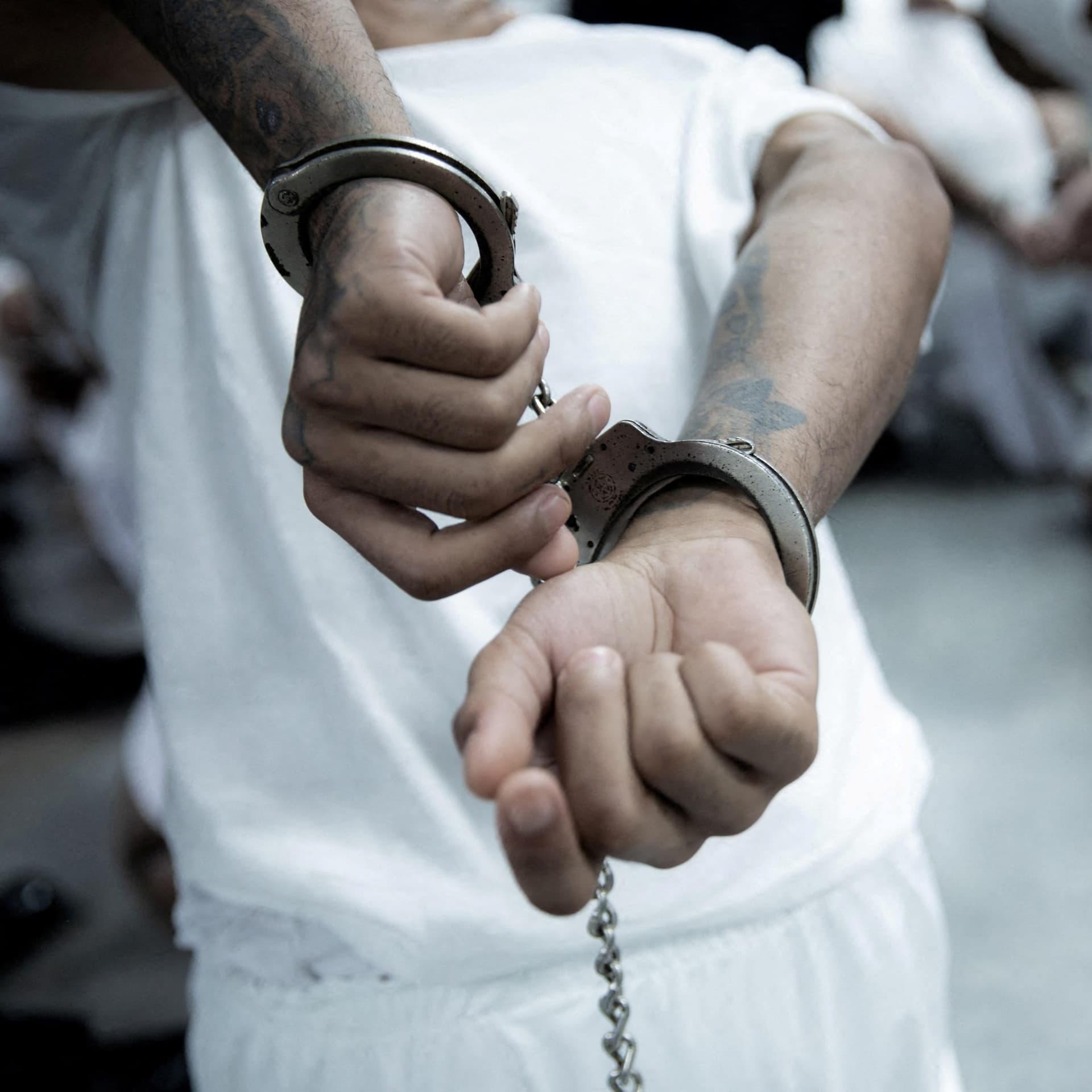
Image: An alleged member of the Tren de Aragua in detention. Reuters.