
In short
How a South Korean right-wing youth movement grew after President Yoon Seok-yeol’s December 2024 martial law attempt, and how it adopted tactics and aesthetics associated with Charlie Kirk/MAGA-style politics.
Guest backgrounds
Jake Kwon, BBC Seoul correspondent covering events between Seoul and Pyongyang, including Kim Jong-un’s nuclear missile developments and K-pop labor disputes.
Key claims
Yoon’s supporters believe he was framed by “lawfare” and “cancel culture,” and that elections were stolen via North Korean/Beijing “spies.” A youth subset called “Freedom University” (linked to the broader Unigain movement) recruits young men with anti-immigration, anti-China, anti-feminism themes and social-media campaigning. Charlie Kirk’s visit to South Korea days before his death is portrayed as inspiration; his messaging is said to have validated their “stolen election” narrative.
Notable examples
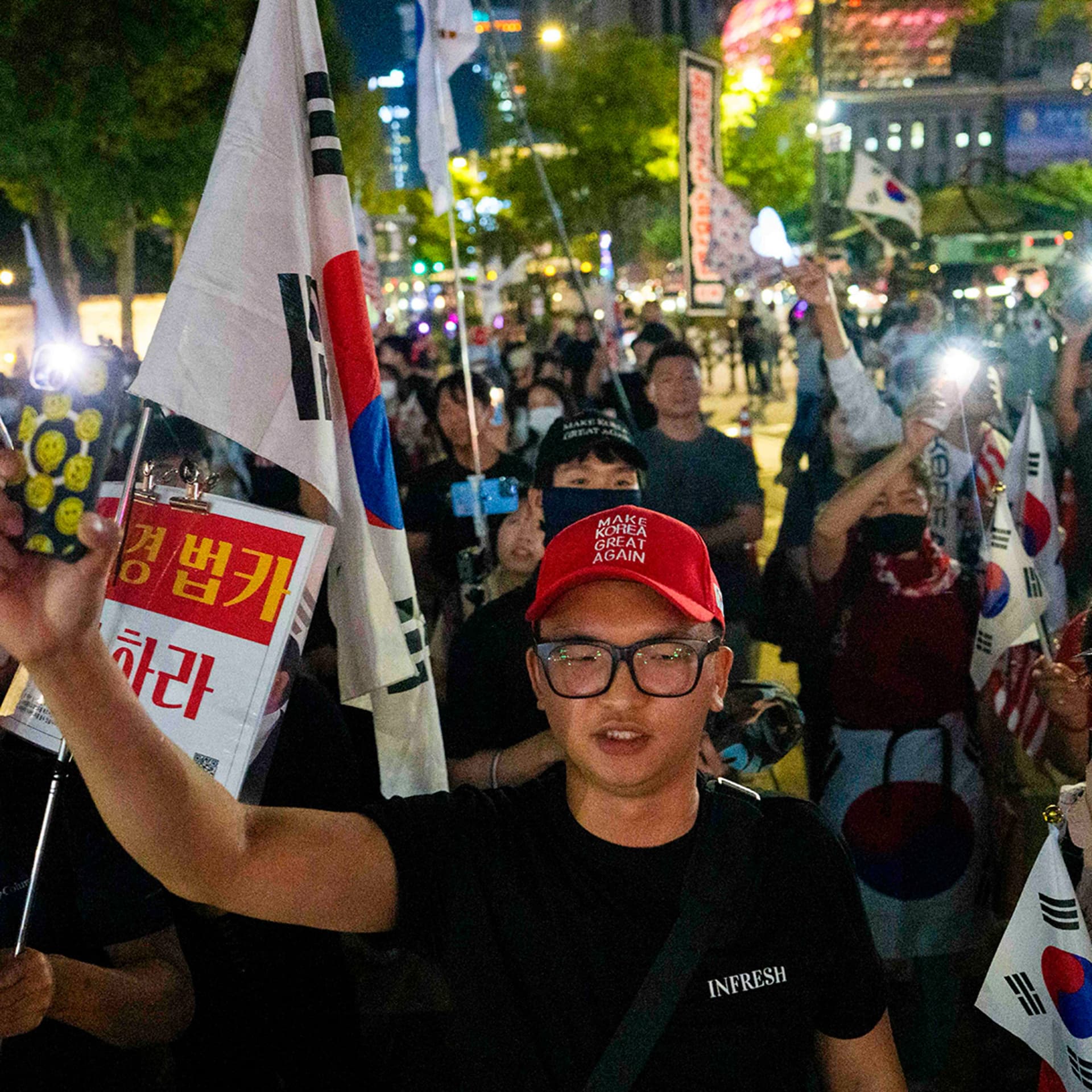
rallies with “Make Korea great again”/“We Are Charlie Kirk” red balloons, chants of “USA,” prayer sessions, mock “martial law” podiums, and booths for photo ops and video messages to Trump.
Written by AI. May contain mistakes. Listen to the episode to check what was said.
Chapters
Tap a time to open that second in VOEmergence of Right-Wing Movement in Korea
0:30 to 1:51
Discussion on the rise of a right-wing youth movement in South Korea inspired by Charlie Kirk.
“There's a story we want to tell you today about a place where young, disenchanted men are moving further to the political right.”
Martial Law Declared in South Korea
1:51 to 5:30
Jake Kwon recounts the shocking declaration of martial law by President Yoon Seok-yeol.
“I'm Jake Kwon and BBC's Seoul correspondent based here in Seoul, South Korea.”
Impeachment and Arrest of President Yoon
5:30 to 7:58
Details about the impeachment of Yoon and the subsequent trials he faced.
“Well, what he was saying is that because the opposition party had such a stranglehold on the country and in the latest general election, they retained the majority, which was a huge disappointment for Yoon.”
Youth Movement and its Inspirations
7:58 to 9:43
Exploration of the Unigain movement and its connections to American right-wing groups.
“You might notice that there's a lot of crazy parts in this story.”
Trump's Influence on Korean Politics
9:43 to 12:14
Discussion on President Trump's perceived influence on the South Korean right-wing movement.
“in the United States like Turning Point.”
Navigating Rumors and Political Discontent
14:01 to 15:38
Explore the impact of rumors and political shifts in South Korea's youth.
“And he was able to navigate it and kind of slip away.”
The Rise of Freedom University
16:50 to 24:05
Discover the emergence and motivations behind the Freedom University youth movement.
“young people do not support right-wing causes.”
Charlie Kirk's Influence and the Political Divide
24:05 to 26:41
Analyze Charlie Kirk's impact on South Korean youth and the widening political gap.
“Jake, we read this piece in the Financial Times a little while back.”
Transcript
Automatic transcript. May contain errors.0:00This BBC podcast is supported by ads outside the UK.
0:30how to invest and manage money. Learn more at schwab.com. There's a story we want to tell you today about a place where young, disenchanted men are moving further to the political right. They're concerned about mass immigration, so-called lawfare and cancel culture. And they're inspired by Charlie Kirk.
0:51Jake Wallace Simons:And no, we are not talking about my homeland or the MAGA movement. We're talking about a right-wing movement in South Korea. Rallies where people chant that Korea is for Koreans and sport red baseball caps. The style, the message, the rhetoric all seem to echo things I've seen at political rallies here in the U.S. The movement has rallied around the disgraced former president Yoon Suk-yul, who shocked the nation with a declaration of martial law in December 2024. On Friday, he was sentenced to five years in jail over abuse of power, obstructing justice and falsifying documents. Prosecutors are also seeking the death sentence for the most serious charges he faces of insurrection.
1:36Jake Wallace Simons:And since our show is about where the world and America meet, we want to understand why this is happening. From the BBC, I'm Tristan Redmond in London. And I'm Asma Khalid in Washington, D.C. And today on The Global Story, why some South Koreans are taking cues from the MAGA movement.
2:06I'm Jake Kwon and BBC's Seoul correspondent based here in Seoul, South Korea. I've been here covering everything from Kim Jong-un's nuclear missile to the latest K-pop labor dispute. So I'm usually just covering everything that happens everywhere between Seoul and Pyongyang. Thanks for coming back to speak with us, Jake. Great to see you.
2:26Jake Wallace Simons:Jake, it's good to have you with us. Thank you for having me back. Jay, take us back to the beginning and explain to us how all of this started. Well, this starts about a year ago, a little more than a year ago, in December 2024, when all of us in Seoul, we started getting texts and notices, alarms saying that President Yoon Seok-yeol had just declared martial law.
2:52This is like a moment for many South Koreans that they can remember when they heard this news because it was so shocking. A Tuesday night in South Korea, the main television shuttle shows a popular chat show. The mood is as soft as the furnishings. Until the president breaks into the evening schedule and spoils it with a national address that shocks the nation. This was 10.30 in the night, and then my phone started buzzing so frequently, which is not a good sign when you're a journalist. We have disturbing details that are just crossing the Reuters wire. At first, I ignored the texts because it sounded so far-fetched.
3:30The president of South Korea, Yoon Seok-hyo, comes on TV in an unannounced address to the nation. He's declaring martial law.
3:50My father called me saying, don't go out. He was terrified. Cue a midnight dash for parliament. First, the army. Heavily armed soldiers enter the back doors of the building. Others take a more direct route.
4:07And I said, I have to go. I have to go to the National Assembly where the lawmakers are all gathering. Because South Korean law says if enough lawmakers gather and vote down the martial law, the martial law will be lifted. And at this point, already there were these special forces soldiers landing on the nation's parliament in their tactical gear from helicopters. And then they were storming the main chamber to allegedly stop the voting. Outside the gates, the scuffles continue in a cloud of tear gas and a flash of cameras. No one could have imagined a situation where these armed soldiers storming what is South Korea's version of the capital.
4:51More than 100 lawmakers essentially having to hop the fences, these two-meter fences around the National Assembly, because the police had cordoned it off and blocking the entryway. And then having a siege with the tactical soldiers putting a barricade. And it was a very dramatic scene that one night. And it lasted for about six hours before it was, you know, voted down. And then the president relented. Martial law and military rule declared by President Yoon earlier in the day have now been lifted.
5:26Jake Wallace Simons:Why was he declaring martial law? What was his reasoning for wanting to do that? Well, what he was saying is that because the opposition party had such a stranglehold on the country and in the latest general election, they retained the majority, which was a huge disappointment for Yoon. So essentially, Mr. Yoon had been rendered a lame duck because there was so little that he could do with so few of his own lawmakers in the legislature. And this really seemed like a nuclear option. Now, he was saying that he had to declare martial law to really appeal to the public how little power he was rendered.
6:03And he couldn't really do anything to rule as the leader of the country. And then he started bringing up more and more reasons as time went. And one of his main accusations is that the North Korean spies and Beijing's spies were stealing elections. And this is why actually he had lost the last general election and that they're conspiring to steal all the future elections. So this has become the main sticking point for a lot of his supporters.
6:31Jake Wallace Simons:And then, Jake, I recall that the former president was ultimately impeached. That's right. And he was impeached the next month. I saw people crying tears of joy. I think a majority of the South Koreans really wanted him gone as soon as possible. I think there was this fear that he would try again, as long as he was sitting in the office, that he would mobilize. And then once he was impeached, he was kind of, you know, essentially under a house arrest. And then the authority finally got the arrest warrant. And then that was another kind of moment of siege because President Yoon just simply did not want to go quietly into that night.
7:07He fought tooth and nail in the courthouse and in the street to try to stay on as long as possible. So he's denied all the allegations against him, is that right? That's correct.
7:18Jake Wallace Simons:You mentioned that he was arrested. What was he ultimately charged with? Well, he's undergoing several trials, but the main one is really the insurrection. This is the most grave, the most serious charge in South Korean law. And if found guilty, the only two options for him is life in prison or execution. It is very unlikely that he will actually suffer a penalty like that because South Korea has not done that since the 90s. It's de facto a non-capital punishment country. And as I understand it, Jake, part of this alleged plan, according to prosecutors, involved sending drones over North Korea, including over nuclear sites and Kim Jong-un's holiday home, to provoke some kind of response.
8:05Can you explain that to us, please? You might notice that there's a lot of crazy parts in this story. And what the prosecutors are alleging is that President Yoon Seok-yeol had been planning this for years now, this martial law. And part of the plan was to start some kind of a limited warfare with North Korea to bait them into attacking South Korea so that that could justify martial law, because that's what the martial law is really for. It's a national emergency or a time of war. And South Korean president allegedly had ordered his military general to send a drone over Pyongyang, North Korea to drop leaflets there to really embarrass and humiliate the North Koreans so that they will have to react.
8:51Now, North Koreans showed a great amount of restraint in not reacting. They simply said that this is something that happened. We will not tolerate this. But in truth, they haven't really done anything to strike back. Now, President Yoon does deny that. And this is still going through trial.
9:07Jake Wallace Simons:But Jake, what is the connection? What's the link between the former president who was removed from office, and this new right-wing youth movement in South Korea. This group of protesters, they started to be identified as Unigain movement. These are around 25 % of the South Korean population who really believe that Mr. Yun did nothing wrong. And a subset of the Unigain is a youth movement that started getting really a big traction called Freedom University. Now, this is not a real university. I mean, this is something that they call themselves. and they have really modeled itself after the similar right-wing youth movement in the United States like Turning Point.
9:47And I think there was a lot of inspiration coming from MAGA. I remember going to these rallies and this one rally I went to, it was pouring down by the way and there were already hundreds of these Yun supporters outside the prison where Mr. Yun was being held.
10:10And the level of kind of adoption of the MAGA aesthetic was uncanny. Most of the people in the crowd were wearing red hats that would say either make America great again or make Korea great again. And at the rally was also Morse Tan, who served in the first Trump administration as a global ambassador against crime. He came to rally to defend the former president and calling on South Korean government to release him. And so this is somebody who served in the first administration. Yes. And many people in the crowd really thought of this as a special envoy sent from President Trump himself, that this is some kind of a sign that Trump was personally interested in the fate of 윤석열.
10:58And this rally, it ended with a great prayer session and with a chant of USA, USA, USA. And it was very obvious that what they were trying to do was to catch the attention of President Donald Trump. Because at this point, they were so desperate that there was no way for Mr. Yoon to be saved, that what is only going to take is President Trump himself intervening and strong-arming the South Korean president to release him. And this was the reigning narrative in that kind of middle of 2025. And a few months after, you know, South Korea has a new president, Lee Jae-myung, who identifies as a centrist.
11:38And this has been opposition leader for a long time. This is somebody President Yoon refused to sit down with him because Yoon believed him to be a bad character who is a criminal. And now the new government of Lee Jae-myung, they have really made it their platform to get to the bottom of what they call insurrection in December of 2024. Now, Lee Jae-myung, the new president, was to visit the White House in August 2025. OK. And Trump had posted something on Truth Social saying, what's going on in South Korea? There is a purge or revolution. It was one of those cryptic message that if you're in America, you would not have any idea what the hell is going on here.
12:25Jake Wallace Simons:I was going to say, I don't recall that post even registering for me, Jake. Because if you are American, this post makes no sense. But me having followed this thread, I knew that Mr. Trump was referring to the incarceration of President Yoon Seok-yeol and was talking about how Mr. Yoon's now other officials, his cabinet members were all being raided and being arrested. The new president of South Korea was about to walk into the Oval Office. And then this drops a few hours before.
12:58Everyone in South Korea, including the presidential office, is scrambling to figure out what does this mean. And I learned later that they were holding emergency sessions to figure out how do we make this go away. Because the worst case scenario here is President Trump ambushing Mr. Yee and saying, hey, didn't you conspire with North Korea? Didn't you conspire with Beijing and steal the elections and ousted poor, poor Mr. Yoon? That would have been a very devastating scenario for South Korea, which relies a lot on America. A reporter threw the question to President Trump saying, what did you mean by that post?
13:41Comments, the post and comments you made on South Korea early this morning, like raids on churches, purge, revolution. How do you think about it? President Lee Jae-myung was obviously ready for this question, and he was cool as cucumber. I think he's a bit of a Teflon man. Nothing sticks to him.
14:06And he was able to navigate it and kind of slip away. I am sure it's a misunderstanding, but, you know, there is a rumor going around about it. Hmm. And then they just moved on. And, of course, pro-Yoon people were devastated to see this. They realized that all this hope and their dream hasn't been answered.
14:32Any team that's tested AI tools for data has seen the pattern already. AI gives a different number than your BI tool. Metrics don't match across teams. and inevitably, users lose trust. It turns out turning on AI is easy, but making it work on data is not. Hex AI was built to solve this. The key is nailing context. Hex is built to unify and curate your data context for agents. Data teams can observe, govern, and continuously improve every AI answer so answers get smarter the more your team asks. The result? Your entire organization asks data questions in natural language and trusts the answers.
15:15Not because the AI got lucky. Because it knows your business and its data. Because that's what an AI analytics platform should do. Join data teams from Cursor, Lovable, Ramp, AWS, and over 2 ,000 more at hex.ai.
15:37Jake Wallace Simons:Jake, you mentioned this youth movement that's dubbing itself Freedom University. They say they don't really have a physical campus per se. Can you tell us a little bit about who they are? What's their defining characteristics? Who's behind the movement? Freedom University is a youth student movement. And it started with maybe a few dozen students in each campuses across the country who believe that Mr. Yoon is not guilty of insurrection. And I remember they were considered very, very fringe. And then they were able to bring thousands of people to their rallies. It is essentially led by Mr. Park Joon-young, who I spoke to.
16:18Korean people's rights are being stolen. Our sovereignty is at risk. And the Chinese are coming in without visa, and crimes are becoming frequent. He's a 24-year-old student in a pretty prestigious university in South Korea. And their method was to just be as provocative as possible. They started marching through Seoul's Chinatowns, yelling anti-China slurs, singing these songs, slurs that I probably cannot repeat in this BBC broadcast. And I was intrigued because traditionally, young people do not support right-wing causes. So to see these hundreds and thousands of people in their 20s coming out in droves to support President Yoon, who wasn't really popular before the martial law, especially among the young people, was a mystery that I feel like I had to unbox.
17:11Where did they all come from then? So I went to see Park Jun-young, the leader of the group, and I asked him these questions. And for me, seeing how this man himself got into the movement was a bit of a surprise because he comes from a very liberal left-wing family. His father was the CEO of a broadcaster that is considered pretty left-leaning. And his mom was the aide of a left-wing president. And his older sister is a very outspoken feminist. And he was saying that he doesn't even speak to his family anymore because of this differing politics. He said in a different interview that he felt like his family was trying to inject him, his words, with a feminist ideology.
17:58And that's when he kind of woke up from his family's politics and he started questioning things. I think there has been a vibe shift in South Korea. And I think largely this movement, this anti-feminism is now a dominant ideology amongst young men. I mean, all of this sounds quite familiar, Jake. Like disenchantment with political centrism or political leftism amongst young people is a thing we're seeing all over the world. But why specifically is there so much disenchantment among some young people in South Korea? Well, this is something that I was questioning as well. And I remember doing a lot of Vox Pops and asking people who were at the rally of the Freedom University.
18:38A lot of these people are in their 20s. And I asked them, why did you turn to this movement? And a lot of them told me that they were actually left-wing before, that they were fans of the left-wing president. They keep expressing this word that I keep hearing, which is this disappointment that the left-wing are hypocrites. They promised something and they didn't deliver. And now I realize that they were lying to us the whole time.
19:05Jake Wallace Simons:When you attend these rallies, Jake, that Freedom University is putting on, what does it sound and feel like? I think there are two types of rallies. One is the one that I described where they're very angry, they're very combative and provocative, they're marching through the Chinatown and singing the songs with anti-China slurs. Now, the other one that I went to, which I was shocked for a different reason, was that it was more like a party, a festival, maybe.
19:35I saw these thousands of young people all wearing this chic kind of black streetwear, And they were lining up some up to an hour waiting for this like photo booth where they can take picture with President Yoon Seok-yeol's photo where he's smiling and doing a hand, you know, the hand heart that K-pop stars do. And there was also a booth where they could record a video message to President Trump, likely to tell him to please help Mr. Yoon.
20:05Jake Wallace Simons:Oh, fascinating. Yeah. And one of the latest rallies that they put on, there was a booth with a mock presidential podium where one could stand and declare martial law yourself, pretend to be President Yoon on the night of the martial law. And a lot of them were also waving these We Are Charlie Kirk red balloons and holding up signs, you know, saying We Are Charlie Kirk. And, you know, a lot of the people looked like they were barely 20. And when I asked them, a lot of them told me that this is their first time ever joining a political rally. This was the first one after the assassination of Charlie Kirk.
20:42And it was really seemed to me like they were trying to attract moderates. Shortly after Charlie Kirk was murdered back in September, we did an episode, Jake, in which we looked at Charlie Kirk's global influence. And we reported at the time that Charlie Kirk had just come back from a trip to South Korea. Why did he make that trip before he was killed? Charlie Kirk was in South Korea just days before he was killed.
21:13Thank you so much for welcoming me to your incredible country. I haven't been here very long, but I can tell you, you have so much to be proud of. He was invited to South Korea by a right-wing group in South Korea who is also part of the Unigain movement. There was also Steve Bannon who sent the video message. Steve Bannon's daughter was there as well in person. What Korea is living through today is what America lived through starting in November 2020. It's the big steal, stolen election, fraud, rigged systems, a media that lies every single day. I mean, these are people who were always considered fringe.
21:48And they were getting this huge sense of validation from America's officials or people who are very close to power coming to South Korea and then telling them, you know, they're fighting the good fight. The people of this country must remain vigilant every day to protect your freedom and your faith from the evildoers who would destroy you. And telling them, you're the bulwark against the Chinese influence. You're fighting American fight for us. And they were essentially saying where you guys are with your president incarcerated, accused of insurrection after his election was being stolen. This is exactly where we were in 2020.
Read the full transcript
22:262020 was stolen, just like how your election was stolen. This is unrestricted warfare. The unbelievers, the Democrats, the elite, the globalists. And telling them our president was going through the lawfare, as they called it. And all you have to do is keep fighting, never give up. And I'll show you some of the strategies that we've done, which is to just stay in it, use social media, forget the legacy media and keep repeating your message and keep spreading it over social media. And one day your president can come back like what happened with our president. And another message was, of course, a return to kind of Christian faith and family values that Charlie Kirk was preaching at this event.
23:13Korea's greatness isn't just a testament to the power of freedom and capitalism. We must never forget it's also a testament to the power of prayer. And then he ends with this kind of rousing message of let's return to faith. Let's return to nationalism, the country, the God and the family values. And then if you keep fighting the fight, President Trump is paying attention to your fight. And you should do what the Americans are doing, which was never give up and keep fighting. And then the crowd goes wild. Just applause, standing ovation. USA! USA! USA! And what I heard from the leader of Freedom University is that he somewhat idolizes Charlie Kirk.
23:56And he believes that Mr. Kirk figured it out, how to deliver the young people to the right wing. And he wants to essentially do the exact same. He wants to emulate his success. Jake, we read this piece in the Financial Times a little while back. And it showed that the political divide between men and women under 30 in lots of countries is in the process of widening. And that that gap was especially stark in South Korea. So women supposedly have moved about 10 points to the left since 2015, but men in that same time period have moved about 30 points to the right. Now that's a huge chasm. What does that mean for South Korean politics?
24:40South Korea sometimes feels like it's just five years ahead of the rest of the world, just because how quickly it adopted social media. And, you know, it's already years since South Korea's online space is mostly segregated by gender. A lot of the men hangs out in gaming forums. A lot of women don't really feel welcome. And the women's space online, they actually mandate that whoever is trying to join the forum show their national ID to show their gender. And that kind of translated into online spaces where men hang out in the kind of male-heavy forums and then women hang out in women-only forums.
25:17And I think there's a bit of an echo chamber happening.
25:20Jake Wallace Simons:And then presumably that'll trickle out into the real world and affect politics. And so, Jake, that leads me to our final question, which is, you know, in this global context, where does this movement that you have been witnessing in South Korea, where does it go next? Well, I don't think it's a big surprise to see a lot of these people joining this movement now with this kind of feeling that they were abandoned by the politics. There's a lot of self-confirming bias and this very robust online social media campaign by this right-wing movement who is trying to actively recruit them into their ranks.
25:58And their messages has been quite convincing for a lot of young people. We saw this movement grow nearly twofold in a year's time. And now that the polls suggest that 30 % of the young people buy into this kind of argument, they buy into these kind of disproven theories of stolen elections, this polarization seems to be getting deeper and deeper. Imagine 20 years or 30 years from now, when these young people now become the leaders, whether it be politics, in business, they become the thought leaders. Can there even be a cohesive society? What is relevant to the rest of the world is how replicable this model is for the rest of the world.
26:48I mean, as I see this number grow, I'm realizing that this could happen anywhere in the world.
26:58Jake Wallace Simons:Well, thank you, Jake, for taking so much time to speak with us and giving us the view from South Korea. Yes, thank you so much, Jake. It's been really fascinating to hear this story from you. Thank you very much.
27:20Jake Wallace Simons:That was the BBC's Seoul correspondent, Jake Kwan, speaking to us from South Korea. By the way, before we go, we've got a quick recommendation for you. As you've noticed, if you're a frequent listener to our show, here on The Global Story, we go deep each day on one story. But the BBC also has a show to catch you up on the latest news from around the world, the Global News Podcast. Check it out. You can find it wherever you listen to your favorite shows. Today's episode was produced by Valerio Esposito and Kat Farnsworth. It was edited by James Shield and mixed by Travis Evans. Our senior news editor is China Collins.
27:56That's it for today. Thanks as always for tuning in. Cheerio.
From the publisher
A right-wing movement in South Korea is attracting disenchanted young people who are concerned about mass immigration, lawfare and cancel culture. They sport red baseball caps, idolise Charlie Kirk and chant that “Korea is for Koreans”. The movement has rallied around the impeached former president Yoon Suk Yeol, who was sentenced last week to five years in jail for abuse of power, obstructing justice and falsifying documents in relation to his failed martial law bid in 2024. Yoon could also face the death penalty over insurrection charges, which he denies. The BBC’s Seoul correspondent, Jake Kwon, explains how South Korea found itself at the heart of a globalised culture war. Producers: Valerio Esposito and Cat Farnsworth Mix: Travis Evans Executive Producer: James Shield Senior news editor: China Collins (Photo: Jintak Han/The Washington Post via Getty Images)