
In short
How the US under Donald Trump pulled out of the Paris Climate Agreement and doubled down on fossil fuels, while China pursued renewables and clean-tech industrial policy—shaping global energy and geopolitical power for decades.
Guests
Justin Rowland, BBC’s first climate editor; energy analyst Li Shuo (interviewed). Hosts are Asma Khalid and Tristan Redman.
Key claims
Trump’s anti-wind stance is tied to a Scotland golf resort dispute and a broader “energy dominance” strategy; his clean-tech skepticism is political, not climate-focused. China dominates clean tech (roughly 90% of solar, 80% of batteries, 60–70% of wind, and major EV production) and uses coal as backup while emissions fall. US renewable momentum was weakened by Reagan-era pullbacks and later fossil-fuel gains (fracking); Biden tried to reverse with major subsidies to compete with China.
Notable examples
Trump’s Meany golf-resort wind-farm court case; BBC Verify fact-checking China’s “no wind farms” claim; Carter’s White House solar heater; Solyndra loans; 2008 Beijing Olympics pollution crackdown; Paris Agreement signing (2015) and US withdrawal/rejoining.
Written by AI. May contain mistakes. Listen to the episode to check what was said.
Chapters
Tap a time to open that second in VOUS Withdrawal from Paris Agreement
0:38 to 1:30
Discussion on Trump's exit from the Paris Climate Agreement and its implications.
“President Trump has pulled the United States out of the Paris Climate Agreement.”
Introduction of Justin Rowland
1:30 to 2:10
Justin Rowland discusses his role as the BBC's first climate editor.
“And could that decision have consequences for decades to come?”
Trump's Views on Wind Energy
2:10 to 4:10
Exploration of Trump's disdain for wind turbines and their impact.
“We were fascinated by Donald Trump's insistence when he was at Davos a couple of weeks ago.”
China's Renewable Energy Production
4:10 to 5:20
Analysis of China's dominance in renewable energy sectors.
“You know, his experience with his golf course was the evidence.”
Strategic Energy Battle
5:20 to 7:17
The discussion focuses on the strategic energy competition between the US and China.
“It's got like 90 % of the solar market, 80 % of the battery market, about 70 % of the wind market.”
Historical Perspective on US Energy Policy
7:17 to 7:52
Overview of the US's past focus on renewable energy and how it has shifted.
“Well, Justin, you say that if you wanted to beat China, then you ought to have been playing this game 30, 40 years prior.”
Technology Development in Renewable Sector
7:52 to 10:03
Discussion on the development of solar and wind technologies in the US.
“I'm not sure you were prioritizing deployment.”
Renewable Energy Initiatives and Failures
10:03 to 11:28
Examination of the Obama administration's renewable energy efforts, including Solyndra.
“but it was promptly removed by President Reagan.”
China's Shift to Renewable Energy
11:28 to 12:18
Insight into China's transition from coal dependency to renewable energy.
“lest us not forget, is the biggest producer of oil and gas in the world now.”
Pollution and the Beijing Olympics
12:18 to 14:01
Discussion on how pollution influenced China's renewable energy policies leading up to the 2008 Olympics.
“By the end of the 90s, they're thinking, well, this can't go on forever.”
Show all 15 chapters
China's Response to Pollution and Energy Development
14:01 to 16:53
Explore how China managed pollution during the 2008 Olympics and its shift towards renewable energy.
“Look, a lot of people say the Beijing Olympics in 2008 was the moment.”
Podcast Introduction
16:54 to 17:26
Hosts introduce themselves and the premise of 'The Global Story' podcast.
“And I'm Tristan Redmond, and together we're the hosts of the Global Story podcast from the BBC.”
The Paris Climate Agreement's Impact
17:27 to 19:51
Discuss the significance of the Paris Climate Agreement and its implications for US-China relations.
“But there is actually a moment when they come together, which is in 2015, when the Paris Climate Agreement was signed.”
Biden's Renewable Technology Initiatives
19:52 to 24:18
Examine Biden's efforts to support renewable energy and the competitive landscape with China.
“And as of today, the United States is officially once again a party to the Paris Agreement, which we helped put together.”
Long-term Strategies and Global Energy Dynamics
24:19 to 27:07
Analyze the long-term implications of current energy strategies on global superpower status.
“Where do these different strategies leave China and the US?”
Transcript
Automatic transcript. May contain errors.0:00This BBC podcast is supported by ads outside the UK.
0:30Justin Rowlatt:Just tap into iHeart to start watching. And we hope you enjoy the show.
0:38President Trump has pulled the United States out of the Paris Climate Agreement.
0:42Justin Rowlatt:Now, you might have thought you've heard a version of this story before. Because Donald Trump previously left the very same Paris Climate Accord in his first term. But this time, something's different. This time, he's gone all in on fossil fuels. And he's made it clear he wants other countries to do the same. Meanwhile, the U.S.'s biggest rival, China, is pulling in a different direction. It's betting big on renewable energies. From the BBC, I'm Asma Khalid in Washington, D.C. And I'm Tristan Redman, for a change, also in Washington, D.C. And today on The Global Story, as the world's two biggest economies plot opposing paths on the future of energy, why has the US decided to opt out of renewables?
1:30And could that decision have consequences for decades to come?
1:43So my name's Justin Rowland and I am, on my biog, it says the BBC's first ever climate editor. We did have environment editors before, but they were redefined as climate editors. Oh, explain the difference, please, Justin. We had a debate about this. I said I should be environment editor because, you know, environment encapsulates more than just climate. And the head of BBC News said, Justin, you can do any story you like, but you're the climate editor. OK, bye. And that was it. OK, well, good to have you with us, Mr. Climate Editor. We were fascinated by Donald Trump's insistence when he was at Davos a couple of weeks ago.
2:23Well, thank you very much, Larry. It's great to be back in beautiful Davos, Switzerland. Talking about windmills. Perhaps the greatest hoax in history. The Green News scam, windmills all over the place, destroy your land, destroy your land. Every time that goes around, you lose$1 ,000. Specifically the idea that he wasn't just annoyed apparently at windmills being built in the United States, but he seemed to be irritated and cross at the idea that, for example, Europeans might be building windmills. There are windmills all over Europe. There are windmills all over the place. And they are losers.
3:08One thing I've noticed is that the more windmills a country has, the more money that country loses and the worse that country is doing. So he seems to have this particular distaste for wind turbines. Where does it come from? We can actually trace it. We can be very precise about this. Donald Trump's dislike of windmills, as he insisted on calling them, he bought yet another golf course in Scotland on the Aberdeenshire coast called Meany. I think that's how you pronounce it. He was going to build a tremendous golf resort there. He said it was going to be the best golf resort in the world. So he bought it in 2006 and then a wind company got the option to build a wind farm off the coast.
3:52So within sight of his golf course, and he was enraged by this, his team challenged the decision to award a license to this company. And Trump actually was a witness, an expert witness in one of the cases. And he was asked by the judge why he thought that wind turbines in Scotland would damage the Scottish tourist industry, which was a claim he was making. And he said, I'm the evidence, he said. You know, his experience with his golf course was the evidence. He didn't succeed in overturning the license for that wind farm. It was built. That was in, I think it was in 2011, that court case. It was about five years before he became president of the United States.
4:33And I think he was incubating that dislike of windmills ever since then. He also talked quite a lot about this idea that China was building wind turbines to sell to other people, but wasn't using these wind turbines itself. China makes almost all of the windmills, and yet I haven't been able to find any wind farms in China. Did you ever think of that? It's a good way of looking at it. They're smart. China's very smart. They make them, they sell them for a fortune. They sell them to the stupid people that buy them, but they don't use them themselves. And it just so happens that our colleagues at BBC Verify fact-checked this and found it to be untrue.
5:19I mean, China overwhelmingly produces solar, wind, batteries, EVs. It's by far the biggest producer. It's got like 90 % of the solar market, 80 % of the battery market, about 70 % of the wind market. I think it's 60 % or 70 % of the electric car market. When you say market, their production that they export and use domestically. Yeah, global sales. It includes the stuff that they put in and the stuff they're selling around the world. So massively dominant in all the clean technology. I mean, the only one that there's a bit of traction, the European wind is about 30, 40 % of the market and is quite dominant locally in Europe.
5:59It's the last toehold Europe has in clean tech.
6:03Justin Rowlatt:But otherwise, the global leader on essentially every form of renewable energy at this moment, you're saying, is China. I mean, far and away. What is so interesting about President Trump's attitude to energy is this isn't just about a dislike or otherwise of green energy, as you say, for the US. He says he wants America to have energy dominance globally. And that's a foundational principle of not just this term, but his previous term as president as well. And he wants other countries to follow his lead. He wants them to buy American oil and gas. He wants to double down on American domestic energy, sell it to the world.
6:40And he wants to do that, remember, in competition with China. China has been investing for many years, for decades, in developing green technologies, clean energy technologies. I spoke to a really interesting energy analyst who focuses on China, Li Shuo. And I talked to him about it. And he said it's like trying to beat China at table tennis. If you wanted to beat China at table tennis, you needed to start building your team 30 or 40 years ago and have continued to work on it all that time. You are not going to beat China at table tennis. You are not going to beat China at manufacturing cheap solar panels.
7:13It's more than just an energy battle. This is a geostrategic battle because it also relates to the relationships these two superpowers have with other countries.
7:21Justin Rowlatt:Well, Justin, you say that if you wanted to beat China, then you ought to have been playing this game 30, 40 years prior. And that makes me think of, well, you know, here in the United States, there was a time period when the U.S. was prioritizing renewables. I know that might not seem obvious to everyone outside the United States who thinks that we just have these giant gas guzzling cars. But it is true that for many years, the U.S. was prioritizing the use of different forms of renewables. And I want to understand how and why that's changed. So can you give us a bit of that history? I'm not sure you were prioritizing deployment.
7:56You did make crucial developments, for example, in solar panel technology. You know, the first modern solar panels were developed in America in Bell Labs. NASA, for example, needed power sources for satellites. And so they could use this incredibly, you know, innovative, new and unbelievably expensive new technology of solar panels, put them on their satellites and that would generate. When are we talking, Justin? This is like from the 60s, 70s onwards. So this was an incredibly expensive technology, but did have this miraculous ability to generate power just out of light. The other people who had the cash to buy this really expensive technology were hippies, dope-smoking hippies, who'd retreated to the hills of Northern California to set up dope plantations growing cannabis and selling their cannabis on.
8:43They had a lot of ready cash. They wanted to listen to the radio, listen to music, and have lights on in their little sheds they had up in the hills. and they wanted a technology that would deliver electricity, allow them to charge batteries, that kind of thing. This is in the late 70s, early 80s. It began to then expand and we've seen this incredible, as the production lines increased, the price went down and it began to be applied to more applications.
9:06Justin Rowlatt:So you're saying though that in the 70s, late 70s, early 80s, the United States did invent, help invent both solar and wind. And wind technology. And remember there was that great story, wasn't there, of President Carter. We're taking the energy that God gave us, the most renewable energy that we will ever see, and using it to replace our dwindling supplies of fossil fuels. President Carter famously put solar panels to generate, I think, hot water rather than electricity, but solar panels on the White House. Therefore, I dedicate this afternoon this solar heater, harnessing the rays of the sun to the benefit of those who serve our country at the White House.
9:51And the indication was, you know, this was a way for America to generate domestic energy using technology developed in America. So there was a kind of push towards solar a little bit, but it was promptly removed by President Reagan.
10:06Justin Rowlatt:So in the 70s and 80s, this technology was being developed. It seems intrigue here in the United States for them. In the 80s, Republican President Ronald Reagan comes in. You're saying he pulls back on some of this government investment in renewable energy. In the mid-2000s, if we fast forward, it seems like there was quite a lot of interest from the United States in pursuing renewable energy. I recall during the Obama administration, there were these loans made to companies that didn't all go well. For the first time, President Obama had to answer for Solyndra, the solar panel company which failed despite half a billion dollars in government loans from the Energy Department.
10:46President Obama had held it up as a model for green jobs and clean energy. What we always understood was that not every single business is going to succeed in clean energy. But if we want to compete with China, which is pouring hundreds of billions of dollars into this space, if we want to compete with other countries that are heavily subsidizing the industries of the future, we've got to make sure that our guys here in the United States of America at least have a shot. I mean, they weren't at this stage really of a kind of commercial, didn't have huge commercial potential. And at the same time, America's developing kind of fracking technology and that kind of thing, which massively increased its ability to produce oil and gas.
11:27America, lest us not forget, is the biggest producer of oil and gas in the world now. So it found this relatively cheap new technology it could use to access oil and gas. The oil and gas price was quite low, which means that renewable power was less attractive because it was quite expensive at that stage. So they doubled down essentially on oil and gas, which I think is probably where China comes in. And China is then in the late 90s, early 2000s, is looking at a number of things. So China has built its industrial development on a kind of essentially coal-based Victorian technology, if you like, developing production lines that produce essentially consumer goods and other goods for Western countries using polluting technologies, leveraging its huge resources of cheap labor.
12:17So that was the industrial model for China from the 80s onwards. By the end of the 90s, they're thinking, well, this can't go on forever. We need to move up. We need to move into higher, more valuable tiers. So they're looking for new market opportunities. But at the same time, the pollution from the coal plants, whilst producing beautiful sunsets, China's sunsets were, you know, the impressionists do those amazing people like Turner painted those amazing sunsets. There was so much smoke and stuff in the sky. China had similar beautiful sunsets, apparently. People in the cities are getting annoyed at the level of pollution.
12:48They're getting ill. They're developing costs. They know it's unhealthy. There's pushback on the pollution. At the same time, China, like America, doesn't want to be dependent on foreign countries for oil and gas and coal. So it's looking to be energy independent. And also, now China is looking at the science of climate change. And it's saying climate change is a real thing. It's really happening. The world is on the wrong trajectory. And there will need to be new technologies that will need to be deployed globally to produce energy without producing carbon emissions. So they thought, actually, there's a huge market opportunity here.
13:24And they were like, let's get in on this quite early. So they went to the universities where people were doing research on solar panels, and Chinese students turned up and started learning about solar and wind technology, battery technology, that kind of stuff. And so by the turn of the millennium, there's a kind of priority, a recognition within China that solar and other renewable technologies have huge potential for future growth. In the early 2000s, these policy changes sound relatively theoretical on the Chinese side. They're a strategy to aim for. But when does this actually translate to practical changes in China?
14:01Look, a lot of people say the Beijing Olympics in 2008 was the moment. I think it was the moment the world thought, hold on, China, maybe China is serious about this because they said the air is disgusting. It's really polluted. It's not fit for athletes to compete in. we need to do something about this because we're welcoming the world into our great capital city and it just doesn't look good, you know. So they did. They closed down huge industrial plants all around Beijing. It was ringed by industry and they closed it all down, but they effectively moved it elsewhere. They weren't going to, you know, give up those great industries they've created.
14:33So the world's pollution happening elsewhere, but not around Beijing. But at the same time, in parallel to that, and this is the pragmatism point that we make about China, In parallel to that, they were developing these new industries. And by 2008, most of the big Chinese solar companies had been founded and were big, significant companies. This was a long-running policy that kind of has increasingly borne fruit over the years. And we've got to be careful when we talk about China. It is still building coal plants. You know, they haven't stopped investing in new coal. They're using them less. So the idea of the coal is essentially you should think of coal as a bit like a battery in China.
15:09When they've got the wind power and the solar power, they'll use that. They've got batteries to store it. And then when there is no other option, they fire up a coal-fired power station, and that delivers the backup power. That means you don't get power cuts in China. So they're being used less and less, which is why China's emissions are beginning, it seems, to fall.
15:27Justin Rowlatt:Justin, you've reported from China in the past. And can you just share with us what really struck you about China and its development during some of those reporting trips? On both occasions that I went, we were talking about China's changing use of energy. We were talking about climate change and that kind of thing. So we did see huge solar factories and that kind of thing, which they obviously wanted to see. We also, I remember, went to one of the coal areas, Shangzi, one of the coal areas of China, and where there's kind of these open-cast coal mines and trucks with huge, piled up with coal, I mean, really filthy.
16:05And, you know, back to the kind of that old fashioned image we have from, you know, before the turn of the millennium of dirty China, that still exists in China. But you also get this sense of a, you know, kind of optimistic, vibrant, forward looking nation. It kind of takes its global role really seriously and wants to be a kind of responsible global citizen. You know, there is still kind of, you know, like I say, coal production and use and smog in some places, but it's a country kind of wanting to build a bright and a clean future for itself.
16:54Hi there, I'm Asma Khalid. And I'm Tristan Redmond, and together we're the hosts of the Global Story podcast from the BBC.
17:01Justin Rowlatt:For those of you who might be new to our show, we here at the Global Story dive deep every weekday on one big story at the intersection of where the world and America meet. And you can now watch the Global Story on the iHeart app. Catch every brand new episode every weekday. Just tap into iHeart to start watching. And we hope you enjoy the show.
17:27So, Justin, we've covered the kind of divergent paths of the US and China in terms of ecological policy. But there is actually a moment when they come together, which is in 2015, when the Paris Climate Agreement was signed. Now, there is widespread global optimism after a landmark climate change deal was agreed in Paris. The main target set in Paris was to keep global temperatures well below 2 degrees Celsius and to limit the increase to 1.5 degrees Celsius above pre-industrial levels. This agreement sends a powerful signal that the world is firmly committed to a low-carbon future. I was there and I remember it very vividly.
18:09I mean, it was this kind of extraordinary emotional moment, tears when the gavel came down and there was whooping. Both the US and China signed that treaty, along with almost every country in the world. How significant was it, or how unexpected was it, that both China and the US came together at that moment? You've got to remember that the American politics changed under Obama. Obama obviously was supportive of green energy. you know, all the countries of the world were aligned in the recognition that they needed to come together to tackle this existential problem. I mean, it was a hugely optimistic moment for the world.
18:56Whether we've delivered on the promise of Paris is a completely separate question. But you've got to remember, American policy changes with the government. Chinese policy tends to follow a pretty straight line. And arguably, that's why China has been so much more successful in developing these technologies. Thank you very much. Thank you. But that moment of optimism was pretty short lived because that was in 2015. And not very long after that, Donald Trump came to power, entered the White House and withdrew the U.S. from the Paris Climate Accord. The Paris Climate Accord is simply the latest example of Washington entering into an agreement that disadvantages the United States to the exclusive benefit of other countries.
19:42Joe Biden comes to the presidency four years later. And on his first day in office, he announces that the U.S. is going to be rejoining the Paris Climate Agreement. And as of today, the United States is officially once again a party to the Paris Agreement, which we helped put together. Joe Biden tries to reverse some of the changes that Donald Trump has enacted. But how does how does he actually do that? at biden he introduces the biggest you know state support for the renewable technology in the history of the world it's going to boost america's innovative edge in markets where global leadership is up for grabs so it was a massive project to uh to stimulate the development of um of all the green clean technologies markets like battery technology biotechnology, computer chips, clean energy, a competition with China in particular.
20:37It was a kind of make America great kind of project in that it was supposed to revive American industry, develop these new technologies, allow it to compete with China, a recognition of what had been happening in China, that China was now dominating in these new technologies and that America wanted to get back its kind of industrial primacy, if you like, from China. That was the kind of logic. OK, so Joe Biden says that he wants the United States green power powerhouse, if you like, during his presidency. But if you look at the statistics at this point, China controls over 80 percent of global solar panel production supply chains.
21:17It produces 75 percent of the world's electric batteries, dominates critical mineral processing, which is needed for those batteries. So, I mean...
21:29Justin Rowlatt:70 % of the electric cars in the world are produced in China? Yes. I mean, it feels like China's lead at this point is kind of becoming unassailable. Is that a correct assessment? It is very difficult to beat, but there are. It's interesting. You look, I mean, Trump has rolled back virtually all of Biden's kind of support packages for renewables, and he's doubled down on fossil fuels. But there are a few technologies, and it's quite interesting. There's a sort of deep geothermal energy which has kind of evolved out of the fracking industry. So fracking has made it way cheaper to drill the big holes underground.
Read the full transcript
22:02And the idea is you drill two big holes, you frack the hot rocks two miles underground or wherever you are, you frack the hot rocks and then you pump water down one pipe and you draw the hot water out of the other and generate, and in the right circumstances, it's hot enough to drive a turbine or certainly to heat homes. So this is a potentially really, really useful technology that's got way, way, way cheaper. And Trump is still subsidizing that. So it's not like he's written off all renewables. He just doesn't like the windmills and he doesn't like the solar panels. What's the opposing case, though, for sticking with the fossil fuel route, as Donald Trump appears to have done?
22:44I think Donald Trump, first off, he's not worried about the climate. He called it a con job, the world's greatest con job at the UN. he said that clean technology is the new green scam. I've interviewed his energy secretary who says, yes, we need to reduce emissions, but not nearly as quickly as the scientists say. It's not a priority for his government. He looks at what China's done with clean tech and he thinks America simply can't compete with that. We can't make more efficient production lines. Our labour is more expensive. Perhaps our energy is more expensive as well. China is going to win at that productive activity.
23:20And so he's like, well, what can America do in this really important global market? America has really successfully increased its output of fossil fuels, biggest producer of oil and one of the biggest producers of gas. So I think he looks at that and says, well, we've got this wealth under the ground. But it seems to me that he isn't he isn't looking at the long term in the way, for example, that China is. So he's like, what have I got in my toy box? What can I play with? and he sees this American capacity to produce fossil fuels and thinks, well, this is valuable stuff. I can make cash for America by selling this abroad and I can use other leverage that I've got to make that happen.
23:59And he thinks this is going to work for me for the next few days, the next year or two. This is a good strategy. So we'll do that. There is a kind of logic to it, but it's not a logic founded on kind of tackling climate change and long-term economic strategy, maybe it would be argued. If we cast forward, say, 30 or 40 years, which is, you know, according to a lot of estimates, the sort of time when fossil fuel reserves around the world are going to be beginning to decline, starting to run out potentially. Where do these different strategies leave China and the US? I mean, it's so interesting, isn't it?
24:39We've got to master the ability to store electricity a bit better. So we've got to get cheaper batteries. But once we've done that, I think there's no reason why you would want to go on burning stuff and putting polluting gases into the atmosphere. Ultimately, yes, you know, clean tech will be the only energy tech at one stage, along with probably nuclear power, maybe a few others, hydropower. And it's hard to see how China hasn't made, you know, the fruit a bet, I think, in this regard. I guess the thing I find myself wondering is like when the fossil fuels run out, which they inevitably will, is it too late at that point to change course?
25:21Like have you missed the opportunity? Have you missed the boat if you disinvested from green technology several decades beforehand? This is a really serious, important question that's being asked in capital cities around the world. I mean, I think there's a feeling that India has the capability to perhaps square up to China and compete with China. Vast population, cheap labour, huge potential deployment, particularly of solar. Europe has, as I said, still has a toehold in the wind turbine market. You'd hope we'd double down on that. But it's hard to see how Europe or America, with the current economies and the kind of cost of labor, can compete with China, India and other developing countries.
26:02China, really interesting now, has an industrial policy to relocate some of this production elsewhere in the world, putting factories in places in Africa and in other countries in Asia where labor costs are lower, partly to offer development opportunities for those countries. And this is something we haven't touched on. China's bilateral trading relationships as a result of its clean tech give it amazing soft power. But arguably, you know, America, which had unbelievable soft power around the world, is losing with its slight more, I'm trying to put this politely, its more confrontational approach to trade relations.
26:43This might be an inflection point where we begin to see a really substantial tilt away from America as the sole superpower into a world in which China perhaps has, you know, increasing power and strength, partly as a result of its efforts to develop clean technology.
27:04Justin Rowlatt:Thank you so much for your time, Justin. Thank you, Justin. That was a real pleasure. I really enjoyed that.
27:16That was the BBC's climate editor, Justin Rowlett. And that's it for today's show. As always, we love to hear from you all. So if you'd like to contact us with any thoughts or story ideas, you can email us at theglobalstory at bbc.com.
27:30Justin Rowlatt:And we've got a quick recommendation for you all before we go. If you're looking to catch up on the latest news from around the world, then check out our sister show, The Global News Podcast, wherever you listen to your favourite podcasts. This episode was produced by Aaron Keller and Hannah Moore. It was mixed by Travis Evans. Our executive producers were James Shield and Bridget Harney. And our senior news editor was China Collins. And I'm Tristan Redmond. And I'm Asma Khalid. Thanks for tuning in. And we'll talk to you again tomorrow. Cheerio.
28:03Hi there. I'm Asma Khalid. And I'm Tristan Redmond. And together we're the hosts of the Global Story podcast from the BBC.
28:10Justin Rowlatt:For those of you who might be new to our show, we here at The Global Story dive deep every weekday on one big story at the intersection of where the world and America meet. And you can now watch The Global Story on the iHeart app. Catch every brand new episode every weekday. Just tap into iHeart to start watching. And we hope you enjoy the show.
From the publisher
President Trump has withdrawn the US from the Paris climate agreement for the second time and also announced plans to leave the UN Framework Convention on Climate Change. In his first year back in office, Trump has rolled back restrictions on oil, gas and coal – and has urged other countries to do the same. China, meanwhile, has spent the past decade consolidating its expansion into clean energy technologies, even as it remains the world’s largest emitter of greenhouse gasses. In today’s episode, BBC climate editor Justin Rowlatt explains how the growing energy rivalry between the world's biggest superpowers will shape the future of geopolitics and have profound consequences for the planet’s ability to cut carbon emissions.
Producers: Aron Keller and Hannah Moore Mix: Travis Evans Executive producers: James Shield and Bridget Harney Senior news editor: China Collins
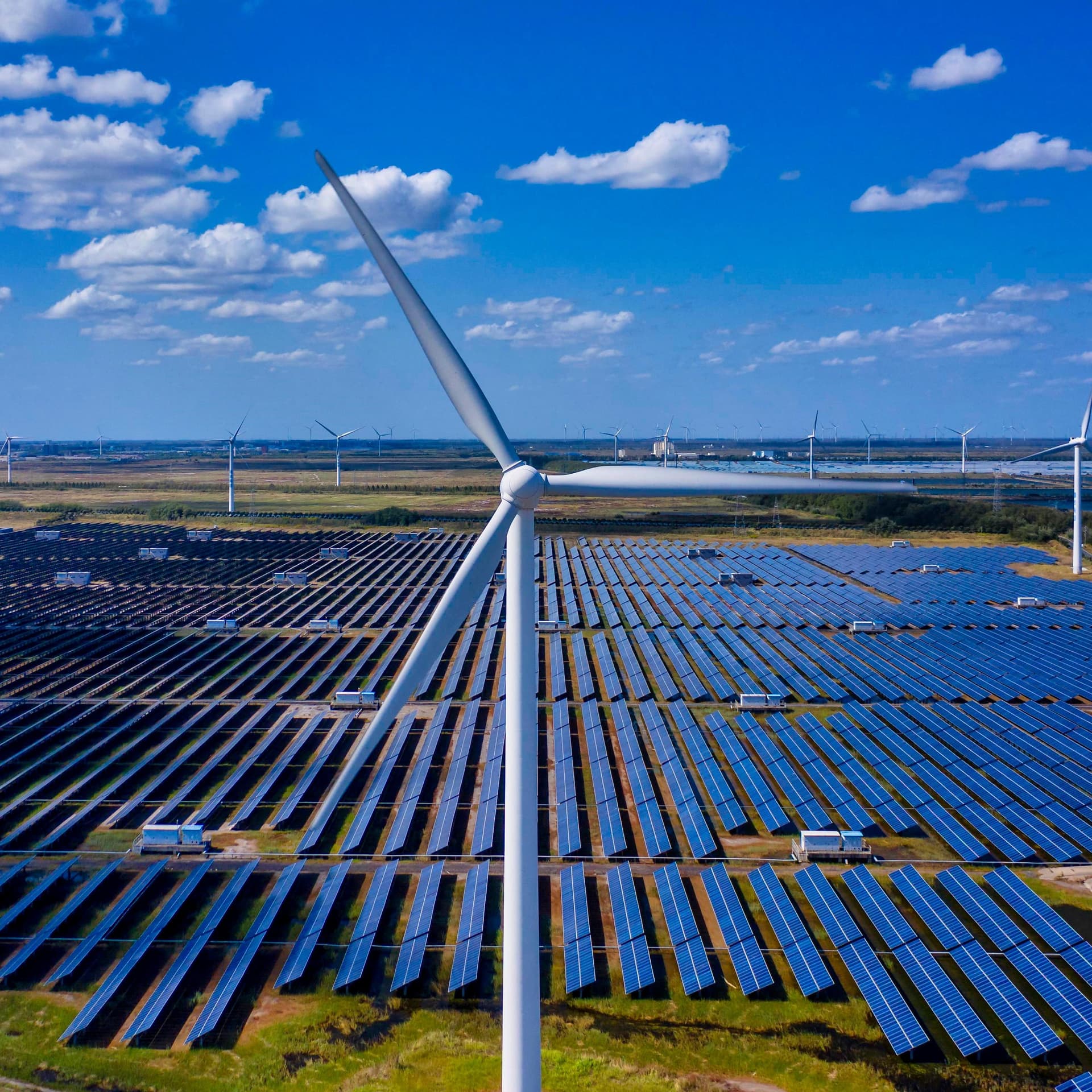
(Photo: A wind turbine and solar panels in Yancheng, China. Credit: Alex Plavesvski/ EPA)