In short
How Falun Gong followers built the Epoch Times into a conservative U.S. media empire, and what its rise says about U.S. media/political polarization.
Guest backgrounds
Brandi Zdrozny, investigative reporter (NBC News; previously reported on Epoch Times for NBC; later MSNB C/MSNBC).
Key claims
Falun Gong leader Li Hongzhi (in the 1990s) created Falun Gong/Falun Dafa; Chinese authorities cracked down, prompting his move to the U.S. Epoch Times is one of Falun Gong’s “media prongs,” alongside Shen Yun (dance troupe) and New Tang Dynasty TV. Shared boards, money, staff, and “marching orders” link these nonprofits. Epoch Times pivoted toward Trump around 2016, hiring pro-Trump reporters. It grew financially (revenue jumps from about $15M in 2019 to $70M in 2020; $122M in 2021). In 2024, its CFO was indicted for alleged money laundering of $67M (pleaded not guilty; CFO suspended; CEO stepped down). It signed Pentagon media access rules that other outlets refused, limiting reporting without approval/escorts.
Notable examples
Epoch Times’ pro-Trump Facebook/YouTube ad spending before 2020; continued attention to claims of a stolen 2020 election; CPAC booth strategy in 2016; Epoch Times reporting from inside the Pentagon.
Written by AI. May contain mistakes. Listen to the episode to check what was said.
Chapters
Tap a time to open that second in VOThe Origin of the Epoch Times
0:00 to 0:37
Exploring the origins of the Epoch Times and its connection to the Falun Gong.
“This BBC podcast is supported by ads outside the UK.”
The Origin of the Epoch Times
2:15 to 3:47
Exploring the origins of the Epoch Times and its connection to the Falun Gong.
“And what does its meteoric rise say about how media and politics in the U.S.”
Falun Gong's Influence and Growth
3:47 to 6:45
The evolution of Falun Gong and its impact on followers and society.
“Let's rewind because I do want to understand how this fledgling newspaper became this sort of media empire.”
Media Strategies of the Falun Gong
6:45 to 10:10
The three main media arms developed by Falun Gong to spread their message.
“So you say there's this guy, Lee Hongzhu, who started this spiritual movement.”
The Evolution of the Epoch Times
10:10 to 12:11
The growth of the Epoch Times and its shift towards a pro-Trump stance.
“And you will see Shen Yun gives money to Epoch Times and then Epoch Times gives money to NTD TV.”
Epoch Times and the 2020 Election
12:11 to 14:00
Analyzing how the Epoch Times positioned itself during the 2020 election.
“Throughout the 2000s, they started to make slow, steady progress in expanding their reach.”
Epoch Times and Trump's Campaign Ads
14:00 to 14:33
Discussion on the Epoch Times' advertising strategy during the 2020 election.
“And they say that many of their ads had nothing to do with that.”
Coverage of Election Claims
14:33 to 15:18
Analysis of the Epoch Times' reporting on Trump's claims of election fraud.
“Over the last two and a half years, we've been reporting on the Trump administration, honestly, and without any false narratives.”
Epoch Times' Shift in Reputation
15:18 to 17:04
Exploration of how the Epoch Times sought to integrate into conservative media.
“Donald Trump lost that election, though he did not accept that he lost that election.”
Hiring Journalists and Financial Growth
17:04 to 19:36
The Epoch Times' pivot to hiring experienced journalists and its financial success.
“And so a lot of connections were made in that way.”
Show all 13 chapters
Indictment of CFO and Financial Allegations
19:36 to 22:03
Discussing the indictment of the Epoch Times' CFO and its implications.
“We were looking on their Facebook site, and our producer Lucy noticed that their English language page has over 8 million followers.”
Epoch Times and Pentagon Reporting Rules
22:03 to 25:08
Examination of the Epoch Times' response to new Pentagon reporting rules.
“It's unclear if those two things are related, but it seemed to happen at the same time.”
Trust in Media and Epoch Times' Rise
25:08 to 27:45
Discussion on public distrust in media and the rise of the Epoch Times.
“And it's probably not in terms of the kinds of stories that the Epoch Times is going to do.”
Transcript
Automatic transcript. May contain errors.0:00This BBC podcast is supported by ads outside the UK.
0:30business needs in one place, saving you time, headaches, and serious money. Stop paying for missing pieces. Go to odoo.com. That's O-D-O-O dot com to learn more. With the new Schwab Teen Investor Account, teens can gain hands-on investing experience and build positive money habits. It's an account co-owned by you and your teen, so you can monitor and engage with the account while your teen learns how to invest and manage money. Learn more at schwab.com. The Pentagon recently introduced controversial new reporting rules with restrictions that stunned journalists. According to a 17-page memo from the Defense Department, journalists can no longer gather or report information, even if it's unclassified, without government approval.
1:18They've also been banned from accessing entire areas of the building without an escort. Most journalists refused to accept these new terms and turned in their press passes. Even some conservative outlets like Newsmax won't sign this thing. Not even Fox News is signing on. But one outlet that did agree to the new rules is the Epoch Times. And frankly, that caught my attention because having been a reporter for many years and in Washington, D.C., where everybody knows everybody, the Epoch Times remains quite the mystery. The more I looked into it, the more curious I became. And it is a wild story that involves a renowned dance troupe, criminal indictment, and a Chinese spiritual movement known as the Falun Gong.
2:05Some call it a religion, but even that's disputed. From the BBC, I'm Asma Khalid in Washington, D.C. And today on The Global Story, how followers of this spiritual movement built a conservative media empire. And what does its meteoric rise say about how media and politics in the U.S. have changed in the last decade?
2:35To help us make sense of this story, we have called up reporter Brandi Zdrozny. And Brandi, I have been reading some of your in-depth investigations on the EPAC Times for the NBC News website. But first, I just want to know how you actually initially heard about the Epoch Times. How did you first come across them? Yeah, well, how I came across them in journalism was we were getting ready for the 2020 election. And so as part of that work, I would get roundups of political spending on different platforms. And I got a roundup of political spending on Facebook. and the top spender of ads for Donald Trump was, as you might expect, Donald Trump.
3:18And then the second largest advertiser was the Epoch Times. Now, when I saw that, I was like, wait, the free newspaper on like every New York City street? And yeah, like that's what it is. And they had those little boxes around D.C. I've seen. Well, I used to see them. These little yellow boxes and inside free newspapers. They were sort of like anodyne, generic sort of news. And, you know, suddenly they had millions of dollars to spend on these pro-Trump ads. So that's where we started digging. Let's rewind because I do want to understand how this fledgling newspaper became this sort of media empire.
3:52Where does the story of the Epoch Times really begin? Yeah. So the story really starts back in China. And it starts with this man named Li Hangzhou. And sometime in the 90s, he becomes sort of a local spiritual leader and he comes up with Falun Gong or Falun Dafa. And what it is, is it's basically like Tai Chi. It's movement of the body. It's healing yourself through, you know, these light movements. It's spiritual. And he becomes pretty popular in China over the years. So, you know, several years go by. He's got quite a following. He's writing books. He's doing seminars. And inside, the teachings are getting less sort of about feeling good and healing yourself and become more extreme.
4:36He's sort of rejecting modern science, liberalism, anything modern, modern art. And he's denouncing things like homosexuality, feminism, modern music. And what do his followers believe? Generally, they believe that Li Hongzhu is a god, that he is a celestial being from another planet, from another plane. And he has come to the world to save all of humanity. He does this by passing on his teachings. And when his followers adhere to his teachings, do what he says in terms of their practice of this exercise, following his rules, then they can ascend to a celestial plane, heaven, as it were. And that they can become sort of gods in their own right as well.
5:25so as the year goes by he's he's growing worldwide its popularity isn't sitting right with the chinese communist party and so the chinese communist party begins breaking up meetings that are happening in china when people are gathered in the parks to practice the exercise they start breaking up these meetings and they really do come hard down against the falun gong practitioners. The Chinese authorities have mounted their toughest internal security operations since they crushed the student demonstrations in Tiananmen Square 10 years ago. They're banned under a law against cults in China right now.
5:59Tens of thousands of Falun Gong followers have been arrested on the streets of Beijing.
6:08You can be imprisoned. It's a very dangerous situation practicing this in China. These women are in a re-education camp. They've been incarcerated without trial for anything up to three years. UN subsequently found credible reports on inspections of these centers of torture going on. And so because of this, Lee ends up leaving the country. Oh, OK. He comes to America in the 90s and he starts growing his empire. Their headquarters is in Dragon Springs, New York, which is about 100 miles north of New York City. That's where they're located now. So you say there's this guy, Lee Hongzhu, who started this spiritual movement.
6:51And I want to understand how he is connected to this newspaper, the Epoch Times, which is the central focus of today's show. So Lee Hongzhu and some of his followers decided that they needed to spread the good word. And so to do that, they came up with three main ways that they call our media. The first was the Epoch Times. And this was a small website first, but then it became this newspaper that spread news and got people to understand who they were. And their main goal, and it's still their main goal, is to dismantle the government of China and to reinstate the old ways and be welcomed back again.
7:35And so that was the purpose of the newspaper itself. Before communism, China had a glorious past. What if you could bring it back? And then the second arm of that was Shen Yun. Since 2006, Shen Yun has been reviving the essence of Chinese civilization. Shen Yun is a dance troupe? The dance troupe, yes. I've seen their posters. I'm sure pretty much everybody's seen their posters. Everyone has seen their posters. Yes, they are. At the core of Shen Yun is an ancient art form, classical Chinese dance. The dancing is really beautiful if you've seen it, but it has a different message. The message of Shen Yun, if you go to see it, is the story of Li Hangzhou and his saving of humanity, the Chinese suppression.
8:25And then at the end, he comes down and he saves everyone. Inspired by the divine. They believe that if you see that play, you can be saved. And then the last way is their television organization, their television company, and it's New Tang Dynasty TV. It's mostly Chinese language television, but more and more they have English language programming as well. Okay, so these are the three prongs that you say Li Hongzhu. You can call him Master Li, too. Okay. Master Li, as you say. These are the three prongs that he has set up. Can you clarify what the connections are between the Epoch Times and the dance troupe you mentioned, Shen Yun, as well as Falun Gong itself?
9:16Because I do want to point out here that the Epoch Times has said in response to reporting previously from the New York Times that that the Epoch Times as an organization is committed to supporting truth and tradition. And in that vein, the Epoch Times has proudly and transparently supported traditional culture by sponsoring Shen Yun. That is the way they sort of explain their connections here. That's right. He and his followers set up these three media prongs that they deny is part of their religion. But Li has come to the Epoch Times offices and said, this is our media. And if you look at the tax filings from each of these groups, because they're all nonprofits, you will see the board members that sit on the Shen Yun board are also the same board members that sit on the Epoch Times board, as are the same board members who sit on NTDT.
10:09TV's board. And you will see Shen Yun gives money to Epoch Times and then Epoch Times gives money to NTD TV. They share money, they share staff, they share executives, and they share a mission is really the way that all of these arms are combined. And you will hear Master Li, whose speeches are available online. He goes to each of these groups and he says, you are our media, here is your mission. So they get their marching orders from Masterly. Well, we want to really dive in deep here on the Epoch Times in particular. That is the main media newspaper arm, digital media arm that we're talking about here.
10:49I want to understand who started it and what its initial purpose was, in part because you've been describing this all as being sort of a proselytizing mission. But if you look at the Epoch Times, many of the stories and headlines you see on their website look like pretty straightforward traditional news headlines. Yes, a lot of it has the trappings of journalism from the sans serif logo to the articles themselves. But the Epoch Times was born out of a Falun Gong practitioner named John Tang. This was in the early 2000s, and the whole point of it was to be a Chinese language public relations newsletter, not only for their followers to get them used to America, but also to promote stories that exposed the Chinese Communist Party for what they said it were.
11:44And then ultimately, you know, to really save the world and educating the world about their experience. So it was Chinese language articles at first, and then they expanded into English language. Okay. And it grew from that to expanding into this news outlet that has far more reach, at least here in the United States, where we see the reporters reporting from the White House press briefing room. What changed to give it such a rise in national prominence here in the U.S.? Throughout the 2000s, they started to make slow, steady progress in expanding their reach. But fast forward to 2016, and that is sort of when things exploded for the Epoch Times.
12:32And that, I think, is because of Donald Trump. And that's when politics just really changed. And so they had been fairly apolitical. The one political thing they really cared about was China, right? But in 2016, when Donald Trump was running for office, he came out very, very hard on China. And Master Li loved this. He told his followers that this was the kind of person that could make their dreams come true, as it were, you know, really affect their ultimate goal. And so with Master Li's backing, the Epoch Times pivoted all in for Donald Trump. And we talked to several former Epoch Times reporters, former Epoch Times executives, and including Falun Gong practitioners.
13:17And they all told us that around 2016, the word from on high seemed to be that they were putting all of their support behind Donald Trump. So they hired over a dozen new reporters and set them in a separate room, we were told, and had them be sort of the part of the outlet that was making this pro-Trump journalism. So you had mentioned the Epoch Times really caught your attention in the run up to that 2020 election because of the amount of money that they were spending at that time on ads that were described as pro-Trump ads on Facebook. The Epoch Times has said in response to your reporting that these ads often feature articles reporting on President Trump, but that does not make them ads for Mr.
14:04Trump. And they say that many of their ads had nothing to do with that. What do you make of that? So in the run up to 2020, Epoch Times starts taking out all of these ads on Facebook and YouTube and spending millions of dollars on them. And what they basically looked like, they involved usually an Epoch Times reporter. Maybe sometimes he would have a copy of the Epoch Times in his hand. And what he was doing was he was talking about the articles that they were writing on Trump. Over the last two and a half years, we've been reporting on the Trump administration, honestly, and without any false narratives.
14:38Now, these articles were talking about how they were the newspaper that was going to reveal the deep state campaign against Donald Trump. While the mainstream media has essentially given Hillary Clinton a pass, the Epoch Times has continued to report on and investigate her many scandals. They sort of criticized the fake news media and they talked about how Trump was waging a war against not just China, but his own government. And so Facebook is the one who called them pro-Trump ads, not me. But to suggest that these were sort of neutral, it's not in the realm of reality. So this was all happening in the run-up to the 2020 election.
15:21We all know 2020 election happens. Donald Trump lost that election, though he did not accept that he lost that election. Neither did they. What was its coverage like, the EBA Times?
15:35The media in this country do not decide who the winner of the election is. The Epoch Times gave a lot of attention to Donald Trump's claims about a stolen election. When there are credible allegations of voter irregularities and voter fraud, we have a system in place for that. They were one of the last journalism outlets not to call the election, even after it had been determined. We here at the Epoch Times will not be calling this election. They were in the camp of that this was a plausible reality that the election had been stolen.
16:12How embedded over the years has the Epoch Times become in the conservative media landscape and political life? The Epoch Times is still seen as fringe. What do you mean by that fringe? Well, they have been seen for what they are, which is a religious sacked with a newspaper. They have not hired trained, known journalists. Most of their staff have been Falun Gong practitioners. They didn't have the same access. They didn't have the same sources. They were just not really embraced by D.C. or anywhere else for that matter. When or how did that change? Because you do reach a point where the Epoch Times is present at the Conservative Political Action Conference.
16:51They reached out to a Republican strategist in 2016, and they told the Republican strategist who I've talked to, We would like to get a foothold in the broader conservative movement. How do we do that? And they were told, and they ended up doing this strategy, to go to CPAC, to have a booth, to invite lawmakers to talk on your program. And so a lot of connections were made in that way. But just to, like, show how much they've grown, you know, after the 2020 election, they were getting people that they would have died to sit down with them just once now had their own shows, their own programs. What do we do?
17:28We know it's gotten so bad. Kash Patel, the current head of the FBI, he got his own show and even interviewed Donald Trump himself. China's building a military like nobody's ever seen before, and we're cutting our budget. Mr. President, thanks so much for joining us on Epoch Times. Thank you very much. Thank you. Brady, I think what I find interesting in hearing you describe the backstory of the Epoch Times is how much I'm learning about what this site actually is. Because if you go to the website, I'm going to pull it up right now. I'm looking to. It looks like a fairly sophisticated traditional news site.
18:07I'm going to read a couple of headlines. At the top, we see here hundreds more flights canceled as FAA raises air travel reductions to 6%. Pentagon confirms the largest U.S. aircraft carrier now in Latin American region. These headlines don't seem to be particularly controversial. They're the source of headlines, straight stories that you might see at other news sites. Yeah, but I think that speaks to the strategy behind the very product itself. It's supposed to be legitimate. There was one instance where Master Lee came to headquarters and told them, like, the purpose of this thing that we're doing is to make money and to become mainstream news.
18:49But the other stuff is, it's less obvious, I think. And partly that's because of something that happened after Biden won, another sort of tactical change. Okay. Tell us more. Sure. So what they did was they started hiring legitimate journalists. They called it the pivot internally, according to employees that I've talked to. And that pivot involved hiring legitimate journalists. We're talking about they hired a woman who was a Pulitzer finalist from Texas, but hiring legitimate journalists who had a very, very conservative bent to do their journalism. So a lot of the stories that you read on the Epoch Times are like pretty good.
19:29I mean, it's more sophisticated, I would say, about offering you the point of view that they want to. We were looking on their Facebook site, and our producer Lucy noticed that their English language page has over 8 million followers. That's an enviable number for many news organizations. And I understand that Epoch Times finances seem to have also ballooned in recent years. Can you walk us through their financial success in an era in which so many media outlets are just struggling to survive? They've managed to make money in journalism, which I think is a miracle, however they're doing it. But in 2019, these folks were making$12 million a year,$15 million a year.
20:18And a lot of that money came from supporters. But in 2020, they went from making like$15 million in revenue to making$70 million in revenue. And then in 2021, that ballooned to$122 million in revenue. That's huge growth. It's insane. I remember getting the filings and just being like, what? Like, how? And when I tried to answer that question, the answer that they gave was, we have a ton of subscribers. And partly that was true. I do a lot of reporting at conservative events, and I have met a lot of subscribers to the Epoch Times. People in the conservative movement really do value it as sort of what they see as a nonpartisan source of information.
21:05I also want to ask you, though, about this indictment. And this involves the Epoch Times chief financial officer. Can you help us understand how that fits into this story? Yeah, well, when I saw this story about the indictment, and I think that was the summer of 2024, for. My immediate reaction was, oh, because I had continually asked this question, like, how could they possibly make this money? The federal government says that the chief financial officer was indicted for basically money laundering. They have accused the CFO of being sort of atop this scheme, laundering$67 million in funds that was ill-gotten gains.
21:48And they had taken those funds and then put it back into accounts that belonged to the Epoch Times. To be clear here, the reporting I've seen shows that the CFO has pled not guilty. And so these are accusations, allegations at this point in the Epoch Times did suspend the CFO. Yeah, the CFO is suspended. The CEO, he stepped down. OK. It's unclear if those two things are related, but it seemed to happen at the same time. And the Epoch Times has said that it intends to and will fully cooperate with any investigation. And so is that where things stand at this point? Yeah, that's where things stand.
22:33The trial has not commenced yet. We're still waiting on the laws of justice to move ahead. So, Brandi, the Epoch Times came, I think, back into sort of my front focus with these recent rules at the Pentagon that were put in place in October around reporting. Time and time again, classified information is leaked or peddled for political purposes to try to make the president look bad. And what's really happening is you're undermining. A whole bunch of traditional news outlets refuse to sign these new reporting rules at the Pentagon. CBS News and other broadcast networks released a joint statement a short time ago saying, quote here, the policy is without precedent and threatens core journalistic protections.
23:13The Epoch Times did sign on to them. You had mentioned earlier that, you know, the Epoch Times is trying to present itself as a traditional news outlet. And so how do you understand why they would have agreed to restrictions that a number of other news outlets have refused to agree to? I mean, I guess I see it as further proof that one of these things is not like the others. I think it just shows that, you know, despite their protestations, that, you know, they are some neutral, credible source for news. In fact, they, as they were in 2016, when they sort of hitched their wagon to Trump's star, still very much in alignment with that strategy.
23:56I talked to a reporter who resigned after it became clear that they were going to sign on to those Pentagon rules. His name's Andrew Thornbrook. And he resigned from the paper because he said he couldn't stand by, as the Epoch Times was saying, that they were going to be this neutral newspaper but then agree to these things. He said he couldn't reconcile his role in the paper with their willingness to sort of toe that partisan line. What does it mean that the Epoch Times is one of the very few outlets that is now reporting from inside the Pentagon? It just means that our ability to know what's going on inside the Pentagon is weakened, is lessened and dependent on an outlet that has shown itself time and time again to not have an objective of informing the public, but to have an objective of aligning itself with this administration.
24:50We have seen a statement, and in that statement they say the Epoch Times is no stranger to attempts to suppress freedom of the press. The Pentagon's new media access policy is no such attack. They do not view these new guidelines, they say, as an impediment to their reporting. And it's probably not in terms of the kinds of stories that the Epoch Times is going to do. It probably doesn't impede it one bit. I want to ask you about how the story of the Epoch Times fits into the big, broad questions that it feels many Americans have around trust in media and trust in institutions. Because I think it's fair to say there's a lot of people who just don't trust any sort of news outlet.
25:37They don't trust traditional news at all. You're a journalist at MSNBC, MSNOW. which a lot of conservatives would not necessarily trust. And the same could be said of many other outlets that folks just do not trust. And so I wonder, is the popularity of a new-ish media outlet like the Epoch Times, I realize it's been around for a while, but it seems like it has had a meteoric rise recently. Is that popularity in part because of the distrust? The story of the Epoch Times is definitely a story of this moment of political polarization and mistrust in institutions, especially the media. I don't think it would have been able to rise had not trust been eroding at such a clip in, you know, the legacy outlets.
26:25I also think that something that the Epoch Times does so well is it really mirrors the aesthetics of journalism in such a way that people can get the sense of news that fits your sort of worldview and still believe that you're doing so in a responsible way that makes you a smart person. And I just think it's important not to say that the Epoch Times shouldn't exist, but that people know what it is. It is a religious enterprise that has utilized our political moment to get its broader message across. The publisher of the Epoch Times wrote in the Wall Street Journal about the links or the perceived links between the Epoch Times and Falun Gong and said that the Epoch Times is a nonpartisan independent media company neither owned or operated by Falun Gong.
27:18What do you make of that? Well, it's not owned by Falun Gong. It's guided by Falun Gong. It's given marching orders by the leader of Falun Gong. It's staffed almost in its entirety by Falun Gong participants. defense. So that might be factually correct. The words independent and all that, it's just, it's hard to quibble with him. I mean, the facts are the facts and we have not made a correction to any of our stories and they have not asked me to. I'm going to let you go, but thanks so much for taking the time to talk. I really appreciate it. Thank you for covering it. I appreciate it. That was Brandi Zadrozny, who reported on the Epoch Times for NBC News and is now a senior reporter for MS Now.
Read the full transcript
28:05By the way, we love to hear your thoughts, ideas, questions, and suggestions, so please send them over to us at theglobalstory at bbc.com. This episode was produced by Lucy Paul and Kat Farnsworth. It was edited by Bridget Harney and Annie Brown, and engineered by Martin Peralta. Our senior news editor is China Collins. And that is a wrap for today's show. We'll talk to you again tomorrow.
From the publisher
When China began cracking down on the spiritual movement Falun Gong in the 1990s, its leader and some followers moved to the United States. From there, they started the Epoch Times, a free newsletter.
But in the past decade, the organisation has grown to become a conservative media empire – with a Pentagon press pass, a slick TV arm, and many millions of dollars in revenue. How did they do it? The story involves a mysterious spiritual leader, a dance troupe, and even a federal indictment.
What does the meteoric rise of the Epoch Times say about how media and politics in the United States have changed in the last decade? We speak to Brandy Zadrozny, who has investigated the Epoch Times for NBC News.
Producer: Lucy Pawle and Cat Farnsworth
Sound engineer: Martin Peralta and Travis Evans
Senior news editor: China Collins
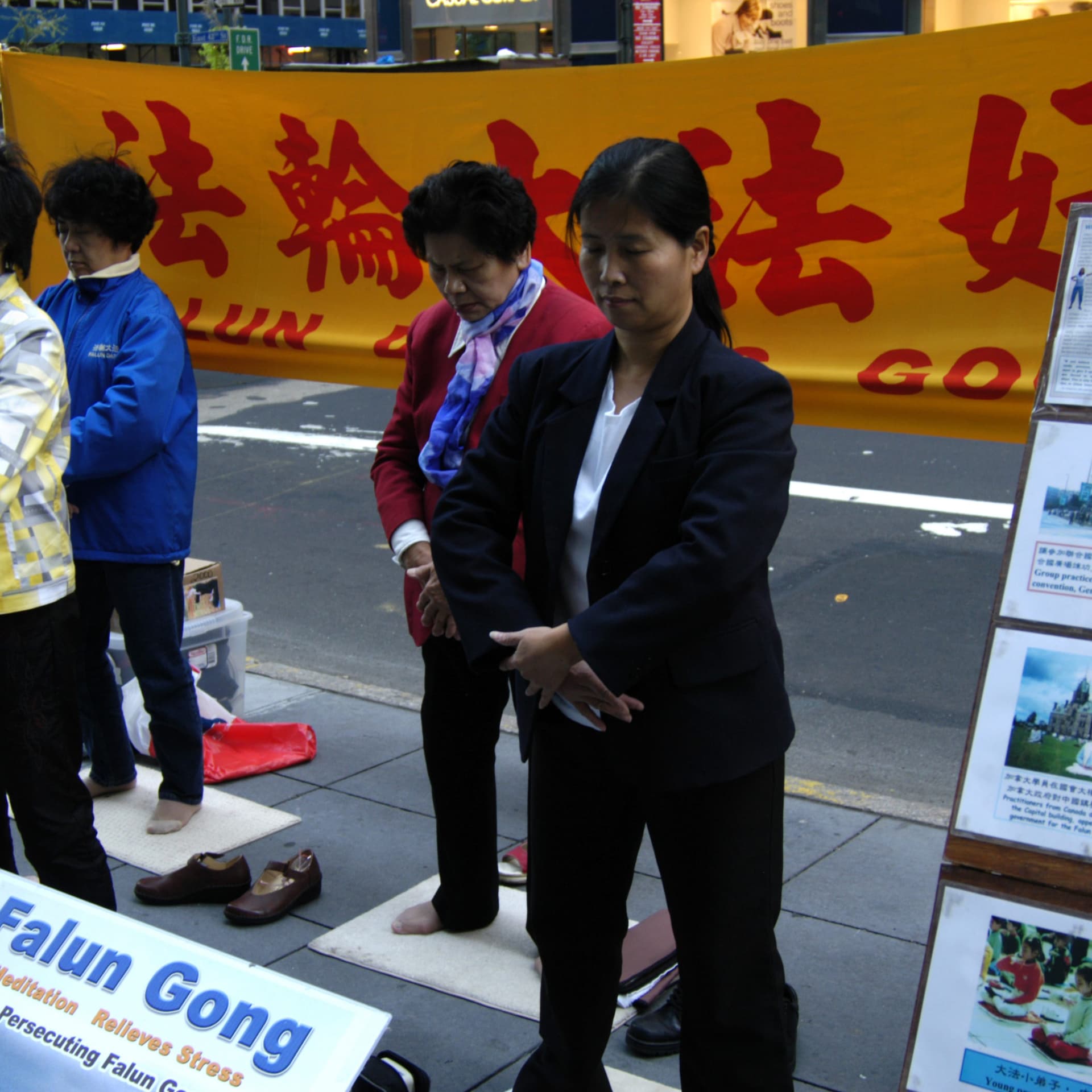
Photo: Members of the Falun Gong protesting in New York. Credit: Alex Segre/BBC Images)