
In short
One year after Bashar al-Assad fled in Dec 2024, Syria’s rebuilding is examined through celebrations in Damascus, ongoing poverty and rubble, sanctions and unexploded ordnance, and continued external threats—especially Israel’s raids and territorial moves. The episode also assesses Ahmed al-Shara’s leadership, ISIS’s weakened status, and prospects for accountability.
Guests
Jeremy Bowen, BBC International Editor; veteran Syria reporter speaking from Damascus. He interviews Syrians in the south (Beijing village) and Duma.
Key claims
Reconstruction is “very little change” besides some economic perk-up; most rebuilding is family-led due to lack of government funds. Israel seized a former demilitarized zone and bombed/raided after Assad’s fall; raids caused civilian deaths. Al-Shara promises accountability and pragmatic governance; West engagement suggests reform, but daily life remains hard. ISIS is weakened and tries to recruit by accusing al-Shara of betrayal (including joining the US coalition).
Notable examples
Beijing village raid—children killed, including 17-year-old Hiba Khalil Abu Tahir; wounded father and 9-year-old daughter. Duma—families returning after bus trips from Aleppo; a former Jesh al-Islam commander says rebuilding is self-funded and his son’s death shaped his view.
Written by AI. May contain mistakes. Listen to the episode to check what was said.
Chapters
Tap a time to open that second in VOCelebrating Freedom in Syria
0:38 to 2:41
Exploration of the celebrations in Damascus marking one year since Assad's fall.
“In Damascus this week, Syrians packed into the city's central square to celebrate one year since the fall of the Assad regime.”
The Fall of Assad's Regime
2:41 to 3:43
Discussion on the impact of Assad's departure and the new leadership.
“And today on The Global Story, how does a country rebuild after the fall of a dictatorship?”
Life Post-Assad: Challenges Ahead
3:43 to 4:59
Insights into the current living conditions and economic state in Syria.
“And then we saw this new leader by the name of Ahmed al-Shara who took over.”
Beijing: A Village Under Siege
4:59 to 5:51
A report on the village of Beijing, its proximity to Israel, and recent violence.
“And I'd love for you to begin with a trip that you took to a place in the south, right?”
Impact of Israeli Raids in Beijing
5:51 to 8:01
Experiences of locals during Israeli military actions and their aftermath.
“And these people have lived very close to the IDF for many, many years, actually.”
Stories of Loss and Resilience
8:01 to 11:15
Personal stories from a family affected by the violence, highlighting their struggles.
“You know, the debate in Israel appears to be, do they want to have, would they rather have a stable Syria that could, they think, become a threat or a weak Syria that couldn't be a threat?”
Challenges of Rebuilding Syria
11:15 to 13:36
Discussion on the multifaceted challenges facing Syria's reconstruction efforts.
“and they're not getting it because this is a country with no money.”
Duma: A Story of Hope
13:36 to 14:00
Exploration of Duma's recovery and the return of displaced families.
“And I want to talk about it because it seems to be a bit more of a story of recovery and hope.”
Rebuilding Duma After War
14:00 to 16:54
Explore the rebuilding efforts in Duma and the experiences of returning families.
“Duma is, if you like, a sort of satellite town of Damascus.”
The State of ISIS in Syria
18:56 to 21:46
Discuss the current situation of ISIS and its attempts to rebuild in Syria.
“AT &T Fiber, limited availability in select areas.”
Show all 13 chapters
Leadership Changes and Accountability
21:46 to 24:35
Analyze the change in leadership in Syria and the implications for accountability.
“Has Ahmed Al-Shaira proven yet that he is the reformer that so many, certainly here in Washington within the White House, believe him or hope that he is?”
Rebuilding Post-Dictatorship
24:35 to 27:30
Understand the challenges of rebuilding a nation after the fall of a dictator.
“and the archetype of how it was handled well.”
Episode Recap and Listener Engagement
28:00 to 28:12
Learn about the episode's content and how to engage with the show.
“Our senior news editor is Chyna Collins.”
Transcript
Automatic transcript. May contain errors.0:00This BBC podcast is supported by ads outside the UK.
0:30so you can monitor and engage with the account while your teen learns how to invest and manage money. Learn more at schwab.com.
0:43In Damascus this week, Syrians packed into the city's central square to celebrate one year since the fall of the Assad regime.
0:57Freedom. Freedom. Just freedom. 14 years. Now we are freedom. When Syria's former dictator Bashar al-Assad fled the country last December in 2024, it brought an end to almost 14 years of civil war. The UN estimates over 13 million people have been displaced and more than 580 ,000 people were killed. So for many, the celebrations this week were bittersweet. I think every person we lose is here now with us. He's in the sky with us. He's seeing us when we are happy and he's happy. We're not sad for losing them because they did this road for us. Much of the hope for the future of Syria now rests on the actions of the former jihadist who's leading the country, Ahmed al-Sharah.
2:01At a speech on Monday, al-Sharah said that Syria is the story of people who were patient and steadfast, turned victorious. And the new leader spoke of guaranteeing accountability for those who had committed crimes.
2:17And in the past year, al-Shara has launched an international charm offensive, becoming the first Syrian leader in history to visit the White House. But has life improved for ordinary Syrians? And has al-Shara proven that he's the reformer the West so desperately wants him to be? From the BBC, I'm Asma Khalid in Washington, D.C. And today on The Global Story, how does a country rebuild after the fall of a dictatorship?
2:59Before we dive further into today's episode, we just wanted to let you know that it contains descriptions of violence. Jeremy Bowen is the BBC's international editor, and he's covered Syria extensively. I'm speaking to you from Damascus in Syria. And I was here exactly a year ago, actually, when the Assad regime fell. But I'm back here because it's 12 months later. So the day that Bashar al-Assad's government fell, I think it's fair to say it took a lot of people by surprise. He was a dictator who seemed rather invincible. And I recall seeing those images, Jeremy, there was huge jubilation. And then we saw this new leader by the name of Ahmed al-Shara who took over.
3:46And I want to get a sense from you when you walk down the streets now, what do you see? And are you getting a glimpse of a nation trying to rebuild and recover? Well, only a few days after the Assad regime fell, actually, the traffic started moving, the shops opened up. But actually, that mustn't distract from the fact that this is a country that was absolutely broken by the war. The Assad regime, President Bashar al-Assad and his family and his close allies and supporters, they essentially decided that to save the regime, they were prepared to break the country. And that's what they did in this war that lasted for, well, a total of 14 years up to a year ago.
4:34and in the last, well, week or so that I've been here, we've been going around revisiting places that I went to during the war, places I went to a year ago. And what you see actually in terms of reconstruction is very little change. There is a massive amount of rubble and people here mostly, the economy's perked up a bit, but most Syrians are still living in really difficult lives in poverty. Well, I want to focus today, Jeremy, on some of your reporting you've been doing during this trip to Syria and on two specific stories and places that I think highlight the current tensions inside the country as it tries to rebuild.
5:12And I'd love for you to begin with a trip that you took to a place in the south, right? Is that right? Beijing. Can you describe why you specifically went there? Well, we went there because, well, it's a small village, and it is right on the edge of the area that Israel has seized since the fall of the Assad regime.
5:34Jeremy Bowen:This village, Beijing, is right under the eyes of the Israeli observation posts in the Golan Heights, very close to the boundary line of what was a demilitarized zone.
5:52Jeremy Bowen:And these people have lived very close to the IDF for many, many years, actually. What the Israelis did, immediately Assad fell, was first of all they moved into Syria. They seized what had been a demilitarized zone and some territory beyond that. And they also did bombing raids against military positions to try and get rid of any military supplies of the new administration it was going to have. Hi, good morning. Good morning, who's this? We're being given a tour of Beijing by Hamid Kamal. He describes himself as a 38-year-old shepherd. Like a lot of the guys around here, he wears sort of olive khaki-type clothing.
6:41So we went there to Beijing because, well, it's now a couple of weeks ago, the Israelis raided the place.
6:46Jeremy Bowen:So this is from the attack, right? He's pointing up at a damaged building full of bullet holes. They got a welcome there they did not expect, I think. There was quite a heavy gun battle. There were, I think, half a dozen Israeli troops were wounded quite badly, and they had to retreat in a hurry. In the course of that, local people were killed, including children. These raids, are they carried out by IDF soldiers? And has the Israeli government addressed at all these injuries that have taken place during the raids? Well, yeah, the Israelis have said that they did the raid to try and pick up some people they claimed were part of a Sunni Islamist group, which is mostly actually based in Lebanon.
7:33And they said that they had some suspects they wanted to pick up because these people were also in cahoots with Hamas, and they believed that they were planning attacks on the Israelis. One of the results of the last two years of war since the 7th of October attacks is that Israel has taken a very forward military policy towards its neighbors, regularly bombing despite the ceasefire they have in Lebanon. And also, it's conducted a lot of raids in Syria. And this is something which, of course, it seems that, certainly in the case of this village in Beijing, that local people who are armed, they reached for their rifles and opened fire when they saw that the Israelis were in town.
8:19You know, the debate in Israel appears to be, do they want to have, would they rather have a stable Syria that could, they think, become a threat or a weak Syria that couldn't be a threat? Well, can you tell us a little bit more about who specifically you met there? So one that really sticks in my mind, we were doing a bit of filming and then I saw that there was a car that had slowed down and there was, and they were looking at us and there There was a guy in the front passenger seat. He'd clearly been wounded, and his arm was in plaster, down to, really, from his shoulder right down to his wrist.
8:57So we spoke to him, and it turned out that his house had been caught up in the shootout. He had been hit. I was in my house with my children. We were trying to find a safe place. They shot at my two daughters. He had a daughter who was back at the house, who we then went to go and see, a nine-year-old. who had also been hit and was wounded, and his 17-year-old daughter had been killed.
9:23Jeremy Bowen:OK, can we go to his house, see the daughter, maybe? So it's about 300 metres far away from me. Do you want to walk? Let's just walk up there, yeah. So we went up to the house. They invited us in. The little girl was lying on the couch with bedclothes pulled up to her chin, looking, as you can imagine, You know, not very well at all. I mean, she was conscious and she's going to get better. She's had an operation. But also there were the women of the family, including the mother, who, you know, were, of course, deeply sad about the loss of the 17-year-old daughter. What's the name of her daughter who sadly died?
10:05Hiba, Khalil Abu Tahir.
10:07Jeremy Bowen:Hiba. Hiba. Abu Tahir. What happened? What happened? What happened?
10:17She'd been hit in the stomach and bled out very quickly. And as the mother said, there was nothing that we could do for her. She died very quickly. And then because the shooting was still going on, they were there alongside with the wounded nine-year-old, the wounded father, and the dead girl for two hours before someone was able to get to them and take them to the hospital. So, you know, they'd gone through a real ordeal and they were, I think, very shaken up by it. And I said to the mum, I said, well, look, how do you see the future? And she said, well, look, we'd like a clinic. We haven't got a clinic.
10:56We haven't got a doctor. We've got no schools. We want to live in our homes. Our children are living in hell here. There is no safety for them. We go to sleep and wake up afraid. So these are traumatized people, and essentially they need a great deal, and they're not getting it because this is a country with no money. Jeremy, that to me is such a striking story because it shows how some people in Syria are trying to rebuild, and they are not just dealing with domestic challenges. It sounds like they are also dealing with external threats. Sure. I mean, there are multifaceted challenges here, not just for the government of Ahmad al-Shara, but also for, of course, every Syrian.
11:48And in no particular order, well, let's start with the economy. One reason the economy can't restart is because there is so much damage after so much war. But there are still residual sanctions. President Trump signed some sanction waivers, but some of the big sanctions are still there. and the government is pushing to have all the sanctions lifted because then it's going to make investment easier. Because the rubble has got a lot of unexploded ordnance inside it, that makes rebuilding very difficult because all that has to be cleared before they can rebuild. The government would say if they get the economy right, and they are getting promises of investment, so things are happening, but it's down the pipeline and clearly it hasn't affected people's lives.
12:31But there's the external factor as well. And the big external factor is that they have a large and aggressive neighbor. And President Shara is trying to say that they don't regard Israel as an enemy. They'd like to have normal relations. But I think Israel is not at all clear or in public anywhere about whether it regards Shara as an enemy because of this jihadist background. They're demanding that the south of Damascus, the place that we were talking about just now, that area becomes demilitarized. They've seized territory there. And the argument being made by the Syrian government is that there is a perfectly good agreement that actually lasted a long time, which was an agreement that the US then US Secretary of State Henry Kissinger negotiated in 1974, separating Syrian and Israeli forces around the Golan Heights.
13:22And that lasted until the war, basically, the recent war. So it was one of the quietest borders in the Middle East for decades. And so the Syrians are arguing, let's go back to that. The Israelis are saying, no, we want to change in the status quo. Well, Jeremy, let's move to another place that you've traveled to. And I want to talk about it because it seems to be a bit more of a story of recovery and hope. I know you say it's a very uphill challenge to rebuild in Syria. But this reporting to me struck a bit more optimistic tone, and that is Duma. Can you tell us about where that is and why you decided to report from there on this trip?
14:00Duma is, if you like, a sort of satellite town of Damascus. So I wanted to go back there for a number of reasons. First of all, earlier on in the war, I was able to cross over the front line through nefarious means to go from regime-held Damascus to rebel-held Damascus. I was also there in 2018 when the rebels there were finally forced to surrender and they were all bussed off to Idlib, which was the last province controlled by rebels in Syria. That was part of the deal. The Russians basically made these deals with rebels and the government. And then the place was absolutely in ruins. So how has it changed?
14:39Well, there's still a great deal of ruination, rubble, but there is rebuilding going on.
14:49People are coming back there. I saw families getting off buses who had made an eight-hour trip from Aleppo in the north because they were trying to find ways to come back to their homes.
15:01Jeremy Bowen:Do you think that you and your family can have a good future here in Dubai? And they were in a good mood. They were positive, actually. They were saying, look, yeah, of course it's going to be difficult, but we'd rather we're here. This is where our families are. This is where our roots are. This is where our homes are. and what people are enjoying is the fact that without the regime, they are able to move around. They don't have to live in fear. They can pay a visit to Duma, try and sort things out a bit, go back to where they've been staying, try and prepare for the final big move. But it still looks war-torn, I have to say.
15:36While they have made a lot of progress since the Assad regime fell, Well, the fact is there is a huge lack of money. And I spoke to a man who had been a commander in the Sunni Islamist militia that controlled a Duma for many years, which is called Jesh al-Islam. And he said the rebuilding that's been done has been done by individuals, by families themselves. There haven't been government funds going into there, because there aren't any. And he said, if we're going to rebuild, we're going to have to do it ourselves. It's going to take a while. But I said, is this what you fought for? And his son was killed fighting as well.
16:21And he said, my son meant more to me than Syria. He said, if I had to choose between Syria and my son, I'd have chosen my son. But my son was killed. And he was still very upset about that. And afterwards, he was emotional. And, but he said, look, I personally lost everything, but we have a chance to begin again. And that's good. And that's what we were fighting for. And God willing, these people are religious. When they say God willing, they mean it. They will be able to make themselves better lives. This is not a bad thing, unfortunately. Thank God, we have reached our goals and our dreams are good.
17:01And now we are... I think considering starting from such a low base in general, Syria could be in a much worse state now a year on from the fall of Assad than you might have expected. Because there were all sorts of desperately apocalyptic predictions of jihadist groups like ISIS, Islamic State, in other words, reconstituting themselves, perhaps carrying out waves of assassinations against the government, maybe large bombs. and while there have been some attacks from them, they are weakened and they haven't been able to do these things. And I think there is no appetite for civil war or indeed for any kind of war in this country outside, of course, of small groups of deeply ideological extremists.
18:00Chicago Talks. A lot. Hold on, let me step over here. People are talking too much. We debate about food, deep dish, tavern style, who's got the best beef. We yell across rooms, across blocks, across generations. Yes, nice earrings, Grammy. And now we're doing it on our phones, too. Video calls from the L train, group chats that never shut up. Neighbors texting you the score before your TV catches up. Come on! Get a load of this guy. Catch up on a dog. Yeah, we've got thoughts. Too loud? In Chicago, you're gonna hear it. Because nothing here gets built without conversation. Nothing moves without connection.
18:38So if you think you know AT &T, it might be time to rethink that. Because their network has improved, like, a lot. So Chicago can keep speaking its mind with AT &T Wireless and AT &T Fiber. Chicago won't stop talking. Our improved network backs it up. AT &T, connecting changes everything. AT &T Fiber, limited availability in select areas.
19:03Jeremy, you mentioned ISIS. And that's been on my mind a lot because I do also recall, I mean, frankly, ISIS controlled a good chunk of what is the state of Syria, territory within there. And so I want to understand from you what happened to ISIS. We have heard reports, I've seen reports, that the group is attempting to rebuild in Syria. Yeah, well, let me give some credit to my knowledge on this comes from some extraordinary reporting that's being done by a group we have in the BBC called BBC Monitoring, who, among many other great things, they monitor the social media and the mainstream news broadcasts and newspapers, you name it, and not least from jihadist groups.
19:49And they've been briefing me on this. So, essentially, the situation is ISIS, IS, whatever you want to call them, Islamic State, they still do exist here. They are much weakened. they're trying to recruit people by saying that Ahmed Ashara, the president, even though he may have started off as an Islamist fighter, a jihadist, that he has turned his back on them. One thing that has really enraged them is the fact that Ashara has joined the US-led coalition against Islamic State. And they are trying to say that Shara has betrayed what he claimed to believe in. He has not brought in Sharia, religious law, in the way that they wanted him to.
20:39This is the argument that they are making, trying to turn religiously inclined people against him. And right now, it's not actually working. It doesn't seem to be at all. Because I think a lot of Syrians are saying, look, this guy is the best bet we have. We've discussed the new leader of Syria a couple of times here, Ahmed al-Shara. And when he was in his jihadist past, there was a U.S. bounty on his head. But since he's become the leader of Syria, I will say the Trump administration seems to have welcomed him with open arms as a reformer. He came to the U.N. General Assembly in New York in September, and he was welcomed with warm arms, not just by the United States, by other world leaders as well.
21:25Well, I've had an agreement with him. He's a very strong leader. He comes from a very tough place and he's a tough guy. And he visited the White House here in Washington, D.C. in November. We want to see Syria become a country that's very successful. And I think this leader can do it. I really do. I think this leader can do it. Has Ahmed Al-Shaira proven yet that he is the reformer that so many, certainly here in Washington within the White House, believe him or hope that he is? Well, in a sense, they don't have a choice. He's basically the only game in town. And I think from the very outset, though, he's presented himself as a man who has been on a journey.
22:10He's changed. and I certainly found that. I interviewed him just a couple of days after he took power a year ago. Did a long interview with him actually in Assad's presidential palace where I'd interviewed Assad, which was kind of an interesting juxtaposition of memory for me.
22:28Jeremy Bowen:You've made a lot of promises. You said that you'll respect the mosaic of different sectarian groups here in Syria, minorities as well. Are you going to keep those promises?
Read the full transcript
22:45The Syrian population has lived together for thousands of years. We're going to discuss all of it. He, of course, is a pious religious man, but at the same time he recognised that, as people always say about Syria, that it is a kaleidoscope of different groups, that if you want to try and stabilise the country and run the country in the interests of the people, he claimed, that's his claim, that you have to be pragmatic. We're going to have dialogue and make sure everyone is represented. The old regime always played on sectarian divisions, but we won't. We were welcomed in all the big cities by all the sects.
23:24I think the revolution can contain everybody. And he appears, not always brilliantly, but he's going in that direction. You mentioned that you did that interview with Ahmed al-Shara at the same palace, the same location, roughly, right, where you met with Bashar al-Assad some years ago and interviewed him. What is he up to now? What happened to the leader that fell? Well, he hightailed it for Russia with his family, his wife and his kids. But certainly he has not surfaced publicly in terms of being filmed or making public statements. It could well be that the Russians said to him, OK, we're going to look after you, but you're not allowed to say anything.
24:10That's it now. You're retired. Well, if Bashar al-Assad has now fled the country, what sense of accountability or justice can there be from Syrians for the crimes that were committed under his tenure? Well, one of the ways all countries that come out of dictatorships have this process, which, you know, in the jargon they call transitional justice, which is how the heck do you deal with what's happened in the past? and the archetype of how it was handled well. And while the apartheid regime in South Africa, which I'm referring to its fall, was nothing like the Assad regime. I'm not trying to compare them for one moment.
24:47They, of course, though, had this appalling racist system of apartheid, which they upheld through violence. After that, there was a Truth and Reconciliation Commission where essentially if people absolutely told the whole truth, they got immunity. There is nothing like that here. I think what happened is that a lot of the Assad people, they tried to escape. Some of them succeeded, some of them didn't. Some of them undoubtedly will be in hiding. And as for any process of trying to get, an international process of trying to get Assad out, well, it's not going to make any difference. It's up to Putin.
25:22If Putin decides that he might want to put Assad on trial or to return him to Syria to be tried, well, he could do it. Of course, he could do it in a day if he wanted to. But no sign of that at the moment. The fundamental question, as we've been talking, Jeremy, to me is, how do you rebuild a country after the fall of a dictatorship? You rebuild a country after the fall of a dictator, first of all, slowly, I think. You can't expect things to happen very quickly. So most countries that come out of dictatorships, I think, tend to muddle along, and there isn't really a great process for trying to find justice.
26:00I'll give you an example, one comparison maybe, is that's Libya. I mean, I was in Libya in 2011 when Gaddafi was overthrown, and he went on the run. And in the end, he was found hiding in a storm drain, and he was dragged out, and he was beaten and shot to death and stabbed, basically hacked by a mob. And that was all filmed and people saw it. And a lot of people thought in the West and in other countries who weren't unfortunate enough to live under a dictatorship said, oh my God, that's terrible. You know, you should be put on trial. It would have been a very healing experience for the country.
26:40But actually at the time when I was in Libya, I said that to people and they said, you've got to be joking. If that man was on TV every night in the courtroom making speeches, people would think he hasn't gone away, that his spell lingers. And the vast majority of Libyans who I spoke to, apart from one or two human rights defenders at the time, said actually the best thing was to kill him, and seemed to be killed. And they knew that once Gaddafi was gone, the regime was gone. and I think there would be a big appetite for seeing Assad killed here. But I think my guess is it's not going to happen that he is going to, you know, if he's lucky, he'll live out his years in Russia in a gilded cage.
27:30Well, Jeremy, thank you so much for taking the time to speak with us, especially given I know how much reporting you're also trying to juggle there on the ground in Syria. We really appreciate it. Not at all. Always a pleasure.
27:46That was Jeremy Bowen, the BBC's international editor, speaking to us from Damascus. His producers in Syria were Imogen Anderson and Firas Kawaf. This episode was made by Sam Chantarasek. It was edited by James Shield and engineered by Travis Evans. Our senior news editor is Chyna Collins. You can find out more about Ahmed al-Shara and his rise to power on our episode from October 1st. And a quick note before we go, if you have any questions, ideas, or suggestions for us, we'd love to hear from you all. You can send us an email at theglobalstory at bbc.com. And folks, that is it for today's show.
28:26Thanks as always for listening, and we'll talk to you again tomorrow.
From the publisher
This week, Syrians have been celebrating the first anniversary of the fall of the Assad regime and the end of almost 14 years of civil war. In the year since, the former jihadist turned leader, Ahmed al-Sharaa, has been on an international charm offensive. But has life improved for ordinary Syrians back home? And has Sharaa proven himself to be the reformer the west wants him to be?
Today we’re joined from Damascus by the BBC’s international editor, Jeremy Bowen.
Producer: Sam Chantarasak
Executive producer: James Shield
Senior news editor: China Collins
Mix: Travis Evans
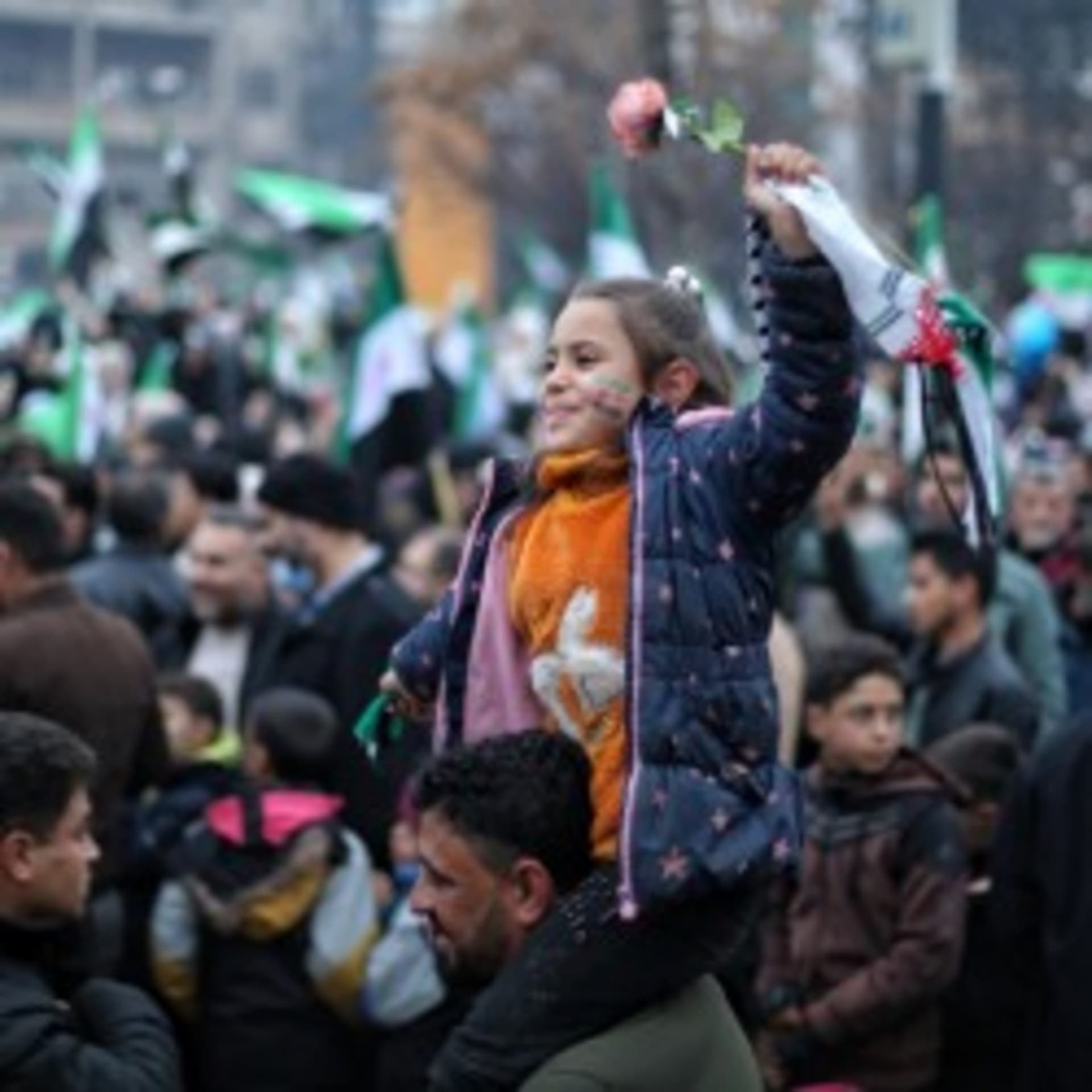
Photo: A young girl sits on her father's shoulders during a parade marking the first anniversary of the ousting of the Bashar al-Assad regime in Idlib, Syria. Bilal al-Hammoud/EPA/Shutterstock