
In short
Trump’s announcement to substantially reduce U.S.–South Korea joint military exercises (Ulchi Freedom Shield) and whether it helps or harms deterrence, amid North Korea tensions and Trump citing South Korea’s lack of support for the U.S. war with Iran.
Guests
Jake Kwan, BBC sole correspondent (speaking from Seoul/Washington). Brooke Gladstone, co-host of WNYC’s On the Media (interviewer).
Guest backgrounds
Kwan is a BBC correspondent covering U.S.–Korea/North Korea security issues; Gladstone is a media/communications journalist and podcast co-host.
Key claims
Ulchi Freedom Shield is mostly computer wargaming with some field training; North Korea protests with missile launches and calls it an invasion drill. Trump’s Iran rationale is that South Korea declined requests to join; Seoul’s stance is “no formal request.” Reducing drills could shift U.S. focus to the Korean Peninsula and encourage talks, but risks lowering allied confidence and fueling calls for South Korean nuclear self-reliance.
Notable examples
2018 Singapore and 2019 Hanoi summits; 2019 Panmunjom border meeting; North Korea sending troops to Russia; satellite evidence of expanded uranium enrichment; discussion of drone/cyber training.
Written by AI. May contain mistakes. Listen to the episode to check what was said.
Chapters
Tap a time to open that second in VOHistorical Context of U.S.-South Korea Relations
0:00 to 0:37
Explore the historical military partnership between the U.S. and South Korea.
“This BBC podcast is supported by ads outside the UK.”
Historical Context of U.S.-South Korea Relations
2:44 to 4:48
Explore the historical military partnership between the U.S. and South Korea.
“And today on The Global Story, is Donald Trump turning his back on a decades-old agreement?”
Details on Military Exercises and Tensions
4:48 to 6:53
Understanding the nature of joint military drills and North Korean reactions.
“And part of the package is that Americans are going to offer what is called a nuclear umbrella.”
Trump's Policy Changes and Their Impact
6:53 to 9:05
Analyzing Trump's proposed reductions in military exercises and its implications.
“And there has been a tendency to kind of reduce the size of the field part, where actually there's a troop movement.”
South Korea's Stance on the Iran War
9:05 to 14:00
Discussion on South Korea's position and responses regarding the Iran conflict.
“You know, there's a lot that goes into planning of this.”
Introducing On the Media
14:00 to 14:39
Listeners are introduced to the podcast On the Media and its goals.
“I'm Brooke Gladstone, co-host of WNYC's On the Media.”
Trump and Kim Jong-un's Relationship
14:39 to 17:47
Discussing the dynamics of Trump’s relationship with Kim Jong-un, including historic meetings.
“So far in this conversation, we have talked extensively about President Trump's shifting relationship with South Korea and South Korea's leader.”
The Fallout from Failed Diplomacy
17:47 to 20:55
Analyzing the implications of the failed negotiations between Trump and North Korea.
“where the two sides just could not close the gap.”
Military Implications for South Korea
20:55 to 23:59
Examining the potential military impacts and shifts in strategy for South Korea.
“And they have been learning exactly how to fight in the cutting edge modern warfare, modern battlefield tactics.”
South Korea's Nuclear Debate
23:59 to 26:48
Discussing South Korea's growing sentiment towards acquiring its own nuclear capabilities.
“You know, he talked about how beautiful the Oval Office looked after the renovation.”
Transcript
Automatic transcript. May contain errors.0:00This BBC podcast is supported by ads outside the UK.
0:30business needs in one place, saving you time, headaches, and serious money. Stop paying for missing pieces. Go to odoo.com. That's O-D-O-O dot com to learn more. Saving money when you shop at Menards. We have an excellent in-stock selection of Whirlpool appliances. We carry great brands at the best prices. Ready to take home today. Whether you want new laundry appliances or need upgrades for your kitchen, you'll find appliances that'll make your life easier. View our selection of Whirlpool appliance options today on Menards.com. Plus, check out our weekly flyer and find plenty of great deals happening this week.
1:14The United States and South Korea have been close military partners since the 1950s, when the U.S. stepped in to help South Korea fight the invading communist forces from the north. It's a relationship that has been upheld by Republican and Democratic presidents alike for decades. The ties linking the Republic of Korea and the United States are many and strong. America is going to continue to stand with the Korean Peninsula, no question about it. We take comfort in knowing that the security we seek, the peace we want, is closer at hand because of the great alliance between the United States and the Republic of Korea.
1:49But on Sunday, President Trump announced in a social media post that the U.S. will substantially reduce joint military exercises with South Korea. He seems to be referring to a program taking place this week called Ulchi Freedom Shield. And in responding to questions from reporters about this decision, Trump pointed to his good relationship with North Korea's leader, Kim Jong-un. How do you respond to folks who say that you are prioritizing the interests of adversaries in North Korea over our longtime partners? No, I'm making it much safer. You see, I'm actually making it much safer. Kim Jong-un has always treated me with great respect.
2:32Trump also suggested that South Korea has been a freeloader and unwilling to help the U.S. in its war with Iran. From the BBC, I'm Asma Khalid in Washington, D.C. And today on The Global Story, is Donald Trump turning his back on a decades-old agreement? Could this set up a new nuclear arms race in another part of the world?
2:59My name is Jake Kwan, and I'm sole correspondent for BBC News. Jake, welcome back to The Global Story. It's been a while since we've had you on. I know. But thank you for joining us. Thank you so much for having me. The U.S. and South Korea, these two nations, began active military cooperation during the Korean War in the 1950s, and they've had a formal military alliance since then. Jake, can you briefly explain why the U.S. and South Korea have had this long history of joint military drills? You know, we have to go back to 1950 when South Korea was invaded by North Korean forces. North Koreans launched a full-scale, well-prepared drive on the capital of the South, Seoul.
3:38The peaceful Southern democracy was taken by surprise by this communist blitzkrieg. And, you know, South Koreans were essentially caught with their pants down. And the United States, in a swift, bold decision, has already gone into action. Air power first, with cover and support for South Korea. The American troops had left the peninsula, and they had to come back and, you know, pretty much save the South Koreans. And then they pushed back up. And since then, South Korea has always demanded that the U.S. station its troops here. And they have been keeping between the current number, 27 ,000, and up to whatever number.
4:14And they have always been called the tripwire. So if North Koreans or other forces would invade South Korea, they would have to attack the U.S. base here. And then it would guarantee that Americans would join the war. And this always has been an anxiety on the South Korean part, that if something happens, Americans will walk away instead of helping the South Koreans. And this is why for many decades, South Koreans have demanded that the U.S. keep their troops. Keep the troops stationed inside South Korea for that reason, to prevent deterrence, essentially. Yes, for deterrence. And part of the package is that Americans are going to offer what is called a nuclear umbrella.
4:53And the contract here is that South Korea do not go and develop your own nuclear weapons because Americans will come and use their nuclear weapons to deter any invaders possible. in the area. If you look at South Korea's neighbors who, you know, like North Korea, China, and Russia, they all have nuclear weapons. So South Korea feels like without their American help, it is very much of a power imbalance here in the country. And in terms of the specific military exercises that were discussed last week, that ULCHI Freedom Shield, what were they intending to practice for, the South Koreans and the Americans.
5:35What was that directed towards? Well, first of all, I think that's a very good pronunciation. And, you know, this is a two-part, you know, military exercise. Uchi is actually the civilian part where the government, civil servants, they prepare for any kind of situation like terrorism, a war situation, evacuation, that kind of stuff. And then the Freedom Shield is the joint military, the drill that has been held every summer, nearly every summer for many, many years now. And this is where South Korean and American troops, as well as this time, there will be a dozen UN military forces joining as well, where they, you know, practice what to do in case of an invasion.
6:18And just to be clear, Jake, for those of us who may not be extraordinarily familiar with military drills and training, what do they actually do? I mean, are they out there physically shooting targets together? Are these computer simulations? Do we know what they look like? Yeah, majority. Most of it is computer simulation, you know, called wargaming. Most of it is done inside a room with computers. They simulate, you know, troop movement, etc. And very small part of it is going to be actual troop movement, which is called FTX or field training exercise. And this happens every year, this exercise in particular that we're talking about.
6:56Certainly. And there has been a tendency to kind of reduce the size of the field part, where actually there's a troop movement. And a lot of that was done to help with, you know, the peace process and dialogue with the North Koreans. J.K., as you've alluded to, North Korea is not a fan of these drills and has not been a fan historically and seems to act out every year when they're about to take place. Yes. And just a few days before Mr. Trump's post, they put out a statement calling this another invasion practice. We heard the same kind of statement we heard before, where they said they'll exercise their right to defend themselves, which is always kind of ominous to hear.
7:37And then they also fired a few ballistic missiles, which is against the UN security resolution. And, you know, it's usually seen as a protest to this exercise happening. And I think what was interesting about President Trump's post is that he called this exercise hostile and inappropriate. And this is the kind of language we actually heard from North Koreans and never from a U.S. president before. We've seen Donald Trump say that he wants the United States to substantially reduce military exercises with South Korea. At this point, Jake, what does substantially reduce mean? Here in Washington, I don't know that we've gotten a whole lot of clarity on what that means.
8:21And in South Korea, we haven't got a whole lot of clarity as well. I mean, we asked the defense ministry immediately whether there will be reduction or even cancellation. And they said, no, it's proceeding as planned, was their very brief answer. It appears to us that this was a surprise to South Koreans. It was a surprise to perhaps even their own American military. because, you know, until this post came up, we haven't seen any evidence of substantial changes. I mean, there has been a reduction of the field training portion of it, but this has been a long time kind of coming changes. And these training exercises are planned months, months in advance.
9:05You know, there's a lot that goes into planning of this. So, you know, we haven't seen any evidence. When President Trump made this announcement, he did not only point to North Korea. That was not the only context in which he was making this decision, he says. He also mentioned that South Korea had declined to join his war against Iran as one of the reasons for this decision. And I think it's worth contextualizing this for listeners. This is not the first time that we've seen the American president turn against an ally who he feels has not been pulling their weight. We've heard a lot of criticism of Europe.
9:38In March, President Trump described Spain as a terrible partner over the Iran war. Some of the European, like Spain, has been terrible. In fact, I told Scott to cut off all dealings with Spain. In that same month, he also told reporters he was not happy with the U.K. over its response to the Iran war. Starmer said no. Starmer said worse than no. He said, we'll be there as soon as you win. I said, we don't need you as soon as we win. A month later, Trump said he was considering troop cuts in Germany after a disagreement with the German chancellor. This also relates to the war in Iran. What has South Korea's position actually been when it comes to the war in Iran?
10:23Well, South Korea has been quite consistent in that they have not heard any formal request to join this military action or any kind of action in the Strait Hormuz from the Americans. I think the formal is the key word there because we have seen the social media post from President Trump calling on South Korea, Japan, Philippines to bring their Navy over to help with Americans. And we also heard from President Trump in the White House just recently saying that he had a call with South Korea's president where he made the request, but he was told no thank you, according to his own words. But we haven't seen any phone call.
11:08In fact, South Korea's presidential office denied that there had been any recent phone calls. They said the last time the two leaders talked over the phone was in May. So maybe, you know, this was discussed back then. But this is actually all quite new to us. What is the sense in South Korea of why the American president might be raising this issue now about Iran in this moment? I mean, the war, of course, has now been going on for more than five months. I think the kind of hopeful reading of this is that President Trump is not getting what he was looking for from Iran. He hasn't gotten that victory, the easy win.
11:49So he is kind of pivoting to North Korea where he could possibly gain some kind of concession or get some kind of peace talks, that this could be used come midterms during the election. He could claim this as a win. He's already claimed that he had brought peace to multiple conflicts around the world. And if he somehow negotiates another meeting with Kim Jong-un, this could be a good kind of a photo opportunity as well. But I think there is also this narrative in Washington, D.C. that South Korea has not been a good ally. Trump has voiced his dissatisfaction with South Korea before in the first term as well as second term, where he think of South Korea as a freeloader.
12:37Americans provide protection, stationing tens of thousands of troops there, but what is America getting out of it is his view. He also believes that America has been ripped off by these very strong economies around the world. He sees South Korea as a very rich country that hasn't done much to contribute back to Americans. And I think Mr. Trump spelled it out. He said that South Korea gets a lot of oil, gas from the Strait of Hormuz. It is in South Korea's interest to, you know, open up that strait as well. South Korea does have Navy, right, that could potentially come to aid in, you know, escorting some of these vessels through the strait.
13:18So where Where is it? Why isn't it coming? Why isn't it helping out? But from South Korea's perspective, the whole South Korea's diplomacy is somewhat mercantile. Their default position is that they want to keep a good relationship with everybody because South Korea will eventually make some deal with them, whether that's trade or some kind of cooperation. There's a reason South Korean passport is one of the strongest in the world, because it doesn't really have enemies, right? And they are looking at a future where the Iran issue is over and South Korea will re-engage in trade with Iran. And they don't want to make an enemy out of, you know, a regional power.
14:06I'm Brooke Gladstone, co-host of WNYC's On the Media. Information doesn't just inform us, it shapes how we see the world, what we fear and who we trust. That's where On the Media comes in. Each week, we investigate how information flows, who controls it, and what that means for our democracy. It's not about the headlines. It's about the hidden structures behind them. Don't be a passive consumer. Listen wherever you get your podcasts.
14:39So far in this conversation, we have talked extensively about President Trump's shifting relationship with South Korea and South Korea's leader. But we have not really dug into his relationship with North Korea's leader, Kim Jong-un. Trump has said he has a very good relationship with the leader of North Korea, and he has been posting quite a bit on social media in the last couple of days. In fact, on Monday evening, we saw this meme of Kim Jong-un on the phone with the message, Hey, Donald, we cool, right? I cannot imagine that going down well in Pyongyang, to be honest. Really? Over there, it is unthinkable to put your leader in a meme or make any light of him.
15:23But because this is an American president, maybe it will go okay. Many of us, I think, will remember that during President Trump's first term, he had this, some would say, lofty goal of trying to get North Korea to denuclearize. He met with the country's leader face-to-face three times. But in terms of policies, did anything significantly change between the U.S. and North Korea's relationship after those visits during Trump's first term? I think one thing we can credit Mr. Trump with is that he broke a lot of tradition. It was unthinkable before him that an American sitting president would meet with North Korea's leader.
16:05And this is exactly what happened in 2018. The two leaders met in Singapore. I remember it was like every media organization in the world had descended upon that city-state. There's Kim Jong-un right there, live on your screen right now, walking into position. Obviously, he is alone, unintended. Coming in, here comes the president of the United States. The two leaders walked towards each other on that kind of red carpet. And here are the two gentlemen. Let's watch the moment. And just like that, history has been made. And when they shook hands, it was like electricity. And I still remember all my hair in the back of my head kind of standing up looking at that image.
16:46Oh, wow. And it was a historic moment. But like the substance of that meeting, the agreement that came after was more kind of, you know, more abstract. But it was said that this is a preliminary kind of agreement. They'll meet again and then that's where they will really come up with some practical changes. So that was that first historic meeting. And then the next year, we see Kim Jong-un and President Trump meet again. Yes, the second time they met was in Hanoi, Vietnam. Well, I wanted to say it's an honor to be with Chairman Kim. It's an honor to be together. And I remember being there very excited.
17:25You know, even the Vietnamese people were very excited. They made cupcakes with the two leaders' faces and ending it out. I remember that one. in really a country, Vietnam, where they've really rolled out the red carpet and they're very honored to have us. But that luncheon that they were supposed to have was never eaten. Something had happened after that first meeting where the two sides just could not close the gap. And this is the danger of when they do top-down diplomacy, when the two leaders meet without the agreement already worked out on a lower level. So President Trump walked away. as he said, because the deal wasn't good enough.
18:04And North Korean leader had to go home without anything to show for her. This was a multi-day train trip. And I could just imagine the air in that train as this supreme leader who is supposed to be infallible, who will never make a mistake, going home without a victory. And this was in the winter of 2019, if I recall correctly. Is that right? Yes. And some of the North Korean officials who were at the forefront of that negotiation has disappeared since that meeting and just never to be seen again. Because, you know, I think this was a moment where Kim Jong-un felt more embarrassed than ever in his life.
18:45And I think he laid some of the blame on the South Koreans who were playing mediator in that whole event. So, you know, a few years down the line, North Korea is declaring South Korea. not even part of our blood. There will never be a reunification with the South. We will treat them as just strangers. There was a surprise meeting with Kim Jong-un the same year, later that year, in the Pamunjom. This is where the North and South Korea share the border. It is good to see you again. I've never expected to meet you at this place. That's good. It's my honor. And President Trump, you know, there's another iconic image of him meeting Kim Jong-un right at the border.
19:31And then they hold hands and walk over the border, the concrete that signifies the border. And then North Korean leader takes Donald Trump to North Korean side for several steps. Would you like me to step forward? Let's step forward. You will be the first U.S. president to cross the border. I'd be very proud to do that. Okay, let's do it. Come on. And this was kind of very unthinkable, another like very much a TV moment, wasn't it? And then nothing much really happened. They kind of just talk about seeing each other again. It didn't really come to an agreement. And that's last time the two leaders actually met face to face.
20:13And here we are. And as a result of those meetings, we have not seen North Korea denuclearize. In fact, it seems, according to experts, that North Korea now has more nuclear weapons. Is it around 50 or 60 nuclear warheads? Yes, and they probably have the material, I think, the best understanding to make another 30 warheads on top of that. They have expanded their uranium enrichment facility. That is our best understanding, according to the satellite images. And I think what makes North Koreans even more threatening, unlike what President Trump has said, is that they have been sending troops to Russia to fight the Ukrainians there.
20:56And they have been learning exactly how to fight in the cutting edge modern warfare, modern battlefield tactics. They have been losing thousands of soldiers there, really learning how to fight with drones. And this kind of feeds back to the Uchi Freedom Shield training, because we've been told that this training will incorporate some of those understanding that North Koreans have now learned how to fight in a drone warfare. So they will be practicing how to counter drone warfare as well as cyber warfare that North Koreans are getting dangerously good at. President Trump's decision to scale back on military drills with South Korea is landing in the same week that South Korea's leader has reportedly proposed talks with North Korea with the aim of ending tensions between those two neighboring countries.
21:44And it sounds like South Korea might want to take a more conciliatory stance towards its neighbor. So I guess my question is, is this decision by the Trump administration to scale back on joint military drills necessarily a bad idea from the view of South Korea? I think South Korean response to this has been more muted and quite ambivalent. And it's a bit of a mixed message, right? Because on one hand, South Koreans are concerned that this is almost seen as, you know, Mr. Trump punishing South Korea in the favor of North Korea. But this is actually exactly what South Korea has wanted him to do to shift his focus back to the Korean peninsula issue.
22:27And the Korean War, I mean, sometimes we call it the Forgotten War because in the American consciousness, it is largely forgotten. But there has never been a peace treaty. So, you know, this war technically has been continuing for seven decades plus. And there has been kind of all these renewed calls, especially now that South Korea has a kind of more conciliatory government in South Korea who wants to, you know, resume the talks with North Korea. This message from President Trump, it's not necessarily something that Seoul doesn't want to hear. And I think that's a more kind of hopeful reading of this post he made.
23:09If you adopt the more hopeful interpretation, what could this actually mean for South Korea's relationship with North Korea? I think if President Trump diverts his attention back on the peninsula issue, perhaps there could be renewed peace talks. There's always that danger of the two Koreas not talking and then a small kind of clash escalating into something we do not want to see. And this has always been the danger of not talking between the two countries and not talking between North Korea and the United States. And South Korean leader has always kind of nudged him. When Lee Jae-myung, president, visited the Oval Office, the first topic he brought up, please engage North Korea.
23:54And we will call you the peacemaker. There was quite a bit of flattery in that meeting, as I recall. Exactly. You know, he talked about how beautiful the Oval Office looked after the renovation. I think he may have said, like, congratulations on making America great again. You know, later when President Trump visited South Korea for the AIPAC meeting, he even gave him a golden crown, right? So there's a lot of flattery going on from the South Koreans. And in a way, you know, President Trump is doing exactly what South Korea has been asking him to do. Just not the exact way South Korea had him at.
24:29That's what I was going to ask you. I mean, it sounds like you're saying South Korea wants the United States, wants the Trump administration to turn its focus back to the Korean Peninsula to try to engage with North Korea. But in doing so, what we see is the Trump administration, at this point at least, backing away from this longstanding military arrangement that it's had. And my question, Jake, is what does that mean? I mean, if the United States were to step back militarily from supporting South Korea, I imagine that would have huge ripple effects. As you described at the outset, the entire military agreement is based on the United States keeping its word.
25:12And in this instance, it appears the United States is not keeping its commitment. Look, best case scenario, Pyongyang is overjoyed and they do come to the negotiation table. We have peace in negotiation. We have peace and everyone's happy. Not so good scenario is that North Korea does not come to the negotiation table. They're actually quite busy right now participating in the Russia-Ukraine conflict, making billions of dollars and sending weapons and troops there. And they're being celebrated by Chinese leadership and Russian leadership. Why do they really need Americans? And in that case, have Americans lowered their commitment and really lower the confidence that Asian allies have in America about deterrence, about giving aids and protection.
26:01And in that case, if South Korea no longer can rely on America to come to its aid, then what's next step? We just heard South Korea's president talk again about self-reliance in defense matters. You know, although this is something that has been said before, at this moment, it kind of feels different to hear South Korea talk about going its own way and being strong on its own and having their own deterrence. And I think there is this risk that we hear from experts that essentially it is nudging Asian allies to seek their own nuclear weapons.
26:41Having South Korea's own indigenous nuclear bomb is quite a popular proposition amongst the general public. You know, it appeals to South Korea's sense of nationalism, appeals to South Korean sense of independence. And the dynamic here is always South Korea's politicians and leadership kind of convincing the general public that nuclear weapon is not a good idea, that South Korea should continue to rely on Americans for that. But if the calculation changes, and if there is, you know, if the politicians here, small voters, are pushing in a certain way, you know, I don't think it's completely off the table in the future.
Read the full transcript
27:19and I think that is the danger of an arms race in the region.
27:28Well, Jake, it's always good to have you on the show. Thanks for coming back. Thank you for having me.
27:43That was the BBC's Jake Kwan speaking to us from Seoul, South Korea. And if you've got any questions or story ideas for us, a reminder that you can always reach us via email. Our address is theglobalstory at bbc.com. And as you loyal listeners of our show know by now, here on The Global Story, we dive deep every weekday on one big story about where the world and America meet. If you're also looking for a way to catch up on the latest news headlines, then we recommend checking out our sister show, The Global News Podcast. Our show today was produced by Vari McKenzie and Aaron Keller, Our digital producer was Matt Pintus.
28:19Our technical producer was Stephen Bailey. Our executive producer was Martine Powers. Our senior news editor is Chyna Collins. And I'm Asma Khaled. Thanks, as always, for spending some time with us. And we'll talk to you again tomorrow.
From the publisher
President Trump took to Truth Social last weekend to announce that the US will "substantially reduce" joint military exercises with South Korea. He cited his "very good relationship" with North Korea's leader Kim Jong Un, but he also accused South Korea of failing to help the US in its war with Iran – comments that suggest major new cracks in the US’s relationship with a key ally.
To understand the reaction from South Korea, we speak to the BBC’s Seoul Correspondent Jake Kwon about whether Trump’s sidelining of South Korea is a major foreign policy shift for the US.
Producers: Aron Keller and Mhairi MacKenzie
Executive producer: Martine Powers
Mix: Travis Evans
Digital producer: Sam Gruet
Senior news editor: China Collins
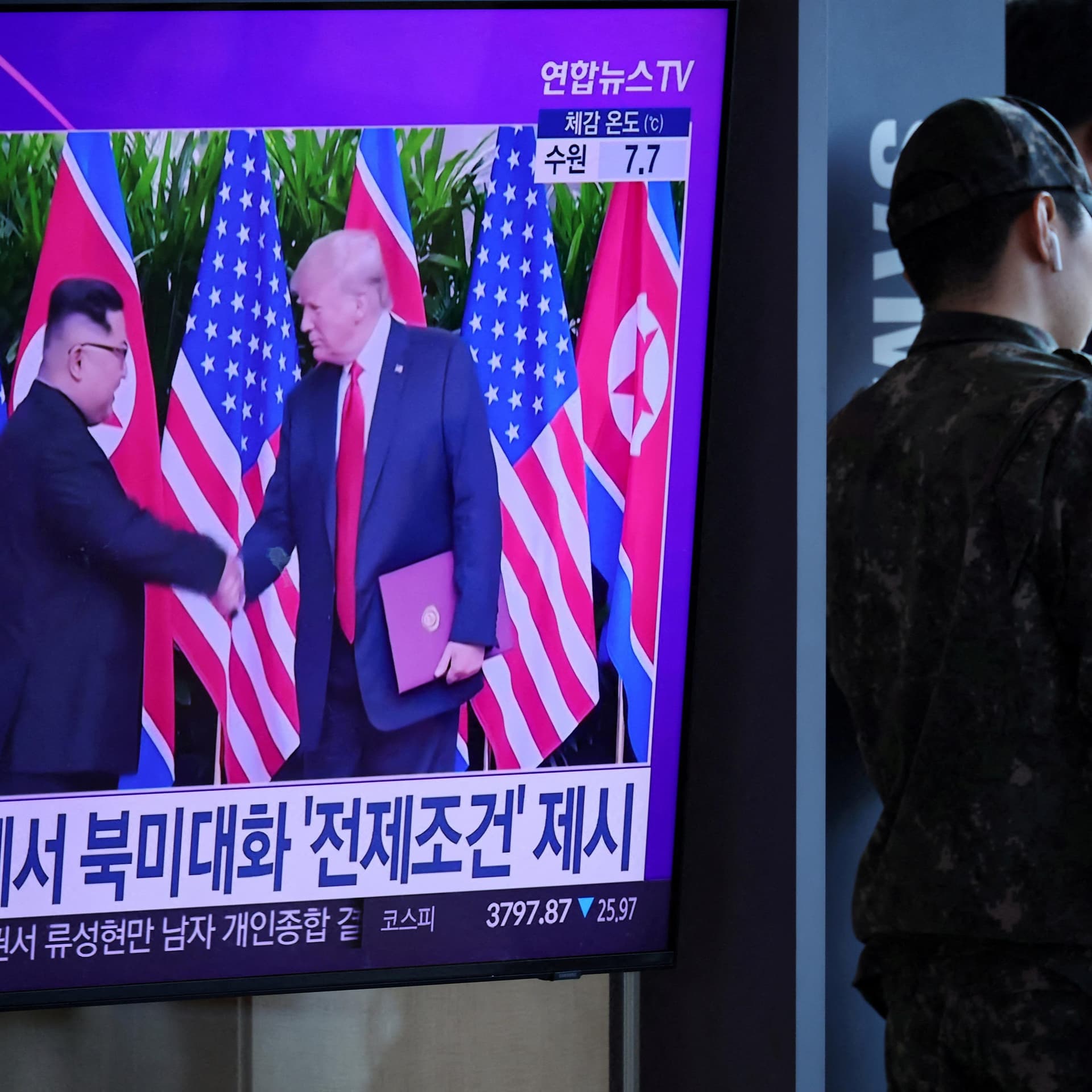
Photo: A South Korean soldier stands next to a TV broadcasting a news report on a possible summit between North Korean leader Kim Jong Un and U.S. President Donald Trump, October 22, 2025. Credit: Reuters/Kim Hong-Ji