In short
Whether the U.S. dollar’s dominance is ending, prompted by the U.S. federal debt crossing $40 trillion and rising interest costs.
Guest backgrounds
Ken Rogoff, former chief economist at the IMF; Harvard economics professor; author of Our Dollar, Your Problem.
Key claims
The reserve-currency “privilege” lets the U.S. borrow more cheaply because many countries hold dollars for trade/finance. But that advantage is shrinking as U.S. trust weakens and interest rates rise; debt interest is becoming a top budget pressure. Dollar dominance began after WWII via Bretton Woods (dollar fixed to gold; countries fixed to the dollar). It was broken by the “Nixon shock” in 1971 when dollar convertibility to gold ended, contributing to high inflation. Major challengers included Japan (1980s) and the euro (later), while China and sanctions drive diversification away from dollars. Rogoff predicts the dollar peaked about 10 years ago; it will remain #1 but with reduced market share over ~10–20 years, with more euro/Chinese use and some crypto.
Notable examples
Bretton Woods (Keynes vs Harry Dexter White); Nixon ending gold convertibility; Japan’s 1980s rise and early-1990s crisis after rapid liberalization; sanctions as a diversification driver; crypto’s role in “shadow” trade (estimated ~20% underground global economy).
Written by AI. May contain mistakes. Listen to the episode to check what was said.
Chapters
Tap a time to open that second in VOThe U.S. Debt Milestone Explained
0:51 to 1:29
Overview of the U.S. federal debt reaching $40 trillion and its implications.
“Imagine buying a toy for your kid, but it doesn't come with batteries.”
The U.S. Debt Milestone Explained
1:36 to 2:26
Overview of the U.S. federal debt reaching $40 trillion and its implications.
“The United States recently hit an alarming milestone.”
Interview with Ken Rogoff
2:33 to 3:18
Discussion with Ken Rogoff on the U.S. dollar's status and debt.
“To help us make sense of this incredibly complicated story, we decided to call up Ken Rogoff, because he seems like just the man to explain it all.”
The Reserve Currency Effect
3:23 to 5:23
Exploration of how being a reserve currency affects U.S. borrowing.
“is the reserve currency, which means it gets held all over the world.”
Interest Payments and National Expenditure
5:24 to 6:04
Analysis of how interest payments on debt impact the U.S. budget.
“It lets us borrow more and you can mess it up.”
The Dollar's Role in Global Trade
6:07 to 8:31
Understanding the U.S. dollar's dominance in international trade.
“You're not being asked to pay that much on it, and it doesn't matter that much.”
The Bretton Woods Conference
8:32 to 10:50
Historical context of the dollar's rise to dominance post-World War II.
“I mean, after World War II, Europe was destroyed.”
The Nixon Shock and its Aftermath
10:51 to 13:20
The impact of the Nixon administration's decision on gold convertibility.
“The system was that countries who wanted to be in the system, which was not everyone, but it was the European countries, Japan, Canada, they were required to fix their exchange rate to the dollar.”
Managing Inflation and Economic Policy
13:21 to 14:00
Discussing challenges in managing inflation in the wake of the Nixon Shock.
“Did people know, did other countries know that the United States was just going to kind of change the rules behind the scenes?”
Nixon and the End of the Gold Standard
14:00 to 15:29
Learn about the impact of Nixon's decision to abandon the gold standard on the U.S. dollar and global perception.
“and Nixon saw that was going to run out and we pulled off the gold standard.”
Show all 13 chapters
Challenges to the U.S. Dollar
15:36 to 19:06
Explore the historical challenges to the U.S. dollar, including Japan's rise and the euro's significance.
“dollar faced any serious challengers, particularly when the United States decided to change the system and not have the dollar linked to gold?”
Modern Implications of a Weaker Dollar
19:06 to 24:16
Discuss the political arguments around a weaker dollar and its potential effects on the American economy.
“But they had this massive debt crisis in the 2010s because they made some mistakes, and here we are with China today.”
Future of Global Currency Dynamics
24:16 to 26:44
Analyze the long-term outlook for the dollar and the emerging competitors in the global currency landscape.
“And so at this point, here we are speaking in 2026.”
Transcript
Automatic transcript. May contain errors.0:00This BBC podcast is supported by ads outside the UK.
0:30We do the things we do. And how to make better choices to help avoid costly mistakes. Each episode covers the latest research in behavioral science and dives into themes like the power of self-control, shaping your mindset for success, navigating new beginnings, and why starting over can feel so hard. Listen to choiceology at schwab.com slash podcast or wherever you listen. Imagine buying a toy for your kid, but it doesn't come with batteries. That sucks. But honestly, it's even worse when you buy business software. You end up with fragmented, disconnected systems that cost a fortune and don't talk to each other.
1:12Odoo completely changes that. Odoo comes fully complete, with all your business apps perfectly integrated and working together seamlessly. It's everything your business needs in one place, saving you time, headaches, and serious money. Stop paying for missing pieces. Go to odoo.com. That's O-D-O-O dot com to learn more. The United States recently hit an alarming milestone. The federal debt crossed$40 trillion. It's an eye-popping stat. And it's left a lot of people wondering, how is the U.S. able to borrow so much money? Well, one reason is because everybody wants our U.S. dollars. You can travel almost anywhere in the world and pull out a$100 bill.
2:00Those Benjamins have been a symbol of prosperity and stability for decades. For the last 80 years, banks in other countries have kept loads of dollars on hand because the U.S. dollar is the most traded currency in the world. How did that happen? And could the days of dollar dominance be coming to an end? From the BBC, I'm Asma Khalid in Washington, D.C. And today on The Global Story, has the U.S. dollar peaked?
2:33To help us make sense of this incredibly complicated story, we decided to call up Ken Rogoff, because he seems like just the man to explain it all. He was the former chief economist at the IMF, the International Monetary Fund, and is now an economics professor at Harvard, who's written a book called Our Dollar, Your Problem, all about the U.S. dollar's dominance. And the reason we wanted to have this conversation with him in this moment is because, as I mentioned a moment ago, the U.S. debt recently crossed$40 trillion. dollars. Now, I think a lot of Americans here will assume that a major reason for that large amount of debt is that the U.S.
3:09government often spends more money every year than it necessarily brings in. But I want to understand from Ken Rogoff how, if at all, the dollar and its status as the reserve currency of the world factors into this debt story. Well, the fact that the dollar is the reserve currency, which means it gets held all over the world. It gets used very widely. Let's the United States borrow more. So the world loves the dollar, but how much? And as time has gone on, they say, well, we love you, but you know what? Please pay a higher interest rate if you want us to love you so much. And that's been creeping up.
3:50So just so I understand what you're saying, because the dollar is the reserve currency of the world, it essentially allows us to have, say, a larger credit card limit, right? Like we all are familiar with a credit card limit. You're saying that because the United States has traditionally been this trustworthy economy, its limit for borrowing is ostensibly higher. It's not just trustworthy. In fact, people today must question how trustworthy the United States is. But because it's at the center of everything, Japan needs to hold dollars to manage their trade and finance. The Middle East holds a lot of dollars to manage their trade and finance.
4:31So if there are more people who are willing to hold your debt, you can have more of it. The debt is how much you can borrow. You can borrow more at a lower interest rate up to a point. It sounds like some would argue, though, that the dollar being the reserve currency then is a bit of, how do you describe it, kind of like a golden curse that it has allowed us to borrow as much as we have. That to this point where now as a nation, we are$40 trillion in debt. It's mostly great. I mean, I think over the years, it lets the United States have a stronger military. It makes it cheaper to own a home in the United States because it's not just the government that gets a lower interest rate.
5:14All Americans. So it's this incredible privilege. But it's true. It puts a bit of upward pressure on the dollar. It lets us borrow more and you can mess it up. And I think we're in some danger of heading in that direction. You mentioned a moment ago the interest on the debt. And And Professor, I was reading recently that part of why our debt has just ballooned so much is because of the interest and that the interest that the United States now pays annually. It is such a large part of the United States expenditure. I believe it's only second to the amount we spend on Social Security. Just put that in context, that it is so much.
5:59Can you help us understand what amount of interest the United States is paying annually on its debt? And again, how does that factor into the conversation around the dollar? Well, at the end of the day, if the interest rate were really low, like it was during the 2010s through the early pandemic, you owe a lot. But who cares? You're not being asked to pay that much on it, and it doesn't matter that much. Our debt payments five or six years ago were next to nothing. And now, as you say, they're second on their way to being first in the budget. It's not just because the U.S. is borrowing a lot. A great many very influential voices and academics, Paul Krugman, Larry Summers, are two famous people, sort of said there's nothing to worry about.
6:44The interest rate ain't going to go up. And it has. And people haven't yet totally absorbed that. We've mentioned a couple of times here the United States status as the reserve currency of the world. Can you explain what that means in plain terms? So the dollar is essentially the lingua franca of international trade and finance. Suppose you have Australia trading with Argentina. Now, there's an Australian dollar, there's an Argentine peso. and I don't know, maybe Argentina's selling soybeans to Australia and Australia's selling iron ore to Argentina. Well, you know, you can work it all out in pesos and Australian dollars, but the people in Australia, they don't want Argentine pesos and the people in Argentina, well, Australian dollars aren't terrible, but they'd rather have US dollars.
7:48And so it's just easier to understand. They're more than 180 countries, so it's a common denominator. It's not the only one. The euro is very widely used. The Chinese currency is very widely used. But the U.S. one, most of all. It wasn't always that way. If you go back to 1900, it was the pound. That was the lingua franca. The Brits, yes. The Brits, they were on top for more than a century. If you go before that, and this may be hard to believe, it was the Netherlands. It was the Dutch Gilder. They were very innovative in finance. Before that, Spain, before that, the Italian city states. But the U.S.
8:31has been really on top since World War II. It started after World War I. I mean, after World War II, Europe was destroyed. Japan was destroyed. The dollar was the only game in town. You mentioned that the dollar wasn't always the dominant currency used around the world and that this became the norm after World War II. Can you tell us that story? Well, the U.S. had all the wealth, all the gold, all the industrial base, and was pretty much in a position to dictate what things would look like. At Bretton Woods, New Hampshire, delegates from 44 allied and associate countries arrived for the opening of the United Nations Monetary and Financial Conference.
9:20Invited by President Roosevelt... And there was this famous conference held in Bretton Woods, New Hampshire, where John Maynard Keynes represented Britain, and the U.S. was represented by Harry Dexter White, a far more minor functionary. These meetings are designed to promote trade in the post-war world and to create a foundation for lasting peace.
9:46But White had all the money. Keynes said, no, no, no, we shouldn't use the dollar. He tried to come up with this idea. I think he called it the boncour that everybody would decide on. And Harry Dexter White said, well, no, we're going to use the dollar. Keynes tried to come up with some world currency that was managed by a group of countries. And he had some rules. And he was trying to cling on to British power. I see. But the trouble is, after World War I and then after World War II, the U.S. had all the cards. because the United States was paying for reconstruction of Europe. You needed to trade with the United States.
10:24I mean, if you think today Donald Trump is holding a big stick, he certainly thinks he is. Back then, the United States was, by some measures, half of the world economy. So we were in a position to sort of bully our way into that. So this conference takes place in Bretton Woods, New Hampshire, and the United States comes out on top. The U.S. dollar is agreed upon. You could say maybe we dictated the terms a bit, but it was agreed that that would be the standard you're saying for the world. And what was the system? The system was that countries who wanted to be in the system, which was not everyone, but it was the European countries, Japan, Canada, they were required to fix their exchange rate to the dollar.
11:11But the U.S. was not required to do anything except if countries, central banks, or treasuries felt they had too many dollars, they could take it to the United States and get gold in return. Our parents. Gold bars. Yeah, literally, literally gold bars. There was a way we were still on the gold standard. Everybody was fixed to the dollar. The dollar was fixed to gold. and that lasted and worked pretty well for a couple decades. The 50s and 60s seemed like halcyon days. Did it continue to work well into the 70s and 80s? So the trouble is the linchpin of this system was the U.S. had to be willing to back the dollar with gold.
12:02The trouble is, the U.S. wanted to spend more and more. It had, particularly in the 60s, Lyndon Johnson was the president, started the Great Society, which was a big increase in our welfare system. And this administration today, here and now, declares unconditional war on poverty in America. There was a massive expenditure increase. And then we got entwined in this war in Vietnam, which lasted and lasted and lasted. And the government was having trouble living within its means. And it started putting upward pressure on the general level of prices. And effectively, that meant we were undervaluing gold.
12:53because the relative price of gold and cars, that's not something the government sets. The market sets that. So countries, particularly France, were starting to say, give us gold. We have a lot of dollars. Let's trade it for gold. And eventually Nixon in 1971 said, that's enough, no more dollars for gold. I directed Secretary Connolly to suspend temporarily the convertibility of the dollar into gold or other reserve assets, except in amounts and conditions determined to be in the interest of monetary stability and in the best interest of the United States. That's a huge shock to the system. We call it the Nixon shock.
13:40Did people know, did other countries know that the United States was just going to kind of change the rules behind the scenes? They did not. And the trouble is, once people started to lose confidence in it, and it's not ordinary people, but the French government, the UK government, if you know there's a fixed amount of gold and everybody has a lot of dollars, you want to race to get it. and Nixon saw that was going to run out and we pulled off the gold standard. The Europeans were furious when this happened because they didn't know it was coming. They basically thought these dollars were going to be worthless.
14:18Nixon sent his treasury secretary, John R. Connolly, over to tell them. And when they were complaining, he said, well, it's our dollar, it's your problem. The irony was it was our problem because once we weren't tethered to gold, what were we tethered to? And people my age know that the 1970s was horrible for inflation. What people experience in the 2020s after the pandemic, that was nothing compared to what happened in the 1970s because it took us a while to figure out how to manage things. And we eventually did.
15:01Self-directed investing, trading, full-service wealth management, automated investing, financial planning, thematic investing, retirement planning. Phew. And to think, that's just a small taste of what Schwab offers. Because Schwab knows that when it comes to your finances, choice matters. No matter your goals, investing style, life stage or experience, Schwab has everything you need, all in one place, so you can invest your way. Visit schwab.com to learn more.
15:35So over the years, has the U.S. dollar faced any serious challengers, particularly when the United States decided to change the system and not have the dollar linked to gold? Were there any serious challengers? There have absolutely been serious challengers. In the mid-1980s, the Japanese stock market was worth more than the U.S. stock market. In other words, the world put a higher value on Japan than the U.S. And why was that? They were inventing everything. Electronics. They had all this innovation. But electronics were the tech of the day. I used to have friends come back from Japan and they'd have some weird new watch, which told the temperature and the time.
16:23Incredibly innovative. And they had new manufacturing techniques, the famous Japanese just-in-time production. I teach at Harvard University now. Michael Porter, a great man, one of my colleagues at the business school, was writing these books about Japan's coming. It's all over. were crushed. Many people thought that the White House thought that. And to make a long story short, we confronted them at some point. And I think Japan misplayed its hand. Can you explain that? Because I was quite young, I will say in the 80s. And I have heard these stories of Japan being some sort of looming threat.
17:05I mean, I've covered the White House for years, and I know that much of President Trump's focus on tariffs began with Japan. But how did the United States really confront Japan and come out on top? And you're right. This is where President Trump got all his ideas about tariffs. But we basically forced them to take actions that doubled the value of their currency within a year. Imagine that. I mean, we're not talking about a 5 % change or a 10 % change. And were they obliged to do this because their currency was in some ways pegged to the dollar? No, I mean, at that point, Nixon had gone off and they weren't paying.
17:42They were really obliged because Japan's under the U.S. defense umbrella. And we were pushing on that. And they could have stared us down and cut a better deal than they did. I would say they opened up their capital markets too fast. They liberalized their economy. They liberalized their banking system, but they weren't ready for it. They weren't prepared. Their regulators weren't prepared. Their companies weren't prepared. And they had what is basically the mother of all financial crises in the early 1990s. Havoc ruled Tokyo financial markets on Monday, a direct result of the collapse in trade talks with Washington.
18:25Stocks plummeted in sympathy while the yen gained still further. It just cut them to their knees, not for three or four years like the U.S. after the global financial crisis, but for two decades. Since Japan's economy began its slide, many Japanese have wondered whether the stress of trying to maintain world-beating industries is worthwhile. Perhaps it would be better to focus on their quality of life, not material benefits. So Japan kind of fell off the map. It was a disaster. And Europe came along after that. They put together the euro, and the euro has been the most serious challenger, and they still are relevant.
19:09But they had this massive debt crisis in the 2010s because they made some mistakes, and here we are with China today. So here we are in this modern era, and I have heard some politicians argue, and in fact, I would say we've heard this argument from someone within the Trump administration that suggests a weaker dollar is actually good for America. It's good for American businesses. And we've heard this argument perhaps most plainly articulated by J.D. Vance. This was an old video from before the days he was vice president that recently resurfaced and has been circulating online in recent weeks.
19:51Americans have enjoyed one of the greatest privileges of the international economy for the last nearly eight decades, a strong dollar that acts, of course, as the world's reserve currency. And he compared it to the resource curse. Now, I know the strong dollar is sort of a sacred cow of the Washington consensus, but when I survey the American economy and I see our mass consumption of mostly useless imports on the one hand and our hollowed out industrial base on the other hand, I wonder if the reserve currency status also has some downsides and not just some upsides as well. What do you make of that argument?
20:23Because it is one that I have begun to hear percolate a little bit more in our politics in recent years. Oh, absolutely. It was a central theme of the early days of Trump 2.0. The Treasury Secretary was probably the most respected on the economic team. He would say it all the time. Trump said it. Scott Besson. But didn't he come out later, though, and say that, no, no, he does believe in having the dollar as the reserve currency? He wants to have it both ways, a little bit like a friend of mine who would say it's too hot and too cold at the same time. He wants the dollar to be low and he wants the dollar to be high.
21:02But basically, if it's the reserve currency and everybody wants to hold the dollar, it does bid up the price. and therefore it makes it more expensive to export, it makes it cheaper to import. But what's a little bit misleading about that is it's one factor among dozens that affects the dollar. The fact the U.S. is the tech giant, that kind of bids up the price of the dollar, probably a lot. That it's an agricultural powerhouse, that bids up the price of the dollar. That the U.S. is a military power. You could go on and on. So there's a little bit of truth to it. And J.D. Vance articulates the point very articulately.
21:45And it's interesting that Trump, we talked about Japan, the Trump administration, you know, waxes euphoric about those days. Remember what we did to Japan? Let's do that to everybody. You know, let's just make everybody suffer and have the U.S. come out on top. You spoke about President Trump's second term, but I have also heard you say in the past that there was a move away from the U.S. dollar that predates Donald Trump's second term in the White House. I mean, the U.S. dollar has been the standard for 80 years at this point. When and why did we begin to see some countries look for an off-ramp?
22:26So one reason was China realized it had gotten too big to keep making the dollar as central as it was. So China's the second biggest economy. And as long as China literally was fixing their exchange rate to the dollar, you could just hold dollars. But once China started moving around and you're an Asian economy or Latin American economy, the Chinese currency becomes more important. A second reason was sanctions. Everybody knows we're trying to put sanctions on Iran right now. Everybody knows, or maybe they don't, we've done a lot of that with Russia. And what they probably don't know is we have sanctions on like 20 countries, thousands of individuals.
23:11And a lot of countries, particularly China, are looking at that and saying, we're next and we can't allow that. And so they want to diversify. It's a little bit like if your only credit card was MasterCard and MasterCard said, sorry, you can't use that anymore. You're in trouble. But the big issue is the one you started this conversation out with, that we're all in on the dollar, but is the dollar going to be all in on us? Nixon went off the gold and suddenly inflated a lot. He made the dollars worth a lot less. How do we know with the debt so high and the deficit so big that the dollar is going to be as stable?
23:56I think that's really the big concerns, a little bit like the fall of the Roman Empire. The real problems were from within. And that's the situation. And this is not a Trump thing. This is both parties. And I didn't really answer your question about sanctions enough. Obama used sanctions a lot. Biden used sanctions a lot. Trump won new sanctions a lot. It didn't just start here. And so at this point, here we are speaking in 2026. Which currency would you say poses the biggest challenge to the U.S. dollar? And maybe it's not a singular currency. Well, I think the first thing that's going to happen is the dollar will still be on top, but people will want a much higher interest rate for it.
24:45It just won't be the cushy monopoly that it used to be. That's bad for everybody. If we're not as stable. So, I mean, that sounds, by the way, if you don't own a house here in the United States, it sounds like you're saying we are going to see high mortgage rates for years to come. Oh, I think that's very likely. Oh, wow. By the way, it's another conversation. That's a domestic conversation, but I am selfishly very interested in that conversation. That's very interesting. Text me later. But yeah, I think there's a concern that we're going to go through an unstable period. But I think at the end of it, and by the end of it, let's talk about 20 years, the dollar will still be on top, but its market share will have shrunk.
25:28People will be using the Chinese currency much more and the euro much more and crypto. Crypto is an important competitor also where there's no state behind it. You see crypto being a real viable challenger to the U.S. dollar? Oh, it's already there. It's not a viable challenger in the sense of I bought coffee this morning and I'm going to go use Bitcoin to buy coffee. But a lot of the world's trade takes place in the shadows. I estimate, and the World Bank does, that roughly 20 % of the global economy is underground, which means not paying taxes, not obeying regulations. That's a significant part of the demand for dollars, is people avoiding the prying eye of the government.
26:19Well, crypto is very well designed to do that. You know, dominating currencies have had a lifespan. You alluded to this earlier when we spoke about the British pound, sterling, right? That was the dominant currency prior to the dollar. So if you look out over the horizon, has the dollar peaked? I think it has peaked. I think it peaked about 10 years ago and it's on the way down. I mean, dominant currencies, that's what the U.S. is, don't die of old age, but they die of, you know, problems coming on the inside. We'll see. But I do think we're headed near term. I'm calling near term 20 years, 10 years to a more diversified world.
27:01China cannot allow itself to be cut to its knees by letting it get threatened by being cut off from U.S. banks. It just can't allow that. Europe, you think Greenland was a joke when President Trump threatened Greenland? I don't think it was a joke. That issue has come up over a long time. And I'll make a prediction right here that it's going to come up in a big way before Trump's out of office. and the Europeans see. What weapons can they use against us? How can we protect ourselves? Look at poor Canada right now. And so, yes, it would be efficient to just be the dollar if you could trust the United States.
27:41But that day is gone. And I don't know when it's coming back.
Read the full transcript
27:51Well, Professor Ken Rogoff, thank you for spending some time with us on The Global Story and helping us to try to make sense of a confusing but important storyline. We really appreciate it. Thank you. And your producer has my email if you want to ask about mortgage rates.
28:14That was Professor Kenneth Rogoff, former chief economist at the IMF. And as always, if you all have any thoughts or questions for us, you can send us an email. Our address is theglobalstory at bbc.com. We really love hearing from listeners. And in that vein, before we wrap, I have got to give a special shout out to perhaps one of our youngest listeners, 12-year-old Everly from Singapore, who writes, I love listening to your podcast before bed. I have learned so much from you guys and want to be a journalist when I grow up. Well, we are cheering you on, Everly. Thank you for listening and thank you for writing in.
28:48Our show today was produced by Valerio Esposito, Aaron Keller, and Lucy Paul. It was mixed by Travis Evans. Our digital producer is Charlie Firth. Our executive producer was James Shield. Our senior news editor is Chyna Collins. And I'm Asma Khalid. That's it for our show today. Thanks as always for spending some time with us. And we'll talk to you again tomorrow.
From the publisher
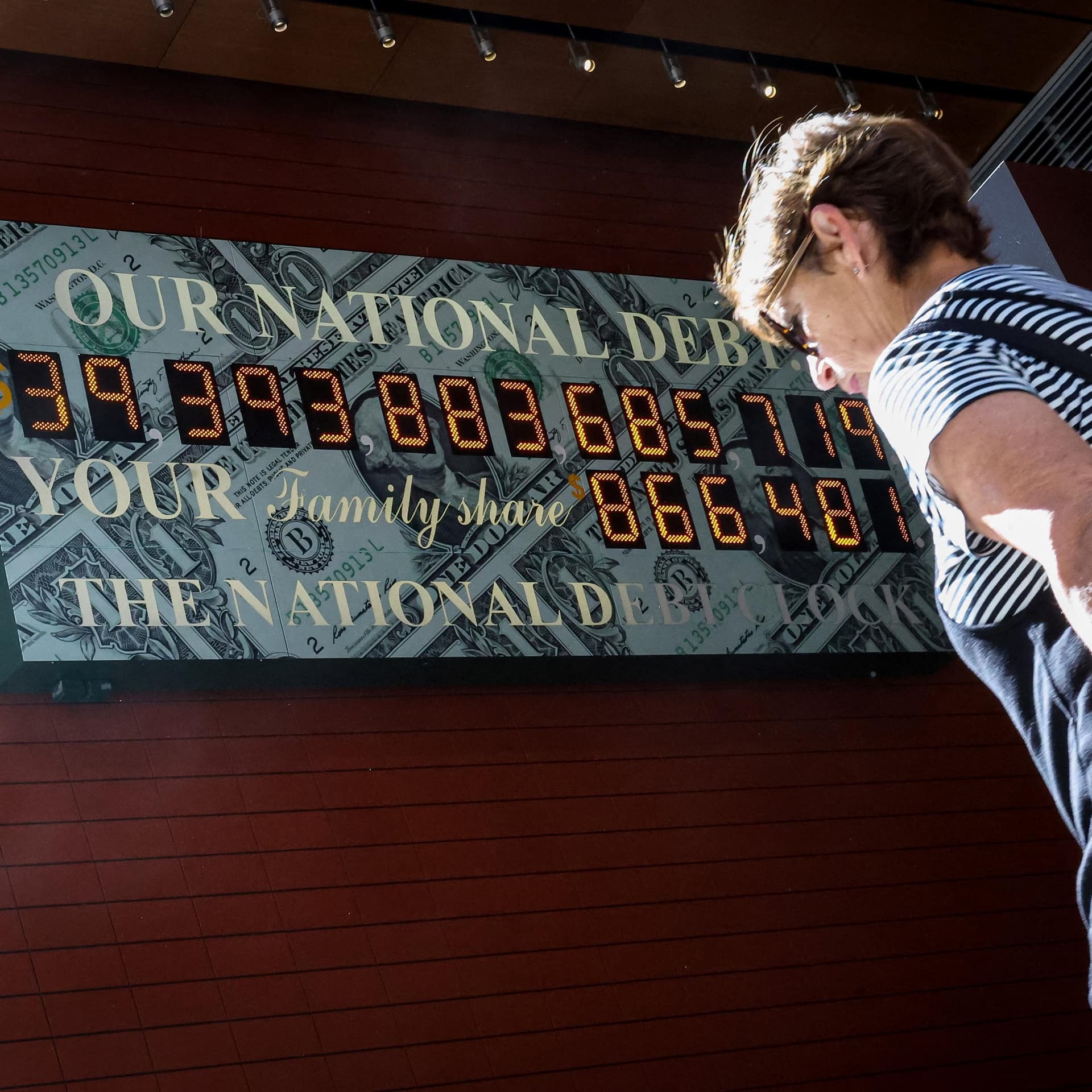
America’s national debt recently hit a new milestone of $40 trillion. It is estimated that interest payments on the national debt are now the second largest expense in the US government budget, trailing only Social Security. How was the US able to borrow so much and for so long? One answer, according Harvard economist Kenneth Rogoff, is the US dollar’s status as the world’s reserve currency.
In this episode, Rogoff - former Chief Economist at the International Monetary Fund - explains how the US dollar came to enjoy this hegemonic status, what being the world’s reserve currency actually means in practice, and why he believes the dollar is now in decline.
Producers: Valerio Esposito, Aron Keller and Lucy Pawle
Executive Producer: James Shield
Mix: Travis Evans
Senior news editor: China Collins
Photo: A woman passes by the National Debt Clock in New York City, U.S., August 19, 2026. Credit: Reuters/Brendan McDermid.