
In short
The BBC Global Story episode examines a UN independent commission report concluding Israel is committing genocide in Gaza as Israel begins a major ground offensive in Gaza City, and it contrasts genocide with war crimes/crimes against humanity. It also discusses what evidence and intent would mean legally, and what changes (if any) the report could drive, including possible roles for the ICJ and ICC.
Guests (and backgrounds)
Navi Pillay, South African-born lawyer; grew up under apartheid; former head of the UN tribunal on the Rwandan genocide; judge at the International Criminal Court; UN Human Rights Commissioner. Imogen Foulkes, BBC correspondent covering the UN in Geneva for years.
Key claims
The report says genocidal intent is shown by statements by Israeli leaders plus acts on the ground; Israel rejects the report as false and says it follows international law. Genocide requires intent to destroy a protected group “in whole or in part,” not just killings.
Notable examples
Netanyahu’s “wicked city” and “turn them into rubble” rhetoric; Yoav Gallant’s “complete siege” and “human animals” language; Isaac Herzog saying “an entire nation” is responsible. Evidence cited includes repeated bombing in densely populated Gaza, alleged drone shootings of children, alleged sexual violence allegations, denial of food/water and power, bombing hospitals/schools and destruction of cultural monuments, destruction of Gaza’s fertility clinic and alleged destruction of embryos, and forcible transfer (including children).
Written by AI. May contain mistakes. Listen to the episode to check what was said.
Chapters
Tap a time to open that second in VOExamining Genocide Accusations
0:38 to 2:15
Discussion of the UN commission's findings on alleged genocide in Gaza.
“Today we witness in real time how the promise of never again is broken and tested in the eyes of the world.”
Understanding Genocide and War Crimes
2:15 to 4:19
Clarification of the legal definitions of genocide versus war crimes.
“isn't a semantic or a symbolic one, or even a legal one.”
Profile of Navi Pillay
4:19 to 6:24
Insights into the background and qualifications of Navi Pillay, the report's author.
“I just want to ask a perhaps sort of basic process question here.”
Evidence of Genocidal Acts
6:24 to 8:22
Exploration of the report's claims regarding Israel's actions as genocidal.
“Imogen, the Israelis have said that the report authors are, quote, Hamas proxies.”
Impact of Bombing on Civilians
8:22 to 10:24
Discussion of the consequences of bombing in Gaza and its humanitarian effects.
“Gaza is one of the most densely populated areas of land on the planet with 2.2 million people.”
Conditions Leading to Physical Destruction
10:24 to 13:44
Details of conditions impacting life in Gaza, including destruction of essential services.
“And what is the Israeli government saying in response to this?”
Evidence Collection in Gaza
13:44 to 14:00
Examination of how evidence was gathered for the report amid restrictions.
“The question I have is how all of this evidence was collected.”
UN Investigations in Gaza: Evidence Gathering
14:00 to 16:27
Discover how UN investigators collect evidence in Gaza amidst conflict.
“Were UN investigators going inside of Gaza?”
Exploring Evidence of Genocidal Intent
16:27 to 21:35
Learn about the evidence that suggests genocidal intent by Israeli leaders.
“Coming up, if you can't prove genocide without proving intent, what's the evidence against Israel?”
Israel's Response to Genocide Allegations
21:35 to 24:25
Understand Israel's dismissal of the genocide report and international reactions.
“What are they saying in response to this report?”
Show all 11 chapters
Implications of a Genocide Declaration
24:25 to 27:00
Discuss the potential consequences if a genocide were officially declared.
“However, as I said, particularly a commission like this, which is the highest level of investigation that the UN can carry out, it has a lot of moral authority, if you like, gets a lot of attention.”
Transcript
Automatic transcript. May contain errors.0:00This BBC podcast is supported by ads outside the UK.
0:30so you can monitor and engage with the account while your teen learns how to invest and manage money. Learn more at schwab.com. Today we witness in real time how the promise of never again is broken and tested in the eyes of the world. The ongoing genocide in Gaza is a moral outrage and a legal emergency.
0:57Imogen Foulkes:That is Navi Pile. She's the chair of an independent commission set up by the United Nations to investigate human rights in the Palestinian territories. Her commission has just concluded that Israel is committing genocide in Gaza. Now, that's a big moment, even if the U.N. is complex and this expert panel doesn't speak for the whole of it. Israel, for its part, has dismissed this report, describing it as distorted and false. Israel categorically rejects the libelous rant published today by this Commission of Inquiry. Is this truly about human rights or is it about defending terrorist leaders who deliberately use innocent civilians as human shields?
1:46The genocide question has been at the center of a massive debate since the war began. But what's the actual evidence?
1:54Imogen Foulkes:From the BBC, I'm Asma Khaled in Washington, D.C. And I'm Tristan Redman in London. And today on The Global Story, what, if anything, could this investigation change?
2:14For Gazans, the question of whether a genocide is unfolding around them isn't a semantic or a symbolic one, or even a legal one. It's a matter of life and death. On Tuesday, Israel launched a major ground offensive in Gaza City, where hundreds of thousands of Palestinians have been living in tents. Breaking news overnight from the Middle East, Israel say it has launched the main phase of its offensive to destroy Hamas in Gaza's largest city. There was a massive bombardment overnight, with locals describing it as a night of hell. Sources tell CNN Marco Rubio told Benjamin Netanyahu that Israel has the full support of the U.S.
2:54for the assault on Gaza City. Israel's defense minister, Israel Katz, said on social media, Gaza is burning. Since the war started, a lot of people have died. 1 ,200 mostly Israeli civilians were killed on October 7th. 251 hostages were taken. Almost 65 ,000 Palestinians have been killed in Gaza, according to the Hamas-run health ministry. As this war's dragged on, the conversation over whether Israel is committing a genocide has changed immeasurably. For this episode, we're talking to the BBC's Imogen Folks. She's been covering the United Nations in Geneva for years. The legal definition of genocide is really pretty strict.
3:41The short answer is the intent to destroy in whole or in part a specific group. In this case, it would be the Palestinians in Gaza. Now, that does not have to mean killing them. It can mean destroying the conditions which allow them to live in their homes. And it doesn't mean also killing all or destroying all of the group. It's key there in whole or in part, and that the intent must then be followed by the acts.
4:19Imogen Foulkes:I just want to ask a perhaps sort of basic process question here. But my understanding is that earlier this commission had found evidence of war crimes and crimes against humanity. And can you spell out what the difference is between genocide and war crimes or crimes against humanity? They all seem extremely awful. What is the distinction between them? You know, it's interesting you say they all seem extremely awful. They are all extremely awful. The difference would be, you could say that using 2 ,000 pound bombs on an area you know is full of civilians. knowing that and still going ahead with the bombing would be the war crime of lack of proportion, lack of discrimination, no protection of civilians.
5:12That's a war crime. Genocide would be, we're going to do this, whether it's indiscriminate bombing, denial of food and water, because it's all part of our strategy to destroy this particular group, whether that means killing them or getting rid of them, i.e. moving them out. So it's a crime against the group of people. It's an intentional crime designed to destroy a group in whole or in part. I see. The author of this report is a woman called Navi Pillay. Who is she? What's her background? She's originally from South Africa. She grew up under the apartheid regime, not being a white person, nevertheless qualified as a lawyer.
6:07She was head of the International Tribunal on the Rwandan genocide. And this is where I think her report does carry a lot of weight, because she knows the laws around genocide inside out. She was a judge on the International Criminal Court. She then became UN Human Rights Commissioner, the leading human rights official within the United Nations. That's how I got to know her. Imogen, the Israelis have said that the report authors are, quote, Hamas proxies. Is Navi Pillay a Hamas proxy? No. And frankly, I was quite surprised to see that kind of language being used. Everyone here in Geneva, every single journalist, every single member of staff at UN Human Rights expected Israel to reject this charge of genocide.
7:03Of course, Israel will do that. But to use that kind of language about a woman who is an international lawyer who is now 83 years old and has a huge body of defending human rights behind her, I think surprised us all.
7:23Imogen Foulkes:I want to turn to the specific context within this report. I am seeing that the report says Israel demonstrated genocidal intent and that four out of the five genocidal acts defined under international law have been carried out against Palestinians during this war in Gaza. Can we walk through these, the five acts? What is the evidence in this report? Well, perhaps we want to talk about what the acts are, which are the intentional killing of a group in whole or in part, deliberately inflicting conditions designed to destroy the group, causing it serious physical or mental harm, or preventing births within the group.
8:07The fifth one is to do with the forcible transfer of people, particularly children. The first four, four out of five, this report says Israel has committed those violations.
8:22Imogen Foulkes:So can we take those one by one when you say killing members of the group? Is that the first one? So there are many aspects to this. Gaza is one of the most densely populated areas of land on the planet with 2.2 million people. And it has been relentlessly bombed using enormous bunker buster bombs without, analysis would say, any account of the fact of where civilians were versus where Hamas fighters were. were, and that this didn't happen just once, it happens on a very regular basis, it looks strategic. We could look at something like the use of quadcopters, which are drones armed with guns, that repeatedly children have been shot by these.
9:14Now, somebody is in charge of those quadcopters, and somebody or some people are repeatedly, according to this report, shooting children in the head.
9:24Imogen Foulkes:Now, despite all of that evidence, the IDF for its part has consistently been saying that it does not target civilians and that it does everything possible to avoid civilian deaths. That is the first category of the acts of genocide. I want to ask you about the second category, and that is causing serious bodily or mental harm to members of the group. What's the evidence there? We have enormous amounts of evidence of the kind of constant bombardment that is taking place in Gaza, which causes physical injury, but also psychological injury. But I will give you one example. And this is the testimony of a great many Gazan women, some of whom have been detained by Israeli forces, but sometimes they are stripped.
10:19Their photographs are then taken, and then these photographs are posted on social media. Is this laid out in the report? Yes. And what is the Israeli government saying in response to this? They have said, again, this is Hamas lies, but they're not addressing the specific allegations. No. No, they're not. They say that the allegations have been addressed in an extensive report. which is actually written by an Israeli think tank. And I think it does become, for a neutral observer, a little bit difficult to say, okay, there's this one report, but yet there are these multiple reports from UN observers, aid agencies, doctors, nurses, eyewitness.
11:12I mean, the report contains eyewitness accounts from former members of the Israeli Defence Force as well as from Palestinians.
11:19Imogen Foulkes:The third genocidal act described here in the report says deliberately inflicting on the group conditions of life calculated to bring about its physical destruction in whole or in part. What evidence is there for that in the report? So we talked a little bit already about the denial of food and water, switching off power. those acts would fall into that particular category. But also, for example, the repeated bombing of hospitals, the bombing of schools, the destruction of cultural monuments, all of the things which destroy not just the physical life of a group, but the kind of cultural, normal, social life of a group so that it becomes impossible to function as a coherent group in Gaza as the Gazans did.
12:20Imogen, the fourth act was the one that surprised me the most because it's the one I knew least about and it's imposing measures intended to prevent births within the group. What does the report say about that? There's a specific example related to that, which is the destruction of Gaza's one fertility clinic, which was bombed. But it also appears that fertilized embryos, which would-be parents in Gaza had been hoping to use, were then deliberately destroyed after the bombing. And this is the specific example that is used in the report that there were potential Gazan children, these embryos, and these were then deliberately destroyed.
13:08I think it's important to say here that Israel has consistently said it does not target hospitals, but that Hamas operatives use hospitals, hide under them in tunnels. It has also said, in particular to the allegation of the destruction of fertility clinic, that it does not target fertility clinics. So, you know, Israel has insisted from the start, it always follows international law. It does not target hospitals or fertility clinics, although it has admitted sometimes there's collateral damage. The conclusion of the report is that that can't be true if you analyze all of what's happened since October 7th.
13:55The pattern is just too clear.
13:58Imogen Foulkes:The question I have is how all of this evidence was collected. Were UN investigators going inside of Gaza? And the reason that's been on my mind is certainly Western journalists cannot go in freely and operate inside of Gaza. So were investigators from a UN body going inside and collecting this evidence? How did they obtain it all? Well, the United Nations is present in Gaza. So I, for example, get a report every day from the UN Office for the Coordination of Humanitarian Affairs. Again, very UN techno-speak, but they are present in Gaza, and they give us an update every 24 hours about what is happening.
14:41Other aid agencies feed into that. The World Health Organization, UNICEF, they are present, they are too. And the things that we are reading in this human rights report, we have actually heard before from many of these aid agencies, not couched in the specific framework of international law.
15:07Imogen Foulkes:So it sounds like you're saying this information has been collected, it's been reported by various aid agencies throughout this war, but it's being put here together conclusively in the report in a way that we have not seen before. That's partly right. Okay. This commission of inquiry has reported on different aspects of what's going on in this conflict, including, as we discussed, the sexual violence committed on October 7th, since October the 7th. It has reported on attacks on hospitals. It has reported on, for example, the killing of journalists and aid workers. The report that is out now goes back over all that evidence, ties it in with statements made at the start of the conflict by Israel's leaders and said, do we see a pattern?
15:59Do we see intent? Do we see acts that fit into these criteria of what constitutes genocide, the things we've just discussed? So that's what this report does. It collates it all together. It's the conclusion and the intent and the pattern.
16:27Imogen Foulkes:Coming up, if you can't prove genocide without proving intent, what's the evidence against Israel?
16:40Imogen Foulkes:You had said earlier that under international law, the acts alone are not enough to constitute a genocide, that there needs to be evidence of genocidal intent. What is the evidence in this report that there is intent? How do you measure intent? When Navi Pili and her colleagues decided to do this report, one of the first things they went to is statements made by Israeli leaders right in the first few days after the attack of October the 7th. Statements that frankly even then caused alarm because of their nature. And the idea was to establish, was this a sign of genocidal intent? I actually had Navi Pillay highlight some of these for me when I interviewed her just a few hours ago.
17:35Now, here is what she told me Prime Minister Benjamin Netanyahu said. As early as 7th October 2023, Prime Minister Netanyahu vowed to inflict, and I quote him, mighty vengeance on all of the places which Hamas is deployed, hiding and operating in, that wicked city. We will turn them into rubble. I say to residents of Gaza, leave now because we will operate forcefully everywhere. So although Netanyahu's statement carefully directed the call for vengeance at Hamas locations, his use of the phrase wicked city in the same statement implied that he saw the whole city of Gaza as responsible and a target not only to Hamas, but he wanted all of all the Palestinians in Gaza to leave, making no distinction between combatants and civilians.
18:37Going on from there, we had, as the conflict got underway, the blocking of food and water into the Gaza Strip. Again, Navi Pillay highlighted something that former Defence Minister Yoav Gallant said. On 9 October 2023, Israeli Defence Minister then, Yoav Gallant, announced a complete siege on Gaza, claiming that Israel was fighting human animals and Israel must act accordingly. There we have, you know, not just the blocking of supplies essential to life, which is a war crime, but the dehumanizing language, the human animals. And finally, Israeli President Isaac Herzog. Isaac Herzog, 14th October 2023, said it's an entire nation out there that is responsible.
19:34It is not true, this rhetoric about civilians who were not aware and not involved. It's absolutely not true. So a very clear statement that the target group is all of the Palestinians. Some people at the time did say these are bordering on genocidal statements. But of course, you know, it's the start of the conflict. Israel had suffered a terrible, terrible, violent, traumatic attack. And, you know, sometimes people say things. They do. It's human nature, isn't it? But since then, there appears to be a pattern.
20:14Imogen Foulkes:So these statements were made at the outset of the war. And there are certainly many critics who feel that there have been indications of genocidal acts for some time. We've had a number of academics here in the United States, human rights groups, refer to this as a genocide for a while. And if these statements were said many, many months ago, is it the fact that these statements coupled with the actual acts and reality on the ground have now led to this conclusion in the report? Yeah, I mean, you can't say just because somebody says something, oh, that's genocide. Obviously, it has to be followed by acts.
20:48What this report does is examine whether the facts on the ground bear out what the words at the start seemed to signify, an intent to destroy a group in whole or in part. And the report's conclusion is there is no other possible inference and that this is the strategy of Israel and Israel's military.
21:17Imogen Foulkes:These are huge allegations being made against not just the government of Israel, but also individual people like the Israeli prime minister and the president. They are being accused of having prosecuted the war in Gaza with genocidal intent. What are they saying in response to this report? Israel, as expected, has firmly dismissed this report. Israel consistently maintains that it upholds international law and is not violating any of the bodies of international law, whether it's Geneva Conventions, Convention on Genocide, Convention on Torture. An increasing number of international lawyers and human rights investigators beg to differ, though, with that statement.
22:03Imogen, Nabi Pillay and her team have laid out their case here, but they don't have the last word on this, if I've understood correctly. That would actually belong to the International Court of Justice, which is the UN court, which is still deliberating on the question of genocide in Gaza. Is that right? That's absolutely correct. I think that's one of the interesting things about these commissions of inquiry. They don't have prosecutorial powers. But what I have seen more recently in the last few years is increasingly how these commissions of inquiry do share their evidence with the International Criminal Court, where, in fact, Benjamin Netanyahu is already indicted.
22:44We know that on charges of war crimes and the International Court of Justice, which is the one that prosecutes states. And as you say, there is a case over possible genocide with the ICJ at the moment. It will take years, but this kind of evidence can be used because these UN inquiries operate to a very high evidentiary bar. Do we know when the ICJ is going to rule exactly? The last I heard, the earliest could be something like 2027. I think this is one of the frustrating things in any conflict. If you are the victim of an atrocity, that the wheels of justice turn very, very slowly. Let's not forget the women of Srebrenica, that massacre in Bosnia and the former Yugoslavia, took place in 1995.
23:36And it took more than a decade for any justice to happen. What would it mean if a genocide were officially declared? The Genocide Convention says that it's not only that states should not commit genocide, but that they have a legal obligation to prevent it if it is happening somewhere else. So according to this report, states should immediately stop exporting weapons to Israel, anything that could be used to continue the conflict.
24:12Imogen Foulkes:This report recommends that. You're saying this report recommends that there's no legal binding, though. You're saying this report is purely sort of a, has no prosecutorial standing. It has no legal binding. No, it doesn't. That is the nature of UN inquiries. However, as I said, particularly a commission like this, which is the highest level of investigation that the UN can carry out, it has a lot of moral authority, if you like, gets a lot of attention. And the idea is that governments, whether in Washington or London, Paris, Berlin, will pause and think, should we be changing our strategy? We are being told we have to stop arms exports.
25:02Navi Pele, very respected international lawyer, has come out and said this. Should we pause?
Read the full transcript
25:10Imogen Foulkes:But from where I sit here in Washington, D.C., I don't see any indication of that from the Trump administration. In fact, we see this report coming on the heels of Marco Rubio, the Secretary of State's visit to Israel. There is no indication that the Trump administration intends to change course. And I hear what you're saying about sort of the moral moment, but I don't see that moral moment translating here in Washington. Oh, I think you're absolutely right. It doesn't at all seem to be a priority. And that is a big concern going forward. If you have multiple people, including highly respected international lawyers and human rights experts saying, this is a genocide.
25:51We need to do something about it. And the world's biggest, most powerful superpower. Kind of shrugging.
26:03but other people other people here in geneva long-standing human rights defenders and and un officials who deal in the humanitarian side will say but a lot of times these things take a long time we might have to be patient we have to at least keep on gathering the evidence but it doesn't help the civilians of Gaza right now, unfortunately.
26:40Imogen Foulkes:Imogen, thank you so much. We really appreciate you taking the time. Thanks, Imogen. Thanks very much. Bye.
26:56That was Imogen Foulkes, our correspondent in Geneva.
26:59Imogen Foulkes:And that's it for The Global Story. We'll talk to you all again tomorrow.
From the publisher
On Tuesday, as Israel launched its long-anticipated ground invasion of Gaza City, a United Nations commission of inquiry concluded that Israel has committed genocide in Gaza. Israel's foreign ministry said it categorically rejected the report, denouncing it as "distorted and false".
The report is a major moment in the ongoing debate over whether the situation in Gaza meets the legal definition of a genocide. We speak with BBC Geneva correspondent Imogen Foulkes about the evidence.
Producers: Viv Jones, Xandra Ellin Executive producer: James Shield Mix: Travis Evans Senior news editor: China Collins
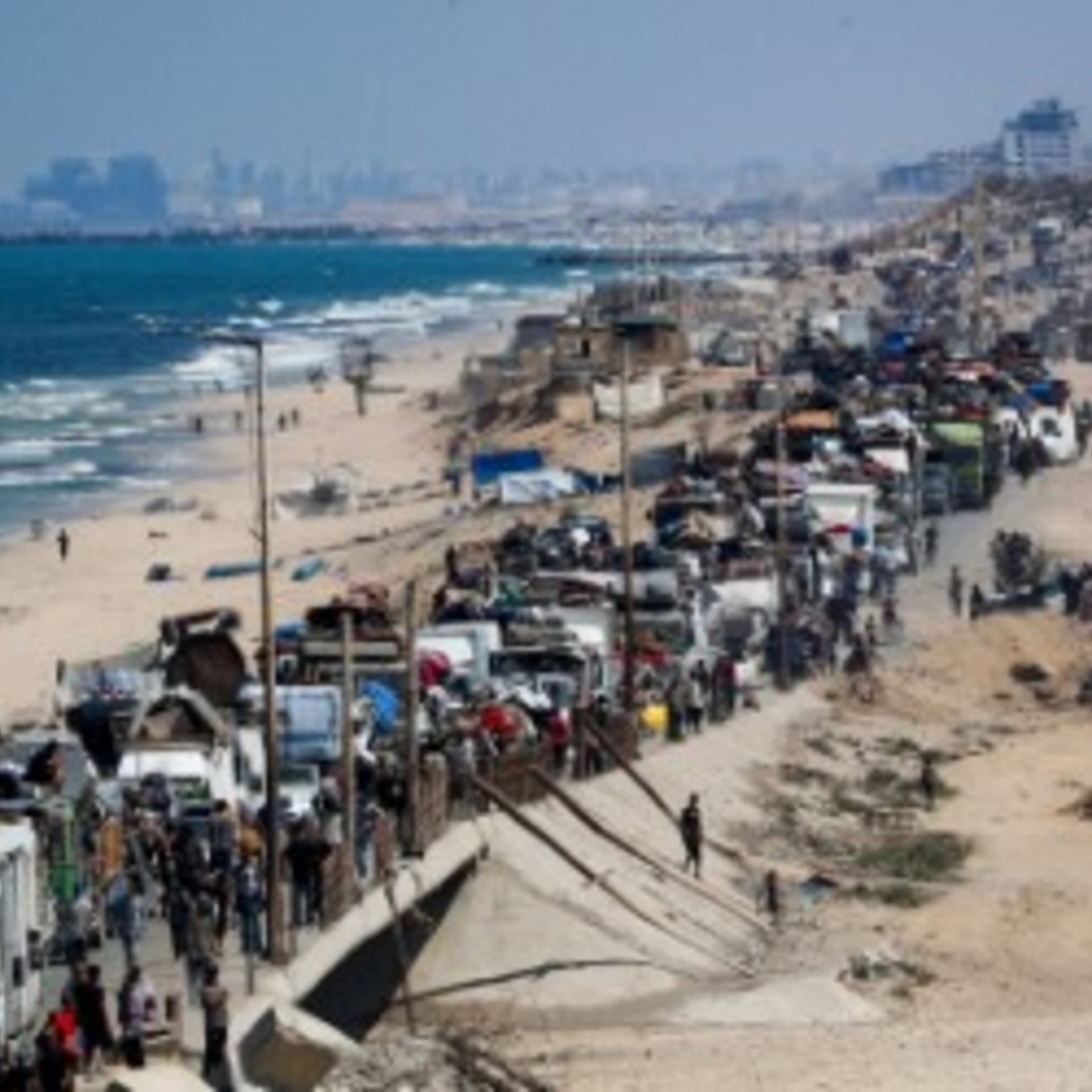
Image: Displaced Palestinians evacuate Gaza City. Mahmoud Issa/ Reuters