
In short
The BBC’s “The Global Story” examines the Aug. 26 Nepal floods/glacial collapse in the Himalayas and how international coverage can shift from information to spectacle. It describes a glacial ice chunk breaking off, triggering ice/rock avalanche and a sudden river surge; about 900+ confirmed dead and ~4,000 missing, including trapped workers in tunnels and hundreds of foreign pilgrims/trekkers.
Guest backgrounds
Anup Kafle, Nepali-American journalist; spent ~20 years covering major foreign disasters for U.S. outlets including The Washington Post, The Atlantic, and BuzzFeed; recently returned to Kathmandu as group editorial director of Kantipur Media Group.
Key claims
Locals first needed practical updates and loved-ones’ status, then accountability (rescue/relief pace; whether international rescue was blocked). Foreign headlines often emphasize foreigners missing (e.g., Everest-linked coverage) rather than Nepalis. Attention helps short-term aid, but sustained engagement is needed for climate injustice and preparedness.
Notable examples
CCTV footage of the Nepal–Tibet border crossing torrent; mention of the 2015 earthquake-era India border blockade; tourism lifeline regions (Langtang, Gosainkunda, Kailash trek) and the likely hit to September–October tourism.
Written by AI. May contain mistakes. Listen to the episode to check what was said.
Chapters
Tap a time to open that second in VONepal's Catastrophic Floods Overview
0:57 to 1:28
Details surrounding the catastrophic floods in Nepal and their impact.
“But honestly, it's even worse when you buy business software.”
Nepal's Catastrophic Floods Overview
1:31 to 3:08
Details surrounding the catastrophic floods in Nepal and their impact.
“It's been nearly a week since we saw those shocking images of catastrophic floods in Nepal.”
Insights from Journalist Anup Kufling
3:08 to 4:13
Interview with Anup Kufling about covering the floods in Nepal.
“And today on The Global Story, we hear from the Nepali-American journalist Anup Kufling, who spent two decades covering big foreign stories for American newsrooms like The Washington Post.”
The Human Cost of the Floods
4:13 to 6:05
Personal accounts and the human tragedy behind the floods.
“I think the initial reaction was honestly like Nepalese are used to news about floods and landslide.”
Shocking Footage and Public Reaction
6:05 to 7:30
Discussion on the viral footage of the floods and its global impact.
“You know, so many of us learned about the scope of this disaster by seeing this dramatic footage online.”
Differences in Coverage
7:30 to 9:18
Exploration of how local and international media cover the disaster.
“And I guess by evening, when we saw satellite images that essentially showed that the whole place was copper, like there is nothing there right now.”
The Need for Sustained Attention
9:18 to 14:00
Discussion on the importance of long-term international attention for Nepal.
“And so they want both information and they want accountability, you're saying.”
Sustained Interest in Nepal Post-Disaster
14:00 to 15:53
The importance of ongoing attention to Nepal's challenges beyond immediate disaster response is discussed.
“I mean, the attention during moments like this is helpful, right?”
Climate Change and Its Challenges in Nepal
16:02 to 20:20
Exploring how glacial collapse and climate change impact Nepal's vulnerability to disasters.
“You mentioned this glacial collapse term a moment ago, and I do want to ask you about that because it strikes me that this story is not just a story of a natural disaster.”
Political Geography and Disaster Response
20:20 to 24:49
The interplay of Nepal's political geography and disaster response capabilities is examined.
“A really good example is when the 2015 earthquake happened.”
Show all 13 chapters
Impact of Natural Disasters on Tourism
24:49 to 27:36
The significant effects of recent disasters on Nepal's tourism sector and economy are highlighted.
“So the question now is who will lead Nepal.”
Optimism in Journalism Amid Crisis
27:36 to 28:00
The editorial director shares insights on journalism's role and the hope for Nepal's recovery following recent disasters.
“I've come here as a foreign correspondent about half a dozen times, you know, when I was living in America.”
Listener Engagement and Upcoming Topics
28:14 to 29:10
Discussion on listener questions and upcoming episodes related to international trade.
“Anup recently moved back to Nepal after spending some two decades covering foreign stories for Western news outlets, including The Washington Post, The Atlantic, and BuzzFeed.”
Transcript
Automatic transcript. May contain errors.0:00This BBC podcast is supported by ads outside the UK.
0:30most to investors, including policy initiatives for retirement savings, taxes and trade, inflation concerns, the Federal Reserve, and how regulatory developments can affect companies, sectors, and even the entire market. Mike and his guests offer their perspective on how policy changes could affect what you do with your portfolio. Download the latest episode and follow at schwab.com slash Washington Wise or wherever you listen. Imagine buying a toy for your kid, but it doesn't come with batteries. That sucks. But honestly, it's even worse when you buy business software. You end up with fragmented, disconnected systems that cost a fortune and don't talk to each other.
1:12Odoo completely changes that. Odoo comes fully complete, with all your business apps perfectly integrated and working together seamlessly. It's everything your business needs in one place, saving you time, headaches, and serious money. Stop paying for missing pieces. Go to odoo.com. That's O-D-O-O dot com to learn more.
1:35Anup Kaphle:It's been nearly a week since we saw those shocking images of catastrophic floods in Nepal. So powerful, they swept away buildings, vehicles, entire villages in their path. The story begins on the morning of August 26th, in the mountains of the Himalayas, where the ground shook so violently that seismic instruments initially registered an earthquake. But it was no earthquake. It was a glacial collapse. A huge chunk of ice likely snapped off, falling to the valley below. Glasses broke away, causing an avalanche of ice and rock. Unleashing a torrent of water, a sudden surge in the river. Scientists believe this collapse began more than five kilometers above sea level, and the rock and ice fell almost a kilometer straight down into the valley.
2:29Anup Kaphle:In total, roughly 4 ,000 people remain missing. Over 900 have been confirmed dead. Rescuers have been in a race against time to find workers trapped in tunnels. Family members in Nepal and beyond are waiting to hear from their loved ones. Hundreds of pilgrims, trekkers, many of them foreigners, are among the missing. And that has left me and others with a question about which stories we pay attention to in the aftermath of such a massive tragedy in another part of the world. From the BBC, I'm Asma Khalid in Washington, D.C. And today on The Global Story, we hear from the Nepali-American journalist Anup Kufling, who spent two decades covering big foreign stories for American newsrooms like The Washington Post.
3:20Anup Kaphle:Now he's back in Nepal, covering the story of these floods in his own backyard, and confronting a difficult question. When does coverage of a natural disaster cross from rightful global concern into a possible spectacle?
3:42Anup Kaphle:So the reason I wanted to hear from Anup is that I know he's Nepali, born and raised there, And he's also worked for some of the most prominent American media organizations over the years, shepherding how they report on big foreign stories like earthquakes and floods. And so it struck me that he has a really unusual perspective, a foot in multiple worlds. Recently, Anup moved home to Kathmandu to work as the group editorial director of the Kantepor Media Group, one of the largest media organizations in Nepal. And it was there at his office that he first heard the initial reports of flooding. I think the initial reaction was honestly like Nepalese are used to news about floods and landslide.
4:24This is monsoon here. And for the last several years, we've had extended monsoons. Usually you think May, June, July, right? Those are the typical monsoon months. But for the last several years, monsoons extended as far as October. And especially during late August, September, we've had roads completely destroyed. So I think for most people who were looking at it from the city, from Kathmandu, it was just another bad flooding. So Nuwakot, which is one of the places that is hit, is about four to five hours by road. Last year, the same area actually flooded. So the first sense was, well, this is another kind of bad flood.
5:05But soon it was starting to become evident that this was bigger than anything else because we started seeing images on social media.
5:17A horrific scene captured on CCTV in Tibet.
5:24I think within hours we realised that we actually had to start taking this seriously and figure out how to deploy reporters on the ground. A desperate escape at the main crossing for tourists and traffic between China and Nepal. I saw around nine trucks being swept away by the floods, including people. It's a heartbreaking incident. I've been teaching here for 18 years and I've never seen anything like this here before.
5:56My family members were swept away by the flood in front of my eyes. My father, my mother, sister and her kids are all swept away. They could not escape the flood. There was no chance at all.
6:15You know, so many of us learned about the scope of this disaster by seeing this dramatic footage online. It was this powerful torrent of water through one of the main border crossings between Nepal and Tibet. And I'm just describing this here for folks who perhaps have not seen this footage. It is surreal. It is unlike anything I have seen. You just see this powerful current of water and everything in its path is destroyed by this wall of water. I'm curious how this video shaped the intensity with which people are reacting to this around the world. Oftentimes we here at the BBC, we cover earthquakes, natural disasters, and you hear of death tolls.
6:58This is a video that I think shows the intensity of this all in a way that I have never at least seen before. And, you know, to be quite honest, when one of our colleagues first showed me that video, I said, that looks like AI, right? It felt unreal because the image of that border crossing is on every Nepalese mind. You know, at least since the 2015 earthquake, that border point has remained crucial, a trade artery between the two countries. You know, in a matter of hours, obviously, we realized that it was real. And I guess by evening, when we saw satellite images that essentially showed that the whole place was copper, like there is nothing there right now.
7:40But that image is now etched in everybody's mind. Anup, we wanted to have you on our show because you've spent a lot of time overseeing coverage of big international disasters akin to this from the vantage point of American newsrooms. How is it different to manage the coverage of this huge foreign story now from home, from within? When you're covering this for an international audience, there is a degree of separation where you're trying to explain what the Himalayas is, right? Like, you know, you have to invoke Everest and you have to invoke distance from one city to another. And I think that is just the nature of how international reporting is done.
8:27But people here are mostly seeking information. They're trying to figure out, you know, what is the government doing? What is the status of relief? How many people have been found? Can we synthesize this information from authorities and bring it to people? And I think starting today, I have seen a lot of local publications as well slowly start to transition into stories about accountability, right? Like what comes next, right? Is the pace of rescue and relief working? Did the government take the right steps immediately after in terms of deciding to use their own security forces and not allow international rescue workers, for example.
9:08So we are really trying to cater to a local audience that is just hungry for information, desperate to find out what is the status of their loved ones. And so they want both information and they want accountability, you're saying. Yes. I think like, you know, for international publications, I used to be very disenchanted with the way my home country was covered for the longest time because I've watched international publications cover the political instability over the years. You know, we talk about this in our media circle in D.C. and New York. Like how many people have to die for it to be an international story?
9:46You were alluding to this a moment ago, and you know this well from all your years of covering foreign stories through the vantage point here of an American news outlet. But when big stories happen abroad, whether we're talking about war or earthquakes or floods like this in Nepal, our instinct as Americans is to try to humanize the tragedy by looking for the American connection. Officials say two Americans have been rescued after a giant mudslide and severe flooding in Nepal. Rescue teams are searching for victims, including 63 missing Americans. It's the story of the missing Americans that we largely keep hearing about here.
10:26Hundreds are now missing, including nearly 300 foreign tourists. Nepal officials say dozens of Americans among them. Crews are urgently searching for survivors. The American embassy is working to locate the Americans who may have been there. I'm curious how you see this all now as a journalist back in Nepal, because you have that juxtaposition of knowing how it's often covered here and now desiring to tell a different narrative, it seems. For most international media, like if you look at the headlines, for example, right, massive landslide or floods devastates Nepal, comma, 500 plus foreigners missing, or 38 Australians missing, or 200 something Indians missing.
11:10And I think like, you know, a lot of locals here who have witnessed international correspondence on the fields right now, they feel like their stories are being manipulated because what they really want to talk about is where am I missing people? Right. Where are my fellow citizens in countrymen? Yeah. I watched a lot of newsrooms focus largely on Everest because that's where the 12, 13 foreigners had died. And there was significant emphasis on covering those missing foreigners in Everest, the climbers and the trekkers. But that's part of the story of Nepal, because until a few days ago, I think there were 500 plus foreigners missing because this area is, again, home to incredible landscape.
11:56landscape. So you have a lot of pilgrims who go to Mount Kailash through the Nepal border, as well as trekkers who during this time of the year, like, you know, visit the country. And I think the stories end up becoming largely about international folks. I, you know, I was using this term with a friend earlier this morning, a symmetry of visibility, right? What we were discussing was foreign coverage for the last several days here has largely followed this whole glacial collapse as a spectacle. I don't mean that in a bad way, but it is a massive story, right? It is the biggest story in the world right now.
12:35And I've seen things like this when, you know, those kids were lost inside the caves in Thailand. Like there is wall-to-wall coverage when natural disasters happen, because audiences are glued to finding out like what's going to happen next. And, you know, we see a similar pattern kind of developing here. You know, we talk a lot here in the United States about the attention economy. I feel like that phrase is in a lot of places. And right now we do see a lot of attention on Nepal. But what does attention, in your view, really substantively do for Nepal? I mean, can the eyes of the West really prevent another tragedy like this?
13:18And I will say I'm asking this in part because this conversation that we are having is happening at a moment when the United States has substantively pulled back its humanitarian aid commitments broadly across the world. Yeah. I mean, you know, the other day when a number of countries were announcing help for Nepal, the numbers started coming in. Sri Lanka was doing$1 million and another country was doing 2.5, the EU announced something. And then there was a statement from a State Department official that said the U.S. was providing$500 ,000 in relief and everybody responded to that. And I think like, you know, there was a reason for that.
13:56It was the initial trends. And I think yesterday, today, they've announced another$2.5 million. I mean, the attention during moments like this is helpful, right? But I think as we discussed earlier, like, you know, what happens after this whole thing is gone? In a month's time, we'll have a final estimate of what the disaster looks like, how much money is required for reconstruction, and then Nepalese start the long haul. I think, and I say this as a Nepali American citizen that was born and raised here, I think what Nepalese would appreciate is a sustained interest in the country, right? Partly when it comes to things like climate change.
14:47Nepal actually barely registers on global emission charts. This is something people have been talking about on social media for the last several days. but it sits on the front line of all of the consequences of climate change when you think about it, especially mountains, glaciers. If you think about climate injustice as a term, I think Nepal sits on the front row of what climate injustice is. And people want sustained engagement, sustained attention. That probably helps solve some of these issues.
15:52We'll be right back. You know it. And fans ready to add John Deere certified pre-owned equipment and more options to their lineup can shop at machinefinder.com. Booyah!
16:26You mentioned this glacial collapse term a moment ago, and I do want to ask you about that because it strikes me that this story is not just a story of a natural disaster. It also speaks to fears of global warming, of climate change. Was something like this at this scope ever expected in Nepal? I don't think something like this was on anybody's mind. But there were a few places that had been ringing alarm bells because Nepal, particularly when you think about earthquakes, Nepal sits on a very vulnerable geographic area. And we're also sort of, you know, sitting at the bed of these like, you know, glacial lakes.
17:10So Isseemode, which has been doing a lot of work on the integrated mountain geography, when you look at these reports, you say, okay, well, it is happening. You know, it's 50 years away, right? Like you look at the level of the glaciers arising and you measure it in terms of meters and they become science stories. Not a lot of local language media have been focusing on the climate change story. So I don't think climate change is something that people discuss here. and they would have to sort of like, you know, start thinking about, okay, like, well, it's here, right? It's not about 50 years or 100 years.
17:47It's actually here now. Do you feel like you have some sort of responsibility to try to convey the science or the sense of what might be happening to help people prepare for this potentially happening again in the future? You're saying climate change is not something that many people think about and discuss it all in the local press. I think there is. And this has been one of the biggest gaps, you know, in terms of what media focuses on in Nepal. You know, a lot of the publications, including ours, have largely focused on politics, right, and general news. This past weekend, I was just trying to look at like, you know, what does, you know, what does the past 10 years of climate change coverage look like in various Nepali media?
18:29The one publication that has consistently tried to focus on this is Nepali Times, which is an English weekly with a focused smaller audiences, right? The people who really need this information are the large segment of the population only speaks in Nepali. And a lot of the Nepali language media don't have climate change desks. I mean, they don't have environment desks. When I came back last month, we hired our first environment climate change reporter. But I think there is a need to explain this to Nepalese in a language that they understand. So they feel prepared. You had mentioned that Nepal is in a sort of vulnerable geographic region.
19:11And we should explain just for people who aren't familiar with the geography. Nepal is at the base of the Himalayas, right? It is a landlocked country sandwiched between two other major countries that don't always get along, India and China. And I'm putting that mildly there. But does that affect the vulnerability of this situation, the political geography in which it sits in as well? Absolutely. Because Nepal's ability to respond, right? And Nepal's ability to prepare, Nepal's ability to recover, all of these rely on our two neighbors, India and China. There is no access to a port. The dry ports, the border with China, are vulnerable to events like this past week.
20:03And depending on which government, which administration is in power and what is their relationship with New Delhi or Beijing, our ability to engage with them and get the help that we need really, really differs. This is the moment the earthquake struck. A really good example is when the 2015 earthquake happened. You can hear the terror of those in this building. Earthquakes of this high 7.9 magnitude are rare. This is the worst to hit this Himalayan nation in over 80 years. So far, more than 100 fatalities have been reported. Right after the earthquake, there was a blockade imposed on the southern border with India.
20:45Along their border with Nepal, a month-long agitation has crippled normal routine. Trucks have been stranded for days and the town market has seen better days as well. India never really called it a blockade, but basically nothing came into Nepal. And this was right after the earthquake. But reports at the time said it was because of political differences and how Nepal was handling an amendment to the constitution. But it was real. people had a hard time finding fuel to prepare food. Nothing came in. And that was kind of man-made. You know, I said this to my friend the other day. I feel like Nepal goes through, you need alternates between disasters.
21:30One is man-made when you look at the blockade, right? Or the political instability. And then the other is the natural disasters. Like we've had this massive flood. Like I remember when I was like 10 or 12, Then we had that earthquake and COVID kind of like, you know, set the country back by a decade. And we had that Gen Z protests last year, the two days of like, you know, violence that nobody kind of imagined. And everybody looked forward to a new Nepal for a better term, right? We had a really successful elections, a young government that is ambitious and clean with all the right intentions.
22:12And people are really looking forward to what Nepal could become. And now this, as one of the one of the members of parliament said, I think this is set back Nepal by another decade again. You had mentioned this earlier when you were speaking about some of the pilgrims or the trekkers who are missing. just how significant tourism is to Nepal and Nepal's economy. How worried are people there locally that this is the beginning of more and more deadly floods and what that could mean for the local population, what it could mean for the tourism sector as well? Tourism is a lifeline for especially the kind of geographies that this area was impacted by.
22:50This region is home to Langtang and Gosai Kunda and obviously the trekking route to Kailas. So a lot of Indian pilgrims particularly visit this region. And then in the fall, so September, October, a lot of hikers and trekkers come to the region. This area was once decimated during the 2015 earthquake. So they've been like gradually rebuilt with more concrete, stronger buildings. And I think now they're all kind of swept away. A few days ago, the private tourism body essentially released a statement and said that this was going to have a major impact. You know, last year, there was no tourism in the country because in September, Gen Z protests happened.
23:34This is not an ordinary political protest. Which began as a response to the government's social media ban. The government had decided to ban a number of social media platforms because Meta and TikTok and a number of other platforms had not registered in Nepal. And that quickly led to a popular sort of like, you know, movement against corruption, nepotism. Protest anger has extended online to videos mocking so-called Nepo kids, the entitled children of officials. And we saw people take to the streets. The authorities responded. Dozens of people were killed. And the following day, I mean, all hell broke loose.
24:17Protesters vandalized the homes of some of the country's politicians and set fire to some government buildings here. The prime minister had to be evacuated. Several politicians escaped from the places they were living in. Grief and anger at the funerals of those shot dead. In the crackdown by authorities, more than 70 protesters were killed. A statement signed by Prime Minister Oli states that he's resigned to pave the way for a constitutional solution to the current crisis. So the question now is who will lead Nepal.
24:56We had an interim government. Fast forward in six months, we have a new government, right? So essentially lost the tourist season, right? And then in April, May, that's really kind of in Nepal, it's the Everest season. So a lot of climbers come, but particularly with the goal of climbing Mount Everest, that's the window to climb Everest. So the peak tourist season in Nepal is September, October, maybe like, you know, late October, November. So now for a second year in a row, we're not going to have the kind of tourism that people had been hoping would make up for last year. When you came, as you said, there was this new government, a prime minister who those of us may know of, one of his credentials is that he's a rapper, I believe, right?
25:43I mean, that's sort of like the claim to fame we all hear. He's a rapper, but his supporters want to remind Mind you that he's also a structural engineer, which he is. Very balanced. But yeah, so that is, he came in a really sort of fresh face in Nepal. And now here you are, well, it's just a month after you moved back and you're overseeing this coverage of a really devastating situation of which, you know, as you say, the scope of it is not fully known. There are many questions around accountability and alert systems, right, as well, and what could be done in the future. do you feel as optimistic as when you first moved here?
Read the full transcript
26:23I actually do. Really? I mean, I do because, yes, I do because I live here. You know, I drop my daughter off at the school every morning. I come to the office. It's been crazy for the past several days. Like I have not slept weekends, days. I have been increasingly editing in Nepali, which I didn't think I had it in me after all these years of working in English journalism. But also to be able to see, you know, what we were able to do in this newsroom. You know, we immediately deployed five reporters, for example. They were out there. And one of the reporters whose stories now actually like, you know, gone viral is one of the reporters who had to witness his village get completely destroyed by the floods.
27:04And seeing, you know, seeing how dedicated they are, how much they actually want to help readers, it's given me a lot of hope. And, you know, there was a brief point where I felt like I have my work cut out for me, obviously. But we've been already, like, you know, working on training, editing, building resources.
27:28I think, you know, this is a great place to be a journalist, particularly because it's home. And there are so many stories here. I've come here as a foreign correspondent about half a dozen times, you know, when I was living in America. and to be able to do this here for my own people, being part of a newsroom that is Nepalese, I'm incredibly optimistic.
27:58On that note, Anup, thank you so much for joining us on The Global Story. We really appreciate it. Thank you so much for having me.
28:13Anup Kaphle:That was Anup Kafle, editorial director of Kontipur Media Group in Nepal. Anup recently moved back to Nepal after spending some two decades covering foreign stories for Western news outlets, including The Washington Post, The Atlantic, and BuzzFeed. As a reminder, if you all have any questions or story ideas for us, we always appreciate hearing from listeners. You can send us a note at our email address, theglobalstory at bbc.com. We received a message the other day from Terry, who writes in, I'd like to understand more about whether trade could come to be dominated by renminbi, referring to the Chinese currency.
28:51Anup Kaphle:Terry adds that the U.S. has had an advantage because so much international trade goes via its banking system and is dominated by U.S. dollars. Well, good news, Terry. We are working on an episode about the U.S. dollar and how it came to be the reserve currency of the world and whether those days might in fact be numbered. As always, you loyal listeners of our show know that The Global Story tries to dive deep every weekday on one big story about where the world and America intersect. If you're also looking for a way to catch up on the latest news headlines, then we recommend checking out our sister show, The Global News Podcast.
29:26Anup Kaphle:Our episode today was produced by Zandra Ellen. It was mixed by Travis Evans. Our executive producer was Martine Powers. Our senior news editor is Chyna Collins. And I'm Asma Khalid. Thanks, as always, for spending some time with us. We'll be back again tomorrow.
30:08ad free with an Amazon Music subscription.
From the publisher
As the world watches the aftermath of devastating floods in Nepal, journalist Anup Kaphle has been asking a difficult question: When does coverage of a natural disaster cross from rightful global concern into spectacle?
Kaphle is the group editorial director of Kantipur Media Group, Nepal’s largest media organisation. He’s also a native of Nepal. After more than two decades working for American newsrooms, he returned to his home country with a mission to help tell Nepal’s story for the people who live there. Now, he finds himself confronting one of the greatest challenges of his career: helping Nepalis understand the full scale of the flooding and its impact on their lives, at a moment when international attention is focused on the most dramatic accounts.
Asma Khalid, co-host of The Global Story, speaks with Kaphle about the ongoing humanitarian efforts, the potential long-term impact of the disaster on Nepalis, and why he worries that the international community will soon turn its attention away from Nepal.
Producer: Xandra Ellin
Mix: Travis Evans
Editor: Martine Powers
Senior news editor: China Collins
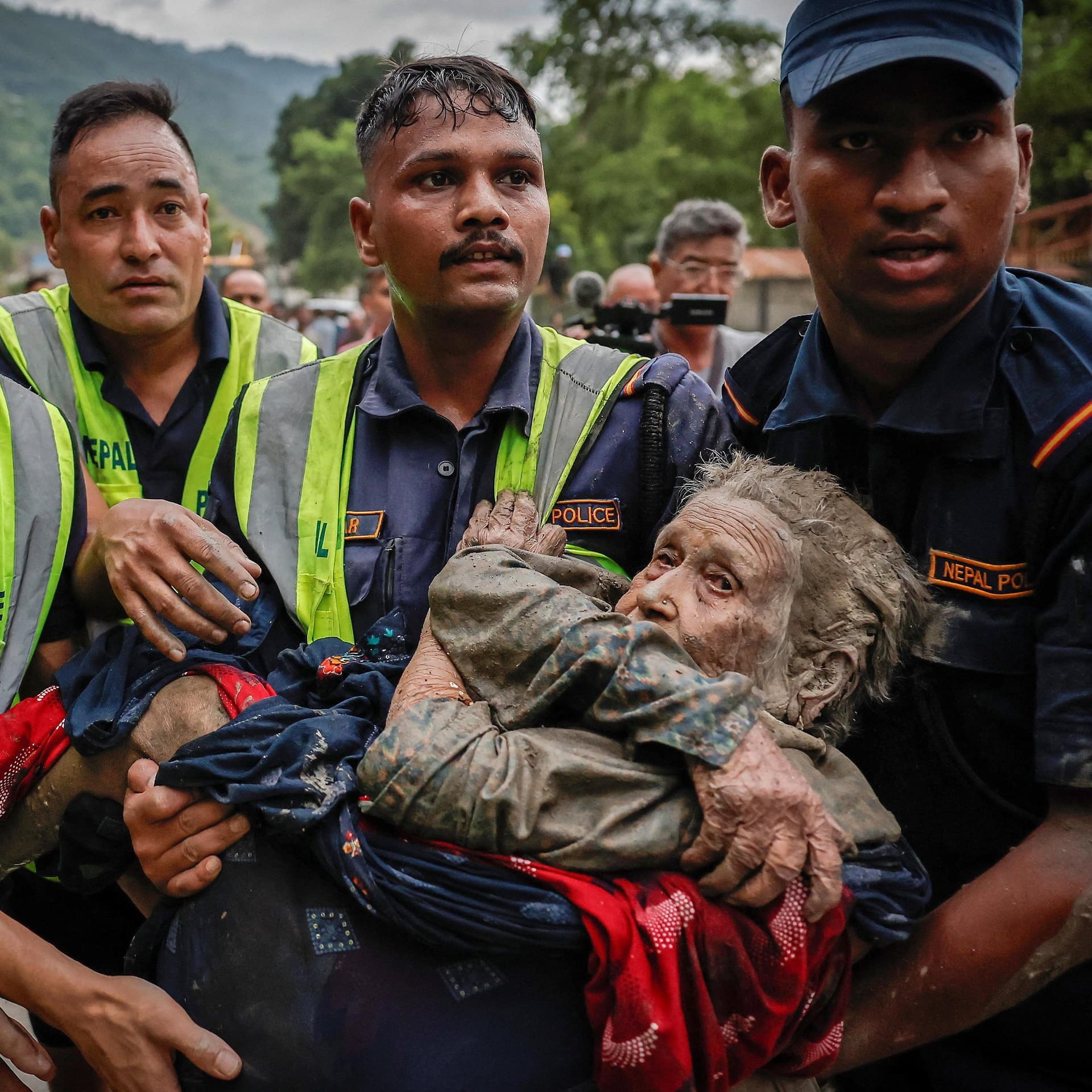
Photo: Police officers carry a survivor after a flash flood at Trishuli in Nuwakot district, Nepal, August 26, 2026. Credit: Navesh Chitrakar/Reuters.