
In short
Post-war plans for Gaza—two competing visions: a Trump “Riviera of the Middle East” redevelopment that would displace Palestinians, versus European/ally moves toward unilateral Palestinian state recognition at the UN.
Guests
Jeremy Bowen, BBC international editor; covered Middle East conflicts for ~40 years, including extensive reporting in Israel/occupied territories and Gaza.
Key claims
A leaked 38-page Washington Post report describes a 10-year plan to encourage Palestinians to leave Gaza via cash (about $5,000), rent support, food vouchers, and “digital tags” for future apartments; those who stay would be in supervised/secured areas likened to internment. Bowen argues the full plan is unlikely due to Saudi opposition but may still influence policy. He says UN visa denials aim to pressure the Palestinian Authority to abandon two-state/self-determination.
Notable examples
White House closed-door meeting with Trump, Tony Blair, and Steve Witkoff; February Oval Office meeting with Netanyahu; France/UK/Canada/Australia pledges to recognize Palestine; Netanyahu/ Rubio condemn the move; Israeli settlement expansion framed as burying a Palestinian state.
Written by AI. May contain mistakes. Listen to the episode to check what was said.
Chapters
Tap a time to open that second in VOOverview of the Riviera Plan
1:23 to 2:36
Discussion about the Trump administration's vision for Gaza as a tourist resort.
“Jeremy Bowen is the international editor of the BBC, and there's a reason why we're having him as our first guest.”
Trump's Vision and Historical Context
2:36 to 4:12
Jeremy Bowen outlines Trump's perspective on the potential of Gaza and its historical significance.
“And the Riviera plan was an idea that surfaced earlier on this year.”
Reactions to the Riviera Plan
4:12 to 6:28
Exploration of Israeli reactions and implications of the proposed plan.
“In Gaza's waterfront property, it could be very valuable to, if people would focus on kind of building up, you know, livelihoods.”
Challenges and Realities of Implementation
6:28 to 9:26
Analysis of the hurdles in executing the Riviera plan and its viability.
“plan and say, no, the sort of long-term resettlement of Palestinians is not part of it.”
Emergence of European Plans for Gaza
9:26 to 11:11
Introduction to Europe’s contrasting vision for Gaza, focusing on Palestinian statehood.
“and what it wants for Gaza, the whole Gaza-Riviera thing.”
Symbolism of Recognition of Palestine
11:11 to 13:50
Discussion on the implications of European nations recognizing Palestine as a state.
“And at this meeting, some of these countries intend to unilaterally recognize a Palestinian state for the first time.”
U.S. Influence Over Palestinian Recognition
13:50 to 14:00
Analysis of U.S. dominance in the peace process and its effects on Palestinian statehood.
“They're not helping because, A, their statement isn't going to change anything other than it encourages and rewards Hamas, who now has every reason in the world not to agree to cease fire.”
U.S. Power Over Palestinian Statehood
14:00 to 14:36
Discussion on the U.S. stance regarding the recognition of a Palestinian state.
“recognition of a Palestinian state means.”
Visa Denials for Palestinian Officials
14:36 to 15:15
Exploration of the implications of the U.S. denying visas to Palestinian officials.
“And this has really been out of the question in the U.S.”
Historical Context of UN Access
15:15 to 17:27
A look at historical precedents regarding UN access for controversial leaders.
“State Department announced it would deny visas for a number of Palestinian officials ahead of the assembly meeting.”
Show all 13 chapters
Impacts of Excluding Palestinian Representation
17:27 to 20:14
Discussion on the motivations and consequences of barring Palestinian officials.
“What do you think they're trying to achieve by barring Palestinians from attending now?”
Settlement Expansion in Response to Statehood Recognition
20:14 to 23:02
Analysis of how recognition from other countries might affect Israeli settlement policies.
“Britain is a steadfast ally, has been, of Israel throughout its history.”
The Potential for Ongoing Conflict
23:02 to 26:05
Insights into the future of Israeli-Palestinian relations and the likelihood of continued violence.
“From your vantage point, Jeremy, where do you see this all actually ending?”
Transcript
Automatic transcript. May contain errors.0:00Last week, there was a closed-door meeting in the White House to discuss what should happen when the war in Gaza ends. We don't know much about the meeting, but we do know that the American president was there, the former British prime minister Tony Blair was there, and of course, Trump's special envoy, Steve Witkoff. It's a very comprehensive plan we're putting together on the next day that I think many people are going to be, they're going to see how robust it is and how well-meaning it is. And it reflects President Trump's humanitarian motives here. And then just a couple of days ago, new details emerged, implying that they were resurrecting a plan that had fallen out of the headlines.
0:45According to a new Washington Post report, the Trump administration and international partners want to build, quote, the Riviera of the Middle East. A 38-page plan to move all 2 million Palestinians from the Gaza Strip. Transforming the enclave into a tourism resort and high-tech manufacturing and technology hub. Putting the U.S. in direct conflict with the rest of the Western world.
1:13From the BBC, I'm Tristan Redman. And I'm Asma Khalid. Today on The Global Story, two competing visions for the future in Gaza and where, realistically, this war ends.
1:32I think I might have seen Mr. Bowen walk past the window. Oh, really? There's Mr. Bowen. Hello. Hello. Asma, very nice to meet you. My pleasure. Hi, Jeremy. I'm Tristan. Jeremy Bowen is the international editor of the BBC, and there's a reason why we're having him as our first guest. He's a total legend here. He's covered almost every major conflict in the world for the last 40 years, particularly in the Middle East. And someone on our team actually described him as kind of like a David Attenborough of news.
2:03Jeremy Bowen:Well, that's a rare honor, and I'm very happy and pleased to have been invited. Are you nervous to be on the first episode of The Global Story? I'm excited. Do you have any advice for us? Keep it interesting. Keep it accurate. If you keep to those rules, you'll be okay. All right, we'll try. We'll try our best. So we want to begin by having you walk us through these two competing visions. And I want to start with the Americans. What is your understanding of what the Trump administration wants to see happen in Gaza? There are clues. There's no hard plan, but there is talk that isn't really going away about Donald Trump's so-called Riviera plan.
2:44And the Riviera plan was an idea that surfaced earlier on this year. I remember. February.
2:53Jeremy Bowen:So back in February, I just left Jerusalem actually after a three, four week reporting stint there. And I was on my way to Ukraine, which Donald Trump was about to turn his attentions to with that notorious meeting with Zelensky in the Oval Office. But an earlier meeting, beginning of February in the Oval Office, was with Netanyahu. Yes, his first invited visitor to the White House. Today I'm delighted to welcome Israeli Prime Minister Benjamin Netanyahu back to the White House. Which Netanyahu is very, very pleased about. I'm honoured that you invited me to be the first foreign leader to visit the White House in your second term.
3:32You are the greatest friend Israel has ever had in the White House. It was a mixed meeting for Netanyahu because he didn't like talk of negotiations with Iran.
3:44Jeremy Bowen:But then Trump came out with this idea. I envision the world, people living there, the world's people. I think you'll make that into an international, unbelievable place. I think the potential in the Gaza Strip is unbelievable. That the U.S. could take over. You know, he's an experienced real estate developer. And I don't want to be cute. I don't want to be a wise guy. but the Riviera of the Middle East, this could be something that could be so magnificent. They were light on detail about the way it was, but it came actually after, almost a year before that, Trump's son-in-law, Jared Kushner, who's also in the real estate business and had been his main advisor in his first term, Trump's main advisor, he said then, he talked about the extraordinary potential in a real estate sense of the Gaza coastline.
4:40In Gaza's waterfront property, it could be very valuable to, if people would focus on kind of building up, you know, livelihoods. You think about all the money that's gone into this tunnel network and into all the munitions. If that would have gone into education or innovation, what could have been done?
4:54Jeremy Bowen:The stretch of the Mediterranean, nearly 30 miles long, sandy beaches, beautiful weather. You can imagine what it could become. Are people in Israel seriously talking about that possibility, about hosting Gazan refugees in what is considered, quote unquote, Israel proper? I don't know. But that would be something you would try to work on. I'm sitting in Miami Beach right now and I'm looking at this situation and I'm just thinking what would I do if I was there. Can you remember what your reaction was when you first heard about this plan? I thought it would really excite the Israeli hard right.
5:30Jeremy Bowen:How so? Well, because in the previous months I'd done a fair amount of reporting with the settlers who are now in Israel and in the occupied Palestinian territory of the West Bank. I've been talking to these people who were really pushing, saying, we need to get back into Gaza and we have support in the government. We need to be back in there. So even in Israel, most people thought this is just not going to happen. But then when you hear the president of the United States talking about scenarios where the Palestinians get moved out, that was always going to send. So my first thought was, wow, the Israeli hard right, they're going to love this and they're going to run with it.
6:13I know initially it sounded like the vision of this plan would expel all the Palestinians, which obviously runs counter to all sorts of regulations around international law. But then you heard the Secretary of State, Marco Rubio, who tried to walk back aspects of this plan and say, no, the sort of long-term resettlement of Palestinians is not part of it. What is your understanding of where the reality of this American plan stands at this moment?
6:40Jeremy Bowen:Well, the answer is I don't know because there are different signals that come out. But what we've seen in the last few days is a leak of a document to the Washington Post, a 38-page dossier where they go into some detail about the way that this is going to work with over a 10-year period, Palestinians being given a small amount of money to try and encourage them to leave. The idea is that, first of all, there will be an encouragement of voluntary in very large, I'd say inverted commas, voluntary emigration out of Gaza, because, you know, the argument is it's hardly voluntary if you flatten the place, destroy their homes and kill more than 60 ,000 people.
7:14Jeremy Bowen:That probably counts more as fleeing. The report in the Washington Post said that there would be incentives for people to leave. They would get a cash payment. I think $5 ,000 was mentioned. $5 ,000? Yeah, it's not a great deal, is it? They would also go maybe get some support with rent. There would be free food for a year. I don't know quite how they do that. Maybe it would be vouchers in the places they were going to. Property owners would be given some sort of digital tag, which would give them the right in the future to get an apartment in one of the new developments. Those Palestinians who decided that they would stay, according to these reports, while this redevelopment goes on, would stay in a secured area, a supervised area, which to my mind sounds a bit like an internment camp.
8:10Jeremy Bowen:I mean, various incentives for them to either get out or to live very restricted lives inside Gaza for at least 10 years while this huge development took place. Look, this is not anointed, this is not certified White House policy, but it appears to be the kind of thing that they are talking about at the moment.
8:35Jeremy Bowen:The reason why removing Palestinians is such a big deal is their history. You go back to 1948, to what they call the Nakba, the catastrophe, the establishment of Israeli independence in the war, its war of independence in 1948. More than 700 ,000 Palestinians became refugees. They were either forced out or they fled. And they have never been allowed back, with a few tiny exceptions. They have never been allowed back. So the lesson that Palestinians have taken from their history is that if you leave, you don't get to come home. That's not going to happen, whatever people say.
9:18At this point, these are just kind of clues as to what the Trump administration might be proposing for the region and what it wants for Gaza, the whole Gaza-Riviera thing. But how possible is it that this might actually happen?
9:35Jeremy Bowen:My instinct is that the full-fat Riviera plan cannot happen because Donald Trump wants to retain good relations with Saudi Arabia. I cannot see a situation in which particularly the Saudis, particularly the crown prince, the de facto ruler of the country, Mohammed bin Salman, MBS. I don't see how he could ever accept anything like this. And that's something that really matters, I think, to Trump. So my instinct is that it will remain pie in the sky. But the idea doesn't go away. It keeps popping up again. So it appears to exist in some chamber of Donald Trump's mind. So since he's the president of the United States, you've got to continue to take a version of it, perhaps, seriously as a possibility.
10:31Coming up next, a radically different vision for the future of Gaza has emerged from leaders in Europe. It's a vision that is likely to collide with the Americans later this month in New York.
10:57So until now, we've been talking about what we know about the American vision for post-war Gaza. But there's a totally different approach because several of America's allies have been coalescing around a different plan. So next week, international diplomats start arriving in New York for the UN General Assembly. And at this meeting, some of these countries intend to unilaterally recognize a Palestinian state for the first time. I wonder if you can just walk me through how this other approach has come about.
11:29Jeremy Bowen:The French were talking to the British for a long time earlier this year. Lots of negotiations. I speak to diplomats. Both sides are actually blaming the other for moving a bit too slowly. A warm welcome to Newsday. The French moved first. In a major diplomatic development, France says it will officially recognise Palestine as a state, becoming the first G7 country to do so. putting pressure on the Brits, who then followed up pretty soon afterwards. It is with the hand of history on our shoulders that His Majesty's government therefore intends to recognise the state of Palestine when the UN General Assembly gathers in September here in New York.
12:20Canada intends to recognise the state of Palestine. at the 80th session of the United Nations. La Belgique va reconnaître publiquement urbi et urbi l 'état de Palestine. Today I can confirm that at the 80th session of the United Nations General Assembly in September, Australia will recognize the state of Palestine. OK, so we have Canada, Australia, France and the UK promising to recognize Palestine as a state in September. But what does it even mean to recognize Palestine as a state right now?
12:56Jeremy Bowen:On one level, it means nothing. Because there is no Palestinian state. There's no prospect of a Palestinian state. They haven't specified the borders of a future Palestinian state. But on another level, it's really significant because it's symbolic. Politics, diplomacy is often a game of symbols. And I think you can tell the significance, and I think it is significant, because of the vehemence of the Israeli and also the American reaction. Israel's Prime Minister Benjamin Netanyahu said Sakhir Starmer had rewarded Hamas's monstrous terrorism and punished its victims. European countries and Australia.
13:36Marching into that rabbit hole and buy this canard is disappointing. And I think it's actually shameful. Secretary of State Marco Rubio has also rejected Macron's plan, calling it a reckless decision. They're actually hurting the cause. They're not helping because, A, their statement isn't going to change anything other than it encourages and rewards Hamas, who now has every reason in the world not to agree to cease fire. When we first started talking about doing this episode, I was struck by how different the Brits on our team and the Americans on our team, because we are a transatlantic production team here, how we interpreted what this unilateral recognition of a Palestinian state means.
14:16because I've covered American politics for years. There is no world in which a Republican or a Democratic administration would unilaterally recognize a Palestinian state. You know, I mean, the talking point has always been peace first. And then maybe one day in the future, they'll talk about a Palestinian state. And so I guess I'm wondering, you know, what does any of this means if ultimately the U.S. holds all the power? And this has really been out of the question in the U.S.
14:43Jeremy Bowen:Well, in a way, the U.S. almost has veto power over the whole process. They've completely absorbed Israel's position. There's very hard to see any daylight between them. You look at the fact now that not only has the State Department announced that the Palestinian delegation will not be given visas to come to the General Assembly, they've also said now, I think, that individuals who have Palestinian passports and apply using their Palestinian papers would not get visas either. OK, so just to pause and explain that a bit. Last Friday, the U.S. State Department announced it would deny visas for a number of Palestinian officials ahead of the assembly meeting.
15:22A whole bunch of officials, including, importantly, the president of the Palestinian Authority, which means that none of those officials can actually attend these U.N. meetings.
15:33Jeremy Bowen:And one of the major reasons for this is because they are pushing for self-determination, i.e. the two-state solution. It's now for the Trump administration and the Marco Rubio State Department a reason to deny someone a visa to enter the United States. Can I just ask you a procedural question? I recall in years past, you'd have someone like the former president of Iran, Mahmoud Ahmadinejad, who came to the UN General Assembly, even though he was like persona non grata, and the U.S. did not have at all a friendly relationship with him. I don't fully understand. I thought that the UN had some sort of like special recognition.
16:11Jeremy Bowen:There was an agreement, a headquarters agreement that was signed back when I think was signed sometime in the early 50s or maybe even the late 40s when the decision was taken to make the permanent home of the United Nations in New York. and the idea was was that even if you didn't like countries you'd give them a visa to come in you know at the height of the cold war the general secretary of the communist party of the soviet union nik khrushchev was there using his shoe to bash on the podium at meetings and and having a big go at the west and gaddafi the same gaddafi i remember the big i've covered quite a lot of uh general assemblies and i remember the year that gaddafi came there was a great big row about where he pitches tent.
16:54Jeremy Bowen:I think in the end he found an estate in New Jersey. I actually thought this had never happened before, but then I was talking to my wife about this episode and she brought up this thing that in 1988, Yasser Arafat, the Palestinian leader, was actually prevented from going to New York for the UN General Assembly by the Reagan administration who revoked his visa saying that he had links to terrorism in some way. And in fact, the UN moved its meeting to Geneva in order to allow Yasser Arafat to attend. So it's not totally unprecedented, but it's obviously rare. What do you think they're trying to achieve by barring Palestinians from attending now?
17:36Jeremy Bowen:They want to put a lot of pressure on the Palestinians to tell the Palestinian Authority, which is the rival Palestinian organization to Hamas and was initially designed to be the building blocks of a state, which it has not become. Netanyahu said repeatedly they will have no part in any future in Gaza. The Arab states in their plans for the future, European countries as well, have all said it has to include the PA. Netanyahu is adamantly against it, And I think that he seems to have the ear of Donald Trump. Jeremy, when we get to the UN General Assembly later in September and France, the UK, Canada and Australia recognize a Palestinian state, what happens?
18:25Good question.
18:28Jeremy Bowen:On the face of it, in terms of what goes on, if anything, an uptick in the pace of the expansion of Jewish settlements in the West Bank. Can you explain why one would follow the other? Because they have used phrases, the Israeli government and the settler movement have used phrases along the lines of, you know, a correct Zionist response to these things is to expand the range of settlements.
18:56If you go through the West Bank, there are so many more Jewish settlements.
19:02Jeremy Bowen:Many more have been authorized.
19:09Jeremy Bowen:Members of the current Israeli cabinet have used phrases like, we're doing this to bury the prospect of a Palestinian state.
19:19Jeremy Bowen:Israel Katz, Defense Minister, Betzal El Smotrich. They showed on a map where they were going to start new settlements, and they explicitly said, we have positioned these settlements to make it as hard as we can for a Palestinian state to emerge.
19:42You're saying that when France, Canada, Australia and the UK go to New York and recognize Palestinian statehood, that in fact it will have the opposite effect on the ground than the one which is intended by the leaders of those countries. So instead of encouraging more aid into Gaza, more moves towards self-determination for Palestinians, it will actually do the opposite.
20:08Jeremy Bowen:Well, that would be the standard Israeli response would be to push back very hard. However, I think that in the medium to longer term, Israel's increasing isolation from countries that have been steadfast allies. Britain is a steadfast ally, has been, of Israel throughout its history. the fact that they are turning against core policies of the Israeli government that doesn't speak to a happy future for Israel's position as a country that wants to be viewed normally. A small but vocal number of Israelis I should say have argued that the country is is lurching towards becoming a pariah state because of the way it's conducted the war.
Read the full transcript
21:00We're talking here about a day after plan, and this is all happening at a high level of diplomacy. But the war is actually still happening. There's a detachment between these two things, talks on the one hand, war on the other. What are you actually seeing on the ground in Gaza and in Israel?
21:19Jeremy Bowen:You know, as a reporter doing this story, the fact that we're not allowed in there by the Israelis makes it very, very hard for us to do our work. And we rely very much on Palestinian journalists who, you know, increasingly it's clear that they're being targeted by Israel. Very large numbers of them have been killed. But, you know, if you look at the realities on the ground, particularly in the West Bank and now especially in Gaza, with not just the war but the absolute destruction of vast areas of Gaza by Israel, And not as a result of battle damage, but because of a policy of sending in military engineers with explosives and civilian demolition contractors to destroy vast areas.
22:07Jeremy Bowen:I mean, I've flown over it. I flew over last month with the Jordanians. And I've been to Gaza many times over many years. I first went in 1991. I'm very familiar with how it felt and how it looked. and looking out of that aircraft, all I could see was a total moonscape. It was flattened. You know, you think about the desperate situation in which they're living. I think even the, you know, the most determined Palestinian nationalist, if the alternative is staying in a place where your kids could get killed and you're living in a tent and you're not, you know, you're facing another winter, it gets cold and wet in the winter and it's really hot in the summer.
22:52Jeremy Bowen:So people are living in such difficult circumstances that I'm sure a lot of them, if they had the chance, would say, all right, look, it can't be worse than where we are now. and I think the Israelis and those ultra-nationalist members of the Netanyahu cabinet in particular are very aware of that because they have been quite open, particularly ministers Smotrich and Ben-Gavir have been quite open about the fact that they believe that this should be land annexed to Israel, by Israel, should become part of Israel, and that the Jews should be able to live there and that Israel should control the place.
23:35From your vantage point, Jeremy, where do you see this all actually ending?
23:41Jeremy Bowen:You know, I've been reporting on this conflict between the Israelis and the Palestinians. I first did a stint over there in 1991. I lived there through the second half of the 90s. If you look back into the history, you know, the sorry history of all of this and having witnessed a bit of it myself, I actually find it really depressing even talking like this. Because, you know, I did see a time when there was some genuine hope for decent lives for people there. It is incredibly depressing to see the way that things are now, I would say, tumbling deeper into an abyss.
24:22And also what's starting with, Hamas is no longer
24:27Jeremy Bowen:a coherent military organization of the kind that was able to mount the 7th of October attacks. It's been absolutely broken in terms of its structure. Its commanders and deputy commanders and deputy deputy commanders have mostly been killed. But what is now happening there is an insurgency. And history shows that when there is no shortage of young guys being prepared to pick up a gun or an improvised explosive device and maybe die in the attempt to try to kill their enemies, then insurgencies can go on for a very long time. In 20 years from now, will there be attacks on Israeli or Jewish targets by Palestinians, radicalized by what's been happening in Gaza at the moment?
25:13Jeremy Bowen:It's entirely possible. I put this point to some Israeli soldiers, And one of them said, never mind them being radicalized. We've been radicalized. Look what they did to us on the 7th of October. This was a soldier who said to me, 6th of October, I would have said, two-state solution, fine. Give them their freedom. Then we have a chance of peace. Now, he said, I'm going to fight them to stop that happening because I'll do 7th of October again. And that is a very common view among Jewish Israelis. So, depressingly, I can just see this conflict going on and perhaps even getting worse, because there is no hopeful political horizon, nothing that could be pointed to as an alternative, a vision of a better life for both sides.
26:01Jeremy Bowen:No one is coming out with that. Israel is just saying we need to be as strong as we can. Palestinians in Gaza are just trying to get through the day but longer term it's already clear that Hamas are recruiting all the guys they need to carry weapons there are lots of weapons in Gaza as long as they have young guys who are prepared to carry on the fight probably with the support of people in their families and communities I don't see how it gets better
26:51Well, Jeremy Bowen, thank you very much for joining us on our first inaugural episode. Really appreciate it. It's a pleasure.
27:00Jeremy Bowen:Thanks for inviting me.
27:13All right, that was the very first episode of the new Global Story. I'm Asma Khaled. And I'm Tristan Redmond. We'll be back every weekday because this is what we're doing now. Cheerio. There's no way you actually say that in real life. I mean, I do. It's just the thing I say. It's a bit of a reflex, but it is real. Thank you.
From the publisher
Today, we’re joined by BBC International Editor Jeremy Bowen to explore oppositional visions for a post-war Gaza — one from the Americans and the other from the rest of the western world.
There are two competing international visions for the future for Palestinians: much of the Western world will recognise Palestinian Statehood at this month’s United Nations General Assembly in a push towards the two-state solution; whilst Donald Trump has touted plans for a US-controlled Gaza riviera. But how do these ideas line up with reality on the ground, as Netanyahu’s government continues to bombard the Gaza Strip, approves plans for expanding settlements and expresses support for a ‘Greater Israel’ that expands across the Middle East? We consider Gaza’s future with BBC International Editor Jeremy Bowen.
Producers: Samantha Chantarasak and Xandra Ellin Executive Producer: Annie Brown Mix: Travis Evans Senior News Editor: China Collins
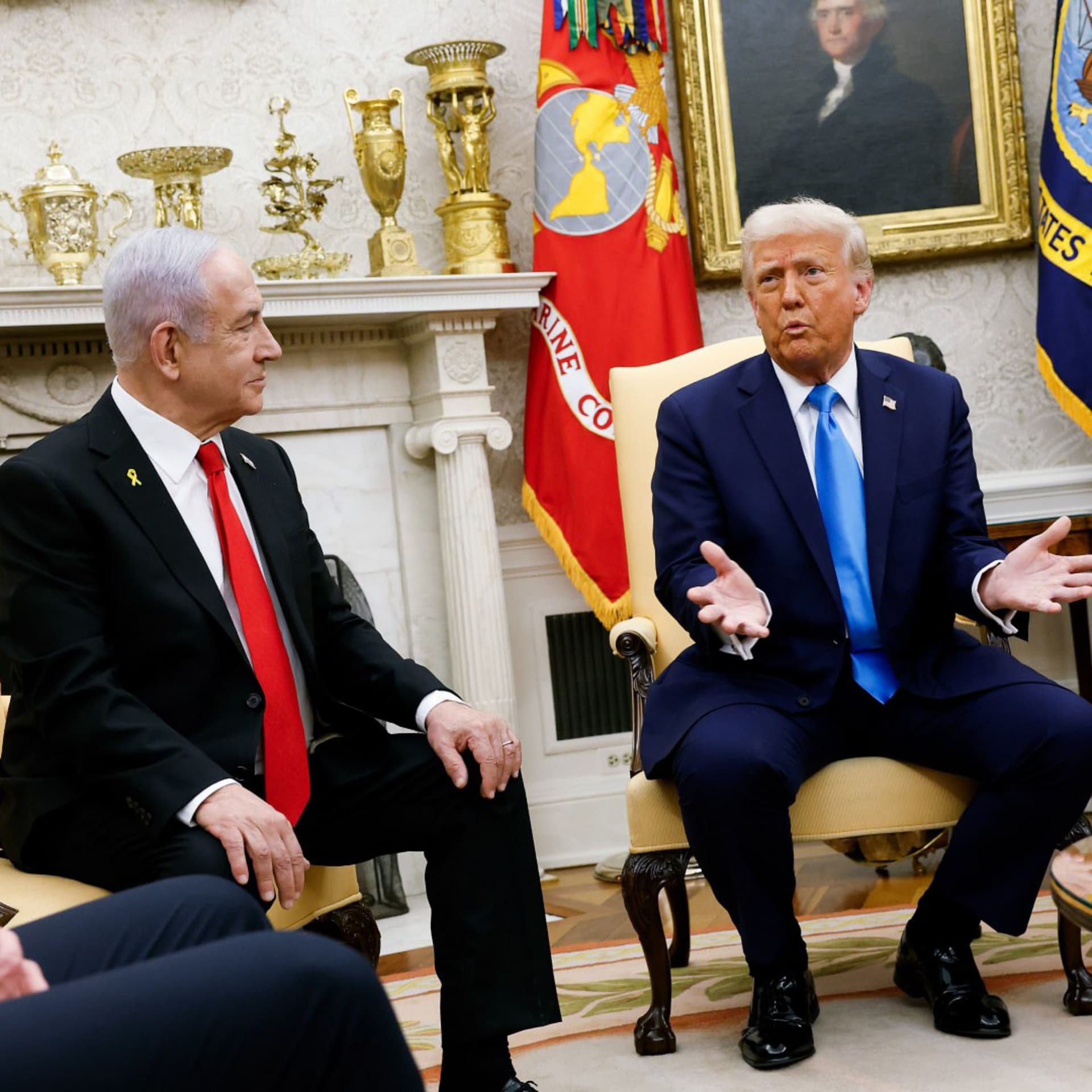
Image: President Trump Meets With Visiting Israeli PM Netanyahu At The White House. Anna Moneymaker/Getty