In short
The Bondi Beach massacre during a Hanukkah celebration and the broader rise of antisemitic violence worldwide since Oct 7, 2023, including claims about government protection and drivers of the violence.
Guests and backgrounds
Hamish MacDonald, ABC news presenter in Australia; rushed to Bondi and interviewed witnesses. Alim Makboul, BBC religion editor; previously a foreign correspondent covering Gaza, the West Bank, Israel, South Asia, and the US.
Key claims
Jewish communities feared escalation and say governments haven’t done enough beyond security. Australia’s anti-Semitism envoy Gillian Siegel delivered recommendations in July; the federal government had not formally responded. ASIO alleged Sydney antisemitic attacks were instructed by Iran’s Revolutionary Guard via local criminal networks. Antisemitism spikes during Middle East conflict; UK/US monitors report record levels since Oct 7.
Notable examples
Bondi Beach triage at North Bondi Surf Club; warning incidents like antisemitic graffiti, attacks on a synagogue and a bakery; UK Manchester synagogue attack; US Pittsburgh synagogue shooting; DC Israeli embassy killings. Ahmed Al-Ahmad wrestled a gun from a shooter and was shot.
Written by AI. May contain mistakes. Listen to the episode to check what was said.
Chapters
Tap a time to open that second in VOSetting the Scene at Bondi Beach
0:00 to 0:48
Description of the aftermath of the shooting at Bondi Beach.
“This BBC podcast is supported by ads outside the UK.”
Setting the Scene at Bondi Beach
1:42 to 2:17
Description of the aftermath of the shooting at Bondi Beach.
“We'll be speaking to the BBC's religion editor, Alim Makboul, about the concerning rise of anti-Semitism around the world.”
Witness Accounts of the Attack
2:17 to 3:30
Hamish MacDonald shares personal stories from those present during the attack.
“Hamish MacDonald is a news presenter with the Australian Broadcasting Corporation, the national broadcaster.”
Community Reactions and Feelings
3:30 to 5:28
Reactions from the local Jewish community and their feelings of fear and anger.
“And so she went down, caught a few waves and heard initially what she thought were fireworks.”
Rising Antisemitism in Australia
5:28 to 9:17
Discussion on recent anti-Semitic incidents leading to the attack.
“the government to do something, we asked them to do something, it has been escalating step by step in incremental ways.”
Geopolitical Factors Behind Antisemitism
9:17 to 11:11
Exploration of international influences on the rise of antisemitism in Australia.
“So the view here is that it's a form of hybrid warfare, that this is a tactic to disrupt, to threaten, to intimidate the Jewish community globally as a means of putting pressure on the Israeli government.”
Government Response to Antisemitism Warnings
11:11 to 12:22
Overview of the Australian government's actions regarding antisemitism in light of recent events.
“So in a sense, some of these fracture lines have been present all along, but certainly the last few years have allowed them to bubble up in a way that has, I guess, led Australia to this moment.”
Australia's Gun Laws and Public Safety
12:22 to 14:00
Discussion on Australia's gun laws following the Bondi Beach shooting.
“Now, in its defence, Hence, the government has been saying the last 24 hours that they have begun to implement some of the recommendations in that Siegel review.”
Gun Law Reforms in Australia Post-Massacre
14:00 to 17:38
Learn about Australia's gun laws and the impact of the Port Arthur Massacre on regulations.
“Where does Australia stand on the scale of gun laws?”
The Bondi Beach Incident: A Hero's Intervention
17:39 to 22:40
Discover the heroic actions of Ahmed Al-Ahmad during the Bondi Beach shooting incident.
“about evidence of a rise in global anti-Semitism.”
Show all 12 chapters
The Rise of Global Anti-Semitism
22:41 to 26:53
Understand the recent patterns of anti-Semitic incidents globally and in Australia.
“In this country, after the synagogue attack, and even before that, the government had committed funds for security.”
Community Concerns and Calls for Action
26:54 to 28:00
Explore the concerns of Jewish communities regarding government responses to anti-Semitism.
“But people here were saying, as we've heard Australian Jews saying, we told you this was on the cards and we need you to take it more seriously.”
Transcript
Automatic transcript. May contain errors.0:00This BBC podcast is supported by ads outside the UK.
0:30And to think, that's just a small taste of what Schwab offers. Because Schwab knows that when it comes to your finances, choice matters. No matter your goals, investing style, life stage or experience, Schwab has everything you need, all in one place, so you can invest your way. Visit schwab.com to learn more.
0:53Aleem Maqbool:On Bondi Beach in Sydney, there's a massive pile of discarded clothes, shoes, crumpled towels, beach chairs, all stacked up neatly on the sand. They were left behind by people fleeing the shooting at a Hanukkah celebration on Sunday, in which at least 15 people were killed, including a 10-year-old girl and a Holocaust survivor. The Jewish community in Australia and around the world, as well as non-Jews all over, have been horrified by the attack. Many people have told the BBC that they felt something like this was inevitable after a series of anti-Semitic incidents in Australia over the past few years.
1:42Aleem Maqbool:I'm Tristan Redmond in Paris, and today on The Global Story, how anti-Semitism has risen around the world since October 7th, 2023, and why many Jews in Australia and beyond say that governments have to do more to protect them.
2:04Aleem Maqbool:We'll be speaking to the BBC's religion editor, Alim Makboul, about the concerning rise of anti-Semitism around the world. But first, we wanted to go to Bondi Beach, where the attack happened. Hamish MacDonald is a news presenter with the Australian Broadcasting Corporation, the national broadcaster. When news of the attack in Sydney broke, he rushed to get to Bondi Beach. I was in Melbourne, another city in Australia. I was competing in a sporting event and had about a dozen missed phone calls from the ABC asking me to get on air as soon as I could. So I took the very next plane. I was still in my sporting gear and went straight to Bondi.
2:45I've been here throughout the day filming and doing various interviews. The beach was largely inaccessible. All of Bondi, North, South and the Western entrance, covered in police tape and police vehicles. But obviously still people out getting their morning coffees, walking their dogs and people just gathering to try and come together and interpret what had just unfolded. But as all the politicians arrived, it was a really unusual greeting instead of the usual formalities and good morning. A lot of them were walking straight up to you, hugging you, crying.
3:19Aleem Maqbool:Well, Hamish, when I heard the news yesterday, you were the first person I messaged. And you told me that one of your friends had been in the surf swimming when the attack happened. What did she see? It was a perfect early summer evening here. And so she went down, caught a few waves and heard initially what she thought were fireworks. And very quickly realized that it wasn't. It was gunshots and they could see people running. She was a clubby, volunteer lifeguards in the surf club. And her instincts kicked in. She herded people up and took them further out to sea because her sense was that was the safest place to be.
3:58A father and a young son on a foamy, which is a sort of beginner's surfboard. She took them further out to where the marker boys are and told them to wait along with some backpackers that were in the water. When they came on to shore, though, they were very quickly pushed into the North Bondi Surf Club, and that was effectively a triage centre. They were met with people bandaged, towels wrapped around heads to staunch bleeding. It was, from her account anyway, horrific scenes.
4:27Aleem Maqbool:Hamish, you've been reporting and speaking to people down there on the beach. What have people been telling you? So a real mix of emotion, as you'd understand, people quite shocked. As I was walking the streets in the early hours of this morning before my program went on air, a young woman emerged from her front gate and introduced herself. I'm Josie 32 from Bondi. He said, I'm a member of the Bondi Jewish community. It happened over my back fence and she immediately started sobbing, hugging my producer. How are you going this morning? I mean, obviously very shaken up and just can't believe what actually happened like on my doorstep.
5:07She was the first hint I heard this morning of the anger that clearly has been bubbling in Sydney and Australia's Jewish community for some time. We've been fearing this for three and a half, two years and like I don't want to put the blame on anyone but like our government just has to do more. Like this is not okay. And she said we wanted the government to do something, we asked them to do something, it has been escalating step by step in incremental ways. And we had feared that something like this might happen. And now it has. I actually stopped by an Orthodox Jewish friend of ours last night on the way down to Bondi.
5:49Had a conversation with her. Rockle Hoffman is her name. Just thinking, I knew from the morning how many people were planning on going down to this Bondi Hanukkah by the Sea event. I myself was planning on going. I only didn't go because I got sidetracked cooking. So she found herself in the most unbelievable set of circumstances on Sunday evening. Because so many people had come down by car to attend this event, they were then unable to leave. And Rockle ended up going on the local Jewish community forums and chat groups, offering to take people out that were trying to escape. I messaged the chat and said, does anyone need any help getting back from the event?
6:27Got a message from someone crying on the phone, asking if I could pick up their sister. So I just jumped in the car, drove down there. And she wound up with people in her car who just lost, literally lost a loved one and trying to get them out of here. I think it was her uncle, sadly, who passed away. She was just sobbing, crying hysterically. I happened to know the person as well. I went to school with his wife, so I knew straight away. Naturally, I got emotional as well. But it was just shock, grief, you know, all coming out at the same time.
6:59Aleem Maqbool:You've alluded to a number of kind of warning signs that the Jewish community have flagged about anti-Semitic events in the lead up to this attack. Can you just talk us through in detail any more of those particular events? Yeah, so last summer, in fact, there was a wave of anti-Semitic attacks in the eastern suburbs of Sydney. Police found anti-Israel graffiti painted on cars parked along several streets in Wulara, including outside of a Jewish hospital. Some of them in Bondi. The hunt is on tonight for two men behind an anti-Semitic graffiti attack at Bondi Beach. Some of them south of here in a place called Marubra, also in Wulara, which is just up the hill.
7:42Initially, some of those incidents were graffiti on walls. Red paint was splattered across a home. At least one car has been graffitied with an anti-Semitic slur. Then there was a bakery that was attacked. Then there There was a property up the road towards Dover Heights. It's Sydney's second anti-Semitic incident in a week following an attack on a synagogue on Saturday. As fears this incident in Dover Heights had a specific target. It turned out that was the former home of the chief executive of the Australian Council of Jury, Alex Rifchen. There is an evil at work in this country. It's thought that that was a targeted attack.
8:21It's vandalism and graffiti and the next step is someone who's going to be hurt. And then only a few months ago, ASIO, our intelligence, our national intelligence agency, released its annual report. And it was during that reporting period that the ASIO Director General, Mike Burgess, indicated that the Australian intelligence agencies had gathered enough evidence for them to publicly state that this wave of anti-Semitic attacks in Sydney had actually been instructed by the Iranian Revolutionary Guard that they'd been engaging local criminal networks, organised crime figures, using pay platforms to commission small-scale criminals to carry out these attacks.
9:05Some of those that were arrested had no known or obvious views even about the Middle East or about anti-Semitism whatsoever. They'd simply been paid to carry out these attacks.
9:16Aleem Maqbool:Why would the Iranian government be interested in this kind of activity in Australia in particular? So the view here is that it's a form of hybrid warfare, that this is a tactic to disrupt, to threaten, to intimidate the Jewish community globally as a means of putting pressure on the Israeli government. You'll recall, of course, that Australia was among a list of Western democratic governments this year that announced that it would recognize a Palestinian state. So this all plays into the broader, complex Middle East political picture and the geopolitics. Well, I mean, Hamish, how many Jewish people are there in Australia?
10:02Aleem Maqbool:And what kind of role do they play in society? The Jewish community in Australia dates back many generations. But there's also newer waves of Jewish migrants. Many of those that were here in Bondi on Sunday night were Holocaust survivors, people that came to Australia for a safer life. It's why so many people that have been touched by this incident in the Jewish community are saying the promise of Australia was safety. You hear from Australian leaders of different persuasions that Australia welcomes people from all over the world. We're seen as one of the most successful multicultural nations on the planet.
10:40But the deal is that the government offers you that in return for leaving behind the problems of the countries and the regions that you came from. And that's always been the argument. It's been largely upheld, I think. But really, it's been the last two or so years since the October 7 attacks and this acute phase of conflict in the Middle East that some of those pre-existing tensions, Obviously, anti-Semitism was already here. Obviously, there's been Islamophobia, particularly after the 9-11 attacks. So in a sense, some of these fracture lines have been present all along, but certainly the last few years have allowed them to bubble up in a way that has, I guess, led Australia to this moment.
11:25Aleem Maqbool:You mentioned, Hamish, that the Jewish community has been warning about their fears of an anti-Semitic attack like this. What has the government's response been to those warnings? So the Australian government, led by Anthony Albanese, appointed an anti-Semitism envoy. Her name is Gillian Siegel, a very successful Jewish-Australian businesswoman. She conducted a review which provided a report to government with specific recommendations on everything ranging from education to policing to security arrangements at Jewish schools and institutions, as well as some more controversial elements like a very particular definition of anti-Semitism.
12:12That report was handed down in July of this year and the federal government, led by Anthony Albanese, still has not formally responded to that report. Now, in its defence, Hence, the government has been saying the last 24 hours that they have begun to implement some of the recommendations in that Siegel review. But as Gillian Siegel herself, still in that position as the government's envoy, has said she would like to see more effort made to implement the full recommendations and to provide a whole of government response to that report.
12:46Aleem Maqbool:What has the response of Anthony Albanese been since the attack? because it sounds like he had on his desk important recommendations about how to better protect the Jewish community in Australia. So he's pointed to the things that they have done. They have acted to remove people from Australia who are not citizens, who have expressed anti-Semitic views. It was just in the last couple of months, in fact, Tristan, that a group of black-clad neo-Nazis staged a rally in broad daylight out the front of the New South Wales State Parliament with a banner targeting what they described as the Jewish lobby.
13:23And this was a shocking event to most people in Sydney. We haven't seen anything like this. And this sent a chill, I think, through the Jewish community, but also the broader Sydney community. So that's just one example of the sorts of things that have been happening here, which have led to calls for governments at both state and federal level to take stronger action. I think the Prime Minister is going to continue facing these questions in the coming days and weeks. Not to mention the fact that one of the two gunmen was actually identified by ASIO, our intelligence agencies, back in 2019 because of his connections with a suspected terror cell here in Sydney with ISIS links.
14:03Aleem Maqbool:Where does Australia stand on the scale of gun laws? If you think of the United States as being very liberal and some European countries like the UK, for example, being very strict, where is Australia on that spectrum? We're very strict. we experienced a tragic massacre in Port Arthur in Tasmania in 1996. Dozens of people were killed. It was a single shooter who went on a rampage, killing people indiscriminately. John Howard was the then conservative prime minister and he pushed through this massive gun law reform program, which meant a buyback of many thousands of weapons, limiting gun rights, gun ownership, created licensing has worked.
14:46It's been very effective. In the years leading up to the Port Arthur Massacre, Australia did have quite a number of large-scale shootings with more than four people killed. In the decade after the Port Arthur Massacre and the introduction of the gun law reforms, there was not a single mass shooting.
15:04Aleem Maqbool:And how much public backing would there be now, in your opinion, for tightening those rules even further? I can't imagine there'd be much opposition. The leaders that met today all committed with pretty firm resolve to doing that. Chris Minns, the New South Wales Premier, emerged from that national cabinet meeting saying that he wants New South Wales to have the strongest gun laws in the country, for example, ensuring that licensing doesn't exist in perpetuity. So you would need to keep proving that you should be able to hold that weapon. The point's been made by a lot of the agencies here that radicalisation happens very quickly today.
15:45This is not a process now that takes many years. It can happen in a matter of weeks online.
15:53Aleem Maqbool:Hamish, I have to ask you about the incredible video of the member of the public who wrestles the gun from one of the shooters. How much do we know about the background of the person who intervened in that way? So the man you would have seen in that video, his name is Ahmed Al-Ahmad. He's a fruit shop owner. He's a father of two. He'd come to Bondi on the Sunday evening to get a coffee when he saw this unfold. So you see him wrestle the gun from the older of the two gunmen. He does appear to have the opportunity to shoot him. He doesn't do that. He puts the gun down and leans it against the tree.
16:32He ended up being shot. His parents have told the media today that he was shot five times. He's in hospital tonight. He's undergoing surgery. He will recover, we're told. The Premier went in to visit him, hailed him a real-life hero. He's certainly a man whose face is becoming increasingly familiar, but there are many individuals who stood up, who stood tall in the face of all of this and who I think will be recognized. A number of police officers were injured during this, including a young officer that had only been in the force for a number of months. I think we'll start to hear more of those stories in the coming days.
17:13Aleem Maqbool:Thanks so much, Hamish. We need to let you go, but we really appreciate you speaking to us from Bondi. I wish it were in better circumstances, Tristan.
17:26Aleem Maqbool:That was the ABC's Hamish MacDonald. When Iran was asked this summer about allegations it was behind anti-Semitic attacks in Australia, it said it absolutely rejected the allegations. Coming up, we speak with the BBC's Religions Editor about evidence of a rise in global anti-Semitism.
17:54Aleem Maqbool:As Hamish mentioned there, the shooting this weekend in Australia didn't happen in isolation. There have been a series of warring incidents both in Australia and around the world since October 7th, 2023. We wanted to understand if anti-Semitism has been on the increase worldwide. So we called up the BBC's Religions Editor, Alim Makboul, who's been looking into this. I'm the religion editor for the BBC. I have been for the last three years or so. Before that, for a long time, I was a foreign correspondent based in the US, based in South Asia, based in the Middle East, including Gaza, the West Bank and Israel.
18:32Aleem Maqbool:Well, you've been doing some specific work on the question of anti-Semitism around the world, even before this horrendous attack in Sydney. Is anti-Semitism on the rise globally, Elim? You know, if you're talking about recent history, obviously, but the world has been grappling with anti-Semitism for a very, very long time, for centuries. In terms of recent years, then yes, certainly what we've seen among those organizations that monitor anti-Semitic incidents in various countries, we've seen similar patterns, that there are spikes when there is conflict in the Middle East, when there's conflict between Palestinians and Israel.
19:13So 2012, 2014, 2021, we saw these spikes. There's an organization called the Community Security Trust that has been monitoring antisemitism in the UK for the last 40 years. There is the Anti-Defamation League that looks at these things in the US. And what we've seen is that in both of those cases, since October 7th, 2023, we've seen the highest levels of antisemitism and anti-Semitic incidents that have been recorded in the history of either of these organizations. So for the last 40 years, over the last two years, there have been the highest levels in the UK. Anti-Defamation League has been saying similar things about the last 46 years in the US, and this has been sustained.
20:02There was a sharp spike in late 2023 and early 2024, an increase of 200%, 300 % in some cases on the year before. But that has been sustained. And for the most part, it is anti-Semitic abuse, verbal abuse, online abuse. We've obviously seen the timeline in Australia of graffiti, of vandalism, but that's been replicated in the US, in the UK as well. So vandalism on synagogues, Jewish schools, Jewish community centers, and so on have happened both here and in the US. Some physical assaults have taken place, particularly people who are ultra-Orthodox or those wearing kippahs, for example, the skullcap.
20:49And then there have also been the much more serious incidents. Now, just a couple of months ago in the UK, there was a deadly attack on a synagogue in North Manchester, the Heaton Park Synagogue, where an attacker drove his car into the front of the building. And then there was a knife attack until he was shot dead. But two people were killed, more were injured. In the US, we have also seen a similar pattern of lower level anti-Semitism, but they also had a couple that were shot dead who worked at the Israeli embassy in DC. I mean, the worst anti-Semitic attack in recent years in the US actually happened while I was reporting out there, which was a gun attack at a synagogue in Pittsburgh.
21:3811 people were killed there. That happened in 2018. Now, in some of these cases, it's Islamist ideology that's driving them. In the case in the US, it was someone with a far right, white nationalist ideology that was driving them to carry out that attack. So the point is, anti-Semitism is something that most countries have been grappling with for a long time. But yes, there has certainly been a spike over the last couple of years.
22:06Aleem Maqbool:Well, you mentioned 200, 300 % increases in some cases, which is huge. Benjamin Netanyahu has accused the Australian government of complacency on the question of anti-Semitism. When you have spoken to members of the Jewish community around the world, do you get the impression that that feeling is shared? Yes. I mean, the government, for example, the government in Australia did set up an anti-Semitism task force last year. So it was saying we're taking this seriously. In this country, after the synagogue attack, and even before that, the government had committed funds for security. And actually what you hear from a lot of Jews is it needs to be more than that.
22:56It's not just about protecting people on certain days, on certain holidays or in certain buildings. It's about educating. It's about having an impact more long-term where people understand what antisemitism is, the history of it, and why it shouldn't happen. As it happens, I've spoken to academics in this country, Jewish academics, who've been looking at antisemitism, who say actually the trajectory as a whole in the UK is in terms of values, surveys, and so on, and these have been replicated in the US, that the population as a whole is getting less anti-Semitic. But during these moments of conflict, the worry is that in the guise of protesting against Israel's actions, it allows people to express anti-Semitism.
23:51Not that all Jews around the world would necessarily want Benjamin Netanyahu to be their spokesman. A lot of them have got their own problems with the Israeli government and with Prime Minister Netanyahu. But I think you will get a sense through speaking to Jews in different countries. Actually, there was a delegation from the UK that went to Australia only a week or so ago, spoke to people about what was going on there and reported back that people there were feeling similarly that the governments weren't doing enough in a more holistic way. Throwing money at security helps, is necessary, but it needs to be more than that.
Read the full transcript
24:29It needs to be about education. A lot of Western countries, including the UK, have spent an awful lot of resources over the years on interfaith dialogue and so on. Something is clearly not working, where people still don't understand where the line is between criticizing Israeli policies and where it strays into anti-Semitism. And whatever work has been done on interfaith relations is clearly not reaching some of the people who are capable of carrying out violent attacks.
25:04Aleem Maqbool:Is there any data, Aleem, on where the rise in anti-Semitism might be coming from? Is it from any one particular part of the political spectrum? What details do you have on that? I mean, I speak often to members, for example, at the Board of Deputies of British Jews, who, yeah, are worried about a rise in anti-Semitism from different quarters, not just necessarily from the far left, from Islamists, as some would term it, or the far right. It's all of them. Well, before we spoke with you, Aleem, we were talking to Hamish MacDonald in Sydney, who was telling us that Australian Jews have been trying to tell the Australian government for some time that they feared an attack like this, that they feared an escalation of anti-Semitic violence.
25:57Aleem Maqbool:Have you seen that that is a pattern that replicates itself around the world, that Jewish communities have specifically approached their governments and said, you need to do more to protect us. Absolutely. And I think the other thing that was quite striking when we were hearing from Australian Jews was that in many ways, while it's shocking what happened in Bondi, it was not completely surprising. And that's what we heard here in Britain when there was the attack on the synagogue in Manchester. People saying, we were telling you that this was coming, something like this was going to happen. and that is not overcome by simply having more security.
26:42And by the way, when we talk about security, a lot of that security is volunteers that come from the congregations at the synagogues. We're not necessarily talking about more police, although there has been a greater police presence both in the US and other European countries around synagogues, particularly on Holy Days. But people here were saying, as we've heard Australian Jews saying, we told you this was on the cards and we need you to take it more seriously.
27:13Aleem Maqbool:Thank you so much, Aleem. Really appreciate you stopping by. My pleasure.
27:23Aleem Maqbool:That was Aleem Makboul, the BBC's Religions Editor. And earlier we heard from the Australian Broadcasting Corporation's Hamish MacDonald in Sydney. This is an important topic and we plan to revisit it soon, but that's it for today. This episode was produced by Kat Farnsworth and Lucy Paul. It was mixed by Travis Evans and the studio manager was Johnny Hall. The executive producer was China Collins and I'm Tristan Redman. If you'd like to contact us with any thoughts or story ideas, we're at theglobalstory at bbc.com. Thanks for listening. We'll be back tomorrow. Cheerio. Thank you.
From the publisher
Australia is reeling after its deadliest mass shooting in decades, in which gunmen opened fire on Jewish people gathered for a Hanukkah event on Bondi Beach in Sydney. At least 16 people have been killed – among them a 10-year-old and a Holocaust survivor. The massacre has triggered a reckoning in Australia and beyond.
While some are asking how this horror could have happened, others believe an attack like this was grimly inevitable after a string of antisemitic incidents in Australia in the past few years. In today’s episode, we speak to the BBC’s Religion Editor Aleem Maqbool and the ABC’s Hamish Macdonald to explore why antisemitism has surged since October 7th 2023, and why many Jewish communities feel their governments aren’t doing enough to keep them safe.
Producers: Cat Farnsworth and Lucy Pawle
Mix: Travis Evans
Senior news editor: China Collins
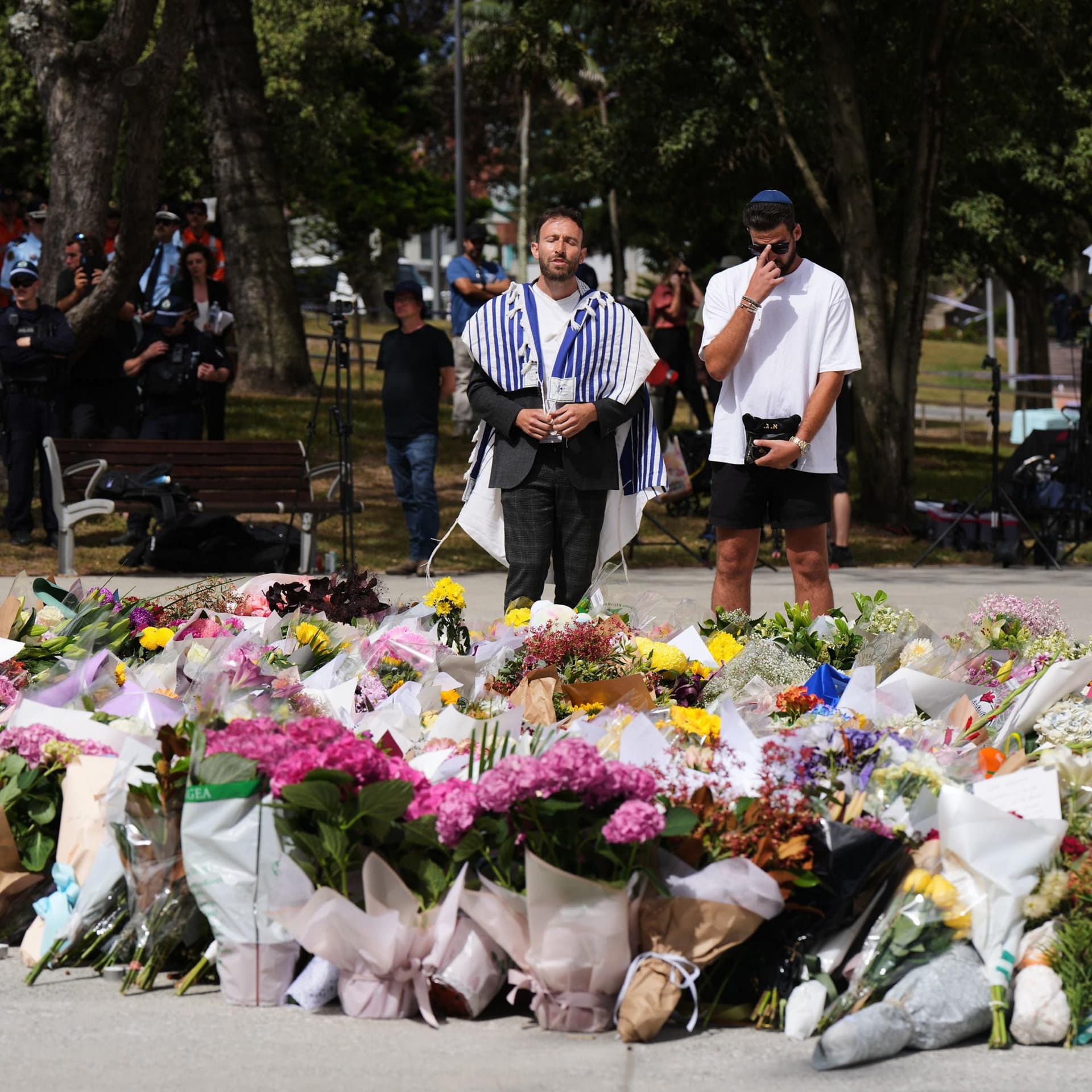
Photo: Rabbi Yossi Freidman at a memorial for shooting victims at Sydney's Bondi Beach. Mark Baker /AP