
In short
A BBC Global Story episode about Alberta’s October 19 referendum on whether the province should separate from Canada, and how U.S. politics and the Trump administration could influence the moment.
Guests (and backgrounds)
Nadine Youssef, BBC senior Canada reporter; she describes reporting at the Calgary Stampede and interviews/meetings with Alberta figures.
Key claims
Alberta independence sentiment is driven by alienation from Ottawa (especially after COVID-era vaccine mandates and the 2021 Freedom Convoy). Polling suggests only about 20–25% would vote “yes,” but separation supporters may be more motivated to turn out. Economically, separatists argue independence would make Albertans richer; opponents cite major risks (including estimates of $62B annual economic shrink and very high separation costs). Mark Carney warns against “Brexit effect” uncertainty.
Notable examples
Calgary Stampede political pancake breakfasts; Freedom Convoy truckers; Jeffrey Rath’s trips to Washington/White House outreach; Danielle Smith’s Mar-a-Lago meeting; trade-war tariff tension between Canada and the U.S.
Written by AI. May contain mistakes. Listen to the episode to check what was said.
Chapters
Tap a time to open that second in VOThe Calgary Stampede: Culture and Politics
2:46 to 4:50
Learn about the cultural significance of the Calgary Stampede in Alberta.
“And today on The Global Story, why Canada could lose Alberta.”
Understanding the Alberta Independence Referendum
4:50 to 6:54
Delve into the details of Alberta's independence referendum and its implications.
“I feel more Canadian than I feel Albertan.”
Alberta's Identity and Politics
6:54 to 9:39
Examine how Alberta's identity shapes its political landscape.
“Some people actually on both sides kind of criticize it as a referendum on a referendum because it doesn't actually automatically trigger a process of separation.”
Leadership in the Alberta Independence Movement
9:39 to 14:00
Discover the key figures behind Alberta's independence movement and their motivations.
“I mean, what you're describing to me almost sounds akin to Texas.”
Alberta's Sentiment and the Call for Separation
14:00 to 20:25
Exploration of Alberta's grievances towards Ottawa and the push for independence.
“Then along came the Trudeau Liberals and everything changed.”
The Impact of U.S. Politics on Alberta's Independence Movement
21:06 to 26:52
Discussion on how U.S. political dynamics, especially under Trump, relate to Alberta's independence sentiments.
“You can also enjoy a range of our podcasts ad-free with an Amazon Music subscription.”
Listener Feedback on the Episode
28:00 to 28:34
Hear insights from listeners about the previous episode's themes.
“Tony adds, quote, From the outside, this lack of empathy looks more like a character of the USA rather than any kind of new phenomenon and seems like a compulsion to cruelty.”
Episode Production Credits
28:34 to 28:58
Learn about the team behind the production of this episode.
“Thank you all for writing in and keeping in touch.”
Transcript
Automatic transcript. May contain errors.0:00This BBC podcast is supported by ads outside the UK. Decisions made in Washington can affect your portfolio every day. But what policy changes should investors be watching? Listen to Washington Wise, an original podcast for investors from Charles Schwab to hear the stories making news in Washington right now. Host Mike Townsend, Charles Schwab's Managing Director for Legislative and Regulatory Affairs, takes a non-partisan look at the stories that matter most to investors, including policy initiatives for retirement savings, taxes and trade, inflation concerns, the Federal Reserve, and how regulatory developments can affect companies, sectors, and even the entire market.
0:44Mike and his guests offer their perspective on how policy changes could affect what you do with your portfolio. Download the latest episode and follow at schwab.com slash Washington Wise or wherever you listen. Running a business shouldn't feel like surviving a software group project. One app for accounting, another for inventory, another for sales. And somehow, none of them talk to each other. That's where Odoo comes in. An all-in-one business management software that brings every part of your business together. From sales and accounting to inventory and marketing, all in one powerful platform.
1:19No messy integrations. No bouncing between tabs. And best of all, no spreadsheets. Stop managing software and start managing your business with one unified system. Try for free today at odoo.com. That's O-D-O-O dot com. It's a bit awkward in Canada right now. Mark Carney, the Prime Minister, is pushing the message that Canada is united in the face of increasing antagonism from Donald Trump. This is our country. This is our future. We are building it together. That's Team Canada. That is Canada Strong. Thank you very much. Merci beaucoup. But at the same time, within Canada, there is an existential battle going on.
2:06And Mark Carney would maybe rather it wasn't. On October the 19th, voters in Alberta, the country's wealthiest province, are going to have a referendum on whether they might declare independence and leave Canada altogether. Fed up. We've had enough. We want the hell out. And we vote to form a separate country. Supporters say Alberta, which is on the U.S. border just north of Montana, would thrive alone because of its rich oil and gas resources. So how might the Trump administration try to leverage this moment of uncertainty in its backyard? From the BBC, I'm Tristan Redmond in London. And I'm Asma Khalid in Washington, D.C.
2:48And today on The Global Story, why Canada could lose Alberta.
2:56So back in July, I attended this event called the Calgary Stampede. It's held in Calgary, Alberta. It's the largest city in the province. That's Nadine Youssef, the BBC's senior Canada reporter. And the Stampede is sort of the marquee event of the summer. It's essentially a large rodeo and fun fair. There are Ferris wheels, a merry-go-round, you know, wacky food like deep fried pizza. Nadine, you're talking to Asma Khaled here. Asma loves a state fair. The queen of state fairs. I love it too. It's a quintessential summer experience. So I totally understand that. Lovely. So there's also, you know, a unique aspect to the Calgary Stampede, in addition to the fun fair, which is the rodeo aspect.
3:41So there are rodeo competitions like chuck wagon races. There's bull riding competitions. and everywhere you go, pretty much everybody's dressed in a cowboy hat and boots. I mean, I had to also dust my hat and boots from the back of my closet when I knew I was going to the Stampede because you kind of have to dress the part. And so that's sort of what it is on the surface. But I would say it's so much more than a summer rodeo.
4:13Many see it as a celebration of what Western Canadian culture is about and the values that it was built on. So it's very deeply entrenched in Alberta's identity, I would say. It's also a very political event. So you have the prime minister, federal leaders, politicians basically descending on the stampede every year. and they host and attend these community pancake breakfasts where they sort of rub elbows with voters and business leaders. And for the politicians, it's essentially a big moment to show face in this important part of Canada.
4:50Of course, at a place where Alberta identity is front and centre, it was no surprise that the referendum question on Alberta independence in the fall was looming large over, you know, these pancake breakfasts that we attended. Alberta in one word is... It's home. Divided. I say it's also. I feel more Canadian than I feel Albertan. I was born in Canada, so I'm Canadian, but I will put Alberta first. I think in independence, Alberta would look more prosperous. Why would people want to be this little separate entity in a wonderful country? If Alberta was independent and they came and said, do you want to join Canada?
5:36The answer would be absolutely no. I worry about the Brexit effect here, right? I mean, be careful what you wish for.
5:45It's so striking to hear how much this issue of the referendum you were saying was really like the topic of conversation, given that the referendum itself isn't actually taking place until October. Yeah, I mean, it's been something that Albertans have been talking about for a long time. But it is the first time that, you know, Alberta puts a formal referendum forward.
6:10Can I just make it clear what the referendum is actually asking? It is asking Alberta if it wants to separate and become, what exactly, an autonomous country? So the question is, should Alberta remain a province of Canada or should the government of Alberta commence the legal process required under the Canadian Constitution to hold a binding provincial referendum on whether or not Alberta should separate from Canada? Now, voters have two options. Option one is Alberta should remain a province of Canada. And option two is the government of Alberta should commence the legal process required under the Canadian Constitution to hold a binding provincial referendum on separation.
6:53Yeah, so it's a question about a question, essentially. It's not yet the big one. It's a preliminary. Yes. Some people actually on both sides kind of criticize it as a referendum on a referendum because it doesn't actually automatically trigger a process of separation. But like I said, it is the first time that a formal question on Alberta separation has been put on the ballot. So it is a consequential moment for both Alberta and Canada as a whole. And I think both sides see it that way. Nadine, we've been talking about Alberta, this province in Canada, and I think it's helpful if we can just geographically place people and explain where Alberta is located, both within Canada and its proximity to the United States.
7:33Alberta is in Western Canada. I would say it's a pretty unique part of Canada for a number of reasons. It's a landlocked province with vast prairies on one side and, you know, the picturesque Rocky Mountains, basically the postcard of what Canada is on the other side. And then on the south is the U.S. state of Montana. Alberta definitely punches way above its weight because of oil and gas. Oil and gas is Canada's most profitable export. And it's a big reason for why we're considered one of the richest countries on Earth. And all of those reserves exist in Alberta. If you were to ask an Albertan, Nadine, how they would describe themselves and how they would describe their province, what would the answer likely be?
8:17And I say this knowing that you are partially Albertan yourself, so you're well qualified to answer the question. I would say Albertans are, you know, we talked about the Calgary Stampede earlier and how it sort of represents the values of Alberta. And I think, you know, a lot of Albertans see themselves as self-starters, people who pick up themselves by the bootstraps, people who value freedom, enterprising. And I think that these are the values that are so core to Alberta identity to the point that they really do govern the politics in the province. I mean, its voters tend to lean heavily conservative compared to the rest of Canada.
8:55So when you say conservative, can you spell out what exactly you mean by that? And does it mean the same thing that we often think here in the United States of what conservative politics equates with? The conservative movement in Canada is a pretty big tent. So you do have people who are more fiscally conservative. I think freedom, enterprising, you know, promotion of business. Alberta is the wealthiest province by GDP per capita because of its rich oil and gas resources, most of which are sold to the U.S. But because of the fact that it is, you know, oil country, people want a government that would promote that, would help that grow and flourish and would kind of let that sector do its own thing and be independent without any government interference.
9:38There's a spirit then you're describing of sort of freedom and the spirit of independence that's matched with the large oil reserves. I mean, what you're describing to me almost sounds akin to Texas. You know, people do say sometimes that Alberta is the Texas of Canada. And I think that that comparison comes because of those things. I mean, it's more than the cowboy hats and boots. There's a fundamental ideology here that sort of governs both those places, for sure. Maybe Texas is the Alberta of the United States. Another way to look at it. Yes. Why is this idea being raised now, Nadine? I mean, as I understand it, there has been a kind of independence movement within Alberta at the moment.
10:20But how is it that it's now crystallized? It's had such a critical mass that we've actually moved to the phase of a referendum, even if it is only a pre-referendum, so to speak. So when I go to Alberta and I talk to some Albertans, you know, particularly those living in rural areas, there's a deep sense of alienation where they feel like they are misunderstood by the rest of Canada and that they don't relate to the Liberal Party that has dominated federal politics here for the last decade or so. They just don't see themselves reflected in the people that are governing in Ottawa, in the so-called elite that live in Toronto.
10:55The bulk of Canada's population is concentrated in the East, right? It's in Ontario, in Quebec. And those two provinces really hold a huge balance of power. So, you know, it's sometimes seen as they get to decide the future of the country. And by the time votes are counted in Alberta, well, it's already a done deal. It's already decided. And that's the tension that's been brewing for some time. But then I would say that this feeling of alienation and frustration with Ottawa really intensified around the COVID-19 pandemic when there was a huge resistance in pockets of Alberta to federal vaccine mandates and social distancing rules because, again, they were seen as infringing on freedom, freedom to move, freedom to live how they choose.
11:39And so that sort of really became a rallying cry, so to speak, for some who were really, really frustrated at that point with Ottawa. I think some of our listeners might remember the Freedom Convoy to Ottawa in 2021. So essentially it was when a huge protest that garnered international headlines, where hundreds of truckers travelled to Ottawa to protest vaccine mandates. Truck drivers are at the centre of this. They've been blocking roads in Ottawa. And the authorities say it's got out of hand. There's now a state of emergency. Many of those truckers actually came from Western Canada and prominent leaders of that movement are from Alberta.
12:16And I don't know if people remember, but those protests gridlocked the nation's capital. They went on for about two weeks and they were eventually shut down by former Prime Minister Trudeau. And so that was a turning point. People felt like that was the turning point where they felt dismissed, that they weren't heard. And now some of those very same people that were part of the Freedom Convoy are now advocating for Alberta separation, basically saying enough is enough. What can you tell us about the leaders of this independence campaign in Alberta? Because, I mean, you can't really have an independence movement like this without leaders of some charisma.
12:52Who are the front and center ones in Alberta right now? So they're primarily led by a couple of figures. One man is named Mitch Sylvester. He's a gun shop owner in a rural Alberta town who has basically emerged as the spokesperson and main organizer of the Alberta Prosperity Project. There are other figures involved. I would say most notably is a man named Jeffrey Rath. He is a lawyer. He also owns a large ranch just outside of Calgary. When we met him, you know, he was wearing the quintessential cowboy hat and cowboy boots. You know, he's pretty outspoken. And can you tell me what being Albertan means to you?
13:32It's really funny. I had a conversation with my daughter, you know, a couple of years ago, and we were literally apologizing to her for the state of, you know, the world that we live in now. Because like when she was born, right, we didn't have this toxic device of liberal politics that we have now. None of us gave a crap who married who. Nobody cared what anybody's race or color was, you know, whatever, right? Alberta was a really, really comfortable post-racial, post-gendered society where everybody basically got along. Then along came the Trudeau Liberals and everything changed. It was all about constantly driving wedges between people, creating wedge issues.
14:11And then along comes COVID, right? And then government literally intruded into every single aspect of our lives, needlessly. You know, he is somebody who says that he's had generations and generations of family that have lived in Alberta, that have helped set up the province, who feels like Alberta has gone down in the wrong direction because of the influence from Ottawa and politics that he is not, you know, particularly aligned with. People in Alberta are just fed up with, you know, being told what to do by, you know, effectively what becomes an elected dictatorship in Ottawa that don't like us, you know, don't understand us and only, you know, look at us as basically a source of wealth and revenue that they can then, you know, feed into other provinces that don't manage their affairs properly, don't have a culture of, you know, hard work and industry.
15:05So Geoffrey Rath says that he is fed up with Alberta footing the bill for the rest of the provinces. You know, he argues that Alberta's rich oil and gas reserves have helped keep other provinces afloat by sending tax money from Alberta to the rest of Canada to Ottawa. And so he has sort of emerged as a spokesperson for other people who do feel the same way. Is there anyone on the other side of the equation who is similarly charismatic, who's arguing that Alberta should stay part of the greater Canada? I think I should say that the separation or independent sentiment in Alberta is a minority. I mean, polling shows that about 20 to maybe 25 percent of Albertans would vote yes in a referendum to separate.
15:48I think there has been a bit of a struggle to, you know, come together as a united, organized front to advocate for Alberta to stay in Canada. The stay side has not done as much organizing as the side advocating for separation. So you're kind of seeing a little bit of a catch-up period right now of them trying to now organize, knowing that the referendum is just, you know, about a month or so away. So there's this man by the name of Thomas Lukasik. He was the former deputy premier of Alberta. He's an immigrant to Canada, and he's emerging as the face of this movement that's now calling itself Forever Canadian.
16:23And he's driving a bus, you know, decorated with maple leaves all over across the province, basically to stop and to hand out lawn signs and to make the case for Alberta to stay in Canada. I mean, they're worried that because polling shows that, you know, Albertans by and large would vote to stay, some people might not show up to vote because they think it's a done deal. And, you know, they do acknowledge that the side advocating for separation has more of an incentive to show up and vote. They're more motivated because they're not advocating for the status quo. And so their, you know, big objective of what the stay side is trying to do is even to just remind people that a referendum is happening.
17:08Mejan, you've described Alberta as being this wealthy province in Canada. Is it so economically vibrant, that it could truly survive on its own from Canada? Is that essentially what they are saying? The people who are advocating for Alberta to leave have one big argument that they put forward, and it's an economic one. Basically, there'll be more money in your pocket if you decide that we can become an independent country. Now, there's economists who strongly dispute that, who say that separation would bring about economic uncertainty. It would mean investment, leaving the province because they're unsure of what the future will hold and, you know, opting to do business in other parts of Canada.
17:53And they estimate that, you know, that loss of business and investment could shrink the Alberta economy by about$62 billion annually, which is a lot of money. And that, you know, the workforce would be reduced by more than 100 ,000 workers. The Alberta premier herself actually said that she believes the cost of separation in terms of transferring social programs from Canada to Alberta and just all the granule things that need to happen in order for Alberta to be functioning as an independent country would cost about$400 billion. Now, the people advocating for separation for independence dispute that.
18:32So again, the answer really depends on who you ask. But yeah, that's a big argument that entices people to want to vote yes to separating, is they feel like they'll be better off richer, more prosperous and wealthy if they did so. But the Stay Together campaign brochure essentially says economically it's a risk and could cost us a lot of money. So why take a chance? Is that their message essentially? Yes. A lot of the people who advocate for Alberta to stay bring up Brexit. Brexit comes up in every conversation. I mean, even Prime Minister Mark Carney brought up the Brexit argument.
19:14This is a real referendum. It's not, you know, question about a question, free option. It's a dangerous bluff. He led the Bank of England during Brexit, which I think is important to note. And I saw firsthand what gets sold in these referenda, that everything's going to be easy, that you can keep your passport, you can keep the currency, You can stay in the country and leave it at the same time. You get all the benefits, but none of that. And you see what's happened in the United Kingdom. He said that, you know, the UK right now is trying to, this is a quote from Carney saying, trying to undo what people didn't think they were voting for, but what they ended up having.
19:58At a minimum, it's years of uncertainty before the subsequent question comes, right at a time the world is fundamentally uncertain. The cloud of Brexit is hanging over pretty heavily over this conversation.
20:24John Deere is putting in work and putting up highlights. Oh man, look at those passes. Tillage, planting, harvesting. Three years in and these pre-owned machines are still at the top of their game. We're talking reliability, performance, and long-term potential. And get this, these veteran machines can pick up the latest precision tech with ease. You know it, and fans ready to add John Deere-certified pre-owned equipment and more options to their lineup can shop at machinefinder.com. Booyah!
21:06You can also enjoy a range of our podcasts ad-free with an Amazon Music subscription.
21:14I am curious how much, if at all, the politics of Washington, D.C. factor into this. And the reason I'm asking you this is we've seen a good amount of coverage about the Alberta referendum in the American press. I would say more so than you would perhaps typically expect. And some of the characterization of this all is described as a movement that has gotten sort of supercharged in this new Trump era. And that there are some separatists who love Donald Trump, who love what the Trump administration is doing. And because our show is about where the United States intersects with the world, I am curious how, if at all, this Trump era is energizing this movement.
21:56And is there any connective tissue there? You know, some of the people who believe in Alberta separation do see, you know, the ideals held by the U.S. as, I guess, something to emulate, specifically conservative ideals held in the U.S. They feel like that is more aligned with where they are politically versus, you know, the direction of Ottawa under, you know, liberal governments of Prime Minister Justin Trudeau or Prime Minister Mark Carney. Jeffrey Rath has told me that he has been speaking with Trump officials. He's made several trips down to Washington. And he says that they seem to be interested in the idea of Alberta separation, trying to see if the U.S.
22:36could support Alberta in some way if it were to become independent. We don't need to meet with President Trump. I mean, our goal would be to meet with senior administration officials to have certain questions that Albertans would have answered. You know, we're building this as a, you know, as a fact-finding delegation to meet with the United States. to first of all, see what the U.S. appetite is for Alberta independence. I think we've already determined that it's very high, right? He felt like Alberta was more culturally and politically aligned with America. He felt like it fit better as part of the U.S.
23:06than, you know, in its current home in Canada. Now, the Trump administration has not commented on this. We don't know exactly who he met with. You know, Jeff himself wouldn't tell us. But he has said that he has gone on a couple of these trips. to make the case for Alberta separation directly to the White House. It strikes me that, you know, this referendum, our conversation, it is all happening also in this broader context of, I would describe extreme tension between the United States and Canada, just to put it mildly. I mean, we are looking at what is arguably a trade war between these two nations.
23:42They both have put at this point in time fairly steep tariffs on one another. how if at all does this tense environment factor in to this vote i guess i'm just curious i mean is the vote largely seen as this domestic issue or are people whether they are supportive of the referendum or not looking at in this broader conversation of what is going on right now with canada's neighbor to the south i think the referendum would be a big conversation nationally regardless but i think the fact that we do as a country find ourselves facing an uncertain future because of the tariff war that we have with the U.S.
24:20There is a really strong emphasis on unity and on keeping Canada together and making sure that all the provinces are on the same page. And some of the anxiety that people feel towards the separation question in Alberta has to do with whether this is fracturing the country in some way. I think the interesting thing about Alberta and its premier, Danielle Smith, she's a conservative premier. She has kind of emerged as a more moderate figure in this trade war with the U.S. I mean, you have Ontario Premier Doug Ford, who's very combative and, you know, very vocal in his dislike of Donald Trump and of the tariffs that, you know, Trump has placed on Canada.
Read the full transcript
25:01So you have that on one end. But, you know, you have Premier Danielle Smith, who's actually made her own trip to Mar-a-Lago to meet with members of the Trump administration in the past. Her line has always been, we need to work together with the U.S. The U.S. is our partner. We should not alienate the U.S. And so there is already a little bit of that friction. And so there is a strong emphasis on other parts of Canada, or Ottawa at least, to really try to present a united front and to keep Alberta in the fold. And I think it's made even stronger by the trade war that we find ourselves in with the U.S.
25:33Yeah. And even if the independence vote were to fail, you've got a situation where a previously kind of fringe idea is now in the political mainstream and becomes a part of the conversation. How could that change things? I mean, Canada's no stranger to separation referendums. We famously had two in Quebec. And so, you know, this is not a conversation that's new for us. And I think the, you know, there's been a lot of inroads that Ottawa has tried to make with Quebec since those referendums to try to make sure that Quebec felt seen and heard, to try to prevent a future referendum. And I think that this is sort of the approach that they're taking with Alberta as well.
26:17You have Prime Minister Mark Carney vocally supporting their goal to build a new oil pipeline to the West Coast. And, you know, it's something that the previous government hadn't done. And so I think you see a lot of effort even leading up to the referendum of trying to convince Albertans that Canada could work for them rather than crackdown, because I think the philosophy here is that, you know, cracking down might just fuel that frustration and backfire.
26:52Well, Nadine, thank you so much for joining us on The Global Story. We really appreciate it. Thanks so much, Nadine. It's been great to talk with you. Thank you all.
27:10That was Nadine Youssef, the BBC's senior Canada reporter. You can keep up with her reporting on the Alberta referendum at bbc.com. And as always, if you've got any questions or story ideas for us, you can email us at theglobalstory at bbc.com. And recently, we've received quite a few really thought-provoking emails from you about our recent Lindsay Clancy episode. We're going to read out a few of them to you. Curtis wrote in saying, quote, I'm extremely disappointed in the UK and Canada that they have infanticide laws. A child's life has no meaning in the UK. And he added, I'm glad I live in the US on this one.
27:50And Tony from England writes in saying, the Clancy case speaks to what they see as the lack of empathy in the US for women, children and vulnerable people. Tony adds, quote, From the outside, this lack of empathy looks more like a character of the USA rather than any kind of new phenomenon and seems like a compulsion to cruelty. Our faithful listener Amanda from Texas said she thought that the episode was, quote, insightful but was, quote, shocked that we didn't mention the true crime aspect of the trial. Amanda thinks that, quote, Americans have lost faith in the professionals and think the internet knows better.
28:30That's just a snippet of the many emails we've had about that episode. Thank you all for writing in and keeping in touch. We do read all the messages, so keep them coming. Yes, thanks, guys. Our episode today was produced by Hannah Moore and Zandra Ellen. It was mixed by Travis Evans. Our technical producer was Philip Bull. Our digital producer was Sam Gruet. Our executive producer was Martine Powers. Our senior news editor is China Collins. I'm Tristan Redman. And I'm Asma Khalid. And thanks, as always, for spending some time with us. We'll be back again tomorrow.
29:18You can also enjoy a range of our podcasts ad-free with an Amazon Music subscription. you
From the publisher
As Canada continues to wage a trade war with the US, an internal battle is being fought over the country’s identity. Next month, voters in Alberta, the country’s wealthiest province, face a referendum on whether they want the opportunity to explore a separation from Canada.
Supporters say Alberta would thrive on its own, because of its rich reserves of oil and natural gas. Prime Minister Mark Carney has warned that independence would lead to years of economic and political turmoil, “right at a time the world is fundamentally uncertain.”
How might the Trump administration leverage this Canadian identity crisis? And how is the Alberta separatist movement complicating Carney’s “Canada Strong” messaging? Nadine Yousif, the BBC’s senior Canada reporter, explains.
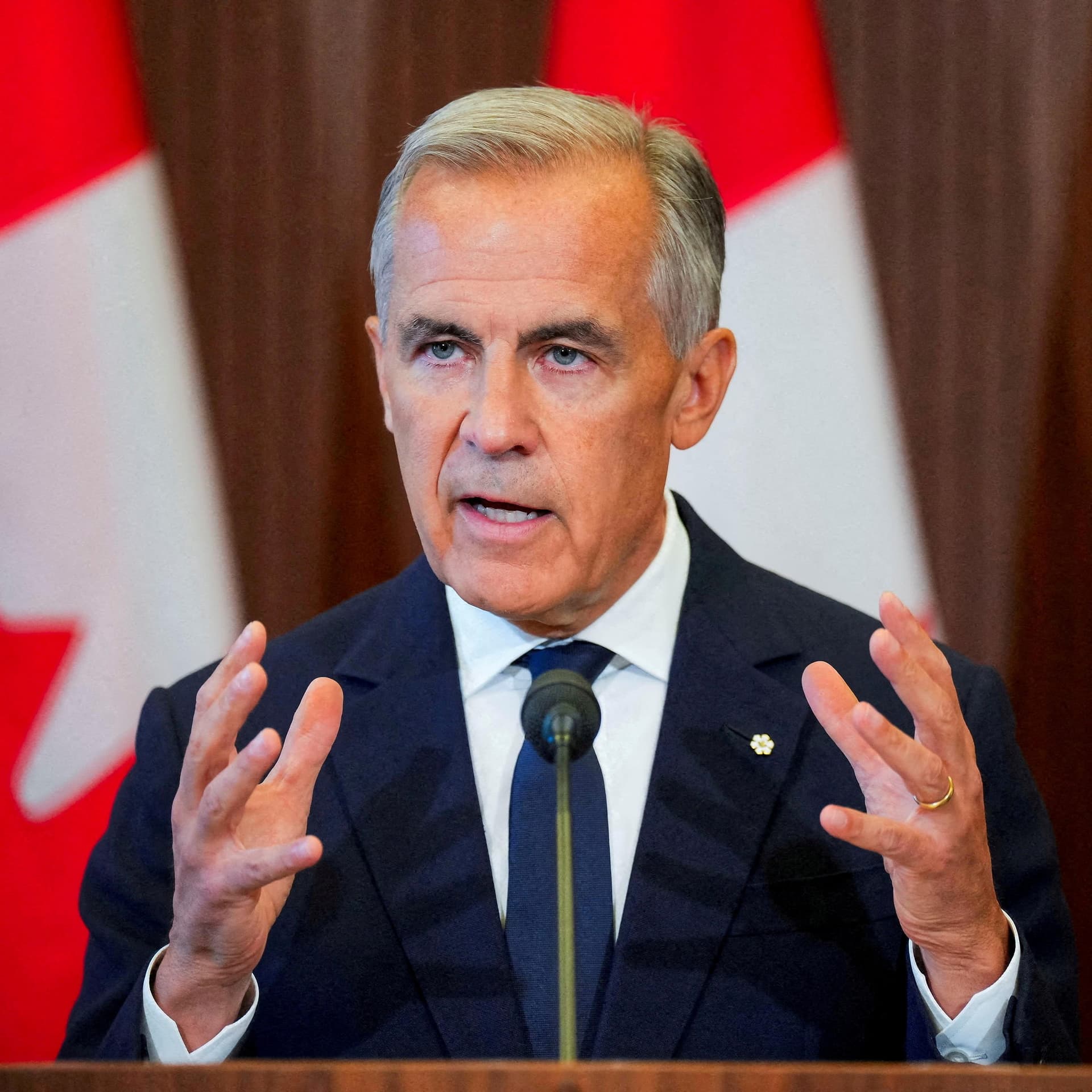
(Photo: Canada’s Prime Minister Mark Carney speaks with the news media after he suspended trade negotiations with the United States, in Ottawa, Ontario, Canada August 22, 2026. Credit: Chris Tanouye/Reuters)
Producers: Hannah Moore and Xandra Ellin Executive producer: Martine Powers Sound engineer: Travis Evans Senior news editor: China Collins