
In short
A siege by Israeli settlers on a Palestinian family compound in the West Bank village of Qusra, and what it signals amid rising settler violence and settlement expansion.
Guests/backgrounds
John Donison, BBC correspondent; reported from the West Bank (based 2009–2013) and returned to cover the siege; interviewed from East Jerusalem. Louis Ritty, Palestinian-American; owns a house in the besieged area; watched via security cameras.
Key claims
Settlers (about 15–25) set up a tent, blocked exits, cut electricity/water, blocked food/water and ambulances, and aimed to starve families out and take land. Israeli forces initially arrived but allegedly did little; later bulldozers flattened outposts, yet settlers returned. Palestinians allege soldiers allow settler impunity; UN says ~six attacks/day on Palestinian communities this year.
Notable examples
Qusra raid where soldiers took over ~11 houses; families kicked out; one home reportedly had food destroyed and $1,500 stolen. U.S. ambassador Mike Huckabee called the settlers “Israeli terrorists.”
Written by AI. May contain mistakes. Listen to the episode to check what was said.
Chapters
Tap a time to open that second in VOIntroducing Louis Ritty's Story
0:23 to 1:31
Discover the plight of Louis Ritty, a Palestinian-American under siege.
“He owns and runs a chain of gas stations in Ohio, And for the last several days, he'd been watching his home away from home through security camera footage as strangers surrounded the outside.”
John Donison's Reporting from the West Bank
1:32 to 2:06
Hear from journalist John Donison about the current situation in Kusra.
“And today on The Global Story, is the West Bank reaching a tipping point?”
Understanding the Siege and Settler Tactics
2:07 to 3:45
Learn about the siege tactics employed by Israeli settlers in the West Bank.
“and we caught up with him from where he was staying in East Jerusalem.”
The Nature of Settlements in the West Bank
3:46 to 6:00
Explore the distinctions between settlements and outposts in the region.
“and they set up a tent outside this house and basically were blocking the people living in those houses from getting out.”
Israeli Military Response to the Siege
6:01 to 8:18
Examine the role of the Israeli military during the settler siege.
“And then sooner or later, you find that electricity is being put in, running water is being put in.”
Palestinian Families' Experiences During the Siege
8:19 to 11:27
Hear firsthand accounts of Palestinians affected by the siege and military actions.
“And I think what Palestinians are asking is, you know, how can it be that, you know, one of the most powerful armies in the world can't disperse a few dozen settlers?”
Settler Violence and International Law
11:28 to 14:00
Discuss the broader implications of settler violence in relation to international law.
“The IDFS says, look, we're sending in an extra battalion.”
The Settler Siege and International Law
14:00 to 16:27
Discusses the illegal actions of Israeli settlers and their impact on Palestinian families.
“which is to, in effect, clear the land of Palestinians in the West Bank and make it theirs, which I reiterate is illegal under international law.”
Israeli Military Actions and Palestinian Life
17:39 to 24:33
Details recent military actions in Palestinian villages and the impact on families.
“and they told these families they had half an hour to all move into one house.”
Settler Ideology and Government Support
24:33 to 26:19
Explores the ideology of settlers and the support from Israeli ministers for settlement expansion.
“John, you've covered Israel and the Palestinian territories for a number of years.”
Transcript
Automatic transcript. May contain errors.0:00This BBC podcast is supported by ads outside the UK. If you are currently overpaying on software to run your business, remember this number, 10 ,000. That's the number of new businesses that join Odoo per month. Join Odoo today at odoo.com. That's O-D-O-O dot com. There's this guy named Louis Ritty. He owns and runs a chain of gas stations in Ohio, And for the last several days, he'd been watching his home away from home through security camera footage as strangers surrounded the outside. Louis built the house on land that was farmed by his family for generations so that his daughters could have a base in his home village where they could connect their roots.
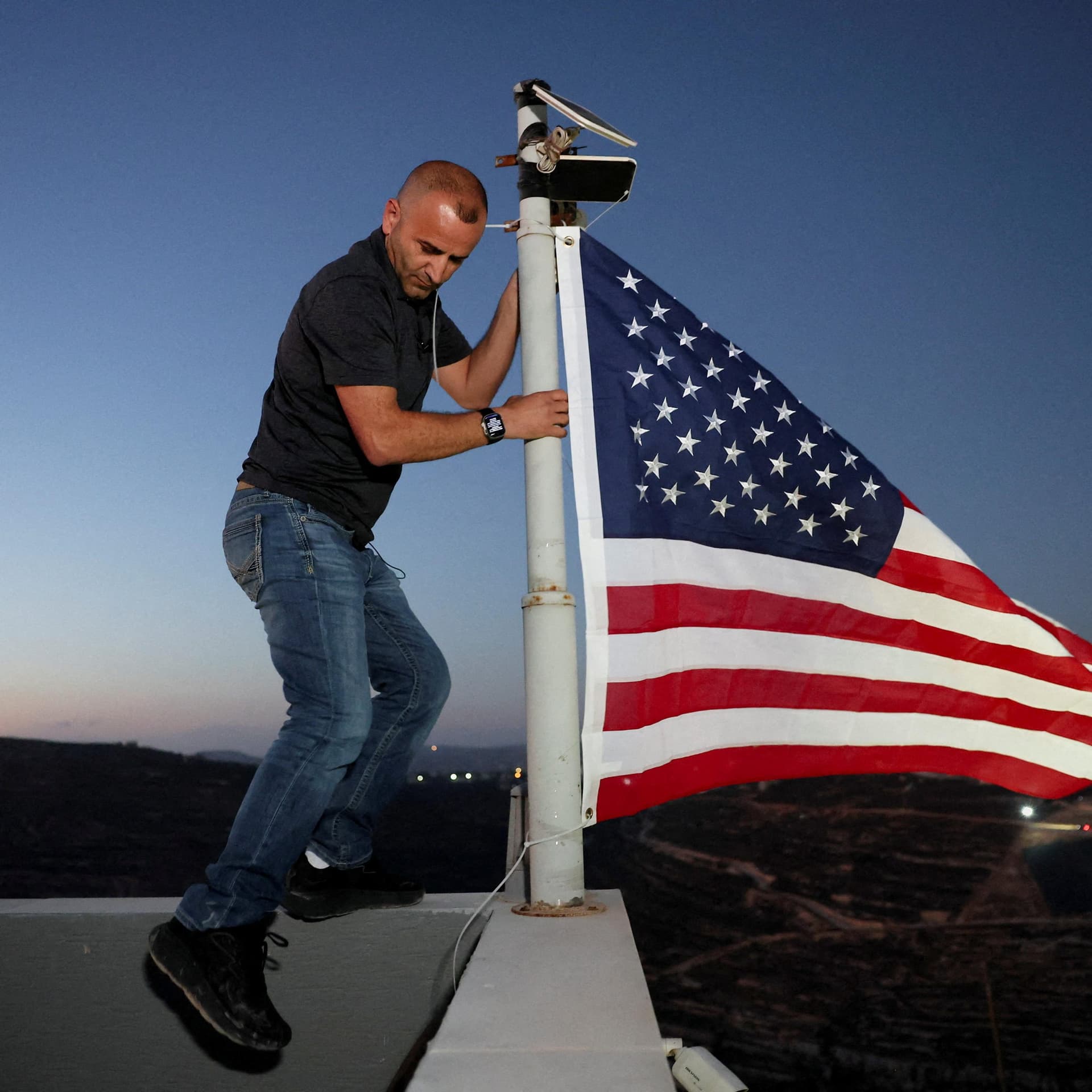
0:45And the story of Louis' house has become international news. That's because Louis is Palestinian-American. His home village is in the West Bank. And those strangers putting his house under siege are Israeli settlers. On Monday evening, Louis arrived at his family home after flying in from the U.S. He climbed to the roof of his house and raised an American flag against the setting sun. My brother was under siege. Now I'm declaring it, I'm under siege too. So we're on the same boat right now. As the siege on his house enters its second week, And in a year where settler violence has reached unprecedented levels, according to the UN, where could this all lead?
1:31From the BBC, I'm Asma Khalid in Washington, D.C. And today on The Global Story, is the West Bank reaching a tipping point?
1:46I'm just in the garden of our hotel and I can hear the birds chirping. and I'm sitting trying to get some shade behind an olive tree. John Donison is a BBC correspondent who's reported from the region for years and was based in the West Bank between 2009 and 2013. Last week, he traveled to the village in the West Bank where the siege is taking place and we caught up with him from where he was staying in East Jerusalem. Well, we spent two days up in Kusra at the end of last week when this was all unfolding. and Kusra is a small Palestinian village of maybe a thousand people and the houses that have been under siege I guess they're just outside the village up on a hillside it's a kind of compound with three four houses where two Palestinian families live and this is in the middle of the West Bank really the occupied West Bank about a bit of a drive south of a big city called Nablus, a big Palestinian city.
2:49And, you know, the West Bank is very much disputed. And the West Bank was captured by Israel in 1967, along with Gaza and the Golan Heights. There's around about, I guess, 50 miles separate Gaza and the West Bank. Along with East Jerusalem is what Palestinians want for a future Palestinian state. So for For decades now, there have been negotiations over whether a Palestinian state could be established. Well, it is on that land where they want it. And these clashes last week are to do with the long-running conflict and dispute over this land. The siege that you spoke of, when did it begin? And what were the settlers doing?
3:40It began on Sunday of last week. and basically the settlers went to this house and they set up a tent outside this house and basically were blocking the people living in those houses from getting out. They were blocking food and water from getting in. They cut off the electricity and the water to the buildings and at various stages they were also blocking attempts for ambulances to get there. And there were two sort of extended families living in these three or four buildings that make up this sort of compound, including young children. And the settlers, this is a new tactic. They were really laying siege to it to, I guess, starve the people out.
4:29Oh, wow. And with a view to take over that land. And we're not talking about a lot of settlers who were doing this. These were maybe 15, 20, 25 settlers. Now these settlers live in what are called outposts. So there are settlements across the West Bank, there are more than 130 settlements that are illegal under international law. And these range from big cities. We're not talking about tent encampments, we're talking about big cities where hundreds of thousands of people live in some cases. With running water and electricity. Yeah, like a city, you know, like a city you would see in the United States or in London.
5:13So I think sometimes when you talk about settlements, you imagine something temporary. These are not temporary. These are big cities with lots of houses and everything that a city has, like infrastructure. Now, there are also these outposts. Now, an outpost is actually also illegal under Israeli law. And these are really very much more temporary. So they might involve porter cabins, caravans, tents. And what settlers do who believe that the land in the West Bank, which they call Judea and Samaria, was given to the Jews by God, they set up these outposts with a vision that they will one day become an established settlement.
5:58And that is what often happens. So it starts off very, very small with a few caravans and port-a-cabins. And then sooner or later, you find that electricity is being put in, running water is being put in. And then they often develop into, with the backing of the Israeli government, into a city development or small town development. And they are popping up really all over the West Bank. And, John, we know this in part because there's been camera footage, which you could describe as CCTV footage, of first the settlers swarming in. You also see the Israeli military arriving. Can you walk us through that?
6:38I mean, at what point do Israeli authorities arrive? And what happens then? Well, the families contacted the IDF, the Israeli military, on the first Sunday, so on August the 9th, and they said, look, you know, The settlers are laying siege to our property. You could see video of the settlers sort of dismantling these dry stone walls and throwing rocks in the road to try and block the road. And the Israeli army did go quite quickly. But there is quite a lot of crossover between the settlers and the army. So some settlers serve in the army. They have strong links with the army. and when these first Israeli soldiers arrived, there was actually footage of them praying alongside the settlers and not really doing very much to remove them.
7:30Now, when we were there, which was kind of on day four, day five of the siege, the Israeli army were there. Well, we've tried now to drive up the road towards the four besieged houses, but we've hit this Israeli army roadblock. They say we can't go any further, but just on the hillside, further up under the trees, you can see what looks to be three, four settlers just squatting, and then a bit beyond that hill, there are several more right next to the houses. They had blocked off the roads, leaving to these houses, but they still weren't really doing very much. They did go in eventually. Overnight, Israeli military bulldozers moved in.
8:14They flattened the illegal encampments known as outposts. But within a few hours, the settlers were back. And I think what Palestinians are asking is, you know, how can it be that, you know, one of the most powerful armies in the world can't disperse a few dozen settlers? And one interesting thing that happened late last week was actually some activists tried to walk up to these three or four houses to offer support to these Palestinian families, to take them food. And very quickly, you saw large numbers of Israeli soldiers blocking these activists and completely stopping them and getting rid of them.
8:55You know, they were firing rubber bullets, they were using tear gas, and they did manage to get rid of those people very, very quickly. So the Palestinian view is that the army allow the settlers to work, operate with impunity. And for example, while we were there last week, the Israeli army actually went into the main village of Qusra itself, which I guess is maybe a mile away from where these houses are. It's now about 10 hours since the Israeli forces raided the village of Qusra. You can see it's very, very quiet. And they took over 11 or so Palestinian houses. They ordered those families to leave, saying those buildings were needed for military purposes.
9:36The families were kicked out for, you know, 10, 11 hours. Now, some of the families have been allowed to go back, but the soldiers are still inside others, and we've seen them up on the rooftops. We met Kahir Ode, one of those kicked out. I was asleep in the morning, my brother and I. They came in and broke down the door, shouting, open up, open the door. Even now, I still can't process what I saw in front of me. There was more than 20 of them, maybe 30.
10:16When we actually went to visit these houses, you found that they had really been treated in a disrespectful way. They hadn't been too badly damaged, but one family house we went into, the soldiers had clearly, like, they'd roasted a chicken. So the soldiers apparently came into the kitchen, they went through the fridge, threw quite a lot of the food out, threw two chickens out the window, cooked one, and you can see one just left on the sideboard there, but they've left quite a mess. The family said they had stolen$1 ,500 in cash from hidden in a wardrobe. There were cigarette butt ends everywhere and empty cans of Coke.
10:58And it kind of looked like the soldiers had been having a rest there. So the view is from Palestinians is that soldiers are not really there to help them. They make the situation worse. Injad, what has the IDF said about this, about using people's homes as rest stops, about the ineffectiveness of actually removing settlers? Well, they have said that in terms of taking over these houses, that they are there to protect the civilian population and that they needed these houses. That's what they're doing. The IDFS says, look, we're sending in an extra battalion. I think a battalion is made up of about 800 soldiers.
11:35So they're sending in reinforcements. And with regards to the actions of these settlers who are besieging the house, Well, the senior leadership of the Israeli military has strongly condemned these actions. They seem to be saying, look, these are a few bad apples. It's a handful of extremists. And what they're doing is unacceptable. And indeed, there are Israeli ministers. The prime minister has in the past has condemned the action of these settlers. But they don't really seem to do anything about it. And I think what's interesting with this is, you know, this story has got a lot of attention, I think, because it was this new tactic of besieging a house.
12:18But incidents like this, like settler violence is at an all time high. So the United Nations says that on average this year, there have been six attacks on Palestinian communities every day. And often those attacks involve physical violence. So we've had Palestinians killed this year in settler related violence. We've had many more injured. We've had properties burnt, farmland burnt, olive trees cut down. It's happening on a daily basis. And this is just one small incident, which I think has got the attention because it was this new tactic. But I think it's nothing new. And in terms of these kind of raids on Palestinian villages and towns that are taking over houses, this is also happening on a daily basis.
13:05You know, I have a WhatsApp feed on my phone where I get alerts telling me every time there is an Israeli raid or an operation on Palestinian villages. And it is not an exaggeration to say I'm getting dozens of alerts coming through every day. But it has been going on for a long time and it has got notably worse, particularly since the war in Gaza started on October the 7th. And the accusation from human rights groups and Palestinians is that the settler movement, with the backing of far-right ministers within the Israeli cabinet, have accelerated settler expansion under the kind of cover of the war in Gaza, the war in Lebanon with Hezbollah, the war with Iran, and that because the world's attention has been elsewhere, they've been using that to accelerate their vision, which is to, in effect, clear the land of Palestinians in the West Bank and make it theirs, which I reiterate is illegal under international law.
14:12The way in which this story began to bubble up in the mainstream press here in the United States was when last Wednesday the U.S. ambassador to Israel, Mike Huckabee, put out a message on social media referring to those involved in this settler siege as being Israeli terrorists. And I'm going to quote him here. He says, actions by those who carried out this horrific act of terror meant to intimidate and harass this family are disgusting. No excuse for such thuggish behavior. And it is worth noting for listeners who may not be extraordinarily familiar with Mike Huckabee, that he has had a long history in American politics here, and he has been sympathetic to the settler's cause of the past.
14:57In fact, in 2017, he himself said, there is no such thing as a West Bank. It's Judea and Samaria. There's no such thing as a settlement. So it's in that context that you have to kind of interpret what he is saying in this moment. I think that is a very, very good point. You know, those words of condemnation were very, very strong. I interpret it as they recognize that the actions of what is a small number of settlers, often quite young, is damaging for the international reputation of Israel. But they don't really do anything about it. Did the comments from U.S. officials put any additional pressure on Israeli authorities to deal with the settlers?
15:43Well, you would imagine that they might, but they We haven't done it yet. And certainly during this whole siege incident, I have only seen reports of one settler being arrested. Israel is a country of law and order. We do not accept vigilantes. We do not accept their violence. We've condemned it, and we're acting against it. And I was listening to the Israeli Prime Minister's spokesperson the other day, David Mensah, and he was saying, look... Because of the action of our government in the first quarter alone of this year, more than 350 investigations were opened and there have been 35 arrests.
16:24So we do take this extremely seriously. But convictions are incredibly low. It is very rare for settlers to be convicted for any of this violence, including incidents where people have been killed. That happens very, very occasionally. And the accusation from the United Nations, from Palestinians, from human rights groups is that if rarely people are sentenced, the sentences are very, very lenient.
17:06I'm Brooke Gladstone, co-host of WNYC's On the Media. Information doesn't just inform us, it shapes how we see the world, what we fear, and who we trust. That's where On the Media comes in. Each week we investigate how information flows, who controls it, and what that means for our democracy. It's not about the headlines. It's about the hidden structures behind them. Don't be a passive consumer. Listen wherever you get your podcasts. What happened at the end of the last week was the Israeli army went into these houses and they told these families they had half an hour to all move into one house.
17:48now some of the family members did manage to get out I was actually just by the roadside in Kusra and I came across these two young girls I think they were age four and two with their mother and they had managed to get out and they were actually looking at their houses pretty wistfully and sadly and they were now in effect homeless staying with family members now one of these houses is owned by a Palestinian-American, Louis Riddie, who we've heard from. Hundreds of IDF soldiers came into the village. Then they approached the house, they entered the house, and my brother thought they're coming to remove the settlers.
18:31While the settlers in front of the house, they asked my brother, he needs to leave the house. His brother lives in one of these houses. My brother, he's fear for his life and his son's life, to be honest with you. And I feel his frustration from 6 ,000 miles away watching all this happening live on the security cameras until they cut it off. Yeah, it's terrifying for the entire family and the village. Now, he is quite a successful businessman in the United States, and he has been lobbying very hard the State Department to try and get them something to do about it. I really appreciate what the ambassador, Mike Huckabee, called the Israeli terrorists.
19:17That's really great news. And this is rare to happen. But we would like him and the embassy team to follow up and make sure those terrorists are being removed from the area. So we need a follow up from the U.S. government. This situation has put renewed focus on the violence in the West Bank, as you say. And as we have been having this conversation, I can't help but think of an interview that our colleague Lucy Williamson did recently with The Settler. It sounds like you're saying one Jewish life is worth hundreds or thousands of Palestinian lives. Not a million. One Jewish life, it's 10 million, OK?
20:01That just sounds racist. Yes, I know. I know. But this is the truth. Because God chose us. Because of this, you are jealous. John, what is the ideology of settlers? What is their broader aim or justification for attempting to drive Palestinians from their homes, from their villages? Well, I think it's important to say that there are a broad range of settlers and a broad number of reasons why Jewish settlers choose to live in these settlements, which, as I say, are illegal under international law. So they are not all as ideologically fervent as these individuals who are carrying out violence, besieging homes.
20:50Many settlers choose to live in settlements because it's cheaper. And they might live in a settlement and then they can commute to go and work in Tel Aviv. They can commute to come and work in Jerusalem where property prices are much higher. There are some settlements which are made up almost entirely of the ultra-Orthodox Jewish community who sometimes feel that they are ostracized within mainstream Israeli society, so they choose to live in settlements. But there are others who are ideologically committed. They see it as the land that was rightfully given to them by God. And within the Israeli government, you have two ministers within the cabinet.
21:35You have Itamar Ben-Gavir, the national security minister, and Bezalel Smotrich. He's the finance minister. And these two have been on the record as saying the aim of settlement expansion. And I'm not talking about these little outposts. I'm talking about the expansion of huge residential neighborhoods. There's one just to the north of Jerusalem called E1, where they are planning huge expansion. And they have said the aim of this expansion is to make a future Palestinian state impossible by laying facts on the ground. So in effect, to split the West Bank into so many parts that a Palestinian state becomes impossible.
22:12Now, it used to be Palestinians who made that accusation. But you now have Israeli ministers boasting that that is what they're trying to do. And, you know, just in the last few weeks, we've heard from Prime Minister Netanyahu. He has said under his watch, there will not be a Palestinian state, which I should say has been the aim of the international community, including the Americans, for decades. You know, all American presidents of all stripes have backed the establishment of a future Palestinian state and they have supported the negotiations to try and get that in the West Bank. And the settler movement makes that very, very difficult.
22:51And over the weekend, the Israeli defense minister, Israel Katz, announced that law enforcement powers in West Bank settlements could be transferred to the Israeli police, which comes under the authority of the national security minister, Tamir Ben-Gavir, as you had mentioned. What would that mean? And when you speak to Palestinians, do they have concerns that this could further entrench the Israeli occupation in the West Bank? Yes, they do. And certainly the idea that the people controlling the West Bank and controlling Palestinian lives in the West Bank would be Itamar Ben-Gavir is not something that Palestinians want to hear.
23:32I mean, he is a man who recently has pushed very, very hard for the reintroduction of the death penalty for alleged terrorist offenses committed by Palestinians. that law passed. He has talked about clearing Gaza of Palestinians and getting Palestinians to migrate out of Gaza and fully resettling the Gaza Strip with Israelis, which again is something that is completely against most of the international community's plans for the rehabilitation of Gaza. So the idea that the kind of administration and the control of the West Bank would be passed on to the police, it is that sort of idea that it is making it more permanent.
24:19It's incorporating the West Bank more into Israel itself. And, you know, the fear is that when moves like that happen, there is no way back. John, you've covered Israel and the Palestinian territories for a number of years. over the span of at least 15 years. And so you know that violence in the West Bank, it is not uncommon. But as you've been reporting on what's been going on over the last several days, do you sense that we're at some sort of tipping point? I don't know that we're a tipping point, but we're at a low point from the Palestinian perspective. You know, I'm not sure that anything is going to change, but certainly, you know, I was based in the West Bank and Gaza for four years between 2009 and 2013.
25:12And then in the last three years since the war started in Gaza, I've been coming back and doing a lot of work here. And it is really, really striking to me to see the expansion of settlements.
25:27So we drove up from Jerusalem to Kusra last week, and you go up the main Highway 60. and all along that route there are first of all there are Israeli flags every 25 meters doing it this is ours and then on the hilltops there were these outposts you just look up and you see these caravans these porter cabins and then you know on the other side of the valley you'd see a new settlement when you would drive up that road 15 years ago there were nowhere near as many established settlements or outposts as there are now.
26:11Well, John, thank you for spending time to walk us through this story. Thank you for joining us on The Global Story. It's always a real pleasure. You know, I think these stories, they're complicated and it's good you give them so much time to try and delve a bit deeper into it.
26:42That was the BBC's John Donison speaking to us from East Jerusalem. And a reminder that you all can always reach us here at The Global Story with any questions or story ideas. The best way to get in touch is through our email address, theglobalstory at bbc.com. And even if we can't get back to everyone, we do read those emails. So please keep them coming. A special thank you to Karen, who wrote in asking for an episode on vaccines, saying that there is so much to discuss. We agree there is a lot to discuss. And we, in fact, did an episode about a year ago. It was last September about vaccines.
27:16You might have to search for the specific name because it's been a while. The episode was titled The Disgraced UK Doctor Behind Autism Misinformation. Of course, the story around vaccines lives on and it is one we are going to continue to keep an eye on. Today's episode was produced by Sam Chantarosik. It was edited by James Shield and mixed by Travis Evans. Our senior news editor is Chyna Collins. And I'm Asma Khalid. Thanks, as always, for spending some time with us. We'll be back again tomorrow.
From the publisher
Two Palestinian families in the village of Qusra in the West Bank have been under siege by Israeli settlers for over a week. The Palestinian-American owner of one of the homes traveled to the West Bank from Ohio on Monday, after asking for protection from the US embassy.
His visit comes after the US ambassador to Israel, Mike Huckabee, called those involved “Israeli terrorists”, amid mounting international pressure on Israel’s government to deal with the situation.
We speak to the BBC’s Jon Donnison, who has been reporting from Qusra, and ask whether the West Bank is at a tipping point. Producer: Sam Chantarasak
Executive producer: James Shield
Mix: Travis Evans
Digital producer: Matt Pintus
Senior news editor: China Collins
Photo: Palestinian-American Loui Ridi, whose home in the occupied West Bank has been encircled by militant settlers for more than a week, hangs a U.S. flag after gaining access to his besieged home in Qusra. August 17, 2026. Credit: Ammar Awad TPX/Reuters.