
In short
The BBC asks why President Trump is supporting Argentina with a $20 billion currency-swap/lifeline, seemingly contradicting “America first,” and whether it’s meant to stabilize Javier Milei’s peso and protect his political survival.
Guests and backgrounds
Ione Wells, BBC South America correspondent who has covered Milei and interviewed him in 2024. Tristan Redmond (host, London) and Asma Khalid (host, Washington) moderate.
Key claims
The US Treasury finalized a $20B currency-swap framework and also bought pesos on Argentina’s open market, but details are unclear. Critics (including Elizabeth Warren) call it a foreign bailout using emergency funds. The deal is framed as buying Milei time to avoid a politically suicidal faster devaluation and potential peso collapse.
Notable examples
Milei’s viral “chainsaw” anti-bureaucracy campaign symbol (gifted to Elon Musk) and his rock concert with 15,000 attendees; Argentina’s inflation over 200% annually, poverty around 40%, and dollar use due to peso weakness.
Written by AI. May contain mistakes. Listen to the episode to check what was said.
Chapters
Tap a time to open that second in VOMillet's Rock Concert
0:00 to 0:37
Discussion on Javier Millet's rock concert and personality.
“This BBC podcast is supported by ads outside the UK.”
Millet's Rock Concert
3:00 to 4:34
Discussion on Javier Millet's rock concert and personality.
“why is President Trump ditching America first economics to rescue Argentina?”
Understanding Currency Swaps
4:34 to 6:04
Explaining the financial deal between the US and Argentina.
“did you ask him what his favourite Stones songs were?”
Character of Javier Millet
6:04 to 7:44
Exploring Millet's eccentric character and political style.
“So what we know is that the US Treasury have finalized this$20 billion currency swap framework with Argentina.”
Chainsaw Metaphor in Politics
7:44 to 9:46
Discussing Millet's use of chainsaws as a political symbol.
“He was an economist for a time in Congress, but he really kind of became notorious, I think, for being a very eccentric commentator on TV.”
Argentina's Economic Crisis
9:46 to 12:12
Overview of Argentina's economy prior to Millet's election.
“I think they have a very strong relationship.”
Millet's Economic Reforms
12:12 to 14:00
Detailing the drastic economic changes implemented by Millet.
“Yeah, it was just, it was extraordinary.”
Economic Changes Under President Milei
14:00 to 16:48
Explore the drastic economic measures taken by President Javier Milei and their impact.
“What sort of drastic change has he brought about now?”
Public Reaction and Economic Success
16:48 to 19:16
Discuss the mixed reactions to Milei's economic policies and the perceived successes.
“Where he started to get quite irritated and much more tense is when I asked him about the human impact of some of his policies.”
US Intervention: A Financial Bailout?
19:16 to 22:10
Analyze the proposed US financial assistance to stabilize the Argentine peso.
“One, I think it goes back to this question of who was this success for?”
Show all 12 chapters
Political Risks of Economic Support
22:10 to 24:16
Examine the political implications for Trump and the risk of supporting foreign interventions.
“But I think, you know, this is risky, not just, I think, financially in terms of the taxpayers' money and what happens to this money.”
Comparing Economic Strategies
24:16 to 26:59
Contrast the US's current economic interventions with historic free-market approaches.
“Can you explain to us, please, what's at stake for Millay for these elections?”
Transcript
Automatic transcript. May contain errors.0:00This BBC podcast is supported by ads outside the UK.
0:30business needs in one place, saving you time, headaches, and serious money. Stop paying for missing pieces. Go to odoo.com. That's O-D-O-O.com to learn more. Self-directed investing, trading, full-service wealth management, automated investing, financial planning, thematic investing, retirement planning. Phew. And to think, that's just a small taste of what Schwab offers. because Schwab knows that when it comes to your finances, choice matters. No matter your goals, investing style, life stage or experience, Schwab has everything you need all in one place so you can invest your way. Visit schwab.com to learn more.
1:13You may be wondering why U.S. taxpayers are giving Argentina a$20 billion lifeline. And maybe it's not just because of economics, but politics. OK, there is a video you all might have seen. It went viral a few months back of Elon Musk during his Doge days. He was on stage in front of a cheering audience wielding a chainsaw. This is the chainsaw for bureaucracy. Chainsaw! It's an unsubtle metaphor for slashing government spending. and Musk didn't come up with it by himself. Javier Millet from Argentina, you guys know what that is, right?
1:57Musk's chainsaw was a gift from Javier Millet, the president of Argentina. The chainsaw has been his trademark for a few years now. The one he gave to Musk had his catchphrase written on the blade, Viva la libertad, carajo, which means long live liberty, damn it. Great guy. He's a big Trump guy. He loves Trump. I love him because he loves Trump. President Trump is a huge fan of Millet. He's a MAGA guy, but it's a slightly different form of MAGA. He is make Argentina great again. That's pretty good. Millet is an economist who has promised to transform Argentina's finances. So how come the Trump administration is now bailing him out?
2:47Millais expected at the White House on Tuesday, partly to work on the nitty-gritty of this deal. From the BBC, I'm Tristan Redmond in London. And I'm Asma Khalid in Washington. And today on The Global Story, why is President Trump ditching America first economics to rescue Argentina?
3:11Well, Ioni, thank you and welcome back to the show. Thank you for having me back. Ione Wells is the BBC's South America correspondent, so she's been following Millet's presidency. She even interviewed him last year. Just a couple of days ago, Millet held a rock concert, singing in front of 15 ,000 people. Can you tell us more about that, please? Yeah, so he took time out from the election campaign to do a rock concert, as you do. He was dressed in his quite distinctive leather jacket. There was lots of pyrotechnics. he proceeded to perform an hour or so of Argentine rock classics. Can I hear it?
3:50Is this it?
3:56It's quite bad, isn't it?
4:01That's what I was going to say. I'm not so talented myself, but I'm not sure how I feel about this.
4:11so there you have him chanting give me fire give me fire can I just say objectively speaking I'm not sure anyone on that stage was singing in tune I don't think so either but the crowd loved it so there we go apparently he's a massive Rolling Stones fan he is he is I actually have chatted to him about this oh wow okay so you actually met him when you interviewed him didn't you did you ask him what his favourite Stones songs were? I did, and it was probably the only time that I managed to make him smile or laugh a bit. He sort of broke his quite steely facade. He told me that it was very hard to pick a single song, but he believes the one that he loves the most is Rip This Joint, which he very specifically said is the second song on side A of disc one of the album Exile on Main Street, recorded in a Paris basement while they were, in his words, escaping, I think this is important.
5:05It says a bit about his kind of general psyche. He says this was recorded while they were escaping the burden of asphyxiating fiscal pressure in the UK. So he feels this album has a strong libertarian component to its history. That's true. They were tax exiles in France. Yeah, but he was actually in a Rolling Stones tribute band. So he's a big fan. He's a big fan. So Millet's rock concert, it was kind of part of his political campaigning in the run-up to the midterm elections this month. He is personally not up for re-election, but these midterms are essentially a referendum on his whole political project.
5:40The polling suggests that momentum is against him, and it's going to take more than concerts to turn it around. Luckily, he also has this new financial deal from Donald Trump. Ioni, can you tell us in a nutshell what this financial deal is about. I have seen the headlines. It seems like a major announcement from the Trump administration in terms of what they are willing to do to help rescue Argentina's economy. Yeah. So what we know is that the US Treasury have finalized this$20 billion currency swap framework with Argentina. But also they've said that they have bought pesos just on the open market in Argentina as well.
6:19But the US Treasury haven't yet provided any more details, including on the amount of pesos that they purchased on the open market, but also exactly how this currency swap is going to be structured. Ioni, can I actually follow up on that? Because currency swap is not a layman's term here. So can you explain what a currency swap is? Yeah, so usually what this involves is two countries' central banks essentially agreeing to swap their currencies. So essentially this would be the US agreeing to give$20 billion to Argentina in exchange for the equivalent in pesos. In theory, a currency swap is less risky than other kinds of loans because essentially it is just swapping currencies and agreeing to have them bought back at a later stage.
7:05So the US in theory wouldn't lose money unless though there is some kind of catastrophe if Argentina defaulted on its debt, its currency collapsed completely, for example, that could still be a risky move for the US. And there's of course still a political risk too in the US that this is perceived as a bailout at a time that some US lawmakers are really not happy about that. Well, we've got a lot more questions about the deal itself, and I want to get back to that. But first, Ioni, can you tell us about Millet himself? What kind of character is he? How would you describe him? Well, Millet isn't really an ordinary politician at all.
7:41He didn't have much political experience before he came to power. He was an economist for a time in Congress, but he really kind of became notorious, I think, for being a very eccentric commentator on TV. He was described by some people as El Loco, the crazy one. There were lots of sort of viral clips of him in the past smashing up a model of the central bank on television. He talked about the political class as la casta, the cast, calling politicians rats and parasites, maybe not dissimilar there to some of Donald Trump's rhetoric around draining the swamp. He's got this sort of very distinctive look.
8:20He's got big sideburns, quite a sort of crazy hairstyle. So that's kind of the image of Millet that I think many people might be familiar with or might have seen pictures of over the last couple of years. I mean, he's often compared to Trump because of his populism, his eccentricity and his kind of anti-woke agenda. Could you tell us more about those aspects of him, please? Yeah, he certainly has been compared to Trump, I think, for being or framing himself as an anti-establishment conservative politician. They both have talked about sort of anti-woke issues. Millay, for example, has been outspoken about sort of criticising what he describes as gender ideology.
9:00He plays up to that sort of socially conservative rhetoric. But actually, what he really cares about, what he's really fascinated with, is economics. He's defined himself as an anarcho-capitalist. He believes in shrinking the state. In an ideal world, he doesn't want any state, really. He's criticized the state as being this evil entity at times and wants a total return to free markets, to an ultra-liberalization of the market. So that is his guiding ideology. And that's actually an area where him and Donald Trump have a lot of significant differences. And yet I know that Malay appears to be rather close with Trump.
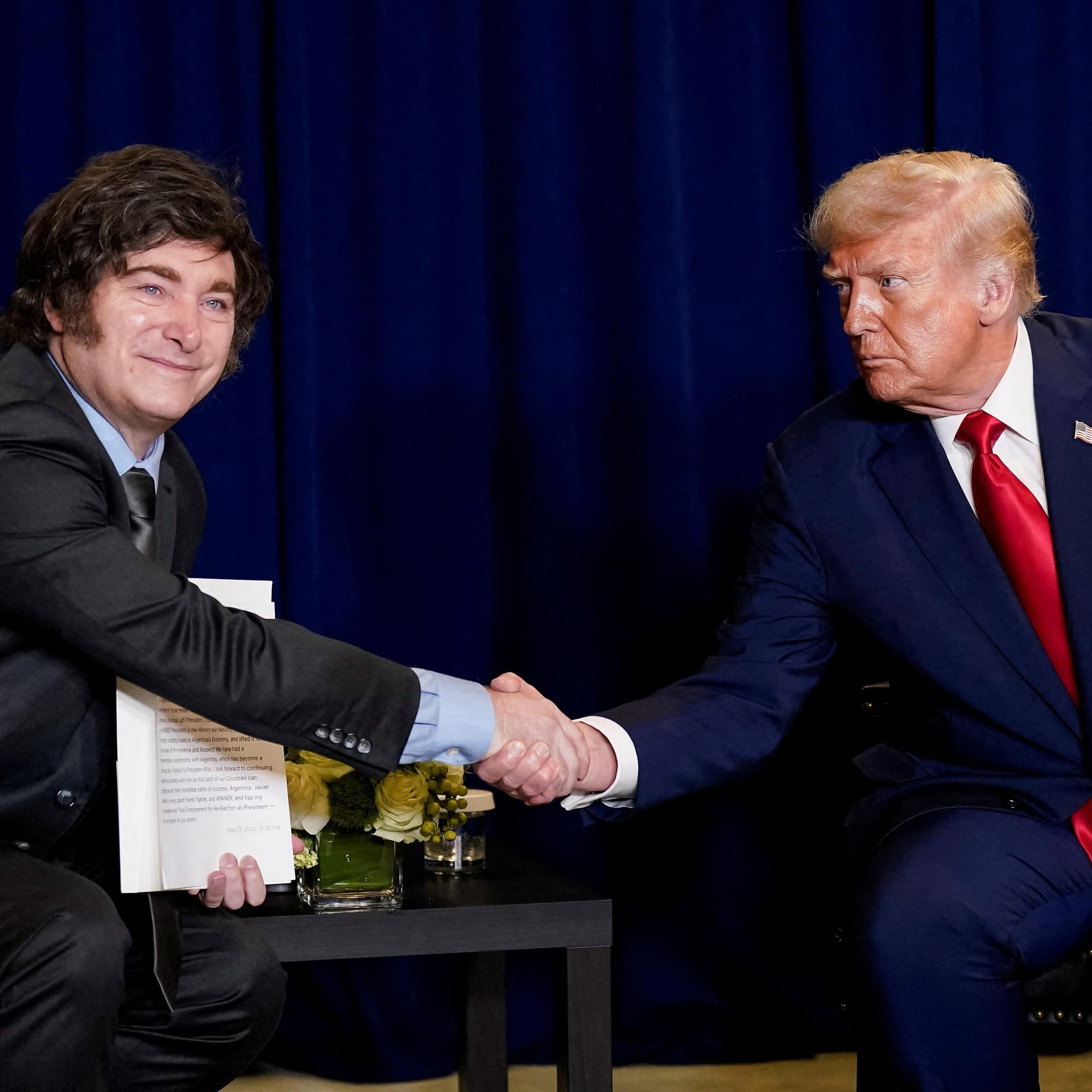
9:41He was here, in fact, at Trump's inauguration this past January. How would you describe the relationship? I think they have a very strong relationship. They clearly get on well. They like being seen together, pictured together. That was really great. And Javier, I'd like to congratulate you on the job you've done for Argentina. of your speech was beautiful, but the job you've done is incredible. He was the first foreign leader to meet him. He's been to Mar-a-Lago lots of times. Make Argentina great again. You know, MAGA. He's a MAGA person. And you know, he's doing that. Donald Trump's described him as his favorite president.
10:21And Millet has been very complimentary of Donald Trump as well. But you know what? I think your numbers are working also. You've done a fantastic job in a very short period of time. It's an honor to have you here. Can you explain to us what is Millet's particular relationship with chainsaws? And is he the reason the chainsaw is also kind of a symbol in some respects in US politics? Yeah, so the chainsaw was basically a symbol, a metaphor, if you like, although a very literal metaphor because he used to carry this on his campaign rallies.
10:59He felt that what needed to happen was radical action, that he needed to take a chainsaw to the government. He went viral as well, you may have seen, for ripping government ministries off a whiteboard shouting afuera, which basically just means out. Essentially sort of symbolising how he was just going to chuck away all these different government ministries.
11:29His guiding principle was that for too long the state had been far too large, and that resonated a lot with voters who felt frustrated at years of economic turmoil in the country, of high inflation. There was a lot of corruption scandals that had rocked Argentina under various different governments. So a general sense that politics wasn't really working for people. You had mentioned earlier that Malay came in after years and years of economic turmoil, hyperinflation. Can you give us a sense of what the economy of Argentina looked like when he came to power? And what did he ultimately do to change things?
12:06When he came to power at the end of 2023, Argentina was in a complete mess. It had the worst inflation in the world, more than 200 % annually, which meant the prices were... 200%. Yeah, it was just, it was extraordinary. I mean, I remember being in Argentina at times and literally from one day to the next... Wild. Prices would change. The pesos that you had were suddenly worth less than they were the day before. It was just, it was really, a really stressful and difficult time for people. About 40 % of the country lived in poverty. There was this big difference between the official exchange rate in Argentina and the black market exchange rate.
12:42And this sounds complicated, but it is kind of important to what's happening now. Basically, because the peso was so weak, it meant that the situation was really bad for people who didn't have their savings in dollars. People would hand over huge amounts of their hard-earned pesos to these street traders that you see everywhere in Argentina just to try and buy dollars to essentially keep their savings safe because they didn't want to risk their pesos suddenly being worth nothing the next day. And the banks often wouldn't have dollars to give them. I'm always impressed when I go to Argentina how literate Argentines are about exchange rates and inflation and all these different kind of economic statistics, which I think most people in the US, for example, UK wouldn't really know about.
13:23But people have to there. I read somewhere, Ioni, that in Argentina, it's estimated that there are more US dollars circulating in cash than anywhere else in the world apart from in the United States. Is that something that stands up for you? Yeah, I think it's really interesting. It's not a dollarized economy, but unofficially, yes, people use and value dollars because the peso has been so weak for so long. This is one of the reasons that Javier Millet and many economists at the time, to be honest, thought that drastic change was needed. So that's the economic climate he inherited. What sort of drastic change has he brought about now?
14:03Well, he used the chainsaw, basically, metaphorically. He halved the number of government ministries. He cut tens of thousands of public jobs, so laying off thousands and thousands of workers. He slashed the government budgets for pensions, for education, for health. He removed a lot of subsidies, which meant that things like utility bills, transport prices went up. How is his economic program being received by, on the one hand, Argentinians, and on the other hand, economists? So I think it's worth starting with where his successes have been. His commitment to getting debt down, spending in a responsible way, did kind of change the perception of Argentina for the markets and for investors as well, from this idea of it being, to be candid, a bit of an economic kind of basket case, to somewhere that you could feasibly want to invest your money again.
14:56Argentina had its first fiscal surplus in 14 years, which means that it's spending less than it's earning, which is something that, to be honest, most nations don't do. Inflation fell from those triple figures annually that we were talking about to single digit monthly inflation, which is much more manageable. You know, there is a lot of caveats to this. And I think it has posed the question, who is this success being for? And is it really success unless it can be sustained? When I speak to opposition politicians or even just a lot of ordinary Argentines and business owners, they feel that there is one campaign promise that he really hasn't kept.
15:33And that is that he said that these changes would be paid for by la casta, by the political elites, businessmen, the political class, not the people. His critics feel that that hasn't happened. And in fact, it has been the people who have paid the price. he initially when he first came to office he devalued the peso by 50 percent that initially meant that inflation went up a huge amount but then as people started to spend less because their money was worth less they had less people were really struggling then I remember being in a supermarket and I just asked a woman how life was and she just burst into tears so people were really people were really struggling and very scared about what was happening.
16:15President Millay Thank you so much for speaking with BBC News today. You've actually interviewed him back in 2024, I think, Ione, haven't you? I'd like to start this interview firstly by talking about the economy. And you challenged him on the state of the economy. You have got inflation down, but you promised that the political class, not the people, would pay. I spoke to a pensioner here who told me that in tears that this, in her words, was a lie, that with cuts to pensions, salaries, the value of people's money, it's people like her who are paying. What would you say to her?
16:55Yeah, I mean, I think one of the things that I found really interesting interviewing him was he is incredibly fluent when it comes to talking about economic theory, about the latest GDP stats, about fiscal deficits, about how he's got the deficit down. Where he started to get quite irritated and much more tense is when I asked him about the human impact of some of his policies. I think, excuse me, President, and with respect, the information people have access to is the prices they're seeing in supermarkets. I mean, for example, do you know how much a litre of milk costs now in Buenos Aires? That was actually a clip that kind of ended up going quite viral in Argentina because people sort of held it up as an example of him being out of touch about the real impact of some of the cuts that he was making.
17:36And I think this is something that's really interesting because he's tended not to care very much about politics. He doesn't really ever kind of get out very much. He doesn't visit provinces and witness the anger of people who are affected by his cuts or the slums where people are suffering from poverty. I've been to a lot of soup kitchens in Argentina, for example, where fights are breaking out over scraps of food. He doesn't really see a lot of that and engage in a lot of that. But even the politician who might be sort of abstract, immune from all of that, that ultimately they will face elections and there are electoral consequences.
18:12And presumably that matters to him because he wants to stay in power. Yeah. And it matters to him and it matters to the markets too, that if he's to continue his agenda, he needs to stay in power. And we're already seeing what can happen when you don't have political support because recent election results in the Buenos Aires provincial elections, which was for the sort of, yeah, the state legislature. His party lost really badly. Admittedly, this is an area that is traditionally a left-wing stronghold, but he had a very negative reaction. He was on the campaign trail at one point and people pelted his convoy with rocks.
18:52So that election was almost a trigger for not only him, but also, I think, investors, the markets, to realize that his political fortunes might be at risk if he continued this economic project in the way he's been doing. Ione, it sounds like his economic gamble isn't necessarily paying off. I think what we're seeing is, well, there's two things. One, I think it goes back to this question of who was this success for? Yes, the markets were happy at some of the macro gains that he had made. But as we've discussed, some of them came at a cost to normal people, to local businesses. But if normal people don't feel the benefits of that, if that's only helping markets and investors and his popularity starts to go down, not only is that having an impact on ordinary people and having a social impact, but markets also start to lose confidence that his program is going to be sustainable.
19:47Essentially, they think he might get kicked out of office.
19:55In a way, as I say, that's where politics and economics are sort of interrelated. Another thing, which we've touched on a bit, is how the way that he's been devaluing the peso at this sustainable rate, keeping it sustainable but also draining Argentina's reserves as a result, is something that has also spooked investors. Because if he keeps doing that, the fear is that the country could run out of dollars to pay its debts in the new year. It owes billions of dollars of debt in the new year. And that is why some economists think that Argentina isn't just heading for a recession. they also think it could be heading for a financial crisis.
20:30If that happens, then any successes he's achieved on the macro front could well be pretty rapidly undone. And this is all why his friend, Donald Trump, is thinking about helping him out.
20:53Just so I understand, What you've described going on with the Argentinian currency is the Argentinian government spending its reserves to prop up the value of the peso. And now there is this deal on offer from the United States,$20 billion to stabilize the peso. Is this a case of instead of the Argentinian government propping up the peso, the US government is spending its money to do exactly the same thing? Or is something else going on here? That is my understanding. As I say, we don't have the detail yet. So it's significant because it's a large amount of money. It's also significant, though, because it's very risky for the United States.
21:31I mean, that's what I wanted to ask you about, Ioni, because already we are seeing lawmakers criticize the idea that this is a foreign bailout occurring at the expense possibly of American taxpayer dollars. And Argentina is a country that for several decades, frankly, doesn't have the best track record of always paying its international creditors. I mean, Argentina has probably one of the worst reputations globally for paying its debts. So there is concern that it would be very risky for American taxpayers. Some defaults in the past have left investors facing huge losses when it comes to Argentina.
22:06It has the biggest debt already to the IMF of any nation. So it is, yeah, I think there's a chance it could be very risky for American taxpayers. But I think, you know, this is risky, not just, I think, financially in terms of the taxpayers' money and what happens to this money. But also, I think, you know, there is a political risk for Trump doing this too. He's pledged an America first policy, and yet he's looking at propping up at another country's currency at a time when Americans are struggling. You may have seen this letter that was written by Elizabeth Warren, the top Democrat on the Senate Banking Committee, who wrote to Scott Bessent basically making this point saying it's deeply troubling that the president wants to use significant emergency funds to inflate the value of a foreign government's currency and bolster its markets at a time when Americans are struggling with their own bills and costs.
22:56Yeah, and she's a Democratic lawmaker, but Republican allies also will have criticism of this type of foreign government intervention, which makes me wonder what's in it for Trump. It contradicts the kind of America first policy that a lot of Republicans have been championing. And I think, yeah, your question about what's in it for Trump, he has these political allies, these right wing allies around the world that for sort of some reason he wants to prop up and support, even if it comes at a political cost to himself, as if kind of the project of conservatism and right wing values is almost paramount and more important to him than necessarily whether it's a good idea.
23:34I mean, that being said, there are significant U.S. investments in Argentina. And perhaps some of this is about trying to sort of make sure that trade relations, that investments that have been made don't kind of derail. But I think, yeah, a lot of this also seems to be political, that Trump likes Javier Millet, that the U.S. government likes his projects, that the markets, that Wall Street likes his project. And therefore, they want to keep it successful. And they want to keep him in power, you're saying. Yeah, keep him in power politically, but also avoid that financial crisis that many think would happen if the peso does kind of completely collapse.
Read the full transcript
24:13Ioni, there are more elections coming up in Argentina later this month. Can you explain to us, please, what's at stake for Millay for these elections? This is the legislative midterms. Why this matters is it will basically affect President Malay's ability to pass and defend his economic agenda in Congress. That then also dictates whether the markets will retain their confidence in his program. A bad result would make that a lot harder. It would basically make it really hard for him to actually do anything, in which case I think markets would be asking the question, well, how long is his economic agenda actually going to even last for.
24:51So I think that's kind of what's at stake really in these elections. So today at the White House, we'll see Donald Trump meeting with Javier Malay. And I think what is so bewildering about this entire story from my perch here in Washington is that it is a remarkable moment of intervention from an America first president in another country's economy. And I just want to make sure I can understand this all, because it sounds like Donald Trump is basically given a financial boost to another country's economy just ahead of their elections. Some would say that sounds like electoral interference. Yeah, I think that's what his critics will certainly feel.
25:37And I think the alternative for Millet at the moment would be to let the currency devalue at a much more rapid rate, which many think would be just politically suicidal. And so this US intervention is seen as a way to buy Millet time. I think the big question is really, is it really sustainable? Does it just buy time or does it actually solve a problem? It's interesting, though, to me, because we've talked a lot, I think, throughout this conversation about the differences between Donald Trump and Javier Millet. And it's interesting that we're almost seeing a bit of a reversal of history here, because the US in the past, I think, was seen as very much the case study for free market capitalism.
26:23And in the past, when we look back to the 20th century, it was Latin America who was being told to adopt these things by the US. Now, the US economy is much more interventionist. And Millais is very much applying a much more kind of free market, liberal approach to capitalism. And Donald Trump is kind of talking the talk of free markets abroad and supporting this project, but is actually intervening quite a lot at home. And so I think you're right to question his motivation here, because it is political in the sense that this is a conservative ally of his. But political in terms of matching Trump's project, I don't think it really is at all.
27:09Ione, they always say that if a good friend asks to borrow money off you, you should only lend it to them if you're prepared not to get it back again. Is Donald Trump going to get his$20 billion back? God, I mean, I worry that anything I say would, you know, maybe that will impact markets, who knows? It's like, not that I'm someone that the market's listening to, but there we go. The big risk here is if he's swapping$20 billion for the equivalent right now in pesos, and the peso does collapse, then who knows? He may well have significant losses. Maybe he'll be proved right. But I think all I can say is that the current economic situation feels very, very fragile.
27:57but Argentina is not looking like the safest investment right now.
28:06Thank you, Ioni. Thank you very much for having me. And we'll see what happens next. Thank you. Thank you so much for coming back.
28:18That was the BBC's South America correspondent, Ioni Wells. And folks, that's it for the global story for today. Our episode was produced by Viv Jones, edited by James Shield and engineered by Neil Churchill. Our senior news editor is China Collins. And I'm Asma Khalid. And I'm Tristan Redman. If you enjoyed today's show, you can delve back into our feed and find more from Ioni. A few weeks ago, we spoke with her about the prosecution of Brazil's former president, Jair Bolsonaro. And if you like the show, rate us wherever you're listening. See you tomorrow. Cheerio.
28:56Thank you.
From the publisher
President Trump’s administration may have frozen foreign aid but this week it’s giving Argentina a $20 billion lifeline. It's a move his critics are suggesting is more about politics than sound economics. Argentina’s president, the chainsaw-wielding Javier Milei, is a friend and close ally of Trump’s. On on Tuesday, Milei will visit the White House to discuss the details of this new rescue plan. We ask the BBC’s South America correspondent, Ione Wells, whether Trump is ditching ‘America First’ economics to bail out Argentina, or whether this is a financial gamble that could pay off.
Further reading: "How Milei's 'Thatcherite' economics divided his nation - but won over Trump" https://www.bbc.co.uk/news/articles/c9865l8540eo
Producer: Viv Jones. Executive producer: James Shield. Mix: Neil Churchill. Senior news editor: China Collins. Photo:Reuters/Al Drago