
In short
The episode explains why Hungary’s Prime Minister Viktor Orbán’s upcoming Washington meeting with President Donald Trump is tense despite their close ties. Topic: Trump’s plan to pressure Russia to end the war in Ukraine by imposing secondary sanctions on countries buying Russian oil, specifically targeting Russia’s major oil firms Lukoil and Rosneft. Key claim: the sanctions would be “particularly painful” for Hungary because it gets roughly 70–90% of its gas and about 80% of its oil from Russia, and Orbán has resisted EU pressure to switch.
Notable examples
Orbán’s “mouse and elephant” metaphor for Trump; Hungary’s 2015 migrant stance and border-fence rhetoric; CPAC Hungary as a MAGA-linked ideas exchange.
Guest
Nick Thorpe, BBC Budapest and Central Europe correspondent since 1986, who has covered Orbán for decades and attended CPAC events from outside.
Written by AI. May contain mistakes. Listen to the episode to check what was said.
Chapters
Tap a time to open that second in VOSetting the Stage: Orban and Trump
0:54 to 2:36
Discussing the relationship between Viktor Orban and Donald Trump amid current tensions.
“Good, bad, billionaire from the BBC World Service.”
Historical Context of Viktor Orban
2:36 to 4:47
An overview of Viktor Orban's political journey and influence in Hungary.
“And could there now be trouble brewing in the Trump-Orban bromance?”
Orban's Political Strategies and Ideology
4:47 to 7:46
Exploring Viktor Orban's political strategies, ideologies, and their appeal to Trump supporters.
“President, can you tell us a little bit about why you're elevating sanctions against Russia right now?”
Orban's Endorsement of Trump: A Contrarian Move
7:46 to 10:41
Analyzing why Orban endorsed Trump and the implications of that support.
“take Hungary much more seriously, this little mouse, if it's got Mr.”
Understanding Illiberal Regimes
10:41 to 14:04
Clarifying what Orban means by an 'illiberal regime' and its significance.
“I think you have to understand why Viktor Orban, the prime minister, is such a crucial figure to Donald Trump and his supporters.”
Understanding Viktor Orban's Political Stance
14:04 to 14:51
Learn about Viktor Orban's contrarian political approach and illiberal regime.
“And that was very different than leaders in other countries.”
Orban's Shift from Liberal to Majoritarian Democracy
14:51 to 15:59
Explore Orban's transformation from an anti-communist to a majoritarian democracy advocate.
“of multi-party democracy and an imagination that all Hungary and the other Central Europeans had to do was to sort of imitate what was happening then in the United States, in Germany, in France, in the United Kingdom.”
Donald Trump's Influence on European Politics
15:59 to 17:48
Examine the connection between Donald Trump's rise and Orban's strategies in Hungary.
“One can talk about the urbanization of the European Union, the urbanization of the United States with a lot of these things either accidentally or deliberately being copied by the US administration.”
The CPAC Conference in Hungary
17:48 to 19:27
Discuss the significance of the CPAC conference and its influence on Hungarian politics.
“Nick, have you been to any of the CPAC conferences in Hungary?”
Hollywood Influence in Political Gatherings
19:27 to 20:44
Analyze the showbiz elements in political events and their impact on the audience.
“And why did they set up an outpost there as well?”
Show all 13 chapters
Orban's Relationship with American Conservatives
20:44 to 25:13
Unpack the relationship between Viktor Orban and the American conservative movement.
“here in Hungary and Central Europe for the thinking nationalists, as it were, to develop a narrative which says that the West is in decline.”
Implications of Orban's Potential Election Loss
25:13 to 27:44
Consider what a loss for Orban could mean for Trump and Hungary's political landscape.
“hesitate to invest here because they're not certain that the courts, if it comes to arbitration or a dispute, would rule in their favor and they might lose their investment.”
Introduction to First America Podcast
28:54 to 29:16
Learn about the podcast 'First America' and its exploration of U.S. history.
“150 years ago, they were hunting us down to kill us, and now they're hunting down immigrants to deport them.”
Transcript
Automatic transcript. May contain errors.0:00This BBC podcast is supported by ads outside the UK.
0:07150 years ago, they were hunting us down to kill us, and now they're hunting down immigrants to deport them. This is First America, the true story of how the United States came to be and how we got to this present moment. Listen to First America wherever you get your podcasts.
0:53and asking you to decide if they're good, bad, or just another billionaire. Good, bad, billionaire from the BBC World Service. Listen now or search for Good, Bad, Billionaire wherever you get your BBC podcasts.
1:10Nick Thorpe:The Hungarian Prime Minister Viktor Orban is coming to Washington DC on Friday to meet with President Trump in the White House. And for the first time, at least that we're aware of, these two friends don't seem to be on the same page. It all comes down to Trump's latest move to pressure Russia into ending its war on Ukraine. Trump wants to hit Russia's economy hard so that Putin runs out of money to fight the war. Trump's threatening to punish any country who's still buying Russian oil with harsh secondary sanctions. And that's a major problem for Hungary. Viktor Orban is friends with both Trump and Putin, and his country relies heavily on Russian oil and gas.
1:58Viktor Orban has done a tremendous job in so many different ways. For the leader of a small, central European country, Viktor Orban really punches above his weight on the international stage. Highly respected, respected all over Europe. Probably, like me, a little bit controversial, but that's OK. For years, he's been honing a political model that's hugely influenced the MAGA Republican playbook.
2:30From the BBC, I'm Tristan Redmond in London.
2:33Nick Thorpe:And I'm Asma Khaled in Washington, D.C. And today on The Global Story, how did Hungary's prime minister inspire some of Trump's most radical domestic policies? And could there now be trouble brewing in the Trump-Orban bromance?
2:54I'm Nick Thorpe. I'm the Budapest and Central Europe correspondent for the BBC and covering Hungary, Romania, the Balkans, Bulgaria, sometimes further afield. I've been here since 1986, so I came here still during the communist system. Oh, wow. Amazing.
3:13Nick Thorpe:And still there. That's amazing. What was that like living through those end of 80s, early 90s years? It must have been incredible. It was incredible. It was especially pretty much every story I did was a scoop at that time because there were either no other foreign journalists here, certainly no other correspondents actually based here. So it was a very exciting time. It's probably the most exciting time of all, actually. It's been downhill ever since. Well, I mean, you've seen the whole range of Viktor Orban back from the early days through to now. I mean, that's a lot of Victor Orban. It is.
3:47He rang me, actually, when he was trying to launch his career to ask if he could come around and tell me about his plans. And I invited him to my flat, put on the kettle, made him a cup of tea, said he didn't stand much chance, but I was happy to report on his existence.
4:05Nick Thorpe:Nick, I'm not sure about your political predictions, I will say, but I do appreciate your reporting. Thank you. Yeah, it's always a bit tricky making predictions. I always fall flat on my face on that front. Well, we wanted to start by asking you about a trip by the Prime Minister of Hungary, Viktor Orban, to Washington, D.C., which is coming up on Friday. These are two men who have a pretty close political affinity, a pretty close friendship. But the visit is happening with something of a cloud. There is a rare tension between these two men. What is the reason for this tension? The tension is that Donald Trump appears to have decided that the main way that he can pressurize the Russian president, Vladimir Putin, to end the war in Ukraine is to hit him where it hurts.
4:57Mr. President, can you tell us a little bit about why you're elevating sanctions against Russia right now? To harm his war chest, his campaign chest, effectively. Today is a very big day in terms of what we're doing. Look, these are tremendous sanctions. These are very big. Those are against their two big oil companies. By imposing sanctions on the two biggest Russian oil companies, Lukoil and Rosneft. And we hope that they won't be on for long. We hope that the war will be settled. And that's particularly painful for Hungary because Hungary gets 80 % of its oil, somewhere between 70 % and 90 % of its gas from Russia.
5:40Viktor Orban has held out against EU pressure to wean itself off Russian oil and gas. Mr. Orban here in Hungary has said this is cheaper and that Hungary wants to keep supplying cheap energy for its own consumers. Therefore, it's resisted the pressure until now. So probably what spurred this urgent meeting in Washington is this very painful, for Mr. Orban personally, very difficult problem of one of his great allies, Donald Trump, suddenly imposing sanctions, actually harming Hungary's ability to get cheap oil and gas from Russia. And I guess coming to Washington now, he's probably hoping to ask him to postpone those sanctions on Luke Oil and Rosneft until after April next year, when Viktor Orban is facing a crucial parliamentary election here in Hungary.
6:36Nick Thorpe:Well, Nick, a moment ago, you referred to Orban and Trump as great allies. They seem to be rather kindred spirits. I mean, wouldn't they from your vantage point as well? Absolutely. Victor Orban really went out on a limb to endorse Donald Trump for his first term when he was much more sort of demonized. People weren't sort of cozying up to him then as they are now across Europe. He very boldly, recklessly, many would say, backed Donald Trump in 2016 and then again last year. And so this time in the run up to Mr. Trump's latest election, just a month or so before Beforehand, Viktor Orban said in one of his regular interviews on state radio that he compared Hungary with its population of below 10 million to a mouse crossing a bridge.
7:31And he said that if Mr. Trump is re-elected as president of the United States, Hungary will then have an elephant crossing the bridge beside it. And people will take, especially I think he was referring to his fellow EU members, will take Hungary much more seriously, this little mouse, if it's got Mr. Trump as the elephant walking beside it. Just after Donald Trump was elected, I had the opportunity to put a question to Viktor Orban at a press conference here in Budapest. Thank you. Nick Thorpe from the BBC. Prime Minister Orban, in a recent interview, you compared Hungary to a mouse on a bridge.
8:08And you said that if Donald Trump won the election, Hungary would have an elephant next to it. Do you foresee any danger that the elephant might by accident tread on its friend, the mouse?
8:25That's why we Hungarians think that the mouse must be quick. To compensate the difference of scale. I was thinking then of tariffs, but now we have this perhaps less expected move of Donald Trump against Russian oil, And this seems to be another way in which the elephant might inadvertently tread on the mouse.
8:47Nick Thorpe:Nick, you just mentioned this meeting in Washington and alluded to the fact that Viktor Orban wants to see a delay at a minimum of these sanctions. Is that the primary goal he has in coming to Washington this week? What ultimately does he want to come away with? I think ideally he would convince Donald Trump and the US administration to drop the idea of sanctioning Luke Hoyle and Rosneft, or rather to make some kind of exception for Hungary. I think Mr. Orbán would like to somehow convince Mr. Trump that Hungary is a small landlocked country in the center of Europe. It's got these big pipelines bringing oil from Russia, gas from Russia via the Balkans, and that it would be hugely expensive to wean itself off those, and that it would harm the Hungarian consumers, whom, of course, Mr.
9:46Orban is supposed to represent as prime minister here. And of course, he would also say, I guess, that it would really harm his chances of re-election next year if utility prices are suddenly seen to go up. So it's very much in Mr. Orban's interest to try and convince Donald Trump to find or create some kind of elbow room, some kind of exception for Hungary.
10:10Nick Thorpe:Nick, you had mentioned that this is all happening in the context of an election next year, next April, in which Viktor Orban, you're saying, wants to see a delay of these sanctions until then, because this could really put his re-election bid in peril. And I think in order to understand why an election in a fairly tiny country in Europe, what some nine and a half million people, let's say smaller than the state of North Carolina here, matters so much, even here in the United States, particularly to folks within the MAGA orbit. I think you have to understand why Viktor Orban, the prime minister, is such a crucial figure to Donald Trump and his supporters.
10:55Nick Thorpe:And so I want you to help us understand how Hungary first got on the MAGA Trump radar. When did that begin? Well, Viktor Orban, you know, he's been in power here since 2010. So he's been in power for 15 years. But he had previously been in office from 1998 to 2002. So he is by now Europe's most experienced politician. He's won four elections in a row, and he has a two-thirds majority in the Hungarian parliament. His ideology has been a national Christian conservative, a pro-family approach, a pro-nation approach, make Hungary great again. And obviously, that chimed with MAGA Republicans. But it's not just about the slogans of office.
11:52He's also been pressing an idea of strengthening national sovereignty, of building border fences, border walls to keep out migrants. In 2015, Viktor Orban went against the mood of the times led by Angela Merkel in Germany to welcome, or at least try to allow a certain number, a pretty high number, of asylum seekers into the European Union. Viktor Orban from the start said, migrants are potential terrorists. Migrants have to be kept out. We don't want, as he said, sometimes controversially, a mixed country, a mixed race country. We want to keep Hungary for the Hungarians. Migrants are a burden.
12:40They don't contribute, he has argued. And he even echoed the Middle Ages of Hungarian kings who built fortresses, keeping out the Ottoman Turks, again, the Muslim hordes, a Muslim invasion. So to that extent, he placed himself in what was pretty much a far-right tradition, what some would call an extremist right-wing tradition here, similar to far-right or much further right groups like the AFD in Germany, the Rassemblement National in France, Gerd Wilder's party in the Netherlands. So all of these things brought him to the attention of MAGA Republicans, who were also very keen on strengthening the wall on the U.S.
13:23border with Mexico, on putting national jobs, national interests first and against this whole idea of a federal Europe in which countries abdicate some of their powers in the interest of a stronger federal Europe.
13:38Nick Thorpe:Nick, you describe the immigration situation in Hungary in 2015. And I am reminded of covering the U.S. presidential campaign during that same time period here in the United States. And as Trump was running that year for president, 2016, I will say much of the world was stunned. World leaders didn't know what to do. But as you mentioned earlier, Viktor Orban endorsed him. He embraced him. And that was very different than leaders in other countries. Why did Orban do that? He's a contrarian-minded politician. He loves to fight. He loves fighting liberals, above all. And he loves taking part in the culture wars.
14:26Viktor Orbán's first speech, declaring that he wanted to build an illiberal regime, was actually in 2014, so going back a long way. All of these speeches were attracting attention.
14:43Nick Thorpe:Can I pause you, Nick, there when you say illiberal regime? Is that what you just said, illiberal regime? What does that mean? What Viktor Orban meant by that, and though he was criticized even by some in his own camp for using that, he says that basically with the transition from communism to democracy in the early 1990s, there was this great embrace of multi-party democracy and an imagination that all Hungary and the other Central Europeans had to do was to sort of imitate what was happening then in the United States, in Germany, in France, in the United Kingdom. and copy the model of liberal democracy, of consensual democracy.
15:26For Orbán, I first knew him in the late 1980s as an anti-communist politician. Basically, he became an anti-liberal politician and he saw this constant seeking for consensus as a weakness, as a watering down, as a failure to stand up for the values he says he believes in, the family, the nation, national sovereignty, Christian values. In electoral terms, in that speech in 2014, he started talking about majoritarian democracy. In other words, the winner takes all. And you've then got four years, or eight years, or in his case now, perhaps 16 years, to basically rewrite the country's laws to change its judges, to reshape its institutions in your own image, which of course we're now seeing Donald Trump doing in the United States.
16:22One can talk about the urbanization of the European Union, the urbanization of the United States with a lot of these things either accidentally or deliberately being copied by the US administration. Okay, well, when Donald Trump comes into office in 2016 in his first term. What happens? I don't think Mr. Orbán at that time, or the Hungarian Fidesz government here, was really on Donald Trump's map. It's very different this time.
16:56It is amazing to be here in Budapest. CPAC conferences have been taking place regularly in Hungary. I want to talk today about the battle for the heart of Western civilization.
17:08Nick Thorpe:And we should just pause for listeners and explain. CPAC is the large conservative political action conference. It's happened here in Washington, D.C. for years and years. I'm honored to address so many patriots in Hungary who are proudly fighting on the front lines of the battle to rescue Western civilization. So just a couple of years back, it spread its wings into Hungary. And that confirms that I am in good company here in Hungary. A lot of big names from the United States, from the Republican MAGA party have been coming to Hungary. Hungary has become one of the most successful models as a leader for conservative principles and governance in Europe.
17:47Make America great again. Make Europe great again. Hoyra, Donald Trump.
17:57Nick Thorpe:Nick, have you been to any of the CPAC conferences in Hungary? Have you attended any of them? I've been outside on the pavement. They don't let journalists that are not on their side into the room. You know, I have over 40 years. I've very good personal relations with Viktor Orban, with many people in his government, with many people in the satellite think tanks and so on built up around it. They would tell me happily what was going on inside. A lot of the sessions were live streamed, but I could not be accredited because the BBC is labelled by CPAC as a kind of hostile organisation. Although all I was trying to do, like my fellow journalists, was to invite them to share their ideas, to tell us what's going on in the room and how that relates to other events around the world.
18:46Nick Thorpe:What was the scene like? Obviously, one could get a clear sense of the atmosphere. And I think we're seeing this in our democracies around the world. It's becoming more and more like show business. There's a lot of razzmatazz, a lot of very finely polished video clips. And each person comes onto the stage with this roar of applause. It's a sense of Hollywood there. So that's certainly the atmosphere, which the Hungarians have learned pretty fast. In this case, I think it's pretty much been a one-way traffic. One had a sense that they're being trained in the United States or that they've been spending a lot of time in MAGA circles somehow.
19:26What's the extent of the links between Hungary and the American conservative movement?
19:33Nick Thorpe:And why did they set up an outpost there as well? I think it was a way of consolidating that friendship and that exchange of ideas between Victor Orban's party here and the MAGA Republicans in the US. So it was a way of supporting one another and helping them get re-elected, strengthening their backbone in a way.
20:04I think when Victor Orban sort of burst on the scene, you know, he was very much seen in Europe as a sort of joke figure, as a black sheep. He was mocked. I think people imagine this as a sort of semi-authoritarian, almost dictatorial kind of country, which is actually quite far from the truth. That one of the sort of ironies of all this is that Budapest is a very livable city. Hungary is a very livable country. And a lot of this is kind of political noise, political circus or political theater. So you have a sense here of Viktor Orban having created this illiberal ideology with the help of the MAGA Republicans and feeding off one another.
20:43He's created a kind of intellectual backstop for the elites in the US MAGA movement, for the elites here in Hungary and Central Europe for the thinking nationalists, as it were, to develop a narrative which says that the West is in decline.
21:16150 years ago, they were hunting us down to kill us, and now they're hunting down immigrants to deport them. This is First America, the true story of how the United States came to be and how we got to this present moment. Listen to First America wherever you get your podcasts.
21:44Hi, I'm Simon Jack. I'm Zing Zing. And together we host Good Bad Billionaire, The podcast exploring how some of the wealthiest people on the planet made their money. And we are back with a new season. From sporting superstars to music moguls and celebrity CEOs. We'll be taking a closer look at the lives and fortunes of some of the world's richest people. And asking you to decide if they're good, bad or just another billionaire. Good, bad billionaire from the BBC World Service. Listen now or search for Good, Bad, Billionaire wherever you get your BBC podcasts.
Read the full transcript
22:20So, Nick, in a few months' time, in 2026, Viktor Orban is facing a general election. In the years that I've been covering European politics, Orban has always looked fairly unassailable in his position as prime minister in Hungary. But things are not looking quite so certain for him these days, politically speaking. What would it mean for Donald Trump if Viktor Orban lost an election? I think it would be a surprise for him because Viktor Orban looks so strong from the outside. I think a lot of people around the world who don't follow Hungarian politics closely would be very surprised that how can someone who's put his country, who's put himself on the global map so well, how could he lose an election?
23:05He's actually trailing by 10 % against another center-right party, Peter Madja, a man 20 years, nearly 20 years, his junior, who has also burst onto the scene like a young Orban with lots of energy and talking about what he calls the corruption, the failures of Hungary today, its health system, its public transport, that Hungary isn't working under Orban, that he's run out of ideas, that the country's running down. What it would mean for the United States would be that Donald Trump would lose a very important ally, an intellectual ally and a political ally in the European Union. And it would be the same, actually, for Vladimir Putin.
23:48Because for his critics, Mr. Orban and Hungary under this government has been like a Trojan horse inside the EU. It's been very useful for Putin to have a country which refuses to sell or deliver weapons to Ukraine, refuses to allow the transport across its territory. So it wouldn't mean geopolitically a big blow for Donald Trump or Vladimir Putin, but sort of emotionally in this extremely emotional and heated emotional world, both Mr. Trump and Vladimir Putin would lose an important ally. Do people in Hungary feel like they would lose some influence if Viktor Orban were to go? I think people in every country, including this one, vote at the end of the day for economic reasons rather than global geopolitical reasons.
24:45And if Mr. Orban does lose this election next year, it will be because people agree with the opposition analysis, which is that their standard of living is not increasing at the same speed that they would like it to. So I think people would vote above all on economic reasons. I think there is also, though, a way in which Viktor Orban's policies, and especially his influence over the courts, many companies hesitate to invest here because they're not certain that the courts, if it comes to arbitration or a dispute, would rule in their favor and they might lose their investment. This was put to me by a a Canadian businessman recently.
25:28So there is a sense in which Viktor Orban, for all his rhetoric, has taken Hungary outside the European liberal democratic mainstream, and many Hungarians might allow that to influence them.
25:45Nick Thorpe:So to summarize the Trump-Orban relationship and the stakes of this meeting here in Washington this week, If I may go back to the metaphor you outlined at the very beginning, the metaphor of the elephant and the mouse, the elephant here being the Trump administration of the United States and the mouse being Hungary and Orban. What would it mean if, as a result of this meeting, the elephant squishes the mouse? I think it would mean for Viktor Orban an urgent need to repackage that heavy foot of the elephant into some kind of victory, because it's very important for him not to be seen to be crushed, to be defeated, to have to change his policy.
26:30And of course, this summit in Washington is taking place just five or six months ahead of this crucial parliamentary election in Hungary.
26:43Viktor Orban's been the unchallenged leader of Hungary for 15 years now. Could he be about to, just at the moment when his own international fame and glory is at its peak, could he be knocked off his pedestal by the voters of Hungary? That's why the timing is crucial. So I think if the US administration insists there can be no exemption for Hungary, he would need to rapidly, using all the media, all the money at his disposal, repackage that as, look, we wanted to diversify our energy supplies anyway. I think he would be bound to lose face he would just have to find a way of packaging it but he's very good at snatching victory from the jaws of defeat
27:44Nick Thorpe:Well Nick it's been a pleasure thank you so much I'm so happy we had you on it's not every day you get to speak with a correspondent who's had Viktor Orban over for tea so thank you Thank you so much Nick Thank you
28:02Nick Thorpe:Nick Thorpe is the Budapest and Central Europe correspondent for the BBC. By the way, if you've got any ideas, thoughts, comments you want to share with us all, feel free to send us a note at theglobalstoryatbbc.com. Now, if you're enjoying the show, please take a moment to rate us wherever you're listening. It really helps others to find us. This episode was made by Viv Jones and James Shield. It was engineered by Travis Evans, and our senior news editor is Chyna Collins. Thanks, as always, for listening. We hope you all have a wonderful weekend, and we'll talk to you again on Monday. Cheerio.
28:54150 years ago, they were hunting us down to kill us, and now they're hunting down immigrants to deport them. This is First America, the true story of how the United States came to be and how we got to this present moment. Listen to First America wherever you get your podcasts.
From the publisher
The man Donald Trump has called a "great leader", and who has long provoked admiration in MAGA circles, suddenly finds himself in an unusual position – at odds with the US president on an issue of critical importance.
Viktor Orban, Hungary’s prime minister, is visiting the White House on Friday to try to resolve a dispute over Russian oil and gas. Orban wants to keep buying it, but Trump wants countries to wean themselves off Russian energy and help put the brakes on Russia’s war in Ukraine. Will Trump choose to keep an old friend close, or put pressure on Putin? We speak to Nick Thorpe, the BBC’s correspondent in Budapest, who has covered Orban since the 1980s.
Producer: Viv Jones
Executive producer: James Shield
Senior news editor: China Collins
Mix: Travis Evans
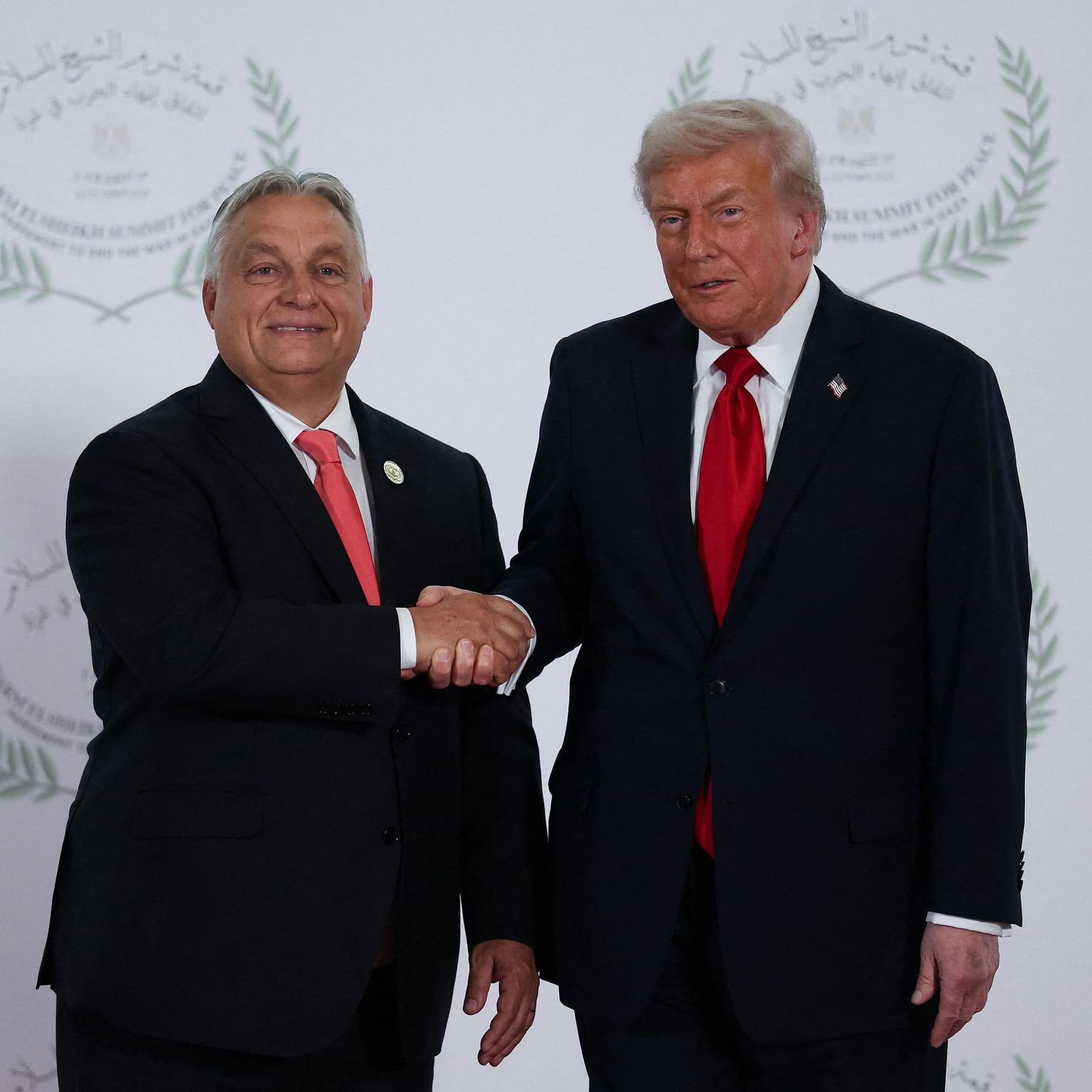
Photo: U.S. President Donald Trump and Hungarian Prime Minister Viktor Orban. Suzanne Plunkett, Reuters.