
In short
How “Made in China” became central to American consumer life, and whether U.S. policy helped China rise into the U.S.’s main economic rival.
Guest backgrounds
Elizabeth O’Brien Ingelson, academic at the London School of Economics; author of Made in China: When U.S.-China Interests Converged to Transform Global Trade.
Key claims
China’s integration into global trade wasn’t inevitable; U.S. actions in the early 1970s (Nixon’s 1972 visit and ending dollar-gold convertibility) helped enable faster capital flows and foreign investment. Early on, China often wouldn’t let Americans set up factories—so goods were made in Chinese factories and sold back. Over time, the “Made in China” label shifted from novelty/cheapness to quality and tech capability, alongside labor exploitation concerns and later Chinese industrial policy (Made in China 2025).
Notable examples
Don King’s 1976 Manhattan promotion of Chinese-made sports goods (“mystic powers”); U.S. firms like Coca-Cola (buying from China before bottling plants opened), Bank of America (carpets in Chicago branches); Apple as an emblem of U.S. branding with China-based production; FCC designations of Huawei and ZTE as national security threats.
Written by AI. May contain mistakes. Listen to the episode to check what was said.
Chapters
Tap a time to open that second in VOThe Evolution of 'Made in China'
0:32 to 2:36
Explores how China transformed into a global economic player.
“Was Made in China actually made in America?”
The Rise of the Chinese Middle Class
2:36 to 4:00
Discusses the emergence of a Chinese middle class and its implications.
“I went to China some years back and I was doing reporting in Shenzhen, which is thought to be kind of the factory of the world in some ways.”
Don King's Unique Trade Venture
4:00 to 5:48
Tells the story of Don King's products imported from China in the 1970s.
“And she's the author of the book Made in China When US-China Interests Converged to Transform Global Trade.”
The Novelty of Chinese Products
5:48 to 7:51
Examines the significance of importing goods from China in the 1970s.
“So he names this new company the Dong King Friendships Sports Clothes and Goods Corporation.”
Nixon's Visit and Opening Relations
7:51 to 9:20
Discusses Nixon's visit to China and its impact on trade relations.
“Can you tell us of the moment when China becomes a real trading partner of the United States, when its market became open to Americans, and when Americans started importing a whole lot more from China?”
Economic Shifts and Promises of Trade
9:20 to 11:33
Details the shifts in economic promises between the U.S. and China.
“And this moment when, yes, China is exciting.”
The Shift from Market to Manufacturing
11:33 to 14:00
Analyzes the transformation of China's role in global trade.
“And so the United States becomes part of an attempt at Chinese pragmatists really trying to work out how to feed its people and its economy.”
The Shift from Selling to Buying: Understanding China's Market
14:00 to 16:43
Learn about the transition of China from a market for goods to a manufacturing base in the 1970s.
“It was this idea of we can sell to China.”
Perceptions of Quality: Made in China
16:44 to 18:08
Explore how the perception of products made in China shifted from inferior to globally recognized.
“People would check sometimes the labels to see, in fact, if it was made in China and not want to purchase it.”
Apple's Role in Changing Perceptions
18:09 to 20:43
Discover how Apple's relationship with China transformed the narrative around Chinese manufacturing.
“But there is one company that in the popular imagination now is really inextricably linked to manufacturing in China, and that is Apple.”
Show all 13 chapters
China's Ambition: The Made in China 2025 Initiative
20:44 to 22:36
Understand China's strategy to become a global tech leader through its Made in China 2025 vision.
“Transcription by CastingWords new episode every weekday.”
Geopolitical Implications of China's Manufacturing Growth
22:37 to 25:05
Analyze the geopolitical concerns arising from China's advancements in manufacturing.
“In 2015, the Chinese government set out an ambitious project called Made in China 2025.”
Counterfactuals: What If Nixon Hadn't Opened China?
25:06 to 26:46
Consider the possible impacts on U.S. industry had Richard Nixon not opened relations with China.
“So we were interested in the idea that it was a through line from Chinese economic success to where we are in the world right now today.”
Transcript
Automatic transcript. May contain errors.0:00This BBC podcast is supported by ads outside the UK. Hi there, I'm Asma Khalid. And I'm Tristan Redmond. And together we're the hosts of the Global Story podcast from the BBC. For those of you who might be new to our show, we here at the Global Story dive deep every weekday on one big story at the intersection of where the world and America meet. And you can now watch the Global Story on the iHeart app. Catch every brand new episode every weekday. Just tap into iHeart to start watching. And we hope you enjoy the show.
0:38Was Made in China actually made in America? And did the US help China to become its main rival? American consumerism is driven by Made in China products. But have you ever wondered how that came to be and whether that reliance is good for the United States? Today on our show, we look at the origins and evolution of Made in China, because it wasn't actually inevitable. From the BBC, I'm Tristan Redman in London. And I'm Asma Khalid in Washington, D.C. And today on The Global Story, how did Made in China go from trashy merchandise to technological marvel? And did the U.S. actually give it a leg up so that China is now its greatest rival?
1:33So far this week, we've been mostly thinking about how the United States came to become the power that it is now. And in today's episode, we're going to be thinking about what comes next and the challenger waiting in the wings, and that's China. And you know, when I think about China, I will say I don't think it can be overstated just how much economically the country has transformed over the last five or six decades. You think of China going back to the 1950s and 1960s, and many folks didn't really see it as an economic player. You look at it now, and it is undoubtedly a global economic powerhouse.
2:14The figure that we often hear from the World Bank of 800 million Chinese people lifted out of poverty in the last 40 years, whichever way you slice it, that is an impressive number. And, you know, you could make a case that that is one of the most impressive economic success stories in human history. And Tristan, you've been seeing signs of that economic success story in parts of China for the last several years. I went to China some years back and I was doing reporting in Shenzhen, which is thought to be kind of the factory of the world in some ways. And I saw all these young people who spend their days working in some of these manufacturing facilities.
2:55And and then they are out in the evenings eating, shopping at these huge shopping malls. And that was something really new. The local journalist I was working with pointed it out to me and said, like, this is something that we didn't used to see. These are all these young people who've come from, in some cases, villages, different parts of China, who've come to work in these factories and have money to spend. It is a Chinese middle class. Well, the creation of that Chinese middle class is something we're going to be talking about today. Where did it come from? The answer is partly through extraordinarily successful reforms instituted by the Chinese Communist Party.
3:34but arguably the United States played a role in it too. The thinking was, if we help China to become more like us economically, then maybe China will become more like us politically too. But the question is now, did that process backfire? And to get into all of that today, we're going to be joined by Elizabeth Ingelson. Elizabeth is an academic at the London School of Economics. And she's the author of the book Made in China When US-China Interests Converged to Transform Global Trade. Elizabeth told a story about a very traditionally American set of products that was being mass manufactured in China and then sold back to Americans by a very big and famous American personality.
4:27We're in 1976 and Don King is a major promoter in the United States. Don King, big man, big hair, big mouth. Most famous for having worked with Muhammad Ali. Who's promoted some of the biggest fighters, Ali, Holmes, Tyson, and promoted some of the biggest fights. And arranging Muhammad Ali versus George Foreman, rumble in the jungle moment, and was this real man of showbiz. If you could define yourself seriously, without any of the overuse of words, the verbosity, in a simple way, what would you say about yourself? Well, let me say this. I'm a guy who loves people. I'm an American. I'm a people guy.
5:08I'm a promoter of the people for the people and by the people. And my magic lies in my people ties. I refuse to allow anybody to appraise me. So I bring my own appraise, only say, look, he's a visionary. It's summer 1976. He is having a party in his Manhattan apartment on the 76th floor to celebrate his new line of goods. He's moved from boxing to trade and has created a company that is importing tennis balls, basketballs, sporting goods from China. Into the United States. So he names this new company the Dong King Friendships Sports Clothes and Goods Corporation. Does it roll off your tongue?
5:56Does not roll off your tongue, no. So perhaps not so good at naming his new trade company, but what he was very good at doing was promoting these new balls, right? So he had tennis balls, basketballs, all bouncing around in his Manhattan home. Glasses of champagne are circulating, so too are balls being thrown across the room. And he, at one point, welcomes the guests and really speaks of what he sees these balls as providing. And it was reported in newspapers afterwards that he described these Chinese hockey mitts and basketballs as having, quote, mystic powers, he said. Mystic powers. Yeah. Because they were made in China?
6:43Because they were made in China. He said that, you know, these basketballs and hockey mitts would mean that players would gain more baskets and more scores. Did they have mystic powers for Don King's bank account? You know what? They did. But what was, I think, most interesting was that these balls, as you're getting at, Tristan, they were just regular basketballs, right? And what made them significant was not at all that they had mystic powers, but instead that they were made cheaply in China. And that was new in the 1970s. It was new that they were coming from China. And this is part of what was happening was the selling of goods, regular goods, was becoming more and more appealing precisely because of the Chinese origins.
7:34and the reason for that was that for over 20 years, the United States and China had no trade at all. This is in the Cold War era and China, even more than the Soviet Union, was cut off from the United States economically, diplomatically, culturally, socially. It was not dissimilar to the dynamics between the United States and Cuba or the United States and North Korea today, almost no contact at So in the 70s, one of the reasons it's so exciting is that you're getting contact and trade and engagement with a country that had been so cut off from the United States for so long. And Elizabeth, these days when we think about products being made in China, it seems given global capitalism at this point, you mentioned that in the 1970s, the idea of sports equipment being made in China was very novel.
8:27Can you tell us of the moment when China becomes a real trading partner of the United States, when its market became open to Americans, and when Americans started importing a whole lot more from China? Yeah, and I think it's really important to not take for granted that today, yes, anything you can imagine has the label Made in China on it, right? But we've got to really trouble that. What we're talking about is the world's largest communist nation is at the beating heart of the capitalist system. It's at the beating heart of trade and manufacturing and labor today. U.S.A.! U.S.A.! And so your question is, how did we get there?
9:08The biggest nation on earth, China, is in turmoil. And part of the answer has to do with this 1970s moment, this end of isolation. And this moment when, yes, China is exciting. You've got Don King and others really celebrating the access to China. So the 1950s and 60s, this is the Mao era, the Chinese revolution, the communist revolution. and what Mao was doing in the 50s and 60s was really experimenting with how to maintain a communist revolution and how to have that revolution be something that is sustainable globally. So Mao was very intent on a very different form of political economy that was not at all like what was happening in the United States in the capitalist order.
10:0117 hours ago, President Richard Nixon landed in Peking, not only the first American president, but the first Western leader ever to set foot in communist China. So the story that is, I think, so important to understanding these dynamics is a story of Nixon and Mao meeting in 1972. We have at times in the past been enemies. We have great differences today. What brings us together is that we have common interests which transcend those differences. China inviting the President of the United States, the key country that China's revolution had been in opposition to for the last 20 years. What legacy shall we leave our children?
10:50Are they destined to die for the hatreds which have plagued the old world? or are they destined to live because we had the vision to build a new world? But what's really important is that this isn't only a story of geopolitical shifts. It's also a story in which the political economy within China and experimentations of development within China begin to turn to the United States and turn to the capitalist order as a way for China to continue its efforts at finding a way to modernise and to develop. And so the United States becomes part of an attempt at Chinese pragmatists really trying to work out how to feed its people and its economy.
11:49What's really, I think, a sort of less known part of this story is the second Nixon shock that happens in the summer. So it's in 1971 that Nixon announces, hey, everyone, I'm going to go to China. So it's that shock, the China shock, it's called. But a month later, he actually announces another very surprise moment that at the time was not seen at all connected, other than the fact that it was a shock. And that is he announced that the United States was ending the dollar-gold convertibility and with it moving away from fixed exchange rates. Why that's so important and particularly important to the opening to China is that it allowed for money and foreign exchange to move faster and more freely across borders and for companies, therefore, to set up foreign direct investments even more easily.
12:42The capacity to set up manufacturing facilities and other spaces overseas is even easier. Okay, Elizabeth, if you could explain though if I were opening a basketball plant in China so we start with this moment where Richard Nixon goes to China and then a loosening of the international financial system like why is Don King and why am I and why are other American business people suddenly rushing to invest in manufacturing in China like what's the what's the thing that sparks us to do that So first and foremost, you and Dong King might want to do that. But you and Dong King face a really significant challenge, and that is that China didn't let you do it.
13:30China in this period wasn't allowing you to set up your own factories. What was happening instead was China was saying, we can make them for you in our factories and we can sell them to you. When Dong King is buying his basketballs, Mao saying, no, you can't set up shop. But why this is significant is that the Dong Kings of the world and others who are trying to sort of are so excited about trading with China are doing so even though they're not allowed to set up factories there because what they're seeing is a promise. and this promise is a very different kind of promise to what American business people and Europeans and others had seen for centuries because for centuries the promise in China had been a place to absorb other countries goods so for Britain it was cloth if all the mill makers in the 19th century Manchester were sort of saw if China just increased the length of their coats by one inch, then it would be enough to sort of fill the coffers of all the Manchester mills.
14:35It was this idea of we can sell to China. The fundamental shift that was happening in the 1970s was a vision that said we can buy from China, we can import from China. So there's a flip from China as market to China as manufacturing base. What was the very moment of that flip? You know, there was no singular moment. This is not a story of a singular moment at all. It's a story instead of slow working through what China's place in the world will be, a slow working through of what will American business people be able to achieve in China. It was very, very uncertain. It's really important to emphasize that Dong King was able to make a really good profit from this, largely because he, thank goodness for that, right?
15:20But largely because he was a very, very good marketer. But a huge number of the American business people who traded with China in the 1970s lost a lot of money. And I think that's really significant. They lost money, but they kept going. So some of the companies that I look at include Coca-Cola, for example. They were just buying things from China. They didn't sell anything. They weren't able to open up their bottling plants until the 80s. Bank of America was buying carpets. And what they were doing... Carpets, yeah. It wanted to be able to open up banking facilities eventually, right? And it wanted to be able to facilitate the transfer of travellers' checks, remittances for overseas Chinese people.
16:03So they had this real vision, long-term vision, but it was very uncertain. Never mind that. What did they do with the carpets? They lined them in Chicago. So the Chicago branches had these Chinese carpets. So, Elizabeth, you mentioned, though, like carpets and even the basketballs that the Don King was selling. I mean, he was pitching them as being exotic with these mystic powers. But somewhere along the line, Made in China, in the minds of many Americans, did not have that exotic appeal. I mean, as I recall it growing up as a kid of the 90s in the U.S., Made in China, to put it bluntly, was associated with products that were at times thought to be shoddy, cheap, People would check sometimes the labels to see, in fact, if it was made in China and not want to purchase it.
16:54So when did that shift begin that something made in China was thought to be of less quality? One of the reasons that this moment of excitement is so important in the 1970s is that it's facilitating and normalizing the idea that things would have made in China on them. So this is a cultural shift accepting China not as a communist threat, not as red China, but as an unthreatening trading partner. And so this accelerates from the 1980s and into the 1990s. I, too, remember and grew up with sort of all of the sort of fear mongering on things made in China. It was part of the largest. Was it fear mongering, Elizabeth?
17:37I mean, are there examples of the reputation? Was it earned or not earned? No, when I say fear-mongering, I should be more clear. What I mean is it would often be tied in with this idea of China as a threat. But no, China was using sweatshop labour. And in the 1990s, there was this real movement led by Chinese activists, one man in particular, Harry Wu, who tried to highlight the exploited labour underpinning so many things that were labelled made in China. So Elizabeth, the Made in China label on a product, its significance is evolving in the period of the 80s and 90s. But there is one company that in the popular imagination now is really inextricably linked to manufacturing in China, and that is Apple.
18:28What's the role of Apple in all of this? And how has Apple changed the way that Made in China has been perceived? I think Apple is a really, really important shift in the story that I'm telling. The story that I'm telling is this period in the 1970s into the 80s of shifting manufacturing. So what Apple represents is an extreme version of the starts of the shifts whereby something that might be considered an American company like Apple is so reliant on countries around the world, particularly China. but we still have a politics that associates Apple with the United States. So it's still 1950s idea of a company that might be based in the United States is a US company, even though we know that the political economy of how those goods are made is very, very different.
19:22And I think that's a real problem that someone like Donald Trump has been able to tap into. So part of it did rely on the training of Chinese people by not just American engineers and others, but Japanese and a whole range of experts from around the world. So China did benefit from sort of technology transfer and a whole range of different ways in which expertise was provided. Really, it was going on since the 1950s itself. The Soviet Union sent experts. Then in the 1970s, America sent experts. Boeing experts came to China to help with the aeroplanes. In the 1980s and 90s, as you say, you start to see technicians, including those from Apple.
20:07And what I think is so important is that as China did engage with and learn from and collaborate with foreign engineers, it was able to build not just a workforce providing cheap labour, but also a consumer middle class that has become one of the most important consumer groups within the global system. And so China by the early 21st century is not only a source of cheap labour, but it also has a site of very significant numbers of middle class consumers.
21:18Transcription by CastingWords new episode every weekday. Just tap into iHeart to start watching. And we hope you enjoy the show.
21:31Well, Elizabeth, gone are the days in our story when, as Asma was describing, the Made in China label was deemed to be a kind of marker of inferior quality goods. China is making great stuff at this point in our story, so much show that in the United States, they're even being considered a threat to national security in some cases. Good evening, everybody. We begin tonight with a major national security development. The Federal Communications Commission today designated Chinese telecom companies, Huawei and ZTE as national security threats. How did that happen? How did they get so much more sophisticated in their manufacturing capacity?
22:13You know, I think in the 90s and into the 2000s was this idea that Chinese goods were cheaply made, partly because this was a period of cheap consumption and cutting corners. And what has happened more recently is China itself has shifted the kinds of products it wants to make. Xi Jinping in particular, since 2015, has implemented his Made in China 2025 vision. In 2015, the Chinese government set out an ambitious project called Made in China 2025. Made in China 2025 is the country's first 10-year action plan focusing on promoting manufacturing sector. It wanted to move away from being the world's factory for low-cost goods to a global tech leader.
22:57So at the moment, what Xi in particular is cultivating is a concept that he calls dual circulation in English. This idea that you would have a fairly self-reliant economy within China itself, one that did not rely upon foreign inputs, but an additional layer that does sell to Europe and if they can to the United States. Yeah, not always. Yes. And so that strategy has been very deliberate. But an additional dynamic coming from Washington is to understand, too, that there is a geopolitical layer on top here, right? There's a geopolitical concern that the change is happening in China's economy, the change is happening with what Xi Jinping is doing.
23:41This dual circulation strategy itself represent a real threat to the United States' own capacity to maintain economic and geopolitical hegemony. I think the fact of the question itself, the fact that American policymakers are so shocked by the sort of outcome that we have and we're living through, tells us a few things about assumptions underpinning the long-term American foreign policy strategies. And one of them has been that the United States' model of liberal democracy was the key way in which any society would survive. And so what happened in this era was China was seen to be sort of engaging economically with the United States.
24:30We've been talking about the ways that it was really starting to manufacture on really large scales by the 1990s and into the 2000s. What the assumption was, was that because China's economic space was liberalising, So too with the political dynamics within China liberalised as well. And I think a lot of the blowback comes from that sort of assumption. China now has a huge trade deficit in its favour with the United States. It exports a lot more to the United States than the other way around. And as we all know, that was a central feature of Donald Trump's successful campaigns in 2016 and in 2024.
25:15So we were interested in the idea that it was a through line from Chinese economic success to where we are in the world right now today. And in that spirit, I wonder if you'll indulge us if we present you with a counterfactual. Yeah, great. Imagine Richard Nixon, right, had not gone to China in 1972 and China had not then opened up and modernized economically. Would U.S. steel mills still be pumping out steel? Would Detroit car factories still be manufacturing cars in huge quantities? Is Richard Nixon the person who has a lot to answer for when it comes to the state of U.S. industry in some parts of the United States today?
26:00Can I counterfactual your counterfactual? Oh, please, love it. I would say that an even more significant counterfactual is not whether or not Nixon went to China, met with Mao, ended the 20-year isolation, but rather that Nixon does not implement the freeing up of capital to move across borders more easily. To set up manufacturing facilities abroad more easily, to have containerized shipping. If that hadn't happened, if those structural shifts hadn't happened, I think we would have a very different world.
26:44Well, Elizabeth, on that note, thank you very much for joining us. Always a pleasure. Thank you both. Thank you so much, Elizabeth. It was great to talk with you.
27:01That was Elizabeth O 'Brien Ingelson from the London School of Economics and the author of the book Made in China, When U.S.-China interests converged to transform global trade. As always, our email is theglobalstoryatbbc.com. And if you've enjoyed our week of special coverage marking the United States' 250th birthday, please rate us, review us wherever you listen. It helps other people find us. Thanks, guys. And a quick recommendation before we go, as some of you all may know, we here at The Global Story dive deep every weekday on one big story that tells us where the world and America meet. If you're looking for a way to catch up on the very latest news headlines, check out our sister show, The Global News Podcast.
27:45You can find it wherever you listen. Today's episode was produced by Zandra Ellen and Sam Chantaracic. It was edited by James Shield and mixed by Travis Evans. Our digital producer is Matt Pintus. Our studio managers were Mike Regard and Hannah Montgomery. Our senior news editor is Chyna Collins. And I'm Tristan Redman. And I'm Asma Khaled. Thanks so much for listening. We'll be back tomorrow. Cheerio.
28:14Hi there, I'm Asma Khaled. And I'm Tristan Redman. And together we're the hosts of the Global Story podcast from the BBC. For those of you who might be new to our show, we here at The Global Story dive deep every weekday on one big story at the intersection of where the world and America meet. And you can now watch The Global Story on the iHeart app. Catch every brand new episode every weekday. Just tap into iHeart to start watching. And we hope you enjoy the show.
From the publisher
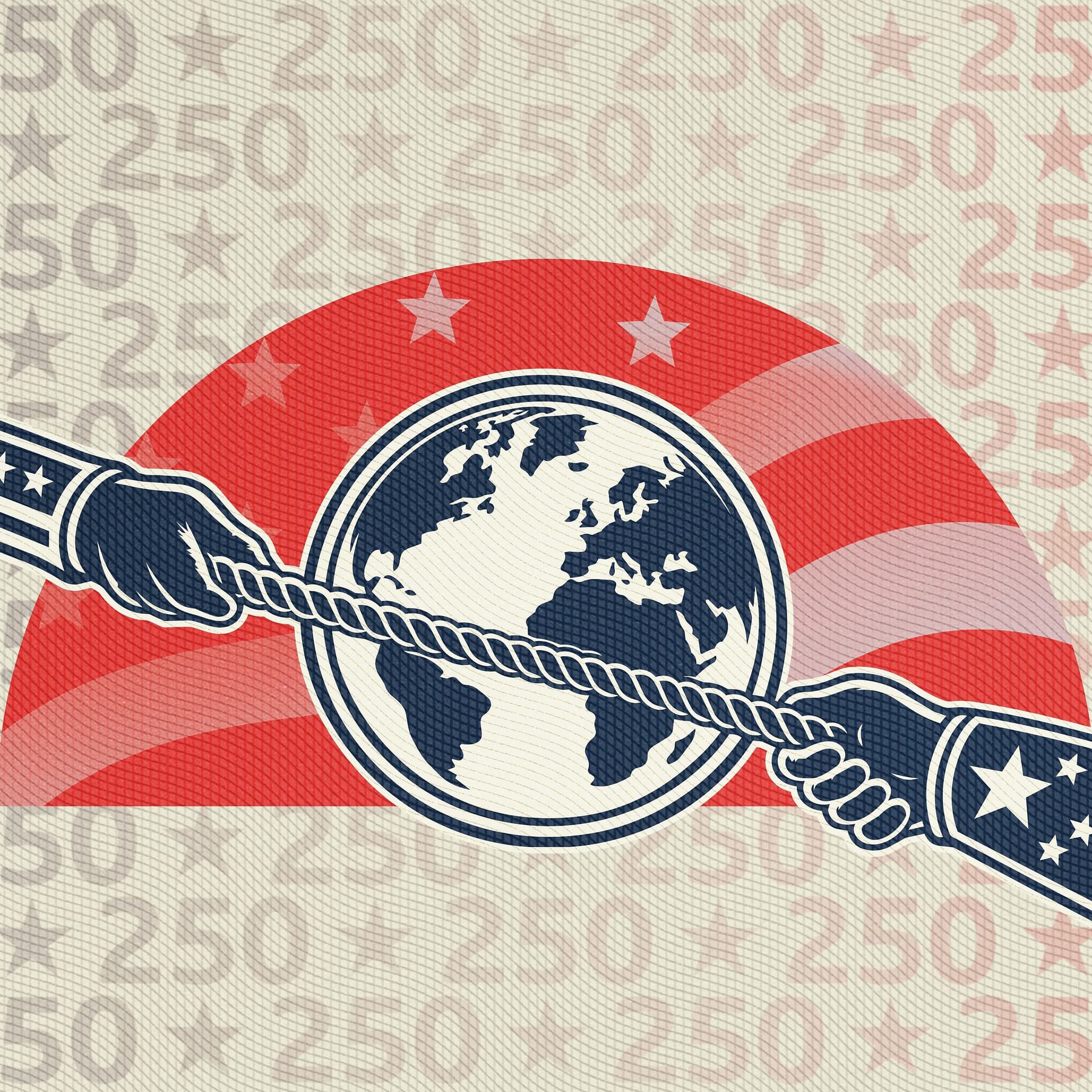
As the United States approaches its 250th anniversary, all this week The Global Story is exploring the surprising and often hidden ways the US has shaped the modern world.
For decades in the US, “Made in China” signified a product that was cheap, poorly made, and, in some cases, produced through exploitative labour. But today, the label signifies something quite different in many American minds - state-of-the-art tech and luxury goods that even rival America, for arguably the first time in US history.
Often overlooked is the fact that China’s ascendance as an economic superpower was far from inevitable. Today we speak to historian Elizabeth Ingleson to trace the evolution of the Made in China brand and to explore what responsibility the United States had for awakening its own economic rival.
Producer: Xandra Ellin and Sam Chantarasak
Executive producer: James Shield
Sound engineer: Travis Evans
Senior news editor: China Collins