
In short
Artemis II’s return to Earth and what the mission really achieved—an engineering milestone versus a largely PR-driven, geopolitically motivated program preparing for later moon landings and potential resource use.
Guests
Georgina Ranard, BBC science and climate correspondent; previously did a PhD on how the British Empire used science for geopolitical interests. She argues science and politics can’t be separated. Tristan Redmond hosts.
Key claims
Artemis II cost about $93 billion and delivered limited new science; NASA emphasized dramatic moments and “human eyes” seeing the far side, despite prior mapping and probes. The mission’s primary purpose is expanding American presence and enabling Artemis 3/4 infrastructure, competing with China and private space firms, amid budget pressures.
Notable examples
Christina Koch’s farthest-ever woman travel; the “Carol crater” named for Commander Reid Wiseman’s late wife; the radio blackout behind the moon; comparisons to Apollo-era superpower rivalry and “Wild West” resource extraction.
Written by AI. May contain mistakes. Listen to the episode to check what was said.
Chapters
Tap a time to open that second in VOThe Return of Artemis II
1:12 to 2:25
Discussion on the Artemis II mission and its significance.
“Over the weekend, the crew of Artemis II arrived back on dry land.”
Geopolitics in Space Exploration
2:25 to 3:49
Exploring the political implications of space missions.
“I'm a science and climate correspondent reporter at the BBC.”
Media Coverage of Artemis II
3:49 to 4:51
Examining the media's portrayal of the Artemis II mission.
“So the whole time I've been covering Artemis, I've always wanted to ask, OK, how's this linked to American interest, global interest?”
Public Engagement with Space
4:51 to 6:31
Discussion on how different generations perceive space exploration.
“that I don't always feel has lent itself to asking deeper, more critical questions about NASA.”
Impressive Moments in Launch
6:31 to 7:46
Reflecting on the emotional and dramatic moments of the launch.
“I mean, it is objectively an extraordinary story.”
Notable Achievements and Moments
7:46 to 9:18
Highlighting significant achievements and emotional moments from the mission.
“There's something wrong with the sensor.”
The Science Behind Artemis II
9:18 to 13:19
Discussion on the scientific contributions and limitations of the mission.
“There's this moment that's now been called the Carol crater moment.”
Inspiration vs. Scientific Discovery
13:19 to 14:00
Debating the balance between inspiring the public and scientific discovery in NASA's missions.
“Because cameras had seen this far side of the moon before as part of probes, is that right?”
The Role of Inspiration in NASA's Mission
14:00 to 14:51
Exploring how inspiring the public has always been a part of NASA's goals.
“But as a lunar scientist, he is not going to learn anything really as a result of this Artemis 2 mission.”
Economic and Political Pressures on NASA
14:51 to 17:42
Discussing the financial pressures and geopolitical competition influencing NASA's future.
“But we shouldn't give agencies a free ride and claim their work is going to revolutionize science when it isn't.”
Show all 16 chapters
Comparing Artemis II to Apollo Missions
17:42 to 18:48
Drawing parallels between the Artemis II mission and historical Apollo missions.
“From what you're saying, it sounds like there is a fair bit of politics involved.”
Geopolitical Motivations Behind Lunar Exploration
18:48 to 20:50
Examining the economic interests and resource extraction driving space missions.
“would be to ignore what I think is the primary purpose of Artemis, which is to expand the American presence on the Moon.”
The Role of Private Companies in Space
20:50 to 22:08
Analyzing how private companies are reshaping the landscape of space exploration.
“So what I'm hearing you say then is that there is a commercial reason to be doing this.”
Trump's Influence on Space Policy
22:08 to 23:18
Discussing Donald Trump's impact on NASA's lunar ambitions and space policy.
“maybe five or 10 years ago, had not heard the expression rare Earths?”
Cultural Reflections on Space Exploration
23:18 to 25:45
Contemplating the cultural relevance of Artemis II in the context of current media.
“Yes, we know a lot about the moon, but Mars is the real place that countries want to discover.”
Exploring the Depths of the Ocean
25:45 to 26:46
Highlighting the importance of deep-sea exploration alongside space missions.
“we've mapped 98 % of the moon's surface.”
Transcript
Automatic transcript. May contain errors.0:00This BBC podcast is supported by ads outside the UK.
0:30business needs in one place, saving you time, headaches, and serious money. Stop paying for missing pieces. Go to odoo.com. That's O-D-O-O.com to learn more. Self-directed investing, trading, full-service wealth management, automated investing, financial planning, thematic investing, retirement planning. Phew. And to think, that's just a small taste of what Schwab offers. because Schwab knows that when it comes to your finances, choice matters. No matter your goals, investing style, life stage or experience, Schwab has everything you need, all in one place, so you can invest your way. Visit schwab.com to learn more.
1:14Over the weekend, the crew of Artemis II arrived back on dry land. Well, sort of.
1:31Re-entry into the atmosphere is the most dangerous part of the mission, but the four astronauts on board the Orion capsule landed off the coast of San Diego on Friday afternoon.
1:44Georgina Rannard:This was not easy. Being 200 ,000 plus miles away from home, Like before you launch, it feels like it's the greatest dream on Earth. And when you're out there, you just want to get back to your families and your friends. It's a special thing to be a human and it's a special thing to be on planet Earth. Thank you. These four brave souls have traveled further from Earth than any other humans have ever done before. But humor me here for a second. Have they really broken new frontiers? What do we actually learn from this mission round the moon? It's possible, not that much. From the BBC, I'm Tristan Redmond.
2:24And today on The Global Story, was the Artemis mission important? Or was it a$90 billion PR exercise?
2:39My name is Georgina Ranard. I'm a science and climate correspondent reporter at the BBC. Today, I'm focusing on science. But before I joined the BBC, I actually did a PhD in how the British Empire used science to advance its interests. So basically, how science can be used in big geopolitical projects. What we discovered is that you can never separate science from the political. And that is one of the reasons I think I'm so interested in the story that we're going to talk about today, which is Artemis II. Well, I mean, we were very keen to hear your take on Artemis, given your academic background, because arguably space exploration has been part of American empire building over the decades.
3:27Empire with a small e. So we're fascinated to hear your take. Yeah, I mean, it is a brilliant story, like amazing engineering, physics, mathematics. You know, it's really an amazing achievement for the human mind. But as I said, you can't separate that from the bigger geopolitics, especially on a really expensive project like this. It's cost, I think it's$93 billion. So the whole time I've been covering Artemis, I've always wanted to ask, OK, how's this linked to American interest, global interest? How's it linked to the new global space race? And then what is the purpose of all this science that they're doing, all this fantastic engineering?
4:06What does it do for America? From the point of view of an academic, but also a science journalist, what has it been like for you watching the Artemis II mission? So, OK, I think I have to put my cards on the table. Right. So I am a science journalist. A space story is like it's my bread and butter. And I don't want to talk myself out of a job because, you know, we don't always get on air. And you've got to put that against the context of all the other news, right? We're only in April and there's been a lot of talk of World War III this year already. And then along comes this dramatic, joyful space story.
4:41And I feel like at times the coverage has been, it's like the royal wedding of science. There's a sort of feeling of irreverence, respect, awe around the occasion. and some outlets have done this very gushing emotional coverage that I don't always feel has lent itself to asking deeper, more critical questions about NASA. You know, journalists love a planned story. They're to entertain us, inform us a bit, we learn a bit of science. And then it's like, well, why sully that with maybe negative, cynical questions? But I also think that as journalists, that's what people ask us to do. They ask us to look at everything around a story, think of all the different angles and try and answer them.
5:19You're absolutely right. It does have a lot of the hallmarks of a sort of major royal wedding or big 100th anniversary of something. But do you feel that that enthusiasm is reflected by audiences? In some ways, absolutely. I think it's a story that's gripped so many people. And I think there is a bit of generational divide. Some older people who remember Apollo directly or were born not long after those missions of the 1960s and 70s, their view is a bit, OK, been there, done that. These guys didn't even land on the moon. And then younger generations, we're a bit more like, oh, OK, this is cool.
5:54We haven't seen this. And the drama of it has really pulled a lot of people along. And I have to say this, and my mum will probably be quite angry, but she did text me last week and she asked me how much thrust was required for the rocket to go off, for the Space Launch Systems rocket. My mum is not interested in science. She would admit that. So I was like, OK, well. Were you able to provide her precise figures without referring to the Internet? I had to Google it. And it was 8.8 million pounds of thrust at liftoff. But yeah, you know, I was like, if my mum, Margaret Ranard, was interested, then I think a lot of people are.
6:31Well, I'm very pleased that Margaret Ranard has made it onto this edition of The Global Story. I mean, it is objectively an extraordinary story. And look, Georgina, I was told a long time ago that there are two types of journalism. There's all shucks journalism and gee whiz journalism. Or shucks journalists have seen it all before and nothing impresses them. And gee whiz journalists just think everything is very exciting. So you are in, for the purpose of this conversation, you are in the or shucks role. And I am in the gee whiz role. So let's carry on on that basis and see how it goes. Let's recap for a second.
7:03Four astronauts strap themselves to a rocket with all that thrust that you just described. They left Earth. They spent four days traveling to the moon. They swung around it and then they came back again. So even though you are all sharks, tell us about the bits that did impress you. The launch. It did. I mean, I've done quite a lot of rocket launches and I'm always skeptical in advance. They're usually at terrible hours, like 3 a.m., 4 a.m., very antisocial for us in the UK. And it was a big build up to Artemis. We've been working on it for a long time. It was actually, it was called off several times.
7:39So we had a lot of anxiety. Is it going to go? What if it went wrong? You've got four humans on top of a massive rocket. There was a moment when they had to halt the clock. They had to check a few issues.
7:49Georgina Rannard:This is an instrumentation failure. There's something wrong with the sensor. And so they took it before the mission. Oh God, you know, is it going to be cancelled? Is it going to go? So now we are clear as far as that constraint is concerned. And there's the countdown. And here we go. Ten, nine, eight, seven. And then I see it kind of on the launch pad. They load up the fuel and you see it kind of fizzing away at the bottom. Booster ignition. And liftoff. The crew of Artemis II now bound for the moon. Humanity's next great voyage begins. And then I'm totally swept up. I drink the Kool-Aid and I'm like, wow, this is cool.
8:30What can humans achieve? This is amazing engineering. And then, of course, we heard their voices after it was confirmed that it went well. Integrity. Guidance converged. Performance nominal. Upper stage RCS ready. the photos are amazing i don't think there's very much science in the photos but they are beautiful there's one by christina cook who's the first woman to travel around the moon to travel this far into space it's a lovely picture there's we can see earth in the background you can see this lovely profile of her face and then her braids are kind of floating there obviously they're in zero gravity and you know it really struck me it is an achievement and it's a milestone for a woman to have travelled that far.
9:12And, you know, she will have, I assume, spent a lot of time in rooms where she was the only woman and sort of fought her way through. So that was a good moment. There's this moment that's now been called the Carol crater moment.
9:27I don't know if you were watching, but it happened just after the crew travelled the furthest into space they've ever been. And they gave some remarks. And we heard the voice of Jeremy Hansen, the Canadian astronaut on board. We started this journey in our close-knit astronaut family. Saying that they'd named a crater after a lost loved one. Her name was Carol, the spouse of Reid, the mother of Katie and Ellie. The person that they had named that crater for was the wife of Commander Reid Wiseman. He's the commander of the flight. And he lost his wife, Carol, in 2020. She had cancer. And since then, he's been a single parent.
10:07and he's got two teenage daughters, and he's raised them on his own. And obviously he had to talk to them before going into space about the dangers involved in that. But you could really hear in Jeremy Hansen's voice that the emotion, it sounded very thick. It's a bright spot on the moon. And we would like to call her Carol. And you spell that C-A-R-R-O-L-L. and Reed Wiseman, the widower who was weeping in the capsule, and the crew hugged. And I was watching it live. I had a lump in my throat. It was quite an intimate moment, I think, for the crew and the world watching.
10:57I have to ask you about the moment where the capsule passed behind the moon and out of radio contact. There was this 40-minute period, wasn't there? What did you make of it? And this is a slightly leading question for me because I felt like it seemed a little bit staged, the drama that was kind of drummed up around it. Yeah, a lot was made of that moment in advance. We talked about how alone they would feel. They'd be the furthest from home anyone had ever travelled. They would lose contact. the moon was going to get between their capsule and Earth, blocking radio signals. On Earth and around Earth, we love you from the moon.
11:45Houston copies. We'll see you on the other side. And I don't know if you noticed, but they kind of were coming and going in and out, so you had this feeling that maybe they weren't quite totally out of contact. Houston, we have you the same and it is so great to hear from Earth again Of course it's dangerous but I think it did lend itself a little bit to this feeling of NASA really know what they're doing they know how to communicate this mission to the world and amping up all of these moments of drama and then you have to ask what else wasn't happening that they needed to focus on on those characters and these moments What do you mean by that?
12:22What else was not happening? What I mean is in the absence of a breakthrough in terms of science, because they couldn't say, oh, we've discovered the moon or we've discovered an asteroid or a planet. To some extent, they focused on these moments as a sort of vehicle to generate and drum up public interest and public support for the mission. So essentially, you're saying that there was a deficit of scientific discovery, but there were PR moments. Is that right? Absolutely. I've been thinking about this a lot. when we got those lovely images back, I thought, okay, are we learning anything new from this?
13:01And NASA was making a lot of statements during the lunar flyby, saying that it would be the first time that human eyes had seen some parts of the far side of the moon. And I was like, okay, what does that mean, human eyes? Is this kind of example of that's the most they can say about this? And they were saying, well, human eyes have a greater dynamic range than a camera. it can spot things that a camera can't. Because cameras had seen this far side of the moon before as part of probes, is that right? Yeah, so there are satellites that have flowed around there. India has sent probes around there.
13:35China has landed a probe on the far side of the moon and actually brought back rock samples. Around 98 % of the moon's surface is already mapped. So we know quite a lot about it. So I was thinking about these questions and I asked Professor of Astrophysics, Chris Lintock at Oxford University, for his view. And he said the value of the images is artistic and not scientific. He said they're lovely images, but this is not a voyage of science discovery. And he said that's fine. It generates a lot of interest. But as a lunar scientist, he is not going to learn anything really as a result of this Artemis 2 mission.
14:13Wearing my gee whiz hat, I put it to you, Georgina, that inspiring people and exciting people isn't that baked into NASA's DNA, its mission. I mean, if you go all the way back to the John F. Kennedy speech in the early 60s about choosing to go to the moon, not because it's easy, but because it's hard. That spoke to an ambition to do things that were inspiring. And if that exists today, that's because it's always been part of NASA's mission, isn't it? Absolutely. I mean, I am completely for inspiring children, adults, anyone to be engaged in science. But we shouldn't give agencies a free ride and claim their work is going to revolutionize science when it isn't.
15:01And I think the risk is if you only understand it in a sort of scientific term, you ignore the other aspect, the geopolitical aspects, the economic aspects, the fact that perhaps this will lead to mining on the moon. So I think it's just important to be aware of that. You mentioned the economic aspects of the mission, and you've already touched on the vast cost. How significant is money in all of this in terms of NASA's future? And also the fact that NASA doesn't have a monopoly on space travel anymore. It has competition. There are private companies that do space exploration as well now. How significant is all of that in this?
15:43I mean, I think in the build up to this, there's been numerous hearings in the US about those cuts to NASA that have been floated since President Donald Trump started his second term. In one of those hearings in the Senate, Ted Cruz said something like, we're in a new space race with China. China has made no secrets of its goals. It is investing heavily in space capabilities and working to plant its flag on the moon by 2030. The stakes could not be higher. And if this goes badly, if NASA fails with Artemis, he said there will be a bad moon on the rise. NASA is more than just a symbol of national pride.
16:27It is a strategic capability that advances our economy, security and values. That speaks to the pressure the agency is under. While the astronauts were in space on Artemis II, President Trump announced new budget cuts for NASA's science budget by up to half. Artemis is quite well protected from that, But it's linked to other elements of space science. There's also questions about the International Space Station, which needs to be renewed by 2030. And I think at this time, as you said, NASA used to have basically a monopoly. But now we have SpaceX. We have Jeff Bezos' space company. These are creeping around the margins of NASA's work and saying that they can do it cheaper, faster, better than NASA, which many people argue has the burden of being a very expensive tax-funded organization.
17:23So all of that is hanging over NASA at this moment, and they're clearly under pressure to prove relevance. And, you know, Artemis II was a success. But if the story had been different, if it had gone the other way, I think NASA would be in serious trouble, and we would be cancelling the next stages of the Artemis program. From what you're saying, it sounds like there is a fair bit of politics involved. But I would also say then that that's not new, is it? But politics have always been part of space exploration. If you look back at the Apollo days, it was about great power, superpower competition with the Soviet Union, wasn't it?
18:00So, I mean, is this nothing new? Yeah. So I think you can directly compare some elements of it to the Apollo missions in the 60s and 70s. So you think about 1969. So that's when Buzz Aldrin, Neil Armstrong landed on the moon, that amazing moment that we all know about. But at the same time, the Soviets had developed their Sputnik satellite, intercontinental ballistic missiles had been developed in the previous decade. So they were locked in this race. But back then, I would say the moon was much more mysterious, unexplored. It really was a frontier. So you can draw a direct line, basically, from that political context of today.
18:39But the difference is the science. To claim that this mission is to leverage new scientific knowledge would be to ignore what I think is the primary purpose of Artemis, which is to expand the American presence on the Moon.
18:59I think claiming that this mission is only for science would be like sending men into the Wild West during the oil rush or the gold rush and claiming it was for geology and not for anything else.
19:24Okay, so sending oil men into the Wild West and claiming it was for geology and scientific purposes. Explain that analogy to us. When the oil men went into the Wild West, what were they there for? It was to extract resources, to extract gold or oil, to make a lot of money. But to do that, they had to mine, they had to map, they had to survey. You know, a whole body of science was created because of it. But it was in the name of economics. And I think they are the parallels with the global space race today. This contest, the US and China are leading, but there are other countries that are interested.
20:00India has a very big space program. The contest is happening because of valuable resources on the moon's surface. It's really geopolitical and there's rare earth metals on the moon, there's titanium, helium, they can be used in superconductors, which could be useful because they're very high efficiency. Some science here, very high efficiency transmission of electricity, useful for the energy transition. And the US is desperate to not lose out on that. And there's also private companies involved in mining. In fact, in 2015, under President Obama, a law was passed in the US giving private companies the right to mine asteroids and other planetary bodies.
20:40So I think that's what's going on. All of this science and this exploration is in the name of this question. Can we use the moon? Can we mine it? Can we exploit it? Okay. All right. So what I'm hearing you say then is that there is a commercial reason to be doing this. But viewed through that prism is something like Artemis II, an investment which is preparing the ground. It's almost like a capital expenditure to make sure that NASA and the United States have the technology to be able to then plough further money into industrial expansion on the moon. Is that right? That is one of the main reasons, Yes, Artemis 2 is about building up to the next mission, to Artemis 3, to Artemis 4.
21:25Artemis 4 is when they want to land humans there again. And it's about establishing a presence and saying, if we can dominate, if we can put down infrastructure, if we can build a nuclear reactor on the moon, then we own that piece of the moon and that is for us to use. You know, we're moving into the kind of interplanetary, extraplanetary age. You know, you see this in the billionaire groups, people like Elon Musk. they are talking very openly about our future beyond Earth and on other planets. And naturally within that, their question is, well, how can I use this? How can I make money from it?
21:57And the U.S. doesn't want to fall behind, just as it doesn't want to fall behind in the technology race that's happening back on Earth. Well, I have to ask then, because how many of us, maybe five or 10 years ago, had not heard the expression rare Earths? And how many since Donald Trump returned to the White House in 2025 have not heard that expression on a weekly, if not a daily basis. Is this part of Donald Trump's rare earth's interests around the world? And I mean, actually, it's interesting. We barely mentioned Donald Trump in this episode so far. What is his role in all of this? So this is, I think, hardly anyone knows this.
22:41I think to understand the origins of Artemis, you go back to 2017, which in some ways feels like such a different time to now. It was his first presidency. And I think many people would agree that there was a different feeling to it. They had a lot of goals, a lot of ideas, but not necessarily the political setup to achieve it. And so we've got to remember that kind of environment. And within that, he announced that he wanted to take America back to the moon. And actually, one of the astronauts who's just come back from space, Christina Koch, she was in the room with him when that was signed. The moon is also considered a bit of a gateway to Mars.
23:18Yes, we know a lot about the moon, but Mars is the real place that countries want to discover. But to do that, it's actually easier to have a base on the moon, which sounds a bit sci-fi, but essentially, you've got better access to Mars if you're on the moon. And I think some of it is also just, in his ideology, America needs to be best at everything. He doesn't want to fall behind China. We heard him talk about that in his call with the astronauts when they were in space. You are doing a fantastic job and hello, very special hello to Artemis II. For most of the mission, I actually thought President Trump was quite quiet.
Read the full transcript
23:54Yeah, he seemed to be quite discreet, especially because he commissioned this mission in the first place. Yeah, I was surprised. And before, I wasn't sure if he would make a really a big deal of it. Today you've made history and made all America really proud, incredibly proud. And then he actually called the astronauts, the four of them, in their capsule and they had, I think it was about a 12-minute conversation. But in that, he congratulated them, he knew all the facts on how far they'd travelled. But then he also said, you know, it was evidence basically of how great America is. So America will be second to none in space and everything else that we're doing and we will continue to lead the whole thing into the stars.
24:38He then issued them this invitation to come to the White House for an Oval Office reception when they're back. Georgina, I totally take on board your very measured and thoughtful scepticism about the scientific goals of this mission. One of the things that strikes me about Artemis II is that there are so many remakes and sequels in the world we live in these days and so much less original content out there in the world, you know, whether it's Spider-Man films or Superman films or Batman films, et cetera. And it does somehow feel of the age and appropriate that this major space mission is rehashing a space mission from the 70s in this way.
25:26I wonder though, Georgina, is there something that you are inspired by and really excited by at this moment in time, whether it's in space exploration or in the scientific world? The deep sea. I am really interested in the deep sea. And it's interesting because I've said that we've mapped 98 % of the moon's surface. We've mapped something like a quarter of the deep sea, of the seafloor. There's a very good scientist on Instagram who's doing a mission now in Antarctica where he's looking at, it's called phytoplankton, so it's the most abundant animal on Earth. And essentially they think that they've been taking up so much carbon from Earth's atmosphere and sinking it deep into the ocean that they play this huge role in protecting the planet from increasing temperatures with climate change.
26:19All of that I think is fascinating because it's about what on Earth don't we already know about and what are all the kind of unseen processes that are happening that we don't know. And I mean, I also just love any weird deep sea creature. You give me those, you know, those really weird looking squidgy things. I will do that story.
26:45Although I'd never go there. You can't send me down there or into space.
26:52Georgina, thank you so much. It's been really great to talk this through with you. Yeah, it's been fantastic. Thanks, Tristan.
27:11That was Georgina Rannard, a science correspondent with BBC News. And that's it for today's episode. Just a few housekeeping notes. We love to hear from you, so please send us your thoughts and ideas. on theglobalstoryatbbc.com. A quick message to our friend, Stephanie Salomo in Germany. After we dedicated an episode to you a few days back, Stephanie, you very kindly wrote to say thanks. Our producer, Zandra Ellen, said, shouting out the listeners is a good way to test whether they're being honest about listening every day. So, Stephanie, congratulations on passing Zandra's hidden test. Please send us any more show requests you might have.
27:51A quick reco before we go. Here at The Global Story, we bring you one story every day where the world and America meet. For the very latest news headlines, listen to our sister show, The Global News Podcast. You can find it wherever you listen. This episode was produced by Kat Farnsworth and Valerio Esposito. It was edited by James Shield and mixed by Travis Evans. Our video producer is Matt Pintus. Our senior news editor is China Collins. See you again tomorrow. Cheerio.
28:23Thank you.
From the publisher
The Artemis II crew are back on solid ground having travelled further from earth than any human has before.
The mission was an undoubted success. But aside from getting some stunning photos of the moon’s surface and the tiny blue dot we call home, what did we actually learn? And was it just a big PR exercise?
BBC science correspondent Georgina Rannard joins us to discuss the point of the mission and what is next for Nasa.
Producers: Cat Farnsworth and Valerio Esposito Sound engineer: Travis Evans Executive producer: James Shield Senior news editor: China Collins
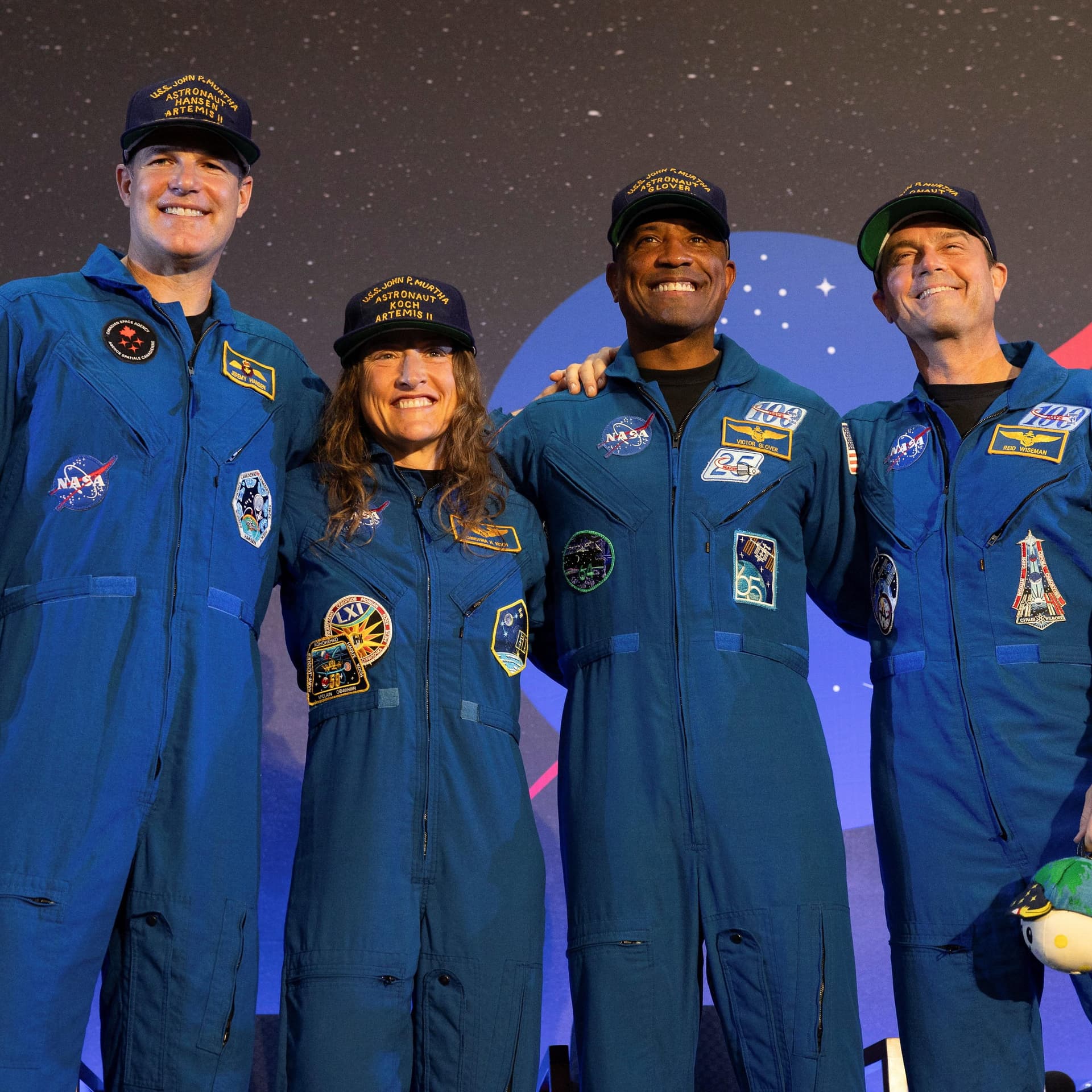
(Photo: The Artemis II crew of Nasa astronauts attend a press conference the day after splashing down in the Pacific Ocean, at Ellington Field Joint Reserve Base in Houston, Texas, US. Credit: Lexi Parra/Reuters)