
In short
The episode explains why U.S. President Donald Trump pardoned Juan Orlando Hernandez, the former president of Honduras convicted in the U.S. for drug trafficking and weapons offenses. Hernandez, who served a 45-year sentence in West Virginia, was released after serving less than two years. The discussion links the pardon to Honduras’s December election, where Trump endorsed conservative candidate Nasry Asfura, and argues the pardon helps secure U.S. influence and funding. Key claims include: Hernandez was portrayed as a “narco-dictatorship” figure; his brother Tony Hernandez was convicted for smuggling 200 tons of cocaine and bribery; and Trump’s decision may have been influenced by Roger Stone.
Notable examples
2017 election fraud allegations, Honduran migration driven by violence, and Trump’s “war on drugs” actions in the Caribbean and Venezuela.
Guests
Will Grant, BBC Mexico/Central America/Caribbean correspondent, reporting from Tegucigalpa.
Written by AI. May contain mistakes. Listen to the episode to check what was said.
Chapters
Tap a time to open that second in VOIntroduction to the Topic
1:12 to 2:14
Discussion of the release of former Honduran president Juan Orlando Hernandez.
“Earlier this week, the former president of Honduras was released from a prison in West Virginia.”
Trump's Decision to Pardon
2:14 to 4:49
Exploration of President Trump's pardon for Hernandez and its implications.
“And today on The Global Story, why is President Trump pardoning a convicted drug trafficker while claiming to fight a war on drugs in Venezuela?”
The Political Background
4:49 to 7:31
Overview of Hernandez's election and his controversial presidency.
“who was in prison here in the United States on charges for drugs and weapons offenses.”
U.S.-Honduras Relations
7:31 to 9:21
Analysis of the relationship between the U.S. and Hernandez during Trump's presidency.
“He says that he has been in the same boat, a victim of, as he put it, lawfare by an administration out to get him and sees parallels.”
Drug Trafficking Allegations
9:21 to 14:01
Discussion of drug trafficking allegations against Hernandez and his family.
“20 people at least were killed in pitched battles between protesters and the police and Juan Orlando went on to serve another four years.”
The Rise and Fall of Juan Orlando Hernandez
14:01 to 21:36
Explore the intricate details of Juan Orlando Hernandez's drug trafficking charges and political connections.
“His brother, Tony Hernandez, a congressman, had been arrested in Miami in late 2018 on drug trafficking charges.”
Trump's Pardon Amid Election Politics
21:36 to 26:01
Analysis of the implications of Trump's pardon for Hernandez in the context of Honduran elections.
“Well, his pardon will hasn't come in isolation.”
Transcript
Automatic transcript. May contain errors.0:00This BBC podcast is supported by ads outside the UK.
0:30business needs in one place, saving you time, headaches, and serious money. Stop paying for missing pieces. Go to odoo.com. That's O-D-O-O.com to learn more. Self-directed investing, trading, full-service wealth management, automated investing, financial planning, thematic investing, retirement planning. Phew. And to think, that's just a small taste of what Schwab offers. because Schwab knows that when it comes to your finances, choice matters. No matter your goals, investing style, life stage or experience, Schwab has everything you need, all in one place, so you can invest your way. Visit schwab.com to learn more.
1:14Earlier this week, the former president of Honduras was released from a prison in West Virginia. Juan Orlando Hernandez was serving a 45-year prison sentence in the U.S. for drug trafficking. In court, prosecutors had accused him of, quote, paving a cocaine superhighway to the United States. He's now been released, having served less than two years of that sentence. He was freed following a pardon from the President of the United States. And all this came about at the same time as Hondurans were electing a new leader. Honduras is a country of a little more than 10 million people in Central America.
1:57It's an important transit point for both cocaine and migrants as they move north from South America towards the United States. Two things which make it a place of strategic interest to the U.S. From the BBC, I'm Asma Khalid in Washington, D.C. And I'm Tristan Redmond in London. And today on The Global Story, why is President Trump pardoning a convicted drug trafficker while claiming to fight a war on drugs in Venezuela?
2:36Will, could you introduce yourself for us, please? I'm Will Grant. I'm the BBC's Mexico, Central America and Caribbean correspondent. And in this instance, very much the Central America correspondent. And you are speaking to us from one of my favourite place names in the world. But I wonder if you could teach us how to pronounce it properly. It is Tegucigalpa. It's the capital of Honduras. And it was, interestingly enough, the place that also inspired me to get into Latin American affairs because the name fascinated me as well. Tegucigalpa is just such a beautiful name. So, yeah, I saw a foreign correspondent standing on a roof during a flood many, many years ago saying his name, Tegucigalpa, BBC News, and it just made me think, that's what I want to do.
3:23Oh, wow. Will, did you go to Honduras expecting just to cover an election and then a pardon landed on your head as well? Yeah, yeah, absolutely I did. I was on my way to do a completely unrelated story. I was going to go and do something about immigration and talk. We were driving to meet a people trafficker, in fact. And then suddenly I get this email from London saying, do you think you could just file 45 seconds on the fact that Trump says he's going to pardon? We virtually came off the road, the poor fixer. He had to pull over in this truck stop and I'm recording my dispatch and my phone and sending it to London.
3:59It was shocking. And you're there in the capital of Honduras, just on the heels of this very close election we're seeing in Honduras. As we record in it, it's just shortly after 9 a.m. Eastern time on Tuesday, December 2nd. An hour behind, I believe, right where you are. It's 8 a.m. It's 1400 in London, 2 p.m. All right. And we don't know the result of that election yet in Honduras. Is that right? I know it's an election that actually has been gaining, I would say, a fair bit of attention here in the United States because on Friday, President Trump made an announcement on his social media platform on True Social regarding the election there in Honduras.
4:40He endorsed one of the candidates in the election, and we'll come back to why he did that. But he also said in the same post that he was going to pardon the former president of Honduras, who was in prison here in the United States on charges for drugs and weapons offenses. And he said, I'm going to quote this portion here. I will be granting a full and complete pardon to former President Juan Orlando Hernandez, who has been, according to many people that I greatly respect, treated very harshly and unfairly. What does the president mean? Why was he doing this? Well, I think there's two things in that truth social post.
5:19The first, of course, is specifically getting involved in the Honduran election by identifying a candidate saying, I want you to vote for the main conservative candidate, Nastia Sfora, the former mayor of Tegucigalpa, who I trust, who I think will help me in what he called the fight against the narco-communists, anything other than my man chosen will put in jeopardy funding from Washington, which is a big thing because let's not forget during this chat that Honduras is the second poorest nation in the Americas after Haiti. It is a very, very poor nation with structural problems in its economy.
5:57And the idea of Washington pulling away more than$100 million in direct funding is a big, big impact on Honduras' well-being, if you like. So that's one thing. The other thing, but in the same post, was the suggestion, the promise in essence, to pardon Juan Orlando Hernandez. Now, Juan Orlando Hernandez is a very, very controversial figure here in Honduras. He was in power for eight years. He was the head of the National Assembly before he was president. And people remember those years as some of Honduras' darkest days in its modern history. There are those who call it the narco-dictatorship. They simply remember him as in control of a corrupt, violent administration that was deeply entwined with organized crime.
6:53So the idea that Donald Trump has had, as it were, advice from people I trust very much, as he put it, or greatly trust. Do you know who he's referring to there? Yeah, the belief is that it's Roger Stone, the conservative media mogul. And just to remind listeners, Roger Stone is this longtime political operative. He was pardoned by President Trump himself. Yes. And in fact, it's not just the belief. According to Roger Stone himself, that announcement came just three hours after he sort of made President Trump properly aware of the case, as it were, for the defense of Juan Orlando Hernandez. So we think it's him.
7:34He says that he has been in the same boat, a victim of, as he put it, lawfare by an administration out to get him and sees parallels. Well, Will, I think a lot of people around the world have been fairly surprised to learn that a former president of Honduras is in prison in the United States and are wondering how this situation came about. So I wonder if we can go back to the beginning of the story. When was Mr. Hernandez elected as the president of Honduras and what kind of leader was he? So he was elected as president in 2014. I was here at the time for that election too in Tegucigalpa and I interviewed him.
8:18He was candidate for his party, the National Party, and won. Now, theoretically, presidents in Honduras only serve one term of four years. It's a very short period in power, and they move through very quickly. During his, he altered the constitution to be allowed to stand for a second time. People on the streets were very angry about it, but he retained a decent amount of support. He stood again, won again, in very controversial circumstances in 2017. During the vote count, he was sitting second behind one of the candidates today, Salvador Nasrada. The machines went down, everything went dark for hours.
9:03And when people woke up the next day, the machines were back on and he was miraculously five points ahead, which he sort of maintained. That was recognized with uncommon speed, that win by the Trump administration. and people have cried fraud ever since, but there was literally nothing they could do about it. It sparked protests on the streets. 20 people at least were killed in pitched battles between protesters and the police and Juan Orlando went on to serve another four years. When he first was elected in 2014, what sort of leader was he? Well, I met him on the campaign trail And I have to say, like a lot of people, I was pretty underwhelmed.
9:47He seemed quite vanilla. He seemed reasonably harmless. I mean, one had heard about suggestions that there was corruption in his inner circle. That's not untrue of lots of kind of potential candidates in the region. Just a couple of questions. I interviewed him. Thank you. He basically said, you know, we're clean and we're going to turn things around. And I'm part of sort of turning the page on the past.
10:17So if we can fast forward a bit to President Trump's first term in office, it seems that he did take a strategic interest, President Trump, in his first term in Honduras as a partner to combat illegal migration across the southern border, as well as potentially combating drugs entering the southern border. We're delighted to have with us President Juan Orlando Hernandez of Honduras. And in 2019, Donald Trump praised Juan Orlando Hernandez as an ally. That President Hernandez is working with the United States very closely. You know what's going on on our southern border, and we're winning after years and years of losing.
11:01We're stopping drugs at a level that has never happened, unfortunately. What was going on behind the scenes in this relationship between Honduras and the Trump administration? OK, so 2019 was an absolutely crucial year. In terms of Juan Orlando Hernandez and basically Honduras' relationship to the Trump administration during that period, from my view, it was key because Honduras really was the source of the majority of undocumented immigrants heading north. If you, as I did, were following the caravans of undocumented migrants, making their way through Central America, up through Mexico and reaching the door of the United States, I would say of every 10 folks you spoke to, seven easily were from Honduras.
11:51They were fleeing what they called the narco-dictatorship. So the two things were related. First, they were fleeing, obviously, economic tough times in Honduras. But also the nature in which police were committing human rights abuses against individuals, death threats and so on for speaking out, prompted lots and lots of people to head north. Now, that analysis wasn't necessarily played out by the Trump administration, who simply saw Juan Orlando Hernandez trying to stop people leave. And I literally mean try to stop them leave. I remember specifically a point where people are trying to leave Honduras.
12:32They've been corralled by hundreds of police officers in riot gear, firing tear gas on them to stop them physically leaving the borders of their own nation. Trump saw this. He heard the rhetoric that Juan Orlando Hernandez was using about immigration and stamping down on it and stopping. It was just that we need to be kind of an iron fist against undocumented immigration. Will, is it fair to say that the United States for the last several years, certainly under that first Trump administration, had twin policy priorities? One was to curb this migration at the southern border and the other was to curb drug trafficking.
13:11And it sounds like what you're saying is during that first Trump administration, migration, migration, migration was key. And does that mean they were willing to look the other way when it came to drug trafficking? I think that's a really strong point. I think my argument has always been that, you know, you're useful to the United States until you're not. Juan Orlando Hernandez was useful in the fight, as it were, against undocumented immigrants. And frankly, it does seem like at least elements of the administration in Washington will have overlooked information that they no doubt had, because at the same time, other things were going on in 2019.
13:56A federal court in New York has found the brother of the president of Honduras guilty of drug trafficking charges. His brother, Tony Hernandez, a congressman, had been arrested in Miami in late 2018 on drug trafficking charges. Prosecutors accused him of using his Honduran government connections to smuggle 200 tons of cocaine into the US. He's charged and by October of the following year, 2019, he'd been found guilty on those charges to the tune of millions of dollars that he'd made through his drug links, through organized crime, to fund the political campaign of Juan Orlando Hernandez and the National Party more broadly.
14:41So in amongst the case against Tony Hernandez, the brother, is a million dollar bribe from the head of the Sinaloa cartel, Joaquin El Chapo Guzman, specifically to go to Juan Orlando Hernandez. By this stage, it's coming out as co-conspirator number four. But it's clear to everybody that co-conspirator number four is Juan Orlando Hernandez. And he's the president at that point. He is the sitting president of Honduras. The sitting president of Honduras and a close Trump ally in the region.
15:27How is it that Hernandez himself then ends up being arrested and extradited to the United States? So while all of this is going on, the temperature is rising and rising for Juan Orlando Hernandez. Donald Trump loses the 2020 election and the Biden administration comes in. That is a very tense relationship for some time. You can genuinely see that the Biden administration starts to sideline Honduras in terms of its relationship with Central America. The relationship has deteriorated very quickly. Anthony Blinken as Secretary of State didn't want to have to be caught in the same instance that Donald Trump openly did but standing side by side with the man with these allegations against him with his brother in prison for drug trafficking and say you know we think Honduras is doing a wonderful job.
16:22There is now a very clear case and drug trafficking charges against him waiting in the United States. And then there's the election in 2021. There was a big question of whether or not he'd stand again. Nasri Asfura stands, who is the former mayor of Tegucigalpa, who is Donald Trump's favoured candidate in this election, and doesn't win. So Juan Orlando Hernandez gets into an SUV and tries to go to Nicaragua to seek asylum with Daniel Ortega, the strongman, the leftist strongman in Nicaragua. In the final days, weeks of his time in power, he's sort of seen sitting with Daniel Ortega and they're sort of creating this friendship, which is very weird because they're ideologically poles apart.
17:11And yet he tries to then flee there, but is stopped by the DEA on his way and told, turn around, Mr. President, you know, otherwise we'll arrest you here and now. and within days after stepping down weeks. He's arrested by the security minister who clamps him in handcuffs and he's held in Tugosigalpa before quite quickly being extradited to the United States. A lot of people in Honduras were angry that he'd never been tried in Honduras for these crimes and was simply handed over to the US. But that is how it happened. He was sent to the US where he faced the extension, if you like, or his involvement in the same co-conspiracy that sent down his brother, who by this stage has been sentenced to the life sentence plus 30 years for his role and is serving that in a US prison.
18:05The case against Juan Orlando Hernandez starts in the US front of the same judge and he is sentenced to 45 years in prison for drugs and weapons charges. So he was explicitly charged with being part of a conspiracy to bring 400 tons of cocaine into the United States. That's a lot of cocaine. And related. It's a huge amount of cocaine. And then he's on trial in New York City. He's on trial in New York City. I mean, again, I just couldn't believe it. The trial was fascinating in that, you know, every day there would be Hondurans outside holding up signs, asking for justice. inside court, you saw a man sort of reduced from the pinnacle of power to holding on for his life.
18:52He delivered this hour-long speech at one point where he laid out his defence that he had been set up, that this was all politically motivated. Why? Because he had been strong on drug trafficking. He'd clamped down, he'd extradited drug traffickers himself. He'd been, if you like, the leading light in the fight against drug trafficking in the region. And it was those drug traffickers who were getting their revenge by accusing him. Now, this is at the heart of his defence by his wife, by his own defence in court, that the only people who basically testified against him were convicted drug traffickers.
19:33Basically, the whole thing hinged on their testimony for which they received lesser sentences, and they testified to bringing him$250 ,000 in bribes, that he received bribes, and so on. The jury just didn't buy it. They bought that he was the brother of a drug trafficker who simply couldn't have not known what his brother was doing as president, and not only knew, but was directly involved in receiving bribes, hundreds of thousands in direct bribes from organized crime, and basically ran a network that had enriched him and the National Party for his campaigns through drug money. And so in the summer of 2024, then he's sentenced to 45 years in prison, and he's been serving out this prison sentence in West Virginia.
20:23That's right. A year's worth he has done. However, Ana Garcia Carias, his wife, the former first lady has never let down her defense of him that he is innocent and bolbara as she says he will be back and to just as we're speaking she has posted his prison record if you like showing that he has been released so as we're speaking he has just been released and how is that being received in honduras given everything you've told us about his popularity or lack of popularity when he was head of state? With disbelief. I had one member of parliament, in fact a minister for infrastructure in this country.
21:09I bumped into him as he was casting his vote. We spoke and he said, can we not forget please that it wasn't us in Honduras who convicted him. It was the attorney general's office in the United States. It was Washington who tried him and found him guilty, not us. And I think that is partly the disbelief that it was the US who wanted him extradited, who wanted to try him on drug trafficking charges, and now it is the US who's pardoned him. Well, his pardon will hasn't come in isolation. It's happened almost at the same time as the election, the presidential election in Honduras. Why is there this link?
21:48Yeah, I think the two things are related. I mean, we can just see from the social media post by Donald Trump that it's in the same posting. So he's saying, vote for this guy, otherwise there's no money. And by the way, I'm pardoning Juan Orlando Hernandez. Now, that may just be Donald Trump talking about Honduras. I'm going to say everything I'm going to say about Honduras. But I also think that what he's doing there is sort of saying, I want my team back in place. I want my dependable folk, the ones who stopped immigrants coming north. I didn't need to worry about that part of the world because I knew I had folks there I could trust.
22:29On board Air Force One a few days ago, Donald Trump was asked what his intentions were with regards to Honduras. And he said he had been asked to pardon the former president of Honduras by many of the people of Honduras. I was asked by Honduras, many of the people of Honduras. They said it was a Biden setup. Former President Hernandez's conviction was, quote, a Biden set up. Was it a Biden set up? What does he mean? Well, again, it's really worth noting that the case against Juan Orlando Hernandez began very much under the first Trump administration. The DEA and the US prosecutors were aware of the claims against him as early as 2009 in many regards.
23:17The action was taken to arrest and extradite him during the early days of the Biden administration. But the idea that it's somehow some Biden administration set up plan, you know, clever thing, you don't put a case like that together in just a handful of months. It's done carefully, meticulously. And I've spoken to US prosecutor involved. I've spoken to DEA agents involved in the whole period. And they're deeply unimpressed, as you can imagine, that this has been painted as just some kind of political campaign against Juan Orlando Hernandez. To that point, we see President Trump announcing this pardon of a convicted drug trafficker, the former president of Honduras, at the same time that his administration has spent the past several weeks blowing up boats in the Caribbean Sea, ostensibly because they say they want to stop drugs from coming into the United States.
24:20And so I think many listeners will see this and will wonder, well, isn't this a contradiction? How are these two things coexisting at the same time that you say you're attacking narco-terrorists in the Caribbean? You're even threatening military action on Venezuelan soil while you're pardoning this guy who was a convicted drug trafficker. And I think there are people from Congress who've also said, make it make sense. You know, it's not just people opening their newspapers or watching this on TV or listening on the radio who are sort of confused by this. There are decision makers who also think it doesn't stack up.
24:54You know, Will, you've been covering the region. How do you make sense of this war on drugs when you look at all of this together? What's happening in Venezuela and what's happening now in Honduras? Yeah, I mean, I think what I'm trying to say is that this feels like the latest example in a long line of Washington tolerating distasteful characters, to say the least, in pursuit of their own goals in the region. That was the truth in the Cold War in the sense that what mattered most of all to Washington was the fight against communism. Today, it's more, I think, to do with undocumented immigration, but it's gone sort of ideological again.
25:36Who shares our worldview? The answer in the region right now is Javier Millet in Argentina. It's Nayib Bukele in El Salvador. It's Juan Orlando Hernandez. And look, he was unjustly attacked by the Biden administration and let him out. And you look at the political calculation for Donald Trump. You know, what's he got to lose? It's not going to hurt him domestically. It's not particularly going to hurt him internationally. But the idea, I think, that a sitting president in the US would simply undo the work of the Justice Department, the prosecutors, the DEA. It's a hard sell to Hondurans, put it that way, that the idea this was all just a politically motivated attack by the Biden administration when it was actually put together under the first Trump administration, the majority of the legwork on the case against him.
26:27And I think it's all taken by a lot of Hondurans to feel like meddling. I spoke to one very smart political analyst who said, governments cannot treat us any longer like a banana republic. Donald Trump is, in a sense, simply doing what Washington has done for a very long time in Central America, which is treated a bit like its backyard, the famous line, it's America's backyard. hard. Well, Will, thank you so much. You've been extraordinarily generous with your time in the midst of also covering an election. So thank you very much. Thank you so much, Will. It's always a pleasure speaking to you guys.
27:06I enjoy it a lot.
27:10That was the BBC's Will Grant joining us from Tegucigalpa, Honduras. If you liked today's show, you might also want to check out our episode from October the 17th, when Will joined us to explain President Trump's threats against Venezuela. If you've got any ideas, questions, suggestions for us, please drop us a note at theglobalstory at bbc.com. Today's show was produced by Zandra Allen, Hannah Moore, and Viv Jones. It was edited by James Shield and engineered by Travis Evans. Our studio manager was Peter Wise, and our senior news editor is China Collins. That's it for today's show. We'll talk to you again tomorrow.
27:50Cheerio.
From the publisher
President Donald Trump has pardoned Juan Orlando Hernández, a former president of Honduras who was serving a 45-year sentence for drug trafficking and weapons offences.
It was only last year that Hernández was convicted in a New York courtroom of being part of a huge drug trafficking conspiracy, after being extradited to the US. Prosecutors said the operation flooded America with cocaine and turned Honduras into a “narco-state”. But Trump has claimed the investigation was a Biden administration “set up”, and Hernández is now a free man.
As the Trump administration ramps up its military threats against Latin American drug cartels, including multiple strikes on alleged drug trafficking boats in the Caribbean, why has it pardoned Hernández? Will Grant reports.
Producer: Xandra Ellin, Hannah Moore and Viv Jones
Executive producer: James Shield
Sound engineer: Travis Evans
Senior news editor: China Collins
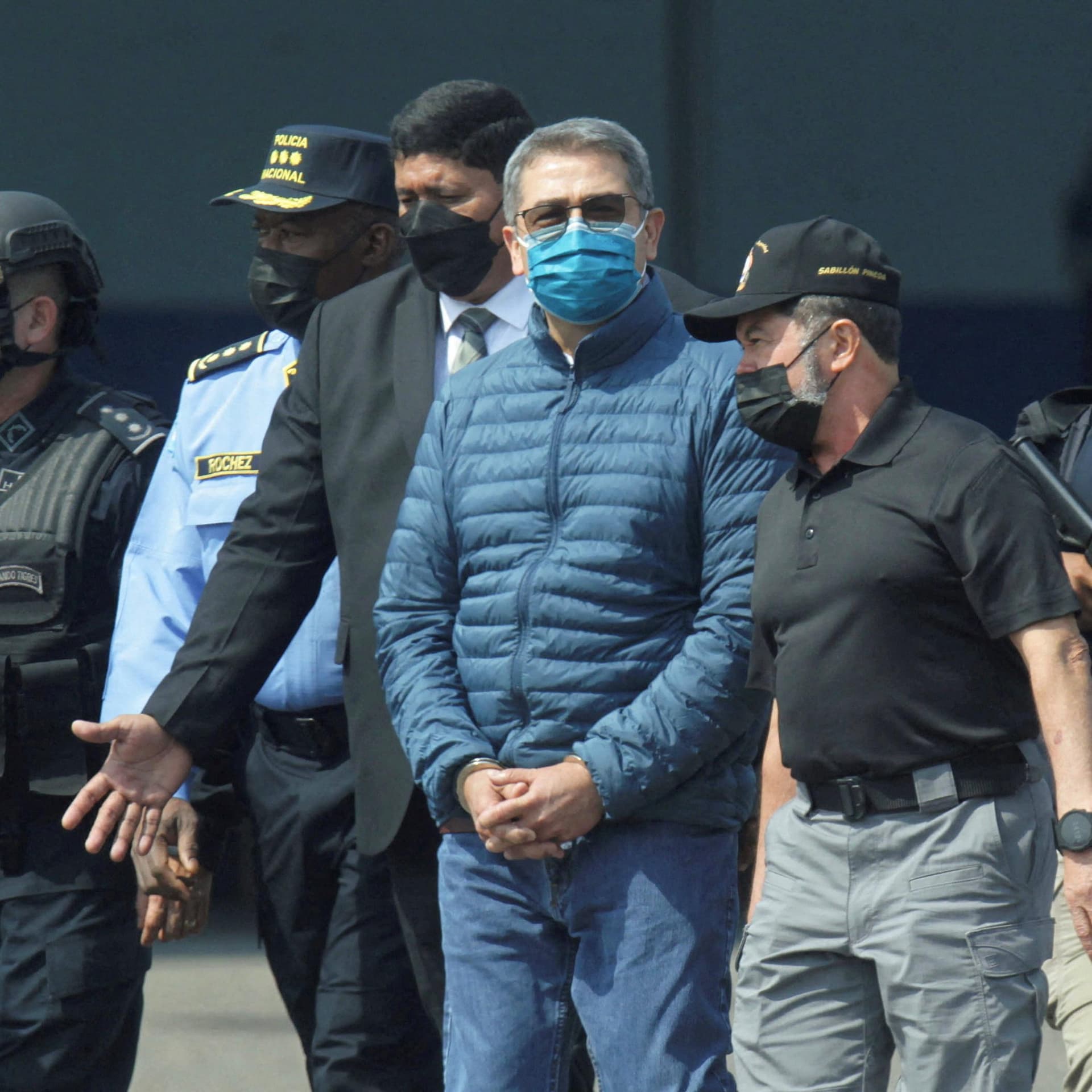
(Photo: Juan Orlando Hernandez being escorted by US agents for extradition in 2022. Credit: Fredy Rodriguez/Reuters)