In short
The Global Story examines how World Cup 2026—co-hosted by the US, Canada, and Mexico—has become unusually political and expensive, using the 1998 Iran-USA match as a historical parallel. It argues FIFA and US policies (immigration/visas, border scrutiny, travel bans) are turning the tournament into a geopolitical flashpoint, while FIFA’s commercial strategy (dynamic ticket pricing, hospitality blocks, transit costs) may leave host cities with empty seats and discounted hotels.
Guests
Mehreen Khan, economics editor at The Times of London; London-based Chelsea supporter; previously did sports journalism; also hosts the Heroes and Humans of Football podcast.
Key claims
FIFA expects about $11B revenue; dynamic pricing can produce extreme resale prices (e.g., reported $2M tickets); hotel bookings were cancelled due to weak demand; New Jersey transit fares may rise from $12.90 to $150 (then potentially lowered).
Notable examples
Iran vs New Zealand in Los Angeles; FIFA banning the pre-revolutionary Iranian flag; FIFA waiving a $15,000 visa bond for ticketed fans from certain countries; Trump/Infantino political involvement; dynamic pricing resale examples (Qatar-Switzerland ~$250; other matches ~$350–$850).
Written by AI. May contain mistakes. Listen to the episode to check what was said.
Chapters
Tap a time to open that second in VOThe Historical Match: USA vs. Iran 1998
0:32 to 2:26
Exploration of the politically charged match between Iran and the USA in 1998.
“It's June 1998 in the French city of Lyon.”
World Cup 2026 Overview
2:26 to 2:46
Introduction to the upcoming World Cup and its significance.
“And at the centre of all this yet again are the United States, the tournament co-hosts and Iran.”
Mehreen Khan's Background and Insights
2:46 to 4:06
Mehreen Khan shares her soccer fandom and journalism journey.
“my own co-host, Asma Khaled, speaks to economics journalist and football obsessive Mehreen Khan.”
The Joint Bid for 2026 World Cup
4:06 to 6:10
Discussing the implications of the North American bid for the World Cup.
“And then I think it becomes more interesting for my day job, which is kind of more about politics, global politics, economics, finance, money, power, that kind of stuff.”
Logistical Challenges of the 2026 World Cup
6:10 to 7:40
Exploring the logistical complexities of hosting the World Cup across three countries.
“I wasn't around then, or I can't really remember much then, but it was supposed to be the sort of dawning of soccer landing in America.”
Americanization of the World Cup
7:40 to 10:41
How the World Cup is being influenced by American culture and traditions.
“From the fans perspective, this is basically a very non-ideal World Cup.”
FIFA's Political Involvement
10:41 to 12:13
Discussion on FIFA's political maneuvers and its implications for the World Cup.
“there is a lot of content that's going to be generated from the World Cup.”
Economic Impacts of the World Cup
12:13 to 14:00
Analyzing the economic benefits and costs associated with the 2026 World Cup.
“As an American, there are some aspects of looking at this World Cup that feel so easily understandable in terms of the idea that sports and capitalism always jive, right?”
Understanding Dynamic Pricing for World Cup Tickets
14:00 to 15:11
Learn how dynamic pricing affects ticket costs and fan loyalty for the World Cup.
“Dynamic prices mean prices change over time.”
Hospitality Challenges for World Cup Fans
15:11 to 18:17
Discover the implications of ticket pricing on hospitality and hotel bookings during the World Cup.
“So I, just before I came onto the show, I went onto FIFA's resale.”
Show all 16 chapters
Public Transit Costs and Fan Accessibility
18:17 to 19:49
Explore how increasing public transit costs are impacting fans' ability to attend the World Cup.
“and you're just not seeing the bookings materialize, at least we are speaking, just under a month before the World Cup kicks off.”
The Impact of U.S. Immigration Policies
19:49 to 21:51
Examine how U.S. immigration policies may deter international fans from attending the World Cup.
“every weekday on one big story at the intersection of where the world and America meet.”
Iran's Participation in the World Cup
21:51 to 24:14
Learn about the complexities surrounding Iran's participation in the World Cup amidst political tensions.
“They are the five countries whose visitors would have been subject to the bond.”
Football as a Diplomatic Tool
24:14 to 28:00
Understand the significance of the World Cup as a platform for international diplomacy and global interaction.
“So they legitimately qualified for the World Cup through their Asian regional rounds before the war.”
The World Cup as a Corrective to Isolationism
28:00 to 29:01
Discussion on how the World Cup might challenge U.S. isolationism and promote hospitality.
“I really hope that if I'm being optimistic, it's a corrective to the increasing isolationism of the US in other spheres of, you know, politics and activity.”
Closing Thoughts with Meherine Khan
29:01 to 29:26
Wrap-up of the conversation with guest Meherine Khan, highlighting her insights.
“Well, on that note, Meherine, thank you so much for joining us.”
Transcript
Automatic transcript. May contain errors.0:00This BBC podcast is supported by ads outside the UK. Hi there, I'm Asma Khalid. And I'm Tristan Redmond. And together we're the hosts of the Global Story podcast from the BBC. For those of you who might be new to our show, we here at the Global Story dive deep every weekday on one big story at the intersection of where the world and America meet. And you can now watch the Global Story on the iHeart app. Catch every brand new episode every weekday. Just tap into iHeart to start watching. And we hope you enjoy the show.
0:41It's June 1998 in the French city of Lyon. Two football teams, or soccer teams if you like, have gathered for what's been called probably the most politically charged match in the history of the World Cup. Iran are about to play the USA in the group stages of the 1998 tournament. And in Lyon, the fans sound pretty chilled. It's all about football, nothing to do with politics. You know, the politicians screwed up the relations between the two countries 20 years ago, and they haven't been able to fix it since then. But there's a ton of pressure coming down from the top. A US official has called this, quote, the mother of all games.
1:25Iran's Supreme Leader Ali Khamenei has ordered his players not to walk towards the Americans to shake hands before the game as protocol dictates. And Bill Clinton is laying it on thick. As we cheer today's game between American and Iranian athletes, I hope it can be another step toward ending the estrangement between our nations. There was a huge security operation around the match, but when the players took to the pitch on Midsummer's night, They shook hands normally. They had their photo taken together. And then they played. Iran won 2-1, their first ever World Cup victory. They'd knocked the United States out of the competition.
2:06And life moved on. Politics have always been part of World Cups. And usually it goes off without a hitch. But this year the tournament enters uncharted waters. Two countries at war with each other have never played in the same competition. And at the centre of all this yet again are the United States, the tournament co-hosts and Iran. And it's not just geopolitics. This tournament is meant to mean big bucks for pretty much everyone. It's been billed as equivalent to 104 Super Bowls. From the BBC, I'm Tristan Redman. And today on The Global Story, as the United States, Canada and Mexico get ready to host the biggest World Cup ever, my own co-host, Asma Khaled, speaks to economics journalist and football obsessive Mehreen Khan.
3:04My name is Mehreen Khan. I am the economics editor at The Times of London. Mehreen, it's wonderful to have you on the show. It sounds like you know quite a bit about soccer. And I should say, we are going to use these words perhaps interchangeably throughout this conversation because the word football when talking about soccer just doesn't feel authentic coming out of my mouth. Fair enough. I'm also an American football fan, so I kind of feel the pain because I also have to switch to soccer when I'm talking about my American football team. So we can do that. All right. So can you explain to us your knowledge, your expertise, your fandom around the world of soccer?
3:41Yeah, so I'm a football fan. Actually, my entry into journalism was doing sports journalism, and I accidentally have somehow wound up becoming a financial journalist. So it's always been a little bit part of my journalistic identity. So I live in London, I support Chelsea. And World Cups are not something, I'm going to admit it, like on the record I've said it before, I'm a bit of a World Cup hater in the sense that the football that I love is the football I watch every week in England mainly or across European leagues. So the World Cup is when, you know, normies basically decide that they're also going to get interested in football, which for the you know for the slightly uh i don't want to say snobbish specialists but for folks like me it's sort of like we have to then sort of get involved in in the sort of mainstreaming of football where people just tune in every four years because it's a huge event but i think one of the reasons i'm finding world cups more intellectually interesting and not just as a fan but just as in my job is that they are becoming bigger as they are encompassing more of the world and every four years they have become actually more regularly a spotlight and a little of a microcosm of what is happening at the world, sort of crystallization of the world in that four to six weeks in which everyone is starting to watch football.
4:46And then I think it becomes more interesting for my day job, which is kind of more about politics, global politics, economics, finance, money, power, that kind of stuff. So I'm actually very much looking forward to this World Cup, even if I'm not going to be, you know, really locked into the sport element. Yeah, well, I was gonna say, I'm excited to have this conversation with you, because our show is really about where the world and America meet. And, you know, this bid for, we'll say, collectively North America to host the 2026 World Cup. It's not just the United States. It is happening in Canada, the U.S., and Mexico.
5:16It was a joint bid that was put forth in 2017. Is that right? During the first Trump administration? Yeah. And I want to understand from you, what was the intention at that point? What did they want this thing to be? Because clearly, I mean, look, 2017, the first Trump term, It's not like the United States had the smoothest relationship with its neighbors at that point. Well, there's been a perennial issue with football. It's a global sport, but there's one major country in the world where soccer doesn't really penetrate the national consciousness, and that is America. And it's actually just worth saying what I'm talking about is the men's game, because the women's game is just at such an advanced and elite level.
5:53And the U.S. is actually historically over the last 15, 20 years has been the most successful women's football team in the world. It's just never been mirrored on the men's level. The 24 best soccer nations from around the globe will compete in 52 matches in nine cities across America. So this will be the second time the United States has hosted a World Cup. The first one is in 1994. I wasn't around then, or I can't really remember much then, but it was supposed to be the sort of dawning of soccer landing in America. Since hardly anyone in this country seems to know who they are, the 22 members of the US World Cup soccer team have had to develop a sense of humour.
6:33What's your name? So you don't know my name, you don't know where I'm from, that's cool. We're off for a good start here. Not to usurp baseball, the NFL or basketball, but to be maybe the fourth sport, right? What is an obsession in the rest of the world has not really caught on in America. So if you're going to have a truly global sport, it's a bit weird not to have the world's biggest economy, which shaped so much of soft culture and culture generally not to be involved in football. So this, I think, is still a continuation of like breaking America. But doing it in collaboration, then doing it with Mexico and Canada, what was the thinking behind that?
7:06Well, that is probably just economics. We are realizing very quickly that it is just not economical for one country to host a World Cup. It's just financially very prohibitive to build stadiums because what do you do with these stadiums afterwards? So if you combine Canada, the United States and Mexico, they already have the existing infrastructure. You've suggested that the expanded geography helps with sharing the burden of costs, right, and just putting on this big sporting event. But I presume that it also presents challenges, right, to fly from, say, Vancouver and Canada down to Mexico. That's just a it's a long distance.
7:41Yeah. From the fans perspective, this is basically a very non-ideal World Cup. If you think about how World Cups go, there's the group stages. So you know your country is going to be playing at least three games. You don't know what's going to happen after that, whether they go into the knockout rounds, the quarterfinals, the semifinals. So you know for the first couple of weeks where you need to be. So if your country is based in Toronto, you're playing your games in Toronto, you can just kind of hang around Canada. At best, you can go to New Jersey and New York. It's not that far. But then if suddenly you find yourself in a quarterfinal and you're playing in Mexico City, it becomes a bit of a nightmare.
8:10So this is a stark contrast to the last World Cup because anyone who went to Qatar realized that everything was probably within 15 to 20 miles. And it was much easier logistically. This is going to be complicated, but it's worth saying this is just the reality of how tournaments are going to happen now. Most bids coming in to host these tournaments are shared between three or four countries. So it's just becoming the new norm, actually, is to spread it out. You said earlier that the United States had hosted the World Cup before, last in 1994. but this seems different to me. Maybe it's also just because I'm older.
8:43I'm more aware of sort of the advertising, the excitement going on around this all, but it is beginning to feel to me super American in some ways. What's your sense of how this World Cup is being Americanized? For example, there's a halftime show. I mean, I've never heard of a halftime show happening before at World Cup. It's obviously a quintessential part of something like the Super Bowl here in the U.S. I saw that, is it Shakira, Madonna, BTS? they have quite the lineup for this halftime show. But also, like, how do you have a halftime show? So you extend the halftime, right? So halftime traditionally is actually only 15 minutes, so you wouldn't even get a chance to BTS to, like, come out and do one song, let alone a whole show.
9:20We actually had a taster of what it felt like last summer, where the U.S. hosted something called the Club World Cup, which was a sort of conglomeration of elite teams across the world who'd won various tournaments qualified for this. And I know that because my team, Chelsea, won the Club World Cup. So I had to sit through a halftime show. Okay, how was that? At the final against PSG. Honestly, like, usually half times when I just go and make a cup of tea and I come back and, you know, look at my phone. This thing went on for so long. I think I went outside, had a kick around, spoke to my mom on the phone, came back, still saw some of the Jonas Brothers, whoever it was.
9:51I was going to say, who was performing? So you didn't actually watch the halftime show? I think it was J Balvin. I wasn't locked in, to be honest. Oh, our producer just wrote, it was Coldplay. Okay, I'm going to actually fact check this right now. Halftime show. Doja Cat, yeah. Oh, the Dodger girl. J Balvin. J Balvin, okay. Yeah, yeah. Oh, alongside special unannounced guest Coldplay. Oh, see, I missed the whole thing. So I wasn't even paying much attention. So if it was meant to impress grumpy Brits, it didn't. Or at least it didn't with me. But then I was like, oh, God, this is weird. And the other weird thing was that when we played the game, before we played the game, Donald Trump walked out with the players.
10:27I do remember. Very famously, Donald Trump celebrated with the Chelsea players, wore a medal, and then sort of jumped around with them at the trophy presentation, which is one of the most bizarre spectacles I've ever seen. And I was like, God, if this is what the World Cup is going to be like, there is a lot of content that's going to be generated from the World Cup. Well, I will say, Donald Trump does seem to view the World Cup being played here on American soil as a great point of patriotic pride. I mean, he said just the other day that... We have the FIFA World Cup and our great American state fair on the National Mall and the Freedom 250...
11:00He seems to view it as a point of pride in American identity. We did something very special and I ended up getting the Olympics and getting FIFA. How is that being received by fans elsewhere? So there's another element to this. So the man who runs FIFA is a man called Gianni Infantino. He probably made the headlines a couple of months ago because he gave Donald Trump a made-up peace prize after he didn't win. We did an episode of the global story on this. Oh, there we go. Excellent. Infantino's behavior has been, I think for a lot of global football fans, incredibly unedifying. It has been one of the more bizarre elements of the run-up to this World Cup is how much the head of FIFA has been in and around.
11:41He's constantly in the Oval Office, taking pictures. I think from a political angle, FIFA would say they need the president to be on side because if they need this thing to be a success, the World Cup to be a success. But when you have the head of the global governing organization actively inserting himself into some of the world's most sensitive conflicts, presenting himself as a huge ally and supporter of Donald Trump, it does add a huge political element to FIFA. And actually, you know, my job as a journalist is that I would love to just be interested in the football. But if FIFA wants to be political, then it will be scrutinized as a political actor.
12:13So let's talk about the economics. You are an economics reporter. As an American, there are some aspects of looking at this World Cup that feel so easily understandable in terms of the idea that sports and capitalism always jive, right? That's just part of the American way with our professional sports teams. Tickets can be really pricey. And I've heard a lot about the cost of tickets, the cost of public transport, being a bit of a lightning rod for fans who may be coming from countries elsewhere. I'm curious what your take is on the economic gains and the economic costs that we're seeing from this World Cup.
12:49Yeah, let's just do on that kind of headline numbers that this, by I think FIFA's own admission and everyone who studied this, including, you know, economists, it's going to be the most lucrative World Cup. It's going to bring in the most revenues through broadcasting rights, sponsorship and ticket and hospitality sales. And bring it in for who? Bring it in for FIFA or for the host cities? For FIFA. FIFA estimate that they're going to generate revenues of around$11 billion. By FIFA's own estimates, this World Cup will generate more revenue in ticketing and hospitality alone than the last six World Cups combined.
13:22Wow. And that's because fans are paying. They are paying way, way more than they've ever paid to attend World Cup games. Can you give us a sense of that? I mean, what's the scope when you talk about ticket prices? So something unique is happening at this World Cup for the first time where FIFA is rolling out a different pricing system, something called dynamic pricing. Dynamic pricing, if you've ever booked a flight or sometimes used Uber when it's super busy, you'll be used to. It's an algorithmic-based pricing system which judges prices based on demand, supply, and timing. And in most World Cups, the ticketing system has been a traditional one that I'm used to as a European football fan, which is I buy a ticket for a seat at a fixed price.
14:00Okay. Dynamic prices mean prices change over time. Based on the demand, you're saying? Based on demand and timing. Now, I should mention that for an American football fan, soccer fan, basketball fan, baseball fan, dynamic pricing is usual because that's how most American sports franchises do their ticketing systems, which means that some of the eye-watering prices that we've seen are not going to be fixed at that level. And what we're seeing now closer to the tournament is a lot of those prices are coming down. But there's something interesting about dynamic pricing, which is that, yes, Americans on average pay way more to watch live sport than Europeans.
14:30That's always been true. They pay way more than any people, any continent in the world to watch live sports. But when you're, say, an example, the New York Giants, a football team, and you do dynamic pricing, you want to make sure that the people that come back to watch the Giants every other week are not getting priced out. So there is a limit, a cap to how much you would actually charge them. And there's also a flaw because you don't want to charge prices that are lower than, say, the season ticket price holder does. So actually dynamic pricing on a domestic ongoing basis is a way to keep fan loyalty and to reward fan loyalty.
15:01When you're doing it at World Cup, it's just a one-off tournament. You know, people pay one price at one time and they're not going to be attached to coming back. So that's why we've seen such egregious levels of pricing in the dynamic pricing model because it's happening for a one-off tournament. So I, just before I came onto the show, I went onto FIFA's resale. They have their own platform for reselling tickets. So you can buy a ticket and then if you don't want it, you can put it onto FIFA's platform. Okay. And there's supposed to be three categories of pricing. Category one, two and three they're called.
15:30Three is supposed to be the cheapest, but from what I could see, you could still pay upwards of$4 ,000 for a Category 3. I think a couple of weeks ago, the resale platform for the final of the World Cup was they had four tickets behind the dugout, so where the players are coming out. They were each priced at$2 million. What? Yeah. Is this so much more than previous World Cups? Yes, it is. Yeah. I mean,$2 million, it's ridiculous. That's not to say anyone is going to pay that. I mean, it's very unlikely that anyone's going to pay that. I think Infantino said himself, if anyone pays that, I'll buy them a hot dog.
16:06If somebody buys a ticket for the final two minutes, I will personally bring him a hot dog and a Coke to make sure that he has a great experience. I tried to find the cheapest tickets on the resale site. The cheapest I found through my research, which is not extensive. You could probably pick up a ticket for around$250 to watch Qatar versus Switzerland in San Francisco in a group round. I think Australia, Turkey, which is happening in Vancouver, somewhere around 350 right now. Then there was Ivory Coast, Ecuador in Philly, and the cheapest I found there was$850. So I think what's going to happen is that you're probably going to have stadiums that are not full.
16:45You're going to have some stadiums that are looking very empty in the cameras. And then if dynamic pricing works, these prices will have to collapse closer to the games because there is no demand. So you can imagine these prices falling a lot. So we've talked about ticket prices. You mentioned the other component of this all is hospitality. What are you seeing when you talk about hospitality, hotel rooms? And I ask this because I've seen reports that hotel bookings appear to be down in some of the host cities. What do we know about that? Yeah, so everything that I've said is kind of downstream of the problem of the tickets, right?
17:19So if fans can't really plan where they need to be, how they need to be, because they're getting priced out, and they're maybe going to take an 11th hour risk, then you can't really lock in so much of where you want to stay. And we know that from, I think, the sort of industry group that represents American hotels, that FIFA do something which is pretty standard, which they block book, you know, hundreds and thousands of rooms in hotels because they assume this is going to be for their delegates and for football fans. And a couple of weeks ago, FIFA has cancelled a lot of these bookings because they don't have the demand.
17:47They can't fill the hotel rooms, which is now forcing the hotels to slash their prices by a third up to two thirds in big cities like Philly and Boston and San Francisco and Kansas City to make sure that, you know, if people want to come at the last minute, they'd be able to get a decent price. So hotels are not getting filled because I think downstream of the ticketing problem, that's then causing the hotels, you know, who were expecting a great summer. Let's be honest, if you're a World Cup hosting city, you think this is going to be a great summer. Your hotels are going to be full. You've been promised all these blandishments by FIFA about how economically great it's going to be to have a World Cup.
18:19and you're just not seeing the bookings materialize, at least we are speaking, just under a month before the World Cup kicks off. Okay, so we've talked about ticket prices. We've talked about hotel rooms. The other story that I'm sure has made its way across the Atlantic is some of the cost for public transit, in particular, the New Jersey transit. Exactly. So there's like, do I get a ticket? Where do I stay? How do I get to the game? And how do I get to the game? It's usually logistically the easiest one, but it's proving very difficult. I mean, you're an American. you know that public transport is patchy at best, but where it does exist, it's now actually going to be very expensive for football fans.
18:54So the New Jersey train that should be taking fans or could be taking fans from Penn Station in New York to the MetLife Stadium in New Jersey, which is where also the final is going to be played, an average ticket is$12.90 for a single,$12.90. The authority has announced that that was going to be yanked up to$150. So a football fan is going to have to pay through the nose just to make that. But I saw there was some backlash and now they're going to drop it potentially to$98. I mean, still, look, way higher than the average ticket price. But it's still going to be way average. Yeah, it's going to be more than$12.90.
19:28So that's the other thing that's really, really irking football fans. So everything I've mentioned so far is just about people's bottom line. Like, can they afford to enjoy the World Cup? And is it just going to cost them through the nose?
19:43But I think the noise around the U.S. is not just the money question. It's not just a capitalist question. It's the question of do you want to be in the United States at this particular period in time because of what is happening in the country itself?
20:16every weekday on one big story at the intersection of where the world and America meet. And you can now watch the global story on the iHeart app. Catch every brand new episode every weekday. Just tap into iHeart to start watching. And we hope you enjoy the show.
20:37So Mehreen, we've talked about the economic cost, but as you just alluded to, there is also the perception of the United States abroad. I'm curious what you see at play in terms of these policies that may be factoring into people's decisions to attend the World Cup. Yeah, I mean, usually when you think about which countries get to host World Cups, you think about ease of travel, are there enough flights, are there enough airports, what's the kind of visa system, weather, something else. So under the second Trump administration, there have been much tighter restrictions on what types of people can come to the United States and get access to visas.
21:14So there are 50 countries in which if you want to visit and you're from these 50 countries, you have to pay a bond, which is something around$15 ,000 to enter the United States because the immigration authorities argue that people come and they stay when they're supposed to leave. So the bond gets repaid on your exit. Now, five of those 50 countries happen to be countries that have qualified for the World Cup. So this was immediate problem number one that most people haven't encountered. So one of the things that FIFA's had to do as a diplomatic, you know, this is maybe why Gianni Infantino spent so much time around Trump.
21:43He was like, well, this is going to be a nightmare if you have people from, and let me try and name the countries. I think it's Algeria, Cape Verde, the Ivory Coast, Senegal and Tunisia. They are the five countries whose visitors would have been subject to the bond. FIFA has actually said, if you've got a ticket, you can prove you're coming to the World Cup, we will waive that fee. The United States will not charge you the bond at Customs and Borders. So that means you need to have a ticket already. and we've already spoken about the difficulties of getting the ticket. So immigration policy is just becoming a logistical problem for some countries.
22:13And then there's the whole, and I've experienced this as a Brit who went to the U.S. last year, I got stopped at Customs and Border Police. I couldn't get through Dulles Airport for a while, right? And it's never happened. And I think these anecdotal stories about ICE at borders, much more stringent checks on anyone. There's been rumors that, you know, Customs and Border Police will look at people's social media. There is this huge unpredictability factor about what happens when you land at the U.S. border, even if you're a football fan. And it just adds, I think, to another one of those, should I go for it or should I not go for it?
22:45So immigration policy is really becoming an issue. It's not just the reputation. You're saying not just if you face additional questioning. There's an actual travel ban for, is it for participating countries? The two strictest travel bans, so travel embargoes, are for Iran and Haiti. So only the coaches, the World Cup kind of officials, people associated with the Iranian football team at the World Cup are going to be allowed entry. So Iranians that are not already in the United States will not be able to travel. And then there's other countries like Senegal and Ivory Coast, some of whose fans can be able to get through if they do have a ticket.
Read the full transcript
23:21But it's going to be more complicated because they're all subject to slightly stronger restrictions. So it's just a little bit up in the air. So yes, immigration bans means if you want to hold international tournaments, you by nature are just saying, well, there's some countries that are just not going to be able to have fans in the stadium for their games. I want to ask you specifically about Iran because Iran is slated to play at the World Cup. And I don't fully understand what that's going to look like. You have Iranian athletes coming to play in the U.S. and the U.S. government has been actively at war with Iran.
23:59Yeah. So this is one of the many, I think, problems of the entry of Gianni Infantino when the war broke out. So Iran, it's worth saying, is a country with a footballing history. They actually qualify for plenty of World Cups. In the last World Cup in Qatar, the U.S. and Iran were in the same group. They played each other. So they legitimately qualified for the World Cup through their Asian regional rounds before the war. So I think there hasn't been that many calls for Iran to be kicked out of FIFA because of the war. But there have been slightly informal attempts to kick Iran out. And the most, I think, bizarre one happened a couple of weeks ago, which is broken by my colleagues at the Financial Times, which is that Trump has an American-Italian envoy who proposed to Trump that Iran should be kicked out of the World Cup to be replaced by Italy.
24:46So there was this idea that we should kick Iran out because, you know, Iran is the persona non grata country in the United States. And we should get Italy in primarily because I think U.S. and Italian relations have been pretty strained because of the Pope, because of relations with Giorgio Maloney, who's the prime minister of Italy. And Italy is a real country. And also a lot of Italian-Americans probably want to see Italy play in the World Cup. This idea went nowhere because, to be fair to the Italians, they were like, no, we did not qualify on merit. We are not going to take this bizarre, you know, weird political backdoor route into the World Cup.
25:14So as it stands, Iranian athletes, Iranian coaches and the Iranian sort of World Cup delegation will be allowed to travel to the United States to play in the World Cup. What the dynamic in the stadium is going to be, I don't know. There is one game, though, which I was looking at, which I think will be quite significant, not from the sporting element, But it's Iran against New Zealand in the group stages, which is being hosted in L.A., which has a reasonably big Iranian diaspora who have been very vocal as against the Islamic Republic's regime. FIFA have already said that the Iranian flag, the pre-revolutionary Iranian flag, which is kind of the Iranian colors with this sort of gold emblem on it, will be banned from the stadiums because it's not the official representation of Iran as a constituent country.
26:03So, you know, the fact that Iran is there is probably, you know, already going to be weird. But then you've got this unique dynamic of you might have anti-regime Iranian diaspora fans in L.A. who are going to turn up to that game and probably use it as a political moment to make their voices heard about the conflict. So, yeah, it's going to be there's just going to be a lot of these sort of flashpoints that are going to happen. And I think this is probably the bigger point that I, you know, interest me as a fan, but also as a journalist. is like football has always been, for me at least, a form of escapism from the horrors of the real world.
26:33It's just 90 minutes when I can just switch up and just think about, you know, tactics and be emotionally involved in a game. It's cathartic. It's what sport's supposed to be. So the gladiatorial environment where you can live out emotions in a different place and then you have to go back to the normal world as soon as you've switched the TV off or gone out of the stadium. It's just so clear now that football is actually far from an escapism. You know, these big international tournaments where countries are coming together in a world which is splintering, right, where multilateralism is becoming less normal, where big diplomatic events to fix world problems are less of a norm, where the might means right.
27:07Weirdly enough, World Cups are becoming diplomatic moments in and of themselves because by accident they happen to be when, you know, 48 countries are going to be getting together. Football has its uncanny ability because all of the prime ministers, presidents, and heads of state want to be there representing their countries and wanting to kind of ride off the coattails of the success of their countries, right? So they're all going to be there And they're going to be in close proximity, which just makes it interesting from a geopolitical analysis. We already mentioned how bizarre is it that Iran is going to be playing a World Cup in the United States at this particular moment in time.
27:37There's nothing else but football that's managed to make that happen by accident. You know, to quote one of my co-hosts on a podcast, Simon Cooper, you know, World Cups are not going to predict what's going to happen in the world. But they do shine a spotlight about what's happening in the world at that particular moment in time. Every four years, it's away. it becomes a marker for us to understand where we were at that particular point in time.
28:05I really hope that if I'm being optimistic, it's a corrective to the increasing isolationism of the US in other spheres of, you know, politics and activity. And if you're in Kansas City, I don't know what the demographics of Kansas City, but if you've got a load of fans from Jordan turning up, right, to invade your city and these hotels for a couple of weeks. I mean, that's an interaction in and of itself. You are hosting the world too. And it's a corrective to what we hear about U.S. immigration policy. It is a corrective to how much we hear about the United States doesn't want to open its borders up to the rest of the world.
28:35It's going to have to do that for at least six weeks. And Americans will have to, you know, be confronted with it. And maybe I'm quite the patriot, but I do think we're quite hospitable face-to-face. I think you're quite hospitable too. Compared to the Brits, I think you're much more hospitable. But I think that kind of organic level interaction and love of sport and understanding that the world is actually pretty good, that's actually the beauty of the whole thing, I think.
29:01Well, on that note, Meherine, thank you so much for joining us. I really appreciate it. It was such a pleasure to talk to you. Thank you so much for having me.
29:15That was Meherine Khan, economics editor of The Times of London, speaking to my co-host Asma Khaled. Mehreen also hosts the Heroes and Humans of Football podcast. Friends, please send us your thoughts. Our email address, as always, is theglobalstoryatbbc.com and please rate us wherever you're listening. It helps other people to find us. And if you want to catch up on the latest news from around the world, then look for our sister show, The Global News Podcast, wherever you listen. And that's it for today. We've been The Global Story. Today's episode was produced by Kat Farnsworth and Aron Keller.
29:51The studio engineers were Mike Regard and James Piper. Our video producer is Richard Kenney. The show was edited by James Shield and mixed by Travis Evans. Our senior news editor is China Collins. I'm Tristan Redmond, and my co-host is Asma Khaled. We'll be back tomorrow. See you then. Cheerio.
30:19Hi there, I'm Asma Khalid. And I'm Tristan Redmond. And together we're the hosts of the Global Story podcast from the BBC. For those of you who might be new to our show, we here at the Global Story dive deep every weekday on one big story at the intersection of where the world and America meet. And you can now watch the Global Story on the iHeart app. Catch every brand new episode every weekday. Just tap into iHeart to start watching. and we hope you enjoy the show.
From the publisher
Politics, power and money have always been part of international sporting competitions, and football (or soccer) is no exception.
However, this year’s World Cup faces new challenges. The United States is co-hosting the tournament with Canada and Mexico, and its relationship with its neighbours has at times been rocky. Two countries at war with each other – the US and Iran – have never played in the same competition before. Some fans are anxious about travelling to games at a time of high tension. And the cost of attending the event has led some to ask whether this World Cup is really worth it.
Mehreen Khan, economics editor of The Times of London and a lifelong fan of the sport, joins us to discuss what this World Cup could mean for a divided world.
Producers: Cat Farnsworth and Aron Keller
Executive producer: James Shield
Mix: Travis Evans
Senior news editor: China Collins
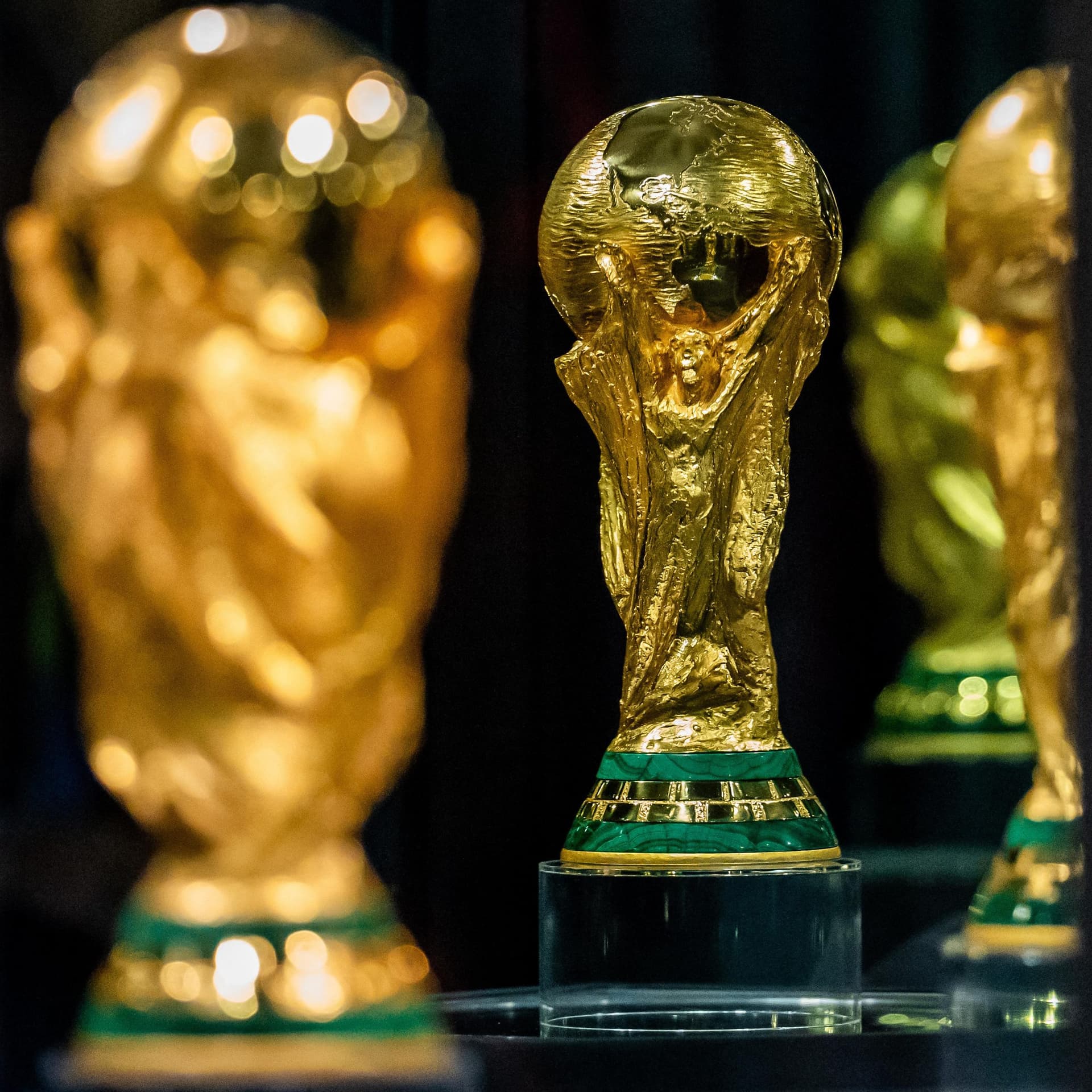
Photo: FIFA World Cup on display in Toronto. Credit: Kevin Sousa/ Imagn Images