Ask ChatGPT

 The Gstaad Guy Podcast
8 Nov 2026 · 1h 9m · 33 chapters
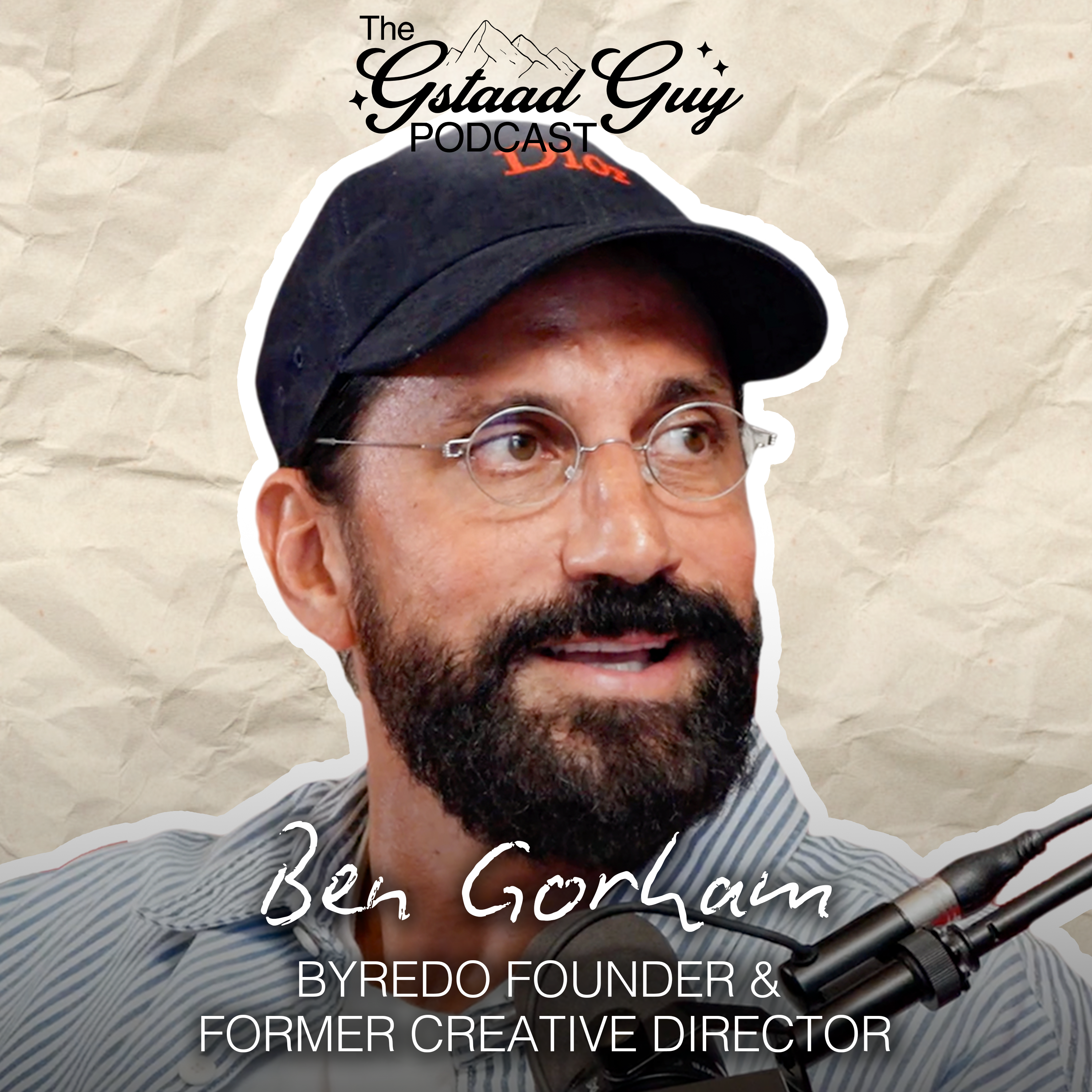
Ben Gorham, founder of Byredo (sold ~3 years before the episode), discusses building a fragrance brand around scent-memory, genderless marketing, and long-term entrepreneurship without a “game clock.” He also shares his move back to the U.S., fatherhood, and a new post-Byredo project influenced by AI and “human-scale” environments.
Ben Gorham is an Indian-heritage entrepreneur and former creative director of Byredo. He studied fine arts in Stockholm, worked with perfumers, and previously pursued professional basketball (idol: Michael Jordan). He lived in Europe for ~25 years, later moved back to the U.S. and has two children.
Fragrance can map personal and collective memory; brand clarity (simple packaging/names) helps consumers engage while deeper stories invite imagination. Gendered perfume norms were “absurd” and historically driven by European marketing/classical training. Success is measured as a long list of small wins over 20 years, not fast results.
First Byredo “story” was the smell of incense from his mother’s birthplace in India; early products included Green (father’s smell), Rose Noir (Middle East gender-role play), Gypsy Water (still sold), and Balafrik (based on his biological father’s Africa diaries). He met his wife in Stockholm while he was couch-surfing.
Written by AI. May contain mistakes.
Ben discusses his move to the US and the experiences of his children.
“Around the world with your host, the Shtad Guy, We welcome you back to the Stad Guy podcast, sharing stories of excellence with those in the know for those who just know.”
Exploring the contrasts between American and European cultures.
“It's been three years back in the States.”
Ben shares the inception of Byredo and his background in fragrance.
“I don't know how you couldn't be, but it's a pretty extreme place.”
The connection between scents and personal memories, including his heritage.
“Where you again bring your energy to them of just feeling heard, not feeling judged or feeling unjudged actually a better way to say it.”
Ben discusses how he uses storytelling to create scents and fragrances.
“I think couch surfing is typical of a cool founder.”
Ben reflects on his early inspirations and the challenges of starting Byredo.
“and had just a conversation, a social conversation about perfume and how to make perfume.”
The process of translating personal memories into scents and fragrances.
“And as I started to understand more about it and think more about it, it became more about moments.”
How Sweden's environment influenced Ben's work ethic and creativity.
“What was the first story you tried to recreate?”
Ben discusses the intentional clarity behind Byredo’s branding and product selection.
“which you can imagine in the darkness of Swedish winter was kind of a new concept.”
Learn how Byredo's simple branding was intentionally crafted to stand out.
“And I think it's true for musicians too.”
Discover the story behind the first five Byredo perfumes and their significance.
“I didn't think about fragrance families.”
Understand the distinction between brand identity and business execution in Byredo.
“I think maybe not as young as I'd imagine.”
Learn how Byredo disrupted traditional gendered fragrance marketing.
“So the larger industry was market-driven, marketing-driven.”
Explore how traditional perfume rules were challenged by changing consumer perceptions.
“that idea early enough but the world changed and more importantly the consumers changed and what they kind of agreed on was that these rules have no real in how we physiologically experience smell.”
Learn how Ben transitioned from basketball to founding Byredo and the mindset shift involved.
“Can you imagine smelling things for the first time?”
Understand how Ben's definition of success evolved from sports to business.
“And more importantly, there was no game clock.”
Discuss the importance of patience and a long-term strategy in entrepreneurship.
“People were doing great things, but impatience or a different idea of the destination caused them to quit or to shift their energy to something else.”
Reflect on how small wins accumulate in the entrepreneurial journey.
“in their circumstances or in their their own kind of journeys but I do kind of speak a lot about people's ability to overcome this variable of time.”
Examine the significance of physical retail in the fragrance industry and how consumer habits are changing.
“I know that with fragrance, the physical retail and the distribution is such an important part of it because people need to try the product out before they buy it.”
Analyze how social media has influenced young people's engagement with fragrances.
“that sparks the imagination of a lot of young people.”
Discover the importance of time in building a brand and the relevance of luxury in modern contexts.
“And one of the important pillars was time, right?”
Ben discusses the emotional journey of selling his brand and the balance of ambition and personal life.
“So a sale or a partnership became kind of a relevant solution to that problem.”
Exploring the challenges and sacrifices of being both an ambitious professional and a present father.
“I'm thinking about it as you say it, and I think I agree.”
Ben reflects on the importance of having a strong partner in life and the dynamics of their relationship.
“Having a strong partner makes all the difference in the world.”
Discussing how being raised among women influenced Ben's perspective on relationships and fatherhood.
“I think my wife has been able to clone herself twice.”
Ben shares insights on marrying young and the personal growth that has come with it.
“And that allows me to physically be there.”
Ben discusses the changes in the entrepreneurial landscape and his reflections on creativity and innovation.
“It would be cool to be like, hey, I'm just breathing.”
Ben outlines his new project, focusing on human-scale experiences and redefined approaches to memory and culture.
“I will probably define myself as a maker.”
Learn how sensory experiences and memories shape the design of spaces.
“Is it starting with that core of memory again?”
Discuss the potential future of living influenced by technology and societal changes.
“So you start to like try to understand again in 10, in 20 years from now, how are people going to live?”
Delve into how natural environments impact our feelings and sense of self.
“I guess the question is just is it 5 or 10 or 15 or 20 years away?”
Reflect on creativity, truth, and the information flow in today's world.
“à la poubelle are the things we'd like to throw in the trash and change about the world that surrounds us could be simple and trivial or could be quite deep.”
Gain insights on resilience and the journey to success against odds.
“is really an example of kind of against all odds.”

Get the gist, explore an idea or ask about something said.
 Claude
On The Gstaad Guy Podcast, what are the key points of this episode?
Searching your listeningAutomatic transcript. May contain errors.
0:01Are you ever shopping online and suddenly a discount that helps you save pops up? It makes your day, sometimes even your week. Want that feeling month after month?
0:10The Gstaad Guy: Well, new customers who save by switching their home and auto insurance to Progressive save hundreds. Cue your happy dance. Get your quote today at Progressive.com. Progressive Casualty Insurance Company affiliates and other insurers. Not available in all states.
0:28This episode is brought to you by Google Chrome.
0:31The Gstaad Guy: You think you know a browser, but Gemini and Chrome? That's new. It can help you with practically anything on the web, like restoring a vintage motorcycle from a 50-page restoration block, or finally break down that long article you've had open for weeks. Gemini and Chrome is here for it. Ready to make anything online make sense? There's no place like Chrome. Check responses set up required, compatibility and availability varies 18+. Everything we did over a 20-year run was built for 100 years. Ben Gorham, you are the founder of Bayrito. Correct. A brand you quite recently sold. I like to describe it as a 20-year overnight success.
1:05The Gstaad Guy: I know now like genderless fragrances are very much a thing, but when you first started, I don't think it was. It was as absurd as going to a restaurant and having a menu for men and one for women. In 2005, I had this idea that I could create fragrance from a new perspective. The story of Byrito is really an example of kind of against all odds. All I've heard is that you're working on a new project. You haven't told me anything. It'd be weird if I told you I'm not working on anything, right? I think it would be cool as well. It'd be cool to be like, hey, I'm just breathing. I did do that. It didn't last long.
1:34Whatever people struggle with and whatever doubts and whatever fears exist, I would just say that there are examples of people in the exact same situations that were able to push through.
1:45The Gstaad Guy: Around the world with your host, the Shtad Guy, We welcome you back to the Stad Guy podcast, sharing stories of excellence with those in the know for those who just know. I made it. I'm the one who made it. I'm very grateful that you're here. Thank you. Thank you for having me. I've been wanting to do this for a while. We've been talking about doing this for a while. I think I've been the one bugging you about it, but I appreciate that you're making it a two-way street. You know what, in all honesty, I think moving to the US, our ships haven't crossed paths as much as they did in the past. That's true.
2:22The Gstaad Guy: But we're here. We're here. How's the movement for you? It's good. It's been three years back in the States. Yeah. Very interesting. I'm like relearning America in so many ways. Yeah. I spent the last 25 years in Europe, even though I grew up part of my life here and in Canada it's kind of a new experience are you happy so far? yeah, it's good I've got two children as you know so I think for them it's being able to experience American culture and the good and the bad that comes with that has been very interesting what has the good been? the good has been that fight you know that interesting fight that you learn and that competitive edge I think for them, you know, we were living in Sweden.
3:12For them to experience that here has been very interesting. Sports, culture, entertainment, all these things that I grew up on has also become a part of their life.
3:24The Gstaad Guy: Yeah, there's that American dream for all ages, energy. Yeah, for sure. I mean, I remember moving from Europe to America when I was 12 or initially to Canada. and my first understanding for the first time in my life that there was truly like haves and have-nots. And then that idea that you can choose. What's that word in Sweden? Logum? Logum, yeah. You're very logum, especially in Miami. I am very logum in Miami. I don't know how you couldn't be, but it's a pretty extreme place. it's a bit of an extreme place but it's also beautiful I think it has this this energy that is hard to find in many places maybe just Dubai for sure but even you know I'll say this there's even for myself stereotypes about moving to Miami or or many places like you'll have about Dubai also and I think it's something really interesting about living somewhere yeah and peeling away those layers and meeting new communities and new friends and finding those new places to go eat and and all of a sudden the flashy idea of a place kind of fades yeah it's true yeah you make of it what you what you bring to it yeah i think that's true for most places yeah well every time i have the pleasure of seeing you people can tell already from this conversation so far but you have this amazing grounding effect on people.
5:06The Gstaad Guy: Thank you. Where you again bring your energy to them of just feeling heard, not feeling judged or feeling unjudged actually a better way to say it. And I'm excited to unpack the life experiences that maybe led you to be the way you are. Yeah let's do it. First and foremost I think most people know from the headline and know from this podcast Ben Gorham you are the founder of Byredo correct a brand many people know and love a brand you quite recently sold correct uh three years ago three years ago um 20 years just to be to frame it sometimes when people talk about the sale of things yeah uh they forget to talk about you know when it was founded and and uh and it really was uh i like to describe it as a 20-year overnight success it was uh it was it was very much learning by doing but in 2005 i had this idea that i could create fragrance from a new perspective and at the time you were homeless that's that's how david our common friend david puts it uh were you literally homeless I was technically homeless, meaning that I didn't have my own home.
6:33But, you know, there's a nicer, I think they call it couch surfing. Couch surfing. Yeah, I was couch surfing.
6:41The Gstaad Guy: I think couch surfing is typical of a cool founder. Really? Yeah, like Daniel Ek, where I met you for the first time. Yeah. He was a famous couch surfer when he started Spotify. Yeah. Maybe that's what it is. maybe couch surfing is the is the secret yeah and i think in sweden it's less about homelessness because most people have a home it's more about hanging out with your friends yeah it's true so i'd love to hear more about that initial desire you had why did you want to do what you did so yeah so if you know i usually describe my life in like two distinct chapters and since the age of seven, all I wanted to do in life was to play basketball professionally.
7:26And my big idol was Michael Jordan. And I dedicated myself to that, you know, from the age of seven until into my early 20s. And, you know, right on the finish line, I kind of stumbled. And that career, for various reasons wasn't available. And in some type of existential crisis, I had to kind of re-emette myself. And I did that initially by going back to school. I studied fine arts in Stockholm for a year and a half. And upon graduating, I met a perfumer for the first time. Okay. and had just a conversation, a social conversation about perfume and how to make perfume. Wow. And that sparked some idea in my mind about my own connections between smell and memory.
8:26I eventually ended up asking this very perfumer to help me realize a creative project, which were very personal memories that I would translate into smells. and that became kind of the inception of the Byrito.
8:40The Gstaad Guy: Well, can you tell me more about your connections of smell to memory? Yeah, for sure. So my heritage is Indian. So as a child, I traveled back to India to the place where my mother was born many times. And so I had very distinct memories connected to smell to India. But also my father, my biological father, who left when I was a young child. I had very distinct memories of him also, the way he smelled. So I started to understand as I explored this new medium, that I could almost map my entire life through different smells. Wow. And that fascination became kind of an obsession. And I created a brand or a vehicle to continue exploring that idea.
9:34The Gstaad Guy: Was it usually tied to moments or feelings, the smells, like particular days that you would remember when you smelled something? You know, it's a good question. Initially for me, it was more about places. Fine. And as I started to understand more about it and think more about it, it became more about moments. And then eventually in the abstract idea of an emotion. I mean, so that, but yeah, and also people, you know, people wore perfume, so actual perfume also played into that timeline somehow. I think senses in general are far easier to digest than they are to share and explain. Even language is a lot easier to understand than it is to speak.
10:29and I think fragrance is that to like a thousand degrees.
10:34The Gstaad Guy: It's, I can recognize the smell of an old friend or an old family member. They walk into the room before I see them sometimes, but I would have a very hard time explaining what that means to me or what I'm smelling. Could you express what the memories were with those scents without actually smelling them at the time? Well, initially, no. And that was kind of the vocabulary that I had to learn. But also the distinction is I was never a perfumer. I worked with perfumers. So my job was to find different ways to communicate that idea. And I did that through images and film and objects that would smell and stories.
11:24So I became kind of a storyteller to help inspire the perfumer to recreate the story through a smell.
11:32The Gstaad Guy: What was the first story you tried to recreate? Well, the first one was this place, this very specific place where my mother was born and raised, which I would visit as a child and didn't go for almost 10, 15 years and came back to a massively developed, very different neighborhood that smelled exactly the same. and as I tried to understand what that smell is a large part of it was tied to these specific incense that were being burnt at the temples so then I found a way to communicate that to him and actually get the incense and actually have him smell it Are there certain scents tied to certain regions of India?
12:15For sure I think you'll find that in a global sense too all the way down to I was in Saudi with some friends and talking about scent memories as it pertained to Bairito and they were all speaking about a very specific gum that they grew up chewing and so what I started to really be interested in is this idea of the collective memory which what scent memories are shared amongst people sometimes within family but sometimes within the larger group.
12:53The Gstaad Guy: I know you actually ended up meeting your wife in the very early days of the business. Exactly. So we met in Stockholm, and I just started the business. I wouldn't even say the business. I just started formulating the idea, and I had to try to simultaneously try to impress and try to explain to this girl that I was working with smells, and that everything was going to be okay one day, which you can imagine in the darkness of Swedish winter was kind of a new concept. It is definitely a unique concept, especially because when I think of Bairito, I think of brightness. And Stockholm, I mean, in summer it's great, but in winter it's not so bright.
13:41Those are the contrasts. Yeah. I think Sweden, and this is probably true for a number of Swedish entrepreneurs that have done relatively well, is that because of this geographic isolation, but also because of this pretty heavy and dark winters, you really put your head down at work. And I think it's true for musicians too. That place allows you to focus. It omits kind of distraction in some way. And then what I was able to do as I built the company, I was able to use Sweden as a base and then travel a lot. So I'd go every week to Paris and London and New York. That's great.
14:24The Gstaad Guy: That's a very convenient place. Well, when I think of Bayrido today, I think of a very simple product selection, a very digestible product selection, at least in terms of the packaging and branding. Of course, deep complexity within the actual products themselves and the fragrances within, but it all seems undeniably clear. It's like nearly even like Apple in terms of the clarity. Was that always the intention? It was definitely the intention in the beginning. And remember, you know, 2005, even the aesthetic landscape of brands didn't look that way. So by being simple, you were being unique. so it had a different value maybe than what you'd perceive today but I also understood kind of early enough understood the difference between consumer goods which was ultimately the commercial success was somehow linked to the consumer's understanding of what you were doing the better you could communicate that the better your chances of selling a product were whereas other industries that I was fascinated by like art created attention.
15:49And if the consumer understood too much, the art wasn't interesting.
15:54The Gstaad Guy: That's true. So I was very focused on that in the beginning in making sure to frame the idea in a way so that it was palatable for people. But there is still that mystery you're talking about with the art because I think the naming at least
16:15The Gstaad Guy: sometimes feels specific and sometimes feels ambiguous and I think that's probably by design. For sure. The naming became, I mean considering the generic nature of the products and the uniform approach to packaging, the names became the great communicator. So I put a lot of emphasis on that as kind of the first connection to a person because I immediately noticed that a strong name triggered strong interaction with product. So yeah, it was. But again, I mean, you know this now that you're in the brand landscape is that brands are complex beings with many different layers. and for consumers and customers, some people partake on different levels.
17:11And I think with Byrito, there was a face value, which was simple and clean for people to understand. And then for people like yourself, the underlying stories and the origin and the quality and all these things became important. So I found ways to communicate those.
17:28The Gstaad Guy: With the initial selection that you were developing, I'd love to learn more about what the first few products were and how that all came together over those 20 years. Yeah. It started as five perfumes. Yeah. Why was it five? I think, so one thing I did early, and I think maybe this is from my background in sports, it was it as i was competitive i studied my competitors and i think uh i think i landed in the idea that i needed five perfumes to be a real brand okay i felt like that was kind of the the the lowest kind of denominator of all the brands that were somehow successful or They had collections of products.
18:52The Gstaad Guy: dot com that is poubelle p-o-u-b-e-l dot com thank you so much for watching and now back to the podcast were you thinking of five different people that that each fragrance would suit or five could be all for one person so so i you know i wish i could say that i was you know a bit more brilliant at the time it was very self-indulgent and i basically made five perfumes that I love. That's great. I didn't think about fragrance families. I didn't think about the wearer. I honestly didn't reflect on the idea of, truly reflect on the idea of a wearer until many years later, I was in an airport standing behind somebody and I smelled, randomly smelled the Bairito perfume on them.
19:43And I felt almost, you know, embarrassed and excited at the same time that this like invisible medium existed out in the world beyond me that's really cool yeah it was it was uh and this again like when you put your head down and you're working sometimes you i obviously saw the sales and the numbers of products going out the door but to actually imagine and this is even before we had our own retail store i didn't really have a face to the customer so it's just putting it out there and and wondering somehow who was wearing it and how they were relating to it.
20:20The Gstaad Guy: Who was wearing it? It was a random woman. I think maybe not as young as I'd imagine. But also, it's another concept for us to speak on at some point, but one of the things I learned on this journey was the difference between the brand of Byrito and the business of Byrito. and they don't necessarily need to be the same thing. And that illustrated through customers that maybe weren't my peers or people that I, but people that somehow related to this product on a personal way. Yeah, or maybe aspired to be who the brand is designed for. For sure. I think aspiration is an important kind of emotion driving emotion for consumer goods.
21:15I think with Byrito, I was scared of the idea of being one thing. So I created something that had the ability to evolve and pivot and where I could recontextualize the brand in many ways for many people. And in retrospect, it worked out really well, but at the time, that's not where people did. In my initial business plan, I remember pitching to somebody to raise money and they asked me who the customer was. And I said, women and men, 18 to 85. And I lost all credibility. But just to illustrate that my idea was that I could sell a product to a wide demographic. And I felt like as long as it was aspirational in nature, that I could contextualize it for an 18-year-old, but also for their grandmother.
22:19The Gstaad Guy: What did your competitive landscape look like in terms of gendering? Because I know now genderless fragrances are very much a thing, but when you first started, I don't think it was. No. So the larger industry was market-driven, marketing-driven. So they were saying, these products are for men and these are for women. and it was that way because perfume was historically made for women and one day they understood that they could probably sell this type of product to the other half of the world's population and they renamed it I think instead of perfume they called it Eau de Toilette and they started tweaking the smells and they started marketing it to men saying this is what a man should smell like and making it quite macho initially quite macho and and you know as i started to uncover the history uh it was as absurd as us going to a restaurant and having a menu for men and one for women in terms of what to eat because taste and smell for me were intertwined so it was very well said i never thought of that and that was so that was the reasoning behind it at the time it was just it was it didn't make sense and again like maybe naive but i was like let's just not do that so what were those first five fragrances oh wow that's the history lesson there's it was the one called green which was the smell of my father okay it was chambur who was that actual place in india there was uh there was one called rose noir which actually do you still sell uh no i don't think i think that one was discontinued there's another rose but that one was linked actually to the middle east okay nice and it was actually a play on gender because the rose was a very masculine symbol in the Middle East.
24:12Okay. It was the complete opposite to the West. So I created a fragrance that had that character that played with those gender roles in the historic Christmas one. The other one, maybe Gypsy Water?
24:27The Gstaad Guy: That you're definitely still selling. That one they still sell. Gypsy Water. And then Balda Freak was one of the, maybe it was the fifth or the sixth. Balda Freak is one of the best sellers, right? Yes, and that one was an interesting one, because that one was based, so when I was 18, my mother gave me the diaries of my biological father, and he'd spent 10 years in Africa, so I got to read about his life, and specifically this time in Africa. so Balafrik became you know the ball of Africa became me translating his memory of Africa into a smell it was the first time I was working in a more fictional approach so it really changed my process but it was it was an interesting exercise and you were trying to kind of assume a memory and a scent that would be aligned to what you were reading exactly that's cool it worked yeah it worked I'd love to know more about that difference you were saying between the brand and the business yeah it's it's I guess when you start anything you have an idea that's clear about you know what you're going to be doing and this is not so different from self you look in the mirror every day and we put on this fancy hat and these jeans and we look in the mirror and we have an idea of how people are going to perceive us.
25:54But the reality is when we go out there in the world, they perceive us most of the time in a different way. And if you're authentic enough, maybe those ideas get close enough, right? I found that the brand exercise was very much similar. I'd sit and I'd do this idea of what Bairito was. I'd take like an Irving Penn image. I'd take some poetry from Boudalire and I'd build a very sophisticated idea of what this brand was. and then I'd make the product and I'd put it out there and people were like, oh, it smells like bubble gum. And you start to understand that the way that you frame your brand is very important, but that there's always going to be an element of perception.
26:41And when you put things out there, you also can't tell people what to feel and think. And you start to embrace that idea. So the way that I did it with memory was I created these ideas that tapped into a collective memory. So in the instance of my father, it was the smell of how I remember my father when I was six years old. But by telling you that this is the smell of a father figure, I could trigger your imagination. And you'd say, oh, I remember my dad or my uncle or my grandfather. it smelled like. And when you pick that bottle up, even though it didn't smell like your father, it let you kind of engage and make your own memory with that smell.
27:31So it was more about just getting people to engage than telling people you should perceive it this way and it should be. And perfume out of all industries at the time, you're talking about what we were doing different at the time, it was very elitist. there was a lot of pedigree so there were a lot of questions of what gave me the right to make perfume so it was I had to fight that idea early enough but the world changed and more importantly the consumers changed and what they kind of agreed on was that these rules have no real in how we physiologically experience smell.
28:20The Gstaad Guy: And would you say that those rules were mostly tied to gender? They were tied to gender, but they were also, Anglo, they're very European, French, and Italian. Those are people that were making perfume. And there was a classically trained perfumer, and perfume was to be made in a certain way. And we kind of offset all those things in the beginning. How did you make yours differently? Part of it is I lacked the pedigree and I lacked the experience. So my idea of what something should smell like, I wasn't even the guy that wore perfume, like growing up. So like this medium was brand new for me. It blew my mind.
29:08Can you imagine smelling things for the first time? One of my best friends was a perfume junkie. I remember he'd always have a nightstand. It was his thing, the ritual. And I never had that. So as I began to understand smell and smell things, it really blew my mind.
29:29The Gstaad Guy: And how did you have so much conviction that this would end up being your life's work? I don't think I defined it as that. But remember, I had this failed career as a basketball player. so you know from an energy from a focus it was just shifting and as i did that uh i think i was able to apply you know the the discipline and the hard work and the even the ability to to visualize which which in sports is very important right is you take a shot and if for a second you don't believe it's going to go in you'll probably miss the shot that translated very well into entrepreneurship is setting goals and then visualizing where you want to go and then achieving them i think in sports success is so easy to define it's just like you win the the game in many ways right but in especially when you're an entrepreneur in the early days when there's a long road ahead.
30:34The Gstaad Guy: I think success is very subjective. Unless, of course, there's a lot of money involved. That rarely happens quickly. What was your early definition of success that drove you? I think what I learned in regards to that or what I experienced was that entrepreneurship it was just a long list of hopefully more wins than losses you know i mean and you know it could be uh signing a new pricing list for logistics yes i did it that was a win you know i mean and when you start to understand that that the true success is like how you solve all these problems for me then you end up winning all the time and of course you lose and there's challenges but in relation to sports if you lose a game you get an L if I get an L in terms of not convincing the bank to give me the loan I can come back next week and convince them and turn that into a W and so that was very empowering for an athlete who lives under the crunch of time, and even in terms of like, there were so many uncontrollable variables, like injuries, age, and coach, and the team player, and the ref, and like those things didn't really exist.
32:13And more importantly, there was no game clock. So people ask, people speak on kind of the success of Byrito, and I like to remind people that it took 20 years.
32:28The Gstaad Guy: I think the no game clock is actually a decision. And I think it's a very powerful decision because a lot of entrepreneurs and people in general will impose a game clock on themselves, sometimes maybe by life circumstance and it's out of their hands. They actually need to solve some sort of problem and that's why they're entrepreneurs. But many is just raw ambition and if they don't find their version of success within a few months or even a year or two. They're like, okay, that's it, I'm quitting. A hundred percent. And again, this was a reflection. I mean, you'll know this. As an entrepreneur, oftentimes you're looking forward, right?
33:06When we sold the company, I actually took a few years to look back and say, how do we do it, what do we do? And to your point, one of the things was we just outlasted a bunch of people. People were doing great things, but impatience or a different idea of the destination caused them to quit or to shift their energy to something else. And Vairita was, again, it was like a process of tweaking and perfecting over a long period of time.
33:43The Gstaad Guy: I admire the long-term view. I think it's easier when you have nothing. when you're rock bottom there's no sacrifice it can only go so as long as the train is moving in the right direction there's some solace to that I think I try not to judge people in their circumstances or in their their own kind of journeys but I do kind of speak a lot about people's ability to overcome this variable of time. At what point did you realize that something was going in the right direction? The day one, I'd say. Yeah? Because remember, I made a perfume and then one person said, I like the way it smells. I'm like, that's a win.
34:40And then I show another one and another one. And then, hey, I want to put it in a bottle. I found a supplier. They're going to sell me the bottle. That's a win. And so, you know, from the second, and I think, you know, the success was immediate, but it was relative. And again, when you're rock bottom, it requires very little to make you feel like it's, again you know it's i don't want to sound like a broken record but this is kind of how i was trained like i you know i was kind of forced to be an optimist
35:21The Gstaad Guy: yeah in my approach this podcast is brought to you by granola ai there is a particular kind of meeting i've come to resent the meeting about the last meeting everyone assembles pretty embarrassed and tries to establish what was agreed on last time an hour spent simply recovering an hour and And Granola managed to put an end to that for me. As Granola is an AI powered notepad that makes your meeting notes useful. It captures what happens and turns it into clean and structured notes with the decisions and action items pulled out and made easy to find. I recently went looking for something from a call weeks ago, half remembering what it was.
35:58The Gstaad Guy: I searched for it and found it in seconds thanks to Granola. Once you try it on a first meeting, it's hard to go without. And you can try it totally free by heading to granola.ai forward slash kshtadgai. That's granola.ai forward slash kshtadgai to get your time back. Go to granola.ai forward slash kshtadgai and try it on your next call. And now back to the podcast. I know that with fragrance, the physical retail and the distribution is such an important part of it because people need to try the product out before they buy it. no one's really I wouldn't say no one but very few people I think are willing to buy something they've never smelled before for sure you will be surprised when you see the numbers people should order online yeah and it's also kind of indicative of the times we live in where people are consuming for different reasons fine you know and you and I can agree on an idea of like quality which I know we share some people don't some people want context some people want status some people want image so it again I try not to judge but I have learned that people buy products for different reasons I realize actually now in this generation more than ever with fragrance there's a huge community of particularly young people actually that are obsessed with the science of fragrance and they look at all the, I forgot which website it is, with all the notes and insane breakdowns.
37:38The Gstaad Guy: For sure. And they can just look at the ingredients list and make a very educated decision and assume they'll like something. Definitely. And imagine that didn't exist in any facet when I started. And that, you know, thanks social media for that. that sparks the imagination of a lot of young people. The fragrance growth over the last few years, a lot of it has come from young men. And I think with TikTok and with social media, makeup and skincare had an incredible swing. And I think as a counter to that, men found an interest, or boys in certain, found an interest in fragrance and nose to be able to counter that interest that the girls were showing in makeup and skin.
38:29So it became kind of the thing to do. It's cool. It's very cool. It's almost intimidating now when I meet young men and they know everything about perfume.
38:38The Gstaad Guy: It's true. The layering and the timing. When did you start getting, I guess, more sophisticated with that frame of mind? With fragrance? Yeah. As a founder. I wouldn't say I am still. You know, I learned a great deal and I have these incredible perfumers that I was able to work with. But I was able to understand their role and understand my role. So I tried to have a very intuitive approach to it as long as I could. I thought if I started to overthink that I would lose the magic. And maybe I was a bit lazy and maybe I was interested in all the other things that I needed to engage in. So what was the inflection point during those 20 years or even towards the end that led you to ultimately sell the business?
39:35I think there was always the idea in beauty that a company could be sold over time. But I thought if that day were to come, it would come naturally. And everything we did over a 20-year run was built for 100 years. Every decision, every fragrance, every campaign, every name, every ingredient. There were more commercial iterations of everything that could have brought short-term gains. But I was lucky enough to have partners that prioritized that vision and understood that. And again, I aspire to this idea of this culture of luxury. So the brands like Hermes and Chanel, there was a portion of the playbook that was always written.
40:29And one of the important pillars was time, right? These brands had grown over time. Now what that meant historically was that if you'd been stitching the same bag for 20 years, you'd probably make this bag better than everybody else. Now the world changed for many of those brands. So they were all making them in the same factories. So, you know, you could question it. And we questioned the notion of luxury and heritage at times. Or the relevance of a horse and a carriage to a young person right in the subway in New York. But I still believed that time was important and that we could, you know, perfect our craft and our story over time.
41:14um so i i um yeah i was lucky enough to have that support throughout most of my career and then it came to a point where we started to see that the next phase and again historically when i look at what we built they're very clear kind of commercial phases which have to do with the scale, essentially, and geography. And they come with a different set of challenges. And we started to understand a few years back that the next phase was going to be increasingly different and that internally we might need another skill set. So a sale or a partnership became kind of a relevant solution to that problem.
42:06The Gstaad Guy: What did you feel when you were coming close to a sale? Was it relief? Was it excitement? I was excited for the brand because it meant securing the next chapter. Personally, I was excited because it meant financially we'd be in a very good place.
42:31And I'd had only good experiences with partners. so you know i felt quite calm with it i will also say that i never called it you know ben's brand it was by rito it was an idea that was kind of a projection of a person i wanted to be and a lifestyle i wanted to be and early enough in that journey i was able to kind of disconnect my my ego from the brand. And at times, you know, people would say, maybe you need to get out in front of it and you need to be more visible and you need to open up your private life. But I kept a very clear separation between what this brand was and who I was as a person.
43:17So in the sale, I think emotionally for me, people were like, how does it feel that's your baby? and I said it is but I feel like my baby's kind of grown up I feel comfortable with letting go to a certain degree
43:34The Gstaad Guy: I like that a lot I spoke about on the podcast with Dave actually about like the archetype of men in my ecosystem that I end up admiring the most and it's a combination of two things it's the man that can be incredibly ambitious and achieve what they want to achieve, but not in isolation. I think doing that as a single man or a bachelor, of course, is impressive. But doing that while being a present husband and father is like the final boss to me. Also, being a present father is a great thing in isolation, but if you're not working, it makes it a lot easier. But doing those at the same time, the max ambition in both categories is the archetype of man I admire most.
44:28The Gstaad Guy: So I'd love to talk about that side of things as well. Yeah, for sure. I'm thinking about it as you say it, and I think I agree. It is though in any form, it is a compromise or a balance, if you want to put it that way. And I think defining your balance is the hardest part in that. I would read about extremely successful entrepreneurs, people that changed our world. And the character description was always the same. They were always some version of an asshole. And I would hear that, and I used to think about that. I used to think about how I get it. People used to say that about Michael Jordan too.
45:16If you want to maximize the ambition within the given realm, there has to be zero compromise. So from a productivity perspective, that would make sense, right? But we're humans, and we live in this human world, right? And I think what's common with all those people is they get to the end of the road, and they speak of regret. And the regret is not what they would have done professionally. it's always what they would have done personally in life and it's about human connections i think i understood that early enough um and then i had my own you know trauma of you know my father leaving so i had from a very young age the way that i saw family or that i wanted to approach family or the way i wanted to be a father or a husband those things were directly linked to you know my experiences so it wasn't um but at the same time it wasn't easy because my wife carried you know the load at home she really uh made sure everything worked so that i could fly to shanghai for a day go to sydney go to miami go to dubai go to la the it was you know that was it required teamwork and sacrifice and we talk about it now do i regret you know especially those early years having to be gone definitely but i also understand the correlation to the opportunities that it creates for our family uh and having we were talking about this the other day.
47:07Having a strong partner makes all the difference in the world. So I'm, yeah, immensely grateful for that.
47:17The Gstaad Guy: What was it that you saw in your partner early on that told you, this is my woman? Well, she was, my wife is, and anybody who knows her will tell you this, she's a tough cookie. And I think that grit, I appreciated that from the beginning. I felt like as a mother, but as a wife, that she would always do what she had to do. And so I took great comfort in that. And then, yeah, we've been together 22 years. It's beautiful. Yeah, so it's, and it's been like, it's been an adventure. and we've both grown but her relationship to me is you know the couch surfer so it's different maybe than other people she doesn't in all honesty she's like if I do a hundred podcasts or a hundred covers of magazines it really hasn't affected the way she sees me that's just a couch surfer that's just a couch surfer and when you meet her which you will at some point, you'll feel that energy in the way she treats me too.
48:36That's beautiful. Yeah.
48:37The Gstaad Guy: And what about your daughters? I think my wife has been able to clone herself twice. So, you know, and I think somehow I'm paying the price for something I did once upon a time. It's so funny. But I live, most of my life, I've been surrounded by women. Single mother, sister. I raised my sister, my younger sister. Strong women, you know, independent women, but always women um and i got to somehow you know i got to be the boss at work i was all right with not being the boss at home uh and uh yeah and somehow my my kids picked up on that i'm sure the people listening today even before you said that you were surrounded by by a woman growing up.
49:26The Gstaad Guy: Could assume that because I always have a very quick feeling. I only have sisters and my dad was traveling a lot growing up so I was always surrounded by a woman. But I very quickly can tell when I meet a guy that does he have no sisters and was he not surrounded by a woman growing up or was he? It's two very different energies. I agree. And I think yeah, for better or worse I think now that You know, I have a 17-year-old daughter. It's anytime she brings up the name of a boy, it's one of the questions. Does he have a sister? It's a good question. What's his relationship with his mother? Yeah.
50:04Yeah.
50:05The Gstaad Guy: And being a girl dad is really cool. For sure. It's become a bit of a thing, especially here. Yeah. Like a full, like t-shirt thing, cap thing, merch thing. Girl dad? Yeah. So I don't use the word as much as I used to. You don't wear the merch? Nowhere to merge. But yeah, it's cool. And it's cool to be able to be there physically. The thing that has changed since we sold the company is I don't travel as much. And that allows me to physically be there. And that has value. Of course. What was it like to get married young? I wasn't that young. You're pretty young, especially in today's standard. Well, I guess that is changing, right?
50:51People are waiting longer and longer. Yeah.
50:55The Gstaad Guy: A lot of my friends that are your age are single. A lot of our friends are single. Yeah. Yeah. I'd imagine more people are single longer today, right? Again, I think, you know, mine was like tied to the way I grew up, right? I wanted to be a dad and I wanted to be a husband.
51:21And then, how young was I? I met my wife in my late 20s. I felt like I lived a good life. I saw the world. I was pretty secure in who I was as a person. I think it's very much about that. As you enter into these partnerships, I think it's more about where you are in your personal journey. and then you know finding somebody who aligns with with values the simple things i agree with
51:55The Gstaad Guy: that and i think you put it beautifully and eloquently because there's a trend online of people saying there's a theory called the taxi cab theory don't worry about this basically your readiness is more important than the partner like a taxi if you're not ready for a taxi you don't a lot when the taxi drives by. And that's the theory. And I fully agree with it. I think it's very true. Yeah, and then, you know, those things change. Circumstances change also in life. But yeah, marriage in the traditional sense is a commitment to deal with. Yeah, we've done that for a while. Well, now you are working on a new project.
52:54Did you hear that?
52:55The Gstaad Guy: All I've heard is that you're working on a new project. You haven't told me anything about the project. It'd be weird if I told you I'm not working on anything, right? That's where my credibility would fall? No, I think it would be cool as well. It would be cool to be like, hey, I'm just breathing. I did do that. It didn't last long. I think if you have an ounce of creativity in you, and if you've been an entrepreneur, you'll know that the disorder of the entrepreneur is seeing possibilities in everything. So you walk down the street and you're like, hey, I wonder if I can do that. So yes, I'm obviously working on something.
53:40I think being able to remember what it was like has been hard when you had a 20 year run of something you forget and just like you forget bad things in relationships it's very much been that thinking about how to do the simple things And then the other thing that's very relevant to this idea of doing another project is that the world is a very different place today than 20 years ago. And in my opinion, it's about truly pivot.
54:25So when I started in 05, as a method, you were able to look at the world and say, there's an opportunity here or there's a gap here and then you were able to create something to fill that gap the cadence of today and the the way that things move you have to look 10 years ahead in time and say i think there's going to be a gap there and then you have to figure out how to fill that. So it is, you know, it's a very different approach than what I did. So I've spent the better part of a few years trying to relate to that reality somehow. And then right when I felt like I could grasp a portion of it came AI.
55:18That kind of turns the notion of like humans and drive and function into a tailspin. So now I'm like, again, trying to understand how I relate to it.
55:34The Gstaad Guy: Have you figured it out? Not even close. The only thing I can tell you is that I love making things. I will probably define myself as a maker. I love the physicality of things. I like objects. I love maybe what's different this time around is I'm quite interested in like human scale in space so the things that like these environments and the things we surround us with whereas like Bairita was very much about this abstract little thing that made you feel things that was essentially invisible now I'm kind of thinking about how we you relate to space in a different way. And I'm incorporating all the senses.
56:25Taste and touch and feel and sight. So yeah, that's the idea so far.
56:35The Gstaad Guy: Is it starting with that core of memory again? I'm trying not to be as literal this time. So I'm trying to, but culture is a very important component for me. And I've, in regards to memory, it relates to how to reframe heritage. So I'm traveling back to India a lot. I'm working with craftsmen in different regards. so yeah it's become like an instant creative outlet which is I was hoping I was hoping that I could find that spark fast enough and there I am and hopefully at the end of this year maybe I'll have something to show without trying to pull information out of you can I ask if it has to do with furniture and interior design that is a very uh important part of what i'm putting together so with the exploration of of spaces are there certain moments in those spaces that you're particularly tied to because i know that the same space can be used in very different ways at different times of the day different times of the year in different parts of the world yeah you know i i think i've I'm in the object portion of it I think I'm interested very much in like how we're actually living which kind of relates to your question a bit is how are we moving, what are we feeling what is the function of these even when you look at you know look at what a house cost in Miami today it's crazy It's crazy.
58:35Look at an apartment in central London. So you start to like try to understand again in 10, in 20 years from now, how are people going to live? What are they going to value? What are they going to need? And that's, you know, so I'm in that very much trying to understand from like a human place, like how are we living in 10 years from now?
59:03The Gstaad Guy: Can we both make bets on this podcast and listen to it in 10 years? Bet, let's do it. Okay, what do you think? Oh no, my bet's gonna be the brand. Oh, okay. My entire bet is gonna be this brand that I'm rolling out. So that one, so you're gonna have to tell me your version and then mine's gonna be the brand. Tell me more of this. Tell me what you're doing in 10 years. I really don't know what I'm doing, but I have high conviction that the world will be a far better place in 10 years. Better place than the previous 10 years or than today? Both. I'm an optimist generally. It's not purely based on assumption.
59:47The Gstaad Guy: It's also based on hope. But I do think that technology is a beautiful thing. I think AI is going to ultimately be a beautiful thing. I think it's going to unlock abundance for more people than today. I think the world we live in today allows for beautiful moments and experiences for very few. And I hope that with AI, there will be more people. I don't think it's going to be a utopia where everyone is living well, but I think more people will be able to live well. And I think we'll unlock more hours of the day for those people, where they can do less tedious things and more things that matter to them.
1:00:26Which is pretty close to my idea of utopia. And I agree. I guess the question is just is it 5 or 10 or 15 or 20 years away?
1:00:37The Gstaad Guy: I think that will be in the hands of governments in my opinion and it will be very different in certain countries very different in others we see that today already like with great leadership some countries just unlock a whole day of the week where people can experience nature and be with family and in other parts of the world people have to work seven days a week just to pay the basic bills. No, I agree. Listen, I think I'm a bit older than you, so when I grew up in Sweden as a kid, it was a very rich, very functional system. And when I speak to my mother, you could have an apartment anywhere you wanted.
1:01:21Nobody locked their doors. Everybody had money for food. There wasn't one single homeless person on the street. and Sweden was defined within neutrality so there was no engagement in any conflicts anywhere but it was yes it was based on a financial reality of a country and their productivity it's not like that today and I think can we get there as like a civilization I guess it suggests we can. I do think that depending on where you are in the world culturally, there'll be other dilemmas tied to that.
1:02:12The Gstaad Guy: I know you're making the big bet with your business. How do you see people living 10 years from now? I think to your point, people will have more time. I think maybe you'll see another movement away from cities. If you don't need to live in the center of a city for work, maybe the value of that property changes. This idea of community, I think, will be increasingly important, especially if you start to change the idea of where you can live. And then I think we're talking about the sensorial aspects of life. I think the realness of that becomes important for us to feel human and to be taste and smell and touch I think art, all these things will be they will continue to be important in culture when you say the idea of where you can live plus the senses my mind immediately goes to the mountains which I think a lot of people will I'm so drawn to the mountains personally do you know why?
1:03:25The Gstaad Guy: Maybe because I grew up in London and it's so different and I feel this childlike curiosity when I'm in the mountains. And when I'm in London, I feel nostalgia. I just think of my childhood. So I feel very young when I'm in the mountains. I feel like I'm seeing everything for the first time. And that's over and over again, like within one day. It's not like, oh, I felt that on this day six months ago. It's just every five minutes in the mountains, it just feels like I'm living in a movie. That's cool. You feel small? Yeah. Yeah. For a tall guy, that's cool. And I feel like some things are in my control, but the bigger picture is completely out of my control, quite physically and vividly, because of the weather in the mountains and the extreme conditions.
1:04:08The Gstaad Guy: The mountains are harsh by design, and there's true seasons and true dangers that are so beautiful in the way they exist. and I feel like that you have to respect the mountain to be in the mountain you have to respect the danger it comes with it's a bit like the ocean yeah exactly that's cool I guess maybe that's where you will end up then I would love that in an AI world especially on this podcast we always play a game of à la poubelle versus fantastique à la poubelle are the things we'd like to throw in the trash and change about the world that surrounds us could be simple and trivial or could be quite deep.
1:04:55The Gstaad Guy: And fantastique are the things we'd like to celebrate and see more of. Can you share a couple of things in each of those categories? You know, more creativity. I think seeing, especially seeing young people express themselves, I'm all for that. And in terms of the trash, I think the thing that I would do off with and that I struggle with today is kind of how information flows. So this idea of what's real and what's not. I struggle with that, and it's something that I hope we can solve as a world because the polarization that exists is very much about kind of the flow of information. and in a lot of instances, at least in my opinion, the truth lays somewhere in the middle.
1:05:58And in my life, I've never seen a time where people have such a hard time talking about things.
1:06:08The Gstaad Guy: I agree with that, I think especially in the US. I think the US is the flagrant version of it because there's a but I will tell you that in Europe you're seeing the same things we just have a different we're less vocal you know there's a different approach but it exists I like what you said about the truth usually exists somewhere in between I think the way I've defined it in the past is the truth exists in the nuance versus the extremes on either end. You know? For sure. Yeah. I like those two things a lot. Good. I pass. You more than pass. I'm learning. If you could leave the listeners today with a message, just today, their September day, wherever they are in the world.
1:07:04I would leave them with maybe just the idea that And I'm really, and the story of Bayrito is really an example of kind of against all odds. And that is the reality. So whatever people struggle with and whatever doubts and whatever fears exist, I would just say that there are examples of people in the exact same situations that we're able to push through.
1:07:39The Gstaad Guy: and can I just say I think you're a really beautiful example of what success and even financial success can look like in a beautiful way during this age where a lot of that may come off as vulgar in the ways people interact with the world after selling a business and achieving amazing things and I think it's a really beautiful thing that should be acknowledged thank you I appreciate it centered, calming and generous man in your energy and in your presence which I think is the most important thing actually I appreciate you man, thank you thank you Ben, I really appreciate your time today alright brother, good to see you good to see you too thank you for listening to this episode of the Shtad Gai Podcast if you're keen to learn more please follow along by engaging with our social channels on Instagram, TikTok, Spotify, YouTube, and Apple Podcasts.
1:08:43The Gstaad Guy: And we look forward to seeing you next week. Merci beaucoup. A la prochaine and a big hug from the Start Guy.
1:09:04The Gstaad Guy: at their job. Then sometimes you make great ones, like protecting your home and auto with Progressive. You get customized coverage options so you can be sure you have the right coverage. Get your quote today at Progressive.com. Progressive Casualty Insurance Company affiliates and other insurers not available in all states. The secret society of semi-homemade, listen up. Sam's Club has pre-made dishes for a Thanksgiving feast that's ready in two hours, all while tasting suspiciously homemade. Come join us. Sam's Club. Individual oven times may vary.
The Gstaad Guy sits down with Ben Gorham, founder and former creative director of BYREDO, who spent his first eighteen years intending to play professional basketball and the next twenty building a fragrance house that only looked sudden from the outside, to explore what patience is worth when nobody is keeping time. With a career built on turning memory into something invisible, Ben reflects on making things for himself long before he knew who would want them, the absurdity of selling scent by gender, and why the people who change the world so often get described the same way.
The conversation dives into the moment he first smelt his own work on a stranger, what maximum ambition costs at home, and why spotting a gap in the market no longer works. Ben shares the business plan that lost him the room, the diaries that became one of his bestsellers, and the two questions he asks about any boy his daughter mentions. A grounded look at memory, patience, and building something designed to outlast the person who made it.
Filmed at Faena Miami Beach, Premier Oceanfront Corner Suite.
(00:00) Intro 🎙️✨
(01:30) Relearning America 🇺🇸🔄
(04:50) A Twenty Year Overnight Success ⏳🏆
(06:19) From Basketball To Perfume 🏀🌸
(07:52) Mapping A Life Through Smell 🗺️👃
(12:05) Selling Smells In A Swedish Winter ❄️🇸🇪
(13:43) Simple On Purpose ◻️✨
(16:50) The Stranger At The Airport ✈️🤝
(20:12) Eighteen To Eighty Five 👥🌍
(21:01) A Menu For Men 🧔🍽️
(24:02) The Brand Versus The Business ⚖️💼
(27:59) No Game Clock ⏱️🚫
(34:30) Why Young Men Fell For Fragrance 🌿😏
(37:33) Built For A Hundred Years 🏛️⏳
(40:19) Letting The Baby Grow Up 🕊️👶
(41:43) Ambition And Fatherhood 👨👧🔥
(47:26) Does He Have A Sister? 😄👀
(48:51) The Taxicab Theory 🚕💡
(50:57) Finding The Gap Ten Years Out 🔭🎯
(57:11) Betting On The Next Decade 🎯🚀
(1:01:21) Why The Mountains ⛰️❤️
(1:02:47) À La Poubelle vs. Fantastique 🗑️✨
(1:05:03) Against All Odds 🔥💪
Learn more about your ad choices. Visit megaphone.fm/adchoices