Ask ChatGPT
 The High Flyers Podcast with Vidit Agarwal
28 Jul 2026 · 1h 37m · 39 chapters
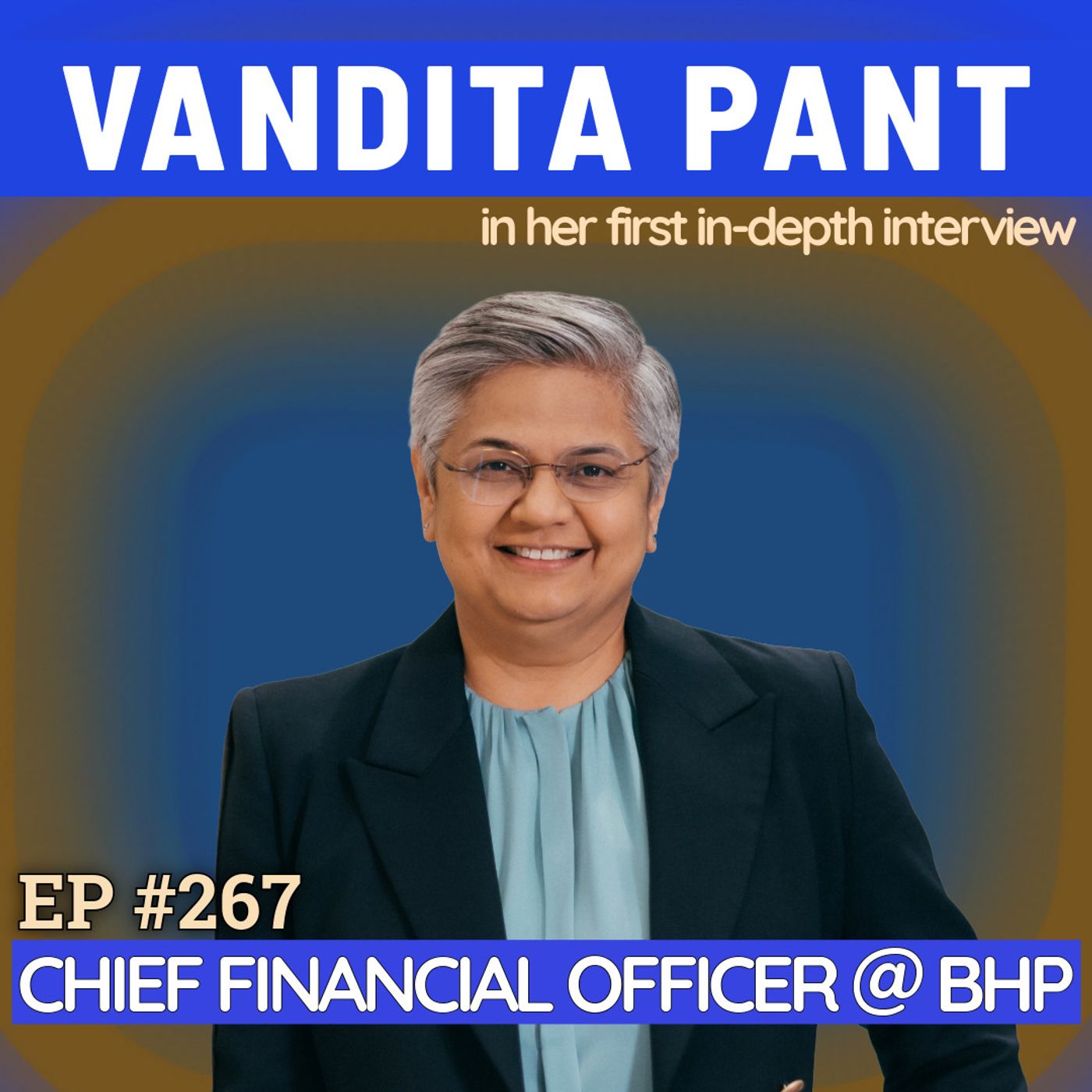
Episode topic: Vandita Pant, BHP’s Group CFO, discusses how curiosity and a “learn how to learn” mindset carried her from an academic family in Delhi to senior leadership across banking, risk, and finance, including major cross-cultural moves (Singapore, Japan) and crisis-era experience (RBS/Lehman period). She also frames “high flyers” as teachers and emphasizes resilience, cultural humility, and building balance-sheet strength through cycles.
Born in Delhi; now lives in Melbourne. Raised in a family of academicians (many professors/lecturers). Studied at Sri Ram College (Delhi) and then IIM Lucknow (MBA, finance and marketing). First job after MBA: financial restructuring for hotel/tourism projects in India. Later moved into international corporate banking (BNP Paribas, ABN AMRO/“Dutch Bank”), then risk management, structured finance, strategy, and treasury. Became chief risk officer for Japan and South Korea at 34 (youngest executive director in ABN AMRO). Later joined BHP as CFO.
Curiosity + deep immersion + handwritten/digital annotation help thinking. Ambition should be explicitly communicated. Development plans are for self-improvement, not just the organization. Cultural trust comes from learning how work gets done and changing visible symbols (e.g., leaving on time in Japan). Crisis lessons: resilience and balance-sheet discipline.
First “innovative” syndicated, currency-hedged railway finance deal (IRFC) in Asia. Japan cultural shift by leaving at 6pm to change “stay late” norms. RBS acquisition shock in 2008: after sponsors left, she took a liquidity/balance-sheet mandate; wrote a memo warning “car crashes” in weeks; helped during Lehman cleanup.
Written by AI. May contain mistakes.
Exploring the podcast's mission to showcase relatable role models.
“Hey friends, welcome back or welcome to the High Flyers podcast where we do reimagine a high flyer, showcase the brightest and most relatable role models and companies and their journey from sunrise to today.”
Vandita shares her early life, education, and first job experience.
“I'm your host, Virita Aguil, and let's have some fun.”
Discussion of Vandita's first job and lessons learned in financial restructuring.
“Where were you born and where do you live now?”
Vandita discusses her family's academic background and its impact on her.
“So a huge amount to be able to learn, real privilege.”
Vandita shares her views on the undervalued role of teachers in society.
“And Vandita, as you know, the purpose of this show is to reimagine the concept of a high flyer, to go beyond someone's job title and recognize their person and the role they play in the world.”
Vandita reflects on her upbringing and the encouragement of curiosity.
“So there was a time when I said, I'm going to read Dickens.”
Discussion on Vandita's love for books and its origins from her family.
“What I mean by that is, we were an upper middle class kind of family.”
Vandita explains her transition from academic to business interests.
“I was going to say a common thread I've seen with people like you and your peers is they still take handwritten notes.”
Vandita discusses her decision-making process for pursuing an MBA.
“and then continued through my commerce degree.”
Vandita Pant discusses her educational choices, opting for an MBA over conventional paths in science and accountancy.
“But by the time I was almost ending my undergrad, the conventional choice was to go into CA, Chartered Accountancy, and the other choice was going to MBA.”
Vandita reflects on her unique experience as one of the few female MBAs in her cohort and the changes over the decades.
“So I'll see how many I can bring up in this conversation.”
Vandita shares her initial career steps in the hotel industry and her transition into banking at BNP Paribas.
“But it was one of those things which was, having said that, frankly speaking, over the years, this has been such a, these kind of things happen, but they are at the back of your mind.”
Vandita discusses the skills she developed as a relationship banker and the importance of curiosity and building trust.
“And with banking, did quite a few different roles and joined then Dutch Bank after a bit in India, in Delhi.”
Vandita reflects on her significant career move to Singapore and the opportunities it presented.
“And that's something which happened over those five, seven years for me.”
Learn about Vandita's move to Singapore and the challenges she faced.
“And that led to an opportunity to come to Singapore, which was quite unusual at that time.”
Vandita shares the story of how she reconnected with her husband after school.
“You made a side comment there about your husband.”
Explore Vandita's transition to Japan and her role as chief risk officer.
“And you've got a son as well, who's doing really well.”
Discover how Vandita earned the trust of her team in Japan through cultural understanding.
“Clearly, as I've said many times in this competition, I think it's a big tick that you've got the smarts, you've got the intelligence.”
Vandita discusses her efforts to shift the late office culture in Japan.
“And then I knew that I had, through my work, gained the trust of the team around me.”
Discover how Vandita Pant navigated cultural nuances in Japan during her career.
“And I would walk all across the trading floor, though I could take the lift close to my office.”
Learn about Vandita's perspective on career ambition and its role in success.
“And it seems to be something about places like Japan because they're so hard to integrate into that.”
Understand Vandita's approach to career transitions and the importance of continual learning.
“Get to know enough of that that you don't have to come back to do each of those roles.”
Vandita shares a pivotal career setback and the lessons learned from it.
“on this theme of change and taking very different paths, but getting to know that you have a lot to learn, but you know that you can.”
Learn how resilience and purpose drive effective leadership in challenging times.
“was given the mandate because of that attitude, because I had got to know so much within two months of trying to be useful that I became part of the crew, which was the cleanup and set it up again crew, which went on.”
Understand the importance of monitoring signals and managing risks as a CFO.
“We talked to the start, Vandita, about your reading habits and your interest in being curious.”
Explore the various dimensions of a CFO's responsibilities beyond numbers.
“And this judgment over a period of time is really important to get.”
Discover the ongoing learning journey and AI's impact on business strategy.
“For that kind of a capital decision, how do you know that this capital will be value accretive in most scenarios in which world may go?”
Explore how AI impacts capital allocation in mining and organizational deployment.
“So that's one very sort of narrow lens, but a very critical lens.”
Understand BHP's transformation from a traditional mining company to a key player in AI infrastructure.
“So very, very much that is on my agenda to work and improve on my knowledge.”
Learn about copper's critical role in supporting AI technologies and infrastructure.
“But while in the last four or five years, what has become very clear is because of security of supply issues and AI revolution, as I said, that actually AI revolution requires power.”
Discover how the tech revolution is reshaping investor interest in mining companies like BHP.
“And that is great because that means the knowledge base is increasing.”
Hear the story of Vandita Pant's transition from banking to her role at BHP and the challenges she faced.
“I'm sure that means you're getting a lot more calls and people want your curiosity and they're asking you questions, right?”
Gain insights on fostering a strong CEO-CFO relationship for effective leadership.
“So I took the role, which I must say at that time, lots of people told me that was a very, very bad decision.”
Learn about the importance of trust and partnership in executive relationships.
“And it's built on real trust and ability and license to say things behind the closed doors, which probably will not be said by anyone else.”
Discover insights on improving business ties and understanding between India and Australia.
“Partnership in strategy, but also in execution.”
Explore the value of family travel for cultural connection and memories.
“and really see how the growth, which will continue, structural growth in India, can be leveraged for either capability or for the core business across corporates here.”
Learn about effective questions to gauge a candidate's adaptability and thought process.
“Is there one question you love asking prospective candidates in a hiring process?”
Get recommendations for impactful books that encourage personal and professional development.
“It's a very short book, but I really like it.”
Listen to reflections on success and the evolution of personal perspectives.
“And last question, I ask every guest if you could recommend one question I should ask the next guest.”

Get the gist, explore an idea or ask about something said.
 Claude
On The High Flyers Podcast with Vidit Agarwal, what are the key points of this episode?
Searching your listeningAutomatic transcript. May contain errors.
0:00Hi, I'm Vidit, the founder and host of this podcast, The High Flyers. Hi, I'm Vandita from BHP. Hi, Vidit. Vandita, I'm really honored that we're getting to do this because I don't think you've done many interviews and I seem to have a good knack for getting people like you who don't do interviews to come on. So I should just start by saying thank you. No, you are very persistent. So I'm sure that's what all the guests feel. That's what actually, Gautsa Moo just came on from Bank America. He said the same thing. So I said, I'll take that as a compliment. And I said to you just before we started recording, like one of the common threads that came up in my research is people said you're one of the smartest people they've either worked with or they've gone to university with.
0:35So I'm keen to unpack what these smarts that these people are referring to. Hopefully you can tell me as we talk today. Hopefully I'm more than just that, even if that is true with it. But we shall see. I'm sure you are. Hey friends, welcome back or welcome to the High Flyers podcast where we do reimagine a high flyer, showcase the brightest and most relatable role models and companies and their journey from sunrise to today. As one of the premier products in our Curiosity Center lineup, providing on-demand intelligence to help you be 1 % better every single day. I'm your host, Virita Aguil, and let's have some fun.
1:15Our listeners have called this podcast a meticulously researched biography unveiling the extraordinary lives and decisions of the most remarkable individuals and companies from around the world. We hope you're enjoying our catalog of 200 plus episodes since we launched in 2020 with many of our guests appearing in rare public interviews. It's now time to explore your curiosity. Please enjoy. Let's set some context with fun facts. Where were you born and where do you live now? I was born in Delhi, capital of India, and I live in Melbourne now. And you've lived in many cities in between that, which we will talk about.
1:52And work, what was your first job and what do you do now? So my first job was a strange one a little bit after my MBA, which was about financial restructuring of hotel and tourism projects in India, which was a very interesting segment, which I didn't know anything about, but it was about financial restructuring of hotel projects which either were not performing well or were near bankruptcy. Really interesting, very small team. I was a graduate, you know, just started my work and reporting to the managing director of the company with a dozen employees with shareholding from some very reputable hotel companies as well as financial institutions.
2:38So I got the best of both worlds. And rather than just photocopying documents as you do in your first job, I got to make the pictures and write the reports along with the managing director. Fantastic. And now I'm the group CFO of BHP, which is the largest mining company in the world. I mean, that's like a really interesting first job. So was that post your undergrad or post your master's? Post my MBA. Yes. Okay, right. And I assume that was wasn't normal for most people to get a role like that? Again, back to your smarts. No, it wasn't. It was one of those things which was not a very conventional path at that time, and maybe not the one which everyone would have chosen.
3:21But I'm so glad because in those two years, two and a half years with the first job, I learned so much. Traveled around India, did some very tricky and complex financial restructuring, debt restructurings, and was in the boardrooms along with my two bosses who had been in the industry 30 years and I was three months into my job. So a huge amount to be able to learn, real privilege. So interesting. And I'm keen to unpack more of that because it sounds like that was a good foundation building moment early on. This episode is part of a special series in partnership with the Australian government and its Centre for Australian Dear Relations in the Department of Foreign Affairs and Trade.
4:02the Australia-India relationship has never been more important. Two vibrant democracies with growing ties across tech, business, media, culture and sport. Did you know Australia is now home to around 1 million people of Indian heritage, the fastest growing large diaspora community in the country. And many are quite the leading in boardrooms, in startups, in hospitals and in creative industries. but often their stories go untold. That's why the Centre for Australia-India Relations exists to build deeper connections between the two nations. And in this series on the High Flies podcast, I'm excited to interview many of these relatable role models, change makers with ties across both countries, exploring their stories, their identities, their ambitions, and activating the full potential of the Australia-India relationship.
4:56So I hope you enjoy listening. And Vandita, as you know, the purpose of this show is to reimagine the concept of a high flyer, to go beyond someone's job title and recognize their person and the role they play in the world. Is there a high flyer you know who you feel hasn't got the recognition they deserve? I don't know if there's a one with it, but coming from the family of academicians, if I can say that, in larger family, we have maybe a dozen professors and lecturers from every subject that you can imagine. I think in a society, we undervalue the impact and the contribution of teachers, lecturers in making who we are as people, and then the contribution that individuals are able to make to society.
5:43So I've seen the dedication as well as the impact that teachers can have. I've had some fantastic teachers who gave me not just the content, but the way of learning, the way of thinking, right kind of values and a sense of judgment and prodding you to think of choices and why. And that has stayed with me. So I think probably I would say high flyers as a class would be teachers in the society. Well, that connects well to your love for books, which you're now joking about the other day. And also where you're sitting, I can see a whole library of books behind you. I mean, that's a good segue into your childhood and sunrise, as I call it.
6:24Let's start with books, because deeply fascinated by your interest in books. Firstly, I don't know where you find the time. People say you read five books a week. So maybe you can tell us the secrets. But when did that love for books start? So I don't read five books a week, but I do read a lot. And I read every day, even if it's for half an hour. It started, love for books started in school. In fact, there was a time in school when I actually wanted to be either a librarian or have a bookstore so that I could be surrounded by books and read them and discuss them with people. But my love for books started in school and actually across many different topics, which has continued even now.
7:04There was a time when I fixed on a particular thematic and read everything. So there was a time when I said, I'm going to read Dickens. And one summer, I read all Dickens across it. In one summer, I said, I'll read American literature, which I was not very familiar with. and started with John Stanbeck and all the way to Koroak and read everything in between. But that started with the school and it has continued. I read quite widely. My husband says if you wrap something in a newspaper, she'll keep what was wrapped and start reading the newspaper. Right. But I do read philosophy to art to geopolitics, contemporary history, fiction, and increasingly scientific progress-related books as well as societal books.
7:55And you said your academic history with family. Can you talk about that? Were your parents in that field? Yes. So my mother and father both were academicians. And I'm very close to my maternal family, my mother's side of the family, with whom I grew up close by. And there are a dozen lecturers and professors from, we don't talk about only chemistry, we talk about organic chemistry professor and PhD in inorganic chemistry. It goes that way. So I grew up in an environment which I now know was foundational in the way I thought about that there was a lot that you could be curious about. You were encouraged to be curious about anything around you, deeply engage with that and explore ideas, explore, challenge each other if that was needed.
8:47So it was a very privileged upbringing. Now I know because I almost didn't think there was any limit in growing up in an environment like that. You could graze and satiate your curiosity on anything which was around you. And only child? Did you have any siblings? No, I have a brother who's in the US for almost last 30 years now, a younger brother. Yeah. And tell me, you mentioned growing up in Delhi, take me inside the environment in your home. What did you see? What did you read? What did you smell? Hmm. Only after coming out in real world with it, I realized that it was a very, very positive upbringing.
9:32What I mean by that is, we were an upper middle class kind of family. So it was not about wealth, etc. But it was rich in terms of opportunities. And I never was told that there was any restriction on what I could do versus my brother or versus what is out there in the world. As I said, I grew up a lot with the influence in my large maternal family. Not only OK, but it was expected that during dinner time, you'll argue I will be 10 years old and giving my point of view on the topic of the day, whatever the adults may be discussing. And that was very much encouraged. My maternal grandmother's been a big influence and she was a very strong woman with resilience and with the huge curiosity.
10:21She made me say, couldn't read English, but would say, read me the English newspaper. And I would have to give her all the stories on the front page and then discuss those stories. And yeah, it was a fantastic environment to grow up in. Some of the people you connected me for research, they said you have this incredible trait of underlying things. In college, you would underline everything. And apparently now as well, when they meet you and they see your work, you will underline things. Did that again come from that time with your grandmother, like reading the newspaper and underlining? I don't know about that particular thing, but I do.
10:55I like to have my annotation, my reflections, my so what, my questions on the margins of what I'm doing. And hence, underlining and making sense of it gives me a sense of engaging with the content, which is for me important. Reading is not just about reading and a download of information. Its ability to be able to pause and reflect on it, connect some dots which are outside of that book and let it marinate a little bit. And underlining and annotating on the margins, I think, gives me a sense of engaging with that content and making it my own in terms of thinking as well as connection. So that's something which I have continued.
11:37And now, of course, our notations are digital and underlines have become highlights in the medium of digital books. But I have continued that. I was going to say a common thread I've seen with people like you and your peers is they still take handwritten notes. I'm amazed at the number of senior executives I speak to that take handwritten notes, even with AI and everything that we have today. Yeah. And I think you have to know what's effective in terms of efficiency and what is the way in which you assimilate. These two things sometimes are a trade-off and you need to find your own optimal way to do that, isn't it?
12:17So there are some things which I just type and I'm good with that, which are more routine, but things which are almost more important when I'm brainstorming, when I'm articulating on what could be and still thinking about it, I tend to do that by writing, even if it is with a stylus and not a pen, but yes. And tell me, when did you first come across the world of business? Because it sounds like your family influence was not business. No, it wasn't. And it was a bit of an unknown with it. As I said, in the family, lots of professors and lectures, but not too many people from the corporate world.
12:56And even in school, I started with sciences. I topped our school in class and still went for commerce, accounting and business because I thought that seemed like something that I didn't know a lot about, seemed very real world. So it is almost by saying I did not want to do sciences that I turned towards business accounting as in school last two years and then continued through my commerce degree. So tell me when you were 18, you've just finished high school. If I met you at that age, what would I have assumed you do with your life? Well, you would have thought that I would go to be immersed in whatever I do.
13:46I like to do that. So I was just joining college with a commerce business degree, but not very clear at all what I wanted to do. I just wanted to really understand the subjects I knew nothing about, which turned out to be accounting, business, and the law, economics, math, of course. And, yeah, I wasn't very clear. But by the time I was almost ending my undergrad, the conventional choice was to go into CA, Chartered Accountancy, and the other choice was going to MBA. And I chose MBA almost, again, unconventionally so, like I had chosen Commerce rather than Sciences in school and went into it because it seemed like that had a better scope.
14:36I didn't know much about it, but it seemed like C at that time, maybe wrongly, but I thought was only numbers, whereas MBA scope seemed it's numbers, but it's strategy, it's leadership, it's more real world in that sense. And that's why I chose to appear for the exam for MBA instead. And so when you say unconventional, what was the conventional path at that time? Conventional would have been in school. I would have gone for sciences, done in engineering or medicine, especially having almost topped the school in those subjects, and I didn't. And then undergrad would have been a CA route, but I chose MBA and did my specialization both in finance and marketing.
15:23And so I understand you went to Sri Ram College in Delhi, and then you went to the Indian Institute of Management IAM in Lucknow. These are both reputable organizations. But, I mean, even now getting into an IAM is really hard. I think someone said to me the other day, it's harder than getting into Harvard or Stanford. Is that true? It is indeed. We're talking probably ancient history now. But when I appeared for that exam, our institute had 100, 125 seats all across four IAMs. There were 600 seats and I think 150 ,000 of the students across from India appear for that exam. So it is difficult.
16:10But in a way, what makes you in these institutes, Vidit, for me is both Sriram College as well as my MBA, which are very difficult to get into, is not really just the content. content you could read anywhere, but the environment to be around other very curious people, really get to work with some smart people, but also get to know how to learn, how to learn, what is important, what's the way to think. I think those attributes and also hard work, hold you in good stead across decades, whereas content may get stale. It's up to you to keep the content of it relevant. But the way of thinking, the way of making simple
17:07insights out of complex situations, being methodical and structured in your thinking, and just learning how to learn, what questions to ask, how to do it, and being able to work with and learn from some very, very high achieving and cognitively high people was fantastic. And of course, you make some great friendships which last you a lifetime. Yeah, I was lucky enough to speak to some of them and they gave me some funny stories. So I'll see how many I can bring up in this conversation. I think on the MBA point, what I find interesting, Vandita, is in countries like India, in countries like the US, in MBA, still today holds a lot of stature.
17:55I feel in places like Australia, not many executives have an MBA. Is that a fair comment? I think it's a fair comment. I would say American business has seeped in that kind of a holistic way of thinking about management and leadership. having said that, there isn't a, I don't think there is a right or a wrong answer. As is always the case with these qualifications, these are the ticket or the foundational element of your career. And if you're good at it and you've taken everything from it, whatever it may be, you can build on it. Whatever is not there, you can build on it. And I think that's the way I think about it.
18:40For me, the MBA qualification led to a broader sense of exploration in subjects from information systems to marketing to finance and corporate strategy and capital markets, etc. Equally, organizational behavior and subjects like this. So it just widens your aperture a little bit. Having said that, I do reflect sometimes that I was very young when I did my MBA. Immediately after undergrad, I went there. And I wonder sometimes, maybe some subjects would have resonated with me even more had I done a couple of years of work ex. So I knew what inside of a real organization looks like. But for an internship, which I did with the Unilever a subsidiary in India, in the Tanleva, I had not really experienced organizations or corporates as such.
19:45I mean, before I go into your career, the other one that came up in my research quite a bit is apparently being a female who did an MBA at that time in India was not very common. A few people said to me in my research that you were one of only nine females and apparently one of only a few people that else had an engineer. I think most people are also engineers in that group. Can you just reflect on that? Yes. You know, things have changed a lot over the last few decades. But when I did the, you're right, in our school, out of 100-odd students, there were nine of us. But Girls' Hostel was a fun place, I can tell you that.
20:26But there were only nine of us. And out of 100, I think there were five or six non-ingeniors. And I was one of them. So I was in this vein diagram slither of a female and a non-engineer. But that has shifted a lot now, of course, over time. But it was one of those things which was, having said that, frankly speaking, over the years, this has been such a, these kind of things happen, but they are at the back of your mind. You do not think of yourself as, you know, you're a female, you're a non-engineer and hence here. And that has continued in my career, which I'm actually grateful for, because then you do not sort of come into anything, any room, in any forum, in any country, in any role, thinking about that as your first way of fitting in.
21:26That's just who you are and that's fine. And then you get immersed more directly into what the role may be. I'm sure now when you go to the alumni events, you must be very proud to meet some people that perhaps didn't have high expectations of you because of the gender, but now you're in a very senior role, right? Like that must be an interesting conversation now reconnecting with the alumni, I'm sure. Yeah, I have some great friends. So I think I don't know whether that's a proud moment. they'll still take my trip if they were given a chance. Fair enough. So you did that. So clearly a lot of investment into your education.
22:05We talked about your family influence of academia. And then you mentioned earlier your first job was in that hotel industry. You were doing restructuring. So I think you did that for a couple of years and then went into banking. Is that right? That's right. So after a couple of years, I switched to actually BNP, BNP Paribas at that time. and went to Mumbai with that role from Delhi. And with banking, did quite a few different roles and joined then Dutch Bank after a bit in India, in Delhi. And when I joined the Dutch Bank, ABN Ambro, again did something new. They were setting up public sector, that is government sector companies coverage, which was quite unusual for a foreign bank to cover Indian government companies.
22:59And I led that group and that became quite a success and worked there. And then finally came to, was invited to come to Singapore to work with the bank there. I'm always curious about the skill sets you think you learned early in your career. If you think of those first five, seven years, I think a lot of the titles I noticed in your profile said relationship banker. So maybe you can unpack firstly what that means. And secondly, yeah, what were the skills in the toolkit that you've taken from that first decade of your career? Yeah. Yeah. So relationship banker was a typical what we call corporate banking mandate, which is you cover a corporate, could be Indian corporate, could be a Nestle, for example, in India.
23:45and later private public sector companies. And you meet all their requirements. You figure out what is it that they need, and then you offer and bring the whole bank to that customer. It could be lending products. It could be products to hedge their exposures. It could be that they are looking for advisory and hence M &A is needed. It could be that they're looking for structured finance and you bring that in. And in the first five, seven years, Vidit, I think it's fair to say I was taking in almost by osmosis everything that these international banks had to offer, not just in India, but globally.
24:28And it was fascinating because at that time, India was not a fully open market. So there were products available in Paris or in Singapore for these banks, which were not yet introduced in India. But I was reading up those things because I could see they have resonance with the problems that my customers and my clients have. And then there was an opening up slowly of what you could do. And then we became one of the first ones to do a few very innovative things because that expertise was in the network, but had to be brought into India. And because I had been plugged in with that, had gotten curious about it, we became the first ones to do a few things like a railway finance company, IRFC at that time, did the first syndicated loan with them, which was also hedged for certain currencies, etc.
25:25Now it looks like a standard vanilla product. But at that time, that became the first time a garment company had ever done a product like this. And this became a very big thing for ABN Amro in Asia Pacific franchise. eyes. So I think it's fair to say what I learned was, A, really be curious, especially early in your career. There is a lot that you can learn from watching people around you who have been doing this for a while, really immersing yourself in the content of it. But at the end of the day, get to know how do you talk to customers, clients, and how do you listen so that you know what the problem they're trying to solve and then go to different people and make sure that you offer that.
26:15Building trust in those relationships so they actually give you a call when something is needed is important, but equally having the expertise and building that expertise and muscle, both soft and content-wise, I think is really critical. And that's something which happened over those five, seven years for me. So it sounds like back to the point earlier about the crossroads of whether you go into science or business it sounds like by this point you knew that business was the right right decision for you indeed it was it was yeah and it it's interesting because when you are dealing with this you know companies across sectors some fmcg companies like nestle i said and some industrials like escot in in delhi at that time or some public sector company, you get to see very different sectors with very different investment horizon, with very different corporate strategies, and at different stages of their life cycle in terms of financial strength or requirements.
27:22And that kind of breadth, I found it very exciting and really enjoyed covering across sectors and some very technical things like structured finance, et cetera, as well. The first big move that I feel you made is moving to Singapore in 2000. So I think you were seven, eight years into your career, if my maths is right. Take me inside that. It sounds like a big moment, or was it a big moment for you in your career at that point to move out of India for the first time? It was. It was. And it was one of those things where, as I had mentioned, the IRFC deal that I did, I did with my colleagues in Singapore, where the trading desk was.
28:08And that led to an opportunity to come to Singapore, which was quite unusual at that time. At my stage in career, I was not senior enough, but to be invited to have that. And at that time, my husband was also working with a tech company. And he got the opportunity as well when he asked for it to go to Singapore. So actually, both of us went there. It was a big moment because I started to cover Singaporean companies after coming there. And I was one of the few non-Singaporeans at that time covering Singapore companies. But the product set was wider. And hence, it was very interesting to get immersed in that.
28:58I know when one of our previous guests, who you know well, Sanjeev Gandhi, when he came on, he talked a bit about his reflection. I think his first move, if I remember correctly, might have been Germany or somewhere in Europe. And he said it was the hardest thing he'd ever done in his life. Like he thought he knew how to run businesses and he thought he knew how to work with people. So Singapore, I guess, is a little bit easier because you've still got English as the common language. And there's, I mean, I've got so many Indian cousins in Singapore and so many of them have had success. So that perhaps would have been easier.
29:30You made a side comment there about your husband. And I wonder if you can touch, if you can confirm this for me. I was told in my research that, did you reconnect with him? So you knew him as a child and then you reconnected later on and then you got married. Is that a true story? That is indeed a true story with it. you've been talking to lots of people who know the right stories then. But yes, so my husband and I were in the same school. He joined our school, I like to say, before it became our school. So from 10 years old, never dated really in school, but we were very good friends as part of a big gang of friends.
30:10And then I went to do my MBA. He went to do his master's. I went to Mumbai. He went to Russia for a year, came back and reconnected when we were 28, as it does. And reconnected in our school reunion and talked about where I had been and he talked about where I had been. And we were fascinated because both of us by that time already had done many different things. And then, yes, then dated for a year and got married. So we have known each other practically all our lives. but really, really started dating only at 28 and then got married at 29, both of us. So have you actually lived in India together?
30:56Because once you went to Singapore, you've been outside India, right? For a year and a half. Okay, you went back for a short period. Okay, right, right. Because I know you've lived in various parts. It's one of those funny things when you see our school pictures, you can see both of us in our class photographs for our middle school and senior school. Yeah, that actually seems to be common. I know a couple of people who sort of had a relationship in high school and then they're connected as they become adults and they've started their life together. Yeah, I think it's very interesting. For us, as I said, we never dated in school, but coming from the same school connects you to a similar kind of a value system.
31:35We know each other, get that. But then most important for me is people grow up, all of us grow up to be different adults and to reconnect as adults and still find that wavelength as adults. It was fantastic because then you have the comfort of actually having the value system being right and similar as well. So as I say, my closest friend is my husband. That's good. You want that to be the case. I'm glad you've got that. And you've got a son as well, who's doing really well. So that must make you proud as well, I'm sure. So Singapore, so you were in Singapore for, I believe, three, four, maybe five years.
32:20And then you made a big move, five years, and then you made a big move to Japan of all places. I mean, most people would say Japan is a very different out of world experience. Tell me about, we'll come to the work in a second. Tell me about the personal transition moving to a place like Japan. Yeah, so that was indeed a very big transition. I was going there as chief risk officer for Japan and South Korea. So there were three chief risk officers in all of Asia. One was in Singapore, one was in Hong Kong, and one was in Japan. And I was one of the three. I was 34. So I became the youngest executive director for Ibn Amro through this role.
33:05and Japan was a very big base for us, very big base for us and I was second, I was sent there as second senior most person in the office of 350 people. Country manager was a Danish guy from Denmark and then I was number two and then there were very few females in the office, though it was a Dutch office. And the next senior woman would have been the executive assistants and the people who would write letters of credit. Very, very junior. And I was number two. So it was quite an experience and quite a transition with a very young family at the time as well. Well, the obvious question then is how did you earn the trust of the organization that they sent you?
33:59Clearly, as I've said many times in this competition, I think it's a big tick that you've got the smarts, you've got the intelligence. but then you need people to give you a chance and say, yep, we'll send her to Japan. I don't know if you can speak Japanese, but we'll send you. Tell me about that. And I know you're very humble, so you will sort of bat this off, but this is a chance for you to shout about your achievements. What did you do in your time in Singapore that gave the organization trust that you should be the person on the ground in Japan? Yeah, I think these are the things when people go out of their way to take a bet on you with it.
34:35And you have to, you know, when the careers go the way they do, you have to remember that it was not you, but someone else taking a chance on you. And it worked. But to your question, in Singapore, after my, as I was saying, I used to cover banks, cover many corporates. I did shift to risk management in banking, which was very unusual. And I did that in a way from a setback in Korea. So I was rated one of the highest performers in the region. Went for maternity leave to have my kid who was now no longer a kid. And came to know during that time that that whole group that I was part of, I had started to cover regionally 17 countries for financial institutions rather than just Singaporean companies.
35:39And that whole group was going to get disbanded and moved to Hong Kong, where the new team had been hired. And in spite of being the highest performer in the region overall, I was brought in to say, can you go to Amsterdam? And it's like I had a three-month-old baby. And I said, I can't move to Amsterdam. So the issue became on what to do. And this is where one of the people who didn't know me very well, Paul Hodgson, he approached me and said, I just heard about this. Do you want to join risk management? And I said, I'm a structuring person. I'm a client facing person. My career would end if I joined risk.
36:27This is how mature I was at that point in time that I thought this was the end of my career if I joined. And he said, no, you know about risk because I've seen you present to credit committees and you know the risks in your clients. And that became the way that I joined risk management to cover Southeast Asia for credit risk. However, coming from a different background of client facing, usually in banks, that's never done. But risk people grew up as risk people because it's seen as a real expertise. I picked that up and changed quite a few things. And within two years was given increasingly bigger things to set up the trading floor, trading and credit risk management for Asia Pacific out of Singapore.
37:16And it became one of those things that head office, Amsterdam, thought I could go and do this role, which was at the same level as the person who had given me the role of risk management. So I became Paul's peer. So it was a fantastic opportunity, a really big step for the bank to allow me that. And the way I think about this is because I made changes in risk, brought a very different perspective. when you know what customers need, where the risk appetite needs to be to be able to challenge in a different way, that worked. But going to Japan was not about only technical time. The way I think about these transitions with it is that if you're changing countries, there is no excuse not to know about the culture of the country.
38:15You have to be humble and lean into what matters, how things are done, why are they important, and how you could do it in a respectful way. Having said that, you do not go 5 ,000 kilometers to be just the same. You go there bringing what you bring with you, which is different. So there is no excuse for not knowing the culture, but there is no point in sending someone 5 ,000 kilometers away if all you will do is do what was being done earlier. And I took these two points very, very much to the core of how I showed up. Do what is needed, show value. And over a period of time, you get accepted in a very different culture as well, which was not easy in the beginning, both Japan and Korea.
39:12but it was one of those things where I say that senior most Japanese person, Josai-san, he used to share some country meetings and the first time I got to know that I got accepted was I was two minutes late and he said, we'll wait for Vandita to come, which never happened in his meetings. And then I knew that I had, through my work, gained the trust of the team around me. And yeah, and we had a fantastic two and a half years doing things quite differently there though, as well. I mean, tell me, how did you understand the culture? Because what you said before is spot on. Like I just spoke to an executive yesterday and she went to, she's an Australian who went to China and she used the example of an offsite.
40:02She tried running an offsite and she wanted everyone to come with their thoughts. And it was a very quiet room. and they said to her where's the pre-read why are you asking us questions you're the boss and she said to me she said that was the biggest learning she's ever had in her career and she's just become a CEO of a tech company here in Australia maybe coming from India maybe it was a bit different because India shares similarities with Japan was I think Australia is a little bit different can you touch on your point earlier about building that cultural understanding and trust? Yeah, sure.
40:34So I think, as I said, you have to be respectful of a few things and know that you are and show that you actually are trying to learn as well as assimilate. Having said that, there are things that you do with work, the way you show up, which are different. So I was very respectful of the way work gets done, how you seek consensus, how you seek opinions one-on-one, because everyone will say yes, but nobody has actually bought into it. And you learn how to do that in the right way. But equally, there are things that I did which were very different. And that message was also important. For example, I'll tell you there was a culture, and this is way back I'm talking about, of course, there was a culture of staying very late in office, very late.
41:33Everyone would just stay late. And being the second senior most person in the office, I took upon myself that I'm going to change that visibility culture for the sake of it. And that's the only location and And only time in my career when I used to watch my watch at exact six, I would pack everything. And I would used to be having my office was on one side of the corner office. And I would walk all across the trading floor, though I could take the lift close to my office. I walk across. I'll say goodnight to everyone in their cabins. And everyone on the trading floor could see me. I would say goodnight.
42:14Bye. Bye. I really leave that way every day at six and then go back home and probably open the laptop and start working again. But after two, three weeks telling my team, OK, let me know if you're staying very late, because obviously then you're not able to cope with the amount of work we have. And suddenly that culture started to shift. So sometimes these symbols of leadership can make a dent in how the organization's cultures can be molded. And that was also a learning for me that time. But I must say, Japan was a very formative experience, Japan and South Korea. And by the time we left there, I had one of the best farewells.
43:05Probably they wanted to get rid of me, but not really. It was where, you know, in my farewell, my husband Atul was asked up by Yosai-san, who was the senior most Japanese there, and given a calligraphic scroll. He used to do calligraphy, Yosai-san. And he wrote, thank you note to Atul. Wow. that he could come to Japan, which allowed Wandata to come to Avian Amro, Japan. And in any other culture, it would be seen like, why is he giving this to my husband? I'm the one who is working. But in that culture, this was the highest compliment. The team and Josiah-san could have given both me and Atul. And that scroll, calligraphic scroll, meant something.
43:54Wow. That's special. And it seems to be something about places like Japan because they're so hard to integrate into that. When you do, there's a special meaning attached. And I don't know if you've been back in your BHP role. Have you been back? Many, many times. Japan is very special to me. And, of course, in my commercial days in BHP, I went back many times because we have very strong and very close relationships with joint venture partners. as well as customers and suppliers in Japan. I go back very fondly. So did you do anything different when you went back in that BHP role, given the learnings you had from Avia and Amber in Japan?
44:38Yeah, as in, you know, these are different times, but things like to be able to talk fondly about my time in Japan, which was really one of the highlights, as well as, as I said, being respectful of the culture and being able to know how to do that authentically, not as a performance, I think is something which is appreciated by anyone, not just Japanese, but anyone, as you would think in India would be the same. I want to zoom out and ask a couple of questions and then we can come back to your moves. One is about career development. I firmly believe someone like you to get to the role you're in.
45:22Yes, you have to be smart. And yes, you have to be lucky. And now people believe in you. But you have to be ambitious. And you have to live up to that ambition. And one thing I learned in my career is sometimes you have to tell people what your ambition is. Because everyone's busy in their own life. I remember one of my early bosses, he talked about FMCG. I spent a decade in that world. And he would tell me, he said, Vida, you need to express to me what your ambition is. I can't read your mind. And I found that baffling. I said, really? I need to come and tell you? And from then I started talking about it.
45:49Did you do that through your career even now? Like, do you sit down and have a clear development plan? Do you reflect on your strengths and weaknesses? Can you just share some thinking about how you've done that over the last 5, 10 years? Yeah, sure. So I think you should have ambition for what you want to learn and what you want to achieve. But the way to do this, at least the way I have done it, is not looking at ambition from a role perspective, but looking at what is it that I could learn and being alive to the opportunities which can come widely because of it. And the way I've thought about it always is you immerse yourself in the role fully and deeply and do it in such a way so that when you are doing a particular role, let's say in commercial, but in just in marketing, there are adjacent roles.
46:46Get to know enough of that that you don't have to come back to do each of those roles. So do it that way, but also keep a very strong sense of peripheral vision of what is not right in front of you, but on the sides, which helps you connect the dots, which helps you scan for opportunities and context, which is wider than what is just needed in the current role. And if you do that, then the opportunities open up. The set opens up more. I have always had a development plan. In fact, something which is very core to my way of thinking about myself is that I think of myself as always work in progress.
47:31Because there's always something more to learn, to improve, to work on. And hence, development plan is not what you do for the organization. You do it for yourself. What is it that next one year, two years you want to actually change about or learn something more about or get better at? And that way of thinking allows for scanning the organization fully and saying that bit I don't know anything about. Why don't I put for myself a view that I will get to know more about it? And that's what I've done quite a lot when I joined BHP in Treasury. I said, how do I learn about commercial? How do I learn about what happens in investment committees?
48:22And I asked the CFO at that time. And he gave me, started sending me the packs for some of the investment committee packs so I could learn. And this was something that I asked. And that allowed me to know more about things that were not right, not really needed in the job that I was doing. So I think that development plan is important. Having said that, I think chasing roles is more difficult in organizations because roles shift. And for me, title has never been important. I've chosen sometimes roles which had four people report to me. That's what happened in RBS later. Instead of 500 people team, because I thought I would learn in the role which had four people reporting to me rather than 500.
49:14And in hindsight, that was indeed the case that I could learn more and shift. So investment in development plans and really following it through has been always positive, but not just staying in one area. For me, the important thing has been as opportunities came, I could do things very differently from corporate banking into risk. These are completely different things. Then from risk, I went to structured finance. From structured finance, I went to strategy, then treasury. And could do that because if you are very honest and humble about what you don't know, then in transitions like these, you say, what is it that I don't know?
50:00And I will invest consciously and deeply in building. Because if you don't do that, then it's not going to be a very smooth transition. But if you are able to acknowledge what you don't know, but equally you bring something which can give you a head start. There is an adjacent skill that you bring and then you build on it. Those two together allow for these transitions to happen and quite transformatively rather than just something which is very close in terms of content. And last thing is you need to know how you learn so that you are able to use your learning style to do very steep learning curves.
50:41And once one or two of these transitions have happened, I think the confidence to take something completely different increases. And this is a virtuous cycle you're looking for. Acknowledge what you don't know. Bring something from your current role. Turbocharge it with your own way of learning. and once you've done these things which were not actually adjacent to each other but where it seemed very different and you do it well the confidence increases and next time you're again able to step out of your comfort zone to do something different and my career has been in a way built on this theme of change and taking very different paths, but getting to know that you have a lot to learn, but you know that you can.
51:33And you will spend time, energy, resources, being humble, and do that pretty quickly. I joked earlier that everyone in my research said you're one of the smartest people they've worked with. And I think that is true. So we don't need to confirm that. but you probably have had moments of doubt perhaps in your career. I think most people look at someone like you and go, it's been up and to the right. And someone looks at your LinkedIn and goes, wow, this person has just been successful the whole time. Maybe that's been true in your life. But if you've had moments of doubt, can you share one example and what was the doubt and how you overcame it?
52:05Yeah. So with it, if you look at a straight line going from, you know, left hand corner to right hand up on the quadrant. And that's how life works. That's not the story. So I'll give you an example. When I was in ABN AMRO and heading strategy at that time, had just taken on strategy and ABN AMRO basically got acquired by RBS. And I was put in the strategy role because as an accelerated path, career path, given that I'd done many things, different markets, et cetera. So this was an accelerated path to hedge strategy for the investment bank, global markets for ABN Ambro. The acquisition happened and overnight, basically the whole board and the executive leadership team who knew who I was, what I had done, I was on this accelerated career path went away, was fired.
53:09And I was here coming back and sitting in the same chair in London and saying, what happened here? Till yesterday, I was on this accelerated path. And today, nobody knows in this bank who I am because no one's left, no sponsor, no one who knew me. And that was the time many, many of us really got shocked and some people never came out of it. And I was frozen for almost a few weeks. And then, you know, that was kind of a setback on what will happen now. And I actually shook myself and said, you know what? This is the situation. What is it that I can control? And my sphere of influence currently is I can control how I show up here.
53:58And this was very early days in 2008. and I said, I will make myself useful. What is it that I can add value on? And this was a time a role came up as global head of liquidity and balance sheet management for the combined investment bank of Abenamra and RBS, 1.2 trillion pounds balance sheet. And I said, oh, I know everything about products. I know lots of markets. This is a huge, this is one of the largest balance sheets. And the mandate was to bring it down. I like to do that. And they said, your senior managing director, there are only three, four people who will report to you. And I said, I don't care.
54:39I don't care about titles. And I don't care about how many people report to me. And I took that mandate because it was interesting. And I took the mandate on 1st July 2008. And you know what happened in September that year, Lehman. And I was literally three weeks in the role when I wrote a memo saying car crashes waiting to happen. It's not months, it's weeks away. And being involved in that in the trenches, and then once the bank failed, I was there and then given the mandate as the new team, because I knew something about it and I was new trying to make it work to set it up and clean it up and bring the liquidity and balance sheet management discipline back in.
55:23But I tell the story because it's not a straight line. This is a choice I had. At that moment, I could have said, how can this happen to me and taken a victim mentality or what I did take two, three weeks to recover from. But then you dust yourself off and say, how can I be useful? Let me concentrate on what's within my sphere of influence. And that was a turning point for me. And of course, after the RBS failure, which I was in the eye of the storm that time, was given the mandate because of that attitude, because I had got to know so much within two months of trying to be useful that I became part of the crew, which was the cleanup and set it up again crew, which went on.
56:16Really hard yards, difficult mandate, but incredible, incredible experience. It sounds like this is one of those crucial moments in your career. I mean, we talked about Japan perhaps being one culturally. This sounds like this was like a hard, solid, crucial moment. Before this in my prep, I was thinking, like maybe you've thought about are there learnings from that time that you apply in your role now? Like is there a lesson from that GFC period that now being a CFO of one of the world's largest companies that you keep in mind every week? Yeah, I think what I learned during that time and which has come in very handy in current role as well as in my earlier commercial role in BHP is one is resilience.
57:02Individually, you have to be resilient to be able to lead resilient teams individually, but also build that muscle of resilience in your own team of what the purpose is and what you're doing. But resilience of the organization, talent sheet as an enabler. And that is a theme in our volatile, uncertain world. But through the cycle, ability to execute on strategy, you need the balance sheet to be an enabler. And that has been the recurring philosophy since GSC days for me, that you have to be able to look at it and say, if there are bad times, are we doing enough in good times so that we'll be able to survive the bad times?
57:48And that resilience is a philosophy which is very important. I think secondly, I would say what I do use is how to galvanize teams around a purpose. It's hugely motivating. We come to work, but we spend a lot of our time and life in work. So having meaning and connection to purpose is really important. That was a time when it was very difficult to hire people into banking, into RBS. But the fact that I said this has been the largest banking failure in the world, in the history of humankind, if we can contribute even a little to bring it back in liquidity balance sheet in its resilience over next five years, this is worth pursuing.
58:44And I managed to build a very good team around me with that sense of purpose, which was very difficult. But lots of people wanted to be part of it and ended up doing some incredible, incredible work. And thirdly, off the back of it, you do build great capability and capacity in people. What you think was never possible. And when teams can see that they've delivered that, that is incredible. And they go on to do that. And that system, if you can put in place, is a system which becomes self-sustaining. From that team, now there are treasurers all across Europe, given they worked during that time with me.
59:31And that is something I have continued with me. Resilience, how do you bring purpose and connection and meaning to work for our teams so that they do things and they strive for things which wouldn't have been possible and equally bring resilience to the organization, but also to itself. It's very important. We talked to the start, Vandita, about your reading habits and your interest in being curious. I'm curious today in 2026, what are the signals that you keep an eye on for? Like, how do you keep up to date with the world and make sure that you don't get caught up in a GFC-like event? Are there certain information sources that you consume frequently?
1:00:19Well, I consume lots of information, but the reality is... But what does your dashboard look like? If you think of your dashboard as a CFO, give us an insight into that. So the dashboard would look like internal indicators, both of our current performance, but you cannot get enamored just by performance today. You have to say, are we enabling the health of the portfolio in such a way so that there is a... Future stewardship that CFO also has a mandate for is healthy. So look for things which are happening today, but also enabling tomorrow and the growth there. Look for signposts, which are weak signals, both in markets, in the organization of our ability to perform the way we do.
1:01:11Are we hitting the marks and what's getting into the way? I think that's a very important way of building resilience so that you are able to solve problems before they become problems. But external scanning, I would say, is really important. Right now, the important issue is the dimensions of disruption and disequilibrium are many. Industrial changes, the technological changes, energy transition and what comes with this, digitalization, geopolitical views. the cohesion or lack thereof in societies and fiscal strengths of economies. So there are many, many such dimensions. The important thing for me is how do you take those in, but are able to distinguish what is a signal and what is noise.
1:02:06Right now, there is a lot of noise in the system. Not every signal is structural and not every signal is just transitional. And this judgment over a period of time is really important to get. So you don't chase everything, but you are able to distinguish what is structural from just transitory. And one view that I have very strongly is there are ways to predict what is to come. and we should, never single point futures, but scenarios and what those world futures could look like. Having said that, what is more important than trying to get to the source of disruption is what is the preparedness to deal with any volatility which comes your way.
1:02:59Prediction is the first step and you can even skip it as long as you have the preparedness and the muscle for resilience built in. And more and more, it's the latter which is important because it's very difficult to know what the source of the next disruption or volatility may be. And that's something that I'm very mindful of. How do you build that financially, supply chain-wise, portfolio-wise, so that your portfolio and strategy is skewed to the upside and does not get disrupted with just one particular disruption coming in. Balance sheet is an enabler. So, yeah, lots of, I think, externals can, but the judgment here is to look for structural versus transitory noise.
1:03:57Maybe this goes into, I've on this show interviewed a few CFOs and one of my reflections on speaking to them has been is that some of them feel we as society don't understand what a CFO does. I think there's a lot of assumptions or perceptions about the CEO job, but CFOs, I think some people, and I think the distinction a lot of good CFOs, like you're great CFOs, like you would say is you're commercially minded. You're not just another accountant. And I think you've referenced that a few times and you've done the commercial role at BHP. Can you just educate us again, what do you think people don't understand about the CFO job and particularly of a big top-of-the-listed global company with, like you said, a lot of headwinds and tailwinds?
1:04:43Yeah. So I think CFO is not understood just by numbers. That's table stakes that of course you know that but the main thing for me is how does CFO become the person who drives value through both risk and return lens and this is really important. Where do you need to align the organization? How will we know that we are aligned and shooting for the right things? Are we measuring the right things? But more importantly, how are we enabling growth through capital allocation? Capital allocation is a very big part. Where to put in money? Why? How will we know that that is going to be a value for every dollar that we invest on behalf of our shareholders and do it in aligned to the strategy?
1:05:41That is really important. CFO is also So not just an alignment of the organization, but about storytelling. What do we stand for? Why are we shooting for it? And how do we say what these numbers mean? This is very important to be able to have that for within the organization, also with our investors so that you can get the investors along the journey on what you are doing, why and have a compelling reason and a differentiated reason for investing into the company. And I think there is a third one, as I would call, is a challenger in chief. There is a role in the leadership team and mostly in partnership with the CEO to be able to look at growth with the right kind of clear-eyed view, but equally be able to challenge so that the quality of decision-making becomes better.
1:06:42For me, CFO is a role which is steeped in judgment, in courage to be able to say the way things are, but again, have also the courage of conviction so that you can support the initiatives and growth and put money in it, even when its futures are uncertain. And that's the point. You will never, as a CFO, have perfect information in the world like today, especially for a company like us. We invest for decades and our annual capital is 10 to 11 billion dollars a year of CapEx. For that kind of a capital decision, how do you know that this capital will be value accretive in most scenarios in which world may go?
1:07:34So it's a probability based view of the decision that you need to take. But I think of CFO role as really value protector and value creator and aligning the organization and enabling people, giving them framework to make better decisions on this value equation, wherever they may be. But very steeped in commercial. And I'm grateful that I did four and a half, almost five years as chief commercial officer role, you know, selling and marketing all our commodities globally. So revenue line, accountability, as well as procurement and maritime, because that view of our own supply chain, external world of customers, suppliers, and the forces which are external, which sort of work on your strategy is a very important lens for CFO mandate, as far as I'm concerned right now.
1:08:40I think what's clear from this conversation, Vandita, is you've clearly built a toolkit of so many experiences. You've worked across so many functions, markets, countries. We talked earlier about development. What do you feel you still need to learn? I'm sure you need to learn many things, but it seems like you've captured a lot more learnings than many other executives have. Well, that's a privilege because that's how you are able to connect the dots, I think, with it. But there's so much to learn. As I told you, I think, yeah, the only time we stop learning is when we are dead, as far as I'm concerned.
1:09:17So for me, something that I'm very curious about right now and working to get more and more immersed in is the digitization phase into the AI. And what does that mean? The pace, the scale may be different from what everyone has a view on, but it is clear that we are living in times when there is a big transformation going to happen because of the AI capability coming. So I am right now curious on and improving how I think about that, improving my own skills. So one is the personal effectiveness and use of AI on that. So that's one very sort of narrow lens, but a very critical lens. The second lens on that I'm curious about is the deployment of AI in organizations.
1:10:23BHP is doing a lot. We've got very positive outcomes on the throughput, on exploration results coming out because of big data and AI. So what is it that we can do there? How to enable it? How to invest? How to make sure we measure the outcomes and enable this to be a differentiated advantage? And third aspect of AI for me is, you know, I'm a big allocator of capital. That's my role in BHP,$10-11 billion a year. And now we are talking about a revolution which will require, what,$5-6 trillion over the next five to seven years in AI, depending on where it goes. And I'm very much leaning into how the financing structures of that are shifting.
1:11:17What would be the analogous to our industry, which has traditionally been seen as a heavy capital intensity industry? Now there is another scale of it. How does that evolve? Where the bottlenecks will come in? So I am improving my knowledge of this ecosystem of AI and all the way back because of interest of where mining comes in, where copper is needed for that, but equally the financial market's ability to fund it. How does it relate to valuations? And overall, how does the economics of it with demand and supply constraints will work out? So very, very much that is on my agenda to work and improve on my knowledge.
1:12:09And I think your answer also touches on something because I'm conscious we haven't talked about BHP much. I also want to come to how you got the role of BHP. I heard a funny story and I can ask you to confirm that. But before I get to that, on BHP, my sense is maybe five, eight years ago, people would look at BHP as a traditional mining company. But like you said, today, it's a critical part of the global infrastructure. Data centers, AI. I don't know enough about copper and where it goes in, but I have a sense that it seems to go into some of these materials needed for the AI revolution, as you call it.
1:12:40Can you touch on that, like that shift strategically and someone like you, your role? Like I'm sure prime ministers and presidents want to talk to you, right? Whereas previously, if they didn't have a mining component, they probably would have said, great, keep doing what you're doing. So can you touch on that, like the role of BHP and the strategic repositioning of the company? Yeah, indeed. So you're absolutely right with it. When I took the role of Chief Commercial Officer in mid-19, 2019, at that time, it's fair to say people who know us, deal with us, customers, suppliers, specialist investors, knew everything about mining, but not beyond it.
1:13:22There was not much interest. But while in the last four or five years, what has become very clear is because of security of supply issues and AI revolution, as I said, that actually AI revolution requires power. And any use of power that you do, you can't do without copper. If you want to cool and have the data centers, even in the infrastructure and the servers, there's a lot of copper goes in. So actually, power is a bottleneck, but upstream, copper is a bottleneck. You need more than 10 million tons of copper, new copper, to come into the market over the next 10 years to just meet the demand.
1:14:03And that 10 million tons is a lot because we are the largest copper mine today in the world. It's just a million tons. So you need 10 of those coming in over 10 years. So this is a real bottleneck. But from the perspective of governments, I think it's fair to say, and I do meet with our customers, you know, governments, as well as the ones who are interested in the US, China, of course, India, Japan, etc. And there is huge interest because of the criticality of mining, both from security of supply perspective, but also for AI, has become very much a central issue for most governments. And that is great because that means the knowledge base is increasing.
1:14:58And as the largest mining company, it's a part of the mandate, even as CFO, to be able to lean into those conversations to give our perspective on what works, which policy works, how to do it, what's the best way to think about it, and be part of that conversation. And you're absolutely right. Yeah, absolutely right. On the investor base, as I was saying, historically, specialist mining investors would know BHP very well. But what we have seen increasingly is that as the tech valuations have gone up, the generalist investors still want exposure to the upside of that tech revolution, but are not clear who the winners and losers would be in this whole ecosystem.
1:15:48So rather than just the top hyperscalers, they come out to chip manufacturers. Then they are talking about data centers. And if you keep coming upstream of that, you don't have to make choices of winners and losers. And you come to copper being the bottleneck. So we have seen a lot of interest from the generalist investors getting into our register, shared register, not just from Australia, but globally. from the US, for example, who are coming into BHP as the largest miner, largest copper producer in the world. And because it's diversified, gives a stability of cash flows wherever the cycle goes and has a history of last two decades of margins of more than 50%.
1:16:37So those kinds of things have changed the investor base and perception about mining and especially BHP. I'm sure that means you're getting a lot more calls and people want your curiosity and they're asking you questions, right? And where you think the market's going to go. Indeed, indeed. The good thing is, as I said, for BHP, being a diversified, you retain the upside, but you have the stability so that you can fund all the growth that is needed from the operating cash flows. whatever the price takes on the commodities. Exactly. And we don't have to go into predictions, but I think that is a key differentiator compared to the tech world, right?
1:17:19Where there is a lot of, I'll say it, maybe you can't, is frothiness. There's a lot of frothiness and a lot of excitement and time will tell where that pans out. I want to come to India in a second because we haven't talked about India today and both you and I involved in that Australia-India corridor. But I joked earlier about the story of how you got the job at BHP. I came across a story in my research that were you on a trekking trip and they got in touch with you? Is that true? That is true. So we as a family were in British Columbia in Canada and hiking there when I got a call saying, BHP wants to talk to you.
1:17:56And I said, well, I'm in the middle of nowhere, so let me at least reach Vancouver before I talk. Anyway, I took those calls. And this was an interesting one for me because I had been a banker for 20 years. across five, six countries, done many different roles as we were discussing, was in business treasury in RBS. And RBS was talking to me about what do I want to do next and which business I want to head. And this call came and I said, I've never worked in a corporate and I've never worked in a mining company, of course, if I haven't worked in a corporate. So have a chat. And then I realized that if I take, so my logic of taking BHP and engaging with them was that I have done some very heavy lifting roles in banking.
1:18:49And if I ever wanted to do a banking role, I think I'll get a job. That was my takeaway. I think I'll get a job in banking if I needed any time. But corporate will give me a very different view of a group treasurer, how corporates manage that. But I want to do it in a sector where balance sheets matter. And in my head, the sector where balance sheets matter would be where there are long investment cycles and which are cyclical. So there's so much volatility that treasury is an enabler of strategy. And of course, BHP, long horizons. That made sense. Then the second thing for me was I want to do it where it's not just maintain the job and keep doing what we are doing mandate.
1:19:37I wanted to do it in a place where I can add value. And BHP told me we are good in very many things, but we don't think we are good in treasury. So you'll have full authority to do what you want. Blank sheet of paper and bring the treasury to world class. And that was exciting. And then the last bit was when I met the CEO after CFO said, I really want you to join her. Here's the CEO. He'll come and talk to you. And I spoke to Andrew at that time. And while we were discussing, he actually started to change the contours of the role. So he said, yes, you'll be group treasurer based in London. But That time, BHP was dual listed, both in Australia and London.
1:20:23And he said, because I'm based in Australia and so is the CFO, you'll be in London. You become my representative in the market. So you'll deal with investors, you'll deal with public policy people, and you'll be the face of BHP externally. And I thought that was, along with group treasurer role, a very interesting mandate. So I took the role, which I must say at that time, lots of people told me that was a very, very bad decision. I was going places in banking. I was a banker. What was I doing? No one's been successful doing a shift from banking into corporate, really. And I still took the role because I thought that this logic for me worked.
1:21:13And in my way of thinking, the adjacency that I was bringing into the role was how to manage treasury and complexity for big balance sheet. But what I needed to learn was mining, how corporates work. And that's what I did. And I joined in 2016 and there was a crisis of commodities as soon as I joined within a month. And it became an opportunity to really bring the rigor which was needed of managing balance sheet. And that was when I set up the capital allocation framework along with the CFO at that time. And that has lasted 10 years. And that's something BHP has come to be known for, of how rigorously we allocate capital, manage balance sheet, look at through the cycle, financial strength.
1:22:06So I haven't regretted that decision, by the way, joining BHP around 10 years back. Yeah, I was going to say it's been 10 years, maybe like exactly 10 years, probably a bit more than 10 years now. And that journey clearly has worked out pretty well. I want to move to India for a bit and just talk about Australia, India relations. Is there anything else on BHP that you want to touch on that I haven't asked? No, I think we've covered quite a bit of ground. And the from treasury going into commercial role was a very big shift. You were earlier referring to transitions with it. And three and a half years into treasury role, being given the privilege of coming into executive leadership team, but going and doing the commercial role, which is quite expansive as defined in BHP, was another of those shifts where I had to be very humble and know exactly what I know, but more importantly, what I don't know.
1:23:02And with a great team with me, we managed to do some very interesting but very challenging periods in a transformation way through COVID, through some geopolitical things and through then Ukraine-Russia war. so the disruption of commodity markets. So yes, it's been a fantastic run in BHP. So as I said, I don't regret joining BHP at all. Maybe one question before we move into the Australia-India element is a common thread that again came up in my research. People said you're good at managing down but also managing up. Now you've got a new boss that's coming to the role. If I came to you for advice and I said, Vandita, I'm the CFO at Company X and I've got a new CEO.
1:23:51What would be two or three pieces of advice you'd give me as I am building a relationship with a new CEO? Yeah, I think this is a very important relationship of CEO and CFO. And it's built on real trust and ability and license to say things behind the closed doors, which probably will not be said by anyone else. And this is really important. And this is how the best CEO, CFO relationships work with Brandon coming in for us to be exactly on the same page and have a huge amount of trust so that my challenge, my advice, his challenge, his advice, and sometimes working together, how will we even come across to the rest of the leadership team together, good cop, bad cop sometimes, is really important.
1:24:48So I would say for a new CEO coming in, if you are the CFO, take the onus on you to allow for that trust to be built very quickly. Because if there is no trust, the organization will suffer. This is really important. And secondly, this is a partnership which allows for advice, for challenge, but also for solutionizing things which are needed. Partnership in strategy, but also in execution. And I think that's a real privilege. But to own us is very much on you, I would say, to do that. And there is a perspective of investor of capital allocation, which CFO has not just the license but accountability for to bring to the table, whether the numbers are being talked about or not, whatever the agenda may be.
1:25:46I'm conscious of times. I want to ask you quickly on India and then wrap with the rapid-fire sprint. You and I were recently in Melbourne and we attended some of the events with the prime ministers and there was a lot of excitement and buzz. You've worked in India. You grew up in India. you've spent time in India, you've got a good understanding of India. What do you think needs to happen for the Australia-India relationship to get to the next level and move beyond just cricket and move beyond just the people-of-people links and move beyond this excitement? Again, if you had to give two or three pieces, if someone with influence came to you and said, Vandita, we want to appoint you as the key conjoint who's going to develop this relationship, what would you do?
1:26:26I think, firstly, properly introduce the capabilities and capacities of both countries to each other. There is a real opportunity to know. There is really complementarity for businesses and industries across the two countries. So I would really invest heavily in making sure that the corporates know what kind of capabilities, what kind of depth of analysis, depth of sectors is available in India to tap into and make it a differentiated competitive advantage if that is part of your own corporate strategy. I think that's very important. Secondly, there's nothing like being able to go and see. and I would encourage the senior leaders to go and see in a very Genba kind of a way, which is a Japanese concept we use in BHP, to go and see what is available.
1:27:28Go to two, three cities, go to a few capability centers, talk to people in your industries. We have worked in BHP for more than 50 years with a very strong relationship with customers who are growing at a stupendous pace. And for example, steel mills in India. So get to know the customers very well, growth plans there, and see where the differentiated competitive advantage can come from. And thirdly, I think it's really important that when you look at that, also look at the leadership in India of your own offices. Now, there is huge talent. And we talk about lack of talent sometimes or lack of capability sometimes.
1:28:18And the reservoir of talent in India is amazing as well. So I would say get into the brass tacks of getting to know the opportunity by doing gambas and by go and see, but equally then being very specific on for whatever the strategy is, how you can leverage of that. in a differentiated way. And we do that for the whole of supply chain. But equally, as you know very well with it, India, Australia, we have the luxury of having the meta good vibes relationship, if I can call it that, between the two countries. And there is an ability to lean into that and really see how the growth, which will continue, structural growth in India, can be leveraged for either capability or for the core business across corporates here.
1:29:26My takeaway from the other week when we were at those events with the two prime ministers and also the surrounding events was we're still at the awareness layer between the two countries. Like a lot of the conversations, there's a either a perceptive gap or there's a very limited awareness where even when I speak to folks in India they still look at Australia as a tourism destination and they like I joked to someone the other day they said do you even work like you've got the beaches and you've got the good locations and the cricket and I said absolutely people work hard here like yeah maybe India is a more competitive shore and you talked earlier about Japan being competitive and asking people to go home.
1:30:02But I think even some of those perceptions seem to be very real even now. Yeah. I think that's why I said it's both ways. Both countries have to invest in really getting to know each other. And more we do from an industrial-based perspective, corporate perspective, the more we'll discover that there's huge complementarity between the two. I think the opportunity is immense. It's absolutely immense. I want to move to Rapid Fire Sprint. You're nearly at the end. You've done a great job so far and hopefully I've asked you some decent questions. Is there one non-work investment that you consider the best in your life, ideally a course or a hobby or a holiday?
1:30:43Yes, I would say holidays. In fact, our way of thinking about holidays as family, because our son never sort of grew up in India. We took a call to every year since he was very young to go to India, catch both sets of grandparents and go to a new state in India to discover it as tourists together. And that has over 15 years given him familiarity with India so that he has a connection. It gave really quality time with grandparents sets with him and with us, which became very precious. And we have created a lot of memories through that way of thinking about travel in India. Besides, we love to travel, three of us as family, separately, internationally.
1:31:34But that way of connecting with the grandparents, with India, and I think we've covered 13, 14 states like that in India over time. Nice. Has been very precious. Nice. That's really cool. I should take that idea and try it. Is there one question you love asking prospective candidates in a hiring process? I like to ask, given everything which is going on around the world, what is the one thing you believed in or you held very strongly four or five years back, which you have revised your opinion on and perspective on? This is, in a way, an important question because you can ask it of anyone, irrespective of seniority.
1:32:22But also, it tells me more about how they think, how amenable they are to revising their opinion, but equally how plugged in they are with the things which are going around them or they get new input. do they change their view? And that is becoming almost a critical judgment and way of thinking in the world we live in. Is there one pet peeve, something that really annoys you? I would say, well, not pet peeve, but I like to go for what is possible. So low quality aspiration becomes a pet peeve for me, even for myself. If I'm striving for something and I set some target and then I have to tell myself, really, is this it?
1:33:19because I do think that our ability and potential as individuals, as organizations, and as teams can be aspirational. And then striving towards it by itself makes you achieve more of what you would have done if the target that you had set for yourself was no. So my pet peeve, if I can say that way, is that low aspiration from self, teams or the organizations. Okay, that's good. We talked earlier about books, these last two questions. We talked earlier about books. If you had to recommend two books that I should read, others should read, any you'd recommend? I would recommend one book, which I always recommend because it's one, it's very short, but it is very good, is Man's Search for Meaning, which is Viktor Frankl's.
1:34:20It's a very short book, but I really like it. That's one. And secondly, I would say as a theme, figure out what you can about the AI, whichever stage of career you are in. And in that sense, I think it's a bit dated, but Co-Intelligence by Ethan Mollick, which talks about how individuals can get augmented with AI skills, is a very good one to get over what could be hesitation to adopt the new tools available. So I would say Co-Intelligence as one and, yeah, man's search for meaning. Nice. Yeah, I've read the first one, not the second one. I've just made a note. I will check that out. And last question, I ask every guest if you could recommend one question I should ask the next guest.
1:35:14Of course, you don't know the next guest, but anything I should include in my notes? I think you could perhaps ask that has a definition of what is being successful changed over a period of time and why? Yep, absolutely. I feel like I kind of... That's a question because it's, you know, we all evolve as individuals and perspectives change over life. And the kind of guess you tend to get with it, I'll be very curious to know how that question gets answered by many. Yeah, I feel like I haven't asked that question directly, but there's an element of that through these conversations, even with you and others going back to childhood.
1:35:55So, but no, asking that pointly, I think is a really good one. But that brings us to our finish line, Vandita. Thank you so much. This was a long time in the making and I'm really glad we made it happen. And hopefully I asked you some decent questions. So thank you. Well, thank you. No, that was very interesting conversation. And you did your research, however you got all the snippets. So thank you. Good to hear. I enjoyed it. That's a wrap. So if something in this episode sparked a thought, send it to a friend or colleague. And if you're curious about partnering with us at the Curiosity Center, whether it's this podcast, to our reports, events, and more, and join the ranks of existing commercial partners, including Google, KPMG, Vanta, the University of Melbourne, and others, my details and the show notes.
1:36:42Until next time, I'm Vidya Tagawal, and this is the High Flies Podcast.
Vandita Pant is the Chief Financial Officer of BHP, one of the world's largest resources companies, with a market capitalisation of approximately US$150 billion and annual revenue of around US$55 billion.
This is Vandita's first-ever podcast interview.
Growing up in Delhi, India in a family of academics, Vandita reflects on her childhood dinner table debates, teachers and love of books for shaping the curiosity that has defined her career. After studying at Shri Ram College and IIM Lucknow, she built a global career across India, Singapore, Japan and the UK before joining BHP, where she now helps oversee the financial strategy of a company at the centre of AI, electrification and the energy transition.
In this conversation, Vandita shares why she deliberately pursued unfamiliar challenges, the career setback that unexpectedly led her into risk management, what it was like helping steer RBS through the Global Financial Crisis, the leadership lessons from earning trust in Japan, why she believes the modern CFO is a value creator rather than a scorekeeper, how she thinks about AI and capital allocation, and why Australia and India have a once-in-a-generation opportunity to deepen their economic partnership.
Please enjoy exploring your curiosity.
________
Get in touch with us via email at [email protected]
Join our stable of commercial partners including the Australian Government, Google, KPMG, Vanta, Allens, Macquarie Capital, City of Sydney and more.
Show notes and more episodes here
Follow us on LinkedIn, Twitter, Instagram, or YouTube
Get in touch with our Founder and Host, Vidit Agarwal directly here
Contact us via our website
________
The High Flyers Podcast features in-depth interviews with the world’s most influential figures in business, tech, finance, government and sport. Launched in 2020, it has ranked in the global top ten for past three years, with listeners in 27 countries and over 200+ episodes released, and featured in Forbes, Daily Telegraph, and at SXSW.
Our guests include -- Malcolm Turnbull (Prime Minister of Australia), Jason Collins (Head of BlackRock, Asia Pacific), Brad Banducci (CEO, Woolworths), Michael Schneider (CEO, Bunnings), David Eckstein (CFO, Legora), Jesse Zhang (CEO, Decagon), Vandita Pant (CFO, BHP), Elena Verna (Head of Growth, Lovable), David Haber (a16z Partner), Jodie Auster (Uber's Global Head of Travel), Rob Giglio (CCO, Canva), Jean-Michel Limieux (CTO, Shopify and Atlassian), Stevie Case (CRO, Vanta), Cristina Cordova (COO, Linear), Gautam Chari (Head of Capital Commitments, Bank of America), John Haddock (CBO, Harvey), Mark Suster (Partner, Upfront Ventures), Niki Scevak (Partner, Blackbird), Craig Tiley (CEO, USA Tennis), Jeanne DeWitt Grosser (COO, Vercel), Paul Bassat (Partner, Square Peg), Bowen Pan (Creator, Facebook Marketplace), Peter Varghese (Secretary of Foreign Affairs, Australian Government), Sam Sicilia (CIO, Hostplus), Jack Zhang (CEO, Airwallex), Tim Doyle (CEO, Eucalyptus), Sukhinder Singh Cassidy (CEO, Xero), Sanjeev Gandhi (CEO, Orica) and Philip Green (Australia's Ambassador/High Commissioner to India).
Join our stable of commercial partners including the Australian Government, Google, KPMG, Vanta, Allens, Macquarie Capital, City of Sydney and more.
________
Welcome to the 12th episode in our special series with the Australian Government and their Centre for Australia–India Relations (CAIR), spotlighting the growing Australia–India relationship across technology, business, media, culture and sport. Other guests in this series include Bank of America's Head of Capital Commitments Gautam Chari, Renowned Music Composer Tushar Apte, Australia's High Commissioner to India Philip Green, MUFG's CEO Vivek Bhatia, Australia's Secretary of Foreign Affairs Peter Varghese, NAB's EGM Sweta Mehra, Deputy Secretary of Australia's Home Affairs Brendan Dowling, Orica's CEO Sanjeev Gandhi, Sports Journalist Bharat Sundaresan, Cricket Legend Lisa Sthalekar and CAIR's CEO, Ryan Neelam, reflecting the breadth of Indian-Australian leaders at the most senior levels.