Ask ChatGPT
 The High Flyers Podcast with Vidit Agarwal
5 Nov 2026 · 1h 18m · 36 chapters
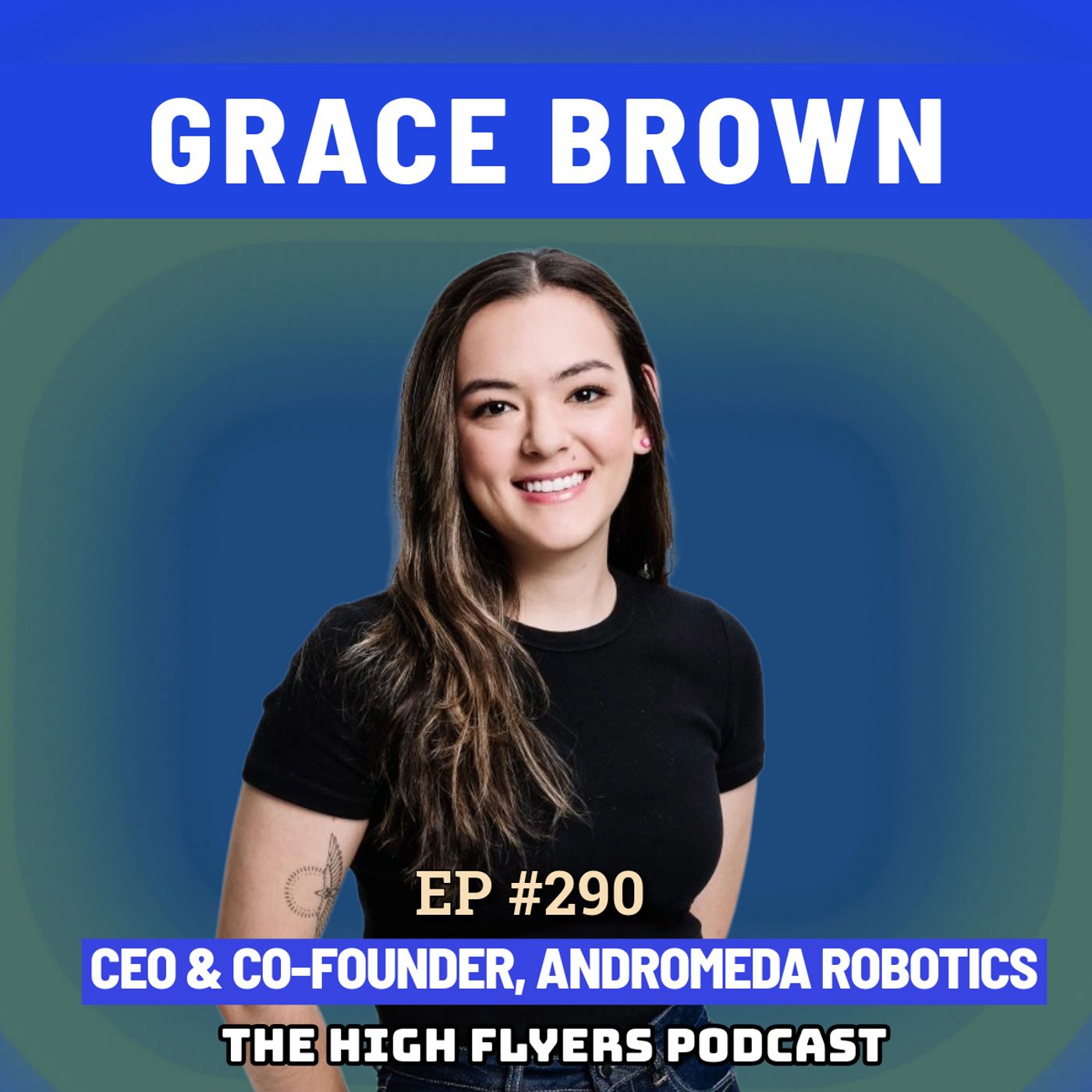
Grace Brown, founder/CEO of Andromeda Robotics, explains how her company builds “Abby,” a humanoid robot for aged care, arguing that the next competitive advantage in robotics/AI is “social intelligence” (a “social operating system”) rather than only physical dexterity.
Grace Brown is 26, born in Brisbane, raised partly in China, and now lives/works in San Francisco. She studied mechatronics (mix of software/electrical/mechanical). She started building Abby during COVID while in Melbourne student accommodation. She previously interned at Skycraft (low-Earth-orbit satellites) and co-founded Andromeda with Jan, her university best friend.
Physical intelligence will become commoditized; social intelligence is harder and more valuable because real-world human environments are unpredictable. Abby is designed to integrate into residents’ routines (group activities and one-on-ones) without forcing interaction.
Abby was inspired by the open-source Poppy Humanoid; early prototypes already drew strong customer attachment. Abby is leased yearly because she upgrades annually. Activities mentioned include Tai Chi, dancing, singing, language guessing games, trivia, and watching football/TV.
Written by AI. May contain mistakes.
Grace discusses her identity as a young founder and her experiences.
“So I think that's always a good compliment, right?”
Discussion on the concept of a 'high flyer' and recognizing unsung heroes.
“Let's hit the scene with some fun facts to get us going.”
Grace shares memories of her childhood in Brisbane and early influences.
“What was the environment like growing up?”
Discussion on Grace's parents and their impact on her work ethic.
“And tell me about the family, you know, maybe tell me about the influences.”
Grace recalls her high school experience and how teachers viewed her.
“me when I was really young that it's only 2 % in where you get to in life is only 2 % intellect and 98 % effort.”
Grace discusses her late-start interest in skateboarding and its significance.
“axiom that I've followed through the rest of my life.”
Exploration of Grace's unique perspective and how it influences her work.
“I actually have messages and emails from my high school teachers saying they're not surprised where I've ended up.”
Grace reflects on her maturity at 18 and aspirations for the future.
“And frankly, why you've built the company you're building is because you think in a multidimensional way.”
The discussion explores how perceptions of one's journey can differ based on who you ask.
“But I guess I never realized how significant that might come across externally.”
Grace shares her experiences of independence from a young age and its connection to entrepreneurship.
“like who would pay for what, what activities would I do?”
The conversation delves into how Grace's education shaped her early dreams of becoming an entrepreneur.
“that, I don't know where I would end up, but it must be somewhere pretty magnificent and aligned to the life I want to live.”
Grace recounts her journey to founding Andromeda, including her influences and the evolution of her ideas.
“our courses to go into university, everything I chose was either maths or robotics engineering.”
Grace discusses how the pandemic influenced the creation of Abbey, a companion robot.
Learn how Grace Brown conceptualized and built her robot, Abby, during COVID.
“when I sort of just had the idea to build Abby she wasn't named Abby at the time but I just wanted to build myself a robot that could keep me company.”
Discover the funding challenges Grace faced and how external competitions helped her project.
“engineer, it wasn't too complex of a project at the start.”
Hear about the pivotal moments that gave Grace confidence in her entrepreneurial journey.
“So I had to, I think as most engineering students are, you're very scrappy with your first few projects.”
Learn about Grace's transition from university to founding Andromeda with her friend Jan.
“where it felt like a bit of a step change.”
Explore how Grace identified the need for robotic solutions in aged care during COVID.
“So I just, I really trusted his judgment and his worldviews.”
Understand how Abby operates within aged care facilities and the activities she engages in.
“this is going to be a fairly, like really significant business.”
Discuss how Abby incorporates emotional intelligence and social interaction into her design.
“There's a new generation almost every year.”
Explore how social intelligence is vital for robotic interactions with humans.
“So touching that for a moment, like how have you incorporated that into the robots?”
Discuss the role of cultural context in the design and functionality of robots.
“So they are building a lot of hardware products much faster, much cheaper than you can get done anywhere else.”
Learn about the journey of a CEO in building a unique company culture.
Understand the complexities involved in managing a diverse team.
“such a there's so much we could cover and that I feel like that could be an interview in itself but But maybe a broader question is how do you reflect on scaling the company?”
Analyze how age differences impact CEO-employee relationships in startups.
“I think in the early days, if I'm thinking just for myself and putting myself first, I would say I overextended myself emotionally, perhaps for the people in this journey with me.”
Discover the value of mentorship in personal and professional growth.
“Either in a formal capacity or informal capacity.”
Learn about Grace's path to developing her humanoid robot Abby and the initial challenges she faced.
“And it's never something I actually went out and tried to figure out how to do.”
Discover the importance of self-belief and delusional confidence in entrepreneurship.
“And it goes back to what you said earlier, which I completely agree with is I firmly believe to be a founder, you have to be delusional to some extent, where if you knew all the downsides, you wouldn't do it, right?”
Explore Grace's vision of technology serving humanity and the unique role of Abby.
“I agree from, yes, from a utility perspective and capital and resource perspective, it has unlocked a lot.”
Discuss the transition from survival mode to scaling in a startup journey and the ongoing pressures founders face.
“And I think to the point before, a lot of the players in this space are feeding into this stereotype.”
Hear Grace's thoughts on the fears and paranoia that accompany the founder journey.
“And last week I was sitting on my couch, as you alluded to, where we're closing a funding around at this moment.”
Grace shares her aspirations and reflections on personal growth and learning.
“Because your thought process is going to evolve.”
Grace discusses her journey in self-growth and the importance of having hard conversations.
“So is there one non-work investment that you consider the best in your lifetime investment of time and energy?”
A conversation about the significance of directness in effective communication and leadership.
“Even the people who I think are quote really good at it.”
Grace shares her favorite interview question and the importance of understanding candidate motivations.
“At least that's the quality that I'm focusing on for this next chapter for myself.”
Discussion on questions for future guests and the evolving nature of opinions in tech.
“Oh, the next question, a question that you should ask your next guest.”

Get the gist, explore an idea or ask about something said.
 Claude
On The High Flyers Podcast with Vidit Agarwal, what are the key points of this episode?
Searching your listeningAutomatic transcript. May contain errors.
0:00Hi, I'm Vidit, the founder and host of this podcast, The High Flyers. Hi, I'm Grace. I'm founder and CEO of Andromeda Robotics. So excited to do this, Grace. I think this has been, what, a couple of years in the making. I think you and I met a while ago and then we've been trying to make this happen. And I was reflecting the other day, you might be the youngest guest we've had on. Usually we have people that are like older and they have so much surface area, but I feel even though you are much younger, there's still a lot of surface area. So So great to have you on. Oh, thank you. I appreciate it.
0:30I'm actually trying to move away internally from a young founder identity. I'm 26, which is still, relatively speaking, very young. But I know, yeah, I think mentally, I think that might help me for this next chapter that I'm going through. For what it's worth, everyone says you're a lot more mature than your age is. So I think that's always a good compliment, right? Oh, thank you. I always want to have a separate call with you just talking about all the conversations you've had. I know this always comes up given the extensive research I do. What if we could reimagine the traditional notion of a high flyer?
1:07Hey friends, welcome back or welcome to the High Flyers podcast, where we do reimagine a high flyer, showcase the brightest and most relatable role models and companies and their journey from sunrise to today. As one of the premier products in our Curiosity Center lineup, providing on-demand intelligence to help you be 1 % better every single day. I'm your host, Virita Agarwal, and let's have some fun. Our listeners have called this podcast a meticulously researched biography unveiling the extraordinary lives and decisions of the most remarkable individuals and companies from around the world.
1:47We hope you're enjoying our catalog of 200 plus episodes since we launched in 2020. with many of our guests appearing in rare public interviews. It's now time to explore your curiosity. Please enjoy. Let's hit the scene with some fun facts to get us going. Where were you born and where do you live now? I was born in Brisbane and I now live in San Francisco. And work, what was your first job and what do you do now? My first job, I was a waitress at a buffet and now I'm the founder of Andromeda Robotics. Wait, was that the second part? I actually missed it. you got them right you got the both of them right i also started my career my first job was a waiter at a restaurant and it was actually life-changing i was 14 what is it 14 years and nine months whatever the age is yeah it was life-changing my mom took me to the manager because i actually used to be a really shy kid which is surprising to a lot of people now and she was like my son needs a job he doesn't really speak can you hire him and that changed my life like literally changed my life.
2:48Wow, that's so sweet. I love that. I think everyone should try and get that work experience as early as they can. Yeah, particularly in hospitality, which as you know, is a tough space to work in. Customer service is really a lot of learnings. But as you know, the purpose of this show is to reimagine the concept of a high flyer to go beyond people's shop titles and cover their human story. Is there a high flyer you know who you feel hasn't got the recognition they deserve? Yeah, I wasn't sure if I could reference this person, but I definitely think it's my co-founder, Jan. He intentionally is a much more private individual.
3:22He never wanted to be in the videos, the photos. He much preferred just being in the back building the company, the product, but he deserves a lot of recognition for the work that he's done without. But I know that probably isn't what he'd actually want, but he's definitely an unassuming high flyer. I agree. I was lucky enough to speak to him as part of the research. And yeah, he's a great speaker and actually was very easy to chat to. So I think it also tends to be people that are on the technical side. They don't want to be in the limelight, right? I think that's quite a common pattern, even in companies that are much later stage, is the technical co-founder tends to be behind the scenes.
4:03Yeah, yeah. He definitely just wants to build great products and build a great company. And he doesn't like all the hype that comes with it. He understands it's part of the journey. He understands you need people to know about you and what you're building. But yeah, he very much prefers just to be able to build awesome things. So very lucky to have him on this journey with us. Because there's two of you, right? The two of you are co-founders of the company. Yes. Yeah, that's correct. Back to the episode in a moment. Something I've heard a lot from business owners and leaders is that speed only matters if you still feel confident in the output.
4:41And it's particularly an important point in this world of AI. Zero's answer to that is accountable intelligence. AI that shows you what it's doing and works from your own real data and is designed to keep you in control before anything happens. As Zero puts it, most AI asks you to trust it. Accountable intelligence shows you why you can. And that's how it works with JAX, Xero's in-platform AI finance partner. So whether you're running the business, advising the client, or working with your board, JAX ensures that you get the upside of automation without giving up any of the control. If you want to see this practice, head over to xero.com forward slash highflyers for 90 % off your plan for the first six months.
5:28Terms apply and go to the website. that's zero xero.com forward slash high flyers now back to the episode yeah we will talk a lot about your company before we get to that i want to talk about you and i think this is interesting because you've not really talked about yourself in in maybe the format that i have so if we went back to your sunrise as i call it your childhood so i think brisbane did you grow up in brisbane in australia is that right tell me about your memories, like particularly the environment? What was the environment like growing up? I think lots of people in Australia would know what Brisbane's like.
6:05It's very humid. I had a very, I feel like very stereotypical childhood. I was very curious about mythical creatures and mermaids and I love Disney princesses. So lots of fantasy, very creative. I love music. I love sports. I had lots of different interests. I was never too much of a weird kid in school. At least I don't think so. I was able to make friends, you know, had a pretty rich childhood with all the activities. But yeah, it was definitely very formative for where I got to. So I don't know if that answers your question or if that's what you're asking about, but that's kind of a little bit of my younger period.
6:40And tell me about the family, you know, maybe tell me about the influences. I think we all have influences growing up. Who would you say were your key influences that shaped you early on? definitely like most people definitely my parents actually one part of my childhood perhaps I didn't mention I did grow up in Brisbane Australia but I did fly back to China quite regularly so there are various periods of my childhood where I was living in China I went to kindergarten there a few years of primary school so yeah definitely my parents shaped a lot of who I am today and seeing their world views and how they operated now that was pretty significant so mum a lot of her background wasn't really recognized in Australia, her education.
7:22So she had to do all sorts of odd jobs just to kind of keep the lights on and raise us. It's not like a rags to riches story. It's not so much like that, but she worked very hard. And so I think from a really young age, I just always knew that to get anywhere you want to go in life, like you have to go really work for it. Mom told me when I was really young that it's only 2 % in where you get to in life is only 2 % intellect and 98 % effort. And so, cause as a kid, people would always tell me, Oh, you're very quote gifted. I know I hate when I hear people saying that, but like, they'd say, Oh, you're very smart.
7:55You're really good at maths. You're very, you know, you're very inquisitive, very curious, and you can learn quite quickly. I got told that a lot as a kid. And my mom always told me like, you can't let that get to your head. And it doesn't even matter if that's true because you still won't get to where you want to get to on that alone. So that, that was always a very significant like axiom that I've followed through the rest of my life. Yeah. And I think everyone would say that you've got all the effort in the world. I think go into a effort contest with you. I think you've demonstrated that. And I think I've admired just watching that as an observer from the sidelines.
8:31That's so sweet. The Chinese heritage one is interesting because both your parents are Chinese heritage, right? or my dad's australian but he met my mom in china so he went over there for work and met my mom and yeah and i was born and raised here well in mel in brisbane yeah and when you say australian you mean white australian white australian yes yes yes yes because you and i are also australians right um yeah okay interesting and how would i'm really curious if i met your like high school teachers and ask them to describe the young grace, how would they have described you? Oh my God. I actually have messages and emails from my high school teachers saying they're not surprised where I've ended up.
9:16It's so funny. One of my, I had an engineering teacher, he messaged me on LinkedIn and said something to the effect, I can't remember exact words, but something to the effect of your quirkiness and just whatever that quality is of my personality has really just, you know, kind of stayed, I've stayed true to that all the way through university and through to my career. Like he says, he's just not at all surprised where I ended up. He always said I was, all the teachers would say I talk too much. I love talking. I was always a kid that got put in the back of the class for talking to too many other people, which is funny because now I do a lot of talks now.
9:48And so I always want to be like, Hey, I actually do talking for a living now, which is kind of funny. But yeah, I think the teachers knew that I was a little bit, But I don't want to say I was like different, but I was just, I always took in high school, I took the STEM classes, so accelerated maths, physics, and I was always the more extroverted chart student in these classes because generally a lot of more reserved students would take choose these classes. So I did always stand out in my classes a little bit for that reason. And you were the only child, right? Yes, I grew up as an only child.
10:20Yeah, I grew up as an only child. Yeah, yeah. I ask that more in the context of are your siblings the same? But of course, in your context, that doesn't apply. So that's fine. And the one that came up a lot in my research is skateboarding. We've always said like you always love skateboarding. Some people said it. Some people had no idea. And I was surprised to learn that. I didn't know that about you. How early in life did the skateboarding interest, I guess? How early in life did that start? That's so funny. I didn't start skateboard. Well, it was a really big part of my life just before Andromeda, actually.
10:53I didn't start until I was about 18. When I was younger, I loved rollerblades. Like I said, I had lots of hobbies. I loved playing piano. I played the flute. I played all sorts of sports. I loved swimming. I was also very competitive from a really young age. But yeah, skateboarding, I started when I was about 18. It actually wasn't meant to be a hobby. I was living in Melbourne at the time. And just going from area to area across campus seemed really inefficient to me. like walking from A to B. And so I got myself an electric skateboard just to get to classes faster and get to the grocery store faster.
11:26I didn't realize I didn't actually know how to ride a skateboard. And so when it came, I was like, oh crap, I actually have to learn how to do this now. And I just fell in love with it as a hobby and as an activity. Yeah. And it just, I ended up building my own electric skateboard after that. So I joined like this hobbyist community that loved hacking and building things and doing a lot of different tricks on the skateboard. so we bought these like gloves and they had pucks on them and we'd slide around on the concrete so that was a lot of fun it was quite exhilarating and I still love skateboarding today I don't do it as often but once I started the company that's when my um the time that I'd spend skateboarding went down significantly I'm so surprised that came up that did come up from a few people so so clearly you've told them about it did you just say you built your own skateboard your own electric skateboard?
12:14Yeah, yeah. I built my own electric skateboard. Surely it can't be that easy. It can't be that easy to build that, right? I feel like it wasn't too hard. It kind of is just like Legos almost. You buy all the parts that you need, all the tools that you need. And I was, like I said, I was part of a community. So if I had any questions, there was always someone I could go to and ask, is this the right battery? What about these hub motors? Should I even use hub motors or should I use a belt driven system? You know, I had, so I had lots of resources around So it didn't feel hard, but yeah, yeah, it was a lot of fun.
12:46That was, that was a really significant project for me and I had so much fun. That is so, so cool. And so, so different to the usual sports that, that I think most of us are into, right? I actually want to touch on your, the other one that came up quite a bit and I think people really appreciate you for is your imagination and even like how you think about things. I think one of the things someone said to me is if someone says brownie points, you will repeat it back as cookie. Oh, cookie mark. Yeah. And I was like, that is great. And the person who told me this said that is reflective of your imagination.
13:21And frankly, why you've built the company you're building is because you think in a multidimensional way. Did you realize that about yourself early on? I think I know who said that, actually. But no, I didn't. I actually really appreciate that. That is how I kind of think, fortunately or unfortunately. When I grew up, I knew I had a lot of unpopular opinions on even very trivial things, like not even very controversial things. And people would always feel like, you know, I don't know. And I guess in that way, I felt a little bit different to the people around me. But yeah, but I guess it does translate through to business and everything else in life because my view on things are slightly less conventional.
14:00But I guess I never realized how significant that might come across externally. that that's an interesting point i'm going to reflect on that well i think most people are trying to fit in right that's probably why like like most of us try and be a replica of the world so i think anytime someone comes around it comes by and they aren't a replica of everyone else i think people are curious yeah no that that makes a lot of sense now that you've mentioned it i'm going to try and pick up and notice it a little bit more but yeah that is very interesting oh i think we all have it we all have a sight to ourselves that other people notice that sometimes we don't i i definitely do i it's funny when you do a podcast it's like a mirror to words you say and how you speak and like that that has been a really uncomfortable process for many years but you eventually realize that it is what it is and then tell me when you were 18 so you've got some understanding of the world you've got some understanding yourself or maybe you were very mature 18 year old if i met you at that age what would i've assumed you do with your life that's a good question what would someone who would have met me at 18 assumed I would do it's hard to say I think people who knew me really deeply would probably not be surprised with where where I've taken my journey but it's funny particularly when I started Andromeda some people who perhaps didn't know me quite as well a handful of people have said oh I could never have imagined that you would go off and build a company or build this robot and go be successful with it or whatever.
15:32And I didn't know you had such drive. And I always found that really surprising because I think the fire in my belly that I have with Andromeda, I've known I've had that since I was about 14 years old, that it's been the same, while it's manifested in the world a bit differently, or at least appears different to people, it's been the same driver. And I recognize it because it's some sort of feeling. So I guess it depends on who you ask and what they would have assumed. Some people have also shared that they knew I'd, you know, I'd go really far with my company or whatever I do, but I probably did it faster than even the people who believed in me expected.
16:06So that's another common thing I've heard from people who've been in my life the last few years. So yeah, I think it would vary based on who you ask. I know that's not a direct answer. Yeah, I was asking what you would say, but yes, I think that the people's opinions matters matter too maybe it connects to I think the the the entrepreneur point you just said is really interesting because I wonder does that connect to like apparently you were quite independent in your teenage years does that connect to the independence and I know that was for various reasons that you can choose if you want to go into or not did that independence drive the entrepreneurial streak in you yeah I think so well yeah I definitely was a very even Even as a child, I was very independent.
16:52Like you, I got my job as early as I could. But my parents, they divorced when I was really young and they could, I think they never really agreed on a way to raise me. There are, you know, core principles that they agreed on when they wanted me to have time with both my parents. But I think there are other things that they couldn't agree on. Just finances was a really big one. Actually, that was probably the biggest one. And it made me realize almost everything in life, unfortunately, particularly because we live in a capitalistic society is just downstream from finance. You can love money, hate money, chase it, whatever you feel towards it.
17:26It influences, you know, your life and your reality. And because my parents couldn't agree on how to raise me from a financial perspective, like who would pay for what, what activities would I do? I had to make those choices for myself. And, and yeah, and that definitely made me a really independent child, which definitely, I think that's why maybe some people say I'm really mature for my age because I had managed my own finances from a teenager and paid my own rent since I was about 17 years old. And yeah, so I'm not sure if that's where you were going, but yeah. I know I was going there and I do resonate with that.
18:01Like I was very similar. I was always an independent child to the point where all through my life, my friends have always been older than me. Even now, like my friends are a little bit older than me because I've always felt that like maybe I've seeked maturity to some extent. Like I was never the kid who would like party every night or would muck about and my parents always say they're like no he was always like he just had this like streak of maturity and not maturity in a boring way but in a way that I think made sense somehow yeah no actually that's something I'm really noticing even now most of my peer group I moved to San Francisco a year ago and most of my peer groups are about five years old five to ten years older than me so yeah and I've had that even earlier on but I'm definitely noticing that now and actually some of my friends from high school who have stuck with me through the years what they would say is I always did things like a chapter earlier like the party phase I had that I just had that when I was about 14 to 16 and then like the the work phase and the you know the focus and being locked in and now company building like everything I just had the chapter earlier um so yeah so when my friends were kind of you know going out a lot more.
19:14I wasn't as interested in that at the same time. Yeah. Yeah. Yeah. I completely connect to that. So you finished high school in Brisbane, if I understand correctly. And then where did you go? Because what's interesting about your previous point is it sounds like you wanted to be a founder and entrepreneur from a young age, but you still went to university, right? You still believed in studies. I think I had like an entrepreneurial just thread in me, but it wasn't ever super clear what I would do. I kind of followed the blind belief that if I just kept following the things that brought me so much joy, like the projects that I loved building, the skills that I'd love to learn, like any activity that really got me into flow state, I thought if I could just follow that, I don't know where I would end up, but it must be somewhere pretty magnificent and aligned to the life I want to live.
20:09So I had assumptions that maybe at some point I'd really want to be an entrepreneur, but I didn't even know what that would really look like. Startups, for example, weren't a thing that weren't a very clear concept in my mind because I thought it was something that only Americans do. Like it's in Silicon Valley, it's in San Francisco. It doesn't happen in Australia. It was actually a Swoop Aero. They're a drone robotics company. They're not around anymore, but it was when I was reading their story in university, I was first or second year and it just opened my eyes. I was like, there's a robotics startup that's just in like South Melbourne and is founded by an Australian and they've raised venture capital funding.
20:46And I was like, this is like an American story, but it's happening here. And can you really build this company here? And I listened to the founder on a few podcasts and was like, oh my God, I'm going to do what he does, which is, you know, it just felt possible. And it goes back to the thing, you can't be what you can't see. And so there's been many, that is one example, but I think there's been, you know, at least a dozen of those stories that fueled my self-belief. And this was post you deciding to study, you studied robotics and mechanical engineering. So this was, because tell me about that.
21:19Was that, because that sounds like a very intentional, I studied commerce, which is the generalist degree, right? It opens many parts. And most people are confused when you study it. You're like, I don't know what I want to do, but I'll study something broad enough that it opens parts. I'm assuming robotics and mechanical engineering is a very specific, intentional part of study. Well, when I was really young, I always enjoyed maths, like really enjoyed maths. I think between first to fourth grade, I would pretend to hate maths because none of the kids liked it, but I've always really enjoyed maths.
21:51And then in high school, we had an engineering subject where we had to build this robotic arm. And that project was such a turning point for me because it was just so much fun. You didn't have to go off and just build the robot arm, but you had to prove it out theoretically first. And then you'd go to the workshop and gather all the resources and materials that you need and you'd cut and you solder and you'd build the whole system. And then you test it and you get it to work. And it was just such a, it was just an awesome project. And I remember saying that in 10th grade, I was like, if this is what engineering is like, this is what I want to do for the rest of my life.
22:27So that was pretty significant for me. And so when we were choosing our courses to go into university, everything I chose was either maths or robotics engineering. I chose specifically mechatronics because it was a mix between software, electrical and mechanical. And I couldn't quite, I don't think I understood myself well enough to know which discipline I'd be most engaged with and also which one would be best suited to my strengths. So I really liked the idea of choosing mechatronics. And I remembered you had to pick six courses, six degrees in one of your university courses and I only chose something like three like it was maths at this UQ, maths or engineering at UQ, maths or engineering at Melbourne Uni and the career advisor was like you have to choose more in case you don't get in and I was like if I don't get in I have bigger problems because that's the only thing I want to do like I don't want to pick five or six that I don't want to do like these are the only courses I want to do but they really advised me to try and pick more and I just I couldn't bring myself to do it I'm like I'm picking these ones and if I don't get in i don't know like i have to get in because this is all i want to do i feel like the two trains of thought on the practical application of what he studied university right or like some people say it really helps with in your career but some people go no it didn't help in any way and you learn on the job or learn as you're building your company how's it been in your context like we can jump around here if you think of the i think you've been building andromeda for five years now is that right?
23:54Yeah four years. Four years so if you think of those four years and we'll come to Andromeda in a moment and go deep on it but how much of the university or college time helped with the company building? Has that is there a direct correlation? It was helpful for some of the foundations of how to being an engineer and the theory and the literature but to be honest university the way university was structured I think it taught me exactly what I didn't want. It was helpful to know what didn't really work for me and what kind of system didn't really, it's not that it didn't bring out the best in me, like my marks were great, but I, yeah, I just, I wanted more.
24:33I wanted to do more. I wanted the projects to be more exciting. I wanted to go faster in some areas. I felt very limited by tertiary education. And so to me, yeah, it was informative in helping me understand myself better, but not necessarily really direct information that helped me build my company better today. So I asked you earlier, if I met you at age 18, what would I assume you'd have done? If I met you at the end of your university degree, by that point, was company building the clear path? Yeah, I sort of, I pretty much started Andromeda before I'd even finished uni. So I was already working on, like Abby started during university.
25:15And then when the business idea came, it was to me, uni was secondary, was becoming secondary very quickly to Andromeda and Abbey because it was a way for me to be able to be completely creative and express myself and just get into that flow state. It's what I enjoy doing more than anything. So, yeah, it was very clear at the end that I was going to be doing my own startup. And yeah, so. And this was also during COVID, right? This was 2020, I believe. Yeah, I started building Abbey during the pandemic. So Abbey and the business are quite different. To me, they're almost different stories. And so when people actually, I'm sure other founders must have this as well.
25:59When people ask me, when did it start? It's actually so hard to answer that question. I come up with an answer and I usually talk about the date the business was incorporated and the journey that we went on. But Abbey started in COVID and everything leading up to Abbey also, So like to me, that's all the start. Like the start was, to your point, like the experiences that you have when you're really young, the fascination that I had with, you know, maths and science and, you know, through my adolescent years, I knew I wanted to build something. I did not as an engineer build, but I knew I wanted to create something in this world that was really significant and greater than myself and greater than like just anything.
26:36I don't know how to quite describe it. But I read in a book or listened to a podcast recently where it said, actually, everyone is born with that fire but the difference between the people who you know do go on to do do go on to greatness and the people who don't is that fire they never let it die whereas some people go through experiences just kind of let it die but yeah so for me I always knew I wanted to build something significant and so yeah the starting point is a little bit nebulous to answer if I'm going to be very specific about when it started because I also have heard this story about during COVID you were in Melbourne in Australia I believe living in student accommodation and there was a sense of like looking for a companion and apparently that's also Abby's origin story is there truth to that yeah no that's entirely true I was in my student accommodation at the time I hadn't had any any meaningful social interaction for many months I'd facetimed my friends called my friends but the lockdowns are really restrictive and so yeah and this was when I really loved skateboarding actually so I also had lots of tools around me that I'd use to build my electric skateboard but I'd also hacked around at different projects other projects and yeah and I guess I just it was after watching just completely consuming all these Disney Pixar movies that I was like oh I really wish one of these characters were like alive and real and next to me and that's when I sort of just had the idea to build Abby she wasn't named Abby at the time but I just wanted to build myself a robot that could keep me company.
28:11You make it sound so easy, like building things, like particularly physical things. I don't think they're that easy. They're literally nuts and bolts. And we talk about building software, which is sitting in a bedroom. And now with AI, it's a lot easier. How did you go about building that first iteration, particularly during COVID, where most of us couldn't travel very far, right? And you couldn't access things and you couldn't buy things and order things in the way you can now again. Tell me about the first iteration of the, I guess, can I call it a robot? Is that the best description? Yeah. Yeah.
28:42She's a robot. Yeah. Yeah. She was 3D printed. Many parts of her today is still 3D printed. And I think like going back to the projects that I'd worked on in high school, I think I always described that being an engineer is the closest thing to real life magic because you can just go from raw materials and resources to then creating something that you had imagined so that's why it was such a light not even a light bulb moment but just like a really enlightening moment for me to realize if you can just go down to first principles and think about how can you create the thing that you what is it that you want and what is required like the materials and the resources anyways to me that was that was so so I guess starting abby was it wasn't too as an engineer, it wasn't too complex of a project at the start.
29:28I did say I looked around at the humanoid robotics industry and I was looking for open source projects. And there were very few open source humanoid projects. There were a lot of open source like wheeled robot projects, quadrupeds, hexapods, drones, but not many humanoid projects. There was one that I found online called the Poppy Humanoid. And I went through, I 3D printed numerous parts of the Poppy Humanoid and used that as a bit of a base to inspire me in terms of how to build Abbey. but because there was so few resources on building a humanoid robot i also you know almost arrogantly assumed like i will be that resource i'll go build this humanoid robot and open source it to the community and let everyone have access to it and build on top of it but obviously we deviated from that course when we started andromeda so i don't know if that answers your question that was very long-winded it does and please stop saying did that answer a question because it does i think you're doing a great job so you don't need to you don't need my approval is so a couple of questions there one is i would love to connect that to the company and how that led to the origins of the company and putting a business around it but before that how much did the robot cost are we talking this is really expensive to get off the ground or was it really straightforward to get started it was it robotics is not yeah it's not really an affordable hobby particularly as an engineering student or any student.
30:48So I had to, I think as most engineering students are, you're very scrappy with your first few projects. You reuse hardware and electronic components from other projects to build new ones. And I was looking at different ways to fund Abby. I'd gone around to different university professors and applied for university grants, but we weren't quite, yeah, we weren't very successful in that. It was very helpful, that whole exercise, though that helped set me up for Andromeda because you had to learn how to create a story around what you're building and really communicate that and sell that to someone who wasn't doing it themselves.
31:25But it was when I came across Vogue, they had some sort of competition for women entrepreneurs. This was also the first domino that started Andromeda. And if you pitched a business idea to a panel of judges, then and if you won, Vogue would fund$10 ,000 towards your idea. And I did not think we were going to have really much of a chance at all. And I also thought it was a little bit airy-fairy. What is Vogue doing backing tech? I thought probably, definitely a misjudgment there. But we applied for it. We sent in a video and then we were invited to do a pitch. And off the back of that, we actually won the competition, which was exhilarating for me at the time to have someone really believe in what we were building.
32:10and that was also the first amount of money that I external money that I ever got towards Abby and yeah that was the first domino that started everything and did that give you the hope that okay you can actually build a business around this that got me to really think that it's possible yeah it got me to really start thinking is this possible I think it must be The best thing I got out of that competition wasn't the money or the recognition, but it was the confidence, the self-belief that I got from speaking to the women who were judging that panel. And they were telling me how much they believed in me, in my idea, and that I should just go for this.
32:55And that was, yeah, I don't know. It'd be interesting. I'd actually love to interview myself at that point in time to understand what I was thinking or my thought processes were, because I do remember that just, I don't really believe in step changes. I think everything's more gradual, but that one is one of the closest moments in my life where it felt like a bit of a step change. So at that point you were still at university, right? Yeah, I was still at university. We were still in lockdowns. Like it was the tail end of the lockdowns, but yeah, we were still in lockdowns. And so then you graduated from university and then, because Andromeda has been your your, that's been your career, right?
33:30Post-university. It has been. I did take a few internships before we'd gone into, before COVID had happened, which was very helpful. I'd worked at a few startups, mostly in the space tech sector. One of them is doing quite well right now, Skycraft. So they do like low earth orbit satellites. And I was one of their mechatronics, first mechatronics engineers, just working on some of the control systems for it. And it was a very short internship but Craig my supervisor is to this day he is one of the smartest just humans that I know on this planet and I think yeah I think that also helped that actually that experience helped a lot with Andromeda because I could see how they ran their business and their startup and and even when I started Andromeda I was constantly referencing my experiences at Skycraft I was like this is how Craig did this and this is how Craig set these things up and this is how he set the stations and yeah so so it was a short internship but it was quite a lot of fun as well and then and then when did Andromeda get formed maybe you can also connect this to like meeting Jan did both of you started from the start or did he come along the journey well Jan and I were best friends in university and he like we were so like I had so much trust in him and he and I and I remembered when people were telling me you should just go build a business and I thought the people who advised me on that I thought they're ridiculous I was like no I can't build a business I don't know anything about how this world works I haven't even got my master's degree and I talked to Jan about it and he was like I don't think it's that ridiculous and I was like really like you don't think it's ridiculous you don't you think I could go off and build a business he was like yeah why not and I was like well because I don't know anything he was like well what's there to know?
35:14He was like, and then he sent me a few Y Combinator videos and was like, just watch these videos. And he was like, I, and he told me, he was like, I think you would be an exceptional founder and you could build a really great business. And because he believed in me and I really trusted him and his judgment, he was a couple of years ahead of me in university. So I just, I really trusted his judgment and his worldviews. And that got me also to really reconsider whether I could really go do this. And watching all the Y Combinator videos was like, I don't know, it was just so liberating. It was just like, I don't know, you discovered your religion almost, not to make it sound culty.
35:50And yeah, and I asked him pretty seriously, I was like, do you think I should build a company? Or do you think I should go off and finish my engineering degree, which I didn't finish my engineering degree, I ended up just finishing off a science degree, enough to get a science degree. And he was like, nah, fuck the engineering degree and just go build the company you'll learn so much more so yeah that is so interesting i would have thought you would have told him that but it's interesting that he told you that so yeah yeah no he he's yeah he says that he well and i agree i think he is one of my first true believers yeah and then when was there a moment where you realized okay this can actually work this could be a company and you can dedicate your the next stage of your life to it I think there are various moments that had that impression on me.
36:40But I think the most significant, at least more recently than at the very start of Andromeda, was when customers were really drawn to Abby and seeing residents and the relationships that they'd build with Abby very early on. The very first prototype of Abby was a very bare definition of a humanoid robot, like very bare. Even that version of Abby brought in so much customer love, like so, so much. I can't even explain how quickly people would just look at Abby and just by the consistency of her showing up, me bringing her into the homes every day and residents expecting her to be there and having stories ready to share with her.
37:26And it was just, yeah, I think that was really eye-opening for me because, and I, even to this day, I say it to everyone. I'm like, this is the worst Abby is ever going to be because that was what I thought then. I was like, Abby is hardly like even one to 2 % of what I imagined for her, but people will already have that love for her. Like even I found that surprising. And so to me, yeah, I think the early customer love for her was the first time I was like, this is going to be a fairly, like really significant business. So. Because I believe aged care is your focus, at least at the moment it is, and maybe over time it expands.
38:02Was that always where you started? Was that always the wedge? Aged care came up because over COVID, as you would know and many people would know, loneliness was one of the most discussed topics. Everyone was talking about the loneliness epidemic. The World Health Organization announced that it had similar health implications of smoking 15 cigarettes a day. And so it was a topic that was just so widely discussed amongst globally. And when you follow the data, the people who are most affected by loneliness are older adults and specifically older adults in aged care homes. And because Abby was built as a solution to help address loneliness for myself during COVID, I thought if she could help me during COVID and keep me company, imagine the impact that she could have for tens of millions of people around the world who experience, you know, the disconnection and isolation that I felt in COVID, but every single day.
38:56And so that's how the market, that's kind of how the steps that led towards going into aged care. And I just, I'd gone to a few local aged care communities with Abby and just started talking to the staff and the residents. And exactly like I said before, just the early attachment to the industry really, you know, just having this appeal for Abby made me realize that this could be a really significant business in this market. And the other reason is like, people aren't really building solutions for this space. You know, it's really unfortunate. It's not seen as a very sexy industry. And so people just aren't really thinking even people, I feel like the older adults are one of the most overlooked and forgotten generations.
39:39We're all going to age and we're all going to get to that stage of life. And at that stage of life, you do need more support, unfortunately. And yeah, and like I said, no one's really building solutions for them. And so I noticed it was an industry that was desperately looking for a new model of care because more and more people are getting older and over the age of 65 every single day. And so it made sense to me that it was a market that even if it wasn't Abby, like I'd be looking at building something else in this space because it's an industry that's perfect for new innovation with very little competition.
40:11And tell me, how does that work? Most tech companies, when they think of aged care, they're thinking about software, right? Whereas you're thinking of hardware and actually putting the robot, I guess, or the human equivalent of a robot, the robot equivalent of a human into the HK space. How does that work in practice? So you sell them one unit of the robot and they buy that from you? We lease at the moment. So they lease a robot because Abby upgrades, we're upgrading her. There's a new generation almost every year. So they lease her on a yearly basis and she comes into the home. She has a schedule and a roster just like staff would.
40:50She's part of the lifestyle and well-being community and activities. And so she has a mix of activities between group activities and one-on-ones. In the group activities, she can do things like Tai Chi, dances, singing, language guessing games, trivia. It varies home to home. And then the one-on-one interactions completely depend on the individual. Some people love to tell Abby stories. Some people want Abby to tell them stories. Some people write poetry to her. Some people just want to watch football with Abby, like just have her next to them while they watch football or TV. And so it really varies.
41:25But we also don't force anyone to interact with Abby. That's something we're very deliberate about. It's just for the people who are curious, who are drawn to her. And that also changes over time. I'd say most people who spend a lot of time with Abby would describe her as either a best friend or a grandchild. And actually in one of our company videos, there's this woman who says that Abby is just very enchanting and that she tells her things that nobody else will ever hear. And so, yeah, I think that's kind of how she's integrated into the home. it sounds like she's got she has an Abby's got the emotional intelligence like this is a big topic topic of conversation at the moment right is will AI ever have not that Abby is the traditional AI I think yours is a bit more sophisticated than the AI we're using as consumers but the topic of will AI ever have the emotional intelligence and the ability to read bias and to read cues in the way humans do.
42:27So touching that for a moment, like how have you incorporated that into the robots? Well, that's exactly our bread and butter. And that's the part of the robotic stack and infrastructure that we built, that we're aiming to be really world class at. A lot of companies and a lot of the industry today naturally are focusing on physical intelligence. So things that can do manipulation, navigation, the dexterity, all of these mechanical applications for these robotics platforms. And there's going to be a massive market for all of this. But as physical intelligence becomes more commoditized, what actually becomes more valuable is social intelligence.
43:04And I think a lot of the founders or developers in these spaces think that they're going to build a robot that can functionally complete a task. and they have almost very little consideration of how this robot is going to interact with the people that it's sharing spaces with. As soon as you take a robot out of an industrial or warehouse setting, it's going to be in an environment where any environment with a person is so unpredictable. We are one of the most complex systems that exists in nature and life. And so for a robot to be able to interact with us effectively, things like reading our body language, looking at our gaze direction, understanding previous interactions and pulling on things from memories, all of these things, and there's many more, changes the context of an interaction that you have.
43:47And we as people do that very subconsciously. There is no part of the robotics stack that people are building that bring in that we call it the social operating system. And that's the part of Abby that I actually believe is going to be incredibly valuable for Andromeda and for the entire robotics ecosystem in the future. So there's lots of founders. There's actually, I'd say the whole industry believes, really believes that robots are going to be part of everyday life and in every single environment that you can think of. We debate on the timing of that. Some people say it's two years away, particularly if they're raising like a billion dollars or something.
44:23Other people say it's more than a decade away. But regardless, I think we're all in consensus that robots are going to be a very significant part of human life and we're going to coexist with them. But I think each of these robots will need some equivalent of the infrastructure that is within Abbey today, like that social operating system. Well, to connect it back to our earlier conversation on China, I've been told like in China, there's companies that have built robots that do cooking and cleaning and can fold clothes and a lot of that stuff, which I know in the US is a big focus where it's getting a lot of funding where it's still a trial stage.
44:57in China it seems to still it seems to be have been adopted in industry right yeah the interesting thing about robotics that I think some people also forget is like the culture of the nation or the country and the developers also get built into the products that you build and China's definitely years ahead of most western societies in terms of hardware development their manufacturing IP and skill sets is far beyond pretty much every country like the quality the reliability the speed. So they are building a lot of hardware products much faster, much cheaper than you can get done anywhere else. So it's a huge advantage.
45:35But particularly when it comes to the social infrastructure and the social intelligence layer, it does need to be like the culture of where you're building it does need to be considered in that stack because people value like how we read, even if you think about driving, how you would drive on the roads in Australia, there are differences to how you would drive on the roads in America or even driving in San Francisco in New York is a very different dynamic we have these people have these like social understandings of what's appropriate when to turn when to speed and it's different country to country and that's even more that's even more significant and true when it comes to interacting with people so I also say all the time a lot of the values of founders of teams and developers the values that they have and their worldviews actually get translated into the products that they build.
46:27And that's why I say it's also a really, like, you almost have to think about what do these teams value because the products, the values that they have get translated and the products that they build and the products that you ship become the world that you create. And so it is, while it's exciting and it's a lot of fun and it's a massive opportunity, I always say it's also a responsibility to do it right. Totally, and I think this is a very topical area that has been, there's a bit of light being shined on it right is how does this go and i think even with a lot of the ai lms that are being talked about is they're being shaped by our biases and our judgments and our restrictions as humans so they actually become replicas of us so that'll be really interesting two areas i thought we could touch on is one i'm really fascinated to talk about your journey as a ceo and building the company i think that that is something people say you've reflected a lot on and I think you've invested time in building people around you not building but finding people around you that can help you with that and two is the fundraising part I think you've had a fascinating journey on the fundraising side where do you want to start the CEO growth or fundraising let's start with the CEO growth what are your questions there okay well that is such a there's so much we could cover and that I feel like that could be an interview in itself but But maybe a broader question is how do you reflect on scaling the company?
47:49Because your company is not a traditional company in that you can sit behind a laptop and vibe code and ship all around the world, right? You've got hardware, as we just talked about. You've also moved from Australia to San Francisco. Maybe that can be because I feel that's an inflection point for you. Curious if you agree. How do you think the – what did you have to unlearn when you left Australia and moved to San Francisco? as co-founder and CEO of your company? Well, some of the comparisons, like if you're comparing Australia and the US, while we're both English speaking countries, our views on work is very different, drastically different.
48:30And so, yeah, I guess there's a completely different way of working here and way of operating here that attracts some of the top, I think, founders and talent in Australia because you feel a lot less. There's not that negative connotation, but less so on the comparisons between Australia and the US. I think when it comes to like my, when it came to my journey, and this is true for any founder, I think the CEO and founder of a pre-seed company is a dramatically different founder and CEO of a Series B company, or at least you'd hope so because the company is so different. The company that you're running, what you do is so dramatically different.
49:05And I recognized this really early on that since I started the company, I knew I had to grow faster than the company. I had to make sure that I could step into the shoes of being the CEO for this company in this next chapter. And you're constantly thinking about what is it between where you are today and where you want to get to for that next inflection point and what's the delta and how do you cover it? And I think part of the reason Andromeda has gone so fast and gotten to where it is today is because my mind inherently is double-edged sword, thinks in deficits. I'm constantly looking at myself of like where do I want to grow where do I want to improve what am I missing what am I missing in my life what do I want to have that I don't have not in a shallow sense but just in a you know what I think particularly since coming to San Francisco it's actually gone a lot more philosophical and I've gone much deeper on reading various sorts of philosophies and just really trying to answer the question what does it mean to live life really like really well but anyways I'm digressing a little bit but going back to I guess the CEO of each.
50:04Oh, sorry. Or maybe to be more specific, like, I think one thing that everyone I spoke to in the research said that you've reflected a lot on is the people side, right? Like, I think we talked earlier, like your strengths have been the technical side and the product. And I've seen this in my own company. People is the hardest thing, right? That is not a rinse and repeat motion. And there is no formula to that. You can't learn that. You can read all the books, you can speak to all the other CEOs. But in my view, until you go through it, you just don't know. And we as humans are emotional creatures.
50:37So that brings complexity. And you're still on this and I think you'll always be on this, but no one ever like quite makes it. I actually think that's a red flag if someone says, I have made it as a people manager and I'm perfect. I don't know if you have the self-awareness if you think you've made it. But tell me like, how have you, even in the last say 12 months or six months, if you want to go more specific. How have you grown as a people leader, not just a company builder? I think, exactly to your point, that's definitely the hardest part of the whole journey. I think in the early days, if I'm thinking just for myself and putting myself first, I would say I overextended myself emotionally, perhaps for the people in this journey with me.
51:23I wanted to make sure that whoever was on this journey employees, investors, customers, I wanted to always make sure that they had the best experience. And, you know, that's almost like not a great place to be making all your decisions from, because sometimes that's indirect, actually very often that's in direct contradiction to what's best for the company and best for where you need to go. And so I think I've been trying to, definitely learning and trying to find the right balance of, you know, inherently, I think in that when I was much younger, definitely had a lot of people pleasing tendencies, still do and still trying to outgrow that.
51:59But yeah, but I think when it comes to managing people, I guess, sorry, I didn't quite really answer your question, but. Is it also interesting where I assume a lot of people you're hiring are older than you, right? They're reporting to you as a CEO. And I've heard this with a lot of other folks and a lot of successful companies, quote unquote, who, let's say they've IPO'd or worth a big valuation or their product is really loved they even Mark Zuckerberg he's in his he's in his 30s I think right at some point in his 30s but he has earned that respect where people much older than him report to him and like he is revered I've never met the guy but that's what people say so and I'm sure that'll probably happen with you too how has that journey been because I know that can be tricky right because that just creates biases that people have around, oh, why is my CEO a certain stage in their life versus I'm in a different stage?
52:55Yeah, I think that when I look at, at least where I am today, and when I look at the people who report directly to me, I know everyone says they've hired the best team, but I really do think I've hired some really great people underneath me, particularly my executive team. They all have, relatively speaking, like very low, little to no ego, like very low ego at least and they're and they're just really great people and everyone in the company not just my direct reports have this unusually high attraction to the mission like we are a very mission-oriented team and I think I communicated that message quite clearly to to really the world but I think the people who report directly to me they I don't think age has really ever even come up I do feel like a peer with all of my execs even though most of them are 20 years older than me.
53:41So it's not really come up as a point too often. I would say the one part, and this is, I never put this more on an age thing, but I would say because they've had such, they've had more lived experience than I've had, and they've had different experiences and different lives and different workplaces. One of the many reasons I hire them is to bring that experience into Andromeda. But I have heard from many people, I've been around the block. I see how it goes. This is how it's done. And it's like, we're going through a different block that doesn't have to go that way. And I've asked many people who report to me directly as to not let the cynicism of experience flow through them.
54:17I think everyone knows that's like one of the greatest advantages of being quote inexperienced is yet you don't have, you don't know too much for your own good. And I definitely observe that there are some things where I'm like, we're going to go after this. And you know, the doubt that comes from it doesn't even show up for me. And so, so yeah, I think that's been, that's probably been a theme that's occurred amongst the people who work underneath me. But I think one thing I do in my interviews for people who work underneath me is there are people who I've interviewed who do talk about coming in and I guess it changes based on their language, but coming in and they're like, I'm going to show you how to do it.
54:58And not in the sense of their role, but like, I can tell that they almost feel this. It's not always directly patronizing, but it's like, I'm going to show you how it's done. And I have to show grace and guide grace. And that does come through in interviews. And I don't hire people like that because that's not what I'm looking for. Yeah. And I was going to say, you've done a good job at bringing those people around you as coaches, right? Either in a formal capacity or informal capacity. I spoke to some of them for research. And then I know you've just brought on even on your board you've of course we talked about yuri earlier you've also brought on i think i forget the person's name someone really credible from the robotics and apple ecosystem so you've done that as i guess pseudo coaches right i know some of the board members they're more than coaches but i think you've done a smart job there at finding those people that can sit around you that don't report to you but can yeah catch your blind spots maybe yes that's actually so i can't remember who but someone once told me that my greatest strength is acquiring mentors.
56:03And it's never something I actually went out and tried to figure out how to do. It was more, if I had a problem, I would want, I would want to collaborate on solving the problem with the person who I think is best to solve that problem. And so I was always really good at finding the people who had the right experience to solve whichever challenge it was that I was experiencing at the time. And actually like with Abby, before it even started as a business, I'd reached out. I was like, who are the best people in robotics? Well, there are fantastic robotics engineers at Amazon. So I found a pathway into connecting with the robotics team at Amazon when I was still just a student.
56:42And I pitched them the idea of building Abby. I was like, I want to build this humanoid robot. Here's what I want her to do. Here's all the different reasons why I want to create her. And I don't really know how to exactly. Here are the parts that I'm thinking. And what are your thoughts and actually a lot of the feedback from the robotics team was that I was very junior like I was I don't know like second third year and they advised me to build a different kind of robot like one that was a lot more simple will based and had a lot less functionality and was just very different to what I imagined for Abby and I told them no I don't want to build that robot I want to build this kind of robot so could you help me build this kind of robot and there I didn't realize it at the time but they were really thinking that it was beyond me as a project and I didn't sensed that.
57:21They were very polite, I guess, in their feedback to me. But then two years later, some of those robotics engineers came to me and they were like, I'm so glad you didn't take my advice because you've built Abby faster than I could have imagined you could have ever learned to build her. And this is incredible. And, you know, some of them we've actually hired. So good. So good. And it goes back to what you said earlier, which I completely agree with is I firmly believe to be a founder, you have to be delusional to some extent, where if you knew all the downsides, you wouldn't do it, right? It's the same in my own business.
57:53If I knew all the risks and the pain that I've had to suffer, I wouldn't do it. It's easier to be in a job and get a fixed salary and you leave and have the weekends off, right? So I think that delusion and I think the self-belief, right? I think that's the other thing here is self-belief because there's this term that I think a lot about as revisionist history where when someone's successful, everyone says, oh, we knew that person was going to be successful. But if you met that person along the way, they would have been like, I don't think Vidit or Grace have it in them. I don't think it's going to work out.
58:25But when it does, everyone's like, oh, I knew they were going to be successful. And I always go like, that is so interesting about human nature. We all do it. That is fascinating. It is. Yeah, it is fascinating. It's just like startups. People say great and successful startups don't always look like great bets in the early days, because if they did, like they just don't. Like if you even look at Uber, Uber was the first thing you're taught as a child, don't get in a car with strangers. And then Uber comes around and that's exactly what you're doing. Totally. Well, look at even Open Air and Anthropic.
58:55Just recently there's been news about Anthropics S1, right? Most VCs didn't believe in it. Most VCs missed the first early rounds and then they came in later on when there was credibility. And that might be the biggest IPO in human history, right? So a company like that didn't get believed for years. Yeah. Yeah. No, Walt Disney has, I can't remember the exact quote, but he has this quote where it's something to the effect of somewhere, something incredible is just waiting to be discovered. It already exists and it's just waiting to be discovered by the rest of the world. And I'm like, I just love that so much because I'm like, that's how I, I know in Australia that more groups know about us, but in San Francisco, at least in this point in time, I feel like we're just on the precipice of being discovered here and by the ecosystem and people here.
59:44So yeah, and by the world. So yeah, I really believe, I know I'm digressing now, but I really believe the world needs to know Abby. She needs to be a complete sensation in this world because she's one of the few robots that's really built in a way that where technology is actually coming back in service of humanity. And there's just not many, not just robots, but there's not much technology or platforms or businesses that are really being built in that way so i digress totally and then you don't digress i told totally and i think also just the the agenda side right it'd be great to see a female founder killing it in that space right i think that's something a lot of people talk about is there's a lot of male energy in that space so i think you're carving that path as well i want to come to the fundraise aspect and then we can move to rapid fire sprint to finish up the fundraising one is so interesting because you've had so many so many changes over time right and i think things now seem to be on the right path and i believe there's further announcements around the corner in good ways maybe again to connect it to the u.s side i like to think and other people think that really opened up the possibilities is you moving to san francisco raising from fordana getting that capital but also getting that support do you agree with that view?
1:01:03I agree. I agree from, yes, from a utility perspective and capital and resource perspective, it has unlocked a lot. But similar to the Vogue competition, the biggest unlock for me was less the resources that it came with and more the people and not the people as in their network, but the people and how they shape my worldview and my belief in what I'm doing. And you mentioned this before we have the call, but like Yuri, who led our round, she's one of the first individuals who I've met who from just very few conversations understood how grand and significant our vision is. I think I get caught, particularly in the early days of Andromeda, I got caught in debates and conversations at a much lower altitude than really what Andromeda is.
1:01:53On the surface, It's, you know, people understandably assume we're this robot for aged care and, you know, what they think about the term of aged care. They think about this application, this vertical. By the way, I think this market in itself is going to be massive, like just on its own. But then if you really get to the core of, like I said, why are we building this company? Why are we creating Abbey? You see it across like Gen Alpha, Gen Z. People want technology that doesn't come with all the distraction and the noise. Some people are so anti-tech now that they actually want to remove the technology entirely from their lives because it's distracting, it's taking away from the humanness.
1:02:30Whereas Abby from day one has been created as not technology that comes with all the other crap, but something that can actually be more whimsical, a bit more joyful and create that utopia that, you know, technology was always there for. It can really go two ways, right? Everyone's so scared of this dystopian science fiction future where robots are going to have this revolution and dehumanize us all because science fiction is what shared that with us. But it doesn't have to be that way. And I think to the point before, a lot of the players in this space are feeding into this stereotype. And Abbey and a lot of our motivations has been an attempt at showing people a different future for what technology could be and the role that it plays in our lives.
1:03:16and that is that might sound a little bit nebulous to some people but that has been the driver from us from day one like creating an abbey to creating something that could keep us company and fill a void that otherwise might be left empty and Yuri got that just from two conversations with her and so I think having someone else be able to feel like yeah like you said like you have to be delusionally confident in where you're going but at least having someone validate that delusion makes you feel, I don't know, it just makes, it's like a spring. It makes you go so much faster. Yeah. It's so interesting, right?
1:03:52Because if you recap your journey, in my words is early on, you were fighting for, to be in the room metaphorically, you were trying to raise a bit of money. You were trying to get it out the door. You're trying to find a team. Whereas now it feels like you've gone from almost survival mode to scaling mode, right? Where you've got the capital you seem to have got the team yes you're still early in many ways but you also have some runs under your belt is that how it feels in your head like you've moved from survival mode to scaling mode now uh even when you were describing that i was like interesting outside perspective we've definitely beyond the survival mode of the first two years but i don't know i feel like as founders maybe you always feel like you're in survival mode earlier this year i was saying to one of my friends, I was like, at this point in time, I thought I'd be out of the dog years.
1:04:46And they looked at me and they were like, Grace, like the dog years are like within you, you know, because yeah, that feeling, that paranoia, that panic, that, you know, it's still there and it still feels like survival mode. And that's actually been a lot of my incentive for reading all the philosophy that I've read recently, because I'm like, I'm just in this state. And one, I don't think it's sustainable or particularly, I wouldn't say it's unhealthy, but it's not always pleasant. But I've just been in this state of we can't stop, we can't let go, this intense urgency. And even like you said, with the runs under the belt, it doesn't ease any of that.
1:05:24Maybe sometimes there are moments, like brief moments where I'm like, we got past that one, but it doesn't go away. And last week I was sitting on my couch, as you alluded to, where we're closing a funding around at this moment. And I was sitting in my couch a week ago, just sinking into it, thinking about, oh my God, this journey is going to be so long and so arduous. And because I've met now with so many founders and CEOs who are many years ahead of me and I'm hearing their challenges, I'm like, God, we have such a long fucking journey to go through and it's not what I signed up for. I don't know if I'd change my mind, but like it's, yeah.
1:06:06So it's, it's, I don't know if I'd say I'm out of survival mode, but it doesn't feel like it, even if we objectively may or may not be. I completely hear you and I'm nodding furiously because one of the chats me and my wife have, I met her just starting my company and I've been doing it for almost seven years now full time. She used to say to me that at the start you were paranoid and now you're still paranoid, but it's in different ways and it's exactly what you said at the start I was starting the company with my own life savings I had no brand no profile nothing to lose but now it's like there's a lot to lose and that creates a level of paranoia where it's like there's expectations and there's reputation and there's feedback and someone said it to me really well the other day like we were looking at when I said the other day a couple of months ago we were looking at launching a new product and I reached out to a few people for their opinions and one of them said to me they said Vidit you seem to be looking for a safe landing here.
1:07:01Did you do that early on when you were launching new things? And I said, no, I just launched it because I believed in it. And they're like, well, maybe that's why it worked was now you're looking for the world to approve it before you put it out there. And this person actually said to me, he said, as you get more successful, you should have more risk appetite. And I said, that is funny. Like it's easy for you to say that, but I also have more to lose internally and externally where there's more paranoia. And you see this in big companies right why do small companies innovate things more than big companies because big companies not that my company's big in terms of google or anything is there's a lot more downside risk right whereas a small company has less of that so they come in and eat the big company's lunch metaphorically you see this all the time in life like you've seen this for decades and centuries where this has happened every five ten years and it's something i often think about is exactly what he said that that story we tell ourselves and kind of kind of also why you and I are founders right like I always say it's because I've got a huge chip on my shoulder and that chip on the shoulder only gets bigger in some ways it never really disappears so no it's a long answer to your comment but I yeah not answer long like a reflection to your comment but I agree yeah and this actually reminds me of one thing that currently makes no sense to me and maybe it will in two months maybe it will by the time this comes out and I'll be like you but like I've been thinking recently what am I so scared of like why am I paranoid what am I scared of losing what let's say the worst thing happened like what what is it that that's that I'm so fearful of and when I look around at other robotics companies that are my peers that I've shut down like I'm like okay maybe is it losing the company and the company having to go under which I've seen more commonly in San Francisco and then what happens to the founders is like they they end up just becoming like robotics engineers at a Google DeepMind or OpenAI or somewhere and they paid like one to two million dollars and to me it's nothing wrong with that path at all but I'm like to me it's like objectively on paper that actually sounds like a much better path than the founder path if you think about it you're paid like a one to two million dollar salary you're far less stressed like these founders that I know they're not stressed like they were when they were running their companies but to me it's like I don't want that I want this I don't know why even though objectively this might not even seem better like stress-free much more lucrative path much more secure and they have so much freedom to be creative and do what they want to do but for whatever reason i still don't want to lose this i don't know if that makes any sense i've got someone in my door give me 10 seconds i'm just gonna tell them to come back once all good good yeah this is such an interesting reflection and i almost want to do this reflection with you in six months and 12 months and 18 months, right?
1:09:43Because your thought process is going to evolve. I want to move to rapid fire sprint to wrap this up before I do. Is there anything I haven't asked that you want to touch on? Oh, I don't think so. Nothing really comes to mind. Yeah. I think, yeah, we've covered a lot of real estate. We have. Yeah. Cool. So is there one non-work investment that you consider the best in your lifetime investment of time and energy? Is there a hobby or a course or a holiday? I'd say recently in the philosophy that I'm reading, I think it's got, I won't get into it too much, but just coming up with my own beliefs for what does it mean to live well?
1:10:23I think that exercise and that kind of endeavor has helped me just show up even better in myself as a job, in being CEO, in for my friends, for, you know, my dating life. Yeah. So I think that that's actually been quite, yeah, quite significant for me recently. Is there one thing you want to learn in the next six months in, in work or outside work? I think self-growth is self-growth is not absolute or complete. There's always going to be areas to work on. And even the areas that you work on, there's, it's never going to be like, you never reach an end to it. But I'd say the thing I'm focused on right now, definitely for this next chapter is being a lot less avoidant of hard conversations.
1:11:07Depends on who you ask. Some people think I'm direct, but then, you know, a lot of, you know, more kind of like powerhouse women who have been in business much longer than I have are like, you're avoidant of hard conversations, not just women, but you know, my advisors as well. How do you learn something like that? How do I learn to be more direct and less avoidant of hard conversations? Yes. I, well, my plan is to, what is my plan to learn that? I think by just trying to do it more, I don't think it will ever be easy. Even the people who I think are quote really good at it. It's not like an easy thing for them.
1:11:41I've seen like Jennifer, my CO, if you meet her, like she intimidates some men who are in their forties and she, you know, she's five feet tall because she's just so direct and clear cut and she's not rude. She's assertive. She stands her ground. She doesn't take shit from anyone. And, you know, and I see her, like even she doesn't have, I've seen her let go of people. I've seen her or heard of her giving feedback to people and she doesn't enjoy it. So I don't think anyone ever really gets good at it or it gets easy. But I think by doing it more and more, you learn the practices and the tools that get you to do it in a way that's effective, but I don't think it'll ever be comfortable.
1:12:17So maybe I also think it's a correlation of success where the more successful you get, the more direct you can be, not in a rude way, but in a just in a direct matter of fact way, or people just take it. I've seen this in my own journey where the more, and when I say success, credibility and respect, I don't mean success in terms of like money and status because there's a lot of people that are direct and no one likes them and they're billionaires. But I mean, in terms of credibility and respect, and that is a huge part of success in my view. I have noticed like that allows me, and probably trust as well, but I think there's a level of trust there where someone's like, okay, cool.
1:12:53If that person is saying this, maybe it helps me because my people tend to have a parasocial relationship with me thanks for the podcast in some ways. So they're like, oh, he maybe didn't mean it in a bad way. But I firmly believe there's a correlation there between like certain forms of success with some form of directness. Mine's also come from just having less time. Like I think with my employees, I've noticed I don't have time to think through how to soften something. I try all the time to not say things disrespectfully. And sometimes I even just say upfront, I haven't had time to think about how to say this.
1:13:28you know perhaps as gently as i can but i just and but then i just tell them what i think and say so it also comes down from not having time and just needing to be able to get the information out as quick as possible at some points just to run at this point because it's super interesting some points directness i'll give you an example the recent guest that came on my podcast was justin from base power which is a company down in austin texas and they're like reimagining the electricity grid and doing really cool stuff and everyone says he's very direct and then when i spoke to a lot of people around him they said yes but when he says something's good we know he means it right because because he's that's how he operates where some people will just be flaky and they'll say that is great or and but then he said he also says i don't know like i spoke to a lot of his vcs and they said he will literally enough and they have raised billions of dollars their valuation is worth billions of dollars is the VC said he'll say I don't know and that builds a lot of credibility because when he does provide answers they go he must know what he's talking about because if he doesn't know he will very explicitly say I don't know now I'm not saying that approach works with everybody but it just reminded me of like your comment about some level of candor and directness sometimes can cut through yeah no definitely definitely so yeah that's the thing that I'm focusing on.
1:14:46At least that's the quality that I'm focusing on for this next chapter for myself. Yeah. This is meant to be a rapid fire. So let's get back into rapid fire. Is there one interview question you love asking prospective candidates in a hiring process? My favorite question, and this was even before I started Andromeda, my favorite question has been cliche. Why do you want to join? Like truly, why, what is their motivation for joining beyond wanting a job or maybe if that is the reason then great we know that like I think and I think that's why we have such a mission-oriented team is because I really want to understand what does this other person want to get out of being in our journey is it to improve their craft is it the mission is it to have a front row seat at what we're building like whatever it is I just want to know it so yeah definitely understanding their motivation and why are you joining truly is my favorite question last two one pet peeve
1:15:43hypocritical of me to say but who take who use too many words to describe something information density is really important to me it goes back to time it's not a disrespectful thing it's just not a lot of time in my day to have someone tell me something that could be said shorter and I say hypocritical of me because I know I ramble at times as well so I don't judge people for it but I want to get as much of my time back as possible because I don't have enough of it as every founder would feel. And last one, I ask every guest, if you could recommend a question I should ask the next guest. Of course, you don't know the next guest.
1:16:16Anything I should include in my prep? Oh, the next question, a question that you should ask your next guest. I don't know, just what have they changed their mind on recently? What's something that they've changed their mind on? Maybe in the last 12 months, recent is too recent, but what's something you believed in or changed their mind on in the last 12 months? This has actually come up quite a bit. I think the last few guests said a version of this question. Really? I think it's something about tech, right? People in tech seem to have this desire to be open to different views and different opinions.
1:16:48So maybe it's people in tech, because I find the guests that come from outside tech don't quite frame that question in that way. They're more curious about the parts. So that speaks to, I think, maybe the industry. But that brings us to the finish line. Grace, thank you so much for doing this. And yeah, I've just enjoyed following your journey. And I'm glad we made this happen. And like you said, there's so much ahead. This is only the start. So excited for you. Thanks, Vadit. I really appreciate this. This has been so much fun. That's a wrap. So if something in this episode sparked a thought, send it to a friend or colleague.
1:17:18And if you're curious about partnering with us at the Curiosity Center, whether it's this podcast, to our reports, events, and more, and join the ranks of existing commercial partners, including Google, KPMG, Vanta, and others, my details are in the show notes. Until next time, I'm Vidya Taggerwail and this is the High Flies Podcast.
This episode is supported by Xero, helping businesses use AI with more control through JAX, its in-platform AI finance partner. Get 90% off your plan for your first 6 months at xero.com/highflyers.
________
What does it take to go from building a robot in your university bedroom during COVID to creating a $100 million robotics company at just 26? And what if the future of robotics isn't about what machines can do, but how they make us feel?
Grace Brown is the CEO and Co-Founder of Andromeda Robotics, building a future where robots don't just work for humans, they connect with them. What began as a university project to tackle loneliness is today a $100 million robotics company, backed by leading investors including Silicon Valley's Forerunner Ventures. Its flagship humanoid robot, Abi, is already bringing AI-powered companionship to aged-care residents, with ambitions to scale globally.
In this unusually personal conversation, Grace takes us behind the headlines. From growing up between Australia and China and paying her own rent at 17, to finding inspiration in Disney and Pixar, dropping her engineering degree and turning a A$10,000 competition win into the beginnings of Andromeda.
Vidit explores the challenges behind the company's rise: the early investor rejections, moving to San Francisco, raising millions in venture capital and learning to lead executives twice her age. Grace also shares her contrarian belief that social intelligence, not physical intelligence, could be the most valuable part of the robotics revolution.
But perhaps the most revealing part of the conversation is what success hasn't changed. Despite the funding and growth, Grace admits she still feels trapped in survival mode, struggles with difficult conversations and sometimes wonders why she's chosen a path that's far more stressful than a lucrative career as an engineer.
Please enjoy exploring your curiosity.
_______
Get in touch with us via email at [email protected]
Join our stable of commercial partners including the Australian Government, Google, KPMG, Allens, Macquarie Capital, Xero, JP Morgan and more.
Show notes and more episodes here
Follow us on LinkedIn, Twitter and Instagram
Get in touch with our Founder and Host, Vidit Agarwal directly here
Contact us via our website
This episode is supported by Xero, helping businesses use AI with more control through JAX, its in-platform AI finance partner. Get 90% off your plan for your first 6 months at xero.com/highflyers.
________
TIMESTAMPS
00:05:40 Growing Up with dual identities
00:15:00 Financially Independent at 17
00:19:00 The Moment Entrepreneurship Felt Possible
00:25:00 How COVID Inspired a Humanoid Robot
00:30:00 The $10,000 That Changed Everything
00:34:00 The Best Friend Who Believed in Her
00:36:00 When She Knew Andromeda Could Work
00:40:00 Meet Abi: The Robot Tackling Loneliness
00:42:00 Why Social Intelligence Could Win
00:47:30 Growing From Founder to CEO
00:52:00 Leading Executives Twice Her Age
01:00:00 How Silicon Valley Changed Her Ambition
01:03:00 Why Success Still Feels Like Survival
________
The High Flyers Podcast features in-depth interviews with the world’s most influential figures in business, tech, finance, government and sport. Launched in 2020, it has ranked in the global top ten for past three years, with listeners in 27 countries and over 200+ episodes released, and featured in Forbes, Daily Telegraph, and at SXSW.
Our guests include -- Malcolm Turnbull (Prime Minister of Australia), Keith Rabois (Managing Director, Khosla Ventures), Jason Collins (Head of BlackRock, Asia Pacific), Brad Banducci (CEO, Woolworths), Michael Schneider (CEO, Bunnings), Aleks Spaseska (CEO, Kmart) David Eckstein (CFO, Legora), David Schneider (Growth Fund Co-Lead Partner, Coatue), Venky Ganesan (Managing Partner, Menlo Ventures), Shiv Rao (CEO, Abridge), Jesse Zhang (CEO, Decagon), Vandita Pant (CFO, BHP), Elena Verna (Head of Growth, Lovable), David Haber (a16z Partner), Jodie Auster (Uber's Global Head of Travel), Paul Grosmann (CEO, RM Williams), Rob Giglio (CCO, Canva), Jean-Michel Limieux (CTO, Shopify and Atlassian), Stevie Case (CRO, Vanta), Cristina Cordova (COO, Linear), Gautam Chari (Head of Capital Commitments, Bank of America), John Haddock (CBO, Harvey), Mark Suster (Partner, Upfront Ventures), Niki Scevak (Partner, Blackbird), Craig Tiley (CEO, USA Tennis), Jeanne DeWitt Grosser (COO, Vercel), Paul Bassat (Partner, Square Peg), Bowen Pan (Creator, Facebook Marketplace), Peter Varghese (Secretary of Foreign Affairs, Australian Government), Sam Sicilia (CIO, Hostplus), Jack Zhang (CEO, Airwallex), Tim Doyle (CEO, Eucalyptus), Sukhinder Singh Cassidy (CEO, Xero), Sanjeev Gandhi (CEO, Orica) and Philip Green (Australia's Ambassador/High Commissioner to India).