Ask ChatGPT
 The High Flyers Podcast with Vidit Agarwal
13 Oct 2026 · 1h 1m · 28 chapters
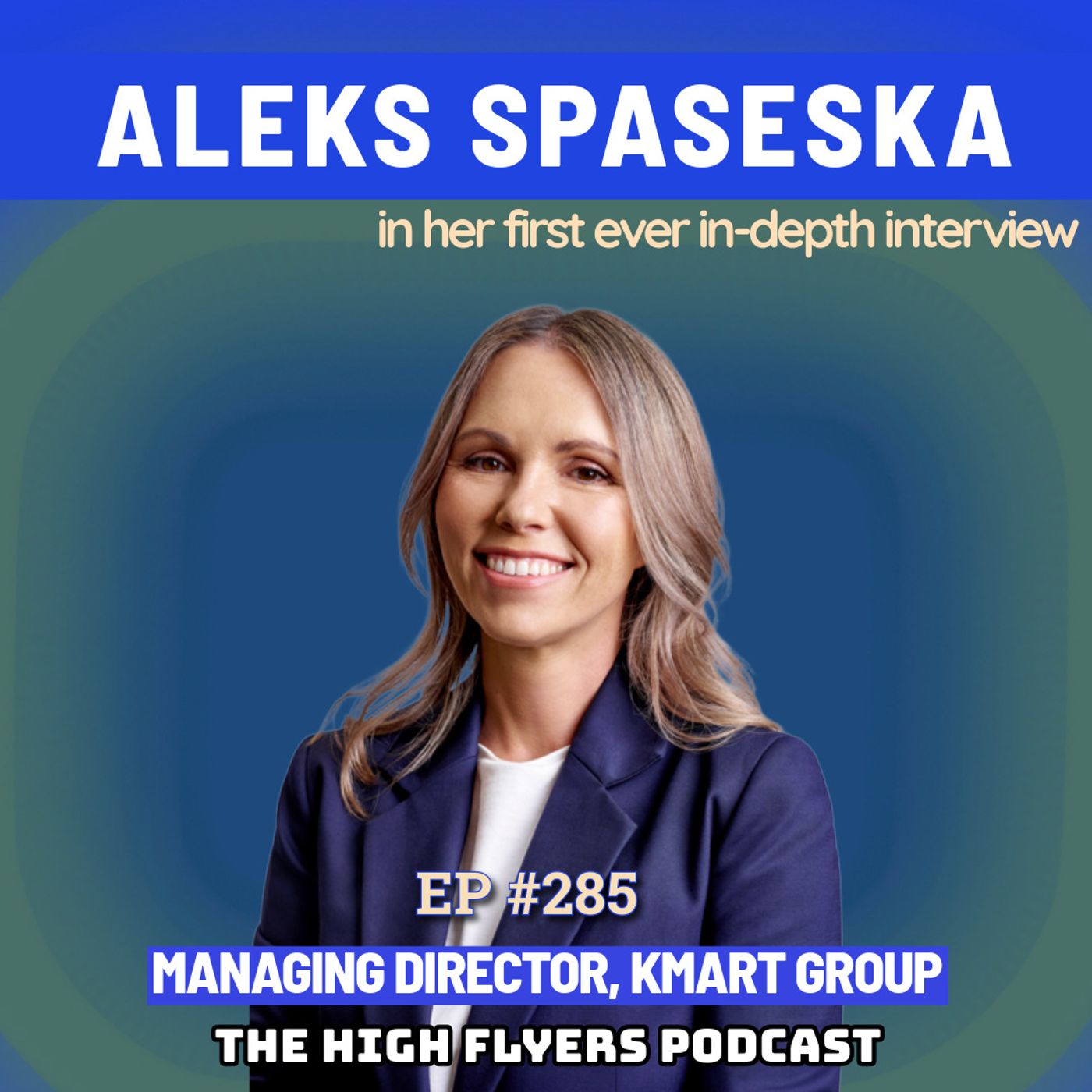
Aleks Spaseska, Kmart Group managing director (overseeing Kmart and Target in Australia/NZ and building global Anko operations), discusses her Macedonian upbringing, moving to Australia as a shy non-English speaker, and how she rose through Westfarmers into CFO and then CEO. She explains retail leadership at scale, why store managers are under-recognized, and how Kmart/Target transformations were executed—especially the Target-to-Kmart store network optimization and the future-proofing of Target’s commercial model.
Born in Ohrid, Macedonia; moved to Australia around age 7; grew up in Melbourne; worked in retail early (e.g., restaurant job via her mother). Studied at UWA (BCom, corporate finance/econ), completed a PhD; part-time tutoring. Career includes Westfarmers business development (2008 grad), investor relations, Target operating roles, then CFO/company secretary, then Kmart CFO in early COVID, later deputy MD and CEO.
Store managers lead large P&Ls and sensitive issues like retail crime; success in transformation requires clear problem statements and success metrics; Westfarmers divisional autonomy plus corporate “guardrails” enable long-term thinking; Anko is ~85% of sales with end-to-end control over design, sourcing, quality, and ethical sourcing.
Target transformation (multi-year; converting many Target stores to Kmart; focusing Target’s apparel/soft home differentiation); 2014 leadership-team turnover; COVID-era leadership while relocating to Melbourne; Philippines co-branded stores; youth segment momentum and social-media-driven product virality.
Written by AI. May contain mistakes.
Vidit and Aleks discuss the purpose of the podcast and set context for Alek's story.
“a high flyer, showcase the brightest and most relatable role models and companies and their journey from sunrise to today.”
Aleks shares her early life in Macedonia and her journey to Australia.
“I was born in a town called Okhrid in Macedonia, and I currently live in Melbourne.”
Aleks discusses the critical role of store managers in the retail industry.
“and we have a global business we're establishing under the Anco brand as well.”
Aleks explains the scale and impact of leadership in retail business.
“That's xero.com forward slash highflyers.”
Aleks shares memories from her upbringing in Macedonia and family values.
“We will touch on retail and Kmart in a moment, but I want to give some context on your journey.”
Aleks describes challenges faced when moving to Australia and finding her voice.
“And there's quite a big age gap between my youngest sister and I as well.”
Aleks reflects on how her upbringing influences her work at Kmart.
“You had that upbringing and then now you're running one of Australia's most impactful companies, right?”
Aleks discusses her educational background and initial career uncertainty.
“I think I said this to you the other day when we spoke that I spent about nine years in retail and FMCG before I started my business about eight years ago.”
Discover how Aleks Spaseska navigated her early career choices and education.
“Oh, I honestly didn't know what I wanted to do at that stage.”
Learn about Aleks's transition from academia to corporate roles at West Farmers.
“I would say my most pivotal moment was when I had the opportunity to join the target business.”
Aleks shares her pivotal early experiences at West Farmers and the skills gained.
“different businesses and learn lots of different things from lots of different people across the business was a huge advantage.”
Aleks discusses her approach to transformation projects and earning trust.
“The target role is something that I was approached to do at the time.”
Learn about the challenges and strategies involved in transforming the Target business.
“and earn the trust of people you work with and ask the right questions and build a plan?”
Explore the dynamics of leading a new team and fostering engagement during transformation.
“What is the problem you're trying to solve?”
Discuss strategies for managing personal and professional change during critical transitions.
“And then you did the company secretary job, as you mentioned.”
Understand the unique challenges and trade-offs a CFO faces in the retail sector.
“my peers that I would be working with and all of a sudden we're all working from home and working remotely.”
Learn about the balance of autonomy and structure within West Farmers.
“But at the same time, the guardrails are always really clear.”
Explore the transition from CFO to CEO and the importance of maternity leave.
“don't succumb to managing weekly or quarterly expectations.”
Discover the qualities that helped Aleks Spaseska stand out as a CEO candidate.
“The second part is none of these moves for me have been a big step change.”
Understand what makes the Anko brand distinctive in the market.
“It means we've got control and visibility end to end in that product development cycle.”
Gain insights on global retail trends and the significance of the youth segment.
“So I think retailers are always customer obsessed.”
Learn about Kmart's growth aspirations and strategic investments moving forward.
“And that's all aspects of compliance and regulation.”
Explore Aleks' views on her current role and future experiences she desires.
“And 10 years from now, we'd love to have more stores in the Philippines and more stores in other markets across Southeast Asia.”
Explore the guest's views on job satisfaction and career aspirations.
“What are some career experiences you've not had yet that are on your bucket list?”
Discuss the importance of family visits to Macedonia and cultural connections.
“I tried asking you the question to get something out.”
Identify personal goals for learning and improving organizational skills.
“Is there one thing you want to learn in the next six months?”
Delve into the guest's approach to hiring and cultural fit.
“So I'll often stop a meeting if that happens and I haven't had the opportunity to digest information beforehand and be able to contribute meaningfully.”
Conclude the discussion with final reflections and gratitude.

Get the gist, explore an idea or ask about something said.
 Claude
On The High Flyers Podcast with Vidit Agarwal, what are the key points of this episode?
Searching your listeningAutomatic transcript. May contain errors.
0:00Hi, I'm Vidit, the founder and host of this podcast, The High Flyers. Hi, I'm Aleks Spaseska, the managing director of Kmart Group. Aleks, I'm honored that you've chosen to do this because I don't think you've done any interview like this. So I'm actually a bit nervous. I'm hoping I can make you comfortable and cover your story in some level of totality. So thank you. No, thank you. It's a pleasure to be here. And you're probably not as nervous as I am doing this for the first time. So looking forward to the conversation. We're both nervous and that probably means both of us will be fine. What if we could reimagine the traditional notion of a high flyer?
0:40Hey friends, welcome back or welcome to the High Flyers podcast, where we do reimagine a high flyer, showcase the brightest and most relatable role models and companies and their journey from sunrise to today. As one of the premier products in our Curiosity Center lineup, providing on-demand intelligence to help you be 1 % better every single day. I'm your host, Virita Aguil, and let's have some fun. Our listeners have called this podcast a meticulously researched biography unveiling the extraordinary lives and decisions of the most remarkable individuals and companies from around the world. We hope you're enjoying our catalog of 200 plus episodes since we launched in 2020.
1:25with many of our guests appearing in rare public interviews. It's now time to explore your curiosity. Please enjoy. Let's set some context before we get into your story. Where were you born and where do you live now? I was born in a town called Okhrid in Macedonia, and I currently live in Melbourne. Oh, very cool. My family and I are actually going to Macedonia, so maybe I'll get some attention after this. Yeah, we're going to Skepsi. Is that how you pronounce it? Skopje, the capital? Skopje, that's right. Wow, I can't even pronounce that. Skopje, we're going there. Yes, that's right. And work, what was your first job and what do you do now?
2:07So my first job was working in a deli and I currently lead the Kmart Group business, which looks after the Kmart and Target brands in Australia and New Zealand. and we have a global business we're establishing under the Anco brand as well. Absolutely. And one of the biggest retailers that touch every aspect of our community, right? I think that's what I find so fascinating about the work you do. And Alex, as you know, the purpose of this show is to reimagine the concept of a high flyer, to go beyond people's shop titles and recognize their human self. Is there a person you know who you feel hasn't got the recognition they deserve?
2:48Yeah, I love this question. I've been giving it a lot of thought. It's probably not one person, but I would say outside of the retail industry, a role that's not as well recognised as it should be, I think, is the role of the store manager. And there's a few reasons for this. I think firstly, our store managers lead some very, very large teams and they're responsible for managing some very large P &Ls, certainly in the larger retail businesses. And so their ability to have impact at scale is incredibly material. And I don't think this is something that's well recognized outside of the industry.
3:24In addition to the very important leadership role they play with so many of our team members, they really are the face of the business with customers every day. And all of the good that comes with the really positive impact they have on a daily basis, but also some really tough things that they deal with on a daily basis. And retail crime is a really big topic. It's one that we talk a lot about. and our store managers are really at the forefront of managing some really sensitive issues on a daily basis. Back to the episode in a moment. Something I've heard a lot from business owners and leaders is that speed only matters if you still feel confident in the output.
4:03And it's particularly an important point in this world of AI. Zero's answer to that is accountable intelligence. AI that shows you what it's doing and works from your own real data and is designed to keep you in control before anything happens. As Xero puts it, most AI asks you to trust it. Accountable intelligence shows you why you can. And that's how it works with Jaxx, Xero's in-platform AI finance partner. So whether you're running the business, advising the client, or working with your board, Jaxx ensures that you get the upside of automation without giving up any of the control. If you want to see this practice, head over to xero.com forward slash highflyers for 90 % off your plan for the first six months.
4:50Terms apply and go to the website. That's xero.com forward slash highflyers. Now back to the episode. I could not agree more. And I always joke with people that a lot of us now talk about startups and wanting to be boss of your own business. A store manager kind of has the best of both worlds, right? You've got the support of the bigger company behind you, but then you're sort of running your small business. And often the small businesses, it could be$10 million, right? People think it's a tiny store, but some stores are trading millions in revenue, which I think surprises people all the time.
5:28Absolutely. It's tens of millions of dollars of revenue. It's a significant cost base. In some cases, it's hundreds of team members on a daily basis. So it really is leadership at scale. Totally. We will touch on retail and Kmart in a moment, but I want to give some context on your journey. And I think this is particularly interesting because you talked earlier about Macedonia and I don't know your journey into Australia is quite interesting as well that people might not be as aware of. Tell me about Macedonia. I'm curious to learn more, but what are your reflections of growing up in Macedonia?
6:05They're really wonderful memories, actually. So we were there until I was about seven years old, and it's a beautiful country, lots of mountains. The town that I'm from is on a stunning lake, so it's just a really beautiful place. I think you'll love it when you get over there. In terms of memories, family is a really big part of our culture. it's a really big part of our life so I remember growing up with extended family part of our daily life whether that was grandparents aunts uncles cousins family is just a really critical part of growing up over there and that that's something I've taken with me throughout my life and something I really appreciated food is a massive part of our culture as well so a lot of things revolve around food and getting the family together around that and a really hard working environment as well so we've gone through some pretty tough times and you build a really strong worth ethic and a strong level of resilience as well that I think you carry forward with you and tell me a bit about the family unit growing up tell me about your parents so yeah mum dad dad had been coming out to Australia and working in Australia for many years so he worked up in the Pilbara in WA for much of his life even long before we made the decision to move to Australia permanently and I've got two sisters as well my mum studied law even after she had me so she worked pretty hard to get her law degree back in Macedonia and then made a very difficult decision to I think start all over again as so many of my parents generation did when we moved to Australia when I was about seven years old yeah the two sisters one is interesting because are you the oldest I am the oldest yes you're the eldest yeah I so I'm the eldest I've got a younger brother and I always joke like growing up if I made a mistake it was my fault if he made a mistake it was my fault yeah that was good it was like that in your family where the ownership's up with you?
8:17Absolutely. And there's quite a big age gap between my youngest sister and I as well. Yeah, absolutely. And tell me about your, when you and I spoke the other day, I think one of the things you said to me is that growing up, you didn't, you perhaps didn't speak as much, like which resonates with me. I was a very shy kid growing up, extremely shy. And for me, it was when I was, I think 13 or 14, my mom took me to a restaurant. So I grew up in Melbourne, And she took me to the manager and she said, hey, you should give my son a job. And I became a waiter and started working. And that brought me out of my shell.
8:52I'm curious, do you have any stories like that from your early life? Yeah, so I think for me, when we moved to Australia, I couldn't speak English, having grown up and started my school in Macedonia. So I think that was a really big part of it. And when we moved here, my parents were very busy starting up their lives all over again. I started year three at the time, not really understanding the language. And it took me a couple of years really to figure out what was going on a daily basis at school. So I think that probably played a large part in terms of confidence levels at school and being on the quieter side, on the shy side.
9:30And I'd say it probably wasn't until the later years of high school where my confidence started to return. when Australia started to feel a bit more like home and I could be a little bit more comfortable in my own skin in what had been a really foreign environment to me for many years after moving here. That's so interesting because I'm sure people meet you today and they you sound Australian and you are Australian, right? I get that a lot. They might not know that they might not realize that you learned English in your early teens. Well, yeah, I would have been about eight or nine when I was really starting to learn from scratch, yeah.
10:09Yeah. Is that an interesting one now? You had that upbringing and then now you're running one of Australia's most impactful companies, right? Like when you sit around the dinner table with your family, is that a strange reflection, like reflecting back on where you came from to where you are now? It is and it isn't. I think for me it's always been quite incremental in terms of I've always had a very strong work ethic and for me I've always tried to do the best possible job I could do of the thing I was doing at the time and I've never really I haven't been one of those people that's looked ahead and had a 10-year career plan or anything like that it's always been do a really good job of the thing that you're responsible for now and then the next opportunity will take care of itself and I think because of that that the steps that I've had throughout my career and throughout schooling as well have always felt like the next logical incremental step to the things that I've been working up to that point.
11:09In terms of my upbringing and the impact that has had on the role that I do now coming to Australia at that stage of life, starting again for my parents was pretty difficult. They were working really hard at the time but there wasn't a lot of discretionary income to go around. And so when I look at our business today and the role that we play in terms of making just really great quality products affordable and the real impact you can have on a family being able to afford good clothes for their kids or toys or presents or something for their home, I think that allows me to connect into that in a very real way because I understand from the circumstances in which I grew up what it means to really need to have to make some really difficult decisions about what you can and can't access as a family.
12:01Totally. I think I said this to you the other day when we spoke that I spent about nine years in retail and FMCG before I started my business about eight years ago. So that's been a long time since I left that industry. But I was in Merch at Kohl's, the Kohl's store support center slash head office. And we used to always talk about$120 shop. This was back in 2013. So maybe now it's different, but back then it was$120 shop because that was the analysis that a family of four, the average family of four could spend$120 and how do we factor that into our pricing and sourcing and promotions and things?
12:35So, yeah, I think there is that sense in retail that you, not a sense, a reality in retail, that you impact everyone's lives, right? Yeah, absolutely. And we hear it from our customers really regularly as well and I think that's one of the really special things about our business as well is you can bring really great quality products to market and make people really happy at the end of the day because you're making something that wouldn't otherwise be accessible to everyone. So to go back to the Alex in high school, when I speak to people that know you really well now, they say you're very numerical, you're very business oriented.
13:13Clearly you're the boss at Kmart. Were you like that as a kid as well? Did you have an interest in economics and finance? Economics, I was always really good at in high school. It just came naturally to me. And interestingly, English did as well. So I'm a really big reader. I read lots of things and I did growing up as well. So despite the fact that for much of my childhood, I couldn't speak English, I caught up pretty quickly, I think through my love of reading. So English, economics and math were really the things that I think came quite naturally to me and I quite enjoyed through high school.
13:52And tell me if I met you at age 18, so you're just finishing high school, what would I have assumed you do with your life? Oh, I honestly didn't know what I wanted to do at that stage. age. You would have said I'm someone that works really hard, is pretty smart at the time, did well on my exams, but didn't really have a clear view of where I wanted to go. And that was one of the reasons I chose commerce as a university degree, because I thought it would just give me the breadth of options to figure out what I wanted to do over time. And so you studied at At UWA, right? University of Western Australia.
14:34And did you do, I noticed in my research, did you do a bachelor and then a doctor as well? Did you do a doctor of philosophy, like back to back? I did. So I did a bachelor of commerce. I majored in corporate finance economics. I stayed on and did my honors year, which was great, really enjoyed that. And I still didn't know what I wanted to do. So I ended up being offered a scholarship to stay on and do a PhD with the finance department. And I stayed on and did that. And over that time, really tried to figure out, do I stay on at uni, be an academic? When I was growing up, I always liked the idea of being a teacher.
15:11I quite enjoy the concept of teaching. So that was an option at the time. I was also doing some part-time work with a couple of companies in Perth. And I think through that process figured out, actually, I want to get into a real business and see what I can do there. I made the decision to start to look for jobs in industry. That is so interesting because I know you had a long career at Westfarm as you started as a grad or I think relatively close to being a grad, but that lecturing one is interesting. I'm curious, what did you learn from that period? Were you a full-time lecturer for a bit? Part-time.
15:49I was a part-time tutor while I was doing my PhD. I used to take the classes and do the tutorials and I really enjoyed it. I enjoyed when you can really connect with students in the class and when you can really help someone achieve their goals and get a better outcome in terms of what they're working towards. What did I get out of it? I guess one of the things that I think is really important in my current job and people would say that would be one of the things that I do well is trying to simplify the complex and taking lots of complex issues and really trying to crystallize into what are the core elements and how do I really pull out in a really simple way that others can relate to understand connect with the topic what the particular issue is and I think that's really at the core of teaching as well and my tutoring days is trying to take complex topics and really be able to articulate them in a way that makes sense or a simplifier and people can connect with.
16:55So from that you went into, I think you're an analyst for a period at a capital management firm. Yes. Connect those dots. How does that happen? Because someone who's done a PhD might want to stay on the research side, but you decided to go into the capital allocation side? Yeah, that was one of my part-time jobs while I was at uni, which was great. So it was through the university. It was a startup hedge fund. They were looking for support in terms of more analytical support and research support. And it was a great way, as I said, to really test university life versus corporate life and really figure out which way I wanted to go.
17:38and so then post that you had a very long successful career at west farmers there's so many questions and i want to spend a chunk of this time on west farmers and then we can come to kmart i mean maybe the obvious question is maybe not the obvious question but the first question i want to ask you is which which role do you look back and you go that role formed you into who you are today because you did so many roles at west farmers I have it's one of the one of the things I love about West Farmers and I've been very fortunate to have lots of different opportunities to do different roles both in the corporate office but also within our divisions the reason I wanted to join West Farmers was actually the diversity of the opportunities within the group and being a conglomerate and operating in so many different industries I just love the idea particularly when I first left uni of the ability to go and learn about different industries, learn about different business models, see different leadership styles and really see where I could contribute to that.
18:44I would say my most pivotal moment was when I had the opportunity to join the target business. So leave the corporate office for the first time. I moved to Melbourne and I joined the target business. And I think that was a really great moment in my career that I still look back on because it was probably the transition point where I could see myself moving from a corporate finance person, someone that was really experienced in the corporate type of roles we're doing, whether that was business development, M &A, investor relations, but moving into a retail operating business and seeing the breadth of career opportunities that was available there and seeing the potential to go beyond being the finance person to actually being able to run an operational part of the business is something that I think first of all really stretched me, challenged me, pushed me into a very uncomfortable place in terms of doing something new and different for the first time, but also it allowed me to figure out what I really enjoy and what I really love and have lots of fun doing, which is really being involved with an operating business.
20:00And retail is so great in that, that you can be in the store, you can see and touch and feel the product and work with such passionate team members across the business to deliver awesome customer outcomes. Yeah, that was a great time. and so they came out the target role sorry this was about five years into your tenure at west farmers right about that i think yeah so i'm curious like when you think of those first five years like when i think of my first five years in my career they shaped me massively more so for the mistakes i made i made a ton of mistakes and i learned a lot and just figured out who i was where i fit in this world what i want to do with my life i'm curious how you looked at that particularly in business development at West Farmers, which is such a critical role.
20:47Like I think you joined just after the Coles acquisition as well, right? Yes, I did. I joined in 2008 as a graduate in the business development team. Yeah. So tell me about those first five years at West Farmers. If someone comes to you today and goes, Alex, I want to start a career at West Farmers and I want to join in business development, what are the skills they can expect to gain? yeah i looking back on it i think it was actually the perfect place to start and the perfect grounding to build lots of diverse careers off the back of that i think the things that you get through the business development function were first of all exposure to the different operating businesses across west farmers and so being able to really understand study contribute to different business models, different industry structures, and see some amazing leaders across all of these different businesses and learn lots of different things from lots of different people across the business was a huge advantage.
21:51If I look then in terms of functionally, I built a lot of very tangible skills and experiences over that time that to this day are the core of who I am and what I bring to any role that I do. West Farmers is very much known in terms of financial disciplines, commerciality, results, orientation, and they're all things that I learned from the ground up, whether it was analyzing M &A opportunities, whether it was working with some of our divisions around improvement opportunities. The time I spent in business development, we were also undertaking the refinancing following the Coles acquisition as well.
22:36And this was through the GFC period as well. So capital allocation, balance sheet management, dividend management, just a lot of those core, core corporate finance skills that I think are so essential and can translate to so many different environments. I had the opportunity to build from the ground up. One of the other roles outside of the BD that I did was in the investor relations team. And this again was such a unique opportunity to really understand how does the market understand and value our businesses? How does the CEO and the CFO, West Farmers, do that? How do we articulate the value drivers to external stakeholders?
23:22How do you work collectively with the divisional teams to bring all of that together. So there's just a lot of really fundamental things that I think I built over that period of time that are just as important today as they were then. Well, and also on the investor relations, you did the target experience, then you went back as GM investor relations at Westphalves, right? That's right. Yeah. So that is to me so interesting. Like one is the target one. I want to come to that in a moment because you said investor relations what did you appreciate about the call it portfolio companies if I can use that word within the West Farmers group from your time working within Target where I would assume if you hadn't got that Target experience and if you'd just risen the ranks in investor relations you would have perhaps looked at the executive sitting on across the table a bit differently?
24:16Absolutely. I think there is no substitute for doing a corporate role after having been in an operating business, having run parts of the functions, having worked side by side with the teams and not just having an understanding and an empathy for the issues, but having been involved in facing some of them yourself and managing them yourself from the inside out. So I think my time in Target was significantly enhanced and I couldn't have done that without the experience I had in Wes Corporate. But then equally going back into corporate, having had the time in Target, I think made me just so much better at the investor relations job than had I not had that experience.
25:07I would say the other part is the credibility from an external perspective. So being able to talk to our analysts and our investors around what was happening within our retail businesses, having worked in a retail business for three years, lent a different level of credibility to that conversation. So absolutely, I think that the two very much built on one another. Which one was a harder transition? Because within Target, you did three very different jobs in the space for a couple of years. Over three years. into investor. Yes, you essentially did one job per year in, I think, commercial property, and then you were state general manager, which on the surface sounds extreme, like you've gone from one industry to the next, even though they're all in the same industry.
25:53And then you went back into investor relations. Maybe just tell me about your thinking. Was that something, I know you said earlier that you didn't make a career plan, but were those roles, did you go out and seek those roles? How did they come about? The target role is something that I was approached to do at the time. There was a new CEO leading the business and there was a really big aspiration for a transformation of the business. At the time, I knew I wanted to get experience within one of our divisions. I loved the challenge of going into a turnaround type environment with a big transformation agenda.
26:31And within the corporate office, team sizes can be quite small. So I knew from a longer term career perspective, it didn't matter what it was, but I needed to get broader people leadership experience than what I had to date. And that's really what the target opportunity presented was to be able to do those things. Moving there in a commercial finance role was a really great way to do that because it meant leveraging the things that were my strengths. So my analytical ability, my finance background, my ability to write good board papers, all of those things that you build in the corporate office were the things that I could really double down on while making the uncomfortable move into an operating business outside of the corporate office, moved to Melbourne at the time and really started to establish myself again in a different environment.
27:27So that was a great way, I think, to de-risk what could have been quite a risky move for someone like me at the time. Both those points, transformation and people management are like words I'm sure a lot of your team now come to you and ask for, right? They go, Alex, how do I work on a transformation project or how do I become a people leader? Maybe we start with transformation. I wonder if you can share a transformation. You don't have to share the specifics if you can't. Can you share how, because I'm always curious, how does someone like you, an executive, go into a new project or a new environment and earn the trust of people you work with and ask the right questions and build a plan?
28:05Again, that could be a case study in itself and we could talk for two hours, but if you have to condense that, can you share an example? Yeah, it's something I've always, always have been attracted to throughout my career in terms of those big complex kind of problems and projects. I've always been the one to want to put my hand up and get involved because I just think you learn so much. Probably most recently, the biggest one I've been involved in has been the transformation of the target business. So when I moved to Kmart Group as CFO in 2020, we had to do a lot of work in terms of really future-proofing the target business and creating a much more sustainable commercial model for the business than what it had to date.
28:51For those that have followed the story, the outcome of that was quite a significant optimisation of the Target store network. It resulted in the conversion of a significant number of Target stores into Kmart and really focus the business on what customers love about the Target brand and what has been an asset historically as well, and that is how we do apparel and soft home and differentiate on quality really well. That required some major surgery of the business and it also required some significant engagement with large parts of the organisation and with our store teams as well to go through a multi-year transformation and get it to where we are today, which is a really great business.
29:41that's continuing to do a great job on quality and affordable prices for apparel and soft home with a cost structure and a commercial model that's fit for purpose and provides a lot of commercial resilience as we move forward. How did we get through all of that? I think the first one is there needs to be a lot of work up front before you do anything in terms of defining the problem statement. So being super, super clear in terms of, first of all, what does success look like? So not transformation for the sake of transformation, but what would a successful outcome look like? And having clarity of that upfront is really important.
30:24And then at the same time, having clarity around, well, what are the things that are stopping you from achieving those success metrics? Because I think if you can do that upfront, then the piece around engagement becomes a lot easier being able to articulate to the teams and to external stakeholders or to the board this is the problem statement this is what good looks like if we address the problem statement and these are our metrics of success and inevitably the metrics of success have to be a financial they have to be customer focused they have to be team member focused i think if you do that up front, then working through the how is almost the easy part in terms of the management of it.
31:11But you need to be really clear going into it. What is the problem you're trying to solve? And if you are successful, how will you measure success? And are you really clear on those metrics? And maybe this also connects to the people side. So I noticed in my research, a really interesting stat and you can tell me if this is true or not that in 2014 apparently 90 % of Target's leadership team was actually new to the business and I think you joined to that time that sounds like a cultural like a transformation in itself is trying to get information flow and continuity how maybe you were involved in that to some extent how do you build a transformation with a brand new team?
31:53I was part of that brand new team back in 2014. At that time, it's necessary sometimes. And it also is difficult. I think part of any leader's job is to create the right settings that provide good clarity, good context. And with a brand new team, all of that is something that needs a lot of work upfront, because the historical context isn't there in terms of why certain decisions have been made, but equally the value of getting that external input is super important. I think for me, establishing relationships, understanding where to get the right information, understanding how to effectively influence, all of those things just become even more critically important when you're working with a new team like that.
32:45That was the first year for me when I joined and then having moved into the property role and then into the state operations role I was much more focused in terms of the store teams and there it was quite different we've got amazing tenure within the target business and we did back in 2015 and 2016 as well so within our stores you actually have people with a long history and understanding of the business of the customer of what works, what doesn't. And that was actually really awesome. And one of the things I enjoyed the most about my time with Target back then was working with the store teams and the passion and the love that they had for the brand and the dedication and the commitment to making the success as we move forward.
33:29And I'm sure you know this firsthand, like state manager roles are all about people. That is all about a workforce. We talked earlier about the high flyer being the store managers. Whereas at least in the store support center or head office, people are sitting around you or they're on a Zoom call. As states, people are in all parts of the state, right, from one corner to the other. How did that, like I'd love to understand how that shaped you as a people leader. I think it broadened me and balanced me quite a lot. I think it built my empathy relative to what I'd had previously I think it it highlighted to me the importance of connection and the importance of how you make people feel in your interactions because in a corporate environment you tend to work with lots of people that are pretty similar to you in lots of different ways and up to that point you'd probably say I'm quite a results-oriented person and at that time that probably would have come across as quite transactional in some of the interactions I would have had with people in the business.
34:46Whereas moving into a broad leadership role, you really do understand the value of that personal connection with the team. You understand the value of the diversity of the experiences and the skills and thoughts that such a large team bring to the table, particularly doing that role as someone who hadn't had experience operationally within a store environment so I didn't bring the credibility of having worked on the shop floor and therefore for me to be effective the level of trust that you build with the store managers with the regional managers was really important and being really clear around what do I bring to that environment but equally what do I need to get back from the team was super super important.
35:31so at this point you I think had been at West Farmers eight years around about right you started in 2008 I think you're up to 2016 now we talked earlier about you were the child from Macedonia who couldn't speak English and you come to Australia now you're in a pretty senior role at one of Australia's one of the world's biggest retail companies right West Farmers what was the mindset what was that self-dialogue with yourself and with your family and friends at that stage in your career? Well, at that stage, I had just gone back into the corporate office as the general manager of investor relations.
36:06We were going through quite a lot of change while I was in that role. So we had the de-merger of Coles, we had the Bunnings UK investment divestment, and we had CEO, CFO transition at a West Farmers level as well, which is a really big deal so when I look back I was just super busy like really busy and doing and being involved in some things that don't happen very often in large companies like West Farmers so I was really enjoying it I was working hard and I was learning an incredible amount and very much focused on we've got some very very big things that are happening right now and as someone that was running investor relations at the time, I've got a really meaningful role to play in these events.
37:02And then you did the company secretary job, as you mentioned. And then I believe if my research is correct, you got the CFO job at Kmart like a couple of weeks into COVID. Is that right? Yeah. Well, what I, so I went on maternity leave first. So I had my daughter in 2018 and I was on maternity leave and then while I was on mat leave I was offered the company secretariat role which was something I had no experience in but I thought what an amazing opportunity to learn something different work a bit more closely with the board and so that that's actually what I came back into after my maternity leave and about a year into that role was when the opportunity to move to Melbourne, came up as CFO of Kmart Group.
37:51By then I loved the brand and I loved retail. So the ability to go back as CFO of the division was really attractive. It was a difficult decision because all of my family are in Perth. My daughter was about 18 months old at the time. In the end, we decided we would go and we moved over in April 2020. And about two weeks after landing in Melbourne is when COVID really kicked off. And I remember we were just focused on finding somewhere to live because we weren't even sure whether we could do rental inspections or find a house or anything at the time we're in temporary accommodation. So yeah, it was an interesting transition into a big job with a company that was being very significantly impacted by COVID at the time and questions like can we or can't we even open our stores or trade while trying to find somewhere to live with my husband and 18-month-old at the time.
38:50Incredible. COVID for me was transformational because I started my own business. So I think a lot of us went through a lot of change in that period. Before I get into Kmart and get into all the business side, I'm just curious like on the personal side, I think that's something that doesn't get appreciated is you move cities, you've got a young family, you've become CFO of one of the biggest companies in the country. What is your process to manage change? I get the feeling like given your finance background, maybe you're very black and white. Are you someone who makes a plan and you're like, this is what I'll do day one, day two, day three?
39:24How do you navigate change that big? Yeah, I'm someone that makes a decision rather than makes a plan. We had decided that the move was the right thing for us to do. So I said it was quite difficult from a personal perspective, but from an opportunity, it was difficult to pass up. And we were committed to the move. We made the move. And then I think it was, if you remember back to that time, planning was pretty impossible because you weren't really sure what was happening week to week or day to day and I think that's the approach that I took at the time was there were some things that I had to do in very unusual circumstances so I was new to the business I didn't know a lot of my peers that I would be working with and all of a sudden we're all working from home and working remotely.
40:16So all of those normal processes for getting to know your team, getting to know your peers, getting to know the business disappeared, but they were replaced with some very urgent, very important decisions to be made around how we were going to navigate this crisis from a business perspective, from a people perspective, and how do we deliver the right outcomes for our customers and our team members. And so I can be quite task oriented and I focused on the task at hand, which was to help the business navigate those decisions as best we could and try and deliver the best outcomes we could for our team and for the customers.
41:01Two reflections that come to mind, Alex says I've interviewed Mike Schneider, the CEO of Bunnings, and then also Brendan Hargreaves, the CEO of Officeworks. And both of them talked about one of the features and bugs is you've got the support of the West Farmers organization, but then you're running your own company, right? You're running the company and it often is quite entrepreneurial in that the executives run their own shop, but then have the support of the parent company, so to speak. I'm curious, you can probably educate me on this. Like, how does that work as CFO? What are some of the trade-offs you have to make where, yes, you've got a, like you talked earlier about shareholder return and you're running a business that has a certain capital allocation structure to it, but then you're running a retail business that is very dynamic and has certain price pressures and margin pressures.
41:47What is that balancing act you had to manage a CFO for five years? Yeah, it's a really important part of the CFO role. First of all, I'd say I think we're very fortunate to be part of West Farmers. I think the divisional autonomy that we operate within, and it's something that West Farmers talks a lot about, means on a day-to-day basis, we do have true autonomy to set our strategy, execute to that strategy and make the right decisions for our customers and for our team members every single day. But at the same time, the guardrails are always really clear. So there are operating models and there are processes that you participate in as part of the West Farmers group.
42:37So whether that's our strategic planning process, whether that's our budgeting process, we run divisional boards. And so there's a very well established framework in terms of what are the decisions that need to get escalated? What are the things that we need to get approved versus what can we do within the division? as the CFO I think one of the really important roles that you have is to ensure that there's really good transparency between the West Farmers team in the corporate office and the divisional team and you really are the conduit in terms of ensuring that we operate within the guidelines that we work to have plans that deliver the financial targets that we do things within the values that are set by the group and the culture and the how we do it is just as important as what we do and importantly as the CFO making sure that you're not just relying on the formal mechanisms which are really great but you're picking up the phone enough to ensure that there's really good two-way dialogue in that I would always understand what was on the group CFO's mind, what was important to them, what were emerging issues across the rest of the group, and equally they could always understand the context that we're operating in and what are the trade-offs that we're thinking about.
44:05And I think that having a really constructive two-way dialogue has always made that job a lot easier and has helped me at least find the right balance between do what's right for the division and do what's right for West Farmers. Yeah, it reminds me of our most recent guest was the CEO of RM Williams. And as you might know, they sit under a family office structure and he was at Nike for many years. And one of the things he talked about is the long-term planning cycle you can have sometimes in a private organization. West Farmers is not a private organization like a family office, but I think you get my point.
44:44Whereas Nike has a lot of public pressures and is dealing to a quarterly cycle sometimes. But West Farmers has both. You've got a quarterly cycle, not you, but the West Farmers organization. But then as a company that is private, within the West Farmers group, it came out, you can perhaps think longer. Is that a fair comment? Absolutely. And even within West Farmers, we always talk about shareholder returns over the long term. We are very much geared to be thinking about how do we generate shareholder value over the long term. and that translates through to the way that we think about our divisional plans and processes as well and I think that's a huge asset of the group and one of the things that has made us a successful company to be a part of over so many years because it's absolutely critical that we don't succumb to managing weekly or quarterly expectations.
45:38You've always got to have the right balance between delivering results in the short term but equally making sure that you're always investing in having a stronger business over the long term and so five years as CFO I think and then you got the CEO job of Kmart then I went on maternity leave as well oh in between so in between the CFO and CEO job yes oh so when was that was that a couple of years into your CFO job I've got a two-year-old no that was five years in so I've got a two-year-old boy now so in 2024 okay and I came back as deputy managing director right so yeah right so essentially you're saying that maternity leave have been like your transition points they are my transition points they're awesome transition points yeah oh kudos to you like clearly you are a high performer and and a culture that supports that family and work-oriented culture, right?
46:37So I think that's fantastic. I think the piece is super important, yeah. I'm very fortunate to be considered and to work for a company where you can go on maternity leave and come back as the deputy managing director. It's just fantastic. Yeah. Alex, you're very humble, so I'm going to try my best to get an answer on this point. How did you stand out from your peers to become CEO? because there's a lot of smart people, both in Kmart and West Farmers, outside the organisation. How did you get the job? Did you do anything specific that made you stand out? Look, there are lots of amazing people within the group and I'm sure there's lots of amazing people externally.
47:21Why did I stand out? It's a difficult one to – I always go back to what are the things that I bring into a role and the pieces around commerciality, the pieces around long-term strategic thinking, results orientation, engaging people, leading people, they're core, core West Farmers competencies that I've worked really hard on over many years. I would say that's the first part. The second part is none of these moves for me have been a big step change. There's always been a logical progression to the roles that I've taken. So even within the CFO remit over those five years, I started off with quite a traditional CFO portfolio, so finance, risk and compliance, property.
48:12Over time, I added data science to that. And then over time, I picked up accountability for domestic supply chain, online fulfillment, and our global sourcing business, which is really a really big part of the engine room of the Kmart group. And so there was a lot of, I guess, natural incremental pieces that I added to my experience set over time that meant the step from CFO to CEO wasn't as big as what it looks like on paper. That's a good point, right? It looks like a big jump on paper, but clearly you're being set up by given broader roles. I think you also had supply chain under your remit as CFO, right?
48:57Correct. Yeah. Yeah. Which for a company like Kmart, the sourcing part, like we talked earlier with even the Anko brand. And maybe you can touch on the Anko brand. I think most of us know of it. There's a lot of publicity. And again, back to being a consumer facing brand, like we all buy it and then use it. Is there anything about the Anko brand that we don't know that you can tell us? Look, Anko is a wonderful brand that we've developed over many years. It's one thing that's not well understood is about 85 % of what we sell is actually under the Anko brand, which is quite a unique model globally.
49:29What does that mean? It means we've got control and visibility end to end in that product development cycle. So we've got an amazing team of designers in Melbourne that work all the way from the design stage through to partnering with our sourcing team across Asia and our factory partners across Asia as well. It means we've got the IP, we've got the control over the quality outcomes, we've got the control over the ethical sourcing, and we've got some really wonderful partnerships with some of our factories have been on the Kmart journey for over 10 years now. So they understand our business, they understand our customer base.
50:10And it means through that end-to-end process, we can deliver something truly unique to us and to our customer at a price point and a quality proposition that's really difficult to match by others. And I'd love to ask about the retail today. I think one of the interesting things I uncovered in my research is your global footprint, right, as an organization. Like people look at Kmart, an Australian company, West Farmers, Australian company, but the global remit where some of your team said to me, you've gone on sourcing trips to the Philippines and to different countries with them. Can you share any observations about different markets?
50:50Like we in Australia, are there any other things that you're seeing overseas that hasn't come to Australia yet, but you expect it might next year in 27? haven't? Yeah, we do a lot of trips overseas, whether that's from a sourcing perspective or whether that's more from a broader retail education perspective to see what others are doing around the world. And so there's lots and lots of different things that you pick up along the way. You mentioned the Philippines. That's a really interesting market for us. So we've actually got six and co-branded stores now trading in the Philippines. And that's an amazing retail market, it absolutely blew me away in terms of the quality of the stores, how competitive the market is, and it's such a vibrant retail sector.
51:34So I think we're constantly learning there in terms of there's a lot of Asian competitors there that aren't in the Australian market. And I think lots of learnings around how the segment's evolving, how the in-store experience is evolving. When you look at more broadly, I think one of the really exciting spaces within in our business and within the industry is the youth segment, which I think is very resilient in the current environment. And we see lots of great examples overseas in terms of youth apparel and fashion, beauty, personal care, the level of innovation that's happening in those industries and the consumer response from the younger customers, their role of social media within that and when a product goes viral on social media, you can it's extraordinary in terms of the impact that those other channels to market now have so i think all of that is something that's been a trend for a while but is really accelerating in terms of momentum and i'd also love for you to compare and contrast so we were talking a little bit target you joined in 2013 now we're sitting in 2026 how do you compare and contrast the world of retail What is harder today about retail compared to when you were at Target in 2013?
52:51Yeah, lots of things are the same. So I think retailers are always customer obsessed. And I think that doesn't change in terms of the customer. The importance of the store, I think, hasn't changed either. So while there's a lot happening online and online only entrance, I think stores are such an asset for retailers. And the importance of the store is as great as it ever has been. What's changed and what's more difficult to your question? I think the complexity of the regulatory environment would be something that today compared to 2013 has only increased. And that's all aspects of compliance and regulation.
53:31It is a pretty complex environment to operate in. And I think that's probably the biggest challenge I would call out relative to 2013. and then also tell me we're coming to an end we'll move to rapid fire in a moment is so you've come out of the turnaround clearly very successful everyone's a huge fan of kmart and i think your recent results show that and the contribution to the west group there how do you think about the next phase of kmart is that something you think about you have one eye on today and then one eye on two years out that's 100 my job is to think about that and stepping into the managing director role last year, a really critical part for me was to really set the vision for what the next phase of it looks like.
54:18We've got a really significant growth aspiration for the business and over a five to 10 year period, we are very much thinking about how do we go again and really double down on the success that we've had to date, but equally, how do we continue to transform the business given customer preferences are changing, the competitive environment is changing, and the opportunities that are available through technology are changing as well. What does that look like for us? There's a few different aspects to it. Firstly, we're doubling down on our store network as a competitive advantage. We're investing in store format, whether that's our existing Kmart stores or the recently launched K-Home store which we have in Melbourne we're really excited about but stores are going to continue to be a really big part of our future and we're doubling down our investment on that.
55:10Supply chains are becoming critical to any retail operation and again we're investing really materially to ensure we've got capacity for growth as well as better availability and service outcomes for stores and customers. Digital is a really big part of our plan so we're really excited by the Kmart digital ecosystem online and how customers are responding to that. So we're investing materially in terms of growing our digital footprint. And finally, our global expansion plans are a big part of that as well. So we've started in the Philippines. We're super early days, but we're really encouraged by the results of the first six stores.
55:49And 10 years from now, we'd love to have more stores in the Philippines and more stores in other markets across Southeast Asia. Last question, and then we'll go to Rapidify Sprint to finish up. Forget job titles. What are some career experiences you've not had yet that are on your bucket list?
56:12Oh, I don't know. I think I've got one of the best jobs going. I honestly do. The level of diversity of things I can get involved in with our business, whether it's working on a new store format, working on new product opportunities, just so many different things that there isn't anything that I'm sitting here going, oh God, I wish I could go off and do something else or different. I think I've got a very, very long runway in what I'm doing now. Okay. Okay. I tried asking you the question to get something out. You didn't give me much. Okay. All right. Rapidfire Sprint to wrap this up. is there one non-work investment ideally of time and energy is there a holiday or a course or a hobby you've enjoyed the most I try to take my kids to Macedonia once a year and I think that's an amazing investment my kids love it and although they can't speak Macedonian I wish one day they would learn how to the seeing them back in the house that I grew up in going to the village that my grandparents lived in and just seeing them enjoy it.
57:19I think it's just a wonderful investment for me with my family. So good. Is there one thing you want to learn in the next six months?
57:30There's lots of different things I want to learn personally in terms of how I get more efficient and planned. And I know there's lots of AI tools out there. I think I would benefit from a more structured approach to organizing myself because although I come across as quite orderly and planned, I'm quite the opposite. I think my life would benefit if I could better leverage technology to become a little bit more organized. And do you mean that in terms of things like note-taking or is that just calendar management? Just every aspect of my life, really.
58:08there are many tools for that but I guess with the young kids and things it constantly changes right so that maybe makes it harder is there one interview question you love asking prospective candidates in a hiring process I always focus on culture that's the most important part is anything that gleams around leadership around the culture that gets the best out of the candidate I think it's the most important thing is hiring for fit much more so than experience or skills and last two one pet peeve
58:46like for me one pet peeve is like i need everything to be tidy if things are out of order it drives me insane oh mine is going to a meeting and being presented slides on the spot and being asked to make a decision at the end of that process. So I'll often stop a meeting if that happens and I haven't had the opportunity to digest information beforehand and be able to contribute meaningfully. Nice. So you like it the night before, you want to read it? I need to have digested the content and be able to provide meaningful input as opposed to trying to provide opinions on the fly, which I don't think is particularly valuable to anybody.
59:28nice I like that it's very specific and last one Alex if there's is there one question I should include in my notes to ask the next guest you of course don't know the next guest but anything I should include I guess what I'm doing is I'm asking your feedback on my interviewing style what did I miss what did you miss I don't know it was pretty comprehensive I'm not sure right I feel like we covered a lot of ground. We did. We did. Can I just say that's a wrap. Thank you so much. This was one that has been on the books for a while. And I know you don't do these many times. So I tried really hard to make this as comfortable as possible, but then try and ask you some of the somewhat tricky questions.
1:00:14So thank you. And yeah, see you soon. Thank you very much. Lovely to see you. Bye. That's a wrap. So if something in this episode sparked a thought, send it to a friend or colleague. and if you're curious about partnering with us at the curiosity center whether it's this podcast to our reports events and more and join the ranks of existing commercial partners including google kpmg vanta and others my details in the show notes until next time i'm vidi tagawal and this is the high flies podcast
This episode is supported by Xero, helping businesses use AI with more control through JAX, its in-platform AI finance partner. Get 90% off your plan for your first 6 months at xero.com/highflyers.
________
Aleks Spaseska is the CEO of Kmart Group, an A$11.8 billion (US$8 billion) retail giant behind Kmart, Target and the global Anko brand, operating 445 stores with over 48,000 employees. This is a rare in-depth interview with Aleks.
In this rare public conversation, Aleks Spaseska joins Vidit to share how she went from struggling to find her confidence at school to becoming CEO of one of the region’s largest retailers. She reveals the career move that changed everything, how she returned from maternity leave into a bigger leadership role, and what really helped her stand out from her peers.
They also explore the realities of running a retail giant, the leadership mistakes that shaped her, why she never had a 10-year career plan, and how her childhood continues to influence the decisions she makes as CEO.
Please enjoy exploring your curiosity.
_______
Get in touch with us via email at [email protected]
Join our stable of commercial partners including the Australian Government, Google, KPMG,, Allens, Macquarie Capital, Xero, JP Morgan and more.
Show notes and more episodes here
Follow us on LinkedIn, Twitter and Instagram
Get in touch with our Founder and Host, Vidit Agarwal directly here
Contact us via our website
This episode is supported by Xero, helping businesses use AI with more control through JAX, its in-platform AI finance partner. Get 90% off your plan for your first 6 months at xero.com/highflyers.
________
TIMESTAMPS
00:00 Meet Aleks Spaseska
02:20 Why store managers are underrated leaders
05:50 Growing up in Macedonia
08:45 No English
10:15 Why she never planned her career
11:15 How childhood shaped her view of affordability
13:10 From university to a finance PhD
17:45 The career move that changed everything
20:50 Lessons from her early Wesfarmers years
25:30 Taking uncomfortable career risks
28:00 Transforming Target's business
33:50 Learning empathy as a leader
37:15 Maternity leave, relocation and COVID
39:15 Making decisions without rigid plans
41:20 How Kmart operates within Wesfarmers
46:00 From CFO to CEO of Kmart
49:10 The Anko business model and global expansion
54:00 Kmart's next chapter of growth
56:40 Rapid fire round
________
The High Flyers Podcast features in-depth interviews with the world’s most influential figures in business, tech, finance, government and sport. Launched in 2020, it has ranked in the global top ten for past three years, with listeners in 27 countries and over 200+ episodes released, and featured in Forbes, Daily Telegraph, and at SXSW.
Our guests include -- Malcolm Turnbull (Prime Minister of Australia), Keith Rabois (Managing Director, Khosla Ventures), Jason Collins (Head of BlackRock, Asia Pacific), Brad Banducci (CEO, Woolworths), Michael Schneider (CEO, Bunnings), Aleks Spaseska (CEO, Kmart) David Eckstein (CFO, Legora), David Schneider (Growth Fund Co-Lead Partner, Coatue), Venky Ganesan (Managing Partner, Menlo Ventures), Shiv Rao (CEO, Abridge), Jesse Zhang (CEO, Decagon), Vandita Pant (CFO, BHP), Elena Verna (Head of Growth, Lovable), David Haber (a16z Partner), Jodie Auster (Uber's Global Head of Travel), Paul Grosmann (CEO, RM Williams), Rob Giglio (CCO, Canva), Jean-Michel Limieux (CTO, Shopify and Atlassian), Stevie Case (CRO, Vanta), Cristina Cordova (COO, Linear), Gautam Chari (Head of Capital Commitments, Bank of America), John Haddock (CBO, Harvey), Mark Suster (Partner, Upfront Ventures), Niki Scevak (Partner, Blackbird), Craig Tiley (CEO, USA Tennis), Jeanne DeWitt Grosser (COO, Vercel), Paul Bassat (Partner, Square Peg), Bowen Pan (Creator, Facebook Marketplace), Peter Varghese (Secretary of Foreign Affairs, Australian Government), Sam Sicilia (CIO, Hostplus), Jack Zhang (CEO, Airwallex), Tim Doyle (CEO, Eucalyptus), Sukhinder Singh Cassidy (CEO, Xero), Sanjeev Gandhi (CEO, Orica) and Philip Green (Australia's Ambassador/High Commissioner to India).