Ask ChatGPT
 The High Flyers Podcast with Vidit Agarwal
2 Nov 2026 · 1h 35m · 39 chapters
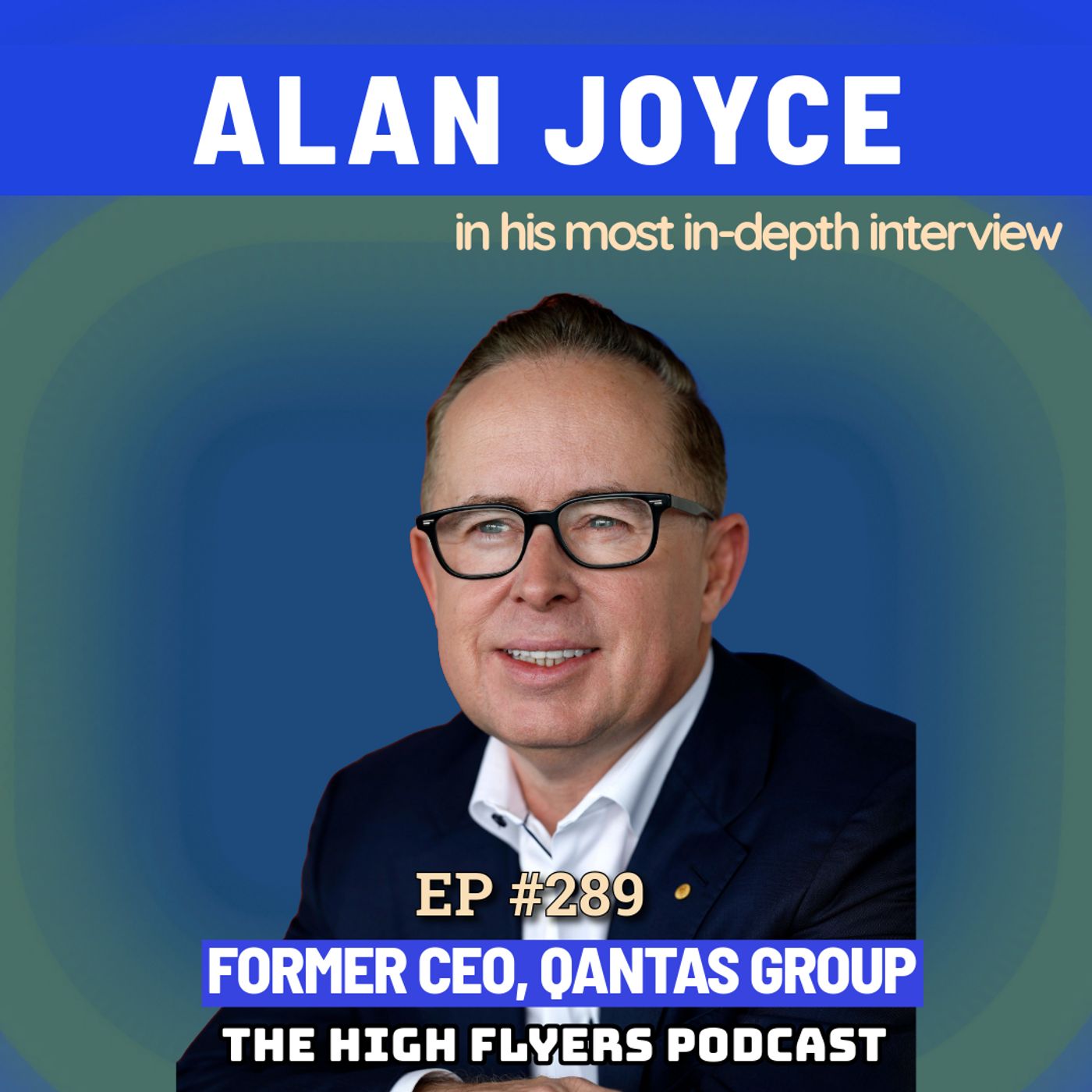
Alan Joyce, former CEO of Qantas (and earlier CEO of Jetstar), discusses his leadership philosophy, personal background, and decision-making under pressure, plus aviation crisis examples and his views on public scrutiny. The episode also includes legal/tax context from Allens partner Ria Nielsen about Australia’s proposed capital gains tax changes affecting startups and venture investment.
Alan Joyce is an Irish-born (Dublin) aviation executive turned author/speaker, later living in Sydney. He grew up in working-class Dublin (Tallinn suburb), rose through airline operations and “operations research” training, and led Qantas and Jetstar. Ria Nielsen is a Managing Associate at Allens, specializing in capital gains tax policy impacts on startups/VC.
Joyce says his mother instilled a “don’t let people walk all over you” instinct (including a fish-market refund story). He attributes his crisis calm to mindfulness training and “compartmentalizing” (dismissing distractions to focus on the task). He argues tough calls should be made for the “right thing,” not for approval, and that boards should evaluate CEOs on long-term outcomes. He claims a science/“hypothesis-testing” mindset helps make fast, safety-critical decisions.
QF32 engine failure and the decision to ground A380s; Aer Lingus meal-service dispute where “hearts and minds” mattered beyond time-and-motion data; a story of challenging an intimidating airline CEO to encourage debate; his high school “bored but ahead” testing; and his regret about quitting karate because he felt he’d be “second fiddle.”
Written by AI. May contain mistakes.
Alan Joyce talks about his polarizing public image.
“There are people that are big supporters.”
Alan shares fun facts about his upbringing and current life.
“Our listeners have called this podcast a meticulously researched biography, unveiling the extraordinary lives and decisions of the most remarkable individuals and companies from around the world.”
Alan reflects on who inspires him and their significance in his life.
“It's now time to explore your curiosity.”
Alan discusses his parents' influence on his work ethic and education.
“My mother worked as a cleaner to get her kids through university.”
Alan shares a childhood story reflecting his belief in standing up for oneself.
“big class sizes, which we did at the time.”
Alan talks about his competitive nature and regrets regarding karate.
“And did you know that about yourself, like from an early age?”
Alan reflects on his journey to becoming a CEO and the mentors that helped him.
“I'm now joined by Ria Nielsen, Managing Associate at one of our wonderful partners, Alan's.”
Alan discusses how his father's influence shaped his competitiveness.
“I always wonder like what makes someone a CEO, right?”
Explore how Alan Joyce's family dynamic and upbringing instilled a sense of competitiveness in him.
“but we're very different in other ways as well.”
Alan Joyce discusses the challenges of long-term decision-making as CEO.
“The CEO before me took the first of the aircraft.”
Discussion on the government's proposed CGT concession for startups.
“Ria, you and I talked a bit about the capital gains landscape at the moment and some of the uncertainty that is playing in the ecosystem.”
Joyce offers insights on how CEOs can focus on long-term outcomes.
“How would you just quickly on this, and then we'll come back to your life and career in a moment.”
Alan shares his path from high school to university and beyond.
“curious if i met you at age 18 you've got some understanding of the world you've just finished high school, you've had all these experiences in Ireland.”
Alan reflects on how his education influenced his career in aviation.
How Joyce's science education shaped his approach to executive decisions.
“and I was lucky I did that because if I hadn't done that, I hadn't taken that course, I would have been a very different person.”
Discussing the value of team debates and diverse perspectives in leadership.
“And I tell the story of the QF-32 as an example, where we were in a boardroom and we had this amazing team around us and we could see TV pictures of part of the engine sitting in Indonesia when they had blown up.”
Joyce reflects on early experiences with workplace politics and stakeholder management.
“Because we could be here for hours if I try and go through everything step by step.”
Understand the challenges of leading a long-established company and fostering a culture of open communication.
“and unless you get the good case for that change and adapting to it, it is very hard.”
Explore the unique challenges of managing in the aviation industry and the importance of expert reliance.
“Because I worked in retail and FMCG for a decade, as you might know, and it was intense.”
Learn how a CEO can develop through mentorship and the importance of self-awareness in leadership.
“You can go to Harvard and you can go to every school, but you've got to do the work every day.”
Delve into the balance of strengths and weaknesses in leadership roles and the impact of intensity.
“And I think the most curiosity I received on that is people said, ask him to assess his strengths and weaknesses.”
Explore how mindfulness influenced decision-making and perceptions of intensity.
“Would you say that's a strength or a weakness?”
Alan Joyce shares his journey and the challenges of the CEO selection process.
“Thank you for sharing that candidly to some extent.”
Discover the importance of appearance and perception in corporate leadership.
“The other thing that was feedback I got at the time was also that I wasn't dressing very correctly for being Qantas CEO.”
Learn how different management styles impacted Qantas and Jetstar's operations.
“Yeah, yeah, I did find that story funny and I'm glad you shared that.”
Alan discusses the pressures and public scrutiny faced while leading Qantas.
“The other one is we chatted earlier about the demands of being a public company CEO, right?”
Insights into decision-making during Qantas's most trying times amid the pandemic.
“And then it was the recognition because I think Australia is a bit unique for its CEOs.”
Alan Joyce reflects on his legacy and the lessons learned from his tenure at Qantas.
“to being in the room when the decisions were made and why they were made.”
Alan Joyce discusses the intent behind his book and the stories it tells.
“Here's my view from inside the room of what actually occurred.”
Joyce reflects on how relationships changed after leaving his CEO role.
“Last year, I had the former Prime Minister Malcolm Turnbull on my podcast.”
Joyce shares his current focus and disinterest in returning to a CEO role.
“If you can find my new phone number, great.”
Joyce discusses how he views his identity beyond his former role as CEO.
“And anything that gets impacted and that is not something I want to do.”
Joyce imagines a learning room filled with influential people in his life.
“and then it's got the solar system of the other things that are used to be more balanced.”
Joyce shares his travel routines and tips for managing jet lag effectively.
“So having that foresight of just the names, just rattle them off.”
Learn effective strategies to minimize jet lag and maintain health while traveling.
“But then the other thing I think is really, for me, is always work really well is exercise at both ends.”
Discover the importance of mindfulness and continuous learning in personal growth.
“So let's move to Rapid Fire Sprint to wrap this up.”
Understand the approach to recruitment and the significance of diverse perspectives in decision-making.
“And some of the best managers I've recruited through that process were really good at doing that.”
Examine the challenges of ensuring passengers pay attention to safety protocols during flights.
“because they just improved the decision-making.”
Reflect on the importance of recognizing those who contribute to personal success.
“Of course, you don't know the next guest.”

Get the gist, explore an idea or ask about something said.
 Claude
On The High Flyers Podcast with Vidit Agarwal, what are the key points of this episode?
Searching your listeningAutomatic transcript. May contain errors.
0:00Hi, I'm Vidit, the founder and host of this podcast, The High Flyers. Hey Vidit, this is Alan Joyce. I'm the former CEO of Qantas Airways. I'm currently an author and a speaker and in the process of setting up my own little business. Alan, I reached out to a lot of people for research on this and spoke to a lot of people. I got two opinions. One, people said Alan has been very unfairly treated. And the other were like, people were like, you better ask him the hard questions. So I'm coming into this just with curiosity. I'm just curious about you because there's so many opinions that people seem to have about you.
0:32Yeah, I think because I've done, I've been in public life, I ran Qantas, probably the airline people have more opinions on. I ran Jetstar for a while. I think I've definitely been a polarising figure. There are people that are big supporters. There are people that have the opposite opinion on it. It's just something that I've seemed to have generated in my career. What's the great Oscar? a wild quote the only thing being worse at being talked about is not talked about so i'm certainly don't have that problem that's good that's good i like i like the optimistic view on that what if we could reimagine the traditional notion of a high flyer hey friends welcome back or welcome to the high flyers podcast where we do reimagine a high flyer showcase the brightest and most relatable role models and companies and their journey from sunrise to today.
1:29As one of the premier products in our Curiosity Center lineup, providing on-demand intelligence to help you be 1 % better every single day. I'm your host, Virat Agarwal, and let's have some fun. Our listeners have called this podcast a meticulously researched biography, unveiling the extraordinary lives and decisions of the most remarkable individuals and companies from around the world. We hope you're enjoying our catalogue of 200 plus episodes since we launched in 2020, with many of our guests appearing in rare public interviews. It's now time to explore your curiosity. Please enjoy. Let's set this in with some fun facts to get us going.
2:11Where were you born and where do you live now? I was born in Dublin in Ireland, I grew up in a place called Tallinn, a working class suburb. I live now in Sydney, in the rocks in Sydney. So I've gone up. I'm up at a high-rise apartment. So my mother would say I've gone up in the world, but maybe still can't make a good cup of tea as far as she's concerned. We will unpack that life's journey in a second. And work, what was your first job and what do you do now? I was first job as an operations research analyst, which is using mathematical models, a branch of mathematics. to solve business problems.
2:48And then I'm currently an author, a speaker, and a retired businessman, but hopefully getting back in to our own little business. And Alan, as you know, the purpose of this show is to reimagine the concept of a high flyer, to go beyond their job title and celebrate their human identity. Is there a high flyer who you feel hasn't got the recognition they deserve? I think for a lot of people that have done jobs like mine, it's your parents and your partner. So I think my high flyers, my inspiration, and I mentioned it in my book, are my two parents. My mother is not well at the moment back in hospital.
3:23She's always been my inspiration. Then my husband, Shane, he's always been my foundation. So I think they're the people that usually get no credit or are a big part of any business leader's success. Back to the episode in a moment. Something I've heard a lot from business owners and leaders is that speed only matters if you still feel confident in the output. And it's particularly an important point in this world of AI. Xero's answer to that is accountable intelligence. AI that shows you what it's doing and works from your own real data and is designed to keep you in control before anything happens.
4:04As Xero puts it, most AI asks you to trust it. accountable intelligence shows you why you can and that's how it works with jacks zero's in platform ai finance partner so whether you're running the business advising the client or working with your board jacks ensures that you get the upside of automation without giving up any of the control if you want to see this practice head over to zero.com forward slash high flyers for 90 off your plan for the first six months terms apply and go to the website that's zero xero.com forward slash high flyers now back to the episode yeah i think you start the book with your parents right colette and maurice is that yeah yeah they've been unbelievable because you know their background they came from extremely poor backgrounds both of them lived in tenement housing which is housing that were slums in Dublin, the worst slums in Europe, both grew up in that level of poverty, but really worked multiple jobs.
5:12My dad had three jobs. My mother worked as a cleaner to get her kids through university. A lot of people say that they're the first to get to university. I was the first in my family to finish secondary education, then the first to get university education, the first to get a master's degree, and then my brothers who were younger all followed. Yeah, I actually heard a story in my research that apparently, is it true that one of your high school teachers thought you were behind in your studies, but you're actually just bored? And when they did some tests on you, you were actually ahead of where you were meant to be.
5:48Yeah, it was interesting because they were talking about putting us into remedial class in high school. And then the teachers did a few tests and then I found out that I was just switching off in class because I was digesting it so fast. I was lucky that was caught at an early stage before it became a problem. But that can happen to kids, particularly when you have big class sizes, which we did at the time. Yeah. A constant theme that I think you've talked about and that you've reflected on in the book and it came up in all the people I spoke to is you've always believed in standing up for yourself and for your views.
6:26Apparently, you've had that since day dot. Can you reflect on that for a moment? I think in the book, you talk about your mom being at a fish market or something, and she asked for a refund or something like that, and she doesn't get it and she stands up. Where does that approach come from? It definitely is in my family. It comes from my mother. My father was very placid, easygoing, but my mother always had this drive and this really view that you shouldn't let people walk all over you. And there's a story, I think I was 10, 11 or 12 in that age group, came home on a Friday. My mom was cooking fish that she got from a little van up the road.
7:06She had a cold, so she couldn't smell the fish. And we had our first bite of it and found it was off. And I said to my mom, it's off. So she immediately marched up with the fish to the van and asked this guy for a refund. He refused. She then started protesting outside the van. And around three hours later, I went up and I said, man, come home. We're all starving. And the guy overheard us talking. And my mom says, I'm staying here all night because he refused to refund this bad fish that he's given us. and he overheard us and I was begging for her to come back, overheard us and he finally relented and gave her the money.
7:46But it was built into me from an early age that you need to stand up when an injustice happens and making sure that people don't walk all over you. And I think my man has that characteristic still today. And did you know that about yourself, like from an early age? Did you have that understanding about your own self? I think so. I think I always knew that was part of it. You know, some of the guys that I worked with said, you know, that it came out more when they read the book, particularly those early chapters. So, you know, the guys that were reported to me when I was head of Qantas, they were all aiding me when writing the book.
8:24And a lot of them said, God, that was very telling, those family chapters, particularly your mother and her upbringing and how she saw the world, because that's exactly you. and I definitely am my mother's son when it comes to that. I think a couple of my brothers are exactly the same. The other story that I found really intriguing from your book is the karate story. I think you reflect on that your brothers were very good at karate. I think they went on to represent Ireland, some of them, but then you realized you weren't good. I think the term you use in the book is second fiddle and you decided to quit.
8:58Reflect on that for a moment. Again, is that central to your personality where if you're not good or one of the best, you'd rather not do it? Yeah, that's one of my regrets also, Vidit, because what happened was we all started at the same time. We were all doing karate. We were all enjoying it. And then I had an important exam that was coming up. It was high school exams that were important for your next level of education. So I took a break from it. And then when I went back, my brothers were a lot better. and we were really competitive as kids, you know, particularly me and my brother Anthony.
9:36And then I felt when I was back in Cracky, they were teaching me. So it became part of who I am. I said, I can't be second fiddle to my younger brothers. And I do regret it because they went on to become black belts. They were pretty good. It would have been a good discipline to actually have. But that competitive nature and having a deficit at the time, which I probably could have caught up with, encourage me in my mind not to do it. Yes, if you're not really good at something, then move on and try something different. Back to the episode in a moment. I'm now joined by Ria Nielsen, Managing Associate at one of our wonderful partners, Alan's.
10:15Welcome, Ria. Thanks very much for having me. I'm happy to have you on. I believe you are an expert in the topic that we will educate our listeners on. tell us about the recent capital gains tax changes and why have they apparently caused concern for the startup and venture capital community so we're actually seeing quite a lot of tax reform in Australia at the moment but one of the changes that's probably had the most attention is the removal of the 50 capital gains tax discount which Australians have relied on for decades really And so for gains which are accruing now from 1 July 2027, so next year, that discount's generally being replaced with an indexation system and also introducing a minimum 30 % tax on capital gains as well.
11:04And so what that means in very simple terms is when you sell an asset such as a share on exit, you'll need to adjust what you paid for it, which is your cost base for inflation. And so what you're then taxed on is really the real gain that you've made at that time. And that might work really well for someone that's bought into an established business. They've paid real money for their investment. That amount gets adjusted for inflation. So when they sell, they'll have a decent kind of cost base there to reduce their capital gain. But startups are quite different. Founders and early stage investors, they often get their equity when the business itself is not worth very much at all.
11:41And so when the business then takes off and you're thinking about what's my capital gain on exit, indexing a really small starting value doesn't get you very far at all. And of course, having a business take off and do really well is a good problem to have, and everyone would like that. But without some form of relief, you can now possibly be taxed or hit with a tax bill on exit, which is almost double what you would have had under the current system with that discount. So understandably, that's all led to concerns that the changes could possibly make Australia less attractive for early stage investment.
12:14Fascinating. Interesting time. So I guess stay tuned for what's ahead. Thank you, Ria. And now back to the episode. Thank you for having me. I always wonder like what makes someone a CEO, right? Because there's so many people that have that aspiration, but not many get there. Would you say that attitude to life is what led you to becoming a CEO eventually? I think so. It's also, I think there's a few things which we mentioned in the book. There were a few mentors over the years that gave me encouragement at different stages of my career. There was also getting a diversity of experience that helped.
12:49But there was one particular thing. I had this, and I don't know where it came from. I had this desire when I worked in Aer Lingus to emulate somebody who I thought was really good. It was the CEO of the passenger airline at the time. And he'd become a CEO at 40. And I said, I want one thing, to become a CEO of an airline before I'm 40. I then had that overarching goal that I gave myself to try and achieve it. I'm very competitive of trying to get there. And I became the CEO of, I think, Jetstar at 34, 35, and the CEO of Qantas at 42. But it was always in the back of my mind, what do I need to do in order to achieve that overarching goal?
13:31and thanks to mentors who gave me the experience in different levels, I managed to get there. And are you a believer in nature or nurture? I think it's a combination of both. I think a lot of my upbringing is thanks to my mother and father. I think it's also thanks to those teachers and mentors that were there. So I think that nurture did help. I think I'm very different in some ways. You know, you met my brother, you say I'm similar to him, but we're very different in other ways as well. So it can't be all nature and it can't be all nurture because we had the same upbringings and we're slightly different in different ways.
14:11Everybody's very driven in our family. You know, they all went on to great careers. One of my brothers became a director for Disney and MTV and has produced major pieces of work. The other brother is an actor, which takes a lot of dedication, another graphic designer, but very different in personalities in some ways. I'd love to ask about your dad, because that came up. You mentioned your brother. I spoke to him for research, and he was very candid with some of the stories he shared. And I think one of the ones, if I heard him correctly, was about your dad, about how he almost apparently trained you to be competitive.
14:46And can you touch on that? Because that, to me, is so interesting, right? You see that in athletes, where they often talk about their parents, and they go one of two ways. They either become very competitive, or they hate the competition. Yes. It was interesting because it was little things like, I think he found at one stage that we weren't doing well in mathematics as an example. And then he would do little cards with the times table on them and then do it between us. We were all very similar age. And then do it between us to see who would get the answers right and encourage us to be competitive on that.
15:22he was also he would throw problems to us or questions to us and get us to debate or discuss stuff and we enjoyed it you know we went off and did our own things we lived in a very working class suburb so we didn't have we couldn't afford cricket bats but we made our own cricket bats and played cricket and got very competitive around the backyard we played tennis over the wall between us and our neighbor. I got very competitive very late into the Irish evenings at that. And I'd say in the book that I felt like, you know, I had three brothers. I felt like competition was the fourth brother. It was always there.
16:01It was always part of our upbringing. And my father encouraged that and he thought it would make us better at what we did. And I think it did. And I mean, the other one is the environment you grew up in. People say the island, when you were growing up was a tough place to grow up how much of that is true like how much of that and then how much of it is still instilled in you like i i very much agree with your point like i have that view where if someone doubts me it just lights a fire in my belly where i will go great i'm gonna prove you wrong but i have realized that like can also be my massive achilles heel yeah like my wife always says she's like dude you need to calm down if you do this you will just blow up.
16:45But just reflect on the island you grew up in, like how much of that shaped your approach to life? Ireland was very different back then growing up in the mainly the 80s, 70s and 80s, but mainly in the 80s. It was, we were very working class suburb. Ireland had a lot of economic problems. There was high unemployment. We were lucky, my father always had a job. My mother had worked as a cleaner in a sports facility. So we were lucky. We always had an income coming in, but there was high levels of unemployment and it wasn't guaranteed that you were going to get a job. It was also very conservative.
17:24It was dominated by the Catholic Church. You know, homosexuality was illegal until 1994 and you really couldn't come out. I had one of my neighbours who came out to his parents and he was kicked out at 16 from his home. And I always thought one of the things I talk about in the book is coming out to my parents and the relief when my father hugged me when I was in my late teens on that. Because, you know, you were scared the same thing would happen and you wouldn't see your brothers again. And that would have been a sliding door moment for me because it would have changed my life completely. So you were living in this very poor, economically challenged country and very conservative at the same time.
18:08And then when you went to university, what was great about Ireland, which changed my life, is that the university fees for poor families with low income were paid for by the government. So even though they were in economic trouble, that allowed me to get through university. I think if we had to pay the fees, we couldn't afford it, I couldn't have afforded to do it. So I got through university. And then at the very end of university, I was one of the few people out of my degree that ended up getting a job in Ireland. Everybody else left. So there was part of, you know, if you needed to go, you went.
18:47And there was none of this located. One of the things sometimes you get frustrated off in Australia is people love their cities, whether it's Sydney or Melbourne, and don't leave. In Ireland, it was part of the culture. You know, for career opportunities, you went and you went to the other side of the world if you had to. So I think, you know, that tough environment, that conservative environment changed my life in some ways because it encouraged me to leave the country, to come to Australia because I was gay and I didn't feel that Ireland was accepting at the time. And then in the next 20 years, God, did things change?
19:23Ireland became one of the most accepting countries in the world. I was going to ask, if you hadn't left Ireland, do you think your life would have been different today? I think it would have been. I think you look back and in the book I talk about the sliding door moments where the opportunities are there and then sometimes you grab them. And sometimes the opportunities are not career because the job in Australia working for ANSET was probably a step backwards from where I was in Ireland, but it was for the personal development, the opportunity to be who I am, to come down to Australia and have an open life.
19:59And that's when I met my partner and now my husband, Shane. So that was for that reason. And then I look at the career and say, anytime there was an opportunity, I always grabbed it because I felt you take those risks and went with it. And maybe it would have been very different because the choice I had back in Ireland at the time was not to come to Australia, but to work for Ryanair, for Michael O 'Leary, because I was offered a job working for him. And who knows where that would have went to. Ryanair turns out to be one of the most successful airlines in the world, has had huge growth opportunities, but it would have been very different from the career I got in Australia.
20:39Yeah, hindsight's an easy thing to do, right? Yeah. One of the things that really fascinated me in my research, Alan, is people said you're very good at compartmentalizing. Extremely good, apparently. You can deal with a crisis and you would put your phone away and you would sleep well. I can tell you I'm decent at compartmentalizing, but if something's in my mind, I will chew on it. I can't put it away. I've got to talk to someone about it or I've got to just find a way to vent. Where does that come from? How early in your life did you realize that you have this ability to compartmentalize? And two, what does that actually process look like?
21:16How do you compartmentalize? So when I was, one of the great things, Aer Lingus was an amazing company to work for, the Irish National Airline, when I started working there. And one of the things that, they did a couple of things that were spectacular for your career, but one of the things they did was start doing mindfulness training before it was a very trendy thing. This would have been in the early 1990s when I was a young manager. and that mindfulness training just helped me to relax to focus on what's in front of you and the process is very simple it says that when something else comes in and it's not part of what you need to be focused of the time you just dismiss it like you would for meditation or for any mindfulness training and then focus back on it and when you do it enough times you get there It can cause frustrations, you know, because with my partner, sometimes he would read headlines during the grounding, during the engine failure, and I'd come back home.
22:18And all I'd want to do is just switch everything off and relax and discount all of that. And he would say, can we chat about what I just saw on TV? And I'd say, no, I'm here to relax. I'm here to switch off. And I could do that very well. I still could do that today. It's one of the number one things I say to young managers, if you can practice it and get it down, it will save your mental health in future life. Because, you know, with everything, the ups and downs of my career over those 30-odd years in aviation, I think it's the thing that kept me sane. It's the thing that made sure my mental health was actually really good and I've never suffered from mental health problems because I'm able to detach from it and focus on what I believe is important at the time.
23:03and in a crisis you need to do that because we go through in the book I have a whole chapter on the QF32 when the engine blew up and you know that was we had a lot happening at the time we had a lot of things that we needed to do but when you're managing a crisis you really need to be focused on what's happening in the room and discount everything else that's going on the other thing for your mental health. I think, you know, we worked out one stage was a 10 ,000 Qantas passengers are in the air when you go to bed at night. And when you wake up in the morning, you have to look at the phone. If you can't detach from that.
23:39And some CEOs, I talk about some of my friends that were airline CEOs that couldn't get over that, affected their sleep, worried them. It impacted on the mental health and eventually they had to leave the role. If you can't get that out of your mind and the risks involved in that and manage it effectively there's no way you could do the job because it would be overwhelming and lucky enough i was able to manage that and i know a lot of ceos that can manage it very effectively it's so interesting because because i like to think you and i are human and we have days where you just go why would someone say that or you'd wake up and read a news article or you do an interview and someone like me would ask you a silly question and you'd go, why'd you ask me that?
24:23How do you deal with those moments? Again, is it meditation and mindfulness? Because I would like to think you have days where you are frustrated because someone said something you don't agree with. You will always get those occasions when you do, but I think you have to also recognize that you need to keep focused on what you're doing. You need to make sure that you're aware of what your agenda is and what you're trying to achieve. And if you believed every headline that was written about me or you or anybody else, you would not keep reading the truth because there's lots of stuff that is incorrect.
24:58There's a lot of stuff that's correct, but you just have to discount that and have to say, yeah, that's just the nature of the world that we live in. I know a lot of people pay attention to what's said to them on social media. I think that's probably the worst thing you could do because that is an unfiltered just view of people exposing anything that they want to. And I don't think that's healthy for people to look at that. So I've always been in that position. Yeah. You know, it's important to make sure you understand what's being said out there, but at the same time, you can't let it drive you and you can't make it live your life.
25:31It's incredible. Maybe that can be your next book because I can tell you, like people always ask me, what have I learned from doing the podcast for nearly seven years? And I go, the key thing I've learned, irrespective of whether someone's a prime minister, CEO, athlete, investor, what have you, is we as humans want approval. We as humans want relevance and approval and connection. That is a basic human need. Do you agree with that? I'm not sure I do, because I think if you're always after approval, I think that gets you and that maybe you're not then suited to do some jobs, because that means you never make a tough call.
26:09because I think sometimes tough calls will automatically mean you don't get approval. All tough calls sometimes means that people feel there's a lot of negativity about that. But if you're doing it for the right intentions in mind, you have to be focused on it. And if you do everything for approval, you know, I think one of the quotes that I've used at the time is the great Eddie Roosevelt quote, at the time of decision, the best thing you can do is the right thing. The next best thing you can do is the wrong thing. The worst thing you can do is nothing. If you're after approval all the time, I think what people get into is not doing anything because they're worried about the mistake.
26:49And you never have the successes if you're worried about the mistake. You never have the great successes and the great things that you think you'll achieve in your life if you're worried about that failure. Because if you're always after approval, you'll never take the risk of the failure and therefore you get into doing nothing. And I think that's the worst thing you can do in some jobs. That is so interesting. I feel I see that all the time with public company CEOs in particular, right? I've never been one. You've been one for many years and you know many years. I always joke they live in this state of paranoia all the time.
27:22This constant state of paranoia, right? Because they're like, what's the headline around the corner that's going to come and ruin my career? And I find that deeply fascinating. and I think the other problem you have is that the life of a CEO was typically I don't know if it's expanded but when I was writing the book I looked her up it was four to five years at the time of a publicly listed CEO and then therefore you know there's not a lot of incentive to make the decisions that last a long time and I say in the aviation industry unfortunately a lot of the decisions go generational. You know, the CEO before me decided to buy the A380s.
28:03The CEO before me took the first of the aircraft. I took 11 of the aircraft and they were going to be, now they're still operating for the current CEO. And they were wrong decision at the time, but you live with them. And that's the problem that if you're there for approval, you're there for four or five years and you're not making the right calls that you believe are necessary, you'll make bad long-term decisions for the company that everybody suffers with. And that's the structure of some of the publicly listed companies we have. And unfortunately, I think that leads to bad outcomes and we've seen a lot of bad outcomes.
28:42Back to the episode in a moment. I'm now joined by Ria again from Allens. You may remember hearing her before in this episode. Ria, you and I talked a bit about the capital gains landscape at the moment and some of the uncertainty that is playing in the ecosystem. People might be wondering how government responds to this. What is your read from that perspective? Thankfully, there is some good news there. So the government has thought about this and proposed a new innovative business CGT concession, which essentially preserves that CGT discount for qualifying equity holders in innovative startups.
29:21And that's the CGT discount that we have at the moment that we talked about earlier in the podcast. But the key word there is qualifying. So there are actually quite a few conditions that need to be satisfied in order to access this concession, including pretty strict innovation criteria and generally also a three-year holding period. So overall, the headline is pretty positive. We have the government listening to feedback and recognising that investment in start-ups is important. But the detail really will matter here because the concession is not law yet and the eligibility rules are pretty strict and fairly targeted.
29:54So we'll really need to wait and see where the final legislation lands. Interesting times. Thank you, Ria. And now back to the episode. How would you just quickly on this, and then we'll come back to your life and career in a moment. How would you change that? Let's assume you were brought in as a consultant and 20 of the leading CEOs were in the room and the chairs of their board were in the room. How would you change that attitude? I think it's important for the boards and for the shareholders to make sure that they are picking and assessing the CEOs on what they believe is the right outcomes for the business.
30:37I think that's a dilemma in some cases because a lot of the shareholders are looking at the half-year, full-year results and are looking at in the US it's every quarter. So I think there has to be more incentives for those shareholders to have a longer term view and to incentivize them around it. And that longer term view, I don't know if you change the REM structure, have the focus of the CEO and the REM to be structured on after they've left how the company is going and what happens to the company well after they've left, given that that may be a way to actually improve on it. But I think in some cases, I think we were lucky.
31:16we had a chairman and a board that was very long-term focused we had shareholders that were long-term focused and if you have that and have those combinations then i think it gives the ceo permission to go off and make those hard calls to have that long-term focus i want to come back to this some of these topics but i want to reconnect back to your journey so i'm always curious if i met you at age 18 you've got some understanding of the world you've just finished high school, you've had all these experiences in Ireland. What would I have assumed you'd do with your life? I think at that stage, I didn't have any view about where I was going to end up.
31:56I didn't want to go to university because I wanted to go out and earn an income. I was very focused on just helping my parents out. I knew they were struggling. And I think lucky enough, I had a father and I have a teacher that encouraged me to stay on and to university and they had an intervention to say you need to go to university you need to do a degree I was very resistant to that so and I think you can have an overwhelming desire that's maybe not in your long-term best interest as a kid and if you have a good mentor and a good parents I think they can make your life very different so I was encouraged to go on and go to university with no prospect about what the idea was at the end of that and it was only when I finished my master's degree and literally saw an ad in a newspaper for a job in an airline.
32:47I had no interest in working for airlines at the time. A job in an airline that happened to be for the branch of mathematics I had just done. And it was just pure coincidence that career path happened and got me into aviation. But I think at 18, I could have gone a number of different ways. And it was thanks to the intervention of my teachers and my parents that encouraged me to go to university and I may not have done that if I had my own way. As in you wouldn't have gone to university if you had your own way? Yeah I was I if I had my own way at the time and hadn't been persuaded I would have just gone out and got a job any job to help my parents out and that was the wrong that was a short-term decision instead of taking it a longer term and looking my father and my teacher had a more long-term view of where I should have gone.
33:35That is such an interesting reflection because because most people would say your career for most of your career panned out really well so you're saying the university thing you think impacted your career perhaps it was very positive for my career if i hadn't done the university course there's no way i would have went into aviation there's no way i would have had discipline in my decision making because i think my university and science degrees really formed the way i think and the way i made calls and I was lucky I did that because if I hadn't done that, I hadn't taken that course, I would have been a very different person.
34:11To talk about the topic because you studied science, right? You did a bachelor's and master's in science. I'm simplifying it, but I think it was a bit more detailed than that. How did that shape your career? Because I think most CEOs, a lot of CEOs actually come from a history background, a history background, or they have an MBA and they've kind of come out of central casting and they've studied commerce. How did that science background shape your decision-making as an exec as you rose through the ranks and eventually became CEO? I think particularly in aviation, it was extremely helpful because in aviation, a lot of the decisions you have to make, sometimes you don't have the space of time or massive amounts of information.
34:54And I always used to say that, you know, I do a couple of examples on the book where decisions were need to be made for safety reasons and other reasons. and the scientific background I think is very useful because the scientific method is usually that you have a hypothesis you think you have an understanding of what the answer is and then you get enough information to either prove or disprove the hypothesis to say is this the right answer is that the right way of going now for that to work you need good people around you and I always tried to get the best people I could to work with me to work with us as a team and then you have big debates and you argue you have your view but you're listening to other views to say that's wrong that needs to change or this is what I think the answer is and you get to answers faster I think through that process than you would of the consultants call a boiling the ocean trying to get all the data you can trying to get all the information that you could possibly make and a lot of people put off decisions because they don't believe they have perfect information and you never get the perfect information.
36:03And I tell the story of the QF-32 as an example, where we were in a boardroom and we had this amazing team around us and we could see TV pictures of part of the engine sitting in Indonesia when they had blown up. And there was a critical decision to be made, do you ground the fleet of A380s? Because we three aircraft departing within an hour or two of when the meeting was happening. And you were listening to people around the table talking about what they can see from the TV pictures, limited information, because the aircraft was still in the air. We had to make a quick call. And that scientific method, which was the hypothesis, was we have to ground up.
36:45They're not safe. And then you had to have the information. Is that right? Because there was a big call either way. And that worked. And it's worked for my entire career, having that ability to make quick calls when it's needed and have good people around you to debate them and argue them. And I think that scientific background, that scientific degree, I think helped me with that way of thinking. I've not spent as much time with scientists, but I've spent quite a bit of time with engineers in the tech world. And one of the things I notice is that single-minded sort of binary approach can limit them.
37:24They don't become the leader of the company sometimes because they don't like the people side they don't like the coaching side whereas you became leader of companies and leader of people and leader of teams how do you reflect on that is that a feature and bug of studying science i think what i actually really enjoyed is the debate and the discussion maybe from those early days with my dad who would encourage that and debating my brothers and having discussions with them. And I like that. And I like people that are unbelievably bright. When you look at the teams that we had together in Qantas and Jetstar over the years and what people went on to do, they were unbelievably capable people.
38:10Jane Hurdlicher, Bruce Buchanan, David Koschka, they all run big companies now around the globe. Andrew David, who came in from running Tiger and being second in charge of Virgin. We had Lyle Scramby, who was second in charge of Virgin Atlantic, had some amazing people that came in. And they all had one characteristic, they debated and argued and put the case. And, you know, there was a lot of times when I had those great people around when I said, yeah, you're write, we go off and do that. And that's what got us to set up Jetstar, to do Project Sunrise, to do all the businesses in loyalty. It was where the innovation came from.
38:50Those debates, those discussions, and those great people. And I enjoy that because you'd like, I still met Bruce very recently. He's doing unbelievably well with a software company in New York. And we were having discussions about things. And I'd say, wow, I love your brain, Bruce. It's very unique. It's very different. You argue in different ways. You come out with different perspectives on things. And it was very fulfilling seeing that. And I've always enjoyed having people that come from solving problems from different angles, different approach and add to the discussion. I did a lot of research about what are some questions I can ask about your early career?
39:27Because we could be here for hours if I try and go through everything step by step. And I found two stories that you talk about in the book. One is you were sat, I think, at the back of the plane and the staff were doing a test about, can they serve meals between Dublin and London and the unions disagreed? So, we'd love to start with that because just reading that, it told me that you learned maybe about workplace politics, right? And like managing different stakeholders with different incentives early in your career. What did you learn from that? And like, what did you take from that and what did you go no I shouldn't do that because that's the wrong way of getting people on board?
40:06Yeah so it was an interesting Dublin London is shorter than Melbourne Sydney as you know it's shorter than an hour and so they there was a big competition happening at the time and Aer Lingus was adding meals to economy and there was a dispute about how many cabin crew you needed to do it so it was time in motion so we were there on the management side just assessing could the crew do it in time? And then the unions had their reps doing a time of motion as well and all the data was going to be combined to make this big call. What I found at the time is that it's not always scientific. There's hearts and minds that come from it because there was a couple of examples.
40:48There's some funny stories about having to interact with passengers, passengers joining the high mile club while I was trying to measure what was happening out in the cabin. I had one flight where the meals were collected in time and they were put into the toilet and stacked up in the toilet and the aircraft came in for a hard landing and all the trays came flying out through the cabin. And I think people thought the aircraft had crashed. But what it taught me is that, you know, there may be obviously a scientific answer that says, yes, here's the maths and here's what the maths shows. But there's also human emotions and that they have to help people understand why things are being done.
41:32And in that case, I think it was very important for Aer Lingus to be competitive on Dublin, London. It was going to lose market share and eventually did. It was going to put the airline into crisis if that didn't happen, which it had to go through a massive restructuring. So how do you make sure you're competitive and not just get to the arguments about here's the maths, here's the science, there's a bigger thing at stake and win people's hearts and minds to get those things done. And it's never easy, particularly, you know, I say the best job I ever had was setting an airline up from scratch, Jetstar.
42:05One of the most difficult things you can do is changing a company that's been around for 100 years because people do not like change. and unless you get the good case for that change and adapting to it, it is very hard. The other story that I found very fascinating and I'm curious how this shaped you is in the book you talk about you, I think the Ailingus CEO had a reputation of intimidating employees and I believe the line you say in the book is you said to him directly, do you realize everyone's terrified of you? and he goes clearly you're not because you say that and i was reading that going hi if that happened to me like that's something i would internalize for the rest of my career because and you became ceo pretty soon after that how did that shape your view of like i know sometimes ceo has to be tough sometimes you've got to be tough like you said you don't have to get approval but then there are times where you got to create a culture of people willing to speak up and say to you, Alan, I disagree with that, hopefully in some shape or form.
43:13How do you reflect on that story about you standing up to the CEO? And then what did you take from that into your own tenure as CEO? Yeah, because I always encourage people to do the same, to stand up. And I used to tell that story quite a bit to people that worked with me and saying that I think this was very important. And I think Kirill, he was, you know, he's a great guy. He actually did want people to argue with him. I remember having a discussion in his office about freighters and I didn't agree with one of the decisions one of the other managers was proposing. And he just sat and listened.
43:48And I thought I learned a lot from that because he did want to hear other views, but people didn't think that was the case. And I always took a big effort to encourage people to come into the room, to be prepared. You know, the last thing I wanted is people coming in and not being prepared for the meeting, not having their arguments, not having it succinct and not having the facts. That was worse to me than anything else. It wasn't a bad thing coming in and saying, I have a different opinion. And if you had good facts and good position on it, that was great and always really encouraged it. And to this day, I'm still really good friends, working still with some of those colleagues over the years.
44:27And if that weren't the case, if you were always somebody that didn't listen to people, didn't encourage different views, didn't get them on side, you wouldn't have kept that talent. You wouldn't have kept those really good people. You wouldn't have encouraged that talent and you wouldn't have got to a stage where you're still working with them. And I think, you know, one of my, and yet there were hard decisions to make. Sometimes people didn't make it. You made wrong decisions of getting people that performance wasn't great. and one of the other messages I have in the book that the head of HR once said to me it's the walking across the street test when somebody doesn't make it and they're not a high performance person they haven't achieved it and you have to let them go will you if you see them on the street be able to go up and shake their hands and have a chat to them or do you cross the street because that hasn't worked out so I've always kept that the case I've made people redundant direct reports that haven't performed well, but there's always been a good relationship with those people because you have to do it in the right way and make it clear of why that's happening.
45:32And usually that gets you to really high performance, really good people that do really well in other jobs when they leave, but they're willing to be there. They're willing to have debates. They're willing to have discussions and they're willing to challenge the CEO because that's when it works and it can only work that way. Yeah. The thought I was having is, have you ever thought about if you were a CEO of a bank or something where you've got a bit more commercial flexibility in terms of your P &L structure, do you think you'd have a different personality? Because I worked in retail and FMCG for a decade, as you might know, and it was intense.
46:10It was intense. Without naming names, like some of the leaders I worked with, it was tough. There were days where they yell at you and you'd go into the Monday sales meeting. and if you didn't know your stuff, you'd be ripped to shreds, literally, right? And I think of that often and I go, I compare that to tech now where I spend most of my time and I go, tech is not like that because they've got a lot more margin protection and a lot more commercial flexibility that allows them to have different personas perhaps sometimes. It's an interesting one that I'm curious. Have you ever reflected on that?
46:41If you weren't in airlines and you were in a different industry, would you have had to take a different approach to management? I think maybe. I think in aviation, you have to rely on experts. So you cannot be the fount of all knowledge and making all the decisions. And so what you're always doing, I think, is asking lots of questions from people that are experts. I go to that engine issue or I go to when we were in COVID. We always had experts in the room from the different elements of complexity that you're dealing with. I don't think there's an industry as complex. I think if you come up in retail, there's a lot of principles, a lot of what you've learned over your career that you've done.
47:23I think in aviation, there's a lot you haven't done. There's a lot you don't know about. And that's why you need those experts in the room that are willing to debate and willing to have those discussions. And I was always one, you know, my personality has always been calm. And I always did not like people shouting or bullying because there's a difference we're asking for high performance and demanding people are delivering. If you get into shouting, and I'm sorry you ever went through a period where people shout at you, that is just completely wrong. And that is just bad management because there's ways of managing performance that there's no shouting, there's no aggression in it.
48:07It's all about taking people through your expectations, why you're disappointed with the expectations. And I think one of the hardest things that when I found in my career and one of the biggest things that shook me up to perform better was a senior manager, one of my mentors saying, I'm disappointed, Alan, you haven't gotten prepared for this. That wasn't a good report. That wasn't. And doing it in sorrow rather than anger. That is a bigger motivator. And I think for a lot of people, having your mentors, having people you respect, showing their disappointment in what you've achieved really stirs you on.
48:43If you haven't achieved the good report, the good business case and telling you that, that's the thing that lifted me up more than somebody shouting at me. Yeah, absolutely. I'm sure you've heard the metaphor about the carrot and the stick. Sometimes a stick can be a bit too much and people actually do it out of fear rather than do it out of choice, right? and you might get the result, but it's very much by fear and that person is gone the first chance. It's gone. And you can imagine it because, you know, I've seen it. It happened to me that I think I did a business case on the acquisition of some aircraft back when I was in Aer Lingus and it wasn't a great business case.
49:19And my boss told me that, but there was no. And I still remember today that review and it was more powerful than anything. And he was right. I went off and redid it and I did a lot better job the next time. and that was more it's still a bit of a stick it's still giving you you know feedback but it's not doing it in an aggressive way and i think that's a lot more powerful let's go into your first ceo job so you you mentioned earlier jetstar i think 2003 is when you became ceo of jetstar i'm always fascinated like how did you learn no one gives you a manual on how to be a ceo right it's kind of like being a parent you become a parent and you figure it out and you sort of make a lot of mistakes along the way is what most people would say, right?
50:08And I think CEO is similar. You can go to Harvard and you can go to every school, but you've got to do the work every day. How do you reflect on your own development as CEO? Did you spend a lot of time on your own development? Did you build a group of mentors you'd reach out to? Did you have other CEOs you'd approach? How did you do that in this first, say, three years of you being a CEO for the first time? First of all, I think what I did is I figured out what I knew and what I didn't know. So I had a career that worked through most of the commercial side of the aviation industry. So network planning, revenue management, pricing, fleet planning.
50:49And a large part of the job at the start was developing a business case, which I had done for decades. So we did that. I got a team around me that were really good, pulled together a great business case, but then figured out the areas that I had weakness in. And then saying, how do I get really good people to help me with that? When I talk in the book against somebody like Bill Johnsey, who had this huge expertise in operations, John Gissing, who had this huge expertise in safety. and then use these guys who are a lot older than me, who were very experienced in what they did, as people to mentoring me through those areas of the business I didn't know and relying on their expertise on it.
51:32And then also we had a great CEO in Jeff Dixon. So we'd be picking up the phone to Jeff. And then later when I was CEO of Qantas, it was Lee Clifford as chairman. He was the CEO of a very big company. and ringing him up and ringing Jeff up and saying, look, here's what I'm thinking. What do you think is wrong with this? How do you think I should handle it when there's a problem? And being always open about the problems that you're facing and having that dialogue with them. But getting, and then it's deep diving on it. So while I knew how to do network planning, which is where airlines should fly to on the fleet, you hired people and let them do that.
52:11and you stayed on that at 30 ,000 feet. You said, I'm not going to get down. I'm not doing that job. That's the job. A few people fail at this because they go back to the area that makes them comfortable. And fleet planning, network planning, pricing would have made me comfortable, but we had really good people doing that. So I didn't need to be at five feet. I need to be at 30 ,000 feet on it. Let them do the job. But then in other areas, like how does the safety management system work? because then I was the accountable manager. I had legal responsibility for the safety of the airline. And there was a big learning curve in saying, how do I be at five feet on this so that I learn I'm comfortable, I know what's happening?
52:54And then you immerse yourself and spend your time and your effort getting to know that part of the business. And I took, I chaired the safety committee on Jetstar for the full five years I was there. I've had a huge amount of training and learning from those great operational people to understand how that worked. And that brought me up to speed very fast. And you had those people that you could rely on. And then after a while, you started coming up from five fleets to also be at 30 ,000 feet for that and the experts manage it. So when I did the research, and as you know, I spoke to a lot of people.
53:31I said, what's one question I should ask Alan? And I think the most curiosity I received on that is people said, ask him to assess his strengths and weaknesses. And I say that because you mentioned the word weakness earlier. How would you assess your strengths and weaknesses? Yeah, well, I think my strengths would be, I think I'm a good people manager, good people selector. I usually get good people around me. I think I'm actually really good at strategic thinking and challenging the strategic ways of doing things. I think my, I'm also, I think, a curious person. I like talking to people. I like telling stories.
54:14I'm very engaged with friends and family on that. I think my weaknesses are I don't suffer fools. so I've had think people come in ill-prepared don't know what they're talking about I'm not sure I tolerate that as well as I could I think I don't suffer injustices I think this comes back from the story we talked about with my man I think I get to a stage where a lot of my ex-colleagues, my friends would say, God, Alan's fighting over another injustice again can you not let it lie? why do you always have to be out there fighting? And I think that was one of the feedbacks I used to get from people.
54:56Why do you have to be out there fighting? But I think my mother's side on that. And I think also, I think looking back on it, I think I'm impatient. So I want things to happen faster than sometimes they can. And that can lead to us. I think that can lead to people getting frustrated because I find that why isn't this happening? Why aren't things moving? Because we don't have the time on this. And I think they can be things that are negative. But I think you always look back on it and you think that everybody has positives and negatives. I think it's also trying to recognise that when your negatives can, well, some of your positives also can be a negative.
55:46So I go through some of those positives at the same time And I think they can translate into being a negative for you. And I think that's worthwhile also recognizing. A lot of people that know you really well say that you are intense. Would you say that's a strength or a weakness? So it depends on the environment about being intense. So probably a lot of people would see me when it came to big decisions and big issues being intense around them. And I felt like it's that mindfulness, which is your strength and your weakness. So your mindfulness translates into you being very single-minded and focused on the thing you're doing at the time.
56:29And I think that can come across as intense. But for me, that's being present. That's being in the room. That's being there and paying all your attention to that issue. But that can come across as very intense. To me, it's the other side of mindfulness, the other side of focus. It can be a negative. It's again, what are your positives being a negative? Okay. Thank you. Thank you for sharing that candidly to some extent. You share in the book about your interview process to become Qantas CEO. You talk about, you reflect on the presentation to the board and some of your aspirations. Can you unpack that for us?
57:07I think people are always fascinated, like how does someone become CEO? What was your process? And now looking back on that process, is there anything you would have done differently? so yes so the the process the process was the the board had decided that they were going to look at internal external candidates they hired a great a great guy called steve langton who worked with all the internal candidates out of assessing what the quanta ceo job description for the perfect candidate looked like and then assessed all of the internal candidates about where where they were and looked at the gap. So it looked at the gap between the current position and where you need to get to.
57:49I then worked on a development plan to close that gap. So there were a lot of things he ran through, his 360 degree feedback, my boss, which was Jeff, people that worked with me, people that worked for me. I then said, what are the areas that you need to build up your strength in? And what were the areas that you needed to enhance? And that was a great process. I really enjoyed it. really worked with Steve Langton. He's been used by a lot of boards to help in the selection and development of CEOs. And as I was leaving Qantas, I used him and the board for the same process with the next CEO. And I think everybody that was involved in that process found it very useful.
58:31The other thing that was feedback I got at the time was also that I wasn't dressing very correctly for being Qantas CEO. I tell the story in the book that I was voted as CEO of Jetstar as the worst dressed CEO in the country at the time. I think somebody said it gave, I gave off, I gave off the vibes of being a graduate at the photocopier, I think was the, was the citation. And I took that as a badge of honor at the time. But I had somebody in Old Meadow, who I know very well, came to me and he basically said, this is going to be an issue with getting the Qantas job because you need to up your game.
59:09You need to start dressing better. And it was right because Qantas, the premium airline, you know, the cabin crew and the pilots all dressed with a tie. Jetstar was obviously more of a leisure airline and low cost. And that was the other thing that I needed to work on. And I say in the book, I got a stylist at the time to help me with what's the right dress sense to have the right impression of being a CEO, because that was an issue with getting the job at the same time. Yeah, yeah, I did find that story funny and I'm glad you shared that. If I compare Jetstar and Qantas, as in your time at both, I was trying to think of what is a question that brings them both together and maybe the one is, was there things that your persona and your approach to Jetstar that actually became Achilles' heel at Qantas?
59:56Yeah, that's a great question. I think Jetstar, because it was a startup, up was a lot faster in moving and doing things. You've been involved in a lot of starts up in the tech industry. And when you're starting something from scratch, the ability to move, it's like Jet Star was a speedboat. I actually had probably a terrible analogy at the time, which was that great scene out of Ben-Hur, where he's got four stallions that is racing around the arena. And And we had four businesses in Qantas at the time. We had Qantas Domestic, Qantas International, Qantas Loyalty and Jetstar. And Jetstar was being run by Bruce when I left it.
1:00:41And I felt that was the stallion. It was pulling ahead and you had to pull it back. But the other three at the time were donkeys. They were very hard to move. You just couldn't get them going. And that was the frustration when you came in because you said, we need to adapt, we need to change. Things were changing rapidly in the environment, but the businesses weren't moving as fast. And I felt over time, by getting the right people to run them, by getting the right strategy in place, by getting the right culture in place, they all became those stallions. And we had the four horses around the arena.
1:01:17But at the start, I think it was that frustration and that I didn't have, I had that expectation. This would be the same as running Jetstar. it would be as dynamic as a startup. And that was just not realistic. And that led to a lot of frustration. The other one is we chatted earlier about the demands of being a public company CEO, right? Like how intense it is. Can you talk for just a minute about a week in the life of when you were CEO, maybe towards the end of your tenure, because I think towards the end of your career tenure, you were under extreme pressure. And it's for people to judge whether that was right or wrong.
1:01:54What was that like, like week to week? Give us an insight. You talked about the mindfulness earlier, but give us an insight. You'd wake up in the morning. What did your day look like towards the end of your tenure at Qantas? It's a good, that's a good catch up because that was the big difference also between running Jetstar and running Qantas. That was quite significant because you were, once you became Qantas CEO, it really just changed. The elevation was completely different. There was a lot more of a high profile. And then the other thing was a lot more stakeholder management. So rather than just running the strategy, running the people management, you had to deal with the government, you had to deal with the media, you had to deal with shareholders, you had to deal with the board.
1:02:36So the whole stakeholder management side of the job was a completely different skill sets that were needed. And your communication skills became very important in all of that. And then you had a lot more employees spread out around the world as Pontus flew to every continent. So communicating to them was also an extreme challenge as well, particularly because a lot of your workforce is in the air or it's never at one location. And then it was the recognition because I think Australia is a bit unique for its CEOs. They appear in the media a lot more than you would in the UK than they would in the United States.
1:03:18So then it's the recognition of you walking down the street and somebody recognises you. And I tell a few stories of the good and bad with that. There was one time there at the end where this guy, he challenged me on George Street as I was going to get a haircut. He was protesting outside Medibank and he asked for a selfie that happened so I was happy to take a selfie but it turned out he was videoing and then he started shouting abuse about us asking people to take vaccines at the time to travel and to work which was controversial and then he turned out to be a controversial individual himself we went along and then I reacted to I tried to stay calm for a while, but when you get so much abuse, and my reactor to have told him to piss off, and then told him to F off, and it became viral.
1:04:11And the security guy said, that is exactly what you shouldn't have done. And it turned out, it talks about in the book, the guy had a bit of history, but it was absolutely the wrong thing to have done to react to it that way. But it was part of that public recognition and the public aspects of being in public life. As you know, I also got with the pie in the face, somebody protesting against my support on marriage equality. He didn't like a strong gay man speaking out on marriage equality and I had a physical attack, a homophobic attack in Western Australia just before I was due to give a speech.
1:04:48So they were parts of the job that you didn't expect that you were going to have to run into and probably an element of being that public figure. Yeah, and I've heard that with other folks that I've had either on the show or spoken to privately. So I think that's one thing that most of us don't quite understand. And I think it's something it's hard to understand until you're in the role. Right? I want to fast forward to maybe there's the end of Qantas. And I want to talk about even the book writing process and also the period in between after you left Qantas and you released the book. But end of Qantas.
1:05:22So what I'm hearing here is you were hoping to leave Qantas at its peak, right? At its peak, at your peak. but unfortunately life works out in funny ways. You left at a time when the company was under intense criticism and you were under intense criticism. What is the hardest truth to accept from that time? So I think you're right. My plan was to leave in 2019 when I was thinking about 2019 going into the 100th anniversary of Qantas and I would have left on the high. I did agree to stay because we were raising equity at the time. The borders had all closed. I was in the position where I felt an obligation to stick with it, even though I knew it was horrendous and it was tough at the time.
1:06:08And it became an issue in raising the equity. And the board asked me to stay for three years. I think, again, sliding door moment, I think probably good for me, maybe not good for the company, would have been to leave then at that stage and not go on to do the equity raising. I think what then happened, when you look back on it, I think we got a lot of things right, but we got a lot of things wrong. And we made a number of different mistakes during that period of time. But it comes back, you know, to this decision-making environment that we were in. We were worried about the airline going bankrupt.
1:06:42Virgin, Rex and Bonza eventually went bankrupt. 40 airlines around the world went bankrupt. so we believed that we had to make really tough decisions to get it through and it was that survival instinct that focus on what we needed to do to get there and within that there were some decisions that were mistakes they were clearly mistakes we could have done differently could have done better i say in the book hindsight is a great thing because all decisions are reviewed in hindsight but they're made in real time and you just have to let in the book i try and take you to being in the room when the decisions were made and why they were made.
1:07:18And you can make your own opinion on them and then how they panned out. And within that period of time, there were a lot of things that didn't work out well. But I look at Qantas when it came through COVID. And, you know, I'm always a glass half full type of person. And I look at Qantas compared to some other airlines, particularly the airline closest to us Air New Zealand. Air New Zealand are really struggling because they didn't make the tough calls during COVID. Their share price is below where it was before COVID. Qantas is ahead. They're not making money. Qantas is. Qantas is doing projects like Project Sunrise and buying aircraft that we ordered in the middle of COVID because we made really tough calls and brave calls back then like doing Project Sunrise.
1:08:05And it's got a great future ahead of it where other airlines didn't. And yet did we make mistakes with flight credits, with the illegal sacking of the TWU members, with what we did on Ghost Likes? Yes, we did. But in the book, I explain what happened with them and why that happened. And I say, if I had hindsight all over again, of course you wouldn't make those calls. But you don't have it at the time. and it gets back to this decision-making process. We talked to the staff in it, where sometimes your best call is the right call, your next best call is the wrong call, and it's better than doing nothing.
1:08:43And I think the case study of the airlines that did nothing show that's the case. If you actually had left Qantas in 2019, would you still have written the book? I always had a plan to do it, yes. So I had a few friends of mine saying, you've got a lot of great stories, you know, because when you're at dinner parties, when you're talking to people, you talk about the stories of the history over time. And I always wanted to celebrate my parents and talk about their story as well. So I had this plan on the back of my mind that I would do that at some stage. I may have not done it as early as I did, but I would have done it eventually.
1:09:25yeah because i think if i asked the critiques about you the critics rather they would say the book is an active rebuttal about some of the stories that you people have said about you right how do you think of the book and i said earlier like my view on human beings and this is me included is we all at the end of the day want to be approval approved and loved and appreciated and feel heard and listened and i would like to think you have aspects of that is that an element as well of the book where you're like this is my side of the story and I disagree with some of the commentary out there? I think when you know when you see the book you know that there's a lot of chapters that don't even cover that and it's only at the end of the last chapter really that I really covered those issues that came up so that you know if I could have written the book around that chapter I would have but I needed to address it I needed to explain it the way it happened because that was part of the story but that was not the intent the intent was there's a chapter on my parents there's a chapter growing up in Ireland there's a chapter on working in air linguists there's a chapter in setting an airline up like Jetstar there's a chapter on the QF32 so the vast majority of the book is just the storytelling it's not rebuttal to anything it's giving people interesting stories on what happened and the last part is about not rebuttal It's to say, here's what happened.
1:10:50Here's my view from inside the room of what actually occurred. And you can make your own judgment on it and say, was that a mistake? Was that ill-informed? Could you have done something differently? And people can make their own decisions on it. But it gives that perspective on it. That was not the intent. And it is a small part of the book that covers those issues. But the vast majority of the book covers what I taught were interesting stories about my career, my parents' life, and things that I taught people would find interesting. Last year, I had the former Prime Minister Malcolm Turnbull on my podcast.
1:11:27And I asked him, I said, what's one thing that changed after you left office? He said the phone stopped ringing. People didn't reach out to him the same way. And people that were friends were no longer there to speak to. and I think a lot of CEOs say that as well when they leave public life or they leave that CEO job the phone stops ringing and the concept of relationships changes and they realize who's truly for them can you reflect on that has that been true in your life where some people that you thought were there for you on speed dial stopped talking to you I've been very lucky with that because I've had a lot of people I'm still in contact with people that were colleagues that worked in Qantas, that people I dealt with daily, that I'm still in contact daily with now.
1:12:11I've had other CEOs that I've still have really good relationships with, that I've run into, that have been good. And I have a lot of very close friends that were outside of the business world who have been my foundation. And I have a lot of friends that we travel on holidays and they've been fantastic on it. What I don't miss is some of those calls. Because when you're an airline CEO, You used to get calls from other CEOs saying, I've lost your luggage or something's gone wrong on boarding and can you fix it? And you got the calls in the middle of the night that you never used to want to miss about some problem that's occurred.
1:12:53Those calls. I remember I tell a funny story. Nearly in the last year, we had, as the A380s were coming back out of being stored in the desert, We had one of the aircraft that had to divert into Azerbaijan and it landed in Azerbaijan. And it was over Christmas and I missed the call when the aircraft was trying to get back out. And there are the calls you don't want to miss. And I tell a funny story about how it was a credit card that bounced. The aircraft was flying out empty. The op-centre's credit card didn't pay for it. It was a million dollars for having the aircraft there. they rang me looking to use my company credit card for a million dollars but during COVID my CFO Vanessa is the CEO now and put all of our limits down to ten thousand dollars so I couldn't have paid for the diversion anyway but those are the calls and there was a release when I left in it which I was on the other side of it because it was the release of not having to worry about that not having that obligation on you and not having those those calls which I actually quite didn't like by having when somebody's ringing you it's a friend wanting a chat it's not somebody that has a problem that you need to talk to them about and usually those calls were all that that was a release well one ceo i know who's not a ceo anymore i think you know this person as well he told me he changed his phone number every time he did a new ceo job ah okay which i thought was very interesting and he said it was because of the reason that a lot of the relationships are transactional So he was like, I don't want you in my life.
1:14:27If you can find my new phone number, great. Otherwise, you're out of my life. Yeah. No, so that's interesting. I've had the same phone number for my entire life. I've never felt the need to change it. Somebody publishes and I get views, maybe I won't. But it's, and it is interesting because it depends on what drives you as well. Is it that, and that attention never really was something I thought was important. and I think at the same time it's also you do know who your friends are but if you didn't know that before you started the job and who was close to you I think you're a bad judge of friends so I have the same friends I've had all the way through I have the same people I trust implicitly I have the same people that I love being with and they've all continued and if you have to have people dropping out then you're probably weren't a good judge of them in the first place yeah yeah I think there's some truth to that for sure.
1:15:23Tell me present day. So you've been out of the Qantas role, what is it, three years now? Just about three years, right? Yes, three years. Yeah, so you've had a lot of time to process that and it's hopefully out of the washing machine now. You've written this book you mentioned earlier about the advisory business, which you can touch on. If someone comes to you tomorrow and says, Alan, I've got a CEO job of a big company or I've got a chair of the board job of a public company, would you sign the contract? I've had headhunders come to me, as you'd expect, about being CEOs of airlines and other companies around the world.
1:15:58And I have no interest in doing that. I was the CEO of what I think was the best airline in the world. I've enjoyed doing that. I did that for a long time. And I thought, you know, being there, done that, don't want to do it. I'm very keen on working with my ex-colleagues on new projects. But I don't want to get that same level of intensity that we had before. I don't think that's for me. If you're, you know, an airline CEO is intense. I think they are dog years. They're more than a normal CEO, I think. And I did that for 20 years. So that's certainly out of my system. Mine now is looking at new opportunities, new businesses, and get involved with them maybe as part of equity or involved with them as part of sweat equity.
1:16:49But it's not to be a CEO of a company again. That's not for me. And what about the board? If someone comes to you as chair of the board, would you take that? Same thing again. I've had people approach me on that. Again, airlines around the globe. What I'm keen on is this new business. That's where our focus is. I'm also doing a bit of speaking engagements. I'm doing a lot of travel from a personal point of view, which I like doing. And anything that gets impacted and that is not something I want to do. And I think it was an interesting perspective having left. I think I got to focus on what I think are my good priorities now and understanding what drives me.
1:17:35And I know people like going from CEO to CEO and some people are driven by that. but when you've done it i think the average we talked about the average life of a ceo is five years i've done it for 20 years so that's the equivalent to have it done in a four times in the country do i need to do it again no i don't feel that's something that that that is something that interests me or drives me that's not something that i'm keen on i'm curious about identity so i've been running my own business now for seven years and i met my wife just as i was starting my business. And one of the things she always says to me, when I met her, I always said to her that work is not my life.
1:18:13Work is one of the things I do. And now she says, she's like, work is your life. Like the business is you and you are the business. And it is very much, candidly, a part of my identity. When I meet someone, I want them to approve me. Absolutely. I have that desire. How does it feel for you? Because previously you were Qantas CEO, you'd go to a party or you'd speak to someone and they'd go, here's Alan, Qantas CEO. now you don't have that title which is we've talked about for the reasons why but how does that change your own identity do you walk around now going you kind of miss a piece of yourself I think if I would say to you that's not healthy if that's how you define yourself because I think of myself as as broader than that and always have I'm a husband I'm a brother I'm a friend I'm somebody that likes those personal connections.
1:19:05I'm somebody that has other interests outside of work. You know, Rod Eddington, who was the CEO of Ansat, had a great expression. We work to live, we don't live for work. And I've always thought that was the right balance. And work at times can become all-encompassing. And absolutely, no doubt, when I was setting up Jetstar, when I was running Qantas, at times it became all-encompassing and it became you because you had to focus in on it. But I'm not sure that's healthy. I don't think that's the way you should view your life. I think hopefully everybody's broader than that and bigger than that.
1:19:47And I certainly think that's the case. And it's freed me up. It's like having a big, huge planet in your solar system, which was your job as CEO. And that's moved out. and then it's got the solar system of the other things that are used to be more balanced. And I think that's healthy. And I think that's why everybody should aim from because that's what life is all about. I agree. And it's something that's one of my development areas. Absolutely. Two questions and then we can move to rapid fire sprint to wrap this up. One, you've met some fascinating people through your time, right? People you've learned from, people you've admired.
1:20:23I love asking people if you could visualize a metaphorical learning room. and you have five seats. So you have one seat and you can invite four people. And ideally people you know, so it can't be random celebrities and people that you've admired. Who would be the four people you'd love to spend a couple of hours with and just ask questions? People you know. The people I know that I think would have in that room, that are the people I trust. So I'll do it maybe two different ways. There would be people that I think would add value to me, which would still be my mother. I still enjoy talking to her, having involvement with her.
1:20:57I think Jeff Dixon, I've always had a huge amount of respect for him. He was my boss, either him or Lee Clifford in that role. I think there's a friend of mine that's helped me all the way through my career to help set up Jetstar, help work on the transformation of Qantas, who's a guy named Connor McCarty. He's one of the brightest people I know. And I think I would then have an ex-colleague, either a John Gissing or a Bruce Buchanan, somebody that I think I really respect that just has a great brain and somebody or Jane Hurdlicher somebody that I just think is brilliant at what they do and we're always good in terms of the input they gave and the advice that they gave I think I probably I think if I was approaching it a different way people you wouldn't know I'd have a lot of other friends that I do trust I've always given good advice over the years and I probably could have a room of them equally as valuable as that room people that haven't had big names people that that just have done stellar careers and where they are and just have got a good sense of what's right and what's wrong and i would probably put them into a room as equally as those names i love how you just answered that on the spot because this none of these questions were given to you before and particularly this question which some people take minutes to think about you just answered it on the spot so kudos to you for So having that foresight of just the names, just rattle them off.
1:22:21I said two questions. The last question in the rapid fire sprint is, I'm curious for my own benefit, how have you managed to travel so much? What is your secret? What are your habits and routines when you go on a long flight? I've just come off 14 flights in the last 11 days. I did US and Europe, which is a very dumb decision, Alan, but I did that. And my body has reminded me of that. I've had the worst cold and flu. if you had to do that like if you were doing us in europe from australia how would you do it like how would you get your body and mind ready for that tough travel schedule i think so there's a couple of things that i think are really useful we did i know the right way of doing it and then the way i do it and i'm not perfect because we had the charles perkins institute go through the science and I'm a scientist the science of everything that you need to do and I think on the Qantas website so where it or through Charles Perkins you could find there are things like you start getting yourself into the time zone that you're going to you start thinking about adjusting your circadian rhythms to get there you then go precisely to that time zone so you eat and you drink with that in mind you don't have any alcohol on the flights you make sure you're fully hydrated when you get to your destination you stay up and you're in the sunlight and you get your dose of sunlight and the same when you get back to make sure your circadian rhythms get into it and on Qantas aircraft now the whole lighting system on the aircraft is designed around the circadian rhythms and getting you into that that zone now do I do all of that No, I don't.
1:24:03I have a drink on board the aircraft. But then the other thing I think is really, for me, is always work really well is exercise at both ends. Go to the gym when you arrive, get yourself into an exercise routine. Go out, jog outside is even better if you can do it, to get the circadian rhythms working and getting that right. And I think I still find jet lag going back is worse than going there. So I always suffer when I get here, but you can minimize it in a few days if you try and do exercise and get out into the sunlight. Okay, that makes me feel better. I assume running an airline for so long, you'd have a pack of things you'd carry on the plane and a manual and you'd be perfect at this.
1:24:47Not at all. And I think usually to show you how bad it was when I was traveling quite a lot, I always ended up catching a cold and the flu, which meant that you were not doing it right. And that happens so often when I was traveling. So yeah, I think for everybody. I'm a clean freak. So I hate touching stuff. I was talking to someone the other day about, you know, the security trays where you can put your stuff in it. I hate that. So COVID was great because everything was wiped down. COVID was very bad for many reasons, but one of the things I loved about COVID is everything was clean, particularly in airports and planes.
1:25:20And that bugs me to no end. The germs that are on a plane and on an airport that has got nothing to do with you as CEO, by the way, but that just is the reality. When you've got that much traffic coming through, that bugs me to no end. And it was funny what we discovered during COVID because the aircraft itself is actually not a bad environment because you're all facing the right way. and the HEPA filters in the aircraft refresh the air every few minutes and they filter the bugs out. Where you catch the bugs is actually walking through the terminals and touching things because you're in it, particularly queuing up at security, particularly queuing up at immigration.
1:25:58You're just packed together and that's where we're finding that things were spreading. So it's actually interesting where the risk is and where it isn't. It's not in the air per se. It's mainly on the ground getting to be in the air. Interesting. Interesting. Cool. We've covered a lot. So let's move to Rapid Fire Sprint to wrap this up. Is there one non-work investment of time and energy that you consider the best in your life? Is there a holiday or a hobby or a course you've done? I go back to the meditation and the mindfulness I learned at a fairly early age in Aer Lingus. That's just helped me all the way through my career.
1:26:38One thing you'd like to learn in the next six months? I'd like to be more proficient at AI. I think I, you know, I was a programmer originally programmed in Fortran. It's so ancient and COBOL, so ancient, but I'm pretty useless at AI. I'd love to be able to get a bit better at utilizing that as a tool. Anything in your personal life that you'd like to learn in the next six months? Yes, I'm learning the piano at the moment as well and there's a good reason for that my father had alzheimer's and he unfortunately in the last few years he completely lost that consciousness and they say one of the best things that you can do for your mind to avoid it is learning a musical instrument or learning a language and i think i have a musical instrument of mine for the next few years and then hopefully then maybe start learning a few languages because they say that does help and it's one of the ways of reducing your risk.
1:27:36Yeah, that's probably right. Is there one interview question you love asking people either in the interview process or now in the investment context? Yeah, I think I used to like asking the question, what do you think is one of the mistakes you've made as a leader? And then how did you react when you found out it was a mistake? And trying to get people, one, to understand when those mistakes have happened, but also how they handle it when it occurs. Because one of the philosophies I always had, you can make mistakes, people should be allowed to make mistakes, but it's how they handle it and how they adapt and how they pivot.
1:28:15So it's admitting that it was a mistake and then moving to solutions with that mistake and presenting them back to you. And some of the best managers I've recruited through that process were really good at doing that. Were you very involved in the recruitment of direct execs that reported to you at Qantas? Yes, of course, you would always be very heavily involved in the people that were there. And we tried to, I would bring a combination of people in from outside when I thought there was a gap. And then that was either people you knew, so you were taking less of a risk. Or if it was people you didn't know, you needed to make sure you go through a good selection process.
1:28:53And then internally, we tried to promote really good talent. So when I set up Jetstar, that team of 20-odd people, a lot of them I didn't know and we had to bring in because there were experts we didn't have. So part of the selection was asking questions like that and getting to know them. And a lot of them, we made really good calls. They're still friends with them today. John Gissing and Bill Johnsey, people that just knew that side of the business. Is it true that you didn't do one-on-ones at Qantas? What's one-on-ones? Like one-on-one meetings with direct reports? No, we did. So we did a few, but most of the meetings were in a group setting.
1:29:34So what I would find is that, you know, if the head of loyalty was presenting their strategy, it was really good having people from different sides of the business coming in and then putting their side. Because sometimes you'd have this gem coming from somebody that was from operations about loyalty. or sometimes you'd have somebody from loyalty talking about the operations that was amazing or somebody from corporate communications that would have a perspective or government affairs. So you try to, when you were making a call, have people from a whole series of different disciplines because they just improved the decision-making.
1:30:13One pet peeve? Oh, there's a few at the moment. I was walking the dog earlier and I don't know if you've seen those e-bikes left lying and skewed around the city. I was in New York recently and they have these city bikes, which are all organized. They're all superb. I think they're terrible. They look terrible. Pedestrians, people, elderly people, there are hazards. And I think the city needs to have a better solution and I'm sure we can find a better solution. And in an airline piece, you know, traveling again recently, I look around watching people watch the safety video and the lack of people that watch the safety video.
1:30:53And there's so many issues that occurred with people picking their luggage and jumping down the slide when something happens or not knowing how the oxygen masks work. And it was always a pay of how to get people to pay attention to the safety video and understand the procedures rightly. Yeah, I'll be happy to admit I don't watch them. Even though some of them are like incredible. I just took Emirates quite a bit on my travels recently and some of the videos are incredible. The amount of production quality that's gone into it, even the Qantas ones are like very good. They're like a mini movie. But I think it's because they're repetitive because we've seen them since we were kids.
1:31:29Yes. And it's like, oh, we got to watch this again. I think it's the reason why the airline spent a fortune on them now is to get people to say, oh, this is a bit different and try and cycle them faster. And that has worked to some extent. A lot of people will at least pay attention. There used to be the same safety video was there for a decade and that just turned people off. Now it's renewed every 18 months or two years. So at least it grabs people's attention and that's good that that's working. Yeah, I think one of the airlines, it might be Jetstar actually that I took recently. They have this thing at the end on domestic flights sometimes where a kid's voice comes on and they're like, hey there, just so you know, if you're getting off the plane, make sure you hold your parents' hand or make sure you hold the railing.
1:32:11And I think that always gets people interested because why is that kid's voice coming up at the end when we're about to get off? and I think that creates this state of shock and it gets people interested. But I also think we live in this world that, you know, everyone's got their headphones in. So people aren't listening to anything. Like that's plugged in at no end. It happened the other day. Like this car was honking and this lady was crossing the road and she had no idea the car's honking because she had her headphones in. That's so dangerous as well, isn't it? I have to say, when I'm walking the dog, I do that bit.
1:32:41I listen to a podcast, but I always put it on the, what you can do now the transparency mode so if something happens the sound goes down you know which you need to do right yeah all the headphones are now noise cancelling right they're made in such a way that the outside world is completely blocked and i'm like there's gonna be some yeah some serious accidents because of that because people just don't hear it but anyway we're turning into two aunties here talking about this and last one alan i ask every guest if you want to recommend a question, I should ask the next guest. Of course, you don't know the next guest.
1:33:15Any questions I should ask? Yeah, I think I would say something along the lines of, who do you think was responsible for your success? And have you ever thanked them? Can I ask you that? Yeah, I think I put a lot down to my parents and my husband. And I think without them, I don't think I would have had the same success. And I think a lot of times we don't thank our partners and we don't thank our parents for what they've given us. So that would be the big things for me. And, you know, as I said, the book was partly for me, a thank you to them and the inspiration they gave me. But that's one I would have.
1:33:57And then through my career, there's a lot of, I could mention other people, mentors and the like, But I think my big thank you goes to my parents and my partner with all the teachers and the bosses I had to help me with my career. They've all added to it. Good note to end on, Alan. I hopefully asked you some hard questions and hopefully asked you some good questions, but appreciate your time and talk soon. Thanks, Peter. It's good talking to you as well. That was very good. That's a wrap. So if something in this episode sparked a thought, send it to a friend or colleague. and if you're curious about partnering with us at the curiosity center whether it's this podcast to our reports events and more and join the ranks of existing commercial partners including google kpmg banter and others my details in the show notes until next time i'm vidi tagawal and this is the high flies podcast
This episode is supported by Xero, helping businesses use AI with more control through JAX, its in-platform AI finance partner. Get 90% off your plan for your first 6 months at xero.com/highflyers.
Find out more about the Law Firm Allens and how they can help your company today at Allens.com.au
________
What does it take to go from a working-class suburb of Dublin to running one of the world’s most recognisable airlines? And what happens when the decisions you made to save a company become the decisions that define your reputation?
Alan Joyce is the former CEO of Qantas, one of the world’s oldest and most recognised airlines, which he led for 15 years. He was also the founding CEO of Jetstar, building the airline from scratch before steering Qantas through the QF32 engine failure, industrial disputes and a pandemic that brought global aviation to a standstill.
In this unusually candid conversation, Alan goes beyond the familiar headlines. He reflects on his parents’ journey from poverty, growing up gay in conservative Ireland and how an accidental career in aviation led him to become one of the industry’s most polarising leaders.
Vidit also puts some of the hard questions directly to Alan: the mistakes Qantas made, why he stayed through COVID, whether his book is an attempt to reclaim his reputation and what he would do differently. Alan shares the mentors who shaped him, the weaknesses that created problems throughout his career and how life changed when he was no longer Qantas CEO.
This is a different conversation with Alan Joyce: less about relitigating the headlines, and more about understanding how he thinks, why he made the decisions he did and what he has learned from the successes and mistakes.
Please enjoy exploring your curiosity.
_______
Get in touch with us via email at [email protected]
Join our stable of commercial partners including the Australian Government, Google, KPMG, Allens, Macquarie Capital, Xero, JP Morgan and more.
Show notes and more episodes here
Follow us on LinkedIn, Twitter and Instagram
Get in touch with our Founder and Host, Vidit Agarwal directly here
Contact us via our website
This episode is supported by Xero, helping businesses use AI with more control through JAX, its in-platform AI finance partner. Get 90% off your plan for your first 6 months at xero.com/highflyers.
________
TIMESTAMPS
00:00:13 Why Alan Joyce divides opinion
00:04:43 His parents’ journey from poverty
00:08:41 Competition, karate and regret
00:12:26 The drive to become CEO
00:16:12 Growing up gay in Ireland
00:20:43 Compartmentalising under pressure
00:31:34 His accidental path into aviation
00:39:26 Early lessons at Aer Lingus
00:49:48 Learning to lead Jetstar
00:53:28 His strengths and blind spots
00:58:06 When Jetstar instincts hurt Qantas
01:03:24 The hardest truth about his exit
01:07:54 Is the book to repair his reputation?
01:13:47 Would he become a CEO again?
01:16:27 Who is Alan without the title?
01:24:42 Rapid-fire questions
01:31:57 Who made Alan Joyce successful?
________
The High Flyers Podcast features in-depth interviews with the world’s most influential figures in business, tech, finance, government and sport. Launched in 2020, it has ranked in the global top ten for past three years, with listeners in 27 countries and over 200+ episodes released, and featured in Forbes, Daily Telegraph, and at SXSW.
Our guests include -- Malcolm Turnbull (Prime Minister of Australia), Keith Rabois (Managing Director, Khosla Ventures), Jason Collins (Head of BlackRock, Asia Pacific), Brad Banducci (CEO, Woolworths), Michael Schneider (CEO, Bunnings), Aleks Spaseska (CEO, Kmart) David Eckstein (CFO, Legora), David Schneider (Growth Fund Co-Lead Partner, Coatue), Venky Ganesan (Managing Partner, Menlo Ventures), Shiv Rao (CEO, Abridge), Jesse Zhang (CEO, Decagon), Vandita Pant (CFO, BHP), Elena Verna (Head of Growth, Lovable), David Haber (a16z Partner), Jodie Auster (Uber's Global Head of Travel), Paul Grosmann (CEO, RM Williams), Rob Giglio (CCO, Canva), Jean-Michel Limieux (CTO, Shopify and Atlassian), Alan Joyce (CEO, Qantas), Stevie Case (CRO, Vanta), Cristina Cordova (COO, Linear), Gautam Chari (Head of Capital Commitments, Bank of America), John Haddock (CBO, Harvey), Mark Suster (Partner, Upfront Ventures), Niki Scevak (Partner, Blackbird), Craig Tiley (CEO, USA Tennis), Jeanne DeWitt Grosser (COO, Vercel), Paul Bassat (Partner, Square Peg), Bowen Pan (Creator, Facebook Marketplace), Peter Varghese (Secretary of Foreign Affairs, Australian Government), Sam Sicilia (CIO, Hostplus), Jack Zhang (CEO, Airwallex), Tim Doyle (CEO, Eucalyptus), Sukhinder Singh Cassidy (CEO, Xero), Sanjeev Gandhi (CEO, Orica) and Philip Green (Australia's Ambassador/High Commissioner to India).