Ask ChatGPT

 The High Flyers Podcast with Vidit Agarwal
20 Oct 2026 · 55m · 23 chapters
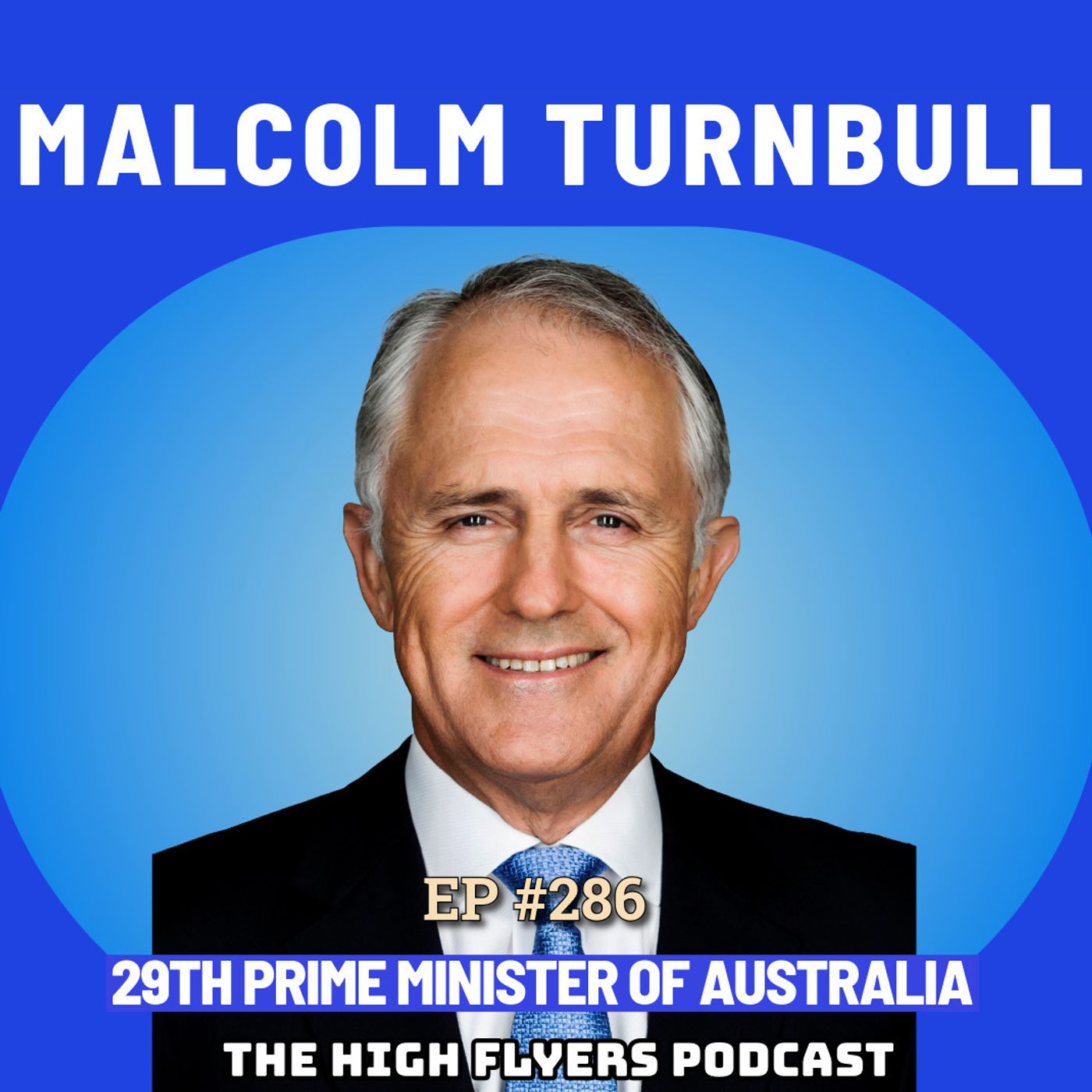
Malcolm Turnbull (Australia’s 29th PM) discusses growing up in Sydney, being bullied at boarding school, learning to stand up to bullies, and how those experiences shaped his leadership. He also recounts major career episodes: Rhodes Scholarship and early journalism, representing media magnate Kerry Packer at 28, and the Spycatcher legal victory against the British government. Later he reflects on rebuilding after political defeat (Liberal leadership loss in 2009), and argues Australia should keep pushing innovation and better “market” its tech.
Only Malcolm Turnbull is the guest. Host is Vidit (plus the episode includes host intro by “Virita Aguil,” but the interviewee is Turnbull).
Don’t take bullies or life too seriously; strength is what bullies respect; leadership requires standing your ground without groveling; innovation policy worked best when framed positively; Australia’s political system centers power and reduces polarization.
Boarding school bullying at Sydney Grammar School; Kerry Packer’s “Costigan Royal Commission” troubles; a champagne offer from TV executive Sam Chisholm; Spycatcher trial “David vs Goliath” with repeated court appeals; Turnbull’s depression after losing Liberal leadership in 2009.
Written by AI. May contain mistakes.
Malcolm shares his background, early jobs, and current roles.
“As one of the premier products in our Curiosity Center lineup, providing on-demand intelligence to help you be 1 % better every single day.”
Discussing individuals deserving recognition, including Sam Crowther.
Malcolm reflects on his childhood, family dynamics, and schooling.
“I want to come back to startups and tech in a bit, Malcolm, but I want to run back the clock to your sunrise, as I call it, your childhood.”
Malcolm discusses his boarding school experience and bullying.
“It was quite, it was very, my father and I had it very close because we ended up being two guys living in a little flat.”
Exploring how Malcolm's parents shaped his character and life perspective.
“The other thread that I really enjoyed reading in your book is you talk about growing up in a home where high court judges, premieres and poets came for dinner, I believe, because of your mum's work.”
Malcolm shares his academic journey and parental expectations.
“I had, I felt under enormous pressure to do well at school.”
Malcolm discusses his first jobs and early media experiences.
“you can be who you want and you can hit the success I think both of my parents were very ambitious for me and yeah but no both of them were very ambitious and in every anything I did They wanted me to be the best at it.”
Malcolm details his unique role as a legal advisor to Kerry Packer.
“Bulletin, out of the blue, offered me a job to work for the Bulletin.”
Malcolm reflects on dealing with strong personalities in his career.
“Literally, we got Alan, Alan and Hemsley had been doing all their legal work.”
Exploring the psychology behind bullies and the importance of strength.
“There was a really, he's no longer with it.”
Malcolm shares about influential mentors and their impact on his life.
“You carry yourself with class and the stoicism.”
Malcolm Turnbull shares insights on the value of listening and learning from others in politics.
“I've had really good people around me and I've, and they've stuck with me.”
Turnbull discusses his personal goals, including marriage and financial independence.
“I used to, when I was in politics, I would go to meetings.”
Turnbull reflects on his career-defining Spycatcher case and the challenges faced.
“I've become, I believe in active citizenship.”
Turnbull shares the tactics and determination that led to winning the Spycatcher case.
“There's a library of books written about the Spycatcher case, which I wrote one.”
A discussion on the impact and legacy of the Spycatcher trial in relation to trust and deception.
“who was the most senior civil servant in the UK and he lied.”
Turnbull discusses his experience recording his audiobook and the importance of reading aloud for editing.
“But he's got a lot of the backstory of all of the hypocrisy and double dealings and deceit that was going on inside the British establishment that led to the case.”
Malcolm Turnbull signals a change in direction for the conversation.
“Then I find a date that is wrong that had 2008 when it should have been 2018 or something like that.”
Discover how reading aloud can improve error detection and enhance writing.
“We talked at the start about the tech and innovation world, and you played a huge role through your role, and Wyatt Roy, one of our previous guests, was involved with you in that.”
Malcolm Turnbull shares his experiences of dealing with failure in politics.
“How have you rebuilt yourself from failure?”
Turnbull discusses his views on innovation and optimism in Australia's future.
“When you became PM, you said it's the most exciting time to be an Aussie.”
Exploring what Australia excels at and where improvements are needed.
“it and everyone in the sector tells me this hopefully i'm not just kidding myself but did result in a much bigger pool of venture capital in Australia.”
Malcolm shares personal insights and anecdotes in a rapid-fire question segment.
“We've had that for the same period, I think.”

Get the gist, explore an idea or ask about something said.
 Claude
On The High Flyers Podcast with Vidit Agarwal, what are the key points of this episode?
Searching your listeningAutomatic transcript. May contain errors.
0:00Malcolm Turnbull: Hi, I'm Vidit, the founder and host of this podcast, The High Flyers.
0:03Vidit Agarwal: Hey Vidit, I'm Malcolm Turnbull, retired Prime Minister. Great to be on it.
0:07Malcolm Turnbull: Malcolm, I've put a lot of work into this. I think I've listened to most of your interviews and you've done many interviews. If I could promise you one thing to make this your favourite interview, what would that be?
0:21Vidit Agarwal: Just be charming and funny. It's got to keep it. Look, honestly, the most important thing is to not take things too seriously.
0:30Malcolm Turnbull: What if we could reimagine the traditional notion of a high flyer? Hey friends, welcome back or welcome to the High Flyers podcast, where we do reimagine a high flyer, showcase the brightest and most relatable role models and companies and their journey from sunrise to today. As one of the premier products in our Curiosity Center lineup, providing on-demand intelligence to help you be 1 % better every single day. I'm your host, Virita Aguil, and let's have some fun. Our listeners have called this podcast a meticulously researched biography unveiling the extraordinary lives and decisions of the most remarkable individuals and companies from around the world.
1:16Vidit Agarwal: We hope you're enjoying our catalog of 200 plus episodes since we launched in 2020 with many of our guests appearing in rare public interviews. It's now time to explore your curiosity Please enjoy.
1:31Malcolm Turnbull: Set the scene with some fun facts, Malcolm. Where were you born and where do you live now?
1:36Vidit Agarwal: I was born in Sydney and I live in Sydney.
1:38Malcolm Turnbull: Very easy. And work, what was your first job and what do you do now?
1:42Vidit Agarwal: My first job was loading bananas in the city markets. That's my first proper job. And my job now, I suppose I'm retired from politics, but I'm chairman and owner of a renewable energy development company. I sit on a number of boards of companies I'm invested in. I'm a tech investor. I'm president of the International Hydropower Association. I'm developing hydropower in Australia. So I'm pretty, for an old codger, I'm pretty busy. So people say to me sometimes, oh, hello, are you enjoying your retirement? And I don't think I'm terribly retired, but anyway, that's cool.
2:22Malcolm Turnbull: And I know you're also the chair of Advanced Navigation. Yeah, that's right. That's exactly right. You're a company.
2:27Vidit Agarwal: Yeah, it is. It's a fantastic company. And its products, in an age of autonomy, are more important all the time.
2:36Malcolm Turnbull: I did a bit of project-based work with Main Sequence back in 2022, and I got to know the Advanced Navigation team really well and very impressed with their traction. And Malcolm, as you know, the purpose of this show is to reimagine a high flyer and go beyond someone's job title. is there someone who you feel hasn't got the recognition they deserve i look there's a lot
2:56Vidit Agarwal: of people there's a long list but i just you when i was thinking about this question a minute ago i thought of a young guy called sam crowther who you may know who's the father of casada and sam is i don't think sam's 30 yet but he might he'd be getting close i suppose but yeah he's a pretty
3:16Malcolm Turnbull: pretty remarkable young guy and i can confirm he's under 30 because i was a judge for the forbes 30 under 30 selection last year and sam was one of the winners back to the episode in a moment something i've heard a lot from business owners and leaders is that speed only matters if you still feel confident in the output and it's particularly an important point in this world of AI. Zero's answer to that is accountable intelligence. AI that shows you what it's doing and works from your own real data and is designed to keep you in control before anything happens. As Zero puts it, most AI asks you to trust it.
4:00Malcolm Turnbull: Accountable intelligence shows you why you can. And that's how it works with JAX, Zero's in-platform AI finance partner. So whether you're running the business, advising the client, or working with your board, Jax ensures that you get the upside of automation without giving up any of the control. If you want to see this practice, head over to xero.com forward slash high flyers for 90 % off your plan for the first six months. Terms apply and go to the website. That's xero.com forward forward slash highflyers. Now, back to the episode. I want to come back to startups and tech in a bit, Malcolm, but I want to run back the clock to your sunrise, as I call it, your childhood.
4:46Malcolm Turnbull: And you write about it fondly in the book that I've enjoyed reading. What are your memories of the environment and the influence of family?
4:54Vidit Agarwal: Look, I've had happy memories. Look, I remember being quite sick when I was a little kid. I had asthma badly and I remember memories of being unwell but I have very happy memories of being with my mother and father in we used to live in a flat in New South Head Road, Vaucluse. Not a big not a you know a posh flat or a big flat it was quite small still the building still there flat 219 New South Head Road and I remember my mother chasing me or me chasing her around the Hills Hoist playing cowboys and Indians. And I remember I have lots of nice memories of that. So shoot, my mother was a very colourful, charismatic person.
5:43Vidit Agarwal: She was a great mother, of course, until she left and then she wasn't there. And my dad was a really remarkable guy. So I've got good, I don't have, the only part about my childhood that is, I really did not like was when I was sent to boarding school when I was eight. And I did not enjoy any aspect of boarding school and at least none that I can think of now. And there were some aspects of it that I really actively disliked.
6:15Malcolm Turnbull: In the book, you talk about that candidly with getting bullied when you were at that boarding school.
6:20Vidit Agarwal: Yeah, sure.
6:21Malcolm Turnbull: How did that shape your view of leadership or creating a safe space for others?
6:27Vidit Agarwal: I think it made me, it toughens you up, toughened me up anyway. And I really don't like bullies. And my sort of reflexive instinct with bullies is to stand my ground and tell them to bugger off, basically. And whether that came from that period, I don't know. But it was, yeah, look, it was. So I went to a school called Sydney Grammar School, which is quite a well-known private school in Sydney. but it's a day school and it had a small boarding house in those days that it's one of its prep schools at St Ives and also a small boarding school for the main high school, which is located in the city in College Street.
7:11Vidit Agarwal: And there that boarding house was located in St Mark's Road, Randwick. But they were both small relative to the size of the school and I think neither of them were well run, to be honest with you. and there was a lot of bullying that was allowed that should never have been allowed. And I just, I think it was a, you know, they closed years ago. I think like 50 years ago they closed and it was just something Sydney Grammar School was not good at, to be honest with you. And so they were not, I didn't think, I certainly had a very unhappy experience there.
7:49Malcolm Turnbull: Today you come across as very stoic and I think you carry yourself with a lot of class and respect. How would your high school teachers have described the young Malcolm?
7:59Vidit Agarwal: Oh, I don't know. Probably wanting to, they probably would have said I was wanting to be the centre of the tension. They would have said I was clever, I'm sure, because I don't think anyone would have not said that. But I think they probably found me an over-enthusiastic pain in the arse a lot of the time, I suspect.
8:19Malcolm Turnbull: And you touched on your parents earlier. In the book, you credit your father with shaping you, Bruce. I'm curious if your mother, Coral, had stayed. How do you think your life would have been different?
8:30Vidit Agarwal: That's a really good question. I don't know. I really do not know. It was quite, it was very, my father and I had it very close because we ended up being two guys living in a little flat. I was, the reason I went to boarding schools was my parents had split up and my mother moved to New Zealand. And so in the school holidays and when I was at home, my father and I sort of lived together more like a big brother, little brother. And while he would sometimes persuade one of his girlfriends to come around and do some cooking, generally we looked after ourselves. And it had one impact is that I'm better house trained than most men of my generation.
9:19Right.
9:20Vidit Agarwal: And as Lucy would say, Malcolm's not a bad cook, but he has a very limited repertoire, which is true. But I can iron, which I can do the domestic stuff in a sort of basic, as you can imagine, two guys living together. Someone's got to do it. But a lot of men grow up being looked after by their mothers. So that wasn't the case for me. But the thing about my father was, look, he was very Australian, very smart guy. Hadn't gone past the intermediate, i.e. what we'd call now year 10. But he's very smart, very funny, very gregarious. But above all, he had enormous self-discipline as far as I was concerned because he had every reason to be very critical and unhappy with my mother.
10:09Vidit Agarwal: She had left. She'd actually, when they'd got together, she'd been earning more money than him because she was a scriptwriter. at a time when radio serials were a big thing and she was doing very well there. And they'd initially rented, then bought this flat in Vaucluse and when she left, the flat was sold. She got most of the proceeds, I think pretty much all the proceeds, and she took all the furniture. When you think about it, it was just crazy. We were literally left. The only furniture we had left was my bed and, yeah, that was about it. I don't think there was any other furniture left. because so I remember when we moved into this flat in Double Bay smaller place which my dad was also renting he got some furniture from a friend of his who was who was a dentist who had been renovating his waiting room right and so these there was these strange white sort of chairs on a swivel on swivels that made out of fiberglass that looked like something from the set of the Jetsons and that was that was the that was the lounge room furniture so anyway he was but he was but the good thing was he was very disciplined and he never criticized my mother as we all know in a lot of people I know what divorce is like it's terrible but a lot of people fight with using the children as a battleground.
11:39Vidit Agarwal: Dad never said a negative word about my mother ever. And he had so many reasons to do so. And it was really only when I was much older that it dawned on me that maybe she hadn't been the ideal mother, actually. So she was very, she was good. He was good.
12:05Malcolm Turnbull: The other thread that I really enjoyed reading in your book is you talk about growing up in a home where high court judges, premieres and poets came for dinner, I believe, because of your mum's work.
12:17Vidit Agarwal: Yeah, I was very young. But when I say basically she had a very arty – she was an actor and a writer and she had a lot of friends and she was quite unsuited. to be. Look, I've got no doubt if she and my father hadn't hooked up and she'd got pregnant, I've got no doubt they would never have been married, right? They got married after I was born. So I was just, I was definitely a bastard, which I think when people call me a bastard, I always say, look, fair cop, absolutely. But anyway, she, they weren't really that well suited, but I didn't think, clearly they weren't. But she had some friends, but I remember as a little boy, I remember two of them, really good friends of her, Neville Rann, who was then a young barrister, lawyer, and Lionel Murphy, who was also a lawyer.
13:14Vidit Agarwal: They were two friends of hers who went on to become premiers and high court judges, but a long time ago. I'm talking about the early 60s here, So when I was very little. And she was friends with James Dibble. Your older listeners might remember Jimmy Dibble, who was James Dibble, was the voice of the ABC News. And, yeah, there were lots of – she had lots of arty friends, I guess. But, of course, when she left, most of them I never saw again until I got much older.
13:46Malcolm Turnbull: Let's fast forward to when you were 18 because I feel 18 is an age where we've got some understanding of self and some understanding of the world. What was fulfillment at that age?
13:56Vidit Agarwal: I was, I'd finished school. So that was good. I'd done very well at school. And that was important. I had, I felt under enormous pressure to do well at school. From, from, I felt my parents had high expectations of me. And so that I'd had, I did do well at school. So that was good. I basically wanted to get out and conquer the world. And I was delighted to go to university. and I went overseas for the first time in, that was actually about, I was about 20 when I went overseas for the first time. But you know, it was just, it was everyone knows what it's like. If suddenly you're out of school, you're working or at university.
14:37Vidit Agarwal: I was doing both. I always had jobs when I was at uni. And yeah, it's a great, oh, to be 18 again, did it. You're closer to that age than me.
14:46Malcolm Turnbull: You say conquer the world. We talked about founders earlier. you've got to have that self-belief and for me it was my mum Malcolm she always was the dreamer it was my dad's they're both alive and well and dad's always been the pessimist and as I get older I go I've got that dreamer nature in me from mum was that from your dad that self-belief that you can be who you want and you can hit the success I think both of my parents were very
15:10Vidit Agarwal: ambitious for me and yeah but no both of them were very ambitious and in every anything I did They wanted me to be the best at it. And I was, yeah, whether it was academics or football or anything, I was definitely a mediocre footballer, but I sort of gave it a good shot.
15:28Malcolm Turnbull: I think your 20s were fascinating. You've talked about in other interviews in the book. So a couple of points, you were a television reporter. I think you interviewed Murdoch when he bought the New York Post. Yeah, when he bought New York Magazine.
15:40Vidit Agarwal: Yeah, you were a Rhodes Scholar.
15:43Malcolm Turnbull: You lost your dad in a plane crash. and a week before his death, Kerry Packer wanted you to manage all his legal affairs at the age of 28.
15:51Vidit Agarwal: That's true.
15:51Malcolm Turnbull: Now, most people in their 20s haven't had even a portion of that level of impact.
15:57Vidit Agarwal: I know. Look, it's funny because so Kerry was then had one of the biggest media empires in Australia and one of the wealthiest people in Australia and I had worked for Channel 9. I'd got myself a job. We're not backtracking a few years before that. when I was at uni. I'd worked for the Nation Review as a stringer. I'd written as a casual writer, I guess. And I think I used to get paid$30, 1 ,000 words, something like that. It was really generous. And then I got a parliamentary pass to cover state parliament as the Nation Review. Then I persuaded someone. Somehow or other, I persuaded someone. I met someone at 2SM and I persuaded them that I could cover state parliament for them too.
16:46And then I met someone at Channel 9, persuaded them I could cover state parliament for them.
16:53Vidit Agarwal: And then at the same time, I also had a job working for John Singleton as a copywriter. So I had all of these balls in the air. And of course, I was supposed to be at university as well, which I wasn't very good at going to lectures, but I was reasonably good at the exam, which is good. Anyway, so I'd got to know the sort of Packer empire that way. And then in 19, must have been 1977 or thereabouts, yeah, 77, end of 76, Trevor Kennedy, who was then the editor of the Bulletin, out of the blue, offered me a job to work for the Bulletin. and so I did that in 77 which was my last year at law school and then that was the year I won the Rhodes Scholarship which I took up in 78 and so I was in and I'd then become a bit of a well-known young man on the go and everyone was very proud of me I think at the Consolidated Press family and so I did my time at Oxford and I worked for the London Sunday Times while I was there still studying and working.
18:02And then when I came back, Kerry wanted me to come and work for him.
18:07Vidit Agarwal: And I said, no, look, I want to go and do my own thing. And so I went to the bar and I was going pretty well at the bar and very well, I think. And then he asked me to come down and do all his legal work. And I said, look, I'll think about it. But I really didn't want to do that. And then my dad was killed and so I thought oh gosh I better this could be a nice quiet time in a corporate backwater not a stupid thing anything but corporate backwater while I can sort out my father's affairs and anyway needless to say I took that job on and Kerry got into a huge I did some big deals for him but he got into just humongous trouble with the Costigan Royal Commission and he was accused of murdering people, drug trafficking, tax evasion.
18:56Vidit Agarwal: It was crazy. It was like a witch hunt. And I represented him in a pretty colourful way and using both the courts and the media. And as Donald Trump used to remind me, I kept his friend Kerry Packer out of jail. Donald, every time I saw him, he used to say, do you know Malcolm's the best lawyer in the world? to whoever was there. And I'd go, oh, that's very kind, Donald. And he'd say, yeah, he kept my friend Kerry Packer out of jail. And I'd say, wasn't that hard, Donald? He was innocent. Oh, no, Donald would say. He was so guilty. He wasn't. But, you know, like it was just, it became a shtick.
19:36Vidit Agarwal: It was like sort of ba-boom. Anyway, but, yeah, so the interesting thing, though, is when I look back on it, I say to myself, if I owned an enormous media empire, would I put all my legal affairs in the hands of a 28-year-old guy, no matter how clever I thought he was? And the answer is almost certainly no. But Packer did. Literally, we got Alan, Alan and Hemsley had been doing all their legal work. That came to an end. I hired Bruce McWilliam to work with me. And basically, the two of us did all of the consolidated press groups. We hired another guy, Mark O 'Brien, who's now a very famous defamation lawyer.
20:17Vidit Agarwal: he stayed in the law as did Bruce I suppose and between this little team that I was heading we did all of their work saved Kerry millions and millions of dollars but we also got him some very good outcomes yeah that was but yes at the time it never occurred to me this was
20:34Malcolm Turnbull: an unusual thing to do if you think of it like a toolkit as we all go through our careers you build that toolkit what would you say from that time with Packer that you've kept in your toolkit and what did you have to discard going through your career?
20:46Vidit Agarwal: Look, I guess, and this sort of helped me dealing with Trump, to be frank. I know that's in the news at the moment. But Kerry was a big bullying personality, and I had a lot of run-ins with him. Working for him was an occasionally terrifying experience. And I certainly stood up to him. And sometimes I had to stand up to him and say, no, you cannot do this. This is going to get you into trouble. He hated being, he did not like being told he couldn't do whatever he wanted, right? That's a lot of men with that personality like that. And, but I think that just being prepared to stand your ground and not give in to bullies.
21:29Vidit Agarwal: You see, you see, so I'll tell you a story about bullying. There was a really, he's no longer with it. Kerry's no longer with us either, but there's a really wonderful man. He's a great friend of mine and mentor called Samuel Hewling's Chisholm, Sam Chisholm. who was a New Zealander who ran the Nine Network for years. He ran B-Sky-B in the United Kingdom for Murdoch. In fact, he took it out of bankruptcy and revived it, turned it into the powerhouse it became. Really brilliant television executive. But he was an aggressive guy. He was like a Jimmy Cagney figure. He wasn't very tall and he was just full of aggression.
22:09Vidit Agarwal: and Sam, when I joined Consolidated Press, Sam of course knew me as the general counsel, Sam of course knew me from when I'd been a television reporter and Kerry sent around a memo saying all the legal stuff goes to Malcolm, don't go to any outside law firms and Sam was very annoyed about this and he rang me up and started giving me a free character analysis as you as want. And I just gave him a very abbreviated response, but equally pungent. And I said, listen, I'm coming over to talk to you face to face. Slammed down the phone, got into my car, drove over to Channel 9. And he'd been very rude to me and I was not feeling in a very benign mood.
22:58Vidit Agarwal: I walked down this corridor, the end of which was his office. And as I was coming down, an arm shot out holding a glass of champagne. And I stopped and I thought, what's that? So I slowed down, I got down and there was Sam holding a glass of champagne. And I said, is that for me? And he said, yes, of course. I said, I wasn't expecting this. And he said, Malcolm, what you have to understand about me is I am a bully and I bully everybody I possibly can. And on the rare occasions, I meet somebody who I can't bully, I befriend them. And so that is why I'm offering you a glass of champagne. And I just thought to say that was a disarming intro was amazing, but it was absolutely true.
23:49Vidit Agarwal: And this is why, you see, this is why I say when people talk about Trump and you get all these people saying, oh, you've got to go and suck up to him and grovel and all this stuff. I mean, they completely fail to understand the psychology of bullies. Of course you shouldn't punch him in the nose or head of government of another country, be rude about him in public. But, you know, when the door is closed and it's down to the short strokes, you have to be as strong as you can be and not because the only thing guys like that respect is strength.
24:22Malcolm Turnbull: Malcolm, you touched on something that's really interesting is some of the biggest figures in your career, whether it's Murdoch, Packer, you talk about Bond in the book, Trump, as you say, they're larger than life, aggressive and divisive, but you don't present that way as I said at the start. You carry yourself with class and the stoicism. Do you think you would have been more successful if you were more ruthless?
24:44Vidit Agarwal: I think, look, I think it, well, possibly. It depends what you mean by successful. Would I have more money? Possibly. Would I have been prime minister for longer? Possibly. I haven't been. I haven't had an unsuccessful life, career terms. and most of all I've had a long and happy marriage and lovely kids and grandkids, which is the most important thing. But look, I think people say about successful leaders that, oh, they're narcissists, they're egomaniacs. They often are. They often are. And because if you think of the abuse, say, that people in politics get, you have to be, you cannot take that all to heart.
25:31Vidit Agarwal: If you are a sensitive soul you can't do it you just crumple up and die. So you've got to be it's a yeah it's not like it's difficult. In other words I think what you're saying for it and I'm trying to answer is some of the things characteristics that enable you to be successful in these highly competitive environments are not characteristics that necessarily make you a nice person. So how do you balance that? I've never taken myself, I've been accused of being egotistical and narcissistic. I think Brendan Nelson famously called me that. When Brendan gave some interview in which he described me as being a terrible narcissist, and he was very angry, of course, because I'd replaced him as Liberal Party leader, I get that.
26:22Vidit Agarwal: But when he gave his valedictory speech in Parliament, he spent the first, it must have been first, it felt like the first 10 minutes was probably only the first three or four minutes, talking about the stud in his ear, that he wore a little diamond stud in his ear and his hair. Right. I was sitting there thinking to myself, so I'm the narcissist, am I? I don't think I've ever spent 30 seconds talking about my appearance.
26:54Malcolm Turnbull: So you write a lot about Lucy in your book and in every year you speak about her so proudly. So firstly, kudos to you. I wish more of us men did that with our better halves. Who else has influenced you, Malcolm, apart from Lucy? Because I think you're alluding to the point that the people that are believers, sounding boards in your life, appreciate it.
27:14Vidit Agarwal: Yeah, I've had, look, I've got, in terms of mentors, typically older people. My father, Neville Ran, was a very, had a very long friendship and I was in business with him for more than a decade or a decade and we're friends for many years. And of course, as he used to say, he used to say, Neville used to say, I've known Malcolm since he was en ventre sa mère, which is an old legal term, which referring to a child when it is still in the mother's belly. Right. But he, yeah, so he was very important. But I've had really great, I've been very lucky to have great staff to work with. The core members of my team in politics have worked with me for most of my time in politics.
28:06Vidit Agarwal: Sally Cray, David Bold, I've thought Bob I'm doing, English, Kerry Pinkstone, you know, there's, and there are others who worked with me in the PMO, had great chiefs of staff, Drew Clark, Greg Moriarty, Peter Wolcott, Clive Matheson. I've had really good people around me and I've, and they've stuck with me. They haven't sort of, my offices have never been a revolving door. People have tended to stay and that's good, but yeah, I've had, look, I've had, look, I've been, you, this sounds like the acknowledgement section of a book, so I'll leave it there. But the point is, I'm a firm believer that no matter how smart you are, or how smart you think you are, you'll always learn something from listening to others.
28:55Vidit Agarwal: I used to, when I was in politics, I would go to meetings. Wherever someone came to meet me, I'd have my iPad there, and I'd be taking a little ton of notes. Before iPads, I used to notebook i'd take notes because you just learn so much from others so i think that's a that's very the sometimes you get people who do not want to ask questions because they don't want to reveal what they don't know but the but that's never been my problem i'll ask any i've never i'll ask any question there is i've always believed there's no such thing as a silly question there can be silly answers, but you've just got to remain relentlessly curious, and that's been important.
29:43Malcolm Turnbull: My observation, having followed you for a long time, is you look for substance in respecting someone, where a lot of your peers look for style. Even in interviews, I think people will ask you questions, you will clarify the question. You won't just answer it.
29:58Vidit Agarwal: Yeah, I'm not sure. Look, I'm really poor at self-analysis. I don't think about myself when I psychoanalyze myself.
30:09Malcolm Turnbull: Did you ever set goals? Did you sit down every five, ten years in your career and set life goals?
30:14Vidit Agarwal: Not really. Maybe. Look, what were my goals? I always had a hankering to be in politics from a very early age, and there were periods when I thought I ran for liberal pre-selection for Wentworth, actually, when I was in my 20s, when Luce and I got back from England. and I narrowly missed out on that. So I could have been in parliament in my 20s and probably wouldn't have got anywhere if I'd done that. But I then, for a long time, I thought politics was something I'd had passed me by. But I was always involved in public affairs, the Republican movement. I've become, I believe in active citizenship.
30:50Vidit Agarwal: And this, like today you get people, every time I say something that's controversial is some idiot that will say, oh, retired prime minister should be silent. What? Like, how stupid? Nobody should be silent unless they want to be silent. It's ridiculous. It's a democracy. The other thing that I was, I guess, so I always had that. The most important goal I had was to be married and stay married. I was really, I didn't sort of, I didn't enjoy my parents being divorced and I didn't think either of them were ever really that happy later. and so I've always been a strong believer in marriage and in long enduring marriages.
31:37Vidit Agarwal: Now obviously not everyone can pull that off but we've been very lucky but that was always a really big priority for me and I guess another priority was I wanted to become financially independent. So I never had a desire to be a billionaire or the richest man in the world or some crazy thing like that. But I wanted to be, I inherited this very much from my father. I wanted to be in the position where I didn't have to work for someone else. I remember saying that to Kerry Packer once, explaining to him why when I did leave his employ and we set up, Bruce and I set up our own law firm, although he still did a lot of work, still did all his legal work.
32:19Vidit Agarwal: But he was talking to me about it, didn't want me to do that. And I said, look, Kerry, independence is very important to me and he said yes son he said but independence is very expensive sort of it reminded me i don't think he i don't think he he was doing this consciously but at the time it reminded me of a saying of lenin's freedom is so precious it has to be rationed now spy catcher made your career
32:45Malcolm Turnbull: in some ways but what was the biggest mistake you made in that case oh god i don't think we made any
32:50Vidit Agarwal: mistakes to be honest with you no i'm i've made more mistakes than most people but i think in spy catcher we were loose and i were like kids right so i was 30 i was i turned 32 in 1986 and i got so i got when i got the brief at the beginning of 86 i was 31 and the trial happened in in November, I think, November of 86. But there was a lot of stuff. There's a library of books written about the Spycatcher case, which I wrote one. But it was a really exciting case. And they're still writing books about it. A guy called Tim Tate's just brought out another book on the Spycatcher affair. But, look, I think we won, and we won really well against overwhelming odds.
33:39Vidit Agarwal: I don't think we, I can't think that we made any big mistakes or any, I just, we got the right, we got the right calls, I think, made the right calls. But again, so I'll give you, just make a point about lawyers. And if you've got lawyers listening to this, some of them may be offended. There are some lawyers who do human rights work get too used to losing, right? And they're looking to give a great speech at the foot of the gallows as their client is led up to be executed. And I was not interested in having a glorious defeat. And Geoff Robertson, who was sort of on the fringe of this case in the UK, and at one point tried very hard to swipe the brief from me, but happily didn't.
34:39Vidit Agarwal: Geoff, I don't think had any idea that it could be won, really, initially at any rate and he was thinking about it as a one of those great freedom of speech cases where you lose but you lose gallantly and I was just determined to win and we did all we did we did so much hard grafting work on research and all the interlocutory work on the interrogatories and the discovery when the British government wouldn't answer the interrogatories or give discovery. We took them to the court. I think we went to the court of appeal three times over this mostly because they were appealing against the trial judge's decision to ordering them to do things.
35:25Vidit Agarwal: And so it was trench warfare, but we stuck with it. And by doing that, by that hard grafting work, that really hard, old fashioned work grounded in a good understanding of civil procedure, we got the British government to the position where the case became winnable as opposed, because you've got to remember when we got the brief or I got the brief in early 86, the client thought the case was completely and utterly lost. And they only agreed to me doing it for them on the basis that I said I'd do it for 20 grand. So basically a year's work, plus a bit extra if the trial went for more than two weeks or something.
36:08Vidit Agarwal: Literally, I think my whole fees for the whole year, and it took up most of my time that year, to them was 40 grand or something like that. We did when we finally won because we got costs from the other side. But the, so yeah, so it was, that was, that was important. But they had, they had advice from all of the, not all of them, they'd had advice from three or four of the leading silks, QCs, and a couple of big law firms telling them they couldn't win the case. So it was a, it's a real, it is a, the Spycatcher trial is like a fantasy story, except it's true for any young lawyer. Because this is, because it's fascinating, it's exciting, it's got enormous profile, it's David versus Goliath.
36:57Vidit Agarwal: And the young lawyers, me and Lucy and our friend David Hooper from the UK, who came out and assisted. They were literally, our team was so tiny. And Paul Greengrass, of course, was the ghostwriter of Spycatcher who was involved in the case. We're just a tiny team of young people. We're all in our 30s except for Lucy who was still in her 20s, early 30s. We were kids, absolute kids, and you had all these QCs and the British government and partners of law firms and stuff. It was wild, really was. It was a great adventure. And yes, it gave me enormous profile because it was a big story here, but it was massive in the UK.
37:40Vidit Agarwal: It was 10 times the story in the UK as it was here. And because it was all about the British government, it was all about their dishonesty and their hypocrisy. And we, Thatcher sent the cabinet secretary out, a guy called Robert Armstrong, Sir Robert, later Lord Armstrong, who was the most senior civil servant in the UK and he lied. And as we now know because some documents have come out of the Cabinet Office records, he actually committed perjury. Really pretty serious. But the judge didn't find that he'd lied, but Armstrong had to apologise for misleading the court at one point. Now you can imagine.
38:21Vidit Agarwal: So he's got this grand English civil servant, Eton, Oxford, all of that establishment around him and he's there at the very peak of his profession. He's in this witness box in Sydney and there's this youngster cross-examining him who humiliates him and he has to apologise for misleading the court. It was just devastating for him but of course it's his own fault of course. I didn't do any, I was just doing my job and yeah so there you go anyway so it was a very very exciting story but there's a i wrote a book in 89 called the spy catcher trial which is it's uh i don't it's on hasn't been printed for years but it's on kindle and second you can get a copy from second-hand booksellers wherever you go but there's a british guy called tim tate has published a book just last year called the spy catcher Affair, I think.
39:18Vidit Agarwal: And it also tells the story of the trial. And he's had access to my book and transcripts and stuff. But he's got a lot of the backstory of all of the hypocrisy and double dealings and deceit that was going on inside the British establishment that led to the case. And it's fascinating. I think one of the reasons that we love spy novels and we love all these stories is that they're all about trust, broken trust, deception, and that happens in every life, right? People are doing this. So, yes, in the novel it's all about Russians and agents and Bulgarian hitmen or whatever it is, but people who lead much very mundane lives far away from espionage nonetheless can relate to it because they understand what deception leading a double life, hypocrisy, breach of trust, all of those things.
40:19Malcolm Turnbull: Yeah. And can I say the side comment? If someone reads your book, they should listen to the audiobook. I've been listening to your audiobook, A Bigger Picture, and your voice is just mesmerizing. Oh, really? Me and my fiancé, I've been listening to it. We were in barrel over the weekend and we drove there. It was just wonderful to listen to it, and I love audiobooks where I find a text-based book. You don't get the author's personality the same way. Kudos to you for putting in the effort.
40:44Vidit Agarwal: I'll tell you an interesting thing about that. I had never read a book before, read a book for an audiobook because my other books I'd written had been done some years ago in the 90s and 80s and 90s, and so we didn't do audiobooks then. And so I'd written this big book, my memoir, A Bigger Picture. So it's 250 ,000 words. It's a whopper. and obviously it had been proofed. I'd proofed it and the editor at the publisher, Hardy Grant, had proofed it. And so it is just about to go to the printers to be printed and I'm in the audio studio reading it. And I kick off and I find a typo. Then I find another typo.
41:27Vidit Agarwal: Then I find a date that is wrong that had 2008 when it should have been 2018 or something like that. And so I rang the publisher, Sandy Grant, and I said, Sandy, you cannot send this to the printer. And he said, no, no, we've got to, we've got to. I said, no, you can't. I'm saying no. I said, I have got to read this whole book here because I'm picking up errors which have been missed. And the interesting thing is, the lesson that I learned from that is, if you ever write a book or even an essay or a speech or anything you write, read it aloud because your brain operates in a different way because you see if you if let's say that the date should be 2008 and it's 2008 if you've written 2018 you might read it 10 times and your brain your eyes see 2018 but your brain says 2008 on the other hand if you read it aloud it and I'm not clever enough to know why this is different but the errors and the typos and the clunky prose really stand out so it was a very it was really interesting experience for me really took a long time yeah but it was very interesting and so I was as I was reading it I was making notes about changes and then sending that off to the editor fascinating
42:59Malcolm Turnbull: I want to change tack, Malcolm. We talked at the start about the tech and innovation world, and you played a huge role through your role, and Wyatt Roy, one of our previous guests, was involved with you in that. As failure is a big part of the innovation world and startups. In politics, in my view, that's not how things are seen, but a lot of our famous leaders have had political losses. How have you rebuilt yourself from failure? I wonder if you can use an example.
43:25Vidit Agarwal: The biggest failure was when I lost the leadership with the Liberal Party in the end of 2009. And I was devastated by that. And I went into, I became really depressed, clinically depressed, sort of snuck up on me. I've written about this in my book, but snuck up on me and I became really ill. Happily, I was able to pull myself out of it, but it was hard, really hard. It felt like climbing out of a pit with your fingernails. And I think I actually emerged from that a better person, but I wouldn't recommend it to anyone. So I think it might have been a case of what doesn't kill you makes you stronger, but that was the hardest.
44:14Vidit Agarwal: I've had plenty of setbacks in my life, obviously, but that was the one that was the hardest to get over. That was even harder than losing the Republic referendum in 1999. much harder.
44:26Malcolm Turnbull: When you became PM, you said it's the most exciting time to be an Aussie. What's exciting now in 2025 in Australia, in your view?
44:34Vidit Agarwal: Look, it depends whether you're a glass half full or glass half empty kind of person. I'm definitely a glass half full person. I think at the moment, you'd probably feel, I think a lot of people would feel there's more risks than opportunities. But I think there is, I think technology and innovation are always exciting, Biddley. And in times of change, disorder, opportunities arise. If you have an optimistic, adventurous frame of mind, you'll find these times exciting. I think back when I became PM 2015, I was really troubled by the mood of the country at the time. And Abbott had got himself into this kind of loop of talking about national security and terrorism all the time.
45:26Vidit Agarwal: And then on the fiscal side, it was all about getting the budget back into balance and cuts. It was a pretty negative vibe, I thought. So that's one of the reasons I pushed so hard on innovation and being positive. I wanted people to feel good about themselves. And I wanted them to be optimistic and have a go. and that so that innovation agenda that white was involved with as the the junior who was the assistant minister for innovation working with chris pine that was a that was absolutely a critical part of it really was and look of all of the things of all of the policies i did in government i can't think of one that worked better than the innovation and science agenda it and everyone in the sector tells me this hopefully i'm not just kidding myself but did result in a much bigger pool of venture capital in Australia.
46:21Vidit Agarwal: And if you have the Prime Minister for a decent period talking about innovation, others start talking about it. It's very much an attitude thing. And you've got to, it's a frame of mind, you've got to have that frame of mind, which I've always had, which is everything I do, I'm thinking, can I do it better, faster, cheaper? you know I've got I've never been happy to say I've never said we've always done it this way
46:47Malcolm Turnbull: right yeah Larry Marshall one of our mutual friends and a previous guest of the show who worked with you closely said you brought entrepreneurship into government and I think all of us in the startup economy thank you for that and even things like the ESVCLP tax structuring is good as to you and your team as you look at today and we'll move to rapid fire to close out, Malcolm. What does Australia do well and what must we do better as we sit here in March 2025?
47:14Vidit Agarwal: Look, I think we do cities well. We've got some really fabulous, livable cities, and I think that's a very important thing. Your wife has played a role in that? Yeah, she has. She's an urbanist and mayor, chair of the Greater Sydney Commission and so forth, planner. In fact, she's down in Canberra giving a speech today on planning. I think we're clearly very good at mining. I think we're good. I think we are good at tech too. I have a good friend who you probably know, David Shane.
47:46Malcolm Turnbull: Yes.
47:47Vidit Agarwal: As our innovation fund. David knows the Israeli tech scene very well. And he's effectively got a business there as well as here. And he's often said to me, the Australian tech sector is as big as the sector in Israel. And I say, David, He said, how can that possibly be right? And he said, look, the only thing the Israelis do better than us, he says, is they're better at marketing and they talk about it and they're proud of it. He said, we just do not. He said, we're good at tech, at innovation, at start-ups, but we don't talk up our own book. And so I think that's, again, I've always felt that intuitively, and that was another part of the NISA.
48:31Vidit Agarwal: But, yeah, look, I think one of the other things we do well is we manage our political system. I know no one's ever happy with it, but boy, you look at the United States, oh my God, they've got gerrymandering, the electoral system is a mess. We've got compulsory voting. We've had that for 100 years. We've got preferential voting. We've had that for the same period, I think. We've got an independent electoral commission. We've had that for many decades. So we've got a political and electoral system, which instead of polarizing people, which is how it operates in America, our system brings people to the center.
49:15Vidit Agarwal: So our politics is mediated at the center. Whereas in the US, because the congressional districts are so gerrymandered, only a Republican or a Democrat can win a particular district. the way you win it is by winning the primary and so you're appealing to the party zealots on one side or the other. And so you've got to, instead of having a Congress, well, the Congress is much more polarised than the country is, whereas I think Australia, our politicians sit closer to the centre because if they don't do that, they don't get elected. And that's a really important thing in these, particularly because the modern media does tend to polarise people, unfortunately.
50:01Malcolm Turnbull: Yeah. Okay, let's move to rapid-fire sprint. I am conscious of time. Is there one thing you'd like to learn in the next six months?
50:11Vidit Agarwal: I'd like to learn yoga and get good at yoga.
50:15Malcolm Turnbull: Nice. I don't know if you interview candidates for your companies, but you have in the past. What's one interview question you love asking prospective candidates?
50:24Vidit Agarwal: i don't have a particular question but i like to get them relaxed and talking about themselves
50:30Malcolm Turnbull: and just talking i just listen one ai product that you love using at the moment you know what
50:36Vidit Agarwal: i don't i don't really use any at the moment you i use like obviously you've got ai you use google or there's ai and everything but i don't use an ai product as such no okay what's your go-to My op-ed in the Herald was written by me, not an AI agent.
50:57Malcolm Turnbull: Are there any go-to apps or websites that you're a big fan of?
51:04Vidit Agarwal: How do you stay with the use? Well, look, I read a lot of stuff on Kindle because I'm just snowed under with books, physical books, so I can't find a place to put. So I try to read e-books. I read a huge amount. I use for productivity, I would think, I use Google Drive's applications a lot. I find they're very good. And people used to joke that when we were in government, the government was run on a combination of Google Docs and WhatsApp. There's some truth in that. But, yeah, no, I'm not. That's about it.
51:41Malcolm Turnbull: You've worked with some of the world's richest people. What's the weirdest way you've seen someone spend money?
51:50Vidit Agarwal: I'd have to say packer gambling, just the amounts of money that he gambled. I was with him one night in London when he lost three million, I can't remember whether it was dollars or pounds, three million maybe pounds, but it was just a staggering amount of money. It was a long time ago. I said, Kerry, why do you bet so much? Why can't you just bet a thousand pounds? And he said, you don't understand gambling. And I said, you're absolutely right. I didn't add and I've got no desire to understand it. But I worked for him. He was my friend and I wanted to understand this. And he said, son, what you've got to understand is that you don't get a thrill out of gambling unless the amount that you could lose is large enough to hurt.
52:41Vidit Agarwal: He said, I'm a very rich man. So if I lost 1 ,000 pounds, it doesn't have any impact. But if I lose a million pounds, a couple of million pounds, I feel that hurts. And I thought to myself, you should get a psychiatrist on to talk about this who's studied it, but I remember at the time I thought, gosh, is this all just a form of masochism? Is this what gambles? Is this sort of like the person who's hitting their head against a brick wall and you say, why are you doing it? And he said, it feels great when you stop. I don't get it. So anyway, that's the weirdest thing. And I'm sure lots of other things.
53:21Malcolm Turnbull: And last one, Malcolm, if I came to you and said, I want to be PM one day, what would be your biggest advice to me?
53:30Vidit Agarwal: Look, I guess I would say you've got to be in Parliament. You've got to be in the House of Representatives. is. And realistically, you've got to be in one of the major parties, so in either the Liberal Party or the Labor Party, and then you've just got to work your way to getting the numbers. And then you've got to become the leader and win an election or become the leader after someone else has won the election. I'd say that, but it's a volatile world. And it may be people will be starting new parties. There's enormous disenchantment with the major parties. You're a young guy. Will the Prime Minister 10, 20 years from now be a member of the Labour and Liberal Party?
54:13Vidit Agarwal: Probably, but not necessarily.
54:16Malcolm Turnbull: Malcolm, you said to me at the start that if I make this charming and funny, it would be one of your favourite interviews. How did I do?
54:21Vidit Agarwal: You've done brilliantly. You're charming and funny. And you've got a lovely smile too.
54:27Malcolm Turnbull: oh you're making me blush malcolm thank you so much this was episode 200 and really enjoyed
54:33Vidit Agarwal: doing this so thank you for your time okay thanks bidet thank you that's a wrap so something in
54:38Malcolm Turnbull: this episode sparked a thought send it to a friend or colleague and if you're curious about partnering with us at the curiosity center whether it's this podcast to our reports events and more and join the ranks of existing commercial partners including google kpmg vanta and others my details and the show notes until next time i'm video tag a while and this is the high flies podcast
This episode is supported by Xero, helping businesses use AI with more control through JAX, its in-platform AI finance partner. Get 90% off your plan for your first 6 months at xero.com/highflyers.
Welcome to this classic episode. Classics are our favorite episodes from our back catalogue, published as frequently as possible. These are N of 1 conversations with N of 1 people. This is a replay of Episode 200, originally released in April 2025— one of our most loved classics.
________
Malcolm Turnbull is one of the most fascinating figures in modern politics and business. He served as Australia's 29th Prime Minister (2015–2018), and previously built a career as a Goldman Sachs partner, successful technology investor, entrepreneur and lawyer. Earlier in his career as a barrister, he famously defeated Margaret Thatcher's British government in the landmark Spycatcher legal battle.
In this uniquely candid conversation, former Australian Prime Minister Malcolm Turnbull joins Vidit to share his remarkable journey from a difficult childhood to the highest office in the country. He reveals how he became the trusted lawyer to billionaire Kerry Packer at just 28, defeated Margaret Thatcher's British government in the landmark Spycatcher case, and what working with powerful figures like Donald Trump and Rupert Murdoch taught him about standing up to bullies.
They also explore the personal setbacks that nearly broke him, the lessons from losing political power, why financial independence mattered more than becoming a billionaire, and how his relentless curiosity shaped his career across law, business, technology and politics.
Please enjoy exploring your curiosity.
_______
Get in touch with us via email at [email protected]
Join our stable of commercial partners including the Australian Government, Google, KPMG,, Allens, Macquarie Capital, Xero, JP Morgan and more.
Show notes and more episodes here
Follow us on LinkedIn, Twitter and Instagram
Get in touch with our Founder and Host, Vidit Agarwal directly here
Contact us via our website
This episode is supported by Xero, helping businesses use AI with more control through JAX, its in-platform AI finance partner. Get 90% off your plan for your first 6 months at xero.com/highflyers.
________
TIMESTAMPS
00:00 – Meet Malcolm Turnbull
01:39 – Life after politics
04:30 – A difficult childhood and school bullies
08:00 – Growing up without his mother
13:45 – The ambition to conquer the world
15:30 – Becoming Kerry Packer's lawyer at 28
20:30 – Standing up to Packer and Trump
24:30 – Does ruthlessness drive success?
27:00 – Mentors and the power of curiosity
30:00 – Why he never chased billions
32:30 – Defeating Margaret Thatcher's government
37:00 – Taking on the British establishment
40:30 – Lessons from his 250,000-word memoir
43:00 – His darkest political setback
45:00 – Bringing innovation into government
47:00 – What Australia gets right and wrong
50:00 – AI, leadership and habits
51:15 – Watching Packer gamble away millions
53:00 – How to become Prime Minister
________
The High Flyers Podcast features in-depth interviews with the world’s most influential figures in business, tech, finance, government and sport. Launched in 2020, it has ranked in the global top ten for past three years, with listeners in 27 countries and over 200+ episodes released, and featured in Forbes, Daily Telegraph, and at SXSW.
Our guests include -- Malcolm Turnbull (Prime Minister of Australia), Keith Rabois (Managing Director, Khosla Ventures), Jason Collins (Head of BlackRock, Asia Pacific), Brad Banducci (CEO, Woolworths), Michael Schneider (CEO, Bunnings), Aleks Spaseska (CEO, Kmart) David Eckstein (CFO, Legora), David Schneider (Growth Fund Co-Lead Partner, Coatue), Venky Ganesan (Managing Partner, Menlo Ventures), Shiv Rao (CEO, Abridge), Jesse Zhang (CEO, Decagon), Vandita Pant (CFO, BHP), Elena Verna (Head of Growth, Lovable), David Haber (a16z Partner), Jodie Auster (Uber's Global Head of Travel), Paul Grosmann (CEO, RM Williams), Rob Giglio (CCO, Canva), Jean-Michel Limieux (CTO, Shopify and Atlassian), Stevie Case (CRO, Vanta), Cristina Cordova (COO, Linear), Gautam Chari (Head of Capital Commitments, Bank of America), John Haddock (CBO, Harvey), Mark Suster (Partner, Upfront Ventures), Niki Scevak (Partner, Blackbird), Craig Tiley (CEO, USA Tennis), Jeanne DeWitt Grosser (COO, Vercel), Paul Bassat (Partner, Square Peg), Bowen Pan (Creator, Facebook Marketplace), Peter Varghese (Secretary of Foreign Affairs, Australian Government), Sam Sicilia (CIO, Hostplus), Jack Zhang (CEO, Airwallex), Tim Doyle (CEO, Eucalyptus), Sukhinder Singh Cassidy (CEO, Xero), Sanjeev Gandhi (CEO, Orica) and Philip Green (Australia's Ambassador/High Commissioner to India).