Ask ChatGPT

 The High Flyers Podcast with Vidit Agarwal
28 Oct 2026 · 1h 15m · 31 chapters
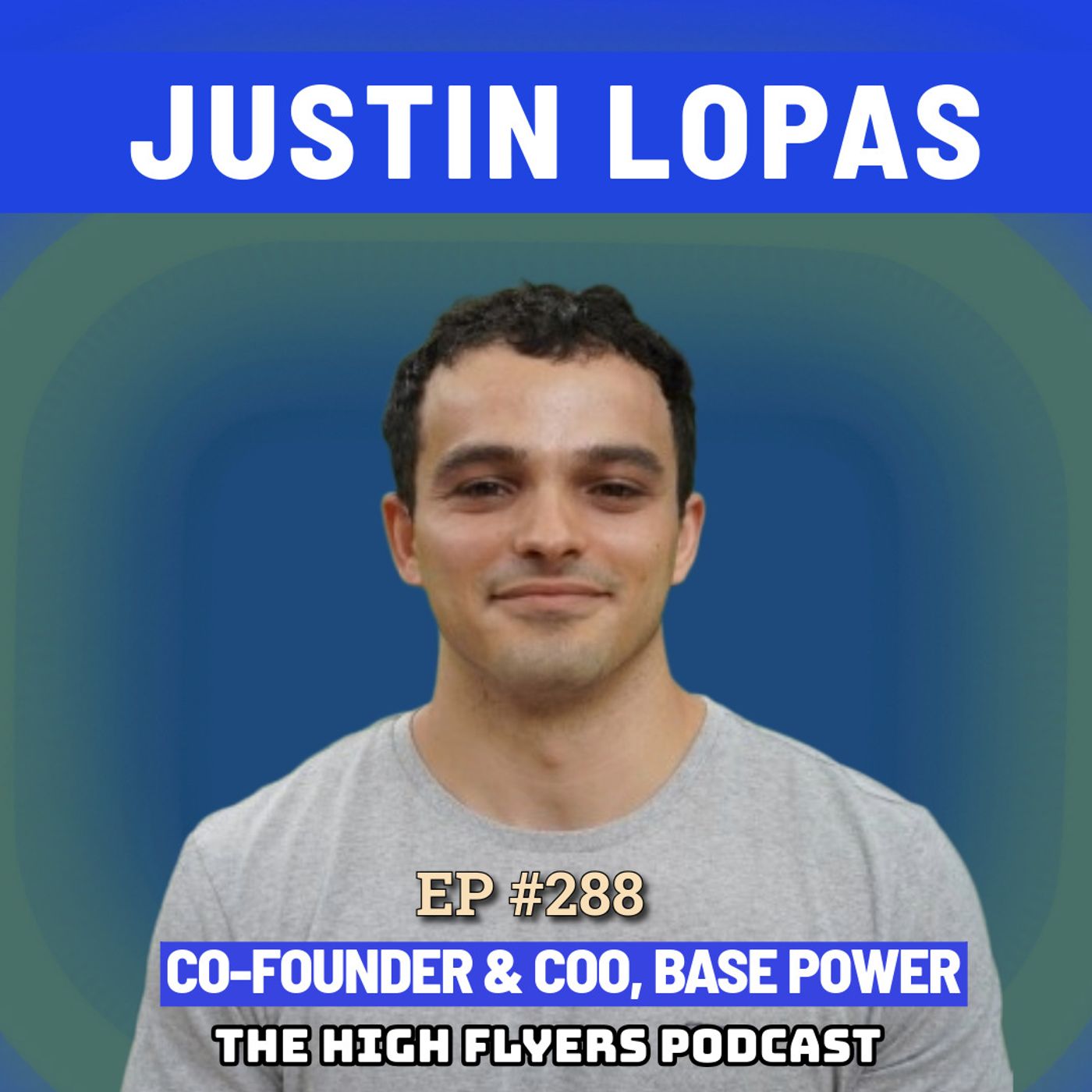
Justin Lopas (co-founder/COO of Base Power) discusses his Midwest upbringing, early career at SpaceX, lessons from Anduril, and how those experiences shaped Base Power’s culture, hiring, and manufacturing/supply-chain approach. He also covers his role split with co-founder Zach Dell and how Base Power operates at high volume.
Justin Lopas grew up in Southfield, Michigan (near Detroit) and later Evanston, Illinois; he now lives in Austin, Texas. He studied engineering at the University of Michigan. Early jobs/internships included Rocket Mortgage/Quicken Loans, Baker Hughes, Timken, Apple, and then full-time SpaceX (started after college in 2016; internship earlier). At SpaceX he helped build Starbase in Brownsville, Texas. He later joined Anduril for ~4 years, serving as head of manufacturing. He co-founded Base Power with Zach Dell.
He hires for “care” and genuine interest in the craft, not just credentials; he prefers direct communication (engineer-to-leader) over “managing up”; he values “today’s output” over hype; he learned to distinguish productivity from sheer work volume; he warns against burnout and emotional volatility in leadership.
Starbase “tall steel tube” problem-solving via pattern-matching to water-tower builders; a SpaceX incident where a nose-cone structure fell in wind; Base Power’s Austin facility feeding ~500 people daily (plus HQ). He also says supplier pricing should be evaluated holistically because parts aren’t commodities and hidden costs matter.
Written by AI. May contain mistakes.
Justin shares his upbringing and the significance of his first job at SpaceX.
“hey friends welcome back or welcome to the high flyers podcast where we do reimagine a high flyer showcase the brightest and most relatable role models and companies and their journey from sunrise to today.”
Justin discusses his wife's entrepreneurial journey and their family's cooking operation.
“home, but my wife, Connie, I would say has not gotten the recognition she deserves.”
Justin reflects on the differences between work cultures in the Midwest and startups.
“Let's wind back the clock and go to your sunrise, as I call it, your childhood, your upbringing.”
Justin shares his high school experience and how it shaped his approach to work.
“And my view is like, you sort of let your game do the talking.”
Learn how to effectively manage diverse team personalities.
“I mean, we'll chat about this with Bates.”
Explore the decision-making process behind career paths in tech vs. non-tech.
“I would have said, I think, I think there's an opinion for me that there are two paths here.”
Discover what different internships revealed about company cultures.
“a bunch of these internships to look at the cultures of the companies.”
Delve into the unique culture and challenges faced while at SpaceX.
“And SpaceX, like almost everyone had all three in spades.”
Hear how taking on challenges early in his career led to growth.
“I've heard of that place, but like Brownsville, it turns out it's really far from LA.”
Understand the emotional challenges and leadership lessons learned at SpaceX.
“I mean, the toolkit largely is what I was just mentioning around work ethic and mission orientation and desire to solve the problem and dogged determination to do so.”
Learn how experiences from SpaceX and Anduril shaped his approach at Base Power.
“And I had no ability to do that and learn a ton from that experience.”
Explore how different company cultures influence management styles and communication.
“And I also want to talk about the transition to Andrel.”
Delve into the conversation about titles and responsibilities within BasePower.
“Was that a conversation like you and Zach had about like, he's going to be CEO and you're going to be CEO?”
Learn about the personal and professional factors that influenced the transition from SpaceX to Anduril.
“And it was about, when I was interviewing, it was probably 150 people, maybe 200 people.”
Discuss the differences in hiring practices and their impacts on company culture between SpaceX and Anduril.
“So Andrel, you were there for nearly four years, I think, and you were head of manufacturing.”
Reflect on how experiences at Anduril shaped leadership and team-building approaches at BasePower.
“should talk Andrew here, but that is an interesting, like specific anecdote that I'd love for you to expand on and how that influenced your team building approach to base.”
Learn about the complexities and learnings in supply chain management from experiences at SpaceX and Anduril.
“I think Andruel had a little bit less of a, I don't know, sort of an allergic reaction to that.”
Discover the misconceptions about Base Power and its focus on building infrastructure beyond just consumer products.
“And like I said, spending a lot of time thinking about how we can improve.”
Explore the story of how Zach and Justin transitioned from a diligence meeting to co-founders and their evolving relationship.
“What is the biggest misunderstanding about base power?”
Learn about the dynamics of leadership and decision-making between Justin and Zach, highlighting their strengths and differences.
“And he thought it would just be like, cool, but you actually sent him edits back.”
Learn about the importance of a positive culture in addressing failures.
“We've changed what we've called it, but we reformatted it actually the last time and the time before.”
Discover how to manage diverse team dynamics for better performance.
“And maybe that connects to what I said at the start is how do you like, again, to different people, I think this has been one of my learnings is I'm similar to you where I expect people to be like me or challenge me.”
Understand the significance of one-on-one meetings in leadership.
“I don't talk to all of them every day, obviously.”
Learn about the complexities of regulatory environments in energy.
“And people say this has been an area that you've learned, like you have just jumped in and learned all about it.”
Explore the process of understanding and changing regulations.
“Deregulated means you can interface directly with the wholesale markets and you can sell power to individual homeowners.”
Get insights into Base Power's expansion and product development.
“Yeah, I mean, I know you talked to Sal from Trust Ventures, who's also a close partner to the company.”
Discuss the impact of health investments on personal productivity.
“The UK is interesting, deregulated big power market.”
The conversation explores the desire to learn about regulatory processes and changing laws to enhance market dynamics.
“I was just traveling a bunch and so I was getting five and six and feeling really bad.”
They discuss effective interview questions and the importance of resilience learned from personal experiences.
“i think we've come a long way we've learned some but i really want to learn more about it Is there one interview question you love asking prospective candidates in a hiring process?”
Justin shares insights on using GrokBot as a transformative tool for enhancing efficiency in work processes.
“I would love to meet her one day because if she's, wow, I am just blown away by this comment.”
The hosts exchange feedback on the interview process and its impact on personal growth and storytelling.
“That is a great set of, a great line of questioning that most people don't ask.”

Get the gist, explore an idea or ask about something said.
 Claude
On The High Flyers Podcast with Vidit Agarwal, what are the key points of this episode?
Searching your listeningAutomatic transcript. May contain errors.
0:00Hi, I'm Vidit, the founder and host of this podcast, The High Flyers. Hey, I'm Justin Lopas, co-founder and COO of Base Power. Justin, I'm pumped to do this and I'm also a bit nervous because everyone I spoke to said to me, Justin is intense, Justin is direct, Justin is no BS. So I feel hopefully I do a decent job today, man. Yeah, well, I'm glad that they said that, but no, I'm friendlier than people will say. at least i hope you give me a review at the end of this and tell me if i was too direct or too much of a jerk okay we'll do that and you can give me a review if i ask good questions so let's do that at the end we'll do what if we could reimagine the traditional notion of a high flyer hey friends welcome back or welcome to the high flyers podcast where we do reimagine a high flyer showcase the brightest and most relatable role models and companies and their journey from sunrise to today.
1:01As one of the premier products in our Curiosity Center lineup, providing on-demand intelligence to help you be 1 % better every single day. I'm your host, Virita Aguil, and let's have some fun. Our listeners have called this podcast a meticulously researched biography, unveiling the extraordinary lives and decisions of the most remarkable individuals and companies from around the world. We hope you're enjoying our catalog of 200 plus episodes since we launched in 2020 with many of our guests appearing in rare public interviews. It's now time to explore your curiosity. Please enjoy. Let's set the scene with some fun facts.
1:42Where were you born and where do you live now? Born in Southfield, Michigan, just outside of Detroit. Live now in Austin, Texas. Yep. When we will talk about that journey shortly and work, what was your first job and what do you do now? First job out of school was a manufacturing engineering role at SpaceX in Hawthorne, California. And now I lead part of the team here at Base Power and started it. And yeah, all problems are my problem to solve eventually, I guess. spacex was your first job out of school wow yeah yeah i went there full-time i had an internship i'm sure we'll get into some of that but yeah an internship there in my sophomore year and then decided to join back full-time and what year was that 2016 right so 10 years ago yeah cool yeah nice and justin as you know the purpose of this show is to reimagine the concept of a high flyer to go beyond people's shop titles and celebrate their human story is there a person you know who you feel hasn't got the recognition they deserve?
2:43Well, maybe this is a little bit too close to home, but my wife, Connie, I would say has not gotten the recognition she deserves. She started a company called Refee about six months, maybe 12 months before Zach and I started Base Power. And it's a really cool company doing some stuff in the real estate space. I'll let her tell her story at some point, but I think just to answer your question, I think she has built something very cool and has done it on extremely limited resources with her co-founder and this sort of, yeah built a really impressive operation in addition to being an awesome person very cool and i've heard a lot about her parents being the pseudo chefs for base power yeah up until the over in the next few months we're they're going back into retirement but we pulled them they had a chinese restaurant in chicago for many years and i was complaining one day to them about doordash and just being unhealthy and they're like oh we'll just cook meals for you and now they cook meals for whatever it is six six hundred people here in the austin facility 500 people every day with a few helping hands in a rented kitchen down the street.
3:40And so it's been a good ride so far. That's right. That is incredible every day. Wow. That is a commercial operation. Lunch and dinner. You have to watch 500 people here in the factory and then over in the HQ building. Back to the episode in a moment. Something I've heard a lot from business owners and leaders is that speed only matters if you still feel confident in the output. And it's particularly an important point in this world of AI. Zero's answer to that is accountable intelligence. AI that shows you what it's doing and works from your own real data and is designed to keep you in control before anything happens.
4:19As Zero puts it, most AI asks you to trust it. Accountable intelligence shows you why you can. And that's how it works with JAX, Zero's in-platform AI finance partner. So whether you're running the business, advising the client, or working with your board, Jax ensures that you get the upside of automation without giving up any of the control. If you want to see this practice, head over to xero.com forward slash high flyers for 90 % off your plan for the first six months. Terms apply and go to the website. That's xero.com forward slash highflyers. Now, back to the episode. Let's wind back the clock and go to your sunrise, as I call it, your childhood, your upbringing.
5:07This one's fascinating because you haven't really talked about this much in a public sense. You mentioned Michigan, you mentioned Detroit, the Midwest. Tell me about your memories. What are your memories of growing up there? Yeah. So, like I said, I was born in Southfield, which is just a suburb just north of Detroit. I actually only lived there until I was one years old. And then we moved to Evanston, Illinois, suburb also north, but of Chicago. And lived there until I was 13 and then back to the Detroit area in a different suburb, but very close by before high school and college. And my upbringing was honestly kind of average and middle class and boring Midwest suburbs.
5:44I was just actually back there last weekend and it always reminds me of feels like home. But both my parents are from the Chicago area. Actually, my wife's from Chicago also. So, and dad was in the auto industry for his whole career, as you'd imagine, being from that area, worked in various different roles in sales and finance and supply chain. And I was an engineer earlier on in his career and sort of inspired me to go into engineering. And yeah, I was always sort of tinkering with stuff growing up. My dad's really into cars, still is. I am as well. And we'd be working on cars and going to the track or doing house projects.
6:14We did an addition on the house and my dad loves architecture and building stuff. And so we did basically all the work ourselves. and just got a sort of firsthand practical understanding of working with your hands, sort of the practical side of engineering. That's why I ultimately decided to go into engineering later. One interesting thing that I think you probably haven't talked a ton about, though, is so my dad worked for different companies in the auto industry, Chrysler when I was born, and then various different auto suppliers and truck suppliers. And these are like big, old, slow companies that were like not innovative, or at least not particularly innovative, and didn't have great corporate cultures.
6:51I remember that one week he told me they're allowing us to wear jeans on Fridays. And it was like a big deal. And it's like, everybody's talking about jeans and jeans, Friday jeans at the office. And so because of that, he didn't really like work. He was never into work in a totally different way than when I went to SpaceX. I was like, oh man, people are into work. They enjoy it. They're here for a mission. They're motivated. They're thinking about and talking about work outside of work. And the whole sort of like startup mission oriented sort of culture just does not exist or almost exclusively does not exist in Detroit and Chicago and places I grew up.
7:25And so when I went to SpaceX, I was like, okay, well, I'm going to go there and hopefully it'd be a good career and kind of do the thing my dad did is make a living and have a good life and all that. But then I realized there's a lot more to it than that. And like work and life are not separate things. Done well, they are very well mixed. And that was something I think I learned from my childhood that I had to unlearn very quickly in 2016 when I started at SpaceX. And even before that, when I did the internship there and internships at other places that I thought were exciting. There's a big gap I think I've learned between General Motors or Boeing or Walmart or, I don't know, just pick an old industrial or retail company and like startups that are doing something exciting.
8:03There's a huge gap in like the reasons that people go to work. I'm very glad to have found SpaceX and then Andrel and now started the company at Base Power. because otherwise I think I would have done the work for one of the big three as they're called in Detroit and had a somewhat successful hopefully career but it would have been totally different it's so interesting you say that because as I'm Australian and I think one of the things Australians and people from the Midwest share in common is we're pretty no bs put your head down do the work kind of people and I think when I spoke to a lot of the people that know you really well for research they said that's one of your really endearing qualities is if you don't know the answer you'll just say I don't know whereas whereas it's like a big culture in tech is like to act like you know all the answers and act like you're smarter than you are like reflect on that like how much of that Midwest upbringing has allowed you to do the work you've done today like just being grounded and a no BS performance-based upbringing yeah I mean I think that that is where the sort of using your word here, high flying sort of tech companies and Midwest work ethic ethos and grounded sort of approach to business and life, frankly, clash a bit.
9:12And my view is like, you sort of let your game do the talking. This is something that my co-founder Zach says a lot, actually. And what I have, I'll say disliked, honestly, about sort of the Silicon Valley culture, even though we're not in Silicon Valley, we're here in Austin, but same difference. Yeah. Is exactly what you said. It's like the sort of fake until you make it or like embellishing what you're doing or talking a lot more about the future than the present. If you ask me about how many batteries you're making, I'm going to tell you how many batteries you made today. And then I might be like, and we're planning for this, but not well, we have capacitized the factory to X, Y, Z.
9:45It's like, I'm going to start with today, what literally happened and did it go well or not? I think that's, there's some Midwest in me about that. When you talk to, we have a bunch of suppliers up in the Midwest. And when you talk to them, they're very sort of down to earth and realistic. It's like, here's the number that we produced for you today. Here's our plan. It's not like some big embellished thing. And then you have to peel back the layers of the onion until you get to the truth. Honestly, I look for that in candidates too. It's just tell it to me straight. If I have to dig, define the truth, that is like a bad outcome.
10:14I want to know the truth, know exactly what's happening. And then we can also talk about the future, but know the truth and what's happening today. Now. Tell me if I met your high school teachers and asked them to describe the young Justin, how would they have described you that's an interesting question probably quite insular and and what's the right word non-social anti-social growing up especially in high school is a good example here like was quite an anti-social kid and not because it was like uh i was like a maybe i was maybe you can accuse me of being a nerd or whatever but it was not like in the traditional sense i just like really did not find value in interacting with other people which i later have in life have learned is it was extremely stupid and like totally the wrong approach to life.
10:59But socially, I think that was what they would say. I'd hope they'd say I was smart, I got good grades and like extremely focused on one thing. So in high school, I did this robotics competition called First Robotics. It's like, I think global now, but definitely in the US and you basically like work with a team to build a robot, to play a game, to compete against other high schools. And like I did literally nothing else except for go to class and do that. And then funny enough, in college, I had basically the exact same experience. We did Baja SAE, basically build this like off-road race vehicle and go competing against other colleges.
11:29And I did literally nothing else but that and go to class. And so I have zero ability to do more than one thing. Like I wasn't like, Oh, I did wrestling for a little bit in high school and ended up dropping that to focus on robotics. Like I can't do multiple things. I don't think I could ever run two companies at once. Like I'm inspired by people that could, but it's like, you got to put all of your eggs into the one basket. And I did that in high school, especially as you're asking with the robotics team. And people, everyone I spoke to say that you're very meticulous with everything. You're very routine oriented.
11:58You're very organized. You're very like one, two, three, four, five. Were you always like that? Yeah. Yeah. I like, you can only fit so much in your brain. And if you are able to remove distractions on the day-to-day, meaning like figuring out your schedule or like figuring out what to eat or where to eat, or if you're going to go to the gym today or whatever. Like you, you just definitionally can't have other things in your brain. And I want to have as much like real society benefiting things like building the company in my brain. And so I work out every single day, it's for the exact same amount of time.
12:33And Mondays are shoulders, Tuesdays are legs, Wednesdays are chest. And it's like, and I just don't like, I could just recite that to you. So I don't have to go into the gym and just figure out what I'm doing in that day, because that's another thought that has to enter my mind. That could be a better, more productive thought. And so on the routine side, yeah, I think I've found that to be very effective for health in particular for me personally. And then yeah, the meticulousness, like I think it's less about, yeah, maybe detail orientation and more just about if you see something in your work or in somebody else's work as a leader now that you think is not good or could be better, like why not tell them?
13:08And I think you can come off as nitpicky or micromanaging. And I think that's just a delivery. It's just a different way to deliver the feedback. But if there's something on a slide that isn't clear to me, I'll ask the question and then ask someone to change it if it rises to the level of needing to be changed. Like, why not? I'm laughing because I have a lot of the traits you have and my wife hates me for it. She's like, that's my feature and my bug. She's like, you're a robot. You need to just be okay with disruption and be okay with a bit of nuance. And I go, no, I need to be really organized.
13:38Well, I can tell from our prep call, it's like this guy cares a lot about it. I mean, I think the two sides of the same coin, right? Being organized and thoughtful and having detail-oriented is just another side of the coin of caring, just giving a crap about your work. And if you do, you will probably be detail-oriented because you care about the details. Because if the details aren't right, then that's not good. And that means you don't care. Yeah, yeah. I mean, we'll chat about this with Bates. I'd be curious how you've learned to manage this with your team, right? Because there might be people that report to you that don't have that personality, that are completely opposite to you.
14:10And you've got to get the best out of them, right? and they've got to get the best out of you. So that'd be an interesting one to come back to when we talk about base. So just to round out the upbringing, so think when you were 18, if I met you at that age, you just finished high school, you're thinking of college, what would I have assumed you'd do with your life? At that time, I had gone to SpaceX and saw the information for the internship. And I think I had sort of an idea that, okay, there's kind of two paths here. There's the work and life are separate things. I'll go live a nice life and I'll go have a decent career at a big company and all that.
14:47But I had this sort of spark of, okay, actually there's something else here. I could go work at SpaceX or Andrel or a startup. They hadn't started right at that time. They're starting like a year later, but, or Palantir or basically a quote unquote tech company versus a quote unquote not tech company. And I would, I'm highly overgeneralizing here, but tech, you care about your work, you're mission oriented, you're engaged in what you're doing and non-tech you're not. And I was like, okay, let me try tech. Cause I think there might be something there. And so I was like, okay, let me go into engineering because that's the thing that I sort of grew up around and I'm interested in doing and go pursue, yeah, go pursue an engineering degree and see which path I want to take basically.
15:29But I think if you asked me at the time, like sometime in the middle of college, I would have said, I think, I think there's an opinion for me that there are two paths here. because i believe you did quite a few internships at college right before you landed at spacex like you're at apple i think you're like at a finance company tell me about that did that help you understand what you're good at and what you're not totally yeah yeah high school senior year and freshman of college i worked at what is now called rocket mortgage but it was quicken loans at the time this is the detroit-based company they're the largest home lender in the u.s on some like I would say like software, quite remedial software is like VBA and Excel, but they had me doing some like data analytics stuff.
16:10And I was like, okay, this is interesting. I'm terrible at software, but I do like data and engineering and sort of technical stuff. And that's why part of the reason I went into engineering. Yeah. Then I was at SpaceX, Baker Hughes, Timken and Apple. Timken is a big automotive suppliers in Ohio. Baker Hughes is a big oil and gas services company. those two I would categorize as not tech big slow boring and yeah I mean not to be rude to people that work there it's just like not a good place for me to work it did not fit my my personality or desires and then SpaceX and Apple while very different companies doing very different things Apple is big I was working on a probably can't say this publicly but it was working on a secret project that never ended up going anywhere that was oriented towards what I was interested in at the time.
16:56And I was like, okay, this is cool. It's like a startup within Apple basically that I was working at. And it's like, wow, this is exciting. You can build new technology and you can be really interested in what you're working on. And then I would say the same thing with SpaceX. And so that's why I chose to, those were the two companies I was looking at when I graduated. It's like probably not Timkin, definitely not Baker Hughes, Rocket Mortgage, Quicken Loans doesn't really make sense. And so, but I was very fortunate to have had these, a bunch of these internships to look at the cultures of the companies.
17:21And then also the like disciplines. Like I really liked big, heavy industry and Baker Hughes and Timken had that. Timken's a steel manufacturer. And so it's like going into a steel mill is like the coolest thing ever. And so I was like, I love that, but I really don't like the culture and the method of working. And so when I was leaving Michigan, University of Michigan, I was deciding between Apple and SpaceX and ultimately chose on SpaceX. And I noticed in my research, correct me if this is not true did you have a break in between apple and spacex because i think you finished apple in mid 2015 and then you started at spacex in mid 2016 is that right no i had no i had a yeah no apple was this is a long time ago now apple was like my junior year and then spacex i started after my senior year i did do it so the space internship i took a semester off of college and so it was the second semester my freshman year that was with spacex right got it so it's a spacex i I mean, now people know SpaceX like globally, right?
18:17It's a very mainstream company. But let's go into 2016. I want to spend a bit of time in SpaceX, a bit of time in Andro, and then we'll come to base because I feel those two would have shaped you with a lot of your beliefs and ways of working now at base, perhaps. Yeah. 2016, take me until you've just joined SpaceX. Like, tell me about what was in the air, what was in the water, what was in the conversations at that point that made you go, this company might be different. Yeah, I mean, definitely would not have seen where SpaceX has gotten in the last 10 years when I first started there. And definitely when I was 2013 as an intern was like, it was the sixth flight of Falcon 9.
18:54It was the first, I think one of the first memory serves like commercial, real commercial flights on the Block 4 design. And when I went there, what all I knew was like, there are clearly really good engineers here. This is like elite engineering. This is like clearly where the best engineers go. And I totally felt like a fish out of water because like I was not a good engineer in the like very technical, traditional sense. I thought it was like, okay, operationally and sort of program management-y, but not in the technical sense. But I wanted to work around the best of the best. And that's what I thought SpaceX.
19:28And I found out that SpaceX had to offer me. I'll be honest with you. I like didn't think that rockets were super cool growing up. I was not like one of those kids that like played with toy planes and rockets. I was like, I was a car guy and like through and through, I still am frankly, but enjoy cars. But I was like, ah, I can't ride on it. The launches are twice a year. And so I was just like, but I was there because I really loved the people and the mission and the, and, and the sort of technicality of the work. And then as I got further into the organization, I was like, wow, this is really good because I had the comparables from Apple, Timkin, Baker Hughes, et cetera.
20:03And I was like, man, this is a very unique culture and an extremely high talent density. When you walk in the door and you like meet people for the first few weeks, you're like, wow, literally everyone is extremely smart and extremely hardworking. And this is like a combination that you do not find almost anywhere. And taking that fast forward, I know we'll get to base power, but like, if there's one thing that I took away from this basic experience and really want to apply here, it is talent density. It's Smart, hardworking, good to work with. Those are like the three things that, you know, matter basically at the end of the day.
20:35And SpaceX, like almost everyone had all three in spades. Well, I mean, people say all the time, like SpaceX folks, if they don't know the answer, they'll say, I don't know the answer. And maybe that's the Elon influence where you don't want to stand in front of him and BS because he would probably rip you apart, I would assume. but I mean one of the things people said in my research is they said you've taken a lot of the SpaceX isms to base but then you've also created a psychological safety which I thought was like a really interesting comment like maybe reflective of like some of the SpaceX culture and again we don't have to go into the critiques about SpaceX but I'm curious how did you learn to filter talent because it's the best of the best at SpaceX right like the one percent of the one percent how do you you differentiate that?
21:22And then how have you taken that into base? Yeah, I mean, I would break it out in basically the sort of more traditional nature versus nurture. There are some things, I am a big nurture believer. I think there are, say, average people that would, in an average organization would perform average, but that same exact person could be extremely high performing in an organization like SpaceX, or like I would hope you could say base power is. And so when you're interviewing someone, you're looking at nature, not energy, right? What they are today, because that's all you have to go off of. And there's a few different traits, but honestly, the main one that matters to me the most is, do you really care about what you're doing?
22:04Are you genuinely interested in your craft? If your craft is accounting or it's manufacturing engineering or it's IT or whatever, it's like, Are you interested in it? Do you think about it outside of work? Do you have examples of projects that you've built personally? If you haven't done that, then you just think about your work as a job. I'm not interested in having you on the team, honestly. If you're like, man, we hire folks to do algorithm development and it was, did math competitions in high school or whatever else. You just have some indication that you care and that you're genuinely interested in the craft.
22:37That goes a super long way. Then there's some other stuff. There's obviously examples of strong work ethic that obviously oftentimes comes sort of downstream of the first one. Are you smart and can think on your feet and can solve really hard problems? Are you optimistic? Are you good to work with? Like all these things obviously matter. Those are more traditional traits. And a big trait that really matters to me is do you really care and you're genuinely interested in your craft, whatever your craft is? Well, I've heard you say in a lot of the other interviews that I listened to as prep for this is you were given quite a bit of responsibility as a relatively junior, inexperienced engineer.
23:12I think those were your words. Can you reflect on that? Like, how did you stand out from your peers in a very performance driven culture? And like, how did your managers or people like Elon, what are they seeing you that gave you that responsibility early on? I mean you have to ask them to be honest with you and I think a lot of it was right place right time and being lucky to be perfectly honest with you but if I had to sort of pinpoint a maybe a thing or two it's like the ability the desire to take on a hard challenge so yes given the opportunity to lead part of the early team down in Brownsville Texas that was building up what is now called Starbase on the sort of manufacturing side and the only reason that I was given that opportunity was because I raised my hand when there was a question of who's going to go down to Brownsville I didn't even know where Brownsville was.
23:58It's like Texas. I've heard of that place, but like Brownsville, it turns out it's really far from LA. And I think the thing that, again, you have to ask Elon this, but I would imagine that he saw in me and I saw him seeing other people that he gave a lot of responsibility to is the like, like, I don't know the answer, but I'm sure he's going to try to figure it out or yeah, I'm not ready for this. I know that I know where my weaknesses are and I'm going to try to improve on those weaknesses as fast as humanly possible. And then just the ability to grind through it. Like, frankly, like a lot of what we did early on and what is now Starbase is just like grinding difficulty.
24:35It's like, okay, we need to go figure out how to build a tall steel tube that we can strap a rocket motor to the bottom of and have it take off. And I was like, well, I've never made a big, tall steel tube before. Who makes big, tall steel tubes? Well, drove by a water tower yesterday and it's like, well those are steel i bet you the construction companies that build water towers could be helpful and then we just called up ones like i've never built anything in steel a stall a tall steel tube structure in my life but these guys have let me learn from them and so i think that's one of the character traits that i've always again look for in people but also encourage in people that are here is like you're gonna have you're gonna come across a problem that either no one on the planet has ever solved or certainly you have not solved and like the only way for you to solve it is to sort of pattern match to other things, tall steel tube example, and take the best from those and then combine a bunch of that information to go figure out how to solve the problem.
25:31Tell me about if we think of your toolkit, and we can come to Andrel in a second as well. What were some of the skills from SpaceX you think you took during your time and you still apply? And what were some things that you had to discard? Yeah. I mean, the toolkit largely is what I was just mentioning around work ethic and mission orientation and desire to solve the problem and dogged determination to do so. I think the more interesting thing is the things to not take. One of the things that I did not do well at all at SpaceX amongst many was like self-control around burnout. And I would say emotional volatility associated with the project.
26:09So especially early on, there was like a lot of highs and lows. We We had a, this is somewhat publicized, but there was like a big structure that was like the nose cone of the vehicle that we had on top for this like photo opportunity that we took off. We like didn't strap it down well enough. And it actually like in a high wind scenario actually fell over. Luckily nobody was hurt, but that was like super low and like emotions tanked there. And so I think you have to have more emotional steadiness with respect to your program. Like if you're leading the program, you need to be the emotionally steady person, not the emotionally unsteady person.
26:42And so I did not have control over that at that time and the sort of burnout associated with that. I think the other thing that I learned through that is the job of the leader is not just to get the absolute most out of everyone and drive them as such, but it is to have them do their most productive work, not their most highest quantity of work. And I didn't have the nuance at the time and have since learned the nuance between productivity and quantity or volume of work. and I like pissed off a good number of people on my team and other adjacent teams at SpaceX because I didn't have that that clear in my head and so and I think I if you ask me in the moment I'd probably chalk a lot of that up to the like stress of the program and the tight schedule and Elon breathing down my neck every day and like all that other stuff but like he has great leaders that have been there for decades now that have been able to manage that like external internal stress from Elon or Gwen or others and filter that down to the team in a productive way.
27:41And I had no ability to do that and learn a ton from that experience. Well, it sounds like you've taught a lot about people management and talent and culture building, right? And I think that's a big part of your job at base being a co-founder alongside Zach. How have you learned that? And we can again, connect Andrel here. And I also want to talk about the transition to Andrel. but if you think of SpaceX and drill both very different cultures both very different trajectories both very different leadership but maybe a more specific question would be like managing up and managing down I mean I mean at base you're managing down in some ways I mean maybe you're working with the board and things but I think that's more Zach how did you learn how to manage up and manage down from SpaceX and and drill can you share any specific examples yeah i mean the i'll go back to sort of what i was saying earlier which is on the manage i don't love the framing of managing of managing i appreciate what you're saying and i think it's a good way to frame the question and just i mean how would you frame it this is actually interesting how do you think about it internally yeah i mean like managing up just has a negative connotation in my mind which is like looking good for your boss kind of a thing and i'd like to think that i've gotten okay probably not excellence but okay at seeing through that basically this is one of the things that I think Elon does quite well and his leaders, which is if there's not really like a chain of command.
29:06So if there's a topic about the design of something, our battery module enclosure, I don't want to just hear from our head of hardware, Dino. Like I want to talk to the individual engineer who's owning that. And Dino maybe can help frame things or prep the discussion or give some guidance or whatever else, but like he should not be talking for the engineer, the engineer should be talking to me. And so I think that this like managing up and down concept, you can sort of break through that. If you just have direct communication from the like, person that is doing the work to the person that is reviewing the work or adding, helping out in some way or adding context or whatever else or guiding the work or steering the work or whatever else, which is you would think a manager or a leader, myself included, should be doing most of the time.
29:50And so I just don't, I don't like don't love the framing of managing up versus managing down. And I really don't like being managed up too. And I think that's really can get toxic. And this is like back to the General Motors or Boeing or whatever else. Like that's the culture that those guys have and adds to this sort of like hierarchy-ness. I've also found that I've not worked in high finance. I've just been adjacent to high finance. And I'll let Zach speak on this as he worked in high finance. But I get the sense that industry is very hierarchical also. You have a conversation with an LP or whatever, and it's like, they're only looking at the partner.
30:22They're only talking to the partner. That's not the expectations that the analyst or associate isn't talking. And like, that's just weird to me. Like I, I never want that for our culture here at Basepower. This is so interesting. I mean, we can kind of jump around here. One of the things I was thinking about leading up to this in my prep is your title at Basepower is CEO. But most people would say you're an engineer. You are the engineer's engineer. You are very in the weeds. You're a tinkerer. Was that a conversation like you and Zach had about like, he's going to be CEO and you're going to be CEO?
30:51Because some people say CEO doesn't capture all the things you do. Yeah. I mean, we had a conversation like whatever it was four years ago or three and a half years ago, and we honestly haven't really talked about it since. So yeah, I think titles are helpful for organizing who is responsible for what generally and the sort of unfortunately necessary, but definitely required piece of like people want to build a resume and they want to be recognized. outside of compensation. And so for the longest time, actually, it helps the customers. Yeah. And so for the longest time, honestly, up until somewhat recently, like, we didn't really have, we have some people had titles, Zach and I had established the titles early on just because it was convenient and was helpful for the first pitch deck, honestly.
31:37And I mean, we split a lot of the workup. Zach is responsible for kind of the mission and the vision and the strategy. And I'm responsible for the a lot of the execution underneath that. He does a lot of the execution as well. He has very close relationships and direct reporting with engineering, with finance, with growth. He thinks a lot about the sort of customer and customer experience. I think a lot about, he thinks a lot more externally, I think more internally. So factory, how we do deployments and installs, how we're managing our material pipeline, all that stuff are the things that I spend time on.
32:07in terms of engineering we don't we have two really strong leaders in these in the in this category dino and jared dino leads hardware for us and jared leads software jared was our first hiring kind of founding engineer and look those guys are like there are a million x engineers if i'm and i'm a one x engineer yeah i know my way around a cad drawing a 2d cad drawing but can't a can't code to save my life and be like those guys are just so much more capable than i am and so we have them owning technology dana as well who leads deployments she has a big engineering function outside of the traditional engineering function.
32:39And then Andy, who leads manufacturing here in the factory, has manufacturing engineering. And so we have the engineering concepts sort of distributed. And I like to be in the weeds on them. But all the people that I just named are way, way better than I am. And so they should be owning it. I want to come back to your career and the transition point. So 2020, I think you've been at SpaceX now three, just about three years. You said 2016. So it says three years, give or take. Where were you at that point in your career? We talked earlier about you grew up in the Midwest. You had a very humble upbringing.
33:10You didn't know about these companies and you didn't know about tech and in the same way, maybe Zach did, right? Given his upbringing was very different. But in 2020, you've been in SpaceX for a while. You talked about some of the learnings you've had. You've probably built a bit of equity in the business. Where were you at? Take me inside the self-dialogue you were having with friends and family at that point? Yeah, I mean, I had super excited about what SpaceX was doing. Clearly, it was not the, we'd done the first hop of Starhopper, which is the first vehicle, the sort of precursor to the actual flight version of Starship and super excited about that and happy.
33:46And it was like very clear that this was not the end of the excitement at SpaceX. 10 years later, it is still not the end of excitement. And there's some really big, interesting opportunities there. I had frankly had a little, been a little bit burned out by some of the early, and again, the lack of sort of self-control around this point, early Starship time. But I built a very good team and had really great managers and mentors. I worked directly for Elon for a little bit of time. And Bill Riley, who was my manager and still is at SpaceX, was just an incredible mentor to me. I learned a ton from him.
34:14And I was like thinking about getting married at the time. And I was living in Brownsville for the most part, traveling back and forth to Hawthorne. And it was becoming very clear what's either going to be her or Brownsville. And so I had a tough choice to make. And I was like, okay, well, let me think about kind of both internal SpaceX and external opportunities just to see what's out there. I've been at SpaceX for four years. And again, I really liked it. But and so I started looking elsewhere and also internally to the company and internally, the company sort of felt like maybe, I don't know, starting over and to be perfectly honest with you, nothing was going to be as exciting as Starship.
34:48Starlink is awesome, extremely impactful for the world and has built it frankly independently more successful business in a way than starship has for spacex at least to date but as i was looking externally and i was like oh man there's some interesting companies out there earlier stage i started in 2016 and spacex was founded in 2002 so what is that 14 years in i wasn't early at spacex it in in retrospect felt sort of early but it was not early at the time and and found the guys at andrew and had a just really interesting dialogue with them. And it was about, when I was interviewing, it was probably 150 people, maybe 200 people.
35:21And saw a lot of the same cultural elements and talent density that I saw at SpaceX and Andrel. And I was like, wow, I thought SpaceX was an anomaly, but maybe there's another one. And I interviewed with Brian and Matt and the team there. And similarly also was not particularly passionate about defense. I was like, well, I'm still a car guy and rockets are now cool to me and tour planes, but defense, I was not in the military and I actually didn't have much family besides my grandfather that was in the military. And it wasn't a big thing for me growing up. But I was like, you know what, this is a really interesting mission.
35:52And the thing that I found very interesting was that I think at Andrel, I had the opportunity to learn about the sort of business side of the business different than just the engineering side. At SpaceX, it was like, if you're an engineer and you're working in engineering, you were like all engineering all the time. And Andrel was a combination of small enough and just working in sort of a more diverse set of products that you could actually go and work on the business side of things, or at least be aware of or tangentially involved in them. And that was sort of a promise at Andrel. And so I decided to jump ship over there.
36:24Very glad I did and had a great experience and learned from outside of Elon, some of the best operators that I've ever met in the co-founding team of Andrel. It's interesting on the car point that you didn't work at Tesla. Yeah, I looked at Tesla and I was like, well, it's probably going to be something similar. I want something like a little bit different. And Tesla had become at the time and definitely is now like they're a big company. They're bigger. They were bigger and still way bigger than SpaceX by head count. And so I wanted to try something relatively early stage. I thought that maybe at some point in my career, I want to start a company.
36:55And so seeing how a business is built from at least closer to the ground up, I'd started an Android and near three of the company. So it wasn't truly the ground up, but at least all of the things that are not engineering about building a business, which is like almost everything, hiring, talent, HR, facilities, like all of the things that seem boring, but are super important. Just like learning from the best is what I wanted to get out of my next experience, which happened to be Andrel. So Andrel, you were there for nearly four years, I think, and you were head of manufacturing. I'm curious, if you think of your base role, and you didn't have Andrel, what would be the gaps in your toolbox that you got from Andrel that you wouldn't have had if you didn't have that experience?
37:37Oh, man. So I think a lot of the like culture and talent and hiring stuff at SpaceX, I learned and honed it at Andruil, but definitely, I think I had a lot of that at SpaceX. What I think I would have missed is the practical experience, or frankly, just the watching a successful, highly operational business get built. Basepower is an extremely operational business. I think about how we are operating almost every second of every day. and I worked directly for Matt Grimm, who's one of the co-founders and the COO at Andruil for most of my time when I was there. And I learned from the best how to build teams, lead an organization, set a culture, and all of the kind of not less fluffy stuff on like, how do you size your facility and where do you go put your manufacturing and how do you acquire an integrated business?
38:22This is something we've somewhat recently done and they did, I think, five times while I was there. And again, I was like a small part of all of this personally, but saw it be done and added a ton of that kind of more tactical how to build a business skill sets from my time with Matt and the team that he built. How do you motivate a team around financial outcomes when they're mostly engineers? Stuff like that that I learned from Matt and the team there. I also found a funny story that did you find your military car on Craigslist? Does that have a connection to Andrew? Tell us about that story.
38:54Uh, I was just, I was interested in this sort of thing. I like my, my car guy dumb has been mostly like weird stuff. So I have a 19, I actually had, I had one in California has a different year as 1972, I have a 1975 six wheel drive Swiss troop carrying vehicle from the Swiss army. And it is totally impractical, totally useless for anything, but having fun and going off-roading whatever in, but yeah, it was a purchase. I guess that was inspired by Andrew in a way it was a craigslist like some random guy out here in dripping springs had a had it so that that is so cool and that is so justin like i can see you like that is you at your call just on the people and talent point one of the interesting anecdotes that came up in my research from one people i spoke to is they said you learned a lot about how to have hierarchy thanks to your time at andrew apparently like when they would raise around like they would bring in a lot of senior talent, but like the grinders would get leveled up and that would affect morale.
39:55Again, I don't know if that's true. Correct me if I'm wrong. Can you just reflect on that? Like, what did you observe? Again, Andrew will have a lot of success. We're not trying to like, should talk Andrew here, but that is an interesting, like specific anecdote that I'd love for you to expand on and how that influenced your team building approach to base. yeah i think yeah they one of the things that i saw at spacex was that the org structure was quite flat both by numbers and just by how it felt and they really like aggressively did not care about prior knowledge and experience in almost every role and certainly the engineering roles and it took a little bit of a different approach and like there's many paths to nirvana and so but it's a maybe tool in the toolkit that I've not taken from Andruil necessarily, which is being more oriented towards past experience in the hiring process.
40:51And I talk about it sort of in math terms, but it's like slope versus Y intercept. Like we hire here for almost exclusively for slope. Where are you going? Not wherever you started. Y intercept is where the line crosses the Y axis. And I think Andruil has weighed, or at least during my time there, it's now been four years from when I left, but weighed more of the Y intercept component to it. And I think it's just a different business, Right. And especially for folks that are facing like customer facing, DOW or allied government sales facing experience does matter. And I just didn't see that there was a lot of that needed necessarily at SpaceX or at least the areas that I was involved with.
41:28And so, yeah, I think like I would I have taken away more, at least in this particular domain, more of the SpaceX than the Andrel. And I noticed that there was sort of a index of people that had been hired in or that were being hired in when I was there that had great experience. And they're great people, but maybe not as culturally aligned. Or maybe they came from environments that were bigger and slower and more corporate, more bureaucratic. And some would rise to the occasion and change and others would not. And I think SpaceX would like meet into you. You can't be you can't none of that big company is here.
42:00I think Andruel had a little bit less of a, I don't know, sort of an allergic reaction to that. so to speak, culturally. But again, it's just two different paths and it's obviously clearly worked extremely well for them and continues to do so. And they're a world-class company. And so I just think, I just have enjoyed more of the SpaceX version of that than the Android version of that and taken more of that to BasePower. Yeah, I thought that anecdote is quite interesting. And I mean, I'm sure the Android guys have a very clear view on why they've done it that way. And to your point of work, so yeah.
42:29Yeah, and like their building, have built a way more successful company than BasePower. and I'm still in awe of their ability to lead and build a team. And so who am I to say that it doesn't work? It's just a different path that I have sort of elected to not take here at BasePower. Totally. I want to come to the story of how Zach met you. I think that's an interesting story. But before that, one of the things I uncovered is I think you wrote an article on supply chains a while back. And I think one of the things you say in that is manufacturing companies shouldn't push supplies to the lowest possible price.
43:01Something like that. I think that was maybe one of the elements. Again, correct me if that's the wrong takeaway. Was that from Andrel? Did you learn that from your time at Andrel or SpaceX? Yeah, Andrel, I was closer to, well, I did some supply chain stuff at SpaceX too, but I spent more time with suppliers at Andrel. And I mean, there's a ton of learnings we can do. We can spend 10 hours on supply chain and frankly still learning some hard lessons even now on supply chain. We have not executed as perfectly as I would have liked and have a lot of learnings and growing still to do as an organization here.
43:31But what I have learned on suppliers on the pricing thing is it's very easy to just get a bunch of quotes or sort low to high and pick the top one. And there's a lot of hidden costs in supply chain that you don't really understand when you're going to source a part or figure out who's going to be a partner for something. And very rarely, especially for SpaceX and Andruil and certainly the case for base power, is it really a commodity product. We're not buying corn or hogs or oil, right? We're buying like machine components at SpaceX or printed circuit boards at Andruil or castings here at Base Power.
44:04And oftentimes you get what you pay for is, you know, I didn't make up that saying, but it's like very true. And so I think when you're evaluating which partner to go with, which supplier, it's a holistic approach. Price is definitely a big piece of it and you want to get the best deal you possibly can. but like the speed of iteration frankly the cultural match of the supplier and your company the ability to scale with you the leadership or management team of that supplier these are all like i would say equally or similarly weighted to the cost and price yeah i think to your point it's an interesting question i spent a couple years in supply chain and i think people don't appreciate the complexity of supply chain i did more in a cpg retail context so it was more food and non-food rather than like batteries and hardware that you're doing.
44:49But yeah, I mean, even, I mean, I think you were saying the other day, you're not working with like Korea and you're working with different parts of Asia and you've got a global like base of stakeholders that you work with, right? Can you just touch on that? Like again, there might be times where you have competing priorities, right? Where your investors might want one thing or one thing might have a better outcome or suppliers and culturally you've got to learn how to work with these folks. How has that been like as a learning journey? Because one of the things people say to me is you're very good at learning new topics.
45:22Like just touch on that. How have you learned how to work with suppliers around the world with different cultures and different ways of working? Yeah, definitely not perfect. And like I said, spending a lot of time thinking about how we can improve. But I guess a few things that I've learned, certainly like there has to be some sort of cultural alignment. And we have, I'd say that predominantly we have, I don't call it 75 % of our spend or something is in the U.S. Maybe even more, probably more than that. A little bit of Mexico, a little bit in Korea, a little bit in a few other places here and there.
45:51But I think that the biggest, the most important thing with the supplier relationship is the relationship part. If the supplier doesn't like you, it doesn't matter what's in the contract. It doesn't matter what's on the print. It doesn't matter what processes or volume on the PO it is. They're just not going to bend over backwards for you. And honestly, oftentimes we're asking suppliers to perform, right? One of the hard things about being a supplier to base power is that we don't let you off easy. This is the same case for Android and SpaceX, by the way. I always said, if I started a machine shop or something, I wouldn't want to be SpaceX's supplier because while they treat you well, and I'd like to think that base power does as well, they work you quite hard.
46:32And if you're going to be a supplier to base power, we're going to hold you accountable. We're going to be very involved in the industrialization of your line, the should cost basically like how much are you charging us versus how much is your cost and therefore what's your margin like we're just we're going to be a kind of nosy customer and i think you can do that in a way that is empowering to the supplier it's like look we're going to make you guys better we're going to help you develop a new process or grow or whatever else it's not just a transactional relationship most suppliers from most companies big tech automotive medical device, it's a business contractual relationship that is not very warm from what I've found.
47:15And then when you actually engage on the personal and sort of company level with a supplier, if you do that well, they will go out of their way to help you because you're helping them not just grow their business and make money. That's a part of it, but equally, if not more importantly, like level up and be better. What I've found from talking to a bunch of suppliers that are suppliers to SpaceX and Tesla or others is like, they'll say they made us better. they held us to account they increased our quality and they developed a new casting process or manufacturing process for whatever part or print circuit board fabrication methodology with us and they also made us a lot better and they up-leveled our culture the hard part about suppliers is that like they're typically kind of big businesses not always but we deal with big automotive suppliers in the midwest as an example and like they normally are selling to gm fort and chrysler and honda and honday and all this and like those customers have very different cultures and hold very different expectations than we do.
48:12I was just in Detroit actually over the weekend and talking to one of our suppliers up there. And I was having this conversation with this guy. I was like, we're probably a more difficult customer than the big three. And he's like, yeah, you are. And then we kind of talked through it. And I'd like to think that they think that we're helping them improve on their production process for this part that they're working on for us in a way that the big three did not hold them to account. And certainly from a speed basis, they're like, well, normally we have a year to develop a program. We're like, well, we're going to ask you to do it in three months and then we're going to help you get there.
48:44So long answer, but that's how I've thought about supply chain. Yeah. I mean, maybe a way to round that out is what do you think people most misunderstand about base power? And when I say people, it could be suppliers, it could be future employees, it could be investors, it could be government. And you do a lot of regulatory stuff. What is the biggest misunderstanding about base power? that it's a little insignificant consumer product that is really just focused on backing people up when the grid goes out and like, how important can that be? It does that. It does that quite well, I'll say. And we do that at scale with a ton of customers.
49:22I think the thing that is often lost is we are, we're really building great infrastructure. It happens to be on the side of a home. It happens to be a consumer oriented product. And we happen to have spent a lot of time, especially publicly talking about our consumer brand, because we want that to be out on the ether. And when you ask AI about base power, it tells you the consumer oriented angle, not necessarily the grid oriented angle, because most people care about I'm getting this product on my house, what is it going to do for me as a person and nothing wrong with that. But internally, we spend a lot of time thinking about and architecting our software and hardware stack, how we install the batteries, what our next generation products are, we spend a lot more time I'm thinking about the grid as a system rather than just the individual home.
50:04We're shaking hands with the homeowners. Great to meet you. Thank you for allowing us to put this battery in your home. It's going to be awesome for you. But then we're actually looking at the like pole and transformer outside of their house and thinking about how it affects the grid, perhaps even more so. And we just don't talk a lot about that publicly because we want to and continue to build a strong consumer brand. Yeah. So interesting. I mentioned earlier, I want to talk about how you and Zach met. We probably should have covered that earlier, but let's come back to that. so you were at andrel and he was at thrive i believe i think the story is he was doing diligence or he and the thrive team were doing diligence and andrel and you were one of the people he was meant to meet for diligence and i think it was just meant to be a normal diligence meeting and it was just he was going to do that and then move on how did that turn from a diligence meeting into a co-founder relationship yeah i was like he was asking some really good questions like we get, we do this now and did this a few times for the, for, for different people at, at, and different firms at Andrel.
51:00And you get a lot of the like, kind of like baseline, not very in the weeds questions that walk through the factory and go, wow, robots, that's cool. I don't really know what's going on here. And Zach and the partner that he was with from Thrive asked really good questions. And they were like, actually trying to figure out if the business worked and the technology worked and how we were making it and all this other stuff. And so it was like, wow, this guy seems quite smart. And then he was interesting because he was looking at investing in the battery space. And I had just recently had a Tesla Powerwall installed on my house in California.
51:32And I was like starting to get interested in electricity. And I was just like, man, it seems like the sort of started drawing this parallel between utilities and the defense primes and how Andro was sort of disrupting Northrop and Raytheon and Lockheed and all this others, all these others. And there's a lot of parallels. They're both cost plus business models. They're both regulate, heavily regulated, and they hadn't attracted top talent and had top cultures. And I was like, it doesn't seem like anybody's done this in the utility space. And him and I sort of were talking about this concept. And he, again, was looking at investing in batteries.
52:04And he's from here in Texas. And so I knew a lot about the deregulated energy markets and sort of the more financial orientation of the business. And so we're like, oh, this is some interesting ideas. You seem smart. And we have very complementary skill sets. He's strategic and commercial, I'm tactical and more technical. And we're like, wow, we have some like sort of synergies here. Let's like ideate on this idea. And so we met almost every night for a while. And he was in New York, I was in California. We're just sort of iterating on the idea. And about nine months later, we just decided to sort of check enough boxes to quit our jobs and start the company together.
52:39I've heard the story, which I think Zach's recounted a few times, the weekend story, the Dolce story. He wrote up like a very detailed paper and sent it to you. And he thought it would just be like, cool, but you actually sent him edits back. And you were like, this is what we should do. And this is what we shouldn't. Has that shaped your relationship even now? I love asking about, we talked about the evolution of you as a exec and base, but talk about the evolution of you and Zach as co-founders, because that is critical in my view above everything else, right? Like how have you worked out? because I think you both I don't know Zach as well but I've listened to his interviews you both seem like very opinionated strong-willed confident personalities so there's probably periods where you're like I'm right I'm right how do you solve moments like that where both of you think you're right yeah super hard we have not perfected it by any means yeah like he's hard headed but so am I yeah I mean I think like it starts with a baseline level of trust which is like he is excellent world-class at things that I am terrible at and vice versa.
53:44And I actually think it works out kind of well that like we don't have super overlapping skill sets. We're not the same people at all, different upbringing, different backgrounds, different technical skill sets, different everything. And so like, yeah. And so while we have a, while we have differences of opinion, it's well, if it's going to be oriented towards the customer brand or how we're financing the business or sort of like our go-to-market strategy or anything else. I'm like, look, you've studied this, you've studied great companies, you know a ton about this, you've invested in great companies.
54:14Like you have a sort of repertoire that I do not have at all on that topic. And so I'm going to give you my opinion and I'm going to tell it to you a few times and be very firm about it. But it's like at the end of the day, it's this call. And I'd like to think that we have a relationship that it goes, it goes both ways where he, I have a supplier selection or something around how we build the org or some technical concept. And he's, look, I don't have depth there or can learn it. Super smart guy, but like sort of has just like this baseline level of trust in me. And so I think it works pretty well, but definitely we argue a ton.
54:48We argue all the time. I think we argue more than we don't argue. And I think it's quite healthy and I'm extremely thankful for him. I learned a ton from him on how to lead and how to build a team and sort of cultural aspects that he's studied in many different companies. I had the good fortune of working at two great companies, but he had the good fortune of working in two great firms and also like seeing 50, 100, 500 companies, whatever it was, and being able to pick all the good pieces from them. And so that's an experience that I haven't had and I've learned a ton from him. Yeah. Yeah. And I think everyone says, like jokes aside, everyone says you're both very grounded and very realistic despite your different upbringings, right?
55:24which I think is a testament to just your families and the way you've been raised where people probably have perceptions about him. But again, everyone I speak to, they go, no, he is in the weeds and he is working harder than anyone else. Yeah. That dude works extremely hard, knows basically everything that's going on. Very thoughtful about the business, very curious also like about topics that he doesn't have, didn't or doesn't at the time have a lot of context on. And so, yeah, that was great. I heard a story in my research, and please confirm this is true. Apparently, you start every all-hands meeting with a failure.
55:58Is that true? Yeah, yeah. We've changed what we've called it, but we reformatted it actually the last time and the time before. But yes, broadly, we used to call it losses, then wins. We called it failures. We called it things we need to work on. We massaged the language. All-hands are tough because you want them to be a pep rally. But I think there's also a really strong cultural element to highlighting failures and having people, the person or the team leader that owned that failure, telling the company about it. We also have this thing we call the hot potato, which is a straight up copy of a name from the thing that SpaceX had, which is if you're the blocker to the business, you have the hot potato and you like send out an email periodically.
56:37it's like sometimes it's daily, sometimes it's weekly, sometimes it's more than that or fewer than that about what why you're the blocker and what you're doing to fix it. And we try to do the same thing in all hands. And it's a great cultural element, I think. And maybe that connects to what I said at the start is how do you like, again, to different people, I think this has been one of my learnings is I'm similar to you where I expect people to be like me or challenge me. But some people are not like that, right? They just want to come do their job and they want to, they're not going to challenge you and they want to be told what to do and they'll take the task and they'll be really good at it.
57:11How have you, like, this is more about your own self-development. How have you learned to manage different, I mean, I use manager loosely, like maybe they don't report to you, but they look to you for guidance. How have you learned to get the best out of them where they might be the complete opposite of you? They don't believe in going to the gym. They want to sleep for nine hours. They want to take the weekend off, but they're really good performers, but they don't have the view of the world that you do. Yeah. I mean, I think the single biggest lesson that I've learned in leadership or management or whatever is that there is not one size fits all.
57:43You have to play to the room. People hear things very, the same thing in totally different ways. Some people, for instance, are very motivated by positive feedback and some people are motivated very much by negative feedback. I'm motivated by negative feedback. positive feedback goes one in your goes in one ear goes out the other doesn't take a stop over like great thanks whatever let's talk about the actionable things but some folks on the team i have learned that it's like you want to reinforce the good and then don't talk about or at least don't spend a lot of time on the bad or at least the things to them to improve on and they'll just do more of the good thing right ultimately you want more of the good thing and less of the bad and so you either do you either give both pieces of feedback or you give more of one and less of the other.
58:22So that's one example. Look, I mean, we have almost 800 people now. I don't talk to all of them every day, obviously. But for the people that I do talk to very regularly, it's like, I think you, a good leader mostly listens and understands what the pain points are in the person's daily life, whether it's team oriented or scope or role or technical or whatever else. And like, just focus on those. And like, people don't have to work every hour of the day. They don't have to go to the gym every morning. It's fine. People are very different. And I think bad leaders will try to force their teams to be like them.
58:58And good leaders will morph their leadership style and their body language and what they say and what they focus on to the individual across from them. And this is why I think like one-on-ones are super helpful. There's some leaders that think one-on-ones are bad. I totally disagree. I think they're extremely powerful and helpful if done right. They're not just like a check-in on how things are going. Like I have all my direct reports send like a weekly update that has that. And so we use the one-on-ones for much deeper conversation or problem solving or ideation sessions or whatever else. And not like the, what is happening on XYZ?
59:32Like you can just do that async. Yeah. I mean, yeah, I think that's been, I'm always amazed. Like I often meet CEOs of like big enterprises. Like I met one recently and his team said to me, he does not do one-on-ones. And I said, that is incredible. Like maybe they're just at such a scale where the CEO doesn't have to do one-on-ones with his like C-suite. They were like, yep, he does not. And this is like a company you would know really well. And the CEO does not believe in one-on-ones. And I was just blown away by that. I was like, that is very interesting. Yeah, I mean, there's, like I said, there are many paths to nirvana.
1:00:02Big successful companies can be built in infinity number of ways. But my view is that personal time with individual employees, to the extent you can, you should do. I spend many hours a week on one-on-ones, and I think that they're some of the best hours that I have. Yeah, I totally agree. I want to touch on a topic within base, and we're coming to wrap shortly, is regulatory. And people say this has been an area that you've learned, like you have just jumped in and learned all about it. And I think it's one of the underappreciated parts of base, right? Because most SaaS companies don't ever think about this, whereas you've got software hardware, but then also dealing with government in the U.S., and I'm sure at some point overseas as well.
1:00:42all so my understanding is that texas is deregulated like the energy market so that gives you a bit more flexibility but i think some of the other states you're looking at i don't want to name them because maybe you've not publicly announced it i think some of the other states you're looking at have a slightly different regulatory mix but then all the folks i spoke to said that you have just rolled up your sleeves and become a legal expert within the company can Can you talk about that learning journey? Like how have you gone about, is it like engineering where you can just put it out on paper and learn it?
1:01:17Yeah, I found this fascinating and I surprised myself. I couldn't tell you how a bill becomes law. It's funny when we first, when we hired our first regulatory person, she's excellent, still with us. A few years later, she was in the Texas legislature for a little while. And I was like, hey, okay, can you just tell me how a bill becomes law? She's like, let's go watch School's House Rock. and and so anyways it's yeah to answer your question i actually think that there's a lot of parallels between legal policy regulatory work and engineering and it's the nice thing about all of those well at least the legal side of it the regulatory side is it's if you're just trying to figure out if you if the law works for you or what to change in the law it's like that's it's all just very logical it's like what does the word say does it allow for us to do this or does it not where it becomes totally non-engineering oriented and completely different.
1:02:07And I've surprised myself about finding this to be fascinating and interesting is like how to get a law changed. And so I've learned a ton. We have an excellent team internally led by Zena, who's our chief legal officer and has legal regulatory policy in her purview. I've just been sort of on the sidelines cheering her and her team on now, and I've hopefully helped in a little ways, but I've found it to be really interesting. To answer your question on the state thing, So there's a few things to know here. Electricity is mostly regulated at the state level, not the federal level. There are some federal regulations that FERC has, but for the most part, especially in our business, most things we care about at the state level.
1:02:44And states are interesting. So there's two broad categories, deregulated and regulated, as you said. Deregulated means you can interface directly with the wholesale markets and you can sell power to individual homeowners. And so if you live in Houston or Dallas or Chicago, as an example, you can choose who you buy your power from. We're one of those options. We use that to also bid into the wholesale markets and monetize our batteries. That's go-to-market motion A, so that's B2C directly. In the regulated markets, and so actually Texas, so Austin and San Antonio and other parts like outside of DFW are regulated, those are a B2B2C model.
1:03:18And so actually our first customer is the utility. We go get a deal, quote-unquote, with the utility like we have with Austin Energy here in the city of Austin, who is actually owned by the city government or is a part of the city government, I should say. And that's a deal whereby we put batteries on homes. We basically have developed a power plant for that utility. In this case, Dawson Energy. They pay us for access to the power plant that we built on spec for them. But then we also have to engage with the end customer and put the battery on their home. And so that works in California and basically everywhere outside of Texas and some states in the Northeast are regulated states where you do some version of what I just described.
1:03:53And so we have both, honestly, about 50 % of our business is regulated, 50 % is deregulated today. It'll probably shift more towards regulated, honestly, just because there's more regulated utilities than deregulated utilities. But the deregulated markets are a great place to start because you don't have to go get a deal with utility. You don't have as much of the cold start problem. When we first started, I was like, OK, well, what if we just go knocking on PG &E's door? This is the Northern California utility. And two guys with a PowerPoint, trust us, we got batteries. And like that obviously was not going to work.
1:04:24And so we went and became a retail electric provider and sold on an individual home basis as a starting point. And we continue to do that today. So interesting. I mean, that was one of the fascinating things I discovered in my research because a lot of, I mean, you probably have experienced this because you've worked at SpaceX and Andrel. But most VCs and most software companies wouldn't be thinking about regulation, right? Totally. Not in a traditional space. Yeah, I mean, I know you talked to Sal from Trust Ventures, who's also a close partner to the company. and they have an interesting kind of mandate where they're a bunch of lawyers.
1:04:55Sal's a lawyer by training and background and he hires and has brought on a team of lawyers and they think about their investments from the sort of angle of, I don't want to speak for him, but I think that they think about that sort of like regulatory unlocks or legal challenges associated with the business model. And they've been super helpful to us as many of our investors, but on this particular topic, Sal and the team have been really helpful. Yeah, he was telling me about his living room. I think there's a great LinkedIn post he made about the living room where you all started and he was telling me back to your tinkering comments.
1:05:23I think you were playing with his dryer and his washing machine to test batteries. So there was only, yeah, it's the only place. So our first office was a house and it was his house that he rented to us that he used to live in. And the only place that 240 volt AC was in the washing, in the laundry room because the dryer has a 240 volt AC. And so we unplugged the dryer and plugged in some test equipment and it was pretty messy, but it ended up being quite useful. Yeah, I thought that was hilarious. Before I move to Rapid Fire Sprint, tell me about like what's coming up for base. Like we're recording this in October, 2026.
1:06:00Are you thinking about international? Are you thinking about, I mean, even your products? I think you've gone from like generation one to generation three or something. You've skipped products and you've killed it in a good way. What's coming up? Like what's on the horizon in 27? Yeah, so expansion to more geographies with more utilities and more homes in our existing markets throughout Texas, Illinois. We recently, just right before this announced Georgia, we've got two or three other states now that we're in sort of final discussions with. And the way in which we monetize those and the regulatory structures with which we go deploy these batteries will be different and interesting and have some interesting things.
1:06:38Working on a new product right now that is, I'd say, quite relevant for energy, but it's not specifically exactly energy itself that I'll leave off of the detail list here. but that's a big focus of ours now. And we've grown quite quickly. We'll do about a gigawatt hour this year. We'll hopefully multiple X that over the next few years. But we're really focused on is like getting really efficient on how we install and deploy and source components for and manufacture the batteries, the whole sort of like supply side and demand side customer pipeline. We're like, we're doing a big effort right now, basically to just add efficiency throughout about the supply and demand pipelines and really focus on building out our internal tools and automate a lot of the manual processes that we have today.
1:07:22And so the next few quarters are going to be really nose to the grindstone on just how do we get really efficient and improve our customer experience along the way. And so that's the kind of near to medium term. Long term, we want to go up and down the stack. We want to be thinking about generation and moving power through space. We want to be doing more potentially within the home and more in the energy stack and build out what you would sort of consider maybe a modern version of a power company, a modern version of a utility. Also on the regulatory side, pursuing a bunch of really interesting things that basically unlock some areas of the business for us, remove red tape where it's unnecessary, around permitting, that sort of thing.
1:07:59We've done that in Texas. We're pursuing that in a few other states now. So yeah, that's just on the roadmap. Continue to grow the company and grow the product suite but be very thoughtful about not trying to go into too many markets and too many new products like we need to be very good at deploying and managing and installing tens of thousands of batteries yeah i was going to say is there like an international market that's a clear white space opportunity actually funny enough we looked at australia pretty pretty deeply about a year ago and there's a few international markets australia being the top that are the most sort of ripe for a product like this.
1:08:31It's a deregulated market. There's a lot of competition in the retail space and there's really interesting ways to monetize the grid and sort of, I think Australia is the most advanced in the world in thinking about how, thinking about sort of the quote unquote smart grid as it's referred to oftentimes in the media, but sort of the grid being a two-way street instead of a one-way street is the way I'd simply describe it. So Australia is interesting. The UK is interesting, deregulated big power market. Funny enough, actually Australia is basically like the same size as Texas in terms of its electricity demand at peak in the whole country.
1:09:03And so that's an interesting sort of corollary there. There's a few other international markets, Brazil and South America. Japan is particularly interesting. So is Germany. We're going to be in the US for a while. I mean, we'll be in the US forever, but we'll be focused only in the US, certainly for the next year, two or three, just because geographic density and sort of deeper penetration into our existing markets is a key focus of ours. Nice. Super exciting. I want to wrap a first sprint to wrap this up. Before I do, is there anything I haven't asked that you want to touch on? No, let's go for it.
1:09:32Sweet. Is there one non-work investment that you consider the best in your life? Is there a course or a hobby or a holiday? Investment? What do you mean by investment? Oh, just like something. Time and energy, like investment of time and energy. Oh, for sure health. Four years ago or so, I did a, I spent a lot of time on it. I still spend a lot of time on this, but exercise and sleep sounds like simple and literally everyone says it, but man, that has been the best, highest ROI thing I've done. How many hours a night would you try and sleep? I'm really trying to get eight. It's hard. I was just traveling a bunch and so I was getting five and six and feeling really bad.
1:10:05At least seven though is probably the average. And I just, you got to just force yourself to do it. And it makes you get less hours in the day, but those hours are 10x more productive, at least for me personally. I'm the same. If I don't sleep and if I don't eat, I cannot function. I can only have so many coffees and they don't solve the problem. is there one thing you want to learn in the next six months? And this could be in a work context or outside work. Yes. I want to learn, well, there's a bunch of different technical topics that I want to learn. I'm really interested in learning a lot more about the regulatory space that we operate in.
1:10:39Gotten a sort of crash course in it over the last few years. And also in particular, how to operate within it to change the rules of the road. We've passed a bill where we have, well, I guess we passed a few bills and advocated for a bunch more, but like what is the sequence of events and what is sort of like excellent look like in the change the laws space basically like if your sole goal in life is to change a law in favor of free markets and better customer experience and lower cost for people which i think i think are the sort of fundamental things that we support how do you do it what is the playbook and how do you get be excellent at that in the same way that we're excellent in installing batteries i think we've come a long way we've learned some but i really want to learn more about it Is there one interview question you love asking prospective candidates in a hiring process?
1:11:24Yeah. If you were the CEO for a day or a week or a month of your company, what would you change? CEO of base? CEO of a company that they work at. Right. Because we're interviewing them, right? And a non-answer is bad. It's like, well, I don't really have anything. It's like, no, there's definitely something you would change. There's also another bad answer, which is like, well, I'd fire everyone because I don't like them. or there's like you can tease out the interpersonal things or if you're like well i would change the strategy or i change the way in which we whatever designed this piece of hardware or whatever that's a much better answer one thing you've learned from your wife resiliency she's extremely resilient she's had a lot of challenges building her business she's raised a lot less capital than we have at base power and she has been extremely tough and resilient and just stuck through a bunch of difficult periods in the business building.
1:12:16If she's taught you resilience, she must be tough as nails because you are very tough. She's, oh no, she's way down. Wow. Wow. I would love to meet her one day because if she's, wow, I am just blown away by this comment. Last two, is there one, like I love asking about habits and routines, is there a tool or an app that has given you a lot of efficiencies recently? Yeah, I've been playing with GrokBot over the last whatever month it's been. And man, totally transformational. It preps me for meetings. It proactively helps burn through the inbox. It summarizes stuff that happened in Slack. There's just so many channels now, it's hard for me to keep track of it.
1:12:55It is like an information funnel in the best way possible. And I've trained it. I've got a bunch of different bots. I got one that also tracks my calories or whatever because I'm a health nerd. And so, yeah, that is a world-class tool, in my opinion. yeah i agree and last one i ask every guest if you want to recommend a question i should ask the next guest of course you don't know the next guest but anything i should include in my prep i really like the upbringing thing i think most people don't most interviewers don't ask about that because most of the person's public life is in the recent past and like how somebody was brought up is i think very indicative of them as a person and shaped who they became or becoming in recent times.
1:13:35And so I would say ask more of that. That is a great set of, a great line of questioning that most people don't ask. Yeah. This comes up. I'm glad you said that this comes up every time. The most consistent feedback we get is, Hey, I've known Justin for 10 years and I didn't know half these stories. I didn't know about him as a person because I know his work identity. So yeah, that's exactly. I said at the start, I'll give you feedback and you'll give me feedback. My feedback is you were great. I thought I have to come into this and I have to work really hard and you wouldn't give me much, but you were great.
1:14:04So thank you. I really enjoyed this. What's your feedback on me? I would say something similar. You've been great, very thoughtful questions. Yeah. I think you, you asked a bunch of questions basically that I wasn't necessarily either expecting, or at least was not, it was not like you haven't answered before. I have a canned answer to the, how do we go to market and that sort of a thing. And so no, man, this is, this is great. I'm super excited to see what the end result is. I appreciate it. That was the plan. I tried to ask you different questions that people haven't asked before. So I'm glad I did that.
1:14:34Awesome. This is the finish line. Thank you so much, Justin, huge fan of what you've done and excited for what's ahead. Yes. Likewise. That's a wrap. So something in this episode sparked a thought, send it to a friend or colleague. And if you're curious about partnering with us and the Curiosity Center, whether it's this podcast to our reports events and more and join the ranks of existing commercial partners including google kpmg vanter and others my details and the show notes until next time i'm vidit agarwal and this is the high flies podcast
This episode is supported by Xero, helping businesses use AI with more control through JAX, its in-platform AI finance partner. Get 90% off your plan for your first 6 months at xero.com/highflyers.
________
What does it take to go from an introverted kid obsessed with robotics to building rockets at SpaceX and co-founding a $13 billion energy company? And what happens when an intense, no-BS operator decides to build a company of his own?
Justin Lopas is Co-founder and COO of Base Power, one of America's fastest-growing energy companies, which has raised over US$2 billion since launching in 2023. Previously, he helped build SpaceX's Starbase manufacturing operations in Texas and led manufacturing at Anduril, one of America's leading defence technology companies.
In this unusually candid conversation with Vidit, Justin reveals how volunteering for a job in a town he'd never heard of led him to help build SpaceX's Starbase, the leadership mistakes he made under intense pressure, and why he eventually walked away. He reflects on his childhood, his father's influence, and the lessons from SpaceX and Anduril that shaped his approach to building and leading teams.
They explore how an unlikely partnership with Zach Dell became Base Power, a $13 billion company reimagining America's electricity grid through home batteries and distributed energy infrastructure. Justin shares what it takes to scale manufacturing at extraordinary speed, why he and Zach argue constantly, and the unconventional culture behind Base's rapid growth, from starting all-hands meetings with failures to the infamous "hot potato" rule.
Please enjoy exploring your curiosity.
_______
Get in touch with us via email at [email protected]
Join our stable of commercial partners including the Australian Government, Google, KPMG, Allens, Macquarie Capital, Xero, JP Morgan and more.
Show notes and more episodes here
Follow us on LinkedIn, Twitter and Instagram
Get in touch with our Founder and Host, Vidit Agarwal directly here
Contact us via our website
This episode is supported by Xero, helping businesses use AI with more control through JAX, its in-platform AI finance partner. Get 90% off your plan for your first 6 months at xero.com/highflyers.
________
TIMESTAMPS
00:00 – Intense, direct and no-BS
01:30 – How his wife's family ended up cooking for hundreds of Base employees
03:00 – Midwest America childhood and his father's influence
08:15 – Growing up antisocial, obsessed with robotics and uninterested in fitting in
10:00 – The strict routines behind Justin's intense personality
16:00 – Inside SpaceX and what separates its exceptional engineering talent
21:15 – Volunteering to build Starbase
24:00 – SpaceX burnout and leadership mistakes
28:45 – Becoming COO and why titles matter less than execution
31:30 – Making choices and finding his next chapter at Anduril
38:00 – How SpaceX and Anduril hire, develop and challenge exceptional people
41:00 – Building supplier relationships and scaling manufacturing at extraordinary speed
47:15 – Why Base Power is building electricity infrastructure, not just home batteries
48:45 – Meeting his co-founder Zach Dell and the origins of Base Power
51:00 – Why Justin and Zach argue, and how their partnership works
54:00 – Starting all-hands with failures and the “hot potato” rule
55:40 – Why negative feedback motivates Justin and how he adapts his leadership style
58:45 – Navigating America's complicated electricity regulations
1:03:40 – Testing Base's earliest batteries in an investor's home
1:04:15 – Base's next products and expansion plans
1:10:40 – Justin's family life and the person tougher than him
________
The High Flyers Podcast features in-depth interviews with the world’s most influential figures in business, tech, finance, government and sport. Launched in 2020, it has ranked in the global top ten for past three years, with listeners in 27 countries and over 200+ episodes released, and featured in Forbes, Daily Telegraph, and at SXSW.
Our guests include -- Malcolm Turnbull (Prime Minister of Australia), Keith Rabois (Managing Director, Khosla Ventures), Jason Collins (Head of BlackRock, Asia Pacific), Brad Banducci (CEO, Woolworths), Michael Schneider (CEO, Bunnings), Aleks Spaseska (CEO, Kmart) David Eckstein (CFO, Legora), David Schneider (Growth Fund Co-Lead Partner, Coatue), Venky Ganesan (Managing Partner, Menlo Ventures), Shiv Rao (CEO, Abridge), Jesse Zhang (CEO, Decagon), Vandita Pant (CFO, BHP), Elena Verna (Head of Growth, Lovable), David Haber (a16z Partner), Jodie Auster (Uber's Global Head of Travel), Paul Grosmann (CEO, RM Williams), Rob Giglio (CCO, Canva), Jean-Michel Limieux (CTO, Shopify and Atlassian), Stevie Case (CRO, Vanta), Cristina Cordova (COO, Linear), Gautam Chari (Head of Capital Commitments, Bank of America), John Haddock (CBO, Harvey), Mark Suster (Partner, Upfront Ventures), Niki Scevak (Partner, Blackbird), Craig Tiley (CEO, USA Tennis), Jeanne DeWitt Grosser (COO, Vercel), Paul Bassat (Partner, Square Peg), Bowen Pan (Creator, Facebook Marketplace), Peter Varghese (Secretary of Foreign Affairs, Australian Government), Sam Sicilia (CIO, Hostplus), Jack Zhang (CEO, Airwallex), Tim Doyle (CEO, Eucalyptus), Sukhinder Singh Cassidy (CEO, Xero), Sanjeev Gandhi (CEO, Orica) and Philip Green (Australia's Ambassador/High Commissioner to India).