Ask ChatGPT
 The High Flyers Podcast with Vidit Agarwal
11 Aug 2026 · 1h 18m · 36 chapters
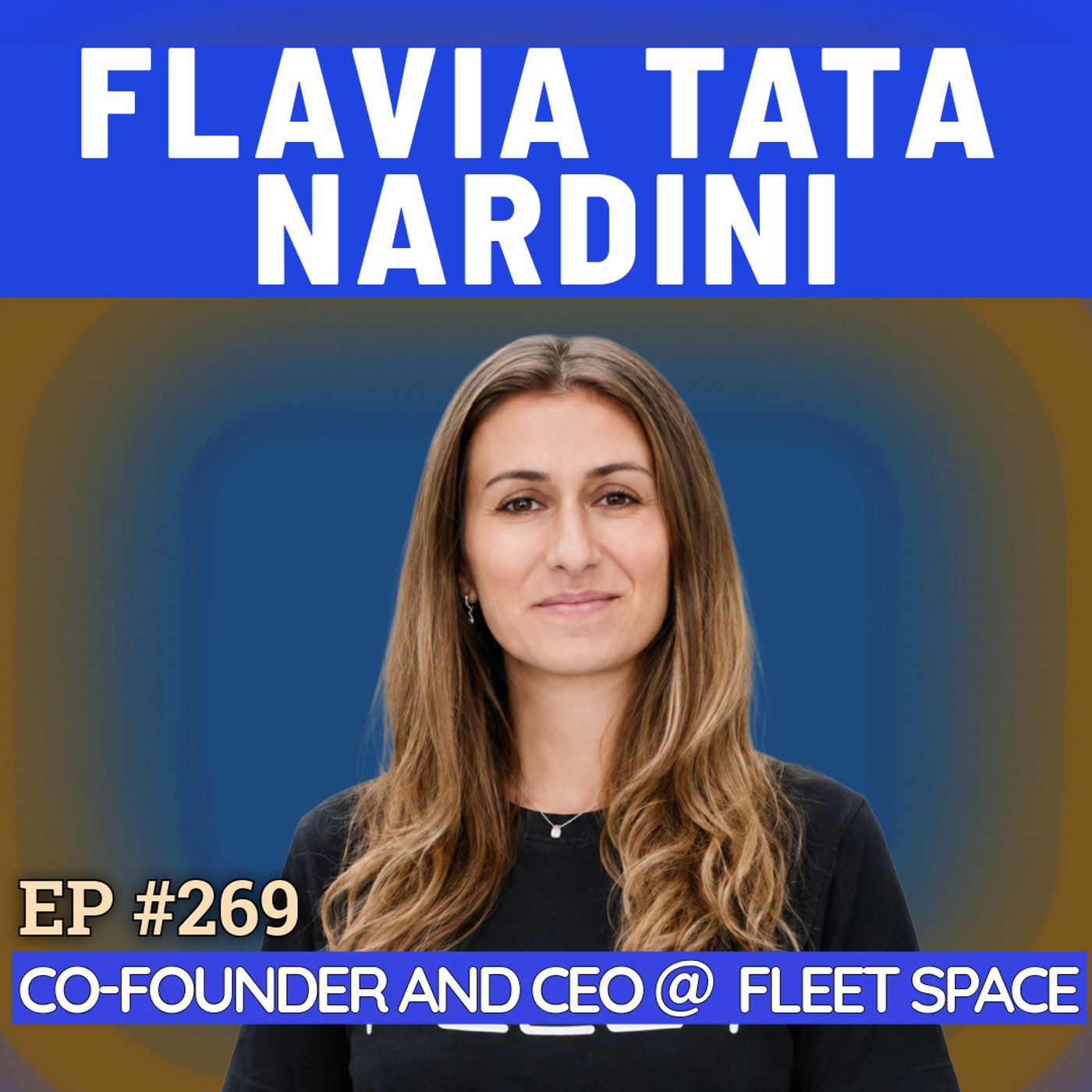
Flavia Tata Nardini, CEO/co-founder of Fleet Space Technologies, explains how an Italian-born space engineer built an Australian “space + mining” company that uses satellites and AI to map the subsurface and locate critical minerals for the energy transition, plus the personal lessons behind her leadership.
Flavia was born in Rome, grew up with a strong family (mom an English/French teacher, dad an architect), and became fascinated with space from childhood stargazing. After her family’s finances collapsed around age 10, she pursued aerospace/space engineering, worked at the European Space Agency, moved to Australia in 2012, and co-founded Fleet after earlier work launching small satellites/3D-printer tech via LaunchBox.
Fleet’s success comes from separating identity from the company; corporate space work felt like “busy” projects without compounding impact; product-market fit was found by testing many remote-connectivity use cases until mining/subsurface mapping proved transformative; fame and money are “drugs,” and she aims for success with anonymity.
Buzz Aldrin’s 1969 moon seismic/“basalt” data inspiring Fleet’s approach; early trials including sensors for beehives/vineyards/Great Barrier Reef; a mining executive calling Fleet’s subsurface data “the biggest breakthrough in 20 years.”
Written by AI. May contain mistakes.
Flavia shares her background, first job, and the founding of Fleet Space Technology.
“I'm your host, Virita Aguil, and let's have some fun.”
Overview of Fleet Space's mission and technology in mapping critical minerals.
“Fleet Space is a company that's now 10 years old, based in Adelaide, and is Australia's leading space and money tech company.”
Discussion about recognition of founders in Australia, including Adam Gilmore.
Flavia reflects on her childhood in Rome and her family's initial wealth.
“Yeah, I was born in Rome in the city, quite close to the city center.”
Flavia discusses her family dynamics and her early fascination with space.
“So in one of the most incredible cities in the world, still I think it is.”
Flavia shares the impact of her family's financial collapse and her parents' divorce.
“And tell me about your parents and the family unit.”
Flavia reflects on the lessons learned about money and personal identity through her family's struggles.
“So we went from having everything to having nothing.”
Flavia discusses her approach to separating her identity from her role at Fleet.
“in my business so it's a kind of a circle of life but I'm very careful um not to count on money life and not to care about money in life.”
Flavia talks about her aspirations and challenges during her teenage years.
Flavia reflects on her childhood challenges and her unwavering desire to work in space.
“belief and confidence i don't know but it definitely comes from a childhood trauma that that in a positive way I've been able to spin it out learning some good stuff.”
Flavia discusses her educational journey in aerospace engineering and her early career.
“And then I, because a friend of mine went to study in the Netherlands for some reasons, weirdly I followed her.”
Flavia examines how moving from Rome to Australia shaped her personal and professional growth.
“Would you have built an Italian space company?”
Flavia shares insights from her decade in the aerospace industry and how it prepared her to start Fleet.
“But tell me about the period before that.”
Flavia shares her journey from redundancy to founding her company.
“Like, why in this very dedicated 25 years of my life in which since the day I came to this world, the day that I graduated and I entered the space industry, it was just a calling.”
A discussion on the isolating nature of fame and its impact on personal life.
“So I, similar to you, had to do my own thing.”
Exploring the preference for success without fame and public attention.
“just want something, do you know what I mean?”
Flavia emphasizes the importance of remaining authentic despite success.
“And I think what I've learned is the best place to be is to be successful and anonymous and rich and anonymous, right?”
Flavia discusses the early stages of her company Fleet and its founding vision.
“So you don't change who you are just because these things happen, right?”
The conversation delves into Flavia's shift from space to mining and critical minerals.
“But our STEM program now, Fleet, is that company.”
Flavia recounts pivotal moments that affirmed her company’s potential and secured funding.
“What gave you the confidence to start the company 10 years ago?”
Learn how the exploration of the moon inspired a shift to mining technology.
“because then we raised one year after we blackbored but that was the moment that Matt and I looked at each other and said wow there's something here people actually want to give us money for this are they crazy?”
Explore the personal journey and relationships that shaped Fleet's foundation.
“And this is the same Matt who is now your husband.”
Understand the difficulties of balancing personal and professional life in startups.
“You saw each other more than you saw your husband at that time, right?”
Discover the process of identifying a profitable market fit for Fleet's technology.
“Tell me, I heard from a lot of your team that in the early days, getting product market fit was quite hard.”
Learn about the innovative approaches to mineral discovery and the challenges faced.
“Then tell me about the moment when you realized there could be something and you went and raised more money.”
Learn how geophysics utilizes seismic waves and AI to map mineral deposits beneath the Earth.
“Geophysics is the science with geology of understanding the subsurface and create 3D maps of the subsurface by studying the subsurface properties.”
Discover how Flavia Tata Nardini brings together engineers and geoscientists for unique collaborations.
“And we created this seismic platform for subsurface decisions that now allow our customers to explore everywhere.”
Explore the difficulties of scaling a space company and the need to focus on customer needs.
“All this exploration DNA is inside people that want to go and explore to the unknown.”
Hear about the obstacles faced in funding launches and the creative solutions implemented by startups.
“So it looks like many other space entrepreneurs don't get that.”
Understand the balance between being a founder and a CEO, and the challenges that come with both roles.
“why didn't he spend millions of dollars when he can spend like so much less and it still achieves the goal?”
Learn about the importance of people leadership and scaling a team in a growing company.
“is very proud of me that I grow as a CEO, but growing as a CEO is some stupid thing.”
Explore the challenges and responsibilities of being a CEO, especially in the startup phase.
“I mean, I think that to me, I do a lot of work with different founders.”
Learn about Fleet's innovative lunar mission to deploy seismic sensors on the moon.
“Like you're just every day of your life is full of the unsolved and I like it.”
Discover Flavia's personal hobbies and aspirations for growth, including board membership.
“But like American companies have done that?”
Unpack valuable interview strategies and how to engage candidates effectively.
“to be i would like to get on a board of a public company big public company to learn what it is being on the other side of a public company in preparation for faith IPO okay that's a very specific one.”
Conclude with reflections on life priorities and the end of the podcast episode.
“Yeah, I think that's quite a hard one to reflect on, but it's a good one.”

Get the gist, explore an idea or ask about something said.
 Claude
On The High Flyers Podcast with Vidit Agarwal, what are the key points of this episode?
Searching your listeningAutomatic transcript. May contain errors.
0:00Hi, I'm Vidit, the founder and host of this podcast, The High Flyers. Hi, I'm Flavia from Fleet Space Technology. Thanks for having me. I'm so excited to do this, Flavia. A number of our previous guests have asked me to feature you on the show for a couple of years now. He said one person we should have on the Flavia Blackbird team and various other investors keep mentioning you. So finally, we've done this. So thank you. Hey friends, welcome back or welcome to the High Flyers podcast, where we do reimagine a high flyer, showcase the brightest and most relatable role models and companies and their journey from sunrise to today.
0:37As one of the premier products in our Curiosity Center lineup, providing on-demand intelligence to help you be 1 % better every single day. I'm your host, Virita Aguil, and let's have some fun. Our listeners have called this podcast a meticulously researched biography unveiling the extraordinary lives and decisions of the most remarkable individuals and companies from around the world. We hope you're enjoying our catalog of 200 plus episodes since we launched in 2020 with many of our guests appearing in rare public interviews. It's now time to explore your curiosity. Please enjoy. Let's set the scene with some fun facts to get us going.
1:17Where were you born and where do you live now? I was born in Rome in Italy and I live in Adelaide in South Australia. And we will cover that journey, how that happened shortly. And work, what was your first job and what do you do now? My first job was working in conferences at the entrance, you know, giving line yards and tickets. And now I'm the CEO and co-founder of Fleet Space Technologies. Do you want to, just for people that might not know about Fleet, give them a quick overview on what the company does? Fleet Space is a company that's now 10 years old, based in Adelaide, and is Australia's leading space and money tech company.
1:58We work, try to understand the subsurface of the world, and we use space technology, satellites, and AI to map critical minerals so we can find them for the energy transitions in the world. very cool i mean that is such a integral there's a lot going on in there so we'll need to unpack i know we will we will and i know one of the things that came up in our research is people said you're not just a mining company you're not a space company you're kind of both and you're also doing things on earth i think that's one of the things i was surprised by is when people think of space they think of mars and other planets but you're focused also on earth this planet is beautiful yes yes i want to unpack that as we chat and and flavia as you know the purpose of this show is to reimagine the concepts of a high flyer is there a high flyer you know who you feel doesn't get the recognition they deserve um many but uh i would say that in uh in australia there are several founders that don't get the recognition than they deserve for sure um i think one of my bestie is uh it's adam gilmore that is the founder of a rocket company in queensland he does get recognition of course because he runs a rocket company but i don't think people understand what how fast he's going how far he's going and how much he's sacrificing so he's a legend yeah he he actually we should feature him on the podcast at some point i mean there's actually a really healthy spacey because it's to my field now yeah australia like i'm an investor in the company heo heo they're doing cool things so many now you're doing amazing things Gilmore I mean there's a few others that are coming up I mean just just last week one of these companies out of New Zealand um got some funding and they're doing something yeah an exemplary of fleet yes yes yeah that's right yeah he was at fleet and then also at rocket lab rocket lab yeah yeah yeah yeah so I think it's a cool ecosystem and I feel with AI as well it's getting more recognition because this whole concept of physical AI and frontier tech and defense everything is coming together i agree yeah yeah was for years it was like oh software software software was now i think hardware and software is yeah now that after the soft talk apocalypse everyone is like would be very interesting to invest in hardware like we told you so in the past 10 years hello i i agree completely agree with that let's wind back the clock and go to your sunrise as i call it childhood so you mentioned italy and rome yes Did you grow up in Rome in the city or was it outside?
4:34Yeah, I was born in Rome in the city, quite close to the city center. So in one of the most incredible cities in the world, still I think it is. So we were very, very, we actually were a very rich family at the beginning of our journey. Beautiful, beautiful house. We came from a family quite big with five siblings and mom and dad. Beautiful house, very close to the city center. fantastic life and then things changed but um yeah rome is is my is my place what was upbringing like i've heard you've even when we spoke the other day you talked about space and being fascinated with the world tell me about the origin story of that interest it's interesting because you know we were we are five siblings and i'm number four and all of us have done different things.
5:28We have biomedical engineers, we have economists and oil and gas engineers and my sister that ended up studying psychology and all sorts of, there's so many things that family does. And then there's this little rocket scientist that is born and it's me and I'm like, I just want to do space. And this was since the very beginning. Sometimes when I reflect on that, I think, why? Like, where did that come from? And I'm pretty sure it's two things. So my room, out of several rooms of this big house, it was on the seventh floor of a beautiful Italian, like, you know, these big palaces type of things.
6:13And I had this view on a Roman garden, like a public garden, just a big view. I remember when I was little I was always fascinated at this big view and I could see the stars and I could see the birds migrating. I don't know it's just a portal to something bigger for me. But then when we had this beautiful house in the mountains in Italy and we were used to go there and the best time of the year for me was in the middle of August when there were all the shooting stars in the sky and I was there with my nose up, looking at the stars and thinking, damn, there's something cool there. I want to be an astronaut.
6:54So this is how it started, really. And tell me about your parents and the family unit. What did your parents do for work? So mom was an English and French teacher and dad was an architect. So they were together for a long time, had the five kids. They were a very strong unit. And then when I was 10, kind of all family crashed down And that was an entrepreneur. He had his own architecture studio. And I think it is a bit of a mess with the company. So we lost all our money. So we went from being quite rich to being really, really poor. Like we couldn't even go to school or eat. And dad left and daddy divorced.
7:35And mama, you know, took care of the five of us. So that was like around 10 years old. We needed to organize our lives and without much food in the fridge. So it was a weird, weird thing to go through as a family. I think it shaped us, all of us, in good and bad. It did shape us. Now, mom was amazing. Like, mom was the most incredible human. She passed away several years ago. So the year, almost the year that we found the fleet, so almost like 10 years ago. And that is still alive, but not doing that well. But yeah, it was very family, very loved and then crashed down. So we went from having everything to having nothing.
8:26So good lessons there. Tell me more. Tell me more. You said it was good and bad. How do you reflect on that now, particularly because you're running your own business? And I don't know if you feel this. I feel this with my business. I've been running mine for nearly seven years. And I say this to my partner. I go, I'm always terrified, right? Do you like, I'm always terrified, dude, like what's around the corner? Do you feel that because you saw it with your parents? And so I seen a family that had all the privilege in the world, losing it all after one night. And I've seen cars to be removed from the driveway.
9:03I've seen police coming and removing, you know, things from the walls, paintings. I've seen it. And not just that, but that created my family and my parents to divorce and separate. so during kind of all my life I had this feeling that money's a trouble money is a trouble for relationship money a lot of money and no money it's just troubles so you can't really wait your life about how much money you have or what you do but he did create it was it was very sad and he a lot of suffering and I would say that I'm bringing this it's like a lot of suffering so I've seen my mom suffering so much because they loved each other as well so I've seen um money and entrepreneurship destroying a lot that's the worst thing and then finally enough now my love is in my business so it's a kind of a circle of life but I'm very careful um not to count on money life and not to care about money in life.
10:10And I'm very careful of the things that I do. And I do not think about losing everything. I don't think it's going to happen. I think I've organized my life so that it's never going to happen. Money is one. The other one, which I feel is the most big, is identity. I've seen this and a lot of founders say this is the company is you and you are the company. Again, did you learn that from your parents to separate your identity? Yeah. Yeah, so my father, when he lost everything with his business, he changed it completely. From that moment on, my father is 82 and he still has got so much money troubles and so much debt.
10:46So I sustain all his life now at the end of his life. He came, he went from me like very successful in what he was doing and loving it and have these five kids and be a fantastic dad to lose everything. And it was his wife, lose his kids. And he lost us because we didn't want to lose him. he lost us because when he lost that identity he lost everything for us not for them nothing else was worth it spending time with us spending time with his wife he just entered into a what i believe was terrible depression a bit of psychosis so the rest of his life he was he has been an absolute disaster so in that point in time i was 10 so he would have been so i'm 40 now he's 80 so we go 40 years, it would have been 50.
11:31Like if I think about it, seven years more than I, that there is a man that lost completely his identity, that is lost completely. He couldn't put it together and he still is unable. So I've learned the lesson as well. So for me, business is not my identity at all. Like, and if lead tomorrow disappears, I'm still me with my dreams, with my love, with my attentions, with my ideas, us with my identity so I've created an identity that is separated from fleet and and believe it or not I think that's the reason why fleet is successful because when you actually are able to separate a little bit that identity you make much better choices how have you we can jump around here and go back and forth between present day and your childhood how have you done that like I would love to learn from you because I'm really bad at that I cannot separate when I met my my wife I said to her I said work is not my identity and then I started my company and now work is completely my identity and yours you're like you said your husband is your co-founder yeah how do you like not take the work home and how do you have a life outside of fleet I mean we work hard of course we have to work hard we got a scale up in our company almost a billion dollar like valuation we've just been building an incredible company as we work really hard but for me fleet is a vessel for learning it's a vessel for helping, it's a vessel for humanity to go further, it's nothing to do with me, you know, it is just it's a honour for me to lead this company so when I I'm very very able to walk I never talk about fleet with anyone so if you are my friend and we go out I would not imagine it like you could go out for me for years and i would never mention it like you wouldn't even know what i do at my job you go on holiday with me never made people talk to me about fleet but i'm like so i'm really able and i wonder if that ability came from from that you know for seeing someone losing himself so much in his identity and his life and everything that he built and it's not worth it so when i make some decisions about fleet they're not fear related i also know that i'm good and i also a fleet will not fail but i always told him if fleet fails somehow that i hope will never if fleet fails i'll be fine and all the people will be fine so this is just a strong belief and confidence i don't know but it definitely comes from a childhood trauma that that in a positive way I've been able to spin it out learning some good stuff.
14:15That's good. Well, so let's go back to that. So you saw this when you were 10. So let's assume this was in your teenage years. When you got to age 18, so you've just finished high school, how did this shape your aspirations in life? Like if I met the 18-year-old Flavia, what could I have assumed you'd do with your life? So first of all, you have to know that in our teenage time, It was tough. We, as a family, as sisters and brothers, we all had a lot of issues. And I'm going to say mental issues, but, you know, a lot of food issues. Like I started suffering for depression. So everything that we've gone through really hit us.
14:54But Flavia, Flavia's always been someone that wanted to do space. Like I was 18 and I clearly was suffering with depression. Then I realized a little bit later. but I wanted to go to space. I wanted to be an astronaut. I want, it was something that it was in my belly. It was like something, I knew that I was in this world to do something related to space. I really didn't know what. So when I was 18, despite the fact that we went through what we went through as a family and, you know, a little bit traumatic, I wanted to do space. I wanted to do space and I and I wanted to study space engineering and nothing would have stopped me and I had no doubt I would have succeeded so if I look back at that girl I mean that girl surely was suffering a lot god bless her like she was just all over the shop mentally and and worried about relationship really but never worried about this like I knew that my my role in life was to make an impact from something related to space and space technology.
16:04So I did it. And so how did you act on that? So you had that dream. What did you do? So when I was 18, I was a good student. I was a really good student. And I'm thinking, should I be an astronaut? Should I study what? And one of my brothers was an engineer. And I'm like, oh, we should do engineering, space engineering. So I started with aerospace space engineering the first three years and then I started space engineering and then I found a job at the European Space Agency so I just was going like I was just nothing stopping me it's such a niche thing as well like you know you are in this world to do space space engineering stuff it's it's quite crazy but I felt like something really really important to me so I just um I just I just went through it what was easy I don't know I've always been a weird student so everything really came to me quite easily but I was very lazy so I could get bored quite heavily I would fall asleep in classes like it's it's really funny because I'm 43 now and I don't think I've got ADHD so like you know everyone every single person is diagnosed with ADHD these days so I wonder because now I'm such a well coping well structured adult that has gone through a lot of reflection and growth but I wonder if that girl had some energy trace because it's very brilliant but impossible to focus impossible to stay awake they're always very tired always very masking and at university things would come so easily I remember one day oh that's so funny like if I still remember that makes me laugh we were in this lesson at university that it was chemical propulsion for big launchers or something like absolutely hard for the for the average person and i found it so easy so easy okay that there were just 20 people in the lessons and i would sit at the very back because i would just find this so easy and i remember the the teacher always asking these questions what what if the pressure comes in and up and no one would understand and i remember after a month um saying like um it this is the answer that putting it this is the answer we've been talking about it for a month and no one in this course understands like you know should we move on i'm like fuck you were so cocky and and crazy when you were like 20 years old but how also fascinating that at 20 years old in one of the hardest class i didn't know i didn't know at that time I was smart you know I thought I was just resourceful but in time I realized that I'm actually there is some pretty good IQ that helps so it's pretty cool so you did the I think you did a bachelor's and a master's right in space in aerospace engineering and this was in Italy I did in Italy, yes.
19:10And then I, because a friend of mine went to study in the Netherlands for some reasons, weirdly I followed her. I loved Rome. I loved staying in Rome. I had no idea whatsoever to go away from Rome. It never occurred to me. but then I followed this girl for some reasons and my life started in the Netherlands from the Netherlands I found a job from the job I found my ex-husband that he was from Adelaide like that's so weird and here I am building a company in Adelaide so are you saying you never went back to Rome after you left so you went no no yeah no I went back to Rome all the time but I would have never left you never you never lived there after that right I would have not I never lived after there but I would have never left it like I loved Rome so it was a series of things that made me made one trip once and after that I lived abroad ever since so it was uh have you ever thought about what life so this is one of the questions that came up I I when I spoke to some of your team for research I said what's one question you want to ask Flavia and a few of them actually said they said ask her what would life have been like if she stayed in Rome and continued living in Rome today?
20:26Have you ever thought of that? Would you have built an Italian space company? Yeah, it is funny because I don't think so. I think if I stayed in Rome, first of all, I think I would have been happy everywhere. I'm that kind of person. But now if I look back, all my friends and family that are back in Rome, I think the growth that I had just doing everything that I've done in the past 20 years, there's not a chance I would have done it in that city. There's not a chance that the balance in like funny, happy, healthy, 40 years old, 43 on Monday, that I am right now would have been so happy in Rome now.
21:11There was just too much. I think I would have been, my growth would have been very limited. And a lot of people talk about what growth does to you, you know, when you have to live in another country and when you need to build a company and when you need to having kids and having a company and having this far away from the people that you love, immigrate. I don't have to tell you. It's painful. But one day you wake up and then you realize that your soul is expanded, you know, that that you can you can tackle any problems, any problems in the world. you're actually gonna smile on it everything that is complicated you just you know you're gonna fix it you know you're gonna go through it and you love everyone for for the people they are it's just no i would have never been able to do it there because i agree with that i think there's something about moving out of one environment into another i've seen it in my own life even even just moving within australia or like now i spend a lot of time in different cities around the world like that new environment and I think it's something about like dropping your baggage metaphorically like not having was I feel like when I like I grew up in Melbourne and I was in Melbourne for most of my childhood and most of my early adult life and I was comfortable because I knew everyone I knew the areas I grew up in my parents were there everyone and then when I moved out of Melbourne for the first time I can relate to what you're saying I had growth but I don't think it was because of the city i moved to it was just the move itself living home and being tested in a new place and i remember struggling a lot the first three years that i came here and in a struggling a lot missing home missing the people like i was probably in my late 20s just i think about that late 20s girl like thinking what were you attached to like why were you struggling so much and because getting rid of those baggages takes time so ed what this is you talking about australia by here right yeah when i came to australia the first you had a period in between what what year was this when you came to australia again so i came to australia in 2012 so okay that's so you had about a 10-year career prior to coming yeah and then i came here so i was dead in the netherlands in north of europe and then i came here um i mean here also i'm fulfilling my destiny here it's funny you look at life and you're like how all these things happen in a row and you is that they all needed to happen to you for you to fulfill your destiny of space that i felt or i could have done that in rome i guess it doesn't matter but the reflection is that if i i'm sure that if i if i had done this in rome i would have not have the same strength that i've got right now so i would have you're saying that's because of the environment yeah because all the changes and the things that I've done and all that grieving you go through when you are a citizen of the world and citizen of...
24:06You go through a lot. So yeah, probably I would have done something in space, but it would have not been so big. So 2012, you moved to Australia. 2015, I believe, you started Fleet. But tell me about the period before that. So the 10, 12 years in your career, because you said you were in the Netherlands. I think then you were in the Middle East for some time as well. Yeah, I was in the Netherlands. What did you learn in this first decade of your career? Like what skills did you build and what experiences helped you to start Fleet? Of course, I was working on European Space Agency, seeing the coolest things about technologies and robotics and building.
24:42And it was quite exciting. Like when you're exposed to the most interesting technologies on the planet, it feels like not as impossible. So there was that feeling. But I also had a weird feeling that I think is the one that led me to build something myself. Like by working for companies in Europe that were the busy building technologies or speed technology in general, I realized how much money I spent just for nothing. Like how every department of big companies spends like hundreds of millions of dollars for a project that goes nowhere. That is just keeps 200 people in a job and then okay, done and no one cares.
25:22For six, seven years, I was working on project after project after project, and it felt like no one really cared. Like, you know, you launch satellites in space, you build. It's all like so, it felt like everyone wanted to keep busy, that no one really wanted to make a compounding impact. Working in corporate is weird. Like, it's just this, like, you hope that out of these thousand people, some of them will move the needle, something major. And the rest are just keeping busy. and spending hundreds of hundreds of millions of dollars because that's how the economy works. And that made me feel absolutely not okay.
26:03I'm like, you know, we are really like, we are talking for hours about the most incredible technology in the world that could save people, that could advance humanity, that could change the way we live and work. And here we are writing documents on documents on something that is never going to happen because in two years, the department will change idea. So, wow, that was shocking for me. Well, the obvious question, Flavia, then is, could you have started Fleet earlier or did you need those 10, 12 years of experience? No, I could have definitely started earlier. Yeah, well, hindsight's a beautiful thing, but I guess, because you're in a space that is quite technical is the sense I get.
26:44You're not building another. I think those years gave me confidence. They gave me confidence that I could build things that work. So that is probably the confidence that I needed. Yeah, maybe that's really what I got there. I got that big confidence boost on the fact that if you work properly, you can build stuff for the real world that actually work. But even when I came to Adelaide, I didn't want to build a company. Building the company was not in my radar. Not even one time from my 20s to the day that I started Flee, that was 10 years ago. I had no idea and no intent to build a company. Because for me, building a company was connected on what my father did.
27:27And it's like, I don't want to do that. That, no. I just want to work in space. But in Australia, I couldn't. That's why I was kind of stuck in the corner. And I'm like, you know what? I'm just going to give it a try. And it would have not happened. Like, if I had found a job, probably. You know, a lot of people build a startup. might not have are you saying fleet might not have started if you got a job in adelaide yeah but it didn't happen you know i applied for so many jobs and you know apply for university and nothing ever happened and i was like why what is the universe telling me like why is it bringing me on the other side of the planet where there is not a space agency there are no space companies you know like i can't find a job because what i do is so overqualified compared to everything that i can I'm like, what is happening to me?
28:15Like, why in this very dedicated 25 years of my life in which since the day I came to this world, the day that I graduated and I entered the space industry, it was just a calling. And I suddenly am in the middle of Italy. What is the universe trying to tell me? And I think at the end I realized that that was supposed to be like us. This is the place where feet is thriving. Like, you know, with all the mining and the knowledge. This is just the perfect place for this company. So looking back, I love how life plays with you and for you. It is just beautiful. Completely. I mean, my story with this podcast and the whole business I run is because of redundancy.
28:58I was made redundant six years ago and I applied for many jobs and I didn't get any jobs. So I, similar to you, had to do my own thing. And now a lot of people look at me and I'm sure they look at you and go, high agency and bias faction and i said no at that stage i had no no option there was nothing else left so i had to have a bias faction and now i can give a speech and say how awesome i am but in the moment it was the only option left i was and the thing is that you notice that the opposite people so the people that build tech startups because building tech startup is cool and you know i'm gonna do a podcast because a podcast is cool and i'm gonna get famous those those that endurance Insurance is not there.
29:39Exactly, exactly. You never get that. Exactly. Bingo. Yeah, I think what you said at the start, right? If you're doing it for money or for being famous, I mean, that can be a byproduct, but that disappears very quickly. And also fame is like money and fame are both really, really, really not good things. Yeah, they're drugs. They're drugs. fame is also like you know fame fame i mean it's if you if you're getting from the angle like because you know i'm a female ceo tech startup so i realize in this the window of time that my influence on young females or women it's very powerful so you can't avoid it but it's also very isolating like because i don't like to talk about for you what they said before when i'm not And it's funny, like people stop me and say, Flavia, can you give me an autograph?
30:34And I'm like, I'm not a rock star, I'm just doing this. It's isolating because nowadays most of the people that want to spend time with me, just want something, do you know what I mean? Like it is what it is. and I was hearing a story about two other funders some successful funders in the US and being very successful I'm talking about billions of dollars and the more successful they become the more security they needed for people and now they've got security in the house I'm thinking what? That makes no sense we're trying to do some amazing things and working really really hard and then you need to fear for your life.
31:24That's weird. Yeah. Fame is weird. Yeah. Yeah. I mean, this is really interesting because probably maybe six, seven years ago, I would joke with my friends that, hey, I want to be famous because I want to be recognized. And I realized it was because of insecurity, right? Because I wanted to be approved by strangers. And through my work, like you're saying, I've tasted 1 % of that. Like I'm micro-famous maybe. I'm in a small community. I'm micro-famous too. Yeah, I'll go to a cafe and someone will recognize me. And my wife always says, she's like, you feel so uncomfortable. I'm like, yeah, I don't want to be famous because I just want to go to the cafe and get a coffee.
32:02And I think what I've learned is the best place to be is to be successful and anonymous and rich and anonymous, right? Like those people still have influence and they pick up the phone. People answer their phone and they can get stuff done, but they can live a normal life. And I think that I've realized is the best place to be. because you look at even someone like some of these public CEOs, right? Like even space tech, we've got a big CEO who is very famous in the US. I mean, his life doesn't seem very happy to me. Like, I don't think I want that life. No, I don't want that life either. And I think you can achieve both.
32:38Like you can do it all. I don't know, fame, even money. Money is another interesting thing. Like I know if everything goes well in the coming years, it could mean a big exit that um i don't even want to want to think what could that be but i really that could be really interesting like really again as our best for something else like for for more support for more help we are in this life once you know so if if money comes i just just used to help someone else like um you know it always makes me laugh because i mean i'm the girl that goes with the t-shirts and like sweatpants around the city and a car that is a good car but it's like 15 years old and you know it's just it is i will always be that girl like i was playing basketball uh when i was in high school so almost professional basketball i always beat that girl like if you see me on saturday morning i've got my basketball hoodie and i've got my basketball shoes and no matter if i'm 40 my 80 i'm sure in my 80 i will be with my basketball shoes and my UDI.
33:43So you don't change who you are just because these things happen, right? You had all these dreams. You wanted to be an astronaut and a basketball player? Yeah. Like we were playing basketball really hard. Like since I was like 12 with my sister, we played basketball since 25 and pretty, pretty high level. I had a lot of surgery on my knee. So at a certain point I had to stop because I was a hard sport. And also it's female basketball. Like you can't have a career and get paid enough to just do anything. But so we stopped and I dedicated my life to engineering and stuff. But that was amazing 10 years.
34:19And I think that impacted a lot as well. Like why you have that what really helped us in the health of that high school journey. A lot of work. Like we were going to games in the weekend and we all have to study for the exams. And really fun though. We are best friends with the basketball friends still, many, many years after. And my daughters, they play basketball. So I'm really that kind of nerdy, sporty girl. And I will always be. Like, always be. So let's go into, you said you moved to Adelaide in 2012 because your ex-husband was Australian. And it sounds like he brought you to Australia. Like a good wine, imported.
35:08I understand you had a company before Fleet, LaunchBox. Yeah, that's correct. So we actually, still with my current founder, that's the first company that we started. And it's interesting because it was probably two years before Fleet. We were launching 3D printers, small satellites on balloons with schools that could take a photo of Earth. It's super cool, like high schools and primary schools. We did that for a couple of years. And then we found a fleet and fleet became the commercial beast that it is right now. But our STEM program now, Fleet, is that company. So now we have that work running through Fleet in which we pass 10 ,000 students a year.
35:54Then we educate them about minerals and space and missions. And so somehow we managed to do both. So that led you to flee through the problems you discovered? Tell me how they're connected. So we, Launchbox was, we were building these little satellites, these little CubeSat and sending them with schools in space and take photos. Okay. But we were charging, so we were making money. And making money really allowed me and Matt to travel a little bit and go to conferences and try to understand what was happening in the ecosystem. So at that point in time, a couple of companies in Silicon Valley, SPY, Planet Lab, were starting raising money, launching small satellites in space, very much taking photos and cameras and weather predictions.
36:45And we were very passionate about remote areas, connectivity. So we were just getting informed. And this company was bringing us the money to travel. I had a little kid so I had my first child a couple of years before this company like one year before this company was formed and Victoria I was pregnant with her fleet I think fleet got incorporated when I was in my last month of pregnancy so I had these two little chickens and I'm there with two companies trying to understand what to do and I remember one day we go to this industrial connectivity conference in Melbourne in which they are talking about connected devices in remote areas and how it can help with mining and agriculture.
37:36And we started looking into it. And Matt particularly got very passionate about critical minerals. And the rest is history. So the previous company really helped us just to move around, you know, just to learn. But that's beautiful because it's all STEM. So it's all bringing kids closer to the stars. That's pretty cool. In my research, everyone I spoke to said to me that five, six, seven years ago when they met you, you didn't know much about mining or geoscience or any of these phases, but you went all in and essentially put everything on the line to start Fleet. Tell me about those moments. What gave you the confidence to start the company 10 years ago?
38:24So the thing is that I really wanted to keep working. So it was, I had no confidence. I just wanted to try. The mining side was interesting because I was very confident on the space side. Like these are going to be satellites that enable connectivity to gather a data set to help a particular industry. And here it comes, the particular industry is mining and minerals. So we're looking at the subsurface that I've never looked at the subsurface. Like everything that I studied is up in the sky, up in space. Like, you know, I'm on the other side of this. But saying that, it's all rocks, right? You know, you go to the moon, you go to Mars, you go under the surface, it's all rocks.
39:10So when we started really working hard in this, I knew a little about how this industry works. europe is not a mining center like like australia i was from rome like the closest thing in rome to mining is the roman archaeology things that you find like fit okay like okay great so it's just like i didn't know anything about anything so but i like to study i'm a nerd with it i like to learn i'm a curious mind and the things that got me that i realized is a difficult problem to solve when you want to go to another planet or you want to launch a rocket and all the things that people think are space, they are hard things to do.
39:53They are really hard things to do. And then suddenly I get exposed to this mineral community, people that actually find the minerals that allows me and you to have this conversation. Like this computer, your microphone, this windows. Like a huge enabler, humankind, that is trying to find deposits It's 500, 800 meters under the surface without almost little technologies. And I'm thinking, wow, this is a difficult problem to solve. Tell me about the, was there a moment when you felt, okay, this can be a real company. It's not just an idea. Yes. So we, so at the very beginning, Meta and I, we just created a logo at eCreatorLogo, got a website together and started thinking.
40:36In the first year, we raised 25K and we were just doing the first satellites, the first ideas. There were a couple of moments. So there was one conference where everyone was talking about the growth of the mineral industry and how things are going to be connected. So humanity is going to go to net zero. We're going to migrate away from oil. It was this big discussion. And I remember someone saying in the panel, I was in the audience, someone said, but yeah, who's going to do it all? Like, who is going to be the infrastructure and enabler for this big change of finding minerals under the earth?
41:13And I realized that there were 10 ,000 people that said nothing. So I'm like, hmm, this could be interesting. Then we started working with Matt and started doing things. And one year in, we got invited by a VC. At this point in time, I've known nothing about VCs. Matt had a previous company that he bootstrapped. He knows nothing about VCs. And we got invited to this VC pitch. I was pregnant with Victoria. I was seven months pregnant. So I remember being in this pitch with this big belly, very self-conscious. Like, I'm raising my money. And I'm, like, so pregnant that it's not even funny. Like, no matter how much, how many clothes you put on, it's just big.
41:56and they offered us money like$3 million that we refused because then we raised one year after we blackbored but that was the moment that Matt and I looked at each other and said wow there's something here people actually want to give us money for this are they crazy? Maybe we should start really looking into it we fell in love with this photo of Buzz Aldrin so Buzz Aldrin in 1969 he went to the moon and there is this photo of basaltry landing on the moon and it's got this digital digital meter like a kind of seismic sensor really complex and it was trying to understand the subterface of the moon with a seismic sensor so measuring the seismic waves on the moon um and in those years nasa reprocessed all that data with with ai and that was 10 years ago because in 1969 they got they got no data it was too much data.
42:54They couldn't read it. They couldn't understand anything about the moon. Then 10 years ago, they understood that if they were using machine learning to measure the seismic behavior of the earth, they could actually study the subsurface. So we thought, that's super cool. That was a moment in which we realized, okay, we need to bring the space technology into money, and mining technology into space. And it's funny because our team is two astronauts that just went past the moon, like what, two, three months ago, and they talk about taking photos of flashes on the moon, and the flashes are actually little rocks and little asteroids landing on the moon.
43:35And all these sub-surface seismic data actually demonstrated that the tremor that they could feel were these landing things. So the moon is just, there's always a shower of rocks in the moon. This is where we said to Matt, this is something here. Like we can study the subsurface with data, with AI. We can connect big data. We can help humanity. And that's where it started. And this is the same Matt who is now your husband. Yeah, we were not married at that time. You were, but you were co-founder. So tell me how did you, because there's three of you, right, that started the company. Yeah. So we started actually for the company before.
44:13then one person left and we were the three of us and then we co-founded the three of us fleet but Matt Tedloff I would say after one year decided to build his own startup that is still going here in Adelaide and he left so Matt and I we were left just by the two of us and we said okay let's just do it and at the point now we were just he was my best friend you know we went through everything in the first three, four years to build this. So he's still my best friend. Yeah, yeah. I mean, I want to talk about Fleet, but maybe I feel a personal side is so connected to Fleet. So because you said you started the company and you had your first daughter.
44:57You've got three kids now, I believe. Yes. And Matt is your second husband, which I think is public knowledge. So I think it's worth connecting the personal with Fleet. Now, I want to go deeper into Fleet because I think what's happened in this conversation, and there's so many personal crucible moments. So you're pregnant with your first child, you're going to start a fleet. You've got three kids now. You mentioned Matt is your second husband. I believe that's public knowledge. How much of it, when you talked earlier about your parents, you saw the struggles they went through. How much of that personal aspect was important to the early years of fleet?
45:34Even going through a marriage breakdown, we don't have to go into the details of it. Oh, that was tough. Was that because you had to put your blood, sweat, and tears into building Fleet? Yeah, the first year of the startups were not good with the little kids, the two girls, and my previous husband. It's just hard, guys. Building a startup is hard. You sacrifice many, many things. But you also realize that shouldn't be the case. like if you're building what you love if this is your dream your other counterpart your partner your your spouse should be your biggest fan it should make your life easier and and that's hard because dreams so big dreams that got impact on everyone so that's what i realized in that previous and then it was of course the divorce that it wasn't easy but that's probably what met and now we realized together that we got the same dreams and the same sense of humor and the same lightness about life or every single no and rejections and disaster that happened we can tackle it together um i would have never done this without him so it's uh it's pretty cool and to be fair we just we just always with each other like i've been knowing this person you've always You saw each other more than you saw your husband at that time, right?
46:56Yeah. Unfortunately. True story. Okay, true story. But you also don't have to justify yourself. You don't have to explain your dreams. You don't have to explain your purpose. You just have to do it. So that's what happened, really. So now we've got three years old. But it's incredible to think about it because the first time we met, we were like, would it be cool if? And now we are creating this life that it's got its own. I actually feel just on this point quickly, I think there's a perception out there that a husband and wife should not be co-founders because they take their work home and it's emotional and all that.
47:34I actually think I've met a few husband and wife co-founders. I actually think it can be potentially good because you both have the same end goal. And like, even a simple example is, so at dinner, if I'm talking about my work and my wife is not talking enough about her work, that is an unfair conversation right because i'm getting the attention whereas in your case i would assume that wouldn't happen so if you're traveling he knows it's for you know your business that you're building together where you're not putting one person in front of the other never an issue like i actually think it makes it easier as long as there's alignment it's not like whose career is more important yeah there is alignment we go on holidays we don't even think about and talk about stuff for a second.
48:17We exactly know at the end of the day is my person. Hey, so life is easier when you find your person because it's much easier. Tell me, I heard from a lot of your team that in the early days, getting product market fit was quite hard. Like I think the term they used was a scattergun approach, which makes sense. I think that's true with most companies, right? And also they talked about that none of the IoT applications that you and the team were trying were profitable enough to sustain the investment. I think this is a good opportunity to educate us about what does that mean? It wasn't profitable enough.
48:54And then how did you reach the point of this product does meet what the market wants and we can scale it? So when you think about a series of satellites that help for communication in remote areas, so connecting sensors in remote areas, when you think about remote areas in industries, so this is not about connecting people. This is about connecting industries. There are many industries in remote areas. There is agriculture. There is water. There is power lines. There is gas pipelines. There is maritime, like the water. All these applications. So you can move data from a vessel. You can move data from a power line.
49:36You can move data from a cow because there are also companies that connect cows. You could move data for everything as long as you want to track something, you want to understand its behavior and change the way you work, change the health of the things you're tracking. So when we started with Fleet, we wanted to understand which one of the market was, as you say, more profitable and more impactful. So since the very beginning, we looked into everything that it was related to climate change. So water and energy, agriculture and minerals. But it was hard to know which one would have won. So we started working with several cases of them.
50:19And wow, that was funny. Like we have done all sorts of things. Like I found myself to connect colors to animals. I connected bees, like beehives and trees and pipelines. Oh my God. God knows what I connected with these satellites. First of all, to understand the feasibility of a stangonomol is like How big is this application? Like if you can connect every penguins in the world to assist them and monitor them, right? It would be cool. Who's going to pay for it? Who pays for monitoring penguins, okay? If you can connect all the cows in the world, why is that relevant? So what is the data set that is important?
51:00So we started connecting, we started working with this industry to really understand the problems. But some things that people requested that were just wishful thinking or nice to have. It would be amazing to know if my beehive is full of honey. So I go there and see just with the honey, it's there. How much would you pay for it? Like a box a month. But sorry, how does that connect? So that was your early potential idea that you were exploring? All of this. We tried them all. Right, because I was going to say, this is not connected to space, right? These were non-space. No, they were connected to space because they were in the middle of nowhere and there was no connectivity.
51:46All these things were in the middle of nowhere. So we tried all these different applications, all of them. I found myself in vineyards and in agriculture, in the water, in the Great Barrier Reef, connecting sensors to space. and then one of these trials was a connecting sensor that would map the subsurface of a tenement to look for minerals. So it was one of the trials of 10 of them that we were doing. And it turns out that that trial, so slowly the others were going, this one is not technically physical, this one no one will pay for it, this is not a big impact on humanity, this one is a bit boring, and this one no one wants to, no one cares.
52:30And so we were left with a few of them. But the first time that a money executive looked at our data of the subsurface, he said, I remember clearly, this is going to change everything. This is the biggest breakthrough in my industry in the past 20 years. And I'm like, woo, I like that. I like the sound of that. So it was like, you can deploy this all in South America and you will find billions of billions of minerals. and this is where as you said I started becoming a little geologist what does that mean let's learn about rocks let's learn about geophysics let's learn about geology and I kind of started diving into an industry that knew nothing about it but now I mean 100 world mining women think about it yeah and at that point when you were exploring these ideas had you raised the VC capital you mentioned yeah just little there was this first time just very little Okay, so it wasn't a big round.
53:28Then tell me about the moment when you realized there could be something and you went and raised more money. Series B is where we decided to focus. And this was five years ago? Yeah, five, six years ago. We did. I mean, like, I decided to focus on the money. No one in the company would say this is the one, but this was the only application in which the CEO of a big money company said to me this is going to be transformational. And then I'm like, you know, guys, we're going all in on this one. The others were saying to me, this is going to be good. And that was Series B before Series B. So at that time, I would have raised$8,$9 million, really.
54:08But then we said we're going down. And this is where the revenue went from$0 to$10 million, like in the first year. And these were big mining companies. Tell us about that. What were they buying from you? So how this works for everyone that is interested. So there are two things that are important to understand. The first one is the need for minerals is skyrocketing. So the mineral industry, so the mining industry, has always been quite happy, healthy, doing its things. But now with the electric vehicles and the AI data centers, the amount of minerals we need in the next 10 years is more all the minerals we have found.
54:54So it's a very critical point of society that we have never really been. So think about this industry as an industry under stress. So historically, for them to find minerals, they drill. It's as simple as that. So they go on a tenement they believe is fertile. Sometimes there are these old bodies like copper. The copper is really important for data centers, for example. Or a Tesla. Tesla has got 80 kilograms of copper, you know, like a lot. They drill, drill, drill, drill. Each drill is half a million. And in the past five to 10 years, we have done five million of drill holes as a society and just 0.1 % found anything.
55:41So the dream success is not that good. And it takes 15 years, around 15 years to find a new deposit. It's low, expensive, inefficient, because it's a difficult problem to solve. And guess who loves difficult problems? Me. So drilling, drilling, drilling, drilling, drilling, drilling is also very impactful on empowerment, correct? Geophysics is the science with geology of understanding the subsurface and create 3D maps of the subsurface by studying the subsurface properties. So seismic waves, metallurgic signals, gravity signals. Earth is noisy. Earth is a noisy, gigantic planet that if you put sensors on the ground and measure this noise, you can create maps of the subsurface in 3D.
56:38That is super fascinating. It's just super high tech. Imagine like an ultrasound of the ground. That's the way I talk about it. So we started with the idea that if these sensors could be on the ground and can take this ultrasound of Mother Earth, you know, sometimes down to 10 kilometers. This is a lot of data, like terabytes, terabytes of data a day. How do we grab this data and get useful information out of it? How this data can tell us, hey, here there is a mineral deposit here or like maybe there is something here or there is water here. That is so much that you need AI to help you. Like a human mind can't put it together.
57:24We can, we do. We have been doing it for 15 years, but with less accuracy, right? So we needed to move all this data from tenements in the middle of nowhere, like mountains in the Andes, deserts in Saudi, the ice in Antarctica, the savannah in the middle of Africa. how do we get data from there to the cloud for AI to bring all this data together and create a map of the subsurface? And that point that tells you, you know what? You have to drill there. And if you drill there, you don't need to do 30 ,000 drill holes. You need to do that one. You're going to be fine. This is why we use space tech to move data.
58:04So we build the satellites of fleet. We launch 11. We launch with SpaceX. We build the sensors on the ground. We build the AI, that create this software platform for the subsurface, all based on seismic. And we created this seismic platform for subsurface decisions that now allow our customers to explore everywhere. And hopefully, what we are seeing is that 15 years to final deposits are decreased to months, if not year, one year. Less cost, less impact on the environment. And minerals are so important because you need to migrate away from oil and all the hydrocarbors. Minerals are important, but we don't want to find the minerals destroying the planet.
58:53We want to find the minerals in a good way. So that's what fleet does. It sounds very technical. So I would assume a big part of the company is the people, both the engineering people, but also sales. I mean, a lot of this is enterprise sales. There's a big, big, giant companies that are conservative and traditional and worried about corporate risk and all those things, right? So tell me about the hiring side. We start there. What have been your experiences there? I mean, you're a pretty charismatic person. So I'm sure when someone meets you, you can convert them. But where do you find these technical folks that could go to a SpaceX or could go to the government, but you get them to come to fleet instead, hopefully?
59:32Fleet brings together two worlds like this, the people that are passionate about space exploration and everyone that is passionate about earth exploration. And they bring them together. So all these mining explorers, geoscientists and all the rocket scientists. And we brought together these two worlds that it's not normal. Like it's never happened. So you bring together all these techie people together, but seeing the world from different parts, some of them looking up, some of them looking down. But when we brought them together, we realized there was a DNA in all of them. So the same people that when they're little kids look up and look at the stars like me and smile and think one day I will be there.
1:00:22Are the same little boy that comes back from the park at six years old with a pocket full of rocks. and they look at a rock and say, wow. And they look at a rock and say, wow. All this exploration DNA is inside people that want to go and explore to the unknown. So we found all these people. These are the people that come here. But in Adelaide? But tell me, how do you do that in Adelaide, right? Like you find these people overseas and you bring them back to Adelaide? We brought them back to Adelaide. We kept them where they were. So fleet is probably under 50 people now. In Adelaide? Not everywhere.
1:00:58So they're here, they're in Saudi, they're in Chile, they are in Canada, they're in US, they're in Europe, they're in Africa, everywhere. Okay, but your head office is Adelaide. Head office is Adelaide. Yeah. Some of them came here, some of them stay there. It just doesn't matter because we are looking for our people. So no matter where they are. Hmm. And tell me, I think the perception about fleet is you've done three things that are somewhat impossible, right? You've built a space slash mining company, you're doing it from Australia. And importantly, people say you've built a company that makes money.
1:01:34Why is that so hard to do? I guess, why are successful companies in your space so hard to scale? So first of all, space tech, you know, if you connect what I was telling you before, it's always been seen like a big science project. So a lot of the people that build tech startups at the beginning with space always tackle the technical issue before who's going to buy this. And that has always been a problem because you build a rocket or you build a satellite constellation, but who's going to use it? We didn't do that. We really struggle to try to find the users, and then we build the infrastructure around the users and the problem.
1:02:17So most of the companies in space have got very tiny, tiny, tiny revenue. Always with this dream, yeah, one day we will launch. One day we will do this. One day, if you just launch another satellite. So most of them would be quite unsuccessful, even if they built amazing technologies. Most of the founders were like me, a nice tech guy that says, I'm going to build a rocket or I'm going to build a satellite. I think coming together we met, we had the customers obsessed with the customer. Another thing is most of the space companies go to defense as a customer to the government. And defense is a government slow-moving beast.
1:02:55We have customers on Earth that pay, that have got a problem to solve, that have got money to spend as long as you help them. So fleet is doing exactly what a space company should do. because space is an enabler. Space is not the technology. It's an enabler for something else. And that something else is data. And data is what makes changes. So it looks like many other space entrepreneurs don't get that. They just focus on the technology and the rest doesn't matter. I'm sure along the way, there's been many bumps by hand intended. I mean, there's bumps maybe in mining is a different thing. Give me one that was the biggest challenge, but now looking back, really set up the company and set you up well?
1:03:40I always talk about two. I mean, the first one, of course, it's topical all the time is that we raised the first money to launch two satellites and we couldn't launch them because SpaceX was delayed and I saw there was an Indian rocket was delayed. So it was six, seven months of delays on a one-year runway. So here we had built these two satellites, send them to the launch providers. We don't have money anymore. Like we are out of runaway. Investors are waiting for us to launch. They're like, what's happening? Companies almost shut it down. And we are waiting on SpaceX. I remember calling Peter Becker Rocket Lab in New Zealand.
1:04:23It was September. And he was having his first business launch in October. And I told him, Peter, if I don't launch a satellite here, the company is going to shut down. And he's like, where are your satellites? I'm like, they're in SpaceX. And he's like, can you bring me another satellite? I'm like, I got spare pieces. And he's like, can you build it in two weeks? And I'm like, I think so. So we were in San Francisco. We built this in two weeks. We gave it in a luggage to one employee that he flew to Auckland. He went on the launch site because the rocket was ready to go. Usually you have to give the satellite to them three months before and insert it in the rocket.
1:05:05and I remember Peter saying to me, it cost more or less a million dollars to launch a satellite just in contest. And Peter said to me, how much money do you have? So I'm like, zero. And he's like, okay, a hundred bucks. So I spent a hundred bucks for launching a satellite that got into space and made me raise money. Did you get like fake solar panels? Is that right? Got fake solar panel on it because we didn't have enough pieces for the real solar panel. So it looked cool for us. But isn't that fascinating where like the obvious question would be why didn't he spend millions of dollars when he can spend like so much less and it still achieves the goal?
1:05:45Like I guess why do – and I think Elon's shown that, right, with SpaceX where one of their stories is like NASA spent so much money for years, SpaceX did it at a fraction of the cost. At a fraction of the cost. But I think that's a good resistance for us that we achieved or wanted to achieve with scraps with our working solar panels that it was painted on it. So we achieved what we wanted to achieve in two weeks where we had spent one year building the perfect satellites and never got to space. So that was fun. So is learning also not to rely on one, like it sounds like SpaceX was a supplier to you?
1:06:18SpaceX was a launcher, but still just one of the only one in the world that does a good job. You couldn't diversify, right? There was no one else that you could buy. It's hard. Like Rocket Lab is really good now, but at that point in time, it was the beginning of an ecosystem. Right. So it was the first launch. I think Peter said to me, yes, it's OK, because he thought his own rocket would blow. I mean, but his own rocket did so well. So I'm like, OK, let's go. A moment like this we had so many times. And even now this year that we are like 10 years in after Ceres-D, we have raised hundreds of millions of dollars.
1:06:54Every week there is something. There is something like what's going to happen to fleet now? We just launched our SpaceX satellites two weeks ago, and it was just like easy peasy. But now do we need to copy our race again? Do we actually go to IPO? How can we conquer all the countries in the world? Like I've just been in Lima where I'm trying to open the Peruvian market. And it's me by myself with my fleet t-shirts going around. One Lima office at the time, talking with the customer. It was a solo trip because we didn't have enough money for two people. And they then tried to speak my little Spanish.
1:07:33So 10 years in, I'm still doing it. Like dog by dog. I mean, I'd say it actually almost gets harder because the stakes are much bigger now. You've got a team and you've got people's expectations. I know. And I think something alongside this that I'm fascinated by that I discovered in the research is people said the way you've grown as a CEO, they feel after the Series D, you really became a CEO? I'm curious, one, do you agree with that observation? And two, how has that CEO transformation been for you over the last 10 years? So I think when you're a founder, you can't just assume that you're good at being a CEO.
1:08:12I mean, I would say founders are the most intelligent people I've ever met. They are exceptional. Like working even now when part of my companies have got a problem to solve, I hire a founder to solve it. They're exceptional. But being a CEO is different. I mean, being a CEO, it's just diligence. It's just working through things and making sure that the system starts in place. It's most of the things that founders don't like because founders like big thing and like big transformation. Turns out that I'm good at both. In the past seven months, when I started Vibe coding, I never coded a line in my life.
1:08:50from January I started by putting like a machine I feel like I'm back in founders mode so in the past eight months I built most most of the apps around around here like because I just love it so I feel like back on building so it's always that balance between like being the CEO and being the founders and you know I do a lot of sales of being the CRO as well at the end of the day doesn't matter. A lot of people also try to label you, you're growing as a CEO and you're doing well as a founder. At the end of the day, we're just solving problems. We are just solving problems and we are just dedicating ourselves.
1:09:31I miss being a founder though. During the growth, everyone is very proud of me that I grow as a CEO, but growing as a CEO is some stupid thing. Founders are incredible and they should always be founders. It kind of connects to the start. We talked about more money, more problems sometimes, right? And I think same with you, like you've got a bigger company now, people that comes with more distractions and you have to deal with, I assume a lot of people report to you and you have to deal with people's careers. and emotions. I mean, I think that to me, I do a lot of work with different founders. That's the biggest transition is a lot of founders don't want to be people leaders.
1:10:10They want to be customer facing and product. But then as you know, a big part of the scaling of the company is, can you scale the people behind you? I think, of course, I love people. That's my thing. I really love people, maybe too much, like all of them and I try to always know them like Matt is funny like Matt keeps saying I forgot I I've not learned the names of the our employee after employee number 20 so yeah 400 employees ago I know them all are you still involved in the hiring process like I'm still involved in the hiring process I mean there is a lot that people now shield me from it like but I shouldn't because Because at the end of the day, I spend most of my time walking around and on the floors and calling people.
1:10:57And I'm not a big fan of org chart. Like, people love org chart. People love their position, you know. So you're up there, you're just isolated. And the only thing that I want to do is not talk to you in my C-suite, not talk to you. I want to talk with the people in the field, doing the stuff. Those are my people. So I get told off a lot by everyone around me. You shouldn't. This is my team. I'm like, okay, sorry, I was just there. Well, I mean, you could, right now, one of the trends in 10 years is a long time is a lot of founders are becoming individual contributors again and they're bringing in executive CEOs who do the stuff they don't like.
1:11:35I think that's a big trend that I'm seeing in Australia and the US because 10 years is a long time. It is. That is a long time. How do you think about that? As you scale fleet of the next two, three years? I think I will do everything necessary for FLEET to succeed. I mean, I think somehow it's a pity that I'm a good CEO. Every year I talk to the board, I'm like, hey, if you're not a CEO.
1:12:04Like, it turns out that being a CEO is being the person that needs to solve the problems and no one else know how to solve. Like you're just every day of your life is full of the unsolved and I like it. So I think I'm a good CEO so far, but I also put a lot of effort. Like I'm in many boards. I work with many other CEOs. I'm learning. If one day I can create an agent, like a CEO agent to do all the work for me that I want to want to do, that would be cool. Yeah. But also scary. Then you and I can sit on a beat somewhere and just not do any work because the agents can do everything. I'll get bored.
1:12:43Exactly, same. Let's hope that doesn't happen. But I want to move to rapid fire sprint. Before I do, is there anything on Fleet that you want to share that I haven't asked? So the things that you guys need to know is that this year Fleet will launch our seismic technique. So our seismic sensors on the moon. So Fleet is going to have the first Australian hardware landing on the moon to map the further sites. Hardware landing on the moon. And that is not being done before by an Australian company. No. But like American companies have done that? Yeah, they blend on the moon. So this is going to be the first Australian batch.
1:13:19And we are going to study a subsurface on the moon. So this is really good. Wow. And that has been, I assume, years in the making. Years in the making. And when does it happen? Like will it be a public? It's later this year. Will you film it? Will you watch it online? Yeah. Okay. Okay, I would love to see that. So it sounds like we're recording this in July. some point in the next few months it's gonna happen hopefully awesome oh very exciting that's that's really cool that's really cool so let's move to rapid fire sprint is there one non-work investment ideally of time and energy is there a course a hobby or a holiday that you consider the best um playing basketball yeah you still play it obviously as you said yeah i try i'm not i don't have time but i think it's the coolest very good is there one thing you want to learn in the next six months in life or work uh yes in the next six months maybe the next year i want to learn to be i would like to get on a board of a public company big public company to learn what it is being on the other side of a public company in preparation for faith IPO okay that's a very specific one.
1:14:36I like it. If I can help, let me know. I spend a lot of my time with public company boards as part of my job outside the podcast. And it's an interesting space at the moment. I mean, you could probably teach them about technology and AI. I think there's a lot of curiosity about that space that they could benefit from someone like you. So yeah, nice. Is there one interview question you love asking prospective candidates in a hiring process? That I always ask. That you like asking a good question that you think uh what have you built up to them in your life like what what have you put your hands on what have you built so that's probably the question that that I ask all the time one pet peeve something that really annoys you in life like for me it's tidiness if people are not tidy it bugs me to no end I need things I am very untied okay it would bug me to no end so i would say really bug me if someone asked me to be tied okay all right so i'll keep that in mind i think i think we can't be roommates yeah yeah i would hate to see your office you must have stuff everywhere yeah i'm that kind of mind you sound like my partner she's like that like even the clothes she will take the clothes in there everywhere and i'm like put them away fold them and keep them in a particular place I've never fooled them.
1:15:55I've never fooled a cloth in my entire life. I throw them in the thing. My wardrobe is like so organized. You can see the difference between my wardrobe and her wardrobe. Yeah. Mine is like OCD. You talked about ADHD. I think I have OCD. Oh, I can see that. Probably that will kill me. Okay. Well, glad we're not in a business together. Actually, sometimes opposites attract. Yeah. Sometimes we can be good. Like you don't want someone who's like you. So I think that actually can be a good thing. and last one I ask every guest if you could recommend one question I should ask the next guest of course you don't know the next guest anything I should include in my notes what was the question that you asked me from the previous one that someone suggested oh I can't remember now I need to go back and check I can't remember but I've got some really interesting ones recently that have come up so what you would ask I think you should ask if that could drop everything in this moment of their life, drop everything, all the responsibility, everything they have to do, what would they be doing?
1:16:58Yeah, I think that's quite a hard one to reflect on, but it's a good one. Yeah, I mean, it sounds like for you it would be basketball maybe, if you're playing basketball. We probably would be having a nap at this point in time. Something very simplistic. I would really have a nap. Well, you can have a nap because we have come to an end. Flavia, thank you so much. This was really fun and congrats. I mean, everyone is such a fan of you and I'm a fan and I'm excited for this moon mission coming up. Thank you so much. Thank you, Peter. That's a wrap. So if something in this episode sparked a thought, send it to a friend or colleague.
1:17:32And if you're curious about partnering with us at the Curiosity Center, whether it's this podcast, to our reports, events, and more, and join the ranks of existing commercial partners, including Google, KPMG, Vanta, the University of Melbourne, and others, my details and the show notes. Until next time, I'm Vidit Tagawal and this is the High Flies Podcast.
1:18:12Thank you.
Flavia Tata Nardini is the co-founder and CEO of Fleet Space Technologies, the Adelaide company using satellites, seismic sensors and AI to help find the critical minerals needed for the energy transition. Since starting with just A$25,000, Fleet has grown into a global space and mining technology company valued at more than A$800 million.
In this candid conversation, Flavia shares how losing everything as a child shaped her relationship with money, identity and risk, why moving to Australia left her with little choice but to build her own company, and how Fleet searched for product-market fit across everything from beehives and cattle to pipelines and vineyards.
Vidit and Flavia explore the mining breakthrough that transformed Fleet, the A$100 Rocket Lab launch that helped save the company, raising children while building a startup, finding the right partner in life and business, and why Fleet now plans to take the same seismic technology it uses beneath the Earth to the Moon.
Please enjoy exploring your curiosity.
________
Get in touch with us via email at [email protected]
Join our stable of commercial partners including the Australian Government, Google, KPMG,, Allens, Macquarie Capital, Xero, JP Morgan and more.
Show notes and more episodes here
Follow us on LinkedIn, Twitter and Instagram
Get in touch with our Founder and Host, Vidit Agarwal directly here
Contact us via our website
________
TIMESTAMPS
01:00 Who is Flavia
03:42 The Day Her Family Lost Everything
14:02 The Childhood Dream That Never Left Her
19:12 Leaving Rome and Becoming Someone New
24:22 What the Space Industry Got Wrong
27:08 Why Australia Forced Her to Become a Founder
35:35 How Fleet Space Really Began
38:38 Betting on an Industry She Barely Knew
41:15 The Moment Fleet Became More Than an Idea
45:05 Building a Company With the Person You Love
49:36 The Messy Search for Product-Market Fit
54:12 The Bet That Changed Fleet Forever
55:45 Using Satellites and AI to See Beneath Earth
01:01:02 Building a Global Deep-Tech Company From Adelaide
01:05:15 The $100 Satellite Launch That Saved Fleet
01:09:15 From Founder Mode to Leading an $800M Company
01:14:40 Taking Fleet’s Technology From Earth to the Moon
01:16:00 Rapid Fire
________
The High Flyers Podcast features in-depth interviews with the world’s most influential figures in business, tech, finance, government and sport. Launched in 2020, it has ranked in the global top ten for past three years, with listeners in 27 countries and over 200+ episodes released, and featured in Forbes, Daily Telegraph, and at SXSW.
Our guests include -- Malcolm Turnbull (Prime Minister of Australia), Jason Collins (Head of BlackRock, Asia Pacific), Brad Banducci (CEO, Woolworths), Michael Schneider (CEO, Bunnings), David Eckstein (CFO, Legora), Jesse Zhang (CEO, Decagon), Vandita Pant (CFO, BHP), Elena Verna (Head of Growth, Lovable), David Haber (a16z Partner), Jodie Auster (Uber's Global Head of Travel), Rob Giglio (CCO, Canva), Jean-Michel Limieux (CTO, Shopify and Atlassian), Stevie Case (CRO, Vanta), Cristina Cordova (COO, Linear), Gautam Chari (Head of Capital Commitments, Bank of America), John Haddock (CBO, Harvey), Mark Suster (Partner, Upfront Ventures), Niki Scevak (Partner, Blackbird), Craig Tiley (CEO, USA Tennis), Jeanne DeWitt Grosser (COO, Vercel), Paul Bassat (Partner, Square Peg), Bowen Pan (Creator, Facebook Marketplace), Peter Varghese (Secretary of Foreign Affairs, Australian Government), Sam Sicilia (CIO, Hostplus), Jack Zhang (CEO, Airwallex), Tim Doyle (CEO, Eucalyptus), Sukhinder Singh Cassidy (CEO, Xero), Sanjeev Gandhi (CEO, Orica) and Philip Green (Australia's Ambassador/High Commissioner to India).