Ask ChatGPT
 The High Flyers Podcast with Vidit Agarwal
17 Aug 2026 · 1h 22m · 35 chapters
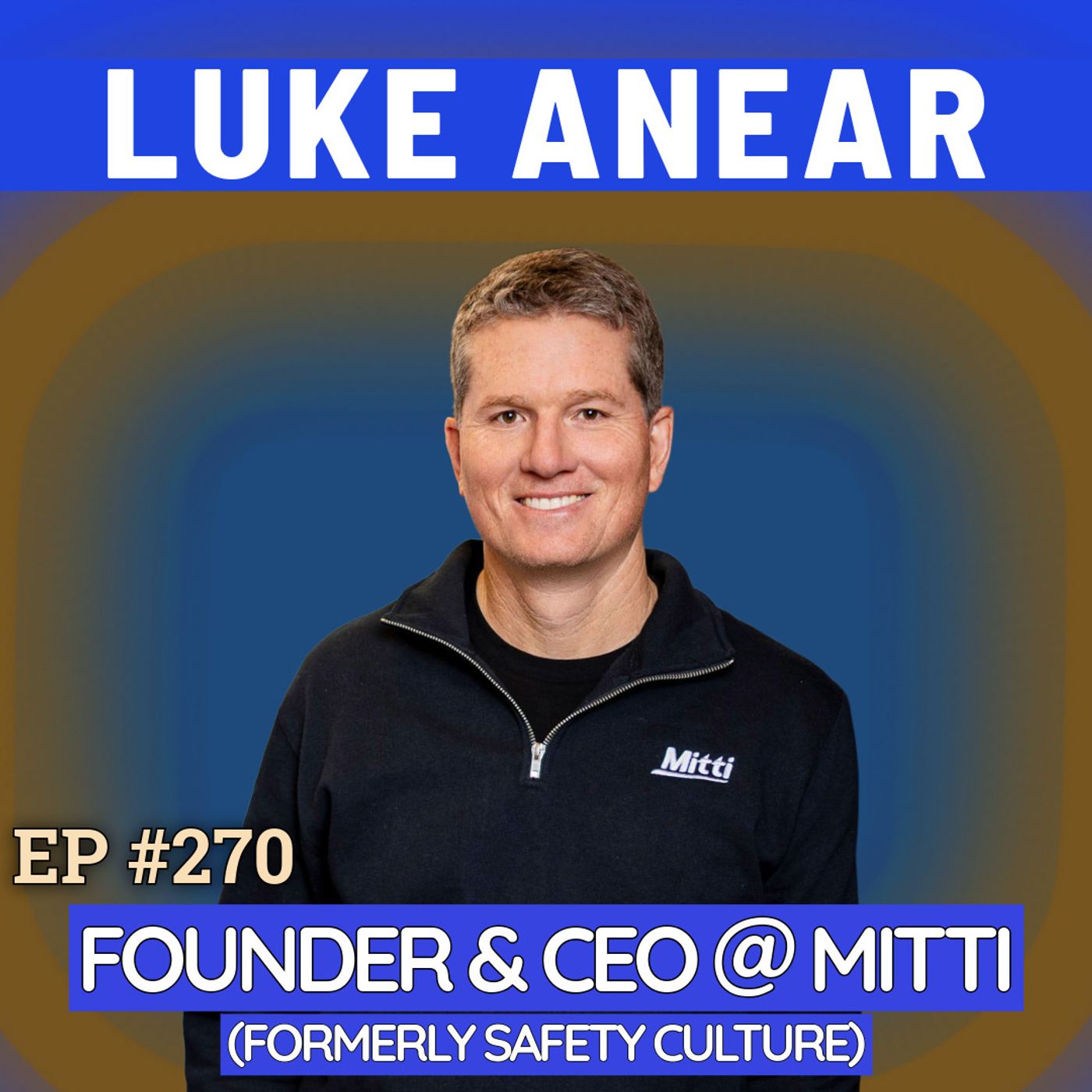
Luke Anear (CEO of SafetyCulture, now MITI) discusses burnout and returning to the CEO role, rebranding from SafetyCulture to MITI, and how AI is reshaping product building, vertical expansion, and an insurance “virtuous loop” (prevent claims, manage assets, price premiums).
Luke Anear is an Australian tech founder/CEO. He grew up in South Australia and Queensland, commutes between Queensland and Sydney, and has run the company since starting it in 2004 (renamed SafetyCulture in 2007). He previously built and failed multiple businesses (e.g., trolley locking system, glass recycling, a gym, photography studio, private investigation).
Written by AI. May contain mistakes.
Luke Anear discusses the reasoning behind the company's rebranding to MITI.
“And so we've finally done it now and we feel really good about it.”
Luke shares insights about his childhood, where he was born, and his first job experiences.
“Hey friends, welcome back or welcome to the High Flyers podcast, where we do reimagine a high flyer, showcase the brightest and most relatable role models and companies and their journey from sunrise to today.”
Discussion of Luke's diverse work history and entrepreneurial ventures before SafetyCulture.
“Where were you born and where do you live now?”
Luke highlights the story of Chuck Feeney and his philanthropic efforts.
“I've been told you had 18 jobs before you started a safety culture.”
Luke reflects on his childhood experiences and lessons learned from various business attempts.
“Let's wind back the clock and spend a bit of time in your childhood.”
Discussion on Luke's personality growing up and how he was perceived by teachers.
“No, my parents were not entrepreneurs at all.”
Explores the guest's unconventional education and early interests, particularly in sports and running.
“the sales process is quite straightforward and people will pull you into their business.”
Discusses the challenges faced during the Tough Man Challenge and how they shaped the guest's mindset.
“So, I mean, I always like asking guests if you think of age 18, because you've got some understanding of the world, right?”
Shares the story of how the guest's mother bought a local business and the eventual transition to Safety Culture.
“I was always told I was not a smart kid kind of because exactly like you, I didn't fit into the school system.”
Reflects on the key milestones and transformations in Safety Culture's development over the years.
“It really spoke to what we did for quite a while.”
Discusses the impact of venture capital on business growth and the importance of timing in fundraising.
“I've had one in tears on the phone a while back saying how this had given his life a purpose that he hadn't had before.”
Discussing the importance of venture capital while emphasizing caution in its timing and valuation.
“Like you've been around this game long enough and you've realized the VC hamster wheel doesn't solve everything?”
Luke reflects on his return to leadership after stepping down and the lessons learned during the transition.
“And, you know, when Kelly Voss, who I know you've interviewed before, he was employed, he was coming on as president out of the US.”
Luke shares advice on what to consider when transitioning to a new CEO, emphasizing communication and support.
“I think in the past I just spread myself thinner and tried to do a bit of everything and over time just did a worse job of all of those things.”
Exploring the difficulties of scaling a business too quickly and the impact of COVID-19 on operations.
“I don't know that I'll do too much differently because like we didn't go to market and look for a CEO.”
Discussing how customer fatigue arises in a crowded marketplace and the importance of understanding customer needs.
“It's not necessarily easy but it's easier and particularly software that scales is still complicated and you still got to have the right infrastructure and still got to build things the right way.”
Luke reflects on critical business decisions made before COVID and the lessons learned during that turbulent time.
“And you go, no, that's not right for Mitty, I should not do that.”
Discussing the changes in product management strategies and the importance of adapting to new methodologies.
“And so I think for us, we grew too quick.”
Exploring how AI is transforming product development and enabling more innovative solutions for customers.
“Starting up an insurance business, expanding to new markets, It's scaling a big company that's a big ship now, to use your metaphor.”
Learn how AI is reshaping business models and customer engagements.
“for five years um we see all the things that go wrong we help them avoid it um it becomes a full loop.”
Explore the shift from horizontal to vertical business strategies.
“Opus 4.5 came out, they could then hold a million tokens or around 750 ,000 words in its memory and stay focused.”
Understand the importance of cultural nuances in product localization.
“But when you're talking about the way businesses operate in different countries and different markets, we probably weren't able to localize as well as we now are able to.”
Discover what metrics indicate success for a SaaS business in the AI landscape.
“into those markets I think has been really important.”
Examine the evolving role of CEOs in the fast-paced AI business environment.
“Like, you know, people don't wake up in the morning and say, oh, let's swap out our operations platform.”
Learn how to assess and redefine company strategies for better alignment.
“Some of the recent conversations I've had on the podcast with a lot of the big AI native companies, think of like the Decagons and the Lagoras and the Vercels, and I've had their founders or their CEOs on.”
Learn how innovative leadership can redefine business strategies.
“And people say, dude, step back, just give us autonomy.”
Discover the benefits of stepping back to reflect on leadership roles.
“Did you have people you spent time with during that break that made you reflect on that?”
Understand how to manage team dynamics amid industry changes.
“Again, back to the CPO role that you kind of are doing de facto, what are you saying to the engineers and the product managers where there's obviously a bit of uncertainty?”
Explore personal insights on leadership strengths and insecurities.
“I messaged some of your board members who I know really well, whether it's Craig or Kel or one of your early investors, Rick.”
Learn how storytelling shapes personal connections and experiences.
“Like usually you get someone who's quite strong one way or the other and they're pretty weak on the opposite.”
Discover the connection between photography and aviation from unique vantage points.
“When they're little, take them out of school and they'd do their own.”
Understand the upcoming goals for MITI and the integration of business operations.
“And, you know, I did my first helicopter lesson in 2012.”
Explore the potential of satellites and imagery technology for business insights.
“early 2000s but yeah I think reading getting access to to other people's stories and how they think has always been a consistent hobby I think and a good way to get outside information.”
Gain insight into effective hiring practices and understanding people's passions.
“Yeah, they're one of only two providers actually getting satellite imagery globally apparently.”
Reflect on key insights and personal anecdotes shared during the conversation.
“There's no point arguing with people on the road.”

Get the gist, explore an idea or ask about something said.
 Claude
On The High Flyers Podcast with Vidit Agarwal, what are the key points of this episode?
Searching your listeningAutomatic transcript. May contain errors.
0:00Hi, I'm Vidit, the founder and host of this podcast, The High Flyers.
0:03Luke Anear: Hi, I'm Luke, the CEO of Safety Culture, which is now known as MITI. Big news. I think, yeah, you just announced that and you're back in the chair, Luke. You're back in the chair after 14 months, is that right? Yeah, this has been probably the busiest time of my whole life. The last four and a half, five months I've been back. I've probably made more changes than I did in the previous 10 years that I was here. And yeah, I think it's an exciting time to be building product. And the company name change is not actually a new problem. We've been told for 10 years that customers use us for so much more than safety.
0:38Luke Anear: They use us for operations across their whole business. And we tried to change our name back in 2019 and we didn't end up with a name we liked. And so we've finally done it now and we feel really good about it. Well, why don't we start there? Tell me the story behind the name change. We were just joking that in different languages it has different meanings. How did you settle on MITI? Yeah, look, to get a short name these days that doesn't infringe on any trademarks and that you can also get.coms for is actually quite difficult. And so we wanted something shorter, something that was catchy that we could build a narrative around and also if we added extra words to it like our MITI insurance or our MITI marketplace, it's not too many words.
1:20Luke Anear: So the problem we have with safety culture was, A, we get pigeonholed to being just safety, which we're actually 80 % of our business is outside of that. It's quality. It's improvement. It's all these things. And so to be able to break away from that, have a short name and something that doesn't necessarily have a connotation, I guess, that people automatically go to. You know, in Hindi, it means soil or earth and there's some other definitions around the world in different languages where it's sort of middle or center. So all of that kind of worked for us. But we already own the name MIDI. We'd used it years before in our insurance business.
2:00Luke Anear: So in the end, it was a straightforward decision. I like it. Hey friends, welcome back or welcome to the High Flyers podcast, where we do reimagine a high flyer, showcase the brightest and most relatable role models and companies and their journey from sunrise to today. As one of the premier products in our Curiosity Center lineup, providing on-demand intelligence to help you be 1 % better every single day. I'm your host, Virita Aguil, and let's have some fun. Our listeners have called this podcast a meticulously researched biography unveiling the extraordinary lives and decisions of the most remarkable individuals and companies from around the world.
2:44Luke Anear: We hope you're enjoying our catalog of 200 plus episodes since we launched in 2020 with many of our guests appearing in rare public interviews. It's now time to explore your curiosity. Please enjoy. Let's set the scene with some fun facts to get us going. Where were you born and where do you live now? I was born in Mount Gambier in the bottom southeast corner of South Australia where it's very cold and I guess we're constantly growing up with AFL and Australian Rules Football. And now I live on the Sunshine Coast in Queensland, which is where I spent sort of second half of my childhood was up in Townsville in Queensland.
3:22Luke Anear: And so now that I live back in Queensland, it's kind of brought me back home again. And am I right in understanding that you commute to Sydney every week? Yeah, so I'm often sort of down here Monday to Friday. Just depends. At the moment, I'm here for a few weeks. So yeah, the majority of my time is down here now. That's amazing that you haven't actually moved to Sydney. You've been running the company for what, 12 years? And you haven't actually moved full-time to Sydney. Is that right? I did. In 2017, I moved from Townsville to Sydney for three years. And then 2020, I moved back to Queensland.
3:52Luke Anear: So I guess at the end of the day, I'm a country lad at heart. And the big cities are great. There's lots happening and there's plenty to do. But I also love, you know, just the nature and having space and time to think. And I tend to gravitate towards more regional areas than necessarily the metropolis. Nice. And work, what was your first job and what do you do now? My very first job was working for a palm farm, digging out palm trees north of Townsville. But that was only for like a few months. And then I worked at a petrol station. That was like the first real job, I guess. $4.20 an hour I was on.
4:31Luke Anear: So I get about$160 at the end of the week. And today I'm CEO of MIDI, which is a global tech business that also has an insurance business. We also supply all the PPE and wearables and things that people wear and monitor temperature of food and telemetry off vehicles, all sorts of stuff. So that's my job today. I've been told you had 18 jobs before you started a safety culture. so maybe you can tell me a bit more about that as we chat. And Luke, as you know, the purpose of this show is to reimagine the concept of a high flyer, to go beyond just job titles. Is there a person you know who you feel hasn't got the recognition they deserve?
5:07Luke Anear: Probably Chuck Feeney. Have you heard of Chuck Feeney? I don't think so, no. Chuck Feeney started Duty Free Worldwide and then gave away$8 billion on the condition that no one revealed where the money came from. and so he gave away the majority of his wealth and uh it was never to be revealed and uh until an actual court case in in uh in the u.s in new york um meant that it had to get revealed and uh then they wrote he wrote to his foundation wrote to everyone and uh said you can now reveal where the money had come from but he'd given away eight billion dollars uh on the basis that it'd be matched dollar for dollar by some other funding from government or elsewhere.
5:51Luke Anear: So, yeah, he ended up doing a lot for a lot of people, and most people have never heard of Chuck Feeney. That's so interesting. And you've met him, I guess? No, I haven't never met him. Okay, right. But General Atlantic is the fund that he set up. Ah, right. And so a lot of people know General Atlantic. So General Atlantic came from Chuck Feeney from Duty Free. Interesting. That is so interesting. I came across him when I read a book called The Billionaire Who Wasn't because he was never written up as a billionaire. No one really knew him as a billionaire. And, yeah, at the end of the day, or sorry, the other way around, people were saying that he was a wealthy guy.
6:30Luke Anear: But, in fact, he'd given it all away. I think in 1984, he'd signed it all over to a charitable trust. So, yeah, it was a cool story. That is so interesting. I recently went to the Getty Museum in L.A. And he's the kind of opposite of this guy. Getty wanted all the fame and all the tropes of success and he built all these museums around the world. So, yeah. Yeah, I guess people want recognition in different ways. Back to the episode in a moment. Something I've heard a lot from business owners and leaders is that speed only matters if you still feel confident in the output. And it's particularly an important point in this world of AI.
7:09Zero's answer to that is accountable intelligence. AI that shows you what it's doing and works from your own real data and is designed to keep you in control before anything happens. As Xero puts it, most AI asks you to trust it. Accountable intelligence shows you why you can. And that's how it works with Jaxx, Xero's in-platform AI finance partner. So whether you're running the business, advising the client, or working with your board, Jaxx ensures that you get the upside of automation without giving up any of the control. If you want to see this practice, head over to xero.com forward slash highflyers for 90 % off your plan for the first six months.
7:52Terms apply and go to the website. That's xero.com forward slash highflyers. Now back to the episode. Let's wind back the clock and spend a bit of time in your childhood. And this is interesting because you've touched on this in interviews over the years. So I tried to pull out a few new aspects. I joked earlier about 18 jobs. Is that true that you had 18 jobs from 14 till safety culture?
8:17Luke Anear: Yeah, jobs slash businesses that I'd started. So a lot of them were failed businesses. I had the rights to a trolley locking system that could be installed in shopping centers to lock the wheel of shopping trolleys so they didn't end up all over the streets. I spent 10 months trying to get that off the ground in Australia and sleeping on my mate's couch and never ended up getting a single sale. And fast forward 15 years later, nearly every shopping centre in Australia has that system, the exact same system. So the right idea at the wrong time in that case. And there was just, yeah, lots of other businesses and things that I'd tried.
8:55Luke Anear: Townsville Glass Recycling was my very first business when I was 16 years old. I'd go around all the nightclubs and bars and collect all their glass and their empty wine bottles and spirit bottles. And then I'd put them on a train to get sent to Brisbane. and then I had friends from school helping me out in the afternoon. So I think I was costing about$400 a week to run that business and I think I was getting about$250 a week back in class payment. So, you know, that was great lessons. I was a 16-year-old. It was fantastic. So, yeah, there was lots of things that I tried over time that ultimately didn't work out.
9:30Luke Anear: I had a gym on the Central Coast of New South Wales called Ultimate Fitness. There was about 450-odd members there. there was a lease I had and again after about nine months I couldn't make that work that I found out after I took it on that the previous two or three people had also gone broke there so I guess I learned a bit about due diligence at that point but uh yeah so many things you know that I tried to do I had a photography studio filming uh everything or photographing everything from weddings to commercial stuff up in Townsville and uh obviously I was a private investigator I had my own private investigation company at one point as well.
10:07Luke Anear: And what else? Oh, so many things. We built a software training platform to train people that never took off. I heard you had a boxing ring. You tried setting up a boxing ring at one point. Is that true? Yeah. So I did a tough man challenge in Darwin. I was living in my car for a month and put on a no-rules boxing competition, something I knew nothing about and had never even seen before. but I wrote down a goal at a Tony Robbins seminar in 1997. I was 20 years old and I wrote down a goal to make$40 ,000 somehow in one month and I had no idea how to do that. I came up with that idea and went and slept in my car, drove to Darwin and put it on and told the media about it and 1 ,509 people paid through the gate.
10:59Luke Anear: and I made$42 ,000 profit in one night, took in$64 ,000. It cost$22 ,000 to do it. So, yeah, it was a pretty valuable lesson at 20 years old. Where did that personality come from? Do you put that down to your parents? Were they entrepreneurs? No, my parents were not entrepreneurs at all. My mum, who raised me for the most part, she, I think, had a pretty utopian view of the world and people. She was very optimistic and somewhat naive, I think, as well, which is a good thing for the most part. And I think I adopted a lot of that. I probably assume the best, believe anything's possible, and then silly enough to actually go and try and do it.
11:45Luke Anear: And so I think a lot of that came from my mom, but not because she was an entrepreneur, just because she believed in me. She believed that, I guess, there weren't really limits to what you could doing life and uh i remember she got into amway mom was always into stuff she got into amway which is like network marketing 101 it's the tupperware stuff right yeah yeah yeah it was it was like um home cleaning products and stuff and uh i've i went along to one of these things when i was like 14 years old and they had books there they were recommending people and i remember the first book i picked up was how to win friends and influence people by dale carnegie and as a 14 year old i was pretty impressionable.
12:27Luke Anear: I thought, wow, this is really interesting. So I think that probably also introduced me to just people who'd done successful things. I've read a lot of autobiographies after that and wanted to study what success looked like and what people had done that had worked and what had failed, what they'd learned from their failures. So I guess it was a quest that started around that age of understanding people and business. And then I was very fortunate. My first real job was with a local businessman in Townsville by the name of Bill Smith. And he was very good at just teaching me the fundamentals of business.
13:04Luke Anear: And that was not something I'd ever really learned in school. So yeah, that helped. It sounds like my parents, I always say my mom's the believer and dad's the pessimist. Dad always thought I wouldn't do much in life. And mom always said, you can, like I'll help you out. So it sounds like maybe you had elements of that. Yeah, yeah, perhaps. it's a good thing. I reflect back on it a lot. Yeah. Tell me about the personality growing up because now you and I've spent a bit of time. You're a confident guy. I always joke someone could put you in a room and you will convince that room to buy your product.
13:35Were you like that as a kid? Your high school teachers, how would they have described the young Luke?
13:40Luke Anear: I don't know. First of all though, I think it's interesting you say if you put me in a room or convince people to buying a product. I've always thought about making great products and then make it easy for people to want to buy them, but I've never been much of a salesperson. So I think there's a distinction there that's important. I think if you build great products and find a need for them, then the sales process is quite straightforward and people will pull you into their business. They want what you have as opposed to trying to educate a market that they should buy from you. So I've always thought that's quite an important distinction um what was the first part my how teachers and stuff saw me um i i was probably i struggled with the school system i think and uh early on grade one grade two i remember you know finishing the year's maths books by sort of you know maybe april or something like i was just i took to maths and and really uh found that fun and easy and then writing as well I used to write quite a bit pretty early but I can remember by about grade four I was kind of over it and I probably wasn't the best student so yeah I think teachers would probably say I was I was you know what they would call today ADHD kid that didn't have a whole lot of discipline or focus at the time probably but I had sport I could run from a really young age from about the age of 10 or 11, I could run.
15:10Luke Anear: And I think that helped as well. And the mental discipline of running, particularly 10 kilometers, like I'd run 60 kilometers a week at the age of 11 on the road. And I don't know, there was something about pushing myself and running that I think translated into other parts of life. Oh, wow. That is incredible. And he's told you that now. I mean, now you fly. So you've kind of gone from running to flying. my knees unfortunately um they're not in the best shape my meniscus on both knees i've had had uh had surgery and stuff and i can't run any more long distances so uh yeah it's unfortunately not something i get to do much these days but you know tennis and things like that i try to stay active and can ride a bike and stuff so yeah but um i remember though you know the the kind of moment when i was probably 12 years old i was thinking i ran under the australian record for 800 meters and I remember then thinking like there's something different about you know what I was doing that most kids were struggling with and and uh I guess that served me a lot going forward because I was used to being in unfamiliar territory and and um I never was one to really just conform or or go along with the status quo if it didn't make sense I mean with all these experiences when you so did you finish high school though right you didn't drop out grade nine was the last report card I got.
16:35Luke Anear: I hung around in grade 10, but I didn't sit any exams. I was fishing down the river when the exams were on. And then I did the first term of year 11. And then I went and worked. There was no point at that stage. I think I'd been to eight schools by grade 11. So mom had moved around a lot. And every time we moved, even in Townsville, she would move me to a different school. And so, yeah, I'd been to a lot of schools. My education was pretty disrupted and I probably just wasn't the best student either. That is so interesting. So, I mean, I always like asking guests if you think of age 18, because you've got some understanding of the world, right?
17:14But with yours, that's so different because you kind of experienced so much of real life business from the age of what, 12, you said, to the age of 18. So maybe the question is, which of these businesses best prepared you for safety culture?
17:28Luke Anear: The tough man challenge, like living in my car with no money, with no certainty, no real expertise in what I was doing and to wake up each day and have a little voice in my head saying, this is crazy. What are you doing? And ignore that and keep going. And then to pull it off, you know, a month later to achieve a goal that I'd set, which was a ridiculous goal. I was earning$800 a week as a private investigator, a trainee private investigator when I was 20. And so I set this goal to make 40 grand a month. And so there was just no logical way to do that. And I think that has served me more than anything else in my life because to have just the clothes I'm wearing and walk out in the street and know that I'll figure it out, to have that sort of belief, I guess in myself is something that has served me time and time again and then also the power of setting big audacious goals like if you don't set a goal to go after then you know you're definitely not going to hit it and so you know it's the old saying Wayne Gretzky you miss 100 % of the shots you don't take and so yeah I think for me that experience is something that I've thought about over and over again and and the feeling probably more than anything of uncertainty the feeling of not knowing what is going to happen today and still stepping forward and taking it on and showing up um yeah even some days building this company all i could do was show up i didn't have anything left in the tank and um you know i think sometimes that's that's enough though that's if you do that you'll figure it out if you don't show up then it's very hard to figure it out so So I think the Tough Man Challenge is probably the one that's shaped me the most out of all.
19:22I always joke in my own story that early on I had a lot of rejection as a kid. I was always told I was not a smart kid kind of because exactly like you, I didn't fit into the school system. I've always been a practical kind of guy. I've never been a bookie, theoretical person. And now I look at it and I speak to my mates and I go, I'm very happy with rejection. Like I don't look forward to it, but if I get it, I go, that's fine. I'm going to start at that point. That's my default starting point to rejection. So I've got to work my way up from there. And maybe that's why you're a founder and I'm a founder because I just don't wait for anyone.
19:54And I go, I will just, even like cold emails, people go, why would you send a cold email? I go, why not? If I don't send it, I don't know if that person is going to respond. So I'm just going to send it.
20:02Luke Anear: Yeah, that's true. Yeah. Yeah. Tell me about the starter safety culture because I've been told a guy, Wade, is that his first name? He was one of your early mentors. and was it called the Wade's business, pre-safety culture? Tell me that story. So Bill Smith, who had the service station I work for, he had a son named Wade. And so he created a business called Wade's Distributors in Townsville, which was the local castor oil distributor. And my mum, I ended up getting my mum to buy that business for$28 ,000 with her superannuation from when she worked at Telstra. And she bought that business. She got a forklift, a little truck and some oil that she knew nothing about.
20:42Luke Anear: and I said, don't worry, I didn't know anything not that long ago either. And she built that into actually a decent business in Townsville called Wade's Distributors. And so when I went to start producing safety and training documents, I thought, well, everyone knows Wade's Distributors in Townsville. And this is back to setting big goals. The biggest goal I thought was maybe one day all the businesses in Townsville would use what we were selling. and so I thought well everyone knows the name Wade's Distributors around town because they deliver oil to places so I should call this business Wade's Business Solutions and they'll you know it's a sister company to Wade's Distributors oh that's great well we quickly outgrew Townsville and very fast you know ran into people that had no idea about what the heck Wade's Business Solutions was or anything else and so that was my first experience in you know not getting a name right, I think.
21:40Luke Anear: And three years later, I changed it. That was 2004, 2007. I then changed it to Safety Culture. And that was a great name for many years after that. It really spoke to what we did for quite a while. So you've been full-time at this since 2007, so nearly 20 years. 2004. 2004 is when I started it and then changed the name to Safety Culture in 2007. I mean, let's go back and forth here. So we're now in 2026, August 2026. if you had to restart safety culture today from scratch how would you start it that's interesting question um because we always always think oh well you do it faster and and i think the decisions that we make uh i'd probably be able to make them quicker and faster but it's it's funny everything we've got to everything that's brought us to this point has been built on all the things that have happened before and the way we've solved these problems you know whether it be the way teams work across all these different industries or even the industries that we ended up solving for um none of that probably would have happened if we hadn't gone through all the things we went through and so you know if we start today obviously you'd make it an ai first play which is now what we've built the company into but um i don't know it's we're an insurance business we're a software business, we're a consumables and wearables business, we've got a pretty big opportunity.
23:06Luke Anear: So I wouldn't change too much. We just need to execute and get the best people we possibly can to realize the vision. It sounds like you're saying the process is still the same, right? Even though today it's AI and back then it was SaaS and cloud and whatever else. Tell me about like when you think of, let's call it Safety Culture 1.0, now you've got MITI, so sc 2.0 when you think of the 1.0 journey what were the key moments that you take take into the second part of the business today like were they key let's start with the highlights what have been the key highlights in the last 12 14 years pre the name change building our first cloud like we we didn't have a cloud when we started so this is before cloud was a thing and we had customers losing devices working on rooftops of buildings and i would say oh where's it all backed up and And Al and I were in the garage saying it's not backed up anywhere.
23:59Luke Anear: So I think when we built our first cloud, I think that really, I guess, was a pivotal point. And then obviously taking funding, that changed the trajectory of the company. And if I was to change anything today, I would probably not have taken funding as soon. That's probably one thing I'd do differently. Can we double click on that? Yeah. Tell me more. I think bootstrapping it as far as you can is a good thing. But then it becomes a point where the way that you're thinking about the problem may be not big enough. And that's where external people can help. The capital and the resourcing thing today, you can build a company cheaper, particularly a software company, cheaper than ever.
24:44Luke Anear: And even a physical goods company, the distribution paths now are much easier to utilize than ever. costs I guess in in a lot of ways had gone up but what I would think is is if we were going to build it today we'd build it in a way that you don't need to take a lot of capital and you'd get the customers to validate the business by paying for the product which then can fund more growth and I'll do that as long as I possibly could yeah we sold 2 million or 28 percent of safety culture for two million dollars in that first round wow and i rolled in the original docs business which was doing about 800k a year on a 70 margin um like yeah i i think the longer you can go it alone the better but then recognize where your limits are and then time it you know when i met my canon rooks and scott farquhar who were part of the blackbird investment i realized really quickly that these guys had been doing it for a decade already they were further down the line and and could offer insights that would help us and so you know townsville wasn't the epicenter of the tech world and so meet those guys and to get the experience from them through blackbird i think um i think it was you know a life-changing experience for for us back in those days so that was really good and then i think that the highlights would be more the customer stories The customers that have shared with us how they help us or how we help them do their work each day and go home and gives their work a sense of meaning and purpose.
26:26Luke Anear: We get customers that contact us. I've had one in tears on the phone a while back saying how this had given his life a purpose that he hadn't had before. You know, we've had lieutenants in the fire department come and join us and work for us because they felt it was such a good purpose and they could see the impact it was having. So, you know, we save people's lives every day. We work in a business that actually makes a really positive difference in the world. And we take that responsibility seriously. And it's something I think everybody here feels and is proud to be part of. and perhaps some of the other parts of the tech industry maybe haven't got the same motivation behind their work and we're fortunate that we do.
27:14Luke Anear: So it's a really nice thing to hear from customers about how we help them do their work each day and what that means to them. I want to double look at that in a second. On the fundraising point, it's really interesting you have that reflection because I feel most founders, like you could almost say you're a second-time founder, right? Not second time, you're a 50-time founder. But like in this safety culture, meaty scenario, you've come back as a, you're kind of doing it in life too now, right? I've noticed that it's a trend with every second-time founder where they are reluctant to take VC and they don't get absorbed by the Kool-Aid.
27:47Whereas any first-time founder I speak to, they go, I want VC tomorrow because I want that social validation that comes with that. But as you know, disappears overnight. Like that, you might get a newspaper article tomorrow. the next day no one cares. Is that part of it as well? Like you've been around this game long enough and you've realized the VC hamster wheel doesn't solve everything?
28:08Luke Anear: Oh, look, I think there's a role for venture capital, an important role. So I think to be able to accelerate growth, then venture capital is one of the best ways to do that. So I wouldn't knock venture capital per se. We've benefited from it considerably. I would just say delay it as long as possible. I think that's my message. Taking too much money or too early can cause other problems. And too high valuations. I think we did a very good job of managing our valuations. When other companies were accepting big valuations, we were saying no to them simply because we wanted to make sure that we could grow into whatever expectations were set in a reasonable timeframe, 18 months after the funding.
28:49Luke Anear: Whereas I think I've seen other companies take valuations that years, four or five years later, they're still nowhere near growing into and it hurts them and it hurts the shareholders and the employees. So I think, you know, there's some of the lessons, but, you know, I came back fresh. Like I didn't have an 18 month break. I was gone. I said I've had enough. And, you know, when Kelly Voss, who I know you've interviewed before, he was employed, he was coming on as president out of the US. And when I decided I wanted to step down, he was the person I rang and said would you be willing to take it on from New York which was a big ask and we both knew that but um you know he um he took the job on and um you know understanding that he had a family in New York he was never going to move to Australia that was that was never part of the deal between us and so when the AI wave came through and everything else it made sense for me to come back but I was I was fresh like I wasn't you know thinking I've got a a time period that I'm not there and then I'll come back.
29:51Luke Anear: I was thinking, well, I'll be the exec chair and continue to steer from that point of view. But yeah, so when the board sort of said to me, I think you need to come back and we've talked about it, I was ready and I had an idea on how to do the job better than before. I think in the past I just spread myself thinner and tried to do a bit of everything and over time just did a worse job of all of those things. So now I came back and said, look, the exec team can run the day-to-day. I'll lead product strategy and the vision and not get distracted with the day-to-day million decisions that have to get made to lead a team and keep a company going.
30:35Luke Anear: So I think I've had a different approach to the role this time, which has been great. Since you brought it up, let's go into this. I recently interviewed Caroline Rowlandson, who's come in as the CultureRamp CEO. Didier's moved on. and I did a lot of research for that. I mean, BlackPitter are a big investor there as well and most people said that was the best transition they've seen. And I mean, time will tell, they're still six months into it and hopefully it doesn't end up badly, but it seems to be the foundations are set. If you could do the transition again or say I reached out to you and said, Luke, I've got a business that is as big as yours and I want to, I think the time's right for someone else to come in and take this to the next stage.
31:13What advice would you give me? Like what are things that you could have maybe done differently in hindsight?
31:18Luke Anear: I don't know that I'll do too much differently because like we didn't go to market and look for a CEO. So it wasn't like we went and canvassed everyone that was out there. I simply offered the role to Kelly and he accepted it. So, you know, I think if someone wanted to do a search where they're going to go and find someone and they don't have a candidate, then, you know, you'd be looking for someone who's a builder and someone who can take the vision and build on top of it and not just, you know, be iterating, you know, in a small way. You want step changes still to happen. And so I think that's important.
31:54Luke Anear: And, you know, I wanted to make sure that I wasn't, I guess, in the background, you know, working on to work with Kelly and through Kelly. So I think that I would say anyone should do that. I'd say to the exec team, if you ever have an issue, you go to Kelly, you go to whoever the CEO is on the day. You don't want them going back to the founder for stuff. And so, you know, I think they're the sorts of things you want to get right. Otherwise, you know, it makes it harder for that person to be successful. So I think being clear about handing over and giving them the opportunity to succeed, I think, is really important.
32:33Luke Anear: And I will hand the reins over again. I don't expect I'll be here for the next decade. I think I'll land the AI plane and help the company transition, the rebrand and all these pieces to the puzzle. The insurance business now stood up in the US. It'll be in the UK next year. And then I'll look to find someone that loves being a CEO and all the things that come with it. At the end of the day, I'm still a pretty simple person. come out of Townsville and I didn't do this to try and be a CEO or even make heaps of money I just did it because I want to solve a problem so um you know I think there's probably better CEOs than me um out there um and um in in the meantime uh I think we just need to keep innovating and I'm pushing the team hard and we've made lots of lots of progress on that front we've got a lot of products in market in the last three months because we don't have to write every line of code anymore and that was the challenge I think for the last 10 or 15 years was everything had to be manually done and it meant that it was resource heavy and so I think now it's much easier to build software.
33:44Luke Anear: It's not necessarily easy but it's easier and particularly software that scales is still complicated and you still got to have the right infrastructure and still got to build things the right way. What I'm seeing, I'm curious if you agree with this, what I'm seeing is that it's very easy to start a business now or launch a new product, but it's really hard to stand out because it's just so much noise. Back to fundraising, the amount of ideas that are being funded at the early stage that I think are coming into a traffic jam and they will not get to any scale. How do you, again, we jump around.
34:19How do you not get caught up in the noise where you look at someone else doing something or you speak to another founder friend and they go, hey, we're trying this. And you go, no, that's not right for Mitty, I should not do that.
34:30Luke Anear: Well, you need to know the problem you're solving well. And I think that's what guides you is your customers and the challenges they're having and how we best solve them. And so, yes, there's lots of people now spinning up businesses, but I think that adds to customer fatigue, like customers getting fatigued with all these different platforms and things that get thrown at them. And so it's getting harder for them to know. I had someone the other day looking at an aviation platform and it ticked all the boxes from the outside but it's two people sitting somewhere without any experience in running aviation platforms and the infrastructure behind it was not solid.
35:09Luke Anear: Do you want to put your airline onto that? And so I think you'll see customers getting fatigued and those that businesses that have a customer base or can leverage others really well will be the ones that get traction I think because it's going to get harder and harder for people to try and win the attention of customers. Tell me about the period pre-COVID. A lot of the founders I've interviewed on the show, they talk about that period being a make or break moment. And I spoke to some of your team, I won't name who, but I spoke to some of your team prior to this and they said, yeah, that was a big reflection point for you where if you could do things differently, you maybe would do that period differently.
35:46And I think you're not by yourself. I think most founders would say that. Curious if you could reflect on that period pre-COVID.
35:51Luke Anear: is that brian swift you spoke to probably who i'm thinking of but he um look i have my sources he was in the trenches with us he's back here now um it's great we acquired quite his company earlier this year but uh 2015 to 2018 we went from like maybe 25 people to 300 odd and it was crazy we'd open sydney office just hiring as many people as we could we had people who didn't know how to do a job well, hiring more people to do their job. It was chaos. And so I think for us, we grew too quick. We didn't know how to scale a team. And you got everybody sort of cheering you on, venture capitalists, giving you plenty of capital and everyone saying, go, go, go.
36:36Luke Anear: And so that's what we did. And I think it's not unusual to have those growing problems because then you you figure it out and um yeah and then we had covid up and then the whole world was growing to a halt but some of our customers went some went to zero like airlines and cruise ships they went to zero but then distribution centers where all the packaging and and and um uh supplies were going through they went through the route because if they had anyone there with covid they would get shut down and so they were rolling out safety culture everywhere so um yeah that was a crazy crazy time for sure and um yeah it was it was a tough time for us yeah tell me what people say you're the de facto cpo of the company right and i think that's the founder's job like you just you said earlier you don't think you're the salesperson you're the product guy and i think everyone verified that when i spoke to blackbird folks or your team or even some of your investors today they all said yeah luke's the the cpo of the company you know you know unofficial capacity i don't think that's your title on your email signature but that seems to be the role you're doing.
37:39Tell me about that journey.
37:41Luke Anear: Titles are for books. I've never worried about titles too much. Great. Great. You're the boss. You know that. You're the boss. Tell me about the product journey. If you compare that period to now, and let's get into the weeds a bit, because I think you're right. You have expanded into all these verticals, which is part of the name change. You make it sound really easy. That is not easy. Starting up an insurance business, expanding to new markets, It's scaling a big company that's a big ship now, to use your metaphor. How do you think about product building? Talk about pre-AI and today with AI.
38:12What are the fundamentals of good product?
38:15Luke Anear: Well, I think the good product piece is all about solving a problem for enough people that it becomes valuable. The method, I guess, has changed dramatically. So some things have stayed true and some things are gone. And I'd say what's gone is the old method of go and do customer research, then go and sit down with a designer, come up with some user experience designs, then go and validate that with customers, then go and meet with engineering managers to think about how they're going to build it, scope it up, give it timeframes. Then we go back. This whole process, like it would go on for weeks.
38:52Luke Anear: That is all gone. now you can take an idea on how to solve a problem build a prototype in minutes hours maybe refine it over a couple of days if it's really well thought through and then you've got something you can validate with customers and see if it actually solves their problem and then you can start building it for production scale deployment and so that time frame is compressed dramatically and so what we can do with the resources we have is much more than before and we can solve bigger problems like we were like at the end of the day we were an inspection checklist app that was our bread and butter and um as we now solve training for customers as we manage their assets for them yeah just the idea of building uh scheduled maintenance for an asset like that is a difficult thing to do pre-ai now it's much easier to do it's still hard but it's much easier particularly when you have a customer base that you can give that product to and they start using it so you know we can go deep into these industry verticals we build now you know for restaurants we used to give them inspection templates for checking their restaurant each day now we can help them manage all their inventory we can help them keep track of you know three grams of mayonnaise that goes on every burger and four grams of pickles like that comes off their inventory and integrate it with their point of sale system we never did any of these things before we never integrated with other other platforms very well um we didn't need to you know we got a lot of data three and a half billion images all manually taken all labeled uh billions of data points that people would check and so we have a very unique data set and uh before ai trying to make sense of that unstructured data was actually a pretty big job it was hard now we can actually synthesize a lot of information way quicker um we're giving customers for the first time a five-star rating so we can now tell you what great looks like we can tell you what you need to do in order to improve we never did that we just gave people a circular workflow that was based on activity if you do more checks each day on your trucks or your airplanes then uh that must be better but we didn't actually tell you what great was and so this is now all possible so you know the my vision on the wall here that's you know sort of the 10-year roadmap we're now finally able to build that out whereas in the past we were kind of biting off a piece and 18 months later we would deliver it and maybe it was good maybe it wasn't now we can move much quicker and um and just solve industry vertical problems instead of generic problems and we solved 80 of customers problems but never 100 and um now yeah we released agents on our platform last week so customers can create agents and they've made thousands of agents already where they can build their own compliance agent that looks at the local regulations if they've got food handling standards they have to comply to or if they've got building codes and you know these agents can take all of the local information and um and help them you know get ahead of their businesses so for us to be able to do that and then tie that to their insurance to their premiums um we see we we handle their claims we've been in insurance now for five years um we see all the things that go wrong we help them avoid it um it becomes a full loop.
42:11Luke Anear: It's like the virtuous circle now has come, I guess, to life. And before AI, it was still years away. And it's compressed it, I think, over the next 12 months. And that's why we're, you know, MIDI is a different company, a different brand. It's because now what we can do for our customers is much deeper and much more comprehensive for the business. Just on the 10-year roadmap, I heard in my research that you apparently had that on a cardboard for years and you make people carry it on planes is that is that true well it's here it's all around the office um okay but the original version like you had her on a cardboard and you would actually fly that from townsville to sydney true actually yeah i forgot about that we did we we'd have it rolled up and we'd have it in a cylinder and we'd take it and show people stuff yeah absolutely but now with ai maybe you've got it on your phone and you can just bring it up right yeah but there's something about having it big on the wall it is yeah you know you can point to it and talk to it and take it in, there's a quality to that aesthetic that you don't really get on a screen.
43:13Luke Anear: And so when it's something as important as the product vision, I think it's good to have it large and have it accessible and around the office and places. Tell me about what you were saying before, which I think is spot on, is the horizontal versus vertical. So traditionally, you were a horizontal business for years and now, if I'm understanding correctly, you've become a vertical business, right? When did that realization happen? Was that, again, back to data that you said and you were uncovering customer insights that made you realize these new verticals could be opportunities? Last year, as I was watching AI evolve, and I think February the 5th this year was when Opus 4.5 came out, they could then hold a million tokens or around 750 ,000 words in its memory and stay focused.
44:03Luke Anear: I think once I saw that come along last year and start developing to a point where we could give it bigger tasks, I started to experiment then around the idea of we could build industry verticals now instead of being industry agnostic. And as I started to experiment with it, I could see how this could be really powerful. And, you know, we've got, we treated whole groups of industries as one industry. We called transport and logistics an industry in the past. Well, inside transport and logistics, you've got shipping, you've got aviation, you've got road transport, you've got rail transport. Like we just kind of grouped it all together because it was too hard for us to go and solve all their problems.
44:48Luke Anear: Whereas now we're able to solve specific industry problems and we're just getting the rails in place so that over the next few months customers will be able to come to us just tell us a little bit about their business if they run you know cement trucks in you know um wichita and kansas city and texas uh we can give you an experience that's going to do a pretty good job of helping you manage all of your team and your trucks and your business and so um i think that wasn't possible before where we could repurpose our modules like assets for example so that that could be reused for a truck company or reused for a shipping company and be adapted well enough that it actually speaks to what they're doing.
45:31Luke Anear: So I think we just weren't necessarily great at speaking to a particular industry problem and now we are. And connect that to markets. So you told me the other day that you're in the US, you're in the UK, we talked about India earlier. Which market forced you to rethink the product? Like even in the last 12, 18 months? Yeah, I wouldn't say a market has forced us to rethink the product as much as we can solve problems across more markets better. Like we've been in multi-language, multi-region kind of, we've been in that world for quite a while. So those different markets working in India or South America, that's not new, but it probably isn't localized well enough for business.
46:22Luke Anear: Like if you're doing something simple, if you're building a dating app or whatever, then perhaps it's quite easily localized that. But when you're talking about the way businesses operate in different countries and different markets, we probably weren't able to localize as well as we now are able to. So I think that's changed for us a bit. Is there a market that you had to spend most time in? Again, back to being the CEO and the CPO. Like I hear from a lot of Australian companies where they go, you can't just copy paste, right? And you would know this with the US where Australia, we think one culture, one market, essentially where US, North, South, East, West is very different.
46:59They buy differently. They think differently. They kind of talk differently, even though they speak English. Can you share a story about a market that maybe surprised you or even made you rethink
47:09Luke Anear: your own prize look i think when you look at developing countries like we took some of the team over to katmandu in nepal and we met with the aviation regulators over there and and that had the earthquake in nepal and there was still a lot of work being done there so you know i think um when you go to a job site and everyone's either barefoot or wearing thongs um my first reaction to that is let's get all these guys work boots um but the boss of the site said even if you do that they won't wear them it's it's just not part of their culture it's not how they work they're not going to wear work boots and so you know i think when you see the different cultures the different ways that people work um you have to step back a little bit you can't impose oh this is what works in australia this is what works in the u.s so therefore this is what will work in china or in Indian places.
48:02Luke Anear: So I think understanding the nuance of different cultures is really important and asking them what they need rather than assuming what they need. And so I think often it's much more simple than what we make it. Sometimes we overcomplicate things. And so the penetration of secondhand smartphones into those markets I think has been really important. Once the secondhand smartphones got below$20 US, it made it a lot more accessible to developing countries. So the great thing about our work is that at the end of the day, it's helping humans be better. And so no matter where they are or what they do, there's something we can do to help them.
48:44Luke Anear: And if we listen and we ask, usually they'll tell us and we can do a good job of making their lives better. And have you built teams on the ground? I know you've got a leadership team that I know John's now running the insurance business, if I understand correctly, but have you put people on the ground that are subject matter experts in that local market? We've had US teams since probably 2015, I think. And then UK came in 2016. And then Yumeo, the Amsterdam office that we recently just pulled out of, actually, we're going back to London for a bunch of reasons. But, you know, they sort of came maybe five years ago.
49:23Luke Anear: And then South America, we do trips down there and regularly get to different places. Canada, we go up to and see people and then all through Europe. So we go to where our customers are located today. Back to my point around creating products that people want to buy rather than trying to educate a market. And so we're not really out in markets trying to convince people to use our products as much as making sure that we are able to give them what they need when they need it. And it solves their problems really well. So I think we ought to do a lot more now in developing countries than we have in the past because we were a checklist app, really.
50:02Luke Anear: We were just a single point. And a lot of those countries don't even use checklists. So now we're a much broader platform. it's I think a much more relevant offering for them. I think you're right getting pulled into a market, right? I think that's a mistake a lot of founders made is they throw money at it and often raise VC money and throw it at a market but don't have customer market fit. How do you in this AI world, like what are some of the signals you're looking for? So like let's talk about your dashboard, like every week you probably sit down with your team or maybe every day and you look at certain metrics or certain signals.
50:34Give me an insight into that. Like what does that look like for Lucaneer when you open your laptop or your phone.
50:39Luke Anear: At the end of the day, you want more people using our products today than yesterday. That sounds simple, right? How does that work in practice? Wow, it is simple. It's not easy. There's a difference between simple and easy. But let's use an example. Is that more demos or is that more usage on the platform or is that more? Yeah, it's people using our products each day. We had a self-serve model where people would download our app for free start using it and so um you know i think the more people you've got doing that each day the better but we you know had a narrow use case two to five percent of any team used inspections like it was usually the the frontline manager and now as we touch everyone on a team we're bringing rostering and shifts and uh you know these kind of features that touch everyone um that changes i guess how people interact with us so we want to see more and more people our ai assistant you know So that's been out three months and people are able to put in tender documents for going for tenders.
51:42Luke Anear: And we can take all the knowledge we have about their business and build them a world-class tender document that in the past they wouldn't have even been able to produce or it would have taken them weeks. So that kind of usage, I think we're seeing like 1 ,000 % a week growth at the moment on our AI assistant. And so that's the stuff I'm looking at. How are people using it? What are they doing with it? and how are they, I guess, evolving their experience with us? Like what are the problems they're getting us to solve? Stuff we'd never even thought of they're now doing on our platform. A thousand percent a week.
52:15That's a pretty good response to the naysayers who say SaaS businesses are dead, right?
52:19Luke Anear: Yeah. No, it's real business. Like, you know, people don't wake up in the morning and say, oh, let's swap out our operations platform. Like this is stuff that businesses depend on. So, yeah, we're not going anywhere. we're solving more and more problems for them every day so um this unlocks i think the the growth opportunity the bigger play and you know the deal size is like we've averaged 10k um a deal that's been our average for quite a while because that's what an inspection app really did which is small considering we service lots of big companies but it's small amounts and so um you know as we add hardware and sensors and things if they have fridges and food now we we bundle that in uh then we bundle insurance as well and up until now we've been underwritten by Allianz insurance and going forward we'll split some of that up and underwrite some of the risk ourselves and that changes our insurance business significantly we go from you know a few percentage like 15 % commission to something much bigger and so the deal sizes then start we've seen deal sizes go from 10 on 20K to 600, 700K deals now.
53:31Luke Anear: And so I think that'll unlock a whole lot of growth and opportunity for us as well. Yeah, and insurance also moves you away from the traditional cycle of subscriptions and people signing up, right? You get more stickiness and more just conversion and upsell and all that good stuff. Yeah, hardware is sexy again. Absolutely. It's a differentiator. 20 years, everyone's been saying, oh, I'll be hardware agnostic. like it's just a race to the bottom you don't want to try and make hardware uh now i say oh hang on a minute everyone who has the hardware they control the data where it gets collected and where it goes and so um yeah it's it's good for us to be involved in in hardware it's good for us to be involved in insurance and also the wearables like you know people buying all their gear we got 200 000 products that we supply to people uh that's a medium you're not manufacturing it though right No, we don't manufacture it, but we distribute it in all the top brands and 3M and all those Honeywell and things.
54:27Luke Anear: And so that's real world stuff that doesn't go away. And it's great to be building a business around physical things as well. Take me inside. So we talked earlier about the transition and he came back into the seat as the CEO. I mean, you've always been the founder and you always will be. What is that like? Some of the recent conversations I've had on the podcast with a lot of the big AI native companies, think of like the Decagons and the Lagoras and the Vercels, and I've had their founders or their CEOs on. One of the things they've all talked about is being a leader today, like a CEO or a founder is really hard because a playbook doesn't exist and it's changing every week.
55:06Like they can't sit back on their results and go, next week will be fine. They're constantly paranoid more than ever before. And people have said, you've come back in and you are reviewing things. You talked earlier about some of the team changes. Take me into that process. How are you doing that? Because there'd be so many things you could rip apart and so many things you could just reinvent. Which parts of the company do you keep and then which parts do you go, no, this needs to be thrown away and changed?
55:32Luke Anear: Well, the first question is what are we here to do together? And clarity around the problems we're solving, who we're solving it for is the first place to start. But that creates the opportunity then that brings everybody together. So having clarity around what exactly are we doing, who are we doing it for, and why do we do that. There's been a lot of work on that front. And we've got this week, we've got a couple of hundred of our go-to-market team here in town that come from the US and other places, UK. And they, I think, are the front line at interacting with our customers in terms of making sure that we are solving the right problems for them and that we're doing it in in the right way so that's that's the first thing you know you mentioned the playbooks being thrown out i never really knew there was a playbook because the people that i saw rolling playbooks out from the last place they worked out usually didn't work and so uh you know i think that was a silicon valley kind of um concept where you just scale businesses all the same way and there's been plenty of good businesses built you know copying playbooks um but i think you're never going to be truly transforming the way the world does something if you're following a playbook that already exists and so for us it's always about how do we do something that no one else has done before and um you know do it in a way that makes a huge difference to people's lives and i don't know what playbook that is like maybe maybe the tesla playbook or uh spacex playbook whatever that looks like in terms of uh you know creating that took 20 years yeah it's great something new taking big bets like that's probably the playbook is go after some of the big opportunities and um dream big and if it if it doesn't sound ridiculous the first time you say it's probably not big enough tell me about the point of being a leader today so some of your team John Blake's back Brian's back Hamish is now CEO I believe you probably there's probably other changes that haven't been announced at different levels of the business I mean that's smart you're putting the Avengers back and people you trust and people who've built the business with you how do you get the best out of them and how do you again like one of the challenges I have as a founder is I can be a micromanager at times because it's my business and it's my identity.
57:54And people say, dude, step back, just give us autonomy. And I go, no, it's my business. Like I'm going to be here. How do you manage that? Like how do you, two-part question, how do you be a leader today coming back with that break you had and maybe some reflections? And then how are you working with these leaders that you've reappointed in pretty important roles?
58:12Luke Anear: Yeah, I think the better or the more capable the people are you get, the less you need to be managing them. The best people don't take a lot of management. So as long as they're clear about the goal and they have their vision too that they want to bring to that and build on it, then it's more a matter of empowering them and getting out of their way. I think it's great. You know, Brian Swift, he went and worked in a couple of places and started his own company. And then we got chatting again and it just made sense for us to team up. And he'd been leading a good AI team and with what he'd been doing with Twine.
58:50Luke Anear: So, you know, I think we've had a bunch of people come back to the business and, you know, they get the opportunity. And I think when you're building and you're in the weeds every day, it can get quite, I guess, claustrophobic or a bit feel like it's just a bit hard. And then people get perspective. They step back and go, actually, that is a very unique opportunity. And they think about how they want to contribute differently to how they have in the past. And for John Blake, he's come from a pretty unique experience. He was a lawyer. Then he was at Goldman Sachs in New York. And he's got a broad perspective on different types of businesses.
59:31Luke Anear: He's seen a lot. He's met with the top software companies in the US and the founders and different things and Travis at Uber and all sorts of stuff. So I think when people come back with that perspective on really what the opportunities and what they want to do, then it gets easier because everybody's aligned, they're motivated, they want to go. Whereas in the past, first time around, I was probably dragging them more and saying, come on, this is the vision. And people would say to me, I don't understand why we're doing insurance or I don't understand why we're now trying to do training. And I would always find opposition to doing these extra things.
1:00:12Luke Anear: And even investors and people would say, you guys are trying to do too much well if we just stuck to being a checklist app i would be pretty worried these days i don't know where it would be because anyone could spin up a checklist app and so it's because we built these other parts of the businesses that um you know they became a moat and so um you know i think there's a lot of energy spent early on trying to get everybody up to the vision and i think now in sort of phase two i guess with midi the people who are here they get it and they realize how massive this is. And if we can't build a business that's doing$10 billion in revenue over the next 7, 8, 10 years, then we've missed the opportunity.
1:00:55Luke Anear: And every single one of our customers, there's 85 ,000 teams using us. Every single one of them already pays for insurance. They just don't pay us. Most of our customers don't even know we sell insurance. And so this is early days. We've sold$180 million worth of insurance in Australia in the last five years, $70 million this year, and that's about to go through the roof and we've just started selling into the US. So that alone is going to be a massive business, let alone our software business, which all ties to that, let alone all our consumables. So people get it now. It just took a while and I feel like we're finally now seeing what this can be.
1:01:32Luke Anear: And someone said to me just last week, they said it's pretty unusual to be you know sort of 15 years into a company and feeling like it's genuinely day one and we've got this crazy opportunity now and that's how it feels and um it's it's a it's a really exciting thing well it sounds like the break was a good thing for you right just to step away from the day-to-day and you of course still involved and i saw you in the office a bunch of times but it was a different role so that you could say in hindsight was a good thing oh it was one of the if best things ever happened like i was cooked i was i was just traveling all the time personally my tank was empty and it was the way i was doing the role it wasn't scalable and i needed that time to reflect and think about it and um you know as i said i wasn't planning on coming back so i wasn't taking that time as preparation it just so happened to be that but um it was wonderful to have 18 months where i didn't have to wake up every single day and deal with you know 100 problems that i don't have answers for uh so when i've come back now i've made sure that the problems that land on my desk are the problems that are the highest value problems for me to solve and um that means there's opportunities for other people to be able to build a business and and um develop themselves and their careers and their roles in ways that they couldn't before and i'm trying to do everything which in hindsight is silly but that's just tends to be what happens because how did you how did you realize that?
1:02:59Did you have people you spent time with during that break that made you reflect on that?
1:03:03Luke Anear: No, I just knew I couldn't go, I couldn't do it the way I did it before. And you just had that self-realization? Yeah, there's just no way. There's just no way. I couldn't, I couldn't, I wasn't prepared to go back to that and, and, and just throw myself into it without any real strategy on, on how to scale myself across the business. You know, as founders, you're constantly putting yourself out of a job and you're usually hiring people to do a job that you don't you've never really done before or you don't know what great looks like and so um you know i think experience helps a little bit and perspective and and just you know we we often uh take too long to move people on if they're not working out or we don't get the right people in the first place and so I think there's been a lot of sort of I guess consideration gone into how we structure teams how we build teams now and make sure that people can get things done there aren't dependencies where you can't get something done because some other team you know not doing their thing so just a lot of the the noise that happens as company scale stripping all that out so people feel you see it in their eyes now they walk around you know they've got their laptops open because they're they've got you know ai running in the background and they're they don't want to stop it and it's running on their device and things and they're just it's a different time to be building product it's it's really cool tell me more about the team point again just culture amp recently or some of the other companies who are going through a re-evolution or reinvention and caroline talked about it openly where she said they've set up a new office that is independent of their office in melbourne and they've got a swat team that works on things they're trying to manage spend and they're trying to manage tokens.
1:04:45Again, back to the CPO role that you kind of are doing de facto, what are you saying to the engineers and the product managers where there's obviously a bit of uncertainty? And, of course, you being a founder, me being a founder, we have high expectations. How are you assessing who's right for this phase two and maybe who's not? Like what are some of the outputs you're looking for?
1:05:06Luke Anear: We made a bunch of changes earlier in the year pretty much as soon as I got back. And so I think that work's been done now. And there was a lot of uncertainty there. And people were worried about, is AI going to take our jobs? How do we use AI to do our work? There was all of this fear. And now I think things have calmed down quite a bit, at least here. The rate of change is still the same. Like, it's still crazy. But there's an understanding now that we can leverage this to do a lot more than we could ever do before. And we know how to do it. And now we run our own infrastructure, we're buying our own chips.
1:05:38Luke Anear: We've never done this sort of stuff before. We always, you know, we're in the cloud. And so I think that's created new opportunities for people. There are roles, industry chief roles that we never had before where they truly understand and have worked in an industry before that they're building the products for. And so, you know, I think that's some of the changes that we've made. We haven't gone and done anything offsite, but we've set up teams who are focused on industry problems. We've got computer vision now. We've got, you know, teams that are out wiring up cameras inside restaurants and things and they can tell them how long customers wait for.
1:06:13Luke Anear: We can, you know, see as food's prepared whether or not it's of the highest standard or not based on portions and all these sorts of stuff. So, you know, computer vision will play a bigger part and that's an example of all those teams that can go and, you know, get things done, I guess, really quickly. And there's a mix of legacy teams who are working on the foundational pieces and then there's these newer industry vertical teams and there's been a little bit of um you know i guess argument about the way things should be built because some of the newer teams are just standing stuff up and running but i think um the first thing is you've got to iterate and validate and make sure it actually solved the problem and then build it into a production scale code base so um we've figured out how to do that now but at first it was a bit chaotic um but it's amazing how quickly everybody's got on board, got their heads around it and are building.
1:07:08Luke Anear: It's really good to see. I messaged some of your board members who I know really well, whether it's Craig or Kel or one of your early investors, Rick. And I said, what's one question you want me to ask Luke? And they all said, ask him to assess his strengths and weaknesses. So I wonder, they said that'd be an interesting question, particularly because you've had that reflection period. So I'd be curious, how would you assess your strengths and weaknesses today? Thanks to whoever asked that question um oh look i'm i'm pretty focused and determined person uh so i'd say that would be um one of my strengths i think um it's funny i think people who don't work closely with me uh would probably not see the empathy side i think those that work close with me see more of that so um i would say the eq and empathy helps understand people and try and set them up so they can succeed and then in terms of and I'm ambitious I'd say that's probably a good thing as well.
1:08:05Luke Anear: In terms of weaknesses probably you know the insecurities around what other people think and trying to do the right thing that still takes its toll I'd say it probably affects me more than it should and I'd say I've got better but it still holds me back and that costs me I think. the other thing is you'd say i'm i'm not detailed enough you could argue that either way because if i'm too detailed then i'm not not thinking on the bigger stuff so that definitely um i guess holds me back sometimes because i don't spend enough time on the detail um weaknesses i don't know sometimes probably make decisions too quickly but again you could argue that the other way too so it's probably everything you've listed them what do they say yeah well i mean you you know someone like Craig Tiley really well.
1:08:57And I think I've gotten to know Craig pretty well the last two years. One thing I really appreciate about him is he will tell you. And I think that's why he seems to like you is he maybe sees a version of himself in you, right? Like he's got that army background and a get shit done attitude. So I think that, but I think on the insecurity point, that's really interesting because I think most founders have that. I'd say I definitely have that. I mean, my wife tells me, I met at your side of my business and I'm seven years into it now. she's like you're still the same guy you're terrified and she's like you've got more money you've got a bit more success with your wake up every morning terrified and i go
1:09:30Luke Anear: yeah maybe that's the prerequisite to be a founder uh fear can be a great motivator for sure fear of failure fear of not being liked or accepted sure and i think that's you know took me probably 10 years as a manager to to stop over indexing for that trying to be liked all the time um some people just won't like you and that's that's just part of it particularly if you're making big decisions and not everyone's going to agree. So, yeah, it is common. It is common. But Craig would be one of the best or the best CEO I've ever met. He is a rare mix of vision and execution. Like usually you get someone who's quite strong one way or the other and they're pretty weak on the opposite.
1:10:07Luke Anear: But he has a really rare mix. He cares deeply about people. He's just a phenomenal leader and CEO and it's a loss for the Australian Open that he's gone and it's a big gain for the US Open. Maybe a new customer of safety culture in the future, of MITI in the future, right? Who knows? Hey, let's see. Let's see what happens. Well, one thing he actually said, he gave you a big compliment. He said the ability for you to understand content in the entertainment world, which maybe goes into your hobbies, like you've done quite a bit of that. He said, and he's been in the entertainment world for 20 plus years, right?
1:10:44He said you're one of the people who like sees it really well and you can predict where it's going to go. Tell me about that hobby. Like how have you, you talked about it as a kid, you were doing all these things. How have you built these hobbies and found time to do more of it?
1:10:59Luke Anear: Look, I think at its core, I'm fascinated by humanity and people. And storytelling has come natural for me, I think, over my life. And, you know, using cameras to document that, whether it be still cameras and photography days or whether it be cinema and some of the documentaries and things we've done. And I'm producing a feature film at the moment on these kids in Tasmania that grew up dreaming about being car racers and racing car drivers and they ended up living out their dreams. And so I think the storytelling piece is important because if you can move people emotionally, then they're more likely to remember something.
1:11:42Luke Anear: And so I tend to try and think about, you know, what are the emotional stories or the arcs that we can tell that people will remember and retell? So, you know, I think that's something I've always enjoyed. It's a hobby and I'll continue to do that as much as I can. I've also heard you filmed a few documentaries with your kids when you've gone traveling on holidays. Is that right? Yeah. When they're little, take them out of school and they'd do their own. I'd say to them, every person you meet has magic inside them somewhere and every place we go to has magic in it. But sometimes you've got to dig a little bit to find it.
1:12:18Luke Anear: And so their projects were to find the magic. And they would interview people and make little mini documentaries that they'd be filming and stuff. We'd go and live with Aboriginal families out across Australia in different places or we'd go and live for a bit with some kids in the pango village in vanuatu or kids in vietnam and different things like that and so um yeah i think it was great for them to have that as as children and we didn't have a lot of money like this was you know we were living out a camper trailer and paying 12 a night for a campsite and things like that so um it was it was just good fun and and um i got to know the girls as people not just as my daughters we would sit around the campfire and chat and we got to spend time in ways that you don't in normal life.
1:13:06Luke Anear: And so that was a really cool thing and something that, you know, I guess it's just part of that storytelling stuff I always did and they benefited from it. And then tell me what are the other hobbies now? Helicopters, I mean, helicopters you've been flying there for a while and then rally car driving as well? Yeah, I don't do that anymore. I was in rally up until 2023. But, yeah, aviation has been really interesting. Again, helicopters for me is just a photography platform in the sky. And so, this allows me to see things from a different perspective and capture it. So, yeah, I photographed out of helicopters a lot and planes.
1:13:44Luke Anear: Even in 2002 as a private investigator, this is before Google Maps, remember. So, there was no aerial imagery. And I rented a Cessna in Townsville and I did a grid flight over the city and I photographed it out the window of the Cessna. And when I would hand in my surveillance reports to the insurance companies, I'd give them these high resolution aerial images of the properties. And they couldn't believe it. This was before any Google Maps kind of existed. And so, you know, I think photographing and seeing the world from above is something that I've always enjoyed. And, you know, I did my first helicopter lesson in 2012.
1:14:21Luke Anear: It was a birthday present or 2011. And, yeah, it's something I really enjoy. but not to be that guy that flies around in a helicopter but just because I love seeing the world from up there, that's all. It's a pretty low-key affair. Well, my brother is actually obsessed with aviation. He used to sit up. He works for one of the big airlines now and he would sit up as a kid and listen to the pilot talking to air traffic control. And even now, like when we're out for dinner or something, he'll see a plane go over. He'll bring his phone out. He's like, that plane is going from this place to this place.
1:14:55That's the model number. He's obsessed.
1:14:57Luke Anear: I think there's a term for those people. They're called aerosexuals. Yeah, right. Well, he even told me there's like YouTube channels where people just film planes landing and taking off and they've got millions of followers. They love it. It's incredible. And trains as well. People do that for trains. There's a guy in the UK that follows trains around. He's got millions. It's great. People are passionate about different things. That's what makes the world colorful. It's so good. It's so good. So we're sitting in August 2026. if you could say if I could ask you in 12 months time and we record this again what would you have wanted to achieve with Miti in the next 12 months look I think for us to be known as an operations platform that can run a business end-to-end like that's where it's going for us so the next 12 months is all about that tying our insurance business to our customers operations um is is the key up till now it's kind of been loosely tied together and now it's time to put foot on the gas and get those built out.
1:15:54Luke Anear: So I think the next 12 months, that's the focus. And that sets us up for what's to come. So, yeah. Very good. Let's move to Rapid Fire Sprint. Anything I haven't asked on MIDI that you want to touch on? That's all good. Sweet. Is there one non-work investment, ideally of time and energy? I mean, we talked a bit about your hobbies. Is there a course or a holiday that you consider the best? Oh, look. Tony Robbins' Day with Destiny event, the six-day one, he's getting a bit older nowadays but he still does them that was pretty formative for me that I think it's been one of the most powerful things I did that was you know quite a while ago early 2000s but yeah I think reading getting access to to other people's stories and how they think has always been a consistent hobby I think and a good way to get outside information.
1:16:46Was there anything you did in your break that you really value now?
1:16:49Luke Anear: Time, having time. Any particular hobby or activity during your break? Mainly just flying. I flew 300 hours last year. Oh, wow. Yeah, so there's plenty of flying. Nice. One thing you want to learn outside work in the next six months? I'm getting pulled more into satellites and imagery from space at the moment, which is quite interesting, and being able to take live telemetry feeds. So I see a few different businesses here where we kind of give, I guess, our customers a view of their business from the inside out and what their team's doing every day. I think there may be an opportunity for us to also give them the outside perspective physically when there's big sporting events on or natural disasters and things like that.
1:17:43Luke Anear: We see customers that want information in real time and so um there's a whole nother world to getting that data down being able to uh process it at base stations and and um uh there's just different layers i think there's drones at one level that are playing a bigger and bigger role you've got helicopters sort of up to 8 000 feet you've got planes at 15 000 feet that are observing and then you've got satellites which aren't available to most people so i think there's um there's a whole ecosystem there that i'm getting pulled into at the moment and um uh and autonomous vehicles particularly on water i think there's a big opportunity there particularly australia's borders so um yeah there's some fun stuff like that that that i'm learning about there's a company out of sydney called heo heo that i just put a small investment into they're about to close the series b soon that fits right into that that then i'd love to connect you to if you haven't come across them and yeah they're selling to the governments and NASA and all that.
1:18:41Luke Anear: Yeah, that'd be awesome. Love to have a chat. Yeah, they're one of only two providers actually getting satellite imagery globally apparently. Yeah, wow. Which is pretty incredible. Them and then Fleet, you probably know Fleet Space, you might know Flavia. The stuff they're doing with mining exploration and satellites is fascinating. And the pivot they've had is incredible. Yeah, Flavia is a dynamite. I would never bet against her. She's one determined lady. She's fantastic. Absolutely. is there one interview question you love asking prospective candidates in a hiring process um the the main thing for me is what are you passionate about what do you want to do what do you love like that's the main thing i'm interested in is uh what what drives people and um what can we do together that's that's my biggest thing and um uh their ability to to communicate that and and uh show understanding of what they want to do um and have a unique perspective on how to do it I think that's what I look for in people.
1:19:39Do you still interview Kendricks? Yeah, yeah, yeah, sure.
1:19:43Luke Anear: And I think most people are capable of a lot more than they realize. So I think looking for the potential in people is something that's really rewarding as well when it comes to seeing how people have made decisions in their life and their career that sets them up for what they're about to do next. And so, yeah, I try to unlock what that looks like for them and how it can help them realize their dreams. Last two, one pet peeve. People who sit in the right lane on a dual carriageway and don't get out of the way. Drives me nuts. It's very specific. I like it. Drives me nuts, especially in Australia.
1:20:22Luke Anear: They're terrible drivers. They pull out in the right lane and pull out a little picnic table and set up camp out there. You go to Europe and places and Autobahn and things like that and they know to keep out of the way. So I wish Australians were better at that. So what do you do? Are you a honker or are you just patiently wait? No, no. I usually just pass them, go around them on the left, get out of the way and just go. No, no, no. There's no point arguing with people on the road. You might as well just work around them. It's all right. Totally, totally. I mean, particularly with some of the road rage these days where people like do weird shit.
1:20:59And last one, I ask every guest if you could recommend a question for the next guest. Of course, you don't know the next guest. anything I should ask the next person?
1:21:07Luke Anear: If you had one month to live, what would you do? Yeah, that's a hard one. Hard one. Yeah, good question. I won't ask you that. I've asked you enough hard questions. I'll let you go on that. But that brings us to a wrap, mate. Thank you so much. And yeah, huge congrats on what you're doing, being back again in the seat. And I'm excited to follow along. Thanks for it. Nice to talk to you, man. See ya. That's a wrap. So if something in this episode sparked a thought, send it to a friend or colleague. and if you're curious about partnering with us at the curiosity center whether it's this podcast to our reports events and more and join the ranks of existing commercial partners including google kpmg vanta the university of melbourne and others my details in the show notes until next time i'm vidi tagawal and this is the high flies podcast
This episode is supported by Xero, helping businesses use AI with more control through JAX, its in-platform AI finance partner. Get 90% off your plan for your first 6 months at xero.com/highflyers. Terms apply.
________
Luke Anear is the Founder and CEO of Mitti, the global technology company formerly known as SafetyCulture. Founded in 2004, Mitti has grown into a US$1.6 billion company with 850+ employees, helping tens of thousands of organisations improve how work gets done. Today, it is expanding across AI, computer vision and insurance, building on more than 3.5 billion workplace images and an insurance business that has already written US$115 million+ in premiums.
After more than 20 years building the company, Luke stepped away from the CEO role completely exhausted. Eighteen months later, he’s back in the chair, has made more changes in five months than he says he did in the previous decade, and is rebuilding the business for the AI era.
In this candid conversation, Luke shares how dropping out of school and cycling through 18 jobs and businesses shaped him, including living in his car before making $42,000 in a single night, and why he regrets selling 28% of SafetyCulture for just $2 million. Vidit and Luke unpack the chaos of scaling from 25 to 300+ employees, why stepping away became “one of the best things that ever happened” to him, what he’s doing differently in his second stint as CEO, and his ambition to build Mitti into a $10 billion revenue business.
They also explore why AI is pushing software from horizontal to vertical, Mitti’s expansion beyond traditional SaaS, the surprising lesson Luke learned on a job site in Nepal, and the more personal side of a founder who flies helicopters, makes films and once took his children out of school to travel the world making documentaries together.
Please enjoy exploring your curiosity.
________
Get in touch with us via email at [email protected]
Join our stable of commercial partners including the Australian Government, Google, KPMG,, Allens, Macquarie Capital, Xero, JP Morgan and more.
Show notes and more episodes here
Follow us on LinkedIn, Twitter and Instagram
Get in touch with our Founder and Host, Vidit Agarwal directly here
Contact us via our website
________
TIMESTAMPS
00:00 Why SafetyCulture became Mitti
02:10 Introduction
07:00 Xero
10:15 Living in his car to making $42K overnight
20:30 How SafetyCulture really started
25:30 Selling 28% for $2 million
31:30 Stepping away and returning as CEO
36:00 The mistakes of scaling too fast
44:15 Why AI is making software more vertical
46:30 What Nepal taught Luke about global expansion
54:00 From SaaS to insurance
1:03:00 “I was cooked”: burnout and becoming a different CEO
1:15:00 Documentaries, his kids and flying helicopters
1:23:00 Rapid fire
________
The High Flyers Podcast features in-depth interviews with the world’s most influential figures in business, tech, finance, government and sport. Launched in 2020, it has ranked in the global top ten for past three years, with listeners in 27 countries and over 200+ episodes released, and featured in Forbes, Daily Telegraph, and at SXSW.
Our guests include -- Malcolm Turnbull (Prime Minister of Australia), Jason Collins (Head of BlackRock, Asia Pacific), Brad Banducci (CEO, Woolworths), Michael Schneider (CEO, Bunnings), David Eckstein (CFO, Legora), Jesse Zhang (CEO, Decagon), Vandita Pant (CFO, BHP), Elena Verna (Head of Growth, Lovable), David Haber (a16z Partner), Jodie Auster (Uber's Global Head of Travel), Rob Giglio (CCO, Canva), Jean-Michel Limieux (CTO, Shopify and Atlassian), Stevie Case (CRO, Vanta), Cristina Cordova (COO, Linear), Gautam Chari (Head of Capital Commitments, Bank of America), John Haddock (CBO, Harvey), Mark Suster (Partner, Upfront Ventures), Niki Scevak (Partner, Blackbird), Craig Tiley (CEO, USA Tennis), Jeanne DeWitt Grosser (COO, Vercel), Paul Bassat (Partner, Square Peg), Bowen Pan (Creator, Facebook Marketplace), Peter Varghese (Secretary of Foreign Affairs, Australian Government), Sam Sicilia (CIO, Hostplus), Jack Zhang (CEO, Airwallex), Tim Doyle (CEO, Eucalyptus), Sukhinder Singh Cassidy (CEO, Xero), Sanjeev Gandhi (CEO, Orica) and Philip Green (Australia's Ambassador/High Commissioner to India).