Ask ChatGPT
 The High Flyers Podcast with Vidit Agarwal
24 Aug 2026 · 1h 16m · 37 chapters
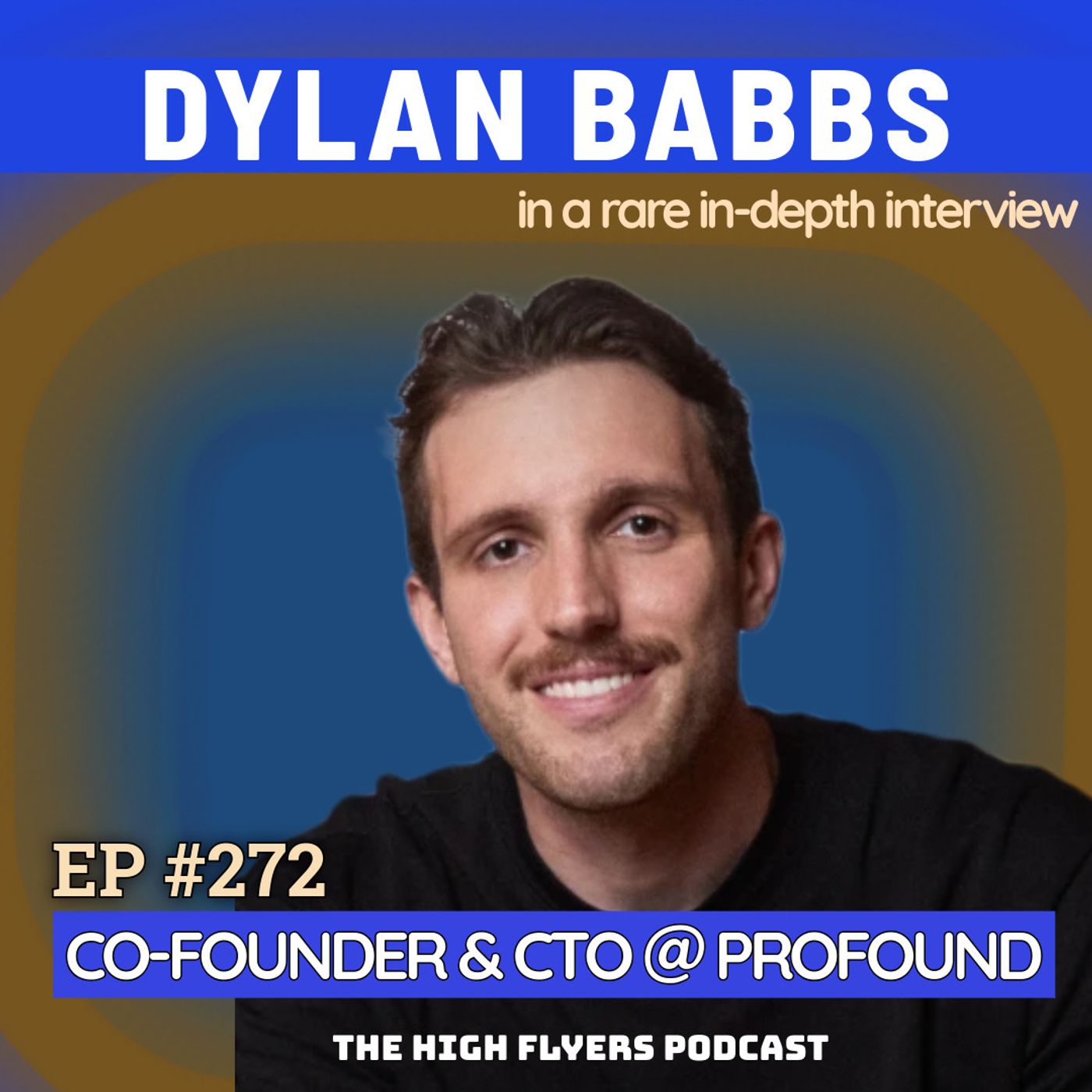
Episode #272 features Dylan Babbs, co-founder and CTO of Profound, discussing his path from maps and design to building an AI marketing company, plus how aviation and “extreme ownership” shape his leadership.
Born in Los Angeles, raised in the Bay Area (moved to Hillsborough), later lived in New York City (Brooklyn). Studied Informatics at the University of Washington (graduated 2017). Early career at HERE Technologies (Hear/Navtech), then Uber’s maps team, then consulting/freelance web mapping after transferring to Berlin. He later became CTO at Profound (about 350 people).
Maps are a blend of engineering, design/data visualization, geography, and culture. Startups should bet on young talent with “extreme ownership.” Great engineering comes from curiosity and passion (he cites private pilots he’s met, including Profound’s head of engineering Charles). In startups, you must “run towards anxiety” and take big emotional bets.
Building JavaScript SDKs for 3D web maps at HERE; Uber’s experimentation culture optimizing gross bookings via small UI changes; quitting HERE in Berlin after consulting at $150/hour; learning to fly in Puerto Rico during COVID; co-founder “dating” with James at South Park Commons and a Puerto Rico trip.
Dylan Babbs only (host Vidit/Virita Aguil; other people mentioned include James, Charles, Shira, Katie Waxman, and Luke Shields, but they are not guests).
Written by AI. May contain mistakes.
Dylan Babbs introduces himself and shares his background.
“Our listeners have called this podcast a meticulously researched biography unveiling the extraordinary lives and decisions of the most remarkable individuals and companies from around the world.”
Dylan discusses his early career and first job experiences.
“And Dylan, as you know, the purpose of this show is to reimagine the concept of a high flyer to go beyond someone's job title.”
Dylan reflects on the impact of his family on his career path.
“I'd say, of course, most of my memorable childhood was in the Bay Area, of course, in Silicon Valley, which was a lot of fun and obviously probably very influential for how I got here today.”
Dylan shares his passion for maps and how it influenced his career.
“A common thread in my research was people said you're a maps fanatic, like you are obsessed with maps.”
Dylan talks about his journey in design and software engineering.
“I can tell you've been asked the map question before because you had four reasons why.”
Learn about the host's evolution from coding in college to becoming a software engineer.
“I really wanted to make things real, have users actually go use them.”
Explore the host's chaotic high school years and their curiosity-driven approach to learning.
“unless you're actually kind of going full stack end-to-end, building and making it from scratch, basically designing it all the way to implementation.”
Discuss the host's college life, desire for a varied career, and feeling miscategorized.
“So you just finished high school because it was really interesting.”
Discover the host's initial role at HERE Technologies and the culture of startups.
“What was the jumping off point post-graduation?”
Understand how the host's early career at Uber accelerated their professional growth.
“So here was only two and a half years full-time, then two and a half as an intern.”
Learn about the host's vision for creating a supportive culture at their company, Profound.
“It's like, okay, go explore this type of stuff.”
Hear about the host's time in Berlin, including a work transfer and cultural impact.
“Of course, they get a ton of coaching and guidance and product direction from up top.”
Explore the decision to leave a full-time job and start freelance consulting.
“I think that was very much eye-opening, just moving countries, getting inspired, meeting a ton of different people, etc.”
Learn how the host grew their consulting business through online presence and networking.
“which was a little bit crazy and I thought it was all gonna go to disaster, but business actually started booming the moment COVID happened.”
Discover the value of posting your work online to build awareness and connections.
“So I saw this great infographic or kind of like meme on LinkedIn.”
Understand how the host navigated their freelance work during the onset of COVID-19.
“Isn't that an interesting paradox that everyone says that?”
Dylan shares his journey from living in different cities to pursuing a passion for flying.
“And then the plan was always to go back to Berlin But I think as time went on and on and COVID turned into definitely not a two-week thing, it's like, okay, maybe I'll hang out here in the US.”
Dylan discusses the mental challenges of learning to fly and the rewards of overcoming fears.
“And then because most of my colleagues at Uber were in Pacific time zones in California.”
Dylan presents his theory that pilots make great engineers due to their passion and curiosity.
“To connect aviation and profound, your co-founder James said to me the other day that you've got this theory that people with aviation backgrounds make great engineers.”
Dylan highlights the importance of emotional thinking over data-driven decisions in startups.
“But I think kind of a funnier take on this is not only are kind of great engineers who are pilots, great engineers.”
Dylan reflects on his experiences at Uber and the skills he gained that led to the formation of Profound.
“My brother works in aviation and I'll ask him if he knows any engineers or chiefs of staff and I can send them your way.”
Dylan discusses his transition from Uber to exploring startup ideas and finding a co-founder.
“of experience or six years of experience.”
Learn about the key factors that led to a successful co-founder relationship.
“And then over time they discover they actually do fit.”
Discover how a trip to Puerto Rico solidified their partnership.
“I find the Puerto Rico story particularly interesting.”
Explore how James and the speaker divided responsibilities and built trust.
“I want to come to profound, but James, again, back to James the other day when I spoke to him, he told me something he himself said.”
Understand the three essential elements needed for a startup's success.
“On Profound, I've heard you talk about a successful startup needs three things in a broad way.”
Learn how to navigate compromises while maintaining a strong vision.
“But as you know, every company has to make compromises.”
Hear the unique story behind hiring a remote engineer from Buenos Aires.
“And I think what's also unique with that is your second hire, if I understand correctly, Mike, is in Buenos Aires, which led you to starting an office there, right?”
Dylan shares how he connected with remote engineer Mike and expanded his team in Buenos Aires.
“And Mike, who's down in Buenos Aires, saw that.”
Dylan discusses the pivotal moments after raising Series A and how it fueled their company's growth.
“And yeah, we got connected with really kind of nothing in common.”
Exploring the evolution of Profound's product in response to AI search market needs.
“So 2025 was, of course, awesome because yeah, we ended up smashing the goals out of the park.”
Dylan explains how AI is transforming marketing roles and the development of Profound's tools.
“You had normal search engine optimization.”
Dylan shares insights on how Profound maintains its edge against larger competitors in the market.
“I'm curious if, like this one's a bit of a tricky one, but I feel like you'd have a good answer in this.”
Discover Profound's ambitious goals for the next six months and its international expansion.
“like if I speak to you in October, the answer might change again, right?”
Hear Dylan Babbs share personal interests, pet peeves, and insights into AI tools.
“Is there one non-work investment that you consider the best in your life?”
Dylan discusses the challenges of hiring in the context of quality submissions versus AI-generated content.
“Oh, I mean, that'd be most people, right?”
Dylan shares his thoughts on speed versus quality in work and answers the closing question.
“I think the best people know how to do quality things at a really fast pace.”

Get the gist, explore an idea or ask about something said.
 Claude
On The High Flyers Podcast with Vidit Agarwal, what are the key points of this episode?
Searching your listeningAutomatic transcript. May contain errors.
0:00Hi, I'm Vidit, the founder and host of this podcast, The High Flyers. Hello, my name is Dylan Babbs. I'm the co-founder and CTO of Profound. Dylan, I am pumped to do this. I think it's particularly interesting given I've been told you like flying and this podcast is called The High Flyers. So clearly that's a match. Absolutely. Excited to be here. Hey friends, welcome back or welcome to The High Flyers podcast, where we do reimagine a high flyer, showcase the brightest and most relatable role models and companies and their journey from sunrise to today. As one of the premier products in our Curiosity Center lineup, providing on-demand intelligence to help you be 1 % better every single day.
0:42I'm your host, Virita Aguil, and let's have some fun. Our listeners have called this podcast a meticulously researched biography unveiling the extraordinary lives and decisions of the most remarkable individuals and companies from around the world. We hope you're enjoying our catalog of 200 plus episodes since we launched in 2020 with many of our guests appearing in rare public interviews. It's now time to explore your curiosity. Please enjoy. Let's set some context with some fun facts. Where were you born and where do you live now? I was born in Los Angeles, California. Shortly moved over to Hillsborough, California in the Bay Area where I lived until I was 18.
1:22And then now I live in New York City in Brooklyn. Yep. We will unpack that journey and work. What was your first job and what do you do now? One of my first jobs was actually an iPhone and Mac repair technician in Burlingame, California at a local store called Yamak. So I spent my days in the summer fixing iPhone screens for about$70,$80 a pop. And then now I am the co-founder and CTO of Profound, and we're building the world's first marketing platform for AI. I was going to say, you should give a quick spiel on Profound, but you've done that. So that's good. And we will spend more time on that.
1:57And Dylan, as you know, the purpose of this show is to reimagine the concept of a high flyer to go beyond someone's job title. Is there a person you know who you feel doesn't get the recognition they deserve? Someone I'd like to nominate is Luke Shields. He's a friend and also another founder building a company called Interfere. They are an observability platform for debugging what's going wrong with software and automatically fixing it. So check them out, interfere.com. Nice one. I will take a look for sure. Back to the episode in a moment. Something I've heard a lot from business owners and leaders is that speed only matters if you still feel confident in the output.
2:36And it's particularly an important point in this world of AI. Xero's answer to that is accountable intelligence. AI that shows you what it's doing and works from your own real data and is designed to keep you in control before anything happens. As Xero puts it, most AI asks you to trust it. Accountable intelligence shows you why you can. And that's how it works with Jax, Xero's in-platform AI finance partner. So whether you're running the business, advising the client, or working with your board, Jax ensures that you get the upside of automation without giving up any of the control. If you want to see this practice, head over to xero.com forward slash high flyers for 90 % off your plan for the first six months.
3:23terms apply and go to the website that's zero xero.com forward slash high flyers now back to the episode let's wind back the clock and go to your sunrise your childhood and this one's particularly interesting because you haven't really talked about your journey well actually you haven't really done many public conversations so it's i'm honored that you've picked pick my show as one of your first you mentioned la and then bay area how long were you in la for la was just the quick zero to three years old. I'd say, of course, most of my memorable childhood was in the Bay Area, of course, in Silicon Valley, which was a lot of fun and obviously probably very influential for how I got here today.
4:04I remember as a kid kind of riding around bikes, the Google campus. And of course, seeing all the ads on 101 for all the different software companies and things like that. Hanging out in downtown San Mateo where a ton of startups were getting started there. So definitely having that all around me, I think was pretty impactful for where I ended up here today. And tell me about the family because I've heard your dad's an investor, is that right? Investor and advisor and banker. So he helps sell startups. So focuses on mergers and acquisitions there. But yeah, he was also a software engineer. So working on a lot of mobile games back in the days of flip phones.
4:47I remember as a kid, one of the big things that he did was bring in a Yao Ming game to the US. So as a kid, always playing around with that. Super fun seeing kind of these really early versions of mobile gaming on the super early phones. And yeah, that definitely was probably pretty impactful for how I got here today. I remember as a kid also just hanging out in his offices in downtown San Mateo and San Francisco, drinking all the sodas that I can and just kind of being in the startup environment. I was going to ask, what have you absorbed from him now when you think back? And even your mom as well.
5:23What do you think the Babs household gave you growing up? I think there is probably a ton of inspiration. I remember as a kid always being on the computer, making websites. My dad was a big football fan. We like Oregon football. So I remember just as a kid making all these different blogs about college football. Of course, toying around with HTML, making these files, uploading them to FTP servers and websites. And yeah, I think just kind of enabling a ton of curiosity and exploration. And I think that's been a big part of who I am today and kind of my journey is always wanting to learn new things.
6:00Always being confident that I could, one, go learn something and then go figure it out and build with it. So yeah, I think my childhood, whether it was just like endless Legos, endless like tech exploration was super impactful for kind of who I am here today. A common thread in my research was people said you're a maps fanatic, like you are obsessed with maps. Tell me when did that love start? So I think to kind of preface with why maps are so cool is I think they're a combination of four different things. One, like the technical aspects. There's a ton of data engineering and just engineering problems in general with delivering maps at scale and kind of on web applications and things like that.
6:43The second is when it comes to design. I've always had a huge passion for design. So kind of doing cartographic design, a ton of really fun data visualization principles there. I always like to say that a map is the ultimate data visualization. There's so many different encodings you could do. And then also just the geographical aspect. I love to travel. I love to go around the world. And maps really are the bridge between the physical and the digital world. And then the fourth thing is the cultural aspect as well from travel, love, you know, cultures, things like that. In maps, you really have to start to put those into them as well.
7:19Humans from all around the world use maps differently. I think maps have always been super fascinating because they combine so many different things into one. I kind of ended up in maps and geospatial quite randomly, you could say, where I did my undergrad University of Washington, Seattle. I was studying information science. The program was called informatics. And it was really a combination of software engineering and product design. So you could think of it a lot more as application development. Of course, we did algorithms, data structures, and all that jazz. But I think we didn't really go too hard past that in computer science.
7:55It was more about making things for people. And I think kind of the focus that I really took there was interactive data visualization. I love just the concept of exploring data, bringing it to life in these dashboards and stories. So, I had studied that a ton, had a ton of foundations for that. And then after college, I started working at this company called Hear Technologies, formerly known as Navtech. So, they do maps for a lot of the large German automakers, BMW, Daimler, Volkswagen, etc. And that was my first job. I started off as a junior product manager and really had no idea about maps at all.
8:34But I think working at that company for two years, where we were building JavaScript SDKs for developers to render maps, do all these different types of crazy data visualization on the web, really just got me super excited about maps. I think particularly around it being the combination of the physical in the digital world, really being able to represent the world in a piece of technology was super fun for maps. And from there, I ended up also doing a smaller kind of side quest of a career. I quit here when I was working there in Berlin and started doing freelance data viz and kind of BI dashboard development for a lot of these companies that wanted more advanced data visualizations.
9:17Think a lot about like fleet logistics companies that want to do these maps, about where their trucks, their shipments are, but really focusing on going super high quality on the design and the visualization there. And then I think my maps career kind of culminated when I joined Uber on the maps team. So we focused on a lot of real world problems when it comes to getting the best pickup location for you and the driver to meet, having the rider navigate to the pickup spots, reducing cancellations, reducing dwelling time for the driver. And then on the driver side as well, a whole turn-by-turn navigation system.
9:51So I think that was a lot of fun because it was very much large-scale geospatial problems, but very much applied for a specific business use case, which I loved. So Uber was great because, of course, the scale at which you're building and operating at, but then really kind of taking this domain expertise on maps and applying it to solve a very specific business problem. I can tell you've been asked the map question before because you had four reasons why. Definitely. I think when I tell people I like maps, they're kind of like what you like to stare at, paper maps and stuff like that. But a very fascinating topic.
10:29I think maps are really cool. Like a good friend of mine worked at Maplery for many years and they go to QuadroMeta and now he runs his own mapping company actually. And he travels the world and he goes to all these conferences and I'm sure you go to some of them. And it's amazing at how, even though it's niche, it's a huge ecosystem, which I would never have appreciated. it? Yeah, great community as well. Had a lot of fun there. I think when I wanted to start a company, of course, my first kind of place I was exploring was geospatial. But I think that kind of starts to turn to what forms a good business.
11:02And you need to have an inflection point, something that's changing. And I think the inflection point for maps came in the early 2010s, when GPS was being added to mobile devices, which kind of made way for all these new types of social applications, companies like uber etc um and so yeah starting a mapping business in the ripe year of 2024 was definitely not a good inflection point and tell me design i feel like that's the other one that's come up quite a bit in my research for this people say you're you're just a design brain even speaking to your co-founder james he goes just your understanding of design is second to none again back to childhood like did that start to form in your childhood or was that later in life I think it definitely started to form in my childhood.
11:44I think kind of the direct application of that was actually architecture. So physical buildings. I was lucky enough to live in Spain for a year when I was 10 years old in Valencia. And Valencia had a ton of awesome like older style architecture, but then a ton of really new modern architecture. One of my favorite architects is Santiago Calatrava. He does all these crazy kind of white modern style buildings in New York City. He did the Oculus. but his work was all over Valencia and I remember just sitting on the school bus going to school and just like being in awe of all the different kind of buildings on the way there and so then I started like getting really deep into drawing cities things like that floor plans building facades etc and I think I really wanted to be an architect when I was younger but what I started to realize is that architecture takes so long.
12:37It will take, of course, years to design a building and then even more years to go build it. Whereas the beauty of software is that you get to do it quite quickly. You get instant feedback, you get test, you get to iterate and just move at just magnitudes of a faster pace there. And I think that type of like instant feedback was very much rewarding. So, I think it's kind of always been part of my life. I think that when I realized like physical architecture wasn't the thing for me. It was just going all in on software. And I think I've always really thought of myself as a technologist, not really just a designer.
13:13I like to build software. But I think that design was probably one of the first things that I focused on because as like a younger child, that was like the first thing you see. Like if you're looking at a mobile app or a piece of desktop software, the first thing you interact with is the UI. So I think that was kind of the first thing I was exposed to. And I think I just started going from there. I think in college, I was really loving kind of UX design as well, designing all sorts of different apps, doing that early in my career at Here Technologies as well. But then slowly transitioning into being more of just a software engineer.
13:49And I think the reason I was doing that is as a designer, you sometimes feel a little bit limited. You'll go design something, but you're still just stuck with concepts or diagrams or prototypes and stuff like that. I really wanted to make things real, have users actually go use them. And so, of course, I learned how to code in college. So, I always had the skills there. But I think kind of a few years after college, I really leaned into more being a proper software engineer. So, by the time I left Uber, I was a design engineer, but mostly building out UIs for web and mobile rather than just kind of living in Figma.
14:23And then I think that also kind of led me to really just understand how to build better interfaces and stuff like that, because I think if you're always living just in the first wave of things in Figma, you're really not that connected to the user. You don't truly understand how people use things unless you're actually kind of going full stack end-to-end, building and making it from scratch, basically designing it all the way to implementation. Just hearing you say that and even the mapping one before, it sounds like you were quite intentional as a kid. Is that how your high school teachers would have described you?
14:57No, I think I was quite chaotic. As a kid, I don't know if the intentionality came until a few years later. I think I was always very curious. I always wanted to learn and try new things, but I definitely didn't really know exactly what I wanted to do. I think I almost felt like a little bit miscategorized in some ways because I think that like after college when I was looking for a job, I wanted to do it all. I wanted to design. I wanted to code. I wanted to be like a PM as well. And I think like big tech companies love to just slot you into one job. And I felt like I was a puzzle piece that couldn't be fit anywhere.
15:27But I mean, I think what kind of turned out well is that's actually kind of the best type of profile to be as a founder is somebody who wants to have their hands basically everywhere and get dirty in all different parts of the business. Totally, totally. And tell me about when you turned 18. So you just finished high school because it was really interesting. You left the Bay Area, right? You went to Seattle for college, like you mentioned earlier. I guess two questions. One, how did that happen? And two, if I met you at that age, what would I have assumed you'd do with your life? I think probably at that point, I was just more into being social and having fun.
16:03I went to UW. I really wanted to be in a large kind of Pac-12 school, get the whole college experience. And I think for the most part, too, I also just wanted to leave home. There was so much more out in the world. And so, yeah, going to a different state was basically a lot of fun, a good chance to kind kind of go learn a lot more about myself and explore more. But no, I don't think there would have been anything too special, to be quite honest, if you saw me when I was 18, just another kid. And so you studied a Bachelor of Science, is that right? Correct, yeah. In informatics, also known as information science, which is, yeah, definitely a very unique program.
16:35I think there's only about four or five undergrads in the nation that do this type of thing. But yeah, kind of combination of software engineering, product design, et cetera, very much all tailored towards building applications for humans. And I think you graduated in 2017, if my numbers are right. What was the jumping off point post-graduation? Yeah, so I started my career at a company called Hear Technologies. That was the mapping one. That was down in downtown Seattle. It was actually a startup called Medio that did predictive analytics that was acquired by Hear just the year before. So it's kind of cool.
17:08I didn't really realize that at the time, but when I started interning there in the summer of 2015 and then eventually started her full-time in the summer of 2017. It was actually kind of a very interesting concept that I was witnessing is seeing a startup that had just exited kind of turn and kind of take on the culture of a larger company. Tell me about that because you were there for nearly five years, right? Like when I think of my early career, that was foundational in some of the skills I built, some of my personality traits, even now like around my own company like you and even how I'm like as a manager.
17:44I think a lot of that was formed in those first five years of my career. How do you reflect on the first five years of your career? Definitely. So here was only two and a half years full-time, then two and a half as an intern. I think it was a really great opportunity to go learn and explore things. I think that, of course, yeah, I got to open up to the world of maps. We were doing a bunch of developer evangelism. I was doing a ton of prototyping. So I think it was a good chance to be free. But I think when I kind of look back and contrast that with Uber, which is the second half of my kind of early five years of my career, Uber very much was a place I think super accelerated my career.
18:22I absolutely loved working at Uber. That was by far my favorite place I've worked. I think that was kind of honestly like the dream of where I wanted to work. Of course, I've always had this kind of obsession with maps, but I think that something about the Uber brand, And I think their growth story, kind of everything they were going on, building this new style of app, just completely captivated me. And I remember when I graduated college, I was like, I want to go work at Uber. I'm going to go make that happen. I think I ended up applying for their associate product manager role. I didn't get that.
18:53And then, yeah, I ended up joining about two and a half years later. But I think Uber was great because they very much believed in me. I think when I kind of contrast that to my first job, of course, I was a new grad, very inexperienced, but I think they very much kept me like boxed in and cage. It's like, okay, go explore this type of stuff. But like, we're never going to like build any of this. It was kind of very much just like ID stuff. But when I arrived at Uber, I remember my manager at the time, her name is Katie Waxman, just says like, you're in charge of everything geospatial right here.
19:26We're going to go redesign and rebuild this map. Just go figure it out. And I was like, oh my God, this is crazy. Like being able to build for the 5 million drivers they had and the multiple hundreds of millions of riders they had at the time was something very nuts. And I think that's very much kind of probably one of the reasons why Uber was so successful is very much this culture of just taking people, giving them a ton of ownership from day one, believing them, just not really like holding back depending on someone's years of experience or something like that. So I think kind of like contrasting those two experiences of the two different jobs that I had before Profound very much were kind of pivotal in kind of how we designed the culture here at Profound.
20:08I think kind of the cool thing about Profound is I think I very much built this company to be a place for almost like a young type of Dylan would come and succeed. People who I think have a ton of potential, a ton of raw talent, a ton of ambition, a ton of curiosity, and they could come in and they just get extreme ownership to come in build from day one. Of course, they get a ton of coaching and guidance and product direction from up top. But I think you have betting on young, talented people who really want it, who kind of believe in themselves. You're going to get just such outsized returns.
20:43I want to come to what Uber and Profound chapter that you've very smartly glossed over as you went to Berlin, which I found fascinating the other day when we spoke. You were telling me, I think, post-university, like post-college, you went to Berlin, but then you decided you didn't like it. Is that right? Not quite that. I love my time in Berlin. So I was able to transfer as part of HERE Technology. So the job that I started in Seattle. So they had a pretty large Berlin site, about a thousand people. And I remember I was not feeling like unfulfilled at my job, but I was like, I need to do something.
21:17I think living in Seattle, I was six years in Seattle at that point, four years in undergrad to postgrad. Seattle is a great place in the summer. Very beautiful. but I think just the weather really does beat down everybody's mood. When you just have the constant clouds, the constant gray, I think that definitely does have an effect on the personality of everybody. People do not really seem that ambitious. They're not that excited, et cetera. And I think after six years that I was like, oh my God, I need to go see what else is in this world. So of course the joke's on me going to Berlin, just the other cloudy place.
21:48But I think of course it was just more of like a different thing. And it was really nice. So talking to kind of my team there, I was able to go basically get a transfer to go work on this different type of data visualization. We were doing like 3D maps on the web at that time over in Berlin. So I got to do a transfer over there, which was pretty cool because I got my whole visa taken care of, a place to live quite easily. So I was moving to a different country, I think very well taken care of. So I didn't have to worry about too many of those details. And yeah, I loved my time in Berlin. I think that was very much eye-opening, just moving countries, getting inspired, meeting a ton of different people, etc.
22:23etc. Kind of hanging out with a lot of the startup folks over there. And then only three months into my time at Berlin, I ended up quitting my job at here. I had been getting a ton of interest from different outside companies to basically go do kind of freelance work for them, building these interactive visualizations and kind of data dashboards for them. And I realized that I can make just a ton of money doing that. So keep in mind, I was like 24 at the time. This is 2019. I realized I could just start consulting for$150 an hour, which was, of course, if you multiply that by 2 ,000, was way more than I was making at the time.
23:04And so, yeah, I said, hey, let's go be a little bit adventurous. Of course, I was quite anxious quitting a job with not like a formal thing set up after that, but I had a ton of interest. So, yeah, I quit in January, just basically three or four months after being in Berlin and started doing that all the way until November of 2020. So keep in mind, this is also during, I quit and then COVID happened, which was a little bit crazy and I thought it was all gonna go to disaster, but business actually started booming the moment COVID happened. Everyone just wanted to build everything. So I was kind of thriving during that time.
23:40I'm curious, you were saying you got a lot of interest. How did they discover you? Were you posting online about your design work? Yeah, so part of the work that I was doing at here was evangelizing this web maps SDK. So we built a JavaScript library so you could render 3D maps on the web. And so yeah, part of my job was just to drive interest to it. So I was always prototyping cool new things, just really going super hard on kind of the design, the interactivity of all these maps. So going crazy on LinkedIn, going on crazy on Twitter. And yeah, just getting a lot of interest. So I kind of carved out myself as like one of the map guys, you could say, online.
24:18So I think kind of like for anyone listening who's kind of looking for advice on how to really grow a consulting business, grow a personal brand is really just go post online, make cool stuff and just share it. Of course, if it's super visual, which is everything that I was doing, that's going to have a 10x effect as people want to see pretty graphics and things like that. But you really just have to put yourself out there. I remember when I started doing that, of course, all my friends were giving me a hard time. It's like, oh, Mr. LinkedIn's like walking in the room. Here we go, blah, blah, blah.
24:46But like slowly all those posts compounded. And I think that's like, that's eventually how I ended up getting my job at Uber. That's eventually how I built up such a network for hiring people at Profound and things like that. So I saw this great infographic or kind of like meme on LinkedIn. And it was this guy and he was on the left side of the cliff and on the right side of the cliff was success. It was basically like what's in between you and success. And it was just like being cringe on LinkedIn is the bridge between the two. So of course, don't actually be cringed. But I think the point is that like, don't be embarrassed to go post things because you're going to have really good outcomes from just putting yourself out there.
25:21If you're talented and you know how to make cool things, no one's going to know that about you unless you're actually sharing it. It is your job to basically drive your own awareness, to drive your career and kind of show the world what you could do. No one's going to go and find you and things like that. Isn't that an interesting paradox that everyone says that? But then every story, even my own story, Like if you post and you tell the world who you are, that can pay off. But we as humans think that's so cringe. Like I have never understood that. Yeah. I mean, I think if you look to kind of all the great stories of entrepreneurs, leaders and stuff like that, your vision or your talents don't really matter unless you could properly communicate them and get people on board with them.
26:05I mean, I see that right now. It's just kind of running profound. Profound is 350 people. and kind of the main thing that I spend my time on is just one, getting a vision of where we want to go, but then just like aligning everybody, overly communicating, telling the story of why it's possible and why we need to go do that. So I think, yeah, of course the number one skill for any leader to have is actually getting people on board and bought in with your vision, why you want to do things, why it's going to be successful, et cetera. Just in social media, I had an interesting anecdote in my research on Profound that apparently James is more on LinkedIn and you're more on X.
26:43Is that true? Is that an intentional decision you've made? I think I started off with more Twitter and X followers. So I think we've always kind of carved me out as the Twitter person. And then of course, as CTO, I do all the engineering, the tech hiring. And that's where most of that happens is on Twitter and X. And then of course, we do a ton of hiring on LinkedIn, but also our customers for the most part are mostly on LinkedIn. That's true. So back to your consulting business. So you were in Berlin. It sounds like you came back to the US in 2020. Is that right? Well, so I was actually hanging out in Brazil for Carnival right when COVID hit.
27:24And because I had quit my job, I no longer had a work visa in Germany. So I was just classified as a normal tourist. And of course, everybody thought that that COVID was just going to be a two-week thing. So I was a freelance consultant, worked with my own clients wherever I wanted, being my own boss and joining that. So a friend of mine were hanging out in Brazil for probably way too long, just waiting for COVID to pass. And then the Schengen zone closed. So I ended up being locked out of my own apartment. So I went back and did what all the millennials did, the millennial bounce back, go back, hang out with the parents and your childhood home for a few months.
28:02And then the plan was always to go back to Berlin But I think as time went on and on and COVID turned into definitely not a two-week thing, it's like, okay, maybe I'll hang out here in the US. So yeah, I spent most of 2020 in California, in Seattle, in New York. I eventually had my roommate in Berlin ship me back my stuff because I was no longer living in that apartment for months on end. And then, yeah, I also eventually found my way to Puerto Rico, which was a very random adventure. but I knew that. So basically we'll fast forward to October of 2020. I had decided I wanted to go live in New York.
28:43So I was living in New York, the late end of 2020, but it started to get very cold. And at the same time, after almost like nine months of being locked up, everyone kind of probably felt the same way. You felt a little bit anxious. You wanted to go do something. You're feeling a little bit boxed in. I said, let's go learn how to fly a plane. It was like a a very much like crazy idea, but I had been traveling a ton for work in 2019. And I just thought it was like such a cool thing being in planes. And I think I decided like, there's nothing in this world I can't go do. And I think I really wanted a challenge and an activity, something almost like outside of work, just like a new hobby and things like that.
29:21So I decided, okay, like I'm going to go learn how to fly a plane. But the problem being in New York is that one, it was way too cold. I didn't like the cold weather that much. And then secondly, all the airports are so far away. It would have been like an hour drive to go find the nearest airport to train at in the New York City airport. That would have been two hours combined both ways. It just wasn't the best kind of use of my time. So, I remember I had been in Puerto Rico in 2017 for a vacation. We flew to the small island of Culebra from San Juan. But we're in this tiny municipal airport in the middle of the city.
29:51It's called Isla Grande Airport. And I realized, wow, Puerto Rico is a US territory. I could go get my USFA license there and then just ride a bike to the airport. So, I'd cut down on the commute time. It'd be an interesting place to go live. Everyone was working remotely. So, a weekend in January, I flew down there to go talk to some flight schools. Found a great flight school there. Decided, hey, I'm going to do this in a few different kind of test flights. And then I realized I don't even need to go back to New York. So, I had my roommate at that time ship me my stuff to Puerto Rico. As you can see, there's starting to be a trend here of roommates helping me out and ship things.
30:31And then, yeah, I started doing my training for getting a private pilot's license in Puerto Rico, which was a ton of fun. So yeah, got to live on the beach, ride a bike to the airports, do my training in the morning for about three or four hours almost every day. And then because most of my colleagues at Uber were in Pacific time zones in California. Puerto Rico was four hours ahead. I could just, yeah, go do my flight train in the morning and go do a full workday right afterwards. So it was kind of the best situation. This is so interesting, just hearing you, even to this point, hearing your life journey.
31:09It clearly sounds like you don't like sitting still, like you like doing different things. I kind of always joke when people meet me, they're like, what do you do? And I go, I do different things. But just hearing you speak, you truly have different experiences. What does that come down to? Like, have you ever reflected on that? Like, where does that inner desire for variety come from? I don't know where the inner desire comes from, but I think that there's just a lot to life. And really, you could go do really whatever you want with it. Of course, I'm very privileged to kind of always have had enough like disposal income from jobs that I've had to kind of be able to go support this type of travel, to support these types of hobbies and stuff.
31:47But I think once you realize that you could go do whatever you want, you could simply just go do things. So, if you want to go learn how to fly a plane, if you want to go do X, Y, or Z, don't let yourself be held back by just kind of the inability to go do so. Not do it just because it's a big, scary thing. I think you got to run towards anxiety. And I think once you start kind of accomplishing things, you realize that the thrill of doing so feels the best. I think what I loved about getting a pilot's license is it was one, a very exciting activity. But then two, it was just such a learning challenge.
32:26It's a huge mental challenge of kind of overcoming your fear of things. You have to study all sorts of things, physics, weather, avionics, etc. And then it's also just a large commitment. like I remember when I kind of wanted to go like you know get re-energized I was like just go skydiving the thing about going skydiving is you just sign up you get in the plane you jump out then you're done in the day where's the fun in that like what are you actually accomplishing and so yeah it took me a year to get my private pilot license I was doing a little bit slow because I was busy with other stuff as well having fun but I think that kind of that year-long journey of just progressing and seeing yourself kind of get past the different like checkpoints looking back on the progress was super exciting, super rewarding.
33:10And then kind of the end of it, getting your license and saying, wow, like looking back on all this, look at what I accomplished was a super awesome experience. To connect aviation and profound, your co-founder James said to me the other day that you've got this theory that people with aviation backgrounds make great engineers. Can you tell me about this theory? So it's a little bit of a ridiculous theory. We don't know if there's too much in it, But every software engineer who I've met who's also a private pilot is some of the best engineers I've ever met. For example, our head of engineering, Charles, is a private pilot.
33:43I think what it comes down to is, I don't know if there's really a connection between aviation engineering itself. It's just more about people that are passionate about things. If you're passionate about to go learn something, like learn how to fly a plane, you're going to be passionate enough to go learn some sort of kind of random thing in engineering, and go down this crazy path and just really being curious and also ambitious. But I think kind of a funnier take on this is not only are kind of great engineers who are pilots, great engineers. I just hired a chief of staff. Her name is Shira.
34:15She was a former air traffic controller. So now my new theory is the best operations people are former air traffic controllers because they know how to manage hundreds of different things at once. so what are you telling me this is confirmation bias this is like confirmation bias but the thing is everything's emotional when doing a startup throw out all the data driven and logical thinking you always just have to follow your hearts because the thing is if you go for the the data driven and the logical and the rational thinking you're always just going to end up on like the very much of the mean or the average path you have to get emotional you have to do crazy things and take big bets.
34:57And a lot of those big bets are going to have large rewards that are going to pay off. So you have to do crazy things is kind of the point that I'm making here. I'll keep you in mind. My brother works in aviation and I'll ask him if he knows any engineers or chiefs of staff and I can send them your way. He's actually obsessed with aviation. Like he used to sit up as a kid and he would listen to the pilot talk to a traffic control. Like I didn't actually know you could do this. Like there's apps where you can sit and listen to them talk to each other and then maybe you do this like if we're out for a meal and he sees a plane fly over he will like stick his phone out and he'll be like that's the plane that's where it's going that's the model number which is oh yeah so unique absolutely do all that so yeah when you're at an airport um tune into this app called live atc it gives you all the digital uh radio of the air traffic controllers the pilots and then the app that um you're talking about is called flight radar 24 uh so yeah whenever you see a plane in the sky you can just look it up and then yeah of course i just go full obnoxious nerd on it whenever i'm on a flight and i just send a few of my friends my live flight tracking links i was like i follow along here's my plane and i think i've taken it even farther now it's this is so stupid but it's just hilarious since if you ever make eye contact with a pilot walking in um just i always go in and take a photo in the cockpit so now i'm starting to collect all these photos in the cockpit i feel like most pilots are if you catch them at the right time, if they're not doing your pre-flight check, they're pretty chill about things.
36:27You tell them you're a private pilot and they just love to chat. And so, yeah, I've been in many cockpits of many of the planes I've been on. Have you got any customers that are airlines that are using Profound yet? We do. We actually have two of the large AirCat manufacturers. So unfortunately, can't say the names, but I'm sure you could deduce who they are. Yeah. That must be a nice feeling, right? Maybe you can use that as an excuse to get deeper into that world. I want to come to Uber and I specifically want to ask about Uber. So when I was chatting to Ilya from Kleiner Perkins, who are things on your board, he made an interesting observation where he feels a lot of the building blocks that led you to Profound, you collected them at Uber.
37:10I'm curious if you agree with that observation. And if you do, what were the building blocks from Uber that potentially led to Profound? I think what it was, was an absolute focus on building a business, no matter what role you're in. I think, for example, like engineers, when you come out of school, you think about your job as an engineer to write the best code to maybe make the most efficient algorithm. But who cares about the efficient algorithm? No one's actually using that or it's not making any money. Or if you're a designer, you're building the best thing for the user. But in reality, as a designer, you should be designing for the business to kind of push the user to do something to make money.
37:45And I think it was really awesome at Uber because one, you had the scale of operating globally, hundreds of millions of riders. But then just kind of everything you're doing just had to be pushing gross bookings, which is kind of our number we're always optimizing for. And then you pair that with just this crazy experimentation platform that they had. So you would go and make maybe like the most random small change, like if you're rounding the corners of a button. and then you'd start to run an experiment, an A-B test and you'd just see like, you'd make like$10 million or lose$10 million in gross bookings just based on these small changes.
38:22So I think what that really led to is just like truly understanding that like every decision you make and kind of the impact that could have on the business. It's like, okay, why are we building this? It's actually make money. It's not just kind of do this polish and stuff like that. I think that was probably the main one. I think I definitely joined Uber in kind of much larger corporation mode. But yeah, just understanding, I think, what excellent talent looks like working with some of the best people in the world there and things like that. So, Uwe, you were there for four years and you mentioned earlier that that potentially was like a really formative period in your life.
38:58Tell me about, because I think you've talked earlier, you mentioned earlier about some of the skills, so I want to ask you to repeat that. But when you were coming towards the end of those four years, where were you at in your career, particularly given all these experiences we just talked about? You had lived in Europe. You had lived in South America. You learned how to fly. You had all these interesting hobbies. And then you end up at Uber, which is, yes, very entrepreneurial, but it's a company. It's a job. Whereas my sense just hearing you speak is that wouldn't have fulfilled you. Like that wouldn't have been enough.
39:29Absolutely. Yeah. So I think I got really good at designing things, really good at developing and engineering. So I had kind of done the design, the build. And I think kind of the last thing that I had, well, sorry, definitely not last, but the next thing that I had left was like, how do you actually build a business? How do you build a large scale business? And I think the best way to actually go learn into that is to actually put yourself in the arena. I could have stayed, I guess, at the large corporation, continued to kind of try different roles, learn new things. But I think that the absolute learning maximization I would have had would have been quite small relative towards doing something on my own.
40:09So, it became quite clear that I was ready to leave basically a year before I ended up leaving. But I knew I didn't want to just go jump out immediately because I've seen quite a few of my friends do that. and they just end up lost in La La Land. So, I knew that I wanted to spend a bunch of time kind of exploring different ideas, meeting a lot of people. And I guess you could say almost like do the training wheels of getting ready to go out there into the arena. But I think kind of the most important thing is that by that point, I had almost like five years of experience or six years of experience.
40:43So, I was, I mean, I hate to say this with a hubris, but I think I was quite talented at that point. I was much more mature in my thinking. So, I wasn't kind of making all these silly mistakes. And then I had also just built up an experience to be quite dangerous in terms of building anything. And then I was also still young enough to the point where I still had a ton of energy. I didn't have a family. I was still kind of solo, not really anything holding me down. And that all kind of culminated as like, okay, this is the right time to go do it. So, when I quit Uber, didn't necessarily still exactly know what we're doing, but I met James at the start of the incubator called South Park Commons.
41:22South Park Commons, they brand themselves as the negative one to zero phase. It's almost before you even have an idea. So very much a place for people to go explore what they want to go build next, meet potential co-founders and kind of tinker around and get ready to go build a business. Let's go into that. I'm always fascinated how you, how founders meet, but particularly how do you build trust to start a business together. Like you connect a bit of Dylan at SBC and he said that often they do this and sometimes it works, sometimes it doesn't, right? Like sometimes founders feel like they found a match, but then a year later they realize they don't have a match or sometimes they don't find a match.
42:01And then over time they discover they actually do fit. Tell me about the first time you met James, like what did you make of him? Yeah. Well, I think before I talk about that, a little bit more context is a bit required. Going back to maps, I think I was so set on building something and mapping in geospatial, just because that's what I had been working on. I felt like I was an absolute expert in the space. I said, okay, I'm going to go use this to my advantage. But what we kind of talked about earlier, it just wasn't really the time to go do something in maps. I think building a strong business, you need three things, basically three qualifiers.
42:34One is a good inflection point. So what is changing in the world? Why now? You need some sort of type of new type of technology being introduced, a new type of regulation, a new type of consumer behavior, et cetera. Number two, you need really strong founder market fits, which I had that for maps. And then number three, it needed to make money. So I only really had one out of three for the maps and you need three out of three. So at one point I basically gave up, I was like, okay, I'm not going to do anything more geospatial. I'm just going to go build software. Because I realized I was quite good at building software.
43:05And at the end of the day, I think any type of software that you're building, 70 % of it's going to be the same. No matter what you build, you're going to need some sort of client application, some sort of backend, some sort of database, et cetera. And then, of course, now in 2026, just a ton of AI in there as well. Really, it's like the last 30 % that gets customized towards your industry use case that you're building. So when I kind of came to terms with that, and also the fact with, to me, What really mattered to me was like the people I was building with. If you are building some more software and you're very much teamed up with people that inspire you, people that you respect, people that you want to spend years building this with, I could really go take on anything.
43:39The type of industry, the vertical actually didn't really quite matter. So when I had that in mind, I ended up meeting James. So James was introduced to me at South Park Amas on a cold winter day. We were having a nice walk around Soho. James came from a marketing background. So he'd previously co-founded a company called Kyra, which did a lot of influencer marketing-related tech. So we decided to team up after basically a few weeks or a few months of almost like co-founder dating. We were hanging out a ton, just getting to know each other, toying on different projects, different ideas. We ended up taking a week-long trip to Puerto Rico as well, which is kind of fun, just like traveling together and getting to really like understand what both of us were looking for.
44:22And I think we just ended up being very much aligned on everything. The type of like intensity we want to run a company, how we wanted to take things quite large. And yeah, we wanted to go build something impactful. So yeah, I think after meeting hundreds of potential different co-founders, it's like, yeah, we decided to basically get metaphorically married and go start a business together. I find the Puerto Rico story particularly interesting. And maybe that goes to your influence again about like going to different cities and countries. right? Like most founders would just go to a cafe in New York and get to know each other as you and James decided to go on a trip together, right?
45:00Yeah. I mean, I think that was funny. I think James, he gave me this, this large manifesto about what makes a good co-founder and there's a ton of good things in there. And I think it was like very much like a shared dedication towards like spending time together. And this is like early on when we just met. And I remember I was like, well, I'm going surfing in Puerto Rico for like five days. like you want to hang out with me let's go and he just said sure let's do it uh so yeah james was very much down for the adventure and kind of willing to go do crazy things which i think i loved because i think a lot of the time if you ask someone just hey come to puerto rico with me they're gonna be like i'm trying to excuse whatever but james like yeah let's make this happen and see i think that's kind of a good representation of how we do things a lot it's like uh we have an idea we think about it for a little bit and then we kind of sometimes go all in on it.
45:50I want to come to profound, but James, again, back to James the other day when I spoke to him, he told me something he himself said. He said, I'm pretty intense, as in James is pretty intense. And he said to ask you about how did you early on work out who does what parts of the business? And I guess to also extend that to now, how has that changed? Because in my role, I speak to a lot of founders in various capacities. And one of the things I noticed is relationships change over time, often in good ways, because trust is built through work and through failure sometimes, right? Like things go wrong and you have candid conversations and get to know each other.
46:24I found James just telling me that, that he's pretty intense means that he knows that and he's very self-aware of that. And maybe also that he was saying you're not intense. Is that a fair conclusion? No, I'm definitely very intense. I think just James is probably the most intense person I know. And it's funny, I would always think that, I was like, yeah, James is the most intense person I know, but like, I feel like nobody would really like understand it. But we had a great time at his wedding a few months ago. I remember all the speeches people came up. I was saying, James is the most intense man I've ever met.
46:53And I was like, okay, finally, I could relate to someone understanding this. But no, I think James and I very much kind of built this relationship on shared intensity, but maybe in like slightly different ways. I think James is, what he's amazing at is just being a complete force of nature, willing to just kind of break through any wall. um i remember what i was like super impressed with him in the early days is when we're exploring ideas um we'd have a thesis um i would go prototype something out see if it would work technically um and he would go basically organize a ton of conversations with like subject experts people in the space and yeah he would just go email like 500 people at once uh get us a ton of conversations which was i was super impressed at because i think a lot of people say like hey i'm willing to putting the effort to make this work.
47:41But James definitely walked the talk on that. And I think kind of another great story related to that as well is like when we first launched Profound, we wanted to get a ton of press coverage. We got like our seed funding from Coastal Ventures. We had a little bit of an early product. And yeah, we're emailing all these tech reporters. We ended up getting TechCrunch, which was cool. But James ended up emailing like, I think 150 reporters, very customized messages to each one, very good outreach. and we just very coincidentally got picked up in a New York Times article. It wasn't an article specifically about Profound, but we ended up coming across a writer who was writing about how AI can influence, I'm sorry, how you could actually influence an AI chatbot.
48:25And then, so yeah, he ended up doing a feature on Profound. Of course, we only had a few paragraphs in there, but that was just because the sheer dedication of James saying, hey, I'm going to do everything I can to basically get as much attention and publications for Profound ended up working out. Basically, one out of the 150 emails ended up hitting hard and ending up in the New York Times, which is probably the best outcome we could have hoped for. On Profound, I've heard you talk about a successful startup needs three things in a broad way. I think you said technology shift, a consumer who's willing to use your product, and a business model that works, which makes sense.
49:03Those are probably the three ingredients of a potential startup that can be successful. Can you walk me through how those three came to life for Profound in the early days? Yeah, absolutely. So the first thing you need is an inflection point. Something needs to be changing that opens up opportunities. So yeah, that could be introduction of a new piece of technology. That could be a new legislation, new type of regulation, or maybe a new type of consumer behavior. So for us with Profound, we started off as AI search analytics. How does your brand show up in ChatGPT? That was basically caused by two different things.
49:37One was the introduction of the LM, a new piece of technology. But then also the second order effect of that was the introduction of an answer engine. Basically this new consumer style application, ChatGPT, Replexity, Gemini, etc. Where now kind of mainstream consumers were using this as a replacement to their Google search. So that was a brand new opportunity that just didn't simply exist. And we were able to come in and basically service that. So you need some sort of change. Because if you don't have a change, then all the existing incumbents are going to have their defenses up. And there's going to be no way for you to enter.
50:15I think kind of like a good counterexample is, of course, like I loved planes and aviation. So a lot of my explorations on business building was, okay, what could we do in aviation? And of course, you could try to throw AI into everything. But I think when you kind of look at aviation and planes, for the most part, nothing's really changed in 50 years or so. Planes are still flying the exact same way with jet engines and stuff like that. There hasn't really been anything monumental there that has changed to let kind of a new startup come in and kind of capture value there. So that's the first thing.
50:46You need something to actually change while you actually enter the market and have basically everyone starting at the same place. Number two is you need to have good founder market fit. Like why you? Why are you going to be able to actually go build this? I think for me, although I didn't have a background in marketing, my advantage was very much very quick in quality building. This is before you could actually go to a cursor web agent and just say, make me an app that does this. It's like you actually had to code and design things back then. And I was just very fast at whipping up prototypes, early proofs of concepts of actually like real software, getting in front of customers and actually launching things quite fast.
51:23And then we pair that up with James, who is one of the best sellers in the world, was able to sell anything and also had a background in marketing and had a ton of great connections to the marketing world. So yeah, one of our first deals we ended up closing was from the former CMO of Walmart who James had worked with before. So we were able to actually kind of enter in and get in a lot of those conversations, pitch profound and have people actually say, hey, I want to commit to buying this and things like that. And then the third thing that you need to have when starting a business is it actually has to make money.
51:52And I think for everybody listening to this podcast, you can say, well, duh, that's the most obvious thing. But I think what I found with many entrepreneurs is that they get very excited on an idea, maybe something that they're passionate about, maybe something that they've experienced with. And they just kind of forget about all the realities of this thing actually has to be commercialized. They'll go all in on building just because they love the thing so much. And then in their mind, they might say, hey, I'm going to invent a market. If I build a really good product here, people are going to end up starting to use it, whatever it will all work out in the end.
52:24But the reality is that most of these things they're going to try building that you love, the odds are that there's probably just going to be physical limitations to the actual market size and the TAM there. And that just because you're making something that you love and that you're passionate about doesn't mean people are going to go buy it. So I find that a lot of super talented founders that I meet, they'll get so obsessed on an idea. But in reality, it's like they're just going down the wrong direction because they just have this ridiculous tunnel vision of, hey, I'm going to make this work.
52:50And reality is they're just swimming upstream. I think the trick is you need to actually go where the money is, where the market is and swim downstream. Everyone I spoke to for research said you are the product visionary. You can see the big vision and you've set that and it's clear with the way Profound's going. But as you know, every company has to make compromises. I'm curious, have there been any specific moments along the profound journey to date where you've had to keep the product vision intact, but make some potential ugly trade-offs with decision-making? I think every day as CTO and as a founder is a compromise.
53:28And that's what really makes the best leaders out there is knowing how to operate within constraints. So I think kind of like the first thing, even before we get into the product, it was just more about company building. So you go raise some money. The next thing is, okay, we're gonna go build a team. Every startup founder is gonna say, okay, I want the best people in the world. The reality is, unless you're probably a repeat founder, exited before you have some sort of crazy aura with you, is it's gonna be really hard to recruit an early team. Because the reality is that at that point, you're just two people with laptops and a dream.
54:01And trying to get people on board with that is very difficult. So I think what a lot of people end up doing is because they need to hire to move the business forward is they end up compromising on quality. They'll say, hey, we're going to hire the best engineers. But the reality is that they're not. They're not hiring the best engineers at all. At Profound, of course, one of the things that we believed in was like you need to have a very strong team in order to succeed because everything really comes down to the team. The expected value of your company is some of the people. But of course, we were going through the same challenges as any other startup.
54:30It was very hard to get people to work for us. So instead of compromising on quality, what we ended up deciding to do is keep the quality really high, but go for less experienced people. So not necessarily new grads, but people with maybe one or two years of experience, very raw talent, very ambitious people who like three or four years down the line would be some like the best engineers in the world. But yeah, we decided to say, hey, like we're going to go bet on early talent, pair that with like very strong product vision and direction and leadership. and that ended up being a very good combination for us in the early days of Profound.
55:06So yeah, I think that at the end of the day, everyone's always going to say you want the best talent, but you have to compromise somewhere. And I would always recommend do not compromise on quality because the team is the foundation of everything. Your first few hires are going to influence the entire rest of the company's lifetime and journey. Yeah. And I think what's also unique with that is your second hire, if I understand correctly, Mike, is in Buenos Aires, which led you to starting an office there, right? We hear startups talk about being contrarian, but I don't know how many startups would have their second hire from Buenos Aires.
55:36Can you share that story? Yes, that's definitely a little bit of a random and wild tangent in the Profound journey. I think it was really funny too, because when we first started Profound, we were saying only in office, everyone has to be here six days a week and we're going to all be in the same room. Very much just kind of like, okay, we're one team here in person. But yeah, I was tweeting out a bunch of stuff even before we started Profound about kind cool things I was working on. And Mike, who's down in Buenos Aires, saw that. And he ended up cold emailing me saying, hey, I want to be one of the founding engineers that were found.
56:07This looks awesome. And in my very much lizard brain behavior, I immediately saw his email and I replied, thanks to the interest, but we're in person only. So, I sent the email, but then I realized he sent over a portfolio. And I clicked on the portfolio link. I said, oh my God, this is so good. and yeah Mike's a front end engineer very good at building complex web applications but also has an excellent eye for UI design and just kind of product design in general so after I saw his portfolio I said oh my god what am I doing like let's at least work with him as a consultant so we hired Mike to kind of work on our website and then just basically within two weeks of working on it part time it's like okay this guy is an absolute genius very talented It's like we need to bring him on.
56:55So when the team was really small, he was down there, the only one remote. We'd bring him to Buenos Aires like every two months or so. But after we raised our Series A and it was time to scale the engineering team, Mike just had an amazing set of connections, friends, and former colleagues down in Buenos Aires. And so, yeah, we started hiring and setting up an office down there. A lot of people always ask me, they say, like, did you have family in Buenos Aires? if you formerly work with people in Buenos Aires or Argentina. And no, the reality is just that Mike is an awesome friend from the internet.
57:30And yeah, we got connected with really kind of nothing in common. And now we have a thriving Buenos Aires office of about 20 people down there. And I think Buenos Aires has been awesome because I think it's very much unknown to the American tech scene. And I think like when you're reviewing applicants and getting introduced people in the US, It's like, there's very much known signal to look for like what universities you went to, maybe people you know, what companies you worked at before. But down in Buenos Aires, it's just like, if you don't know the community, you don't really know kind of the scene or the ecosystem down there.
58:05It's very hard to figure out who's good. So I think having someone down there to really kind of show us who are the talented people has been very, very awesome and impactful for Profound. So yeah, we love our Buenos Aires team. I try to go there as much as possible. and you have the talent down there is really exceptional. I think a lot of people always say, is it some sort of outsourced, low-cost center doing back office, unimportant engineering? Absolutely not. The team there is working on kind of the most important parts of our product here. I want to talk about traction and I feel like the Series A might've been that inflection point.
58:38At least that's what your investor said when I spoke to them. And then you and James blew that out of the water post the Series A. I guess the question is, what happened? What did you do? And can you share one or two examples? So I think kind of the biggest thing you need to do as a startup founder is just be almost delusional. So I think when we started the company in August of 2024, of course, we were working six days a week, nonstop. So putting all the energy into the inputs, but there's really like no outputs. In reality, it's like we had kind of no idea of anything that we were doing was actually going to be successful.
59:11We're doing a ton of sales calls, kind of like getting a few small deals here and there, building the product out. But then after about four or five months, when we kind of went to go raise the Series A, everything started coming together. We finally had a product that was pretty good. We had all different sorts of functionality. It was quite deep in terms of what it could actually do. We had a few larger sales contracts and bigger deals come together there. And I think the other thing too is that starting a company is very much a snowball. What you need to do is kind of ignite the fire somehow.
59:41Go get a talented engineer who will help you build a great product. A great product is going to help you then raise money from a large-scale big-name investor who's going to help you then close a bigger deal and so forth. So as long as you just kind of keep working on the smaller inputs, those are going to lead to better outcomes. So if you get one big customer in the early days, or actually more like one small or medium customer in the early days, you could then use that contract to say, hey, we're working with this company. If this company trusts us, you should trust us. And then the deals start getting bigger and bigger.
1:00:12And I think that really all came together when we were raising the Series A in early 2024. The revenue started to add up. A lot of our contracts with big names started to add up. Even on the team and the recruiting side, the team kept on getting better and better. And then I think really the Series A turbocharged everything because it's like, hey, this is actually legitimate now. We have a great BC, one of the best in the world, Kline and Perkins backing us here. And that just kind of brings more confidence to everybody, to customers, hey, this is a real company, to engineers, this is the place to work.
1:00:45And then yeah, things just kind of start to take off after that. So 2025 was, of course, awesome because yeah, we ended up smashing the goals out of the park. I remember when James and I were sitting in South Park in San Francisco after we kind of learned that we were going to end up working with Kleiner Perkins. So yeah, of course, we were doing a lot of good work on the inputs that sort of lead to good outputs. But then also, I think the external factors of the market really helped us then. Answer engines really started to take off. ChatGPT just had enormous growth at that point. And so yeah, our customers started thinking more about, hey, this is someone you need to pay attention to.
1:01:18And we were timed quite well with having a product and a company ready to go to help them out in the age of AI search. I think you said to me the other day, or maybe this came up in my research, that 20 % of the Fortune 100 is now using Profound. Correct me if that percentage is wrong. In my business that I run beyond this podcast, we do a lot of enterprise work and I have never seen so much enterprise interest in software. I'd actually say any healthcare, enterprise, government, legal tech, accounting firms who traditionally have been slow to adopt software. I think with AI, they're just deeply curious and they're all trialing software.
1:01:58I think that's one interesting observation. But I'm curious, what is a CMO of some of these Fortune 50 companies talking to you about that perhaps you didn't think of 12 months ago? So we first started Refound only to be analytics on how you're showing up in these answer engines. So there's hundreds of millions of new consumers using AI search to discover new products, get new information. And the first thing we wanted to build there was a platform for brands to see, okay, what are people searching for? What are the outputs of those searches, et cetera, to actually just get a baseline of where they rank and when they're appearing.
1:02:33But the next evolution of Profound, which we learned from there, is our customers that say, hey, I'm number three in this category. What do I do about it? And so now we've expanded our product offering to be the place where marketers come use AI to do the work to basically improve their rankings and really to do any type of marketing. So I think what's really interesting is with AI search, it was a brand new category that just simply didn't exist before. You had normal search engine optimization. Think about tools like SEMrush, BrightEdge, Ahrefs, etc. But they didn't quite offer the ability to see how you showed up in these AI search engines.
1:03:12So companies basically had to buy Profound because nothing else existed. You just simply couldn't get this data elsewhere. But then now as we also shifted as a place for marketers to come in and actually do the work to harness AI in their day-to-day, we've now been able to kind of start to upsell that because we've used basically the AI search analytics product as a wedge to sell to all these different companies because that solution simply didn't exist. and now for kind of the place to do the work, which is a much bigger TAM that simply shows up as kind of a new feature in the sidebar and we can start to kind of expand our existing contracts based on all the new things we start to offer there.
1:03:52We talked at the start, Dylan, about people saying you're a very good product mind and a very good design mind. I'm curious, how are you assessing the AI landscape today? Like, I think a lot of people are struggling to stay up. It's moving so fast, right? And that's creating a bunch of anxiety, but it's also creating excitement because that means new businesses are being formed every day. Now, I'm curious when you put your product hat on and your design hat on, how do you stay abreast of the landscape and then ensure that Profound continues to deliver, I guess, over and above what your customers want?
1:04:28Yeah. So one of our core values at Profound is speed. I think that's very much been very helpful in kind of this industry, in this landscape that we're working in, because everything is constantly changing. So, what we like to do is always have a six-month plan of what we want to go build, but we have to end up changing that plan every month. So, basically, every month, we're changing the six-month plan. And that's all based off the recent technological kind of innovations we're seeing, just kind of in the markets, talking to customers, kind of figuring out where we want to take the product in general.
1:04:58And then, yeah, constantly trying new things. I think kind of the beauty of having speed so ingrained in your culture is that you're going to go try new things very quickly. And if they work, you're going to invest in them. If they don't work, you're going to shut them down and just be constantly iterating, constantly experimenting. How are you looking at the whole, like we talked to SEO, it was such a big thing for decades, right? Like companies were built in SEO. Like you talk about design, you think of like Canva, like a lot of Canvas story they talk about is SEO and backlinks and things. You've been now hearing of AEO.
1:05:31I spoke to a founder the other day who said GEO. I don't even know the acronyms anymore. Maybe you can tell me, where are we at? What is the pattern today? And maybe you can also link it to your team said to me, marketing engineers is a concept you're thinking a lot about. Do they kind of go hand in hand, like the world of the future of SEO alongside marketing? Absolutely. So the term is AEO, Anserge and Optimization. I think kind of the irony of everyone calling it geo geo is that that actually has horrible seo because anytime you type in geo you just need someone maps or geospatial related uh so yeah the term we like is answer engine optimization that's because an answer engine is an lm attached to a web search tool that's basically what chatubt is chatubt is not just an lm it's actually this consumer application that has an lm and can then go search the web and yeah so we invented the term marketing engineering because that's really where we start to see where this kind of job is headed.
1:06:31You're starting to see now with AI, every profession is starting to become a lot more capable. So now you're no longer just this analyst who's reading data or just this content writer that's kind of writing things yourself. Your job is getting supercharged with AI. So marketing engineer is kind of the culmination of this new type of role that knows how to build systems, know how to basically automate their work with AI and become a 10x better version of themselves. And this very much aligns with where we're taking Profound as a product. So as we kind of mentioned, started off just as this analytics platform, but the same inflection point and the same thing that kind of led us to this product was the introduction of LLMs.
1:07:10LLMs led to ChatGPT, which led the need for brands to go see how they're showing up. LLMs also are basically an efficiency tool. You could use that to actually go do the work of a marketer. The same way that engineers are using AI to code more effectively, the same way that basically AI is supercharging every industry. Our goal at Profound is to build a platform for marketers to use AI to do a 10x better version of their job. The same way that lawyers have Harvey, the same way that developers have Cursor, Cognition, Factory, etc. The same way that finance professionals have Robo. Marketers have Profound to use AI in their day-to-day job.
1:07:47I'm curious if, like this one's a bit of a tricky one, but I feel like you'd have a good answer in this. If OpenAI or Anthropic or Google or one of the big incumbents launched a similar product tomorrow and they gave marketers like first-party analytics and some of the features that Profound has, where is the secret sauce in Profound that gives you comfort that all those customers that we talked about earlier that are using your product will continue to use your product? I'm curious, Dylan, we talked a lot earlier about your product vision, and I feel you'd have an interesting answer on this. I think one of the questions today, and you go on Twitter or you speak to VCs, this comes up a lot, is what are the incumbents coming to your category, right?
1:08:31Like you said, this has been a question that comes up every pitch meeting. Anytime someone goes to a VC, it's like, oh, what if Anthropic or OpenAI or Google come in and disrupt your space? I'm curious, in the profound example, how real is that threat? Yeah. See, I remember when we were raising, we would just get this question nonstop. And I think like with that type, not to sound too lizard brain, but it's like with that type of mentality, why go do anything? If Google, if OpenAI are going to go take it on, like why try to go build anything? I think the first thing is that, of course, yeah, you always have to take a risk.
1:09:02You always have to take a bet and go in the arena and try it. But really, I think what's going to kind of help us here in the long term is focus. I think OpenAI and Throb are going to try to do so many different things. They're going to go after so many different verticals. And we strongly believe that a smaller focus team in one area is always going to outperform a larger team that's doing so many different things. So yeah, I think it's as simple as that. I think we go into a lot more specific reasons about how to make our tech better, more specific marketing. But I think it really just comes down to focus.
1:09:32We are going to be the marketing platform for people to use AI. That is our vision. So I think it all comes down to focus. I think a smaller team focused on one thing is always going to outperform a larger company doing many different things at once. And we are always going to do devoted passion towards building AI tools for marketers. That's always going to be our ICP. That's what we're going to focus on. And yeah, we think we could outperform a larger company that's doing so many different things at once. It's an interesting space. I think some of these answers, I appreciate that you can't give a direct in the moment answer because I feel like we're recording this in August.
1:10:07like if I speak to you in October, the answer might change again, right? Which is probably the exciting part. I am conscious of time. Before I go to rapid fire sprint, I'd be curious, like what are the next six months look like for you and Profound? Any key goals? Like if I spoke to you in December 26, are there any things you would have hoped to have achieved by then? Absolutely. So yeah, we're making Profound and going all in as a place to do the work for marketers. So I think tangibly speaking, we're making the world's first and best marketing AI harness. So you're really investing the product experience on that.
1:10:42And then of course, really trying to drive the agent revenue. We've built a very successful analytics business, doing a ton of revenue there, but really trying to diversify into our second product as the place to do the work. So kind of guiding this company through that transition of going multi-product is something we're actively working on was also a very exciting challenge. And also expanding internationally. Like you're doing quite a bit in various markets, right? Yeah. So we have offices so far in San Francisco, New York, Buenos Aires, and London. London is primarily GTM for EMEA. And then we're opening an office in Singapore to help our APAC expansion.
1:11:18So yeah, Profound, we're going global, we're going big. Our goal is to be the marketing AI company across all different types of marketers, whether that's brand marketing, performance marketing, social media marketing, etc. And then, of course, in every region in the world as well. Let's move to Rapid Fire Sprint to close this out. Is there one non-work investment that you consider the best in your life? Is there a course or a hobby or a holiday? Definitely flying. Flying and surfing. Oh, flying and surfing. Okay. So you're in the air and you're in the water. That's good. And I'm on land building profound.
1:11:58I mean, flying is a huge investment, right? Like financially as well. Definitely. Yeah. Is there one thing you want to learn in the next six months outside of work? Please don't say flying again. Brazilian jiu-jitsu. From scratch? From scratch. Never done it. But I had a great weekend. I was learning from somebody who said, hey, this is the best thing to work on in terms of focus, breathing, mental, and then also like physical types of things. And yeah, I kind of love the combination of all those different things. So yeah, I'm excited to try that out. Is there one interview question you love asking prospective candidates in a hiring process?
1:12:33What are you passionate about? Yeah, nice and simple. Is there one AI product you're using that is not one of the mainstream apps? This will be mainstream, but GrokBot. GrokBot is absolutely excellent. I think this is becoming great because the model intelligence has finally gotten really good to handle quite complex tasks. Computer use has made a ton of progress there. and then I think also the ecosystem of MCPs and connectors has really started to thrive where you can now start to hook up everything that you work with and really kind of the flood of context coming in has really made these tools quite helpful now.
1:13:11I think basically for three years now, everyone always tries to make a nice AI personal assistant. And in my opinion, they've always been quite underwhelming. But I think RockBot was the first one to finally nail it. So shout out to the Kirsten team for that. One pet peeve? People who don't like quality. Oh, I mean, that'd be most people, right? Like that must annoy you every day. Yeah, but I think you see it a lot now, which is the, sorry, you see it a lot now with the proliferation of AI slop everywhere. That's true. Particularly websites. I find every website now looks the same. Like literally looks the same.
1:13:45Yeah. Actually, I think, yeah, my main pet peeve and the answer to this is someone sending me AI generated slop to read. It's like, if you can actually write out your thoughts, Why should I bother to read your AI generated junk? Well, we talked earlier about Mike reaching out to you cold inbound. Do you still get candidates trying to join Profound? Cold? We do. And yeah, we've hired quite a few of them. But the people that we've hired actually put in efforts with your outreach. And then they also have a good reason to be hired. As in, they've properly researched the business. They made something.
1:14:19And they actually put love and care into it. We see people all the time now doing ridiculous AI slop outreach. hey, I made something for Profound. Then you just log on to their website and it's just the clawed gradient just slopped everywhere. And it's like, this is the equivalent of you doing nothing. Why should I be impressed with this? Totally. And last one, Dylan, I ask every guest if you want to recommend a question I should ask the next guest. Of course, you don't know the next guest, but anything I should include in my notes? Is there a trade-off between speed and quality or do the best people know how to do both?
1:14:52I feel like I should have asked you that. that's a great question. Why didn't I ask you that? I mean, I'm curious, how would you answer that if I can ask you now? I think the best people know how to do quality things at a really fast pace. So there's no trade-off there. I always tell my team, I don't like the laws of physics. I don't like these constraints. I don't believe in them. Do things well and do things fast. And the team knows how to do that. So interesting. Dylan, that's the finish line. Thank you so much for joining me. And yeah, super excited to see where profound goes next. Absolutely.
1:15:22It's been a pleasure. Thank you for hosting me. That's a wrap. So if something in this episode sparked a thought, send it to a friend or colleague. And if you're curious about partnering with us at the Curiosity Center, whether it's this podcast, to our reports, events, and more, and join the ranks of existing commercial partners, including Google, KPMG, Vanta, the University of Melbourne, and others, my details in the show notes. Until next time, I'm Vidya Tagawal and this is the High Flies Podcast.
This episode is supported by Xero, helping businesses use AI with more control through JAX, its in-platform AI finance partner. Get 90% off your plan for your first 6 months at xero.com/highflyers.
________
Dylan Babbs is the Co-Founder and CTO of Profound, one of AI’s fastest-growing marketing companies, which reached a $1B valuation within 18 months and has raised $155M+ from Lightspeed, Sequoia, Kleiner Perkins, Khosla Ventures and others. Previously a design engineer at Uber, Dylan is a licensed private pilot and maps obsessive with a distinctive approach to engineering, product and design.
In this conversation with Vidit, Dylan shares how an obsession with maps shaped his approach to product and design, why years of side projects eventually led him to leave his dream job at Uber, and how meeting James Cadwallader at South Park Commons led to Profound. He unpacks the three things every successful startup needs, why founders should stop “swimming upstream”, and how Profound grew far beyond even the founders’ expectations.
They also explore Profound’s bigger bet on how AI is reshaping marketing, what Fortune 500 CMOs are asking today, the rise of the “marketing engineer”, product taste and speed, and why learning to fly taught Dylan to “run towards the anxiety.”
Please enjoy exploring your curiosity.
________
Get in touch with us via email at [email protected]
Join our stable of commercial partners including the Australian Government, Google, KPMG,, Allens, Macquarie Capital, Xero, JP Morgan and more.
Show notes and more episodes here
Follow us on LinkedIn, Twitter and Instagram
Get in touch with our Founder and Host, Vidit Agarwal directly here
Contact us via our website
This episode is supported by Xero, helping businesses use AI with more control through JAX, its in-platform AI finance partner. Get 90% off your plan for your first 6 months at xero.com/highflyers.
________
TIMESTAMPS
00:00 Meet Dylan Babbs
02:25 Xero
03:25 Growing up in Silicon Valley
04:35 Why maps are fascinating
19:35 Berlin + starting a business
26:35 Puerto Rico + learning to fly
30:35 “Run towards the anxiety”
38:35 Uber + walking away
42:35 Meeting his co-founder
49:05 3 things every startup needs
53:35 Product taste + speed
56:35 Building Profound
59:35 Fast tracked revenue growth
1:03:35 What Fortune 500 CMOs want
1:07:35 The rise of the “marketing engineer”
1:10:35 Can the giants copy Profound?
1:13:35 Profound’s data moat
1:16:35 Flying, surfing + rapid fire
________
The High Flyers Podcast features in-depth interviews with the world’s most influential figures in business, tech, finance, government and sport. Launched in 2020, it has ranked in the global top ten for past three years, with listeners in 27 countries and over 200+ episodes released, and featured in Forbes, Daily Telegraph, and at SXSW.
Our guests include -- Malcolm Turnbull (Prime Minister of Australia), Jason Collins (Head of BlackRock, Asia Pacific), Brad Banducci (CEO, Woolworths), Michael Schneider (CEO, Bunnings), David Eckstein (CFO, Legora), Jesse Zhang (CEO, Decagon), Vandita Pant (CFO, BHP), Elena Verna (Head of Growth, Lovable), David Haber (a16z Partner), Jodie Auster (Uber's Global Head of Travel), Rob Giglio (CCO, Canva), Jean-Michel Limieux (CTO, Shopify and Atlassian), Stevie Case (CRO, Vanta), Cristina Cordova (COO, Linear), Gautam Chari (Head of Capital Commitments, Bank of America), John Haddock (CBO, Harvey), Mark Suster (Partner, Upfront Ventures), Niki Scevak (Partner, Blackbird), Craig Tiley (CEO, USA Tennis), Jeanne DeWitt Grosser (COO, Vercel), Paul Bassat (Partner, Square Peg), Bowen Pan (Creator, Facebook Marketplace), Peter Varghese (Secretary of Foreign Affairs, Australian Government), Sam Sicilia (CIO, Hostplus), Jack Zhang (CEO, Airwallex), Tim Doyle (CEO, Eucalyptus), Sukhinder Singh Cassidy (CEO, Xero), Sanjeev Gandhi (CEO, Orica) and Philip Green (Australia's Ambassador/High Commissioner to India).