Ask ChatGPT
 The High Flyers Podcast with Vidit Agarwal
26 Aug 2026 · 59m · 34 chapters
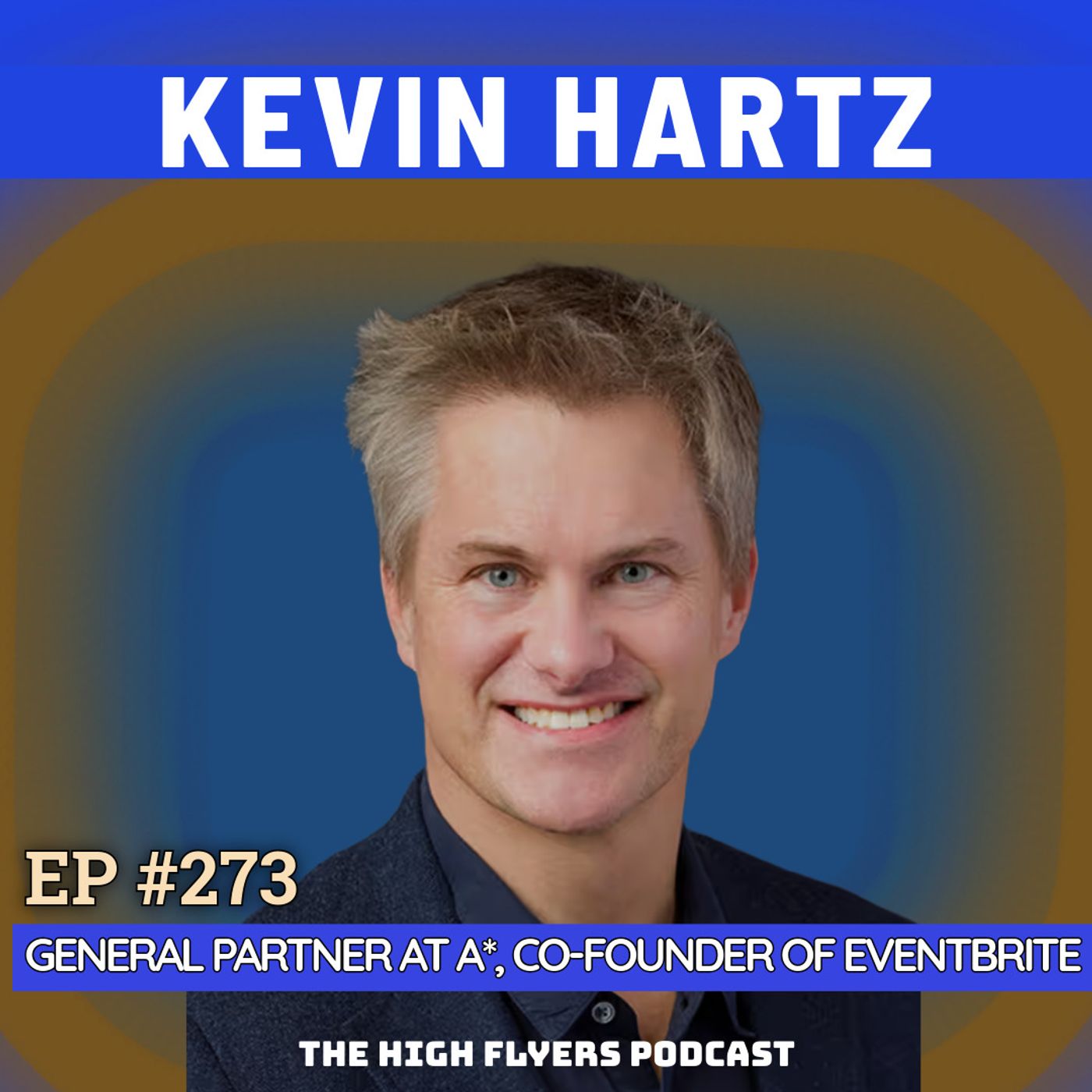
Kevin Hartz, venture capitalist and former CEO/founder, discusses his path from Berkeley/Orinda to Stanford and Oxford, early tech and PayPal connections, building Zoom and Eventbrite, and how he now invests via ASTAR (including SPAC-to-traditional VC shift). He also shares views on talent, founder identity, and diligence.
Born in Berkeley, raised in Orinda; Stanford (early tech/entrepreneurship focus) and later Oxford (history). Worked in a neural lab and at Silicon Graphics; associate at Outlook Ventures. Co-founded Zoom-adjacent money remittance via PayPal API; later founded Eventbrite with Julia Hartz. Now partner at ASTAR in San Francisco.
Great companies come from great teams and “lifeboat” talent; hiring should be partnership-based, not adversarial. VC fundraising adds operational burden and signals. Founder markets and high valuations enable scaling. Family environment predicts founder fit.
Peter Thiel, Roloff Botha, David Sacks, Keith Rabois, Neil Gorsuch; PayPal API used to build remittance; Zoom IPO (2013) and PayPal acquisition interest (2015); Eventbrite’s ticketing “perishable virtual good” and self-service flywheel; ASTAR bets like Ramp and Decagon.
Written by AI. May contain mistakes.
Kevin Hartz shares insights about his early life, family, and education.
“Our listeners have called this podcast a meticulously researched biography unveiling the extraordinary lives and decisions of the most remarkable individuals and companies from around the world.”
Kevin discusses his childhood experiences growing up in Berkeley and Orinda.
“Let's one back the clock and go to your sunrise, as I call it, your childhood.”
Kevin reflects on his family's influence and his early career choices.
“I came across a story that your parents met at a Democratic Party function.”
Kevin talks about his sister's career and their family dynamics.
“Of course, there was that desire to have me practice law, But I thankfully, I'll say, wasn't quite cut out for it.”
Kevin shares anecdotes from his family's time in Miami during the 80s.
“My aunt, who is in her late 80s, is still in residential real estate and sells and moves so many homes in that kind of market.”
Kevin describes his return to the Bay Area and experiences in high school.
“And he went to work for a bank in the early 80s for five years or so.”
Kevin discusses his college years, focusing on learning and entrepreneurship.
“They're all fundamentally the same people.”
Kevin compares his experiences at Stanford and Oxford, focusing on the academic rigor.
“So that makes the tech connection even more unique.”
Kevin reflects on the intellectual pursuits at both universities and their impact.
“Whereas Oxford, I mean, you mentioned the Supreme Court judge.”
Explore the differences in drive and purpose between students at Oxford and Stanford.
“That maybe wasn't clear at that point, but now in hindsight it is.”
Kevin discusses his transition back to the US and the uncertainty he faced in starting his career.
“So I think you finished Stanford in the mid 90s, if I'm correct.”
Kevin shares his entry into technology and his early involvement with PayPal and Outlook Ventures.
“Max and started PayPal and Angel invested into that.”
Learn about Kevin's experience founding Zoom and the challenges he faced during its early days.
“And there was a rule when Peter Thiel offers you something, say yes.”
Discussion on how the role of founders has transformed in the tech industry over the years.
“four and a half, five years, and then you joined the board.”
Kevin compares the tech ecosystems of the early 2000s to the current landscape, highlighting key differences.
“I'm curious, like, let's do that for a second because you've seen the ecosystem from the early 2000s to today.”
Kevin delves into the motivations and insights that led to the founding of Eventbrite.
“I really didn't feel like I wanted to just go travel and sit on a beach.”
Explore the complexities Kevin faced while managing Eventbrite post-fundraising.
“It wasn't hard to build the first kind of versions of it.”
Learn about the pros and cons of fundraising from Kevin Hartz's perspective.
“remittances where you'd move into the Philippines or you'd move into sending to Mexico or so on.”
Kevin discusses what it takes to scale a company like Eventbrite and its challenges.
“But no, the VC route and raising, what that really means is that you've got serious building to do.”
Insights into the mental load and responsibilities of being a CEO.
“shoehorn ticketing or events or money remittance or the like.”
Kevin shares insights on working with family and partners in a business.
“Yeah, I mean, it's like I do characterize it as like just this regular drumbeat of kind of gut-wrenching news.”
Kevin reflects on how becoming a parent changed his time management and work-life balance.
“but we put in a lot of other safeguards, ensuring that we were kind of cut up the areas of responsibility of the company and assign them out and there was no overlap.”
Kevin discusses how to approach hiring and building a strong team.
“And he could stay back in his place and play chess and think about the future, and that team would execute.”
Kevin shares his views on the current market and investment approach.
“I haven't seen that for a very long time where they feel there's this very important mission and technology that they need to build out.”
Kevin reflects on his identity post-Eventbrite and lessons learned.
“And so you can't just step out of the market as much as like there's a good argument to take six or 12 months off and sit on a beach and just let craziness happen because they're just by the nature of it.”
Discussion on Kevin's preference for privacy and focus on supporting others.
“And I'm working on that and hopefully I get better at it.”
Explore the journey of staying grounded in the tech world despite the limelight.
“Whereas you stayed and you've doubled down on tech.”
Learn about the evolution from being a founder to becoming a venture capitalist.
“Tell me you've been doing that for, I think, five years, is that right?”
Understand the approach to sourcing unique investment opportunities in startups.
“It was a$300 million fund and 21 was not a good vintage to invest in.”
Discover how relationships with founders impact investment decisions.
“there's been a number of companies that kind of precede with just a few angels and a small round.”
Insights on selecting partners and building a cohesive venture capital team.
“Because of the commitments you make to the LPs.”
Engage in a quick session of questions that reflect personal and professional insights.
“So I want to move to rapid fire sprint in a second, but I thought an interesting question before that, Kevin would be, I'd love for you to visualize like a learning room.”
Discover personal investments and valuable book recommendations from the guest.
“Is there a hobby or a course or a holiday?”
Kevin and the host discuss interesting book recommendations and the importance of knowing one's childhood.
“Last two, when I saw you last time, I think you were reading an interesting book.”

Get the gist, explore an idea or ask about something said.
 Claude
On The High Flyers Podcast with Vidit Agarwal, what are the key points of this episode?
Searching your listeningAutomatic transcript. May contain errors.
0:00Hi, I'm Vidit, the founder and host of this podcast, The High Flyers. Kevin Hartz and a partner at ASTAR, a venture fund in San Francisco, California. Kevin, this is so good to do. We've gone from meeting for breakfast to doing a podcast. That's good. We're making progress. Breakfast in Sydney, you should point in. Exactly. Sydney of all places. We were both there at the same time. So that was incredible. And your daughter, your daughter's spending some time there, right? She's over there traveling abroad at University of New South Wales. So good. So good.
1:00Our listeners have called this podcast a meticulously researched biography unveiling the extraordinary lives and decisions of the most remarkable individuals and companies from around the world. We hope you're enjoying our catalog of 200 plus episodes since we launched in 2020 with many of our guests appearing in rare public interviews. It's now time to explore your curiosity. Please enjoy. Let's set the scene, Kevin, with some fun facts and rapid fire. Where were you born and where do you live now? I was born in Berkeley, California at Alta Bates, just across the bay and live in San Francisco now.
1:36And work, what was your first job and what do you do now? My first job was as a lifeguard and now I'm a venture capitalist. It sounds like a contrast. Well, someone would say you are being a lifeguard now. Like maybe you can save a company, right? Or you can help a company grow. So who knows? I won't extend that metaphor. And Kevin, as you know, the purpose of this show is to reimagine the concept of a high flyer. Is there a person you know who you feel hasn't got the recognition they deserve? Well, it's always Julia Hartz, my wife, who just sold her company to Bending Spoons and had been running that business for over a decade and co-founded it with me way back when.
2:21I like how you call it her business, even though it was your business together. Well, when she's running it, it was clearly hers and that's what made it so great. And this is Eventbrite. This is Eventbrite. Yeah, just casually. But I mean, Bending Spoon is really interesting because they've been in the news so much recently, right? With the Airtable acquisition. Yes, Airtable, Evernote, AOL, a number of companies. Luca, the founder CEO, has done a brilliant job at assembling all these businesses. Yeah, so interesting. Back to the episode in a moment. Something I've heard a lot from business owners and leaders is that speed only matters if you still feel confident in the output.
3:07And it's particularly an important point in this world of AI. Xero's answer to that is accountable intelligence. AI that shows you what it's doing and works from your own real data and is designed to keep you in control before anything happens. As Xero puts it, most AI asks you to trust it, accountable intelligence shows you why you can. And that's how it works with Jaxx, Xero's in-platform AI finance partner. So whether you're running the business, advising the client, or working with your board, Jaxx ensures that you get the upside of automation without giving up any of the control. If you want to see this practice, head over to xero.com forward slash highflyers for 90 % off your plan for the first six months.
3:54Terms apply and go to the website. That's xero.com forward slash highflyers. Now back to the episode. Let's one back the clock and go to your sunrise, as I call it, your childhood. You mentioned growing up in Berkeley. What are your memories of that environment? Well, I grew up in a town adjacent to Berkeley called Orinda. It was a small town. And so oftentimes you would just say you're from Berkeley because that was a little more recognizable, but it was Orinda and we would call it Borinda because it was a little dull and boring. But in hindsight, it was a great environment to be a kid growing up there out in the wilds of the East Bay before the tech revolution.
4:37And it was a great like all-American experience, I guess, is what I would describe it as and was a launching pad to go to Stanford. I found it interesting in my research. I came across a story that your parents met at a Democratic Party function. Is that right? They did. They met in San Francisco. They were both very involved in the Democratic Party, and our whole family has been lifelong Democrats, although I call that into question for myself as of recent, as things have gotten a little swirly. But who knows if you should talk about politics in a podcast. Yeah, yeah. We might not go too far into that story.
5:15I agree. What I find really interesting about you, and I saw this even when we caught up the other day, is you still seem to be, I mean, I didn't know you as a kid, but when I speak to other people, they say you're still the same guy that you were growing up. Whereas, as you know, a lot of people change when they have success and when they have a bit more money. I'm curious, what do you put that down to? Is that the family that raised you? I think so. Parents were always very modest and stoic with a focus around learning. And I think what you get there is just you're always just ready for the next chapter and for a big change or for resetting things in a sense for that next great adventure.
5:56Tell me about your parents. What did they do for work? Well, my father is now a retired attorney and he loved the law. Of course, there was that desire to have me practice law, But I thankfully, I'll say, wasn't quite cut out for it. I think he's one of the few in the profession that really loved the law, loved the practice law and really appreciated it. And I would say he had just this great intellect around it. And my mom was a homemaker for most of her life. And then she got a real estate license and started practicing commercial real estate. And she kind of hustled, had a lot of energy. She'd grown up on a farm in the Midwest.
6:34My aunt, who is in her late 80s, is still in residential real estate and sells and moves so many homes in that kind of market. And there was some kind of commercial and hopefully intellectual like bent to the hearts family. And you're the only child? Is that right? No, I have an older sister and she works down the peninsula. She lives in Menlo Park and she's the CEO of Washington Hospital. And I always say she works harder than I would say 98 % of the startup CEOs out there. And it's a public hospital, which is a tireless, low-paying job, but she does it for the love and for wanting to help the community.
7:19So it's a very admirable position. Hopefully, maybe some of our surgical robotic companies or AI companies can help her job move along more efficiently in the coming years. Totally. I mean, my partner, she works in the healthcare system as a doctor, and I've been amazed at how much technology actually is coming into that space. I think you might have done a few investments in that space as well, and it's amazing at how technology is finally starting to shift the healthcare system. So yeah, hopefully your sister can chat to you about it over a meal and there's a few opportunities for sure. Tell me about, I again came across in my research, Kevin, that did you spend some time in Miami as a kid?
7:59Like you called it in one of your interviews, like your sketchy Miami years. Tell me about that. Yeah. Well, Julia kind of coined the phrase our sketchy or shady Miami years because my father, as mentioned, was an attorney. And he went to work for a bank in the early 80s for five years or so. And being the general counsel in a Miami bank in the 70s, 80s sounds like you're like money laundering and somehow like involved in cocaine trafficking. So that's our of course he was not. But that's our kind of like family joke is like that we went out to the Wild West of like the narcotics trafficking, you know, heyday in that late 70s, early 80s period.
8:42but i you know i i beat that whole group to miami and was had left prior to all of them by a number of years uh if only we you know kept the real estate i guess it was when that entire area was almost or it was really still like just swamps in the everglades totally so so you did that and then you came back to the bay area right because you finished high school here? Came back to the same town and father became general counsel of a Canadian company called Genstar and had its headquarters in San Francisco. And, you know, I kind of continued along in Orinda and it was still the same boring town when I got back.
9:24I'm curious, how would, I mean, you've been an entrepreneur for what, 20, 30 years now, longer probably like how would your would you say your personalities change much like if i spoke to your high school friends compared to like the people you hang out with now would they would they say that kevin as a kid was different to the kevin today uh you know i i think primarily not at all and just having this perspective now of friends from high school or friends from college and watching them grow their careers or however you want to phrase it, build businesses, accomplish big things. They're all fundamentally the same people.
10:05I guess we have to, what is the age of, there's some cognitive decline that begins at age 45. So hopefully you have some wisdom and perspective to make up for maybe some loss of cognition. I mean, I want to fast forward to when you were 18, because I feel like 18, we've all got some understanding of self, right? Like if I met you at that age, what would I have assumed you do with your life? Well, I wasn't focused on building a startup. I was focused on learning and just freshman year in college and finding what really grips me. And it was only a few years later that like I was really drawn into tech and drawn into entrepreneurship.
10:48It was such a smaller market in effect way back when at that period. And it wasn't really a track in the same way that at the time at college, you could very easily go to law school or go to med school or take these other professional directions, like kind of entrepreneurialism and tech was kind of an oddball concept in a sense. Well, particularly because you, I think both at Stanford and Oxford, where you studied history, right? That's correct. Yeah. So that makes the tech connection even more unique. Yes. So, you know, in that sense, I mean, I thought I always, and I still feel strongly that that's the reason to go to college, to university is to learn how to learn and to pursue a liberal arts degree and not to go to a trade school.
11:42Like you go to an auto mechanic school to be a auto mechanic, you know, like, you know, you go to college to kind of expand your mind and, you know, kind of just experience new mechanism of learning. I'd be curious, Kevin, because most people ask you about your time at Stanford for obvious reasons, because of the crew you went to college with. I don't think people ask you enough about Oxford. So I wonder if the question that might get some interesting anecdotes is Oxford versus Stanford, if you compare the two environments, how would you compare and contrast them both in terms of the study, but also in terms of the people you met?
12:23Yeah. So Oxford is kind of a misnomer because Oxford's really a cluster of colleges. So I was at university college. There's also new college, there's Christchurch. And so you really sort of bond and gain closeness to your college itself. And then in my case, as a graduate, working on a graduate degree, you know, spent more time in our graduate commons. And I would say that like the level of intensity, like the academic rigor was higher than Stanford. Maybe it was like my focus of classes, but at Oxford just, it was like a very intense year. And then kind of take the nice weather of California out of the equation and you have another incentive to be inside more and be studying along.
13:12But with that said, there are some incredible minds there. One of the nicest people in our graduate group at that time was Neil Gorsuch, who's now a Supreme Court justice. And so it always kind of makes me feel good to say like, okay, this person had a very good heart and a brilliant mind, and that's a good person to have on the U.S. Supreme Court. Tell me more about the people, because I think most of us know that at Stanford, you're with Peter Thiel and Keith Verboe and David Sachs and a lot of these personalities who've got a big profile of their own now in tech. Whereas Oxford, I mean, you mentioned the Supreme Court judge.
13:56How different were the people? Because Stanford, it seems like you were like in this whole star team, right? That maybe wasn't clear at that point, but now in hindsight it is. Was Oxford also have smart people? Any differences between the people in the two universities? Yeah. I mean, you're making me actually think deeply about this. It's a great question. And what I would say, and especially at that time, you know, was like, you know, the Oxford side, you know, maybe there was just not that drive to get outside of academia or what happens in the future or how do you change the world for the better as much, you know, like, again, a deep intellectual like drive there.
14:38I was just in Oxford earlier this year and have noticed the environment is changing somewhat. I don't want to just all tee it up to tech. You know, like there are more companies now being created out of Oxford and certainly Cambridge, where a lot of the DeepMind crew came from. But, you know, at Stanford, there was a sense of purpose when you enter the university. There is a relatively large set of people that really wanted to go out and make change. Cory Booker was a friend and we worked in student politics together. He's a senator now, as was Peter Thiel. And there was sort of a greater purpose looking ahead.
15:20So I think you finished Stanford in the mid 90s, if I'm correct. I think it was 93 potentially. 92, actually. 92. Okay, great. You clearly know you're - I know in the United States, it's like, you know, identifying my coaches. You know, I might have to bleep this out. You still look young, Kevin. Don't worry. You look very young. So tell me, you finished that, too. You were clearly in the UK because that's where Oxford is. Did you come back to the US to start your career? I came back to the US. I came back to the Bay Area and I would say fairly lost. I wasn't sure what to do. There was like a, in that 93, 94-ish period, there was a recession.
16:01I was actually, I had med school classes completed, and I was thinking, what do I do? Apply to med school. And I was going through that and was working in a lab. It was a neural lab, and we had these unique systems to do the work. And lo and behold, the internet appears. And as soon as saw and recognized that impact of it was like just immediately drawn in and took a job at Silicon Graphics. And kind of that was the first jump into technology. Because I think you were at Silicon Graphics for a few years and then you went to, did you go to a VC fund early on? Were you at the fund called Outlook Ventures?
16:45Outlook Ventures, yes. So was a associate, a small fund called Outlook. And what else would I say about it? But at the same time, I was also, that's when Peter came out to the Valley and met up with Max and started PayPal and Angel invested into that. And that was thanks to your Stanford connection, I assume, where that deal came up, right? That's correct. Yeah. Yeah. And then you went and started your first big company. I mean, you've done, I think, a couple of companies before that, but Zoom was your first one in just after the dot-com bust, right? Actually, after I left Silicon Graphics, I started a company with some people I knew from Stanford called Connect Group.
17:30And, you know, it was like during the late 90s and we had like a, I think we incorporated in April and the company was acquired by a public company called LodgeNet, you know, for a modest sum. but it gave us just kind of like blood in the water for sharks. Like it was just, it was very exciting development and kind of gave me a taste at least for entrepreneurship and so on. And I wanted more. And that led to Zoom. Is that where you're going? Yes. I think the other factor of it was that now you go into the 2000s and in March of 2000, the NASDAQ crashed. You had this prolonged sort of dot-com wreckage compounded by 9-11, effectively a year later.
18:19And you had the market in a terrible place. And out of that, PayPal is blasting off. So while there's this general belief that tech and the internet are dead and are kind of a fraud or something of that like, this PayPal is doing very well. And given I had this angel investment in PayPal, I wanted to find a way to build off that success. It was kind of what you learn initially in tech. In fact, Mike Moritz, like great companies, industries are built upon great companies and beyond. And so I went to David Sachs, who was heading up product with my business partner at the time, Alan Braverman. And we asked that they would open up an API so that we could tap in and build a money remittance business off PayPal.
19:10And we did just that. I mean, exactly. But that's so interesting that you started your own company. I'm curious, was there ever a moment where you could have joined PayPal, given you knew all these guys? Yeah. And in fact, was asked. And there was a rule when Peter Thiel offers you something, say yes. and like made a mistake or two on that part. But it worked out just fine because instead built this adjunct to the business. And while we're getting this off the ground, PayPal gets acquired by eBay and Peter and most of the team, most of the key players like leave with the close of the deal or with the announcement and then close of the deal.
19:53And Peter angel invests 500K into Zoom, X-O-O-M. Yeah, X-O-O-M, exactly. Well, I mean, Zoom actually eventually got acquired by PayPal. So that's how interesting is that? That's like a full circle story, right? Yes. It's like a circular reference or something. And it was a good exit. We went public in 2013 and PayPal came knocking 2015. But it is also a message that the market was really just beginning then. And I don't know if we pondered where this market would end up. But if you look at the remittance businesses today that were maybe even just startups at the time that we were acquired, it's become an absolutely massive market.
20:40So I wouldn't say miscavines, but something to ponder. I bet. I mean, tell me about the time at Zoom. We probably can't cover the entire story, but I guess many people would say that was your coming of age moment, right? like that's when you got on the public stage, so to speak. People probably heard about you. And I think Vrolof Boita was your first investor or second investor. I don't know if that was through Sequoia or through him personally. But then what I find interesting is you were CEO for five years, four and a half, five years, and then you joined the board. So how do you reflect on that?
21:18Did you realize that you like building rather than leading people and running the company. I'm curious if you can reflect on that. Well, when Sequoia came knocking, it was when Roloff, he was the CFO at PayPal. He left and joined. And the company went public when he was, I think, 26 years old. But after the sale of the company, he went over to Sequoia. And what Sequoia did at that period of time was pair kind of a senior partner with a junior partner. And so it was Pierre Lamond, who's kind of a legend. He's the founder of National Semiconductor. He was the first partner with Don Valentine. He was at Sequoia a few decades.
22:03And he was a great mentor along with Roloff through this. He was also very, very tough and a very hard grader and very much in the camp of like at that period of like old school venture, which at a certain point you bring in the quote unquote professional CEO. And so I was kind of brushed aside to the board. It's amazing what happened with the return of Steve Jobs and the rise of Mark Zuckerberg in terms of like really shifting the weight over to the founders. And in this market today, you now have so many measures to ensure that those sort of things don't happen. Well, I would say today is actually a complete founders market.
22:46If you've got a hot company, you do what you want. That's exactly right. And for I was putting in the special voting shares for its founders team as they prepare to go public. And they can do that. Yeah. Even the early stage ones. I mean, even some of your portfolio, we don't have to name names. But some of the companies, like when I speak to their founders, they're like, yeah, if we're continuing to grow at this scale, we can raise money at any valuation. I'm curious, like, let's do that for a second because you've seen the ecosystem from the early 2000s to today. How do you compare and contrast today versus the 2000s?
23:27Well, things were, you know, the 2000s, just as the time has progressed, the capital intensive nature has diminished. But at the same time, there's been more capital available as tech market has grown substantially. Again, it feels like tech was large in the 2000s, but this is on a whole different ballgame. And, you know, that's a great thing. You look at the top 10 or top 20 most valuable companies in the world today, and they're all tech. in 2000. It was like banks and oil, you know, oil and so on. And the returns have been astounding and the returns for investors have been astounding. And that's what you see in the market today is you see the valuations raising up.
24:16Keith and Javan and I invested in the original seed round of Airbnb. And I think it was like a 1.7 million pre, like that, you know, like 1.7 million pre, like that just is not going to happen anymore. I mean, 1.7, that's like a pre, pre, pre-seed round now, right? So, okay. So back to 2005. So that Sequoia moment happened, you stepped away from the day-to-day of Zoom. Did you go to Eventbrite straight after that? Not go, did you start Eventbrite straight after that or did you have some time off? I was really always working. I really didn't feel like I wanted to just go travel and sit on a beach.
25:05And so I was working my way up to the next act and Eventbrite was just that. What was that? I'm sure you ask founders this now when you meet them. I ask this, I do a bit of angel investing. It's like, what gave you conviction to start that business? I'm curious because that's quite different to payments, right? What were you seeing in the world at that time? What were you consuming that made you realize that could be an opportunity? You know, it was just like this first wave of like, what we see a lot today is that tech is just this, there's this negative side to things that it can be very isolating.
25:44And we picture this dystopian future of being like by yourself in a closet with a VR headset on. And Julia and I were in Renault, we're talking a lot about how can you reverse that or use tech in a different means. And so I call that like the heart side of like founding Eventbrite is that we We wanted to drive, get people together and not succumb to this matrix dystopian future of live experiences and bringing people together around great music or intellectual pursuits of lectures or fitness, you name it. The second side of it was that I'm kind of a one trick pony. And it was another transactional business where still the majority of kind of payments on PayPal and then soon Stripe and so on were really still merchants with e-commerce physical items.
26:36And ticketing had not really been addressed at that time and certainly not in a kind of self-service manner. And so I think David Sachs once pointed out like tickets and Eventbrite did was this, you had this like virtual good of sorts, a ticket that could be worth a few thousand dollars. And it's also this like sort of perishable good that, you know, once the event happens, it's worth a zero. And so there's this urgency to move that virtual or perishable good. So those two sides were like really the driving force to it. And then we just started to build it. It wasn't hard to build the first kind of versions of it.
27:16And we started having fun and really almost spent two years just kind of pushing this along to be truly self-service and really get that flywheel going. I've heard you say, Kevin, in other interviews that Eventbrot was actually harder to run after you raised money. Is that true? Was it harder to raise after? I mean, in some regards, like I think we were in this, you know, we had this belief of making the perpetual motion machine that you could just set this up and event creators would sign up and publish events and people would come and buy tickets and it would all happen and you'd never have to have anyone operating it.
27:57But the market, maybe one challenge of it was the market wasn't as well defined as like safe remittances where you'd move into the Philippines or you'd move into sending to Mexico or so on. It was all these kind of small verticals that were very disparate. And how do you put together a go-to-market teams for doing this? Yeah, I think that's what I said. I don't even remember what I said exactly. Yeah, I didn't watch the interview, but I came across a quote, which is something along the lines of like, it became harder when it wasn't bootstrapped, which I mean, it's a long time ago now, but I found that just interesting because you've got a really interesting vantage point today on like the pros and cons of fundraising right so maybe that's the better question is like when you compare zoom eventbrite and then of course you work today i mean if you could start eventbrite again like would you still go down the vc route um yes but you know perhaps like if it was today i mean very different environment but But no, the VC route and raising, what that really means is that you've got serious building to do.
29:12You're responsible for people. You need to motivate and drive them. You have a myriad of decisions. You have every morning you wake up and your stomach drops as you find out something terrible has happened that you have to deal with. It's really like as a company grows and scales against being maybe a very small organic business that you can just keep tuning until it's practically running on itself. Like, I think I would always choose to scale up. And so, yes, it is certainly harder, but you learn the relationships you build, the people you interact with. It's such a great experience. this might be a tricky what if question but what would an event pride business look like today in this ai era i one maybe you've thought about this and you've chatted about this to friends what what might it look like in this ai era if you were starting it today you know like i don't know i don't believe that like i don't spend that much time trying to rethink it for each era and maybe it's because you know it's been launched and created in a certain era yeah i guess i i would much rather look at a entirely better adapted business for this era and not necessarily shoehorn ticketing or events or money remittance or the like.
30:35I asked you earlier about, so at Zoom, you were CEO for about five years and you shared the Square story. At Eventbrite, I think you were CEO for 11 years. Or were you co-CEO? Were you and Julia co-CEOs? For a very short time, we were co-CEOs. But you were CEO for like the first decade, right? was CEO for the rest of the time through the IPO and Bending Spoons acquisition. Right, right, right. Tell me about that because you know this firsthand. Being a CEO is really hard of a scaling company. I mean, I'm a CEO of my own company, and we're not scaling the way Eventbrite did or any of these VC-backed companies.
31:13But like you said, you're always thinking about it. You never really switch off. The mental load is intense. I'm curious, was there, Can you share any moments from your time as CEO of Eventbrite that really taught you a lot that you look back on now? Yeah, I mean, it's like I do characterize it as like just this regular drumbeat of kind of gut-wrenching news. But that's a world-class problem to have because you're getting to a certain size where things are going wrong that much and you're moving really fast. And you just have to adjust and continue forward. But it's something to think about is like perhaps what area of business, like some businesses are easier to scale than others.
32:00Don't ask me for an example. I don't know if I can give one right now. But, you know, like but in any case, you know, you do it like it's a labor of love. And I always point out that it's different chapters in a book and you want to progress through each chapter and have a different experience at different size of headcount and different revenue and going into the public markets and beyond that. And so it's a great adventure and a journey. And for some CEOs, it's been very rosy, but for most it's wrought with challenges. If I came to you today and said, Kevin, I'm starting a business with my wife, what would you say?
32:44I would say it can be a very good thing. You just want to make sure you're stress testing it, that you have a plan. I mean, almost every set of founders should come up with a plan if they find themselves at each other's throat because you're going to sink the entire company. And so we had talked about if it was not working out, if we were finding ourselves as adversaries, like I would step out of the business or Julia would step out, but we put in a lot of other safeguards, ensuring that we were kind of cut up the areas of responsibility of the company and assign them out and there was no overlap.
33:24So it was very clear who was the final decision maker with things like I was focused on the product side and Julia was focus on the marketing acquisition side. And she could give advice, but not overrule or anything and vice versa. And I think like our set of rules worked out quite well. I wonder if we can go a bit personal for a moment, because by this point, you'd had your first daughter, right? We did Emma. Yeah. So how did, because that, yeah, like, Yeah, she's the one who's in Sydney now, right? I mean, that, I assume, would have been a big change in your life. Before that, you were just this founder tech guy and now you're a dad.
34:10I wonder if you can reflect on that. Did that change you? And if so, how? Wow. Well, I think, you know, like certainly with parents, like you learn, like you sharpen your time management because you want to be with your child. And at the same time, you want to build your company. So you really work that out. Like it was our company. We had three employees at the time, or there were three of us at the time. And so we could bring Emma into the office that we were given by our wonderful landlord, Gary Gomez, who set us up in this great warehouse in Petra Hill. And Emma was kind of a fixture in the office and subsequent offices to that.
34:52Yeah, because I would have thought that that would have been potentially an inflection point, right? Where particularly building a business with your wife and then having your first kid, that's quite a bit. But it also, I don't know, like, you know, the other side of it is you always want to think about like great leverage. And that just means hiring great people. And you knew, like, if you're changing diapers and saving the company every minute, changing diaper with right hand and saving company with left hand, you just hadn't done the right hiring. And when you find great people and they really move the business.
35:29And I always think back to the best example of it that I'd ever seen was Peter Thiel, who had brought on Roloff and David Sachs and Keith Reboys and Reid Hoffman and this incredible group of people in Elon via the merger. And he could stay back in his place and play chess and think about the future, and that team would execute. I actually was going to ask you that. What have you learned about talent? because one, if you go back to the early part of this conversation, Stanford, you went to college with these guys, but then Zoom and Eventbrite, you would have hired tons of employees. And then with Astar, you've got a team of different types of people in the firm, right?
36:15So how do you look at talent? Maybe that's a conversation you have with founders today where they come to you and say, Kevin, I'm thinking about my first exec hire, or I'm thinking about, should I bring in an external CEO. How are you advising founders on talent today? Well, I mean, it's just always been that people picture that hiring, you have an employee and a boss and there's an adversarial. It's very much you find partners that share your vision and share your values and they want to build and they want to have a big impact. And you want to see them rise up and do amazing things. And so there is this understanding or this pact between the founder and a team member to get there and that you want them to be, we always talked about the kind of lifeboat exercises, like who are the people with the biggest impact in the org and how do you just keep giving them more responsibility and you're more than happy to give them more stock and equity and kind of keep loading them up.
37:23The other thing that is interesting that I noticed about this era is just how well, say, Anthropic has done with people really believing in the company. Anthropic employees love Anthropic. They feel such a sense of mission. I haven't seen that for a very long time where they feel there's this very important mission and technology that they need to build out. It's a bit of a cult, but I don't know. I would not fault Dario if he's reading some good books on how to build a cult. He's just got a loyal audience that really cares. And at the same time, they've built an insanely valuable business. Word is it's FIIP files next month.
38:08It'll be valued about$2 trillion. dollars which is i mean i'm sure someone like you looking at that that is just baffling right like that is an absolutely baffling number it's um i mean i i just marvel at like uh i believe it was started in anthropic was started in 2021 so five plus years just an incredible like the growth is like no other company we've seen like go back to the 90s and it was the netscape ipo in maybe 95 or 96, August of 96, maybe. Apparently that was Jerry Garcia's. The day Jerry Garcia died, I think Netscape went public, if I got that correct. But it was maybe a$6 or$7 billion company.
38:57And that was the center of the internet revolution. And now we're talking about$2 trillion for the AI counterpart. It's incredible. I mean, does that, I want to come back to Eventbrite in a second, but just on that point with your investing with Astar today, I mean, I do like small checks as an angel, whereas you've got a fund and you're doing slightly bigger checks. A pessimist might say like, if there's so much money coming to the market, this is the time to like exit the market and watch. Whereas an optimist will say, no, ride the wave and continue to keep going up and up and up. Which camp are you on?
39:33Yes. No, I mean, I mean that by I'm trying to be from both perspectives, like great companies can be created at any time. And so you can't just step out of the market as much as like there's a good argument to take six or 12 months off and sit on a beach and just let craziness happen because they're just by the nature of it. Google, for example, was created in the late 90s towards the end of the dot-com boom. But at the same time, you need to have enough ownership in a business and you can't sprinkle checks around. And the challenge of today is can you get large enough allocations at the right valuation given valuations are so much higher?
40:22And it's a very tricky market. Hmm. Yeah. And who knows? I mean, hindsight's a beautiful thing, right? We might look back in five years and we can decipher what worked and what didn't. Yeah. One side of me does want to take off to just go away for six months or do something completely different, but you can't do that. I want to go back to Eventbrite for a moment. And I wonder if I can ask you this, like, how do you reflect on the event, right? Like how it finished up? And the reason I ask this is because I reflect on this in my own life. Like if you speak to my wife, she'll say my identity is very much my work, which is very sad, but it is.
41:07And I'm working on that and hopefully I get better at it. And I feel most of us have that. Like if someone like you who's a high performer, it would definitely have that. I'm curious, how do you reflect back on that period? Because I know it was hard. I think that's obvious and you've talked about that. But who is Kevin Hart's post-event pride? Yeah, maybe it has been. I think having an identity around what you do is there is some good to it and there's an unhealthy amount. But it was a great period of time, learned a lot and saw a lot. And even greater macro scale was like interesting chapter in my larger book.
41:50And perhaps it's motivational to keep pushing forward into the next big adventure. Yeah. And I think kudos to you for like, because some people might have that moment and then completely step away, right? Go and do something different. Whereas you stayed and you've doubled down on tech. I mean, you're now investing in tech and you've done that for a while. What I also find interesting about you and I, this was confirmed when we had breakfast the other day is you've not tried to like have a big profile compared to like a lot of your peers who you went to stanford with have gone out and seek the limelight i'd say and i've gone to know some of them whereas my sense is you haven't done that like even speaking to julia and i was lucky to meet her at that breakfast very briefly like you both seem pretty grounded like i'm curious like is that again deliberate like Is that again back to childhood?
42:39Yeah, certainly that's part of childhood. And I'm investing now and working with founders. And my focus is around them, not around me. But certainly a lot of... I would say that a lot of my past colleagues and friends have just done incredibly well and have earned maybe a lot of the fanfare they've received. Potentially, potentially. Who knows? The jury's out on some of them. We don't have to go into specifics. So tell me about ASTAR. Tell me you've been doing that for, I think, five years, is that right? Five years, yes. Yeah. And you've been through a few iterations on ASTAR, right? I know you were fully all in on the SPAC era.
43:25Now you've got more of a traditional, I guess, early stage fund. And what has that experience been like, again, going from being a founder for more than two decades to being a VC and being, I guess, the metaphor I think of is you're now in the passenger seat, you're not driving the car anymore. How's that been? Well, Bennett Gautam and I came together with this idealistic notion that the SPAC would be the new method of companies getting efficiently and inexpensively to the public markets. And it did not live up to our hopes and dreams, but it was a venture upon itself. And even though we went through and we again call it our assorted SPAC years, these assorted SPAC years together, we didn't want to kill each other, even though things have been really tough.
44:15And we got together and said, let's invest, do what we have a lot of experience doing, and that's investing in the private markets. And so we started our first fund in about 2021, just three of us. We were mostly seed in some growth and we just fortunately in that first fund didn't go too wild. It was a$300 million fund and 21 was not a good vintage to invest in. But we kind of made it out without too many scars, I guess, from the period. 22 is like this big hangover period. it was actually difficult to raise our second fund. The first fund was very early and didn't quite have, don't have the results or all the markups yet.
45:04And so it took us a little while to raise the second fund, but we were off to the races. Yeah. I think you've got three funds and I think your most recent was 450 million. Is that right? Yes. So the first and second were 300. The third was 450. And how does that form your, like, I mean, your portfolio is exceptional like i know decagon jesse's been on recently you were i think early in ramp i mean that might have been pre-a star potentially and then you've got a whole bunch of other investments macor is another one how are you thinking about like finding the deals today like finding the next decagon and finding the next ramp like what does that look like given your network and your access yeah it changes but it's always just the relationships that one builds that you were introduced to the right founders by people that have worked with you and trust you and know you're going to be a good steward of the business, even especially in the seed stages where it's this zero to one creation moment.
46:08And the hardest aspect is to get off the ground. And that's where we spend the bulk of our time. That's our focus and practice area. And that's a very hard thing for others in the, you know, like if you're a multi-stage, it's, we, we, we're biased, but taking money from a multi-stage at the seat around sends all these signals around the A and this is where we think we have this unique advantage. So does that mean you, you ideally want to be the first check and then you might do like a follow-on and then you kind of stop there? We do. There's been this, especially since there's been this very, you know, kind of there's been a number of companies that kind of precede with just a few angels and a small round.
46:55And then, you know, you get to the seed and it is more like a series A. But yeah, I mean, I'd say like to be in from the scratch and can help and really get those step ups for the founders as we go forward. Well, my sense seems to be on some of your investments you've made, because I know their portfolios is you've bet on the founders, right? And you bet on the team. If I think of Eric at Ramp or Ashwin and Jesse at Decagon, I think you knew Ashwin pre-Decagon, right? Maybe we can use that as an example given Decagon's been on the pod and I know both Jesse and Ashwin are killing it. I think the incredible founders and they're so young.
47:31I think that's what I find incredible in this era. What did you see in Decagon in the early days? Did you back Ashwin in his previous startup and then you backed him again? Is that right? And that was entirely the answer from my perspective. Now, Jesse is incredibly talented and an amazing pedigree, but Ashwin is just an automatic check. And he's somebody I worked with. He had a company prior that he started with Daniel Barrios, who's now chief of staff to Sam Altman and Russell Kaplan, who's president of Cognition, and then Ashwin. And so you have these three very high trajectory, you know, PayPal, AI mafia, I guess.
48:19And Ashwin was a hard driver. The business was not ready to that business was not ready for this time. and when Ashwin met up with Jesse, then it was very natural to back him in his next endeavor. And also you met, I mean, you met Bennett, one of your partners at ASTART through the Ramp Investment, right? I mean, that one's really interesting because he was at KOTU, which is one of those multi-stage funds and then he's come into early stage. So again, maybe I asked you earlier about like talent and how you build teams. Was that a big, because you could almost say a venture fund And there's a longer relationship than a traditional startup founder, right?
49:01Because of the commitments you make to the LPs. It is. In the case of Bennett, like I was in the seed as an angel and Bennett was representing KOTU in the seed. And Bennett's a great complement. And you talk about like firm building. He's very financially oriented. He can understand almost any business immediately through the numbers. He's kind of a savant there and he's 35 and he's graded negotiation, graded kind of sales. Basically, a lot of things I'm not as strong at. So, you know, you want to look for the complementary nature. And at the same time, you want to make sure that you want to hang out with the person.
49:47I noticed that in so many venture funds, all the partners don't like each other. um and so we kind of run around and always are reinforcing that we all right do we still like each other i think so yes okay good well you've done an incredible job and then gotham who's just stepped away and he's gone back with travis right at adams i mean we're sad but very elated that he's back with he's reunited with travis and that's an incredible story in the making of tk getting the band back together. And it's fun to get the, like we get good real time updates. Yeah, I bet, I bet. I'm conscious of time. So I want to move to rapid fire sprint in a second, but I thought an interesting question before that, Kevin would be, I'd love for you to visualize like a learning room.
50:37Let's assume you have five chairs and you can invite four people, ideally four people you know. This one's particularly interesting because you know some fascinating people. Who would be the four people you'd love to have a meal with and just ask questions? people that you know? Oh, good question. I mean, I'll go with the closer acquaintance one, which would be like, and Stanford one, which would be like Kevin Warsh and Peter Thiel and Roloff Botha. That would be a little stiff, but it would be very eye-opening. Kevin was, been friends with Kevin since college, and he is now the chair of the Federal Reserve.
51:19That's three seats. You've got one more seat. Who'd be your last pick? Four seats. Yeah, you've got four seats. You have five in total. You've got one seat, and those are three. You can pick one more. Well, I'd have to throw in Max Legend to make sure that there's an engineer at the table too. Nice. Nice. Yeah. I mean, Max's, I mean, that's an incredible story in itself, in the journey he's had and he's still going with the firm. So absolutely. Sweet. I want to move to Rapid Fire Sprint to wrap this up. Is there one non-work investment that you consider the best in your life? Is there a hobby or a course or a holiday?
51:57So this is non-investment? This is like a leisure activity? Yeah, it could be investment of time or energy. uh we um a number of years back we built a home in fiji and there is a direct flight from san francisco to fiji and that's our getaway spot and the direct flights at night so you sleep on your way over there and that's uh fiji is like a very special place that looks like it's Hawaii in the year 1900. Yeah. I've actually never been to Fiji, but I think you've mentioned it a few times. So I better add that to my list because it's, yeah, it's incredible. It's a bit closer. Yeah, exactly. Exactly.
52:43Is there one thing you want to learn in the next six months?
52:49What do I want to learn? I mean, there's not one thing. There's like an almost infinite number of things. I want to understand the Chinese ecosystem more because I think it's like the Galapagos Islands where you have innovation and great things happening, but it's been very separate of the West. And so it's very curious to me to see how things are happening there. You have the Unitary IPO yesterday that was up like 600%. Is there one interview question you love asking prospective founders in the diligence process? It's always about their families. That really always determines their path. It's like, what kind of family environment?
53:34What are the passion of the parents? Are they academics? Is it a competitive environment? So if you can ask enough questions and get to the bottom of like the environment they grew up in, you're going to figure out if they're the one. Oh, you could start a podcast, Kevin. I mean, those are some of the questions I ask, like we did today. Any particular questions you love asking? Because I agree. I mean, that's a great way to get to know someone. But as you know, their incentives in our fundraising processes to tell you what you want to hear. How do you elicit candor? Well, I mean, I would hope nobody has been deceitful about what are your parents' professions, for example.
54:24That's true. Yeah, you'd hope not. Yeah, you'd hope not. Is there one pet peeve you have, something that really bothers you? One pet peeve. Oh, gosh. It's a pretty incredible cohort of founders. It's the GOAT, the best of all time. And there's so many great founders all focused from a young age and sophisticated. So what would be the pet peeve? Well, it could even be a pet peeve in life. It doesn't have to be work. It could be like, my pet peeve is I need to be tidy. If people are messy around me, that drives me nuts. Yeah. What is that? That's a great question. Why is it hard to think of a pet peeve?
55:10I'm really surprised. Maybe you don't have one. Maybe you're just such a patient guy. You just don't have a bad peeve, which is great. Oh, I have a response to that. I've banned the use of the term, I'd be happy to at A-star because I need you to meet with this founder. I'd be happy to. Well, you're not doing me a favor. We want to find the next ghoul. you need to meet with this person and it's not a like at the pleasure of like you got to do it so that expression i'd be happy to like if you're if somebody is doing you a favor like i'd be happy to loan you my car you know that's the use of i'd be happy to but not you know anything of like company or firm building i i agree now that i think of it it's it's such a good point.
56:08Last two, when I saw you last time, I think you were reading an interesting book. Was it How Not to Die in Prison? Was that the book you had on your table? Yes. Is there a book you'd recommend now or is it maybe it's that one? I would recommend that book because you just never know. No, it's Taylor Sheridan. He was at this Sun Valley conference and gave a really great talk on the work he's done. He quit as an actor when they were kind of underpaying him and started writing. And I think it's one of his first or second films was Sicaro and like the road and directed Yosemite and Landman. So he's just, he's just a very interesting guy and it's a guide on how to not like do stupid things in prison and get killed.
56:59Yeah. And it's a very polarizing title, but it sounds like it's got a lot of depth, right well it's one of the best titles to have when you're like out and about because everyone you know you'll be speaking to somebody and be holding the book and they're guessing you're like going to prison so it's you know get the leads to conversation starter that's true that's true and and last one is there one question you'd recommend i ask my next guest of course you don't know the next guest but anything i should add i'd have to be the profession and his or her parents and yeah what the environment was like growing up in the family well that's good because i i stopped with that so as we did with you so that's that's good we that is a critical part and i loved asking that because i think i'm amazed at the number of people it's a lot of the guests we've had on the pod we've people come back to me and they'll say i've known kevin for 10 years and I didn't know anything about his childhood.
57:56I'm amazed. A lot of friendships today are so work-oriented. People just don't know about people outside of their jobs, which is a story for another day. But Kevin, that's the finish line. I'm so glad we did this and I'm excited for our next breakfast or lunch or dinner. Hopefully in Sydney. Hopefully in Sydney or otherwise in San Francisco. We'll catch up. We'll find the time in either of those cities very soon. Excellent. Thank you so much. Thank you. That's a wrap. So if something in this episode sparked a thought, send it to a friend or colleague. And if you're curious about partnering with us and the Curiosity Center, whether it's this podcast, to our reports, events, and more, and join the ranks of existing commercial partners, including Google, KPMG, Vanta, the University of Melbourne, and others, my details are in the show notes.
58:47Until next time, I'm Vidit Tagawal, and this is the High Flies Podcast. Thank you.
This episode is supported by Xero, helping businesses use AI with more control through JAX, its in-platform AI finance partner. Get 90% off your plan for your first 6 months at xero.com/highflyers.
________
Kevin Hartz is the Co-Founder of Eventbrite and Xoom, and Co-Founder and General Partner at A*, the early-stage venture firm whose latest fund is $450M. Xoom was acquired by PayPal for more than $1B, Eventbrite went public, and Kevin has backed some of technology’s most important companies from the earliest stages, including PayPal, Airbnb, Palantir, SpaceX, Anduril, Ramp and Decagon.
In this conversation with Vidit, Kevin goes back to the beginning: growing up in the Bay Area before Silicon Valley became Silicon Valley, studying history at Stanford and Oxford, returning home “fairly lost,” and nearly choosing medicine before the internet pulled him into technology. He shares how friendships with Peter Thiel and the early PayPal team shaped his trajectory, why he chose to build Xoom instead of joining PayPal, and what it felt like to later be “brushed aside” as CEO.
Kevin also reflects on building Eventbrite with his wife Julia while raising a family, the relentless reality of being a scaling CEO, and how identity changes when a company that defined two decades of your life is no longer yours. He explains what the PayPal Mafia taught him about talent, why the best founders create leverage by surrounding themselves with exceptional people, and why some founders are simply an “automatic check.”
They also explore A*, how Kevin finds the next generation of breakout founders, the extraordinary valuations and competition in today’s AI market, why relationships still matter at seed, and what decades of building and investing have taught him about ambition, judgment and the people you choose to spend your life around.
Please enjoy exploring your curiosity.
________
Get in touch with us via email at [email protected]
Join our stable of commercial partners including the Australian Government, Google, KPMG,, Allens, Macquarie Capital, Xero, JP Morgan and more.
Show notes and more episodes here
Follow us on LinkedIn, Twitter and Instagram
Get in touch with our Founder and Host, Vidit Agarwal directly here
Contact us via our website
This episode is supported by Xero, helping businesses use AI with more control through JAX, its in-platform AI finance partner. Get 90% off your plan for your first 6 months at xero.com/highflyers.
________
TIMESTAMPS
00:00 – Meet Kevin Hartz
02:56 – Xero
03:56 – Childhood and family
16:00 – Stanford vs Oxford
21:00 – “I was fairly lost”
24:00 – PayPal, Peter Thiel and Xoom
30:00 – Getting pushed out as Xoom CEO
33:00 – Tech then vs now
35:00 – Why Eventbrite had to exist
43:00 – The reality of being CEO
45:00 – Building with Julia and becoming a dad
48:00 – What the PayPal Mafia taught him
53:00 – Investing in a wild market
56:00 – Who is Kevin Hartz after Eventbrite?
59:00 – Building A* after the SPAC era
1:02:00 – Finding the next great founder
1:04:00 – Why Ashwin was an “automatic check”
1:08:00 – Kevin’s dream dinner table
1:11:00 – The question Kevin asks every founder
1:13:00 – Why “I’d be happy to” is banned at A*
________
The High Flyers Podcast features in-depth interviews with the world’s most influential figures in business, tech, finance, government and sport. Launched in 2020, it has ranked in the global top ten for past three years, with listeners in 27 countries and over 200+ episodes released, and featured in Forbes, Daily Telegraph, and at SXSW.
Our guests include -- Malcolm Turnbull (Prime Minister of Australia), Jason Collins (Head of BlackRock, Asia Pacific), Brad Banducci (CEO, Woolworths), Michael Schneider (CEO, Bunnings), David Eckstein (CFO, Legora), Kevin Hartz (Partner, A*; Founder, Eventbrite), Jesse Zhang (CEO, Decagon), Vandita Pant (CFO, BHP), Elena Verna (Head of Growth, Lovable), David Haber (a16z Partner), Jodie Auster (Uber's Global Head of Travel), Rob Giglio (CCO, Canva), Jean-Michel Limieux (CTO, Shopify and Atlassian), Stevie Case (CRO, Vanta), Cristina Cordova (COO, Linear), Gautam Chari (Head of Capital Commitments, Bank of America), John Haddock (CBO, Harvey), Mark Suster (Partner, Upfront Ventures), Niki Scevak (Partner, Blackbird), Craig Tiley (CEO, USA Tennis), Jeanne DeWitt Grosser (COO, Vercel), Paul Bassat (Partner, Square Peg), Bowen Pan (Creator, Facebook Marketplace), Peter Varghese (Secretary of Foreign Affairs, Australian Government), Sam Sicilia (CIO, Hostplus), Jack Zhang (CEO, Airwallex), Tim Doyle (CEO, Eucalyptus), Sukhinder Singh Cassidy (CEO, Xero), Sanjeev Gandhi (CEO, Orica) and Philip Green (Australia's Ambassador/High Commissioner to India).