Ask ChatGPT

 The High Flyers Podcast with Vidit Agarwal
31 Aug 2026 · 1h 6m · 29 chapters
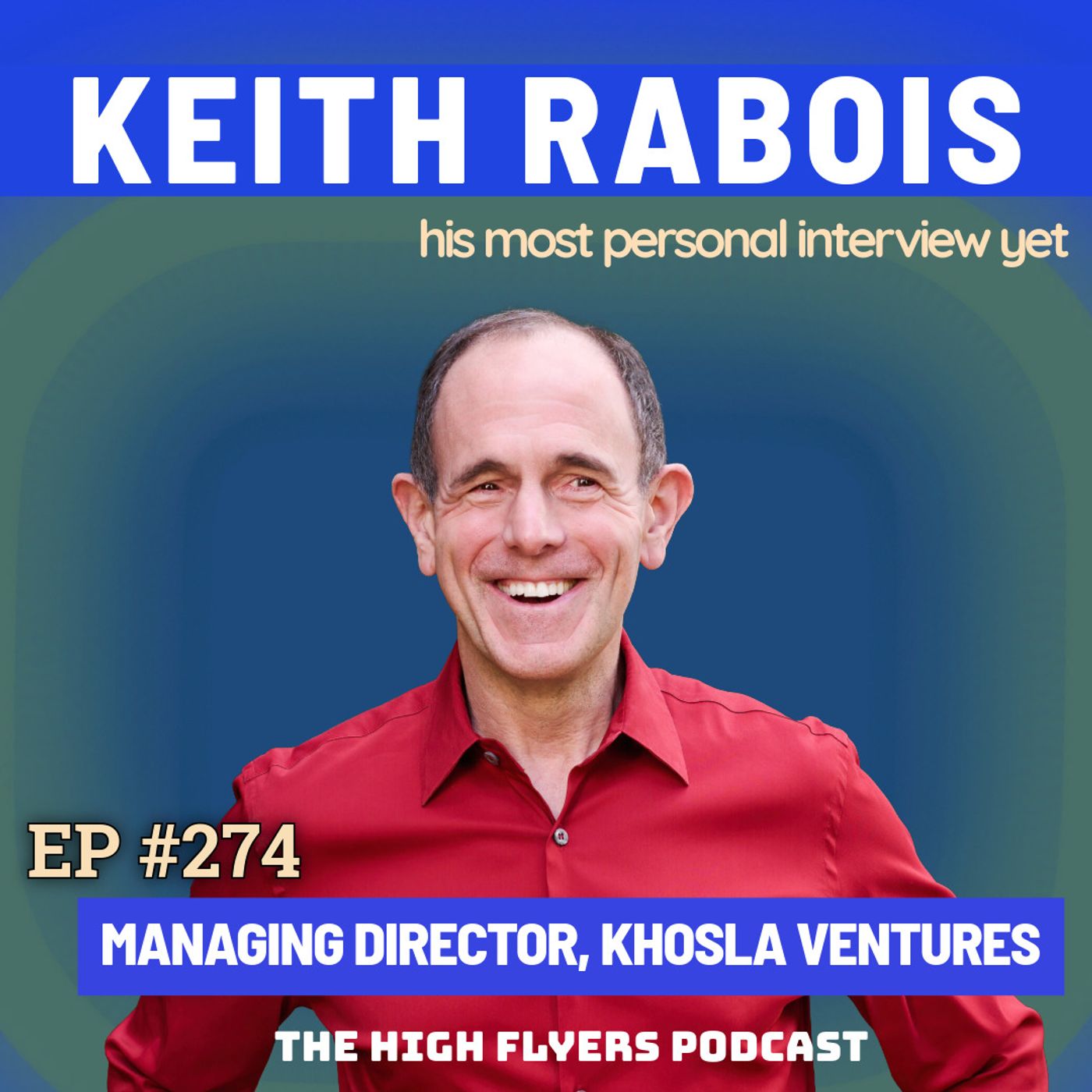
Keith Rabois’ personal career arc from law clerk to Silicon Valley investor/operator, plus his approach to judgment, hiring, time management, and learning; includes reflections on upbringing, credentialism, and how he thinks about AI and productivity.
Keith Rabois is a Managing Director at Crystal Ventures. He previously worked at PayPal (including government affairs/partnerships) and helped early LinkedIn as it shifted from viral growth to revenue. He also worked at Vodra.com (briefly) and later at LinkedIn; he’s an angel investor in companies including YouTube, Palantir, Zoom, and PayPal.
He prefers interviews that uncover “unexplored topics.” He engages with most non-troll posts on X to correct misconceptions. He says top VC skill is identifying high-potential people early. He argues hiring beats people-management: hire top talent and management becomes easier. He avoided an EA for a decade; now uses a chief of staff for strategic prioritization. He insists on handwritten notes.
Voter.com board meetings; leaving law in Feb 2000 for Vodra.com; angel investing in LinkedIn; using quantitative framing at PayPal; dinner with Jensen Huang about management; Peter Thiel’s Stanford Review delivery leading to involvement.
Written by AI. May contain mistakes.
Keith discusses his preference for interviews that explore unexplored topics.
“But I think people on Twitter might see you and be like, oh, I don't know if I want to approach this guy.”
Keith reflects on how his public persona may differ from his private demeanor.
“Our listeners have called this podcast a meticulously researched biography unveiling the extraordinary lives and decisions of the most remarkable individuals and companies from around the world.”
Keith shares insights about his upbringing and the influence of his parents.
“I actually read something the other day that if we travel a lot, it's bad for our skin.”
Keith recounts his transition from law to technology and venture capital.
“That one looks pretty good in retrospect.”
Keith discusses the concept of high flyers and the recognition they receive.
“Yeah, you connected me to Jeff Donica for research as well and he gave me some interesting answers.”
Keith reflects on his early career choices and key investments.
“And this one's particularly interesting because people haven't really asked you about your upbringing.”
Keith shares more about his childhood and the influence of his parents.
“too credentialist sort of along the way.”
Keith discusses his childhood activities and early career aspirations.
“homework while i was watching games but then i like to play a lot of baseball a fair amount of soccer, some tennis, you know, so mostly outdoor activities, like constantly.”
Keith shares his journey through law school and initial political aspirations.
“So tell me after high school, so you went to Stanford, right?”
Keith explains his decision to leave law for a career in technology.
“And so from that generation on, I have friends all over the map, you know, Stanford, Stanford grads all over the map, once it became kind of a normal thing for Stanford grads to do.”
Keith reflects on the implications of choosing a career in law versus technology.
“And I was trying to figure out, so I was flattered and happy to speak to a bunch of Harvard Law grads.”
Keith shares how meeting Peter Thiel influenced his life and career path.
“He wound up clerking on the 11th Circuit And he wound up actually working for the same law firm I did, Sullivan O 'Cromwell.”
Explore the importance of engaging with influential figures for valuable insights.
“and you've got five seats, this is really interesting for you because you've got access to essentially anyone on the planet given your network.”
Learn about Keith's transition from PayPal to LinkedIn and the experiences in between.
“And I want to go, I've tried to do this a bit differently.”
Understand the significance of quantitative arguments in business discussions.
“Yeah, I think I've told this story or posted a version of this story on Quora somewhere.”
Discover key strategies for hiring and managing a successful team.
“You just divide their output by the number of people on their team and it forces you to really think about the value of that incremental hire.”
Learn how to identify key traits for hiring top talent effectively.
“Steve and David were incredibly talented, incredibly ambitious, very productive, and really did push me to achieve more myself.”
Discuss the pros and cons of having an executive assistant in a busy leadership role.
“Follows that advice right down the middle.”
Learn about Keith's methods for prioritizing meetings and time management.
“I still schedule a fair number of things myself.”
Explore why Keith insists on handwritten notes over digital devices in meetings.
“It will just be stuff I don't understand.”
Keith reflects on his experiences at Slide and the valuable lessons derived from it.
“me one way or the other there's some training we're working on though where we're trying to create an AI proxy for me.”
Discuss Keith's perspective on venture capital and building enduring companies.
“So helps counseling founders today about pivoting.”
Understand how to differentiate between product market fit and corporate curiosity.
“and their current political administration is fairly friendly to acquisitions.”
Learn how startups can create lasting value by enhancing a large company's revenue and competitive advantage.
“Like no one is going to pay tens of millions of dollars forever to a company that doesn't drive a meaningful lever in someone else's business equation.”
Discover the challenges and strategies for fund construction in a rapidly changing AI investment landscape.
“I wonder, I think you've thought about this before coming back to CoSlay, starting potentially your own fund.”
Understand the aphorism 'startups die more of indigestion than starvation' and its implications in investing.
“It's a Bill Gurley aphorism as far as I can tell.”
Explore the debate on focus versus parallelism in startup strategies, especially in the AI era.
“Peter Peele is a pretty specific classificer of focus.”
Engage with rapid-fire questions covering investment philosophies, personal interests, and pet peeves.
“If you just simplify it, like you'd optimize both the higher VO2 max, the better your sleep, the longer you're going to live and the better your life's going to be.”
Learn valuable lessons about blending different fields and the importance of personal history in entrepreneurship.
“I think I know some of your upcoming guests.”

Get the gist, explore an idea or ask about something said.
 Claude
On The High Flyers Podcast with Vidit Agarwal, what are the key points of this episode?
Searching your listeningAutomatic transcript. May contain errors.
0:00Hi, I'm Vidit, the founder and host of this podcast, The High Flies. Hi, I'm Keith Rabois, MD at Crystal Ventures. Keith, I'm thrilled to do this. I feel like the obvious question is you do so many of these interviews. What would make this your favorite interview? Well, I love interviews that cover unexplored topics. Obviously, I've done a lot of interviews over the years. And yes, my views do change over the years. And there's always emerging technologies and new trends to talk about. But I find the ones that are most interesting is when people ask questions that haven't been asked before. And then there's new content to publish.
0:32That is my goal out of today. You know, what's been what my interesting reflection was the other day, like you and I've got to know each other a bit. And we've talked on emails a bit and we're planning a small event soon. You're really warm and friendly and easy to chat to one on one. But I think people on Twitter might see you and be like, oh, I don't know if I want to approach this guy. Do you get that? Do you get that often? I get the question a lot. I think it's a misleading question. I think I went down this fool's rabbit hole of trying to correct every wrong view on the internet, and most of it's on X, which is probably a bad crusade to bite off.
1:06But there's a lot of fools on the internet. There's a lot of fools in the world, and it's an unhelpful, probably, passion. The good news is founders are a lot sharper, more ambitious. And so when I meet people in the tech sector, they're typically much more on target with a lot less ridiculous views than the 8 billion or whatever people on the planet. Yes, but one of the things I do do, though, that is representative of, I try to respond to most tweets or posts at me on X and engage in a dialogue as long as someone's, you know, not a ridiculous troll. So I try to always be helpful whenever I can in correcting people's views.
1:41Hopefully it changes their life in a positive direction. Yeah, I mean, hopefully you'll correct some of my views today. We'll see how we go. We'll see. hey friends welcome back or welcome to the high flyers podcast where we do reimagine a high flyer showcase the brightest and most relatable role models and companies and the journey from sunrise to today as one of the premier products in our curiosity center lineup providing on-demand intelligence to help you be one percent better every single day i'm your host vidit agaral and let's have some fun. Our listeners have called this podcast a meticulously researched biography unveiling the extraordinary lives and decisions of the most remarkable individuals and companies from around the world.
2:30We hope you're enjoying our catalog of 200 plus episodes since we launched in 2020 with many of our guests appearing in rare public interviews. It's now time to explore your curiosity. Please enjoy. Let's set some context with some fun facts. Where were you born and where do you live now? I was born in Edison, New Jersey. For those of you who've commuted up and down the Eastern Seaboard, Metro Park train station is right there. It's probably the easiest way to find it. It is the original home of Thomas Alva Edison, renamed after him. And then Menlo Park originally, which is funny that I now work also in Menlo Park.
3:05I've spent all my life chasing Menlo Parks around. And then I mostly travel a lot now. I spend a lot of time in New York. I spend some time in DC, some in the Bay Area, San Francisco, and some in Miami. And so in any given month, I'm in all four cities. I also don't recommend that for most people either. It's one that I think about because I travel a lot overseas. It was yours is more in the US. I actually read something the other day that if we travel a lot, it's bad for our skin. I'm sure you've read about that. I don't know how true it is, but it makes sense for lots of reasons. I do find that there are certain cities that my skin really likes, and certain cities that the skin gets aggravated in, but I don't know if it's travel or humidity or some other variable.
3:52And tell me, work, what was your first job, and what do you do now? My first job officially, like as a full-time employee, was as a law clerk for the United States Court of Appeals for the Fifth Circuit of the United States, working for the Honorable Edith H. Jones, and now I'm a venture capitalist. Again, not a path I'd recommend to most people. And Keith, as you know, the purpose of this show is to reimagine a high flyer. Is there a high flyer you know who you feel hasn't got the recognition they deserve? Well, I think I would recast that a bit. I think there's people with high potential and that will likely be high flyers.
4:30I think of the people who are already flying high altitude, most of them are pretty well recognized. There's a lot of interest in tech from legacy media, from podcasts, from new media. So I think it's hard to stay sort of undiscovered, but I think the art is finding people and identifying their abilities before they've demonstrated with work product. So, you know, one of the predictions and prognostications and Quora posts I'm most proud of is in 2010, I was asked who are the people you would fund under any circumstance, sort of, regardless of what idea they were chasing. And I listed about eight people.
5:02That one looks pretty good in retrospect. Remember, this was written in April, I believe, of 2010. It was Sam Altman, Daniel Gross, and a bunch of other pretty good calls. So Brian Chesky. So that's the hard part and the hard part of venture capital as well. I'm not sure I have anybody that I think is already magnificent, but doesn't get attention. Well, I was going to say even your angel investments, your first five angel investments were all like home runs, right? I know I should have quit then. I thought it was easy. There was like YouTube Palantir, this company called Zoom, which went public before it was acquired by PayPal.
5:38And there was a fourth one that was pretty good too. Yeah, we just released an episode today with Kevin Hartz. Oh, cool. So yeah, so Kevin, you know, co-invested in several of those companies with me. And Kevin really started me down my career in tech. He was one of the more instrumental people in persuading me to leave the practice of law, which I alluded to as a law clerk. And as a litigator, Kevin was pretty persuasive. and fortunately I returned the favor and helped him invest in PayPal, which sort of helped his career trajectory start. But he really deserves a lot of credit for rescuing me from law.
6:13Yeah, you connected me to Jeff Donica for research as well and he gave me some interesting answers. Jeff deserves even more of the credit. Jeff was my first manager in tech, which I'm sure he told you all about. Lots of fun. He did. He probably told you about these amazing spreadsheets I created. You know what he did tell me, and you and I were joking about this the other day, is that apparently you would drink six Diet Cokes in a board meeting. That's probably true. If you had to attend, the company was called Voter.com. Back then, if you had to attend Voter.com board meetings, you would drink six Diet Cokes as well.
6:49Back to the episode in a moment. Something I've heard a lot from business owners and leaders is that speed only matters if you still feel confident in the output. and it's particularly an important point in this world of AI. Xero's answer to that is accountable intelligence. AI that shows you what it's doing and works from your own real data and is designed to keep you in control before anything happens. As Xero puts it, most AI asks you to trust it. Accountable intelligence shows you why you can. And that's how it works with Jax, Xero's in-platform AI finance partner. So whether you're running the business, advising the client or working with your board, Jax ensures that you get the upside of automation without giving up any of the control.
7:37If you want to see this practice, head over to Xero.com forward slash highflyers for 90 % off your plan for the first six months. Terms apply and go to the website. That's Xero.com forward slash highflyers. Now, back to the episode. Let's go back to Edison, New Jersey. And this one's particularly interesting because people haven't really asked you about your upbringing. Like you've talked about it a bit here and there. So I'll see how far we can get into this. I feel one thing that came up a bit in my research is your parents. People said like your parents are very different to you, but of course they've shaped you.
8:16Can you reflect on that? Yeah, I mean, my parents were kind of classic, I guess, sort of parenting middle America. So my dad was a CPA by training, an accountant. My mom, most of her career was like a teacher, English, social studies. So, you know, not related at all to anything I wound up doing in law and technology. My dad is extremely introverted. My mom is more social and maybe somewhere in the middle. I am much more introverted than people guess. But I'd say my dad's on the extreme scale. So at least maybe my mom pulled me a little bit this way. And they were very academically focused. They met originally University of Michigan as students.
8:58And so, you know, there's a high premium on academic success in the household of a younger sister who also followed me to college. So really, it was a traditional sort of middle class Jewish household, you know, get good grades, study, no excuses, kind of, but not particularly unique, at least in many ways that I remember. What did you inherit from each of your parents? I'm actually, surprisingly, I'm actually a pretty good subtle salesperson. And I ran away from it because my mom, when she quit teaching because of problems in public schools and just didn't want to deal with a lot of them, became fairly effective as a sales manager.
9:36And I think I picked up a lot of skills that have come in handy, even though like many ambitious, highly educated or overeducated kids that ran away like the plague from the title sales. and I remember in college I had this friend named Chris who went to Stanford with me and I was kind of denying that I would ever do anything related to sales and Chris looked at me and he said he's like Rob boy you're like the greatest little salesman ever and I was like oh that's interesting and then you know sort of helped me think about it as maybe a skill or a talent versus like something to run away from but I think I probably picked up some from her uh I definitely also picked up reading more from my mom than my dad.
10:16I was a voracious reader and growing up, which we could talk about in detail. She likes to describe, I read the encyclopedia cover to cover. You know, I'd come home from school every day and read a different volume of the encyclopedia, but I'd read all kinds of fiction, spy fiction, Jean Le Carre kind of stuff, Ken Follett. And I picked up that through my mom and my grandma, more than like my dad's side of the family. And then I probably picked up more from my dad i have a pretty good ability to not get too caught up in something and kind of let the dust settle a little bit and just ignore the volatility and my dad's very reserved and very calm and so that was probably that's probably useful tell me about i read in one of the interviews you did you described yourself as a high credentialist kid i think you were seeking i was yes is that is that right i guess oh yeah i definitely wanted like the highest grades, go to the best schools, all the things that you're not supposed to do.
11:11You know, my friend and longtime colleague, Peter Till, used to always make fun of me for being too credentialist sort of along the way. He got off the addiction before I did. And so I went to Stanford, then went to Harvard Law School, and then I clerked for a federal appellate court judge, which is exactly what you do. I worked for Sullivan and Cuomo, which is the elite of the elite Wall Street law firms. It's like the central casting. So I was on this perfect credentialist journey. And then I quit it all very cold turkey in February 2000 to join a startup, this one called Vodra.com when Jeff hired me that no one other than maybe 10 of us will ever remember.
11:48And it didn't do anything related to the practice of law. I quit cold turkey. I just did pure business stuff, business strategy, partnerships, customer acquisition, all of that stuff, and how to learn content, content strategy, financial modeling, which I never really learned, as Jeff, I'm sure told you all along the way. So for the first 29 years of my life, I was on the classic, this is what you're supposed to do, earn the next grade, earn the next medal, silver medal, gold medal, whatever. I've also heard you say that your high school friends would never have guest, you'd end up in tech. Is that true?
12:23That's very true. I think law and politics were very obvious fits for me since I was in sixth grade. Pretty committed to the law and politics hybrid career, which is a pretty common combination. I did programs, maybe if they had to be, if you were probing them, the only flash they might have seen is I did program in high school. I did take like AP computer science and things like that. I did actually write a high school, actually in elementary school, I actually wrote a program to organize our class schedule. We used to use these punch cards or whatever, you know, something awful like that. And my dad had an early, and this is probably also really important stuff I picked up from him.
13:06He had a very early Apple II, which he used for work and accounting because it was one of the early use cases. but also you can use it for games and I kind of learned to program some basic double entendre stuff and I actually was annoyed with the school scheduling and calendaring enough that I wrote a program for all the kids in our fourth fifth and sixth grade school so maybe there were these little super early signals but it's one of those Steve Jobsian lines of you can only really connect these dots in hindsight I don't think anybody would have connected them at the time. And tell me about soccer which i was surprised like even your um your gmail picture i think is a soccer like someone kicking a soccer ball yeah yeah i was pretty addicted well i played a lot of sports growing up i when i wasn't school was easy for me so i kind of snapped through the school stuff pretty quickly homework would be like i watched the nicks and rangers while i was doing my homework um i was like addicted to mass msg network at the time yankees nicks rangers i could do my homework while i was watching games but then i like to play a lot of baseball a fair amount of soccer, some tennis, you know, so mostly outdoor activities, like constantly.
14:10But soccer, kept up with soccer, you know, all throughout, every year, faded a little bit in baseball as I grew up and got frustrated with tennis and basically quit at cold turkey for about 15 years. I mean, I'd almost be curious, you're probably fitter today than you were as a kid, right? it it depends no i mean i'm probably a more muscular i doubt i'm fitter than high school playing soccer like you know the first day of practice we'd run like three miles for time and you know i think probably it was like a six minute minimum cutoff so i don't think i could run three miles i doubt i'd hit three miles in six minutes right now but i didn't really lift weights when i was growing up in high school so i was like lean much leaner tell me about i again read that apparently at the age of six you wanted to be a lawyer like that was your dream yeah it was pretty it was pretty clear pretty early i don't know if it's exactly six but plus or minus my dad actually probably suggested this with a slightly more pejorative phrasing but i remember getting punished for something and i used to also like to watch professional wrestling wwf at the time and so i got banned from watching tv you know as a punishment so i had tv in my room i wasn't allowed to watch so then midnight midnight passed and wwf was on late night back then it wasn't like a major institution it was like on at midnight on like channel nine in new york wr and so i turned on my tv at midnight sharp and he's like fury comes in my room furious like what are you doing i'm like well you told me i was banned for the day the day's over so he suggested uh i become a lawyer at that point tell me suggestion tell me when you were finishing high school so you're 18 but some sense of the world, some sense of yourself.
15:55If I met you at that age, what would I presume you do with your life? Politics, definitely. And did you consider that? Did you try? In and out. There's this hybrid lawyer-politician type that has been famous for years, decades in Washington, D.C. And I kind of went down that path. I started practicing law. I worked mostly in Washington, D.C., which allowed me to go in and out of politics. And I definitely thought I'd be on that kind of trajectory. So I wanted to be involved in politics in different ways and then figured out practice law when people I wasn't close to were elected. And that was kind of the goal.
16:33I was always intrigued by politics. I read every book that one could possibly read about politics. I worked on campaigns, internships, like all the stuff you're supposed to do and learned a lot. I mean, I read everything and a lot of it's still here. Like occasionally I'll meet a politician and some topic will come up and the vast recesses of my brain i'll remember the entire history of their congressional district and they will be shocked what would need to i mean it's interesting because your husband jacob's in politics and what would need to be true today for you to go into politics probably nothing because i don't he can do all the political work not that much i mean you know like the only thing that would probably motivate me at some point is if somebody I was very close to was elected president of the United States and they needed like a chief of staff or something, but that's about the only thing that would be tempting.
17:24So tell me after high school, so you went to Stanford, right? Is that where you started? Yep. And then I actually, so this doesn't come up in other interviews. Did you transfer from Stanford to Harvard? Is that a true story? No, not undergrad. So I graduated from Stanford and then started at Stanford Law and transferred to Harvard Law. So I went to Stanford. I actually did want to go to Stanford since I was in sixth grade also. I found out, I remember reading this copy of U.S. News or World Report, 1983. And Stanford was on the cover. And I was like, oh, that looks kind of cool. I was sitting in New Jersey at the time.
17:58Like, that looks nice. And then it had the rankings, you know, the canonical. This is very early years of the college rankings, U.S. News or World Report. And it was like Stanford number one. I was like, oh my God, it's in California. That feels so much better than being in New Jersey. And it's ranked number one. So my parents can't barf. And by the way, they have really good football. I was like, college football is great. Like John Elway was playing there at the time as an undergrad. I was like, this is great. I can watch football. I can go to California. And I was imagining all the sun and beaches and things.
18:28And I could escape New Jersey. So I was on this crusade to go to Stanford from then on, 1983 on, or actually earlier. Whenever that first issue came out, I was addicted and everything was focused on how do I get accepted to Stanford. I mean, the other story I read. That was probably ninth grade. That was probably ninth grade. That you had aspirations for Stanford. That was when I was like dialed in, we're going to Stanford. Are you still in touch with the people from like sixth grade and ninth grade? Because it sounds like you're super ambitious. No, there's a couple outlier people that occasionally cross paths with, but typically not from high school, some from college.
19:08Although, you know, when I went to Stanford, being an entrepreneur was basically the thing that only the weird kids did. People couldn't get traditional jobs. So there's a few people from my generation of Stanford that became entrepreneurs and some became VCs. And I keep in touch with that crowd, but not too many of my actual classmates. It was about three or four years later in the mid nineties that becoming an entrepreneur and joining tech companies became like a mainstream thing on campus. And so from that generation on, I have friends all over the map, you know, Stanford, Stanford grads all over the map, once it became kind of a normal thing for Stanford grads to do.
19:46Is it true that you had to sell baseball cards to go to Harvard? Oh, to pay for, yeah, like my parents, for a variety of reasons, you know, I had to sort of fund my Harvard Law education. So I had collected baseball cards and it had some pretty valuable ones. So I was able to sell them for the collection for a reasonable amount of money, which definitely helped to fray the Harvard tuition. Let's fast forward a bit. So you did go into law, which you said was your aspiration from essentially even day dot. I believe Jeff was the first person that was able to convince you to leave law despite Peter Thiel telling you for years to do it.
20:23What did Jeff say that cut through that the others couldn't get through? That's a good question. So there's a couple of things about Jeff's pitch. So first of all, he was working at this company called Voter.com. He left Excite at home for another startup. This was going to be his second startup. And Voter.com was at the intersection of politics and technology. So my appreciation and understanding of politics fit in well, even though I knew nothing about tech. So that helped. Secondly, it was such a bubble in technology. It's the height of the internet bubble. that companies like Voter.com and people like Jeff just could not hire enough people because there are so many companies, so many companies being funded that finding ambitious, talented, interesting, smart, whatever people was virtually impossible.
21:07So they were desperate to find lawyers like me. And then third, though, I remember thinking from my perspective, wow, I'm going to jump into a whole new field I know nothing about. I need to learn a lot really fast because there's no way I can get proficient at this unless I actually learn. And so I was filtering potential opportunities by, do I think I can learn from this person? And I really felt that Jeff at the time had really mastered a lot of large parts about building sort of quote unquote internet companies. And then I could absorb them from him quickly, which actually proved to be the case.
21:39So that was a pretty good prediction. And then the last piece is I jumped in February of 2000. In January of 2000, I built 360 hours at Sullivan and Cromwell. I suspect it was not totally accidental that I was more receptive to a new career after building 360 hours. Have you ever reflected on what if you stayed in law and you still are a lawyer today? Very, very, very rarely. To give you some color on how rarely, I probably went 20 years without thinking about it once. What re-triggered it was I was in Miami and I went to law school with Ted Cruz. And so Ted was in Miami and he reached out to me to have breakfast.
22:19And I was like, sure. So I sat down with Ted, we had breakfast in Sunset Harbor. And I was describing like how my field works, which is at my, we're basically the same age. So at my age, I'm like, very old. And at the time, he looked at me, he's like, you know, I'm the third youngest senator. And that was when I was like, well, wow. The world would be very, very different. I wonder what would happen if I stayed in politics. I'd probably be like primetime now as opposed to feeling like I've got to keep up with everybody like half my age. So that was one of the first times. And then there was a second time that actually was a little bit before that.
22:54The Harvard Law School Association was nice enough in maybe a 2016 era or so to invite me to speak. And I was trying to figure out, so I was flattered and happy to speak to a bunch of Harvard Law grads. But I really struggled with what I was going to talk about and kept procrastinating. I couldn't think of anything interesting because most of the topics and audiences I talk about would be completely uninteresting to most lawyers. So these days, I could probably talk about legal AI or something. But at the time, I couldn't think of anything. So I was really frustrated and I tend to lose sleep when I get frustrated with like, I can't like come up with a topic.
23:28And then the day before, I get this email and because I was on the mailing list, it says title, hey, you know, something like come see Keith Raboy, class of whatever, speak. And as soon as I saw the headline and the subject line, I'm like, oh my God, that's what I could talk about. because they had put my class year in the title, class of 94. And I was like mortified because I'm like, now everybody's going to know my age and like they're going to feel really old. But then I was like, Harvard Law was thinking they was honorific to put 94 in the subject line, that the older you are, the more wisdom you have and the more insights you have.
24:00And I was like completely mortified. And so that was the whole topic of my speech. I was like, that's going to be the topic of my speech, how to contrast the way law works and the way tech works with that as like the original anecdote. They should share that recording because I don't think that's online. I don't know if it was recorded. It may have been recorded. I've never seen a recording of it, but who knows? I want to go back a bit to September 1988 because I believe this is when you've received the second edition of the Stanford Review and the guy delivering the newspaper to your dorm room was Peter Thiel.
24:35It was a random guy named Peter Thiel. tell me if peter delivered that addition to the next room and not yours who might keith reboy have become well he delivered it to all the rooms that was what he was okay well what if he didn't deliver let's assume you weren't there the more yeah well yeah so the more interesting thing was i happened to be in my room in larkin which is the dorm and i happened to have the door open so when he delivered it people used to deliver lots of things flyers advertisements for parties for pizza publications, everything came in under your door sort of thing. So I looked at it, I was like, oh, that looks cool.
25:10And then I happened to chat with him. He's like, oh, we're having this organizational meeting or on Monday or whatever at such and such place, you should come by. So I did. So yeah, there's a random question of if I had never seen it, never been interested, if I hadn't been in my dorm room at the time, if I hadn't chatted with him, would I have been proactive enough to show up to this meeting? Maybe, maybe not. Yeah, I was kind of one of these joined organization kind of kids, both in high school and in college. I probably set records at both schools for leading simultaneously the most unique organizations in parallel.
25:46Yeah, I would get bored with school too easily. So what I would do is run organizations for fun, which turned out to be useful in other parts of my career. But I probably, in high school, probably led between five and 10 organizations, probably simultaneously. And likewise, is probably about the same in college. And so I probably, I might've joined or signed up or somehow showed up at some point, but who knows? But yeah, it was somewhat serendipitous. And I wrote an article for the next issue on the brilliance of Ronald Reagan's foreign policy, the underappreciated brilliance of Ronald Reagan's foreign policy, which Peter edited and he really hacked the editing and I was frustrated with him.
26:22So like I quit and we got our first fight. I mean, that is such a, like, it's almost like, what is that show? Is that just right place, right time? Like, you know, like people talk about like luck. Is that just luck? Like you and him went to college together and... Yeah, I mean, you don't know because where else would I have gone? What would I have done with my life? I mean, that's why I don't bother thinking about it because you can't really control anything like that anymore and, you know, change anything. But it was serendipitous, but it didn't pay dividends, you know, in the way you would think for a very long time because Peter, like me, also went to law school.
26:57He went to Stanford Law and then he clerked. He wound up clerking on the 11th Circuit And he wound up actually working for the same law firm I did, Sullivan O 'Cromwell. But he was prescient enough to quit S &C in three months and four days or three months and five days, where it took me three years to figure out I should do something else in my life. So this is how when Peter wants to make fun of me or he's introducing me at some event, he'll make fun of me for taking three years to figure out what was obvious in three months. I remember I interviewed Peter on stage once at our CEO summit, and I was giving this introduction or Peter was giving some version of his dialogue.
27:30and Al Gore was watching on the side because he was going to speak next. So Peter and I finished our interview. We leave the stage and Al Gore comes on stage. And he says, I see this ego thing between Keith and Peter about like who quit law the first and that somehow predicts how smart you are and talented you are. Well, I got to tell you, I'm obviously the most talented because I quit law during law school and the audience just erupted into laughter. I'm actually curious to ask you on this point before we get to your career in more detail is if you could picture like a Hall of Fame learning room and you've got five seats, this is really interesting for you because you've got access to essentially anyone on the planet given your network.
28:08And you've got one seat and you can invite four people. And these have to be four people you know. So not randoms that you've never met. Who would be the four people that you've got to know you would love to spend, say, two hours with and just ask questions? It's a good question because I try to do that as much as I can. And the benefit, you're right, of having a good network is that I can try to absorb different ideas from different people. And most of the people that would be on that list, I know well enough. But I think one of the reasons why they put up with me is actually, I sometimes can remix their ideas and or pressure test some of their own and they find it valuable.
28:45I think that's the key. But one of the ones that was more interesting and arresting that I've shared one or two insights from was we were having dinner in Washington about a year and a half ago. and it was a small table with Jensen and he was talking about some of his management techniques. And because he runs NVIDIA in a very different way, and some of this is well-reported about how many direct reports he has and doesn't do this or doesn't do that, it was fascinating to try to probe and understand what he actually does, why it works, why it doesn't work, et cetera. So that was useful because I hadn't really had the chance to dive into his specific way of running the company at a granular level and how that translates to what you're trying to build.
29:29And so that was actually pretty fascinating. So that was an unusually serious conversation over dinner. But most of the other people that I'd be intrigued in sort of having a debate or dialogue and learning, I would probably set up in some other capacity. Do you want to name any names? I think I still, I'll say this publicly, I think I've learned more about how to build a technology company from Peter than anybody else. He also has a different set of perspectives, some which have been more widely diffused through the ether, partially because some of his disciples have been successful, partially because he wrote a book about it, speaks about it.
30:07I think he'd be probably number two. The third one will surprise you, not because he's already not well known, but I'm not an investor, but I find chatting with Winston of Harvey to be the most useful at the moment. partially I think our brains both being excellent leaders are kind of wired similarly and partially he also is a voracious reader and is pretty broad but we can build on each other's ideas or natural instincts are somewhat contrarian to a lot of people's and about a lot of company building stuff and so I find it incredibly useful to just chat with him about almost any topic. You've got one last seat who'd be the lucky fourth?
30:45Well Sam's always a good choice I mean I've been friends with Sam for so long that it's hard to even disambiguate ideas and insights from Sam versus strains I had on my own. But I'd say the most interesting part, although everybody wants to talk about the future of AI and stuff like that, he still has this ability to assess undiscovered talent that's extremely world-class. And discussing with him specific people and why is incredibly valuable in sharpening and honing my own instincts, especially if I've seen or met or encounter these people. And business strategy, there are very few people that have the overall business acumen.
31:32And this is true from the time probably I first met him in 2005 when he was 19. It was true then. It was obvious then. Let's go into your career. And I want to go, I've tried to do this a bit differently. And I said to you the other day, I will ask you different questions. I want to live up to that hope. You left PayPal, I think in November 2002, around about then, right? And you joined LinkedIn in January 2005. So that's a two, 2.2 year, just a bit of a two year window. What did you do in those two years? Great question. So I spent the first year working with Peter at what used to be called McLaren Capital, which is mostly a hedge fund with a bit of tech investing, angel seed, beginning some of the insights of Founders Fund there, starting companies, investing companies, negotiating investing in companies.
32:22And then I joined in 2004, this very complicated startup that would use effectively video games to retrain people's brain who are suffering from dyslexia. It's a very cool technology. It mostly worked. It was kind of a little bit of flaw of averages. It worked extraordinarily well on a segment of people afflicted with dyslexia. But at its time, it was the kind of technology that could only be delivered in a retail store. Mobile devices weren't capable enough to delivering the programming. So it was kind of like you had to go to a Kaplan Center, Princeton Review kind of place, and very challenging business model.
33:02Eventually, that company was having challenges. And so for a variety of reasons, a company was going to fail one way or the other. I left to join LinkedIn, which I've been tracking since day one, actually before day one. Reid Hoffman had the idea for LinkedIn back while we're still at PayPal. While we were counting down the days for the acquisition to close, he had three ideas. And one of them was LinkedIn, which is the one I was interested in. The other two were very bad. One was terrible. One was just mediocre. And so I was very interested in LinkedIn from before it was even started. I wound up angel investing in LinkedIn.
33:35So that's the answer to the fifth one. Forgot about. The LinkedIn forgetting about is pretty funny. But then there was nothing really for me to do in the beginning of LinkedIn because it was really like, could we create a product that would be viral and grow organically? And that was mostly a product and engineering challenge and Reid's brain as a business person was more than sufficient. So it would have been duplicative for me to be there in the very, very beginning. So I was kind of waiting for when they needed things like revenue and like other complicated business topics to join. So when the company started growing above a viral coefficient of 1.0, they started needing people to produce revenue and business lines.
34:17And that's what I was hired to do. I actually heard in, I came across this in my research, and you can tell me if this is true or not. Apparently, Reid said to you that your arguments are very quantitative and you started putting metrics into everything for the next six months? Yeah, I think I've told this story or posted a version of this story on Quora somewhere. But no, Peter gave me the critique at PayPal. I wanted to get promoted to, we had this EVP, executive vice president level. And Peter gave me some feedback to deliver through Reed that my arguments weren't quantitative enough. And Peter is an empirical genius.
34:53He wants everything in numbers and calculates numbers very fast. And that was basically the PayPal culture. So I got the feedback from Reed. And so then I started framing everything with all kinds of quantitative insights. And it worked. I got promoted relatively quickly thereafter. But it actually did lock in people's brain that I was actually capable of this. And maybe it was a stereotype of having been an ex-lawyer and people thinking that I was just perceiving me from the framework of an ex-lawyer. But I put some effort into it. I actually have always been fairly financially savvy and incredibly proficient at statistics.
35:30Peter, at the time, was actually more into calculus. He said calculus really matters, first-rated, second-rated stuff. Statistics is pretty bland. But he conceded that I was sharper at statistics than he was. But he thought it's a meaningless, very Peter-ing, was being like, yeah, you're better at statistics than I am. But statistics is intellectually bankrupt compared to calculus. Anyway, I got better at both, but I started weaving both into my work product and apparently it had the desired effect. And also, was LinkedIn the first time you were a people manager? No, no, no, no. I had a fairly sizable team at PayPal, actually, because I ultimately was responsible for our government affairs operation, or most of it.
36:16our sort of strategic business partner relationships was pretty complicated. Our financial services team, which is really the partnerships that make the money move where it's supposed to move all around the globe, which is a fairly complicated set of puzzle pieces and negotiations and contracts and different partners in different regions is responsible for our comms team and like a kind of marketing comms team. And so that added up to be double digits, you know, easily, but it was a very elite, more like Navy SEAL kind of team management. We didn't try to scale any of those teams. David Sachs had this mental model of, which I use in my how to operate lecture, where I learned from David is to avoid people artificially scaling in their teams because it makes them feel important.
37:01You just divide their output by the number of people on their team and it forces you to really think about the value of that incremental hire. So that was a fairly challenging because all these roles were very different, like juggling four or five things simultaneously. they're pretty different fields actually. Tell me if you, let's assume you invested, let's assume I'm a founder and I've got a new company and you've invested and I come to you and I say, Keith, I'm going to become a first time people manager and I would love your advice. What are the three things you would advise me? I think there's one very straightforward one, which I used to be incredibly adept at, which is hire amazing people.
37:38I was like, if you hire the right people, the job is really easy. If you hire the wrong people, all the people management skills in the world are not going to save you. It's a little bit like sports. If your team is awesome in terms of ability, coaching can be very fun and very invigorating and very rewarding. And if your team is not very talented, there are opportunities to out-coach the rest of the world, but they're very rare. And I would rather have the talent. So I basically learned to not be a better people manager, learned to hire better. And if you recruit better and hire better, you're ultimately going to be great.
38:13And if you do that better than other people, you'll have a team with incredible density of talent that has incredible ambition and pushes you to even be better at your own job, which is even more fun, which I did have. At LinkedIn, I had a very elite team, especially the first two hires. Steve and David were incredibly talented, incredibly ambitious, very productive, and really did push me to achieve more myself. So it worked magically. The guy refused to join LinkedIn unless the company gave simultaneous offers to Steve Segman and David Hahn, because I knew that then I'd have a core team that could really deliver.
38:49I mean, I didn't want to have to rebuild a team from scratch. Just to extend that advice question, what is important in that recruitment phase? Is it the interview process? Is it the reference checks? Something else? Well, I mean, they're all like, look, at the end of the day, they're all ingredients and inputs. But if you want to hire, it depends what your goals are, but if you want to hire top 1 % talent, sourcing is pretty critical. And knowing what you're looking for, knowing what traits are going to predict success. Any given role requires a certain set of skills to be successful at solving the challenges that are most critical.
39:26and being able to identify what are the key ingredients to success in this role. And then testing whether through an interview, references, etc., whether this person has those traits. And ideally, those are their superpowers. So when I'm counseling these days, what I do is mostly play consigliere to founders. And when I'm consigliere and people are hiring, I'm basically saying, okay, what problems are we trying to solve here? What are the challenges? Why are you hiring? Okay, they're like, this challenge. Okay, great. what's the single most important skill in being successful at solving that challenge.
40:00And then go find that. Don't try to have a list of 10 different traits. This is something actually I originally learned sort of through Reid Hoffman. Don't create a list of, you know, multi-variables and like there's pros and cons. It's just like, what's the number one criteria for success? And then make sure this person is outstanding at that. It's actually how we prescribe kind of writing a seed deck is like there's three core risks to any business. Great. I've got this person lined up to solve this one, this person for this one, this one, and they each have an unfair advantage in solving and conquering these challenges that nobody else in the world has solved before because of X, Y, and Z.
40:34A great illustration of that is the Varda Seed Deck. Follows that advice right down the middle. It's a perfect illustration, very intentionally drafted that way. I think there's copies of the Varda Seed Deck available online. tell me about i read the other day on twitter you said in quotes i insisted on avoiding an ea for the first decade in tech and it was mostly wrong yes so i hated the idea of having an ea i like to schedule things myself because it can reflect my priorities i also didn't like the optics of like turning something over to some ea and so all through my days at paypal and linkedin and beginnings of square, never had one, never wanted one.
41:20I was somewhat skeptical of people who over demanded one. And then Jack came up to me and said, you have to get an EA. I was like, okay, why? And I explained all the reasons I didn't want one. He said, it doesn't matter. He's like, basically, you're causing too much damage for other people because people want to add meetings or delete meetings or move meetings and they feel like they need to go to you, which is true because I was doing my own calendar. but he's like the pain, the perceived friction of interrupting you to move a meeting deters people from moving the damn meeting and that's not constructive for anybody.
41:50So he's like, it's more important for other people to be able to function without having to interrupt you in the middle of the day all the time. It's good advice actually, but you do lose some things. So for example, now weaving back to the Jensen conversation, one of the things Jensen does, he talked about with me is every Sunday night, he looks at his calendar and he cancels half of his meetings because they don't reflect the most important priorities at the time, which is a great approach, but that's something you have to do. Your EA can't do that. I still schedule a fair number of things myself.
42:22I still like to have, because I have this, even if you have an incredible EA, and I've actually had very, very talented EAs at Square and at KV and some of the time at Founders Fund. I've had really good EAs, but they still don't have your business strategy locked in their brain. And so the best EAs definitely remember everybody in my life and they kind of know who's who and why and how important they are and what the prioritization is. They definitely can do that stuff very well. They actually really are excellent at that, basically all of them. But what they don't know is what's in the back of my mind about strategically, how are we competing like this week or next week?
43:04And what am I thinking about changing about our strategy, whether it's a company or KV or something? And therefore, when I shuffle things around, I have a sort of a different goal in mind than most EAs would be able to track. I do use a chief of staff now since I've been a KV. I never had one this in my operating career. It's become popular among tech companies though. My chief of staff usually has a much better strategic feel for what's top of mind because he shadows me basically 24-7. So I typically take my chief of staff to all meetings, all board meetings, all one-on-ones, all interviews, all pitches.
43:42And so they have a pretty strong perspective of what's important and why. And so they can help bridge the gap between what an EA can do and what I actually would do by hand. But I'll still move things around. There's even things I'll just like add to my calendar, like, you know, just like on my own. I'll just be like, or don't even put it on my calendar. I just know it's like six beyond tonight. I'm just going to do this. But for tracking purposes, now I even add those things more so we can do an analytical deep dive at the end of every quarter of like how did Keith invest his time? How much was new pitches?
44:15How much was early stage versus growth stage pitches? How much was at board meetings? How much was a one-on-ones? How much was like PR or whatever? How much was podcasts? so now i go back and add stuff onto the calendar but mostly for analysis you know one of the things i've reflected on like i've been doing this pod for nearly seven years is most high-performing people take handwritten notes it has been my observation and i i think some of the people i spoke to who've worked with you said yeah you've got the handwritten the notepad how does that work because you do you meet so many people you do so many meetings like if i handwrite all the time i I will write gibberish.
44:53It will just be stuff I don't understand. How do you do it? What's the secret? I carry a notebook all the time. And yeah, I insist upon handwritten notes. I do not allow really laptops in meetings on that. I mean, obviously you can present, but like I don't allow people to type or take notes. First of all, you don't retain them. Secondly, it's incredibly distracting. So yeah, I have a notebook with me wherever I go. When I travel, I bring a notebook with me. When I go to a board meeting, I have this pen. I use exactly this pen, only this pen. I've actually got a lot of my friends addicted to this pen.
45:25What pen is it? Tell us. Tell us the pen. It is a beautiful, as Trump would say, it's beautiful. It's a precise, the key is a precise V5, not V7, Pilot. Right. I use blue, but the black is pretty good. This is not sponsored. It's not sponsored. They should be paying me. I've been on this crusade for like 20 years. It's the only pen I can use. I want to get to VC in a second and also talk about one crucible moment from your career but how does that shape your view on AI recorders today like do you are you anti-AI recorders or you're pro them I'm neutral I don't use them I still handwrite my stuff but I don't mind if other people are using them I think they still should be writing notes but it doesn't affect me one way or the other there's some training we're working on though where we're trying to create an AI proxy for me.
46:19And the recorded notes are probably a helpful ingredient in making that project a success. Interesting. I'm curious to see that when you have it out. That'd be fascinating. Tell me about Slide. I feel this is a chapter that people skip over between LinkedIn and Square. And some people said to me... We tried to edit that out. No, just kidding. We definitely learned a lot of things there. Well, a lot of people said to me, because everyone on I spoke to for research, I said, what are some things I should ask Keith that he's not talked about? And this was one that came up. People said, ask him, what has he learned from those three years?
46:54Oh yeah. A lot. I mean, incredible number of things. First of all, we had an incredible team, a slot of which worked for Max Levchin again, and we had a rocket ride, rollercoaster ride in three years. We were doing extremely well in some of those years and extremely poorly in other ways. We learned basically how to build on other people's platforms, which we succeeded at with PayPal on eBay. We had mastered on MySpace back when that was the primary social platform on the planet. And then we initially succeeded on Facebook's platform before Mark and his infinite wisdom made a lot of changes. And we were less adept at competing after the transformation of the Facebook platform, which did cause significant issues for the company.
47:34So I learned an incredible amount about building out other people's platforms, the pros and cons. I learned a lot about actually ran a product team for the first time by a true product team consumer focused product team versus like a LinkedIn I built like revenue products that was interesting and great learning and a lot of a lot actually a lot of fun learned a fair amount about organizational stuff partially because a lot of it was a work in progress where at PayPal it felt like the organizational shuffles were like bolts from God like somehow Peter or Max and their infinite wisdom would just shuffle the entire organization and like this person would disappear.
48:12Like whereas in Slide, I was involved in like all the important decisions and so that was interesting. It was a learning curve where I was responsible for a broader set of things and so there's a good challenge even though it didn't work out that well. We pioneered a lot of things that people take for granted including the pre-public institutional large institutional investment rounds to T-Row. We were the second investment T-Row ever made into a private company and technology. So we started a lot of these trends, but ultimately, and I learned some lessons about what not to do, we sort of edited our vision and to be more in line with the modern version of the Facebook platform.
48:56But that had a lot of negative consequences that were less appreciated. So helps counseling founders today about pivoting. There's some cautionary tales in there. I learned a lot about office design because I think one of the things that went wrong in our slide culture was we had a very dense office. We were very functional and way above fire code. And then we moved to a nice office, but it was multiple floors and it caused all kinds of catastrophic messes organizationally. And so much more attuned to things like that. There are so many things you kind of have to learn the hard way. Interesting.
49:27So you clearly reflect the internet. So thank Thank you for that. Oh, yeah, all the time. But the most important thing is to learn to build something successful after, which Max has obviously done. Yeah, yeah. I want to come to VC, and I want to talk about it from a few angles, one kind of state of play today. But then let's start with Vinod. I've heard in a few interviews you've said Vinod is the investor you most want to emulate. Correct me if that's right. No, I don't think that's right. No, no, no, no, no. I think Vinod is an incredibly successful investor, period. Okay, like no doubt about it.
49:59But his style overlaps some with mine and what I aspire to do and is somewhat different. So Vinod is a technology-driven investor who sees the implications of technology better than maybe anybody else. So for AI, he's on the AI. He's going to transform everything at least as early as 2013. Published papers on AI medicine, blah, blah, blah. A decade probably before many people saw anything. Five or six years before really anybody. So – and he's done that consistently in his career. He's extremely clever about creative strategies to solve the David and Goliath problem of how do you compete with a large incumbent.
50:33He kind of pioneered open source software back in some days, actually, as a business strategy. There's a Harvard Business School case study. You can read about it. And he taught me most importantly, the number one lesson when he was on the board of Square was he said, the team you build is the company you build. And coming from him, it resonated particularly well because he's a technology investor. That said, he understands all about the people at the end of the day. And you can get distracted with technology and innovation and who's doing this and what the architecture is and all that and what the market is and customer acquisition strategies and payback.
51:07But it comes down to, can you build the right team with a critical density of talent, which is something I've always believed, but he really clarified it. And coming from the polar opposite of being a technologist, it just double etched in my brain. And so I've been on that crusade ever since. I use that formulation all the time, every week. So learned a lot from that experience. But he's more of a hypothesis-driven investor, and I'm more of a founder-driven investor. Fair. You tweeted in February, in quotes, the AI era will not be friendly to startups who chased revenue traction at the expense of accumulating advantages or seven powers.
51:47Can you unpack that tweet? Sure. There is such a massive wave of AI adoption and interest that right now, launching a company and getting to$10 million in revenue or$100 million in revenue, things that would typically take significant effort and time, happens fairly quickly and sometimes easily. That does not mean that those companies are destined to end well. Sometimes when anything's easy, it means it's easy for other people. And when things are really challenging and difficult, it means it's actually really challenging and difficult and therefore maybe sustainable and durable. So I do think that a lot of people have focused on the growth at the expense of what are accumulating advantages.
52:29The way Vinod would describe this is actually pretty useful in this case of reverse engineering from 2030. Like, is this company going to be sustainable to 2030? What advantages will they have in 2030? How does that translate versus is it a point in time and is the momentum there because there is such a massive wave? Now that said, there's a couple of caveats here. One, If you're riding a massive wave, you have the opportunity to discover new ways to bridge into that may have more durability or more sustainability or more accumulated managers. Momentum is indispensable to any startup success. And if you have a lot of momentum, you may be able to hire a lot of people that are great.
53:06And if you have a dense pool of people that are great and awesome, you may discover opportunities and jump into those before your current thing is fleeting. That can work in the hands of a great founder. That is not a bad investment at all. Second thing is if you time, AI is quite hot. Lots of incumbents feel the need to acquire things. If you time an exit, you get an offer from some large entity and you're sharp enough to accept it. Timing that can work out well for everybody on the cap table, employees, investors, etc. But there's a very big difference between building a durable, iconic company that's a public company for decades and a savvy acquisition, even though the returns to an investor can look similar.
53:51We're in the business of company building at KV. Obviously, there are companies that we have had acquired. But we really want to be in business with founders who want to build a business that everybody has permanent history with that's on someone's iPhone. You know, when I look around, one of the invigorating things is I look at my friend's phones and I look at, you know, the apps are on the home screen. I try to count how many I've been involved in. That's cool. Building companies that people don't remember definitely can be lucrative, but it's a different art in and of itself. So I think there's right now a lot of momentum and there's a lot of momentum that translates into revenue.
54:28And there are companies that need pieces of the puzzle and they're willing to spend real money. and their current political administration is fairly friendly to acquisitions. So there is a window of opportunity for being, quote unquote, successful as an investor and employee founder that isn't building a permanent company. I'd rather build a permanent company and partner at the margin, certainly, at least with people who want to do that, kind of come hell or high water. This is a really topical area at the moment, right? Like I've never seen this level of enterprise adoption of technology. Like we talked about legal AI.
55:01like I know both Harvey and Lagora really well you look at Decagon, Bridge, pick your name and they're all like two, three, four, five hundred million ARR in like two years, three years. I'm curious how do you how are you currently distinguishing product market fit from corporate curiosity? Very good question and I don't think there's a superficial answer I think you need to do like reference calls with the enterprises they're buying you can look at engagement and There are proxies like what fraction of the company or what fraction of a department are using a product on a daily, weekly, monthly basis, like we'd always evaluate consumer companies.
55:38You can definitely do that too. You can look at the actual terms of the contract. Are they pilots? Are they complete contracts where they have a contractual commitment that doesn't have an easy cancellation period? There's a lot of stuff you can do. But at the end of the day, unless you're producing ROI, like business outcomes that the enterprises care about, it's still temporary. Like no one is going to pay tens of millions of dollars forever to a company that doesn't drive a meaningful lever in someone else's business equation. So as you connect what you do as a startup to the P &L of a large company or the competitive landscape of a large company, you make their revenue accelerate, blah, blah, blah.
56:18You make their costs decrease. You give them a structural advantage vis-a-vis their competitors. That's durable. Anything that's not that may be more of an experiment or cover your ass. We need to get an AI strategy. So we'll see how that plays out. It's, again, working backwards from 2030. Are you building layers of revenue? Like true layer cakes. These are fundamentally sound customers that love what we do because we drive outcomes that make their business better in their competitive markets. That's foundationally great. And if you keep doing that over a five to 10 year window, you're going to have a wonderful company that's incredibly valuable.
56:54I wonder, I think you've thought about this before coming back to CoSlay, starting potentially your own fund. I'm curious, hypothetically, if you had, say, call it Red Boy Ventures today, what is the optimal fund construction in this AI world where rounds are getting bigger, valuations are getting larger, and it's just hot? That is a great question because you're right. that median round size for a seed. I like to be the first institutional investor as often as I can. And I know you talked to several founders where that was the case. Even those rounds though, when I used to be able to invest 500k to$5 million, let's say, sometimes an hour, $5 million to$50 million.
57:31And so you need a fund that can compete in the dimension you want to compete the most important. So most important for me is to be first. I do do other investing. I have led growth rounds very successfully, invested in Stripe in a growth round. I led a growth round for Ramp, led a growth round for FAIR, I've led a growth round, somewhat of a growth round for Factory recently, co-led with Vinod a growth round in Avon. So definitely do this. But at the end of the day, where I have the most alpha and most competitive advantage is being the first institutional investor in a high potential company.
58:05Those rounds, the risk reward of those rounds is changing if you have to commit$10 million instead of$3 million. And so I don't know what the right fund size is. And then you have these, what Ben Horowitz labeled back in the day, fat startups, where before they've done anything except marshal the team, which is important for our point about the team we build being the company we build, they raise$50 to$500 million. And what's the risk return look like at those? And if your fund size can't easily write a$25 million minimum check for a seed that doesn't have anything, you can't participate in that whole segment of the new startups.
58:37And I think missing a whole segment of startups might be a mistake too. So it's one of the challenges for a new emerging manager of any type, whether my background or less experience, is that the size of fund you would need to really participate has changed from something that maybe you could be influential at $100 million to$150 million,$200 million. $500 million probably is the minimum fund size right now. I think a lot about the line, which I'm sure you've heard of many times, is startups die more of indigestion than starvation. I think that's often repeated. It's a Bill Gurley aphorism as far as I can tell.
59:14I think that like many aphorisms, there's a lot of truth. There's a kernel of wisdom there. But I think the exceptions matter. Peter Peele is a pretty specific classificer of focus. And I generally think he's more right than wrong. So I'm sort of on that side of the fence. I preach focus and Peter had ways of implementing focus that were pretty extreme, which I've talked about in other podcasts and some core posts, I generally subscribe to the focus point. But there are exceptions when you have to do multiple things in parallel. And there's an argument in the AI age that because of the ease of building certain things, you may need to do more in parallel than ever before.
59:55It's still debatable, but I understand that sort of Patrick Coulson's of that view. And he's usually right. One thing I've learned is more right than wrong. so I do want to debate that and how that with him and how that compares to the the Peter focus point but I generally start on the side of focus let's move to rapid fire sprint to wrap this up is there one non-work investment ideally of time and energy is there a course holiday or hobby you consider the best the best investment well you know I'm very addicted to health and fitness so I've become I'm sort of on a crusade about sleep and I'm on a crusade about VO2 max.
1:00:35If you just simplify it, like you'd optimize both the higher VO2 max, the better your sleep, the longer you're going to live and the better your life's going to be. One interview question you love asking prospective candidates. This could be in a diligence process for a founder or a hiring process for a candidate. Yeah, the one for executives I usually use and I really like is if you were the CEO of company acts where you currently work what would you have done differently i find that to be incredibly provocative and insightful one thing you want to learn in the next six months outside of work oh outside of work probably to play the piano well nice that's that's different there you go i told you we have some interesting new content is there one pet peeve oh my god oh yeah i have a lot of pet peeves give me give me some yeah so look one of the things i learned from peter or peter clarified i was probably always this way but he distilled it really simply for me is people systematically undervalue their time and so i am a time max time maximizer i'm always trying to find high leverage ways to maximize my time so people who do not value their time drive me absolutely crazy the The second thing is I have incredible memory for conversations.
1:01:55I can usually recycle almost every conversation I've had with someone in my life. What that means, that's a feature. The bug part of that is anybody who repeats themselves and tells me the same story or anecdote drives me absolutely insane. If they ask me a question the second time, I get furious because I'm just like, you asked me that last week? And it drives me crazy, professionally, socially. Totally. Last two, one thing you've learned from Jacob? That's a really good question. Well, the key ingredient in his success is he's been able to blend two fields. So when he first started down this path, he was the only person who could really explain to technologists the world of politics and the only person who was very proficient at the elected official level of explaining complicated tech concepts.
1:02:40And so he became the one person bridging the gap. And I think the lesson from that is one way to create a superpower is to be able to fuse together two worlds that do not speak the same language. Nice. That is, yeah, that is exceptionally hard. Last one, Keith, if you could recommend one question I should ask the next guest. Of course, you don't know the next guest, but anything I should include? Well, yeah, you need to tell me who the next guest is. Then I'll give you a good question. I think I know some of your upcoming guests. They all seem interesting. Yeah, yeah, we've got some cool ones.
1:03:14We've got some of your founders, actually. We'll have to get you all the great founders. Yeah, I mean, I actually say to VCs, you can use me as a diligence because I asked them about their childhood and they're like the human side. Well, the funny thing is, as you probably know, I never ask people this question. It shocks people all the time. A lot of very good investors who are founder-driven, like Daniel Gross, for example, or Doug Leone, really dive into people's childhood. And that's an important part of their assessment. I'm a very founder-driven investor and I almost never ask questions about their childhood.
1:03:50Interesting. And people also don't ask you about your childhood, which I find interesting. They do, but it's so less, I mean, it's so less relevant. But maybe that's where I learned this from is because I don't find it that relevant to ask me. I almost never ask people about their childhood whether there's a family life. There's times when, you know, they volunteer it and it could be interesting or not. But my go-to set of questions when I'm meeting a founder usually does not entail anything except like let's dive into what you're doing and why. And the why may entail like some historical experiences.
1:04:27Well, it's actually a good point that I tend to think about is people change over time, right? That's true too. And, you know, if you'd picked me up as a, like, look, I was one of the best lawyers, you know, you could find. I won this award, which is embarrassing now, but one of the, there's this way to be selected as one of the top four lawyers in the United States under 30. You get selected by the Supreme Court, the Chief Justice of the Supreme Court and the Chief Judge of the UK or whatever he's called, I can't remember. So it's a pretty prestigious thing. But like, if you had guessed that I'd be like this tech person from that.
1:05:03So anybody who's diving into like this like very precocious 30-year-old lawyer would have totally missed probably my potential as an entrepreneur. So maybe that's part of the reason why I don't go that direction is I don't know what sparks they would have been able to identify. And I think most of the things they would have tapped into would not have predicted like entrepreneurial success. Well, I hope you enjoyed this. Keith, hopefully I'll ask you some decent questions. Cool. Great to be with you. Thank you so much. and I will see you in a couple of weeks. We've got something coming up. That's a wrap.
1:05:35So if something in this episode sparked a thought, send it to a friend or colleague. And if you're curious about partnering with us at the Curiosity Center, whether it's this podcast, to our reports, events, and more, and join the ranks of existing commercial partners, including Google, KPMG, Vanta, the University of Melbourne, and I'll lose my details in the show notes. Until next time, I'm Viti Tagawal and this is the High Flies Podcast.
This episode is supported by Xero, helping businesses use AI with more control through JAX, its in-platform AI finance partner. Get 90% off your plan for your first 6 months at xero.com/highflyers.
________
Keith Rabois is Managing Director at Khosla Ventures and one of Silicon Valley’s most influential technology investors and operators. He held senior roles at PayPal, LinkedIn, Slide and Square, co-founded Opendoor and OpenStore, and has backed more than 15 companies that have gone public, including YouTube, Palantir, Airbnb and DoorDash. A perennial Forbes Midas List investor, Keith has ranked as high as #4 in the US and #8 globally.
In this unusually personal conversation with Vidit, Keith goes back to the beginning: growing up in a middle-class Jewish family in Edison, New Jersey, reading the encyclopedia cover to cover and becoming what he calls a “high-credentialist kid.” He explains how that pursuit took him through Stanford, Harvard Law School, a federal appellate court clerkship and Sullivan & Cromwell before he abandoned the path “cold turkey” at 29 to join a startup almost nobody remembers.
Keith reflects on the people who changed the direction of his life, including Peter Thiel, Reid Hoffman, Vinod Khosla and Sam Altman. He shares why Peter’s criticism forced him to become more quantitative, why he waited to join LinkedIn until the company needed his particular strengths, and what the rarely discussed Slide chapter taught him about platforms, pivots, organizational design and failure.
He also reveals how he identifies top 1% talent, why hiring exceptional people matters more than becoming a better manager, and why “the team you build is the company you build.” Keith explains why he still takes every note by hand, refuses laptops in meetings and measures how he invests every hour of his time.
They also explore venture capital in the AI era: how to separate real product-market fit from corporate curiosity, why rapid revenue can conceal a fragile company, and why enduring advantages matter more than momentum. Keith also explains why his greatest edge remains becoming the first institutional investor in exceptional founders, and why launching a competitive venture fund today may require at least $500 million.
Please enjoy exploring your curiosity.
________
Get in touch with us via email at [email protected]
Join our stable of commercial partners including the Australian Government, Google, KPMG,, Allens, Macquarie Capital, Xero, JP Morgan and more.
Show notes and more episodes here
Follow us on LinkedIn, Twitter and Instagram
Get in touch with our Founder and Host, Vidit Agarwal directly here
Contact us via our website
This episode is supported by Xero, helping businesses use AI with more control through JAX, its in-platform AI finance partner. Get 90% off your plan for your first 6 months at xero.com/highflyers.
________
TIMESTAMPS
00:00 – The Real Keith Rabois
02:51 – His Online Persona
03:25 – Childhood and family
05:45 – Spotting Talent Before Everyone Else
06:50 – Xero
07:40 – The Parents Who Shaped Him
11:05 – The Ultimate Credentialist Kid
13:00 – Why Tech Was Never the Plan
16:10 – Becoming a Lawyer at Six
19:00 – Stanford, Harvard and Status
24:00 – Quitting Law at 29
28:05 – Growing Up With Peter Thiel
31:00 – Learning From Tech’s Best
36:00 – Between PayPal and LinkedIn
39:00 – Peter Thiel’s Career-Changing Criticism
42:00 – Talent Beats Management
44:00 – Finding the Top 1%
47:00 – His Executive Assistant Mistake
51:00 – No Laptops, One Pen
53:00 – The Lessons From Slide
57:00 – Vinod Khosla’s Best Advice
59:00 – Is AI Revenue Built to Last?
01:02:00 – Real Demand or Corporate Curiosity?
01:05:00 – Building a VC Fund Today
01:08:00 – Does Focus Still Win?
01:09:00 – Rapid Fire
________
The High Flyers Podcast features in-depth interviews with the world’s most influential figures in business, tech, finance, government and sport. Launched in 2020, it has ranked in the global top ten for past three years, with listeners in 27 countries and over 200+ episodes released, and featured in Forbes, Daily Telegraph, and at SXSW.
Our guests include -- Malcolm Turnbull (Prime Minister of Australia), Keith Rabois (Managing Director, Khosla Ventures), Jason Collins (Head of BlackRock, Asia Pacific), Brad Banducci (CEO, Woolworths), Michael Schneider (CEO, Bunnings), David Eckstein (CFO, Legora), Kevin Hartz (Partner, A*; Founder, Eventbrite), Jesse Zhang (CEO, Decagon), Vandita Pant (CFO, BHP), Elena Verna (Head of Growth, Lovable), David Haber (a16z Partner), Jodie Auster (Uber's Global Head of Travel), Rob Giglio (CCO, Canva), Jean-Michel Limieux (CTO, Shopify and Atlassian), Stevie Case (CRO, Vanta), Cristina Cordova (COO, Linear), Gautam Chari (Head of Capital Commitments, Bank of America), John Haddock (CBO, Harvey), Mark Suster (Partner, Upfront Ventures), Niki Scevak (Partner, Blackbird), Craig Tiley (CEO, USA Tennis), Jeanne DeWitt Grosser (COO, Vercel), Paul Bassat (Partner, Square Peg), Bowen Pan (Creator, Facebook Marketplace), Peter Varghese (Secretary of Foreign Affairs, Australian Government), Sam Sicilia (CIO, Hostplus), Jack Zhang (CEO, Airwallex), Tim Doyle (CEO, Eucalyptus), Sukhinder Singh Cassidy (CEO, Xero), Sanjeev Gandhi (CEO, Orica) and Philip Green (Australia's Ambassador/High Commissioner to India).