Ask ChatGPT

 The High Flyers Podcast with Vidit Agarwal
2 Sep 2026 · 1h 10m · 34 chapters
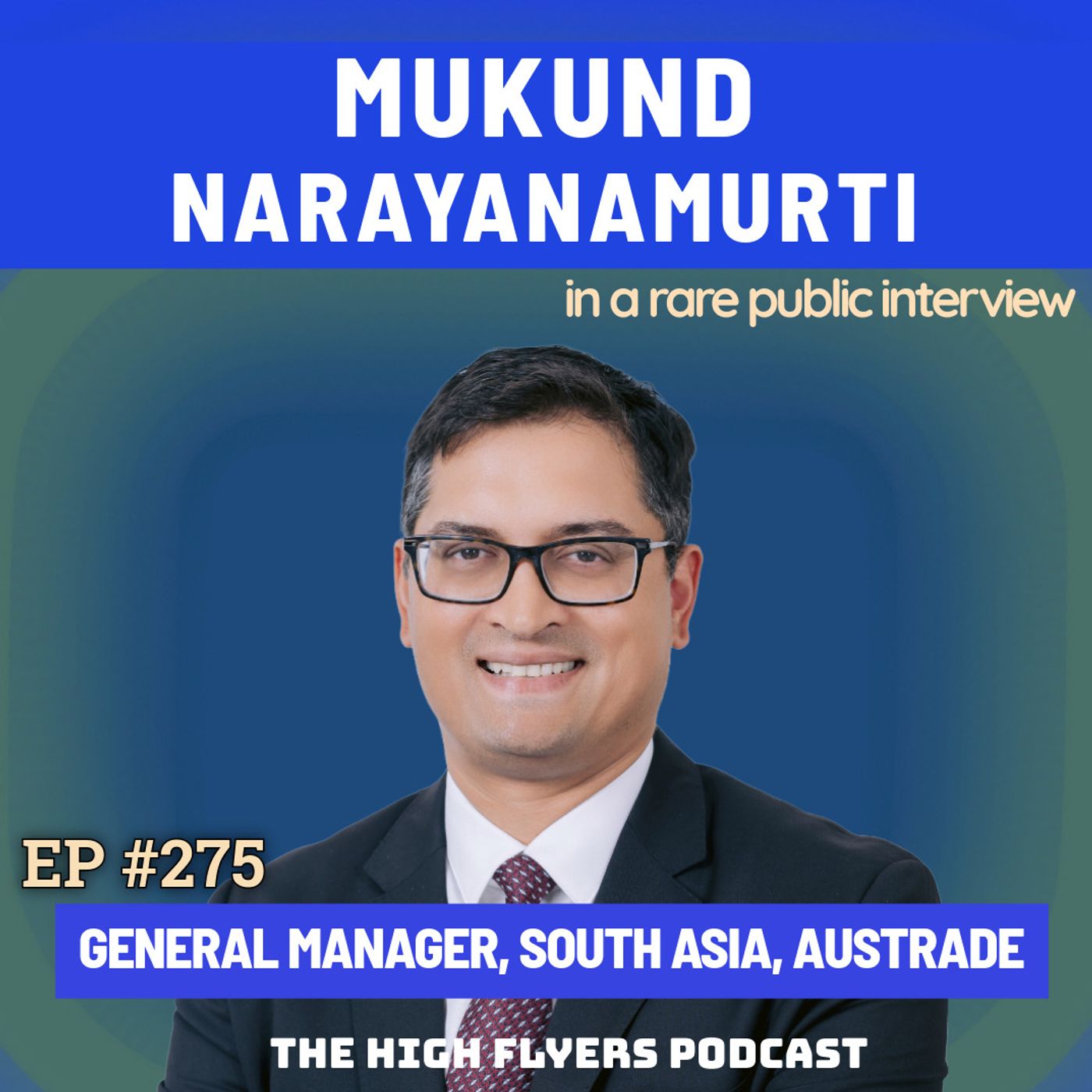
Mukund Narayanamurti’s journey from Bangalore to Australia and then into international tax, Asia-focused M&A, and finally diplomacy with Austrade in New Delhi; he also discusses what makes India unique for dealmaking and how Australia-India ties are evolving.
Mukund was born and raised in Bengaluru, moved to Australia at 18 for Deakin University (Bachelor of Commerce), then joined KPMG (2003–2014) in tax, including an honours year in finance. He later studied at Melbourne Law School (Master’s of International Tax), did an MBA at a US “big five” economics school (2013–14), and is part-time PhD student at Melbourne Business School (~60% complete). He now leads Austrade’s South Asia team as a senior representative.
Brutal academic and professional feedback accelerated his growth (e.g., 55 points of feedback on a PhD submission). Success in bids requires “maximizing shots” and learning from failures; success-fee-only models can reduce learning. Australia-India awareness is growing, supported by strategic necessity, economic opportunity, and people-to-people links.
advising on an $8.5B M&A transaction at age 23; “Tax Trek” to Delhi (about 7 months) pivoting him to Asia deals; AsiaLink Business startup transition; Austrade working with 1,200 then 1,400 then ~1,700 Australian companies in the prior 12 months.
Written by AI. May contain mistakes.
Mukund shares his journey from being an international student to working as a diplomat.
“Where were you born and where do you live now?”
Mukund discusses inspiring individuals he believes should be recognized more.
“Is there a person you know who you feel doesn't get the recognition they deserve?”
Exploration of the significance of the Australia-India relationship in various sectors.
“and many are quietly leading in boardrooms, in startups, in hospitals and in creative industries but often their stories go untold.”
Mukund reflects on his childhood in Bangalore, focusing on sports and education.
“And, you know, from that period, we'll validate that.”
Discussion on Mukund's passion for cricket and aspirations to play professionally.
“I don't look like one today, but I got one reasonably fast back in the day.”
Mukund shares insights about his family dynamics and academic expectations.
“My perhaps guiding influence was my grandfather.”
Mukund recounts his decision to move to Australia at 18 and his family's support.
“And I came out to Australia and it was a shock.”
Mukund describes the cultural challenges he faced when settling in Australia.
“decades for middle class Indian families.”
Discussion on Mukund's reflections regarding his educational choices and the changing landscape in India.
“And I mean, you went to Deakin, which we'll talk about.”
Learn about the challenges of adapting to a new culture as an international student.
“only the really top group of eight have a culture of colleges, residential colleges, but even that accommodates a very small fraction overall of the total students who study there.”
Discover the impact of perseverance and family advice on educational choices.
“And, you know, and then when I gave it another year following her advice, I was then only a year away from finishing my three-year degree.”
Explore how pursuing an honors degree changed career aspirations and self-perception.
“I got a dream graduate job, which at the end of my three years, I would not have imagined even applying for.”
Understanding the journey to landing a dream graduate job at KPMG.
“The second time was very, very, for a very short period.”
Learn how mentorship shaped career paths and academic pursuits.
“And then I did the Melbourne Law School degree, the master's.”
Understand the value of honest feedback in personal and professional growth.
“So for me, my PhD is an incredible opportunity to spend time with my supervisors who are now my coaches in life, because one of the things with work is that you don't really get much feedback.”
Reflect on lessons learned and challenges faced while working at KPMG.
“So and they create that space for me, and they give me genuine feedback.”
Examine the impact of high-stakes M&A transactions on professional development.
“And I was terrible at so many areas of tax.”
Learn about pivotal experiences in Mukund's career that shaped his approach to M&A.
“So 23 years on, that former colleague and I, we still catch up.”
Mukund discusses his transition to focusing on Asian markets after his experience in India.
“So I completely pivoted my career, gave up all of my work with the US, European, and the biggest company out of New Zealand.”
Explore the challenges Mukund faced in business development pitches and how they shaped his understanding of market dynamics.
“We both have Indian heritage and business interests in India.”
Compare the evolution of doing business in India from a decade ago to the present.
“Because they're putting, they're betting everything on just one bid at one point in time because of how they want to go about actually learning about opportunities.”
Discussion about the increasing commercial opportunities between Australia and India.
“Now, people go, wow, I can't even think of 10 Australian companies doing business.”
Exploration of leadership and team dynamics in fostering bilateral relations.
“It was stuck around$30 to$35 billion for a long time in two-way trade.”
Mukund shares his career transition from KPMG to leading AsiaLink Business.
“We've talked a bit about India present day and back then.”
Mukund recounts the challenges and excitement of building AsiaLink Business.
“So I came back to Australia, but I realized very quickly that my heart was no longer in consulting.”
Discussing the mentors and lessons learned while leading AsiaLink Business.
“Again, this pattern of feedback turning into success.”
Mukund compares and contrasts his experiences at KPMG, AsiaLink, and Austrade.
“I was like, I can't believe how hard you're working for what we get paid as a not-for-profit.”
Insights learned from working with Nicholas Moore and his effective leadership style.
“On the Nicholas Moore point, I'm curious what learnings you had there just quickly.”
Learn about the significance of stewardship and meticulous documentation in leadership.
“Second is that there's no greater way to show stewardship because stewardship is about showing great care for what's been entrusted in you.”
Explore the qualities needed in high-level diplomatic roles and the cultural factors at play.
“that it is how Nicholas operates, which is the difference.”
Hear Mukund share his views on balancing work and family, and the pride his family has in his accomplishments.
“done, I think is an extraordinary reflection of how welcoming Australia is and meritocratic Australia is and can be.”
Mukund expresses gratitude toward his wife and daughter, acknowledging their support in his journey.
“It's the PhD, but a lot of time for play.”
Discover Mukund's approach to personal growth through research and learning new skills.
“And so over the course of the next six months, it's actually going to reveal some findings.”
Mukund discusses key goals for the Australia-India relationship, focusing on education and employability.
“and there's a lot of AI tools just for healthcare, particularly on the research aspect.”

Get the gist, explore an idea or ask about something said.
 Claude
On The High Flyers Podcast with Vidit Agarwal, what are the key points of this episode?
Searching your listeningAutomatic transcript. May contain errors.
0:00Hi, I'm Vidit, the founder and host of this podcast, The High Flyers. Hi, Vidit. Mukund Narayanamurti. Great to be on the podcast with you. I am so excited, Mukund, because I don't think you've done many of these. I'm curious to see how far we get into your story. Well, I'm very much looking forward to it. And you're right. I've often done many of these. Hey, friends. Welcome back. Welcome to The High Flyers podcast, where we do reimagine a high flyer, showcase the brightest and most relatable role models and companies and their journey. from sunrise to today. As one of the premier products in our Curiosity Center lineup, providing on-demand intelligence to help you be 1 % better every single day.
0:41I'm your host, Virita Agarwal, and let's have some fun. Our listeners have called this podcast a meticulously researched biography unveiling the extraordinary lives and decisions of the most remarkable individuals and companies from around the world. We hope you're enjoying our catalog of 200 plus episodes since we launched in 2020, with many of our guests appearing in rare public interviews. It's now time to explore your curiosity. Please enjoy. Let's set the scene with some fun facts. Where were you born and where do you live now? I was born in Bangalore, India, now called Bengaluru. I now live in New Delhi, but my permanent long-term home is in Melbourne.
1:22Very good. And work, what was your first job and what do you do now? My first job out of university was with KPMG, where I started as a graduate. And I now work as a diplomat for the Australian government for Austrade New Delhi, leading a team across South Asia. And I believe you're the senior most representative for Austrade in the region, right? If I know correctly. I should say, though, I mean, that was my first formal job, which was out of university. But I did come to Australia as an international student a very long time ago, almost 30 years ago, 28 years ago. And I had many, many critical jobs that helped me survive.
1:55perhaps, you know, which I can share with you over the course of this conversation. Absolutely. I think that is actually one worth sharing because an international student might listen to this and might be inspired that they can follow in your footsteps too, right? And Mukundas, you know, the purpose of this show is to reimagine the concept of a high flyer, go beyond just a job title. Is there a person you know who you feel doesn't get the recognition they deserve? It's hard to say if they don't get the recognition they deserve, but there are probably three people at least that I can think of that I believe are really inspiring who you should consider you know speaking to Daniel Kim who's a Korean Australian who's doing amazing things in the renewable energy sector today but has done many things in the international sphere over a long period of time Sekhloong Tan who's a partner at BCG again has done some amazing work at the intersection of public sector and strategy really and then finally Ki Wong who's an amazing Asian Australian has done arguably, in my opinion, the most across corporate, academic and not-for-profit spheres.
2:55And he's probably not as well known as he should know. He's an absolute giant, I would say, across a number of those domains. That's great. You've come prepared. I like this. This is a good start. And I think all three of them sound interesting. I'm surprised I've not come across any of them. So absolutely, after this, we can work through how we feature them in the future. This episode is part of a special series in partnership with the Australian government and its centre for Australian-India relations in the Department of Foreign Affairs and Trade, the Australian-India relationship has never been more important.
3:24Two vibrant democracies with growing ties across tech, business, media, culture and sport. Did you know Australia is now home to around 1 million people of Indian heritage, the fastest growing large diaspora community in the country. and many are quietly leading in boardrooms, in startups, in hospitals and in creative industries but often their stories go untold. That's why the Centre for Australian Dear Relations exists to build deeper connections between two nations and in this series on the High Flies podcast I'm excited to interview many of these relatable role models, change makers with ties across both countries, exploring their stories, their identities, their ambitions, and activating the full potential of the Australia-India relationship.
4:15So I hope you enjoy listening. Let's one back the clock and go to your Sunrise as I Call it, your childhood. You mentioned Bangalore. Were you there for a while during your childhood? Is that where you spent most of your years? So I was born in Bangalore and I grew up there. I was there till I was 18. So I left India when I was 18 to come to Australia for my undergraduate education. Tell me about the memories of that environment, particularly because I know you in your current role and you're very organized and diligent and well-prepared every time you and I speak. But what was the mukund of childhood growing up?
4:48Very, very different. And, you know, from that period, we'll validate that. I was very, very focused on sport and sport was very much my life. and I had an exceptionally large friend circle, larger than my parents were happy with. And I was an exceptionally unfocused student. I was middle of the class at best. And so I came from a family that, like a lot of families in India, valued education and having a focused child in the family. And I was certainly not that. So I was a cause for a lot of concern growing up in my family. Tell me about the sports. Were there any particular sports you were really into?
5:30Yeah, I was into a few key sports. I play a lot of cricket. I played a lot of cricket to school and a lot of cricket as well at the club level and then at very junior levels as part of expanded state teams as well. But it was certainly my whole world. And the reason I moved to Australia ahead of going to Canada and the US was so that I could retain playing cricket. And then I played district for Perran in Melbourne. And so that was my point to come out to Australia as opposed to foreign education, which explains how I thought at the time that I'd get a reasonable education, but I wouldn't have to give up at that point in time the love of my life.
6:07So, yeah, so cricket was a big part of it. But I also played soccer for school. And also I was an athlete as well. I was a sprinter. I don't look like one today, but I got one reasonably fast back in the day. So those are the three key sports, which is very different to today because now I'm absolutely madly and obsessively connected to my tennis, which is absolutely central to who I am. That's good to know about tennis. Tennis was my dream growing up was to play tennis professionally. I had every year on my birthday, I'd get a new racket and I'd train a few times a week. But my issue was discipline.
6:37I didn't have the focus. So who knows in hindsight how that would have gone. I did not as well. So that's the truth. but it sounds like for you cricket was a big aspiration did you did you want to do it professionally i did i did absolutely did i think right again not a unique ambition for a boy growing up now boy or girl growing up in india to want to play for their country and so everyone has that that dream but it's just so extraordinarily competitive and hard but it's a dream worth having so absolutely absolutely i did i just wasn't good enough And tell me about the family unit. Tell me about the parents.
7:15What did they do for work? So like a typical Indian family, my influences really came from the wider family, not necessarily directly from my parents. My perhaps guiding influence was my grandfather. And even though I didn't get to meet him because he passed away before I was born, but I grew up every day, every single day with statements of expectations that my grandfather would have had because he was the scientist and a very, very well-known one. And so I was brought up with those expectations. There were lots of scientists in my family and physicists in my family. So I was brought up with a lot of expectations around academic excellence and making a contribution.
7:52It did not come from my parents at all. It very much came from the wider family. And my parents adopted that as expectations for me. And were you the only child? I was the only child. Yes. Yeah. Yeah. Right. Okay. Okay. I can't, I can't use the joke of me being the older sibling and getting in trouble for my brother's mistakes. I was in a lot of trouble with it. I did not need someone else to find me. I was in a lot of trouble. Right. And so tell me with all these influences, when you got to age 18, you're finishing high school. I think you said you moved outside of India at that age. Tell me about that influence.
8:29How did that happen? So, you know, in my year 12 class, some 120 students and of the 120 students, I seem to recall some 37 went to the US. I think one went to Canada, one went to the UK. And I came out to Australia and it was a shock. It was an absolute shock in 1998. And as a family, we had to really dig deep into our networks to even find someone in Australia who we knew. So it wasn't the norm at all to consider coming out to Australia. So it was a shock. But as I said, the reason why I came out is because I'd heard about Australian universities. that heard that it was a safe place, a progressive place, a welcoming place.
9:05And obviously, I'd related to Australia in the context of sport, and I didn't want to give up playing sport, which I would have had to have done if I'd gone to the US for my undergrad, which I was not willing to do at that point. So it wasn't the result of any deep thought. I think the greatest thing about that decision is the level of confidence that my parents had in me to back me and to send me, because it was on my part very, very, very poorly researched and very poorly thought through. But they backed me and they sent me to Australia, for which I'm, you know, eternally grateful. And this was in the mid-90s, if I have researched correctly?
9:40You know, I was taking these decisions around 96, 97, and I left in 98, mid-98. And that was also an interesting time in India, right? Economically, India was opening up. So you could say you're in India now in 26. if you compare it to back then, India was a very different country. Yeah, I mean, it was very common and it had been for a very long time, for decades and decades for middle class Indian families. Certainly to think of sending their kids overseas for an education, getting into the best institutions in India was enormously challenging. And they were very, very good and they still are very, very good.
10:18But it was just about creating an expanded set of opportunities, which is natural for parents to want to create for their children. So it was very common in India to have kids leave when they were 18 and go all over the world, which is why just in my year 12 class, the B7 went to the US. It was just seen as a very normal thing to do. Before I come to the transition to Australia, I'm curious today if you could redo it. Would you still leave India at age 18? Or do you think the India of 2026 would give you more opportunities? If it was the India of today, I probably would have paused and really considered some options.
10:52Like a very serious option for me at the time and an aspiration of mine was to come to St. Stephen's College in Delhi because I had family that had been to St. Stephen's and I heard amazing things about it. And it's probably something that I may have pursued, but today there are lots of other exceptional top private universities in India. And so possibly, but also I think that if I could have gone back, this is an interesting question because I may have actually chosen to go to the US because I did go to the US finally for my graduate education. And that was the most extraordinary experience for me.
11:22But would I go to the US today? I don't know, right? So it's just, I don't know. It's just a little bit different. I still have very close bonds in that country. And I love that country deeply. But it's just different today. So places change. To your point earlier about Indian parents and Indian families, I find like when I speak to cousins or colleagues or friends there, reputationally, people still want to go to the US, like to the Ivy League universities. I mean, And it's interesting as we'll chat about India-Australia relations. I think people are still surprised to know that Australia has the most number of campuses in India, like university campuses.
11:54And I mean, you went to Deakin, which we'll talk about. I think Deakin was the first international university, if I'm correct, to open a campus in India. I find that paradox interesting that Australia is investing so much into India, but Indian society still thinks of the UK and the US for higher education. Yeah, I think that, you know, Indians by nature, maybe through osmosis, not even through just, I'm not talking just through deliberate effort, but are students of history, right? Many of them through deliberate effort are very deep students of history. And so there is just that very deep historical connection with the elite institutions of the UK and with the elite institutions of the US.
12:29So Australia will get there over time, but we're not going to get there as a result of two decades of effort. We'll get there perhaps because of five or six decades of effort. And that's what, you know, the US and the UK have. Hopefully that happens. And I think it seems to be moving quickly and you can give us a perspective as we chat. So you moved to Australia, you went to Deakin University, I think, in Melbourne. I grew up in Melbourne too, so we share that in common. And you studied a Bachelor of Commerce. Take me inside the transition. Was it a difficult transition at that time? It was a terrible transition.
13:00So when I got to Australia, I did not actually settle well. And I did not settle well because I had spent two years deeply evaluating opportunities to go to the US and had decided to come to Australia at the very late stages of that decision making process. So I had also a lot of family in the US and a lot of family in academia in the US and I had 37 friends going to the US just in my cohort. And so all my images and impressions of what college life should be was very much framed based on what I had expected in the US. And when I came out of Australia, I did not have that, right? I didn't have that for a number of reasons, but there's one very fundamental cultural reason, which is that now having also studied at the US, I can see that difference, is that in Australia, a lot of Australians make their best friends at school, and they stick with those friendships through life, whereas university for them is a place you go, and you spend a few hours there, a day, maybe even just over the course of a week, not even every day, but they don't necessarily focus on residential only the really top group of eight have a culture of colleges, residential colleges, but even that accommodates a very small fraction overall of the total students who study there.
14:15So what I experienced was basically just a lack of locals on campus. And I observed basically just a large number of international students who, like me, were really lost. So it was quite a, I felt very lost. I felt very isolated and didn't really see a lot of what I thought I would experience, which was, you know, deep engagement in Australian culture, deep engagement in sport, in university life. And so it was actually a very challenging transition. So it saw that after 12 months, I'd made up my mind to leave and I was well and truly going to head back. And I wanted to head back and pursue that dream of going to St.
14:53Stephen's College. But my mother actually said to me, no, no, no, just stay and spend another year there. Give it another year. First year can always be challenging. And, you know, and then when I gave it another year following her advice, I was then only a year away from finishing my three-year degree. So then I saw that through. But for me, at the end of that three-year degree, I still remember so clearly, I was very clear in my mind that I was completely unemployable. I was like, I've got no capabilities that I feel anyone should be paying anything for. So I truly need to top this up with some other experienced because I just don't know how I've changed.
15:26I clearly must have, but that was certainly my impression. I remember it very clearly. And for me, the first big, big moment in my life that I always go back to and relate to was my honours years. That was the fourth year that I did, and I was delighted to have been admitted. And that fourth year was, again, not because of deep thought. I felt so unfinished that I felt I needed a bit more time. And that fourth year was a transformational year for me. So you did the, and that was the degree from the start, right? The four years you didn't change your degree no so I got admitted to a bachelor of commerce and then at the end of my third year you have to apply to be admitted into an honors year so I applied to get into an honors year in finance and then I got admitted into that honors year in finance so then I graduated second time which is what happened you get a bachelor of commerce degree then you get a bachelor of commerce autos degree and so it was that fourth year for me which was I would say the just crucial year so you mentioned you thought you couldn't get a graduate job so where did you get a job post honours year?
16:23So I got a great graduate job. I got a dream graduate job, which at the end of my three years, I would not have imagined even applying for. But at the end of my fourth year, I felt that I belonged at a good firm in a good graduate recruitment program. And I'm very, very fortunate to be admitted into KPMG's graduate recruitment program in the tax team there. But one of the reasons why that happened was because the honours year, one gave me an opportunity to think deeply about a topic. And it exposed me in a very small group of just six students had been admitted. So, you know, you had a few thousand students graduate from the Commerce degree, but only six students got admitted into the Honours degree.
16:59And so the six of us had significant access to the senior faculty. And there are three faculty members who made this incredible contribution in helping me with my Honours research, but more importantly, helping me shape what career aspirations I could pursue, one of which was to pursue a career in international tax at the intersection of international tax and corporate finance. And so those three academics have stayed very close to my heart and made a huge contribution helping me secure that job. And this led to an 11-year career, right, at KPMG in different roles, approximately 11 years. Yeah, yeah.
17:31So I was at KPMG from 2003 through to almost the end calendar year 2014. But importantly, as you've pointed out, I had three, almost three very distinct careers within my time at KPMG. and also I had a total of almost three years away from the firm two career breaks from the firm. So the firm gave me leave on two occasions to go away and pursue other interests. People never came back from career breaks. I came back twice, so they were shocked. The second time was very, very, for a very short period. It sounds like education has been a big part of your life, right? Like even to consciously do that.
18:08Well, I feel today maybe it's a bit different where, like I have this chat often with peers or people as they're figuring out their careers, is should you do an MBA or should you go start your own business? Should you join a big four consulting firm or should you travel the world? How do you reflect on your degrees post the bachelor's? You did a master's off tax, I believe, and then you did an MBA at Sloan, right? That's right. At different periods. I think you did the first one and then you had a few years back in industry and then you did the MBA, right? That's right, yeah. I've been studying, I'd say, through art.
18:36So after I got my honest degree from Deakin, became a home and resident, started to work with KPMG. And then I did not need to do the Chartered Accountants Program because I wasn't an audit, but I chose to do it. I could have done that or a master's degree at Melbourne Law School in international tax, but I chose to do the Chartered Accountants Program. I struggled through it. I absolutely struggled my way through it because I had some peers who just shot the lights out. I was not one of them. And I really struggled with balancing doing the Chartered Accountants Program and working. And I really prioritized work.
19:08So I became a qualified Chartered Accountant. And then about a year after that, I took a career break, went to Melbourne Law School, did my master's of international tax full time. And I also was a full time academic at Deakin University. So I spent that whole year in academia. And the partners of that state said, well, this is a very odd thing to go and do. No way people take a year off and go and travel across Europe or the US or do something fun. But you're choosing to go work twice as hard for a quarter of the pay. It makes no sense. And I said, yes, but I'm passionate about academia. And I want an opportunity, a first world opportunity with the safeguard of having my KPMG job if I don't like it.
19:44And I said, fine. So I went and studied at Melbourne Law School and I was teaching finance and deacon. And it was a fantastic experience. But I knew that I wanted to go back to KPMG. So that first period of KPMG was all about international tax, amazing work. I did a lot of M &A work, large cross-border deals. And then I did the Melbourne Law School degree, the master's. And then I came back and I went into an Asia practice, which I'd be happy to speak about, which was defining. And then I transitioned again from doing cross-border M &A work with Asian countries to then doing a lot of work with government, advising government on economic engagement strategies.
20:19And I really loved it. And again, happy to speak about that if that's of interest. But I then chose to go to the U.S. because it had been an aspiration of mine. When I did my honors year, everything comes back to my honors year. And I was studying the research of various Nobel laureates from around the world. Many of their papers are etched in my brain to this day. And I'd made it an ambition of mine to go and study under some of them and at some of those institutions, particularly big five economic schools. I was like, I have to go to one of them at some point. And so I was delighted when in, you know, 2013, 14, I was able to go and do my MBA in the US at one of those schools.
20:53And that was great. And then after that, about three years ago, I commenced my PhD at Melbourne Business School. Again, I'm the only part-time student there. All the other students are full-time. And I'm now about 60 % of the way through my PhD. Wow. Where does this come from? I wonder if this is the international student in you trying to prove to Australia that you belong. because I look at myself like I was born in India, but I came to Australia as a kid. I like to think I'm pretty proactive and I've got agency and a bias faction, but you are next level. Look, it's a few different things. I have extraordinary respect for my teachers in a way in which I did not have growing up, right?
21:30Because I was so focused on sport and my friends and I was such a mediocre student. But my honours year, because the impact that those three academics, their names are Rami Harnikbe, who's a tax lecturer, Tony Van Eklund, he's a finance lecturer, And then Jonathan Batten, who is a very, very senior finance professor, I think, at Monash today. And the three of them exposed me to the incredible work that academics do and the deep thinking that they bring. So I don't see this divide between academia, industry, theory and practice. I use education as an opportunity to really think deeply about things in a way in which you can't sometimes do at work.
22:06Right. So for me, my PhD is an incredible opportunity to spend time with my supervisors who are now my coaches in life, because one of the things with work is that you don't really get much feedback. Particularly once you're senior. Once you're senior. Right. And so the feedback you get is also very, very sugarcoated. It's like, you know, you're great, but and then but you're great. So what I love about my PhD professors is that they don't care who I am in my day job. I'm a nobody to them. I love that, right? They treat me just like that hungry 25-year-old PhD student who comes in hungry as hell, who's trying to land that academic job that will one day give them a role with financial outcome, which will sustain them.
22:55And then they'll work towards tenure. So They're so hungry and so driven, these PhD students. They're the best of the best. And so I'm up against them. So I remember I did a piece of work and I submitted it. And this was fairly early on in my first 18 months. And I'd had a fantastic week at work. I'd shot the lights out. Everyone told me that I'd done a great job. And that weekend, I was finalizing this piece of work. I sent it off on a Saturday afternoon. I got it back on a Monday. It had 55 points of feedback. That was scathing, totally scathing, right? One point of feedback was, for God's sake, can you write better?
23:30Now, who talks to you like that at work? Nobody. But, you know, he was 100 % right. My professor was 100 % right. It was horrible what I'd framed. And there were gaping errors and holes in what I'd said. And what they were pointing out to me was that I thought I was a deep thinker. But no, I'm not. I'm actually a fairly shallow thinker compared to the many, many, many deep thinkers they spent their time with. And so that's why I love spending my time with them, because you need a safe space in which you can be challenged. And actually, that's what I love. So and they create that space for me, and they give me genuine feedback.
24:04Can I just say, Mukund, you are in the minority where you seek that feedback. Like I spend a lot of time with senior leaders. You spend a lot of time with senior leaders. It can become comforting to have everyone say you're the best and be in a bit of a bubble. And then I hear so many stories where folks are in senior roles for 20, 30, 40 years, and then for various circumstances, they lose that job. And it is a big reality check for them too late in life. And I've always said to myself, I never want to be that guy that gets to like whatever, whether it's age or seniority or title. I mean, I run my own business, so hopefully I'll never get sacked, but things happen.
24:38That's great. Just as a comment, like just go seek that feedback and hopefully your team, your team probably knows you're doing this study, right? Most would not know. I don't really talk about it. Most would not know. Very, very, very few might know. It's, you know, something that I raise in context. Otherwise, I don't raise, but it's a core part of just the life that I'm leading. Yeah. Tell me about the time at KPMG. So 12 years. What was some of the learning? I'm sure there's many highlights, but tell me about some of the knocks, maybe not knocks, but learnings, whether it was a project or a client or a country that set up your foundations in your career beyond the academic studies.
25:15So, you know, it was an extraordinary learning environment, phenomenal learning environment. So when I started at KPMG with my grad group, a great group of people, fantastic partners, fantastic managers, and they really invest in your learning, right? So in addition to doing the Chartered Accountants Program, to actually get on top of the knowledge base that's essential to be an effective tax advisor, you know, I had to go through four years, eight modules a year of what was delivered through a tax business school, and you had to get 8 % on each module passed. So you had to show up to your manager's office and explain why after two attempts you can get 80%.
25:50This is a complex, complex tax-related stuff, right? Really hard to get 80 % to get through the module. And so it was an enormous struggle. And I was terrible at so many areas of tax. Like, for instance, because, you know, people in tax typically come out of two fields. They either come out of having an accounting background or they come out of having a law background. Both have advantages and disadvantages. Those that come out of an accounting background are effective tax advisors because they can read financial statements and they understand the business drivers. The advantage that the law graduates have is that they can get much deeper into the law and the intent of the law and also into case law.
26:32Now, I was terrible at those three things. I found that enormously boring. It's when I took up drinking coffee. I started drinking coffee when I started working at KPMG because I just couldn't read the legislation. Like, this is quite lovingly boring stuff, right? But enormously important. But what I loved were the business drivers around transactions. And what I was good at was then thinking about really, really sophisticated, complex structures around transactions. So if a foreign company was buying an Australian company billions of dollars, how could they finance that through a mix of different instruments?
27:05And so a defining set of opportunities for me were working on some of the largest M &A transactions at that time. I remember I was just 23 and with another colleague who's now a very senior professor at Melbourne Law School. We're still connected as a result of it. We were advising on an$8.5 billion transaction. And it was so hard. It was so complex. And the stakes were so high. And we were supporting a group of managers and a group of senior partners who were advising this client in a competitive bidding process. It was so complex. And all of a sudden, I was being relied on for some really critical elements for that transaction to succeed.
27:40I was getting really sharp feedback. And I'm not kidding, but I used to escape to the men's restroom and actually cry. I actually used to cry because it broke me. It just completely broke me. It was seven days a week for a few months on this transaction. I'd never worked harder. The feedback was brutal. The stakes were high. It was just the two of us as grads. And we've been in the trenches. So 23 years on, that former colleague and I, we still catch up. I always still talk about how defining that was. So I had a few transactions like that, which were absolutely career defining, which again, the firm gave me the opportunity to be a part of.
28:16The important thing is that right through my career at KPMG, I had never been part of a winning deal team. Never. Every deal I advised on, the bitter field. I almost feel like the secret to your success bookend is knocks along the way. That seems to be a key pattern is like feedback that this didn't work and that didn't work, but then somehow things worked out. Yeah. So I was part of all these losing teams constantly. So my first, you know, first few years was being a part of these M &A deals where we were working so hard to support bidders who ultimately have bid on transactions. And then the second part, the second part came about actually because of a really pivotal moment.
29:02KPMG selected me to go on what was called Tax Trek. I was part of the first ever Tax Trek court. They just celebrated 20 years. I was happy to see a post from them on that. And I was sent to Delhi from Melbourne. And I was sent out to Delhi for an initial three months. It ended up being about seven months. I got extended. And it was a game changer for me because I went from working on basically US, European, and Kiwi clients, and some very few Australian clients, mostly multinational, to all of a sudden being exposed to the large Indian conglomerates. And that was a fascinating time where they were buying assets all over the world in 2006, seven.
29:38And I came back to Australia at the end of it and I said, I never want to work on anything but Asian deals and transactions. So I completely pivoted my career, gave up all of my work with the US, European, and the biggest company out of New Zealand. It was one of my clients, amazing company to have done work for. So grateful to them. but entirely focused on Asia. So that was the big pivot, but it came from being in India. And I said, oh my God, the energy and dynamism in India was amazing. And the firm was setting up an Asia practice. And so I went into that practice. It was a small group who were discipline agnostic.
30:11So we weren't sitting in tax. We weren't sitting in valuations. We weren't sitting in due diligence teams. We were seen as a small group that had capabilities cutting across those domains. And we were asked to go into different markets in China, in Korea, in Southeast Asia, in Japan, and India at the height of the mining boom and really pitch investment opportunities in Australia for acquisitions. And I was a part of that group and it was some of the best work of my life. It was so exciting with an amazing group of people, one of whom I referred to Daniel Kim. We've been built bonds for life. He was the best man of my wedding as a result as well.
30:43And with an incredible partner, Jason Chang, who's gone on to build one of the largest energy and natural resources, private equity funds in the world. As a result, that work that we did, that was formative for him as well. So that was the second pivot. And then the third pivot with KPMG was, as I said, governments across Australia started to take notice, federal government, state governments, of some of the transactions, the investments that I'd been a part of. And they started to ask me for advice. How can we attract these investors into more organic, foreign direct investment type investments?
31:13And so I was being asked to provide strategic advice. And I found that I enjoyed that more. I found that I was far, far less comfortable working with the corporate finance and the investment bankers and far more comfortable with the strategy guys and the management consulting guys. So that was the third transition. So there were all these little mini careers, these three distinct mini careers. But on that second mini career, if I can just say, if the first part involved working on no successful M &A deals for bidders, the second part involved, it was the best part of three years of 100 % loss rate on every business development pitch.
31:52wow me and a couple of colleagues had become the joke of the firm right because uh the group was called asia business group and even grads like several years younger than us it's like it can't be the asia business group because you have no business because we couldn't win any work we got priced out of everything right and so i learned the hard way of how long it takes to win trust understand markets understand scale understand pricing across asian markets and it's different across every single one of these india is not the same as korea korea is not the same as japan japan's not the same as china private entities state on enterprises and then we got one right and then we had this avalanche of work that we want but oh my god i mean we were so close to being out of a job every day let's go into this as a good case study right is and let's focus Look at some India, given you're based in India.
32:47We both have Indian heritage and business interests in India. So let's just assume this was 10, 12 years ago, right? We're now in 26. This was 2012, 14, 15, around that time, just ballpark numbers. Tell me about what was it like doing business in India then versus now? Back to like the deal that worked, if you use that as an example. Maybe tell me what made it work back then. And now, if you were in that role and you were advising, let's say I came to you and I said, hey, Mukunda, I've got energy opportunities in India. and I want to look at the India market, and we've got a presence in Australia, how would you advise me to go into India today?
33:21So I guess the question is back then when you were doing it, and now, like, compare and contrast those two periods. So back then, a lot of the focus, I did advise a lot of Australian companies on entering India, but a lot of my focus was on advising large Indian companies on entering Australia and advising them on acquiring assets in Australia. Back then, and it's no different today, because in our work at Austrade, We help Australian companies enter India, but we also help Indian companies invest in Australia. So I get to still see both aspects as I did back in the day as well. One of the things that I love about India is that it is such an incredible vantage point for global affairs.
33:57If you want to feel the intensity of global competition, this is where you want to be, right? So this is a great vantage point to understand global trade policy, to understand global capital flows, to understand what's happening in the world of technology and the strategic bets that companies all over the world are making. And so when I was advising, you know, trying to advise Indian companies with teams at my former employer, they were getting ideas from advisors all over the world in a way in which we never saw in Australia, right? The level of competition in Australia versus the level of competition all of a sudden my Australian colleagues and I were exposed to in India was just extraordinary.
34:38And things that we were willing to price as a formal offering were being offered free with really a payment coming in the form of a success fee payment. So only if the ultimate transaction was successful. Can you imagine if that happened in the first part of my career? I never would have got paid, right? So now there are pros and cons to this. The pros and cons to this is that Indian entities will say that success fees tie their interests with the interest of the advisor. So the advisor is incentivized and can make much more than if you got paid as you go on a fixed fee or retainer basis or on a priced for your time basis.
35:14But it aligns interest that ultimately you're advising the company to succeed. So you should get paid if we're successful. Let's actually see how good your advisors when it's actually competing against all the other advisors, providing all the other bidders advised. Where that logic fails is that there is tremendous value in learning what not to do. And the minute you stop paying for that, it actually impedes your ability to learn over time to then actually have a winning bid in the future. So the key to succeeding with bids and actually with so much of what we do is to maximize the number of shots that you take, right?
35:49So when I speak to a lot of bidders now across different types of opportunities, like I was being a one large institutional investor in my former job, still with Austria, but when I was in Southeast Asia, one of the largest institutional investors, and they said to me, they would have looked at about a thousand opportunities, studied very, very deeply, about two dozen opportunities with advisors to have made one successful investment. Now, if you don't do that through that process, you don't make that one successful investment. So you actually have to value the process of learning when you're failing, because it's actually helping you price risk.
36:23And so investments are made on a risk-adjusted return basis. And every time you don't learn about the pricing of risk, you can't make that winning investment in the future. So I think this has actually impacted Indian entities at times with their ability in comparative processes themselves in offshore markets to make winning bids because they just haven't had enough experience with bids. Because they're putting, they're betting everything on just one bid at one point in time because of how they want to go about actually learning about opportunities. So there are pros and cons to this, but this is the result of 23 years of going on that journey.
37:00What have you noticed, whether it's M &A or entering a new market through sales and marketing or from an investment landscape? What is truly unique about India? Like you said, you spend so much time in so many markets around Asia and Asia is not a blanket, right? It's so different culturally in every facet. We were just chatting about in Australia, the prime minister was in town and there were a lot of business meetings. and some of my observations were there's still limited awareness about each other's market. Australia's awareness of India and India's awareness of Australia, even in 2026, despite the internet and despite information being democratized.
37:33How would you assess that? Like again, let's just say I'm a CEO and I come to you and I come to you for advice and I go, Mukund, I'm an Australian business CEO or a board director. I want to learn the India market. Not just come and do a visit and shake hands, but I want to actually learn the market and I want to build a plan internally to either invest in India or start selling products in India or acquire a business in India? What is that playbook to actually do that today to build knowledge of the market? So, no, look, it's a great question. The starting notion that there's a low level of awareness is a very important one and a very complex one, because the question is, who should be aware, who isn't aware in Australia?
38:11And why should they be aware based on their complementarity with India? Right. And then within India, it's understandable given the size of this economy. The fourth largest is going to become the third largest economy, just to save the population, that there are low levels of awareness. Now, a lot of what Australia does, the economic complementarity, is embedded in the fabric of India, in the structure of India. It's not visible. Now, the Indians that you meet every day connect with the US, they connect with Europe, they connect with Japan, they connect with Korea, a lot because they have a lot of consumer brands that have been consumed over a long period of time.
38:48Think about Japanese electronics. Think about Korean electronics. Think about German automakers, right? Think about US pop culture. And these have all been at the heart of Indian society. So it's not actually deep industrial connections, but it's actually that consumption as a result of household incomes over time consuming these products that are relatable to Indian households. Suzuki, the greatest marquee foreign entrant in the history of India, arguably, with Nestle and a few others, Japanese company, aspiration of every Indian family to own a Maruti Suzuki, right? So it's this consumption.
39:26Now, those Maruti Suzuki's steel is crucial, right? People wouldn't know that the steel supporting the automotive industry depends upon iron ore, or depends upon cooking coal. And Australia has been the major supply of cooking coal. So no one stops and says, hey, how was my car actually manufactured? Or, you know, how many critical minerals are going to my phone. They just care about the product that they're using. So a lot of what we do, a lot of what Australia has supplied has been integral to building the India of today. It's infrastructure today, you know, as a result of some really critical commodities and over time now increasingly critical and strategic minerals, but it's embedded in the India of today.
40:04Same with education, right? Part of it is the stories of people being educated in the US on a need-blind basis. And that's very powerful, right? And the stories of Indians leaving and going to the US and becoming successful entrepreneurs, and actually lifting their families and their societies as a result of their repatriations as a result of being successful, right? Australia is very much on that journey, right? Because of the Indian diaspora in Australia, who are incredibly successful, increasingly so successful, you've, you know, had podcasts with some incredible Indian Australians. Now, if I went back 10 years ago, we would have struggled to identify successful Indian Australian CEOs.
40:48But today we've got somewhere between half a dozen, very obvious ones to a dozen really influential Australian CEOs of large business entities. There are a large and growing number as well in the public sector. There are a large and growing number in positions of influence in our universities as deans, as deputy vice chancellors and others. So the point here is that you can just imagine fast forward in 10, 20, 30, 40 years time, and that level of awareness will grow. So we just have to be a bit patient. It's not because of a lack of effort. If I go now to the core of your question, when I came to Delhi for this role exactly 12 months ago this week, this team in South Asia had worked with 1 ,200 Australian companies in the preceding 12 months on commercial transactions.
41:35That shocked a lot of people. Wait a second. 1 ,200 Australian companies just in 12 months on commercial opportunities, in agri-food and consumer, in various areas of technology, in defense advanced manufacturing and space, in various areas of infrastructure, circular economy, mining equipment and technology services, in clean energy, and of course, in education. Well, in the last 12 months, that's gone up to over 1 ,400 Australian companies. And this year, we're on track to hit 1 ,700 Australian companies, right? Now, people go, wow, I can't even think of 10 Australian companies doing business.
42:08It's just 1 ,700 in the last 12 months who we have been working with on commercial opportunities. Now, it might be that we have to do a much, much, much better job of telling that story and raising awareness of their experiences and, in many cases, of their incredible success to inspire many more with stakeholders like yourself and others who can help us tell those stories better. But the levels of awareness that have been growing every year has been very, very significant. On this point, to expand it, when I interviewed the High Commissioner, Phil Green, a few months ago on this podcast, he said the three forces he thinks are bringing the two countries together is strategic necessity, economic opportunity, and people-to-people links and affinity.
42:49And you've touched on that. But he also said that Australia can't be complacent because India is the popular kid at every party. Everyone wants to talk to India and have a drink with India. and spend time with India. One thing I really enjoyed about our chat last time, Mokun, was the commercial aspect that you're deep into, right? I think one of the critiques about government is this head policy and then the private sector is to drive commercial outcomes, whereas Australia is a commercial, I mean, your incentives are tied to the commercial outcomes. One, I guess, would you agree with the High Commissioner's views on those three forces?
43:18And two, where would you assess them at the moment? Like we're in August 2026. How would you assess things in the relationship? I agree 100 % with the High Commissioner's views. In fact, those three points are a core part of our strategic framing and our bilateral relationship. And I think during Philip's tenure here, our bilateral relationship, certainly on the economic front, on the trade side, has done exceptionally well. It was stuck around$30 to$35 billion for a long time in two-way trade. It's some$54 billion today, right? And it's in no small part because of Philip Green as our High Commissioner, his leadership.
43:53On a whole, a government basis, Austrade is at the heart of it. But our colleagues from DFAT, the economic section, have done an incredible amount of work working with the Indian counterparts on tariff and non-tariff barriers. Colleagues from the Department of Education have done phenomenal work helping all of these Australian universities enter India. And so it's not just one team. It's many, many, many teams. And Australia would not be successful if not for the incredible culture that we have here at the High Commission, working with our DFAT colleagues, working with our Department of Education colleagues.
44:27And colleagues from all other teams, from Home Affairs, from Dicer, Treasury, amazing colleagues. And so we are successful because we are a really good team. And Philip, as the High Commissioner, has cultivated a really fantastic team culture. And I've worked across a lot of countries. But, you know, I think Philip definitely stands along for his passion for economic engagement and his interest in creating all the government high-performing teams. Let's come back to your career and we can jump around here. So we talked about KPMG. We've talked a bit about India present day and back then. Your next role was quite interesting.
45:03You were one of the, I guess, the pseudo founders of AsiaLink. Is that right? AsiaLink business. Yeah. AsiaLink business. So 2015, if I've done my research correctly. Tell me about that transition. How did you go from a well-oiled machine at KPMG? Like you said, a lot of resources, a lot of brand affinity, a lot of distribution, frankly. It sounds like AsiaLink business was a startup. It was. And so, you know, there's a really interesting story behind it in the context of my journey. And that is that I've just had the most wonderful bosses right across my life. And I stay close to every single one of them to this day.
45:36And so I had a fabulous boss at KPMG, my last boss there, a guy by the name of Rob Bassani, who I'm still very, very close to. He was the chairman down in Victoria. He was an investment banker, the corporate finance practice, the M &A practice. And, you know, when I was doing my MBA, he called me every Sunday evening when I was in Boston. He'd call me every Sunday evening at 8 p.m. Boston time to find out what I'd learned over the course of that week. He was incredible, right? He was so connected. He wanted to really know what I'd been learning. And he wanted me to always know that I had to pop back to the firm.
46:07And so my wife, who is by far the most important influence in my life for a number of reasons, was so supportive. She moved to the U.S. with me. And then she supported me again to come back to Australia because I wanted to focus on Asia. And I was a bit concerned if I stay in the US, my passion for Asia would be lost because the US is so big and all-consuming. And I knew I could always try and find my way back to the US if that's what I wanted to do. Or so I thought at least. So I came back to Australia, but I realized very quickly that my heart was no longer in consulting. I did not want to do the things that I had done before my MBA.
46:42Once I got my MBA, I wanted to build something. I went to an institution in the US which encourages you to take a leap to build things. And so I wanted to do that. And so this opportunity came up because Rob was on the board of AsiaLink. And he told me, hey, you know, AsiaLink has just been asked by the Australian government with$35 million worth of funding to build a new organization called AsiaLink Business to be Australia's national center for Asia capability. And it's going to be the biggest thing. And they are running a process for a CEO. and importantly, he wanted to introduce me to Sid Meier from the Meier family, who was the chair of AsiaLink because, you know, Rob had this vision over the long term that, you know, I'd come back and I was going through the partnership process at KPG that I might take over his role on the board of AsiaLink.
47:26Anyway, he introduced me to AsiaLink, but what ended up happening was that I got so excited about AsiaLink business and the role of the CEO there, which seemed like an amazing opportunity. And my partnership opportunity was very similar to focus on Asian markets, but here I could do it at the intersection of the public and the private sector, 35 million of announced government funding, opportunity to go out and build a set of products in executive education, build a research and insights team, read advocacy for the country with Asia, and also bring on board a number of corporate partners and really execute a strategy that BCG had built for the government.
48:01And so that was just far too exciting. So I applied for that job and somehow miraculously got it because I was only 34. So it's a massive leap of faith that they took. Yeah, can I ask before you go just on that, what was the interview process for the job? Well, interview process, I was told to get lost a couple of times because they just thought that I was a bit silly. They didn't think that I could be a candidate. And I got that feedback from the recruiter. And we've had a laugh about that a few times. And so I just went away. I was like, okay, they're not interested in even having a conversation.
48:30But then a few months passed and they were very ambitious for who they wanted. And for whatever reasons, you know, they weren't able to find what they were looking for. So they expanded the field, called me back in. And I met with the founder of Azure Link, who's again, a key person in my life, a mentor of mine to this day, Jenny McGregor, who's had a huge influence on my life. And she finally agreed to have a coffee with me. She'd said no for like four months. Like, you know, I think her words were like, you know, send me an adult. I don't want to see a child or something like that. We still joke about that.
48:59And so we met and, you know, obviously had a proactive conversation and she agreed with the recruiter for me to be allowed into the process. And so then I went through several rounds. And I think I know what clinched it was when I got to the final round under an NDA, they shared the business plan, which BCG had developed. And they said, present back to us now because you're not coming in. They said very clear, you're not coming in to tell us what your vision is. We spent three years crafting the vision. We don't need someone to come in and tell us, no, but I want to do this, which is different.
49:28So they said, we want you to tell us how you can execute. And execution is everything as I've come to learn in life, right? And so I presented basically an execution plan against a strategy that I was willing to adopt as my own, which convinced them. And then, you know, I embarked on the heart of six and a half years of my life, two terms of CEO. Again, this pattern of feedback turning into success. I love it. I find that that's the theme of this whole conversation. We couldn't. I was good. It was good. But again, you know, so the key there were two people, lots of people, amazing team, incredible colleagues who did amazing work.
50:04But Sid Meier has been a great mentor of mine. He was the chair of my board. So I reported to him. He was the most extraordinary chair. He was such a kind human, such a kind human that when my daughter was born, my only child, I said, I just want you to grow up to be like Sid Meier. He's the kindest human I know, the gentlest human, the most thoughtful human. And I think the world of Sid. And so he was a wonderful chair who was kind to me. Jenny was the most incredible founder, group CEO. So this was her baby. And for the first time in 30 years, I was the first male leader and executive in 30 years who was founded really for women.
50:42And they had one, you know, towering male academic influence, but he was an academic, Tony Milner. But to be a formal part of the executive in the way that I was coming in as a kid, as they saw me and they had 30 years on me in a women led organization. It was a bit of a shock to them as well. And so it was a very hard place for me to settle. But I went through, you know, the period of understanding where they were coming from and how they built AsiaLink. Like what burned through them was Australia's prosperity and security. And a very important realization coming out of consulting where there's this very strong correlation between being successful and your own incentives, which means that if you're working harder, you're going to get paid more.
51:24And if you're getting paid more, then, you know, you're more invested and you're more motivated. They broke that correlation for me. They showed to me that there's no relationship between money and work effort. And it just blew my mind. I was like, I can't believe how hard you're working for what we get paid as a not-for-profit. And it's like, there's no correlation between the two because you're working for Australia's prosperity and security. And so it was the most wonderful learning ground with them, with Jenny and Sid, which really shaped me. I wonder, Mukund, if you could compare the three organizations, KPMG, Asia Ling, Coastrade.
51:56How are they similar and how are they different? Because in some ways, just hearing you speak, the outcomes are similar-ish, but the structures of the organization are very different, right? From a resourcing perspective, from a decision-making perspective. I mean, you could write a book on this topic, I'm sure. But if you give me a short summary of the three, yeah, compare and contrast them. Yeah, it's a great question. I'd have to say that ultimately it comes down to people, right? So what I have been the beneficiary of is incredible generosity and kindness. So KPMJ for me was all about a partner and my tax years by the name of Gary Voigt, who invested in me and gave me career opportunities to work on those big transactions.
52:37And then this guy, Jason Shang, who brought me into the Asia practice and still to this day remains a mentor and invest time in me and supports me. Asia Link was about Sid Meier, Jenny McGregor and some incredible colleagues who supported me. And then here at Austrade, I've been here for five and a half years, and my first term, Austrade gave me perhaps the defining opportunity of my career, which was to work with Nicholas Moore on the Southeast Asia economic strategy. And to me, he is the most consequential leader I've ever worked with. No one I've ever worked with works harder, has higher integrity, and has a character that I want to learn from, let alone try and emulate parts of.
53:18Austrade created that opportunity for me. I never would have had that anywhere else, right? And now I'm in India and I have such an incredible, incredibly supportive executive who support me endlessly, just endlessly. I'm just surrounded by phenomenal support. You know, there's something that a colleague of mine back at KPMG said to me, and it stuck with me right through, right? And his name was Vlad Younger. And he said to me, Mokin, you always get the best of us. Everyone else gets the rest of us. And I have always got the best out of the leaders and the organizations I've been a part of. And I am where I am because of their support.
53:54So today, phenomenal support from my CEO, deputy CEO, all members of the exec. They all support me as I am by my team, phenomenal leadership team. I'm just surrounded by incredible amounts of kindness and generosity. On the Nicholas Moore point, I'm curious what learnings you had there just quickly. And I should say, I mean, we in my business actually work with Macquarie very closely and a couple of their board members have been on the podcast previously. So I've heard various snippets of Nicholas and I mean, his legacy is so large at Macquarie. So Jakarta, where you were there, I think you lived there for a few years, right?
54:27You were living there for a few years. And like you said, you built this economic plan with him. What did you learn from him about, I guess, mobilizing business that you think perhaps policymakers miss? There are many, many extraordinary things about Nicholas. But the one thing that always stands out for me is that Nicholas just has an insatiable curiosity. So when Nicholas goes into a meeting, you know, when we did these consultations, 750 consultations across markets in the region, he led every single one of them. And typically what would happen is someone is like a special employee leading an initiative for the prime minister and the government.
55:04They would come in. They'd introduce themselves. they would give you their set piece on the strategic imperative that's driving what they're doing and why they're doing it and how they're going to do it and what they're doing it for in terms of what they're there to achieve. But then they'd leave it to the bureaucrats to do the consultation piece and the documentation piece and all of that. Nicholas, he gave you 30 seconds in a one-hour meeting on that strategic framing because that's all you needed. And he spent then 59 minutes plus, every single person in every room he went to asking 12, 13, 14, 15 questions of each person, right?
55:41And he would then go so deep with every person he met that you would learn so much even with people that you thought you knew. You would learn so much from investors in the region that we'd been working with for so long, or in some cases, decades, and we thought we knew them and we didn't really know that because of his ability to ask questions deeply. Second is that there's no greater way to show stewardship because stewardship is about showing great care for what's been entrusted in you. And there's no practical way of showing stewardship every day than to take detailed notes of every single interaction and to then come back to those notes over and over and over again to assess if you've really listened to and thought off what was said to you.
56:25And he had more detailed notes than all the official note takers. And he just go back to them over and over and over again and say to me, look, remember that day, that afternoon, that meeting, this executive in Manila, in Bangkok said this, I don't think you've heard them. I don't think you've listened. I don't think you've actioned it. Prove to me you've done it. Right. So that ability to be that curious and to want to learn so much out of every conversation, to document, to reflect, to act, that discipline is just unmatched, like unmatched, all day, every day. Phenomenal. Absolutely phenomenal.
57:02Absolutely phenomenal. Incredible. I mean, it was actually a conversation I had recently with a few Indian-Australian CEOs around would a special envoy like Nicholas or someone else accelerate the Australian-India relationship. Again, we're both hyperthising here, but given your lived experience, if the Prime Minister came to you and said, Mukund, would that be helpful for the India work you do today? What would your response be? Oh, yes, yes, yes, yes. So you think someone of Nicholas's stature and his lived experience is a differentiator? So the thing here is that there are people who are of Nicholas's stature, that it is how Nicholas operates, which is the difference.
57:46So in my humble opinion, what we don't need is a senior leader who's got the experience. But often when people give back in these types of roles, they do it with enormous generosity. But there's a difference between that person and who they were in their executive life. I got the real Nicholas Moore. You know what I mean? That you don't get. So that's what I want. not just a person of stature, but a person is going to run 100 miles an hour, just as they did when they were making all that money in their biggest executive job. Will they do that? That, I don't know. So that second part is not the first, not the first.
58:27Absolutely. I think you've nailed it. Exactly. And I think, are they doing it for the country or are they doing it? I think it's also goes to Macquarie's culture, right? The entrepreneurial cultural culture. Again, we work with my business, work with Macquarie very closely. I'm amazed at how much rope they give their staff. That is true, right? So a lot of those values, Nicholas with a few others has been instrumental. But Nicholas again stands a lot, even in that environment. When you go to that firm even today, to that institution, and I'll tell you that Nicholas stands a lot because Nicholas's integrity, character, and generosity.
59:05Just look at the things he does, right? The breadth of what he does. And it's 110 % of commitment on everything. So, again, he's unique even in that context. Yeah. So let's bring it to your present role. So we started this conversation. You came to Australia as an international student. And you have spent your career advising Australian businesses and Indian businesses and Asian businesses to do this work. And then last year you got appointed as one of the most senior public servants to represent Australia in India. How did that feel? Did you go back to your family and say the student that went to Deakin is now going back with the Australian emblem representing the Australian government?
59:50Yeah, isn't it just the most amazing thing about Australia that it didn't take generations for me to come to Australia and, you know, for my daughter or her children to basically become a diplomat representing a country. I'm a first generation Australian migrant, and I was able to get there, you know, within slightly over 20 years when I first got to Jakarta, playing a similar role, and now here. So it didn't take generations. It didn't even take a lifetime. done, I think is an extraordinary reflection of how welcoming Australia is and meritocratic Australia is and can be. So I think that's at the heart of this.
1:00:30I think that, yes, my family is absolutely delighted that I'm here. You know, when they do get to see me, I don't get to see them that much. That's the reality of it. I don't have siblings, so I don't get to see them that much. But what I know they're proud of with me, you know, there's this view that you sometimes hear, right? that when you're on your deathbed, you're never going to think about the work that you didn't finish. And you're going to think about all the time that you didn't spend with your family. Well, that doesn't hold in my family and doesn't hold. So my family will judge me based on the work that I have done, because through my work, they will judge the contributions I've made.
1:01:05And I know that when I'm on my deathbed, I will be stressing about all the things that I've left unfinished. And that is the legacy I want to leave my wife and my daughter, because I think and genuinely believe that work is worship and there's no greater thing that I can do. So that is what my family wants me to do. And they are pleased that I am committed to my work. And as I've said not so long ago, Australia's prosperity and security burns through me. So it is my whole being. And I think they're pleased that I'm consumed with my purpose. I hope they also care about spending time with you, Mukund.
1:01:39They do. They want to see me fulfilled, right? And they know that I'm very fulfilled and I'm very happy and so as a result when I do spend time with them it's uh you know joyful we're coming to a close I want to come to rapid fire sprint in a second you've subtly referenced your wife and your daughter a couple of times I won't ask you to talk extensively about them because that I'm sure is a private space but I asked you the start of the high flies in your life that perhaps don't get the recognition and I think I think you and I are the lead actors in our life like we've got a support cast right everyone's got a support cast in in various ways Do you want to just give some recognition to your wife and daughter?
1:02:17My life's very, very simple, right? So my life is really just four things. And this is unranked, right? It's a lot of time for study. It's the PhD, but a lot of time for play. I play a tremendous amount of talents. I love it. It sustains me. It keeps me young. It keeps me energetic, wholeheartedly committed to my work. It's work is worship for me. and at the heart of all of it is a maddening love for my wife and daughter. And my wife is a towering influence in my life because she's made me a better son. She's made me a better colleague. She's made me a better father. She's made me a better friend as a result of the way in which she goes about her life.
1:03:02She has the most extraordinary temperament. No one in her life, let me just leave you with one thing about her, right? No one in her life, not her siblings, not her mother, not her father, no colleague, and we've been together for 20 years, has ever seen her get angry, ever. Think about that. Think about that, right? It's the most extraordinary grace every minute of every day that I get to witness. It's absolutely phenomenal. So, you know, she's a towering influence in my life. And everything I've achieved from being able to go to business school to making the career pivot, going to Jakarta, going to Delhi, has all been because of her.
1:03:37And even my mother says, you know, that she's so grateful for Dallas because I have become a better son as a result of her. Yeah. That's great. Hopefully you don't bring out the angry side in here, right?
1:03:50That's good. That's good. So I'm very lucky. That's great. Kudos to your wife and your daughter for allowing you as well to do all these things because I know my own journey, like time is the only asset we have, right? and it can get taken up so quickly. Let's move to wrap up our sprint. I'm conscious of time. Is there a non-work investment, ideally of time and energy in your life? You've talked a bit about the study and maybe in the hobbies. Is there a holiday you've done that you consider really enjoyable? Oh, look, lots and lots and lots of great holidays. Holidays are really important to rest and relax.
1:04:30I do love going back now to Indonesia for my holidays. I love Indonesia as a country. I love the people. I love the culture. a beautiful country. Perhaps the place where Dallas and I, my wife and I have taken the most number of our holidays is at a very special place in the US, Kitcott, a particular place called Chatham, because I studied in Boston and I have family there and family at a home there. So we've had our most special holidays there with family. And it's a place that we love very, very dearly for personal reasons. Yeah. My wife and I actually went to Yosemite National Park at the end of last year and you've already been there that was incredible like the size of that place is a different planet like i've never seen a national park that big that's right lots of beautiful places in that country is there one thing you want to learn in the next six months outside of work you know for me i'm very excited over the next six months on what some of my research findings are going to reveal in my phd and so i'm currently at a stage of testing the propositions of my research.
1:05:35And so over the course of the next six months, it's actually going to reveal some findings. And I'm really curious. So it's very much centered on my PhD. I don't know if you still do interviews for candidates, but if you had to ask one question in a hiring process, what would you ask? You know, there isn't a question, to be really honest. But instead, there is a way of questioning, which I really value, which is depth, which is finding something on their CV that they're proud of and actually asking them a lot of questions about to really study the depth of their passion. I like working with passionate people.
1:06:11And so I like to find what are they passionate about? And then I like to ask them a lot of questions on that. I don't get to do a lot of that in the public sector because it's very rigid. But previously, that's exactly what I did. I'd find something that they said they're proud of and then go really deep on it. Yeah. Okay. Well, maybe you can critique my questions today if I've gone deep on your CV. No, it's been great. It's been great. And last two, is there, AI is a big focus for everyone at the moment. Is there an AI product you're using that you're really enjoying? Look, to be honest, outside of the mainstream ones in my personal life, no.
1:06:45And then at work, it's really Microsoft Pilot, which I don't use extensively. But then in my study, the tool that's used for certain forms of the research that I'm undertaking is a tool called MVO. And so it's got some great both AI productivity tools that we're encouraged to use, particularly that will help with coding in my particular research. So that is perhaps the one that I'm most excited about. If you ever do research in healthcare, my wife's a doctor, and there's a lot of AI tools just for healthcare, particularly on the research aspect. I can imagine. Yeah, it is incredible because as you know, doctors spend half their career just trying of research stuff.
1:07:25And now with AI, it'll be interesting what some of the scientific breakthroughs are over the next five, 10 years. We've talked a lot about India, Australia. We're sitting in August, let's say in a year's time, and you had a magic wand. What's one thing on the India-Australian relationship you'd love to unlock in the next 12 months? There are many, many things. The one thing that stands on top for me is these university branch campuses that are being set up and ensuring them they can, yes, set up effectively and recruit effectively for the first cohorts of their students is very important. But what's going to be crucial is for them to ensure the employability of their graduates.
1:08:07So there's nothing more important for Hingling families than to ensure that their children who get this education from Australian and foreign universities that are now setting of campuses here, ultimately can be really well employed. Now, while that is a common aspiration across the world, it's the sharpness of that aspiration here, which requires a lot of effort from foreign universities, because it's a fundamentally different culture in Australia, the UK, Canada, around graduate employment. And we take pride in graduate employment, but the way in which Indian institutions go about it with placement offices around the country to ensure 100 % of class get offers is serious competition.
1:08:48And so with my team and colleagues across the High Commission, we're all very committed, not just to the immediate establishment of these campuses, but thinking deeply about how we can work with our universities to fulfill that big promise in the long term, because it is at the heart of ensuring that the promise of the USAN education is delivered. And it is then at the heart of the flagship sector, which is the education sector's viability with India in the long term, which is then at the heart of the bilateral relationship and its substance. So that's really the one thing I would say above all that's going to preoccupy me.
1:09:23And it's a very topical question at the moment, right? I think if you Google it, everyone knows what's happening. And I think that makes it even more pertinent at a prime ministerial level. So good note to end on. Mukund, thank you so much. I'm glad we finally did this. And yeah, excited to see you soon in India. Thank you so much. It's been a pleasure. Thank Thank you so much. That's a wrap. So if something in this episode sparked a thought, send it to a friend or colleague. And if you're curious about partnering with us at the Curiosity Center, whether it's this podcast, to our reports, events, and more, and join the ranks of existing commercial partners, including Google, KPMG, Vanta, the University of Melbourne, and others, my details are in the show notes.
1:10:04Until next time, I'm Vidya Tagawal, and this is the High Flies Podcast.
1:10:12Thank you.
This episode is supported by Xero, helping businesses use AI with more control through JAX, its in-platform AI finance partner. Get 90% off your plan for your first 6 months at xero.com/highflyers.
Get in touch with us via email at [email protected]
Join our stable of commercial partners including the Australian Government, Google, KPMG,, Allens, Macquarie Capital, Xero, JP Morgan and more.
________
Mukund Narayanamurti has spent more than two decades at the intersection of business, government and Asia. Based in New Delhi, he leads Austrade across six South Asian markets, including India, after previously leading its work across Southeast Asia. Earlier, he founded and led Asialink Business and spent more than a decade at KPMG advising companies across Asia. Born in Bengaluru, Mukund moved to Australia as an international student at 18, later earning an MBA from MIT Sloan and pursuing a PhD at Melbourne Business School.
In this conversation with Vidit, Mukund shares his unlikely journey from a cricket-obsessed teenager in Bengaluru to moving to Australia alone at 18 — where he struggled so badly that he almost left after his first year — and ultimately returning to India as a senior Australian diplomat.
He reflects on working on an $8.5 billion deal at 23 that “broke” him, losing business pitches for nearly three years before the wins finally came, and being initially dismissed as too young before becoming Asialink Business CEO at 34.
Mukund also explains why he still pursues a PhD despite a demanding career, what 55 pieces of “scathing” academic feedback taught him about staying humble, and the leadership lessons he learnt across 750 consultations with Nicholas Moore.
They also explore why India offers a front-row seat to global competition, the rapidly growing commercial relationship between India and Australia, and what Mukund has learnt from building a career across some of Asia’s most important markets.
Please enjoy exploring your curiosity.
________
Get in touch with us via email at [email protected]
Join our stable of commercial partners including the Australian Government, Google, KPMG,, Allens, Macquarie Capital, Xero, JP Morgan and more.
Show notes and more episodes here
Follow us on LinkedIn, Twitter and Instagram
Get in touch with our Founder and Host, Vidit Agarwal directly here
Contact us via our website
This episode is supported by Xero, helping businesses use AI with more control through JAX, its in-platform AI finance partner. Get 90% off your plan for your first 6 months at xero.com/highflyers.
________
TIMESTAMPS
00:16 — Meet Mukund Narayanamurti
03:10 — Australian Government Message
04:10 — Bengaluru, Cricket & Growing Up “Unfocused”
09:10 — Leaving India Alone at 18
14:40 — Feeling Lost & Almost Going Home
18:15 — The University Year That Changed Everything
25:00 — Why Senior Leaders Need Brutally Honest Feedback
31:15 — The $8.5B Deal That “Completely Broke” Him
34:15 — Returning to India & Betting His Career on Asia
37:50 — Three Years of Losing Every Business Pitch
40:15 — Why India Is the Ultimate Test of Global Competition
50:00 — The Surprising Scale of Australia–India Business
54:10 — Leaving KPMG to Build Something From Scratch
58:10 — Dismissed as Too Young, Then CEO at 34
01:07:55 — 750 Meetings With Former Macquarie CEO Nicholas Moore
01:13:30 — International Student to Australian Diplomat in India
01:16:30 — “Work Is Worship”, Family & What Drives Him
________
Welcome to the 13th episode in our special series with the Australian Government and their Centre for Australia–India Relations (CAIR), spotlighting the growing Australia–India relationship across technology, business, media, culture and sport.
Other guests in this series include BHP's CFO Vandita Pant, Bank of America's Head of Capital Commitments Gautam Chari, Renowned Music Composer Tushar Apte, Australia's High Commissioner to India Philip Green, MUFG's CEO Vivek Bhatia, Australia's Secretary of Foreign Affairs Peter Varghese, NAB's EGM Sweta Mehra, Deputy Secretary of Australia's Home Affairs Brendan Dowling, Orica's CEO Sanjeev Gandhi, Sports Journalist Bharat Sundaresan, Cricket Legend Lisa Sthalekar and CAIR's CEO, Ryan Neelam, reflecting the breadth of Indian-Australian leaders at the most senior levels.
________
The High Flyers Podcast features in-depth interviews with the world’s most influential figures in business, tech, finance, government and sport. Launched in 2020, it has ranked in the global top ten for past three years, with listeners in 27 countries and over 200+ episodes released, and featured in Forbes, Daily Telegraph, and at SXSW.
Our guests include -- Malcolm Turnbull (Prime Minister of Australia), Keith Rabois (Managing Director, Khosla Ventures), Jason Collins (Head of BlackRock, Asia Pacific), Brad Banducci (CEO, Woolworths), Michael Schneider (CEO, Bunnings), David Eckstein (CFO, Legora), Kevin Hartz (Partner, A*; Founder, Eventbrite), Jesse Zhang (CEO, Decagon), Vandita Pant (CFO, BHP), Elena Verna (Head of Growth, Lovable), David Haber (a16z Partner), Jodie Auster (Uber's Global Head of Travel), Rob Giglio (CCO, Canva), Jean-Michel Limieux (CTO, Shopify and Atlassian), Stevie Case (CRO, Vanta), Cristina Cordova (COO, Linear), Gautam Chari (Head of Capital Commitments, Bank of America), John Haddock (CBO, Harvey), Mark Suster (Partner, Upfront Ventures), Niki Scevak (Partner, Blackbird), Craig Tiley (CEO, USA Tennis), Jeanne DeWitt Grosser (COO, Vercel), Paul Bassat (Partner, Square Peg), Bowen Pan (Creator, Facebook Marketplace), Peter Varghese (Secretary of Foreign Affairs, Australian Government), Sam Sicilia (CIO, Hostplus), Jack Zhang (CEO, Airwallex), Tim Doyle (CEO, Eucalyptus), Sukhinder Singh Cassidy (CEO, Xero), Sanjeev Gandhi (CEO, Orica) and Philip Green (Australia's Ambassador/High Commissioner to India).