Ask ChatGPT

 The High Flyers Podcast with Vidit Agarwal
7 Sep 2026 · 55m · 24 chapters
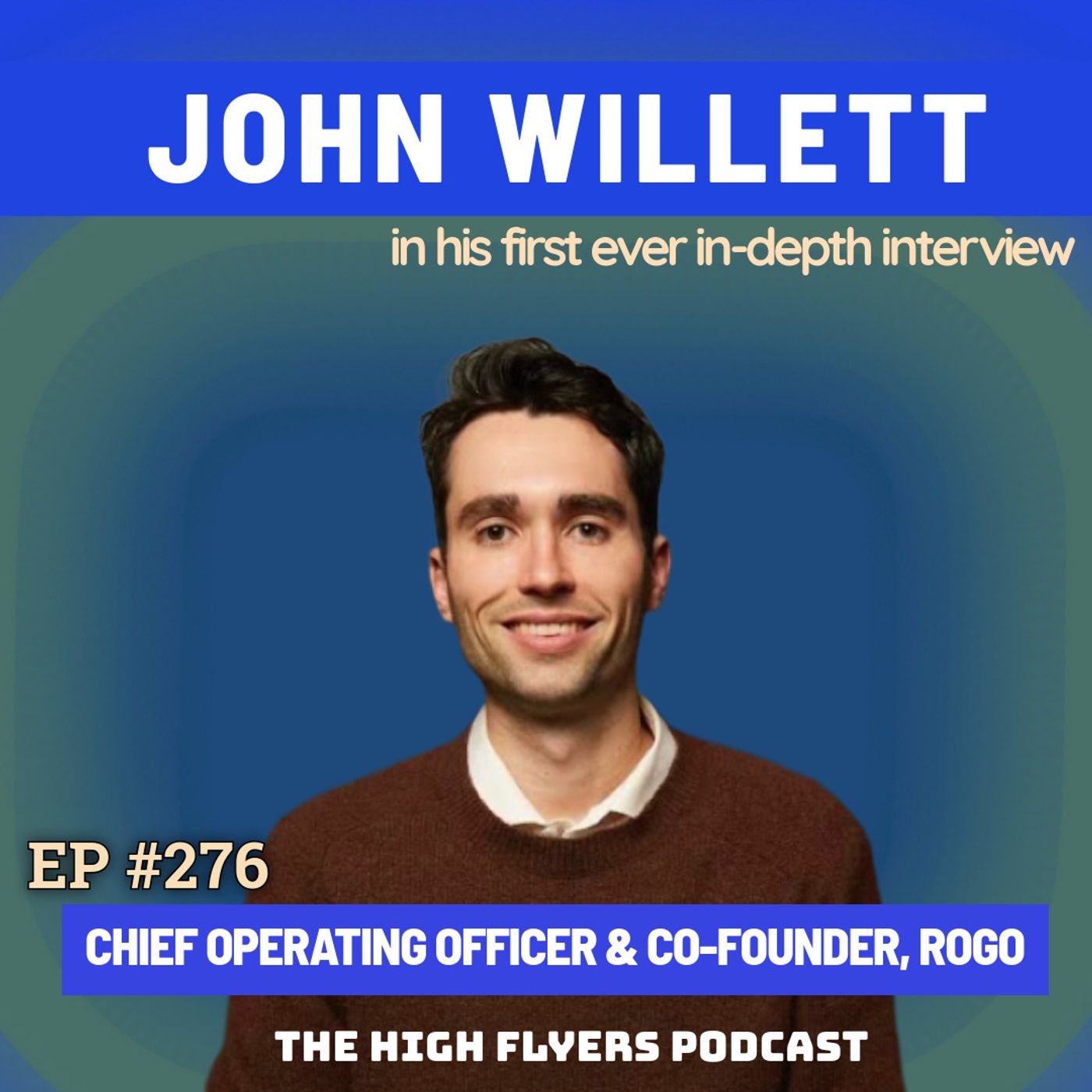
John Willett (Rogo COO/co-founder) discusses his path from Princeton to building Rogo, an AI partner for large banks, including why early sales were slow, how ChatGPT changed enterprise urgency, and how Rogo now sells “accountable” AI workflows via change management and enterprise deployment.
John Willett is a co-founder of Rogo; he grew up in Coventry, Connecticut, lives in London, and works on Rogo’s European/APAC expansion. He studied at Princeton (economics; minored in engineering, machine learning, computer science) and previously worked in investment banking. His co-founder is Gabe (also Princeton).
Early on, banks ignored them for ~2 years; they kept going via curiosity and small wins. ChatGPT (Nov 2022) created the “aha” moment that made AI adoption mainstream. Rogo’s differentiation is tailored, bank-specific agents/workflows plus security/InfoSec/governance support, not generic AI.
First major customer was Lazard (pitch: models + daily embedded prompt/workflow work). Lazard deal signed Dec 2023; rolled out first half of 2024; ~1,500 bankers used it. Funding: Kevin Ryan invested $2M and later joined the board; Series A followed after deployment; Keith joined the board around Aug 2024.
Written by AI. May contain mistakes.
John shares insights about his dual persona and his initial career path.
“I'm your host, Virita Aguil, and let's have some fun.”
John explains what Rogo does and its unique market position.
“We are an AI partner for large global banks and institutional financial firms.”
Discussion about Rogo's investors and the journey to product-market fit.
“I know most of the investors and I was joking to the other day, it's like the Avengers.”
John discusses a team member deserving of more recognition.
“Something I've heard a lot from business owners and leaders is that speed only matters if you still feel confident in the output.”
John reflects on his upbringing and family of engineers.
“All right, let's wind back the clock and go to your Sunrise's Equality childhood.”
Discussion on John's time at Princeton and his academic journey.
“What are your memories of the environment and family?”
How John met his co-founder Gabe and their early collaborative efforts.
“So I was like 12 years old, 11, 12 years old.”
The evolution of Rogo's initial product and its differences from current offerings.
“I'm blanking on what the first couple ones were.”
Learn about the early challenges and perceptions of Rogo's initial products.
“like company fundamentals and company financials.”
Explore the misconceptions and early optimism surrounding AI in 2019.
“So I'm curious now with the benefit of hindsight when you reflect on that moment in 2019, I guess, what did you know and like, what did you maybe misunderstand?”
Discover how Kevin Ryan's investment shaped Rogo's journey and their initial strategies.
“When I spoke to your investors, they said that's the difference in like your board decks compared to other portfolio companies is that both of you worked in iBanking.”
Understand the tough early years and the motivation behind continuing the business.
“So if I had to guess, those were kind of the three legs of the stool.”
Learn how the release of ChatGPT transformed Rogo's marketing and customer engagement.
“People associated AI with predictive machine learning and big data.”
Explore the strategies and pitches used to attract major clients in investment banking.
“Tell me if you had, let's assume I worked at one of those companies back then, Lazard or JP Morgan or what have you.”
Discuss the expansion of Rogo's team and the timeline of funding rounds.
“And that's something that like we used to need to like sell really hard.”
Learn about the early funding rounds and the customer acquisition strategy.
“then when you had uh i guess by the lazar deployment it was just rachel and then yeah Aliana and some other folks, Nikki Coley came on kind of over the next 12 months or so.”
Explore how customer discovery processes have evolved over time.
“There was enough to show somewhat of a repeatable kind of motion there.”
Understand the importance of trust and how it impacts client relationships.
“they can kind of kick the tires and give you some confidence that it does the things that we say we're going to do.”
Discuss the dynamics of co-CEO roles and leadership decisions in startups.
“The right way to think about it is a provider like Rogo.”
Learn strategies for attracting top talent from investment banking to tech.
“I have more like scope and stress and responsibility and like everything that I know what to possibly do with.”
Discover the key differences between the US, European, and APAC markets.
“If you pluck a random person at a bank, there's a good chance they would never think about quitting and joining a tech company.”
Learn about the differences in market strategies across the US, Europe, and APAC.
“And it is going to come down to like, hey, these are the specific problems that we're going to want you to tackle in your in your first year.”
Explore the challenges of scaling a company from 40 to 200 employees.
“I'm conscious of time, so I want to come to Rapidify Sprint.”
Discover insights on improving management skills and fostering team dynamics.
“It's so interesting because this is probably the first time in tech where there's so many like founders, CEOs that are like in their late twenties, right?”

Get the gist, explore an idea or ask about something said.
 Claude
On The High Flyers Podcast with Vidit Agarwal, what are the key points of this episode?
Searching your listeningAutomatic transcript. May contain errors.
0:00Hi, I'm Vidit, the founder and host of this podcast, The High Flyers. Hey, I'm John Willett. I'm the co-founder of Rogo. John, I am so excited to do this. It was so funny. In my research, I had two perspectives on you. Some people said you are very reserved and you don't talk. And some people said he doesn't shut up, like he sings everywhere he goes. So I'm hoping you can tell us which John is real. I can pretty thoroughly debunk the quiet one. Yeah, you'll see that it's not the dominant personality trait. It was so funny. Like I love that mix that came up in the research. Hey friends, welcome back or welcome to the High Flyers podcast where we do reimagine a high flyer, showcase the brightest and most relatable role models and companies and their journey from sunrise to today.
0:43As one of the premier products in our Curiosity Center lineup, providing on-demand intelligence to help you be 1 % better every single day. I'm your host, Virita Aguil, and let's have some fun. Our listeners have called this podcast a meticulously researched biography unveiling the extraordinary lives and decisions of the most remarkable individuals and companies from around the world. We hope you're enjoying our catalog of 200 plus episodes since we launched in 2020 with many of our guests appearing in rare public interviews. It's now time to explore your curiosity. Please enjoy. Let's set some context with the fun facts.
1:24Where are we born and where do you live now? Sure. Born in a town called Coventry, Connecticut, an Eastern CT, sort of like an hour and a half from Boston, the closest city. Live in London now, opening our European office. Yeah. And work, what was your first job and what do you do now? First job was I was an SAT tutor when I was like an 11th grade or 12th grade. And then now European and APAC expansion for Rogo. And why don't you give us a quick overview on Rogo for someone who may not have heard of it? Sure. Yeah. We are an AI partner for large global banks and institutional financial firms. You can kind of think of like Harvey or Lagora, but much more tailored to finance and with a bit probably more of an emphasis on kind of the change management.
2:08Like we have a big team of four deployed bankers who come in and help build out the custom agents and workflows and actually teach people how to use the product, etc. So we started the company about five years ago out of New York. Since then, we've grown quite a bit. Very lucky to be working with a lot of the top banks globally. Yeah. And your investors. I know most of the investors and I was joking to the other day, it's like the Avengers. You've got all the investors. Yeah. It's kind of like the like, it seems like it would be sort of this like cigar smoke filled back room just with all these guys across, you know, Sequoia and Thrive and Kleiner and Kozla, but actually it's a very kind of like tame group when we're together.
2:47It's a very tactical squad. But yeah, no, they're awesome. I mean, it took us like two, two and a half years between our pre-seed and raising kind of our first more institutional capital from Keith. So that was kind of a long-ish product market fit journey. But yeah, since then, we've been lucky to put together a pretty insane board. Totally. And I want to talk about that in a moment. And John, as you know, the purpose of this show is to reimagine the concept of a high flyer, to go beyond people's shop titles. Is there a person you know who you feel hasn't got the recognition they deserve? I mean, hopefully I give her a lot of recognition internally, but maybe externally.
3:22Aliana Virgi is a woman on my team who started with us about two years ago, ex-Goldman and Sixth Street, did a lot of work with a lot of our early clients. And then she actually moved over here to London with me and this helped build out the office. And she's a 15 out of 10. She's awesome. She must be killing it if you've called her out. Like she must be absolutely smashing. Yeah, she's the best. She's also my rock here. Back to the episode in a moment. Something I've heard a lot from business owners and leaders is that speed only matters if you still feel confident in the output. And it's particularly an important point in this world of AI.
4:00Zero's answer to that is accountable intelligence. AI that shows you what it's doing and works from your own real data and is designed to keep you in control before anything happens. As Xero puts it, most AI asks you to trust it, accountable intelligence shows you why you can. And that's how it works with JAX, Xero's in-platform AI finance partner. So whether you're running the business, advising the client, or working with your board, JAX ensures that you get the upside of automation without giving up any of the control. If you want to see this practice, head over to xero.com forward slash highflyers for 90 % and off your plan for the first six months.
4:43Terms apply and go to the website. That's zero xero.com forward slash high flyers. Now back to the episode. That's great. That's so cool. All right, let's wind back the clock and go to your Sunrise's Equality childhood. And I think this is particularly interesting because you've not, I mean, you've actually not done, is this your first interview? I think you've done one more like mini interview. I think this is my first podcast that exists. Yeah, yeah. Yeah, yeah, yeah. Okay, so we'll see how far we can get into this because I think people are curious about who is John. It's uncharted territory.
5:15Yeah, which is great. So you mentioned growing up. Tell me, what are your memories? What are your memories of the environment and family? Yeah. I mean, I had a great childhood, two great parents, two older siblings. Coventry is, it's a great town. It's one of these like, I don't know if you've ever spent time in kind of New England and like the tri-state area. It's like half of it is like this very sort of like urban, suburban, affluent, like hedge fund manager type vibe. And then the other half is like weirdly rural and kind of like agrarian and like all these towns in like Eastern Connecticut, Central Mass, upstate New York that like that was kind of my vibe growing up.
5:53And you were telling me the other day that you come from a family of engineers. Tell me about that. Yeah, that's right. Yeah. I mean, my, my, my, my family was very like kind of well educated. My dad is or was a professor at the local state college, UConn, of computer and electrical engineering. My sister has her PhD in chemical engineering from Columbia. My brother's an engineer at an army base in Alabama. So I was kind of a little black sheep to not like directly be an engineer, even though I literally minored in engineering, machine learning and computer science. There definitely was a bit of like my dad impressed upon me from an early age that like the way to make money is to go do finance because he had and he didn't know much about that world.
6:32But all of his friends from university who were with him in like electrical engineering, half of them became like academics and didn't make all that much money. And then the other half went to go work at like Citadel and made a ton of money. And so from an early age, he was like, John, if you're really smart, you won't do engineering. and you'll do something much more lucrative, which like looking back is a pretty hilarious perspective to have. But that was kind of what I was brought up with. When I spoke to Gabe, who's your co-founder at Rogue the other day, he said to me at Princeton, you would finish three hour exams in 30 minutes.
7:02I don't know if he was joking. Like, is that true? That's a funny, that's an interesting perspective on it. No, I mean, I may be very, I would have to be very confident in it because there were two kind of competing forces. One is like my, I was good at school, like almost everyone at Princeton. And so that was one force. And then the other force is my sort of like Irish Catholic upbringing, which causes me to constantly be paranoid and the kind of second guess and things are going to go wrong. And so like, I feel like just as often as that would happen, I would, you know, maybe finish it in 20 minutes and then spend two hours and 40 minutes, like reading over every single answer to make sure it's right.
7:38And I probably have that conflicting Jekyll Hyde personality at Rogo at times as well. I mean, the exact quote he actually said is, He said, John is one of the highest IQ people I've met and a standard deviation above people I've met. He was always that boy. Did he say always that boy? He literally gave me that. We had a call and he gave me that line and he said, you can quote me. And that was the exact line he said. That's so funny. And I'm curious, did that form? Clearly, he's a big fan of you, which is great. Yeah, he's being very generous and very kind. Gabe's an extremely smart guy. Yeah, I mean, again, growing up, I was a huge nerd.
8:15I mean, so I like, but I wasn't publicly so like I always I didn't really like like it about myself, I would say. Like I literally I remember in sixth grade or something. So I was like 12 years old, 11, 12 years old. I mean, how did that shape your aspirations when you were just about to finish high school? So if I met you at age 18, what would I have assumed you do with your life? I think like this generic sort of like business or finance, like I was so maybe I was book smart, but I was not good at the kind of extra mile, like getting to know the career paths ahead of me or like networking or, you know, really knowing the topography of these different areas within finance.
8:58So I'm probably generic would have been like, yeah, I'll be like a CFO or maybe a CEO of some company and having zero idea what that meant. Zero concept of like the path towards that zero concept of like what industry that would be. So like generically, I was like, OK, economics is probably a reasonable first step towards towards that. So that was kind of the random walk that I was on at that time. And it sounds like engineering was not a family influence. No, I mean, I took my first coding class. I only took sophomore my second year of university at the right at the end. I was late to the game and I quickly realized I'm like, I prefer this by a lot to economics and wish that I had done it the whole time.
9:34I know you met Gabe at Princeton. Was that pretty early on? Like maybe tell us the story of how you met him at Princeton. Yeah, I mean, we, Princeton's not that big, so we definitely knew each other a bit just from the first few months. We started getting closer kind of maybe halfway through, halfway through college. And it was just a bit like, I mean, Gabe's also a big nerd. And so we would just take some of these random like linear algebra or like stochastic systems classes together. And I feel like of the people who were going out and getting drunk on a Tuesday, like of that group, which is not a big group at Princeton, Gabe and I were like the nerdiest of that group.
10:06And so we sort of like naturally became close through that. Do you remember your first impressions? Like I told you how Gabe described you when I spoke to him the other day. How would you describe Gabe when you first met him? So confident, like so much just sense of presence, sense of self. Super funny. I mean, out the gate, just like hilarious. but not like warm and fuzzy. He was a little bit intimidating when I first met him, but always just, yeah, super smart and sharp and hilarious. So how did you break in? How did you go from that to becoming friends and then starting companies, right? I think it was classes that we took together.
10:43I'm blanking on what the first couple ones were. And then, yeah, we ended up in some of the same kind of like social clubs within Princeton. And then, I mean, the company thing, we did a little bit of independent research together when we were seniors in college. Well, really the story there was, so Gabe had taken some natural language processing classes and we started kind of chatting about it our junior years. And I had just finished my junior paper for economics. And one thing we just kept talking about is there were all these people in the economics department at Princeton who are smart, but they're not technical or they don't know how to program.
11:18And the weird thing about these independent research projects was that you might spend like two weeks coming up with like a topic like, OK, I'm going to do like an instrumental variable study on this and this. And then like there's a bit of like collecting the data. And then a lot of it is just literally like writing the R code or the Python code to like cleanly do the analysis, clean the data and do the outputs. And so it felt like 80 percent of the work that went into these financial or economic studies were things that the people weren't good at. Like they hated it. They like figuring it out from scratch.
11:50And anytime you see something like that, it just sticks out, right? You're like, this is a weird dislocation of resources. So we started looking at, I mean, LLMs were around, but they weren't like that good. And there wasn't like an API you could like ping to get like a good, you know, LLM response. And so a lot of it was kind of these more anachronistic grammar based approaches. And we were pretty impressed with a rule set that's not so crazy. You could take pretty open ended strings of text and convert that into more like deterministic like code runs. So that was basically the insight, which wasn't like a novel insight by any stretch of the imagination, but we were really interested in it.
12:23So kind of the idea that we set for the next year is like, OK, what if we can like build kind of a product that allows you to, as an economics student, just kind of describe what you want. Say, hey, here's this big clunky data set. Can you remove the outliers and get rid of parts of the data that clearly are mislabeled? Like those sorts of things like do the cleaning, do some of the exploratory analysis and then do the outputs. just describe that. And then the system could sort of piece together like a Python script to do that analysis. Again, like this is all stuff that within a day of GBD3 coming out would have looked so horrible, like did not work that well, but for the time felt like it was going to be helpful.
13:00So we spent a lot of time building that our senior year. And then actually after our senior year, we had a few months before we started our like investment banking jobs. And we did talk a little bit about, should we try commercializing this? Was it called Vrogo? No, this was before. So the original product we called Athena, which is just like the most cliche possible technology name. Every single product is called Athena. So from the jump, there was no way from a legal or branding perspective that that was going to work. How different was that to the first Vrogo product that you eventually went with?
13:35Quite different. Because the first one didn't incorporate LLMs at all, it was all like uploaded data. And it was all like it was more structured data. It was kind of like, oh, like I have these CSVs or like there's this like data set I'm integrating with. And you would do basically just like structured analysis on top of that. Whereas the first kind of versions of Rogo were actually much more like we're plugged into all the like market data and like company fundamentals and company financials. And you can ask a question and it would basically just pull those public pieces of information. This was still like FaxEd and SVGlobal and L seg still were not picking up the phone.
14:11So it was all these like random like data bento, like these random third party market data providers that no one in investment banking would ever use or trust, but it was sort of more of a proof of concept. And then the first product was also like a command line interface. So it left a lot to be desired in terms of UI UX, to say the least. It's interesting because when people think of Rogo today in August, 2026, people think of Gen AI, right? Yeah. Back then in 2019, like you said, it was pre-ChatGPT going mainstream and it was pre-AI disrupting software in general. So I'm curious now with the benefit of hindsight when you reflect on that moment in 2019, I guess, what did you know and like, what did you maybe misunderstand?
14:50The latter category is much more than the former. I mean, we like, we had like vaguely an idea that this stuff was cool. Like that, I think that's probably the extent of our knowledge. There was maybe also a vague sense of like, this stuff is both cool and getting better. And there was some concept of like Moore's Law It was all very vague. We were like, OK, maybe this stuff will get better. Had no idea of the timelines or where things were going to end up. And to give you a sense, it's like we started our banking jobs. We did kind of somewhat quickly. We were like, you know what? We do think this stuff could be applicable to our front office banking jobs.
15:23I'm spending my entire day pulling data from Faxed and then from CapIQ, PitchBook, Crunchbase, Dow Jones, all these different data sources. And so it felt like some of what we had built could apply. But we had basically no urgency whatsoever to start the company. Like we were like, oh, maybe we'll do, you know, in five to 10 years, we'll pool some capital and bootstrap this or start working on it at some point, which I think is a pretty good indication. Like if we were smarter and really knew where the research was and knew where things were going, we obviously would have just quit our jobs and started the company immediately.
15:55The reason we ended up doing that was our first investor was this guy, Kevin Ryan, who founded, yeah, MongoDB and Business Insider. And he's kind of one of the best early stage investors, certainly in New York. And he recognized it, I think, a little bit before us. And we were talking about what we were doing. We were like, hey, maybe we'll apply to Y Combinator at some point. He was like, no, don't. I'll just give you$2 million. You should quit your jobs now and start the company. This thing's going to move a lot faster than you think. So that made it a lot, a lot easier. And he helped. Can you connect those dots?
16:27Because by then, you had already graduated from Princeton, right? Yeah. Yeah. So this was like a year and a half into investment banking or something like that. And so you were doing this on the weekends and nights? Yeah, basically. We were doing a little bit of time. So at this point, not that much of it was actual company building. We were working 80, 90 hour weeks in banking. So there was very little product or selling. We were maybe doing small user interviews and stuff, but very little. It was much more by the end, kind of figuring out, defining the vision for what we wanted to build and actually putting together a pitch deck, which seemed like a very important exercise at the time to have a really long and comprehensive.
17:02It was such a good investment banking style pitch deck of just like so detailed about all of our thoughts. I was going to say exactly that. When I spoke to your investors, they said that's the difference in like your board decks compared to other portfolio companies is that both of you worked in iBanking. So your decks are like very like iBanking style. Oh, that's so, because I would have thought that like now we've gotten away from that. So they still think that, that you guys should see this first one. It was horrific. It was also, it was so funny. like some founders write memos, right? Because I think you guys still do decks.
17:33Yeah, we've experimented. I think our series A was a memo. We've experimented with both. Honestly, I do like the memo. But the first deck was so funny about it. This is more of an aside, but we were looking at it like a couple months ago. It's like we were, I don't think either of us had ever like seen a fundraising deck before. So it was all like from first principles, like zero clue of like how it should look. And we had like our like next 24 months plan. And like typically when you look at a founder deck, It's like in three months, we're going to be at like 100 million of ARR. And then we're going to like take over.
18:04Then we're going to start in Europe. And just like this world domination plan that's like very grandiose. We were like so insecure and just we're like, yeah, this probably won't work. So like first six months, like ideation and then like hire an engineer. And then like 12 months later, like launch our first product. And it was literally like by the end of two years, we projected like 100K of ARR or something like that, which like hilariously ended up being accurate. it, but just because we were so not confident, it's actually, it's so funny. We'll have to, at some point if we IPO, we'll release that deck alongside it and it'll give everyone a good laugh.
18:39I feel like you can do it now. Like you've got enough runs on the board to share that now. Yeah, maybe you're right. Yeah, you're right. We should. I mean, tell me on the Kevin Ryan point, because like you said, he built MongoDB. I mean, he's also done Business Insider, I think, and a bunch of other stuff. So clearly he could say he understood software, right? And he still understands it. What did he see in both of you and your, I guess your MVP in a viable product in 2019 that gave him confidence to give you 2 million? I think Kevin probably recognized a bit about, I'm sure he had followed what was happening at OpenAI and Google and had probably had some preexisting thesis on language models and where things were moving.
19:16And I'm sure that existed somewhere in his brain. And then he just loves first time founders. That's a big thing with him. Like he like, he loves like young talent and like giving them money and letting them and letting them kind of run wild. And I don't know if I fully share that thesis, but it worked out incredibly well for us. And Kevin's rationale for that, my understanding is, you know, he was the CEO of DoubleClick, which was one of the early kind of internet ads companies sold to Google, and he ran it incredibly well. And he's like, dude, like if DoubleClick was like my third company, I would not have been nearly as good because I wouldn't have been as paranoid.
19:48I wouldn't have been up all night thinking about it. I wouldn't have been just kind of as much of a freak about it as I was. So he likes the kind of first time founder, like no points on the board, like leaving nothing to chance, which like, to be fair, definitely is our personality. So I see that. So I think for him, it was probably more the calculus of like interesting market backdrop of language models. First time founders, I like them. And these guys pass some bar there of drive and whatever. And then probably the bare bones, like, okay, they worked in banking, they're going to start something to attack banking.
20:17That's often a pretty successful or interesting idea. So if I had to guess, those were kind of the three legs of the stool. Well, I mean, I was going to ask, like, maybe you can't answer this, like, what were the terms? Because his 2 million would be worth quite a bit now, right? Yeah. I mean, maybe I won't comment specifically on the valuation and stuff, but yeah, I mean, you know, it's definitely been a successful investment for Kevin. And he's, originally, he wasn't on the board. It was one of his kind of lieutenants. And now he is on the board. He's awesome. He's one of our biggest kind of supporters and he's been a great champion for us.
20:47So you've alluded a few times to like the early years being really tough. I think the line Gabe said to me the other day is the first two years were pretty dinky. Yeah. And PCs were like not interested in you at all till Keep came along. Yeah. Take me inside that because now that seems like a perfect story, right? Like the dots connect in hindsight and what a rags to riches story. Yeah, yeah, yeah. Now we're here. Like what was it in those two years that I guess gave you both confidence to keep going? Oh, that's a great question. very little in terms of concrete data points like there was especially the first like year and a half like there was like essentially no external information whatsoever that would like support the idea that we should be running a company like like no interest from clients so that was the that was kind of the status at the time what kept us going i mean maybe maybe you know back to kevin's point there is a first-time founder like kind of a je ne sais quoi i'm just like oh this is kind of cool.
21:44Like it's kind of fun. Like even like meeting Kevin, I was like, I never really met a billionaire before. And that's pretty, pretty fun. And then like, you know, I remember there were times where, you know, we'd go meet with like Blair Efron from Centerview. And it's like, you know, if you grow up or, you know, if you're a young investment banker, like Blair Efron, it's like basically a celebrity. And so there are all these, there are all these moments that at the time being like 23, 24, 25, having come from, you know, the first couple of years of our career in banking where like my MDs wouldn't even really like talk to me like there was no connectivity to like or senior people or more successful people and so there were enough sort of just moments of that were interesting and kind of fun I think to to keep us going and and there was a feeling like hey we're learning a lot like let's let's just keep learning a lot I think going back it would be really hard to do that again but at the time it kind of just felt like I mean I won't pretend there weren't very dark days but i think what kept us going was just a bit of a sense of like curiosity and and fun and in the small stuff of starting and running a company so i mean the obvious question is when did it start to click because also at this point there's two years did you quit your job or were you yeah yeah we quit our jobs so you were full-time so you took the two million and you were full-time on we were full-time yeah we were full-time because you know we could pay ourselves salary and stuff so right of course all that all that felt you know relatively low risk, which is really lucky.
23:07So yeah, we quit our jobs. We were fully doing it. ChatGPT coming out November 2022 is probably the single biggest moment where previously, I mean, if you look at our pitch decks to like sales pitch decks from before that, we wouldn't even mention AI because it was not a good marketing term. It was distracting. People associated AI with predictive machine learning and big data. It was like, oh, you're going to help us do portfolio analysis. It just did not really jive with like, we were trying to build like front office workflow automation software and like linking that with AI made no sense. And there was also just a lot of, there are a lot of skeletons in the closet and investment banking in terms of previous, I don't want to call any companies out by name, but like previous companies that had purported to do like PowerPoint automation in the pre-LLM era.
23:51And I had access to like five of these when I was at Barclays and they never got used because they weren't good enough. And so there was a lot of that kind of mental block to get over. But when ChatGVT came out, everyone kind of had that aha moment. And it still took us another year to like really commercialize, partly because we had to get through like InfoSec and governance and all these things. But we could at least start to talk to guys like Blair and talk to guys like Peter Orzak from Lazard and get to know them and start to ingratiate ourselves as people who are like really focused on the space and thinking thoughtfully about it and raise some money and are building in it and really kind of pitching ourselves.
24:24Tell me if you had, let's assume I worked at one of those companies back then, Lazard or JP Morgan or what have you. What was the initial opportunity? Because again, you mentioned at the start about like Lagora and Javier. I know both Lagora and Javier really well. They've both been on the show. They said like AI changed how enterprise started looking at software, right? And I feel I see that every day, like across the stack, like healthcare, government, accounting firms, law firms, banks. I think to your point, like the ChatGPT has made a mainstream where they all seem very pro software, where I don't think they had that desire pre-ChatGPT in the same extent.
25:01But I'm curious, what was that initial pitch or that initial opportunity that you were presenting to them? And like, yeah, maybe you can tell us about the QLE customers and how you got them on board. Yeah, 100%. I mean, like the first real customer was Lazard. And the pitch to them was kind of just like, hey, these models are incredible. They're going to change how you work. that change is going to take a lot of harnessing from a technological perspective and also a lot of like human capital transformation. Trust us with both. Like, you know, we're going to have an engineering team who is fully focused on taking really what was open AI at the time and kind of teaching it, prompting it, how to do financial tasks, giving it access to all the financial market data, giving it as much context as possible on how Lazard works.
25:42So that was one. And then the second part was like literally like myself and Gabe and a couple other folks like Rachel Friedman and Aliana, who were ex-bankers. And we're like, we will just come in to Lazard every day and we will write all these custom prompts and workflows and automations and get to know your bankers super well to actually start to embed this stuff into their workflows day to day. So that was kind of the original pitch. To your point, and I've never sold SaaS or software in the previous era, but you're totally right that investment banks, I mean, Europe is a perfect example of this.
26:12Like when I came over here this year, I was not sure how European banks were going to be procuring this stuff because there are banks in Milan and Madrid, et cetera, that like basically like missed cloud. Right. So they're like very, very kind of slow to adopt stuff. But they all now have these like agentic AI task force. So they're trying to figure this stuff out. And, you know, I think for them, it was probably more like the Claude Opus 4-5 stuff as opposed to the ChatGPT moment that really put stuff into focus for them. But like they're getting there, too. So to your point, like these banks, I think, have recognized that whereas previous transformation cycles have been about cost cutting and maybe about security and maybe about data organization internally and things around HR and human capital management.
26:58This one is about existential revenue transformation. This is about what are the next five to 10 years of the industry look like we think they're radically different. And every bank, no matter whether you are JP Morgan, Goldman Sachs, or some like small regional boutique bank, if you don't have a good AI strategy, you're putting your entire business at risk. And that's something that like we used to need to like sell really hard. Now it's something that doesn't even show up in our deck, right? Like that is like so table stakes obvious. And the entire conversation is grounded in like, how are we going to help you address it?
27:28So the urgency is, has been completely different, I think from, from previous cycles. Hmm. Or even if I think of like, I recently had Jesse from Dekagon on the CEO on the pod. And even he talked about like they sell to enterprises mostly and and he was saying he's been amazed at how it's gone from like an efficiency conversation to actually a product conversation yeah like it's not just a cost setting i mean that's a whole topic we can talk about is like cost management like that's a topical area with token spend and just efficiency but it's just down rogo in the early days also your side point you mentioned rachel and aliana so you had hired a team by then when you had uh i guess by the lazar deployment it was just rachel and then yeah Aliana and some other folks, Nikki Coley came on kind of over the next 12 months or so.
28:11And then when did you raise the next round of funding that Keith came on board for? Keith for board? Yeah. So the Lazard round? The Lazard deal was December 2023. We rolled it out in the first half of 2024 because we were like deploying it like kind of on-prem or in cloud-prem, which was not the best way to deploy the software at the time. And so it took a little while. And so once that was like successfully deployed and 1 ,500 bankers were using it day to day and the feedback was good. At that point, we were able to raise our Series A. So I think Keith came in maybe in like August of 2024 or something like that.
28:45And so by that point, you had clearly more customers, right? You had more traction. Yeah, yeah, yeah. Yeah. Yeah, we kind of had like Blizzard and then like three or four boutiques that had started on like smaller things, but we're starting to talk about upselling. That was kind of the shape of it at the time. There was enough to show somewhat of a repeatable kind of motion there. Tell me about in this, we can connect to present day, like customer discovery, like in the business I run behind the podcast, we, I think I said to you the other day, we work with like JP Morgan and, and Macquarie and a whole bunch of these banks.
29:16And that can be like a six month process just to understand what their problems are. Yeah. Get the right, like stakeholder and get the meeting and then fall into their budget cycle and procurement onboarding. You've done this, right? Yeah. What is your... Six months even sounds, six months sounds like a dream for that. Yeah. That's... Yeah. It sounds ambitious, right? That'll be the quickest sales cycle ever. Yeah. So tell me, how's your discovery process changed? Again, if you met me today and I was your ICP at one of your target customers in Europe, let's use Europe as an example. How do you build trust with them and how do you understand their problems to then convince them to buy a wrong way?
29:52Yeah, it's a great question. And I think early on, so much of the effort was like, yeah, A, spent convincing them AI was like very important and that they needed a strategy. then B a lot of it was like very specific workflows it was like hey we think that your seniors are spending a lot of time doing this and your juniors spending a lot of time doing this and like that kind of med pic style discovery was really really important now I think we're just one altitude above so there's the same type of exploration but it's much more like hey what have you rolled out like what are the tools on desk like is it working is it not working where are the gaps how are you managing token spend are you cross model how are you building like firm memory Is the system getting smarter over time?
30:30How is your internal data organized? So it's much more kind of like CIO, COO, CTO, maybe CEO level kind of altitudes for just the overall AI strategy. And then the pitch is pretty compelling. It's like, hey, look, like clearly you guys need a partner on this stuff. And every bank does. We don't think that your partner should be one of the frontier labs for a variety of reasons, including cost economics, vendor lock-in, just overall model risk, security, and domain focus. So you should go with a provider who's fully focused on the space and can help you hot swap between models. And then it's a bit about showing why we think that we're the right people to help you with that.
31:09And it's kind of just like, hey, we think you guys have a great business. We think you can make it better in these ways. We'd love to connect you with five clients who we've done something similar for in the past. We'd love to get the product into a few users' hands so they can kind of kick the tires and give you some confidence that it does the things that we say we're going to do. And then kind of going from there. So, I mean, a lot of the much more cycles at this point are spent in the just enterprise procurement, infosec governance. Like that's, that's where the meat of the like deals are at this point, as opposed to like the upfront stage setting or like the need to buy or like why us?
31:46It's actually a lot more, okay, yeah, Rogo seems great. I know they're working with these, you know, these companies, like whatever. It's like, hey, which divisions would it make sense to start this in? How is that going to align with some other initiatives we have? How is that going to align with our internal build? It's those sorts of questions that end up dominating these conversations. When I had Harvey's CBO, John Haddock, on the show, he almost said to me, prestige was their go-to-market motion, right? They had some big law firms early on and that became a proxy for trust. And I see that, I think humans work on that?
32:21Like if you recognize a logo, I guess a two part question. One, was that part of the Rogo story, like using big logos as a proxy for trust? And two, were there trade-offs? Like one of the conversations I have with a lot of founders today is it's kind of like a carrot to chase the big logo. But as you'd know, it takes a lot of resource and time and money to service them. And I kind of say to founders, don't go after the big logos early on because then you have to hire like a sales team just to work on one account. and a bit churn, you have a big hole in your budget. So I'm curious, yeah, tell me about the proxy for trust and then when did you feel big customers were right to service?
32:55Yeah, totally. I mean, you're right that going with Lazard and going with some of these other bulge bracket names kind of that I don't have logo rights for, so I can't reference publicly, but you can probably guess where they are, helped us a lot kind of going down market. It wasn't like that galaxy brained or like intentional. I feel like there was some element of, we knew people at these institutions and we've been talking to them for a lot. I also think like the partnership pitch actually works better at a large organization where there's more kind of like stability that's required. There's more like hands on change management that's required.
33:28Security is more important. So having folks who are fully focused on your firm and on your industry is actually more of a selling point than going to like a 10 person private equity firm or boutique bank. So those are the reasons that we started there. To your point, it was a huge risk from a P &L perspective and a huge risk from a product roadmap perspective to serve these institutions early on. Like we were constantly getting pulled into very bespoke features that they that they wanted. And we had to have a good nose for where something was helping us find product market fit with other firms versus building something that's that's really, really bespoke.
34:00And that was kind of a painful thing early on, like that whole first year of commercializing where there was really only like one to two big customers. and we would occasionally tell them no, because we're like, hey, we don't think that's going to apply to other firms. It did take a lot of discipline. It definitely has paid off overall and every conversation is easier when we can start it by saying, hey, these are the 10 banks where we have over 5 ,000 bankers deployed at each of these and you can call the CTO and they'll say good things. But I would say, honestly, what's kind of hilarious and ironic, what I've noticed in Europe is at times it's almost like an objection we need to handle because they're like, oh, is Rogo, one, are they too like focused on the American banks?
34:41And so that's something that we've needed to really start telling the story. Now we're working with a lot of the big European banks as well. And, and, you know, really showing that we're, we're building local here. And the second, which I never saw coming, if you told me this like five years ago, I'd have been like, this is incredible. Is like, is Rogo too big to like focus on our needs as a G-Cit bank in, in, in the UK? And what do they mean by that? What they mean is it's like, OK, if they are working with all these bulls bracket banks, we don't necessarily want the exact same tool that all those banks are using.
35:14We actually want more of a tailored partnership and a build partner who's going to build a lot of custom stuff for us. We don't want to show up to meetings, but the same exact pitch book that these large banks in the US are showing up with. We want something that's super differentiated, etc. And so when I hear that, I mean, I know it's clear that I haven't told the story well, because that's just not the right way to think about it. The right way to think about it is a provider like Rogo. We are in the business of creating tailored versions of the platform for different firms and having tailored partnerships.
35:44And actually, if a banker at MOLUS and a banker at BNP Paribas ask a question in Rogo, the answers are going to be very different just based on the firm intelligence that we've created for them. all the workflows, all the agents, all the skills. So there's actually more of a divergence than a convergence in terms of the types of answers that folks are getting and the types of materials that we're creating. I want to come to go to market in a second, particularly comparing and contrasting the different regions you're building. But before that, one interesting anecdote came up in my research is how you and Gabe decided who should be CEO and decision-making.
36:18I think the amount of founders I see that stuff up because of that, where egos get in the way, is incredible, right? You see it, you're seeing it right now with a lot of the AI labs, like it's playing out in public. There's so much ego at play. Whereas folks, when I spoke to them for research, they said, you guys are pretty cordial about it. And maybe it goes to your, this low ego approach to life that we talked about at the start. Was that an interesting conversation on like being, because I think you were co-CEOs initially and then Gabe became CEO? Yeah, sort of. When we first started it, yeah.
36:47And then when we raised the first round from Alicorp, they were like, someone needs to like be the boss day to day. and they're obviously right about that. It was interesting at first. I mean, I like the angle that I'm super low ego. It was just all easy and probably not quite true. I was like, I can't believe I'm quitting to start a company. I'm not even the CEO. And it was pretty clear, like, if it was going to be one of us, it should be Gabe. I mean, like, partly because he had a better investor network and partly because, like, Gabe is just, Gabe is one of these people who, like, that dude is a CEO.
37:15Like, you meet that guy and you're like, that guy is going to be the CEO of, hopefully it's Rogo that makes him, like, a legendary CEO. But if it's not Rogue, it'll be some other company where he becomes like a Travis Kalanick figure, like a Brian Chesky figure. He's just incredible in so many ways. And so that was just pretty clear. And that wasn't even me being like humble. That was more me observing the kind of guy that Gabe is. And then within a few months, it's like we're a real company. Like we've hired a couple engineers. We're trying to do stuff. And like all of my energy and thought are just directed towards how do I actually try to like make this company successful?
37:46and everything else is just so kind of like stupid to think about. I have more like scope and stress and responsibility and like everything that I know what to possibly do with. So there's no semblance of like, oh, I wish I had like way more. Tell me about it on the social signal point. I feel hiring is a good example of that as well. And like you said before, you've hired a lot of ex-investment bankers that have left a path that perhaps had more prestige and more financial upside, at least back then, you joined Rogo. How have you gone about that? Because again, I know firsthand, like convincing someone to join a company, maybe now it's a bit easier because you've got the cred and you've got the valuation and the investors and all that.
38:27But maybe the first couple of years, like till maybe your series B, it might have been tricky. Again, any stories on how you convince some of these like smart people to come work for you instead of Anthropic or OpenAI? Yeah, yeah. Yeah. It's a good point or good question. I mean, definitely in the early days, every conversation that you have with a potential hire, it's like you're raising money. You're doing the full end-to-end pitch. This is our right to win. This is why we're here. This is what your equity is going to be worth. Maybe you can use Europe as an example. Tell me, that could be an interesting case study.
38:58When you decided you're going to come on the ground in Europe, how did you build a team? Yeah. Well, I mean, for the ex-bankers, it's a pretty compelling job, I think, in a lot of ways. There are a lot of folks who are in investment banking who want to have operating roles for a variety of reasons, maybe because they want to be operators long term, maybe because they want to go into VC or growth equity or tech investing. And that's often the best way to do that and gain kind of credentials in the space. And if you're going to be an operator, it's a pretty good gig, right? You get to really apply all of your previous financial experience.
39:30It's very cross-functional. It's very commercial, very client facing, very growth oriented. It's also a lot of product and eng collaboration. And you're part of like kind of like a, you know, I don't want to call us a rocket ship, but like a, you know, you're part of a quickly growing company. And, you know, I think for a lot of our engineers, it's like our engineers are going to have like infinite opportunities to join really fast paced, high growth companies. That's just the nature of being like an AI or, you know, good back end engineer. There aren't that many opportunities to like join a company like this where your skill set's super applicable.
40:01And it's like, you know, this venture scale business that's growing incredibly quickly. So in Europe, it's like, hey, we have all that. We have that backdrop. We have that kind of product market fit. We have the funding. And then here's a chance to do like the early stage thing again and be kind of that startup within a startup, be even more cross-functional, even more autonomous and help win the geo. What I've seen is there's sort of two different types of folks who join. There's the current Rogo user or product and, you know, likes it enough that they're like, I could get behind this for my career.
40:31And that's my favorite because any call they join, if they introduce themselves as a former Rogo user who joined, that's like the best possible recommendation. And then the second type of person is someone who is in seat as like an analyst or associate at a bank and then becomes sort of like a AI czar within the firm. Like they join like the AI committee and they're helping roll tools out internally and test stuff and build workflows. And often you see someone like that after like a year of doing that. They're like, well, this is 25 % of my job. This is the best part of the job by far. I don't like the other stuff.
41:02And if I join a place like Rogo, I can do that the whole time, except it's way higher leverage. I'm doing it across a ton of different firms, impacting way more people. I'm part of a tech company. So this is a very different vibe, less bureaucracy, moving way faster, and then a lot of equity upside in what I'm building. So for both those two types of people, I think it's pretty compelling. If you pluck a random person at a bank, there's a good chance they would never think about quitting and joining a tech company. But for the self-selecting group, I do think it is a pretty compelling pitch. Anything you're seeing on expectations from talent on REM or ESOP, like it's a very competitive talent market out there.
41:38And folks can, like you said, they can go to Harvey or Legora or Decagon or a bridge or one of these like application layer companies that are killing it. How are you getting them to Virogo? Like, are you offering any benefits that's above market? Vis-a-vis, you know, like a Lagora Harvey, it's probably a somewhat similar, you know, package, I would assume. And it's more person to person. And it is going to come down to like, hey, these are the specific problems that we're going to want you to tackle in your in your first year. It's probably more personality compatibility with whether it's me and Gabe or other folks on the team.
42:11So I think it's more idiosyncratic. I don't think we figured out like a systematic way to beat, you know, these other app player companies that are getting talent. I think it's just trying as hard as we can on each candidate to tell our story. I said before, let's compare and contrast to different markets. I think what's particularly interesting, I said this to you the other day with you coming into Europe is, I mean, all those companies you mentioned, I don't think the founders have moved. The founders are still based in the US. I mean, Lagora is based in Sweden, but the others are based in the US.
42:37They've hired a GM or they've hired a chief business officer. Yeah, yeah. That goes to clearly your belief in yourself to put yourself on the ground and uproot yourself. But I'm curious, how do you compare and contrast US versus Europe versus APAC? Any distinct differences between the three markets? Definitely very different markets in a lot of ways. One concrete difference is definitely like the security cycles are longer here. There's a bit more sovereign cloud stuff that shows up. In the US, they'll pilot anything. Like you can go to a bank and be like, hey, you want access to the software?
43:12they probably have like a lightweight way to like get a sandbox trial going, give 20 users access, get some feedback quickly. So like we'll be in bake-offs regularly with like five other vendors at once. Everyone has access to all the tools and they're running the same props. And that's a little easier for us just because our product is good. And so if you use us versus other folks, most of the time, you're probably gonna be like, hey, I think I should really like the Rogo one. And so that's a bit of a, it's a bit of more easy. It's a bit of an easier go-to-market motion in some ways. Europe, frequently they will pilot just one tool, maybe two tools, because it takes so long to get stuff through InfoSec.
43:48They consider it a risk to even have a pilot. Well, it sounds like they actually view U.S. brand as a negative signal, right? It's hard to fully draw. It varies person to person. I think if we can thread the needle and be like, we are a U.S. company with U.S. capital, U.S. innovation. We are moving quickly like a U.S. company. but we have the local boots on the ground presence of like ex-bankers who are going to help you deploy this. We have local legal folks, local compliance folks, local solutions architects, security engineers, et cetera, who are working to adapt the playbook for Europe. That's probably the best possible pitch if we can show that we're a bit of both.
44:28But so in Europe, there's a lot more kind of just value selling upfront. Like we need to like be everywhere and be well regarded enough in every single firm to be included into the one to two vendor pilot that goes on. So it's very relationship based as opposed to, you know, product based at times. And APAC, anything unique about APAC compared to Europe and US? It's just so sprawling that it's, I mean, they're, you know, of course, like the French market is different from the Spanish market. It's different from the Italian market. In APAC, like Tokyo versus Singapore versus Hong Kong versus Sydney versus Dubai versus India.
45:04It's like very hard to even draw like parallels across. They're probably more different from one another than they are similar. Singapore is probably the most similar to Europe. You know, it's Western in a lot of ways. A lot of the expansion we're doing there and a lot of our users there are actually just the Asian divisions of the bulge bracket banks that we're working with. Compared to Tokyo, like our deals there, it's like you need, you know, a native Japanese speaker on hand. It's a culturally very unique. It's a completely different market. So just the sprawl and the scale of it is different.
45:37So it sounds like, because a lot of these banks you're working with are global banks, right? But you've got to sell to them by region. So they come by Frogo globally? Occasionally. What I found, this is me drawing a broad kind of a characterization that's probably not fully accurate. Frequently, I found in the US bulge bracket banks, the US banks have a central procurement where you sell in New York and then you get users globally. Sometimes in the European banks, it's a separate procurement office, procurement center in Asia. It needs to go like get budget approved. It's completely different paper.
46:08It's a different MSA, et cetera. Right, interesting. It's a pretty boring answer, but it's just kind of a kind of... Yeah, I mean, I think the takeaway is it's not one size fits all. Yes, exactly. Which makes sense. I'm conscious of time, so I want to come to Rapidify Sprint. But before I do, we talked a lot at the start about the challenges building Robo. Now things are up and to the right. If you think in the past 12 months, has there been one moment where you've been tested a lot? And I wonder if you can share it. Yeah, question. The sheer volume of scaling has been a huge task. We've like, you know, in the last 12 months, we've gone from like, I think like 40 people to like 200 or something like that.
46:46So it's a completely different company. And so when you're 40, it's like, you don't really need any process, right? It's just like everyone just doing everything at the same time. And like, as long as we're roughly on the same page, it's fine. Now it's like we're hiring people who are hiring people who are hiring people. And there are people at the company like we don't really know that well. Hopefully we spend a little bit of time with them. But to be able to create kind of an operational cadence, a set of values, a way of doing things that is not restrictive and still like fosters autonomy and creativity, but keeps people aligned is a big is a big challenge.
47:20challenge how how are you getting better like if i reflect on my own self like being a manager of people leaders really yeah like i'm sure when you were like you go back to like princeton days we all said it right we're like we want to be a manager we want to yeah we want to have like 20 direct reports and now i think of it and i go no i don't actually want 20 direct reports because that's 20 careers yeah yeah the emotions and 20 egos that i've got to manage yeah how are you getting better at being a people manager? Because it's hard. I hope I am. Yeah, it's no, it's so, it's the hardest thing.
47:54I think, yeah, when you're like - Your team says you're really good. Your team says you're like a good listener and you're empathetic, which is like a daily challenge, right? Particularly in a startup that's growing so fast. Yeah, yeah, that's really nice. Yeah, I think when you're 20 years old and you picture managing, you picture like everyone's gonna be happy all the time and like you're just gonna be a good manager and there's not gonna be these like problems. And yeah, that's never how it is. Even when it's a company that's doing well, you know, these things still come up. I think I've just like learned to be so transparent about what I do and don't know about what I'm working on, about what I need from folks with feedback.
48:30Like I'm just so open book on literally everything. And when we first started the company, like we were 23, 24, we had people who were like in their thirties reporting to us. And so there's a bit of a pretense of us being like, yeah, we know what we're going to do. Like we have these clients lined up like whatever. And you're trying to kind of, you know, show why you're the boss and not them. And as you gain confidence over time, it's like, I would never pretend I know something I don't. I would never purport to like be better at something if someone else is. I'm like, hey, this story when I when I asked them to join the company is not like, hey, come work with me as I solve these things.
49:07It's like, hey, like, let's grind on this together. And like, we are just on the same team. We're just going to run at it. And that perspective, I think, allows you to have just a lot of bi-directional checks and balances throughout the day. People always kind of know where I'm at. People always know, you know, if I liked what they just did, if I didn't like what they just did. When you give feedback constantly, it like de-weights it. If there's an endless stream of feedback from me to everyone else, then no one takes it personally when they get something. People kind of know that they can, hopefully that they can trust me and that I have their back because I'm so kind of open.
49:42So that's probably been the biggest lesson is just being myself as much as possible and putting on as little of a pretense as I can. It's so interesting because this is probably the first time in tech where there's so many like founders, CEOs that are like in their late twenties, right? Running like multi-billion dollar valuation companies. Well, like again, back to Kevin Ryan, people like him were running those companies in their 40s, right yeah yeah 10 years ago it was now you've got like a whole group of you guys in your like literally like in your late 20s and maybe somewhere in like early 30s yeah and that's like fascinating like yeah how that plays out and that probably just speaks to the hopefully the meritocracy nature of tech where and especially what's different you know is like where you had these people in their 20s before and like the 2000s and 2010s running companies they were typically like consumer companies social media companies internet companies and yeah now it's like bank rates, secure enterprise software companies, but that is a big change for sure.
50:39Yeah. I want to move to rapid fire spring, John, before I do, is there anything I haven't asked that you want to touch on? This has been fairly comprehensive, but - No, this has been great. All right. Rapid fire, is there one non-work investment, ideally of time and energy? Is there a course or a hobby or a holiday you've really enjoyed? I love guitar. It's like my best way to just kind of unplug and kind of noodle around and not really think or do anything after work. Do you still do it? Do you still have time? Yeah, I do it. Probably like 10 minutes a day. I haven't gotten any better in the last five years.
51:09I just plateaued at House of the Rising Sun by the animals, but that's kind of where we are. Nice. Is there one thing you want to learn in the next six months? I think more about revenue organizations. I think I'm still, I don't really have an instinct how to think about territory planning as we're just really building out a commercial engine. But it's ironic though, because one would say a lot of the playbooks a lot of these like senior CROs have used don't apply today. That's true too. Yeah. And I, I, I'm always a believer. Like, I think it's the best people are going to be the people who have the playbooks and then know when and where to apply them as opposed to like, I don't even have the playbook to begin with.
51:48So I would want to, I think you want, I want to study at the altar of these, you know, John McMahon style CROs and then maybe throw out 50 % of it, but keep the good 50. Yeah. Cause that's something I always think about is like, you could hire like a high flying CRO and this is what I did 10 years ago. But it's like, dude, that doesn't work today, right? Yeah, yeah. No, you're totally right. Yeah. It'd be interesting how you make decisions on that in terms of your exec team. Is there one interview question you love asking prospective candidates in a hiring process? I just love really digging into like, if they're leaving their current job, exactly why.
52:20And we'll spend like 30 minutes talking about what is going wrong, where specific personalities at their current job, who they get along with, who they don't, what's been going well, what hasn't been i found there's usually a lot more there than their first past answer of like oh i'm looking for more autonomy i really dig in there actually i was gonna ask on that have you learned anything about how to do good reference checks like this comes up quite a bit at the moment like back to talent yeah how are you getting beneath the surface of yeah i i'm pretty like i'm kind of quantitative i'm always like like if you're just like oh like is this person good they'd be like yeah and i'm like what percentile are they like what rank are they compared to other people you've worked with in this role.
53:01And then barring that, it's like, I literally like, people probably hate me, but I'll be, hey, for the following like 10 traits, rate them out of 10, like raw IQ, horsepower, intensity, ambition, like all these things. And just get literal like numbers on the board that I can use to benchmark. Because when you don't have that, it gets kind of fluffy, I've found. Last two, one pet peeve. When you're waiting in line at like a coffee shop or something and the person in front of you leaves a lot of space between them and the person in front of them. And I'm like, dude, you're leaving the flank open.
53:35Like we're in danger of someone else jumping in. That pisses me off. I like it. That is so specific. Yeah. Yeah. I think about this a lot. And last one, if you could recommend a question I should ask the next guest, you of course don't know the next guest, but anything I should include in my notes, particularly founders that are coming up. Yeah, maybe a regret slash thing that they think they, if they had done differently, the company would be in a better spot. Because I think there's a temptation to be like, oh, well, it's all part of the journey. And it's like, no, there's definitely things that could have accelerated us and helped us move a lot faster.
54:07I mean, hindsight's a beautiful thing, right? Like things you could always change things. I'm sure those first two years, you probably do them differently now. Oh my gosh. With what you know. I hope so. But you wouldn't have known that if you didn't go through the two years. You're right. Yeah. Our literal frontal lobes were still developing. John, you have made it. You have made it to the end of your first In-Depth podcast. Thank you. And yeah, super, super excited for wherever I go is going and hopefully see you in person soon. Yeah, thank you so much. Really appreciate it. Thanks for having me.
54:36That's a wrap. So if something in this episode sparked a thought, send it to a friend or colleague. And if you're curious about partnering with us at the Curiosity Center, whether it's this podcast, to our reports, events, and more, and join the ranks of existing commercial partners, including Google, KPMG, Vanta, the University of Melbourne, and others, my details and the show notes. Until next time, I'm Vidya Tagawal, and this is the High Flies Podcast.
This episode is supported by Xero, helping businesses use AI with more control through JAX, its in-platform AI finance partner. Get 90% off your plan for your first 6 months at xero.com/highflyers.
________
John Willett is the Co-Founder and Chief Operating Officer of Rogo, one of the fastest-growing AI companies in global finance, used by leading institutions including Lazard, Jefferies, Rothschild & Co, Moelis and Nomura. Rogo has raised more than $300 million from investors including Kleiner Perkins, Sequoia, Thrive and Khosla, was valued at $2 billion in 2026, and John now leads its expansion across Europe and APAC.
In his first in-depth interview ever, John joins Vidit to tell the story behind Rogo and the person behind the company. He reflects on growing up in Connecticut in a family of engineers, being academically far ahead of his peers, meeting co-founder Gabe Stengel at Princeton, and experimenting with AI for finance years before ChatGPT made the category obvious.
John shares how early investor Kevin Ryan convinced them to quit investment banking and go all in, why Rogo spent its first two years with little external validation, and how ChatGPT changed enterprise demand almost overnight. He also explains how Lazard became the first major customer, what it took to earn the trust of global banks, and how Rogo evolved from an early product into a platform tackling some of finance’s most complex workflows.
They also unpack John and Gabe’s co-founder dynamic, why Gabe became CEO, how Rogo recruits former bankers into operating roles, and what John has learned scaling the company from roughly 40 to 200 people while building out Europe and APAC.
Please enjoy exploring your curiosity.
________
Get in touch with us via email at [email protected]
Join our stable of commercial partners including the Australian Government, Google, KPMG,, Allens, Macquarie Capital, Xero, JP Morgan and more.
Show notes and more episodes here
Follow us on LinkedIn, Twitter and Instagram
Get in touch with our Founder and Host, Vidit Agarwal directly here
Contact us via our website
This episode is supported by Xero, helping businesses use AI with more control through JAX, its in-platform AI finance partner. Get 90% off your plan for your first 6 months at xero.com/highflyers.
________
TIMESTAMPS
00:00 – The Real John Willett
04:33 – Xero
06:01 – The Family of Engineers Behind John
11:11 – Meeting Gabe at Princeton
12:22 – The Idea Before Rogo
17:16 – Building AI Before ChatGPT
18:46 – The Investor Who Told Them to Quit Banking
20:11 – Rogo’s First Fundraising Deck
24:31 – Two Years Nobody Wanted Rogo
27:16 – The ChatGPT Inflection Point
29:16 – Landing Rogo’s First Major Customer
34:11 – When Enterprise AI Started to Click
38:11 – Why Big-Name Customers Matter
43:10 – Deciding Who Should Be CEO
45:22 – Convincing Bankers to Join a Startup
50:09 – US vs Europe vs APAC
55:04 – Scaling Rogo From 40 to 200+People
01:00:04 – Becoming a Better Manager
01:02:44 – Rapid Fire
________
The High Flyers Podcast features in-depth interviews with the world’s most influential figures in business, tech, finance, government and sport. Launched in 2020, it has ranked in the global top ten for past three years, with listeners in 27 countries and over 200+ episodes released, and featured in Forbes, Daily Telegraph, and at SXSW.
Our guests include -- Malcolm Turnbull (Prime Minister of Australia), Keith Rabois (Managing Director, Khosla Ventures), Jason Collins (Head of BlackRock, Asia Pacific), Brad Banducci (CEO, Woolworths), Michael Schneider (CEO, Bunnings), David Eckstein (CFO, Legora), Kevin Hartz (Partner, A*; Founder, Eventbrite), Jesse Zhang (CEO, Decagon), Vandita Pant (CFO, BHP), Elena Verna (Head of Growth, Lovable), David Haber (a16z Partner), Jodie Auster (Uber's Global Head of Travel), Rob Giglio (CCO, Canva), Jean-Michel Limieux (CTO, Shopify and Atlassian), Stevie Case (CRO, Vanta), Cristina Cordova (COO, Linear), Gautam Chari (Head of Capital Commitments, Bank of America), John Haddock (CBO, Harvey), Mark Suster (Partner, Upfront Ventures), Niki Scevak (Partner, Blackbird), Craig Tiley (CEO, USA Tennis), Jeanne DeWitt Grosser (COO, Vercel), Paul Bassat (Partner, Square Peg), Bowen Pan (Creator, Facebook Marketplace), Peter Varghese (Secretary of Foreign Affairs, Australian Government), Sam Sicilia (CIO, Hostplus), Jack Zhang (CEO, Airwallex), Tim Doyle (CEO, Eucalyptus), Sukhinder Singh Cassidy (CEO, Xero), Sanjeev Gandhi (CEO, Orica) and Philip Green (Australia's Ambassador/High Commissioner to India).