Ask ChatGPT
 The High Flyers Podcast with Vidit Agarwal
10 Sep 2026 · 1h 8m · 36 chapters
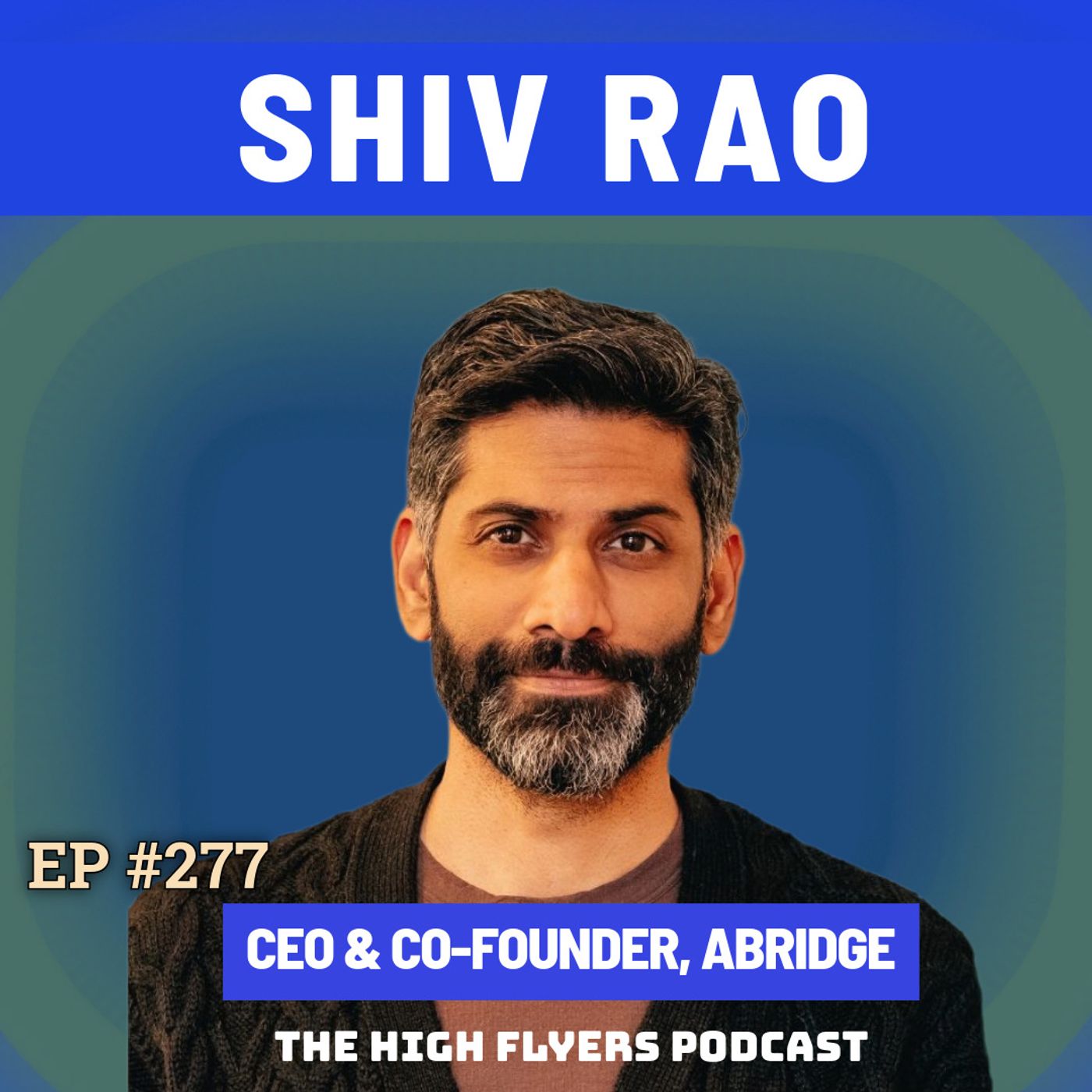
Shiv Rao, co-founder/CEO of Abridge, discusses building an AI healthcare company that helps doctors by turning clinical conversations into computable data, the “languishing” early product-market-fit struggle, and how LLMs shifted Abridge’s trajectory; he also connects his experiences in medicine, VC, and identity/calm under pressure to company culture and execution.
Shiv Rao was born in Pittsburgh; moved to India at age 9 (lived there until ~14–15), learning Telugu and Hindi and facing bullying. He studied history, music, and design; obsessed with skateboarding in late teens; then pivoted into medicine. He trained in internal medicine at University of Michigan, built a residency learning app using Ruby on Rails, later became a cardiologist, and worked at UPMC’s innovation/venture investing environment. He co-founded Abridge and is a clinician-operator.
“Pressure makes diamonds” and calm execution improves outcomes; healthcare conversations are “upstream” data for better care delivery; early Abridge struggled ~3.5–4 years (“desert”) before LLMs made the product viable; sleep is “work” for CEO performance.
bullying in India; building the residency app to cite evidence during rounds; hosting an Anthropic-cohosted clinician hackathon; a University of Kansas Health System pilot producing “love stories” (positive clinician feedback).
Written by AI. May contain mistakes.
Shiv discusses his lifestyle of frequent air travel and its effects.
“I like, I can feel myself age while I'm on these planes.”
Shiv talks about his background and the founding of Abridge.
“And work, tell me what was your first job and what do you do now?”
Shiv shares insights on people in the industry who deserve more recognition.
“And I think, again, the healthcare and intersection of healthcare and tech and investing, which you've done really well, is a fascinating career trajectory.”
Shiv reflects on growing up between cultures in Pittsburgh and India.
“But I want to go back to your sunrise as I call it, your childhood.”
Discussion about how Shiv's family background shaped his identity.
“And what it meant to over time become, befriend them.”
Explore how skateboarding shaped Shiv's identity and path.
“And my musical preferences were probably heavily influenced by that subculture.”
Shiv discusses his transformative year post-college and its impact.
“What did you, like now, how do you reflect on that year off post-college?”
Shiv reflects on the challenges and joys of medical school.
“And I'm sure that all that I got to experience, all those people I got to learn from impact the way I see the world.”
Shiv discusses the evolving relationship between technology and medicine.
“I love the impact that we get to create.”
Shiv recounts his experience creating a healthcare app during residency.
“I tell the story that my dad retired because he couldn't type fast enough.”
Shiv explains the insights gained from his early research and development.
“I'm just trying to find it here is I think during your internal medicine residency at Michigan, the iPhone arrived.”
Shiv shares insights on working under pressure in cardiology.
“And you need to have access to the right dollars to be able to be successful, perhaps.”
Shiv compares the early startup phase to managing chronic conditions.
“And his answer was pressure makes diamonds.”
Shiv Rao discusses his transition from practicing medicine to working in healthcare VC.
“And so you, from there you went to, was it healthcare VC at UPMC.”
Rao shares insights on his learning experience in the venture capital world.
“Tell me about that transition, because on the surface, it looks like quite a big transition to go from being a practicing clinician to being a VC and working in a more of a corporate environment.”
Shiv explains his internal desire to innovate in healthcare despite a successful VC career.
“So it's cool that like we had conviction in something that ended up being such a success.”
Shiv discusses personal experiences that inspired the founding of Abridge.
“Where did that internal desire come from?”
Rao acknowledges the support of his wife and discusses the sacrifices made.
“And I almost feel this is the moment to ask you earlier about like the high flies in your life that maybe don't get the recognition.”
Shiv discusses the pressures of being a founder in the fast-paced AI landscape.
“Both of us making a decision very, very quickly on each other.”
Rao shares strategies for managing time and mental wellness as a CEO.
“Like we talked earlier about flying and both your and my schedules.”
Shiv reflects on the initial challenges of building Abridge and product-market fit.
“And the importance of sleep and prioritizing it, trying to get the best quality of sleep.”
Shiv discusses how advancements in AI changed Abridge's product approach.
“It's not easy to get into health systems.”
Rao talks about the conviction that kept him going during difficult times at Abridge.
“And I think the name of the game, the companies that win will be able to evolve very, very quickly and will be able to redefine themselves and the way they operate.”
Learn about the belief and conviction that fueled persistence in challenging times.
“What gave you confidence to persevere during those years?”
Explore the journey from consumer-grade products to enterprise solutions.
“And then as the whole world started to learn about generative AI and ChatGPT in late 2022 or early 2023, if the sky just opened up, we were just like, this is it.”
Understand the importance of early positive feedback in shaping product direction.
“I think the moment was a pilot with the University of Kansas Health System and starting to see what we later called love stories trickle in.”
Discuss the challenges of long sales cycles in healthcare and how to overcome them.
“Tell me, so in my business that I run behind the podcast, which is, we do a lot of enterprise work.”
Learn about the importance of trust and creativity in healthcare technology.
“that healthcare is probably moving faster than any other industry right now in adopting AI, which is wild to say.”
Examine the challenges of evolving a team from startup to scale-up.
“You know, these notes that we started with, what a lot of the industry didn't understand, and even now a lot of the industry is just coming to understand or haven't actually understood yet, is that these notes are bills.”
Discover the trade-offs and priorities of leading a rapidly growing tech company.
“Team is interesting because, I mean, it's natural that the team is going to change over time, right?”
Learn how to effectively communicate within a large organization during rapid change.
“Just always finding a way to focus on the things that actually matter.”
Learn about the importance of internal communication in a rapidly changing landscape.
“so that they can go help everybody else in the company understand why.”
Discover insights gained from industry leaders and their unique approaches to creativity and leadership.
“Two people that you've talked quite a bit about is Jensen Hong from NVIDIA and Rick Rubin.”
Explore the impact of mentors in the healthcare space and the lessons learned from them.
“Like, I mean, I like asking this question about a metaphorical like learning room.”
Discuss the evolving role of AI in healthcare and the potential transformations on the horizon.
“What are you seeing in terms of the AI evolution as we move forward that maybe the rest of us are missing?”
Hear about personal passions and the balance between work and family life.
“Like that's the world that's increasingly possible.”

Get the gist, explore an idea or ask about something said.
 Claude
On The High Flyers Podcast with Vidit Agarwal, what are the key points of this episode?
Searching your listeningAutomatic transcript. May contain errors.
0:00Hi, I'm Vidit, the founder and host of this podcast, The High Flyers. I'm Shiv Rao, co-founder and CEO of A Bridge. Shiv, I am so excited to do this. I almost feel the first question should be the most common thread that came up in my research for this is people said you live in a plane and you and I was just joking about this. I think you spend your time between three cities. I almost want to ask you, how do you make that work? What's the secret to manage your energy? Yeah, it's a great question. I think I've found a way to fall in love with the solitude that I get to experience in a way when I'm on a plane.
0:30Like it feels somewhat meditative, but I don't have to do the kind of flight travel that you do. It's not international for me. So I'm kind of curious how you think about it. I've just learned to suffer Shiv. Yeah, totally. Yeah. I feel like when I'm on planes now, I can feel what it means. I can feel my telomeres shorten. I like, I can feel myself age while I'm on these planes. Like I'm doing a red eye week and it's kind of brutal, But I should say also, it's just super, super exciting to be on this podcast. So thanks for the invitation. No, my pleasure. And because you're such a busy guy, this is an honor to be actually locked you down.
1:04And I mean, the health one is really interesting because someone said to me something that really worried me. Someone said, you age faster when you fly a lot. So now I'm like really paranoid that my skin and my face is going to age a lot faster. Maybe you've got a trick to that. Totally. I was at some event where I was sitting next to Brian Johnson and we were talking about travel and he taught me a lot about how my DNA is breaking and how I need to ask the pilot to fly at a slightly lower altitude, which obviously I cannot do. So yeah. Maybe one day when you pull the private jet, maybe you can try it.
1:39Yeah, exactly. Hey friends, welcome back or welcome to the High Flyers podcast, where we do reimagine a high flyer, showcase the brightest and most relatable role models and companies and their journey from sunrise to today. As one of the premier products in our Curiosity Center lineup, providing on-demand intelligence to help you be 1 % better every single day. I'm your host, Virita Agarwal, and let's have some fun. Our listeners have called this podcast a meticulously researched biography unveiling the extraordinary lives and decisions of the most remarkable individuals and companies from around the world.
2:21We hope you're enjoying our catalog of 200 plus episodes since we launched in 2020 with many of our guests appearing in rare public interviews. It's now time to explore your curiosity. Please enjoy. Let's set some context with some fun facts. Where are we born and where do you live now? So I was born in Pittsburgh, Pennsylvania. And like you said, I kind of live everywhere right now. I'm in Pittsburgh on the weekends. I'm in San Francisco, usually Monday, Tuesday, Wednesday. That's the goal. And then I'm either in New York at our other big office, or I'm with a customer on Thursday and Friday.
2:54And so your team split fairly evenly between SF and New York? Yeah. I wouldn't say evenly. It's definitely headquarters of San Francisco. I think we have two thirds of people on the builder side, for example, who are there. And a lot of our commercial folks are distributed, but we see San Francisco as our headquarters. Yeah. And I want to chat about that, like the journey from Pittsburgh to SF to NYC. I think that's a fascinating story that doesn't get talked about enough. And work, tell me what was your first job and what do you do now? Yeah. First job was as a research assistant in an orthopedic surgery lab that was probably in middle school.
3:29And yeah, I was like vaguely even remember what that felt like, but it was cool. I feel like I learned a lot. What do I do now? Like now I'm the CEO of a company called Abridge that focuses on AI and healthcare. And super excited to talk about that as well. And Shiv, as you know, the purpose of this show is to reimagine the concept of a high flyer, to go beyond someone's job title and recognize their impact. Is there anyone you know who you feel hasn't got the recognition they deserve? Yeah, so many people. I think of folks who I've learned so much from over the years, folks who in some way I feel like I've grown up with in this industry and who've had a real impact on our journey, on our trajectory.
4:09One comes to mind, his name's Morgan Cheatham. If you know Morgan, he is an investor. He's at Breyer Capital now. He used to be at Bessemer. But Morgan is one of those people, like if you know him, if you've experienced his intellect, his mind, you can't, you know, sort of like forget it. He's so bright and he can connect so many interesting dots. And he's such a deep sort of scientist on one level. He's a geneticist. That's what he's studying right now in a residency program in Boston. And then at the same time, he's like a very distinguished investor. He just manages to do everything. Yeah, I mean, Morgan actually helped me with research for this and he was great.
4:43He gave me some really interesting thoughts. So absolutely fascinating guy. And I think, again, the healthcare and intersection of healthcare and tech and investing, which you've done really well, is a fascinating career trajectory. Back to the episode in a moment. Something I've heard a lot from business owners and leaders is that speed only matters if you still feel confident in the output. And it's particularly an important point in this world of AI. Zero's answer to that is accountable intelligence. AI that shows you what it's doing and works from your own real data and is designed to keep you in control before anything happens.
5:21As Xero puts it, most AI asks you to trust it, accountable intelligence shows you why you can. And that's how it works with JAX, Xero's in-platform AI finance partner. So whether you're running the business, advising the client, or working with your board, JAX ensures that you get the upside of automation without giving up any of the control. If you want to see this practice, head over to xero.com forward slash highflyers for 90 % off your plan for the first six months. Terms apply and go to the website. That's xero.com forward slash highflyers. Now back to the episode. But I want to go back to your sunrise as I call it, your childhood.
6:06I think particularly this is so interesting because But you and I have Indian heritage in common and you actually lived in India, which I find deeply fascinating. But tell me, let's start with Pittsburgh first. Yeah. When you think of the environment you grew up in, what are your memories? Yeah, my memories are living in suburban home, seeing my father work incredibly hard. I moved to India at age nine. I lived in India from around nine to 14, 15-ish. But he was probably in the prime of, he was a cardiologist in the prime of his career, doing a lot in the cath lab, doing procedures in the catheterization lab, treating folks with acute heart attacks.
6:43And I remember how he would just rush out of the hospital to go tend to someone. I just remember like what kind of how I feel like a theme throughout is just not feeling like I necessarily belong in any of the rooms that I'm in. But I have like interesting memories from growing up, just feeling like a little bit of an outsider as well. Just like coming to terms with my own identity as a boy. I'm curious if you've had that too growing up, but just sort of recognizing that you're different. It's interesting. I did as I get older. So I, as you know, grew up in Australia and I always used to joke that was I the Indian in Australia and then the Australian in India, right?
7:18And I'm curious, like when you went to India, did you feel that? Like, did you go, okay, this is an American kid is in India. But then when you came back to the US, you're like, okay, I'm the Indian kid in the US. Yeah, that's exactly right. That's exactly what it was because in growing up until I was like age nine feeling, you know, like the, like I was just figuring out or grappling with like being a little bit different and then going to India and being the American in India and being treated differently because of it. And the first couple of years in India, I just have vivid memories of being bullied on a, on a, on a soccer field, kids like throwing rocks at me because they were, they perceived me to be entitled or rich, like the rich new kid from America.
8:01He thinks he must be better than us. And what it meant to over time become, befriend them. And like, yeah, the cultural transition there was rapid, but there were definitely some hard times. Because could you speak the language when you went to India? No. So I was getting tutored. I'd have to wake up at like six o 'clock in the morning. I'd get tutored in multiple languages. I was learning Telugu and Hindi. And then after school, more tutoring to just make sure that I was like coming up to speed on academics over there. And that was like every single day. So I know that there's a lot of kids who probably live that life here.
8:34My kids don't, but it was like a definitely a big lifestyle shift from what I was used to before. It's so unique. Like you don't hear that often. Like I know, I know a whole bunch of like Indian Americans or Indian Australians or Indian whatever. And you're probably the first person I met who actually went, your parents took you back to India to study and live there. Like, is that something you've talked about with your parents now, now that you've gotten older and Like you've lived in the U.S. for most of your life, right? Since then. Yeah, that's right. I know that their decision had everything to do with their parents and wanting to be me to know them and spend time with them and learn from them and wanting me to get a sense of like the broader family and the family's culture and background.
9:12And I really got that. There's no question about it. And when I asked my dad about it now, I think what he would say is that he was always planning, you know, for it to be a like a limited time and last about five years. but I certainly didn't want to come back at the end of it. It certainly felt like I'd completely habituated. I'd completely fallen in love with cricket, with cinema there, with music and I was learning instruments. Like I was definitely, my identity had shifted, but I was young enough, I think, both going there and coming back that I could reshape myself pretty quickly. That is so interesting.
9:43It's also interesting because I feel in this age of AI, there's so many founder CEOs like you that have immigrant backgrounds more than ever before. Like even some of the guests we've interviewed on this show like even like i was having this chat with jesse from decagon the other day he's got he's got i mean he i don't think lived overseas he's lived in the u.s all his life but i think he's got chinese heritage if i remember correctly and then you've got indian heritage and then i've got indian heritage and then so miyambas like it's it's just an interesting observation i've made around this age of ai and tech around the number of immigrant founders like at the leading edge right yeah yeah no question about it tell me one thing that i heard a lot in my research, which I found really interesting, and people say this about me, is people say I'm very calm and I have like a calming voice, irrespective of what happens.
10:27And people get really irritated with me about this. Like if you ask my friends and family, they'd be like, why doesn't this guy get annoyed? Like, why is this guy the same all the time? And that came up in the research for you. And I'm curious, was that true as a kid as well? Was the younger Shiv also just very calm and always contained? I wouldn't say content, but I think like I can be, or at least project equal poise for sure. I remember as a resident studying internal medicine in my first week of residency or first month of residency, I should say, I was on the code team. Like the code team is the emergency team.
11:01So you're staying sleeping in the hospital overnight and you're going to get paged for a patient who's acutely decompensating and you got to rush the ICU and you've got to tend to the situation. And it's a team sort of sport for sure. Like there is someone who's the like running the code. And then that person is sort of directing everybody else to do the right thing, whether it's place an IV line or start a medication or do a procedure on the spot, you're doing everything you can to save that person's life. And I remember that there were some codes that felt like a zoo, just absolutely chaotic.
11:31And, and it just, I was convinced that this wasn't leading to the best possible outcome, but then there were separately, there were these other codes that were just run like an orchestra where the person who was running it was incredibly calm and very, very sort of decisive in the directions he was giving everybody. And oftentimes those codes would be quiet. It'd be like silent, almost silent, silently run codes where everybody knew their role and things were just moving smoothly. And you'd get to a good often outcome more often than not. And I think like I've always, I think about that experience a lot because it feels like there's a way to run a company like that kind of code because startups are always in extremis.
12:11Like startups are always on under some kind of pressure where you've got to figure out, you've got to like solve a new puzzle, a new problem. You've got to deal with a new escalation, a new urgent issue. And if you can kind of stay calm through it, but move very quickly, like you do when you're saving a person's life, then you'll probably get to a better outcome. How do you deal with like even connecting into present day? I'm sure there's days, probably hours every day where things don't go to plan, right? Things pop up or you've like you're traveling and you're like even i heard in the research like your flight can be delayed but you just stay calm whereas i'm someone i'll get annoyed i'll message my wife or i'll message someone i'll be like oh why did that flag get canceled that's gonna affect my day and it's just human to do that whereas it was apparently you just don't do that like you just take it in your stride and you'll i don't know like just sit there and do something else while the flight's delayed is that like how does you how do you connect that with your team because you there might be people coming into your team today who would go yeah we don't have that demeanor we get frustrated and we're going to express that.
13:06Have you managed to create a culture of calmness in your team as well? I think that there's a culture that we aspire to in the company that is about agency, that is about figuring it out, that is about embracing pressure and not seeking comfort and just figuring it out regardless of what challenge you might have to face on any given day. Much easier said than done. And I'm certainly not the best at this, but it's something that I think in the smaller kind of situations, like the ones that you're mentioning, it feels effortless to be able to find a way to figure those situations out. And there are certainly much harder problems where it can get the best of me, it can get the best of other people.
13:40But aspiring to that, I think, is good. Take me back to when you were 18. So you've just finished high school. If I met you at that age, what would I have assumed you'd do with your life? Yeah, that's an interesting question. You'd meet someone, like I was obsessed with skateboarding at the time. And so I dressed like a skateboarder at the time. I talk like one. And my musical preferences were probably heavily influenced by that subculture. I deluded myself into thinking I could skateboard for a very long time. And I was mostly skipping college classes to skate with friends. Like I was very, very obsessed with it.
14:16It was the biggest part of my identity. And I think you might have met me because of the people I was hanging out with. And you might think that I was either going to be an academic or something in like a creative field, or at least because all of my roommates through college were painters. I met my wife in college. She was studying design. So there's a lot of folks on the sort of art design sort of part of the axis. So you might've assumed that as well. That is so interesting because I did hear that in one of your interviews that in, in at Carnegie Mellon, I think that a lot of the students were either computer science or arts and you connected more with the arts, which I find interesting.
14:51I mean, that makes sense because yeah, design and music seems to be central to who you are today. But then where did the medicine influence come from? Is that again back to dad and watching him be in the field? No, I mean, we were talking about being like our Indian heritage. I think I was subconsciously rebelling against all the Indian doctors in my family and my dad. And I was trying to do anything but and be different, like find a new path that nobody in the family had ever pursued. I remember it was junior year college. There was an architecture professor who was visiting and gave a lecture.
15:22His name is William McDonough, talking about sustainable architecture. and he was also talking about design thinking when I think the D school at Stanford was still pretty young. And he told this story about an ophthalmologist in India who brings patients in on a revolving platform and he does cataract at 12 and then he says spin and he gets spun to the patient who's waiting at three and he does another cataract, takes five minutes, 10 minutes, spin. He does the next cataract and he's just spinning all day long, 12, 3, 6, 9. And by the time I heard this lecture, he had given eyesight to over a million people and his daughter had given eyesight to over 400 ,000 people.
15:55And I remember walking away from that lecture thinking like just blown away by that kind of impact, giving people eyesight. It's pay as you can. And so essentially free these like biblical skills of people that he's impacting. And I remember thinking like being just so excited about it and wanting to be a part of something that could create that kind of impact as well. So that was the start of a pivot. But given that I studied history in undergrad, I was programming virtual synthesizers in the School of Music and School of Fine Arts. A lot of my friends, there were plenty of technical friends, but also plenty of artist friends.
16:28I hadn't taken a lot of those classes, those pre-med classes. So I had to pivot pretty hard and sort of focus myself, skateboard less and find a way to get into medical school, which, you know, I took a long path towards. I took a year off after college, made music, sold records in Japan with a roommate who had a record label while I was also doing pre-med requirements and then applied and then finally got in. Tell me more about that year post-college, because people might be surprised to hear that, where people might assume you've always had a clear path and you've, like we talked earlier about ambition and determination, right?
16:58What did you, like now, how do you reflect on that year off post-college? Like, did that give you something that if you hadn't taken that year off, it might not have? Absolutely. I think we say explore, explore, explore, and then exploit at the right time. We invoke that also in relation to how we approach model training on some level. And I think it's the same thing for humans and their identities. For me, I was incredibly privileged that I had all this space and time to explore and took film critical theory classes, studied continental philosophers, and got into sociology and minored in religious studies as well.
17:34Like I got to explore a lot of stuff, made music. And then once I figured out what the kind of impact or kind of story I really wanted to be a part of, I was able to focus. I was just like so divergent in terms of interest and then finally found a way to focus and converge on something. And I'm sure that all that I got to experience, all those people I got to learn from impact the way I see the world. You know, I'm sure that's a story for all of us. I know, for example, like that all those friends, a couple I still keep in touch with and their paths in their own careers in the arts, like it's impacted me.
18:06It's definitely given me a point of view on how we could create a company that can hit different, that can reflect incredible taste. You mentioned Morgan earlier. He was very gracious with his time for research. And he described you to me as, quote, skateboarding, beat-dropping cardiologist turned world-class AI founder. I'm curious, which part of that description do you identify with most? probably the cardiologist. I don't know that the, those, the other stuff is at this point, a modifier. And what is definitely inside the brackets for me is being a doctor. I remember medical school couldn't stand it.
18:45Felt like I was doing rote memorization, didn't feel creative, didn't feel like that story about the ophthalmologist. And I remember thinking I like, I might not want to do this anymore. Maybe I should drop out and figure something else out again, but stuck through it, got to University of Michigan for residency and just like fell in love very, very quickly. Like once you you're like actually caring for someone and changing the trajectory of their life, of their health, it's such an incredible privilege. And for me, it was very easy sort of to derive purpose. So I'd say that's probably what's inside the brackets more than anything else.
19:18I love the work that I get to do. I love the people I get to work with. I love the impact that we get to create. I love reading AI papers. I love learning from our PhDs and professors. I love geeking out on all the different layers of the company stack. And at the same time, you know, from an identity standpoint, I'm a clinician. And I think that part of my DNA, well, you can't sort of crisper out. And if I understand correctly, you became a full-time clinician in the mid-2000s. Is that right? Or was it late 2000s? Yeah. Yeah. Like mid 2000s, like it's probably been close to 15 years since I was like a full blown attending.
19:54So when you first started, this is really interesting because my, I think I said this to you last time, my, my wife is a doctor, she's a pediatrician and I've got like a front row seat into the medical world just through her. And most people in medicine aren't very tech forward. I think it's changing now with AI. Like I think it's fascinating. Like there's a lot more AI adoption and companies like yours are helping that. But for the longest time, it was almost anti-tech. Like tech was viewed as a threat, one could almost say. I'm curious, when you got into that medical world, what was your relationship with tech early on?
20:27Well, I think historically, tech is, for some clinicians, tech has been overhead. I tell the story that my dad retired because he couldn't type fast enough. Like technology became something that made him feel like he was outmoded, like he could no longer practice. It was too much for him. And I think that we're at a moment now where clinicians recognize that they have more agency in this platform shift moment to make sure that the technology that is developed is for them, that it's been developed with them. And that's a big part of the ethos of our company at Abridge. We recently, we had a hackathon that we hosted, co-hosted with Anthropic, and it was unbelievable the amount of clinicians who applied to be a part of it.
21:10There was a prior winner of an Anthropic Cloud Code competition who was a cardiologist from Belgium and we hired him. He moved his family from Belgium to San Francisco and he's a really important person in the company doing a lot of awesome R &D. And it's just so exciting. I think people like him, people like all those folks who are at that Anthropic Hackathon that we did, there's just so much energy right now amongst clinicians at every stage of their career to be a part of it. Tell me about one of the stories I came across in my research. I'm just trying to find it here is I think during your internal medicine residency at Michigan, the iPhone arrived.
21:48And is this a true story that you taught yourself how to like build a healthcare like app? Yeah. It was pivotal to like understanding. Tell me about that. Yeah. I just taught myself Ruby on Rails and built something that could help the residency program, other residents and fellows basically keep track of what they were learning on the floors. So the way residency works or worked for me at Michigan was that you're basically on your own at night. You're treating incredibly sick patients who are coming to this tertiary care center from other hospitals because they found them to be too complicated.
22:18But you're also, you're a trainee. You don't have years of experience under your belt and you're alone at night and you've got to find a way to figure it out and work through it. And part of figuring it out is looking things up, is doing the research and figuring out if there are guidelines, is there data that can support whatever diagnostic or therapeutic decision that you want to make or differential diagnosis that you want to explore. And when you're looking things up, you're reading papers and on rounds the next morning, when your attending shows up, your superior, the consultant shows up and rounds with you, they're going to quiz you.
22:55They're going to ask you like, okay, why'd you do this drug instead of the other drug? And you need to be able to cite that evidence. You need to be able to pull that article out and say, it's because of this. And this is how I interpreted the data. And it's like, this P value was statistically significant. And I was impressed by the methodology, whatever it is, like the deeper that you can go that way, the more credibility that you could create and this more confident you would feel. And so all those papers would just get like recycled the next day. And thinking was, well, what if everyone could just store them and we could like distill out all the insights that humans at the time, obviously I can do all of this very easily now, that humans were sort of pulling out and all the color related to their patients.
23:32What if we could capture all that stuff and create a network? And this is before the software eats the world refrains probably, or just around that time. And I was just like very excited by this idea of like, could we create this network of trainees across the country that could share information. I think it was pre-companies like Doximity though. So, you know, it was probably right around that time when software eats the world. And it was awesome. Like it took off. I learned a lot in that exercise and I experienced some peasant level of product market fit because the program director said like they should pay for it.
24:02They would buy it from me. So that was like a really eyeopening moment that there's a certain kind of research that you can do as a clinician where it's basic science, 13 years, bench to bedside. There's so much overhead. There's another type of research where maybe you don't need to have as much patience, but you do need to be working with the right people on the right idea. And you need to have access to the right dollars to be able to be successful, perhaps. But this type of research just felt very, it just felt like even playing field. And it felt like where the puck was going. And it felt like for someone like me with a very low attention span, like where I could thrive.
24:37Low attention span. I resonate with that. I think particularly in today's world, distractions are paramount. But that is interesting because as a cardiologist, I'm assuming I have no knowledge of cardiology beyond what I see in the movies, but I would assume it requires a high attention span. So tell me, how did that compute? Yeah, yes and no. So it's not like, say, there's some specialties that I associate with really smart people who can take time, who are very, very thorough and deep and are incredible analysts. And I think about infectious disease or neurology. When I think about cardiology, I think about people who as much want to be procedural, want to be in the operating room, want to fix things, and want to be in high-acuity situations like heart attack scenarios, for example.
25:23And as much as they do want to also be in clinic, they want to build relationships. They want to see those patients after they've helped them in the operating room. They want to sort of manage their medications over time. There's just so many flavors of cardiology. And as a general cardiologist, you get a little bit of everything. I don't practice as much anymore. I just see patients about one weekend a month. But even when I'm in the hospital those weekends, it's just like, it's such a thrill. It's such a privilege. Like these are really high stress scenarios. oftentimes you're seeing patients in the ICU and you're making really consequential decisions with them for them.
25:55It's the pressure is awesome. Remember there was a surgeon from UPMC, Starzl, who is known for incredible innovations around transplants. And there are any number of mythologies around Starzl, but there's one story about how he would pretty much like torture his trainees, his fellows, his cardiothoracic surgery fellows or whatever, sorry, the transplant and surgery fellows. And someone asked him one day, like, why do you put them through so much hell? Like, why do you push them so hard? And his answer was pressure makes diamonds. And it's kind of funny. I remember hearing that story from maybe like a program director at UPMC, but it's like etched in my brain.
26:34And we say it a lot in the company now that pressure makes diamonds and like pressure is a privilege. Like you embrace it and you try to react as like quickly and decisively as you can. Cardiology is a lot of that. On your comment about ICU patients, that was something I found fascinating. I think you've mentioned before that sometimes early stage startups are like ICU patients. Yeah, totally. You're doing CPR. Yeah. Every day. I'm curious now, it's like, again, we're crisscrossing here and we will talk about a bridge in a second, but is that metaphor still true at a bridge's scale today? Or would you almost say the company has moved from ICU to like chronic disease management?
27:13Yeah, that's probably true. It's probably more chronic disease now. We're not intubated in the ICU. We're not doing CPR every day in the same way that we were before. And I kind of feel bad, guilty saying that though, because I think when you feel that much urgency and you feel that much pressure, you probably are going to create prototypes that much faster. You're going to probably like build, measure, learn, go through those cycles even more quickly. So on some level, there's the challenges are the challenges. The shape of challenges are pretty consistent. It's just in some ways, the pressure is even greater than ever before because the stakes are higher.
27:48There's so much more than we've been able to accomplish. And so loss aversion is something that we will be mindful of and not take over. But yeah, it's definitely a different game than it feels like it was in the early days. And so you, from there you went to, was it healthcare VC at UPMC. Is that right? Yeah, I was at the right place, right time. When I finished cardiology fellowship, UPMC was investing pretty heavily into an innovation center that over time evolved into a corporate venture lab. It started off with this concept of building products that could solve internal problems that we could then commercialize externally into other healthcare systems.
28:28It sort of evolved to this concept of let's invest in companies wherever they might be and also build. And so we got to do both. It was perfect for me because I got to learn from all of this incredible builder DNA. We had about 200 software engineers at the time. We had product managers, we had designers. I was coming in super cold to this world and I got to learn osmotically from all of them. And then I got to go to board meetings and learn from venture capitalists. We were investors, we were LPs, like in any number of really amazing VC firms and got to learn osmotically from them as well and from founders that we had invested in.
29:04And maybe the most consequential part of the job is like we got to put a lot of capital into Carnegie Mellon University. We started a machine learning and health program and got to fund professors there. And that certainly had a huge impact. One of the professors, Zach Lipton, was our CTO for a while. I'm certain that made a huge difference on how we approach problems, you know, different times of the company's sort of journey. Tell me about that transition, because on the surface, it looks like quite a big transition to go from being a practicing clinician to being a VC and working in a more of a corporate environment.
29:35Now when you reflect on that change, how was that? Yeah, I think it was, I started off 50-50. So I was seeing patients in clinic or in the hospital 50 % of the time and doing that work the other 50. That felt, I think, pretty split-brained, but I think I found a way to integrate both of those, a lot of that work together so that it felt harmonious, but the adjustment, like I, you just love being in scenarios where you have everything to learn and like being thrust into an environment with finance folks and analysts and product people and engineers just was for me, it's just like so exciting to be able to learn.
30:13And I think probably I was like the token doctor on a team at first. And then over the course of years, got to lead strategy and then got to lead a lot of the provider facing work, the doctor facing work that we were doing, the investments in the products that we're building. But it was just yeah it was an awesome experience any investments you made from that time that you can talk to or even companies that perhaps you missed that time that eventually led you to a bridge oh that's a good good question the one that we missed that i wanted to invest in pretty badly was path ai i remember when they were doing their seed round we had just started and i was really ucrassed by andy like founder and just wanted to be a part of that story and he's done an awesome job over these last year's and I wanted to be able to learn from him and just like witness it.
30:56So it's cool that like we had conviction in something that ended up being such a success. The thing that we did invest in that I'm super proud of is just like building that infrastructure for funded research, you know, in the university that was just like deeper in the stack. And those years, like the 2010s, when deep learning was really starting to take off, obviously pales in comparison to the moment that we're in right now with AI. It was a very exciting moment to fund that research and to learn from professors, PhDs, postdocs too. So it sounds like you had the dream job, like you're practicing medicine, you're working on technology, you're getting paid to invest in health tech, but you still felt that wasn't enough.
31:32Like you clearly started a bridge and it's done really well. Where did that internal desire come from? Yeah, I remember just feeling incredibly restless once I fell in love with this idea that really underpins everything that we've been building out of bridge. We had been doing some research at UPMC with Microsoft Research, with MSR, and it was all around use cases for AI and healthcare. And, you know, we were circling any number of ideas, including this idea around helping doctors, but it always felt like there was a bigger way to think about this, that there was a, you know, when you invoked real first principles on care delivery, you realize that this signal, those conversations between professionals and patients are upstream of so many workflows, so many systems of record, so many outcomes that we're trying to improve, whether it's on the cost side, experiences, whether it's clinical outcomes.
32:20And once I sort of figured that out, it was just so it was impossible to unsee. And then everything that you've seen or experienced, everything is like filtered through that lens. And it could be professional experiences around hating clerical work and just being the worst at writing notes and getting slapped on the wrist by all of my administrators that I'm like late on clerical work. But it also could be personal experiences, like the story about my dad retiring or the patient side of the story and experiences that my wife and I went through. For us, my wife did IVF with PGD for multiple years, trying to select a healthy embryo that didn't have a specific genetic mutation.
32:59And we traveled the country. And after every single one of the conversations we would have with a counselor, with a geneticist, with a clinician, we'd always look at each other like, what do they say? What are we supposed to do? What just happened? And, you know, I'm a cardiologist, yet things would go in one ear out the other because when you're in one of those moments, it's just so hard to be fully present, to not be nervous, to not be afraid. And this sort of idea of being able to thread the needle through the people who matter most, obviously patients first and foremost, but also the clinicians, the care team around them just felt so exciting and felt like a way to refactor what care delivery, what healthcare is from a technology standpoint.
33:35That is so interesting. And I almost feel this is the moment to ask you earlier about like the high flies in your life that maybe don't get the recognition. You've mentioned your wife quite a bit and she came up in my research quite a bit as well. Do you want to just talk to her for a minute? You said earlier you met her in college. Is that right? Yeah. Yeah. Yeah. I met Dahlia in college. I was a junior. She was a freshman and we probably bonded over really similar interests, whether it was like in indie rock or design and art and hanging out with a lot of the same people. Yeah, we became really close friends and we've been together now for like, you know, well over 20 years.
34:12So it's been awesome. We talk about good investments. Oh my God. Yeah. Yeah. We definitely like, we're very decisive. That's for sure. Both of us making a decision very, very quickly on each other. And then in terms of like what she represents, like nothing, none of this would be possible, honestly, at this point. all that I've been able to accomplish really like she's been like the backbone for our family like the CEO of the house and she's in so many ways and as much as it pains me to say like she's single parenting I'm here on the weekends I get to just sort of like dive in and be the dad that takes everybody to to dinner and ice cream but like she's doing the hard work over the course of the weeks and like helping the kids with the school and there's sacrifice and there's certainly some sacrifice on my side but there's so much sacrifice on her side too but we've done the math and we feel like it makes sense and that we can manage it.
35:07And then in the scheme of things, we won't regret it. And that this is like an absolutely once in a lifetime opportunity with the bridge that we should take advantage of to do good. Yeah. I feel this is a topic that doesn't get talked about enough, right? It's just the founder sacrifice and the debt column that is continuing to build as you scale the company. And I think the common thing I'm hearing a lot at the moment with AI is previously people would switch off, right? Like over the summer or like we're going into the Labor Day weekend, you have some time off, but now with AI, like it's moving every minute and every hour.
35:40I'm curious, how are you managing that? Like we talked earlier about flying and both your and my schedules. How are you managing your time now as CEO? Because the most common thing I'm probably hearing from CEOs and your peers is just finding time to get away from the noise. Yeah. It's hard. You mentioned that you were speaking to the Decagon founder, Like the, I'm in these WhatsApp groups with some AI CEOs and I think we're all experiencing the same thing, which is incredible excitement and energy. And also feeling like we're in the middle of this cyclone, like this, you know, it's just absolutely insane.
36:15This moment right now where every minute literally matters. And it's so hard to convey to other people, especially people who are outside of whatever radius we're in as an AI company, but so much is possible. and you can bend the trajectory for what you end up accomplishing by just recognizing that every minute matters right now. And that level of agency and urgency, it's not for everyone. You know, some folks I think are discouraged by the amount of pressure that you could perceive. And then other folks see it as opportunity. They see it as a privilege and they see it as like a once in a lifetime sort of moment, this platform shift moment.
36:54And they want to be a part of it and learn as much as they possibly can. So it's definitely a moment that's not for everyone out there, but for the folks who are in it, it's just absolutely incredible. If you go tactical on that question, Shiv, are there any things you're doing to, like our biggest asset is our mind, right? Our mind and our intellect and our time and energy. How do you do that? Like if I even ask you about like your routines and habits during a week, are you very disciplined when it comes to emails and meetings and just tell me, are there any tactical things you do to ensure that your team's accessible to you, but then you're also getting the best out of yourself.
37:30Yeah, my RCTO, San, told me recently something that I think we all tell ourselves, but it really landed on me in the moment, which is like sleep is work. And the importance of sleep and prioritizing it, trying to get the best quality of sleep. It's so hard when you're living on airplanes, number one, or in hotel rooms, or you're away from home. And so it's a little bit work in progress, but at least being in bed at a certain time and optimizing for a certain amount of time. You know, in bed, horizontal is something that I've tried to become a lot better at. It's, there's tension in it because I take pride in feeling like I can outwork anyone, that I can grind harder than anyone out there, that I can go the extra mile.
38:11I can do the, you know, I can go with less sleep or food or whatever it happens to be to figure it out, to like get an edge. But that's obviously not the right way to think. and especially when you're playing a long game as we are. So it's, I don't know that I'm the best person to honestly like think through this. There's like one thing I try to do is at night, I do try to take like 30 minutes to unwind a bit and listen to music or just talk with my wife and just try to unplug for at least 30 minutes just before I go to bed. But then yeah, you wake up again and you just want to run as fast as you can, especially right now.
38:45I mean, yeah, I mean, that would be really interesting because I'm sure there's a point where you might do something else knowing the personality you've got. So that'd be really interesting and I'm going to watch very closely. Let's go into the transition into a bridge. And I think what's particularly interesting here, Shiv, is the early years. I think in one of the interviews, you called it a five-year desert. I think some of the people I spoke to for research for this described you as a languishing founder trying to get product market fit. Yeah. And I think people can say this now because you've clearly got enough success that we can laugh about it.
39:21I guess, is that comment, languishing founder with limited product market fit, a fair comment in the early days? I think it is a fair comment. We were certainly doing everything we could to figure out a business model. We knew the thesis for the company, but actually I think it's like certainly a fair comment. We started with this thesis, healthcare is about people, their conversations are computable. But to jump right into helping doctors, that's a tall task because the threshold for good enough is high. The bar is really high. It's not easy to get into health systems. It's not easy to integrate.
39:56It's not easy to pull all this data out of systems of record or push data back in. And it was clear that we'd need to accomplish a lot of that stuff to build something that could work. And that's putting aside models being good enough to like actually have that core sort of unit of a product, you know, nailed down on the clinical note side of things, the doctor's note. So how to figure it out. So we went first with a consumer app, the other side of the room, the other side of the slide in our Series C deck. And the idea was consumers, let them give them the agency to actually record their clinicians and then help them better understand and follow through after those visits.
40:32And could you be an extension of every clinician's best intention? Could you nudge that patient in a week or in two weeks with all their next steps? Could you make life easier for them? The idea is a great one. And in many ways, we're still going after it. Although now it's not consumers. it's patients because we are you know for us it's all about enterprise it's all about going to those large systems because the unlock was really in 2022 2023 where llms really changed the product entirely where we very quickly saw that we were more we were past the threshold for good enough but prior to that we'd slogged you know we were we were using pre-trained models that predated llms and BERTs and BioBERTs and longformers and T5s.
41:14And we published a paper around how this could all work. And we were paying experts millions of dollars to give us annotated datasets to be able to build something that could work pre-LLM. And then post-LLM, it's been fascinating. It's like, we've gone from that moment with generative AI to this new moment of agent native, agent first product, but also agent first company. And it's like, it's never going to end. I think like the primitives will continue to evolve very, very quickly. And I think the name of the game, the companies that win will be able to evolve very, very quickly and will be able to redefine themselves and the way they operate.
41:46The early years, as you described it, the desert, I think was your wording. Five years, if I got the number right, is a long time. Like a lot of people might go, this is just not worth it. And either pivot or you came from a good job in medicine and you had a good career there, you could have gone back. What gave you confidence to persevere during those years? Yeah. Yeah. It was more maybe a three and a half, four, perhaps if we're like generous. I think just a belief that we would find a way that there was a there, there that the thesis was sound. So much conviction in the thesis. I remember seeing any number of other companies really start to pop while we were building against this thesis and being at times tempted to pivot the entire thing.
42:30But the thesis always felt like the only thing, like so obsessed with this idea. It's an idea you can do so much underneath. Like there's a lot that you can build underneath, but there's a lot of flexibility and there's a lot of room to innovate on the go-to-market and the business model. But like that core thesis, that conversations are an untapped data set that you can do a lot of good with. We just felt like the entire reason to be a founder of this. And so it was so hard. And for us, we got really lucky where things, the stars aligned. And when they started to align, when we started to see them align in 2022, mid 2022, we knew it was this was the moment.
43:05And then as the whole world started to learn about generative AI and ChatGPT in late 2022 or early 2023, if the sky just opened up, we were just like, this is it. Like we have to go as fast as we can. And maybe because our backs were against the wall, we YOLO'd it in a way that perhaps other companies, you know, would not have. Let's go into that because I think that is, I feel if there's one undiscovered or maybe not undiscovered, but under conversed part of the abridged journeys that transition from consumer grade to enterprise grade and actually succeeding at enterprise grade. And you just said the YOLO move.
43:39So 2022, I think you made a decision. You want to compete with the likes of Microsoft and Nuance and then some of the other companies. In hindsight, it sounds like a perfect story. You tried consumer, you learned about the business, you learned about your product, you learned about the consumer. And then you took that learning and went into enterprise and look where you are today. What a magical story. But in the moment, I assume it probably wasn't as simple as that. Can you share a moment when you started going after enterprise in 22, when it actually worked? What was the moment you realized this can work?
44:10I think the moment was a pilot with the University of Kansas Health System and starting to see what we later called love stories trickle in. We have this channel in Slack called love stories, where we just try to funnel all the positive feedback that we're getting from users every day. Like even this morning, I got a text message from a CMIO at a health system saying that he was in a physician executive meeting and a urologist said that a bridge had changed their life completely. And he was like, here's just heard this quote, feel free to use it as you see fit. And I immediately put a screenshot of it in our love stories channel.
44:43And it gives all of us just so much energy, so much optimism, so much purpose, like so much reason for why we're here. We're doing what we're doing. And we're not at some lab. We're not at another vertical AI company. We're at this company in this moment because of this impact that we're creating. So getting that feedback early on as fast as we did was just such an eye opener that like, this is the kind of feedback that we could scale. We didn't really know what enterprise grade meant in early 2023. We didn't know what we would have to do from a compliance perspective, a security perspective, how we'd need to build all kinds of infrastructure for evaluations, to build trust, how we'd need to think about transparency and publish papers, how we'd need to build a product that could serve all the different doctors and all the specialties, that spoken languages were an important thing, that enterprise grade meant integrating with all kinds of different systems of record, but most importantly, the electronic medical record and how difficult that could be as well to pull data, but also push data, how difficult it could be to scale this across the country, how you've seen one health system, you might've seen just one health system.
45:49They're all kind of snowflakes in their own way. They all need partner success teams who can really keep track of how the metrics are moving and help arm the executives in those health systems with all the data that they need also to do their job. We had no idea about any of that, but when we got those early love stories, you know, it gave us all the energy in the world to go figure it out. Tell me, so in my business that I run behind the podcast, which is, we do a lot of enterprise work. We work with government, we work with healthcare institutions, and you work with banks and things around the world.
46:17One of my observations in healthcare has been that it just takes time. Like someone not from the industry. I mean, some of these procurement cycles can take nine months, right? And this is true, not just in the US, it's true around the world, if my knowledge is correct. How did you get fast feedback then and even now maybe that told you, okay, this customer and enterprise customer is worth pursuing and there's something here that we should spend the time and energy on, but we may not have a contract for nine months. Yeah. Well, the good news is though, for us, it was a little bit shorter than that.
46:51But I think when we were getting that incredible feedback for end users, we just figured we'd find a way to land these planes. The sales cycles can be long. There's a lot of complexity in who you're serving as well. There's a lot of needles to thread. You need to serve all the different end users. Also need to serve all the different executives. And it's chief medical information officers or chief medical officers, but also chief information officers, it's chief financial officers, finance officers, like it's all those different folks that you need to be able to kind of thread the needle through maybe even, you know, the executive officer.
47:22So the, there's so much complexity in all of this, but that's part of the puzzle. That's part of the challenge. That's part of frankly, like part of the defensibility, part of the reason, just part of the reason why this is like such a durable space, these regulated industries where it's so difficult to earn trust, where once you're in, you have a little bit of space and time to lend and expand and be more creative and build and ship new products. Over these last few quarters, for example, we've shipped a new product that can help clinicians make better decisions with all the context that lives in these systems of record that we integrate with.
47:56And it's like it's hockey stick almost overnight. And we were able to turn that feature on within weeks, you know, across any number of different health systems. And that's thanks to the dues that we paid, you know, thanks to all the trust that we were able to build in those longer sales cycles up front. So ends up paying off, especially in this moment with AI. I think it's just, it's awesome for us. A lot of investors, I think, who passed on a bridge early on because they were afraid of those sales cycles or healthcare are the same ones who recognize that healthcare is probably moving faster than any other industry right now in adopting AI, which is wild to say.
48:30Like we can go live with a new, that we could go live with a new product in a matter of weeks, like it's just like wild. It's a completely new moment. Totally. I mean, I've never seen so much, the amount of enterprise adoption across industries that's happening at the moment. And it's proven through Abridge and Harvey and Dekagon and Lagora and all of you guys that are just killing it and competing in some ways as well is unheard of, right? And I'm curious, like I just interviewed Keith Rabway from Coastline. I mean, Coastline is a big investor in your company. And one of the things he and I were riffing on is how do VCs today diligence for corporate curiosity where corporates are curious, corporates or health institutions, enterprises are curious and they might trial a product, but then will they actually roll it out for a long period or will they decide to build their own product internally and use some of your models?
49:20Again, I think it's a flawed question. Like no one knows the answer, so I'm not expecting you to predict it, but I'm just curious, how do you, like, is that a risk you have to mitigate as a bridge continues to grow? I think that there are any number of tasks that you, if you can ring the bell on those tasks, if you can do a good enough job on those tasks relatively quickly with an off-the-shelf model, you know, then you should. And there are health systems providers, there are insurance companies, there's life sciences companies that will invest heavily into their own internal AI-centered R &D.
49:52And the low-hanging fruit is there for them to pick off. That said, I think what companies have to do, What startups have to do is be very, very deliberate, going after and focusing on use cases where you'll never be good enough. You'll never be perfect, but it's worth it to be less than perfect every single day, every single week. Those are the opportunities probably where the stakes are high. And if you can find high frequency, high stakes use cases, and the stakes might be financial. Those are the ones that probably we'll all focus on first, but they also might be medical. They also might be clinical.
50:23If you can find a way to focus and figure out how to go deep there, then you can build a really durable value proposition. So that's been the playbook for us. You know, these notes that we started with, what a lot of the industry didn't understand, and even now a lot of the industry is just coming to understand or haven't actually understood yet, is that these notes are bills. Just one example, like these notes have real financial ramifications on what happens next. The thing with healthcare, though, is you were talking about that like nine month sales cycle. Everything is kind of slow. You get paid slow.
50:52You get denials slow. You get prior authorization slow. So when everything moves slow, when you also on the clinical side, it takes time to see if that decision you made with the medication was the right one or not. But everything takes time. The feedback loops are long. It gets challenging to make the ROI case. And you have to find a way. That's where companies have to get creative to be able to backtest, to be able to demonstrate with evaluations, be able to get into head-to-head pilots measuring the right things to demonstrate that like, hey, you've got real hard outcomes on the line here. If you don't go with us, you will lose money.
51:27You will compromise quality measures. You could even deliver bad, poor, suboptimal care. And when you can kind of reframe it that way, then I think that curiosity gap, at least for the right challenges, for the challenges that are going to require millions and millions of dollars of investment over time and a lot of R &D, it goes away. Totally. And I think, I mean, you could almost say that could be a competitive advantage, right? Where once you get through that process, the likelihood of you getting churned out is probably low because you've gone through the diligence and the enterprise has secured you.
51:58Yeah. As long as you're demonstrating that value. And a part of it is actually treating your partners as partners, like sharing with them. Like we just recently built a dashboard with all of our, you know, essentially like live real-time evaluation metrics. And that exposes to all of our customers, all of our partners, what we think is important. If we've built some new feature that is extracting medical diagnoses from the encounter. What do we think is important? How are we measuring ourselves? What are these like, whether it's an F1 score on the speech recognition side, whether it's like a medical term recall metric or word error rate, like how are we doing on diarization?
52:34How do we measure that? What about like summarization? What are the right metrics for this specific challenge? How we evaluate ourselves demonstrates our values and those values they should be aware of. And, you know, when there's resonance, it's like really magical because we're all kind of seeing what is differentiated here. And it's not a case of us having to have our backs against the wall, you know, trying to prove that it's more than just vibes, that this is actually like a superior product and solution for them. I want to spend some time on team and also talk about your journey going from founder to CEO, because as you know, that is a very different role.
53:08Founder and CEO is a different role. Team is interesting because, I mean, it's natural that the team is going to change over time, right? I think it's public acknowledge that some of your early team have moved on and the team today is a team ready to manage a scale up, which is very natural. I think in all my time in startups, like if that doesn't happen, then almost something's wrong because why has the team not evolved? So that is what it is. But I'm curious, how have you, I guess, how have you learned to separate loyalty from like scaling the team? Because early on, I think a lot of the people you hired were like you said earlier, were friends and people you went to college with or people you knew from medicine as well.
53:43Whereas now you've maybe got to hire more subject matter experts and you've got to spend more time interviewing them and people want the fancy titles and they want the big salaries, right? Yeah. It's a tricky question. I guess, how have you learned to separate loyalty from like responsibility? And then what have you learned about successful hiring? Yeah. I think that on the loyalty side, the most important thing is to just be loyal to the mission and, you know, everything, everyone I've ever worked with, even on the highest leadership levels are ultimately loyal to the mission and want to see us win because they want to see us save time, save money, save lives.
54:18That's our mantra outside the company. And so I think that sometimes can be easier said than done, but it's just so important to always come back to that. In terms of this new moment that we're in, oftentimes in specific for specific seats, we're trying to find the right person who's got the right priors, but also can operate from first principals who can sort of transpose from their previous experiences into this new world, into this new challenge and be really effective for us. And that's to me anymore, like executive hires are one way doors and you got to be really, really deliberate. And I spent a lot of my days, it feels like doing interviews and trying to figure out mutual fit with people, but it's a critical thing.
54:56But like, we're definitely at the moment where it's, there are a lot more folks who've got playbooks, who, who, who know, who have paths in mind, who have patterns they can match than we did before. On team size, I think you're, are you now over 500 people? Yeah. Approximately? Yeah. That is a big company you're running and you're running that from a plane. I mean, the president jokes about that the Air Force One can run the country. Maybe, maybe you'll get something like that one day, but how do you manage like being a CEO of a scale up at that stage? Tell me a bit about what has that journey been like to go from being a founder of an idea that you thought might work to being one of the breakout tech companies today that everyone wants time with and you're getting a lot of demand, both from investors and customers and talent.
55:42Like what are the trade-offs when it comes to being a CEO of a company at this scale? Ruthless prioritization is an ongoing challenge. Just always finding a way to focus on the things that actually matter. Finding a way to not just focus yourself on those things, but also focus the company on those things and making sure that everybody on the leadership team understands the why so that they can go help everybody else in the company understand why. In a moment where the ground is shifting as fast as it is right now, it's the ability to share context is so much more important than it ever was before.
56:16Internal comms wasn't a thing that was top of mind for me like a couple of years ago, but now it feels like a really, really important function inside the company that I need to be at the center of and that we need to build up. It's a muscle that is really, really crucial right now in a large company, 500 people, but most importantly, because of the moment that we're in. This is an example. Just in the last couple of weeks, there were announcements from OpenAI that they were doing something in healthcare. They were turning on a certain integration for enterprise chat GPT. And it's important to share context with everybody in the company on what that actually means.
56:51Like, what are the implications? just yesterday or a couple of days ago, Astra came out and there were some benchmarks in relation to what it could do for healthcare. And it's important for all of us to be riding the frontier and figuring it out and building a stack that can absorb the best of all worlds. Even if we do spend a lot of time building our own in-house models, you know, we're very much open weight pilled. And so I think that being able to all stay aligned, all kind of share context right now is so important because like everything, like the board shifts so often. Two people that you've talked quite a bit about is Jensen Hong from NVIDIA and Rick Rubin.
57:33I think you had interviewed Rick Rubin at one of your company offsites. I'm curious, what is one thing you've learned from Jensen and what is one thing you've learned from Rick? Yeah. Well, first of all, like they're both like very fascinating figures. Jensen is a mythological figure. You just want to like learn as much as you possibly can from because he just oozes wisdom and he's so inspiring and what he's been able to accomplish and the journey, how he's been able to navigate is just wildly inspiring. Rick Rubin is not in the same category for me, but I don't know him as well. I think where Rick Rubin, he's not a CEO company.
58:10He's not someone I'm learning from or reading a lot from, but I think where Rick Rubin like spikes for me is just the way he approached music production, the way he's been able to work with a lot of artists I enjoy and a lot of artists that I don't listen to, but he's been able to pattern match across them and pull their best out. There's something inspiring about how he approaches his craft and how he approaches creativity. I think that book when it came out, I certainly got a lot of excitement, you know, and inspiration from. But I don't want to make it seem as if like I'm texting Rick Rubin every day.
58:42We had him at a conference. It was like a grail sort of quest for me, side quest to get Rick Rubin to just sit down with me for a fireside at one of our customer conferences. And I partly I just thought it would be like the weirdest image in the best way of a room full of healthcare executives and like listening intently to Rick Rubin. And we all know what Rick Rubin looks like and what he sounds like, what he represents, the kind of stuff he likes to talk about. And he's like in front of these executives and he's waxing poetic about creativity and how they're all creatives, all these folks wearing suits in the audience, like you're all creatives, you're all artists and you're, you're all designing, you know, healthcare right now.
59:24And you can leave it more beautiful than you found it. And it's just like such a cool image. So, um, that was a side quest that we were able to accomplish, but, um, I don't know that there's necessarily a thread between the two. And there's not, which is why I asked you, because they're two very different people to your point. Is there anyone else you've learned? Like, I mean, I like asking this question about a metaphorical like learning room. I want to ask you to like go into your memory bank, but I'll ask you like, is there another person that you've learned a lot from? It could be someone within a bridge or outside.
59:59Yeah. There's so many people from my medical career, my, you know, my, my clinical training that I've learned so much from. So there's one, there's a couple of people in cardiology. They're, they're both at Emory. One's named June Lee, the other's Oscar Maraquin, but they were both mentors for me, um, in many ways. And June Lee, especially like incredible leader. He's the CEO of a large health system, Emory in Atlanta, Georgia. And he is just so strategic and he plays very long games.
1:00:32Like But he's so strategic and he has a really strong sense of what he's working backwards from. And he can get everybody on the team in the department on the same page very quickly. And he can earn trust so quickly with his team. So, so inspiring. I was so lucky to be recruited by him into the cardiology department to be able to work from him and learn from him. But I've been really privileged over the years to have mentors in every kind of part of the journey. people who are willing to take a call from me and just listen and give me advice. We're coming towards the end. I want to move to rapid-fire sprint.
1:01:05But before I do, I think one question that you're probably thinking about is what are none of us pricing into our decision-making on AI? And we're sitting in September, 2026, as we record this, if you had to play out the next six months, and maybe you do this when you sit down with your product team and your engineering team? What are you seeing in terms of the AI evolution as we move forward that maybe the rest of us are missing? I think that multimodal is, for example, we recently acquired a company in the computer use space. And these founders are all so exciting, so inspiring. They're building very, very quickly.
1:01:44And that technology is somewhere today. I think that technology is going to be in a completely different place in six months. I think a lot of us have been playing with these personal consumer agents like instinct or or playing with grok bot or um or maybe we were put we've been playing with open claw or or building stuff with hermes but like that frame is to me is very obvious it's going to explode and it's going to explode in the consumer domains but it's it's going to absolutely also start to take shape in enterprise and there are going to be more barriers to figuring out what that can look like and feel like in enterprise but it's coming and it's going to come fast and goes without saying that's a big part of what we've even already announced and showcased.
1:02:25We recently had a keynote in New York City in June. And the concept that we wanted to leave behind with everybody in the audience is like imagine a world where every single doctor or nurse has a team of assistants that can kind of work for them 24-7, helping them get all the jobs done that they need to get done and helping them deliver the best experience, the best outcome, helping really more evenly distribute the best possible outcomes across the country. Like that's the world that's increasingly possible. And it's going to take these new sort of technology primitives to really deliver it in the most magical way.
1:02:58Let's move to rapid fire fun sprint to wrap this up. Is there one non-work investment, ideally of time and energy? Is there a course or a holiday or a hobby that you have really enjoyed doing? The lame answer is probably like me with my twin 10 year olds doing like cloud code on the weekends. And that's an awesome ritual these days. That's like, that's so cool just to sort of see how their brains are wired and how they see these technologies differently. They play with them differently. They think about them differently. Creating a new sort of ritual with my daughter where we go record shopping every weekend.
1:03:33That's like an investment of time that I think is invaluable. Someone told me that I should try, especially at this age, you know, she's 15 years old, try to always do something every week with her because before I know I shall be in college. And so that's like what it's turning into, like us going to a record store, buying vinyl. She's very artistic. She's really into music. We have a lot in common on the music front. So that time is huge for me. Otherwise, I'm not doing this yet. But at some point, it would be amazing to be able to pull forward some of my interests even around like music making.
1:04:05But I've been keeping track for sure of all the all that's happening in that world it's pretty nuts like what technology is doing too in that space to connect it back to the start of this conversation do you listen to much Indian music um I don't yeah I don't I have references a lot of my references are much more like older school and classical I don't listen to a lot of like Bollywood music or film you know stuff but I recently though on Instagram discovered this this beat maker I'll send his like his uh profile to you afterwards. It's kind of awesome. Like he samples these like old guzzles, like, like classical music, and he just completely recontextualizes them with like beats that sound like Jake Dilla, you know, like very, very like, it's just like off kilter in exactly the right way.
1:04:52I think I might get into some of that stuff again through this musician. Nice. Please share that. I'd be curious to check it out. Is there one interview question you love asking prospective candidates in a hiring process? I love asking people what they're working backwards from. So I love asking them like, Hey, you're in a bar in one year. What do you want to reflect upon? Like, what'd you do in the last 12 months? And interestingly, like some folks talk about like who they were and some folks talk about what they did. And that says a lot, I think about like how people are, are perceiving this moment and like the kind of like teammate they're going to be.
1:05:28Last couple of questions. One pet peeve. uh that's a good one that's a good one i um like for me it is i need to be very tidy like if people leave their clothes on the bed or the bed's not made that really drives me up the wall what have you got as a pet peeve yeah um i have so many pet peeves i gotta think about it like what's a good one maybe is it is it colors like i've heard in my research like you will only wear blacks and grays. Is that a pet peeve or is that? No, I don't have any pet peeves on the front. I think like people underestimate, it's not easy to match blacks. Like that's a whole thing.
1:06:07I'm just joking. But I think, I don't know. Some of my pet peeves are like work-related pet peeves, but they're not like as interesting. Give me one. Give me one. This is so dumb, but like just walking into a meeting without understanding what we're trying to accomplish up front or having a pre-read or an agenda in place, not coming in with the right sort of mode of inquiry. Is this like a divergent exploration? Are we trying to make a decision anymore? It feels like, especially more recently, like everything again, like back to this moment and how wildly exciting it is, but like the time is really precious.
1:06:43And so yeah, making sure that everybody sort of is respecting each other's time is, uh, is, uh, is important. For sure. And with your schedule i think i feel like pre-reads would be critical because you're running around so often you'd need pre-reads for pre-reads right so i i yeah i totally get that shiv that brings us to the finish line i am so glad we did this particularly given your chaotic schedule so appreciate you making the time and congrats on what you're doing and and yeah hopefully see you soon again awesome thank you really appreciate it it's such a privilege to be on this with you that's a wrap so something in this episode sparked a thought send it to a friend or colleague and if you're curious about partnering with us at the Curiosity Centre whether it's this podcast to our reports, events and more and join the ranks of existing commercial partners including Google, KPMG, Vanta the University of Melbourne and others, my details are in the show notes until next time, I'm Viti Tagawal and this is the High Flies Podcast
This episode is supported by Xero, helping businesses use AI with more control through JAX, its in-platform AI finance partner. Get 90% off your plan for your first 6 months at xero.com/highflyers.
________
Dr. Shiv Rao is the Co-Founder and CEO of Abridge, one of the world’s leading healthcare AI companies, turning clinician-patient conversations into clinical intelligence across 300+ health systems and 100M+ conversations annually. A practising cardiologist, Shiv previously worked across healthcare technology and investing at UPMC before founding Abridge in 2018.
In this rare in-depth conversation, Shiv joins Vidit to unpack his unconventional path: moving from Pittsburgh to India at nine, skateboarding, programming synthesizers, selling records in Japan and nearly quitting medical school before becoming a cardiologist.
He shares how a seemingly perfect career across medicine, technology and investing left him “incredibly restless”, eventually leading to Abridge. But success was far from immediate: Shiv spent nearly four years as a “languishing founder” before generative AI arrived, “the sky just opened up”, and Abridge made its pivotal move into enterprise healthcare.
They also explore why “pressure makes diamonds”, the family sacrifices behind building when “every minute matters”, what changes when a company passes 500 people, why Shiv still practises medicine, and what he’s learned from unlikely influences including Jensen Huang and Rick Rubin.
Please enjoy exploring your curiosity.
________
Get in touch with us via email at [email protected]
Join our stable of commercial partners including the Australian Government, Google, KPMG,, Allens, Macquarie Capital, Xero, JP Morgan and more.
Show notes and more episodes here
Follow us on LinkedIn, Twitter and Instagram
Get in touch with our Founder and Host, Vidit Agarwal directly here
Contact us via our website
This episode is supported by Xero, helping businesses use AI with more control through JAX, its in-platform AI finance partner. Get 90% off your plan for your first 6 months at xero.com/highflyers.
________
TIMESTAMPS
00:00 Meet Shiv Rao
02:00 Living on planes
04:55 Xero
07:00 Pittsburgh and India
12:00 Identity, India & belonging
17:00 Skateboarding, music & creativity
19:00 The moment that led Shiv to medicine
23:00 Selling records in Japan
25:00 Nearly quitting medical school
28:00 Medicine’s complicated relationship with technology
30:00 Teaching himself to code & early product-market fit
35:00 Why “pressure makes diamonds”
39:00 Medicine → healthcare investing
44:00 Leaving the “dream job” to build Abridge
48:00 Family sacrifice & the reality of building
50:00 Why “every minute matters” in AI
54:00 Abridge’s years as a “languishing” startup
59:00 When “the sky just opened up”
1:01:00 Abridge’s YOLO move into enterprise
1:03:00 The first customer “Love Stories”
1:10:00 Why enterprise healthcare is so defensible
1:15:00 Building AI that enterprises can’t replicate
1:21:00 Hiring, loyalty & scaling the team
1:23:00 Leading 500+ people
1:26:00 Lessons from Jensen Huang & Rick Rubin
1:30:00 What everyone is missing about AI
1:32:00 Rapid fire
________
The High Flyers Podcast features in-depth interviews with the world’s most influential figures in business, tech, finance, government and sport. Launched in 2020, it has ranked in the global top ten for past three years, with listeners in 27 countries and over 200+ episodes released, and featured in Forbes, Daily Telegraph, and at SXSW.
Our guests include -- Malcolm Turnbull (Prime Minister of Australia), Keith Rabois (Managing Director, Khosla Ventures), Jason Collins (Head of BlackRock, Asia Pacific), Brad Banducci (CEO, Woolworths), Michael Schneider (CEO, Bunnings), David Eckstein (CFO, Legora), Kevin Hartz (Partner, A*; Founder, Eventbrite), Jesse Zhang (CEO, Decagon), Vandita Pant (CFO, BHP), Elena Verna (Head of Growth, Lovable), David Haber (a16z Partner), Jodie Auster (Uber's Global Head of Travel), Rob Giglio (CCO, Canva), Jean-Michel Limieux (CTO, Shopify and Atlassian), Stevie Case (CRO, Vanta), Cristina Cordova (COO, Linear), Gautam Chari (Head of Capital Commitments, Bank of America), John Haddock (CBO, Harvey), Mark Suster (Partner, Upfront Ventures), Niki Scevak (Partner, Blackbird), Craig Tiley (CEO, USA Tennis), Jeanne DeWitt Grosser (COO, Vercel), Paul Bassat (Partner, Square Peg), Bowen Pan (Creator, Facebook Marketplace), Peter Varghese (Secretary of Foreign Affairs, Australian Government), Sam Sicilia (CIO, Hostplus), Jack Zhang (CEO, Airwallex), Tim Doyle (CEO, Eucalyptus), Sukhinder Singh Cassidy (CEO, Xero), Sanjeev Gandhi (CEO, Orica) and Philip Green (Australia's Ambassador/High Commissioner to India).