Ask ChatGPT
 The High Flyers Podcast with Vidit Agarwal
11 Sep 2026 · 1h 13m · 35 chapters
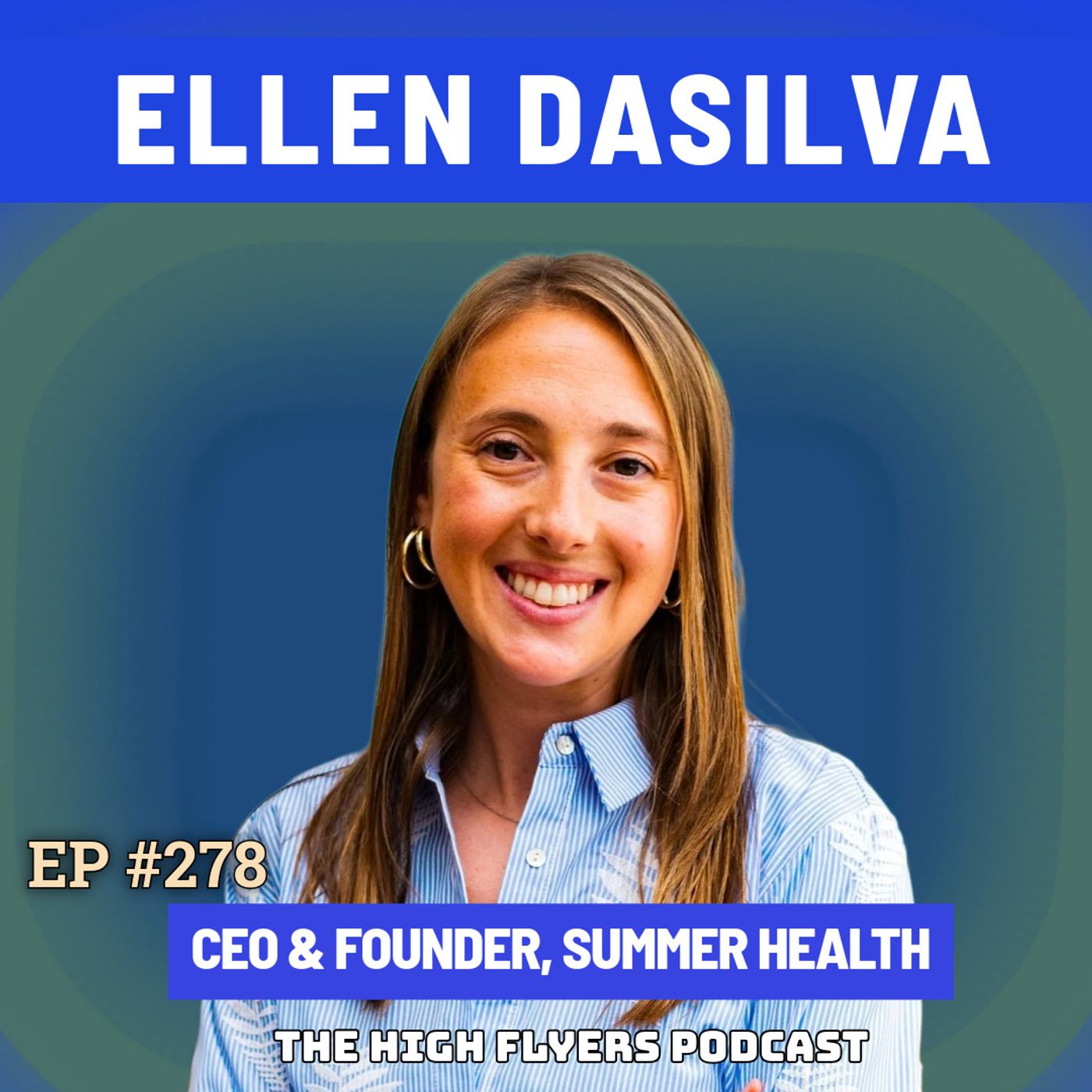
Ellen DaSilva discusses her career arc from Barclays to Twitter, then early employee at Hims (employee #8), building Summer Health, and selling it to Doctronic. She also shares her “hot take” that consumer AI agents are early in a lasting shift, and connects this to healthcare’s need for simple, text-based, consumer-like experiences.
Ellen DaSilva is a New York–born executive and founder. She worked on the equity syndicate desk at Barclays Capital, joined Twitter in 2012 (early revenue/business ops), later joined Hims as the eighth employee, and co-founded Summer Health (pediatrics care delivered via a minimal consumer interface). She recently sold Summer Health and is now SVP of partnerships and enterprise strategy at Doctronic.
Consumer AI agents are not a flash in the pan. Healthcare should feel consumer-grade, despite reimbursement complexity. Great early companies are “inevitable” category creators led by strong “cult leaders.” She emphasizes relationship-building, proof points, and “winner energy” for fundraising.
Twitter’s sales apparatus launch and international expansion; Summer Health’s “one simple text” model; Doctronic’s end-to-end clinical AI that can write prescriptions; her childhood stock-basket story (Coca-Cola) and her “CEO of Coca-Cola” ambition.
Written by AI. May contain mistakes.
Ellen shares her perspective on consumer agents and their impact.
“they're a flash in the pan or whether it's a trend that's here to stay.”
Ellen discusses her upbringing and career from Barclays to Summer Health.
“with many of our guests appearing in rare public interviews.”
Ellen reflects on her time at Barclays and meeting her husband.
“The Bacchus one is interesting and we will chat about it.”
Discussion about high flyers and Ellen's friend Saria Zoot.
“This is really interesting because I found the research for your childhood super interesting.”
Ellen shares her childhood experiences and the ambition instilled by her family.
“So it was totally the right choice for me.”
Ellen discusses her educational journey and the influence of her parents.
“Well, my parents always read a physical newspaper and my mom would come home with a physical copy of the Wall Street Journal every day.”
Ellen reflects on her childhood interest in politics and societal change.
“Because I knew that I wanted to be at the helm of a large, iconic American institution.”
Learn how a liberal arts degree fosters critical thinking and analysis.
“It's funny, I was just listening to your conversation with Kevin Hartz, who's somebody in tech I've long admired.”
Hear about the speaker's transition from college to the professional world.
“So it's clear as day to me what he's going to be when he grows up.”
Discover the story of how the speaker met their partner at work.
“I sit on this desk, equity syndicate desk with people who had literally been on the desk since they were 22 years old and they are now in their 40s.”
Explore the journey from a banking career to working at Twitter.
“I was placed on the tech group because tech companies were the only companies in 2010 that were even thinking about going public.”
Understand the key skills developed during formative years at Twitter.
“David said Twitter was probably one of the most formative periods in your career, in his opinion.”
Learn how early experiences in team management shaped Ellen's career perspective.
“seeing a very amorphous problem and making order out of chaos was probably the biggest thing.”
Discover the importance of sales skills across all job functions in tech.
“At Twitter, it was non-traditional business development.”
Hear about Ellen's commitment to supporting women's careers at Twitter.
“for the sales team and account ownership.”
Understand how Twitter inspired Ellen to drive change in the healthcare industry.
“And I feel very fortunate that they took me under their wing and taught me so much of what I know today about running a tech business.”
Explore the differences between Twitter and Hims, and the learning journey.
“The same is true of challenging the status quo in an industry.”
Ellen reflects on how her MBA shaped her career and entrepreneurship approach.
“And getting an MBA is definitely coloring inside of the lines, which feels a little antithetical to the journey that I am on.”
Learn how Ellen evaluates early-stage companies and their potential for success.
“Yeah, I bet I wouldn't disagree with that at all.”
Ellen discusses traits she learned from leaders at Twitter and Hims.
“But from a consumer lens, my framework is, am I obsessed with this product?”
Ellen shares her journey from Hims to founding Summer Health.
“And so when I was in business school, I had dabbled with attempting various entrepreneurial ventures.”
Ellen discusses her transition from working at Hims to launching Summer Health.
“And I'm so happy that I stuck it out rather than leaving at any point to go start my own thing.”
Exploration of the consumer-centric approach and design philosophy behind Summer Health.
“I'm curious, was that product decision actually deciding not to build more product?”
Ellen shares her thoughts on future opportunities in healthcare and technology intersections.
“Well, you've led me to this question is what would you build today?”
Ellen reflects on the acquisition by Doctronic and her continued passion for pediatric health.
“I will definitely start something again after this.”
Ellen shares valuable advice for entrepreneurs seeking funding, including relationship-building and evidence of concept.
“And I'm very happy and proud of how it all went out.”
Discussion on how to effectively present to investors and what they look for in founders.
“And I think that's voting with their time or their dollars.”
Ellen describes who she would invite to a learning session, emphasizing the importance of mentorship.
“I think this is particularly interesting for you because you just have a, you're just a magnet for people.”
Ellen discusses four significant mentors and their impact on her life.
“And even just you and I, like the first time we met, I could just tell I was like, this person is different.”
Ellen shares her challenging transition from Wall Street to tech.
“You can have multiple rocket ships in the future.”
Ellen talks about the challenges and joys of parenting while managing a career.
“I want to go back to the question I planted a seed on earlier, which is stepping away from summer health.”
Ellen discusses her investments in health, cooking, and learning Mandarin.
“And I just want to enjoy everything on maximum mode.”
Learn how to recognize unique qualities in potential hires.
“And this could be in a hiring process or it could be in a diligence process for investment.”
Explore the importance of grammar and the drawbacks of unreviewed AI outputs.
“Bad grammar to me is like nails on a chalkboard.”
Discover the value of asking about failures to elicit meaningful insights.
“And it's so obvious that there's no actual human thought behind it.”

Get the gist, explore an idea or ask about something said.
 Claude
On The High Flyers Podcast with Vidit Agarwal, what are the key points of this episode?
Searching your listeningAutomatic transcript. May contain errors.
0:00Hi, I'm Vidit, the founder and host of this podcast, The High Flyers. Hi, Vidit. I'm Ellen DaSilva. Ellen DaSilva. I am so excited to do this. We had David, your husband, on, what was that, like a couple of months ago? And now we've flipped the script. So I am really, I'm nervous for this. I don't know what to expect. It's my turn to talk now. I was actually going to ask, one of the things that came up in my research is people said you love asking the question, what's your hot take? I'm curious, what's your hot take at the moment? My hot take at the moment is that I really love these consumer agents.
0:42I know that there's a lot of polarizing feedback in the market about whether or not they're a flash in the pan or whether it's a trend that's here to stay. I might laugh looking back on this, but I think we're in the very early innings of a revolutionary change of how consumers and individuals experience AI. Do you mean companies like Instinct that have got a lot of attention? I love Instinct. I've been using it a ton. It leads my life, but I've dabbled and tested lots of these platforms. And I do, that's my hot take. I really, I think it's, I don't think it's a flash in the pan. I think it's a trend here to stay.
1:18Well, I wonder if it's going to enter healthcare, right like the intersection of healthcare and consumer it has to it has to i have my eye on it what if we could reimagine the traditional notion of a high flyer hey friends welcome back or welcome to the high flyers podcast where we do reimagine a high flyer showcase the brightest and most relatable role models and companies and their journey from sunrise to today. As one of the premier products in our Curiosity Center lineup, providing on-demand intelligence to help you be 1 % better every single day. I'm your host, Virita Aguil, and let's have some fun.
2:02Our listeners have called this podcast a meticulously researched biography unveiling the extraordinary lives and decisions of the most remarkable individuals and companies from around the world. We hope you're enjoying our catalog of 200 plus episodes since we launched in 2020, with many of our guests appearing in rare public interviews. It's now time to explore your curiosity. Please enjoy. Let's set the scene with some fun facts. So where were you born and where do you live now? I was born on the Upper East Side. I have moved across town. I now live on the Upper West Side. I've gone very far, but I have spent time living in other cities.
2:44And so I am a New Yorker born and raised. I'm a New Yorker at heart, but I have seen the world and I feel very grateful for it. And we will unpack those journeys shortly. And work, what was your first job and what do you do now? My first job was at Barclays Capital. I worked on the equity syndicate desk, taking companies public. And now I actually just this month sold my company, Summer Health, to a larger health tech company. And I am now the SVP of partnerships and enterprise strategy at a company called Doctronic. That sounds so fancy. It's almost fancier than CEO, right? It's longer. I prefer the gravity.
3:33I know. The Bacchus one is interesting and we will chat about it. That's when you met David, didn't you? It is. It's funny. I was actually giving, I seldom do this anymore, mostly because I just, time does not permit, but I was chatting with a junior at the university I went to who was asking me for some career advice. And I was waxing poetic about what a waste of time I thought working on Wall Street was. And he called me out and he said, but you met your husband there. So it served its purpose. It was really important. And I do believe that I was meant to have that chapter in my life, if for nothing else, than that I met my person.
4:17And Ellen, as you know, the purpose of this show is to reimagine the concept of a high flyer to go beyond someone's job title. Is there a high flyer you know who you feel doesn't get the recognition they deserve? I was thinking about the answer to this question. My instinct is always to say David, my husband, because I think he deserves all the credit and all the recognition. But since he's been a guest on this podcast already, I'm going to give a shout out actually to my best friend from Brown. Her name is Saria Zoot. She is a great follow on Twitter, X, whatever you call it these days. She's the founder of a company called Sublime, which I think is one of the most interesting applications of intellect on the internet, something that doesn't get recognized or thought about very much.
5:01And it's really pushing the boundaries on how we should think in this modern era. So I'm going to give a shout out to Sari. Okay, interesting. I will look her up after this. Let's wind back the clock to your sunrise, as I call it, your childhood. So you said Upper East Side, New York. This is really interesting because I found the research for your childhood super interesting. Most people's childhoods are pretty boring. Yours was really interesting. So I'm keen to unpack this, but tell me what are your memories of your childhood? Well, my parents moved out of the city when I was little. So we moved to the suburbs and I grew up in a very nice, safe area in Westchester County, a town called Scarsdale.
5:45And my parents had actually moved there in part because it's a great commuter town and They both still work in the city and they still live in my childhood home. But in part because Scarsdale has some of the best public schools in the country. I have two younger sisters. And when I was in, must have been fourth grade, after five years of being in the Scarsdale public school system, I turned to my parents and I said, I want a bigger challenge. I'm not enjoying this. I don't think it's hard enough for me. because I guess I was nine. And they said, what does that mean to you? And I said, I want to try going to a private school.
6:25And I think they weren't so keen on it because they had moved to Scarborough's jail so they could have a community. And so I could go to these amazing public schools, but I pushed and I really felt strongly that I wanted more of an academic challenge. So I, they said, if you figure out what school you want to go to, you can apply. if you can take the test, study for it yourself. It was really my first lesson in self-alliance and being self-assertive. So I took the standardized test. I called their bluff. I got in and I chose to go. And so I really, starting at age 10, I switched to a private school in the city and I enjoyed it very much.
7:04It was absolutely, I was instinctively, I was right. It was absolutely the right academic environment for me. I really thrived. I loved it. My kids go to the school now. So it was totally the right choice for me. I think back to that moment when I made that decision, a lot of my decisions in life have been based on gut feel. I couldn't really tell you why, I just knew strongly that this was going to be the right fit for me. And I'm glad that I've leaned into instinct a lot because that has served me very well. i i've been told your parents are very they still are very successful and i wonder if that because i think one thing i've noticed i've got to know you a bit and you connected me some really interesting people they all said your level of ambition has always been very high since you were a kid it makes sense today with the career you've had but as a kid it it might not do you put that down to your parents?
7:59So my parents are both very successful. They have had great classic career success. My father is a corporate lawyer. He focuses on debt securities law, big white shoe law firm. He's been a partner there for many years. My mom, I think, really eschewed the trend of being a mom in Scarsdale. She has worked a very successful career and she's now the CEO of PIMCO's real estate asset management division. I think, you know, I also want to attribute some success. My grandparents were also very successful at a time when Jewish people were not really afforded opportunities to do very much in traditional professional settings.
8:42But I want to give credit to my grandma, who's 101. She's still alive. She was a professor of Spanish literature, first at NYU and then at Hofstra. And she worked up until 10 years ago. She was 91 and she retired begrudgingly. I think she would happily still be teaching today if she could. But I was surrounded by people who believe very strongly in the life of the mind and loving what you do and loving learning for the sake of learning, but also really high achievers and not being complacent to just achieve the bare minimum, to always do your best. And I remember my father, probably after, you know, not scoring well on a test or something, would say, do you feel that was your personal best?
9:31Are you proud? Did you go above and beyond? And if the answer is no, that's not good enough. And I really did my life by those standards. did you realize that in that like what I think of my childhood growing up I didn't realize a lot of this stuff till I got older did you realize these foundations that you were given you mentioned your sisters have they are they this similar to you in terms of like just get shit done um I mean they're very impressive in their own right but my sisters and I are very different I think I guess in a not self-aggrandizing way yes I have always known that I need to be an extremely high achiever that I need to have the biggest level of ambition that I need to set my sights extremely high and then exceed it and so that is that is table stakes for me like I've never questioned that you mentioned earlier about the private school I think it was Horace Mann is that right so so age five now when i was i don't even remember what i was like oh nine age five age nine okay age nine the other thing that i think is obvious here is you were quite a mature child is that a fair comment yeah i was the kid who brought the book to the party i love reading really and i for my 10th birthday so my mom who has worked on wall street or in finance her whole career, used to come home.
11:02Well, my parents always read a physical newspaper and my mom would come home with a physical copy of the Wall Street Journal every day. And she had her, I remember she would fold it in quarter, like the one page into quarters. So the sheet was about, I don't know, the size of half a sheet of paper and it would have the stock tickers and she would bring those home for me. And I would follow certain stocks that I really liked. And for my 10th birthday, I asked for a basket of equity for my birthday. And my mom bought me, my parents bought me stock in the Coca-Cola company. And the reason for that is when I was in first grade, so I was five, I think I wasn't even six yet.
11:44Our teacher, we had career day at school and our teacher made us go around and talk about what we wanted to be when we grew up. A lot of the kids said, I want to be a fireman or I want to be a ballerina. And I got up and I said, I want to be the CEO of the Coca-Cola company. Because I knew that I wanted to be at the helm of a large, iconic American institution. That just seemed like my destiny. And even at age five, I knew that. And so I still live by that ambition. But that was who I was as a child. as you know usually the question i ask is like age 18 i'm almost curious to ask you like age 15 if i met you at age 15 what would i have assumed you'd do with your life politician i've always been yeah i've always been fascinated by politics i think it's a body and a beast that is a place for good and a change agent.
12:47I spent time in my childhood or in my adolescence, I guess I would say, volunteering on political campaigns and getting involved in causes. At age 15, I worked on Mayor Bloomberg's reelection campaign, and I dabbled in democratic politics when I was in college. You know, I also learned at that age that it's a very tough profession. And if you really want to make change, you have to be the change you want to see. It's an industry, it's a field and a discipline that has changed a lot, obviously, in the last 20 years. And so I have no regrets with where my life has taken me. But I think if you had met me at age 15, that's kind of what you would think I would be doing.
13:30and so but he didn't clearly he didn't do that he went to brown and he studied a bachelor of arts right how to connect those two i think i've always been i've always been fascinated and enamored of change and the science of making change happen which is why at age sort of 15 to 18 i think politics seems fanciful and then and then sadly you get to the real world and you realize that a lot of change doesn't happen that way. But I went to Brown. It's funny, I was just listening to your conversation with Kevin Hartz, who's somebody in tech I've long admired. And I've gotten to know his wife a bit, Julia.
14:13Kevin said something that espouses very much my family's philosophy on education, which is go get a liberal arts degree, because the best thing that you can do in university is learn how to think and learn how to be intellectually curious, Learn how to be analytical. Understand the life of the mind because being a lifelong learner is how you become successful. I wager that most people who get an economics degree are not spending their time thinking about Pareto efficiency and the theories that they're learning. They're taking the thought process and the ability to think and analyze and using that in their day to day.
14:53So I studied English literature as all great founders and CEOs do because it taught me how to read. It taught me how to write. I think writing is the single greatest skill. And certainly in the era of AI, when a lot of produced work now is slop, being able to separate the taste and the ability to articulate your point of view is probably now the biggest differentiator as a leader. So I loved my English degree. I would happily recommend that to anybody. And by the way, it helped me crush business school because reading a 10-page case in a night and analyzing it, extremely easy when you're used to reading a 300-page book novel in two days and analyzing it.
15:37So that's my small shout out to all the English majors out there. Totally. Kevin, I think, studied history and he talked about that and you talked about CEOs. A bunch of the CEOs that I've met did not study business or economics. They studied history or arts or one of those degrees that, like you said, tested their left brain and right brain in a very different way. It's interesting today. I wonder if your kids are small still, but when they grow up, it'll be interesting watching you and David, what they decided if they decided to go into the business world, right? My kids are three, five, and seven.
16:16And David and I talk a lot about what we romanticize, what we think they're going to be when they grow up. It's very obvious what my oldest child is going to be. Since before he was two, he's been obsessed with robots and robotics. And he actually, at age seven, had a bunch of robotics internships this summer, which for anybody listening to this podcast, and if you're in robotics, talk to me because we're trying to enrich his school. I heard about this because you tweeted about it, right? And the startup switched out. And then, yeah. I did. He had three internships this summer. We're actually doing another internship this fall for a day.
16:51on the West Coast. So it's clear as day to me what he's going to be when he grows up. But the other two, I don't know. I just, I want them to explore all the corners of their mind and find what makes them happy. Totally. Yeah. Just watching you two, like you and David, their opportunities are endless. It'll be so interesting to watch them grow up. So you went to Brown, you studied English literature. Where did you start? Did you go to Barclays straight after Brown? I did. So I graduated, this is going to make me sound really old, but I graduated into the last recession and, or really in the wake of it, I graduated in 2010.
17:33I had an opportunity to go teach English in China and I've been studying Chinese at Brown, which I love. I think Chinese culture and history is so interesting. The language is amazing. I wanted an experience. I didn't study abroad. And so I wanted an experience to go overseas. But I had this opportunity to go teach English in China. And I had this opportunity to have a job on Wall Street. And to my parents' credit, in the fall of 2009, they said, absolutely not. You have a job. Most people would kill to have a job. You may have an opportunity later in life to go teach English in China, take the job, take the gainful employment.
18:11So I did. I went straight from Brown to Barclays. I actually took the month in between graduating from college and going to work to drive across the country with my youngest sister who had just graduated from high school. And for anyone who knows me, they know that I can't drive to save my life. So it's a good lesson in that. But Nancy and I had a great time. We really saw who's exact across the Northern band of the country. And my eyes got opened and exposed to things that I had never seen before. Not only the vastness of this nation, but also the national parks. We saw friends who lived in North Dakota and in Jackson, Wyoming and in Seattle, who we would never have otherwise visited.
18:56But it was just amazing. It was so eye-opening. So I get home, I think on a Friday or something, I start work on a Monday morning, which was a big wake up call after living basically in a car in a very spontaneous way for a month with my sister to this extremely rigid environment. So I get to Barclays and I just start asking why we've done it this way. I sit on this desk, equity syndicate desk with people who had literally been on the desk since they were 22 years old and they are now in their 40s. This is their career. And these are people who take a lot of pride and a lot of passion in what they do.
19:38And I was in awe of that. I really respected that. But again, my frame of reference are these people sat on this desk, on this training floor and never left. It was just their life. And so I assumed that was what I had to do too, because I was given a seat at this table and I had to take it. and I met David the first week at work which totally changed the trajectory of my life did you know just as a side note quickly on David did you know I guess that he was the one like how did you how we all were you friends for many years before you became partners I knew from the minute I laid eyes on David that I was gonna marry him I knew it he had not even said a single word to me basically the story, our meet cute, if you will, the story of our meeting is I was sitting on the third floor at my desk and my job was, it was the first week at work.
20:37My job was to answer the phones and route them. And David's job was to do whatever they said on the fifth floor. And so he called down to my desk and he asked for trading color on a stock or something that we had just taken public. So I get the trading color and I call him back. And then I looked him up on the intranet and I thought, another analyst. I am going to ask him for coffee because my job is to try to meet as many people as possible and soak up, network and soak up how to do this job. And so I asked David for coffee. And the next day we met for coffee, and I remember he was sitting, I didn't even really know what he looked like.
21:15He had a sort of generic corporate photo on the intranet, and there's a courtyard behind the Barclays building. He was seated in the courtyard, like waiting for me. It was, in hindsight, it was poetic. A movie script writer couldn't even write something like this, but he was facing me and we made eye contact as I was walking over toward him. I was probably 20 paces away. And in that moment, the thought that went through my head was I'm going to marry him. I just knew it instinctively. And we started dating a few weeks later, but we struck up a friendship over the course of those few weeks. But I knew I had no shred of doubt.
22:01I was 21 years old, but I knew it. And I've never wavered to this day. that is so good so you went from banking to tech so you went from barclays to twitter how does it sounds like maybe you met someone along the way that connected you how did you do that switch i okay the very quick story was i was placed within equity syndicate which is basically the group that takes at a bank that takes companies public. I was placed on the tech group because tech companies were the only companies in 2010 that were even thinking about going public. Facebook, it was actually as a predecessor to Facebook, it was Zynga and a couple of these sort of early web 2.0 businesses that were going public.
22:51So I was placed on that group and I started learning about these tech companies. And part of my job was to go hear the pitch. I would sit in, I was like the person who would like print out the pitch materials for the investors on the IPO roadshow. And I remember my first few weeks asking if I could go sit in on a roadshow and they let me do it. And so it was a data center company, which I guess now is polarizing, but then was like a very boring IPO. And so I sat on this pitch and I thought, wow, these companies are really interesting. David, who grew up with two parents who are entrepreneurial and his best friend from college, that guy's Aaron Danik, his father is also a tech entrepreneur of sorts.
23:32And David and Aaron were forever starting businesses when they were in college. So in the wake of that, that was my first real exposure to tech and to entrepreneurship. And I was hooked. I became really interested in what it might look like to work at some of these companies. in 2011 I started attending I guess I would call them lectures but it was like fireside chats with tech founders anywhere I could find on the internet and I actually remember the most formidable chat I went to Eric Friedman who's now a friend of mine at the time was at Foursquare and Christina Cassioppo, who is now the founder and CEO of Vanta in January of 2011, she was at the time at Union Square Ventures, did a conversation on what it's like to join and invest in early stage businesses.
24:24And I thought, this is for me. This is exactly what I want to be doing. So I remember I had a review in, it must've been at the end of 2011. I had a review with the MD on my desk. And he was very humane about it, but he said, you clearly don't want to be doing this job. What is it that you do want to be doing? And I thought about it for 10 seconds and I said, I really want to work in tech. That's really what I want to be doing. And he said, great, I'll help you. I think Wall Street at the time was not a very warm or friendly environment. So his name is Joe Castle. I give Joe a lot of credit for really pushing me to think beyond the confines of what I was seeing at work day to day.
25:07And so at his suggestion, I made a list of the tech products that I liked and I used on a daily basis. And I decided I'm just going to reach out to people I know who work at these companies. Spoiler alert, I didn't know anybody who worked at these companies. So I remember I found Twitter was at the top of my list. I loved the Twitter product and I was a massive user of it. And so I found a friend of mine from Brown whose roommate worked at Twitter. And so a shout out to Danny Hertz, who put me in touch with a hiring manager. And I remember this was in the winter of 2012. I had a first interview and a last interview within five days of each other.
25:52And they said, great, get on a flight and come to San Francisco and meet us and then we'll get, you know, and then maybe you'll get a job. And I, that following Monday, I got on a plane and I flew to San Francisco. I'd never been to San Francisco before. And they gave me an offer and they basically asked me to accept it on the spot. And I did. And so with, from start to finish within 10 days, I'd gone from thinking that my whole life might revolve around the equity syndicate desk at Barclays to accepting a job at Twitter, which totally changed the trajectory of my life. This is what David said.
26:27David said Twitter was probably one of the most formative periods in your career, in his opinion. And it was also really interesting because it was two years after the iPhone launched. It was the early era of social, right? Because Facebook had just come out, Twitter was out, I think LinkedIn was hovering somewhere there. When you look back, I think there were four years around about. But when you look back, what were the key skills you developed? Because I've been told you were given quite a bit of responsibility at a pretty young age. In retrospect, now that it's been almost 15 years since I started Twitter, in retrospect, the single biggest skills that I got were more soft skills than hard skills.
27:14It was networking. getting. It was meeting really smart, interesting people who believed in me and trusted me to go build aspects of this business that didn't exist. It was learning how to create something out of nothing. Twitter, I think, made very little revenue. I don't even remember what the numbers were, but they made very little revenue when I started. And my job on the revenue operations, sort of business operations team was to figure out how are we going to make money in an organized way? And then how are we going to actually organize the business? So it is its most efficient self. That was my job for the most part.
27:52It ended up morphing into a little bit of a business development role too, which is how I got to where I am today. But the skills of seeing a very amorphous problem and making order out of chaos was probably the biggest thing. And then people management too. It was the first time I had people management experience. And I credit so many people from Twitter for believing in me at, I think I was 23 or 24 years old to go manage teams of people and manage swaths of the business, like to, you know, to organize them. And so it just, it rocked my world. It really opened my eyes to what a career in tech can and should look like.
28:37Can you expand on the point you just said about business development and how it led you to where you are today? Sure. At Twitter, it was non-traditional business development. I was tasked to go help them launch our sales apparatus in other countries, which was extremely cool. It was like the dream job. If you could have written a dream job for me, that was it. But every job becomes sales, no matter what profession you're in. Even if you're the CTO of a company, every job becomes a flavor of sales. You have to sell the vision of what you're doing to investors, to potential recruits and employees, to clients and customers, to vendors, to extend things to lines of credit or whatever.
29:24Every job kind of becomes sales. I certainly think that's the job of an entrepreneur. And so at Twitter, doing the job, the simultaneous internal and external sell jobs was really formidable for me. Part of my job was figuring out a business strategy and then making a case internally for why we should pursue it and why we should take precious resources, especially going into an IPO at the company, why we should take precious resources to build the thing or organize ourselves that way. or change the way. I remember we did a massive account reconfiguration for the sales team and account ownership.
30:03And it was like six months before the IPO and it was a risky thing to do. It was the right thing to do. And making that internal sell was really important. So I do credit a lot of Twitter. The other thing at Twitter that I did that I'm really proud of, I know in today's era, this is not seen as favorably, but I spent a lot of time trying to help women bolster and advance their careers. And I became very close with a lot of senior leadership, both men and women. But there was a core group of female SVP and C-level executives at the company who I became very close to, who have been continuously mentors and role models for me.
30:43And they have all gone on to do, like Katie Stanton, who I admire so much, has gone on to start her own extremely wildly successful venture fund. And April Underwood and just really the same, you know, investors in summer health. Janet Van Heys, who went on to be the chief HR officer at Cloudflare. These are women who have had remarkable careers post-Twitter, but really also changed the shape and the trajectory of a company while they were there. And I feel very fortunate that they took me under their wing and taught me so much of what I know today about running a tech business. And also some people said to me in the research that they feel Twitter in some ways led to to you creating summer health.
31:26Is there any truth to that? I know we're fast forwarding a few years, but can you bridge that like Twitter and summer health? No question. For a couple reasons. One, Twitter taught me to challenge everything, challenge the status quo, challenge how things are done. Don't come into an organization and think, well, it's always been done this way. So you should continue to do it this way. It's I had a glimmer of that at Barclays, but I think it was suppressed so much because it was the way things had always been done. And Wall Street is not a very friendly environment for change or being a change agent.
32:00But Twitter really instilled that value in me. And I saw how successful you can be, but also how valuable it is to an organization to push the boundaries. The same is true of challenging the status quo in an industry. and a lot of my zeal for wanting to change the trajectory of pediatric care and wanting to challenge the way care gets delivered and to whom came from my time at Twitter. I certainly also learned about the medium of like brevity and written language and all of that. That's the form of a tweet. And that was kind of how we did things at Summer Health. But certainly the challenging of the status quo was a skill and a value that I picked up at Twitter.
32:46I want to come to HBS in a second, but you were early at Twitter and you were early at Hims and Hers. I think similar stage of company approximately. How do you, yeah, okay, maybe Twitter was more advanced because I know Hims. Yeah, Twitter was more advanced, but their business endeavors were very nascent. It was as well right but yes hims i was the eighth employee so it was a tiny company yeah absolutely and they're both consumer companies even though they're very different i mean hims is obviously healthcare and then twitter is more social and more agnostic but i am curious when you look back on those two experiences and you've been a founder yourself post that but we'll come to that in a bit how do you compare and contrast your did because one could say that twitter experience helped you be a better early employee at HIMSS without Twitter.
33:39But then you also have the HBS experience. So you had this MBA and then you went to an early stage company, right? We talked to earlier when you were a kid, you had these ambitions and you wanted to be a CEO. And then you've gone and joined these super early stage companies, but you've still done your MBA. I don't know what the exact question is, but that just is an interesting paradox of ideas. So I think I will liken it to maybe the nugget of the question here is either why not just go be the CEO early on or why not go do the big, bold thing? And simultaneously, why do like with Barclays and especially the training, why be shoehorned into a mold when you can go be outside of color outside of the line?
34:33And getting an MBA is definitely coloring inside of the lines, which feels a little antithetical to the journey that I am on. And the way I think about it is an artist must sharpen her tools. You can be classically trained like Picasso and then create whatever it is you want. there's a lot of value in knowing what the norms are so that you can either reject them or embrace them or do go your own path and I'm very happy I'm extremely happy that I have the skills that the MBA and even like to a certain extent that Wall Street taught me in part because I know what I don't want as much as I know what I do want but I also know what good looks like and my my father always said this and it's true.
35:23He said, go get your Harvard MBA because then you will never be intimidated when you're in the room with another Harvard MBA. And I think it's true too. Like none of that faces me. But I actually, I love, not actually, I shouldn't be a surprise. I loved HBS. I think it was an extremely formidable and important experience in my professional journey. I would do it again. I'm very involved in the institution. I'm actually going up next week. There's a case that they have on me. It taught me a lot about entrepreneurship. I have an incredible network of people. Most importantly, I had fun and I have friends.
35:59I have amazing friends and my closest friends in life who have nothing to do with tech or New York City who have really shaped me and who I am come from my time at HBS. So I'm very happy that I had that experience. And I would encourage anybody, even if you think about having a really non-traditional or non-linear career, to consider it. It was a very amazing program. Yeah, I bet I wouldn't disagree with that at all. I haven't done it, but I know a lot of people that have, and I think it's a life-changing experience, right? Which sounds like it was for you. And by the way, Vidit, if I ever need to call a banker or if I ever need to call a consultant, I have a network galore.
36:39Exactly, exactly. David's got a network of people like that. So yeah, you plus David, that is just magic. you joined twitter and hymns early before the outcome was remotely obvious right what maybe people reach out to you now and say ellen how do you how should they pick a career part or how should they pick an early stage company right i often have these chats i've gotten to know a lot of early googlers early meta folks or early open ai folks anthropic folks and i always say it's a lot of that might be luck but i'm curious how do you reflect on that what did you see in particularly in hymns because you were so early that gave you confidence and now today if someone comes to you and says ellen i've got this role should i take it what are the ingredients of a potentially magical company that tend to show up early on luck plays a large part in it but i do think there's an alchemy in companies, you can tell early on if it's going to be great or not.
37:49And here's how I think about it. I'm a consumer person. I really have never, I could not, and I don't really understand how to invest my time or dollars in enterprise software businesses. But from a consumer lens, my framework is, am I obsessed with this product? Am I obsessed with it in a long-term sustainable way? is it a good business? Is the underlying thing a good business? And do I trust that this founder is going to make it great? Because a lot of people can build any business. And we see this, we see, especially in AI right now, there are lots of companies that do the same thing, but what separates the good from the great, if you will, is the person leading the company.
38:36And so you have to think to yourself, if this is a cult leader, am I going to go to battle behind them? Dick Costolo was the CEO of Twitter when I joined, and that was certainly true. He was amazing. And Jack too is a visionary. The same is true of Andrew Dudum and the people he surrounded himself with at HIMSS. It just seemed inevitable to me. But I think if you believe that the thing you're building is an inevitability and is a category creator and a category winner, it doesn't have to be a first player. as I'm all in on Team Lagora, but it has to be inevitable. And I believe that these businesses were inevitable.
39:13Just because you mentioned those three names, I'd be curious, were there any traits you took from them into summer health from Jack, Dick and Andrew?
39:26Yes, certainly being comfortable with change and being comfortable with sort of the, the winning your way on the journey and rolling with things if they don't go according to plan. The second thing is trusting people who are smarter than you, who may be experts in things that you're not. Paul Graham has an essay called Giving Away Your Legos that I think is a very foundational one for my leadership style. And all three of those people were great at giving away their Legos. So let's go into when you were coming towards the end of your time met hims and hers pre-summer health tell us about that transition because i've actually heard on good account that you had an idea that was similar to hims before you joined hims and they convinced you not to be a founder so was that brewing in the back of your mind that i still want to be a founder i as i've said i love the art of creating something out of nothing that can be done within a company like at Twitter, that can be done starting a net new company like the way I did at HIMSS.
40:31And so when I was in business school, I had dabbled with attempting various entrepreneurial ventures. I never really got anything off the ground, nothing notable to talk about. But when I graduated from business school, I really wanted that to be my career path. And I had a very similar idea to the idea of HIMSS and hers. And I was attempting to raise a very small amount of money, I think$250 ,000. I was reconnected with a friend of mine who I had worked with at Twitter, who at the time was a partner at Redpoint, Ryan Sarver. And Ryan pulled me aside and he said, look, this idea is interesting, but there's another company that's doing the same thing.
41:08They're six months ahead of you. You really ought to meet them. And so he connected me with Andrew and I met Andrew and I just thought, wow, this is somebody I want to go to battle with. And Andrew and one of the co-founders, Hillary Coles, who's one of my closest and dearest friends and like business buddies today, the two of them convinced me that what they were doing was worth joining and that I should take all of the learnings that I had from attempting to start the same thing and bring it into hims and hers. It was just hims at the time. I actually think it was called club room at the time, but it, you know, hims.
41:43So I did and I have no regrets because it turns out that I'd actually never seen zero to one up close. And so I got a great education in zero to one and I got a great, great education in one time heel too, which was incredible. The trajectory of him is something that I think I will never see again in my career. And I'm so happy that I stuck it out rather than leaving at any point to go start my own thing. As a naturally post IPO, it became time for me to go do my own thing. And I really got bitten by that entrepreneurial bug. But I had a great education into how to do something from zero to one.
42:20So let's go into summer health. So December 21 is, I believe, around then is when you started it. The obvious question is, when you look back now, were you building a healthcare company or a consumer company that happened to deliver healthcare? I think that one of my biggest learnings from HIMSS was that healthcare should feel consumer. To deliver great healthcare, it is ultimately a consumer experience and the consumer has to elect it. So I like that you asked that question because it is an intentionally blurred line. And I'm intentionally not going to answer that question because I think, or I'm not going to give you the direct answer you're looking for, because I think the answer is yes.
43:01It should feel like great healthcare should feel like both. the problem in healthcare is that who pays for it is not really the consumer and so that you have a bit of a principal agent problem of who pays for it and who consumes it and that's why a lot of healthcare today does not feel like it's consumer but but i really want it to feel that way and that is a crusade that i can quest that i continue on so i found sequoia's investment thesis it's on their website from 2022 and it literally describes summer as making healthcare accessible through one simple text you can tell me what that actually means but i was thinking about it before this and i went like i spent a lot of time with founders you spent a lot of time with founders most founders want to build more product i guess you almost started summer by removing that interface entirely.
43:54I'm curious, was that product decision actually deciding not to build more product? Healthcare is such a complex and convoluted space. The complexity in healthcare is around how people get paid and reimbursements work, how it's delivered. there is so much that is complex that to deliver a clean and simple experience is way harder than it sounds, but also leads to better outcomes, leads to a better experience, leads to something that people want to come back to. It was a very intentional design decision to keep the surface area of the product extremely minimal and extremely clean. The two things I'll say on that are one, the product itself was not just the technology, but was also the care delivery.
44:49I say was, it still exists within Doctronics, so it's still going, but it's the care delivery. And that is actually an extremely complex product. And the technology that we had to build to support and sustain that, the routing, the provider routing engine, the sort of checks and balances within the system, the electronic health records platform, that stuff is all really complex. So for the consumer experience, very simple. So that's number one. The second thing I want to say is we're seeing that thesis play out a lot right now. Think about what instinct is building. It's kind of the same thing.
45:22AI powering it instead of human doctors powering it. But I would argue that I think summer health was five years too early in its interface of that. And that 2027 is going to be the year of text-based interfaces that are extremely simple, that strip out, abstract, remove a lot of the complexity and deliver a beautifully simple experience that is delightful for consumers. And that is what we set out to build. Well, you've led me to this question is what would you build today? We joked earlier about the intersection of consumer and healthcare being really interesting today. I was talking to a VC just yesterday and she was saying for years she was known as a consumer investor, right?
46:06Like you said, B2B software is different, was now it's all blurred. The same investor is doing physical AI, doing data centers, and consumer-based software, right? So I'd be curious, and maybe you are thinking about this. I'm sure you'll do many more companies. Where are the opportunities today that get you excited? I'm less than a month out from selling Summer Health, so it's funny to think about this already. But yes, I am an entrepreneur. I will definitely start something again after this. I've already started percolating and thinking about spaces that excite me. But from a, what do I want to build next perspective?
46:48I don't know. I'm actually very happy in my current role at Doctronic. So this is not probably imminent. It's more hypothetical. Totally. Really, I'm still keen on the intersection between consumer and healthcare. And I think that there's so much that needs to be solved in the navigation of care, in the delivery and the experience of care. So that is certainly an intersection that I'm really passionate about. I actually, to take a page out of David's book, I think that we are on the precipice of trust and safety and security issues with AI. And I'm actually endlessly fascinated right now about that.
47:30I think that there is a massive need for us. a lot of these AI platforms ingest information and what they do with that information is risky it reminds me of in the early days of Facebook when people would see advertisements on Facebook with their own pictures and I just you know I think we're veering down that path and I'd love to I'm actually really keen on figuring out how to solve some of those problems so those are areas that pique my interest right now and it's evolving so fast I'm sure if we chat in a month's time it's probably going to change but just to round out the summer health period in your career so you ran that business for nearly five years and then like you said you've just been acquired by Doctronic if I've pronounced that right any background on that acquisition again if you ask founders some founders want IPO some founders want to run it for the rest of their life some founders want to have an exit so you could say you've ticked one of those boxes how do you reflect to the acquisition?
48:32It came very organically, which in a way I feel grateful for. I didn't have to go kind of like have bankers chase down people. But we were talking with Doctronic about a partnership for a few months and they needed pediatrics to help round out their offering for adult care. They're a company that has started and really flourished in the AI era. they are the first clinical AI that practices medicine from end to end. So they are the first clinical AI that can actually write prescriptions in the United States. It's a very cool concept. It reminds me of Uber actually in the way they push a lot of boundaries from a tech perspective and a regulatory perspective.
49:14They needed pediatrics. They were just doing 18 plus. And for a bunch of partnerships that they're doing, they needed to add kids zero to 18 as well. And so summer health ended up being a very natural tie-in to what they were doing. I am still very passionate about kids' health. It's not my zeal and fervor for solving problems in children's health has not waned. And I think that there is still a real need for it. Pediatrics is a very tough category. At least right now, it's just systematically underinvested in. And it is tough to get some of the big dollars to really care. And so while we were very fortunate that we were able to accomplish a lot more than I probably ever would have expected, this was undeniably the right outcome for the business.
50:00And I'm very happy and proud of how it all went out. I'm extremely proud of the team. My co-founder, Matthew, was just a tremendous support through the whole thing. And Doctronic ended up taking the team from Summer Health. And we built, by the way, a world-class group of individuals who are both mission-oriented and extremely talented at what they do. And so I'm very proud of what we built and the problems that we got to tackle and solve. I want to ask you a couple of life questions. And before that, I want to ask you about fundraising. I think you and David could probably write a book on fundraising.
50:35Like you both are just superheroes at fundraising. And you've seen it from two sides. Like you've done the Sequoia Scout thing. I know both you and David have done angel investing over the years. And then for Summer Health, you raised the funding. and then I think Matthew joined to post the funding if my research is correct. Tell me about that journey again. That could be a conversation in itself, but let's say I come to you, let me ask you a specific question. If I come to you and say, Ellen, I've got a great idea. I want to go out and fundraise. I think I'm confident I can build this into a big company.
51:12What would be the three, let's say three pieces of advice you would give me or three things I should keep in mind before I go and speak to VCs? The first thing I advise is build relationships before you need to fundraise. Spend time, like I spent years while I was at HIMSS building a bench of relationships and getting to know investors. It should, by the way, especially in equity investing, be bi-directional. These are people who become part of your company. They become part of your life. my board members at summer health are some of my closest people my closest advisors mentors you know friends like i i really admire and respect them and they're people who have played a very meaningful role in my life and i knew almost all of them before i started the company i'd spent time with them they knew me so number one is build the relationships prior to ever needing to make the ask.
52:12The second thing is it's as much of an idea. So, oh, and for the first bit, that's because they're investing in you, especially in the early stage, they're making a bet on you. It has nothing to do with your idea. The second thing is have a credible narrative that includes data and outcomes before you go raise any money. An investor is not looking to invest in somebody who's still at their day job, who has not actually spoken to anybody in the real world about what it is they're building or whether or not there are proof points. Go get those proof points. Go build something. It has never been easier to build something than it is today.
52:58So don't go with a half-baked idea. Go with some actual data and proof that this is something that the world wants and needs and will pay for. That would be my second piece of advice. My third piece of advice is try to get some level of signal that other people are passionate and interested and excited about what it is you're building. That could be a first customer. That could be a co-founder or a first employee. That could be other investors. Whatever it is, being an entrepreneur, especially a tech entrepreneur is a little bit of being a cult leader. And if you can't get anybody to join the cult, investors are not going to want that.
53:40They want to invest in winners. And so you have to have winner energy. And the way to get winner energy is by getting other people to attest that you are a winner in some capacity. And I think that's voting with their time or their dollars. And is there anything with the pitch tech or the first meeting that you do you had tier one vcs that invested from the first round right you had sequoia you had lux you had other investors that i can't think of at the top of my head these guys meet as you know they meet hundreds of founders every week and they might invest in one i think you had the relationships because of the scout work and just your profile like to your executive success but if someone doesn't have that and they are going to an alfred at sequoia or a dinner at Lux, what would you advise they should do tactically in that first meeting or even in the pitch deck before they meet the person?
54:37Be authentic. An investor wants to invest in you because you are going to run through walls to do anything. You are going to be unstoppable at making this vision a reality. Anybody who has seen the entrepreneurial journey, let alone experienced it. But anybody who has even seen it from the outside knows how impossible the task is. It is a Sisyphean task to continue to push the boulder up the hill and to have the emotional stamina to do it. And what the investor is going to be looking for, especially in that first meeting, is are you up to the task? Do you have the stamina, the energy, the motivation, the willpower, the sheer force, and the authenticity to go lead through all of the difficulty.
55:28That's what they're looking for. And that's what you need to exude in that first meeting. I want to ask you an interesting question about how you feel now not being a founder, not having the weight of that. But I'll leave you with that breadcrumb and I'll come back to that. I want to ask you, maybe I asked this to David, is imagine a learning room. Imagine you have five seats and you can, you have one seat and you can invite four people. I think this is particularly interesting for you because you just have a, you're just a magnet for people. People love spending time with you and you've built some incredible relationships.
56:01And even just you and I, like the first time we met, I could just tell I was like, this person is different. Who would be those four people you'd love to, let's say, spend a couple of hours with and ask questions? And there should be four people you know. Four people I know. Yeah. So they can't be like presidents and celebrities they need to be for people you actually spend time with yeah well maybe i know some presidents no yeah maybe you do maybe you do you probably do knowing you you probably do so so people i would alfred lynn from sequoia has been probably the most formidable professional figure in my life he has been a mentor he's sat on the board of my company he's believed in me in moments when i didn't even believe in myself he has been a real sounding word for me, he would be undeniably seat number one.
56:46And it's not even about me. He is the most successful investor. He has been a founder himself, has lived so many interesting lives. I just, I feel like I could spend a lifetime and not really get to the bottom of all of his knowledge. So Alfred would definitely be the number one person on that list. Number two would be probably Especially Katie Stanton, who again has been a role model and a mentor to me. She's somebody who has shown me that you can be classy and gracious and have good values and invest in those values and still be very successful. You don't need to be brash and bravado to be successful and be well-respected and well-liked.
57:33She's also extremely smart, very worldly, again, very gracious, just so thoughtful. I have so much admiration and respect for her and can learn a lot from the way she operates and the way she engages people. So that would be the second seat on my rocket ship. The third seat on my rocket ship would probably be another board member of mine, Chelsea Clinton, who has had a tremendous career in health care. And she spends a lot of time in not only healthcare investing, but also public service healthcare and understanding how just the healthcare, the industry of healthcare works writ large with the Clinton Global Health Initiative.
58:16She is also somebody who has extremely good values and is a very genuine individual. And so she would be the third seat on my rocket ship. One last. The last seat on my rocket ship.
58:32can i add david i was gonna say david could be the one riding the rocket ship but yeah he can be in there sure i don't go anywhere without like i i wouldn't take any major journey in life without david so david of course would be would gets a default seat on the rocket ship he's the person i have i sit next to every day of my life but in all seriousness he would earn a seat in his own right David is my rock. He is the reason I feel confident to go explore and take real risks. He's the one who's pumping me up to go try things that I would never have otherwise tried and is the person who teaches me things every moment.
59:15Obviously, he's my biggest supporter, but I am so in awe of his career and the things that he has built, the relationships he has built, the businesses that he has built and the way he approaches solving problems that I truly could not imagine being on the rocket ship without him yeah the one of the friends you connected me to research she described you and David as each other's jetpacks which I thought was a pretty good description right that's what you want in a partner it's incredible that's incredible oh gosh there's so many more people I would invite on my rocket ship if I could but if I You only have four seats.
59:53Four seats. Yeah. Great. You can have multiple rocket ships in the future. We're coming to a wrap. So I want to ask a couple of questions, like maybe zoom out and maybe more about like mindset and even, maybe a good question. Like people might hear this and go, Ellen's had success the whole way. She got into the school she wanted to when she was young and she's met David. She's worked at these companies. I'm curious, has there been a period that challenged you the most? Can you share one?
1:00:24the story always looks smooth. The road always looks paved in hindsight, but it is never totally paved. A particularly challenging period was actually the transition from Wall Street to tech. I started at Twitter in a job that was mostly a support function. It was like an internal tooling support function. And I took the job because I really wanted to work in tech and I really wanted to work at Twitter specifically, but I wasn't sure that it was going to be the right job function for me. And in the spirit of being risk-seeking, I really just wanted to, I wanted a seat on that rocket ship and I was going to take any seat that I got.
1:01:06But I got there and it was clearly the wrong seat. And I remember taking a walk with David around Birtle Heights and we had just moved to California. We had moved together. I'd never even been to San Francisco. And I just felt so foreign, both at work and in my daily life. And I remember David and I took this walk and it was in that moment, he said, don't be complacent. Go be the change that you want to seek. Go make your own luck. You've done that before. And I certainly had done that before in other aspects of my life. Go make a change. And it was in that moment that encouraged me to get up and ask a question at the company-wide all hands and build a relationship with Adam Bain and Dick Costolo, who remain sort of lifelong friends and mentors to me and go build relationships with the executives of the company and tell them how you see things and go basically demonstrate to them that you are ready of helping them build this business and to be an outlier at the company.
1:02:08Don't be a cog in a wheel. And I will never forget that walk because that really changed my mindset. And it's a value and kind of a spirit that I take with me today. But it was a very tough time. I want to go back to the question I planted a seed on earlier, which is stepping away from summer health. And I'm a founder of my own business. It is tough. You're always thinking about it. My identity is very tied to my business. how does it feel now where yes your jobs are still demanding and i think knowing you you probably don't switch off and you're probably always thinking of stuff i'm sure but does it feel like a relief now not having the ceo gig and actually just being an employee again i am incapable of turning off founder mode it turns out in in retrospect i have always been this way but i didn't know it until i was actually a founder i i am a founder at heart and i will go back to starting companies.
1:03:06So I guess I'm using this moment. It's when you have, when you're a kid and you have a play date at somebody else's house and the parents serve you dinner and you see how they eat dinner and you see what food they eat and you see what toys they play with. And you just get a glimpse as to how someone else does it. I'm using this as an opportunity to work with extremely smart people to learn how to build an AI native company and an AI native healthcare company. I am really in awe of the CEOs of Doctronic who I think are brilliant and are building something that I believe in inevitability. So it's a little weird, but I'm embracing it and I'm trying to do founder mode without being too heavy handed.
1:03:49I don't think I'm ever going to be able to switch off. I don't think I'm ever going to be able to just relax and have a chill job where I turn my phone off and whatever. I'm always thinking about it, but I'm trying to use this as a moment to get better as a founder myself. Well, I think the other one on this point about not chilling out is like the family you've grown. Like everyone said to me in my research and you connected me to one of your really close friends. She said she's just been blown away by watching you every time you've given birth or been pregnant. But still, I think you've been to like national parks with her.
1:04:24You've baked cakes at night. You've done all kinds of stuff that most people would go, why are you doing that? Again, any advice for parents out there? I think people look at you and David and go, you've got it all sorted out, right? You've got the successful careers. You've got the kids. You've got the help. You've got the holidays. How does that work? What are the behind the scenes mess look like? I almost thought about having you interview my seven-year-old who I think could have given into what it's like. Nothing is perfect, obviously. And nothing is what it seems on the outside. My advice would be the following.
1:05:03Enjoy it. It's a very fleeting moment in life. Have fun. I love my kids. I love spending time with them. I love playing with them. My favorite thing to do when I get home from work is playing trains with my kids. I just love, maybe because I'm building something out of nothing, but I love those Brio trains. I should be sponsored by Brio. I really try to have fun with it. I try very hard to not let myself slow down because of it. And I think that's been a theme, it turns out, throughout my whole life. I'm not somebody who likes to slow down, but we travel extensively with our kids. We took them to Japan last year.
1:05:42This year, we're going to China and Malaysia with them. We've been to Australia with them. I love, and I will come visit you with it in Australia. I think you can't slow down. My number one trope in life is I don't want to wake up at 80 and look back and say, I wish I had done more with my time. The one thing that everybody has that's the same is we all have 24 hours in a day. And I want every minute of the 24 hours to count, which is why I don't slow down, which is why I take extreme risk, which is why I try to do it all. And I don't know, yes, balls are going to get dropped. And yes, people will be disappointed.
1:06:21And yes, you can't make an omelet without cracking a few eggs. Fine. But I'm really at peace with that. And I just want to enjoy everything on maximum mode. And that especially translates to life with my kids. How many hours do you sleep every night? Not enough. so can you function off five like can you function off five six hours sleep you know what it is i'm a really early riser yeah i guess i go to bed at 11 30 and i wake up usually at 5 30 so six hours that's still good six hours yeah it's good sleep it's good it's fine sleep and there are plenty of nights when i don't get that much sleep but that's okay and i work out every morning but i just i really and i rest when i need it i'm on vacation this week and I've been indulging in seven hour nights of sleep, but by and large, I really try to push everything to the max.
1:07:15I can see that. And then I'd say I'm similar, but I've realized that I need to actually manage, you know, line, manage your energy, not your time. That's something I think a lot about. And it's hard because I probably don't manage my energy as well. I'm the same as you like how can I get to the evening and be exhausted and sometimes that's just not healthy but anyway we are coming to a wrap so I want to move to rapid fire sprint before I do is there anything I haven't asked that you want to touch on okay hopefully I've done a decent job has been pretty comprehensive but I know you came in with high expectations so hopefully I've lived up to those expectations no this has been extremely thorough very thorough okay good good is there one non-work investment ideally of time and energy is there a holiday a course or a hobby that you consider the best in your life a core my kids which i know i wouldn't call a hobby it's i mean that is an investment that's an investment of every kind but anything outside the kids yeah an investment so i i spent a lot of time thinking about my health my personal health I feel very fortunate that longevity perhaps naturally runs in my genes.
1:08:32All my grandparents lived into their 90s, except my one grandma who's still alive at 101. I exercise a lot. I think a lot about what I eat. I cook a lot. I love to cook. It is my joy and my passion. And so I certainly invest a lot of time and energy in food and in making sure that I'm eating well. The other thing is I have continued my Mandarin lessons. And so I do practice Mandarin outside of work. I try, I've tried various browser extensions where it will exchange words for words in Mandarin. So I keep it fresh. That's an investment that I think is important and something that is just fun for me to do.
1:09:11So good. Is there one thing you want to learn in the next six months?
1:09:19Ooh, there's tons that I want to learn. And I would love to get better, honestly, at vibe coding and cloud code. I spend some time doing it in my day-to-day, but now that I'm not running a company and I have a little bit more slack in the system, I would just love to get better and more proficient at being a builder from end to end. That probably extends to more physical things. As I mentioned at the beginning, my son is really obsessed with robotics and it's a discipline I know nothing about. I know very, as much as I know very little about software engineering, I know even less about hardware engineering and mechanical engineering.
1:09:53And so I would love to spend some time tinkering with him on physical hardware. Is there one interview question you love asking prospective candidates? And this could be in a hiring process or it could be in a diligence process for investment. Where are you an outlier? I ask that question of every single person I interview. And I don't care if the answer is about something professional or personal. where do you spike? I want to understand what makes you excellent. If you can't answer that question, you're definitely not getting a job. And if you answer it and it feels like something that makes you just more of a cog in a wheel, it shows me that the kind of roles that I'm hiring for, you are probably not a right fit for it.
1:10:37And there's nothing wrong with that. There are plenty of people who don't want to spike in certain areas, but I'm looking for people who are going to be extremely, who are going to be very spiky in certain ways, because I would rather you excel at something than be generically good at a whole bunch of things. Last two, one pet peeve. Bad grammar. As in written? The subjunctive. Bad grammar to me is like nails on a chalkboard. If you send me something that has a grammatical mistake, I will probably disregard it. Well, I feel with AI, that might not be an issue, right? Because people are just using AI for everything, yeah.
1:11:21I would say a newfound pet peeve of mine, though, is unreviewed AI slop. I can't tell you the number of people who I have interacted with of late who send me these AI slop documents and decks that they themselves have not reviewed. And it's so obvious that there's no actual human thought behind it. That is a newfound pet peeve. Totally. I could not agree more. And you see a lot with like young people because they're trying to impress and actually doesn't achieve the goals. So, yeah. And last one, if you could recommend one question I should ask the next guest, anything I should include?
1:12:03What's one thing you completely failed at and what did you learn from it? Yeah. Well, I guess I asked you a version of that, but that's a more direct question. yeah like what did you spectacularly fail at yeah i think particularly in childhood that's an interesting one to ask because i feel i'll get some candor yeah yeah like in especially an early failure i'm trying to think yeah i don't know a lemonade stand like it could be anything um but but when what is one colossal failure and what did you learn from it that's a good one ellen you have made it you have made it to the finish line thank you so much this has been like Yeah, it's been such a thrill getting to know you and David through this process.
1:12:49And yeah, I'm really excited for what's up next for you. Thank you. Thanks, Medit. The pleasure is mine and the feeling is very mutual. I can't thank you enough for having me. That's a wrap. So if something in this episode sparked a thought, send it to a friend or colleague. And if you're curious about partnering with us at the Curiosity Center, whether it's this podcast to our reports, events, and more, and join the ranks of existing commercial partners, including Google, KPMG, Vanta, and others. My details are in the show notes. Until next time, I'm Vidit Tagawal, and this is the High Flies Podcast.
This episode is supported by Xero, helping businesses use AI with more control through JAX, its in-platform AI finance partner. Get 90% off your plan for your first 6 months at xero.com/highflyers.
________
Ellen DaSilva is the Founder and CEO of Summer Health, the pediatric healthcare company that served 30,000+ families before being acquired by Doctronic in 2026. Earlier, she was employee #8 at Hims & Hers and worked at Twitter during its hyper growth years. She is an active angel investor and Sequoia Scout, and earned her MBA with Distinction from Harvard Business School.
In this conversation, Ellen joins Vidit to unpack the ambition behind her extraordinary career, the leap from Wall Street to scaling Twitter during its hyper gowth years, why she nearly became a Hims competitor before joining as employee #8, and what happened when she finally took the founder leap with Summer Health.
They also explore how consumer software has changed, what makes great companies feel “inevitable”, why Ellen is “incapable of turning off founder mode”, and the philosophy behind living life on “maximum mode” and lots more.
Please enjoy exploring your curiosity.
_______
Get in touch with us via email at [email protected]
Join our stable of commercial partners including the Australian Government, Google, KPMG,, Allens, Macquarie Capital, Xero, JP Morgan and more.
Show notes and more episodes here
Follow us on LinkedIn, Twitter and Instagram
Get in touch with our Founder and Host, Vidit Agarwal directly here
Contact us via our website
This episode is supported by Xero, helping businesses use AI with more control through JAX, its in-platform AI finance partner. Get 90% off your plan for your first 6 months at xero.com/highflyers.
________
TIMESTAMPS
00:00 Ellen’s “hot take” on consumer AI
02:00 From Barclays to selling Summer Health
05:00 Growing up ambitious in New York
09:00 The family behind Ellen’s drive
11:00 “CEO of Coca-Cola” at age five
13:00 Politics, Bloomberg & an early obsession with change
15:00 Why Ellen studied English literature
18:00 Raising three intensely curious kids
19:00 China vs Wall Street
23:00 “I knew I was going to marry him”
26:00 Discovering tech from a Wall Street desk
29:00 The 10-day leap from Barclays to Twitter
31:00 Scaling Twitter during hypergrowth
33:00 Why “every job becomes sales”
35:00 How Twitter shaped Summer Health
38:00 HBS, ambition & “colouring outside the lines”
42:00 How Ellen spots exceptional companies early
45:00 The startup she nearly built before Hims
47:00 employee #8 at Hims to IPO
48:00 Building healthcare like consumer software
49:00 Why Summer Health removed the interface
51:00 Why text-based products may win
52:00 What Ellen would build next
54:00 Why Summer Health sold to Doctronic
57:00 Ellen’s fundraising playbook
01:02:00 The 5 people in her "hall of fame" room
01:08:00 The hardest period of her career
01:11:00 “I’m incapable of turning off founder mode”
01:13:00 Parenting without slowing down
01:14:00 Living life on “maximum mode”
01:17:00 Food, health & learning Mandarin
01:18:00 Vibe coding, robotics & what Ellen wants to learn next
01:19:00 “Where are you an outlier?”
01:20:00 Ellen’s pet peeve
________
The High Flyers Podcast features in-depth interviews with the world’s most influential figures in business, tech, finance, government and sport. Launched in 2020, it has ranked in the global top ten for past three years, with listeners in 27 countries and over 200+ episodes released, and featured in Forbes, Daily Telegraph, and at SXSW.
Our guests include -- Malcolm Turnbull (Prime Minister of Australia), Keith Rabois (Managing Director, Khosla Ventures), Jason Collins (Head of BlackRock, Asia Pacific), Brad Banducci (CEO, Woolworths), Michael Schneider (CEO, Bunnings), David Eckstein (CFO, Legora), Kevin Hartz (Partner, A*; Founder, Eventbrite), Shiv Rao (CEO, Abridge), Jesse Zhang (CEO, Decagon), Vandita Pant (CFO, BHP), Elena Verna (Head of Growth, Lovable), David Haber (a16z Partner), Jodie Auster (Uber's Global Head of Travel), Rob Giglio (CCO, Canva), Jean-Michel Limieux (CTO, Shopify and Atlassian), Stevie Case (CRO, Vanta), Cristina Cordova (COO, Linear), Gautam Chari (Head of Capital Commitments, Bank of America), John Haddock (CBO, Harvey), Mark Suster (Partner, Upfront Ventures), Niki Scevak (Partner, Blackbird), Craig Tiley (CEO, USA Tennis), Jeanne DeWitt Grosser (COO, Vercel), Paul Bassat (Partner, Square Peg), Bowen Pan (Creator, Facebook Marketplace), Peter Varghese (Secretary of Foreign Affairs, Australian Government), Sam Sicilia (CIO, Hostplus), Jack Zhang (CEO, Airwallex), Tim Doyle (CEO, Eucalyptus), Sukhinder Singh Cassidy (CEO, Xero), Sanjeev Gandhi (CEO, Orica) and Philip Green (Australia's Ambassador/High Commissioner to India).