Ask ChatGPT
 The High Flyers Podcast with Vidit Agarwal
18 Sep 2026 · 1h 13m · 25 chapters
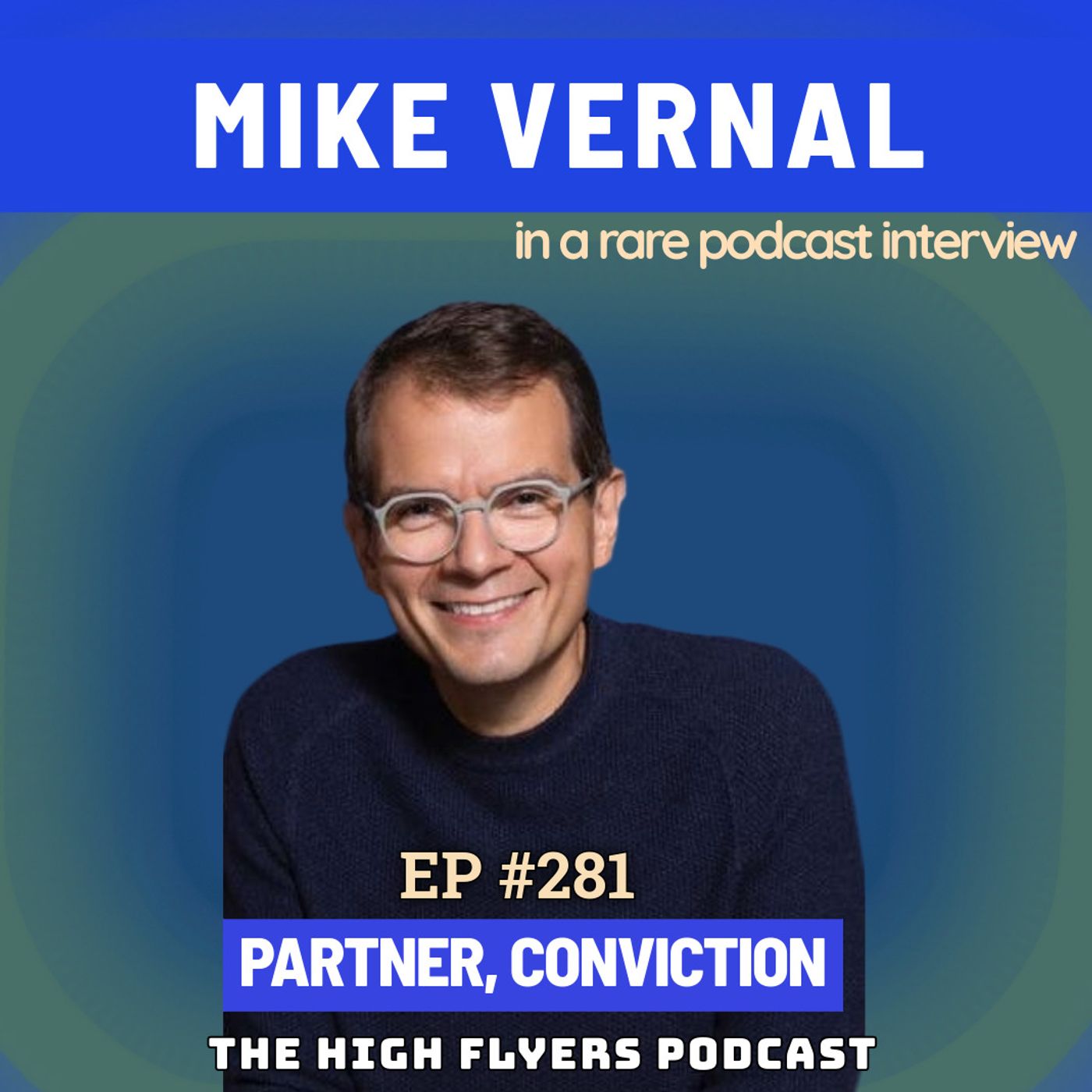
Mike Vernal’s journey from early internet/networking curiosity to founding-era Facebook and later Sequoia investing, arguing that the “tech wave” (today’s AI era) differs mainly because startups can and must move faster while still pursuing durable engagement/revenue.
Mike Vernal. Backgrounds: born in Westchester County, NY; immigrant parents (mother from England, father from Chile); studied computer science at Harvard (graduated ~2002); worked at Microsoft on “XML web services” for ~6 years; joined Facebook in 2008, helping shape engineering culture and shipping cadence; later became an investor at Sequoia and now works at Conviction Partners as an early-stage tech investor in Palo Alto.
early Facebook’s optimism enabled ambitious scaling (e.g., Dustin Moskovitz casually discussing re-architecting at 1B users); daily site shipping was a defining competitive advantage; AI-era startups should fight the natural slowdown and reevaluate weekly; durability of engagement/revenue reflects real value; after ~7 years in one environment, risk of overfitting increases.
Dustin Moskovitz’s “billion users” re-architecture comment; Microsoft shipping on 3-month cycles vs Facebook releasing daily (twice daily during London expansion); recruiting ~40–50 Microsoft colleagues into Facebook.
Written by AI. May contain mistakes.
Mike discusses his background, childhood, and early career experiences.
“that have worked with you very closely for many years.”
Mike shares insights about his curiosity for technology and the internet.
“Let's go back to your sunrise, as I call it.”
Mike reflects on his school experiences and how they shaped his ambitions.
“Like you are very knowledgeable on things like the internet, things like the electricity grid in your neighborhood.”
Mike talks about his time at Harvard and its impact on his life and career.
“So, and then fast forward to when you were finishing high school, again, if I met you at age 18, what would I have assumed you'd do with your life?”
The discussion reflects on the importance of being present with children.
“life and go, oh, we should have been so more present with our kids.”
Mike shares insights on his time at Harvard and the differences with Stanford today.
“You must have been together for, I don't know, 20 plus years now.”
Mike recounts the story of how he met his wife and their journey together.
“I mean, this reminds me of, so I proposed to my now fiance in Portugal.”
Mike shares the humorous and heartfelt story behind his engagement ring experience.
“I, when I was graduating my senior year, one, like the economy was not in great shape.”
Mike discusses the valuable lessons learned during his time at Microsoft and how they shaped his career.
“How did you stand out in that environment for someone like Facebook to notice you?”
Learn how to increase your impact in a professional environment.
“One of the anecdotes I used to tell at Facebook, this was 15 years ago, was, you know, people would always ask, you know, how do you get to the next level?”
Discover the pivotal moments that defined Facebook's early culture.
“So Facebook, you were there from 2008, 2006, I think, till about 2018 roundabout, you're there essentially for the rise of Facebook from, I guess, day dot in many ways, right?”
Understand the importance of rapid software deployment for success.
“And that, you know, you hear it talked about in many forms these days.”
Explore how speed and agility can define startup success today.
“the site twice a day because we had started to open a London office.”
Learn about the challenges and insights from transitioning careers.
“slash customer stickiness is less prominent today than it was when you were scaling Facebook?”
Explore Mike Vernal's transition from Facebook to venture capital at Sequoia.
“goes on and as you spend more time in a given job or on a given problem, your competence increases until eventually, presumably, you were very competent at the problem.”
Mike shares insights on learning diverse business models through venture capital.
“One of the people that I spoke to for research said it's the ultimate high-status job in Silicon Valley is working at Sequoia.”
Discussion on the importance of network and evaluating founders' intentions.
“You just build such a wide network because you speak to people all the time.”
Mike reflects on his career, family life, and his continued commitment to supporting founders.
“I think Sequoia, you were there for just under seven years.”
Mike discusses the fulfillment he finds in supporting talented individuals in the venture capital space.
“folks like Parker Rippling and Ivan at Notion and Vijay at Statsig at the time.”
A conversation on the current trends in the venture capital ecosystem and the impact of AI.
“I'm curious to ask you, Mike, like maybe one of the things you're thinking about, I'm definitely thinking about it when I speak to other VCs is like, what is next after AI?”
Mike shares insights on how to build virality into products through quality and attention to detail.
“robotics, things that are very hard, but might paradoxically be easier now that software is so hard.”
Mike reflects on the personal growth he experiences through coaching his kids in baseball.
“Yeah, I've been using it and it's a great product.”
Mike discusses his approach to managing emails and productivity in a fast-paced environment.
“There's read, unread, and then there's starred and unstarred.”
Learn about the importance of prioritizing individuals over companies in career choices.
“I get irrationally impatient when driving.”
Hear the final reflections and appreciation from the host and guest.
“And it kind of embodies I like I'm a big believer in I do a lot of like cell conversations.”

Get the gist, explore an idea or ask about something said.
 Claude
On The High Flyers Podcast with Vidit Agarwal, what are the key points of this episode?
Searching your listeningAutomatic transcript. May contain errors.
0:00Hi, I'm Vidit, the founder and host of this podcast, The High Flies. Good to see you. Thanks for having me. Mike, I am so thrilled to do this because I think you said to me the other day, you haven't done any interviews in a few years. So I should just start by saying thank you for trusting me. I'm excited to be on the show. And also the most common, you know, the most common comment I heard in my research is people said, Mike is the nerd's nerd. What do you think that means? I hope, I assume it is a compliment. I think I was probably nerdier in the past when I was like a full-time engineer, but there are a bunch of things that I like to hack on on the side.
0:38And it's probably some residual from when I was like a proper engineer. I think it's a big compliment and it came from people that have worked with you very closely for many years. What if we could reimagine the traditional notion of a high flyer? Hey friends, welcome back or welcome to the High Flyers podcast, where we do reimagine a high flyer, showcase the brightest and most relatable role models and companies and their journey from sunrise to today. As one of the premier products in our Curiosity Center lineup, providing on-demand intelligence to help you be 1 % better every single day. I'm your host, Virita Aguil, and let's have some fun.
1:24Our listeners have called this podcast a meticulously researched biography unveiling the extraordinary lives and decisions of the most remarkable individuals and companies from around the world. We hope you're enjoying our catalog of 200 plus episodes since we launched in 2020 with many of our guests appearing in rare public interviews. It's now time to explore your curiosity. Please enjoy. Let's set some context, some fun facts. Where were you born and where do you live now? I was born in Westchester County in New York City, which is just north of the city. It's one of the commuting suburbs. And today I live in Palo Alto, which is also a commuting suburb of San Francisco.
2:08Yeah. And we will cover that journey, how that happened. And work, what was your first job and what do you do now? I think my first job was basically like filing at a medical biller. So in the US, there's this like, you know, Baroque system around medical billing. And my job was to literally take pieces of paper and put them in filing cabinets. And today I work here at Conviction Partners. I'm an investor. So I work with early stage tech companies. Absolutely. And Mike, as you know, the purpose of this show is to reimagine the concept of a high flyer to go beyond people's shop titles and celebrate their human story.
2:46Is there a person, you know who you feel hasn't got the recognition they deserve. Who should be on the show in the future? It doesn't have to be on the show. It doesn't have to be on the show. It could be someone unrelated to the show. But do you mean someone in my life that I would want to highlight? Yeah, it could be someone in your work, could be someone in your personal life, could be anybody. I'm sure there are tons. Let me, I will think about it and maybe we can circle back to that. Okay. The last one, someone said they're debating coach from high school. So it could be anyone, But yeah, we can come back to this if you think of someone later on.
3:20But let's, unless you want to answer it now, should we move? The idea is someone who's had an impact on my life that I would want to highlight, as opposed to someone who could be interviewed on the show. This is good. I've never thought about this question so much. Someone who, so when I think of the word high flyer, I think people think of CEOs and presidents, right? but my thesis for the name of the show is we should celebrate people beyond just people at the top of their game, but people actually doing great things every day. So often people will say, family members will say, an easy one is like their spouse.
3:56That comes up a lot. Like people will mention their spouse or their kids or their parents. And then often it's people in their job, like people who do the grunt work that maybe don't get the recognition because they don't have the CEO title or the general partner title, but are doing incredible things. So yeah, there's no real rule around it. People pick, but if you want to skip it, we can skip it. Let me give it some thought as we talk and then maybe we can circle back at the end. Yeah, sounds good. Let's go back to the start. Let's go back to your sunrise, as I call it. So you mentioned growing up in New York.
4:28Tell me, what are your memories of the environment? So I, maybe a little bit of context. So I'm the youngest of four kids. Both my parents are immigrants. So my mother is from England. My father is from Chile. There's probably like a 10 or 11 year age spread between the oldest and the youngest. So what I remember is my family moved around a lot in the decade prior to when I was born. So my oldest brother was born in Chile, which is where I think my family would have lived. And I would have been born if not for sort of like political instability. And so they moved, you know, one brother was born in Chile, one was born in England, my sister was born in Miami, shortly after they, my family moved from Puerto Rico to Miami.
5:18And I was born in New York. I think part of the reason that's relevant is, I think the family moved around a ton in the decade prior to when I was born. And then New York kind of became the point where everyone settled and it was fairly constant for my parents probably lived there for 30, 35 years. And so what I remember, I guess early days, we were, you know, we grew up in a very nice town. We grew up in a sort of small apartment in what otherwise would have been like a very affluent suburb. And so I think there were like six of us in a like 700 square foot apartment. So we were very much on top of each other.
5:59But it was, my parents, as like many immigrant families do in the U.S., were like very, were very focused on education and sort of opportunity. And so they wanted to find the town that had the best schools. And the town I grew up in, Harrison, had pretty good public schools. And so it was, you know, it was a nice sort of suburban town, you know, a nice smaller suburban town, kind of commuting town for New York City. I mentioned to you before we started recording that an anecdote that came up in my research is that apparently you only started talking at age three is that true you know it's I think it is true it's what I remember I you know by virtue of being the youngest of four and everyone being on top of each other is there I just I don't think there was a lot of airtime and so I didn't I doubt anyone was that interested in what I had to say and so I think I mostly I probably mostly kept to myself.
6:52I didn't need to learn to talk because there were other people filling the airtime. And that is definitely, that's definitely true. And then I think I had a, like a fairly strong speech impediment as a kid, maybe not speech impediment, but I think it was hard to understand. I was, I didn't have the sort of the clearest articulation or diction. And so that probably didn't help. So. I've also been told, this one's deeply fascinating. Like you are very knowledgeable on things like the internet, things like the electricity grid in your neighborhood. Firstly, that's awesome. I think that is so unique.
7:29A lot of us go about the world and just forget about these things. But can you pinpoint to when that started, when that curiosity started in your life? Well, I definitely, a little bit of it was born of necessity, which is, especially if you work in tech, especially if you are on Zoom calls, especially if you're ever working remotely. All you need is power and internet, and maybe some caffeine. And actually, I'm also a big fan of coffee. So maybe those are the three things you need, like power, internet, and caffeine. And those are probably three of my hobbies. On the internet side, I think everyone knows how frustrating bad internet is.
8:06And that's probably part of the driver. I think another part is actually when I, in college, I mostly, I studied computer science and I was a systems person. I thought like the most prestigious job I thought of when I was graduating was to be a kernel engineer. And probably had I been a kernel engineer, I would have focused on the networking stack. And so I'd done a bunch of networking work in college. I had sort of TA'd the, both like the undergraduate and the graduate networking classes. So I knew a reasonable amount about networking from a technology perspective. And so one, I've always been fascinated about that.
8:43Two, as many of your listeners probably know, there's this very interesting company in the US called Ubiquity, which builds a lot of the networking gear that people use. It has a very fascinating backstory, which is probably too long for this podcast, but I will say it was founded by a pretty young guy who was an ex-Apple engineer. Today, he owns something like 95 % of the company. I don't know what the company is valued at, but it's probably$35,$40 billion. And he owns the vast majority of it. He also owns the Memphis Grizzlies now. And Ubiquity is basically what you would get if Apple focused on enterprise networking gear instead of consumer hardware.
9:26And so it builds great hardware, it builds really good software, and it is constantly trying to build new, interesting product. And I just love, I think I literally own one of every SKU that they have, and they probably have a couple hundred SKUs, and I'm constantly experimenting with it sort of on the side. Tell me, Mike, if I met your high school teachers, how would they describe the young Mike?
10:01I think I was, it would probably depend a little bit on subject, based on subject. It's funny, today I have a 10-year-old son, and I think he really enjoys math and what they call computational thinking and some subjects like that. And he really dislikes choir. And you might get a similar range of answers for me in high school. But I think I was, you know, reasonably studious and quiet. I think the maybe a little bit precocious. I was definitely like much more kind of bookish and academic than I was athletic in high school. And definitely with like a bent towards like math and sciences. I was not great at, I was probably worst at just like pure, you know, literature and creative writing.
10:54Well, most people would say those passions have worked out okay, right? Exactly. So, and then fast forward to when you were finishing high school, again, if I met you at age 18, what would I have assumed you'd do with your life? probably a reasonable guess would have been working in tech in some form i actually i ended up in high school working at this effectively dot-com startup that was maybe 15 20 miles away i think i started when i was probably a senior in high school and i worked there for three or four years sort of through college to pay for college and so i think the fact that i was working at a startup in high school definitely had some, you know, predictive power.
11:39So that probably would have been the most obvious thing, though I originally intended, especially when I went to college, I intended to be a math major, not a computer science major. But I think computer science ended up being a much more practical, sort of like practical job. And then how did Harvard happen? Was that a, again, a conscious choice to go to Harvard? So I think I'm a, I was very lucky to go to Harvard. My, I'm a very competitive person. You know, I have three kids right now and my kids are unreasonably competitive with each other. I think it's like a biological instinct that as a parent is super annoying because you guys have no reason to compete.
12:19Like my, I have a seven-year-old daughter and a five-year-old son and they're on a baseball team together that I coach. And my seven-year-old daughter at practice this week hit like an amazing line drive. Like it was a, it was a, it was a perfect shot. I was very proud of her. And so after practice, I was complimenting her on her line drive and my five-year-old son for the rest of the car ride just couldn't stop saying, but I've hit like better, I've hit better, better line drives, right? I've hit better line drives. And so the reason that's relevant is I have a brother that's seven years older than me.
12:55and he got into Harvard, he went to Harvard. And I remember the day that he got into Harvard, I would have been like 11 years old and everyone was very happy with him. Getting into Harvard was not a, you know, the town that I grew up in had, you know, one person get in every couple of years. It was not some fancy private school and everyone was very happy when he got in. And so the day that happened and everyone was very happy for him, I think I was in my head was like, well I'm not gonna I'm not gonna get outdone so I sort of decided at 11 years old that I would probably also go to Harvard and so then you know I was lucky enough to get in but it was definitely motivated by my older brother getting in and going there yeah that is so interesting and I love the story about the kids that actually came up quite a bit of my research is that you're very active with your kids just to digress for a second which I think is incredible because you've got a really busy job now and particularly in this era of AI you could be meeting founders every minute of every day.
13:53But I think everyone said you're very present with your kids. And I know your wife has a big demanding job too. So kudos to you for putting that first because so many of us go through the life and go, oh, we should have been so more present with our kids. So just kudos to you. No, my kids are great. I'm sure everyone who's a parent has a similar reaction. And I just, I do my best to optimize for hanging out with them and it is 10 % worth it. totally I bet on the Harvard one something that's interesting you connected me to some of your classmates from Harvard that you've got to know over your time and one of the questions they said is how do you reflect on Harvard now if you could have your time again would you have preferred going to Stanford?
14:35That's an interesting question almost in practice certainly no mostly because I have a bunch of friends from my time at Harvard and my wife I knew from Harvard and you know certainly that would be like a bad counterfactual to explore. I do think it's, you know, the best thing about a place like Harvard is that it is like a convening force for just talented, interesting people. And I think, you know, at the time, you know, late 90s, I might argue that like Harvard was the sort of like most, was the best convening force for the most talented people. And obviously Harvard was not perfect. And there were a bunch of very great people who did not end up going there.
15:17But I had a very interesting class and many great friends from that. I do think the world has changed a lot in the past 25 years. And now if it were for one of my kids, I feel like Stanford might be a more interesting place than Harvard. They obviously, Stanford is more both tech bent and probably like technology bent broadly. And so that's, you know, today the answer might be different. But at the time, I was very happy that I was able to go to Harvard. Can I ask you about meeting your wife? Because that's an incredible story. You must have been together for, I don't know, 20 plus years now. Well, we have known each other for a very long time.
15:56We both went to Harvard. We were both CS at Harvard. She is a year younger than me. So we knew each other then. We didn't start. We were friends after Harvard as well. We both worked at Microsoft after Harvard. And then actually, we both worked at Facebook after Microsoft. She was one of the two people who helped recruit me to Facebook. But we didn't start dating actually until a few years into our respective time at Facebook. So we've been married for 12 years, I think, at this point and together for longer than that, but not since college. I think the obvious question is, I don't know if you want to name her, so I won't name her if you don't want to.
16:31But what have you learned from her? Because you both had really interesting, successful, impactful careers. is? She is. She's wonderful. She's very grounded. I think she's very good at putting things into perspective. And it's really easy in many contexts to just lose grounding and perspective. If you think about in a company, one of the hardest things as you become more senior, if you run a larger and larger organization, certainly if you're something like the CEO, is really knowing what's happening inside the company because everyone is always trying to make you happy and everyone is always trying to tell you what you think.
17:15And as an exec, you constantly have to fight to really understand what's going on and to really have an allergic reaction to people that are sort of telling you what you want to hear. And I think the same is true in life, where it's really easy to become untethered or have a sense of privilege or have a sense of entitlement. And I think she has absolutely none of that and an extreme skepticism towards anything like that. And so that has been really great. As like one anecdote, she might be mad about this anecdote. So we got engaged on a trip to New Zealand and I had no idea how this whole process worked.
17:55And so I went into a store and I bought like a very fancy engagement ring. And I thought the rule of thumb at the time was like three months salary or something like that. So it was like a reasonably expensive ring. And I remember buying it. And when I walked out of the store, I was just like immediately terrified because I had this thing in my pocket that I was terrified that I would lose. Actually, I walked out of the store and I sat outside the store on a bench. And I remember I called up, I think my insurance company at the time. And I wanted to make sure it was insured before I left side of the store because I was terrified of losing it.
18:31And then I took it with me on this trip to New Zealand, which was supposed to be like a backpacking trip. So I had a giant yellow sort of like hiking, camping backpack. And a long story short, when I finally proposed, one of the things she said was like, to the ring, she was basically like, absolutely not. like I have that's like way like I that's like way too stressful to have so she made me return the ring and then she said I have a bunch of rings I can just wear like one of the rings and I it was I think the the person at the store was very sad when I returned and returned the ring but you know she was just she was very skeptical of having some like fancy piece of jewelry and that you know emanates through all of her personality that is such an incredible story I I mean, this reminds me of, so I proposed to my now fiance in Portugal.
19:25We traveled to Porto, which maybe you've been, they've got the seven bridges and a beautiful lake. And I asked all my friends, I said, hey, should I take the real ring or should I take a dummy ring? Because you're traveling and you've got a backpack and all that. And they said, yeah, take the dummy ring. Don't take the real ring. Leave the real ring at home and you can give it to when you come back. So I took the dummy ring and I proposed, I won't give you the whole story. And she looked at it and she's like, is this like a cheap ring? you just got from like Kmart or something? Is this like a$10 ring?
19:54And I said, yeah, because that's what I was told by my friends. I was told to get a dummy ring. And then when he went home, I got the real ring. And that actually backfired on me really badly because she went, you've not put in the effort to get me a decent ring. So clearly our stories are very different. No, I felt relief just because it's very stressful to have, it was very stressful to carry an expensive ring around. I was just constantly terrified. Yeah, totally. I can't imagine wearing that on my finger every day. Like insurance, absolutely. I'd be worried about that too. So Harvard, so 2002, I believe is when you graduated.
20:31And then you, like you said, you joined Microsoft. You were there for six, six years, right? Before you went to Facebook. People know your Facebook success. I'll come to that in a moment. I feel like the Microsoft period is almost glossed over because you had so much success at Facebook. What did you learn from Microsoft that you maybe wouldn't have been able to do at Facebook if you didn't work at Microsoft first? Oh, yeah. The Microsoft experience was a great experience. And one thing that people might not fully appreciate is, so I, you know, I graduated in 2001, 2002. One was really defined by two things.
21:05First, you know, the dot-com bubble kind of popped and crashed probably in early 2001, I think maybe circa March or so. And then obviously September 11th happened actually like the first week of my senior year in college. I think we're recording the 25th anniversary is tomorrow. And September 11th had a big impact on everything. For me, actually the same brother of mine that went to Harvard, then when he graduated from Harvard, he went into the Air Force and he was in the Air Force for 27 years. That had a big impact on me. I, when I was graduating my senior year, one, like the economy was not in great shape.
21:49Like the tech bubble had burst. There were like very few interesting tech companies in the world. And so I, you know, Microsoft was by far the biggest tech company in the world and was somewhat in, was almost like if you put Amazon and Microsoft and Google and Facebook together today, that's what Microsoft was relative to the rest of the ecosystem. And I had interned at Microsoft. And, you know, Microsoft is a wonderful place. It had very smart people. I was like, actually a very hardcore Mac user at the time, still am, but it was probably more out of vogue at the time. And so I went to Microsoft somewhat with a lot of trepidation, because I was like such a hardcore Mac user and more skeptical of things like Windows.
22:37But it was an amazing experience. There were amazing engineers and PMs and the like at Microsoft. And in fact, there were to fast forward for a second to the Facebook experience. I think one of the things, I think one of the values that I brought to Facebook and one of the ways that I probably stood out was I was a reasonably good recruiter. And I probably, I don't know the exact number, but I would guess that I directly recruited, call it like 40 or 50 people that I had worked with at Microsoft into Facebook. And so I would not have had that network if not for that experience. The other thing I learned, and this is a bit of a, I don't mean it to be a, like a negative anecdote, but just like an interesting anecdote is I worked for my first four or five years at Microsoft on what was at the time was called like XML web services.
23:38And it was a very interesting experience because the team was incredibly smart. It was one of the very top teams inside of the company by seniority and by technical talent and the like. But the interesting thing about the group and the product and the experience is we were trying to build something not per se in response to some customer demand or need, but more as like an exercise in strategy. And there was something Microsoft was trying to achieve relative to its competitors. And the thing that I worked on was like an expression of that strategy. And when you are doing that, You know, there's this funny dynamic where if you work in a company, and especially if you're like not one of the more senior people, you always want to be more strategic, right?
24:27Like who wants to be more tactical? Everyone wants to be more strategic. And I remember at the time, you know, someone who was senior to me, I had a one-on-one with them. And they told me in, you know, all honesty, they were like, you know, I'm working on this team because I want to learn how to be really strategic. And the thing that is so dangerous about quote unquote strategy or being strategic is you get fixated on building things that you want because you benefit from them or the company benefits from them. And you lose complete sight of like what an actual end user wants, like what an actual customer wants.
25:09And so it was actually, you know, I worked on this team for four years and I sometimes joke and I'm only half joking that like for the first year that I was on the team, I like didn't understand what we were building or who we were building it for because it was very sort of abstract and complex. And I think what I eventually realized, I think with the benefit of hindsight, I now understand everything we did and why we did it. But I don't think it was as successful as it could have been in the world. And I think that the kind of the core reason was we were very inwardly focused and very focused on how we could win some battle with competitors, you know, competitors like Sun and IBM and Oracle at the time, as opposed to just as YC says, like building something people want.
25:53And that I think was actually very, it took me a little while to unlearn it, but that has been like one of my like most important like product building lessons in my career, which is, I mean, it sounds obvious, but just build something people want as opposed to like building something that you want. The strategic one's really interesting, Mike, because I think you're referring to strategic more from a customer lens, but I was thinking about it also from a career lens because another thing that came up in my research consistently is people said, you're not someone who is interested in the politicking, you're not interested in the dynamics, you want to get the job done and you want to win and you want to succeed, which I think is what is the best way to approach a company.
26:37But then how did you manage that in a Microsoft environment where I think it was much bigger than when you joined Facebook, significantly bigger, where people are probably trying to one-up each other and who's going to get the credit? How did you stand out in that environment for someone like Facebook to notice you? Well, I think there's a different, you know, I joined as a college grad and I was there for five or six years. And so in the grand scheme of things, I was on the much more, you know, I was on the more junior side of things. I think things get more competitive as you rise through the ranks.
27:12But I don't, all of the, a lesson I learned at Facebook, but I think was also true, you know, I worked with wonderful people at Microsoft, but I think it really crystallized in my time at Facebook, which is I was early on the engineering team at Facebook and then was one of their early sort of like engineering leaders at the company. And we spent a lot of time thinking about hiring and leveling and calibration and just building the engineering culture. And one of the things we really tried to focus on was if you can build a culture where everyone is worried about making the people around them better, just like good things happen in a kind of like decentralized property way.
27:58And actually, like I remember one of the things, One of the anecdotes I used to tell at Facebook, this was 15 years ago, was, you know, people would always ask, you know, how do you get to the next level? And, you know, at Facebook, there is this, you know, you were hired as like a level three person. And, you know, people always wanted to get to level six or level seven or level eight or what have you. And the thing that I would always try to describe to people is like the way, like your mental model should be at every level increment. what you have to roughly do is double your impact. And when you're earlier in your career, it is possible to double your impact just by being better at your job.
28:39So like maybe the transition from like a level three to a level four or level four to level five is just becoming a more competent engineer. But at some point pretty quickly, unless you are John Carmack or Ilya Sutskiver, you're like not going to be able to continue to double your impact all the way through eight, nine, or 10. And so at that point, the way you have to think about doubling your impact is basically how do you make the people around you more effective? And there are a few ways of doing that. One is actually like building tools that the rest of the engineering team can use for each of them to become more effective.
29:11And so there's a heavy emphasis at Facebook on like internal tools and the like. The second was in going into some form of leadership. But again, like the point of leadership is to figure out how to make the people on your team more effective and more impactful. And so at the, and then there were a handful of other potential ways to become more impactful over time. But I think the most important thing is if you can instill a culture of like selflessness and just like your job is to make the people around you great. And then by extension, their job is to make you great. I think you can end up with both like a nice place to work, a place where everyone likes each other as opposed to is competing with each other.
29:52And also you just get, you know, you end up with a much more collaborative and collegial is not quite the right word environment than you do one of like sharp elbowed in competition. So Facebook, you were there from 2008, 2006, I think, till about 2018 roundabout, you're there essentially for the rise of Facebook from, I guess, day dot in many ways, right? And I want to connect this to present day because there's probably similarities and differences between how you built Facebook and how you're helping some of your founders build companies today. So I think that's one train of thought. But tell me, was there a conversation with Zuck or with someone else in the company that made you realize this company is different?
30:32This company can become what we know Facebook today. Yeah, you know, I remember there was a, one of the things that is perhaps hardest for people to appreciate about Silicon Valley until you have been here and really spent time here is there's an optimism and ambition and lack of cynicism that can be very foreign to people that are not here. And so I grew up in New York. New Yorkers take great pride in their sarcasm and general cynicism.
31:15Microsoft, when I was there, was like a fairly mature company that was not in a stage of hyper growth. And I remember, and it was also a company that was very measured and very practical about everything. And I remember in my first couple of months at Facebook, there was a, we used to have lunch or dinner. There was a space that doubled as both the all hands room and also lunch and dinner. And it was probably in my first month of the company, I happened to sit down for dinner with two or three people. And one of them was Dustin Moskovitz, who was one of the co-founders of Facebook and then founded Asana.
31:53And the team was talking about, at the time, Facebook probably had 50 million monthly active users. And Dustin was casually talking about, oh, like when we reach a billion users, we're probably going to have to re-engineer this system. And I remember at the time feeling like it was, it felt very presumptuous. It almost felt like something between a sales pitch pitch and just presumptuous. Because, you know, we're at like 50 million users and probably the biggest internet service in the world at the time was maybe 100 million or 120 million people. And so talking about, you know, what we need to do when you're when you have a billion users is kind of if you're, you know, hanging out with a friend in high school, and you were each talking about like, what you're going to do when you're billionaires, it's like, well, hang on, you know, there's a lot to do between here and there.
32:46But Dustin was having this very, you know, So casual is like, well, when we hit a billion users, we're probably going to have to re-architect the system over here because we're going to run into scale limits. And it was actually a very formative moment for me because at the time I was like, come on, guys, can we just worry about getting to 100 million users before we start talking about this crazy stuff? And it was a few years later when we hit a billion users. And I just kept going back to that comment in my head because it was obvious. it was not like a sales pitch by Dustin. It was just, it was clear to him that like given the momentum that Facebook had and the tailwinds and the like, that Facebook was going to get to a billion users.
33:28And that was a thing that I think was true at Facebook, but also in like the, I think for like some of the most successful companies and venture firms and the like in Silicon Valley, there is a, both like an optimism and ability to extrapolate from like relatively small data to realize, okay, this thing is going to work and it is going to become very big. And that, you know, you hear it talked about in many forms these days. Sometimes people are like, you can just do things. And that is not something, you know, where I grew up and when both my like high school education and even my college education, like my mentality on the world was not, you can just do things.
34:19It was much, much more constrained. And I think a lot of the past 20 years has really been like an expanding of the aperture and a like an increasing appreciation for the fact that, yes, you can just do things. And there are people who can just go and decide that they're going to do something ambitious and audacious and they can just will them into existence. They can just make that happen. And so that was very true of the early Facebook team certainly in some degree of contrast to my Microsoft experience. That is such an interesting reflection because you're right. If you go on X today, every second tweet is you can just do things right.
35:00And then sometimes it's not for a positive reason. I feel like the best thing, instead of asking you to rehash history, is to connect your Facebook experience to AI today. So if you could take the, let's say, the 2009-2010 Facebook playbook and apply it into an AI startup today, what would still be relevant and what would be outdated? The interesting thing, at Sequoia I worked with this guy named Doug Leone. And Doug is wonderful. Everyone's making fun of his Novocaine story right now, but Doug is the real deal. And Doug had these 10 rules of venture. I think one of the rules was something like everything just always accelerates or the rate of change only ever increases.
35:49And so one of the things that really set Facebook apart, and everyone always talks about move fast and break things. But one of the core things that set Facebook apart was we shipped the site every single day. And actually, I remember, you know, I joined Facebook in 2008. And then maybe a year after I joined, I was invited to come back to Microsoft and give a talk, a guest talk at their, Microsoft had this sort of annual retreat for the top 100 technical leaders at the company. And I was invited to give a guest talk. And I went to this conference and I explained, this would have been like late 2008, early 2009, the mechanics of how Facebook shipped software and how Facebook released the site every day.
36:31And actually at that time, it had moved to releasing the site twice a day because we had started to open a London office. And, you know, at the time, the web properties at Microsoft shipped every three months. And that was considered a breakneck speed. And most of the products inside of Microsoft shipped every two years. And at the end of this talk, I had the closest I've ever had to a pitchfork mob, because I had all these technical people come up after the talk and explain to me how this was not possible, and that it was a ticking time bomb, and that Facebook was going to implode upon itself any moment now because it was literally just impossible to, you know, to do the QA required on a, you know, a 12 hour cadence.
37:17But obviously it was possible. And I think it was a core, it was like a defining attribute of what made Facebook successful. If you think about AI companies today, I think the overall feel of the moment right now is everything is getting faster and it's getting faster. And, you know, it's something that might've taken three months, six months, 12 months to build in the past, you can now maybe build in three hours a day, you know, a week on the outside. And so I think one lesson to definitely take away is if you think, you know, Facebook, the natural order of companies is to slow down. As companies get bigger, as you add more people, as there's more coordination cost, like the natural order of things is to slow down.
38:03It's one expression of the second law of thermodynamics. And I think one of the things we like, tried very hard to do at Facebook was like fight that slowdown and constantly try to speed up as like some antidote to the natural slowdown. And there's probably a similar thing with AI companies at the moment, which is like, everything is already insanely fast, and it's getting faster. And one reaction might be to try to get your hands around it. and bring order to it. But probably the better strategy is to try to figure out how to constantly move faster as a result of like technology that is being unlocked and created.
38:46And so that's probably, you know, if I were trying to run something in a Facebook-like way right now, I would be obsessed every day or every week with how to move faster and how to just get more stuff done and get more stuff done, not on every three months, let's reevaluate, but almost like on a weekly basis, reevaluate and try to figure out how to speed up. Because that is probably,
39:14I don't know if it's a durable advantage, but it is like probably one of the most important vectors of competition for startups right now is like basically who can move faster in a given space. Would you also say like durability of revenue slash customer stickiness is less prominent today than it was when you were scaling Facebook? I think it's pretty important. I think that's pretty important. So I would not want to go after non-durable revenue. And Facebook's business is more you want durability of engagement and then the revenue will follow. So I always think you want to go after, I feel like durability is often an expression of value.
39:55Not always. Sometimes, you know, if you get someone to depend on you and then you prevent them from leaving, you have durability, but no one's happy about it. So that I think is less good. But I think at its, you know, at like a basic level, durability is like an expression of value. And so I think you always want to go after a more durable engagement and more durable revenue if you can. Take me inside, to come back to your decision making and transitions, take me inside the end of 2015, early 2016. So I think you left Facebook officially in May 2016. where were you at in your career at that point?
40:30What were some of the conversations you were having with yourself and with the people you trusted? Yeah, I had an amazing run at Facebook and I love the company and I think Mark is an amazing leader. When I joined Facebook, it was a few hundred people. It was probably like 70 or 80 engineers. When I left, I think it was 20 ,000 people. So it had grown quite a bit in that time, probably like 100x.
41:00I was definitely, I was a bit burned out at the time. I used to have this rule of thumb. And I think about it less these days. But I do think this is a relevant rule of thumb that I think you can do anything for seven years or up to seven years and sort of get better in general. And then roughly at the seven year mark, you have you run a risk of overfitting for your environment. And for the life of me, I've never been able to figure out who originally said this. But at some point, I heard this anecdote that I think has incredible wisdom embedded in it, which is when you first experience a problem, when you first take a new job, you can think of two curves, like creativity and competence.
41:41And so when you first take a new job, when you first experience something new, you have zero competence in it because you've never done it before. But by virtue of that incompetence, you have maximal creativity. You have the ability to look at the problem in a new way and from first principles because you have no idea what the orthodoxy is. But then as time goes on and as you spend more time in a given job or on a given problem, your competence increases until eventually, presumably, you were very competent at the problem. But your creativity necessarily decreases. Your ability to look at the problem in a new way just monotonically decreases over time.
42:20And this is a hazy analogy because who knows what the y-axis is and what the units are, but there is some sense of at some point those curves probably cross and you're probably reach some competence in a job that you just necessarily lose a lot of creativity. And that's probably a good time to go mix things up and change things up. And again, my rough rule of thumb has been seven years. You can do something for seven years and get better in general and, you know, enabled some transfer learning to new domains. And then like post seven years, you tend to, there's like a high risk of overfitting for your environment and the like.
42:56And sometimes this would show up when I was hiring people at Facebook. You know, if you were talking to someone who'd spent 15 years at Microsoft or 15 years at Google and had been successful there, it was very hard to tell whether that person was good in general and could come into a place like Facebook and just hit the ground running. Or if that person had become good at Microsoft or good at Google. And when they came in, they would just flame out because they lacked the ability to adapt to a new environment. And so I had spent about eight and a half years at Facebook. And I was a little burned out on what I was doing.
43:33I had crossed that seven year mark. I was trying to figure out what I would want to do next. And I thought through a bunch of permutations. Facebook is an amazing company. And I think could easily have spent another decade there and been very happy. But at least at the time, I felt like it would be more of the same in the sense that it would be, you know, maybe managing larger and larger teams and doing new technical tasks, but I'd be running the risk of overfitting for my environment. And so I thought through all these different paths that I could have taken. And at roughly the same time, I'd gotten to know a guy at Sequoia named Brian Schreier.
44:09and I had no, I didn't really know much about venture. I had no aspirations of going into venture to the extent I knew anything about venture. I think I took a dim view of it. I thought it was like a little bit like, like finance bros invests, but Brian convinced me to first, he said, you know, if you ever think about doing something else, you should come talk to us and then convinced me to explore doing venture. And so I, he got me at a good time. My wife and I also had our first kid at the very beginning of 2016. So I took a month or two off on for training to leave. And I used that time to think about what I wanted to do next.
44:46I spent some time with the Sequoia folks. They, they said, you know, if you want to join, we'd love to have you. I think at the time they were the most prestigious firm in the world. And so I figured, you know, if the Yankees come and ask you to play baseball, you should probably give it a try. And so I decided I would give it a try and see what happened mostly because I thought it would be fun to try to learn a completely different career at that stage of life. It's such an interesting transition. One of the people that I spoke to for research said it's the ultimate high-status job in Silicon Valley is working at Sequoia.
45:19And I know you've never chased status. I find that it's such an interesting trajectory. What did Sequoia give you that he didn't get at Facebook? If you think of your career toolkit, and I feel you're the kind of person who sits and reflects on this in a lot of detail, and you probably have diaries about this, What did Sequoia give you that at that point, Facebook and Microsoft hadn't? There is no better way to learn what makes a good business. Like the thing about both Microsoft and Facebook is like you, I think you learn a lot about engineering and building things and you learn a lot about product and how to build products that, you know, billions of people love.
45:57And actually at Facebook, you know, I was lucky enough to be involved with a few revenue products that did very well. I think there was one revenue product I worked on that got to 15 or 20 billion in revenue, which I felt like was pretty good. And then I remember chatting with some illustrious enterprise CEOs at the time who were like, my business is a quarter of that. So you get incredible scale with global consumer businesses. But despite that, I had no idea what made a great business and the diverse set of businesses that could exist in the world. And so there's no better job in the world, I think, than venture to just go out and learn about the shapes of lots of different businesses and what are the commonalities and just like how can you, what is like the intrinsic structure to businesses?
46:50And so that was incredible. And especially in the first few years, that was like a really fascinating thing to learn. I actually think, one, for a lot of execs, it would be spending like two years doing venture would be like, and then going back to operating would probably be an incredible, would just be like incredible education. And then I actually, I think ex-VCs who have started businesses, I think have done like very well. Like there's a guy named David Velez who started NewBank down in LATAM. And he had spent a year at Sequoia before he started NewBank. That business seems like it's done really well.
47:35Christina at Vanta, I think, worked at USV before she started Vanta. Michelle Valentine worked at Index before she started NROC. There are a bunch of VCs that have turned founders, especially like young VCs that spent a couple of years in VC turned founders. and I think part of the reason that they probably over-succeed relative to the baseline is venture is just so good at teaching you what makes a good business. Yeah, and also the network, right? You just build such a wide network because you speak to people all the time. The conviction team said to me that they've never seen you take notes in a meeting, but you can recite every fact in the investment memo afterwards.
48:17How do you do that? I don't think it's not clear to me that not taking notes as a virtue. One, I don't, I find, one, I think I find taking notes to be, I can sometimes fall victim to being a perfectionist. And by virtue of that, if I'm taking notes, then also I have terrible penmanship. And so if I take notes, I'm probably going to use my computer. And if I use my computer, I run the risk of like becoming a stenographer as opposed to a note taker where I will like literally capture the entire conversation. And I'm a fast typer, so I can probably capture like the entire conversation. And so I think it just pulls me out of the moment.
48:56And I think especially in early stage investing, so much of evaluating the company is just getting a feel for the founder. So I probably, this might be just like justification for laziness, but mostly don't take notes so I can just be more present. And I think on the recounting, I used to have a great memory. I have a terrible memory right now. But I at least historically have a pretty good memory for numbers. And I think I can often do a decent job of remembering the P &L and the financials. Yeah, that's what Sarah said to me. She said, it bugs her to no end that you can read the market within minutes.
49:34She might have not. So I think that maybe it's just your engineering mindset, right? Tell me about, you've worked with some fascinating founders. your hits are all time. People can look them up themselves. But you probably also worked with some founders that didn't work out or you learned a lot from. Tell me about some of those stories. How have you improved your own spidey sense as an investor? I do a bunch of angel investing. And one of the jokes I always say is you learn about the company often after you invest, not before you invest, right? Because they tell you all the good things before and then there's a honeymoon period.
50:07And then you get the first update and you're like, two of the bedrooms are missing and the washing has not been done for months. Tell me about how your spidey sense has gotten better as a VC. You've done it now for 10 plus years. I think there are a couple of things. One, I have an ever-increasing respect for ambition. Like you think about someone, you think about someone like Sam Altman and I do not know Sam well, I've never invested in him, but I feel like Sam from afar, I feel like Sam's superpower is ambition. And he has been able to manifest that into, you know, one of the greatest companies of all time.
50:50And, you know, every so often, you know, there was some moment a year or two ago where Sam said something to the effect of we're going to need five to seven trillion dollars in order to like fully realize our goals. And at the time, it was just this laughable number, right? Because, you know, the largest, you know, venture rounds of all time were maybe a couple of billion dollars. So talking about five to seven trillion dollars seemed insane and insane in a very just provocative way. You know, it seemed like the kind of thing you'd say to get attention. And now, one, I think in the next couple of years, like total data center CapEx spend will probably be something like three trillion and probably a reasonable amount of that will go to OpenAI.
51:34And then that number will only, you know, I think the five to seven trillion number was like a cumulative number, not a one-year number. And having the, in a funny way, like having the courage to be like, yeah, I think this thing is going to need five to seven trillion dollars and be okay with people laughing at you. And then in the limit being right is a rare skill. Very few people, very few people do that and do that in a credible way. So ambition is incredibly important. And if you have an under-ambitious idea and you succeed, who cares? I would much rather someone with a very ambitious idea and get 20 % of the way there and still build something interesting than someone with, you know, a median idea and knock it out of the park.
52:16Can I ask what, say if you met me, say if I came and pissed you tomorrow or today, and what would be some questions you'd ask me to truly understand and am I in it for the right reasons? Because I think one of my observations right now is a lot of people are coming into this because there's a lot of money flowing around. There's a lot of opportunities. You can raise rounds relatively easily. You've got a decent track record and you have an opportunity you're going after. But some people are doing it for the wrong reasons, like money sloshing around. How do you test for that when you meet someone?
52:49Yeah, I think that actually that duffetails with the second thing that at least I personally look for, which is to the best that I can to the best of my ability. I only want to be in business with good people. I only want to be in business with people who I want to see succeed. And so part of that is just, I think, you know, some calibration of you have met thousands of founders over time and you have met tens of thousands of people and just, you know, some, some spidey sense based on, you know, first and second and third interactions. A lot of that comes from references. And, you know, references are incredibly important to get at the core of who a person is.
53:31I think you can pretty quickly figure out, is this a person, is this like a beloved person that like people want to see succeed? And that counts for a lot. Like back to the, you know, the Facebook anecdote of wanting to see the people around you succeed. If there is someone like Vijay from Statsig now at OpenAI, Vijay is universally loved. I've never heard anyone say anything bad about him. Maybe the closest I've heard is like designer is frustrated that he like moves too quickly and doesn't respect like the pixel perfection of their design. But absent that, like Vijay is universally loved. And he's also universally loved as like just a great human that people want to see succeed.
54:17And so that's a lot of, I think, talking to references and figuring out. And I haven't met many people that are universally loved that everyone wants to see succeed that are in it for some money grab. Yeah. And I always say nature heals, right? Time does this thing that you always discover the real person when you spend enough time with someone. So you talked earlier about the seven-year career journey in different companies. I think Sequoia, you were there for just under seven years. I think six years, 11 months is what your LinkedIn says. Now, most people said you were pretty happy to retire after Sequoia.
54:56You're back in a very active way with conviction. And I know you're meeting a lot of founders every day. I spoke to Pranav who said he's in meetings with you all the time talking to founders. Again, back to mindset. I love asking transition points. What was the mindset when you were leaving Sequoia? Like where were you at that point in your career? Because you've done Microsoft, you've done Facebook, you've done Sequoia. That's a very successful career by most people's standards. Well, I have three young kids. I think in 2023, they were like seven, four, and two probably. And they're the best.
55:37My kids are awesome. Having the freedom. When I left Sequoia, I actually stayed for two years as a board partner, venture partner kind of thing. And so I was still on 12 boards. And those two years were actually probably the most fun years of my life in the sense that I continued to work with founders I love, folks like Parker Rippling and Ivan at Notion and Vijay at Statsig at the time. But I could usually engineer my schedule to be done at 3 p.m. and then sort of pick up my kids from school and go hang out with them or play baseball or the like. And it was it was the best. I think two things probably shifted it.
56:17One, I like fundamentally or three things probably shifted it. One, I think my default orientation is to just want to help people and want to see people that I think are great and succeed. That's a lot of what I like about venture. The wonderful thing about venture is you get to meet a bunch of very interesting people. You get to decide the people that you think are both insanely talented and good people. And then you get to sort of do everything you can to help them be successful. And that was like, for conviction, 100 % true. I think Sarah is insanely talented, the best early stage investor that I've ever seen.
56:55I think she's a great person. And one part of it was just wanting to see her succeed. Pranav is wonderful as well. Our partner Bella is also great. So part of it is just like all those people are great and I would love to see them succeed. Part of it is it's just like it's a pretty interesting time. Easily the past three years has been like the most interesting of my venture career. And in particular, you know, it's funny, like 2023, 2024 will probably have been, will probably end up being like the best venture vintages of this century. and so there was some element of maybe not FOMO, but just, oh, well, like it's finally getting good.
57:33So those are probably two of the big factors. I think in one of the interviews I listened to, you said you enjoy like you're a better number two. Correct me if that was the wrong thing I heard, but I think something like that you mentioned a while ago. Is that also why conviction was good rather than starting your own firm, perhaps? Yeah, what I mean by that is I like, I think it's probably just another manifestation of the sort of the Facebook engineering culture thing that I mentioned, which is I am much more interested in, like, I'm much more interested in seeing the founders that I work with succeed, seeing Sarah succeed, seeing Pranav and Bella succeed, than I am like, I'm fine, I'm good.
58:17And I don't, you know, I would much rather, I appreciate anonymity. And I think the great thing about, I think the great thing about venture in general and being a board member versus being the CEO and the like is you can do your best to help other people succeed, but you can also, you know, they, the other people deservedly get the spotlight when success happens. And to me, that's the way it should be and is the thing that is best about the business. There are a few examples of this, but it's like, I think the world of Parker Conrad at Rippling, I've known him for a very long time. We went to college together.
58:55You know, the ending of Zenefits was maybe not as anyone, it was maybe non-optimal. And I feel such happiness that Parker has proven everyone wrong and has built an incredible company in Rippling. And same for Vijay and Statsig. Vijay was one of my most favorite people to work with at Facebook. And I always knew he would make a great CEO. And so seeing him build a great company with a great culture and a great product and a great business and then be acquired by OpenAI and then have a very interesting job at OpenAI is just incredibly gratifying. So Matt McInnes helped me with research for this.
59:41And I think he said to me, you're the only independent board member Rippling has, which probably reflects that trust and relationship they have with you that goes back decades. I'm curious to ask you, Mike, like maybe one of the things you're thinking about, I'm definitely thinking about it when I speak to other VCs is like, what is next after AI? Where is venture today? We're coming up towards the end of 26 and entering 27 in a few months. It's become really busy. One of the things I've noticed a lot with some of the VCs over the recent summer break is they're having to take forced breaks. Because previously you could have some time off, right?
1:00:14And you could have the weekend off, you could take the evenings off. Now with AI, it is nonstop and something can happen within minutes. And it can change the trajectory of the next startup being able to build on top of it or alongside it. How do you keep, maybe the better question is how do you absorb information and what are you reading at the moment? and what are the questions you're asking yourself and other people? Because I think one thing you've shown in your career is you're ahead of the curve. Like you've led it rather than followed a trend. How do you keep doing that? Like even in a conviction capacity where you spot the next trend before everyone else?
1:00:55I think the, so I'm a very big believer in, I think of it as a hundred smart people is better than one smart person. And what I mean by that is it's way better to meet a hundred smart founders and listen to them and try to absorb it and use that, synthesize that to sort of get a view of where the world is going than to sit off in a corner by yourself and just prognosticate. That said, it is useful every so often to, it's really useful to constantly be meeting founders and constantly be thinking about what in the world is changing. And then every so often to have some sort of compaction stage where you then think about what is structurally changing in the world and like how that should change what you should be focused on.
1:01:41As an example of this, there was an anecdote when I was at Sequoia of, you know, this may have changed now, but in the early decades of Sequoia, a lot of money was made in semiconductors. And if you look at a bunch of the best companies of the 70s, 80s, 90s, NVIDIA, probably most notably, they were all semiconductor companies at Sequoia. But probably starting with the dot-com bubble, semiconductors were no longer the interesting thing. The interesting thing in the 2000s and 2010s were software companies. But there were still some people who invested for a decade in semiconductors, even though those were like no longer good investments.
1:02:23And so having the ability to take a break every so often and think about things and realize, okay, the game has changed and the game is no longer about semiconductors, the game is now about software is valuable. And so in this context, you know, one thing that I spend a lot of time thinking about is the cost of creating software is asymptotically going to zero. What does that mean for software companies? And then what does that mean for the broader venture ecosystem? And so I've spent a lot of time thinking about things like that. I think it has definitely caused both the broader venture ecosystem and us in particular to think about more hardware companies, more companies that maybe people have not spent time on over the past decade because software has been so easy, for lack of a better word.
1:03:08So that's, I think, where we're spending a lot of time is power, energy, semiconductors, robotics, things that are very hard, but might paradoxically be easier now that software is so hard. Yeah. And I think the most recent one that Pranad was saying given in work time was Instinct, which seems to have captured everyone's zeitgeist. Did that bring back any memories of how do you build a viral product? It's definitely the Facebook experience is very useful there. It gets all all credit. Noah gets all credit, and then Panov gets all credit for finding and partnering with Noah. The virality aspect of instinct, from my perspective, is a little bit accidental in the sense like the virality really comes from the ability to create product, compute is scarce, and so you want to be able to regulate the speed at which people come on board.
1:04:04People look at it from the outside and then decide that it was some insanely clever viral growth hack. And I think like the core lesson from instinct is, is one of like care and taste, which is if you really focus on building something great and iterating it and getting all the rough edges out and getting all the little details right, you can cross some threshold of, you can cross some threshold of delight where, you know, there's an element of the The probability that someone tells their friend about a product is not linear. It is a discrete step function thing where if something is like 98 % good, you're probably not going to tell your friend unless your friend asks you about something.
1:04:46If something is like 110 % good, then you might start raving about it. And just iterating on something until it is 110 % good is hard. And I think it's something that comes naturally to Noah. And I think the reality really comes from the fact that they really work to make it just an exceptional product. Yeah, I've been using it and it's a great product. It's still early and it's probably going to have iterations, but it's good. I'm conscious of time, so maybe we've got a rapid-fire sprint. Should we finish with that? Please. Is there one non-work investment of time and energy that you consider the best in your life?
1:05:22You've talked about family, so maybe tell me about some of your hobbies and maybe even holidays you've done. I think the best one on the family side is baseball. I did not grow up playing baseball. I grew up playing hockey. I didn't know the rules of baseball. I found it dreadfully boring. My oldest son loves it. I have coached him and now his siblings for three years going. And it's just, there's nothing more fun than I, my, you know, I never had the experience of like my parents coaching anything. And the experience of coaching your kids and their friends is just the best. And so that has by far both been the most gratifying and also probably consumed the most time.
1:06:04One thing you want to learn in the next six months?
1:06:09I want to, I was thinking about this morning, I want to, I want to figure out, this sounds maybe obvious, but my son yesterday is, he's just learning how to use computers at school. and he looked at my inbox and he saw that I don't use labels in Gmail. And he was like, how can you not use labels in Gmail? You know, productive people use, you know, label everything. And I was like, no, you know, like I'm incredibly productive at email. Like I am best in the world at answering email. And then I thought about it and I was like, oh man, I back to the like overfitting for your environment. Like I am so set in my ways of doing email that like I need to be more malleable and I need to adapt my use of email.
1:06:57And so I think I have to do a better job of like finding, I need to be willing to automate more of the things that I am very good at. And so being able, being willing to sort of cross the line and start automating more of my job from first principles, rather than just relying on the fact that I've done it for a while and feel like I'm relatively good at it. Please tell us, how do you manage your emails? actually badly at the moment but i'm like fanatically inbox zero i try to answer every email i try to i don't believe in fancy systems i just believe in stars and unread and processing it and archiving it and then it's too long to describe right now but i feel like one folder like you just file i just have one folder i just then you search like your search is really important right yeah back to the memory point i don't have to search that often but it's mostly my inbox has, there are two bits of information on any email.
1:07:49There's read, unread, and then there's starred and unstarred. And so if something is read and not starred, and it's in my inbox, I haven't read it yet. If it's read and starred, it's both important and urgent. If it is starred, it is important, but not urgent. And if it is unread, the moment something is both read and not starred, it's immediately archived. And what about the to-do list? So if something comes out of those emails is how do you manage your to-do list? I try to have my long-term to-do list in my inbox. And usually most things I have to do are already encapsulated in some form of email.
1:08:28And to the extent that they're not, I will send myself an email with a subject line that captures the to-do. I sometimes do a short-term to-do list on a piece of paper, which I have right here, but I try to only have to-do lists, one which is urgent today and then otherwise my inbox. Okay, so you're different to me in that you don't use your calendar as your to-do list. Like I often will put a task in my calendar, like a five-minute block as a reminder. And I find that helps so that I can just see it during the day, each to their own. Is there one AI product you're really enjoying using that is not mainstream?
1:09:02Well, certainly instinct is great. That's mainstream now. Yeah. I guess you try products because given again back to the engineer's engineer, are you playing around with a lot of tools? I should be doing more. I'm trying to think of what is a good example. I think one that I have, it's a company that I work with. So it's a little bit of a cheat. But there's a company I work with called Treehouse. And they're building a platform for building worlds and building games within those worlds. And I love Lego. And there's an aspect of the game, there's an aspect of the product where you can just imagine any world and then any game within those worlds.
1:09:38And if I had more time, I would create more worlds. But there's something about, I loved civilization and SimCity as a kid. And so there's something that's very fun about sort of building worlds and then seeing them come to life. And it's part of the reason that I'm like pretty excited about Treehouse. Last two, one pet peeve. In general? In life. So one for me is I need to be tidy. I hate people that are not tidy. I get irrationally impatient when driving. I just, I want things to be fast and efficient. And I'm pretty bad with slow drivers in the left lane. You know, I'm always trying to figure out how to get between point A and point B as efficiently as possible.
1:10:28And last one, which goes back to the start, the reimagined high flyer. Is there someone you want to call out that doesn't get the recognition they deserve? I think this person gets a lot of recognition, but I will, you know, beyond my wife and my kids and Sarah and everyone I work with who is great, I will give a random story, which is, you know, when I was leaving Microsoft to go to Facebook, Microsoft threw the kitchen sink at trying to get me to stay, or maybe not the kitchen sink, but, you know, I had this, like, these series of conversations with execs at Microsoft all trying to convince me to stay and how I was doing great and people liked me and I was going to be successful and all these kinds of things.
1:11:11Some of the conversations were more over the top than the others. And one of the conversations, one of the last conversations I had was with a guy named Dave Treadwell, who's now at Amazon, but at the time was my skip level at Microsoft. And I hope he doesn't get in trouble for me saying this, but he, you know, we went out to lunch. He asked me about what was happening. You know, He thought about it for a while. And then he was like, you know what? You should go. It's like a great opportunity. I think it's like a very interesting company. And you're young. It'll be a great experience. Something to that effect.
1:11:49And it was just a very generous thing to do because he was a VP at Microsoft. This is definitely not his marching orders to do. I think he wanted me to stay. I don't think he was trying to get me to leave. but he like was kind enough to put what he thought was like best for me over what was best for the company. And it was a standup thing to do. Dave Treadwell is a very standup guy. And it kind of embodies I like I'm a big believer in I do a lot of like cell conversations. I do a lot of interviews. I do a lot of trying to convince someone, you know, not to leave companies. And I'm a big believer in all those conversations that like, you should always put the person first, and then like the company second.
1:12:27And to the extent that those things align, that's great. But if they don't, first and foremost, do right by the person. Great. Great. Thank you. You've clearly thought of that answer. And that's a great story. And that brings us to the finish line. Thank you so much, Mike. I know you're a busy guy. So really appreciate your time. And yeah, kudos for the way you carry yourself. I think people speak well of you and it's confirmed in this chat. So thank you. Thank you so much for having me. Have a good one. That's a wrap. So something in this episode sparked a thought, send it to a friend or colleague.
1:12:57And if you're curious about partnering with us at the Curiosity Center, whether it's this podcast, to our reports, events, and more, and join the ranks of existing commercial partners, including Google, KPMG, Vanta, and others, my details are in the show notes. Until next time, I'm Vidit Agawal, and this is the High Flies Podcast.
This episode is supported by Xero, helping businesses use AI with more control through JAX, its in-platform AI finance partner. Get 90% off your plan for your first 6 months at xero.com/highflyers.
________
Mike Vernal is a General Partner at Conviction and one of Silicon Valley’s most respected operator-turned-investors. He joined Facebook very early, spent eight years there working closely with Mark Zuckerberg and ultimately became VP of Product and Engineering, before becoming a partner at storied venture capital firm Sequoia Capital, where he backed companies including Notion, Rippling, Clay and Statsig.
In this conversation, Mike joins Vidit to unpack the journey from Microsoft to joining Facebook when it was still only a few hundred people, helping scale it through one of the most important periods in technology, and later becoming a partner at Sequoia before joining Conviction. He shares what he learned working closely with Mark Zuckerberg, why Facebook’s obsession with speed became such an advantage, how he learned to spot exceptional founders, and why ambition remains one of the traits he values most.
They also explore why Mike believes people risk “overfitting” to a job after seven years, what Sequoia taught him about great businesses, why he came back to venture after some of the most enjoyable years of his life with his family, and what changes when the cost of creating software starts approaching zero. Along the way, Mike shares the habits, quirks and principles behind his reputation as a “nerd’s nerd”, from obsessive curiosity and inbox zero to the belief that the best leaders make the people around them better.
Please enjoy exploring your curiosity.
_______
Get in touch with us via email at [email protected]
Join our stable of commercial partners including the Australian Government, Google, KPMG,, Allens, Macquarie Capital, Xero, JP Morgan and more.
Show notes and more episodes here
Follow us on LinkedIn, Twitter and Instagram
Get in touch with our Founder and Host, Vidit Agarwal directly here
Contact us via our website
This episode is supported by Xero, helping businesses use AI with more control through JAX, its in-platform AI finance partner. Get 90% off your plan for your first 6 months at xero.com/highflyers.
________
TIMESTAMPS
00:00 — The Nerd’s Nerd
04:00 — Growing Up in New York
08:00 — Power, Internet and Caffeine
13:00 — Working at a Startup in High School
14:00 — Why Harvard Became the Goal
18:00 — Meeting His Wife
24:00 — What Microsoft Taught Him
31:00 — Why Strategy Can Go Wrong
33:00 — How Facebook Built High-Impact Teams
37:00 — The Moment Facebook Felt Different
43:00 — Facebook’s Speed Advantage
49:00 — Why Mike Left Facebook
54:00 — Why Sequoia
56:00 — Learning What Makes a Great Business
59:00 — Why He Doesn’t Take Notes
01:01:00 — What Mike Looks for in Founders
01:07:00 — Leaving Sequoia
01:09:00 — Why He Joined Conviction
01:14:00 — How Mike Spots What’s Next
01:16:00 — When Software Costs Approach Zero
01:18:00 — What Makes Products Go Viral
01:20:00 — Coaching His Kids
01:22:00 — Inbox Zero and Productivity
01:25:00 — What Mike Is Experimenting With
01:27:00 — The Advice That Changed His Career
________
The High Flyers Podcast features in-depth interviews with the world’s most influential figures in business, tech, finance, government and sport. Launched in 2020, it has ranked in the global top ten for past three years, with listeners in 27 countries and over 200+ episodes released, and featured in Forbes, Daily Telegraph, and at SXSW.
Our guests include -- Malcolm Turnbull (Prime Minister of Australia), Keith Rabois (Managing Director, Khosla Ventures), Jason Collins (Head of BlackRock, Asia Pacific), Brad Banducci (CEO, Woolworths), Michael Schneider (CEO, Bunnings), David Eckstein (CFO, Legora), Kevin Hartz (Partner, A*; Founder, Eventbrite), Shiv Rao (CEO, Abridge), Jesse Zhang (CEO, Decagon), Vandita Pant (CFO, BHP), Elena Verna (Head of Growth, Lovable), David Haber (a16z Partner), Jodie Auster (Uber's Global Head of Travel), Rob Giglio (CCO, Canva), Jean-Michel Limieux (CTO, Shopify and Atlassian), Stevie Case (CRO, Vanta), Cristina Cordova (COO, Linear), Gautam Chari (Head of Capital Commitments, Bank of America), John Haddock (CBO, Harvey), Mark Suster (Partner, Upfront Ventures), Niki Scevak (Partner, Blackbird), Craig Tiley (CEO, USA Tennis), Jeanne DeWitt Grosser (COO, Vercel), Paul Bassat (Partner, Square Peg), Bowen Pan (Creator, Facebook Marketplace), Peter Varghese (Secretary of Foreign Affairs, Australian Government), Sam Sicilia (CIO, Hostplus), Jack Zhang (CEO, Airwallex), Tim Doyle (CEO, Eucalyptus), Sukhinder Singh Cassidy (CEO, Xero), Sanjeev Gandhi (CEO, Orica) and Philip Green (Australia's Ambassador/High Commissioner to India).