Ask ChatGPT
 The High Flyers Podcast with Vidit Agarwal
22 Sep 2026 · 1h 7m · 20 chapters
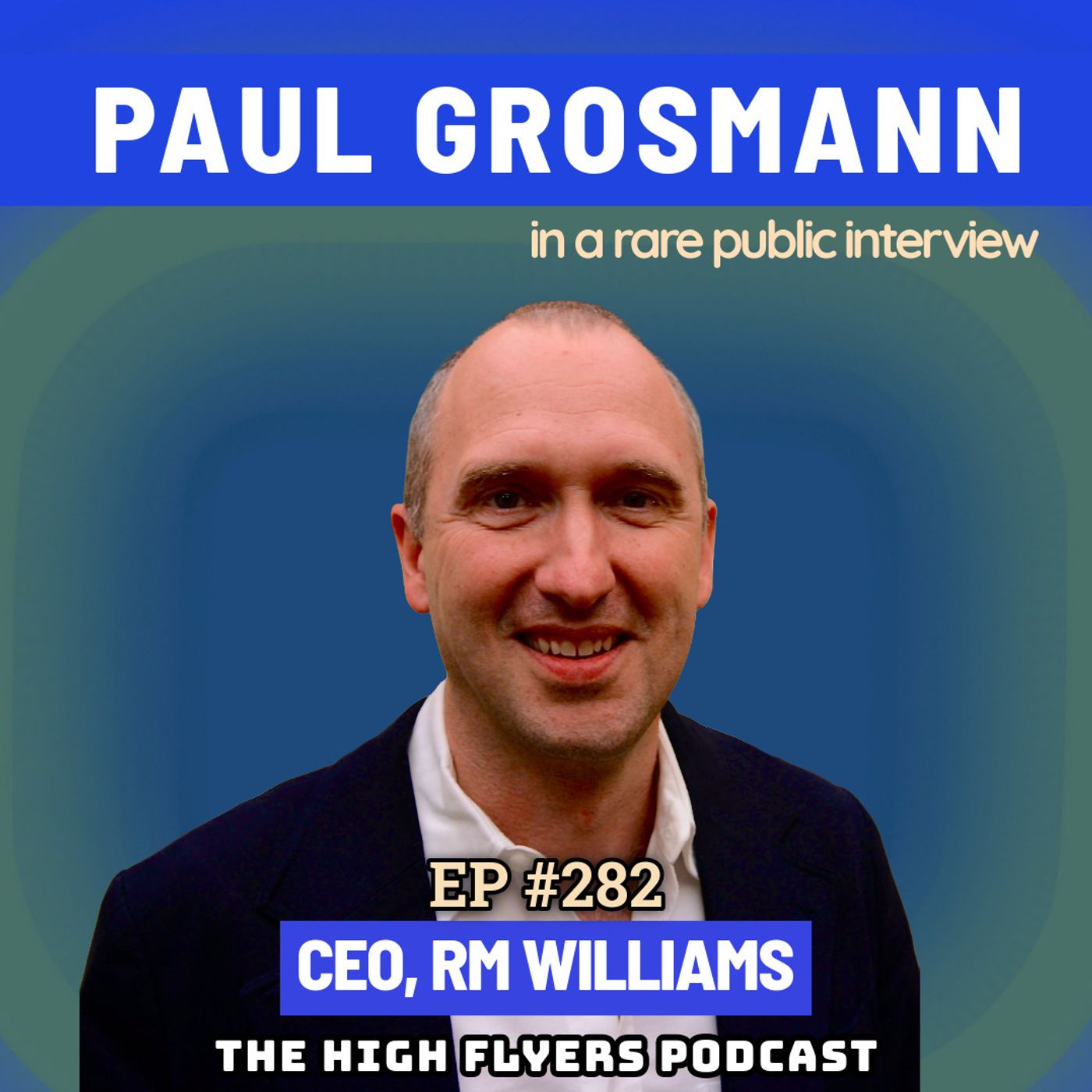
Paul Grosmann (CEO of RM Williams) discusses how he built his career through cold emails, international moves, learning Mandarin, and developing “listening” skills; he contrasts private vs public-company leadership and offers practical advice on pausing before answering.
Paul Grosmann is CEO of Australian heritage bootmaker RM Williams (94 years old). He grew up on Sydney’s North Shore, is the oldest of three siblings, and played basketball in high school. He studied economics/social sciences and later finance (USyd/UNSW). Career includes PwC (Sydney then New York), McKinsey (New York then Shanghai; learned Mandarin for a China interview), then retail operator work with Brett Blundy, followed by Nike China (about six years). He speaks fluent Mandarin.
Cold emails and intentional outreach work when respectful of time and framed as seeking help. Effective listening includes deliberate pauses. Mandarin learning and cultural immersion were formative. Private-company decisions are faster; public-company matrices require “cut-through” leadership.
studying Mandarin in Kunming/Beijing after McKinsey required Chinese proficiency; 11pm Christmas Eve retail setup with Brett Blundy for Boxing Day; pausing to let others think; getting a director-to-VP acceleration at Nike via structured problem framing and alignment.
Written by AI. May contain mistakes.
Exploring Paul Grosmann's background, career path, and cultural influences.
“in Williams, so maybe I shouldn't have mentioned that.”
Discussion on how Australian culture and international experiences shaped Paul’s career.
“That's xero.com forward slash highflyers.”
Paul shares insights on gaining international work experience and personal motivations.
“China and started studying the language.”
Paul discusses his experiences integrating into Chinese culture and overcoming challenges.
“You've moved countries, you've moved company, you've started a new job, new language.”
Paul reflects on the importance of mentors and how they shaped his career.
“there are more similarities than with working in the US, for example, I think in many ways, than there are to other parts of Asia.”
Paul emphasizes the value of intentional networking and effective listening in professional relationships.
“or from word of mouth that are good in that space and seeking them out directly.”
Learn about the challenges and experiences of moving from McKinsey to a more operational role.
“it was time to return back to Australia for a stint.”
Explore the contrasting paths of consulting and retail careers, and their implications.
“chief of staff type role, but it was an office of four people.”
Discuss the stigma around retail roles and the value of P&L responsibilities.
“And sometimes what it is that you don't want, like that you sort of, I don't know if you're running from or you're transitioning from that you're not looking to repeat.”
Analyze the differences between working in a private company and a multinational corporation.
“I mean, if you're running a Coles or Bullwit store, most of them are doing like a few million dollars turnover, right?”
Understand the decision-making processes in private vs. public companies.
“but then served me so well in terms of the R.M.”
Gain insights into the challenges faced when transitioning between different company structures.
“consulting to private company to nike because when i reflect in my career so i went from working at the Colts head office to a private startup to Procter & Gamble.”
Learn about the journey and networking steps taken to land a job at Nike China.
“I want to ask you about how you got the Nike job, because I've been told there's a great story there.”
Learn about the importance of strategic cold emailing and networking in career advancement.
“It all sort of fell into place pretty quickly.”
Discover the significance of personal support systems in professional success.
“And then when the Tatarang bought RM Williams, I got in touch with John Hartman, who at the time, he did the deal on behalf of Andrew and Nicola Forrest.”
Get insights on the business trajectory and growth strategies of RM Williams.
“But, yeah, please give Sophie some recognition.”
Explore how RM Williams aims to engage younger customers while maintaining brand heritage.
“And to your question on the channel, that's been a combination of digital, our own retail and with wholesale partners.”
Learn how R.M.Williams engages a younger demographic through branding and product strategy.
“And I was just so proud because it meant that actually there is a – we are tapping into a younger customer here that is, like, really wanting to wear our product.”
Discover the unique approach R.M.Williams takes in expanding store locations and managing economics.
“different demographics and genders and ages.”
Get personal insights from Paul Grosmann on investments, learning, and hiring.
“And I'm not saying it's working like a charm.”

Get the gist, explore an idea or ask about something said.
 Claude
On The High Flyers Podcast with Vidit Agarwal, what are the key points of this episode?
Searching your listeningAutomatic transcript. May contain errors.
0:00Hi, I'm Vidit, the founder and host of this podcast, The High Flyers. And I'm Paul Grosmann, the CEO of RM Williams. I'm thrilled to do this, Paul, particularly because you don't, I mean, you've done maybe one or two interviews in your life. So I am deeply honored. Thank you. Thank you. Yeah, I do steer clear, but no, I'm honored to be asked to do this. So thank you. One of the interesting things that came up in my research that I'm really keen to unpack with you is people said you're very good at sending cold emails. That's something I have done through my career. I actually went back to my school last week and I spoke to the year 11 of students and they said, hey, in the age of AI, what is relevant?
0:33And I said, send cold emails. So I'm really keen to ask you because I've heard some of the jobs you've got have been started off as cold emails, right? Yeah, that's been my go-to. Yeah, I mean, you might get a bunch of cold emails after this because the jobs that are in Williams, so maybe I shouldn't have mentioned that. Hey friends, welcome back or welcome to the High Flyers podcast, where we do reimagine a high flyer, showcase the brightest and most relatable role models and companies and their journey from sunrise to today. As one of the premier products in our Curiosity Center lineup, providing on-demand intelligence to help you be 1 % better every single day.
1:15I'm your host, Virita Agarwal, and let's have some fun. Our listeners have called this podcast a meticulously researched biography unveiling the extraordinary lives and decisions of the most remarkable individuals and companies from around the world. We hope you're enjoying our catalog of 200 plus episodes since we launched in 2020 with many of our guests appearing in rare public interviews. It's now time to explore your curiosity. Please enjoy. Let's set the scene with some fun facts. Where were you born and where do you live now? So I was born in Sydney's North Shore. My journey has taken me for a long time out of Sydney, but returned home five years ago to Sydney's Northern Beaches.
1:58And yeah, we will talk about that. I mean, New York, China, all over. And work, what was your first job and what do you do now? My first job was stacking fruit and vegetables in a Sydney fruit and veg chain. And now I am the CEO of RM Williams. Do you want to just, I mean, people know RM Williams, but if there's one or two people on this planet that might not. Do you want to just give a recap on the brand? Yeah, it's a good call out. So RM Williams is an Australian heritage brand, 94 years old, and we make the greatest boot in the world. You do? I mean, you should actually get that sentence trademarked.
2:30Maybe you're a bit... And Paul, as you know, the purpose of this show is to reimagine the concept of a high flyer, to go beyond people's shop titles. Is there a person you know who you feel hasn't got the recognition they deserve? Yeah, the first person that comes to mind is my beautiful wife, Sophie, who epitomizes the definition of high flyer in absolutely everything that she does. And selfishly, no small part of that is how she partners and supports me. So I'd definitely love to shout out to her. Absolutely. And I am very envious because my dream was to be a tennis player when I was a kid. I was nowhere near as good as she was.
3:08No, she, a former professional tennis player is far more gifted in almost everything she does than I am, which is humbling and inspiring at the same time. Back to the episode in a moment. Something I've heard a lot from business owners and leaders is that speed only matters if you still feel confident in the output. And it's particularly an important point in this world of AI. Zero's answer to that is accountable intelligence. AI that shows you what it's doing and works from your own real data and is designed to keep you in control before anything happens. As Xero puts it, most AI asks you to trust it, accountable intelligence shows you why you can.
3:51And that's how it works with JAX, Xero's in-platform AI finance partner. So whether you're running the business, advising the client, or working with your board, JAX ensures that you get the upside of automation without giving up any of the control. If you want to see this practice, head over to xero.com forward slash highflyers for 90 % off your plan for the first six months. Terms apply and go to the website. That's xero.com forward slash highflyers. Now back to the episode. All right, let's wind back the clock and go to your sunrise as I call it, your childhood, your upbringing. You mentioned the nature of Sydney.
4:34I've been told that you've got a very tight family unit. Tell me about that. I'm very fortunate to have, I grew up in a loving family. I'm the oldest of two brothers and a sister. And I think fortunate family has played a big part because that was my immediate family. But my mother was from a family of 10 kids. And so would have had over 40 first cousins, big Italian family that was everything that you could imagine from a stereotypical Italian family, loud, highly opinionated, very close, place high value on family and community. And I think I was fortunate to grow up in that environment because it taught me a lot about the importance of being confident, dealing with different personalities, valuing community and family.
5:16So yeah, very fortunate upbringing. Tell me a bit about your parents. What did they do for work? So my mother was a teacher through, she taught English and Latin and then worked in the travel industry. My dad, who since passed away, also worked in the travel industry and did various jobs afterwards, but was always very good with his hands and making things and was very excited the day that I decided to join RM Williams. I bet. One of the interesting comments, you connected me to one of your brothers. He said to me that Paul had dedication, but he had talent. Is that true? I think he was referring to sport, particularly basketball.
5:54My brother is generous in his praise and one of the funniest individuals I know. I'm not sure how much talent, maybe a bit of luck, a bit of talent. He mentioned basketball was quite a central part of your upbringing. Is that right? We as a family loved it. I loved it. I was obsessed growing up. And I think that's probably one of the, you know, early on, I did realize that I did have a lot of passion and drive for certain things. And that was certainly one area that it wasn't just being engaged in the sport, but wanting to play and working hard and realising that the hard work can pay off when you do put your mind to it.
6:28And how seriously did you play basketball? Like, was that potentially a dream to go professional? Mate, it was a dream, but it was never going to be a reality. So it provided a very healthy environment to grow up and a healthy passion to have. And honestly, I think that it was never going to go beyond high school. But what it has done is actually given me a passion that I'm sharing with my kids these days who have equally fallen in love with it. And that's been special to have that passion as something that can be shared in this next phase of the journey. Absolutely. I mean, I know you lived in the US for a while.
7:05You hopefully saw a bunch of basketball games there. I did. That's where I did become a tragic Knicks fan, which was redeemed this year. Yeah. It took a long time to get there. But yeah, spent some time in the US, fell in love with their passion for sport, their passion for life more broadly. I think there's just an incredible energy that that place has. I know they're going through a lot of challenges at the moment, but there's something incredible about the energy, the innovation, the positivity for the most part that embodies not just the US, but New York in particular where I was living. Totally.
7:35And I was going to actually ask, I was amazed in my research about your global, like people talk about being a global citizen. You've actually lived that. And I also found out that you can speak fluent Mandarin. So I'm curious again, back to childhood. Was that something consciously you wanted to do? Like experience the world and new languages and cultures? I didn't travel overseas until I was, I think my first overseas trip was maybe not until I was 18, but then quickly fell in love with it. It was started just traveling with mates and then just had a real passion for it and ended up I've spent, I haven't worked it out exactly, but it must be over 20 years of my life living in different parts of the world.
8:10So it's interesting when you do these discussions that you reflect back and sometimes it's hard to disseminate that early journey. How much of it was driven by a personal yearning to explore different environments and how much of it was a professional one. And I think the two sort of blend into one a little bit. Yeah, I mean, I'm keen to ask you, like, as we chat today about when you think through your roles, like how much of that Australian culture played a role? Like you mentioned the US, I spend a lot of time in the US now. And Aussies, I think we stand out and cut through in a really positive way where we're relatable and we're disarming and we're not chest beating a bit.
8:41But then you also in China, right, which is, again, very different. Like the Western attitude of confidence is almost defined differently in China. Right. So I'm really keen to ask you, like, how are those cultural nuances as you scaled in your career? It's a great question. I think, firstly, we're very fortunate as Australians to, in general, have a great reputation in a lot of places around the world. And so we're off to a very advantaged start in terms of like we're typically received well when we first arrive. So that, whether it be in New York, whether it be in China or in Singapore, I think just when you can have a really positive start like that, that just helps to create a really positive experience overall.
9:19It's funny when I first started living overseas, it brings a different understanding and a different dimension to understanding an Australian culture. because by nature, you just start to, whenever you interact with another Australian overseas, it doesn't matter what their background is, but there is an ease of just sort of mutual relatedness and understanding that it's difficult to describe and you only know it when you're there and you do it. And so I have to say, you know, in the early days, my friendship grew skewed disproportionately to Australians, but then the longer I stayed there, the deeper some of the relationships and some really strong bonds that, you know, with some of the Americans that whether we're living there.
9:54But yeah, it's a privileged and it's a very unique thing, the Australian culture. Absolutely. And I mean, I'd say I appreciate Australia more when I go overseas, right? I think when you live here, we have a tendency as human beings to complain and not appreciate things. But then you land back in the country and you go, I am so happy to be home. Again, that's something I want to ask you as we talk about your career. Like you were away for very long periods of time, or maybe you came back once a year or twice a year, right? So I think that'd be interesting as we chat today. And tell me about entrepreneurship as a kid.
10:22I think that came up a lot of my research. So Harris Farm Markets, I think is your cousins. They started that. I think your uncle ran a plastic business, I believe. So what was that like seeing all your cousins and uncles and aunties being entrepreneurs? Did that influence you in any way? It definitely. So it did a couple of things. So yeah, I did. I was fortunate enough to have in that big Italian family, a lot of really strong entrepreneurs, men and women. And my grandparents were very much that way as well. Both my grandmother and grandfather were very successful in their own rights. And I think this did a couple of things.
10:54It one gave me very, it gave me opportunities to dip my toe into various industries and get a taste of early work experience and apprenticeships, which was a privilege. And then secondly, it also, you're right, just it changes the dynamic of the discussion, what you're exposed to and creates a passion and just a sense of like what could be at an early age, which I think is also very fortunate. And so tell me if I met you at age 18, so you're just finishing high school, what would I have assumed you'd do with your life? I had no idea. At that point, other than a passion for traveling, I didn't really know what I wanted to do at university.
11:29I think I did generalist type degrees. Didn't really apply myself, if I'm being honest. I didn't enjoy it that much. I enjoyed I worked multiple jobs while I was going through that phase. And then post-university, I think my first job was in consulting. And that's also quite a generalist job in many ways. I loved it because it gave a breadth of opportunities, a breadth of clients, breadth of people, projects, an incredible apprenticeship, but far from clear what I wanted to do. And so sort of the generalist path was where I was tipping my toe into. And so what did you study at university? I studied economics and social sciences, and then I did a master's in finance afterwards at University of Sydney and then the University of New South Wales.
12:07Right. Because I was told in my research, because you connected me to your best mate and your brother, they both said your dream was to be a cadet at a big four firm. That was always their dream. Is there any truth to that story? I probably just said that. I don't know if it this actually. I think it's one of those fake it till you make it type things. I remember applying to a wide array of different jobs got rejected a lot. And so I think I just repeated those dreams. And then when it actually came off, then you couldn't be disappointed or proven wrong. But I did really enjoy the consulting space and I loved it.
12:37I loved it for a long time. And I still think of it really fondly today. So that was definitely a big part of what I wanted to do in the early years. I think you're referring to PwC because you were at PwC. I started at PwC in Sydney and I transferred to the New York office after 12 months. They were incredible because from memory, I actually interviewed in that Sydney office and was extremely open saying that I'm interviewing because I want to go and work in New York and I'm hoping that this can facilitate. Quite frankly, if I was interviewing myself back in those days, there's no way I would have given me the job.
13:06But I think back at the time, maybe I didn't have as many applicants. So that was great. And then after a couple of years in New York, I was exposed to a team from McKinsey and there was one individual in particular, a guy called Michael Rennie, who was just, I found to be an inspiration and decided that that's what I want to go on. I want to go and follow in his footsteps. And so I sort of hunted down that opportunity and did another, I think it was another four or five years at McKinsey post that. Just on the New York one, because you did that New York stint, but you didn't come back to the US, right?
13:35Post that you went to China and then you were mainly in Asia. Is that right? I loved New York, but as I mentioned earlier, I think the early parts of those journey was really driven by the personal experiences of being in different cultural environments, even more so than a professional, and decided after a while in New York that I really wanted to go and work in China. So when I was interviewing for McKinsey, I said to them, I want to interview for the Shanghai office. And they said they were open to it, but you had to do the interview in Chinese. And so I quit my job, moved to the city called Kunming in the west of China and started studying the language.
14:04I studied the language for 12 months, came back and did the interview. And it was far from perfect, but I think they must have had a little bit of sympathy given the effort that I'd gone to and the ambiguity through that 12 months and ended up giving me the job and started in that Shanghai office. I have heard great stories about how you got that job and I want to come to that in a moment. I am curious though, let's assume I'm just graduating uni. I'm not, I'm much older, but let's assume I am. And I come to you and say, Paul, I want international experience. Given you've worked in US, China, Singapore, Australia, what would your advice be to me hypothetically about where I should start outside Australia?
14:40I think it depends on, one, the reason that you're, what your motivation is to go and work outside of Australia. If it's professional, if it's personal, if it's a bit of both, I think really is one important lens to view where you would go. For me, it was probably skewing more towards the personal. And so I was keen on New York. And then the second one was, you know, probably starting to lean more professional in terms of what China was becoming. This was back in 2007, 2008. I think the other lens that's important is it's often what you want to go and do overseas. And I've seen all different sorts of examples of people leveraging the current job that they've had as a stepping stone to a great opportunity overseas, which may not give you the breadth of exactly where you want to go, but gives you the overseas experience.
15:23And then I've seen the other braver individuals that have just got something in mind and they quit their job and they go and jump at it. I don't know if there's one well-trodden path that works better than others, but I think it's each their own. And it really, it comes down to, you know what's the real motivation i feel i mean the conversation i have a lot of people want to go to the us or the uk and maybe it's cultural good single speaking i wish more people did what you've done and go to china i mean singapore you get a bit because that's a fairly multicultural society but i don't hear many of china or india or countries like that which are quite intimidating kudos to you and maybe you can tell us how you did it because i actually heard i think you're again too humble and you've you've given me a very short summary earlier but i heard you moved to China with no job.
16:02So the McKinsey job fell through and you had to go there on your own and essentially knock on door. Is that true? It hadn't fallen through, but it was, they weren't going to give me the job. They said, but they'll, they'd give me an interview once I was proficient enough in China. So that was the agreement, but it was essentially all on my own bad. So there was just as much chance that that interview didn't go well. And then the whole year would have been, you know, in terms of from that specific job opportunity for nothing. I was clear that just as much of this was called a personal development opportunity and experience.
16:31and honestly, I look back on it as one of the most challenging mentally, emotionally from going, you know, having some of my best mates in the world with me in New York and, you know, going out and having the time of our life, great job, to going and being in this. I have visions of like remembering like moments in this apartment trying to study Chinese, not being very comfortable in the apartment that I was in, sometimes struggling to even order meals and there were some dark stages to that journey that I found really, really tricky but I also reflect on it now and look back on it is just some of the most formative in terms of what it did for me as a human.
17:04And so how did it play out? So you studied Mandarin full-time for a year and then you applied to McKinsey again? Yeah, that's right. They were sort of keeping tabs on what I was doing. So about six months in, I went back to Shanghai and spoke to them and they were just sort of testing how I was going. And they suggested that I might be better off moving to Beijing where it's a little bit more intense and a little bit more structured, a little bit more, I guess, professional in their approach. So I did that. So I moved after six months to Beijing, an area called Wudakou, which is where a lot of the universities are in the northwest of Beijing, and studied at one of the universities there.
17:38And then, yeah, after six months of that, came down and did a round of interviews and finally got the job and then moved down to Shanghai after that to start in the Shanghai office. I mean, that sounds like a flurry of change all at once, right? You've moved countries, you've moved company, you've started a new job, new language. We in the business world joke that sometimes it sounds like speaking French when you hear new acronyms, but this was literally learning Chinese from scratch. I mean, you said those moments being in the apartment and did you go to China by yourself or had you met Sophie by this point?
18:10No, I hadn't. I was single, which probably gave me the optionality to be jumping around and be selfish in what I was doing. So no, I was single at the time. I literally didn't know anybody in Kunming, Beijing. I knew some people in Shanghai when I eventually got there, but more acquaintances than anything else. So how did you, I mean, I've interviewed many people on the show and they say adjusting to China in particular is really challenging. Also being a foreigner, like they don't trust you straight away. You've got to earn that trust. Like I had a lady come on recently, Caroline Robinson from CultureAmp, and she's talked about how she tried to do offsite in China and she went in as the CFO and she thought, oh great, they're all going to give me feedback.
18:49They just sat there and did not give her any feedback. It was the worst offsite ever. And she had to walk away going, okay, I need to earn their trust for them to speak up and share candor. I mean, I don't know how senior you went into McKinsey, but tell me, how did you integrate yourself into the culture? The first thing I'd say is, and it was not all sunshine and roses, but for the most part, I always felt really welcome, really well looked after. Before I even started working, there are some extraordinary stories of, you know, I'm trying to get my way to the university and people just go out of the way and will literally travel with me for 20 minutes out of their way to help me find where I need to go.
19:25There's another fond memory I have of going in to get a haircut. I had a lot more hair back then than I do now. But going in to get a haircut and not being able to speak a word of Chinese and having three guys around me, you're desperately trying to use sign language to work out what I was going to get for my haircut. And I was just at the time imagining if a Chinese guy who couldn't speak English had come into a barber in Sydney's Northern Beaches, would he have got the same treatment? I'm pretty sure the answer would be no. So there was a lot of like, I had a lot of amazing experiences as well, just in terms of in general, felt very welcome.
19:55And then later when I came back with my family, it was much the same. On the cultural side of things, super tricky, but interestingly, especially compared to other parts of Asia, I think working in mainland China, there are more similarities than with working in the US, for example, I think in many ways, than there are to other parts of Asia. Of course, there are nuances and challenges and instances of needing to learn to gain trust. But I fundamentally believe there are more similarities and there are differences in these cultures other than the really obvious language. I agree. I always say humans are the same all around the world.
20:25We have all the same fears and desires and goals, right? So generally understanding that helps. Tell me about the role. I think one thing is really interesting in your journey and it's been true in mine too, is the role of mentors and people who've believed in you before. Perhaps you believed in yourself. And I think that one of the early ones was Michael Rennie, I believe, if I've got his name right, from BWC slash McKinsey. I think you referenced him earlier. I heard in my research that he played a big role in forming some of your people management and leadership beliefs. Is that true? And if so, can you reflect on that?
20:55Yeah, it's interesting when I think back to those earlier career milestones and career stages. For me, they were disproportionately driven by individuals and seeking out individuals than they were organizations or specific opportunities. And so, yeah, the McKinsey one was driven by Michael And what I found so inspiring with him is that he had carved out this niche within McKinsey that sort of blended organizational design and behavior with sort of the more the behavioral side of things and organizational dynamics, which I just found really, really fascinating in contrast to sort of the more, you know, the nuts and bolts of the McKinsey sort of strategic work.
21:32And so I was just so inspired and sort of sought him out. And he was, you know, to this day, remains an incredible mentor that helped me, you know, with that foray into McKinsey. and similarly post that. It's funny, I've never in my evolution of just sort of different jobs, I don't think I've ever gone to a new job opportunity for promotion, for money. In fact, most of them, I've either gone sideways backwards and the next job after McKinsey, where I sought out a guy called Brett Blundy, who's for those that don't know retail is probably Australia's best retailer. I actually think for the first two years, I didn't even have a job title working for him.
22:04So it was disproportionately driven by chasing individuals and what they stood help where they could help me grow more so than anything else. I'd love to unpack this. I joked at the start about your cold email technique. When I think of my journey, a lot of it was thanks to my dad. He made me open a LinkedIn account when I was a teenager and he always said like, go out and meet people and have coffees. And that kind of is why I do this podcast because I just want to learn. And for many years, I learned no money attached to it. How have you seeked out these people? And we don't have to just focus on McKinsey.
22:34We can talk about any period in your journey because as you know better than most, when you get to a certain age and stage in your career, it can be easy to go, oh, I'm senior now. I know the answers. People come to me for answers. Why do I have to go to someone? Whereas you seem to have always seeked out these people and frankly, taken the hard jobs and moved countries every few years. How have you done that? Like in practice, maybe compare back then to now, like, what does that look like? Do you find people and then email them and grab a coffee with them? Or how does it work in practice? Yeah, it's a great question.
23:04So I do, I'm not great, as you alluded to in the start of this discussion. I'm not great at going to networking events. I'm not great at even engaging in these sorts of discussions. It's not that I'm not great at them. I don't seek them out very often, but I am very intentional about areas that I'm interested in, areas that I know I need help in. And so I am very intentional about trying to find individuals that either I get from research or from word of mouth that are good in that space and seeking them out directly. And one of the things I learned quite early on is if you are intentional, if you are thoughtful in both your approach and how you are respectful of people's time, people are far more willing than I ever imagined in terms of being generous with their time with when someone's genuinely seeking them out with the spirit of wanting help, as opposed to trying to sell them something or, and also an acknowledgement that there can be a mutual benefit to the relationship.
23:57A skill I've been told you're very good at is one, making people heard, but two, actually pausing before you answer. Even some of the team members you connected me to said that initially it was a bit hard working with you because you would just pause and they would try and fill the space. But now they've learned that's just your style, which I think is amazing, right? Because we all live in this world today of fast paced talking and short answers and a lack of nuance thanks to AI and all this. Was listening something you have intentionally worked on and developed? If I'm being honest, I have always been, I think a good listener, but I don't think it's something that I've worked on and honed and developed.
24:31I think it started because I've been more of an introvert, maybe not as confident as many of those around me. And so I'll often just sit back and observe and listen and take things in and absorb. I've been given feedback from my team early on is that that tendency to pause, to create space can also, people can not know what I'm thinking. And when you're in more senior roles, I think it's also important to be able to strike a bit of a balance. I do like creating space because often the space that gets filled by others is some of the most meaningful output that can come through. But I've also realized that people can clarify, think differently, clarify their thoughts, structure their thoughts differently.
25:09A lot of people do that just by talking. I tend to do that by thinking. And I have also learned the counter to that is it's important sometimes to be able to articulate some of the introvert type thoughts that are going through my head so people can know that, can share the journey together as opposed to feeling like I'm thinking something wildly different than what they might be thinking. It's interesting you say that because I would assume for most of your career, you've had to present to big groups of people, whether it's clients or in your roles now to the board and to prospective investors, and you must be good at it.
25:41I think I am good at it. I enjoy, depends what it is, but I enjoy presenting. I love having discussions like this, but I also, I'm not sure if I'm a natural at it. And yeah, as I mentioned, I'm naturally an introvert. So I get my energy from solace and not from engaging with other people. But I know that is also a part of who I am. Nobody skews completely one way to the other. There is also an important part of me that does need that. And I do feel like when I put my mind to it, I can be effective at it as well. Yeah. It's one of those things that over time you hone these skills and you get better at it, even if naturally that's not your natural tendency.
26:16I'd say I'm the same as you people. Assume I'm an extrovert because of the work I do, but I'm a deep introvert. And I've also learned introverts actually often better because extroverts, as you know, like to fill the room. They like the sound of their voice and they get energy from it. Whereas introverts are happy. Like I have this with my friends where, because I talk quite a bit, because I ask questions and the other work I do, but sometimes I'll go for dinner with them and I'll just be quiet and same with my parents or my partner and they'll go, what's wrong? Are you in a bad mood? And go, no, I just don't have anything to say.
26:45I'm just happy to listen to all of you talk. I don't know if you find that. Like I really struggle with that. They're like, why do I need to talk? I'm like, I'm happy to just listen. When you get the right combination, it's easy for you and I to agree that introverts are better. I'm sure that may not be as easy if you had an extrovert that you were interviewing. But I do agree. It's actually, it's a powerful combination when you can mix introverts and extroverts because you get, you know, I can be very happy to sit there and listen and they can be very happy to sit there and talk. And it all works nicely.
27:11So back to your career, take me into, so it was the end of 2011, I believe is when you wrapped up at McKinsey and came back to Australia. Before I ask you about Brett Blundy and the role you took, tell me about the mindset. I'm really curious about the decision-making here because you've learned Chinese. You talked about the hard slog you did trying to learn Chinese and the, I guess, rejection you dealt with. One could say you could continue being in China and you could have gone into one of McKinsey's clients and worked in China. What was that? Was that a crossroads moment on whether you come back to Australia?
27:44Yeah, it was. If I'm, again, in full transparency, the crossroads moment was probably driven more personally than it was professionally. So I actually returned to Australia with McKinsey. And part of it was, there were two parts to it. One was I was really lonely and I was getting older. And so I felt like it was time to return back to Australia for a stint. The second part of it was I was finding the level of work commitment in that McKinsey China office challenging. On the one hand, And it was some of the most extraordinary work I could have been working on in terms of these incredible market entry strategies and growth strategies in a time that China, it was just around sort of Beijing Olympics.
28:19Like it was just an incredible time to be there. But it was also brutal in terms of travel and hours. I'm talking like be away for months and you'd be working until two or three in the morning. It was just taxing. And so at that point, decided to make the transition back to Australia and did that with McKinsey and was worked for, I think, about a year in that office. and then came to the point where the transition was wanting to be becoming operator. And I love McKinsey. I'm so grateful for the time that I had there. I think it's an extraordinary place, but you're either going to stay, like I got to sort of the later stages as an engagement manager, you've either got to stay on and head into the partnership world, which is an amazing journey, or for me, it was like time to move on.
28:57And that's why I sought out Brett Blundy. And our agreement was, I could help him on the strategy side and with the board bits and pieces that he was doing across the brands and his words, he'd help me become an operator. And that was the start of an agreement, which I think also maybe a five-year journey. The first two years, as I said, I worked out of his home. I didn't have a job title. I was literally maybe like a chief of staff type role, but it was an office of four people. So it's not like there were a lot of staff. There was 4 ,000 people in the organization of which he sort of owned. But anyway, and true to his word, he gave me some incredible lessons in operating retail businesses.
29:30This one's again interesting. I don't know if I had mentioned this to you the other day we spoke. Like I spent nearly a decade in CPGs, FMCG and retail in Australia and a little bit in Singapore. And I often reflect on this and maybe it's the concept of the grass seems green on the other side. And I often reflect on this and I go, what if I started my career like you did in consulting or in law or in banking? Would I have more of a rounded experience? And it sounds like for you, you're saying the opposite. Like you did the consulting gig and then you came into CPG and retail, right? Yeah, it's interesting.
29:59Like how do you reflect on that? Like you've done both now and I guess you'd call yourself a retailer now or a FMCG guy, but your early career was in consulting, client-facing, project-based work. How do you compare and contrast the two different industries? It's funny because whenever I have people reaching out at probably the age that I was then going through that transition and I get them quite regularly, it is so often gravitated around this discussion that either people have gone into specialist areas earlier and then wanted to go generalist or vice versa. Again, there's no right or wrong answer for this.
30:28There were two things for me. One is I think the way I had approached it, even if it wasn't intentionally done this way, was incredible because I look back on that time at PwC and McKinsey and just think it was one of the greatest apprenticeships in understanding business. Businesses operate at the higher level, problem solving, strategic communication and structuring your thinking. Just an extraordinary apprenticeship in a lot of these skills, which are so valuable in whatever you do in later life. I'm exceptionally grateful for what that did for me and for a big part of the other stages of my career.
30:58But yeah, it's each of their own. There are others that start specialists and want to go into there. As you said, the grass can always be greener. But I think sometimes it's about being clear on what's really driving you to take that next step. And sometimes what it is that you don't want, like that you sort of, I don't know if you're running from or you're transitioning from that you're not looking to repeat. Sometimes being clear on the two things together are really important in terms of thinking through that next stage of the journey. And also I'd say brand awareness. Like I've asked this question to some of the other retail CEOs that have been on the show whether it's bunnings or woolworths or office works and the like and the joke they always make is if they go to a party and someone says hey what do you do for work and you go bunnings they go which store right you go mckinsey whereas if you say mckinsey they go oh mckinsey you're so so powerful and i think that social construct and that limitation of brand awareness that i always say retail has not done a good job at same with rm williams like i'm sure if you go to a party maybe people assume they're like, oh, which warehouse or which store?
31:53I don't think that plays into the limitations of people going into retail as a career part. It's a great point. And maybe it's individuals like me who are reluctant to get out and speak more in these types of forums that are actually doing half the damage is that we don't celebrate the industry as much as we should. We don't celebrate the extraordinary career journeys. For those that are working in RM Williams stores, and quite frankly, any store managers, is such an extraordinary apprenticeship for young people or old people for that matter in terms of like almost business and people are so often wanting to make that transition into having P &L accountability.
32:26It's sort of such a big buzzword and such a big sort of like silver lining in most careers. And it's like go and run a retail store and you don't just have P &L ownership. You've got people leadership. You've got people like me breathing down your neck. You've got, yeah, so it's a real, you know, there are extraordinary parts to that, to our industry and to our business. So come and work for R.M. Williams. It's a great place to work. I could not agree, mom. I'm nodding furiously. I mean, I spent more time in food retail and non-food retail. I mean, if you're running a Coles or Bullwit store, most of them are doing like a few million dollars turnover, right?
32:57And people, like I spend a lot of my time now in the startup world and people talk about being a founder, being an entrepreneur. It's like, that's the best of both worlds. Because like you said, you've got the head office or the store support center, as it's called, behind you and they're backstopping you. But then you've got this own store that you can run. But I think a lot of it is social. like I've got a friend who I went to school with and he's a store manager at Woolworths. Like I know when he comes to like alumni drinks, he feels embarrassed. Everyone's like, oh, what do you do? And everyone's like, oh, we do all these things.
33:23And he's like, I'm a store manager at Woolworths. But he's actually getting paid really well. He's got great ownership. He's got great responsibility. And he's probably managing a P &L to your point, bigger than most people that work in other industries. And it's true. But I think as listening to you say that, I have flashbacks to me in early phases of my career. And maybe back to when I was working with Brett. I didn't have a job title. Actually, a lot of people, unless you're working in retail, you don't really know who Brett is. And so I'd be sheepish and embarrassed when somebody says, you know, especially having come from a McKinsey, when you say I work for McKinsey, everyone, you know, not everyone, but you know, there's a level of respect there.
33:55And I would show, like the way I turned up and would, you know, talk about what I was doing at the time would actually do more to, it would say more about, you know, what I was doing to the individual I was speaking to than, you know, any preconceived notion they would have had. And so, you know, For your mate that works in Woolies, I think if he or she was standing up proudly and articulating exactly the way you did just then, it'd probably do a lot for actually just changing perceptions too. Yeah, absolutely. So, Brett Bundley, you were there for, I think, about four years and then you did the Nike China role for about six years.
34:28I can't ask you each step because we'll be here for hours. But I'd love for you to compare and contrast those two because those were your two big meaty retail consumer goods roles, right? I had one in Australia for a private company. I think it's a private company. Yeah, it is. And then Nike, of course, being a big international public company with a significant footprint. When you look back now, how do you compare those two companies, but then also your learning journey? Maybe share one highlight from each of them and one learning. The contrast between the two was really, really significant in almost every dimension in terms of how they operate, the leadership styles, the business models.
35:05like very very different in terms of one being well they've both been quite high margin but one being just a faster moving almost fast fashion type and nike being more brand sort of more brand and innovation led so very very different and to give you the examples you're asking for one of my starkest memories of working with brett was 11 p.m christmas eve in a lavisa store setting up jewelry on a prong with him side by side for the boxing day sale like just really nuts and bolts operational rigor to Nike, where just a different type of obsession on product, on brand, on probably somewhat more strategic.
35:43And I say that they're really going through some significant challenges at the moment. Just very different experiences, but quite complementary in terms of having experiences on both ends of the spectrum, because it's not that one's right or one's wrong. They're both incredible business models, just different leadership, different models, different styles, but having the contrast of the two was super powerful for my experience, but then served me so well in terms of the R.M. Williams, which is some way in the middle of the two. How do you compare private versus public companies? Like you worked for Brett Bundy's company and now you're working for R.M.
36:14Williams and then Nike being a public company. From a decision-making perspective, again, I think there's perceptions and there's reality. You've seen reality. How do you compare and contrast, maybe from two points, maybe decision-making, but then also career progression, like in your experience. Yeah, they're two great examples because they are very different. Decision-making, infinitely simpler, not just in a private, but also when you've got a private, call it founder and owner run, then decision-making becomes really, really quite straightforward in terms of there's typically one individual that will say yes or no, they will do it in a way that's quite quick.
36:47In Nike, and I think they're actually not necessarily bad at this, but just a lot more complexity. You've got a matrix org structure that just so that nobody, very few people in the organization actually have end-to-end accountability. It relies on really influential leadership and you do get great leaders. The ones that get to the top are amazing leaders at getting cut through and getting good at getting cut through on decisions. That's super tricky to navigate if you're not that way inclined. Have I answered your questions, Vidit? Are they decision-making and… Well, I don't think it's a fair answer.
37:17Career progression. I was going to ask like career progression because you were, did the, I guess maybe a more specific way to ask that is, did the Brett Blundie experience set you up for China, like Nike China? If you didn't do an experience with Brett Blundie, how would, yeah. Yeah. Career progression, a lot trickier to navigate. Well, the pros and cons to it, a lot harder to navigate in the more entrepreneurial private company because one, you just don't, like in Nike, on the other hand, you've got very structured career paths. There's typically one or two paths you can go by. And so it's quite well laid out for you, both in terms of timing and staging.
37:50And so long as you're performing, then it's a great journey with the more entrepreneur, with Brett's environment, more challenging, but then potentially you can look at it also in terms of more opportunities because there typically isn't a clear career progression. And sometimes you've got to take sideways steps and backward steps to get the experience that you feel like you need to add to your experience set. The flip side of that is that if you're good and you're performing, then individuals like Brett will give you a shot in an area that is well outside of your wheelhouse. especially if you're looking to take you know it's not a promotion or whatever you're either sideways or backwards whereas a lot more challenging to do that in a place like nike where you know they'll typically there's so many people that are vying for different jobs that they'll typically gravitate to the proven and known quantity than taking a bet on someone that's you know looking to to take a punt in a completely new area were there hard transitions going from consulting to private company to nike because when i reflect in my career so i went from working at the Colts head office to a private startup to Procter & Gamble.
38:47And when I went from Colts to the startup run by a founder, that was really hard. It took me six months. Like you joked earlier about P &L. I think the other thing people ask for is like rope. People want autonomy and they want a blank sheet of paper and they want to come up with a strategy. I was given a blank sheet of paper and I was drowning. I was like, shit, I've never done this. I'm used to blaming someone else or hiding behind people or having a meeting of 20 people. Now I don't have anyone. I've got to hire the team and I've got to figure it out. That was a six month process of just drowning every day.
39:13And then I went from there to Prox & Gamble and I went, great, I'm going to have mentors and the big brand and I'm going to get the career experience you got working overseas. And that completely mentally consumed me because it was so structured. I went from a very unstructured private company with a lot of autonomy to one of the most structured American companies in the world. How was it for you, those transitions from McKinsey to private company, back to big company? I think the transition back to big company to Nike was much easier. The transition to Brett was far more challenging for two reasons.
39:47One, for what you just touched on then, which is like, okay, you are given a lot more rope. And when you're at the same time trying to so-called become an operator, there are a number of times where I really screwed up and I used to beat myself up a lot because I felt like there were times where I really felt like I was failing. I was really struggling because the reality is too that you're sort of wired slightly differently and it's not something that you used to. you're coming in late to the journey. And so it's a tricky transition. I definitely found that a lot harder. But going back to Nike, I think because I'd had the apprenticeship that I had and then the transition with Brett, it was a lot more straightforward.
40:19In fact, I think it helped me accelerate a lot faster. I actually took a step down to go to Nike and a lot of people were like, why are you going to do that role? Honestly, I think I'd sort of set record times going from director to vice president just because I'd had that experience of not just McKinsey, but the operations with Brett and being in a different environment like that, that I think was quite unique. I want to ask you about how you got the Nike job, because I've been told there's a great story there. But can you just share on the director to vice president promotion? Because again, you probably have those chats with your team now where they go, Paul, I won the job.
40:49I won the job. I won the job. What did you do in practice to accelerate at Nike? I was one, just got to work bloody hard. Two, I think I was able to be quite effective in getting cut through in where a lot of leaders in Nike and in a matrix organization in particular struggle in terms of I was able to drive clarity on the problems that we were grappling with and potential solutions and then take that to get alignment with the right people, understanding how the networks operate, who are the influencers, et cetera, and just get cut through and results faster. And so I think whether it's a combination of that was something that I really got through the McKinsey, like one of the biggest things I got from that in terms of, you know, effective tools in my toolkit was just structured thinking and communication.
41:37It's not what people think of when they go to places like that, but it's just so powerful when you can hone in on exactly the problem that needs to be solved, the solution, and then just go out of line and through. That's what supported that acceleration, I think. And can you share the story behind how you got the Nike job? Same as every other job in terms of had been a connection from back in the McKinsey days, someone that I'd worked with that didn't give me the job, but introduced me to the senior leader in China. It all sort of fell into place pretty quickly. But the one thing is that Sophie, who I had met and we married at the time, we were living in Singapore.
42:10I was still with Brett. And I said, I think it was time to move on. And she said, I'll go anywhere in the world except for China. And when I made that reference early on in terms of a high fire, that's the level of support that I've had from her. And yeah, so I'm not sure if that's the funny bit that they were where it was. It seems like maybe I've got it wrong. I do want to come to Sophie because she deserves all the recognition for sure. I always told you pitched Nike China to get the job, but maybe that's not the full story. Oh, no. I mean, this individual that I had worked with previously in McKinsey, that's how I had approached it.
42:42So when I said I want the job, it wasn't just like, do you have any jobs going? It was like, this is what I think I can deliver for the team in China. And that's when she introduced me to the China team. Yeah. I mean, that again is interesting. Because we talked earlier about cold emails. I think cold emails, sure, anyone can send them, right? Particularly with AI now, how hard is it? But to actually research the company and to know how they're performing and where you can help them that's a lot harder that's a lot of private information how did you uncover that information um yeah i think it's um at the time there was a lot of googling and a lot of conversations um i think there's also a lot of learning video too in this um i do think there is an art to how you whether it's pitching ideas or whether it's reaching out to networks i'm making i don't want to make it sound like it's easy because um right nine out of ten are rejections um there is a bit of a numbers game to it but there's also an art to um one of the things that um uh john hartman who's the ceo of tatarang um when i was interviewing for the the rm williams job um constantly gives me a hard time because before the R.M.
43:57Williams job was available, I had tracked him down as well and pitched what I could do for R.M. Williams. And he gives me a hard time to the day because he says that at the time I was super negative about the business model and what was going on and he was quite put off by it but did give me a shot when we went through the interview process six months later or whenever it was. The point of giving that story is that there is an art too to actually like as part of that pitch if you come in and just say look everything you're doing is crap and i can help you fix it it's typically not going to win over the individual that you're trying to and it's not not to say that there aren't problems but there is an art to actually like getting the right balance between you know this stuff is just amazing this stuff i really think can see where it's going but but can really be improved and and my experience a b and c i really think i can add a lot you know to that is is part of the art of um of of you know getting the foot in the door, I think.
44:51Can you share specifically how you do it? So like if I share my, one of the things, a couple of things I've learned is when I send these emails, I always send them in the evenings or the weekends because I know someone like you will have time to read them. I think a lot about the subject line. Like I spend a lot of time thinking about the subject line. I think a lot about the first couple of sentences because people are reading it on their phone. Can you share any tactical specifics you've done to catch the attention of these people? I'm laughing because I think of very similar things and it's before you even get to that stage I have to confess that it's quite nerdy in terms of I think I've even developed these like mud maps of you know it depends on what if I was going for another job opportunity is like you know industries that I'm you know well maybe tell us about the Aaron Williams this maybe this can go into Aaron Williams like you because you mentioned it how did you get a hold of them like what did you say and how did you reach out uh so um at the time um so iron williams was going through a sale to um it was it was a fairly long sale process but it ended up going to andrew nicola forest obviously um and when it was going through the sale at the time actually someone reached out to me and said um it wasn't tatterang or andrew nicola forest but whoever was um searching for previously said they might be interested in finding a new CEO, would you be interested?
46:18And so that flagged it on my radar. And then when the Tatarang bought RM Williams, I got in touch with John Hartman, who at the time, he did the deal on behalf of Andrew and Nicola Forrest.
46:34And so that was a call. It wasn't an email, but I managed through mutual connections to get a call. And so I had a finite moment to prepare a pitch and clearly wasn't strong enough to go anywhere, but wasn't bad enough to not give me a shot that the interview when it actually came six or nine months later or whenever it was. And but, yeah, so that was that's at the time to be more tangible in terms of how I prepared. I was obviously I had a big passion for R.M. Williams. So that made it easy. I was familiar with the brand, but had to do – I was in China, so I couldn't go to the store. So I had to do a lot of research online just to understand where they were from a product perspective, where they were from a brand perspective, some of the challenges that I think fundamentally were with the business model in terms of when you make the best boots in the world and they last forever, it creates challenges on repeat purchase and driving LTV for your customers.
47:35So I was talking through a lot of this with John and clearly it was just a bit negative. But obviously it said enough, right, that at least he gave me a shot when the interviews came around. And at this point were you still in China because you moved back from China to Australia for the job, right? Yeah, I was in China and it was a bit of a precarious time because COVID hit obviously in sort of for the most part early 2020, but I was in the heart of it and we came out to Australia And then it was hard because in China, I was in time in charge of retail and had, I think it was 2 ,000 odd team members out.
48:19And we were seeing them back out of the stores in the middle of COVID to go and work. And I was sitting on the beach in Bondi on calls and there was just something that just didn't feel right about this. So we went back to China in the middle of COVID. And that was taking a big toll on my family. Even though when we were back there, it was actually fine. But it was starting to take a toll on the family and we decided we did need to move. And so I had started to explore. RM Williams was one of the opportunities, but there was also another opportunity with Nike in the US. And so I was exploring a range of things because it was just becoming more challenging personally to be in that environment.
48:57So you've been at RM. Actually, before we get to RM, I mentioned Sophie. We have glossed over that. But we'd love for you to use as an opportunity to call her out and give her the credit. I mean, I always joke that you and I are the heroes in our journey, but the support system matters so much. I mean, I talk about my family all the time and I've said it on the record that without my partner, I wouldn't be anywhere today. And she laughs because she thinks I'm just saying that for the sake of it. So hopefully Sophie listens, she actually believes what you're about to say. But we would love for you to mention that because I think you've mentioned it a few times.
49:30and kudos to you for mentioning that. I think that's something I really like about you where a lot of executives will not mention family. They'll just make it about themselves, which is never quite the case. But, yeah, please give Sophie some recognition. It couldn't be further from – but she's been extraordinary. She's just like – if I take it away from me for a second, she's just an extraordinary individual that has done amazing things in her own right and at the risk of not sharing anything that she wouldn't want me to share. I'll leave it at that. But just to say that she has been such an amazing partner and supporter and whether it be, you know, going on this journey together or just putting up with the crap that I bring home and trying to get my head back on track, yeah, just extraordinarily fortunate.
50:26Absolutely. So RM Williams, you've been in the role nearly five years. Is that right? Yeah, five years on the 1st of November, but I'm not counting. Incredible. I mean, five years is a long time in today's world for CEOs, right? That means you clearly are performing. I mean, you see so much attrition nowadays with CEOs and things changing, particularly in retail. So kudos to you firstly on that. But before we get into some specific questions, just tell me about where RM Williams is at today. You said at the start it's one of Australia's greatest exports, some would call it, but also just brands in Australia.
51:00I mean, every Australian connects to it. I've got a pair of Iron Williams and deeply passionate about it and really enjoy wearing them. Where is the business at? Like some people say you're trying to build online. Some mention your overseas footprint is expanding. Some mention your split of revenue amongst your different mix is changing. Just give us a sense of the business where it's at today in 2026. Yeah, sure. So the one thing, you know, again, for those who are not familiar with the organisation, I mentioned flippantly about it is largely about the extraordinary product that we make. But what is somewhat unique about RM Williams is that we are both a manufacturer and we are a retailer.
51:43And one of the few brands that are manufacturing still holds the most substantial part of our business, and we do that down in Salisbury in South Australia. The last, if I talk about it in two chunks, and the chapters are really from the Andrew Nicola Forrest's ownership and Tatarang ownership to today, which has been a little over five years, that journey has been really on focusing on three things. One has been, Andrew Nicholas, super passionate about our Australian-made manufacturing. And so really leaning into that, we've doubled our production capacity. We've brought on 350 new jobs. So a lot has been done to lean into an industry which goes against what is often happening more broadly outside.
52:39The second thing has been a journey of elevating our product, whether that being we've got extraordinary boots, but it's continuing to strengthen and evolve that offering, but also bring apparel and leather goods to an area that can sit proudly alongside our boots. And that's something that's harder to shift and it's taking time, but the team has done an extraordinary job in that regard. And the third part has really been only once we had those two more intact, the international Porsche. And our first foray has mostly been focused on the UK and Europe. And to your question on the channel, that's been a combination of digital, our own retail and with wholesale partners.
53:30And, yeah, so that's the stage where we've come to. And today it's really exploring where can we sort of accelerate that further? How can we continue to obsess our Australian manufacturing and take it from having done extraordinary things, increasing production, just being world class in terms of what we're trying to do? So taking it to that next level and our owners would want nothing less than to make this proudly Australian brand something that's well known around the world. I'd love for you to share a bit about online. I think as a student of retail, I'm always curious, like how does one grow online today?
54:15Like most people would say paid acquisition is very busy. It's very noisy. every retailer is trying to build their own direct relationship with the consumer what is the role of online in our and williams context so um no different so um it has it's a it's a critical part of um both providing insight in terms of what our brand is about the best and most pinnacle of our offerings. It is obviously central to not just driving brand awareness for our new customers that are less familiar with us, but it's also been a journey of just solidifying who we are as a heritage brand and who we are in our roots while trying to expand internationally.
55:07That's a really tricky thing to balance. and the online platform and how we're engaged digitally with our customers is a critical part of not just communicating that but also getting the right appropriate feedback loops to make sure that we continue to hone and refine how we are communicating with our customer. I think you and I talked about this the other day, is like how do you attract a younger audience whilst keeping the demographic of men or perhaps slightly older men still a loyal customer base like if you compare it to nike where i would assume every age and every demographic buys nike right like when people think of it they think of it like more skewed towards a certain gender and and perhaps at age correct me if that's a wrong perception how do you attract like when you think of your kids and and you want them to proudly wear rm williams like how do you attract that younger audience now and into the future yeah um if you One of the proudest moments I had recently was at my son's school, getting him fitted for his school uniform, and the woman that was helping us, who had no idea who I was, said the only thing that is an absolute no-no is the kids aren't allowed to wear RM Williams belts.
56:28And I was just so proud because it meant that actually there is a – we are tapping into a younger customer here that is, like, really wanting to wear our product. There's no silver bullet with this. I think what is unique about R &M Williams, even different to Nike, yes, you're right in terms of with Nike, you have a massive range and demographic coming in and shopping one brand. With R &M Williams, what's even more extraordinary is that you get just as much of a spectrum of an age bracket coming in and they're not just shopping one brand, they're shopping one product. And, you know, the black and chestnut comfort craftsman is just like, just, you know, shot by such a broad array, which is an incredible privilege.
57:16And it's also an incredible challenge because we have to find ways to make sure that we are not isolating certain customers when we're talking to them, that we are resonating in a way. and we've got it wrong so many times in terms of flip-flopping, trying to talk too intentionally to a younger or to an older demographic or to an urban versus a heartland demographic. And I think where we have evolved to over the last couple of years is just really focusing on who we are as a brand and who we want to be in telling our heritage story, which is such an incredible story. And then if you do that in a way that can resonate, then I think you're more effective in achieving a broader customer base and having that appeal to a broader customer base.
58:00I think the other one which you're doing, I know you've announced a new line and you're focusing on it, is the female consumer. When I think of some of the other CEOs that I've spent time with, one of the things they've reflected on with me is not treating the woman's category as a segment but actually building a business around it. And again, maybe from Nike you've learned this. I think Nike have had many learnings around how to service different demographics and genders and ages. How do you think about that? We talked about youth being a critical focus, I mean online being a focus. You talked about international.
58:34I assume female is the fourth one that's a key focus? It is a big focus. And you're right, it is super challenging and a ton of learnings from Nike on this as well because it's a brand that also skews more masculine or skews more male in their gender demographic. It has absolutely been a focus for us and part of it is getting, for us it always starts with our core, which is our footwear, and getting that right has been the first part of the journey. So historically, RMs has done women's boots for a long time, but they've often been a men's last, which is that the last is the footbed that they put to mold the boot around.
59:30It's used a men's last and just put a heel on it and put a female name to it. But part of that journey for us has been to reimagine what that looks like, create unique product solutions for our women's customer. And they're often more complex to make than the men's because, you know, we've got needlepoint toes and things from a manufacturing perspective are just harder to make. But, yes, that's been part of it. And then the other part of it, which is also challenging, is you can't communicate the same way to women as you can to men. And we all know and joke about that. But it's, yeah, that's also part of the journey as well.
1:00:11I think we're very fortunate in that 50 % of the customers that walk into our store are actually women, many of them buying for men. But you've got a captive audience in the store already. So it's an incredible opportunity. It's going to take a while for us to get it right. And I'm excited to see that evolution. I mean, my wife's got RM Williams and she's a big, big fan. She was at work a few times a week and we're very proudly. So you've got a customer there. I want to ask you about international, particularly the UK, and then we can move to Rapid Fast Sprint to wrap this up. I reached out to a bunch of the other retail CEOs that have been on the show and I said, hey, Paul's coming on.
1:00:52What's the question I should ask? The question they said is how do you think of like store economics when you expand internationally? Again, maybe some of this is confidential. I'm not expecting you to share numbers. But how does that model work? Because I think we've seen so many Australian brands try to expand overseas. Proud, big Australian brands with a lot of money behind them and have failed very proudly. Your strategy seems to be working in the UK. I think you've got nine or ten stores there. Any secrets around the economics that is making it work for you? No secrets. I think we've taken a slightly unique approach in that what we didn't do in the UK is just go in and open a bunch of stores on Regent Street in London and areas where they are, as it relates to store economics, prohibitively high and long leases, high rent, long leases that if it's not working and you don't have time to get it right, they can be crippling.
1:01:52We've actually been taking an approach not too dissimilar with how the brand started in Australia and actually where in many of the regional heartland areas. we are in london as well but um uh we've been really really we firstly took our time and were quite intentional around just we did have um some sales history online with partners to actually map out where our customer face is but we started in a lot of the regional areas so we started in um in cambridge and marlow and kilford and bath and edinburgh so we've opened up stores around the UK more broadly where a couple of things were, A, the store economics are a little bit more forgiving.
1:02:36It then gives you time because the store economics only improve once you drive higher levels of brand awareness. You can drive higher traffic and then better conversion. So not easy, but we're off to a great start. That's been our approach and how we've probably shifted from the approach that many other retailers would typically take. And I'm not saying it's working like a charm. It's like anything. It has its challenges and has its things to work through, but it's been a really great foundation for us. Absolutely. And it's so, I mean, dynamic, right? All those topics we just covered about where the brand can continue to accelerate.
1:03:15So I think a lot of retailer brands cap out after the longevity that RM's had, but you've got so much legroom with all these new demographics and countries and online. I want to move to Rapid Fire Sprint. Is there anything I haven't asked that you want to touch on before we do that? No, I think we've covered a bit. This has been comprehensive and you've been very patient, so thank you for bearing with me. Rapid Fire, is there one non-work investment, ideally of time and energy, that you consider the best in your life? Is there a holiday or a hobby or a course you've done? uh um it's going to sound a little cliche but um i uh invested in a golf club membership cliche because um my role in golf but uh it was not because i love golf it was actually more because um my wife and kids were getting into it falling in love with it um and i was feeling like i was getting left behind uh and so uh through a combination of fomo um i uh i've jumped into it And I don't get to play very much, but it's been a great, something that I hope will set us up for future and lots of great time as a family together.
1:04:25Is there one thing you want to learn in the next six months outside of work? I don't know about outside of work. I've been leaning in super heavily into all things AI, probably sparked off by an acknowledgement from many that have given me advice that unless the CEO is leaning into this heavier than anybody else, you are not going to go anywhere. And so this is one of those topics that spans the spectrum of professional through to personal and life more broadly. But this is certainly something that I have been and will continue to be leaning in very heavily over the next six months or so, for sure.
1:05:06It's the answer I'm hearing from every executive. So I think you and all your peers are in the same boat. And I mean, yeah, it's a fascinating time. I don't think we've had a technology shift that's moved so fast as the way AI is. I mean, the joke I make is I used to read the daily newsletter. Now I read the weekly newsletter because if you read something yesterday, it's out of date by today. Is there one interview question you love asking prospective candidates in a hiring process? Yeah, one question is asking to describe feedback that they received that has shifted the way that they've thought about leadership in their profession.
1:05:45One, because it gets them to think honestly about feedback and articulating feedback they've been giving. It tells you a lot. It helps them describe leadership and how they think about leadership and also tells you a little bit about their level of humility and continuous improvement. Last two, one pet peeve. Going through airports. Don't ask me why, but any time I walk through an airport, I just get triggered at everything. I don't know why. I know it's unhealthy. I know it's irrational, but I just, yeah, it's odd. That is so funny because you've been to so many airports. Maybe that's why. Maybe that's why.
1:06:18I don't know. Oh, wow. That is very interesting. If you ever get an airline CEO gig, maybe that's the first thing you can change. Paul, that brings us to the finish line, mate. Thank you so much. This has been a real thrill and particularly because you don't do many of these, I wanted to make sure you're comfortable and enjoyed it. So hopefully I asked you some decent questions. Thank you. It's been a great reflection. and appreciate the time, care you've taken and all the research you did super impressive, mate. So thank you. That's a wrap. So if something in this episode sparked a thought, send it to a friend or colleague.
1:06:50And if you're curious about partnering with us at the Curiosity Centre, whether it's this podcast, to our reports, events and more, and join the ranks of existing commercial partners, including Google, KPMG, Vanta, the University of Melbourne and others, my details are in the show notes. Until next time, I'm Vidya Tagawaal and this is the High Flies Podcast.
This episode is supported by Xero, helping businesses use AI with more control through JAX, its in-platform AI finance partner. Get 90% off your plan for your first 6 months at xero.com/highflyers.
________
Paul Grosmann is the CEO of R.M.Williams, the 94-year-old heritage bootmaker whose handcrafted leather boots have become one of Australia’s most recognisable cultural exports, worn from the outback to boardrooms around the world. He is leading the next phase of growth for the business, which generates hundreds of millions of dollars in annual revenue, expanding it as a global premium brand while preserving its manufacturing roots in Adelaide. Before R.M.Williams, Paul built an unusually international career across PwC and McKinsey, before leading strategy and digital growth for Nike in Greater China.
In this rare public conversation, Paul joins Vidit to unpack an unusually global career, from Sydney to New York and China, including quitting his job and spending a year learning Mandarin to earn a role with McKinsey in Shanghai. He shares what he learned working inside Brett Blundy’s private business group, how he pitched his way into Nike and helped lead its retail and digital growth across Greater China, and why decision-making changes across public companies, private businesses and founder-led organisations.
They also explore Paul’s return to Australia to lead R.M.Williams, the 94-year-old heritage brand whose handcrafted boots have become one of the country’s most recognisable cultural exports. Paul explains how the company has doubled its production capacity and created 350 Australian jobs, while expanding online, attracting younger and female customers, and building an international retail presence through an unconventional UK strategy. Along the way, he reflects on cold emails, considered decision-making, living across cultures, balancing ambition with family, and the role his wife Sophie has played throughout the journey.
Please enjoy exploring your curiosity.
_______
Get in touch with us via email at [email protected]
Join our stable of commercial partners including the Australian Government, Google, KPMG,, Allens, Macquarie Capital, Xero, JP Morgan and more.
Show notes and more episodes here
Follow us on LinkedIn, Twitter and Instagram
Get in touch with our Founder and Host, Vidit Agarwal directly here
Contact us via our website
This episode is supported by Xero, helping businesses use AI with more control through JAX, its in-platform AI finance partner. Get 90% off your plan for your first 6 months at xero.com/highflyers.
________
TIMESTAMPS
00:00 Cold emails
04:32 Growing up in a loud Italian family
07:35 Becoming a global citizen
13:55 Quitting work to learn Mandarin
18:29 Learning to operate in China
20:31 Choosing mentors over promotions
22:11 Paul’s cold-email playbook
23:57 The leadership power of pausing
27:09 Why Paul left McKinsey
28:57 Learning retail from Brett Blundy
34:28 Public versus private companies
40:39 Rising rapidly at Nike China
45:38 Pitching for the R.M.Williams CEO role
47:51 Returning to China during COVID
49:12 The partner behind the career
50:24 Rebuilding an Australian icon
53:53 Taking R.M.Williams global
55:47 Winning younger customers
58:00 Rethinking women’s footwear
01:00:44 The unconventional UK expansion strategy
01:03:30 Rapid-fire lessons and quirks
________
The High Flyers Podcast features in-depth interviews with the world’s most influential figures in business, tech, finance, government and sport. Launched in 2020, it has ranked in the global top ten for past three years, with listeners in 27 countries and over 200+ episodes released, and featured in Forbes, Daily Telegraph, and at SXSW.
Our guests include -- Malcolm Turnbull (Prime Minister of Australia), Keith Rabois (Managing Director, Khosla Ventures), Jason Collins (Head of BlackRock, Asia Pacific), Brad Banducci (CEO, Woolworths), Michael Schneider (CEO, Bunnings), David Eckstein (CFO, Legora), Kevin Hartz (Partner, A*; Founder, Eventbrite), Shiv Rao (CEO, Abridge), Jesse Zhang (CEO, Decagon), Vandita Pant (CFO, BHP), Elena Verna (Head of Growth, Lovable), David Haber (a16z Partner), Jodie Auster (Uber's Global Head of Travel), Paul Grosmann (CEO, RM Williams), Rob Giglio (CCO, Canva), Jean-Michel Limieux (CTO, Shopify and Atlassian), Stevie Case (CRO, Vanta), Cristina Cordova (COO, Linear), Gautam Chari (Head of Capital Commitments, Bank of America), John Haddock (CBO, Harvey), Mark Suster (Partner, Upfront Ventures), Niki Scevak (Partner, Blackbird), Craig Tiley (CEO, USA Tennis), Jeanne DeWitt Grosser (COO, Vercel), Paul Bassat (Partner, Square Peg), Bowen Pan (Creator, Facebook Marketplace), Peter Varghese (Secretary of Foreign Affairs, Australian Government), Sam Sicilia (CIO, Hostplus), Jack Zhang (CEO, Airwallex), Tim Doyle (CEO, Eucalyptus), Sukhinder Singh Cassidy (CEO, Xero), Sanjeev Gandhi (CEO, Orica) and Philip Green (Australia's Ambassador/High Commissioner to India).