Ask ChatGPT

 The High Flyers Podcast with Vidit Agarwal
25 Sep 2026 · 1h 16m · 34 chapters
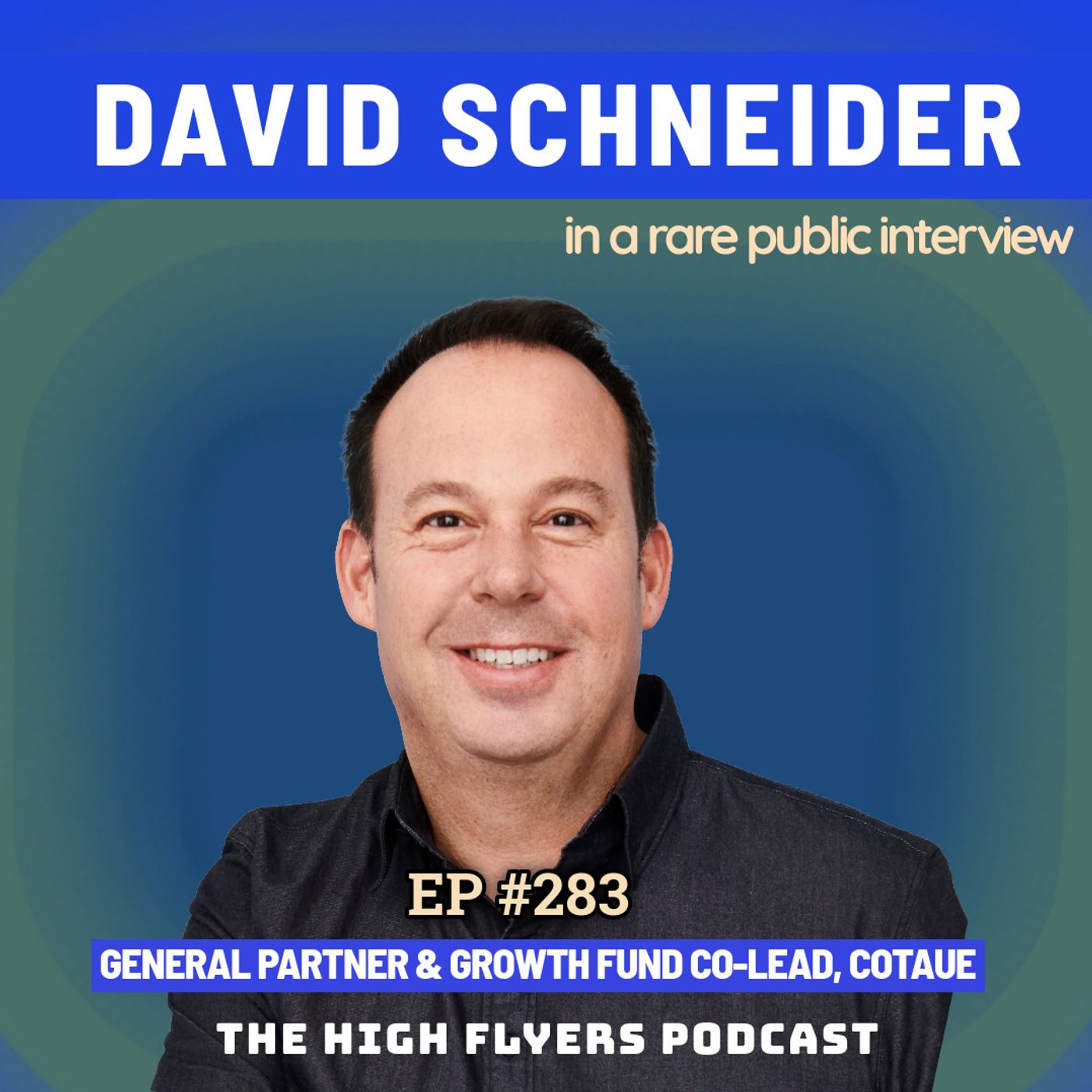
David Schneider’s career and operating playbook—how he scaled Data Domain and ServiceNow, what he learned from early failures, and how he thinks about enterprise go-to-market and venture investing (including co-leading Coatue’s Growth Fund at KOTU).
David Schneider is a general partner and co-leads the growth fund at KOTU, a late-stage venture firm. He previously scaled Data Domain (from near-zero customers to IPO-scale) and ServiceNow (from ~$100M to ~$5B). He met Frank Slootman early while working together at a Scotts Valley HQ.
Product-market fit can’t be “magicked up”; you must join the right growth-stage elevator. Forecast integrity and activity rigor matter early (weekly sales debriefs; deep pipeline questioning). Great sales leadership requires coaching and peer-based learning, not just top quota performance. For enterprise deals, ask for “bad news” early—where you rank among top business priorities.
Data Domain: hit quarterly number in month 1; board asked “how fast can you go?” ServiceNow: hired ~150 people in 90 days to grow revenue from $100M to $200M+ the next year; he missed only 1 quarter in 40 due to a late renewal.
Written by AI. May contain mistakes.
David Schneider shares his background and the purpose of the podcast.
“I'm your host, Virita Aguil, and let's have some fun.”
David discusses his upbringing in Mountain View and influences from his family.
“And this is really fascinating because I don't think you've actually talked about like your life journey in much detail.”
David reflects on his high school years and aspirations for his future.
“prior to go to, which we can get into being in sales and leading companies, I think it was sort of like right at a central casting of what you would expect a sales leader to look like or be like.”
David shares his college experience and decision-making process regarding schools.
“I think that comes from growing up in a household that provided that confidence.”
David describes how he got into sales and the importance of early experiences.
“Because if I think of a lot of the guests that have been on the show, they didn't study business degrees.”
David reflects on the challenges in his first jobs and their impact on his success.
“And then we had this thing called a leaderboard at that company where it talked about the person who sold the most of something.”
Learn about the pivotal moments that defined David's early career and growth.
“And they didn't ask me to come into his office.”
David discusses his career moves and the lessons learned from each role.
“The good news was in that office, there were two incredible people that I could learn from.”
Understanding how to identify and leverage product-market fit in growth companies.
“And so I joined a company at that time called Iona Technologies.”
Explore essential questions that David recommends asking when evaluating a company.
“And what we were really talking about when I and I started using that term to people was if you join a growth company that's moving really quickly, opportunities are going to come if you do really well for them.”
David shares his experiences working with Frank Slootman and what he learned.
“So Boland Software, I believe, was interesting because that's when you met Frank.”
David reflects on how pivotal decisions shaped his career trajectory.
“And that was not the prototype that they were looking for.”
Learn about the strategies and culture established during the initial success of Data Domain.
“recruit somebody over me and that at the time that I would probably be looking for another job within a year or two because he'd found a better person to help scale the company.”
Discover key attributes that differentiate great salespeople from effective leaders.
“I mean, both Kevin and John and other people I spoke to said you were fanatical about data, which makes sense.”
Explore the importance of recognizing potential in team members and investing in their growth.
“To say, hey, Jim or Samantha, how did you do X?”
Understand the shift from tactical to strategic thinking in executive sales leadership.
“And so productivity wasn't necessarily quota, but it was, are they covering the cost of breathing air in our building for us?”
Get insights on what it takes to create a successful enterprise-focused market approach today.
“I started to think about the business much differently as I was thinking about a multi-year problem.”
Learn how to prioritize customer needs and become a strategic partner.
“I think everything I've learned says start from the customer.”
Discover effective strategies to recognize when potential clients are ready to buy.
“And oh, by the way, don't be afraid to ask a customer, how are we doing?”
Hear about important lessons learned from a major setback at ServiceNow.
“Mike probably claimed to fame over how many quarters was I at service now?”
Explore David Schneider's shift from executive roles to investing and coaching.
“What was David Schneider's mindset at that point?”
Understand how critical support from family and friends is for success.
“I mean, the CEO one's interesting, Dave.”
Gain insights on the complexities of going international with a business.
“We mis-executed, product didn't work the way we said it was gonna work, the way that it was contracted to do.”
Learn about the importance of strategic market selection in technology investments.
“And I think you have to make strategic choices about what markets you can be in.”
Discover David Schneider's journey after leaving ServiceNow and his approach to coaching.
“I felt like we had published a report in 2016 to our analyst community that we We were going to do$4 billion by 2020.”
Understand the significance of being a supportive coach as an investor.
“And I think I was delivering for the team at KOTU.”
Explore the evolving landscape of growth investing and its challenges.
“And by the way, that's not that different as a as a lieutenant to Frank or anybody else.”
David Schneider reflects on personal growth and future learning goals.
“And if you're doing that and you're a founder and you're a company and you're going to go raise money, come to me and talk about your business.”
Discover the importance of understanding grit and challenges in interviews.
“Yeah, and we can always do a part two in the future with so much more that's happening in your career.”
Learn about the importance of asking about personal struggles during interviews to gauge grit.
“I'm still trying to learn more about people and what makes them tick and then how I could be a better coach, supporter of those people around me.”
Discover the value of supporting colleagues and helping them achieve their goals.
“I think, what did you have to struggle with in school, in work, in life?”
Explore how loyalty among team members can lead to longer career paths but stronger bonds.
“When I first met him, I said, I know you want to be a CEO in a great company.”
Understand the importance of learning from failures and how they contribute to success.
“Like I knew that they were being patient with me and I, as a result, had to be incredibly supportive of them.”
Learn how to create meaningful connections through curiosity and empathy.
“I mean, my dad always says, he's like, irrespective of whether you're a billionaire or not, you've got to wake up, you've got to put your shoes on, you've got to brush your teeth, you've got to comb your hair.”

Get the gist, explore an idea or ask about something said.
 Claude
On The High Flyers Podcast with Vidit Agarwal, what are the key points of this episode?
Searching your listeningAutomatic transcript. May contain errors.
0:00Hi, I'm Vidit, founder and host of this podcast, The High Flyers. Hi, this is David Schneider. I am a general partner at KOTU. Dave, I am pumped to do this. I'm particularly excited to do this because people say you like asking left field questions. So I need to figure out a couple of left field questions to ask you. Well, you know, part of the reason I probably asked left field questions, I was just insanely curious. I love to find out information and how people think about issues. And it usually ends up being a really interesting conversation. So let's go do it. Hey friends, welcome back or welcome to the High Flyers podcast, where we do reimagine a high flyer, showcase the brightest and most relatable role models and companies and their journey from sunrise to today.
0:44As one of the premier products in our Curiosity Center lineup, providing on-demand intelligence to help you be 1 % better every single day. I'm your host, Virita Aguil, and let's have some fun. Our listeners have called this podcast a meticulously researched biography unveiling the extraordinary lives and decisions of the most remarkable individuals and companies from around the world. We hope you're enjoying our catalog of 200 plus episodes since we launched in 2020 with many of our guests appearing in rare public interviews. It's now time to explore your curiosity. Please enjoy. Absolutely. Let's set the scene with some fun facts.
1:26Where were you born and where do you live now? I was born in Mountain View, California, and I live a whopping probably 20 miles away from where I was born in Atherton, California with my wife and family. And work, what was your first job and what do you do now? I was a busboy in a Chinese restaurant, the only person who didn't speak Chinese in that restaurant. And it was a great and humbling experience. And how would you describe your role now? Not like working in a Chinese restaurant. I am currently a general partner and I co-lead the growth fund at KOTU. We are a late stage venture firm focused on finding the next great platforms that will hopefully go public and change the world.
2:08Absolutely. And yeah, we've featured a bunch of your portfolio companies recently. Jesse from Decagon was on a couple of months ago. So yeah, you've got a nice batch of companies doing really well. Yeah, thank you. And Dave, as you know, the purpose of this show is to reimagine the concept of a high flyer to go beyond people's shop titles and showcase their personal story as well. Is there a high flyer you know who you feel hasn't got the recognition they deserve? I'm blessed that I get to work with a lot of incredible people. I think if you haven't met Yotam, the CEO and founder at Syriera, I think he is really an interesting person with a great story and his company is absolutely crushing it.
2:43Really fun to be around Yotam. I agree. He helped me with research for this conversation. We had a quick, quick call as he was on the go. So yeah, maybe a future guest for sure. Back to the episode in a moment. Something I've heard a lot from business owners and leaders is that speed only matters if you still feel confident in the output. And it's particularly an important point in this world of AI. Zero's answer to that is accountable intelligence. AI that shows you what it's doing and works from your own real data and is designed to keep you in control before anything happens. As Xero puts it, most AI asks you to trust it.
3:22Accountable intelligence shows you why you can. And that's how it works with Jaxx, Xero's in-platform AI finance partner. So whether you're running the business, advising the client, or working with your board, Jaxx ensures that you get the upside of automation without giving up any of the control. If you want to see this practice, head over to xero.com forward slash highflyers for 90 % off your plan for the first six months. Terms apply and go to the website. That's xero.com forward slash highflyers. Now back to the episode. Let's wind back the clock. And this is really fascinating because I don't think you've actually talked about like your life journey in much detail.
4:06So I'll see how much information I can get out of you. But you said California, you said Mountain View. What are your memories? What are your memories of the Schneider household growing up? Oh, it was really a very wonderful place to be, both growing up here in California and in the family that I was fortunate to be born into. My parents were moved back to the Bay Area in 1968-ish, 67. I was born actually in 68. My dad was a PhD in organic chemistry and was entrepreneurial. And he was recruited after time at MIT to invent the first drug test of all things in the biological and diagnostic space.
4:42My mom was a stay-at-home mom at first and then a teacher and then she worked in HR and exposed herself to amazing things here in the valley. Growing up in the Bay Area was sort of a unique time in the 70s. It was the early days of what became Silicon Valley. My neighbors were everything from people that worked in agricultural businesses to the earliest people at places like Fairchild Semiconductor, Hewlett Packard, Syntex, and other really amazing companies, as well as like McDonald Douglas and NASA Ames Research Center. So it was a fascinating neighborhood to grow up in, a lot of advanced degrees, and some really interesting people to role model after.
5:20And you were the only child? No, I had an older brother who is now a radiation oncologist. So I'm the one in the family with the least number of degrees. Right. Was height something that was common in your family? I mean, like you're a pretty tall guy. Was everyone tall? Quite the opposite. I was a really, really, from the very beginning, this really large individual, sometimes six to 10 inches taller than my peers. Now, some kids used to pray to grow. When I was in seventh or eighth grade, I think I was thinking, geez, how do I stop growing? And luckily I stopped at about six foot four, which was a pleasure.
5:55You've probably seen the memes recently from the Salesforce conference last week with Mark walking around and he's just towering over all these AI CEOs. Yeah. Mark and I have gotten to know each other over the years and we have a similar body frame and presence. He's quite a character. Yeah. I mean, people said to me in my research that you are tall, but you're actually a soft, cuddly human being, which I think seems to be quite common with everyone that I've met that is tall in height as they tend to be emotionally very connected and easy to get along with. So I think that I find is an interesting one.
6:29I think height and size and presence. Let's be honest, being a six foot four male in the technology industry has a lot of advantages. And if you think about what I did prior to go to, which we can get into being in sales and leading companies, I think it was sort of like right at a central casting of what you would expect a sales leader to look like or be like. I think the other part is true that when you're a large, larger, taller person with a big physical presence with a big voice, sometimes you come across as like imposing on people. And one of the things I tried to do is actually maybe sometimes be smaller in sometimes to be more approachable, to be friendlier.
7:07And that was a very conscious decision on my part to make sure I didn't overwhelm a group of people or a room. And tell me, and connect that also to curiosity that you said early. So was that present growing up as well? Like in high school, were you very curious? Oh boy, high school. My motivation in high school was probably, yeah, I mean, curious about people. I was fortunate enough to go to a school here in San Jose that was an all guys prep school. And I think curiosity was part of it. I think when I was at that point in time, I was really thinking about how I was going to get prepared for whatever the next chapter was.
7:41There was something about how I grew up and maybe as you asked about early kind of formative days, I really wanted to be the best version of myself. And so I was always thinking about how do I do enough, be enough to make people proud of what my contribution was. So I did ask a lot of questions, but it was really around trying to figure out what makes the world tick and then how do I fit within it? And then how do I guide or help others find their place in the world? And tell me when you were 18, so you've just finished high school. I love asking this question is, if I met you at that age, what would I have assumed you do with your life?
8:18That's a great question. Interesting in that I think the people that knew me at 18 knew that I was going to do something interesting, but I don't think even I knew what that meant. I think that I was fairly self-assured and confident about myself and where I stood in the world. I think that comes from growing up in a household that provided that confidence. I didn't necessarily know how I was going to do something. But I think people thought I was probably, you know, reasonably put together, approached life with a lot of confidence and adventure. And when I was 18 and heading off to college, I grew up here in the Bay Area.
8:53I wanted something different. I went to a small liberal arts college in the middle of Amish country, Pennsylvania, called Franklin or Marshall College. And I did it because I wanted something completely different than the environment of which I grew up in. And it was a little bit about academics. It was a lot about social and thinking maybe I want to be on the East Coast at some point in the future. Why don't I go have that experience now at 18 and see how that works out? Because then you went and studied political science, right? You were at Berkeley. No, sorry. So I was at Franklin and Marshall.
9:23I was doing fine there. And I made a decision that I didn't really love the East Coast, that I wanted to come back to the West Coast. And I really thought about if I was going to come back to being on the West Coast, what schools do people come and recruit from? And the West Coast companies didn't know about Franklin and Marshall College. And so I made a decision to come back to California and I went to UC Irvine. I went from rowing crew in college to sailing in college, two incredibly different sports that most people never even think of as sports. But I loved my time both on the East Coast and in California going to university.
9:59How do you reflect on political science? Because if I think of a lot of the guests that have been on the show, they didn't study business degrees. A lot of them studied history or political science or the arts, and then have fallen into the business world and had a lot of success. How do you reflect on your degree? I think from the very beginning of going to college, I knew I wanted to be quote unquote in business. I didn't know what that meant necessarily. So to be in business, what I thought I needed as skills were critical thinking, communication, the ability to write clearly and communicate crisply, which this will be a test for.
10:34And political science and economics were very interesting to me and how things all fit together. Becoming a global economy back in the 1990s or 80s when I was in college was very interesting to me. And so that's what I studied. And so then post-college, was sales always the natural parts? In some ways, it was accidental and then purposeful. The accidental part was I didn't know it was going to be a technology sales. My first sales job, besides asking a girl on a date, which I think was the ultimate sales job when you're growing up, was actually working in a marine hardware store. And the manager of the store asked me to go talk to somebody about one of the, we sold these inflatable dinghies with motors and it was a high margin product.
11:20And he said, why don't you go help this person out? He's got some questions. I did it. Not only sell him one of the boats, I sold him the best boat with all the features and everything else on it. And I got paid something called a commission. And that kind of turned me on to, boy, if I'm really good at working with people and could answer their questions and solve problems, I could make money. And then we had this thing called a leaderboard at that company where it talked about the person who sold the most of something. And I love being measured. I love competing. And so the ability to put my name on the board and win was something that was always really interesting to me.
11:56And then I was, I think, having a cup of coffee with a friend of my dad's. And we were talking about what I was going to do post-college. And he's like, the one skill that you could that will never go away is learning how to talk to customers and selling. And it was that conversation that had me look for what we called at the time a college recruit sales program where I could get hired and then learn the basics of selling and get trained in a set of products to become an expert in. And so that was my first job really out of college was joining a company that was in the technology sector that had a college recruit sales program.
12:31And they kind of taught me the basics. On the commission point, I heard in my research that your first million dollar commission check was quite a big deal. Apparently, you mailed it to your wife. Is that the same story or is that a different? That sounds like it might be later in your career. It wasn't a commission check. It was the first proceeds after an IPO. Of course. So it was post-IPO at Data Domain. I had the opportunity to sell a little bit of stock. Well, a lot of bit of stock for me to get to a million dollars. I never thought that was actually going to happen. And I had the check made out to Barbara, my wife.
13:04Okay. So that was obviously much later in your career. It wasn't this check that you're referring to. It was not that check, but it was probably the best check I ever got or she got. Yeah. Most meaningful to me at that time. I bet. I mean, I tried really hard in my research for this to ask you, because people know you for your success at Data Domain, ServiceNow, so many other things. But I always wonder what you learned from the first five, six, seven years of your career. Like I think you were in a bunch of different sales jobs. How do you reflect on that? Like, did that set some of the foundations that came in handy with some of these success stories that people know you for?
13:40In some ways, the struggle set the foundation for the successful and human that I am today. So I talked about that first job out of college. I told you I joined this thing that was supposed to be a six month training program. Two months into it, the company was having financial difficulty. I was working in the office in Southern California. I walked in and there were security guards in the office and my manager was in process of letting three quarters of the team go. And they didn't ask me to come into his office. At the end of the day, he came to me and I thought it was my turn next. And he said, hey, the good news is we pay you so little that nobody cares if you're here and you're part of corporate overhead, not my P &L.
14:24So I'm going to put you to work. And you now have this list of really crappy accounts and you're going basically on a full commission program and welcome to the real world. And it was that moment where I truly had to learn how to fly on my own. The good news was in that office, there were two incredible people that I could learn from. And that was probably the most formative period of my career was learning how to ask questions to others, learning how to absorb information and then making it personal and find my own path in watching others and then adopting that to my style. But that was my first real job out of college.
15:01I did that really well. I became one of the most successful guys in the company in really the first year, year and a half. But I also needed to move because my fiance at the time, now wife, was going to graduate school up here in the Bay Area. And that caused me to move up here. And I also wanted to work closer to the owner of the technology or builder. And so I transitioned to one of the manufacturers of technologies that we were selling. And that was my second job. I know you said to me the other day when we spoke is that I think at age 25, you said you were running Americas for one of these jobs.
15:34Is that right? Yeah, there was a company called Pinnacle Micro. And Pinnacle, I joined as the Northwest regional manager. There were like eight to 10 of us at the time, small company in the data storage space. And about six months in, the founder, who was, I think, 28, I was 25, he kind of leaned on me and said, hey, actually at my wedding, said, hey, when you get back from your honeymoon, we should talk about the next steps in your career. And he asked me to lead up sales for them at that company. And I learned a lot very fast. I also shouldn't have been promoted at 25. It happened too fast. I didn't know what good looked like.
16:10And I didn't know how to lead and manage others because I'd never really been led or managed appropriately. And so a lot of the things I did were instinctual. And looking back on it, probably not the most helpful for the others around me. Well, you also said to me the next two jobs didn't work out. Is that what you're referring to because of your early career skills? So I think when that was a young company, we actually took it public. I think we took it public on a whopping$30 million of sales. And I left due to some conflicts I was having with the founder, who I thought was brilliant in some ways, but not brilliant in many others.
16:48And when I left, I actually went to a really, really early stage startup company that became a company that people may be familiar with called Success Factors. It became that after I left, but it was a product that I was actually using called employee appraiser. And it was, I realized very quickly I needed to give my people feedback. And so I started using this product that was advertised in the back of an airline magazine to help me give constructive feedback to my employees. And I called the company saying, hey, why is there not more content in this for sales professionals? The guy I was talking to happened to be the CEO and founder.
17:25It's how small the company was. And we agreed to meet for coffee and talk about it. Next thing I know, he offered me a job. I was working for him. It was an Excel-backed and Greylock-backed company. So I thought, oh, this is going to go all the way to the moon. Turned out that we were wrong and we struggled for a while. But the phenomenal bit of that was this guy, Dave Strom, who was an investor at Greylock, said, Dave, you're really bright, but you're really young. You need to go get mentored. You could do incredible things in your career. but take a step backward to go forward. And so when I was leaving Austin Hain to do the next thing, I became focused on who could I learn from in my career rather than just the title.
18:03And so I joined a company at that time called Iona Technologies. Iona was in the object middleware space. People don't even know what that means anymore. And I learned from this guy, Bob Wamsley, who was an MIT math guy, became sales leader. And we were hyperscaling before that was a term called hyperscaling, going from about 20 million to 150 million and watching him operate, subdividing territories, scaling the team, setting quotas, creating an environment where people mentored each other as they came in. That became the foundation of skills that I used later on at Data to Make. Did this also teach you how to filter for jobs in any point in your career?
18:42Because I think this is a really interesting one. Like I think of this early on, I was the same as you, I was like deeply ambitious, but on this like bullet train to get to the top. And a lot of people said to me, they're like, what is wrong with you? Like, just slow down, like just do the job. And now I think back at that time and I go, I was just not good at filtering where I would fit in. I was chasing the wrong metrics. Did you get better at filtering jobs as you went through your career? I think I did. I think I got some very, as I said, good advice from David Strom. I think I used to think that if the best investors in the world were in a deal, that that was a massive checkmark on confidence in the outcome of a company.
19:20And I think it's one of the indicators of is the company likely to be successful? But by no means is it solely. I think I got better at picking CEOs and founders around the kind of people where I thought I would be a good fit for. I also learned how to pick larger markets. I think when you find yourself in a market that's too small, even if you execute very well, the outcomes are going to be small. And when I found myself focusing on big markets, when I executed really, really well, the outcomes were incredible. And so as my good friend Frank Slootman, who recruited me, and we'll get into that story later, Frank used to say, find an elevator going up.
19:59The faster the elevator is moving, that's the one you want to get on. And the higher this number of stories, the better. And what we were really talking about when I and I started using that term to people was if you join a growth company that's moving really quickly, opportunities are going to come if you do really well for them. And there's more ways to win when you're in the right type of place. I mean, the elevator one's interesting. I mean, you probably have these chats with folks wanting to join your portfolio company today. Is that a leading indicator or a lagging indicator? Right. Like sometimes in the moment, you just don't know if that's an elevator.
20:31You might find out a year later that that was the right elevator. Right. Yeah, I think they're there. I mean, obviously, depending on stage of company, if you're going to go into a venture seed or series A company, you don't know if there's any elevator whatsoever. You know that there may be an interesting idea that captures your attention that you feel passionate about. You can get attracted and validate the type of people you get to work with on a daily basis. Are they insanely curious? Are they strong emotional leaders? Are they strong integrity? Those types of things. But I think if you're joining a growth company, something that's already moving, you get a good sense of product market fit.
21:07And I tell people all the time, like especially as a go-to-market professional, you cannot magic up product market fit. If it's there and you're a go-to-market professional, you can leverage the heck out of it and maximize the potential of product market fit. And my job before becoming a venture capitalist was really run and go to market organizations and customer facing organizations and service organizations and maximizing the potential of product market fit. And the analogy I used is the developers and founders, they were the artists. I was the art dealer. And my job was put art in everybody's wallet in the world and show everybody how proud we were of that artist.
21:46And that was a pleasure and a privilege. But if you're thinking about elevators going up, you can't fake product market fit. Join a company if you're going in a growth stage that has that. And especially if you're going to go to market, then don't mess up and work hard. Make sure you're the art dealer. Totally. And I mean, just quickly on this one, it's interesting before we come back to your career. Are there any questions, like if you were joining a company today, hypothetically, what are some questions you would ask the leadership team or even metrics you would want to understand? I mean, I always want to know what business problem we're solving.
22:17And what are the economic impacts of solving that problem? And then what happens if we do nothing? Because the inertia of doing nothing inside of an enterprise is higher than the inertia of doing something, right? So staying with what you have is safe. So what's the problem we're solving? And when that problem becomes significant and apparent and we can save money or help people make money or secure them better, then we have a massive opportunity. But if we can't describe the problem we're solving and the economic impact of that problem, it's going to be difficult to position and sell product in that space.
22:54So when I talk to founders, I'm interested in that. Oftentimes they go into a technology discussion. That's not the discussion that customers want to have. They want to know what problem you're solving and the economic impact of that. Let's come back to your career. So Boland Software, I believe, was interesting because that's when you met Frank. Yeah. Is that right? So Post Iona went to another small startup company called Togethersoft, and it was a Java UML modeling tool company. That company was never going to be a freestanding IPO type candidate company. My job was to disrupt the market as much as possible, create pain and opportunity for the others in that space.
23:31And Borland Software was one of those companies. And they came knocking and they bought our company for a small amount of money, but it was a good outcome for everybody. But the best outcome for me was Frank Slootman and I shared an office wall in our headquarters office in Scotts Valley, California. And that's how I got to know Frank Slootman, who then later became the CEO of Data Domain. Can we spend a minute on Frank? Because Frank is revered, right? In tech, but I'd say in business broadly. What was he like back then? Was that the early formations of Frank? I think both Frank and I were driven to drive incredible outcomes for the people around us.
24:09And he was super competitive, wanted to win. And I think in many ways had a chip on his shoulder as an immigrant to this country. And he wanted to make a dent in the universe. And so I saw that in him early on. He had this striving for greatness category that I enjoyed. And he didn't suffer fools at all. And so I enjoyed that kind of refreshing element of Frank. We were in some ways peers. He was running products and I was helping to run a good portion of the sales organization. And we happened to be on a business trip together and got to know each other a little better. And then shortly thereafter, he tells me he's leaving for data domain.
24:49But early on, yeah, there were signs of greatness. The data domain story with you is really interesting. What I uncovered in my research is you were rejected the first time. I think the board said to you that you weren't aggressive enough, apparently. Tell me about that story. This goes back to maybe what we said earlier. I'm a six foot four guy. Sometimes I blend or try to not be as loud and boisterous or what have you. I think part of it was I met these two gentlemen, Anil Bushry, who then became the founder of Workday. He was a general partner at Greylock and Scott Sindel, who is an NEA and still today now runs NEA.
25:24Two great guys, the pleasure of working with. I think what they really saying is he doesn't have enough experience. And can he command the room? Can he do this? Is he going to just own it? And what I was trying to do is come across as thoughtful and interesting and maybe educated and approaching not like a typical go crazy sales leader. I was trying to be maybe more thoughtful, as I said. And that was not the prototype that they were looking for. They were looking for the rah-rah guy, the guy that's going to stand on the stage and command presence and do all that other stuff. And at the time I was thinking that was obvious.
26:02I'm six foot four. I'm a big guy. I'm going to own this place. But the reality was I didn't come across that way. And so people buy what they're consuming and I wasn't delivering for them. And so Frank called me and said, you know, Hey, we're going to keep looking. We're just going to keep the options open. And I continued my career at Borland. And by the way, that year I crushed it. I think I made like 500 % of my number. So it wasn't bad to wait, but at the same time, I was very disappointed that I didn't get the opportunity. But Frank and I stayed in contact during that time. And then I got this crazy phone call from Frank said, hey, would you consider just coming in to run the Americas?
26:37And I said, well, do you have a worldwide person? He said, no. And he said, don't worry about it. It's going to take us two or three years to get global. We just need to solve the Americas problem. We need to make sure we have some customers. Can you help me do that? And I talked to my wife. We had one child that was about two and a half years old and another the one that was 10 months old, and I threw caution to the wind, and I joined this little startup company called Data Domain. Rather than paying down my mortgage, I actually took any cash I had and pre-bought my shares at a very early price to trigger long-term capital gains.
27:08I think I was a little crazy, but that was the beginning. I was all in at Data Domain. And this was two years before the IPA, right? Oh, this was - No, not two years. I mean, you joined 2004. You joined 2004. Yeah, three years. Yeah. Now, we had, by the way, you could take companies public at a much smaller price then. But when I joined, they had zero customers. And one salesperson that was hired two weeks before me and no idea how to actually position the product correctly. So it was very raw, very early in the company formation. I think there were 18 employees. I'm curious, Dave, have you reflected on if Frank didn't call you back and offer you that role?
27:44Like, would your career have gone differently? More times than you could imagine. I am so appreciative of that extra phone call and maybe my courage to say yes. And more importantly, his courage to lean on me. I was very thankful for that opportunity. And then as we went, part of this was I three quarters expected that Frank was going to recruit somebody over me and that at the time that I would probably be looking for another job within a year or two because he'd found a better person to help scale the company. That's his job as a CEO is to find the best possible teammates to grow a company. And I somehow managed to avoid that by just out executing, out working, and maybe out stressing on the opportunity that everybody else.
28:27So you took two companies from essentially zero to well over a billion dollars an hour, both data domain and service now. I mean, you must be in a club of a handful of revenue sales leaders that have done that. When you reflect on it now, what did you do in the early days? I'm really curious. I love asking about the first year because I fundamentally believe that's when you set the foundations, like for the team, for the culture, with your customers, with your own confidence. Yeah. So what did you do in that first year at ServiceNow or Data Domain that set you up for success? Those are two very different stories and different skill sets that I had to practice.
29:02At Data Domain, when we had zero customers, what I did is I did hire an initial group of people. And I told everybody, our job is to learn. Our job is to try to position this product. We have a goal of called$3 million this year, and we're going to deliver against that goal. But more importantly, we're going to set the foundation and give feedback to the product organization, engineering organization, and be as transparent as possible with everybody. And so when I had my weekly sales meetings, they weren't once a week, they were twice a week. And we would say what we were going to do during the week.
29:34And then we would debrief at the end of the week what we learned on every sales call. How did our positioning work? What questions did they ask? What things did they glom onto that they wanted more information about? And what triggered someone to stop a meeting and say, can you explain that again to me? So that was really all about the first six to nine months. And then we got better and better at honing our message and finding product market fit for the limited capability that the product had at the time. But during that time, we gave all the great feedback to product engineering and they built the next product.
30:06And that next product was like magic. It was like hot butter on bread. Right. It was it just worked. And everything about it changed the market. And it was the most interesting thing in that never in my career had I made my quarterly number in month one. Three weeks into the first month of the quarter in July of, I think, 2005, I made my number. I called my buddy who was running sales for another company. I said, has this ever happened to you? He said, hell no. I said, what do you tell the board? The board meeting's next week, and I've already hit the quarterly number. What do I say? And he said, tell them you can't guide, but it's a good problem to have.
30:44Things are starting to work. I did that, and I swear to God, the board looked at me and said, how fast can you go? Because that was the magic moment. We knew we had product market fit, and we didn't want to waste it. And so we kept ourselves kind of small and lean up until that point. And then it was time to go. Let's go. And so that lesson of hyper growth. And I said, how fast have you ever seen this done? And of course, they quote other numbers like network appliance numbers at the time. I said, well, that's great. I've always been competitive. I got to beat that number. So that's what we did.
31:15We just go beat everybody else. And we disrupted markets. So that was really early data domain. And I was lucky enough to hire an early crew of people. I think you talked to a couple of them as part of your work. guys like Kevin Haverty, guys like John Sapone, other heroes that we aren't going to talk about on this podcast. But those guys not only figured it out, they helped me recruit all their friends. And so we created this culture of almost like a family brotherhood, sisterhood thing where, yeah, I was a leader, but we worked our butts off because the opportunity was so great. And once we had that working, why waste it?
31:48So it was a really special time in my life. It was a really special time in company formation. I hope for everybody who listens to this podcast that once or twice in their career, they're lucky enough to be part of a team that kind of quote unquote hits it because that was really, really fun. I mean, both Kevin and John and other people I spoke to said you were fanatical about data, which makes sense. Most great sales leaders care about commercials. But as you know, early stage companies can have all the commercials in the world and they can almost get lost in tracking too many things. Were there three or four key metrics you tracked in those, let's call it the first two years of data domain that told you the company was on the right track?
32:30Sure. There were lots of metrics. I mean, the data that comes out is the output for all the work you do to figure out if you're going to close something or not. So I was a maniac on forecast rigor and activity. The only way to get to the outcome was to really inspect what people were doing and to look at patterns to see if they were going to repeat or not. And so for me, when we'd have a forecast meeting, somebody would have a long list of activity going on. I would just randomly pick on an account that was listed. You'd have the biggest thing in your pipeline. But if you couldn't answer the first question I asked, so this may be the left field question that you were referring to with Kevin Haverty.
33:07I would go down a list of accounts and ask XYZ person about an opportunity. If they couldn't tell me what the next step was and why they were going to buy, then I'd go really deep onto something and they would just run for cover. But what I was teaching them was forecast integrity mattered because I had to report back to the board where we were going to go, how we were going to do it. And so that kind of incessant curiosity about details was something that was super important to me. And this is before like the modern systems that would give you AI help. I was the AI help on that one. And it had to go deep all the time.
33:43You also ask kind of culturally, what did I do? You know, we didn't have enough opportunities for sellers. So I hired a set of one business development rep per two reps, which a lot of people did. I went one to one. I said, every field rep gets their own business development rep. And then I went two to one. I want two business development reps for every field rep because I wanted them swimming in activity. It was much cheaper for me to hire a person right out of college to dial for dollars and get meetings for people than it was to hire field reps and have them churn if they weren't successful.
34:14So I just inverted the model. I was like, let's think about this completely differently. And oh, by the way, I'd have enough people on the phones. I spent two days a week dialing, trying to set meetings for my people, right? So my reps knew I was out there calling to get them meetings. And then I'd fly around the country, around the world. And I was gone five nights a week for seven years to build the company. You had to do that to win. And that's what it do what it takes to win. Tell me about people leadership, because one of my observations, I worked in commercial sales jobs for the first eight, nine years of my career in FMCG and retail, which, as you know, is low margin, highly competitive, very commercial.
34:52And one of the things I learned is sometimes the best sales leader is not a good people manager. They should remain as an IC. They shouldn't be given a team because they actually lose their shine and they lose what they're actually good at because they get distracted by other stuff. Did you figure out a playbook for when a great salesperson can actually become a people manager? I think I did. I think I started figuring out what made a good salesperson a good people manager. There may be who are going to be the best people managers that may not have been the number one salesperson. I think there are better, there may be better salespeople in the world than me.
35:26I think I became one of the most effective leaders of people available in the market. And I think there are different things. The number one thing I looked for is in a peer group of sellers, who is the person that other sellers would go to and ask questions of? To say, hey, Jim or Samantha, how did you do X? How did you position Y? And for those people that had figured it out, if they were generous enough with their time to help their peers to learn, then they at least qualified to be coaches, which became the beginning of being a good leader of people. And I think that the skill of coaching people is under understood on how to get the most out of folks.
36:05And so were they a good coach? Were they a good mentor? Were they a good peer? Were they a good citizen? And I do think that that's sort of what it takes to become a good first line manager. Is there also an element of loyalty here? I mean, this was an interesting chat with Frank in the research process where he said to me, there'd be times where you and him would chat and he could predict that someone wouldn't work out. But you were a very loyal people leader and you could actually see potential. And sometimes the person would evolve and they'd be ready for the job. But sometimes Frank would say he could predict it and he knew the person wouldn't work out.
36:38Which, I mean, in hindsight, is beautiful because you can say, yep, I knew this and I knew that. How did that play where you could spot potential and also disagree with someone like Frank and go, hey, like, assume if I was in your team and you'd be like, hey, Vidit might not have the skills now, but I can see him growing into that in 12 months. I think there's a difference between having the skills and sometimes having the patience to let the pipelines develop in the target customer markets that you have. And there were two situations. I still remember this with Frank. I don't want to give the names because they'll be disappointed.
37:09Actually, I can give one. There was a gentleman named Tom in New York. And Tom worked for us. He left being the number one rep for, I think, Brocade at the time to join Data Domain. And Tom went from a very high paying job to taking a giant risk on us. In New York sales, he was doing major account sales, hard job. And it took a while to build pipeline. And Frank was maybe a little impatient about some of that story. And I said, geez, he's doing all the right things. I've been on the calls with him. And I was active in the field. So I was present learning what was going on in the field. I wasn't doing this through five degrees of separation.
37:48I was there. And so my ability was like, hey, Frank, I'm seeing what he's doing. He's doing everything we want him to do. It's just taking longer in this region. And sure enough, that next year, Tom sold some of the deals that became the reason we could go public. Right. And so by being patient and investing in that person, it was something I'm proud of being patient for. I'm also proud of Frank for listening to me in that situation and saying, OK, but we had a deal that I couldn't hire more reps until I made them productive. And so productivity wasn't necessarily quota, but it was, are they covering the cost of breathing air in our building for us?
38:30And if they were, then I could hire more people. And that was before hyper growth. But Tom was one of those guys we invested in time. By the way, he took a second mortgage out on his house so he could invest in time with us, pay his bills while he was waiting to build the pipeline that became the outcome for him to make a ton of money. and it was great to watch that happen. I mean, the other side to this is also like your growth as a sales leader. I mean, I think some of the research really brought out some of the candor where people said you grew as a sales leader significantly, which makes complete sense.
39:03I mean, we all grow as humans. How do you reflect on your own growth journey? Like how did you consciously develop yourself? Because I think in the time I've gone to know you, you seem quite intentional. Like I get the sense you're someone who like reads about things and talks to people, which now you've got the success to maybe say, I don't know. Did you do that in like data domain and service now? Did you find people who could help you be a better sales leader? I was always in search of information. I was super curious. There wasn't a lot of people. I didn't work for big companies before. So I didn't really, as I said, I went to school with this guy, Bob Wamsley, who taught me a lot on hyperscaling companies, but I didn't have a lot of great role models.
39:41And so what I did is I read incessantly. I read books on leadership. I read books on heroes. I read books on business. And And there is a business author that if you guys haven't read anything by Len Sione, he had a book called The Five Dysfunctions of a CEO, Five Dysfunctions of a Team. They became my Bibles on how I wanted to be perceived, how I wanted to work with the other executives on a team, how I wanted to support, enrich others in their career paths rather than do it just for myself. And by being focused on the good of the outcome for everybody, it let me do incredible things with a team of people.
40:20And so that was a learning and learning that it wasn't just about me. It was about everybody around me. And creating an environment where they could thrive was really cool. And then I think I still remember when we were at Service Now, there are some really interesting things there. We walked into a company that had a lot of problems, including they didn't have enough people. We hired 150 people in 90 days to create a revenue team that could grow the business 100 million on a$100 million business that next year. But as that went forward, I remember when Frank promoted me from a VP of sales or VP of services and sales to a CRO.
40:54And I said, well, what does this really mean, Frank? And he goes, I need you to think about the problems that are two years out. I don't want you to worry just about the quarter. You've got people for that. I want you to help me look around the corners and think about all the things that we're going to be facing over time. And that's really, I think, when I became a better executive, is I learned not just to focus on 90-day problems, but the more strategic issues that we were going to face, the kinds of people I would need, the roles I would need to solve for, the kinds of customers I wanted to earn.
41:22I started to think about the business much differently as I was thinking about a multi-year problem. So Dave, everyone that I spoke to, and whether it's CJ, who's now at MongoDB, or Frank, or Kevin, or John, I said, what's the question I should ask Dave? And they all said, ask you, how would you build an enterprise-focused go-to-market organization today? Particularly today, because I think you and I talked about this the other day, I've never seen so much enterprise curiosity about software, but also that curiosity means they're trying different things and the stickiness perhaps might not be the same.
41:51I mean, you're seeing this bit more than me. What would be your playbook today? I mean, this could be a podcast in itself, But if you could spend a few minutes on this, what would be the playbook and maybe advising your CEOs and CROs today about building an enterprise focused go to market organization? I think everything I've learned says start from the customer. Start from what problem we're trying to solve and how impactful we can be in their business. And once I understood from a customer's perspective what that looked like, I would feel the team that serviced that well. Notice how I'm not saying there's one way.
42:23I think if you're doing this, it's first principles for your business. What is the right thing to meet the needs of your target customer with your value of solution in mind? Very different if you're Decagon, very different if you're Island, very different if you're Sierra, very different if you're ServiceNow Today. And then ask yourself or ask the customer, how do I become one of the top three most important providers to you? Not necessarily the number one or two revenue pieces, but how do I become the most strategic to you? And that becomes a really interesting goal. And so you think about who are the kinds of people that want to be strategic to a customer?
43:03What is their personality type? What are they all about? They're not transactional at that point. They're very much solution-oriented. They're value-oriented. They're thinking about the customer first. They're thinking about outcomes they're going to drive. That becomes a very different part of how I think about solving problems. I'm not sure that I would do it. I mean, I would use AI. I would use all the modern tools. I would leverage everything in my power to become effective at reaching those customers. But I think the approach I would take is from the customer's point of view, how do I become one of the most strategic providers to them?
43:36And oh, by the way, don't be afraid to ask a customer, how are we doing? Are we strategic to you? What could we be doing better? Who's your favorite vendor? Who's your favorite partner? And if your name isn't in the top couple, you got work to do. And so I think raising the bar around that is something super important as somebody who's a CEO of a company, a founder of a company, or a head of sales or head of services in a company. But if you can't answer those questions, you got work to do. And I would set yourself up to be able to. One of the things I'm hearing a lot from folks at the moment, I'm sure you've heard this term in sales, like happy years, where a customer tells you everything's great, but then you have six meetings and you don't close the deal.
44:14How, I feel like this, maybe you've already written about this and I should have found it in my research, but you would probably have a great playbook on how to look for signals that big enterprises are ready to buy your software. Are there any particular tactical signals that tell you that person on the other side of the table is ready? Yeah, I think the I actually wrote a blog post on I think called happy year somewhere on my LinkedIn. For those who are curious could probably find it. What the premise of that was a lot of sellers and people only want to hear good news. I was looking for bad news.
44:45And so sometimes it's asking the question, Mr. And Miss Customer, there are a lot of things going on in your business right now. What are your business priorities and where do we fall against helping you to achieve them? And if we were not in the top one, two or three business priorities and you were going to go get funding from a CFO and having to go find a champion that was going to get you there. If your executive buyer couldn't tell you where you fit in that priority list and you were not in the top three, you're probably not going to get a deal done this quarter. And so just ask the questions, like ask the questions, even if you don't want the answer because you're afraid of the answer.
45:23Best to know the bad news early so that you could go do something about it. And if you're a rep or a manager and you're rolling up a forecast that is going to disappoint at the end of the quarter and you give news the last two days of a quarter when no one can do anything about it, that's how you get fired. Right. Mike probably claimed to fame over how many quarters was I at service now? So 10 years, 40 quarters. There was one quarter in 40 where I missed the number I called. and I missed because of a late renewal from one single customer because the CFO, I don't know, was sick or family emergency.
46:00It did cost us a lot of money because our stock went down that quarter and I would never let that happen again. But if you've got a sales leader that one in 40 misses, that's a pretty good guy. If you've got a first line manager that one in 10 makes it, that person should be looking for a new job. Yeah. I mean, you and I were talking about sport. And I know you like comparing sales leaders to athletes. I mean, you look at hit rates of the best athletes. I mean, there's that famous Michael Jordan quote, right? You don't need to win. I think he lost more than he won, but the times he won, he won big.
46:29And that's what he's remembered for. Yeah. I mean, his point is you can't be afraid to take the shot. I think in business on the macro, you got to take a lot of shots, but at the end of a quarter, at the end of a year, you get judged on whether or not the ball went in the net in that case. And the ball going in the net is being at or above the goal that was set for the business and then making sure you execute against it. I want to go into 2011 because I believe this is when you wrapped up at Data Domain. We talked to the start about your mindset, about the environment you grew up in, your schooling.
47:02Where were you at at that point in your career? Because that was a lot of success. You took a company to over a billion dollars in revenue, went public. Like you said, you built some financial wealth thanks to hard work. What was David Schneider's mindset at that point? My mindset after leaving Data Domain, Frank Slootman had gone to be a venture capitalist at Greylock. And I was an executive in residence at Greylock at NEA. And I was thinking I wanted to become a CEO. And I was hopefully going to have Frank join my board and be a funding source for whatever company I went to. I'm not an entrepreneur idea guy.
47:36I'm an execution guy. And so I spent a few months thinking that that was my next step. And then I had to be smart enough when Frank came to me and said, hey, I'm really not excited about becoming a staying as a VC. I want to go build something again. I use more colorful language than that. But the opportunity to work alongside of him and he was going to grab Mike Scarpelli, who was our CFO at Data Main and ServiceNow, and then they went to do Snowflake together. That was a great combination of people that I loved working with. And so that became very enticing to me. And I took that what I thought was going to be my next step and put it aside and said, I'm going to go do this again.
48:15And by the way, I had unfinished business. The data main bit story got finished in a hostile acquisition. We didn't necessarily want to be acquired. It just happened. And then I was wondering, was I good or was I lucky? And what ServiceNow let me do is go practice what I had learned, accelerate my learning at ServiceNow or what I learned at DataMain, accelerate that into ServiceNow and kind of proved to myself and maybe the world that I was pretty good. And more importantly, that the team I represented was really good. And I couldn't have done anything without being surrounded by incredible people that made it all happen.
48:52Frank and Mike and I were just, we were the coaches in the coaches box some ways, and then we had great people that executed. I mean, the CEO one's interesting, Dave. Did you ever revisit that later in your career? I did. I revisited the idea of it. And what happened really for me was it just became less important. And I think to be a CEO, what I saw in watching Frank and then John Donahoe, who was our CEO after Frank, and then Bill McDermott, these are great, great leaders and people. And I have some of those skill sets, maybe more than not, but I also didn't necessarily want the job anymore.
49:24It didn't fit my goals and lifestyle. What I really love to do is coach and develop people. And I thought about how I could balance all the aspects of my life. And that led me to become an investor. And I call it a coach here at KOTU where I can lead our growth investments and help young founders and teams get to their potential. And that has been so much fun. I've never looked back from that decision. I've been doing it now for five and a half years and it's been absolutely phenomenal. I want to spend a couple of minutes in ServiceNow because I want to come to KOTU. And I think that transition is really interesting as well.
49:54I mean, ServiceNow, I think you joined when it was doing a hundred million in revenue. I think it was about 90 million at the time. Okay, 90. And I think you scaled it to like a couple of billion in revenue, give or take. Yeah, 5 billion. What was the biggest 5 billion? Just casually, 5 billion, yes. It seems like a small number in comparison to Anthropic these days, but at the time it seemed big. Oh, I mean, a billion is still a billion. I would hope that never becomes mundane. But I mean, I'm curious, again, people know you for your success. I'm curious, what were the things that didn't go right at ServiceNow?
50:23Can you share an example or a story that taught you the most? Within my first three months of being at the company, we had a massive outage at a very large bank. and it cost our sponsor to get fired. And it was one of the most traumatic situations I ever had to deal with as a business leader where the person that sponsored you into the deal and kind of bet their career on you, you failed them in such a catastrophic way that they lost their job over it. And I think that that was one of the most material moments for me as a human being, as a leader of people and how I brought that back to the team at ServiceNow and how we responded to it was very important because it was personal.
51:05And I wanted to make sure that every one of us knew that we let this person down. And that's terrible. He has a family and it was our fault. It was our fault as a company. We mis-executed, product didn't work the way we said it was gonna work, the way that it was contracted to do. And I didn't sell that deal. I didn't write that contract, but I was responsible at the time for delivering against it. And one, I would never write it. I came home or came back. I said to the guys that wrote the contract, signed off on all the terms and all the things we said we were going to do. I said, what the heck were you guys thinking, making these commitments when we couldn't do it?
51:39And they're like, well, we had to do that to win the deal. I was like, no fucking way. Are we going to say that again? We're going to tell people what we can do, what we can't do. And then we're going to over deliver against those commitments. And our job is to get people promoted, not fired. And that became a really important moment. And Frank and other people there, they rallied and they hired different people to go solve the problem. And we all came together and made sure that moment never happened again. It was a very hard lesson to learn. But think about that. The guy that sponsored you brought you in and got fired because of his choice to select you.
52:12That's a terrible feeling. And so what happened afterwards? Did you find another sponsor or? We managed to stall on that account. We eventually delivered the technology that would would work for them. The gentleman who got fired ended up working for our competitor. And I don't know what happened to him. I hope for his sake, he's okay. But we obviously solved the problem eventually, but it was a material problem for us at the time. It's an interesting point though, because I'll give you a personal reflection. So one of the guys in my team recently left and he started his own company and he's in his early twenties and he's doing a lot of sales.
52:45And he looks at it from a very product lens and software. And he asked me the other day, he said, what have you learned about sales? And I said, people buy from people. If that person doesn't like you and they don't want you to succeed. It often doesn't matter how good technically your product is, they just will not engage with you. I'm curious, do you agree with that philosophy? I think the world is, despite all this AI stuff that we have going on, I think when it comes to doing large transformative deals with each other, humans become very important. Trust becomes important. Whether or not we are likable becomes important.
53:17If we care, if we're empathetic, all of those terms that may seem oh my god oh so human become massive difference makers and i think the best executives the best sellers the best people are in general curious about others and then they do well by others i'm a big fan of that i want to come to the transition into co2 but before i do that i'm really curious to ask you sitting the other day in both your jobs at data domain and service now you're on the road i think 95 of the year right whether in in the u.s or you were overseas. You mentioned earlier about your wife. We talk about high flies. Like I think about this a lot as I get older, like the support cast.
53:56Like when I was young, I'd be like, oh, it's me. I'm self-made. Look at how awesome I am. And now I go, fuck no. Like there's a whole team around me of people, whether it's family or friends. Do you want to just reflect on that? Like how that support cast helped you succeed in those jobs? I don't think it would have been possible for me at all to not have this strong person in my wife or parents or friends that were accepting and supporting me. I didn't always bring my best self home because I was tired. I was exhausted. I was distracted, all those things. And I was doing 250 to 350 ,000 miles a year constantly.
54:31Asia, Europe, anywhere in North America, South America, Australia, it was like back-to-back jumping time zones. It's very hard to be present in that situation. Remember, my girls, when I was a data man, were almost zero and two and a half, and they didn't see dad very much. So having an incredible partner was essential to that. And somebody who could see me for who I was. There is nothing like people in your life that are just insanely honest with you. And you realize very quickly that whatever your performance was at work matters not at all if your performance at your house isn't good. And so I take a lot of pride in the fact that I feel like after 34 years of marriage and 40 years of knowing each other, I'm still dating my wife and we're still in love, or at least I'm, I know I'm in love with her.
55:16And I think she's very much in love with me or she wouldn't be with me. It's fun. And my two daughters are great. They're great humans and they continue to just thrive and grow and do amazing things. And so that's a massive balancing part of my life for sure. Absolutely. And I mean, go, go Bob and, and, and absolutely a high flyer in every capacity. You mentioned international. I realized we skipped over that. Maybe just spend a couple of minutes on that and then talk to the KOTU transition. I mean, international is so interesting because I feel every company today is going international even faster, right?
55:48Like you're probably seeing this with your portfolio. Is there one philosophy on international that maybe you didn't do as well that you're advising your companies now to keep in mind? Yeah, I think as you go international, it's very expensive to be in every market. And I think you have to make strategic choices about what markets you can be in. And is it better to build out in force and be dominant or effective in a market or be in every market. And what I realized after doing the math is there's really eight countries that matter in about 40 to 50 cities in the world that really move the needle.
56:25And if you're thinking about selling AI or cloud solutions, you can't really sell effectively in some markets, let it be Russia or China or other kind of what I'd call people that don't follow the quote unquote Western rule of law, Those are tough places to be effective in. So you want to make sure that as you get started, you're putting enough work and wood behind the arrow in the markets you need to be in. But the market does dictate sometimes a faster approach. I also think that best to make these investments in these markets prior to going public. So the high cost burn of doing those things as a comparison over time, when you are starting to scale and go public, your model is looking much better up and to the right.
57:08from a performance basis and an affordability basis. So there are markets that matter. Happy to go into more detail about which ones they are. There are also markets that move faster in Europe or in Asia. I love the Australian market, for example. It moves really quickly. I love the Nordic market, specifically for AI and for cloud stuff. It's a heavily outsourced market. Labor costs are high. Labor benefits are high. Getting rid of people is very difficult. So there are reasons why technology gets adopted faster in some of those markets. Pay attention and learn where the fit is. And nowadays, you can actually get early warning because customers are finding about your product anyways.
57:47I had one of my portfolio companies that already had tens of millions of dollars of business in Japan before they ever put people there. That's a pretty good indicator, right? So the PLG motion can help the SLG motion work very well. So I'm not hard over PLG or SLG. I think the best companies figure out a way to do both. I'd say I'm also seeing more companies than ever travel to the US to just learn about AI. The amount of boards that I hear from all around the world go to the US, where previously they'd be like, no, you need to come to us. I'm not traveling and they want to spend time with OpenAI or Anthropic or Decagon or you guys at KOTU.
58:23I've never seen that before. That is incredible. Yeah. I mean, my goal is to become a destination on people's stops when we were at ServiceNow. was our executive briefing center in a good week would have three to four massive fortune 500 clients a week in our executive briefing center so that our product people didn't have to travel to go see the customers they were coming in and that took a while to build but eventually we became as big a stop as cisco or intel or apple or anyone else at the time in santa clara was a great place to visit. It wasn't San Francisco, but we had a lot of people coming through there and it was a very efficient way for the company to talk to customers.
59:04So let's go into 2021. When did you leave service now? You left at the end of 2020? Yeah, December 2020, the end of that year. I had made the decision a little bit before that, that it was time for me, my wife and I were going to be empty nesters. I felt like we had published a report in 2016 to our analyst community that we We were going to do$4 billion by 2020. And that was written by both Frank, Mike, and I. And Frank had departed the company. Mike left about halfway through that journey. And I really wanted to see it through. And so learning how to build a multi-product company was important to me.
59:42Getting to that$4 to$5 billion number was important to me. Having my people be in great places in their careers was important to me. So I stayed and I delivered that against the plan that we had written. And I had the opportunity to work with people like CJ Desai and others that were just phenomenal co-workers on that journey. And so at the end of 2020, I told Bill it was time for me to move on. He asked me not to go. I said Kevin and the team, Kevin Haverty, who is my sales leader, could do the job. And so he was tapped to do it. Another person was tapped to do the other half of my job, which was the customer-orientated part of the job outside of sales.
1:00:20So services and partners and customer success, although that's a whole nother term. And I felt like I was at the right time, right place for me to transition out of the business. I didn't exactly know what I wanted to do next. I didn't want to be a CEO. We talked about that. And I didn't want to operate and be on an airplane the way I was doing it before. And so I was lucky enough to have built a lot of great relationships here on Sand Hill Road with the venture community over the years. Some of those people reached out to me, including Thomas Lafont, who I met actually on a nonprofit board. I believe in giving back to the community I'm part of.
1:00:53Thomas and I started talking and he had this idea that the combination of professional investor and professional operator at the highest level, people that were world class, were going to be really interesting to the next generation of companies that just money by itself wasn't going to be enough to differentiate. And so that was the idea. And Thomas said, hey, we're going to be a platform to be the best possible coach you can be and make a big impact in the world. And so I listened and it was sort of a six to nine month experiment in 21 that I was having a blast with. And I think I was delivering for the team at KOTU.
1:01:28And we got a chance to invest in companies like Grafana with Raj, who I think is another world class leader that should be included in your podcast at some point. I think that those experiences just convinced me that I was doing the right job for me at this point in my life. And I'm having a really, really good time now co-leading the growth fund with Lucas Swisher. I mean, it's so interesting. I mean, Lucas was kind enough, talked to me quickly for research before this. And he said to me, it's the perfect yin and yang. Like he understands the investment world. You understand how to scale companies.
1:01:58But I've spent time with a lot of operators who have become VCs or become private equity investors. and they all talk about like the transition took tests to them in a different way. Like I just had a founder's fund have just hired this lady, Ryan Biermeister and she's come across, she was senior at Palantir OpenAI and Meta and she's a VC for the first time. And she was talking about feedback loops and she was saying, you just don't get the same feedback and you've done this all your life. You know the numbers every day, every week, every month. And then you come into KOTU and you don't know if a company is going to succeed for years.
1:02:28How have you learned to grow up that? This is a patience game. And I think that one of the things that I try to do, maybe different than other investors, is I try to get super close in a non-intrusive way to the operators inside the portfolio. And I want to create trust networks between myself and them so that they can come to me at any time of the day about any issue. And we could talk first principle issues about what they're facing. And I go back to that word coach. If I'm seen as a coach, not just as an investor or a board member, I get to be part of some really interesting conversations and try to make an impact.
1:03:05It still takes an unbelievable amount of patience. And the other part of this job is they don't have to listen, right? We are the source of funding. And sometimes we can hire or fire a CEO, but that's a lot of work. So I have to be convincing. I have to be thoughtful about how I approach a problem to get my point across. And there are times I'm right and there are times where I may not be right, obviously, meaning it takes time for that to develop. And there are times where the founding team is right and I'm learning from them. And I think you have to be patient and you have to enjoy this role of coach.
1:03:36And if you want to be an operator, go operate. If you want to be an investor, advisor, coach, then you've got to put your ego back or behind that of the founders. And by the way, that's not that different as a as a lieutenant to Frank or anybody else. My job was to make them and the whole company look successful. It wasn't the Dave Schneider show. It was the ServiceNow experience. It was what we were delivering as a company. It wasn't about me. And I think the same thing here. This is not about Dave Schneider as an investor and how effective I am. It's about the companies we invest in and the outcomes we drive with them or that they're driving and that we're just a small and hopefully important part of their story.
1:04:16Yeah, I think in one of the interviews I listened to in prep for this, you talked about seagull VCs. I think you talked about like VCs that come in and just try and act like they know it all, make a mess and then disappear. You see my seagull over here. I remind myself. So what I was trying to say there is there are people that come in and they fly in and they drop a turd and they leave and they don't add any value. They give busy work to people without really context or a framework. And they're just pattern matching about something they heard in another meeting without any real truth about what's going on for you.
1:04:51And I want to be the opposite. I'd much rather be the person who's well prepared for your meeting, talking deeply about the things that you're concerned about, working on your problems. By the way, that requires a CEO and a management team to identify them and tell me what their priorities are, which some people don't like to do. But if you get a single VC when you're as a leadership team kind of all over the place, or you select one in your funding process just because of, I don't know, evaluation or name brand of the firm, when you're selecting who's going to be funding you and who's going to be a board advisor, what have you, think about what you need as a coach, a partner, the people you want around the table, both in good days and on bad days.
1:05:34That was where I was coming from on that. and probably the other one is which again you and i think talked about the other day is like the state of growth investing today we we referenced i referenced earlier about how companies are scaling up faster than ever before like you're seeing companies that are two years old that are doing 200 million dollars in revenue we don't have to name names and they're probably coming up to you quicker where they're ready to get coach you on their board and then get coded to invest how are you like just assess the market today like what are some of your observations on what's happening in the market?
1:06:05I think that, as you said, things are happening faster and faster. The records I created at Data Domain on company scale and growth, they look slow in comparison to what we're seeing today. I still think that there are some fundamentals that we have to focus on. What is the value we're providing our customers? Is it, are we delivering against the value we said we were going to deliver when we are? Then they're going to spend more money with us and they're going to renew and grow. If we're not, they're going to churn. And you could get to$200 million really fast. And like what we saw in 22, how companies reversed very quickly.
1:06:40Churn was a big deal back when budgets got tight. My focus right now with all of my portfolio companies, are we deployed? Are we delivering the value we thought we were going to do? And are we growing share at that customer by getting additional workloads with them? If we are, we're in a great place to expand. And if you're doing that and you're a founder and you're a company and you're going to go raise money, come to me and talk about your business. But if you can't answer those questions, you're too early for me. I think your point about this ecosystem being different is true, but then also people like you, people like Frank, people like I think Sequoia just hired Dave, who was the former MongoDB CEO, is interesting.
1:07:19So clearly that playbook still applies. The fact that all of you, you are being recruited by VCs to help them out. Yeah, I mean, I think what happens is the best entrepreneurs seek out great counsel who appropriately gives counsel in helpful ways. And Carl Eschenbach is a good friend. He's over at Sequoia. He was briefly at Workday as CEO and before that at VMware. He is a mentor of mine. I love the guy. He provides great advice and help. I think there are others in this industry. And there's great, by the way, there's traditional investors that are equally helpful in building companies, including Thomas LaFont, who I think is one of the most brilliant.
1:08:00In another life, he could be a head of products at a tech company and probably be one of the best ever at doing that. I think there's just a skill set of people who understand how to help and guide companies. And we're lucky enough to have a lot of those people at KOTU. Absolutely. I want to move to Rapid Fire Sprint. Before I do, is there anything I haven't asked that you want to touch on? There's a lot to cover in somebody's career and life. I think we've done a decent job here today. I mean, if there's something appropriate people have questions on, I'm sure they'll reach out to either you or to me.
1:08:30Yeah, and we can always do a part two in the future with so much more that's happening in your career. So Rapidify Sprint, is there one non-work investment, ideally of time and energy? Is there a course, holiday, hobby that you consider the best? So remember what I said about my wife and my family being the grounding force in my world? Anytime I get an excuse to spend quality time with them, I take it. I never look at an investment on a vacation, a holiday, a dinner as something that I should ever think twice about. There's never a regret for time spent with family and friends in my life right now.
1:09:04And I think maybe because I was gone so much, I realize that even more now how important that is. We've had some very special holidays together as families or as a family. One of my favorites is being on a boat near the water. We all love the water and having time away, beautiful place, whether it's Sicily, Greece, the Caribbean, Bahamas, anywhere sort of doesn't really matter. It's best when the Internet is iffy. I mean, I love Starlink, but sometimes I hate Starlink because it allows us to be together and talk and share, laugh, cry, do whatever we need to do to come together as a family. Yeah.
1:09:39I mean, I've been told about your golf and wine. I've been told those are two hobbies that you're spending a lot of time in. So I mean, wine, wine, I'm good at acquiring things. Golf, I'm terrible at playing, but you never regret a day on the golf course. Yeah. Is there one thing you want to learn in the next six months? You know, I think I'm still trying to learn how to be patient and be even more curious about the world. I'm still trying to learn more about people and what makes them tick and then how I could be a better coach, supporter of those people around me. Is there one interview, I mean, for you, it's interesting.
1:10:15Maybe it's an interview question for a hire or interview question to a CEO that you're considering investing in. Is there one question you love asking? You know, I do. I try to get to maybe a level of grit that someone has. I want to know what they overcame. We often talk about the highlights of our lives versus, and I think you did a good job here on this podcast asking the questions that kind of formed me rather than just the stuff that people may have heard about on the highlight reel. I think, what did you have to struggle with in school, in work, in life? How did you approach that? How did you overcome it?
1:10:52Or did you run away from it? And I'm looking for kind of the thought process that went after. And if it was easy, like they just kind of throw something out that's not really, does it seem like much of a struggle? I always push back and say, really? Maybe you got a B in French and that was your big struggle? Like, is that it? Like, I want to know a little bit more. because in life and in work, there are days that are just not fun. And I think it's really about how we get through those days and what makes us tick that matters. And I've always had a chip on my shoulder about something to prove. I don't even always know what it is, but I'm going to grind it out.
1:11:29And I want to know the people around me are going to grind it out too. Last two, is there one pet peeve? Being rude. I find that people that don't say thank you, people that don't hold the door open for one another. And I mean that metaphorically and physically, whether it's at a restaurant, but I think that in workplaces all the time, part of my joy was holding the door open for my coworkers. So they would get promoted. They would get recognized. They would get the jobs next. I mean, I still was CJ Desai. When I first met him, I said, I know you want to be a CEO in a great company. My job is to make sure that this experience here together at ServiceNow is going to make sure you have that opportunity and let's go do that together.
1:12:09Right. So I knew that from very first time I met him, that was his goal. How did I help him make that possible? We just work together every day. And so open the door up. My pet peeve is people have shut doors. Yeah. So someone said that to me the other day. They said success for a CEO or a C-suite exec is not often revenue or numbers. It's how many of their direct reports became CROs and CEOs and CFOs. Right. Yeah. I had this interesting thing that happened to me, though, on that journey. was we were having so much fun working together. A lot of my team didn't leave to go do what they could have done, right?
1:12:42So, which I'm also really proud of, that they may have taken longer to get to their career destinations because we were just loyal to one another. And believe me, I didn't go far. I didn't miss that. Like I knew that they were being patient with me and I, as a result, had to be incredibly supportive of them. Well, I mean, the anecdote that came up in my research, I didn't reference this earlier, as people said they will run through walls for you, but they were always terrified of the forecast meeting. So, yeah, well, you know, what do they, what do they call it? A carrot and a stick? Yeah. Yeah.
1:13:15You know, I'm a big believer in, as I said, holding the door open, but holding people accountable too. And last one, Dave, is there one question you recommend I ask the next guest? Of course you don't know the person, but anything I should include? You know, I think you did a really great job of this interview. I think that the stuff on Childhood is really interesting. I think it informs us maybe more than we know when we're going through it. And I think continuing to ask those early formation questions is really interesting. I think we're all survivors of something and we're all winners because of certain things that happen to us in our lives.
1:13:49And I think you continue to probe around that. That's really interesting. I love the fact you don't ask the softball questions that are just the easy ones. Tell me about a great experience that you had. You asked about some other ones. And I think that's really important to get a well-balanced perspective. I mean, someone who listens to this, I hope what they got out of it is, yeah, I've achieved a few things on the path towards where I am today. I also failed at a lot of things. And all of those failures made me more equipped to deal with the opportunities that I was greeted with in life. And I think for everyone who's listening, don't get too disappointed by the failures.
1:14:26embrace them in a way of what can I learn from this and how do I apply it in the future? And to your point, we've all had failures. I mean, people always ask me, I've been doing this nearly for seven years and people say, what have I learned? And I go, that's the learning is we're all human. I mean, my dad always says, he's like, irrespective of whether you're a billionaire or not, you've got to wake up, you've got to put your shoes on, you've got to brush your teeth, you've got to comb your hair. Like we've all got to do that. And I find that like we forget that sometimes because we look at people because of their job title.
1:14:54Yeah. And don't judge them just from the outside. Ask questions. You get to know someone you'll be rewarded endlessly by the information they're willing to share with you. If you're curious enough to ask questions and when people get to know one another, that bond that we have, we're going to do incredible things to be supportive of one another. We find out that we're more alike than disalike, that we all have hopes and dreams. Many of them are very similar. And when we're aligned, we can do incredible things. And, you know, when I was leading companies, it was that humanity that I think was the difference and the humanity extended through our employees and to our customers.
1:15:31And so learning that skill set, learning what's important, asking questions, being endlessly curious, being empathetic, being supportive, being demanding, all are fine things to be, especially when you focus on the people around you. Totally. That's a great note to end on. Dave, thank you so much for your time, And particularly because you don't do many of these, I'm deeply grateful that you agreed to do this. And I'm sure I'll see you soon. Thank you. Thanks for doing that. And it was great to get to spend time with you. Thank you. That's a wrap. So if something in this episode sparked a thought, send it to a friend or colleague.
1:16:02And if you're curious about partnering with us and the Curiosity Center, whether it's this podcast, to our reports, events, and more, and join the ranks of existing commercial partners, including Google, KPMG, Vanta, the University of Melbourne, and others, my details and the show notes. Until next time, I'm Vidya Tagawal and this is the High Flies Podcast.
This episode is supported by Xero, helping businesses use AI with more control through JAX, its in-platform AI finance partner. Get 90% off your plan for your first 6 months at xero.com/highflyers.
________
David Schneider is a General Partner at Coatue, where he co-leads the firm’s Growth Fund. Previously, he was President at ServiceNow, helping scale the company from roughly $100M to $5B in revenue, after helping take another software company in Data Domain from zero customers to more than $1B in revenue. David is widely regarded as one of Silicon Valley’s most successful go-to-market, sales, revenue and business building executives of all time.
In this rare public conversation, David joins Vidit to unpack a career spent building some of enterprise software’s defining companies. He shares how he was initially rejected by Data Domain for not being “aggressive enough”, only to join when it had zero customers and around 18 employees and help scale it beyond $1 billion in revenue — revealing the intensity, hiring philosophy and relentless focus on execution that shaped him as a leader.
They also explore David’s decade at ServiceNow, where he helped scale the business from roughly $100 million to $5 billion, what he learned working alongside legendary CEO Frank Slootman, and the painful customer failure that fundamentally changed how he thought about leadership. David then opens up about leaving operating at the height of his career to become a General Partner at Coatue, where he now co-leads its Growth Fund, and the surprisingly difficult transition from being the person making decisions to the investor sitting beside the founder. Along the way, he reflects on building exceptional sales teams, spotting future leaders, the future of enterprise go-to-market, flying 250,000–350,000 miles a year, the impact that ambition had on his family, and why curiosity has remained a constant throughout his life.
Please enjoy exploring your curiosity.
_______
Get in touch with us via email at [email protected]
Join our stable of commercial partners including the Australian Government, Google, KPMG,, Allens, Macquarie Capital, Xero, JP Morgan and more.
Show notes and more episodes here
Follow us on LinkedIn, Twitter and Instagram
Get in touch with our Founder and Host, Vidit Agarwal directly here
Contact us via our website
This episode is supported by Xero, helping businesses use AI with more control through JAX, its in-platform AI finance partner. Get 90% off your plan for your first 6 months at xero.com/highflyers.
________
TIMESTAMPS
00:00 – Left Field Questions
01:24 – The founder David is betting on
04:01 – Growing up in Silicon Valley before the boom
08:25 – How David became obsessed with winning
24:45 – Rejected by Data Domain for not being “aggressive enough”
28:40 – From zero customers to a billion-dollar business
40:00 – What David learned working with Frank Slootman
50:23 – The customer failure David never forgot
52:25 – How David helped scale ServiceNow from $100M to $5B
59:04 – Why he walked away from operating
01:00:29 – From operator to investor at Coatue
01:08:00 – What David looks for in breakout companies today
01:11:00 – 350,000-mile years
01:13:30 – Left-field questions: grit, pet peeves and what matters now
________
The High Flyers Podcast features in-depth interviews with the world’s most influential figures in business, tech, finance, government and sport. Launched in 2020, it has ranked in the global top ten for past three years, with listeners in 27 countries and over 200+ episodes released, and featured in Forbes, Daily Telegraph, and at SXSW.
Our guests include -- Malcolm Turnbull (Prime Minister of Australia), Keith Rabois (Managing Director, Khosla Ventures), Jason Collins (Head of BlackRock, Asia Pacific), Brad Banducci (CEO, Woolworths), Michael Schneider (CEO, Bunnings), David Eckstein (CFO, Legora), Kevin Hartz (Partner, A*; Founder, Eventbrite), Shiv Rao (CEO, Abridge), Jesse Zhang (CEO, Decagon), Vandita Pant (CFO, BHP), Elena Verna (Head of Growth, Lovable), David Haber (a16z Partner), Jodie Auster (Uber's Global Head of Travel), Paul Grosmann (CEO, RM Williams), Rob Giglio (CCO, Canva), Jean-Michel Limieux (CTO, Shopify and Atlassian), Stevie Case (CRO, Vanta), Cristina Cordova (COO, Linear), Gautam Chari (Head of Capital Commitments, Bank of America), John Haddock (CBO, Harvey), Mark Suster (Partner, Upfront Ventures), Niki Scevak (Partner, Blackbird), Craig Tiley (CEO, USA Tennis), Jeanne DeWitt Grosser (COO, Vercel), Paul Bassat (Partner, Square Peg), Bowen Pan (Creator, Facebook Marketplace), Peter Varghese (Secretary of Foreign Affairs, Australian Government), Sam Sicilia (CIO, Hostplus), Jack Zhang (CEO, Airwallex), Tim Doyle (CEO, Eucalyptus), Sukhinder Singh Cassidy (CEO, Xero), Sanjeev Gandhi (CEO, Orica) and Philip Green (Australia's Ambassador/High Commissioner to India).