Ask ChatGPT

 The High Flyers Podcast with Vidit Agarwal
29 Sep 2026 · 1h 11m · 25 chapters
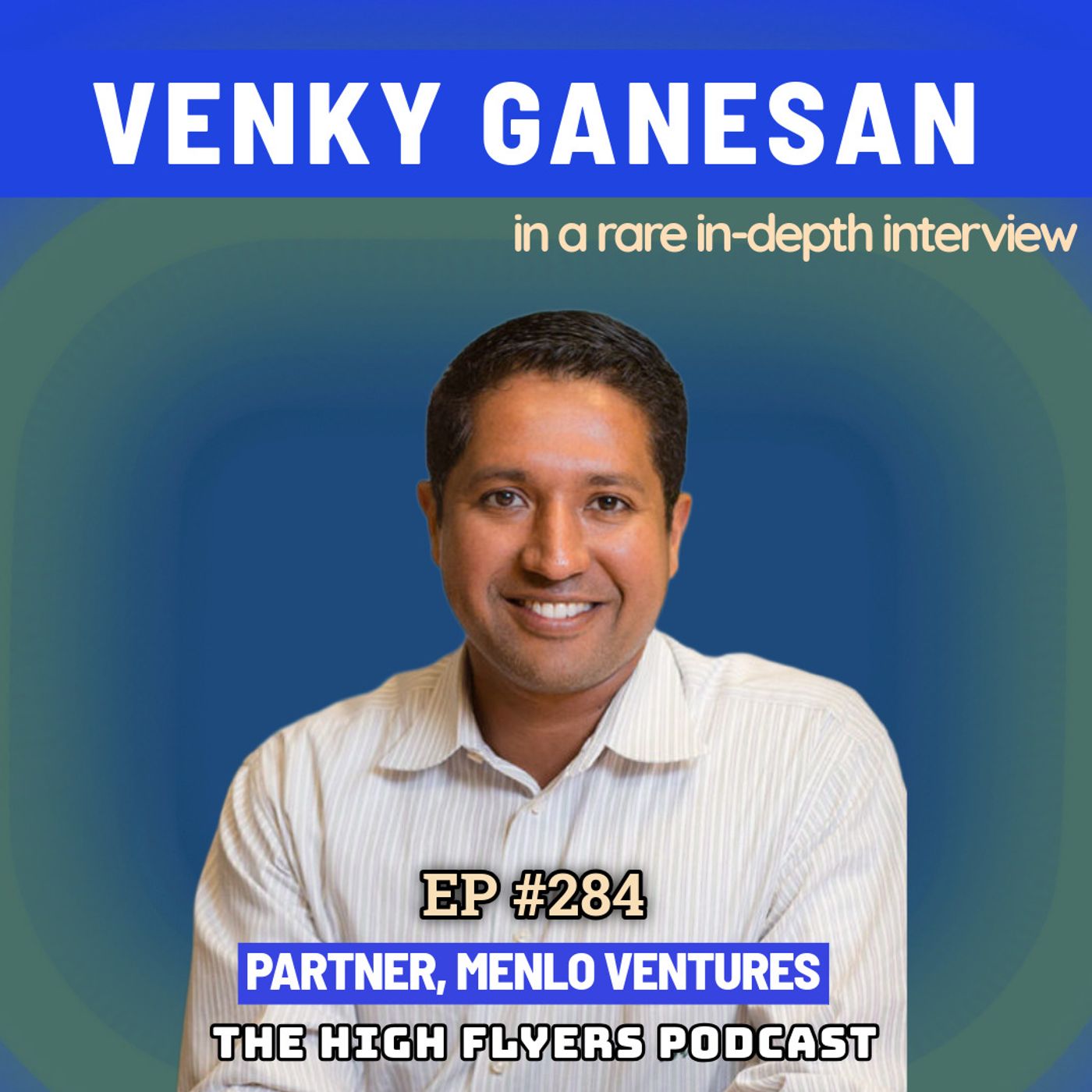
Venky Ganesan’s life and VC philosophy—moving from India to rural Washington at 16, founding a tech company during the late-90s internet boom, then becoming a Menlo Ventures partner and investing in major AI and enterprise companies. He emphasizes “propensity for action,” founder DNA/culture, and why “good vs great” investments take time to judge.
Venky Ganesan is a Menlo Ventures partner (about 28 years in venture capital). Born in Cochin, Kerala, India; grew up in a small South Indian town with a large extended family. At 15/16 he won a Rotary scholarship to attend high school in Enumclaw, Washington (1990). He studied at Reed College and Caltech (computer science), worked at McKinsey, then joined Jafco Ventures before co-founding Trigo Technologies (with Byron Deeter and Reza Mohsen). Trigo was acquired by IBM in 2004 (~$200M).
VC success depends on founder learning speed and culture, and on “propensity for action” (what founders do between meetings). Fast followers can surpass leaders; AI winners are shaped by founding-team DNA.
Apollo Auto Networks (Nir Zook), Poshmark (Manish Chandra), Palo Alto Networks (early investment; valuation negotiation vs Menlo), Anthropic (founded by ex-OpenAI team), and “fast follower” examples like Google.
Written by AI. May contain mistakes.
Venky shares his origins from India and his first job experiences.
“I'm your host, Virita Aguil, and let's have some fun.”
Discussion about Venky's family and the impact of his parents on his life.
“So we have, we are very, very fortunate to have people have been with us for a long time.”
Venky discusses his evolving approach to personal presentation and its significance.
“But even my dad, just in all those black and white pictures, always looked good.”
Venky reflects on his transition from India to a small town in the U.S. at a young age.
“because I think in the mid-90s I had a chance to work in South Africa and I had a chance to go to Robben Island.”
Venky shares his aspirations in technology following high school and his desire for independence.
“I mean, maybe one of your daughters can go to India and then she can do the opposite.”
Venky shares his aspirations and experiences growing up in India and moving to the U.S.
“What was, what were your aspirations at age 18?”
Venky discusses his educational path and the influence of his colleges on his career.
“So then I just and this is sort of my philosophy in life.”
The conversation transitions to Venky's early interest in venture capital and his career decisions.
“I just didn't think that's who I wanted to be.”
Venky reflects on his journey as a founder and the launch of Trigo Technologies.
“So as I told you, I wanted to be an entrepreneur.”
Explore the critical role of the first employee and spouse in a founder's journey.
“And sharing that moment with those folks who joined us.”
Hear about the shift from entrepreneurship to venture capital and its challenges.
“I want to come to that in a moment because I think that people have said was an inflection point.”
Insights into traits of successful founders and the nuances of venture funding.
“But you could see the conviction and you can see his vision for what he was going to do.”
Understand how to differentiate between good and great investment opportunities.
“And hopefully don't add negative value because I think a lot of venture capitalists add negative value.”
Discuss the impact of being a late entrant in competitive markets.
“Like is that true with the good versus the great investments?”
Explore how slower startups can catch up and learn from leaders.
“And that was one thing he was talking about is like, we often talk about like, who's going to finish the race first.”
Venky shares his mindset during his career shift and motivations for change.
“And I mean this in as respectful manner as I can.”
Discussion on the importance of team building and company culture in VC.
“You know, the house needed some work, right?”
Insights into how to effectively raise capital and foster trust with investors.
“I think the same thing with venture firms.”
Venky discusses the challenges and opportunities in today's investment climate.
“I'd love for you to assess the market because as we've talked today, you have lived through the dotcom era.”
Explore the current state of venture capital and important trends in cybersecurity.
“the moment, like every VC I speak to is investing in like robotics and like infrastructure companies and like DTECH and biotech and physical AI, this whole term.”
Insights on venture capital strategies and the importance of position sizing.
“And I really appreciate some of those reflections you've shared because I wish some of these conversations were talked about more openly.”
Understanding the impact of market cycles on investment and recognizing potential fraud.
“So I think you've got to be very flexible and not locked in into a position long term.”
A reflective story about a health scare and its effect on life priorities.
“exceptional founders who are learning machines, who have great culture and who have a very high degree of clarity.”
A light-hearted rapid-fire session discussing hobbies and personal reflections.
“You've been very gracious with your time today.”
Venky reflects on his college experience, emphasizing the importance of relationships over goals.
“I never went on spring break because I was so afraid.”

Get the gist, explore an idea or ask about something said.
 Claude
On The High Flyers Podcast with Vidit Agarwal, what are the key points of this episode?
Searching your listeningAutomatic transcript. May contain errors.
0:00Hi, I'm Vidit, the founder and host of this podcast, The High Flyers. Hi, I'm Venky Ganesan, partner at Menlo Ventures. Venky, I am pumped to do this. I mean, you have so many varied interests. My goal out of today is to capture all your interests. Hopefully we can do that. That feels like a lot with it, but I'm game if you are. I am game. Let's take on the challenge. I'll try my best. Hey friends, welcome back or welcome to The High Flyers podcast, where we do reimagine a high flyer, showcase the brightest and most relatable role models and companies, and the journey from sunrise to today. As one of the premier products in our Curiosity Center lineup, providing on-demand intelligence to help you be 1 % better every single day.
0:47I'm your host, Virita Aguil, and let's have some fun. Our listeners have called this podcast a meticulously researched biography unveiling the extraordinary lives and decisions of the most remarkable individuals and companies from around the world. We hope you're enjoying our catalog of 200 plus episodes since we launched in 2020 with many of our guests appearing in rare public interviews. It's now time to explore your curiosity. Please enjoy. Let's set the scene with some fun facts, Finky. Where were you born and where do you live now? Kuchin, India, Atherton, California. Nice. Very good. That's a great journey that I'm keen to unpack.
1:26And work, what was your first job and what do you do now? First job in 10th grade, I was a sales guy for an IT company. Funny story, but we can talk about that later. Tell me now, tell me the story now quickly. Well, I think I read a newspaper ad when I grew up in a small town called Khoemthu, India, and the ad said they were looking for someone to sell IT products. And I showed up there. What I didn't realize was it was really an ad for college students. And I was the only high school student in this interview. And there were like 30 offers. And they had one opportunity, one job. And I ended up getting that job offer.
2:05So it was just an interesting experience as a 10-year-old or as someone in 10th grade, so 15-year-old. Wow, that is so interesting. And we will talk about that as we talk about your early journey in a moment. And now, how would you describe your job? My job is to find amazing entrepreneurs and make their dream a reality. Simple. That sounds so simple. It's a privilege and I'm grateful to have it. And do you want to just give some context on Menlo? I think most of our listeners know Menlo, but if there's any that don't, do you want to just remind them? Yeah. Simple snapshot, 50-year-old firm, probably one of the oldest firms in Silicon Valley, all in on AI and fortunate to be one of the largest, if not the largest investor in philanthropic and have built an amazing AI portfolio that includes companies like Open Router, Lovable, Suno, Whisper, Xfin.
2:53So good. I spoke to one of your partners, Sean, for research and he said to me he joined Menlo in 2002. I couldn't believe that. That is 24 years in a venture capital firm. Yeah, we have a couple of people in our firm who have been here since I think 2000, sorry, 1999 and maybe 2000. So we have, we are very, very fortunate to have people have been with us for a long time. Let's start with your early journey. I'm fascinated by this because I don't think you've actually talked about this in a public format as much. So you said Cochin, Cochin, India, right? So west, is that west of India? It's actually Kerala.
3:27So it's really south. It'll be southwest, you're right. Southwest. Okay. Tell me, let's start there. What are your memories of growing up there? So I was born in Cochin, but I didn't grow up there. I grew up in a small town called Kwayambathur, which is in South India. Here's what I remember most was that my mom is from a family of six, five sisters and a brother. And then all of them conspired to make sure they all could live within a block of each other. So I had this incredible environment growing up. We were not wealthy, but we were privileged in the sense that we had this huge family. My grandparents lived with my uncle and we all lived within a block of each other.
4:02So I just remember like we could never have any friends because of every birthday party. There were so many people in our own family who showed up, you can never invite someone else. So I was one of, I think, 16 sort of grandchildren. So I had 15 cousins who all live within a block of each other. That's what I remember most. Tell me a bit about your parents. One thing that came up a lot of my research is your mom always said to you to dream big. And that reminds me of my mom because she's been the same. I always say my dad is the pessimist and my mom is the optimist. Is it similar for you? Yes.
4:33Actually, I think both my parents are optimist, but I think the one difference And I think of this a lot because I think I was very, very lucky. My mom, for whatever reason, clearly not backed by facts, just always had this insane belief in me. And growing up as a kid, my mom always believed I would do amazing things, even when all the evidence was to the contrary. And I think it was such a gift because I just grew up with someone who believed in me so much when I didn't. And her self-belief in me, I think, made an impact in making me believe in myself. Tell me about what your parents did for work.
5:11My dad was in the auto parts business. He initially was selling radiators. He eventually became kind of like the general manager of a company. And then in his late 40s, early 50s, decided to become an entrepreneur and sell radiators himself. And my mom was a housewife. And you were the only child? No, I had a sister. So I'm the oldest child. And then my sister, who is better looking, smarter, and in all dimensions better than me, she's two years younger than me. So she's a 12. Right. So I said to you before we started recording that one of the most common threads in my research that came up is people said you like to dress well and you always present really well.
5:47And even right now, you look so suave and smart. When did that start? Is that back to childhood or did that start later in your life? You know, it's really funny. But if you were to go and ask my parents, especially my dad, my dad would always say I dressed like a slop growing up. I did not care about my appearances at all. I think I used to embarrass him with how sloppy I was. And my dad was a very, he was a well-dressed person. I mean, if I look at black and white pictures of my dad, he or even, we were very, very middle class. Like, I wouldn't say we were not poor, but we were very middle class.
6:24So everything was a luxury. But even my dad, just in all those black and white pictures, always looked good. And he always looks good. And I think maybe it was like some point, I would say like after college, that I decided to make a change. I don't quite know why. And I went, I guess, from one extreme to the other. I went from not caring at all how I looked to perhaps spending more time than I should on how I look. I think it's great. I think more people should do it. And it particularly makes you stand out in tech because as you know, everyone wears hoodies and a t-shirt. And then if you come in in a suit jacket, you stand out.
6:58But it's actually interesting to me the way, because my dad told me something, right? He always said like, you know, eat what you want, but dress the way people want to sit. You want people to see you. And what I mean by that is that I think the one thing I internalized from my dad is like, you're not actually dressing for yourself. You're dressing for others. And when I understood that, to me, it's like, it's a sign of respect and seriousness for what? I think my partners make fun of me because I do show up to a lot of Monday morning partner meetings in a jacket. And I do it because to me, it's an internal message to myself.
7:34This is the most important meeting of the week. And I am going to take a level of seriousness and focus to this. And I'm going to show up in a way, I'm going to think carefully about what I'm going to wear as a way of showing respect to the meeting and to the institution. and once I made that mental click like this was not for me but this is really for the other person because I can't see myself well I can't see myself today but like most of the time I can't see myself other people see me so this is the way I'm going to show how much I value this meeting how much I respect the fact that you're giving me your time and once I made that switch it really made it easy for me to focus on that if I can tell you one story which really stuck with me because I think in the mid-90s I had a chance to work in South Africa and I had a chance to go to Robben Island.
8:20That's the island in which Nelson Mandela was a prisoner for, I think, X number of years. The thing that when you go there and you hear is that even though he was a prisoner, when people would come to see him, he would just come up, be groomed the best way he could. He would act like you were visiting a dignitary, not that you were visiting a prisoner. And so, I think that was an important lesson for me. And I think it's been said in his autobiography. That's when people are confident that he could be the leader of South Africa when he was going to be released from prison because he carried himself that way.
8:52And so in many ways, I think you become what you believe and you should act like who you want to become before you even become it. And I think that's another thing that struck me, especially when I'm thinking about, okay, why do you want to spend some time? Because people are going to see you and then they're going to make a judgment. And if you want to become something, you got to first to act like that. Absolutely. Tell me about what your personality as a kid. So I'm curious, like if I met your high school teachers, how would they have described the young Venki? I think they would have said super intelligent kid.
9:26I know this sounds very, I'm pretty sure. I'm very extroverted, friendly, a little bit of a prankster, smart, but would not do like the one phrase my third grade teacher said is like, I've never met a kid who's as smart as you, but who just doesn't spend enough time on the schoolwork. So like it, I was kind of a kid who wouldn't get the grades. I did okay in school, but like, who was just like, my teachers kept like, oh, you don't, if you just could work a little harder, you'd capitalize. But I was just, I was just a rambunctious little kid who was running out. And so then tell me, you had a big inflation point in your life when you moved from India to the US at the age of 15, I think you were telling me the other day.
10:06So you went from living in Coimbatore to rural Washington. That just sounds like a movie when I even repeat that. Take me inside that. Yeah. So when I was 15, I had this dream of, I want to go to England first. And then I realized that actually, if you're Indian, you need to go to England, you want to go to Oxford or Cambridge, you can't really get scholarships. You actually need your parents to pay for it. And it turns out my parents could not afford to ever send me overseas to study. So I quickly switched my dreams to come to America. There are more opportunities in America to potentially get someone else to pay for your education.
10:41And I realized there's this rotary scholarship that takes high school students to come to America for a year. And I think most of the time people would come to America for a year party and then go back. But I realized that this was a great opportunity to go to America and potentially graduate from American high school and then potentially get into American colleges. So I applied and got this luckily. It was actually a really funny story because it's very hard to get those applications for the scholarship. And a friend of mine got it and he wanted me to write his essays for him because I was a good writer.
11:15And I said, I'll write the essays for you if you also give me an application so I can write essays for myself. Clearly did a better job writing my essays than his because I did get the scholarship. And that's how I ended up in Enum Cloud, Washington, small town of 4 ,000 people. And so this was grade nine? It was grade 11. So I finished grade 10. Okay, so you did. Right. Right. How do you reflect on that now? I mean, now you are as American as anyone else, right? You've been here for so long. But what was that like first coming? Did that take you a while to transition? Looking back, this was so crazy to do.
11:47Didn't have any family, anyone in America. No one in my family had ever come to America. I actually think of all the gifts my parents gave me. Like the first gift I would say was like my mom gave me this gift of insane self-belief in me that translated to me having self-belief. And the second gift my parents gave me was like, they actually like let me go when I was 16. I can't imagine one of my three daughters going to a place. Now you got to go back. This is a 1990. We didn't have the internet, no phone. Calling back to India was$2.61 a minute. And so basically I'd spend 10 minutes a month calling them.
12:23And the only other way of communicating was writing long form letters. But my parents gave me this gift. And I think it was really a notion of their sacrifice that they were willing to send their 16-year-old son. I don't think I will actually make that kind of sacrifice because I generally feel like it was really hard. And so many people told my parents it's a bad idea to send a 16-year-old boy to America on his own. But they had this confidence in me and they felt like this would help launch where I wanted to go. And so they sacrificed for me in letting me go, which to me is the second biggest gift they ever gave me.
12:54Totally. I mean, maybe one of your daughters can go to India and then she can do the opposite. That'd be interesting, right? If that ever happens. It'll definitely be interesting. I'll see which one signs up for that. But to your point, so I go very middle class in India, show up in this 4 ,000 person. Like, you know, when you think America, you're thinking Upper East Side, New York, Beverly Hills. I show this very remote rural town. There are literally, I think maybe there are 400 kids in my class in 11th grade. There are two people who are people of color, two students who are people of color.
13:26Me and this girl whose father owns the one Chinese restaurant. Every small town in America has a Chinese restaurant. And that's it, the two of us. That was a culture shock. Incredible. I mean, I can't even fathom what that was like because you hear stories of people moving for college when they're in their 20s, right? Or 30s. Like even all the successful Indian Americans that you hear about came here like a lot older when they had a bit of maturity. You came here as like a teenager. That is, that is incredible. Like truly incredible. So tell me, then you went, you finished high school in, in Washington.
14:00What was, what were your aspirations at age 18? Because you've had this life experience in India and then your eyes have been broadened, so to speak, coming to the U.S. What did you want to do post high school? So you got to go back 1990. Enumclaw is like 60 miles south of Seattle. The biggest story at that time is this company, Microsoft. This is an amazing story about Microsoft had just gone public in 1986 and the technology made. And so growing up in Enumclaw, Washington, like everybody talks about at that point, Microsoft, the PC revolution software. And my goal when I was 18 is I want to do something in technology.
14:36I want to be an entrepreneur and I want to be economically independent. And I remember that very clearly. And it's interesting, I say economically independent, because what I really valued was freedom and curiosity, right? Because the one thing that you asked me about being a kid, like the one thing everybody will tell you when I was a kid was, I just read. I loved books. Best thing my parents gave me was the library card. We couldn't afford books. I would read everything. And I'd read every book I could. And so it was like, I just felt like, you know, if you were economically independent, you could just pursue your curiosity.
15:07And in 1990, as an 18-year-old, it felt like doing something in software would be the best way to be economically independent. And so you went to Caltech? Well, I went to Reed College and Caltech. So essentially, I had applied to Caltech. And it didn't matter. Getting in was hard, but getting in was not enough. I had to find a place that would also give me a scholarship because my parents couldn't pay for it. Caltech did. But the family I was staying with, really nice guy. He was like, you know, you say you want to be an engineer, but I actually think you have wider interest than engineering. Have you considered like doing something at Reed College, which is a liberal arts college in Portland?
15:47And they have a program with Caltech. You can go to both schools. And I was like, that's interesting. He actually took me to see Reed College. And I was like, well, maybe I'll try that. Why not? And that's the best decision I made. You know, I learned a lot about computer science at Caltech, but I learned about life at Reed. That's interesting. So life at Reed, computer science at Caltech. I was told in my research that you always wanted to be a VC. Apparently, you told your college buddies that you want to be a VC back then. Is that true? That's true. So I, you know, you go, I love libraries.
16:20And so I go to the Reed library and the Reed library had all these old periodicals. And so I would go, I remember reading through the Time magazine. I know nobody reads Time magazine now, but they would have this person of the year edition. I was going through it and I would go through systematically. And I think it was in 1981 or 80. I'm not exactly sure. There was a story about person of the year. And so the story, the cover was actually about a computer. It was the first time time had an inanimate object as a computer. And then I read that and they had a profile of Steve Jobs. And then I noticed that that profile of Steve Jobs was written by Mike Moritz, who actually turned out to be a venture capitalist.
17:01And I was like, well, what is this venture capital thing? And then I read this story about Arthur Rock. I was like, this is great. So there's a job in which you can make money, invest in entrepreneurs and leverage your technology and software and do it. That sounds interesting. Why can't I? Let's be a VC. But then you didn't become a VC straight away because, like you said, you worked at Microsoft and you're at McKinsey. Then you're a founder for a bit. Did you think about going and joining one of those firms back then? It's funny. I actually went to the guidance counselor. And I think I remember this clearly, like a woman in her 50s, really nice person.
17:36And I told her, hey, I want to be a VC. And she looked at me and said, you know, most VCs have gone to Harvard or Stanford. I actually don't think that's a good career choice for you. Why don't you pick something like engineering? That'll be a better choice for you. I know she said that in the best intention manner because she was trying to set the expectation like that doesn't feel like a good career choice. But it only made me want to do it even more. So I was like, oh, OK, I can't be that hard. I mean, I'm going to try to figure out. So then I just and this is sort of my philosophy in life.
18:09It's like, you know, whenever someone tells me something can't be done, I always write, OK, let's reverse engineer why it can't be done. I think what she was trying to say is that to be in venture capital, you need to have networks and people who go to places like Harvard or Stanford are more likely to have those networks. But she did not. You know, most people, when they say these things, don't actually give you what they mean, the second degree. And so I was like, OK, well, how do you replicate networks? And that's when I realized, oh, a lot of these people go to places like McKinsey or Goldman Sachs.
18:37And so I decided instead of going back to Microsoft where I was working, I need to expand my network. I need to be in places, which was good. And I ended up going to McKinsey. And you know what? That was a great decision because at McKinsey, which was what was called a business analyst from 1996 to 1998, I had the opportunity to meet a couple of people who have been sort of huge factors in shaping the rest of my professional career. So I always say, I joke to my daughters, there are people I met before I was the age of 23 who have just been so influential in shaping my career. I met a gentleman named Byron Deeter.
19:10He started a company together. And then when I was in South Africa, I met Rulof and Sarah Fryer and a whole bunch of other folks. So it's funny how people you meet in your early 20s can still be relevant in your 50s. Absolutely. So, I mean, you've now been a VC for 20 plus years. Is that right? 28, yes. 28, just casually? 28 years? Yeah, who's counting? Exactly. Exactly. And you're still young and back to you, like, well-dressed and all that. So who's counting exactly? So, I mean, I'm curious. So you were at Microsoft, I think, for a couple of years and then McKinsey for a couple of years. No, I worked at Microsoft.
19:47Sorry. Sorry to interrupt. I worked at Microsoft through my summers at college. So I did not. Right. It was mostly a summer job. And then I joined McKinsey right out of college. So in 96, when I graduated, I joined McKinsey. How do you reflect on that now? Like you hear a lot of VCs talk about like they have this operator background or they have this founder background or executive background. And did that McKinsey period give you any skills that came in handy when you started as a VC? Huge, huge. I think it's really interesting. So in 1996, when I was graduating from college, I was really trading between two options, right?
20:22Either going to McKinsey or going to this quantitative trading fund called Credit Suisse Financial Products. And I just remember this, like, you know, I remember the job offer to the day because, again, didn't come from money. So, like, money was important. The Credit Sense Financial Products offer was$200 ,000 with a$44 ,000 bonus if you got the full bonus. The McKinsey offer was$36 ,000 with a$3 ,000 signing bonus. And so it would be$39 ,000. And that was a really, really big gap in my mind. And I just could not. So I was really going to take the offer, which had more compensation. But I went on a visit to both places.
21:01And I remember going to visit the Credit Suisse Financial Products Fultz. And you have this day, they wine and dine you. And then you kind of meet your boss. I'm meeting my boss. He's in the trading floor. You know, he's eating a peanut butter and jelly sandwich at 4 p.m. And I see the jelly drop off to his tie and he doesn't care. And I was like, okay, that was one experience. And then I went to the McKinsey cell weekend. It was in Shudders by the Beach in Santa Monica. And I see all these people who just like to me seemed interesting and thoughtful and people I could visualize being someone I could visualize being 10, 15 years from now.
21:40And that made my decision. I was like, I need to be around. One of the things I really believe strongly is you're the average of the five people you spend the most amount of time in your professional life. And I didn't like what it meant. The average of the five people that criticize financial products. I'm sure they're great people. I just didn't think that's who I wanted to be. But I could see at McKinsey, like there was just the way people carried themselves, the way they talked, the way they thought about the world. It just felt closer to me. And so it was a hard decision turning down that kind of money as a 24-year-old.
22:10But I knew this would be the better long-term decision. And that's turned out to be the case. You know, my thought as I was preparing for this was maybe you've had days where you've thought about what if you didn't do McKinsey and you were just in VC, right? Like has that thought crossed your mind? No, it hasn't. And part of this, I just feel like I met so many people that are so integral to sort of how this shaped out. I noticed in my preparing, when I was looking at your career history, that did you have a one-year break between McKinsey and starting your company, like from 98 to 99? No. So it goes like 96 to 98, I was at McKinsey.
22:45Then I left McKinsey in 98 June to join a venture capital firm. It's called Jafco Ventures. It later became a Gloves fan. So I was in that venture capital firm from 98 June. So I joined them as an associate till 99 December. And then in 99 December, Byron, Reza and I started Trigo Technologies. Right. That makes sense. So tell me about Trigo because you did that for a couple of years and then you became a full-time VC. How do you reflect on Trigo? Yeah. So as I told you, I wanted to be an entrepreneur. That was one of the things I want to check out. And so I left McKinsey, South Africa to become an associate in a venture capital firm in Boston called Jafco Venture Stand.
23:24It has now changed to Globes Fan Capital. And so I worked there. And if you remember, the internet boom was going full. Some of your listeners are old enough to know what the internet and the internet boom is. And so 98 June to like 99, like the internet was in full flow. Every 20-year-old idiot was starting a company and being successful. I felt like I qualified. So I was looking and I was an associate in a venture capital firm. So I could see how the sausage was being made in venture capital. And Byred at that point was an associate in a firm called TA Associates. And we would call each other all the time and email about how the world is passing by.
24:03There's this huge opportunity and we got to start a company. And we decided we're just going to start a company in 99 December, right? Close to the peak. And we needed a third co-founder, someone who's going to be very technically focused. And so I called the smartest person I knew. It was my classmate at Caltech. He was a year ahead of me called Reza Mohsen. And he was working then as a youngest manager at a telco. And we started TreeGo in 99 December. Tell me about Byron because you both are now well-established VCs. He's at Bessimo. You're, of course, at Menlo. I mean, I find that like really interesting that you both were founders in the late 90s, trying to just start out in your careers, right?
24:41And now you're both established VCs. Give me the reflections on first meeting Byron and how has that journey been to build a company, get it sold and then go into VC? Yeah, that's a great question. If there's any skill I have, which is not many, but if there's any skill I have, it is that I've always had an eye for exceptional people and try to figure out how to attach myself to that. And I would put Byron in that very rare category. So I met him, I want to say February, March 1996, because we were both in the BA class that started in June. And the first day I met him, I'm like, there's something special about him.
25:18The way he carried himself, the BA taught. He had incredible work ethic. I think he actually came from privileged means. But what struck me was just his ability to work. Like sometimes I think people from privilege may not work as hard. His work ethic was incredible. His ability to engage with people, the way he communicated. And as a kind of like 23-year-old, I was in awe. I was like, man, this guy is so good. How he carries himself, what he does. How do I attach myself like a parasite to him? That was my goal. I was like, get close. And it's not a surprise. And so when I look back, I just feel like you see people.
25:56And by the way, you could say the same thing about Roloff when I met him. It was not a surprise to anybody that they've turned out to be as successful as they are. because all the signs were there. And then I believe IBM acquired the company in 2004, I think for about 200 million. And I found one of the quotes you said is that created many millionaires, right? We've talked a bit about like how you came from India and you seeked a better life. Did that tick the box for a better life and you got some success? Yes. And I think it's very gratifying. It was a great outcome for a company started, like we raised venture money in March 2000.
26:33And there are not many companies that raised venture capital in March 2000 had good outcomes. So in the context of that, I think it's a great outcome. It definitely, for the first time in my life, I felt financially secure. I mean, looking back, it was not that large of a money, but it felt huge for me. Until that point, I think I never go to a restaurant and order anything without looking at the price and thinking a lot about it. And I know this sounds crazy, but like the notion of like going to a restaurant and not caring what the menu costs of anything you're going to eat or staying in a hotel and not caring about what the hotel costs.
27:10Those are very foreign concepts for me. And I think Trigo allowed me to have that freedom. I know it was like, you know, it was great that I could get my wife a fancy car. It's a Toyota Camry. We went for the XLE option, which was, you know, the highest end option of the Toyota Camrys, which was great. But it was also amazing because there's so many people who joined Trigal were folks like me and Reza. So almost all the engineers were people on F1 visas who were usually people from South Asia, from India, Pakistan. And then we'd gone to college in America and joined us. And like it was gratifying in two ways.
27:48One, yes, we created economic wealth and independence for them. But more importantly, we also allowed them to get overtime green cards and U.S. citizenships. And I'm proud of both. And so what I have found is that whatever joy I have gotten from any achievement, it's been a lot higher than there have been other people to share it with. And sharing that moment with those folks who joined us. You know, when you are a founder, you're telling the story about all these things. And the first employee is the most important one because this person is going to join you with no evidence or reason to do it.
28:22Dan Laughlin was the first employee at Trigo. And the fact that all those people were able to create some economic wealth for their family, that's very gratifying. Absolutely. I mean, I bet. You also mentioned your wife. So you were married by this point, right? Yeah. And I got married in 2000. Yeah. Can we touch on that for a moment? Because I've been told, again, she came up so much in my research, like the role she's played. I always talk about you and I are the heroes in our story, but the support cast, they're the real high flyers. And I think both your wife and mine, they're both doctors.
28:51So they're both definitely smarter than you and me. So we have that in common. Oh, look, the bar might have been higher with you. But look, my wife is just a really, really special person in so many ways. But I think the thing that always struck me about her is that I met a lot of really smart people. And I met a fair number of attractive people. I've never met someone who is really smart, really attractive, but also incredibly kind. And the thing that struck me from the first moment I met her is just her empathy for people and her willingness to do things for other people and take care of them.
29:29And I'm not surprised she ended up being adopted. And so for me, like that's always inspired me. And most days, probably every day, I cannot live up to her standard. And once in a while, when I do live up to a standard of what it means to work hard and be kind to people, I feel so great. But it only happens once in a blue moon. And maybe we'll talk about it as we chat. She's noticed things about you before others have, right, that have prevented more serious health conditions, which I think is one of the perks of being married to a doctor. That's true. And we can talk about that whenever you like.
30:00But yes, obviously. Back to the episode in a moment. Something I've heard a lot from business owners and leaders is that speed only matters if you still feel confident in the output. And it's particularly an important point in this world of AI. Xero's answer to that is accountable intelligence. AI that shows you what it's doing and works from your own real data and is designed to keep you in control before anything happens. As Xero puts it, most AI asks you to trust it. accountable intelligence shows you why you can and that's how it works with jacks zero's in platform ai finance partner so whether you're running the business advising the client or working with your board jacks ensures that you get the upside of automation without giving up any of the control if you want to see this practice head over to zero.com forward slash high flyers for 90 off your plan for the first six months terms apply and go to the website That's 0xero.com forward slash highflyers.
31:09Now, back to the episode. I want to come to that in a moment because I think that people have said was an inflection point. Like it made you take stock of what's important and that makes sense. But post the acquisition of your startup, you then became a VC. I mean, I'm curious, like just hearing you speak, you seem to have all the founder traits. Like, did you think about going back and starting another company? If I'm going to be an honest grader And I try really hard to be someone who is objective. I would sort of give myself a B plus grade as an entrepreneur. I don't think I was a great entrepreneur.
31:40And I think that when you think about a job of an entrepreneur, there are many dementors to it. I think I was good on the strategy piece. I was good on the recruiting piece. And I was good on the selling piece. I don't think I was great on the execution piece. And actually, that's where I would say like Reza and Byron, they were insane. execution machines. I probably could do all of the above and execute. And so when I look back and said, look, I think you should do the things that you like. And what is a job in which I can do in technology where I can still focus on strategy, focus on recruiting people and focus on selling?
32:19And VC felt like a much better fit for me. And that's why I decided to stay a VC. The other thing is also I really value curiosity and freedom. And when you're an entrepreneur, you really have to be focused. The best entrepreneurs are focused and they're maniacally executing. You don't have the time to explore curiosities and you don't own your time. And so as a VC, I feel like you have the benefit of both satisfying your curiosities and having more control over your time. Before I go down the path of your VC career, I think your point in founders is so interesting. And it's one I think about a lot through this work and various other work I do.
32:57I mean, you've met some incredible founders through your time and you invested in many of them. Can you share any of the founders that have really challenged you to think in different ways, but have achieved the outcome? Like, I don't want to put words in your mouth, but some of the companies you invested in have been significant outcomes back when you started as a VC and even more recently. Can you share any examples of founders that have, to you, achieved that A-plus grade? For sure. I mean, I've been fortunate to have seen quite a few, right? I think about someone like Nir Zook, who's the founder of Apollo Auto Networks.
33:30And it's a$200 billion business today. But you could see the conviction and you can see his vision for what he was going to do. It was crystal clear, right? I think about Aaron Easterly. And usually he's not the founder of Roval, but he was a CEO and he built it. And so I almost consider him founder-like. Again, you could see his mission, intelligence, and execution. Think about someone like Manish Chandra, who's the founder of Poshmark. And again, so I look at these folds and there's some traits I've seen consistent across them, right? One is just the obvious traits that people already know. Founders need to have incredible persistence and grit.
34:11All of these people have that. But the thing that I also found interesting to me, the single biggest thing I have found over time to be really a good signal is propensity for action. So like the people who are high propensity for action, I feel like are much likely to be successful entrepreneurs. And I didn't say high propensity to action. It's just that I always say between meetings, what have they done? And then you meet some people and between meetings, they still are showing you the same PowerPoint. And then there are other people, like I think about Evan at Abnormal. You know, between meetings, they've accomplished so much.
34:46They're like, each meeting, you're learning so much more. And they have had so many more meetings, they have pushed a product out. So to me, propensity for action is probably the number one trait in entrepreneurship I look for. The Palo Alto network story is incredible. And I mean, I think you sourced them quite early in their journey. I'd love for you to share that story because we talk in VC, the big part of the job is sourcing, but then also getting selected for the founder to want to take your money and for you to want to invest. Can you share that story? Yeah, I think there's a very interesting nuance to the story.
35:17So I was introduced to Palo Alto Networks by my friend Ashim, by the way. It's amazing. If you're like, who should you have on the High Fires podcast, you should have Ashim Chandra. He's an N1 entrepreneur, N1 VC. And he's also successful. But Ashim introduced me to the company. The reality is that, And I was at that point at Globespan Capital. And so it's not in Menlo. And when I looked at the company, Palo Alto Networks was also trying to talk to Menlo Ventures. And Menlo Ventures actually put a term sheet in the company. I think I want to say around$50 million pre. John Jarvie was partner then.
35:52John has since retired. And then they came to meet me at Globespan. Obviously, I also love the entrepreneur. And I put a term sheet through Globespan at$60 million. And the honest truth is if Menlo had raised the evaluation from$50 to$60, Nir and Dave Stevens would have probably gone with Menlo because Menlo was a more established firm than Globes fan and John Jarvie was a more established VC. But lucky for me, Menlo, I guess unlucky for Menlo and John, they didn't raise their valuation. And I was able to convince Nir, Dave, Ashim, and Jim Gax, who was the other board member, Jim's a legendary VC from Sequoia, to let us into the company.
36:26And then I had to go back and convince my partners why we had to pay this high valuation. And that's the thing about venture capital people don't fully appreciate, that you got to sell everybody. You got to sell your partners. You got to sell the entrepreneur. You got to sell the other VCs and convince all of them to pick you. And I was lucky enough to be able to do it. Incredible story. And I mean, that the return profile on that investment, I mean, hopefully you've still got shares in it now that it's a public company. I still have a few. You know, it worked out really well. And this is a great story.
36:57It's not, look, at the end of the day, venture capitalists don't create these companies. the entrepreneurs who do. What I think you want to think about is like, how do you put yourself in a place where you can partner with them? And hopefully don't add negative value because I think a lot of venture capitalists add negative value. But if you can then, if not, add a little bit of value, then you get invited again to be part of the journey. I mean, that's an interesting comment because I think that's something that a lot of founders talk about, right? Many founders that have been on this show, even the VCs.
37:27I mean, recently we just had Mike Vernau who was early at Facebook and then Sequoia now at Conviction. And he said he thinks the lifespan for a VC is seven years. He was like, once you've done it for seven years, it's time to move on, which I thought was interesting because a lot of VCs have done it more. You've done it more. You've been, I think, 14 years at Globespan and then you've been 13 at Menlo. I mean, maybe the better question is, how do you compare your VC archetype at Venki when you were at Globespan to Venki when you were at Menlo? What has been different and what stayed the same? Yeah, actually, you know, so it's funny.
37:56I have to talk to Mike and understand a little bit more why he says seven years, because Because I actually think it takes 10 years before you even know. At least it took me 10 years before I could even understand what I was doing. I am a slow learner, so it might be more me. But I think it's so different. I think the most important thing about venture capital is you have to understand a couple of things. One, history doesn't repeat, but it arrives. So there are things you can learn from history, but you can't just repeat it. And two, that the best companies break some sort of rules. So there are all these heuristics you have as a venture capitalist.
38:33And then you know that the best companies will actually break them. And how do you decide when to break your heuristics and when to follow them? It's the art of the business, right? For a long time, people had these rules. Oh, don't invest in husband and wife teams. But if you believe that rule, you won't have invested in Cisco. And they're very successful. Don't invest in things focused on college students. You would have missed out on Facebook. So to me, what I would say is that the difference between Venki at Globespan and Venki at Menlo is that you have some context of history. You understand things change.
39:07But most importantly, enough years, you've seen greatness. So it's very easy to know the difference between a bad investment and a good investment. Very easy, it's true. It's easier to know the difference between a bad investment and a good investment. I think most people can do that. I think it's much harder to know the difference between a good investment and a great investment. That's actually where all the outlier returns are. And I think it just takes time to know what's a good investment and what's a great investment. And there are things around the entrepreneur, things around the market, things around where certain trends are that need to all come together for something to be a great investment.
39:41And I think it just takes time to know that. At least it took me time to know that. Is that true? Like we can move around a bit here with AI. Like is that true with the good versus the great investments? So can you, this is something I talk to a lot about, like your VCP is about, is like, how do you tell the difference today? Because every company is growing so fast and every company is getting new valuations very quickly. And that's exciting. But then also some might say it's become consensus, right? Like, how do you think about it today? Like, if I was working in your team and I said to you, Venki, I want to learn how to be a great investor.
40:13And how do we separate our portfolio companies, the good and the great? What would you say to me? I thought you should go and find a good mentor, not me. I would say, yes, you can. Because the core, I think if you're looking at metrics, they all look the same. But the metrics are, in many cases, like the equivalent of driving a car by looking at the rearview mirror, right? You got to look through the windshield, not the rearview mirror. And the windshield is determined by the DNA of the founding team, the culture of the place, the quality of human capitals they are attracting. and then the clarity of vision they have on what they want to do.
40:51And so to me, like I literally go back and think about, okay, what is the growth curve of learning for these founders, right? The best founders I know, the ones that are going to be great companies, they are learning machines. Like one snapshot to just say, hey, if you met them, think about when you met them a year ago and now. How palatable is they learning? How much have they shown you in the ability to learn and understand the situation? I think the best entrepreneurs are learning with a very high curve. The culture they built, right? What are their values? Are they living their culture? And then by extension, what are the kind of people they are bringing to the company?
41:25And so in my view, the difference between the good and the good company might have a moment in time it's doing well, but every company will hit a hiccup. The markets will change. Companies will show up. The great companies have laid the seeds of how they handle the transition by the DNA of their founders, by the quality of how much they are learning every day, and by the human capital in the building. One of my observations at the moment, and you've got both these companies in your portfolio, is you don't have to be the first mover, right? You look at Anthropic OpenAI, you look at Legora Harvey.
41:54I think most people would say Anthropic and Legora came afterwards, but in many ways, they're now dominating it from every metric possible. I had Legora CFO David Eckstein on the podcast recently. And that was one thing he was talking about is like, we often talk about like, who's going to finish the race first. But sometimes actually watching another player start the race and then being a so-called slower runner and then catching up and seeing how they run and what shoes they're wearing and what speed they're going at can actually be a good thing. I'm curious, do you notice that in the companies you spend time with, like that they can catch up to the leader and actually surpass them?
42:26Absolutely. I mean, these games are all so early, right? I mean, like when someone says someone's a leader, it's like judging a 20-over match by the first over, okay? It's great if you do well in the first over, but there's still 19 overs to go. So like trying to call winners in the first over, not make sense and you will never do it. And so like, it's always interesting to me how people are like, oh, someone's a leader. Well, okay, those games may have played out over 10 years and it's awesome that they're doing great in the first six months, but best wait and see. And I do think that sometimes people who are coming in behind have the benefit of being able to see the mistakes that the leader makes, right?
43:04They say the pioneers get the arrows, right? So you can come and be a fast follower. Some of the most successful companies have been fast followers. If you look at Google, Google's probably the ninth or 10th search engine, and they were able to come through. Nothing wrong with being the market leader, but to me, what I would say is that you can see the culture and the DNA of the founders, right? The founders of Anthropic, they built ChatGPT. It's not like, so they were the ones who built ChatGPT and then they left because they didn't like the culture and the DNA of where open AI was going. So they wanted to do something different.
43:37You look at Max and I'm sure you can feel, you can palpably feel the force of nature he is and his drive. And I think he's thought deeply about where, how AI in the legal space is going to evolve. And then he has built a team. So like, to me, I go back, like, what's the quality of the founding team? What's your DNA? What's the culture they're building? And how quickly are they learning? Max is a learning execution machine. Absolutely. I want to come back to your career. I think what is really interesting is the transition from Globespan to Menlo. So 2013, I think, I think you were around about 40 years old at this point.
44:13I mean, by most standards, everyone would say you were successful. You had ticked most of those boxes. You came as the kid from India to the US. You said you didn't have much. You had these aspirations. I think you'd agree that you made it by that point. Where were you at? Take me inside Venki's mindset in 2013. My mindset in 2013 was that super grateful for all the things that have happened. Also, acknowledged lucky to be perhaps the right places at the right time. And I mean this in as respectful manner as I can. I love the people at Glovespan. My mentors there, Andy Goldfarb, Barry Schiffman, they taught me a lot about what it means both to be a venture capitalist, what it means to be a good human, but I never felt that Globespan could be in the mix for the best investments and the best entrepreneurs.
45:01And so I felt that I'm grateful for the opportunity I got, but I needed to think about someplace else if we wanted to be in the mix for the most. I think the whole point of doing this business is to be in the mix on the most transformational companies. At least that's to me At this point, the only metric that matters. Yes, we want to make money. Yes, we want to have drive returns. But most importantly, we want to partner with the most transformational, iconic companies. And I did not think Gloves Fan was going to be that place. And so I was mostly thinking about leaving to start my own firm. Not because I had some good idea, but I was like, hey, there's certain things of culture I wanted to have, certain things I believed in that I felt like it would be easier to have in a new firm.
45:43And, you know, Menlo had reached out to me a few times before, and I had just felt like I did not want to go and join an existing venture firm because I've always felt like it'll be much harder. And regardless of what people tell you, it's very hard to change. So I was skeptical. But I then spent enough time with Mark Siegel, who was the partner that Menlo was leading the search, and a gentleman named Praveen Vazrani. They kind of convinced me that they would be open to thinking about all the changes they wanted to make. And that's actually something I found I'm really proud of is that most institutions that are old just are very hesitant to change.
46:21They have this very strong rejection mechanism for new people and new ideas. But Menlo, I felt, was very different. And, you know, in 2013, Menlo was coming through some tough funds. We raised some big funds in 2001 and 2004 that was not as successful as we wanted it to be. So the firm was in transition. But the thing that struck me was, I kind of explained this to my wife. It's like they say in real estate, it's all about location, location, location. Mellow was in a great, great location. You know, the house needed some work, right? You had to like, you know, maybe redo the kitchens, maybe get some new clothes.
46:59But the bones of the house were amazing. And what struck me was the culture was amazing. And so it was an opportunity to come and sort of build on something that was in a great location. And that was really the motivation to make that movie. Tell me how you did that. because I think that is so fascinating. And I feel there's not enough talk about building the firm. A lot of VCs will talk about, like we talked about how you source the Palo Alto Networks deal and other investments, but building the firm is not talked about. And again, the people you connected me to for research, they all said like a lot of that is your fingerprints on the firm.
47:32I think it was point one. I think point two is some have said Menlo had two lives since she've joined. It was a 2013 period to say pre-Chat GPT and then post-Chat GPT in the AI era. Menlo in many ways is back in a big way, right? You guys are in big deals, Anthropic being the perfect example. Do you agree with that sentiment, the two lives that you've helped scale Menlo to, the 2013 and 2023 and then 23 to now? Yes, and there are different phases. So I agree. By the way, I mean, like people, in general, I think leaders get way too much credit. Nothing is done by any one individual. It takes a whole bunch of people.
48:08I know definitely like there's a whole bunch of people. I feel like I played my part in it, but there were many folks who were critical. I think I'm a big sports fan. Mike Krasinski was the head coach for Duke basketball. He has a saying, like, you know, the secret to great coaching is to have great players. And so to me, like, you know, the first thing about all of these things is that you just have to have great people. And what was amazing and what I think has helped Menlo is that we started off having and brought in great players. So when I think about the story of Menlo's Evolution, critical part from 2013 to 2023 was having folks like Matt Murphy join us from Kleiner, Jordan Armand come in.
48:49And these were critical players because they laid the building blocks for then being ready for the AI phase. And then I think the AI phase, what we have done is like brought in folks like, you know, a Tim Tully, a Matt Craning, a D.D. Das, these are all great people to have, Joffrey Edfern. and then complemented that with existing partners that has allowed us to then capitalize on the AI wave. So the way I think about things is that, like, look, just like for entrepreneurs, you want to focus on culture and DNA. I think the same thing with venture firms. A lot of venture firms are, to me, like golf teams.
49:25Everybody goes, shoots around, they add up the score at the end. I think we always said, like, can we be a rugby team? Can we be a team where we are all like, you know, in the scrum together, where we can count on each other, where we will take body blows for each other? Can we do it with a high degree of trust and transparency? And I think that's the part I felt. Could that be a strength? Could we essentially build a culture of high trust, high transparency, have collectively a sense of what we want to accomplish and then go about doing that? And all of these are easy things to say, and I don't think they're controversial.
50:03So how do you put that in place? How do you think about incentives? How do you make sure that our incentives align with our values? How do you live and make sure that people feel that? So to me, all of those details that I think the difference happens. And then you got to also win, right? You can have the best culture in the world, but if you don't win, it doesn't matter. And I think they all came together in between 2013 to 2023. I think we were laying down the seeds of these pieces, which is all important, but we didn't quite have that big trend we could latch on. And we've been thinking about it.
50:36Like if you remember in the late sort of 2017 to 2020, there was crypto and a lot of folks not. And we didn't feel like there was a trend to bet the firm on. In the early 2000s, there was clean tech. That was not a trend. Some people leaned in. And because I think when you are going through this transition, you got to build a team. But then you also got to find an identity. Like if you're a sports team, say, what is your identity as a sports team? And to me, that all came together in 2022 when ChatGPT came out because you actually had this, wow, AI product gets 100 million users. What if we just pivot and completely focus the firm on AI?
51:13And I think that was sort of a decision point that allowed us to focus and capitalize on it. And then we've been able to execute on it. These things are all a combination of things. Well, I get told by a lot of people, one of the underappreciated contributions you've made is not actually the deals you've done, but is how you've built a culture at Menlo of raising capital and deploying it. People say you're this magician, just knows how to do that in a very unique way. Talk about that for a few moments. Like, what did you do that was different to the traditional VC model? I'm not sure it's different.
51:45I just think that raising capital is fundamentally about selling trust, credibility, and vision. What do I mean by that? It's that people can see your performance. But again, performance is a rear view mirror, right? So you have to convince people that you can give them a future. And so to me, I've always felt that having other people's capital is a privilege, right? You got to earn that privilege by being a very good fiduciary to them. You got to show you care. And then you got to be able to communicate to them why that they should do capital to you, why you can drive returns. And so I think that comes from being consistent.
52:23It comes from telling people what you're going to do and then admitting if you haven't done it. Right. Everyone's good at telling you when they've done something great. But people are less open about sharing the things that haven't worked out. But I find that the best way to build trust is actually to tell people the bad news, not just the good news. So I feel like those are the things I've thought about how we want it and what our culture needs to be. Because if you do that, then having the capital is a weapon, right? I don't think we could have done the SPV we did for Anthropic, where we raised$500 million for the first time in short notice, if we're not invested in building the trust with our limited partners.
52:59I mean, I would love to ask you, Vinky, like to zoom out a bit. I'd love for you to assess the market because as we've talked today, you have lived through the dotcom era. You lived through the early 2020s era. And now, I mean, I've had a bunch of VCs on recently. Some say it's very frothy. Some say it's the best time to invest. How are you assessing it? Like what to you is justified and what is insanity at the moment? And I think it's a really, really challenging time because you have to have a little bit of cognitive dissonance in this market. That is, you've got to both believe that there are going to be some incredible companies created in this time frame and that this is the biggest platform shift of our lifetime and it's going to create incredible wealth.
53:40While at the same time, you also have to believe that there are going to be excesses in the system and there are going to be highly overvalued companies and people are going to make mistakes. And you've got to keep both of these ideas in the same place, right? And one of the examples I always think about is, I think my partner, Matt Craning, told me this. If you look at, if you map out railroad tracks laid out over time, if your x-axis is time and y-axis is number of railroad tracks laid out, it is just a straight line. Like people just laid out railroad tracks. But what that number won't tell you is all the boom and bust that happened.
54:12And so every time we go through a platform shift, doesn't matter when, the capital of any technology is that it creates this boom and bust cycles. You saw that happen. Look at the South. So many famous examples. Isaac Newton lost money in the South Sea bubble, probably the smallest business ever. People poured money into railroads, into water canals in the 1800s, into radio and TV company, radio, TV and auto companies. So what I'm trying to say is that AI is no different. You're going to have an incredible amount of booms and busts. And we as venture capitalists or capital allocators have to balance these two thoughts.
54:48I think the challenge you have today is there are some people who are FOMO-driven, who have missed out, right? And so you missed out on Anthropic, OpenAI, and SpaceX. Now you're going to try to make up for that by finding the next one. And you're saying, well, if Anthropic worked out, other neo labs work out. That, to me, is not first principle thinking. That's kind of like lazy analogies. I think the people are going to be successful or people are going to go on first principle basis. Okay, there might be a bigger company than Anthropic OpenAI and SpaceX in the future. In fact, they will be, I'm pretty sure.
55:16But you got to think in first principle basis on who that is and how it's going to happen. You can't just do lazy analogies. And so the challenge I see is that you have a lot of people who are taking a more mimetic imitation mode of investing than first principles thinking. and those invariably are the folks like i always say in any cycle you have the innovators imitators and the idiots we are we are the imitators part of the cycle going quickly to the idiots part of the cycle and so you're gonna see some turn and some pain and the thing you've got to keep in mind is when that happens there's the long-term trend of ai and its wealth creation and transformation is still intact even though you have this sort of bump in the world i find it really interesting at the moment, like every VC I speak to is investing in like robotics and like infrastructure companies and like DTECH and biotech and physical AI, this whole term.
56:11I mean, you talk about LPs. I spent a bit of time with pension funds in my advisory business and they're all laughing at this term physical AI because they go for years, like all these frontier tech companies could not raise money. So, I mean, that'd be interesting as we go forward, right? People like you who are building firms and scaling firms and leading firms is the mathematics of some of these rounds. like even some of the companies at the moment without going into names, like they're looking at raising money that has never been raised before at a series A because they need the compute capacity and they need the infrastructure cost build out.
56:41I mean, maybe to connect that to cyber, let's talk about cyber for a moment because we haven't spent much time on that. Like you've built a name in cyber, you've done some great deals. What is underappreciated about cyber today? Like when you think of the next alpha opportunities in cyber, like are there things people are not thinking about that you are? I hate to break this to you with it. Like there's so much capital now chasing everything. Every sector is getting financed. So, no, I don't think there's any place where people are not thinking about it. What I mean by it is like, what is going to be the biggest trend in cyber?
57:07And I actually want to get back to physical AI in a second, because I do think it's a great example. But on cyber, sure, we all know there's going to be a world of agents that are going to be all over the enterprise. And we're going to have these non-human actors who are going to go and be very active in the enterprise. In fact, we'd probably say there's going to be 100x more non-human actors than human actors. And how do you protect that? That's not a secret. Everybody knows that. And then honestly, at this point, I can't think of any secret areas of alpha. It's going to be everybody's chasing it.
57:40There's never been a more high consensus market in my lifetime and there's never been more capital going. What's going to determine success is actually the quality of the team you back and their execution more than I found an area that nobody else was looking at. Because the markets have become super efficient. The minute any company has traction, it shows up in everyone's radar, right? Everyone has metrics. Everyone's using AI to track. So there's no way. I go back and in 2004, I want to say Google was growing really fast, but people didn't know it. Like people were like, I want to say Google might have gone public in 2004, 2005.
58:20But there was this period between 2000 to 2004 where like the dot-com collapse, everyone's like, there's no consumer internet company growing fast. But Google was actually growing really fast. People just didn't know it. And what I'm trying to say is now that can't happen. Any company that's growing fast is very visible to people because of all the exhaust data that's available. And so which means that I don't think there are any like secret areas where you can go and invest. What's going to come is like within an area, people know how do you identify the player with the right founding DNA and the right product differentiation.
58:54What I think is also really hard is just velocity in which things move. Right. Even just look at this year. I think in February or March, everybody's thesis was Anthropic is going to kill SaaS companies. ServiceNow, Salesforce, Viva, Atlassian, they're all being priced at literally down 40%, 50%. And now they all back up. I won't say all the way up. How do you make sense that companies that are valued at 200, 300 billion are moving up 30%, 40 %? Just track Meta shares. Meta is like a trillion dollar plus company whose shares have fluctuated all the way from$800 to back to 500 and now at 640. So what I'm trying to say is that the markets move so fast in volatility right now, that also further accentuates winners and losers in capital.
59:44It is, to me, 20 years of doing venture capital is the most disorienting market I have been in. And there's a very famous quote from the CEO of Citibank where he said, oh, when the music is playing, you have to dance. I'm trying to think. I think in 2008, they asked him, why were you lending money to these mortgage-based securities? is when the music is playing, you have to dance. And I read that in 2008 and I didn't really fully understand it. I think I understand it better now because I know what he means. What it means, like if you're a venture capitalist today, you got to play, you got to dance.
1:00:17And the question, because you can't say, oh, I'm not dancing this one, guys. I'm going to sit this one out. Because if you sit this one out, you don't know if you're going to miss it and you might become irrelevant. So everybody is forced to act, which creates this very interesting dynamic. Okay. So if you're forced to act, how do you dance? When you know at some point the music will stop. And this is what makes it, I think, really tricky. So I'm not sure I have any great answers other than like, I do think you have to think about this. I think the defining metrics for venture capital firms going forward is not going to be deal selection, but it's going to be portfolio composition and position sizing.
1:00:53What do I mean by position sizing? Position sizing is how big of a check do you have? And I think most of the time in venture capital, people have not thought about position sizing. But it turns out it makes a big difference, right? I'll give you an example in which we didn't position size correctly. We were lucky enough to be investors in Uber. We put 25 million in at roughly$320 million valuation. We own 7 % of the company. But we didn't really invest much after that. And so even though the company's valuation went all the way from$320 million to close to$100 billion, we invested very little money after that.
1:01:25That was a mistake. It's an outlier company. We should have invested more. While with a company like Anthropic, in addition to obviously being part of the series C and then putting fine money in the series D, they have continued to invest or increase our position sizing. So I think when you look forward in the next 10 years, it's going to be venture firms compose your portfolio correctly. Did they make sure you have enough at-bats diversified? And then did they size their bets so that they're putting money in the best companies and the outliers and minimizing companies on the ones that didn't work out?
1:01:55Unfortunately, for most venture firms, it's the opposite. If you go back and look at venture firms and venture funds, They have more money in their worst companies and less money in their best companies. And I think the people who get that the other way are the ones who are going to survive through this. I do think that this is going to be a period of massive dispersion in venture. What do I mean by that? I think that it was always the big difference between the top firms and not. And when I say top firms, I just mean the top returning firms. And the top returning firms may or may not be what people perceive as the top firms.
1:02:26But I think in the next 10 years, you're going to see the difference between the top 10 % firms and the bottom 50 % is going to be very significant. And the people who are in the top 10 are going to be happy. And the people at the bottom 90 are going to be very unhappy with this asset class. I mean, absolutely. I mean, there's some incredible reflections. And even the growth stage, like when I think of, and some of these guys have been on my show recently is, as you know, you've been around this game a long time. There were certain metrics that you are now at a growth stage company. And then the growth stage investors would look at you and they would do a deal.
1:02:57And the most common thing I'm hearing, Venki, is the growth stage investors are like, we're seeing these companies now a year in. They've only been around for a year and they're getting to the growth stage because they're doing two, three, four hundred million dollars in ARR and they're getting growth stage rounds with growth stage valuation. and to use some of your metaphors familiar, they're still children. They're not fully formed adults. They're children who haven't been through puberty, but they're as tall as an adult and they suddenly have facial hair and they're starting to shave. I don't even know if that metaphor makes any sense, but you get the point.
1:03:25And that is like so interesting. I'm sure you're monitoring that. It's a fascinating time in venture. And I really appreciate some of those reflections you've shared because I wish some of these conversations were talked about more openly. I mean, the one that I'm seeing a lot at the moment, I spend a bunch of time with the growth stage investors is how quickly companies are getting to their expectations on revenue, where they're ready to meet a growth stage investor without taking any names. And they were saying they've not seen that ever before. And you would know some of these growth stage investors really well.
1:03:53I'm curious, like, does that change some of your, back to what we talked about, you talked about fund construction and portfolio construction. Does that change your thinking as you think we're recording this in September 26, as you think of 27 and beyond and your next fund? How do you factor in the fluctuations? So these are great questions and I'm not sure I have, I mean, I don't know the right answers. I'm taking a guess like anybody else. First thing is, I think you have to assume that everybody now is renting your position, not owning the shit. What do I mean by this? You have to take the mindset that I'm going to be holding this for two, three years and moving in and out because of the way things are moving.
1:04:31They can move really fast on the upside, but they can also switch on the downside because we are living in a world where frontier models are putting out crazy advances every few months and you don't know how those new advances are going to reshape it. So I think you've got to be very flexible and not locked in into a position long term. That's one piece. I think about from a mental standpoint, like we are going to use Cassidy to our benefit. We have deliberately kept our fund sizes small so that we are selective because the problem is the index is not going to be good. The index is, if you look at the index of all these companies being invested at this price, they're not going to lead to a venture outcome.
1:05:06Only the outliers will. And the more investments you make, the more mathematically you're going to go towards the index. So almost the only way to beat the index performance is to keep these cares and find the outlier companies. The other thing I think you always have to be careful for is what I've seen is when you have cycles of where we are, you're going to see fraud. I guarantee you there are some companies here that are using, let's say, creative definitions of what revenue ARR is. And it always starts like very innocently. Let me just, you know, stretch this definition. And then over time, it'll go to fraud.
1:05:44And the peak of the cycle, there will be some massive fraud. If you go back to the dot-com, people forget about companies like WorldCom, which just had fake accounting. And so you will actually end up, I'm not saying we are there, but I think those are the things I watch out for. And I think the best way of mitigating this is to be very first principles driven and go back to, again, the things that matter. Great companies are defined by exceptional founders who are learning machines, who have great culture and who have a very high degree of clarity. Yeah. Interesting times, right? And we'll see where it goes.
1:06:17I'm conscious of times. I want to cover one story and then we'll come to Rapid Fire Sprint to wrap this up. So I was at dinner with a couple and my wife. And I think throughout the dinner, I was having trouble hearing people. And then at one point, it felt like we were all underwater. And like, you know, you know how when you're underwater, you know, people are talking, but you can't really figure out the words. And like, it just, it felt very hard to understand what people said. And can you, so that clearly was unfortunately a start of a stroke that you were having. I believe your wife took you to the hospital.
1:06:48And I think the key question that I'm curious is without going into the details, because that is a very unfortunate health incident is People say that really made you reflect on what's important. And most of the most people say, yeah. I didn't want to say so. My wife's a physician. And so I told her, hey, I'm not going to hear people correctly. But I really wanted to go home because I just thought maybe it's like, you know, I'll just sleep it off. And she really insisted that we stop by the ER. And we stopped by the ER and they did all these tests. And the physician there was like, I think he's OK.
1:07:20Go home. And my wife's like, no, he's not OK. I want you to do the stroke protocol on him. And as they were doing the stroke protocol, I collapsed and I had a complete block in my MCA artery, just the right current artery that goes through. The reality is if you have a complete block in your MCA artery, you die. I was lucky that my stroke happened right in the ER of Stanford Hospital. Thank you, Stanford. And I was able to both get something that was called TPA and then have someone put a catheter in and blow a balloon to open it up. Those are things that only a trauma one center has and I was super fortunate.
1:07:59And so what could have been a really fatal incident was something that I was able to recover from. And so like super lucky to have that. And I just want to say that before. And And you're right. It gives you perspective on a lot of things. And in my case, it gave me a sense of what should be your priority. I'm speaking about everyone. I think we're all glad that you're still here and you're fit and healthy and fashionable and good looking and everything else. So that's good. I want to move to Rapid Fire Sprint, Venki, to wrap this up. You've been very gracious with your time today. Is there one non-work investment you consider the best in your life?
1:08:38Is there a course or a hobby or a holiday? I have to say right now, my favorite hobby is watching college football. There's something actually I picked up in probably seven, eight years ago. And even though cricket has always been my first true love, I feel like I found a second one at the space of my life and I love watching college football. Nice. That's a good one. Is there one thing you want to learn in the next six months? My goal is to learn to be a better swimmer. I feel like this is my, unfortunately, a lot of South Asians and maybe you're the exception to this with it. We are not, we don't grow up around the water.
1:09:16And so I learned to swim, but not well. And so I actually want to get to the point where I can swim a mile in the ocean. Interview question you love asking prospective founders when you meet them. That's a great question. I was just listening to a podcast with Michael Moritz and he said his favorite question is he asked people, if you go back in time, what is one thing you would change about your life? I think that's a fascinating question. I think that's going to be my favorite question to ask going forward. It's actually not my question. Morris came up with this question. I mean, I wish I knew this before.
1:09:50I mean, can I ask this to you now on the spot? Like, is there anything you'd change about your life? If there's one thing I could go back can do is I could go back and tell myself in college and high school, don't be so anxious, like actually do some fun things. I worked 40 hours a week in college. I never went on spring break because I was so afraid. And I wish if I could go back and say, you know what, it's okay. Like you could, you should, I should have spent a little bit more time, particularly like meeting and spending time with people. When I look back at my college self, I would sort of say I was a very goal-oriented person, was very focused.
1:10:27And I didn't spend enough time spelling the roses. And I think I lost the opportunity to have connected and built deep relationships with people. If I could go back in time, that's what I would do differently. Venki, you have made it. This was so much fun and you have been so patient with your time. So thank you so much and see you soon. Well, it's been a lot of fun. Thank you. And hopefully at some point here, we'll go back and see how this stood the test of time. That's a wrap. So if something in this episode sparked a thought, send it to a friend or colleague. And if you're curious about partnering with us and the Curiosity Center, whether it's this podcast, to our reports, events, and more, and join the ranks of existing commercial partners, including Google, KPMG, Vanta, the University of Melbourne, and others, my details and the show notes.
1:11:17Until next time, I'm Vidya Tagawal and this is the High Flies Podcast.
This episode is supported by Xero, helping businesses use AI with more control through JAX, its in-platform AI finance partner. Get 90% off your plan for your first 6 months at xero.com/highflyers.
________
Venky Ganesan is a Partner at Menlo Ventures, one of Silicon Valley’s oldest venture capital firms, where he has helped lead its push into AI and backed companies including Anthropic, Abnormal AI and Palo Alto Networks. He has spent 20+ years in venture capital, after starting his career as an entrepreneur and co-founding Trigo Technologies, which was acquired by IBM in 2004.
In this rare public conversation, Venky joins Vidit to unpack a journey that began in India before he moved alone to rural Washington State at 16. He shares the culture shock of arriving in America, working through college, choosing a $39,000 McKinsey job over a far more lucrative offer, and eventually becoming an entrepreneur — co-founding Trigo Technologies and selling the company to IBM in 2004.
They also explore Venky’s 20+ years in venture capital, from backing Palo Alto Networks early in its journey to becoming a Partner at Menlo Ventures and helping drive the firm’s push into AI. Venky shares what separates good founders from great ones, why “propensity for action” has become one of his strongest signals, how he thinks about position sizing and why VCs often end up with more money in their worst companies than their best. He also unpacks today’s extraordinary AI market, investing in Anthropic, and why he believes the industry is moving from innovators to “imitators and idiots.”
Venky reflects on the role his wife has played in his life, the stroke that nearly killed him and changed his perspective, what more than two decades of investing have taught him about ambition, and more.
Please enjoy exploring your curiosity.
_______
Get in touch with us via email at [email protected]
Join our stable of commercial partners including the Australian Government, Google, KPMG,, Allens, Macquarie Capital, Xero, JP Morgan and more.
Show notes and more episodes here
Follow us on LinkedIn, Twitter and Instagram
Get in touch with our Founder and Host, Vidit Agarwal directly here
Contact us via our website
This episode is supported by Xero, helping businesses use AI with more control through JAX, its in-platform AI finance partner. Get 90% off your plan for your first 6 months at xero.com/highflyers.
________
TIMESTAMPS
01:17 — The 15-year-old who talked his way into a job
03:21 — Growing up in India with big ambitions
08:08 — An unexpected lesson from Nelson Mandela
10:05 — Leaving India alone at 16
14:10 — Why technology became his path to freedom
22:41 — McKinsey, entrepreneurship and selling to IBM
31:13 — From founder to venture capitalist
39:57 — The signal Venky looks for in great founders
44:02 — How he backed Palo Alto Networks early
47:00 — Reinventing Menlo for the AI era
53:14 — AI’s “innovators, imitators and idiots”
59:25 — The most disorienting market of his career
1:06:05 — The stroke that nearly killed him
1:08:20 — Rapid fire
________
The High Flyers Podcast features in-depth interviews with the world’s most influential figures in business, tech, finance, government and sport. Launched in 2020, it has ranked in the global top ten for past three years, with listeners in 27 countries and over 200+ episodes released, and featured in Forbes, Daily Telegraph, and at SXSW.
Our guests include -- Malcolm Turnbull (Prime Minister of Australia), Keith Rabois (Managing Director, Khosla Ventures), Jason Collins (Head of BlackRock, Asia Pacific), Brad Banducci (CEO, Woolworths), Michael Schneider (CEO, Bunnings), David Eckstein (CFO, Legora), David Schneider (Growth Fund Co-Lead Partner, Coatue), Venky Ganesan (Managing Partner, Menlo Ventures), Shiv Rao (CEO, Abridge), Jesse Zhang (CEO, Decagon), Vandita Pant (CFO, BHP), Elena Verna (Head of Growth, Lovable), David Haber (a16z Partner), Jodie Auster (Uber's Global Head of Travel), Paul Grosmann (CEO, RM Williams), Rob Giglio (CCO, Canva), Jean-Michel Limieux (CTO, Shopify and Atlassian), Stevie Case (CRO, Vanta), Cristina Cordova (COO, Linear), Gautam Chari (Head of Capital Commitments, Bank of America), John Haddock (CBO, Harvey), Mark Suster (Partner, Upfront Ventures), Niki Scevak (Partner, Blackbird), Craig Tiley (CEO, USA Tennis), Jeanne DeWitt Grosser (COO, Vercel), Paul Bassat (Partner, Square Peg), Bowen Pan (Creator, Facebook Marketplace), Peter Varghese (Secretary of Foreign Affairs, Australian Government), Sam Sicilia (CIO, Hostplus), Jack Zhang (CEO, Airwallex), Tim Doyle (CEO, Eucalyptus), Sukhinder Singh Cassidy (CEO, Xero), Sanjeev Gandhi (CEO, Orica) and Philip Green (Australia's Ambassador/High Commissioner to India).